Enterprise Financial Services Corp: The Bank That Grew by Buying Its Way Into the Spread
I. Seven Loans, Six Properties, and a Bank at a Crossroads
In the final months of 2025, a bank in suburban St. Louis became the owner of six buildings in Southern California. It had not gone shopping for them. Enterprise Bank & Trust had lent against them, and for a while that seemed a sound arrangement: seven commercial real estate loans, about $68.4 million in all, each made to a separate special-purpose entity, all of them sharing common owners.1 Then the owners fell out. Their litigation pushed all seven entities into bankruptcy in the first quarter of 2025, and a dispute between strangers in a courtroom became a problem on a Missouri bank's balance sheet.21
In October 2025 the company disclosed the relationship to investors in a Regulation FD filing. Few regional banks do that for a single borrower group, and it told the market the loans were big enough to matter.2 In the fourth quarter the bank foreclosed on six of the properties and moved them onto its books at about $64.9 million, taking a $4.0 million net charge-off on the way. Early in 2026 it took the seventh.13 By June 30, 2026, other real estate owned (OREO), the banking term for property a lender has had to take back, stood at about $84 million. A year and a half earlier it had been under $4 million.3
The rest of that quarter's results look like a bank in good health. Net interest margin, the spread the bank earns on its money, rose to 4.30% in the second quarter of 2026, higher than the quarter before and higher than a year earlier.4 Net income was about $41 million.4 That figure is the puzzle. A 4.30% margin puts EFSC among the better-earning commercial banks in the country, yet its quarterly profit was about a fifth lower than a year before.4 Between a strong spread and a falling bottom line sit provisions, foreclosed property, and the cost of carrying a balance sheet that has nearly doubled in five years.
So the question for this story is narrow. Can Enterprise keep earning above-average margins without taking more credit risk than its capital and funding can absorb? The California buildings might be a one-off: one borrower group, one family feud, one unlucky geography. Or they might be the first visible crack in a loan book that earns more because it lends where loans carry more risk. Two more questions follow from that one. Can the bank's specialized deposit businesses protect its margin when interest rates move? And can a company that grew mostly by acquisition still compound value per share, not just total assets?
One boundary needs setting first. The listed company is Enterprise Financial Services Corp, a Delaware bank holding company based in Clayton, Missouri. Its main operating subsidiary is Enterprise Bank & Trust, a Missouri-chartered trust company with full banking powers.1 No larger parent sits above it and no controlling shareholder; the biggest holders are index and active institutions such as BlackRock, Wellington and Dimensional, each with single-digit stakes.56 Every branch, loan and deposit in this story belongs to EFSC and its bank. When the buildings sell, any loss falls on EFSC's shareholders alone.
To see why a St. Louis bank owned property in California at all, start with how it grew.
 Subscribe on LinkedIn
II. A Small Bank Learns to Grow in Chapters
Enterprise began as a St. Louis commercial bank and built its identity on business owners, not mass-market consumers: closely held companies, professional firms, and families with operating businesses who wanted a banker who answered the phone.7 For most of its history that was a modest ambition. At the end of 2014 the whole company had about $3.3 billion in assets, a respectable size in Missouri and invisible nationally.1
Eleven years later the balance sheet was about $17.3 billion, more than five times bigger.1 A small share of that came from the slow work of winning clients. Most of it came from a run of acquisitions, each one adding a piece the bank lacked. The company's own investor presentation credits acquisitions with a meaningful part of its asset growth, which is an honest admission: this is a bank that grew in chapters, and each chapter began with a deal.8
The first chapter that still matters came in 2017, when Enterprise bought Jefferson County Bancshares and with it deposits and branches in the St. Louis region. The second, in 2019, was Trinity Capital, the parent of Los Alamos National Bank in New Mexico, which brought a new state and a deposit base built around one of the country's best-known federal laboratories.8 Neither deal changed what kind of bank Enterprise was. They made it larger and spread its funding wider.
The third chapter did change it. In August 2020, during the pandemic, Enterprise agreed to buy Seacoast Commerce Banc Holdings of San Diego for about $156 million.9 Seacoast was more than a California bank. It ran a national SBA lending platform and a specialized deposit business, which gave Enterprise skills it could use well outside its own branches. Management projected more than 10% earnings-per-share accretion once cost savings were in place.9 A year later, in April 2021, came First Choice Bancorp, a Southern California commercial bank with about $2.5 billion in assets and a franchise built on Asian-American and middle-market business owners in the Los Angeles basin.101 Those two deals together made Southern California the bank's second home, and that is how a St. Louis lender came to hold property near Los Angeles.
The fourth chapter was smaller and different in form. In April 2025 Enterprise agreed to buy twelve branches from First Interstate Bank in Arizona and Kansas, and it closed the purchase that October.111 It bought no whole bank, holding company or management team, only offices, about $609.5 million of deposits and roughly $291 million of loans.1 It was a cleaner way to grow, though not a cheap one: the bank recorded about $51.8 million of goodwill and $16.4 million of core deposit intangibles on the deal.1
Was the bank more capable after all this, or only bigger? The record supports a middle answer. Each acquisition brought something the bank could not easily have built: a New Mexico deposit franchise, a national SBA engine, California commercial relationships, a branch base in the fast-growing Southwest. Over the five years to 2025, net profit compounded at about 22% a year, which is not what a bank looks like when it overpays every time.1 Over the most recent three years, though, net profit was flat, from about $203 million in 2022 to about $201 million in 2025, even as total assets kept rising.1 Integrated scale did not stop the earnings from stalling, and it did not protect the bank from the California loans.
What exactly did all those deals buy? Not branches, mostly. They bought the spread, so that is where the story goes next.
III. The Spread Is the Product
Picture a small manufacturer in suburban St. Louis paying the monthly interest on a line of credit. The cheque goes to Enterprise. Part of the money stays with the bank and part of it goes back out almost at once, as interest to the property manager whose escrow balances sit in a deposit account, to the holder of a brokered certificate of deposit, and to the Federal Home Loan Bank of Des Moines. A bank's business comes down to how much of that coupon it gets to keep.
Bankers call what it keeps net interest income. In plain terms it is the gap between what the bank earns on its loans and securities and what it pays for the money that funds them. In 2025 Enterprise earned about 5.9% on its earning assets and around 6.4% on its loans, while its interest-bearing liabilities cost about 2.7%.1 Spread across a balance sheet of roughly $17 billion, that difference produced about $626.7 million of net interest income for the year.1 Net interest income makes up about 85% to 89% of the bank's net operating revenue. Enterprise is a spread business with some fee income on the side.1
The fees are useful and modest. Deposit service charges, wealth-management and trust fees on about $5.2 billion of client assets, card fees, tax-credit brokerage and gains on selling the guaranteed parts of SBA loans add up to roughly $81 million in a normal year.1 That is real money, and the trust business brings clients who stay. None of these lines would hold the bank up if the spread shrank.
Everything therefore depends on how the spread behaves when rates move, and here the bank's structure points both ways. About 60% of Enterprise's loans carry variable rates.1 When the Federal Reserve raised rates in 2022 and 2023, those loan yields rose almost immediately, which helped. When rates fall, they drop just as fast. To soften that, the bank put on cash-flow hedges: about $250 million of interest-rate swaps that receive fixed rates of roughly 6.6% against prime-based loans, plus two collars, one tied to prime and one to SOFR, which set a floor and a ceiling on part of the book.1 Think of them as a thermostat fitted to one room of a large house. They keep part of the income steady and leave the rest of the loan book exposed to rate moves.
The deposit side is the other half of the calculation. In the second quarter of 2026 the bank's total cost of deposits was 1.53%, low for a bank whose loans yield above 6%.4 That cheap funding is what pushed the margin to 4.30%, up from 4.28% in the first quarter and 4.21% a year earlier.4 On the July call, management attributed the improvement to disciplined deposit pricing and loan yields that held up, and it described the margin outlook as broadly stable rather than predicting further expansion.12 That is a careful position, and probably the right one. A bank with 60% variable-rate loans has no reason to promise a margin through a rate-cutting cycle, and this one did not.
The data used to judge banks like this one needs a warning. Standard financial data providers treat a bank's revenue oddly. One widely used series puts Enterprise's 2023 revenue at $68 million and its operating margin at an absurd 362%. The company's own statements for that year show about $562.6 million of net interest income and about $68.7 million of noninterest income.1 The $68 million is the fee line mislabeled as the whole business. Free-cash-flow yields for banks deserve the same suspicion. When a bank makes a loan, the cash leaves; when a depositor walks in, cash arrives; and both flows run through the cash-flow statement in ways that have nothing to do with how much the owners could take out. The better measures are pre-provision net revenue (earnings before credit costs), which reached about $274.7 million in 2025, and growth in tangible book value, which rose from about $41.74 a share at the end of 2024 to about $45.47 by June 2026.13 Both show a bank that is still building equity.
So the spread is the product, and in the middle of 2026 it was working well. Whether it lasts depends less on loan yields, which follow rates, than on the deposits.
IV. The Deposits That Make the Loans Possible
Picture a property manager in Phoenix with three hundred apartment units and a security deposit, a rent payment and a maintenance reserve for each of them. Or a homeowners' association treasurer in suburban Kansas City holding a decade of dues for a roof replacement. Or a law firm holding settlement funds in escrow until a case closes. None of these people is looking for the best certificate-of-deposit rate. They want an account that reconciles thousands of small transactions every month, software that works with their own systems, and a banker who knows what a lockbox is.
Enterprise built a business around exactly these clients. It calls them specialized deposit verticals: property management, community associations and legal escrow.1 At June 30, 2026 they held about $4.1 billion, roughly 28% of the bank's $14.5 billion of deposits, up from about $3.8 billion six months earlier.3 Combined with ordinary business operating accounts, they help explain one of the more striking figures in the filings: about 34% of the bank's deposits paid no interest at all.3 For a bank, an operating account that pays nothing and stays for years is about the best funding there is.
That is the bull case in one sentence, and it is a real advantage. KBRA, the credit rating agency, said much the same when it affirmed the company's ratings in October 2025, citing strong core profitability, an above-average margin, and the niche deposit franchises that support it.1314
The test of a moat, though, is whether competitors could take these customers, and here the filings are thinner. Enterprise does not publish a retention series for its deposit verticals, so investors cannot see how many accounts left during the 2023 rate surge or what it cost to keep the rest. Specialty-deposit clients are often paid through earnings credit rates rather than interest: their balances offset bank fees, and those credits rise when rates rise. So "noninterest-bearing" does not mean free. The money is fairly cheap and sticky in ordinary conditions, and it is concentrated in a few industries whose software vendors and trade associations can steer large balances to whichever bank offers the best package.
Concentration shows up elsewhere in the funding picture too. Uninsured deposits were about $4.5 billion, roughly 31% of the total, at mid-2026, down from about 35% at the end of 2025.31 Reciprocal networks such as IntraFi let large depositors split balances across many banks to get FDIC pass-through coverage, and about $1.2 billion moved through those programs.3 That reassures the depositor, but the cost goes to the bank. Beyond the core franchise, the bank used wholesale money: about $736 million of brokered CDs at an average cost near 4%, and $208 million of Federal Home Loan Bank advances, up from nothing at year-end.3 Neither is alarming in size. Both are the expensive edge of the funding stack, and they tend to grow when core deposits lag loan growth.
The competitive pressure is easy to describe. Depositors can move balances with a few clicks. Large regional and national banks can offer the same property-management software integrations with bigger technology budgets and wider branch networks. Enterprise's answer is specialization and service: bankers who understand an HOA's reserve study or a property manager's month-end close. That answer is credible because these businesses are fiddly and value expertise. It is not proven to be a moat, because the bank has not shown, through a full rate cycle, that it keeps balances without paying up for them. One risk the bank does not carry is currency: it operates only in the United States, so its exposure is to interest rates and nothing else.1
The deposit franchise, then, is a real and valuable niche, and the evidence stops short of calling it impregnable. Those deposits fund a loan book that is specialized too, and that book is where the yield, and the risk, sits.
V. The Specialty Loan Book: Higher Yield, Higher Consequence
Imagine four Enterprise lenders on a single morning. One is underwriting an SBA 7(a) loan to a franchise restaurant owner, knowing the federal government will guarantee most of it. Another is reviewing a life-insurance premium finance loan for a wealthy family that is borrowing to pay the premiums on a large policy, with the policy's cash value as collateral. A third is assessing a sponsor-finance loan to a company owned by a private-equity firm, where repayment depends on the company's cash flow and the sponsor's willingness to support it. A fourth is structuring a loan backed by low-income-housing or historic tax credits. These are four different kinds of risk.
Enterprise is still mainly a commercial bank lending to businesses and commercial real estate in its markets. On top of that core sit specialized national verticals, and their size is material. At mid-2026 the bank held about $1.24 billion of SBA loans, of which roughly $960 million was government-guaranteed, about $1.25 billion of life-insurance premium finance, about $708 million of sponsor finance, and about $726 million of tax-credit-related loans.3 Together these specialties make up roughly a third of a loan book of about $11.9 billion.3
Each one has its own economics. The SBA business is the least risky per dollar because the guarantee covers most of the loss if a borrower fails, and the bank can sell the guaranteed portion for a gain. In the first half of 2026 it sold about $25 million and booked about $1.4 million of gains.3 Premium finance usually has very low loss rates because the collateral is a policy with cash value, but it depends on carriers, policy performance and wealthy borrowers who can walk away from a policy. Sponsor finance carries the highest yields and the least protection, because the loans depend on leveraged companies in an economy where private-equity portfolios have been under strain. Tax-credit lending and syndication produce fee income in lumps, tied to closings and to the IRS rules behind them.
The second-quarter call gave a concrete example of how outside decisions reach a specialty lender. Management discussed a federal policy moratorium affecting hospice and home-health providers, a sector some of the bank's borrowers operate in. Washington changed the economics of an industry, and the borrowers' cash flows, and with them the bank's credit risk, changed too.12 Few depositors would think of hospice reimbursement as a bank risk. For a specialty lender it is one.
Do these businesses earn enough for the risk they add? The bank's higher yields and above-peer margin suggest they help. KBRA's analysts named the same verticals, sponsor finance, SBA, premium finance and commercial real estate, as the main constraint on the company's ratings.1314 The company does not report credit losses, pricing or risk-adjusted returns by vertical, so outsiders cannot check whether, say, sponsor finance earns its keep after losses over a full cycle.
Scale matters too. At June 2026 Enterprise had about $17.4 billion in assets.3 Commerce Bancshares, its larger St. Louis neighbor, is roughly twice that size, and UMB Financial of Kansas City is far bigger again after its Heartland combination. Both can lend to the same middle-market companies with larger balance sheets and broader product sets. National specialty lenders, private-credit funds and insurance-backed lenders compete hard for sponsor and premium-finance business. Enterprise's specialties set it apart from those rivals. Without vertical-level data, though, nobody outside the bank can tell how much of the specialization is an advantage and how much is simply taking more risk for more yield.
The specialty book explains the margin and the risk, then. To see whether the acquisitions that built it were worth the price, look at what the bank paid.
VI. The Acquisition Premium Comes Due
In April 2021 Enterprise announced it would buy First Choice Bancorp, the Southern California business lender, and put a price on it. The deal valued First Choice at about 1.89 times tangible book value and about 11.5 times trailing earnings.10 In return Enterprise would get a California commercial franchise, a strong SBA business and the cost savings that come from folding one bank into another.
Was that expensive? It depends on the yardstick. Godfrey & Kahn's review of 2021 bank deals put the national median at about 1.52 times book and about 15 times earnings.15 Against book value, Enterprise paid a clear premium, roughly a quarter more than the typical buyer. Against earnings, it paid less than the median. The two yardsticks disagree because First Choice was more profitable than the average target: a buyer pays more for each dollar of book when that dollar earns more. The record does not show that Enterprise overpaid. It shows that the bank paid up for profitability and then had to keep that profitability after the deal.
Management made specific promises. It projected about 8% EPS accretion in 2022 once synergies were fully in place, and said it would earn back the dilution to tangible book value in under three years.10 What followed matched that roughly. Earnings per share rose from about $3.47 in 2021 to about $5.43 in 2022, though the Federal Reserve's rate increases did much of that work for every asset-sensitive bank in the country.1 Enterprise has never published a separate scorecard for First Choice, so the deal's own return cannot be pulled out of the consolidated numbers. The honest conclusion is that the promised accretion arrived in a year when rising rates made it easy to deliver.
The Seacoast deal follows the same pattern on a smaller scale. Enterprise paid about $156 million for a bank with roughly $1.1 billion of loans and $1.0 billion of deposits, and projected more than 10% EPS accretion after synergies.9 What it actually got, the national SBA platform and specialty deposits, has lasted longer than the accretion estimate, since those skills now run across the whole company.
The 2025 First Interstate branches are a different bet. Buying branches leaves out the target's management and the hidden problems of a whole bank. It also means paying a deposit premium on balances that can leave once their old bank's name comes off the door. The twelve offices brought about $609.5 million of deposits and roughly $291 million of loans.111 The deposits were the point: the branches give Enterprise funding in Phoenix, Tucson and Kansas, which it can then lend out at its own spreads.
There is a cost side. Noninterest expense rose about 11.6% in 2025 to roughly $430 million and ran at an annualized rate of about $462 million in the first half of 2026.13 Part of that is the new branches, part is credit-related costs such as carrying foreclosed property, and part is ordinary inflation in bankers' pay. A skeptical shareholder would point to the combination: assets up, expenses up, net profit flat over three years. Long serial acquisitions often look like this. Each deal makes sense on its own, the goodwill piles up, and the per-share return depends on growth that the deals were supposed to bring and have yet to show.
The evidence that will settle it is specific. It is whether the Arizona and Kansas branches grow loans and deposits on their own over the next year or two, and whether the efficiency ratio stays controlled without another acquisition to hide the comparison. While that remains open, the bank faces its more urgent test in California.
VII. Seven Properties Become the Credit Story
Go back to the seven special-purpose entities. Each owned a single commercial property, and each borrowed from Enterprise.2 The structure is standard in commercial real estate: separate entities keep one property's troubles from spreading to the others. It assumes the owners get along. When the owners went to court against each other, all seven filed for bankruptcy together, and the separation that was supposed to contain risk ended up spreading it across the whole relationship.1
The bank's October 2025 filing set the scope: seven loans, about $68.4 million, one sponsor group.2 In the fourth quarter it foreclosed on six properties and moved them to OREO at appraised value less selling costs, taking a $4.0 million net charge-off and, oddly, a small $2.1 million gain on the transfer.1 The seventh followed in early 2026.3 On the third-quarter 2025 call, management stressed that this was one relationship with a specific trigger and not a pattern across the commercial real estate book, a point it repeated in later quarters.16
The numbers around that one relationship are large. Nonperforming assets rose from about $46.6 million at the end of 2024 to about $164 million at the end of 2025, and were still about $160 million in June 2026, nearly 1% of total assets.13 OREO went from under $4 million to about $84 million.3 Those figures are mostly the California properties. A broader measure does not fit the single-relationship story so neatly. Classified assets, the loans examiners and the bank itself flag as weak, rose from about $281 million at the end of 2024 to about $414 million by June 2026, from about 1.75% to about 2.38% of assets.3 That increase is more than seven buildings.
The second half of the story is the sales. On the first-quarter 2026 call management said four properties were under contract.17 Over the first half of 2026 the bank sold about $13.8 million of OREO with only about $0.3 million of valuation adjustments.3 That is encouraging evidence, because the properties sold close to their carrying values. But the sales were small, and the OREO balance barely moved because the seventh property came in as others went out. On the July call management described the remaining portfolio and its expected credit costs and set out three priorities: asset quality, disciplined growth and efficiency.12 Putting asset quality first is a telling choice of order for a growth bank.
The allowance gives some cover. At June 30, 2026, the allowance for credit losses on loans was about $139 million, about 1.17% of loans, covering nonaccrual loans about 1.8 times.3 That ratio should not settle the question by itself. OREO sits outside the loan allowance. Once a property is foreclosed, any further loss shows up directly in earnings as a valuation charge or a loss on sale. And the ratio says nothing about what the larger pool of classified loans will do.
The verdict is narrower than either the bulls or the bears would like. The original problem was contained: one relationship, one trigger, losses so far moderate relative to the bank's earnings. The broader rise in classified assets and the specialty concentrations mean the credit story is still open. Three things will close it: sale proceeds against carrying values on the remaining properties, the direction of classified assets, and net charge-offs, which were about 0.21% of average loans in 2025.1 If all three improve over the next two or three filings, the California episode will look like an expensive lesson. If classified assets keep rising, it was an early warning.
California was not the only unusual event on the income statement in 2025. The other one came out of the tax code.
VIII. When the Tax-Credit Business Reaches the Income Statement
In the third quarter of 2025, Enterprise's effective tax rate jumped to about 49%.1 A commercial bank in a 21% federal tax world does not pay half its profit in tax by accident, and the explanation shows how much noise a specialty business can bring into reported earnings.
Enterprise has long been active in tax credits: brokering them, syndicating them, and lending against projects that generate them. In 2025 one investment tax credit position was recaptured, meaning the IRS took back a benefit previously claimed. The recapture cost about $24.1 million, plus about $8.0 million of related tax liability.1 The bank had insured against that risk, so it recorded an anticipated insurance recovery of about $32.1 million as other income.1 Net of everything the episode came close to breaking even. On the face of the income statement it inflated both fee income and the tax line at once, and pushed the full-year effective tax rate to about 29%.1
For anyone reading the headline numbers, that means reported 2025 noninterest income of about $113 million included roughly $32 million that will not recur. The recurring fee base was closer to $81 million.1 By the fourth quarter of 2025 the tax rate was back near 21%.1 The tax-credit business still produced swings afterwards: in the second quarter of 2026 it booked a loss of about $1.7 million, which helped hold quarterly noninterest income to about $13.5 million.3
The right way to think about it is as a useful sideline that brings lumpy fees, deepens relationships with developers and investors, and occasionally makes the reported numbers hard to read. Until the insurer actually pays, the $32.1 million is a receivable. The test is plain: full collection in cash, without dispute or write-down, in the coming filings.
One more judgment deserves a mention. Deloitte & Touche gave clean opinions on the 2025 financial statements and internal controls, and identified a single critical audit matter: the allowance for credit losses under CECL, specifically the macroeconomic forecasts and qualitative adjustments in the bank's loss model.1 Every bank's auditor flags this. For a bank with a concentrated specialty book and a recent credit event, it is a reminder that the most important number on the balance sheet is an estimate built on forecasts.
The people who make those estimates, and the capital decisions around them, are where the story goes next.
IX. Jim Lally's Next Test Is Per-Share Growth
James Lally is not the kind of bank chief executive who arrives from a rival to shake things up. He joined Enterprise in 2003, worked his way up through commercial banking, and became president and CEO of both the holding company and the bank in 2017.5 Almost every acquisition in this story happened under him. His partner on the financial side is Keene Turner, chief financial officer and chief operating officer, whose job is to explain the margin, the expenses and the capital plan to analysts each quarter.5 Together they have run the bank through a pandemic, a rate shock, a regional-bank panic and now a credit event.
Under them the senior bench has been reshuffled. In October 2025 Scott Goodman, president of the bank for twelve years, moved to a part-time vice chairman role. Doug Bauche, a 25-year Enterprise veteran and its former chief credit officer, became chief banking officer over all revenue units, and Kevin Handley became chief credit officer.18 Putting a career credit officer in charge of the revenue businesses, in the same quarter the California foreclosures came onto the books, sent a clear message about which risk the bank intended to manage first.
Pay is substantial without being lavish for a bank this size. Lally's 2025 total compensation was about $3.62 million, made up of salary, an annual cash incentive above $1 million, and stock and option awards worth about $1.6 million.5 It had risen only modestly from 2023. Shareholders still pushed back. At the May 2025 annual meeting about 21% of votes cast opposed the say-on-pay proposal, a strong rebuke by the standards of these routine votes.19 The compensation committee brought in Willis Towers Watson to review incentive targets and performance measures. At the May 2026 meeting say-on-pay passed with about 97% support.520 Shareholders objected, the board changed the plan, and the next vote showed the change worked.
Ownership puts the alignment in perspective. Lally held about 197,773 shares, under 1% of the company, and all directors and executive officers together held about 2.2%.5 They have real wealth at stake but are not owner-operators, so most of the incentive comes through stock awards rather than founder-style ownership.
The capital decisions are the most direct test. In June 2026 the company issued $175 million of 6.25% subordinated notes due 2036, which count as Tier 2 regulatory capital.21 In the first half of 2026 it bought back about $50 million of its own stock, and in July the board approved a new program for up to two million shares and raised the quarterly dividend 25%, from $0.28 to $0.35.34 At the same time, regulatory capital looked comfortable, with a common equity Tier 1 ratio of about 11.5% and a total capital ratio of about 15.0%.3
A skeptic would point out the timing. In the same quarter the bank raised expensive subordinated debt at 6.25%, it used capital to buy back stock at about 1.3 times tangible book and raised the dividend, while classified assets were rising and $84 million of foreclosed property sat on the balance sheet. The defense is that the debt adds a capital cushion and the buybacks return surplus equity at a reasonable price. Both readings hold up. Whether the sequence was wise depends on what happens in California: if the properties sell near carrying value, the July moves will look confident; if they do not, they will look early.
On the July call, management's answers on charge-offs, OREO and the margin were measured. It talked about loan growth in the mid-single digits and did not repeat the faster growth language of earlier years.12 Lally's credibility now depends on results rather than tone. That brings the analysis to the price.
X. Analysis & Bear vs. Bull Case
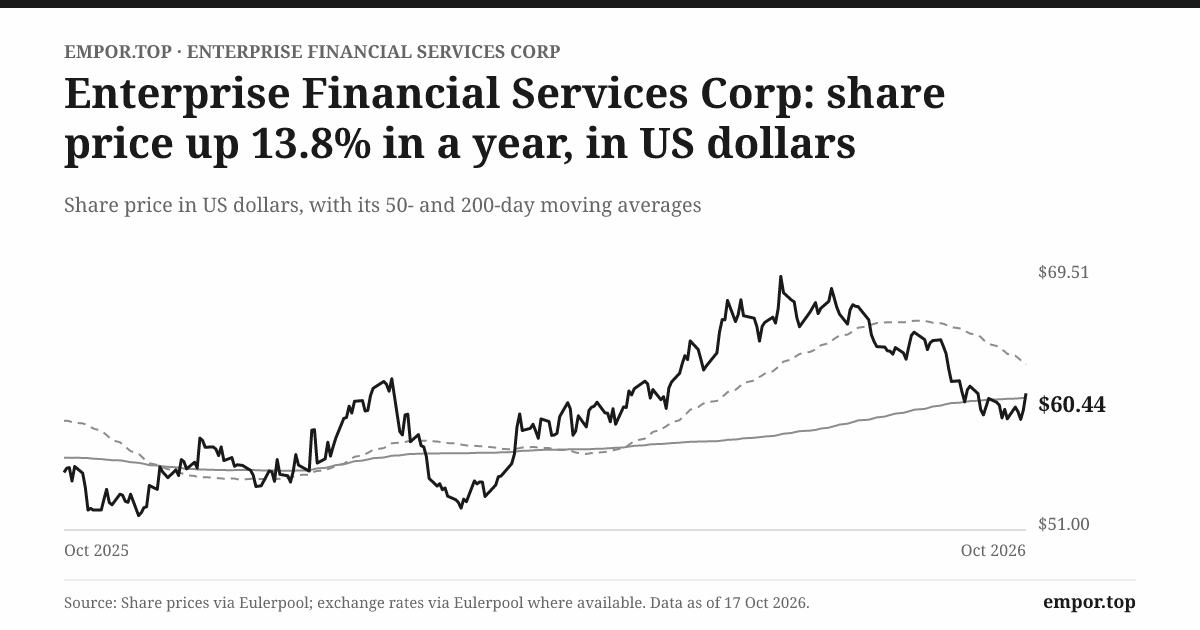
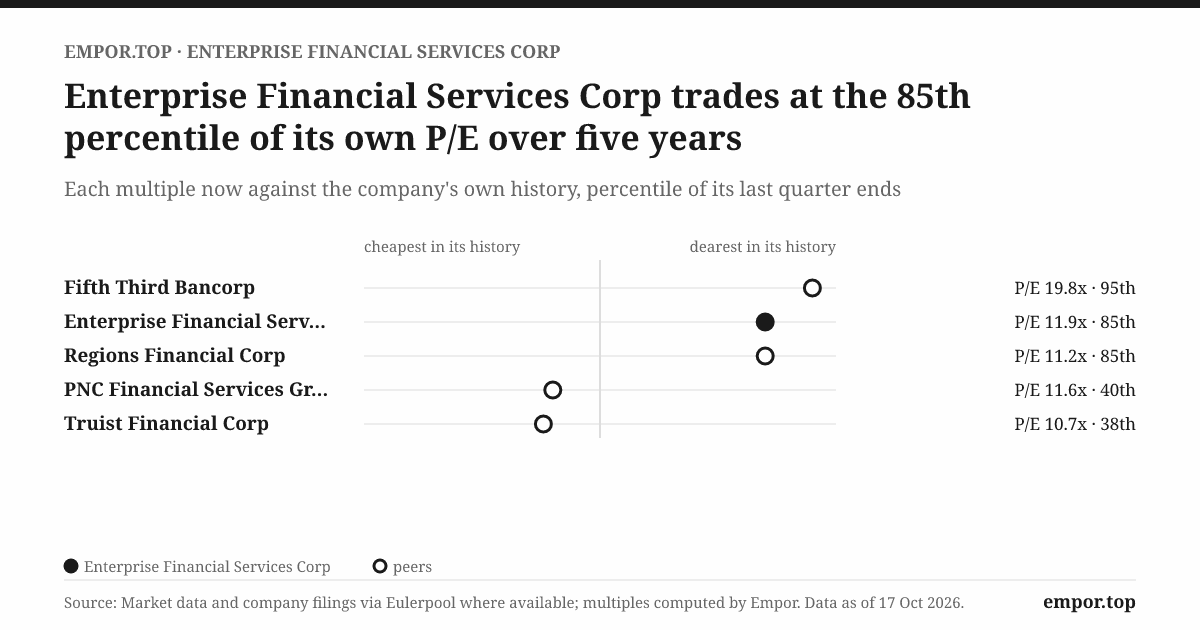
On October 17, 2026, Enterprise shares closed at about $60.44, roughly 12% below their 52-week high of about $68.52.4 At that price the market valued the company at about $2.2 billion, about 11.9 times trailing earnings and about 1.1 times book value.13 Against tangible book of about $45.47, the price was roughly 1.33 times.3 The trailing multiple sits above the stock's own five-year median of about 10 times, so investors are paying somewhat more than usual for earnings that have just fallen. Trailing return on equity was about 9.2%.3 A bank earning a 9% return on equity at 1.33 times tangible book is priced for those returns to recover toward the low teens. The price does not reflect a credit disaster, and it does not reflect a return to the growth years.
The bull argument rests on four claims, each supported by evidence and each limited by it. First, the deposit verticals keep funding costs low: a 1.53% cost of deposits and about a third of deposits paying no interest are real figures.43 Second, variable-rate loans and the hedge book have kept the margin near the top of the commercial-bank range, and it rose through mid-2026.4 Third, the acquisitions added lasting capabilities, the national SBA platform most of all, and over five years net profit compounded at about 22% a year.1 Fourth, capital and liquidity are ample: about $7.2 billion of available liquidity, comfortable regulatory ratios, and investment-grade ratings with a stable outlook from KBRA.313
The bear argument is just as concrete. Specialty and commercial real estate concentrations can produce lumpy losses, and the California episode showed one relationship can triple nonperforming assets in a year.1 Balance-sheet growth has not turned into profit growth: three years of flat net profit while assets grew by about $4 billion.1 Wholesale funding is creeping up and will reprice more quickly than core deposits. Branch integration adds cost before it adds revenue. Last, the margin depends on rates: with 60% of loans variable, a falling-rate cycle cuts yields right away, while deposit costs fall only as fast as competitors allow.
Porter's five forces explain why this bank earns its spread and why the spread could narrow. Buyer power is the most important force. Depositors can move, and sophisticated property managers and HOAs can run their balances through a bank auction if they choose. Enterprise's counter is switching cost, since treasury software, lockbox processes and reconciliation integrations take effort to rebuild elsewhere. The bank does not publish retention data, so that switching cost is plausible but unmeasured. Supplier power, in a bank's case, is the cost of wholesale funding, and it rose as brokered CDs and FHLB advances grew. Rivalry is intense: Commerce and UMB in its home markets, money-center banks with bigger technology budgets, and private-credit funds in sponsor finance. Threat of new entrants is moderate, since bank charters are hard to get but fintech deposit platforms are not. Substitutes for commercial lending keep multiplying, as nonbank lenders take a growing share of middle-market credit.
Hamilton Helmer's seven powers framework narrows the claim further. Enterprise does not have scale economies against bigger regionals, network effects, or a cornered resource. It shows signs of switching costs in the deposit verticals and of counter-positioning against large banks that find small-balance specialty deposits too fiddly to bother with. Process power, the institutional knowledge of how to bank an HOA or underwrite premium finance, is the most plausible lasting edge. None of these has been proven with retention or vertical-return data. The fair conclusion is that Enterprise has a valuable niche and an unproven moat: a defended position that has not yet been tested in a falling-rate cycle with heavy competition for deposits.
Three indicators carry most of the weight. The first is the tax-equivalent net interest margin together with the cost of deposits, latest about 4.30% and 1.53% and both moving the right way.4 If the margin holds above roughly 4.1% through rate cuts, the deposit niche is proving itself. The second is nonperforming assets, OREO and classified assets: about $160 million, $84 million and $414 million at mid-2026, the first two roughly flat and classified assets still rising.3 The third is organic loan and deposit growth alongside a controlled efficiency ratio, especially in the acquired Arizona and Kansas branches. Management's mid-single-digit growth target sets the bar for that measure.12
KBRA's stable outlook supports the bank's access to funding, and its concentration concerns are the bear case in a rating agency's language.1314 Both views are reasonable, which is why the stock sits at roughly the price of an average bank despite above-average spread economics.
XI. Playbook: Business & Investing Lessons
The first lesson starts with a Phoenix property manager's escrow account. A bank's product is the spread, and its funding relationships are part of the factory. Enterprise's 4.30% margin was not mainly a lending achievement. It came from the HOA treasurer and the law-firm escrow account willing to leave money in a non-interest account because the bank made their monthly work easier. Investors studying a bank should look at the deposits before the loans, because loan yields follow rates while deposit costs depend on the franchise.
The second lesson comes from the First Choice announcement. Every acquisition price is a promise about the earnings that come later. Paying 1.89 times tangible book was a bet that a California commercial franchise would keep earning more than average after it changed owners. Rate increases in 2022 made the promised accretion easy to report and impossible to attribute. Buyers who never publish a deal-by-deal scorecard ask shareholders to trust the aggregate, and the aggregate has been flat for three years. A serial acquirer should be judged by per-share earnings and tangible book across the full sequence of deals, not by the slide promising accretion.
The third lesson is the seven bankruptcies. A concentrated loan can turn a quiet balance sheet into a public story. One family feud, spread through seven separate entities that were meant to isolate each other, tripled Enterprise's nonperforming assets and left a Missouri bank owning California real estate. Structures built to wall off risk can carry it from one entity to the next instead, which is why the useful measure is concentration by relationship, not by legal entity.
The fourth lesson is the free-cash-flow yield that sounds so attractive. For a bank, cash flow is not free cash. Deposits that come in are liabilities, loans that go out are assets, and neither is money owners can take home. What a bank's shareholders actually keep is growth in tangible book value plus what it pays out. Enterprise's tangible book rose about 9% in eighteen months, and that is the more useful measure of what it produced for them.13
The fifth lesson comes from the shareholder vote. Trust is restored by measurable correction. When 21% of shareholders voted against pay, the board hired advisers, changed the measures, and won 97% the next year.1920 Credit and integration now call for the same response: specific targets, reported plainly, and met.
XII. Epilogue
Tonight Enterprise is a bank waiting on its next set of results. The Arizona branches have operated under the Enterprise name for a year. The remaining California properties are still on the balance sheet, where every month adds carrying costs and leaves the bank exposed to whatever price the buyers offer. About $3.2 billion of loan commitments that borrowers have not yet drawn sit off the balance sheet, ready to become loans if clients need the money and the bank wants to lend it.3
The next few quarterly reports will answer the central questions in order. The California sales come first. If the rest of the OREO sells near carrying value, the 2025 credit event will turn out to have cost a few million dollars of charge-offs and a year of investor anxiety. If buyers demand larger discounts, each sale will cost earnings directly, and the allowance on the loan book will not absorb it.
The margin comes second. Rate cuts work on Enterprise quickly. Variable-rate loans reprice within weeks, while deposit costs move only as fast as specialty clients and competitors allow. If the margin holds above roughly 4.1% through that adjustment, the deposit niche will have passed its hardest test. If it falls back toward the industry average, the bank's main advantage was the rate cycle.
Growth comes third. The Arizona and Kansas branches need to grow loans and deposits on their own without the efficiency ratio slipping, because that is the only way flat three-year net profit becomes per-share compounding again. The insurance receivable needs to arrive as cash, and fee income needs to keep its steady $80 million-odd a year without the tax-credit noise.
Each of those results will push the bank toward one of two descriptions: a specialized commercial bank whose funding niche earns lasting excess returns, or a higher-yielding lender whose credit costs absorb most of the extra spread it earns. Both descriptions still fit the evidence, and that ambiguity is why the stock trades at about 1.1 times book.
XIII. Outro
Back in Southern California, the six buildings are just properties now. They are no longer loans with coupons, covenants and payment schedules. They are assets with roofs, tenants, maintenance costs and a price set by buyers who know the bank wants to sell. Two thousand miles east, the property manager's escrow balances keep arriving each month and the HOA reserves keep growing quietly, funding the spread that pays for everything else.
That contrast is the whole of Enterprise Financial: deposits that come in steadily and cheaply because the bank does unglamorous work well, and loans that sometimes come back as buildings because the bank lends where the yields are higher. Enterprise grew by finding the spread; now it has to prove it can keep what the spread earns.
References
-
Enterprise Financial Services Corp Form 10-K for fiscal year 2025 — SEC, 2026-02-27 ↩↩↩↩↩↩↩↩↩↩↩↩↩↩↩↩↩↩↩↩↩↩↩↩↩↩↩↩↩↩↩↩↩↩↩↩↩↩↩↩↩↩
-
Enterprise Financial Services Corp Form 8-K, Regulation FD disclosure on CRE lending relationships — SEC, 2025-10-16 ↩↩↩↩
-
Enterprise Financial Services Corp Form 10-Q for Q2 2026 — SEC, 2026-07-31 ↩↩↩↩↩↩↩↩↩↩↩↩↩↩↩↩↩↩↩↩↩↩↩↩↩↩↩↩↩↩
-
Enterprise Financial Services Corp Reports Second Quarter 2026 Results — Enterprise Financial Services Corp, 2026-07-22 ↩↩↩↩↩↩↩↩↩↩
-
Enterprise Financial Services Corp 2026 Proxy Statement — SEC, 2026-03-31 ↩↩↩↩↩↩
-
Dimensional Fund Advisors LP Schedule 13G/A for Enterprise Financial Services Corp — SEC, 2026-10-08 ↩
-
Investor Relations Overview — Enterprise Financial Services Corp ↩
-
2025 Investor Presentation — Enterprise Financial Services Corp, 2026 ↩↩
-
Seacoast Commerce Acquisition Announcement — Enterprise Financial Services Corp, 2020-08-20 ↩↩↩
-
Enterprise Financial Services Corp to Acquire First Choice Bancorp — Enterprise Financial Services Corp, 2021-04-26 ↩↩↩
-
Enterprise Bank & Trust to Expand in Arizona and Kansas through Acquisition of Twelve Banking Offices from First Interstate Bank — Enterprise Financial Services Corp, 2025-04-28 ↩↩
-
Enterprise Financial Services Q2 2026 Earnings Call Transcript — Stock Analysis, 2026-07-23 ↩↩↩↩↩
-
KBRA Affirms Ratings for Enterprise Financial Services Corp — KBRA, 2025-10-15 ↩↩↩↩
-
KBRA Releases Surveillance Report for Enterprise Financial Services Corp — KBRA, 2025-12-09 ↩↩↩
-
Bank Strategy Briefing: 2021 Bank M&A Round-up and 2022 Predictions — Godfrey & Kahn, 2022 ↩
-
Q3 2025 Earnings Call Transcript — Enterprise Financial Services Corp, 2025-10-28 ↩
-
Q1 2026 Earnings Call Transcript — Enterprise Financial Services Corp, 2026-04-23 ↩
-
Enterprise Financial Services Corp Form 8-K, officer appointments and executive transition — SEC, 2025-10-02 ↩
-
Enterprise Financial Services Corp 2025 Annual Meeting Voting Results — SEC, 2025-05-12 ↩↩
-
Enterprise Financial Services Corp 2026 Annual Meeting Voting Results — SEC, 2026-05-15 ↩↩
-
Enterprise Financial Services Corp Form 8-K, issuance of $175 million 6.25% subordinated notes — SEC, 2026-06-17 ↩
 LinkedIn
 WhatsApp
 Reddit
 Hacker News
 Email
 Kindle
 RSS Feed
 Spotify
 Apple Podcasts
 Amazon Music
 Audible
 YouTube