Intuitive Machines, Inc. (NASDAQ: LUNR): The Moon Is a Customer. Can It Become a Business?
The First Footprint Was Crooked
On the evening of February 22, 2024, a room in Houston went quiet in the way mission control rooms do when the data stops coming. A spacecraft called Odysseus, a six-legged hexagonal lander built in Houston, had just finished its descent toward the Moon's south polar region. The engineers expected a signal at touchdown. What arrived instead was nothing, then something faint. After several minutes the flight director confirmed that Odysseus was on the surface and talking, barely.1
That faint signal made history. It was the first American spacecraft to land softly on the Moon since Apollo 17 in December 1972, and the first commercial lander ever to do it.1 For a company that had existed for barely a decade, it was the kind of headline that rewrites a pitch deck overnight. Every future proposal could open with the same sentence: it had been there.
The fine print came later. Hours before landing, the team discovered that the lander's own laser rangefinders could not be used, because a safety switch had not been flipped before launch, and engineers improvised by routing navigation through an experimental NASA lidar that happened to be on board as a payload.1 Odysseus came down moving faster sideways than planned, caught a leg on the surface and ended up tipped on its side, propped against the slope.2 Its antennas pointed in the wrong directions. Its solar panels caught less light than designed. The mission lasted days rather than the full lunar daylight period, and NASA's inspector general later summarized the outcome in one dry clause: the lander "successfully landed on the lunar surface but tipped over onto its side."2
That clause is a fair summary of the company that built it. Intuitive Machines had done something extraordinary and something incomplete at the same moment. The landing proved the engineering team could reach the Moon. It did not prove the company could reach the Moon reliably, on schedule and at a profit, which is the only version of the achievement that a business can live on.
The mismatch between the image and the economics is the place to start. In the photographs, a gold-wrapped machine sits on grey regolith a quarter of a million miles away. In the accounts, the company that put it there has never earned a full-year operating profit in the period covered here. In 2025, the year after Odysseus and the year a second lander reached the Moon, Intuitive Machines booked about $210 million of revenue and lost about $87 million at the operating line, which means that for every dollar a customer paid, the company spent roughly $1.41 delivering the work and running the business.3 Revenue that year was actually lower than in 2024, when the first mission's milestones flowed through the books.3
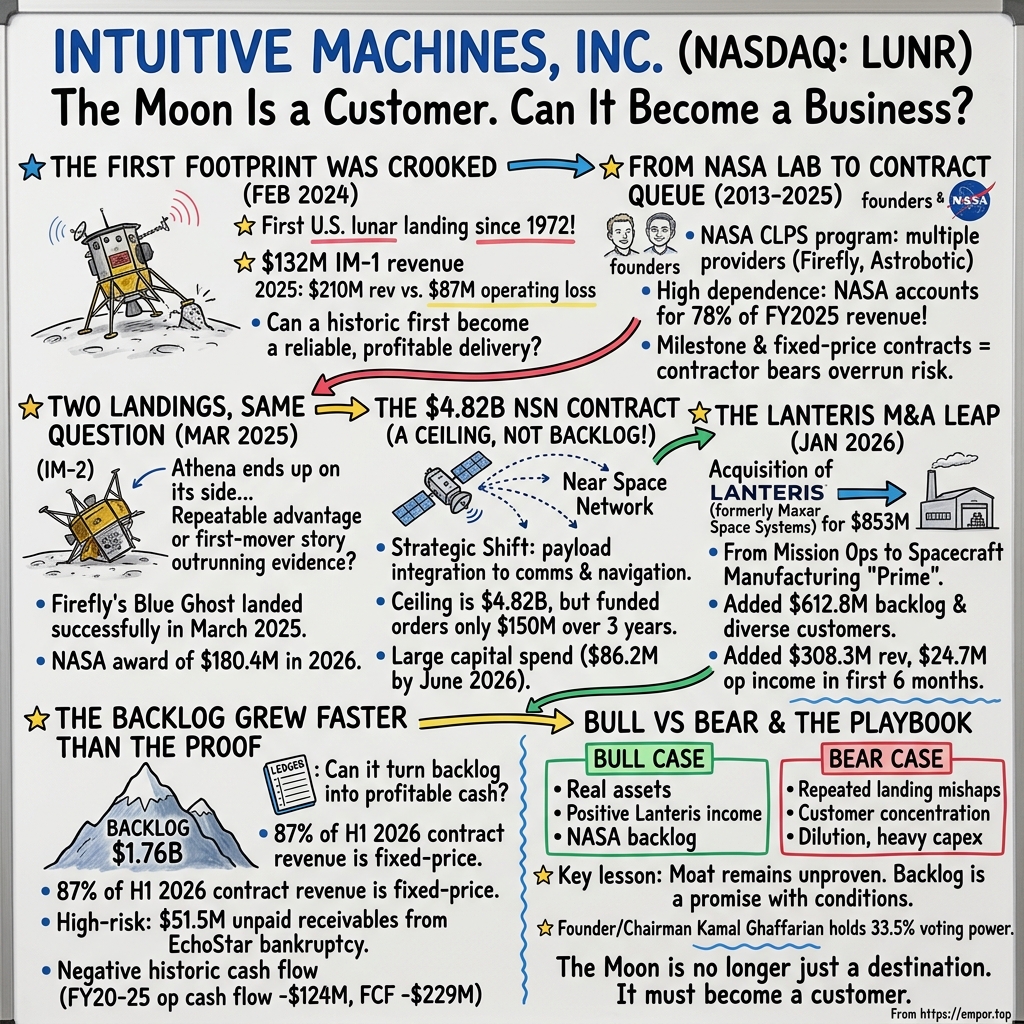
So the question this story has to answer is not whether Intuitive Machines can land on the Moon. It can, at least approximately. The question is whether a technical first can become a business that turns contracts into cash. That question breaks into four smaller ones that will run through every section. Can a backlog that has grown spectacularly become profitable cash rather than a list of obligations? Can a company build a competitive edge in a market where NASA is the anchor buyer and deliberately keeps several suppliers in the race? Does the January 2026 purchase of Lanteris, the satellite manufacturer formerly known as Maxar Space Systems, improve the quality of the business enough to justify its price? And can management fund all of it without repeatedly asking shareholders to own a smaller slice of a bigger pie?
A note on boundaries matters before the story proceeds. Intuitive Machines, Inc. is the Nasdaq-listed parent; it consolidates Intuitive Machines, LLC and the operating subsidiaries beneath it, so the reported numbers are the whole group, not a holding shell.3 Lanteris joined that group on January 13, 2026.4 That date splits the company's history in two. Before it, Intuitive Machines was a Houston lunar specialist with 525 employees at the end of 2025. After it, the company reported roughly 1,695 people across the combined operations and a revenue line that tripled almost overnight.34 Any comparison that runs across that date mixes two different companies, and this story will keep them apart.
The through-line is a company trying to change what it sells. For most of its life, Intuitive Machines sold missions: take a customer's instrument, carry it to the Moon, set it down, relay its data home. Management now wants to sell infrastructure as well, meaning satellites, communications relays, data services and spacecraft built for other people's missions. That shift is logical, because missions are lumpy and infrastructure can, in theory, earn recurring revenue. But the company's most visible proof points remain two difficult lunar landings, and the infrastructure story is still mostly contracts and capital spending rather than service revenue.
The Odysseus signal, faint and hard-won, is the right emblem. It proved arrival. Whether it proved a business is the question that the rest of this story tests, starting with how three people from NASA's orbit ended up bidding for the Moon.
 Subscribe on LinkedIn
From NASA Lab to the Lunar Contract Queue
The founding story of Intuitive Machines does not involve a garage, a dorm room or a college dropout. It involves three people who had spent careers inside the American human spaceflight machine and decided, in 2013, that the machine was about to open its doors to outsiders.5
Kamal Ghaffarian was the businessman of the trio. He had founded Stinger Ghaffarian Technologies, an engineering services contractor that grew into one of NASA's significant support firms, and he had a habit of building companies around government demand.5 Stephen Altemus was the operator, a NASA veteran who rose to deputy director of the Johnson Space Center in Houston, the home of mission control.5 Timothy Crain was the engineer's engineer, a guidance and navigation specialist from the same NASA world, the kind of person who thinks about landing as a problem of sensors, software and margins.5 Ghaffarian became chairman, Altemus chief executive and Crain chief technology officer, and all three remain in senior roles more than a decade later.5[^6]
Their timing was a bet on policy. NASA had already used fixed-price commercial contracts to buy cargo and then crew transport to the International Space Station, and companies like SpaceX had shown that the model could lower costs. The open question was whether the same approach could work on the Moon. In 2018 NASA answered by creating the Commercial Lunar Payload Services program, known as CLPS, and selected a pool of vendors to compete for delivery task orders.2 Intuitive Machines was among them.
The model is simple to describe and hard to execute, so it helps to picture it as a freight business with an unusually demanding customer. NASA builds or funds scientific instruments. It then buys space on a commercial lander, much as a shipper buys space on a freighter. The lander company designs the vehicle, buys its own rocket ride, integrates the payloads, flies the mission and returns the data. NASA chooses the instruments and the landing site, but it does not own the spacecraft.2 The company may also sell spare capacity to commercial or international customers, which is how a lunar lander can carry a camera for a university, a time capsule for an artist and a drill for NASA on the same trip.
The contracts behind that work come in three broad shapes, and the shape determines who gets hurt when something goes wrong. Under a cost-reimbursable contract, the customer pays the contractor's allowable costs plus a fee, so overruns mostly land on the customer. Under time-and-materials contracts, the customer pays agreed rates for hours and materials. Under a fixed-price contract, the contractor promises to deliver a defined outcome for a defined price, so overruns land on the contractor.3 CLPS task orders are firm-fixed-price. In NASA's own framing, "the contractor, not NASA, is responsible for the full scope of payload delivery to the Moon."2
There is an upside to that structure. Fixed-price contracts are typically billed against milestones or progress, which can bring cash in ahead of costs and recognize revenue as work advances.3 A company that estimates well and executes cleanly can earn healthy margins, because any savings are its own. A company that underestimates the difficulty eats the difference. For a young firm building a lunar lander for the first time, the difference can be large.
Intuitive Machines grew on this foundation. Revenue rose from about $44 million in 2020 to about $210 million in 2025, which works out to roughly 37% a year compounded.3 That headline sounds like a scaling story, but the path was anything but smooth. Revenue fell in 2023, nearly tripled in 2024 as lunar mission milestones and engineering services work landed, and then fell about 8% in 2025.3 The endpoints of the series include the volatile timing of a few big contracts, so the five-year rate is better read as a clue about the scale of NASA demand than as evidence of steady compounding.
The concentration underneath the growth tells the same story more bluntly. One customer accounted for 90% of revenue in 2024 and 78% in 2025.3 The company's annual report does not name that customer in its concentration note, but it describes most pre-acquisition revenue as long-term aerospace engineering and lunar delivery work, and NASA is the obvious anchor of that work.3 Nearly all of the company's government contracts can be terminated for the government's convenience, which means the buyer can walk away and pay for work performed rather than for the full contract.3 The record shows that this is not hypothetical: NASA cancelled task orders on the OSAM servicing program, and a lunar terrain vehicle contract ended in the second quarter of 2025.3
A buyer that supplies four-fifths of revenue, can cancel at will and runs a program designed to keep several vendors competing has leverage that few commercial customers enjoy. CLPS was built that way on purpose. NASA's pool started at 14 vendors, and the agency awards task orders competitively among them.2 By 2025 five vendors had won 11 deliveries under a program with a cumulative maximum value of $2.6 billion through 2028.6 Firefly Aerospace and Astrobotic are among the direct rivals, each with its own lander and its own NASA orders.7
The inspector general's 2024 review of CLPS reads like a diagnosis of the industry Intuitive Machines entered. NASA had set aggressive delivery schedules, averaging 30 months from award to launch, based on what the auditors called overly optimistic market research. Seven of the eight task orders reviewed had slipped, average time to launch had stretched to 44 months, and total program costs had risen by about $208 million.2 The auditors also argued that fixed-price contracts were poorly suited to the conditions, because optimal use requires well-defined requirements, stable markets, low technical risk and experienced contractors, and CLPS had none of those in abundance. Financial pressure on small vendors had already contributed to one bankruptcy.2
The auditors were equally pointed about the customer's own behavior. NASA, they found, had drifted from the hands-off approach it promised. It added oversight, demanded more detailed proposals, changed landing sites and inserted a large rover mission into the early schedule before smaller landers had proved themselves. NASA-directed changes alone accounted for about $171 million of cost increases.2 Some of that money flowed back to vendors as price increases, but the pattern matters for anyone valuing a CLPS supplier. The buyer can change the job midway, the vendor carries the fixed-price risk on the rest, and the agency had not, in the five years since the program began, reassessed whether the commercial lunar market it hoped to seed actually existed beyond NASA itself.2 Vendors surveyed for the audit described an uncertain commercial market and stiff competition for a limited number of task orders.2
That last finding deserves a moment, because it frames the economics of every lunar contract Intuitive Machines signed. The customer wanted speed, low prices and fixed-price risk transfer. The vendors were young companies trying to build something no private firm had done. When schedules slip under a fixed-price contract, the contractor keeps paying its engineers while the milestone payments wait. That is how a company can win prestigious work and still lose money doing it.
So the early growth of Intuitive Machines was real, but it was built on government contracts and mission milestones rather than a broad base of repeat customers paying for a product they could not get elsewhere. NASA demand was the engine, and it remained a buyer with considerable bargaining power. Winning a task order gave the company work. It did not guarantee a steady flow of profitable missions, a distinction that the next two landings tested with uncomfortable precision.
Two Landings, One Repeat Question
A year after Odysseus, Intuitive Machines went back. On February 26, 2025, a Falcon 9 lifted off from Kennedy Space Center carrying Athena, the company's second Nova-C lander, on a mission called IM-2.6 The target was more ambitious than the first time: Mons Mouton, a plateau near the lunar south pole, where NASA wanted to drill into the surface and sniff for volatiles such as water ice with an instrument package called PRIME-1.6 Athena also carried a small hopping drone and a Nokia demonstration of 4G and LTE cellular networking on the Moon, the sort of payload manifest designed to show that a lunar lander could be a platform for many customers at once.6
At about 11:30 a.m. Central time on March 6, Athena touched down inside a crater, several hundred feet from its intended site.6 Then the images came back. The lander was on its side again.68 Lying on its side, it could not fully operate the drill and other instruments before its batteries ran down, and shortly after midnight on March 7 the company and NASA called an early end to the mission.6
What happened next is the part worth separating carefully, because two different questions get tangled. The first question is scientific: did the mission return anything useful? The answer was yes, partly. NASA received about 250 megabytes of data. The drill demonstrated its full range of motion. A mass spectrometer detected gases, likely from the lander's own propulsion exhaust. The hopper and the Nokia network completed some objectives.6 NASA officials were careful in their language, with one saying the mission "didn't achieve all of its objectives for NASA" and another that the agency was "disappointed in the outcome."6
The second question is commercial: did the customer receive the service it bought? A freight company that delivers the package on its side, in the wrong yard, with the contents only partly working, has delivered something. It has not delivered what the shipper paid for. In a fixed-price market where customers pay for outcomes, that distinction is the business.
Now place the competitor beside the claim. Four days before Athena's landing, at 3:34 a.m. Eastern on March 2, 2025, Firefly Aerospace's Blue Ghost lander set down upright near a volcanic feature called Mons Latreille in Mare Crisium, carrying ten NASA instruments.9 It was Firefly's first CLPS delivery and its first Moon landing, and its instruments were planned to operate for about a full lunar day, roughly 14 Earth days.9 In other words, a rival with no prior lunar landing achieved the clean outcome that Intuitive Machines had not achieved in two attempts.
That comparison undermines the most popular version of the Intuitive Machines story, which treats the company as the first mover that cornered the commercial lunar market. Being first to arrive was real; it bought publicity, data and credibility with customers. But it was not a cornered resource. NASA kept buying from multiple providers, and a competitor demonstrated that the clean landing was achievable by someone else. If there is an edge in lunar delivery, it is not "first." It would have to be "most reliable," and the record does not yet support that claim for Intuitive Machines.
There is a fairer reading of the record that should also be stated. Landing on the Moon is genuinely hard. Astrobotic's Peregrine, the first CLPS mission to launch, never reached the surface at all.2 Intuitive Machines has twice put landers on the Moon intact enough to communicate and return data, which is a capability most of the world's space agencies have never demonstrated. The company's engineers have flight heritage that a new entrant cannot buy. Those are meaningful assets.
The customer has also kept buying. On March 27, 2026, NASA awarded Intuitive Machines $180.4 million to deliver seven payloads, five of them NASA's, to the lunar south pole region, with landing targeted for 2030.10 It was the company's fifth CLPS award. Tellingly, the payload list read like a roll call of the program's previous missions: a camera that had flown on IM-1 and on Firefly's Blue Ghost, a spectrometer that had flown on Astrobotic's failed Peregrine, and the mass spectrometer that flew on IM-2.10 NASA was reflying instruments across vendors, which says something about how the agency views the suppliers. They are interchangeable carriers in a program designed to hedge against any single one failing.
So one award does not settle the reliability question, and it does not reveal contract-level profitability. It shows that NASA still considers Intuitive Machines a qualified bidder and that the company remains willing to bid. It also extends the company's lunar commitments years into the future at a fixed price, which is good for backlog and a test of cost estimation that will not be graded until the end of the decade.
What would a stronger advantage look like? It would show up as a run of fully successful missions, on-time launches, cost estimates that hold up, customers who return without being prompted by a NASA competition, and communications assets that paying customers actually use. The company's own schedule is the most immediate test of the on-time part. When IM-2 ended in March 2025, NASA described the third Intuitive Machines mission as "slated for 2026."6 On the company's year-end call in March 2026, management tied the first lunar relay satellite to the IM-3 launch and described it as the step that would start operational task orders under its NASA communications contract.11 By the second-quarter call in August 2026, Altemus said that satellite would fly on Mission 3 in the first quarter of 2027, adding that "as with any launch manifest, timing will reflect spacecraft readiness, launch vehicle availability and NASA stakeholder priorities."12
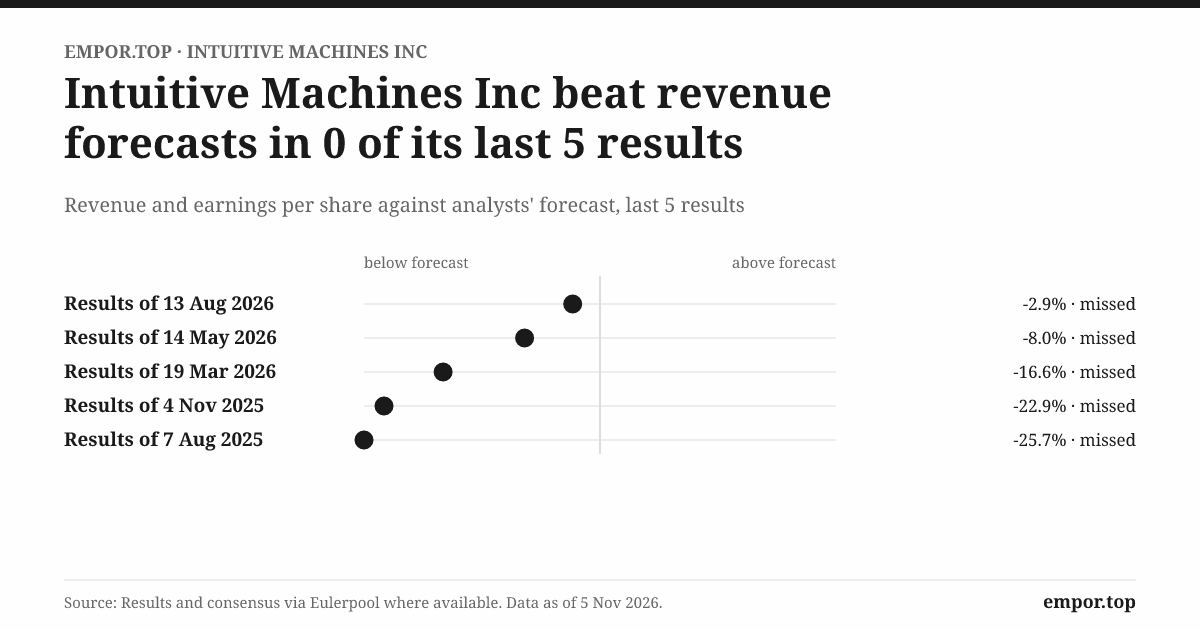
That caveat is reasonable in an industry where every CLPS order has slipped, but it is also familiar. The inspector general found that schedule delays across CLPS averaged 14 months per task order.2 A slip of a quarter or two on IM-3 is small by that standard. It is still a slip, and it pushes the moment when the company can show a clean landing further into the future while costs on the mission continue to accrue. The company's fixed-price lunar missions have already shown the cost of that dynamic: the IM-3 and IM-4 contracts entered loss positions, meaning the company expects to spend more on them than it will be paid.3 And in the second quarter of 2026, the company booked a further $14.7 million estimate-at-completion adjustment on IM-4 to accommodate payload changes.12
Taken together, the record narrows the thesis rather than rejecting it. Intuitive Machines has demonstrated real lunar-delivery capability, twice. It has not demonstrated a repeatable outcome, and its contracts show that lunar delivery as currently priced has been a loss-making activity for the company. The claim that survives is a smaller one: a capable, experienced bidder in a multi-vendor market that has not yet proved reliability. The KPI that would confirm or falsify the bigger claim is simple to state. IM-3 has to land upright, operate for the planned period and come in at or better than its revised cost estimate.
If the lander business is that uncertain, it is reasonable to ask why management has been so emphatic that the future lies elsewhere. The answer is a contract with a very large number attached.
The $4.82 Billion Contract That Wasn't Backlog
On September 17, 2024, NASA put out a short release with a big number in it. The agency had selected Intuitive Machines for a Near Space Network services contract to provide relay communications between geostationary orbit and cislunar space, the region around and beyond the Moon. The contract carried "a maximum potential value of $4.82 billion."13
For a company whose revenue that year would be about $228 million, the number was almost twenty times annual sales.3 It went straight into headlines and investor conversations as if it were a sale. It was not, and understanding why is the key to understanding the most hopeful part of the Intuitive Machines story.
Start with the contract type. NASA described it as a "firm-fixed-price, multiple award, indefinite-delivery/indefinite-quantity task order contract."13 Each of those words matters. Multiple award means more than one company can hold a slot on the same contract vehicle. Indefinite-delivery, indefinite-quantity, usually shortened to IDIQ, means NASA has not committed to buy any particular amount. The $4.82 billion is a ceiling, the maximum that could be spent under the vehicle over its life, not a promise to spend it. The base ordering period runs from October 2024 to September 2029, with a five-year option that could extend it to 2034.13
A useful analogy is a wedding venue's capacity. A ballroom licensed for 500 guests tells you the most people who could attend, not how many invitations have been sent. The money that actually matters arrives through task orders, the individual purchases NASA makes under the vehicle, and then only as the work is performed and revenue is recognized. In its 2025 annual report, Intuitive Machines described initial funded task orders under the network contract totaling about $150 million over three years.3 That is roughly 3% of the ceiling, and even that amount becomes revenue only as services are delivered.
So the $4.82 billion should be heard the way the company's own accountants treat it. It is not contracted sales. It is a license to compete for business.
Why does the network matter anyway? Because it represents the strategic shift at the center of management's ambitions. Delivering a payload to the Moon is a one-time job. The lander lands, operates for a lunar day, and goes dark. Communications are different. Anyone operating on or around the Moon, whether NASA's Artemis crews, robotic landers or commercial missions, needs to send data home. Much of the lunar south pole, where most missions now want to go, has poor or intermittent line of sight to Earth. A constellation of relay satellites in lunar orbit, with ground stations on Earth, could act like a cell tower network for the Moon, charging each customer for connectivity across many missions.
In that model, the economics change from freight to utility. Freight earns a margin per trip and must win every trip again. A utility earns fees for as long as customers use the network, and the more missions that rely on it, the more valuable it becomes. Management has argued that its lunar relay network and mission operations can support recurring revenue in this way.311 The filings stop short of quantifying it. The company does not disclose a recurring-revenue share, and nothing in the reported results yet shows the network operating at scale.3
The build cost, meanwhile, is visible. Utilities spend before they earn. Intuitive Machines has been fabricating its first data relay satellites, building ground network capacity and investing in the mission operations that support them. By June 30, 2026, capitalized fabrication and development costs for communications satellites and ground-network assets had reached about $86 million.4 Capital spending rose from about $10 million in 2024 to about $42 million in 2025, and the company spent another $34 million in the first half of 2026, while research and development costs climbed from about $1 million to about $12 million a year before reaching $13 million in the first half of 2026 on the combined base.34 Those are not huge sums by aerospace standards, but for a company that has never generated free cash flow over a full year in this period, they are real money committed ahead of revenue.
The timing of the first relay satellite tightens the link between this story and the last one. Management said on its year-end call that the first relay satellite would launch with IM-3, starting the operational task orders portion of the network contract.11 That means the lunar communications business inherits the lander's schedule. If IM-3 slips, the first relay satellite slips with it, and the recurring revenue that justifies the capital spending is pushed further out. By the August 2026 call, that first satellite was tied to a first-quarter 2027 launch, with four more relay satellites planned to deploy together in 2028.12
Now place NASA's bargaining power in the same frame. A multiple-award contract exists precisely so the buyer can compare providers and direct task orders to whichever offers the best value. NASA's release did not name the other awardees, but the structure itself means Intuitive Machines does not hold an exclusive right to NASA's lunar relay business.13 The award does not establish pricing power, because prices are set competitively under the vehicle. Nor does it establish switching costs, because the network is not yet built, and switching costs only appear once customers have integrated their missions with an operating system. A relay network could eventually become sticky if missions are designed around its frequencies, protocols and coverage. That stickiness is a possibility, not a present fact.
The honest verdict on the network is that it could become the most valuable thing Intuitive Machines owns, and that it currently exists mostly as a contract ceiling, a small set of funded orders and a growing balance of capitalized spending. The investment case depends on three things happening in order. NASA and other customers have to fund task orders. The company has to deploy working assets on schedule. Customers then have to use those assets enough to pay back what they cost.
The KPI that tells investors which way this is going is therefore not the size of the contract ceiling but the revenue earned from deployed communications assets, read alongside operating cash flow after capital spending. When the first relay satellite is operating and billing, the difference between a ceiling and a business will start to become measurable.
In the meantime, management chose not to wait for the network to mature before reshaping the company. In late 2025 it agreed to buy a business with something the lunar unit had never had: a long record of shipping satellites to paying customers.
Lanteris: Buying the Other Half of the Space Stack
In Palo Alto, California, there is a satellite factory with a history older than most of the space startups now valued in the billions. For decades it built large communications satellites for broadcasters and telecom operators under names that changed as owners changed, most recently Maxar Space Systems. By 2025 it had been renamed Lanteris. In early November of that year, Intuitive Machines announced it would buy Lanteris for $800 million, paid as $450 million in cash and $350 million in Intuitive Machines stock, subject to adjustment.14
The logic was easy to explain on a slide. Legacy Intuitive Machines supplied lunar delivery and mission operations. Lanteris built spacecraft for national-security, civil and commercial customers. Put them together and the company could, in management's words, move "beyond the Moon and into a wider range of space projects."14 Chairman Kamal Ghaffarian called it "a transformative step" toward a vision stretching "from LEO, to GEO, beyond the Moon, and to Mars."14 Management began describing the combined company as a "space prime," the kind of contractor that can build, launch and operate whole systems rather than supplying a component.
The deal also changed the shape of the company in ways that mattered more than the slogan. At announcement, Altemus said the combined entity had more than $850 million of revenue, positive adjusted EBITDA and $920 million of backlog as of September 30, 2025.14 Overnight, a lunar specialist dependent on one customer would become a satellite manufacturer with a broader customer list and an established production line. That is the chess move: instead of waiting years for lunar services to diversify the business, buy diversification now.
The transaction closed on January 13, 2026.4 After adjustments, acquisition-date consideration came to about $853 million.4 The company paid about $403 million in cash at closing, issued about 24.5 million acquisition-related shares, and assumed about $135 million of debt and funded obligations.4 Lanteris brought about $613 million of backlog with it.4
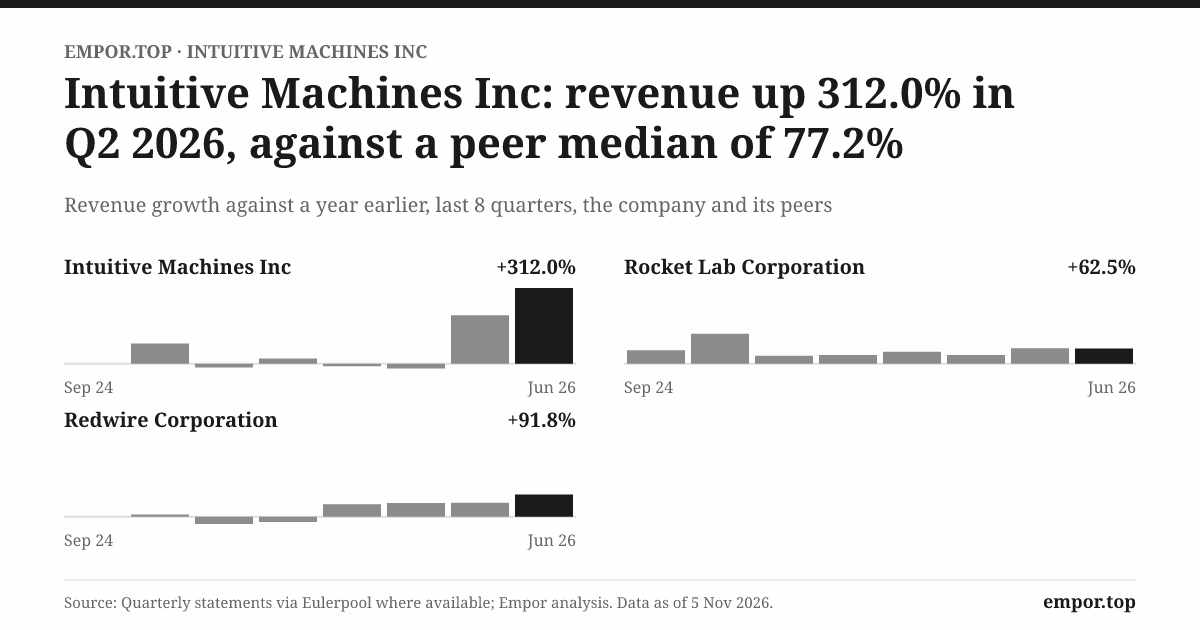
That timing matters for anyone reading the 2026 numbers. First-half revenue of about $393 million was nearly three and a half times the prior-year period, but Lanteris contributed about $308 million of it.4 The growth is overwhelmingly acquired, not organic. A rough subtraction implies the legacy business generated well under $100 million in the half, similar to its 2025 run rate rather than a breakout. The company has not yet reported a full-year split that lets outsiders measure organic growth cleanly.
The more interesting question is whether the price made sense. Two rough benchmarks help, and both need to be held loosely. Lanteris's roughly $308 million of revenue in its first six months under new ownership implies an annual pace of a little over $600 million. Against the announced $800 million price, that is about 1.3 times sales. Lanteris also contributed about $25 million of operating income in those six months.4 Doubling that gives roughly $49 million a year, which puts the announced price at about 16 times operating income. Neither number is a full-year valuation, because six months is short, satellite revenue is lumpy, and the first months under new ownership include integration costs and transition arrangements.
Public benchmarks are a weak guide. Listed space manufacturers have very different product mixes, margins and growth rates, and Lanteris was a private carve-out from a larger defense and imaging group. On sales, the price does not look obviously excessive, especially for a business that came with positive operating income, which the acquirer itself did not have. On operating income, the multiple is reasonable but not cheap, and it assumes that six months of profit is representative. The evidence does not establish that Intuitive Machines overpaid. It does not justify calling the deal a bargain either.
What can be measured so far is encouraging in one specific way. In the second quarter of 2026, the combined company earned about $36 million of gross profit, compared with a gross loss of about $12 million a year earlier, and CFO Pete McGrath credited "higher margin contributions from Lanteris" for the improvement in adjusted EBITDA.12 Lanteris also changed the customer mix. National-security revenue rose to about 30% of the quarter's total from about 3% a year earlier, and Altemus said all 16 satellites for the Space Development Agency's Tranche 1 program had been delivered.12 The company described a new order for three geostationary satellites from an undisclosed commercial customer, valued at more than $600 million over 30 months.12
The commercial side of the factory kept shipping as well. During the second quarter, a satellite built for SiriusXM, the satellite radio broadcaster, launched and deployed, with handover to the customer planned later that month.12 Those are the routine deliveries of a mature manufacturer, and they matter precisely because they are routine. The lunar business has spent a decade producing extraordinary events; the satellite business produces a schedule. For a company whose core weakness has been converting heroic engineering into predictable delivery, buying a team that already knows how to deliver predictably is the strongest argument for the deal. It is also the hardest to verify from outside, because the benefit would appear only if Lanteris's processes improve the lunar programs, and no such improvement has yet shown up in the lunar contract estimates.
The workforce numbers show how large the cultural task is. The legacy company had 525 employees at the end of 2025; the combined company reported about 1,695 after the acquisition, meaning roughly two of every three people now working for Intuitive Machines came with Lanteris.34 In practice, the acquirer is the smaller organization absorbing the larger one, with a headquarters in Houston and most of its production people in California. Integrations of that shape tend to succeed when the buyer leaves the acquired business largely alone and fail when it tries to reshape it quickly, and the company's early statements emphasize growth and cross-selling rather than restructuring.
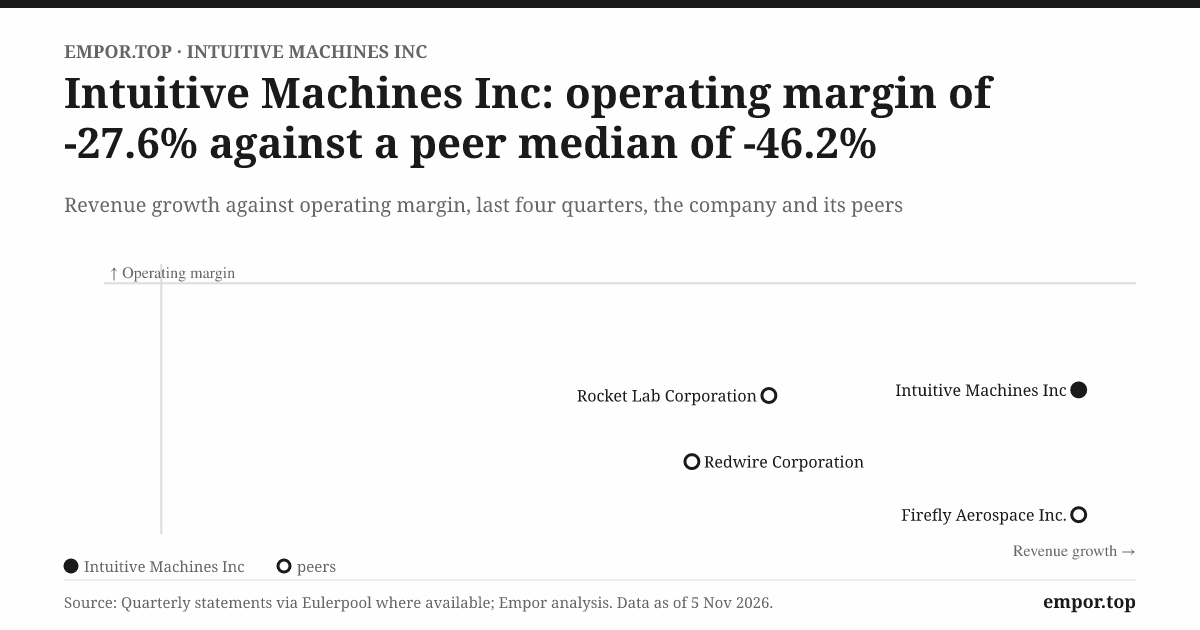
Yet the combined company still lost money. The second-quarter operating loss was about $47 million, including roughly $11 million of share-based compensation and $8 million of acquisition and integration costs.12 Adjusted EBITDA, management's preferred measure, was still negative at about $14 million.12 The acquired business is profitable; the whole is not yet. That gap is where the "space prime" promise has to be tested, because the promised benefits of combining the two companies, such as shared engineering, cross-selling of spacecraft and lunar services, and lower overhead, have not been separately quantified.
The financing tells the rest of the story. Intuitive Machines did not pay for Lanteris from cash generated by operations, because it has never generated meaningful operating cash. It paid with a mixture of the cash it had raised through earlier equity and the 2025 convertible notes, the shares it issued to the seller, and further raises in 2026: an 11.6 million share private placement that brought in $175 million, and about 8.3 million shares sold through an at-the-market program for about $235 million of net proceeds through June.4 The acquisition was a capital-markets event as much as a strategic one.
To be fair to management, the timing of those share sales looked shrewd in hindsight. The company said it had raised about $291 million gross through its at-the-market program at an average price of about $26.81 a share.12 On November 5, 2026, the stock traded at $8.62. Selling shares at three times today's price is, from a continuing shareholder's perspective, about as good as dilution gets. It is still dilution, and it was required because the business consumes cash.
The central bargain of the Lanteris deal is now visible. Intuitive Machines exchanged a narrow, lunar-focused business for a more diversified one with positive operating income in its acquired half. In return it took on integration demands, a larger share count, assumed obligations and a capital base several times bigger than before, all of which must now earn a return. Whether it does will not be clear until a full year of combined results separates organic growth, segment margins and cash conversion. The first sign will be whether the larger backlog turns into cash, which is where the story goes next.
The Backlog Grew Faster Than the Proof
By the end of June 2026, Intuitive Machines reported something its investors had never seen: a backlog of about $1.76 billion, more than eight times the $213 million it had reported six months earlier.411 The combined company booked about $393 million of revenue in the first half.4 On the second-quarter call, management reaffirmed full-year revenue guidance of $900 million to $1 billion and said it expected positive adjusted EBITDA for 2026.12
For a company that had spent its public life explaining losses, it looked like an inflection. The skeptic's job is to ask what kind of inflection.
Begin with what changed in the revenue base. In the second quarter alone, revenue was about $206 million, of which about $167 million came from products, mostly spacecraft, and about $37 million from services.4 That product line is largely Lanteris. The lunar delivery work, engineering services and mission operations of the legacy company continued alongside it, but services remain a small slice, and nothing in the filings shows the service base becoming a large recurring profit pool yet.
Backlog grew because the acquisition added about $613 million and because the combined company kept winning. Altemus told analysts the company had booked about $1.7 billion of new work in 2026 to date, while McGrath cited about $920 million of bookings in the second quarter itself, two figures that measure different windows rather than contradict each other.12 Either way, the order intake dwarfed anything the legacy company had recorded. Management said that backlog at the end of June was split roughly 37% civil, 49% commercial and 14% national security, a far broader mix than the one-customer business of 2025.12 McGrath also gave a conversion schedule: about 25% to 30% of the June backlog was expected to become revenue in 2026 and 35% to 40% in 2027.12
That conversion schedule is worth working through, because it shows how much has to go right. Converting a quarter or so of $1.8 billion over the rest of 2026 implies roughly $450 million to $540 million of revenue from existing backlog in the second half. Add that to the first half and the company lands in the bottom half of its guidance range, provided the satellites and missions ship on time. Hitting the guidance therefore requires second-half quarterly revenue well above the $206 million achieved in the second quarter. That is plausible for a satellite manufacturer whose revenue tracks production milestones, but it leaves little room for the schedule slips that have defined the lunar business.
There is also a deeper question about what backlog means here. In a conventional manufacturing company, backlog is a firm order book. Here it is a set of obligations with conditions attached. Some government contracts remain cancellable, and the company warns that backlog is not guaranteed revenue.3 Some of the commercial satellite work depends on the financial health of customers, as the EchoStar episode below shows. Backlog is a real asset, but it is less certain than its size suggests.
The margin question is even more urgent, because of the kind of contracts the company now holds. In 2025, about 57% of contract revenue came from fixed-price work and 38% from cost-reimbursable contracts. In the first half of 2026, fixed-price work rose to about 87% and cost-reimbursable work fell to 11%.34 That shift reflects Lanteris's satellite contracts, which are typically fixed-price. It means the combined company now bears cost overruns on most of what it sells.
That risk is not theoretical, because the legacy business has already shown what overruns cost: its lunar contracts were in loss positions, including a further IM-4 adjustment in the second quarter.312 Satellite manufacturing has its own long history of fixed-price losses across the industry, and the shift to 87% fixed-price revenue magnifies the effect of any estimating error. A one-point change in margin on a billion dollars of revenue is $10 million, which is enough to swing a company near breakeven into loss.
Cash generation is a separate hurdle from accounting profit, and the record here is unforgiving. Across 2020 to 2025, the company's cumulative net loss was about $349 million while cumulative operating cash flow was about negative $124 million.3 The gap is not a hidden cash profit. It reflects large noncash charges, especially fair-value changes on earn-out and warrant liabilities created by the 2023 listing, and in 2025 alone the company recorded $33.4 million of earn-out remeasurement expense partly offset by an $8.4 million warrant gain.3 After capital spending, cumulative free cash flow over those six years was about negative $229 million.3 Operating cash outflow improved to about $14 million in 2025 from about $58 million in 2024, but free cash flow was still about negative $56 million.3
The combined company has not yet broken that pattern. In the second quarter of 2026, operating activities used about $60 million, which management attributed partly to roughly $17 million of accelerated inventory purchases, a $17 million milestone payment to SpaceX for IM-4's launch, and about $8 million of acquisition and integration costs. Capital spending was another $24 million.12 Each explanation is plausible. Together they still describe a company that consumes cash while growing.
The balance sheet shows the effect. Cash and equivalents stood at about $583 million at the end of 2025, a cushion that earned the company about $15 million of interest income that year.3 By the end of June 2026 cash had fallen to about $367 million, even after the private placement and the at-the-market sales, because the Lanteris cash payment, integration costs and continuing operating needs absorbed more than the new equity brought in.4 Interest income on a shrinking pile of cash is not a recurring earnings stream, and it flattered the 2025 loss more than the headline suggests.
Then there is what the company is owed. At the end of June 2026, trade and other receivables were about $120 million and contract assets about $51 million.4 A third category came with Lanteris: about $210 million of non-current orbital receivables.4 These are an unusual feature of the satellite business. Some commercial satellite contracts pay part of the price as performance incentives over the satellite's life in orbit, so the manufacturer effectively lends money to the customer and collects it over years, contingent on the satellite working. Three customers account for about 35%, 30% and 17% of the receivables balances.4
The EchoStar exposure is where that structure meets credit risk directly. Certain EchoStar and Hughes-affiliated entities entered bankruptcy proceedings, and at June 30, 2026, the company had about $10 million of accounts receivable and $41 million of orbital receivables associated with them, about $51.5 million in all.4 Intuitive Machines recorded no incremental allowance for those balances through the filing of its second-quarter report on August 13, 2026, while stating that recoveries and the treatment of the contracts remained uncertain.4 That is a judgment, not a certainty. If collections disappoint, the write-down would land directly on earnings, and it would remind investors that satellite revenue is only as good as the customer's balance sheet.
There is a small irony here. On the year-end call in March 2026, management highlighted that EchoStar 25, a satellite built by Lanteris, had "successfully launched last week."11 A satellite delivered to a customer who then files for protection from creditors is a delivery that may not be fully paid for.
Three operating measures matter more than any others for the rest of this story. The first is gross margin, and the loss positions on major contracts, especially IM-4 and the large satellite programs. The second is operating cash flow after capital spending. The third is backlog conversion read alongside customer concentration. If all three improve together, the backlog is turning into a business. If revenue rises while margins stall and cash keeps draining, the company is getting bigger without getting better.
Quarterly revenue can rise sharply while the quality and cash value of that revenue remain uncertain. That is the situation tonight. Which raises the obvious question for anyone deciding how much trust to place in the people steering it: what does the full case for and against Intuitive Machines look like once the evidence is weighed together?
Analysis & Bear vs. Bull Case
Picture the stage on a results day in 2026. Stephen Altemus, the former Johnson Space Center deputy director, presents a company that now builds satellites in California, lunar landers in Houston and relay networks in between. Somewhere in the background sits Kamal Ghaffarian, the co-founder and chairman, who does not run the company day to day but controls about a third of the votes that decide who does.
That control is structural. When Intuitive Machines went public in 2023 through a merger with a special purpose acquisition company, it adopted an Up-C structure, in which legacy owners hold units of the operating LLC paired with Class C shares that carry votes but no economic rights; the units can later be exchanged for ordinary Class A shares.3[^6] Class C shares carry three votes each. As of April 10, 2026, Ghaffarian held about 35.6 million Class C shares and 33.5% of the voting power. Altemus held 11.6% and Crain 8.2%.[^6] Together, the three founders command more than half the votes. Their economic ownership is lower than their voting power, which is the point of the design.
Shareholders have noticed. At the June 2026 annual meeting, Ghaffarian received about 22.3 million votes against him, more than double the roughly 10.6 million cast against Altemus; both were elected.15 In a company where founders control so much of the vote, that dissent is a measure of how outside investors feel about the chairman, whose outside business interests also show up in related-party disclosures, including Aerodyne and X-energy, where he holds management roles.3 Those transactions were small relative to revenue in 2025, but they are the kind of entanglement that makes high-vote control harder for outside holders to accept.
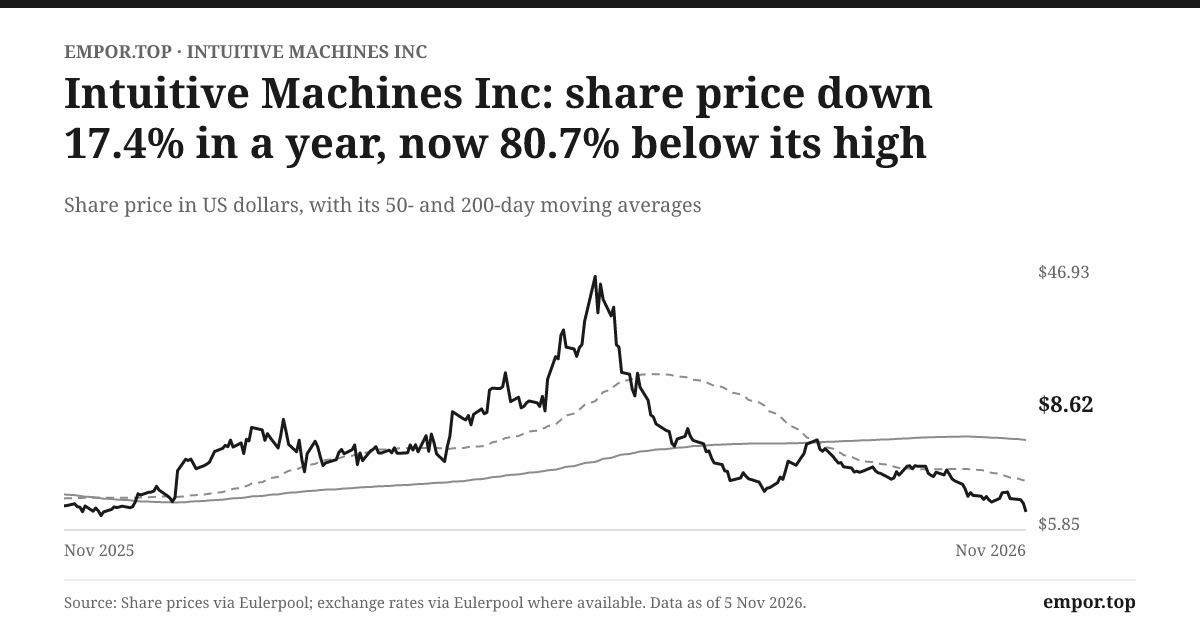
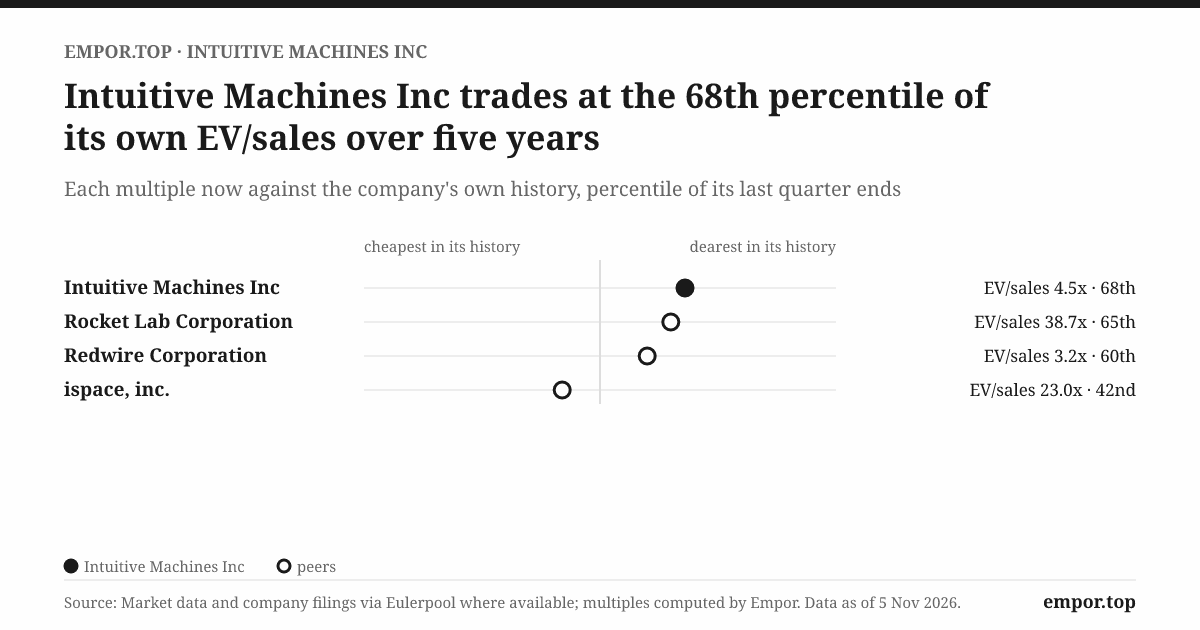
The market's mood is easy to read. On November 5, 2026, the stock traded about 81% below its 52-week high of $44.73, valuing the company at about $1.8 billion. That is about 3.6 times trailing revenue, and well under two times management's 2026 revenue guidance if that guidance is met.12 The stock's one-year volatility of around 110% is typical of a company whose value rests on a few binary events. The price appears to assume that some, not all, of the backlog becomes profitable, and that the company will need more capital before it generates its own.
The bull case deserves to be stated in its strongest form. Intuitive Machines now has real assets: flight-proven lander engineering, a satellite factory with decades of heritage, a growing list of national-security customers and a lunar communications network that, if deployed, could earn fees across many missions. NASA has kept awarding it work, including the $180.4 million CLPS order in March 2026 and further delivery contracts that management says extend its lunar cadence into 2030.1012 The acquired business is profitable at the operating line, gross profit has turned positive, and the backlog is larger and more diversified than the one-customer book of 2025. The company also raised capital through stock sales, leaving about $367 million in cash at the end of June.412
The bear case is just as concrete: repeated landing problems, loss-making lunar contracts and estimates still moving. NASA remains the dominant buyer of lunar services and has designed its programs to keep vendors competing. The recurring-service economics of the relay network remain unproven. Fixed-price work now makes up nearly nine-tenths of contract revenue. Free cash flow was negative in five of the six years from 2020 to 2025, and the share count has expanded through a SPAC listing, equity raises, warrant exercises, acquisition shares and at-the-market sales.34 Roughly $51.5 million of receivables sits with bankrupt EchoStar affiliates.4
Porter's five forces help explain why both cases can be true at once. Buyer power is the dominant force. NASA supplied most of the legacy revenue, contracts are terminable for convenience, and multi-vendor programs such as CLPS and the Near Space Network are built to compare providers. National-security buyers like the Space Development Agency also run competitive procurements with several manufacturers. Rivalry is intense: Firefly, Astrobotic and others compete for lunar work, while established manufacturers compete for satellites. The threat of new entrants is moderated by the difficulty of the engineering but sustained by government programs that deliberately fund new suppliers. Supplier power is real for launch, where SpaceX dominates, and the company's IM-4 milestone payment to SpaceX is a reminder that the launch provider gets paid whether the lander lands upright or not.12 Substitutes are limited for lunar delivery but abundant for satellite manufacturing.
Hamilton Helmer's seven powers offer a sharper test of the moat. Scale economies are emerging at the Lanteris factory but are not visible in margins yet. Network economies are the theoretical prize of a lunar relay constellation and remain unbuilt. Switching costs might arise once missions integrate with that network, but no customer is locked in today. Counter-positioning is weak, because NASA designed CLPS precisely to fund many companies doing the same thing. Cornered resource is the claim most often made for Intuitive Machines, in the form of "first commercial company on the Moon," and Firefly's clean landing disproves it. Branding, in the sense of customers paying more because of a name, does not appear in fixed-price competitive bids. Process power, the ability to execute more reliably than others, is exactly what the two landings have not yet shown. The honest conclusion is that the moat is unproven. Intuitive Machines has capabilities, not powers.
Management's record over time is the remaining test. There is evidence of candor: on the March 2026 call, management guided to 2026 revenue approaching $1 billion, and in August it reaffirmed the $900 million to $1 billion range rather than walking it back.1112 There is also evidence of drift. IM-3 moved from NASA's 2026 slot to a first-quarter 2027 launch, explained in generic terms about spacecraft readiness and launch availability rather than a specific cause.612 On the year-end call, analysts asked about the timing of a lunar terrain vehicle award and the structure of NASA's next CLPS program, and the answers were confident but undated, with management saying it felt an award was "imminent" and that it would "wait and see" on structure.11 Analysts also asked about organic growth, and management did not provide combined year-end figures.11 That pattern of confident answers without measurable commitments is common in the industry. It is still the pattern investors have to price.
The incentive structure deserves attention in proportion. Altemus received about $5.07 million of total compensation for 2025, including about $3.5 million in stock awards and a transaction bonus tied to the Lanteris deal that was paid in 2026.[^6] Crain and McGrath each received about $1.8 million to $1.9 million.[^6] Those packages rose in a year when the company lost about $87 million at the operating line, and the transaction bonus rewarded closing an acquisition rather than earning a return on it. The 2026 proxy presented no shareholder say-on-pay vote, so investors had no direct way to register a view on pay.[^6] Equity-heavy awards do align executives with the share price, which has fallen sharply since its peak, so the alignment works in both directions.
Capital allocation has to be judged by what the money has bought so far. The 2023 listing, the 2024 public offering and private placement, the $345 million of 2.5% convertible notes in 2025 and the 2026 equity raises funded landers, satellites, ground networks and Lanteris.34 The share base expanded materially as a result. The returns on that capital are not yet measurable: the lunar missions lost money, the relay network has not started earning, and Lanteris has six months of positive contribution. In February 2025, the company spent $20.7 million repurchasing about 941,000 shares in connection with a warrant exercise, a small offset to a large dilution history.3
An activist reading the filings would also press on the plumbing that connects the founders to the company. KBR, the engineering contractor that bought Ghaffarian's earlier company, owns about 10% of Space Network Solutions, an Intuitive Machines subsidiary, and is a joint-venture partner on a NASA engineering services contract known as OMES III, where profits are split 47% to Intuitive Machines and 53% to KBR.3 In 2025 Intuitive Machines recorded about $22 million of costs paid to KBR on that contract, roughly a tenth of its total cost of revenue, against under $2 million of revenue from KBR.3 The filings describe these as ordinary-course dealings on normal terms, and the arrangement predates the listing. It still means a meaningful share of the legacy company's service economics is shared with a partner rather than retained.
The same skeptic would note the tax receivable agreement that came with the Up-C structure. It obliges the company to pay legacy unit holders, chiefly the founders, 85% of certain cash tax savings it realizes in future.3 At the end of 2025 that liability was unrecognized, because the company had no taxable profits to shield.3 It is a quiet claim on future success: if Intuitive Machines becomes consistently profitable, a large part of the tax benefit from its historical structure flows to insiders rather than to all shareholders.
The governance record has a few further marks, none of them severe on its own. The company disclosed material weaknesses in revenue-review and procure-to-pay controls, which management said it remediated in the fourth quarter of 2025 without any resulting misstatement; the auditor's opinion on the 2025 financial statements was unqualified.3 As an emerging growth company, Intuitive Machines did not provide an auditor attestation on internal controls.3 A Delaware Chancery Court suit filed in November 2024 by a former preferred holder, alleging it received too few shares on conversion, remains unresolved, with cross-motions for summary judgment reported in February 2026 and no accrual recorded because a loss was not considered probable or estimable.3 For a company that has just tripled in size through an acquisition, controls are not a footnote. Integrating a satellite manufacturer's contract accounting into a lunar company's finance team is exactly the kind of work where weaknesses reappear.
One more diligence point is worth stating plainly. The company does not disclose an issuer-level credit rating with an agency rationale, so investors have to assess its credit standing directly.34 The main obligations are the $345 million of convertible notes due in 2030, about $49 million of securitized orbital receivables, and a Lanteris receivables facility under which ING may buy eligible receivables up to $250 million through December 2026, which the company guarantees.4 Its Stifel revolving credit facility was effectively suspended by waiver when Lanteris closed.4 Nothing matures before 2030 in the filings, but continued cash burn means the company depends on contract conversion and access to capital markets.
So where does the evidence land? The bull case has real assets and a better business mix than a year ago. The bear case has execution problems, contract losses, a dominant government buyer, cash burn and dilution. The moat is unproven. The scorecard that will decide between them is narrow: profitable backlog conversion, customer diversification that persists after the acquisition effect fades, and positive operating cash flow after capital spending. Those are the same measures that turn the company's history into lessons for anyone building a business where every mission is both a product and an exam.
Playbook: Business & Investing Lessons
Go back to that faint signal from Odysseus in February 2024. In the mission control room, the relief was real. In the weeks that followed, the broken leg and the tilted antennas turned celebration into a different conversation: not "can we land?" but "can we land the same way every time?" Intuitive Machines has been living inside that question ever since, and it has turned out to be the question its business depends on.
The first lesson is that a first can open the door, but only repeatability keeps the customer. IM-1 opened the door; IM-2 and Firefly's clean landing showed why repeatability matters. In a market where the buyer deliberately keeps several suppliers in the race, a historic first buys an invitation to bid again, not loyalty. For founders, the lesson is that a proof of possibility is not a proof of product. For investors, it is that a technical first is the start of the evidence, not the end of it.
The second lesson is that backlog is a promise with conditions attached. The $4.82 billion Near Space Network ceiling, the initial funded orders and the backlog are different measures; the discipline is to ask what has been funded, earned and collected.
The third lesson is that buying capability is not the same as earning a return on it. Lanteris brought diversification and positive operating income, but the return on the capital invested in the acquisition remains uncertain.
The fourth lesson is the one that belongs most specifically to this company: in space, the customer pays for the outcome, and the contractor often owns the overrun. Intuitive Machines' loss-making lunar contracts show the cost of fixed-price work when schedules slip. With nearly nine-tenths of its contract revenue now fixed-price, the company is selling insurance against its own delays.
The wider discipline for anyone watching Intuitive Machines is to count the right things. Count deployments, not contract ceilings. Count missions that operate as planned, not landings that make headlines. Count cash collected, not awards announced. The company has given investors plenty of awards and ambitions. The next chapter is about the counting, which is where the epilogue begins.
Epilogue
Tonight, Intuitive Machines is a very different company from the one that waited for Odysseus's signal. It has about 1,700 employees, a satellite factory in California alongside its Houston operations and a much larger backlog and revenue guide.412 It also has a share price about four-fifths below its peak, a combined business still losing money at the operating line, and a lunar delivery record that has yet to show a clean landing.
The next quarterly report matters more than usual, because it has to bring the legacy business and Lanteris into a more comparable frame. The most useful thing management could publish is the separation investors have been asking for: how much of the growth is organic, what margins each part earns, and how much cash the combined company generates after capital spending. A full year of combined results in early 2027 will be the first real test of whether the "space prime" story produces better economics or only bigger numbers.
The second moment is IM-3. The mission now carries two burdens: proving the lander can come down upright and operate as planned, and delivering the first relay satellite for the company's lunar communications business.1112 If it lands cleanly, on its revised schedule, the company's most damaging weakness would start to fade. If it slips again or ends on its side, the reliability question would harden, and the relay network's revenue would move further out. Either way, the quality of management's explanation will matter almost as much as the outcome. A specific cause and a specific fix would be a signal of process improving. Generic references to readiness and manifests would not.
The third moment is the network itself. Watch whether the Near Space Network produces funded orders and paying usage, not just potential value. The first relay satellite in orbit and billing for service would be the first evidence that Intuitive Machines can earn recurring revenue from infrastructure rather than one-off fees from missions.
The fourth is EchoStar. The receivables tied to bankrupt affiliates will either be vindicated by collections or require a write-down.4 Alongside it, the next annual customer-concentration disclosure will show whether the broader customer mix visible in mid-2026 holds or whether one customer again dominates.
What would change the verdict? Rising revenue alongside improving contract margins and positive operating cash flow after capital spending would make the investment case materially stronger, because it would show the backlog turning into a business. Continued losses, more dilution or another troubled landing would weaken it, because they would show a company growing its obligations faster than its ability to fulfill them profitably. The story's central questions are now measurable. They are not yet answered.
Outro
Remember the faint signal from Odysseus, crossing a quarter of a million miles from a lander lying at an angle on the Moon. It was proof that a company from Houston had reached a place no private firm had reached before. It was also a reminder that arrival is only the first part of delivery, and that the customer pays for the second part.
Intuitive Machines has made lunar access tangible. It has bought a satellite factory, collected a backlog and drawn a map of a communications network around the Moon. What it has not yet done is turn that distance into dependable profit. The Moon is no longer just a destination for Intuitive Machines. It has to become a customer.
References
-
Private Moon Lander Makes First U.S. Landing in More Than 50 Years — Associated Press, 2024-02-22 ↩↩↩
-
NASA's Commercial Lunar Payload Services Initiative — NASA Office of Inspector General, 2024-06-06 ↩↩↩↩↩↩↩↩↩↩↩↩↩
-
2025 Form 10-K — Intuitive Machines, 2026-03-19 ↩↩↩↩↩↩↩↩↩↩↩↩↩↩↩↩↩↩↩↩↩↩↩↩↩↩↩↩↩↩↩↩↩↩↩↩↩↩↩↩
-
Q2 2026 Form 10-Q — Intuitive Machines, 2026-08-13 ↩↩↩↩↩↩↩↩↩↩↩↩↩↩↩↩↩↩↩↩↩↩↩↩↩↩↩↩↩↩↩
-
Form S-1/A — U.S. Securities and Exchange Commission, 2023-06-29 ↩↩↩↩↩
-
NASA Receives Some Data Before Intuitive Machines Ends Lunar Mission — NASA, 2025-03-07 ↩↩↩↩↩↩↩↩↩↩↩
-
Intuitive Machines Lander Arrives on the Moon, but on Its Side — Axios, 2025-03-07 ↩
-
NASA Selects Intuitive Machines to Deliver Artemis Science and Technology to the Moon — NASA, 2026-03-27 ↩↩↩
-
Q4 2025 Earnings Call Transcript — Investing.com, 2026-03-19 ↩↩↩↩↩↩↩↩↩
-
Q2 2026 Earnings Call Transcript — The Motley Fool, 2026-08-20 ↩↩↩↩↩↩↩↩↩↩↩↩↩↩↩↩↩↩↩↩↩↩↩↩
-
NASA Selects Lunar Relay Contractor for Near Space Network Services — NASA, 2024-09-17 ↩↩↩↩
-
Intuitive Machines Acquires Lanteris for $800m — Advanced Television, 2025-11-06 ↩↩↩↩
-
Annual Meeting Voting Results — U.S. Securities and Exchange Commission, 2026-06-08 ↩
 LinkedIn
 WhatsApp
 Reddit
 Hacker News
 Email
 Kindle
 RSS Feed
 Spotify
 Apple Podcasts
 Amazon Music
 Audible
 YouTube