Redwire Corp: From Space Parts to Defense Drones
I. The company that doubled—and the business that did it
Picture the August 2026 earnings slide as a split screen. On the left sits the company Redwire spent five years telling investors it was: a maker of the unglamorous but essential parts that keep spacecraft alive, the sun sensors that tell a satellite which way it is pointing, the solar arrays that unroll like a carpet in orbit, the camera systems, the hinges and booms, the payloads that let pharmaceutical crystals grow in microgravity. On the right sits something the company was not until the summer of 2025: a builder of small uncrewed aircraft, long-endurance drones that soldiers launch from a catapult, stabilized camera gimbals and the surveillance sensors that hang beneath them.
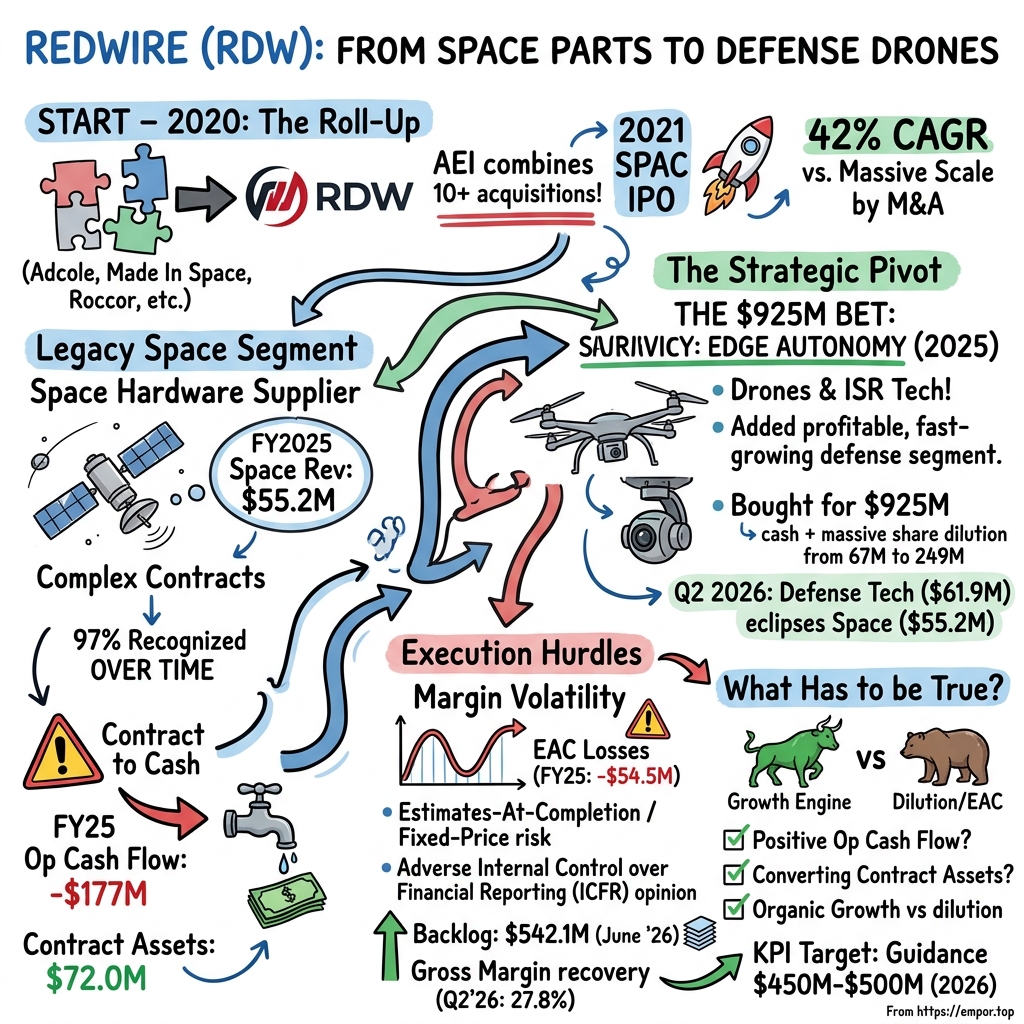
For the three months to June 2026, the right side of that screen was the bigger one. Redwire reported revenue of $117.1 million, the largest quarter in its history, and a non-GAAP gross margin of 27.8%, also a record.1 Of that revenue, the Defense Tech segment, which is essentially the Edge Autonomy drone business Redwire bought a year earlier, brought in $61.9 million, while the Space segment, the original Redwire, brought in $55.2 million.1 The company that was born to sell parts for the space economy now earns more of its revenue from aircraft that never leave the atmosphere.
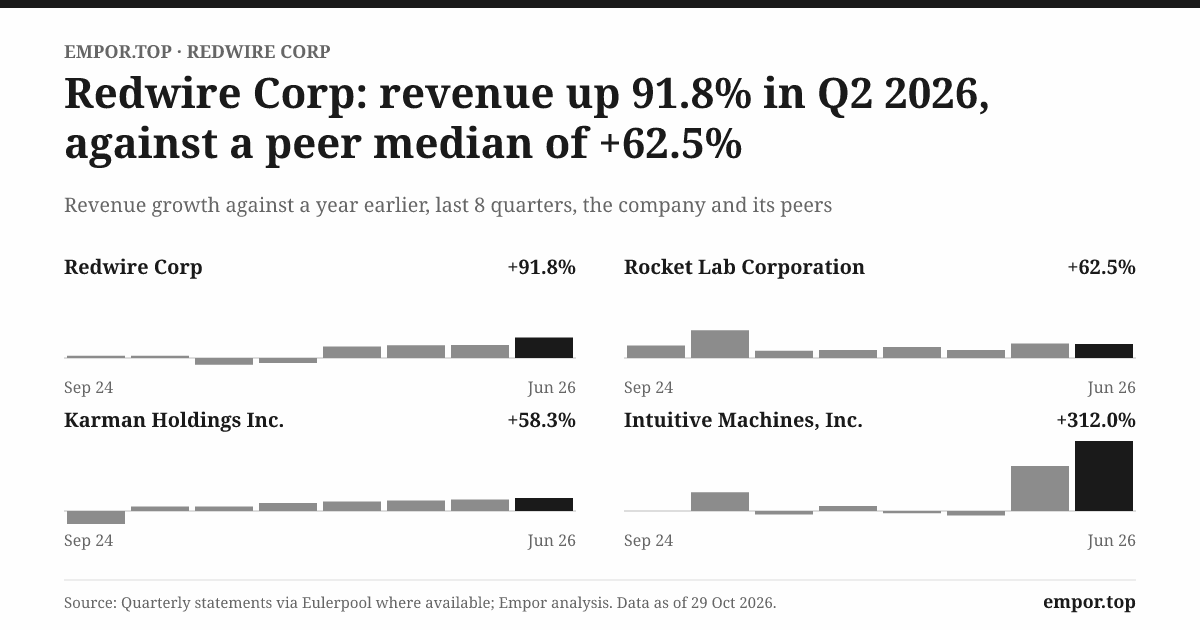
That is not a scandal, and it is not a failure. Plenty of good companies have discovered that their second business is better than their first. But it does change the question an investor needs to ask. The headline growth looks spectacular: revenue in the June quarter was about 92% higher than a year earlier, when Redwire booked roughly $61 million.2 Set that beside the full year 2025, when revenue rose only about 10%, to roughly $335 million, and the acceleration looks like a company that suddenly found its stride.3 The record tells a less romantic story. Edge Autonomy closed in June 2025, so the June 2025 quarter contained almost none of its sales, while the June 2026 quarter contained all of them. Most of what looks like a doubling is the arithmetic of adding a second company to the first.
Meanwhile the order book grew. Redwire ended June 2026 with $542.1 million of contracted backlog, the funded, signed work it expects to deliver, up from $411.2 million at the end of 2025.2 That is more than a year of revenue at the company's 2026 run rate, and it suggested customers were still placing orders on both sides of the split screen.
The split matters for more than bookkeeping, because the two businesses are valued, financed and run differently. A space-components supplier lives on long engineering programs, milestone payments and the accounting judgment of how far along each job is. A drone maker lives on production lines, inventory, export licences and the defense budgets of allied governments. When one company owns both, investors cannot simply apply one set of expectations to the whole; they have to ask which half is carrying the other, and whether the combination is worth more than the two would be apart.
So the story has three stakes, and they run through everything that follows. The first is whether Redwire bought a durable growth engine in defense, or simply bought revenue at a full price. The second is whether a company built on complex, one-of-a-kind contracts can actually make those contracts pay, because the record of 2025, when contract cost overruns helped drive an operating loss of about $230 million, says it has struggled to.3 The third is the one a common shareholder feels most directly: whether all of this, the acquisitions, the shares issued to pay for them, the equity raised to fund the losses, creates value per share or merely creates a bigger company.
The verdict at the outset is a narrow one. Redwire is plainly larger and broader than it was. Its backlog is real, its gross margin improved, and its balance sheet was far stronger by mid-2026 than a year before. But the visible acceleration belongs mostly to Edge Autonomy, the legacy Space business shrank in 2025, and neither half of the company has yet shown that it can turn growth into cash. In the June quarter, even with record revenue and record margin, adjusted EBITDA was still negative, at about $3.2 million.1 The company that doubled has not yet proven what the doubling was worth.
To understand how a space-parts company ended up with a drone business larger than itself, the story has to go back to 2020, and to a private-equity firm in Florida that decided the space economy could be assembled one acquisition at a time.
 Subscribe on LinkedIn
II. Ten companies become one Redwire
In the spring of 2020, as most of the world was learning to work from its kitchen table, AE Industrial Partners was shopping. AEI, a Boca Raton private-equity firm focused on aerospace, defense and government services, had concluded that the space economy was fragmenting into thousands of small specialist suppliers, each of them good at one thing, few of them large enough to win the bigger contracts that new constellations and government programs were starting to offer. Its answer was to buy several of those specialists and bolt them together under one name. That name was Redwire, and AEI founded it in 2020.4
The pieces came from very different worlds. Adcole Space, a Massachusetts maker of sun sensors and attitude-determination hardware, had decades of flight heritage, meaning its parts had actually flown on real missions, the single most valuable credential in an industry where nobody wants to be the first to trust an unproven component.4 Made In Space was the Silicon Valley-flavored startup that had put 3D printers aboard the International Space Station and dreamed of factories in orbit.4 Roccor, from Colorado, built deployable structures, the booms, hinges and antennas that fold up for launch and spring open in orbit.4 Deep Space Systems and LoadPath added engineering and structural capabilities, and Oakman Aerospace brought digital engineering and spacecraft design.4 Each had its own culture, its own customers, and its own accounting systems. AEI's bet was that the whole would be worth more than the parts, because a customer who needed sensors, structures and power from one supplier would prefer a single counterparty with a single balance sheet.
To run it, AEI chose Peter Cannito, a defense-technology executive who has been Redwire's chief executive since 2020.4 Cannito's style, visible across five years of earnings calls, is the confident vocabulary of a platform builder: Redwire is not a component vendor but an "infrastructure" company, the picks-and-shovels supplier to a space economy the company describes as structurally growing. That framing would matter, because it was the story Redwire took to public investors.
The SPAC pitch
The route to the public market was the one so many space companies took in 2021: a merger with a special-purpose acquisition company. Redwire combined with Genesis Park Acquisition Corp., and the combined company began trading on the New York Stock Exchange under the ticker RDW in September 2021.4 The investor presentation that accompanied the deal laid out a pitch of extraordinary ambition. It described Redwire as a broad provider of mission-critical space infrastructure, sitting on decades of flight heritage, and it projected that the company's revenue would grow at an organic compound rate of about 72% a year between 2021 and 2025.5 Acquisitions would come on top of that. The message was that the roll-up was not just buying growth; it was going to generate it.
The buying continued after the listing. In late 2021 Redwire added Deployable Space Systems, the maker of the roll-out solar arrays that unfurl like a window blind and were being fitted to the International Space Station; Techshot, an Indiana company that built biotechnology equipment, including a bioprinter, for experiments in orbit; and QinetiQ Space NV, a Belgian spacecraft builder with a long history of small European satellite missions.4 The Belgian business became Redwire's European foothold. Later came Hera Systems, a small-satellite developer.6 By the time Edge Autonomy closed in 2025, Redwire counted ten acquisitions since its founding.3
The SPAC route left a legacy that outlived the listing itself. Like most SPAC mergers, the Genesis Park deal came with public warrants, the right to buy Redwire shares at a fixed price for years afterward.4 Those warrants became a small character of their own in the story: a noncash line that swung reported profits up and down with the share price, and, when they were finally exercised, a source of both fresh cash and fresh shares. A SPAC listing is, among other things, a decision to bring options on future dilution into the capital structure from day one.
What the pitch became
Here is the version most people remember: Redwire grew from a startup roll-up into a company with about $335 million of revenue in 2025, a compound growth rate of roughly 42% a year from 2020.3 Those figures are accurate. They are also almost useless as evidence of organic execution, because the company's perimeter changed nearly every year. The revenue of 2020 belonged to a handful of businesses; the revenue of 2025 belonged to a different and much larger set, including half a year of Edge Autonomy. Measure the more settled stretch from 2022 to 2025 and growth falls to about 28% a year, still including acquisitions.3
Now test the SPAC projection against that. A 72% organic growth rate sustained for four years would have multiplied the 2021 business roughly eight-fold. Redwire's actual 2025 revenue, including acquired businesses, was about two and a half times its 2021 level of roughly $137 million.3 And the most damning number is the most recent one. In 2025, the year the drone business arrived, Redwire's Space segment revenue fell about 18%.3 The original projection was not met on its original schedule, and the legacy business was shrinking at the very moment consolidated revenue looked healthiest.
Why did it fall short? Part of the answer is the nature of space procurement, where programs slip, government budgets arrive late, and launch dates move, so revenue that looks certain on a spreadsheet arrives a year or two later than planned. Part of it was the post-2021 collapse in commercial space funding, which hurt the startups that SPAC-era projections assumed would be buying components. And part of it, as later sections show, was execution: contracts that cost far more to complete than Redwire had estimated.
None of this means the roll-up was pointless. Redwire did assemble a portfolio of genuinely flight-proven capabilities, from sensors to solar arrays to spacecraft platforms, and it did grow large enough to bid for work that its components could not have won alone. But the history narrows the claim. AEI built a broader supplier, not an organic growth machine, and the company's growth has depended on continuing to buy. That raises the question the rest of the story has to answer before it can judge any acquisition: what exactly does Redwire sell, and how does a customer's money move through it?
III. The long journey from contract award to cash
Imagine a single Redwire component on its way to orbit. Say it is a deployable structure for a government satellite. The journey starts not in a factory but in a negotiation. A customer, perhaps a national security agency, perhaps a prime contractor building the whole satellite, issues a contract with a price, a technical specification and a schedule of milestones. Redwire's engineers then spend months designing, analyzing and testing; its technicians build the part in a clean room; quality inspectors document every step because nothing can be repaired once it is launched. Along the way the customer pays not when the part ships, but when Redwire hits milestones written into the contract: design review passed, qualification test completed, hardware delivered.
That is the business, and it is worth sitting with because almost everything about Redwire's financial results follows from it. This is not software. There is no subscription, no seat licence, no recurring fee that arrives every month whether or not the company does anything new. Redwire sells projects and products, and each program is, to a large extent, its own contract with its own economics.3
The contracts come in three main flavors, and the differences matter. In a fixed-price contract, the price is set at the start. If Redwire's engineers solve a problem faster than expected, the company keeps the savings; if a part fails qualification and has to be redesigned, the company eats the cost. In a cost-reimbursable contract, the customer pays Redwire's allowable costs plus a fee, so the risk of overruns sits mostly with the customer, and so does most of the upside. A smaller slice of work is time-and-materials, billed by labor hours at agreed rates.3 Redwire says its contract prices are generally fixed at inception, which means a large share of its work carries the first kind of risk.3
Over time, but not on schedule
Accountants have a phrase for how Redwire books most of its revenue: "over time." In 2025, about two-thirds of Redwire's revenue was recognized over time and about one-third at a point in time.3 The split between the two businesses is stark. The Space segment recognized about 97% of its revenue over time, as work progressed, while Defense Tech recognized about 85% at a point in time, mostly when a drone or gimbal was delivered.3 In plain English, the space business behaves like a builder working on a commissioned house, earning revenue as each room goes up, while the drone business behaves more like a manufacturer selling finished products off a production line.
It is tempting to hear "over time" and think "smooth and predictable." It is neither, and the reason is the most important accounting idea in this story. When a company recognizes revenue over time on a fixed-price contract, it estimates what share of the job is complete, usually by comparing the costs it has spent so far with the total cost it expects to spend. That total is an estimate: the estimate at completion, or EAC. If engineers discover halfway through that the job will need more labor, more expensive materials or more subcontractor work than planned, the estimate rises. Two things then happen at once. The share of the job that counts as complete shrinks, so previously booked revenue and margin are reversed. And if the contract is now expected to lose money, the whole expected loss must be recognized immediately, before a dollar of the extra cost has actually been spent.3
Think of a contractor who agreed to build a house for a fixed $500,000 and discovers at the halfway mark that it will cost $600,000. The contractor does not wait until the roof goes on to admit the loss. It books the entire expected loss of $100,000 that quarter. That is why Redwire's reported margins can swing violently from one quarter to the next, and why the company itself lists changing estimates of labor, materials and subcontractor costs among the main sources of volatility in its results, alongside funding delays, contract starts and completions, and launch timing.3
The backlog and the cash it has not yet become
The order book is what makes this model investable. Redwire's contracted backlog, which it defines as firm, funded, executed work, rose to $542.1 million in June 2026.2 That is the number investors use to gauge visibility. It is important to understand what it is and what it is not. It is signed work, not a pipeline of hoped-for bids, and that is a meaningful discipline: a company could easily publish a much bigger "opportunity" figure. But backlog is still a promise with conditions attached. It becomes revenue only as Redwire performs, and it becomes profit only if Redwire's cost estimates hold.
Then there is the question of when the cash arrives, and here the balance sheet tells a story. At the end of 2025 Redwire had about $37.3 million of accounts receivable, meaning invoices sent and awaiting payment, and about $44.0 million of contract assets.3 By June 2026, receivables had fallen to about $27.5 million, but contract assets had jumped to about $72.0 million.2
Contract assets are the accounting term for work Redwire has already recognized as revenue but cannot yet invoice unconditionally, typically because the next billing milestone has not been reached. In the house analogy, the walls are up and the contractor has booked the revenue, but the contract says the next payment comes only when the roof passes inspection. Redwire said the 2025 increase reflected production running ahead of billable milestones.3 That is a normal feature of milestone contracting. It is also a working-capital drain: Redwire has paid for the labor and materials, recorded the revenue, and is waiting for the right to send the bill. When contract assets climb from about $44 million to about $72 million in six months, the company is effectively lending more of its own cash to its customers' programs.
On credit quality, Redwire offers some comfort. It expected substantially all of its year-end 2025 receivables to be collected during 2026, and its allowance for credit losses was not material in 2025 or 2024.3 Its customers are largely governments and large contractors, who tend to pay eventually. But the company does not publish a full aging table showing how long invoices have been outstanding, so an outsider cannot see which balances are late. The longer series is a warning sign worth keeping in view: receivables measured against revenue stood at around 89 days in 2025, after peaking at about 133 days in 2022, long collection times for a company that needs cash.3
The arrival of the drone business changed the shape of that working capital as well as its size. A company that recognizes revenue when it ships a finished aircraft has to build and hold that aircraft first, along with the motors, cameras and fuel cells that go into it. Redwire's inventory, which had been almost negligible against its cost of sales in earlier years, rose to roughly two months of cost of sales in 2025, once Edge's production lines were part of the company.3 So the combined business now ties up cash in two ways at once: the Space segment in work recognized ahead of billing milestones, and Defense Tech in parts and finished goods waiting for delivery. Neither is unusual for a hardware maker. Together they mean that growth itself consumes cash before it produces any, and the faster Redwire grows, the more working capital it needs to fund.
What the cash-flow statement said
The bottom line of this model, in 2025, was stark. Redwire's operating cash flow for the year was about negative $177 million on revenue of about $335 million.3 For every dollar of revenue, the operating business consumed more than fifty cents. Some of that came from one-off costs, including the Edge Autonomy transaction, and some came from the working-capital build already described. But it is the clearest single number in the story, and it frames everything else. A business can survive a long time with reported losses inflated by noncash charges. It cannot survive indefinitely when the cash itself is going out the door faster than it comes in, unless it keeps raising capital.
So the verdict on the business model is clear enough. Redwire is a project and product contractor, and backlog gives it genuine visibility into the next year or two of work. But in this model, visibility is not the same as profitability. Delivery timing, contract estimates and working capital decide whether revenue turns into profit and cash, and in 2025 all three moved against the company. The test from here is conversion: whether operating cash turns positive, whether that pile of contract assets becomes invoices and then cash, and whether the estimates stop moving.
Which leads to the question a customer asks before signing any of these contracts: why choose Redwire at all?
IV. A portfolio of flight heritage—or a moat still to prove
Put yourself in the shoes of a satellite program manager. You are building a spacecraft for a national security customer, and you need a set of sun sensors, a deployable boom and perhaps a solar array. One option is Redwire, a specialist that has flown versions of these parts before. Another is to ask your prime contractor, a giant with tens of thousands of engineers, to supply the whole subsystem in-house. A third is a European specialist, or a fast-growing American rival that is building its own component catalogue. Your career depends on the satellite working. What do you choose?
That scene captures the competitive position of Redwire's Space business better than any market-share chart, partly because Redwire does not publish market share. The company's offering is broad. Its Space segment sells avionics and sensors, power generation equipment such as roll-out solar arrays, structures and deployable mechanisms, radio-frequency systems, complete spacecraft platforms and microgravity payloads for research and manufacturing in orbit.3 Few suppliers of its size cover that much ground, and almost every product line carries some measure of flight heritage. In a market where a single failed component can lose a mission worth hundreds of millions of dollars, "it has worked before" is a serious selling point.
The customer list leans heavily toward government. In 2025, about 47% of Redwire's revenue came from national security customers, about 22% from civil space agencies and about 32% from commercial customers, and about 42% came from customers outside the United States.3 That international share is larger than many investors assume, and it reflects both the Belgian spacecraft business and, after mid-2025, drone sales abroad. International contracted backlog rose to about $193 million at the end of 2025 from about $71 million a year earlier.3 Redwire itself flags Ukraine-related sales as a potential source of decline if hostilities or military support change, an honest disclosure that also tells you where some of that international demand has come from.3
The competitors who can outspend it
The competitive field is crowded and, in places, much bigger. Rocket Lab, best known for its Electron launcher, has spent years assembling a space-systems business of its own, selling solar panels, reaction wheels, star trackers and complete spacecraft, and it reported about $602 million of revenue in 2025, against Redwire's roughly $335 million.7 The comparison is imperfect, because Rocket Lab also sells launch services, but it shows that Redwire's closest rival in components is a larger, better-capitalized company pursuing the same strategy of breadth. In Europe, Airbus and the French optical-sensor specialist Sodern compete for components. And in integrated programs, Northrop Grumman and other large defense contractors can supply entire subsystems themselves. Redwire's own filing says plainly that some competitors are larger and can spend more on research and development.3
Redwire spent about $19.8 million on research and development in 2025, roughly 6% of revenue.3 That is respectable for a contractor, but it is a rounding error against the R&D budgets of the defense primes. Redwire says it does not need to outspend them, because it often works alongside them as a supplier or subcontractor, and sometimes against them as a bidder.3 That dual role widens access: a prime that would never hire Redwire to build a whole satellite may happily buy its sensors. But it also exposes the limit of the moat. A supplier that a prime can choose to use is also a supplier that a prime can choose to replace, by insourcing or by qualifying a second source.
Two customers, no names
The concentration figures make that buyer power concrete. In 2025, two customers each accounted for more than 10% of revenue: one contributed about $66.3 million and the other about $62.8 million, together about 38.5% of the year's total.3 Redwire does not name them. They could be government agencies, prime contractors or program offices, and the filing does not let an outsider tell which. The year before, the larger of the two had accounted for about $107.6 million, roughly 35% of 2024 revenue on its own.3 Concentration fell in 2025, partly because Edge Autonomy brought new customers. But when nearly two-fifths of revenue depends on two counterparties, those counterparties have leverage over price, scope and schedule, and an investor cannot assess the risk of losing either because the company does not say who they are.
There is also the question of what Redwire's technical milestones are worth commercially. The company has a genuine record of firsts in orbit. Made In Space's 3D printers, Techshot's biotechnology hardware and Redwire's microgravity crystallization payloads, such as the PIL-BOX system designed to grow pharmaceutical crystals in space, have demonstrated that manufacturing and research in microgravity can work.3 Those are real achievements, and they give Redwire a seat at the table if in-space manufacturing becomes an industry. But the record since 2020 is that demonstrations have not, so far, turned into a large or recurring profit pool. Space still contracted in 2025. Technical milestones open doors; they do not by themselves produce repeat orders at an economic margin. The fair way to treat PIL-BOX and its cousins is as optionality: inexpensive tickets to a future that may or may not arrive, while the investment case today rests on ordinary contracted work across the existing portfolio.
The verdict on the Space franchise is therefore a qualified one. Flight heritage, specialized engineering and a broad catalogue support a credible supplier position, and the backlog shows customers keep buying. What the record does not show is pricing power, high switching costs or a defensible share of any market. Redwire looks like a respected bidder in many competitions rather than the default answer in any of them. If the company wanted to change that, it needed either more scale in space, or a second engine somewhere else. In 2025, it chose the second.
V. The $925 million bet on Edge Autonomy
The deal closed on June 13, 2025.8 Redwire paid for Edge Autonomy with $160 million in cash and close to 50 million newly issued Redwire shares, for a headline value of about $925 million.8 For a company whose entire 2024 revenue had been about $304 million, it was a transformational purchase: a space company buying a drone company of nearly comparable size, and paying mostly in its own stock.6
Edge Autonomy was a creature of the same private-equity firm. AEI had assembled it, much as it had assembled Redwire, from specialist businesses in uncrewed systems. Edge makes small, long-endurance uncrewed aircraft, the kind a small military unit can launch by hand or from a compact catapult and fly for hours to watch a road, a border or a front line. It also makes the stabilized camera gimbals and intelligence, surveillance and reconnaissance sensors that ride beneath such aircraft, and power systems that include fuel-cell technology to stretch flight time far beyond what batteries alone allow.9 In a decade when the war in Ukraine taught every military in the world how valuable cheap, persistent aerial eyes can be, Edge was selling into one of the fastest-growing corners of defense procurement.
The strategic argument for combining the two was simple to state. Redwire said the merger would create a multi-domain space and defense technology company, combining space infrastructure with airborne autonomous systems and sensors, giving it exposure to national security demand across domains and a larger platform from which to bid.9 The skeptic's version is just as simple: a drone maker and a space-parts maker share some customers and some technologies, such as sensors and autonomy, but they build very different products in very different ways, so the main thing they would share is a balance sheet.
What Redwire paid for
The proxy statement for the deal gave investors what they needed to judge the price. In 2024, Edge Autonomy had revenue of about $195 million, operating income of about $29.2 million and net income of about $15.8 million.9 Edge was, unlike Redwire, profitable. It was also growing.
Against those figures, the $925 million headline implied a price of roughly 4.7 times Edge's 2024 revenue and about 32 times its 2024 operating income. Translate that into investor language: if Edge's 2024 operating profit stayed flat forever, it would take Redwire about three decades of those pre-tax profits to earn back the price. For the deal to make sense, Edge's earnings had to grow substantially. That is a demanding price for a defense hardware business, though not necessarily an irrational one in a market that was paying premium multiples for drone makers.
Two cautions belong right beside that multiple. The first is that the headline was a cash-free, debt-free figure, and the stock component was valued at Redwire's share price at the time of signing, so the economic cost to Redwire's shareholders moved with the stock. The accounting value recorded at closing, which governs goodwill and future impairment tests, is not the same as the headline.3 The second is that public comparables for drone makers are imperfect and volatile, so declaring the deal an overpayment would be as premature as declaring it a bargain. The honest conclusion is that the price required growth, and only Edge's subsequent results can say whether the growth arrived.
What the drones did to the income statement
They arrived quickly in the reported numbers. In the roughly six and a half months it was part of Redwire in 2025, Edge contributed about $107.1 million of revenue.3 By the June 2026 quarter, the Defense Tech segment generated $61.9 million, more than Space's $55.2 million.1 Defense Tech also brought a different kind of revenue: products delivered and recognized at a point in time, rather than long engineering programs measured by percentage of completion, which in principle means less exposure to the estimate risk that bedevils the Space business.
As established, the acquisition drove most of the reported growth; Space's recovery was too small to explain it.1
The financing left its own mark. The $160 million of cash came largely from borrowing, including a JPMorgan term loan tied to the deal, while the stock component went to Edge's sellers, led by AEI-affiliated funds.3 Redwire's year-end common share count jumped to about 191.9 million in 2025 from about 67.0 million a year earlier, nearly a tripling, driven by the Edge shares together with warrant exercises and other issuance.3 Every existing Redwire shareholder now owns a much smaller slice of a much larger company, and the question of whether the trade was worthwhile became a per-share question rather than a company-level one.
There is also a quieter risk sitting on the balance sheet. A purchase of this size leaves behind a large stack of goodwill and acquired intangible assets, the accounting residue of paying more than the book value of what was bought. Redwire's total assets rose from about $293 million at the end of 2024 to about $1.4 billion a year later, most of the increase reflecting the Edge purchase.3 Those balances are tested for impairment, and Redwire had already written down the Belgian business it bought in the 2021 shopping spree. If Edge's growth disappoints, the same test that produced the Space Europe charge would apply to a far larger number. And the auditor's finding that the acquired Defense Tech business had control weaknesses is a reminder that buying a company and integrating it are different tasks.3
Demand carries its own concentration. Edge's systems found a market partly because of the war in Ukraine, and Redwire's own risk disclosures name Ukraine-related sales as a potential source of decline if the fighting or the military support behind it changes.3 Defense procurement of small drones is booming across many countries, so this is not a single-customer bet. But a meaningful slice of Defense Tech's recent growth rests on a conflict whose course no contractor controls.
The next test is easy to name and hard to pass. Inside Defense Tech, investors need to see organic growth now that the acquisition anniversary has passed, follow-on awards from existing military customers, production delivered on schedule, a healthy segment margin and cash generated after integration costs. Defense Tech backlog stood at about $220.2 million in June 2026, a solid cushion for a business of its size.1 Whether that backlog turns into profits large enough to justify $925 million is the question that will define Cannito's tenure.
But before Edge could prove anything, the original business had a problem of its own, one that turned 2025 into the worst year in Redwire's history.
VI. The contract estimate that broke the margin story
Every audit of a public company has a moment when the auditor decides which judgments are hardest to check. In Redwire's 2025 audit, KPMG chose the company's estimates of the remaining cost to complete selected fixed-price contracts, and flagged them as a critical audit matter, the auditor's formal signal that a judgment was especially subjective, complex and material to the financial statements.3 It is not hard to see why. In 2025, revised estimates on Redwire's contracts produced net unfavorable adjustments of about $54.5 million, up from about $3.5 million in 2023.3 In two years, the cost of getting estimates wrong had multiplied roughly fifteen-fold.
That trajectory is the spine of this section, because it is the strongest evidence in Redwire's own record against the claim that its specialist engineering is a durable advantage. A supplier with real pricing power and real mastery of its programs should, over time, see estimate changes that roughly cancel out, some favorable, some unfavorable. Redwire's moved in one direction, and grew.
How a year falls apart
Walk through 2025 in sequence. Redwire's operating margin was roughly negative 69%.3 Several distinct forces stacked on top of one another. The $54.5 million of unfavorable estimate adjustments went straight to cost of sales, which is a large part of why the company's full-year gross margin collapsed to about 5%.3 A $34.4 million impairment wrote down the value of the Space Europe business, the Belgian spacecraft builder that came with the QinetiQ Space acquisition.3 Acquisition costs for Edge Autonomy added more, and share-based compensation ran unusually high.3
That decomposition matters because it separates the noise from the signal. The impairment and the deal costs are, by their nature, unlikely to recur at that scale; an investor who annualized 2025's loss would be overstating the run-rate damage. But the impairment is itself an admission: a business Redwire bought to anchor its European presence was worth materially less than the company had carried it at. And the estimate losses are the opposite of one-off. They come from the core activity of the Space business, pricing and executing fixed-price engineering work.
The worst single quarter shows how violently this accounting can move. In the June 2025 quarter, on revenue of about $61 million, Redwire reported an operating loss of about $92 million.2 On the earnings call that followed, management attributed a large part of the damage to cost growth on a major radio-frequency contract, together with estimate revisions across other programs, and described tighter program reviews.10 The explanation was specific, which counts in management's favor. But a specific explanation of a big miss is the start of a credibility repair, not the end of one.
The gap between loss and cash
The 2025 income statement and cash-flow statement tell overlapping stories. The net loss was about $226.6 million.3 About $101.2 million of that was noncash or otherwise added back, including share-based compensation, depreciation and amortization, and the impairment.3 Had the story ended there, operating cash burn would have been about $125 million. Instead, working capital consumed another $52.0 million, the cash tied up in those contract assets and in inventory as Redwire built ahead of its milestones, leaving operating cash outflow of about $177.3 million.3 Add about $23.3 million of capital spending, more than double the prior year's, and free cash flow was roughly negative $201 million.3 Redwire paid no dividends, and had never paid one.3
One further item flatters the comparison with 2024 and deserves a footnote's worth of attention. Redwire carries warrants on its balance sheet at fair value, and their remeasurement swung from a $52.0 million loss in 2024 to a $16.1 million gain in 2025, moving with the share price.3 That line made the reported pre-tax loss look about $68 million better relative to the prior year than it otherwise would have, and it has nothing to do with building spacecraft or drones.
One good quarter, and the CFO's warning
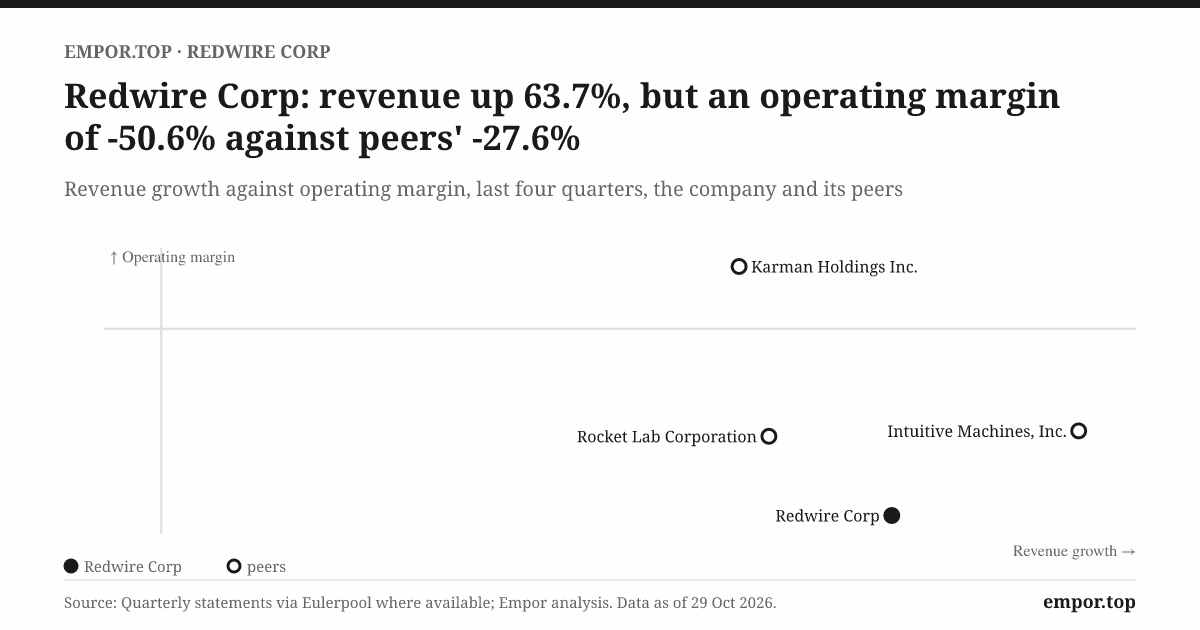
Then came the June 2026 quarter, and the record non-GAAP gross margin.1 It is a genuine improvement: from a full-year gross margin around 5% to a quarter in the high twenties. Part of the improvement reflects mix, because Defense Tech products carry a different margin profile and less estimate risk, and part reflects fewer large estimate charges in the Space business. Yet even in that quarter, adjusted EBITDA was still negative, and the GAAP operating loss was about $22 million.1
The improvement also has to be read against the scale of the business. A 27.8% gross margin on $117 million of quarterly revenue produces roughly $33 million of gross profit, and Redwire's operating costs, from engineering overhead to corporate expenses, amortization of acquired intangibles and share-based pay, still consumed all of that and more.2 The path to profitability therefore runs through two levers at once: keeping gross margin at or above that level, and growing revenue faster than overhead so that fixed costs are spread more thinly. Neither lever has been proven over more than a quarter.
What made the Q2 2026 call revealing was not the good news but the caveat. Chief financial officer Chris Edmunds, who took the role in 2025, cautioned that Redwire's forward-leaning technology work could bring further estimate adjustments in the future.11 It was a candid admission, and a sensible one, because the work most likely to produce cost surprises, first-of-a-kind engineering on fixed-price terms, is also the work Redwire describes as its technological edge. Put the two calls side by side, the June 2025 call explaining an overrun and the June 2026 call guiding to better margins while warning that overruns could return, and the change is real but incomplete. The explanation has become more candid; the exposure has not gone away.
The control environment
The audit opinion adds the final layer. KPMG gave Redwire's financial statements an unmodified, or clean, opinion for 2025, meaning it concluded the numbers were fairly stated. But it gave an adverse opinion on internal control over financial reporting, because Redwire had material weaknesses, including weaknesses in the newly acquired Defense Tech business.3 A material weakness means there is a reasonable possibility that a material misstatement would not be prevented or caught in time. Redwire reported that remediation was under way, and noted, as companies must, that weaknesses are not considered fixed until the new controls have operated effectively for a sufficient period.3
For a company whose margins depend on cost-to-complete estimates, and whose growth depends on integrating acquired businesses, that is not a technicality. It is evidence that the systems for producing those estimates and integrating those businesses were not yet where they needed to be. The verdict is therefore not that 2025 was a run rate; it was not. It is that the estimate losses, the impairment and the control weaknesses together are the most serious execution evidence in Redwire's history, and one improved quarter does not establish recovery. Several quarters of stable margins without large unfavorable adjustments would.
All of which puts a sharp edge on the question of what management should do next with shareholders' capital.
VII. The roll-up's second act: capital, dilution, and credibility
On the August 2026 earnings call, Peter Cannito told investors that, with the Edge Autonomy integration well under way, Redwire would keep scanning for acquisitions available at good values.11 For a company assembled from ten acquisitions, it was not a surprising sentence. For a company that had just lost about $230 million at the operating line, issued well over a hundred million new shares and earned an adverse internal-control opinion, it was a sentence that invited scrutiny.
Cannito is the constant in this story. The same chief executive has led Redwire since its founding in 2020, through the SPAC, the 2021 shopping spree, the 2022 preferred-equity raise, the Edge merger and the 2025 losses.3 The strategic vocabulary has been consistent throughout: platform, infrastructure, multi-domain. Chris Edmunds became chief financial officer in 2025, after Jonathan Baliff retired from the role; Baliff's 2025 compensation included about $842,000 of severance benefits under a retirement and consulting agreement.12
Cannito's own pay is weighted toward equity, which aligns the chief executive's interests with the share price at least in direction. Cannito's reported 2025 compensation was about $4.4 million, of which about $3.7 million was stock awards.12 In a year when the company lost more than $220 million, an outsider might wince at the total. But the structure, mostly stock, means that realized pay rises and falls with what the market thinks the chief executive's decisions are worth, which is the right principle even if the absolute level is open to debate.
A governance knot
The Edge deal raised a governance question that deserves to be stated plainly. AEI was Redwire's former parent and a major shareholder, and AEI also owned Edge Autonomy. The firm was, in effect, selling one of its portfolio companies to another for $925 million, much of it paid in the buyer's stock. To manage that conflict, Redwire's board formed a special committee of independent directors to evaluate and negotiate the transaction, and the proxy describes the committee's process and the fairness analysis it relied on.9 That is the standard and appropriate mechanism. It does not change the fact that AEI stood on both sides of the deal, nor that the seller received equity that left it with a large voting position in the combined company. Redwire describes itself as no longer a controlled company.12 As of late March 2026, AEI-related holders owned about 33.6 million common shares plus preferred shares carrying about 16.1 million votes on an as-converted basis.12
The financing sequence
Follow the money and the pattern of Redwire's capital history comes into focus. In 2022, when cash was tight, Redwire sold about $81.25 million of convertible preferred stock to AEI, Bain Capital and other investors.3 In 2025, holders of the company's public warrants exercised them, bringing in about $77.5 million and creating about 6.7 million new shares.3 Then came the Edge shares. In May 2026, AEI converted its remaining preferred stock into about 15.25 million common shares, after which no preferred remained.13 Removing the preferred simplified the capital structure and ended its accumulating dividends, but it also added to the common share count. In February 2026, the Edge-related term loan was refinanced.2 And in May 2026, Redwire registered an at-the-market program allowing it to sell up to $350 million of new common stock directly into the market over time.14
The result is visible in the share count: about 249.9 million shares outstanding at the June 2026 quarter, against about 67 million at the end of 2024.2 In eighteen months, the number of slices in the pie nearly quadrupled.
The capital raised did strengthen the balance sheet. By June 2026, Redwire held about $557.7 million of cash, cash equivalents and restricted cash, against about $48.9 million of term-loan principal carrying an effective interest rate of about 8.1%.2 Compared with the end of 2025, when cash was about $95 million, the company had moved from a thin cushion to a substantial one, and the risk that Redwire would be forced to raise money on bad terms receded.3 One reconciliation note keeps the record straight: third-party data services report much higher total borrowings for the end of 2025, about $231 million, while Redwire reported about $88.4 million of conventional debt, separate from leases, in its own debt note; the difference appears to reflect what each counts as debt, and the company's own note is the better guide.3
The at-the-market program deserves a sentence of plain explanation, because it is the most important open door in the capital structure. Instead of selling a large block of shares at once, an ATM lets the company sell stock in small amounts through brokers at prevailing market prices, whenever it chooses.14 It is cheap and flexible, which is why companies like it, and it is quiet, which is why shareholders need to watch it. At a share price around $9.44, raising the full $350 million would mean issuing something like 37 million new shares, roughly 15% more on top of the June count. Whether that issuance funds productive growth, cushions further losses or pays for the next acquisition is the question that decides whether it helps existing owners.
The related-party channel, by contrast, has become small. Sales to customers linked to board members or to AEI's other investments were about $3.2 million in 2025, roughly 1% of revenue, down from about $10.5 million in 2024, and they fell further in the first half of 2026.3 Redwire says other transactions with AEI portfolio companies that it does not separately disclose were not material. Given AEI's history on both sides of the Edge deal, the shrinking of this line is a modest but genuine reassurance.
Shareholders, for their part, sent mixed signals at the May 2026 annual meeting. The say-on-pay vote passed comfortably, with about 87.5 million votes for and 5.2 million against. But director Reggie Brothers received about 29.4 million votes withheld against about 63.5 million for, nearly a third of votes cast, a meaningful protest even if not a defeat.13
Has management earned another deal?
Here an activist's question becomes unavoidable. A roll-up's value depends on buying businesses for less than they are worth to the combined company. Redwire's record on that test is mixed at best. The Belgian Space Europe business carried a $34.4 million impairment in 2025. The legacy Space segment, assembled from most of the earlier acquisitions, shrank 18% that year. And the largest deal, Edge, was paid for substantially in shares at a demanding multiple, with returns still to be demonstrated. Against that record, a promise to pursue accretive acquisitions is a claim, not evidence. Redwire's return on invested capital was about negative 14% for the twelve months to June 2026, and operating cash flow was still negative.2
The fair verdict is not that management is undisciplined. It is that management has not yet shown, in its own numbers, that its acquisitions earn more than they cost, and that it now has both a large cash balance and a $350 million equity program with which to buy more. The burden of proof sits squarely with Cannito and his board: show the return on Edge, show positive cash generation, and then make the case for the next deal. Which brings the story to the question every investor in the stock ultimately faces.
VIII. What has to be true for the stock to work?
An investor looking at Redwire in late October 2026 faces two sets of facts that refuse to reconcile neatly. One set says demand is real: $542.1 million of contracted backlog in June, split between about $322 million in Space and about $220.2 million in Defense Tech, and a book-to-bill ratio of about 1.42 in the June quarter, meaning the company booked $1.42 of new orders for every dollar of revenue it recognized.1 The other set says the economics are unproven: 2025's cash burn, a large estimate-loss history and a share count that has nearly quadrupled.3
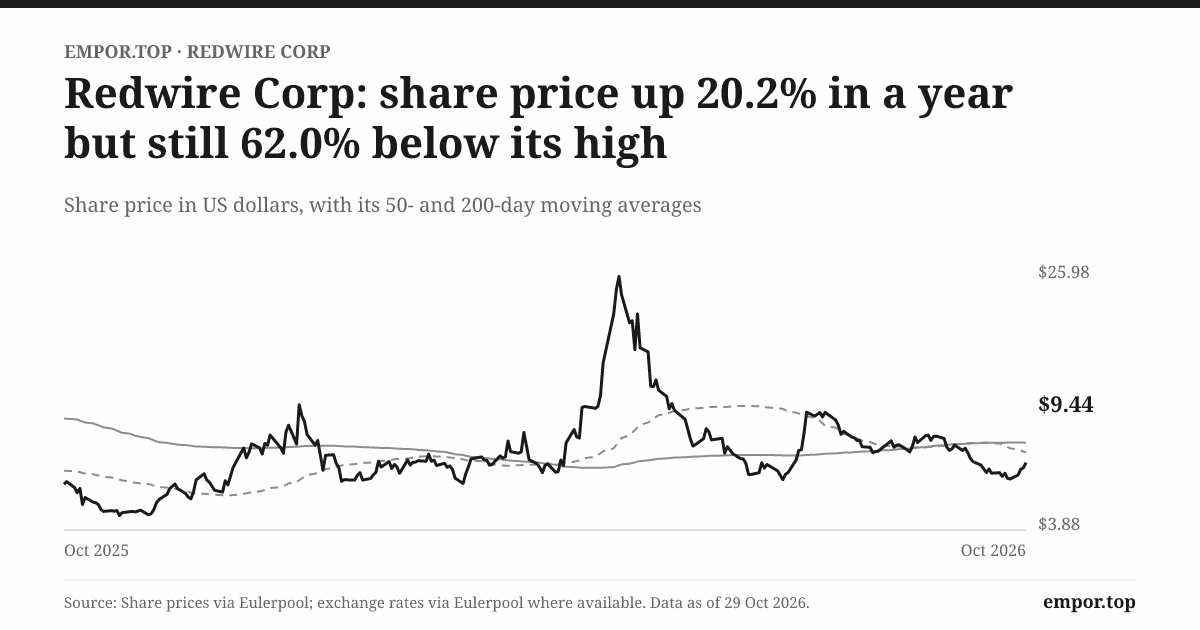
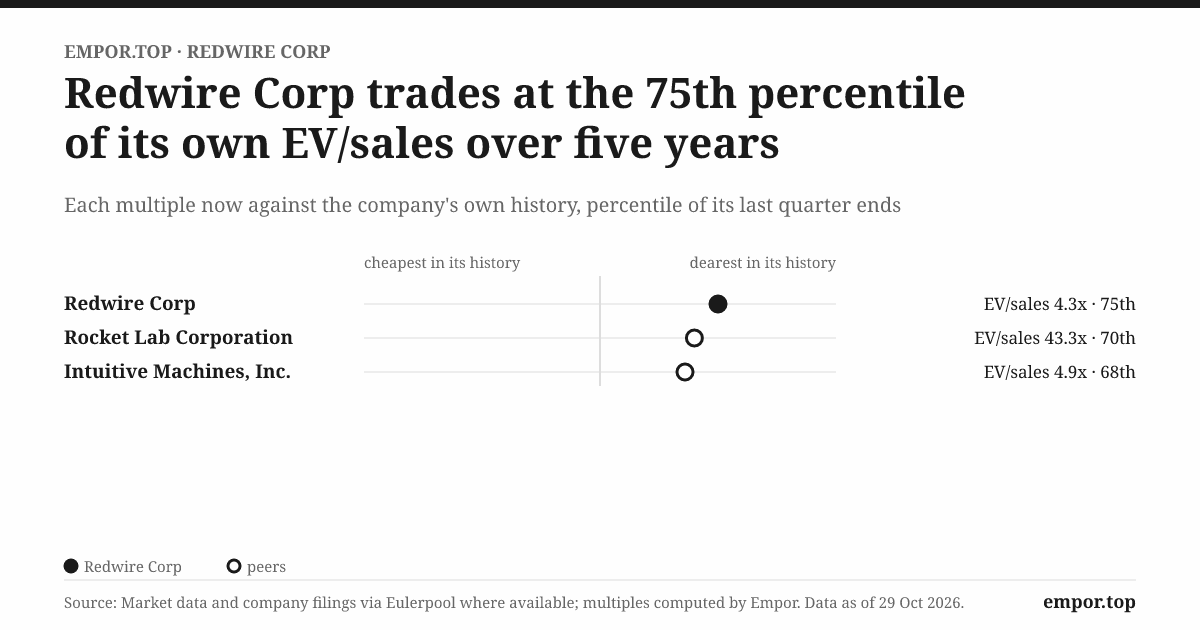
The market has been oscillating between those two readings with extraordinary violence. On October 29, 2026, Redwire's shares closed around $9.44, about 62% below their 52-week high of about $24.80, and well above a 52-week low of about $5.06.15 Over the past five years the stock has at one point fallen about 87% from a prior peak, a volatility that tells its own story about how uncertain investors have been.15 On the June share count, the equity is worth roughly $2.4 billion; net of the June cash balance and debt, the enterprise is valued at a little over four times trailing twelve-month revenue of about $424 million.2 With earnings negative, there is no meaningful price-to-earnings or EV-to-EBITDA multiple to compare with history. What the price does seem to assume is that Redwire's revenue will keep growing and that margins will eventually reach a level where that revenue produces cash, because on current cash flow the business is a consumer of capital, not a producer of it.
The five forces, applied to a space-and-drone contractor
Run Redwire through Michael Porter's five forces and the shape of the challenge appears. Buyer power is high. National security agencies, civil space agencies and prime contractors are sophisticated, budget-constrained buyers, and two of them accounted for about 38.5% of 2025 revenue. Government buyers can split awards among vendors, re-compete programs and insist on fixed-price terms that push cost risk onto suppliers, which is exactly the risk that produced Redwire's estimate losses. Supplier power is harder to judge because Redwire does not disclose supplier concentration, but specialized space-grade materials and electronics come from a limited base, and subcontractor cost growth was one of the reasons the company cites for estimate changes.3
The threat of substitutes is real in both segments. In space, a prime can insource a component or qualify an alternative; in drones, the rapid evolution of cheaper, more expendable systems, visible in Ukraine, could compress the value of premium long-endurance aircraft. The threat of new entrants is moderate. Flight heritage takes years to accumulate, which protects Redwire against startups, but venture- and defense-backed entrants have flooded both small satellites and drones since 2020. And rivalry among incumbents is intense, with Rocket Lab building out a component catalogue on a larger revenue base, European specialists competing on their home turf, and the primes always able to do the work themselves.
Seven powers, and the ones Redwire lacks
Hamilton Helmer's seven powers framework asks a sharper question: what lets a company earn returns above its cost of capital for a long time? Test each power against the evidence. Scale economies favor Rocket Lab and the primes, not Redwire. Network effects are absent; one customer's satellite does not make Redwire's sensors more valuable to the next. Switching costs exist in a narrow, program-specific sense, because once a component is qualified on a spacecraft design, the program is reluctant to change it mid-stream, but they do not carry over to the next competition, and the history of Customer D shrinking from about $107.6 million to about $66.3 million in a year shows that even a dominant customer relationship can move.3 Brand, in this industry, is flight heritage, and Redwire has a genuine version of it. Counter-positioning, a business model incumbents cannot copy without harming themselves, is not obviously present. A cornered resource could be argued for specific patented technologies such as roll-out solar arrays, but the record does not show those technologies producing outsized margins. And process power, the hard-to-replicate operational excellence of a Toyota, is precisely what the estimate losses argue Redwire has not yet achieved.
The honest moat verdict is that Redwire has the beginnings of two powers, a heritage-based brand and program-level switching costs, but no evidence yet of the pricing power or margin stability that would show they are durable. Past performance, reliability and integration genuinely matter to customers in these markets, which is why the backlog exists. They have not yet translated into returns.
The case for, and what could break it
The bull case is coherent. Redwire now sits in several procurement pools that governments are expanding at once: space infrastructure for national security, civil exploration, European sovereign space programs and, through Edge, the small uncrewed aircraft and surveillance systems that modern militaries have discovered they need in quantity. Its balance sheet in mid-2026 is the strongest it has been. The June-quarter gross margin suggests that, with fewer estimate charges and a better mix, the company can earn a reasonable gross profit. And a book-to-bill above one says customers are ordering faster than Redwire is delivering.
The bear case is equally coherent and has stronger proof in the historical record. The estimate losses grew three years running. The legacy Space business shrank. The flagship acquisition was paid for with equity at a demanding price, with its returns still unproven. Customers can multi-source or insource, rivals have more capital, and the identities and economics of Redwire's largest contracts are only partly visible. Political and operational risks run through specific mechanisms: a government budget delay or continuing resolution pushes awards to the right and leaves contract assets unbilled; export controls and international exposure can restrict sales, especially of drones; cost inflation on fixed-price contracts erodes margin directly; and control weaknesses or a cybersecurity breach in a defense supplier can threaten contract eligibility itself.3
Currency is a smaller but real thread in that risk weave. Redwire's international revenue share is substantial, and the European operations transact mainly in euros, which matches costs and revenues in the same currency and limits the damage from exchange-rate swings.3 The company does not describe a material hedging program. For now, the bigger international exposure is political rather than financial: export licences, allied defense budgets and the continuing demand for surveillance drones in Eastern Europe matter more to Redwire's results than the dollar-euro rate.
Weighed honestly, the evidence leaves the bull thesis intact but unproven, and narrower than the company's platform language implies. The claim that survives is that Redwire is a credible, diversified supplier with real demand. The claim not yet supported is that it is a business whose growth produces cash. Three numbers will settle the difference: backlog conversion and book-to-bill by segment, which test demand; gross margin and the size of estimate adjustments, which test execution; and operating cash flow after working-capital movements, which tests whether the first two produce anything a shareholder can keep. Rocket Lab offers a useful yardstick of what scale looks like in this industry, though not a valuation comparison, because its launch business makes its economics different.
If those numbers are the test, then the story of the past six years has already taught its lessons, and they are worth stating plainly.
IX. Lessons from a company built by acquisition
The International Space Station has hosted Redwire hardware for years: Made In Space's printers, Techshot's biotechnology experiments, Redwire's roll-out solar arrays unfolding to power the station, crystallization payloads growing pharmaceuticals in microgravity.3 Each of those was a moment of triumph, a press release, a photograph of astronauts with a strange new machine. And yet the business that owned all of that heritage lost money every year from 2021 through 2025, and its space segment shrank in the very year its technology portfolio was broadest.3 That contrast is where the first lesson lives.
A technical first opens the door; repeat orders pay the bills. Redwire's history shows how easily investors, and companies, confuse a demonstration with a market. Printing a part in orbit proves that the physics works. It does not prove that anyone will pay a profitable price, again and again, for the next thousand parts. For founders building deep-technology companies, the lesson is to count the reorders, not the firsts. For investors, it is to treat each milestone as an option with an unknown strike price, and to ask what fraction of past milestones turned into recurring revenue. At Redwire, that fraction has so far been small.
Backlog is a promise with conditions. The $542.1 million order book in June 2026 is real, signed work, and it is the reason Redwire's revenue has visibility.2 But the story of 2025 showed how many conditions sit inside that promise: milestones that must be reached before invoices can be sent, customer funding that must arrive on time, and, above all, cost estimates that must hold. When the estimates broke, the same backlog that looked like future profit became a source of current losses, about $54.5 million of them in a single year.3 The general lesson for anyone valuing a contractor is that backlog has a quality as well as a quantity, and the quality is revealed only in the estimate adjustments and the cash-flow statement.
A clean opinion on the numbers is not a clean bill of health for the machine that produces them. In the same 2025 audit, KPMG signed off on Redwire's financial statements and declared its internal controls ineffective.3 Both judgments were true at once, and the distinction is one most investors skim past. The first says that, after a great deal of auditor work, the reported figures could be relied on. The second says the company's own systems could not yet be relied on to get them right unaided, at exactly the moment those systems were absorbing an acquired business and estimating the cost of difficult fixed-price contracts. For anyone assessing a fast-assembled company, the lesson is to read Item 9A as carefully as the income statement, because control weaknesses are often where the next estimate surprise is born.
The purchase price keeps speaking after the deal closes. Edge Autonomy's $925 million headline was, on the day it closed, just a number in a press release.8 But because Redwire paid largely in stock, that number continues to speak through every share of the enlarged company, in the per-share economics of every future quarter. A roll-up that pays in cash learns quickly whether it overpaid, because the debt has to be serviced. A roll-up that pays in shares can defer the reckoning, but not avoid it: the dilution is permanent, and only earnings growth can make it worthwhile. For acquisitive companies and their shareholders, the lesson is that a deal is not complete at closing. It is complete when the returns on the purchase price can be measured, and until then, the next acquisition should wait for the evidence.
X. Epilogue
At the end of October 2026, Redwire stands in an unusual position: richer in cash than at any point in its history, larger than ever, and still unproven. The company says it expects 2026 revenue of $450 million to $500 million, its first full year with Edge Autonomy inside the tent and a step up from about $335 million in 2025.11 It carries $542.1 million of contracted backlog.2 It has yet to report a quarter in which adjusted EBITDA, let alone cash flow, turned decisively positive; the June quarter's adjusted EBITDA was about negative $3.2 million.1
That guidance is itself a credibility marker worth tracking. The SPAC-era growth target was not met on schedule. The 2026 range is narrower, nearer in time and backed by a backlog larger than the revenue still needed to reach it, though not all of that backlog will be delivered this year, which makes it a far more modest promise. Delivering it, and delivering it with improving margins rather than through another acquisition, would be the first clean evidence in years that management's forecasts and the company's results move together. Missing it would reopen the question of whether Redwire's ambitions consistently run ahead of its execution.
The next moments that will decide the story are on the calendar. The third-quarter report, due in the weeks ahead, will be the first to compare a full quarter of Edge Autonomy against a full quarter of Edge Autonomy a year earlier, so for the first time Defense Tech's organic growth will be visible without the acquisition's arithmetic. If that growth is healthy, and the segment's backlog keeps rising, the acquisition thesis gains its first real evidence. If Defense Tech growth stalls once the anniversary passes, the doubling will look in retrospect like what it mostly was: a bought step-change, not a new trajectory.
On the Space side, the question is whether the 2025 shrinkage was a trough. A book-to-bill above one in Space, and a quarter or two without large unfavorable estimate adjustments, would argue that the business has stabilized and that the hard lessons of 2025 were absorbed into better pricing and program control. A fresh round of estimate charges, which the CFO warned could come from forward-leaning technology work, would argue the opposite.11 The remediation of the material weaknesses, which Redwire will report on with its 2026 annual filing, is the parallel test of whether the control systems behind those estimates have improved.
The cash-flow statement remains the final judge. Watch whether contract assets convert into invoices and then into cash, and whether operating cash flow turns positive after working capital, not just before it.2 And treat any use of the $350 million at-the-market program, or any new acquisition, as an event that changes the per-share math, not merely the company's size.14 A larger Redwire is not automatically a more valuable one for the people who own a slice of it.
There are three possible endings. In the best, Space stabilizes, Defense Tech grows on its own, margins hold near the June-quarter level, and operating cash turns positive in 2027, turning the roll-up into a platform. In the middle, revenue grows but cash stays stubbornly negative, and the company keeps drawing on its cash pile and its equity program to fund the gap, growing larger while per-share value stands still. In the worst, estimate losses return, a large customer shrinks, and the balance sheet that looked so strong in June becomes the reserve that pays for another difficult year. Which ending arrives depends less on any new growth claim than on a few lines in the next several quarterly filings.
XI. Outro
Go back to the split screen. On one side, a deployable boom folded tight for launch, waiting to spring open three hundred miles above the Earth. On the other, a small grey aircraft on a catapult rail, about to be flung into a sky over a border somewhere, where it will circle for hours and send back pictures. They are made by different engineers, in different buildings, for different customers, under different kinds of contract. They share a ticker, a balance sheet, and the fortunes of one group of common shareholders.
That is what makes Redwire unlike a conventional aerospace supplier. Most suppliers grow by doing one thing better over time. Redwire grew by assembling many things quickly and wagering that one public company could make specialized technology across space and defense earn durable returns. The wager is now fully visible, in the backlog, the segment split and the share count. The returns are still being tested, one quarterly cash-flow statement at a time.
References
-
Redwire Corporation Reports Second Quarter 2026 Financial Results — Redwire Corporation, 2026-08-05 ↩↩↩↩↩↩↩↩↩↩
-
Q2 2026 Form 10-Q — Redwire Corporation, SEC, 2026-08-06 ↩↩↩↩↩↩↩↩↩↩↩↩↩↩
-
2025 Form 10-K — Redwire Corporation, SEC, 2026-02-27 ↩↩↩↩↩↩↩↩↩↩↩↩↩↩↩↩↩↩↩↩↩↩↩↩↩↩↩↩↩↩↩↩↩↩↩↩↩↩↩↩↩↩↩↩↩↩↩↩↩↩↩↩↩↩↩↩↩↩↩↩↩↩↩↩↩↩
-
2021 Form 10-K — Redwire Corporation, SEC, 2022-04-08 ↩↩↩↩↩↩↩↩↩
-
2021 Investor Presentation and SPAC Merger Materials — Redwire Corporation, SEC, 2021 ↩
-
Completion of Edge Autonomy Acquisition, Form 8-K — Redwire Corporation, SEC, 2025-06-13 ↩↩↩
-
Edge Autonomy Merger Proxy — Redwire Corporation, SEC, 2025 ↩↩↩↩
-
Q2 2025 Earnings Call Transcript — Redwire Corporation, 2025 ↩
-
Redwire (RDW) Q2 2026 Earnings Call Transcript — The Motley Fool, 2026-08-13 ↩↩↩↩
-
2026 Definitive Proxy Statement — Redwire Corporation, SEC, 2026-04-10 ↩↩↩↩
-
2026 Annual Meeting Voting Results, Form 8-K — Redwire Corporation, SEC, 2026-05-20 ↩↩
-
ATM Prospectus Supplement — Redwire Corporation, SEC, 2026-05-06 ↩↩↩
 LinkedIn
 WhatsApp
 Reddit
 Hacker News
 Email
 Kindle
 RSS Feed
 Spotify
 Apple Podcasts
 Amazon Music
 Audible
 YouTube