Kemper Corporation: The Auto Book That Needs to Earn Its Way Back
I. The quarter that looked better, but still lost money underwriting
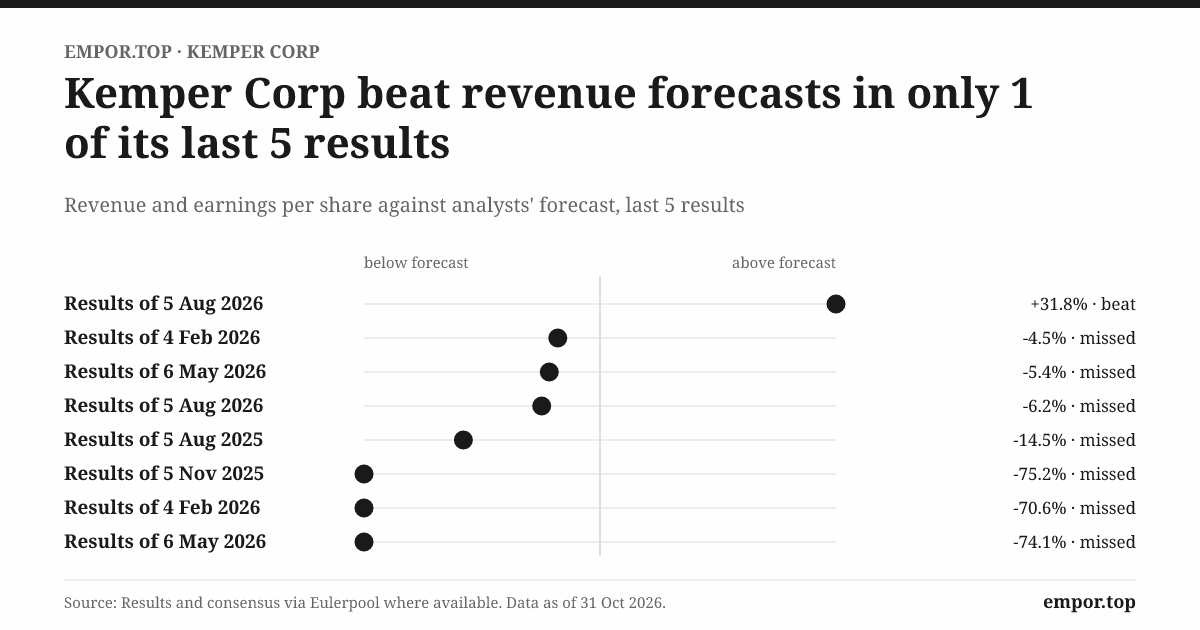
On Wednesday, October 28, 2026, Kemper Corporation did something companies usually avoid. It got ahead of its own earnings date. Nearly two weeks before the full third-quarter report, the Chicago insurer put out a short preliminary release saying it expected net income of about $52 million for the quarter, or 88 cents a share.1 Three months earlier the same company had reported a loss of about $465 million.1 On the surface, that was the kind of swing that gets a stock moving: from a crater to a profit in a single quarter, with adjusted operating income more than doubling to about $60 million from about $26 million.1
Then came the sentence that set the tone. Stephen McAnena, the chief executive who had been in the job for barely five months, said the company was pleased with the improvement, "but we have more work to do."1 Chief executives say things like that all the time. In Kemper's case, the numbers underneath said it more bluntly than he did.
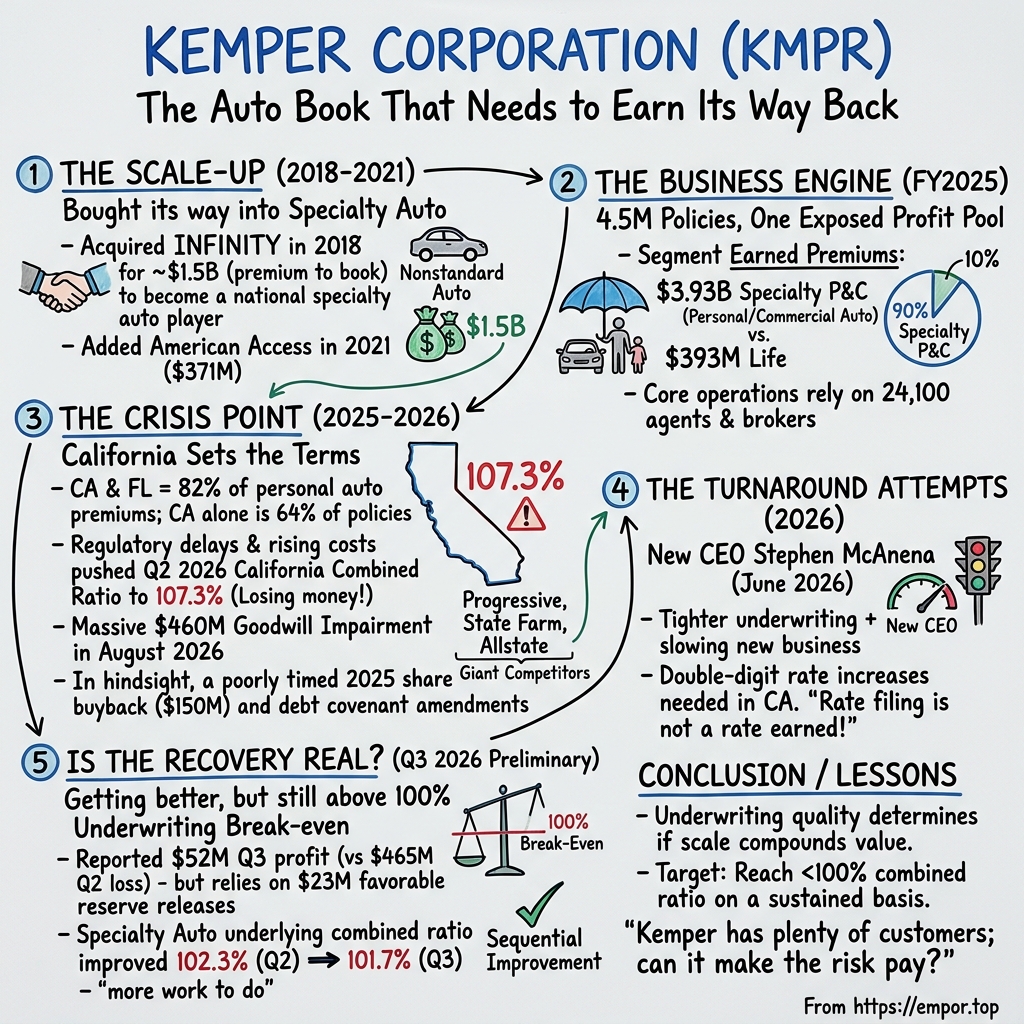
The measure that matters most for an auto insurer is the combined ratio: claims plus the cost of running the business, divided by the premiums earned. Under 100% the insurer makes money writing policies. Over 100% it pays out more than it takes in and has to rely on investment income to make up the gap. Kemper's Specialty Auto business reported a combined ratio of about 99.2% for the third quarter, down almost five points from about 104% in the second.1 That looks like a business that has just crossed back into underwriting profit. But the figure included about $23 million of favorable prior-year reserve development.1 In plain English, Kemper had set aside more money for older claims than it now thinks it needs, and releasing that cushion flattered the current quarter.
Take the old claims out, along with catastrophes and other noise, and you get the underlying combined ratio, the closest thing an insurer has to a clean reading of today's pricing. For Specialty Auto that number was about 101.7%, a little better than 102.3% in the second quarter.1 Still above 100. For every $100 of auto premium Kemper earned on current business, it was still spending about $101.70 on claims and expenses. The headline said profit. The engine said the book was still losing money underwriting, just a bit more slowly than before.
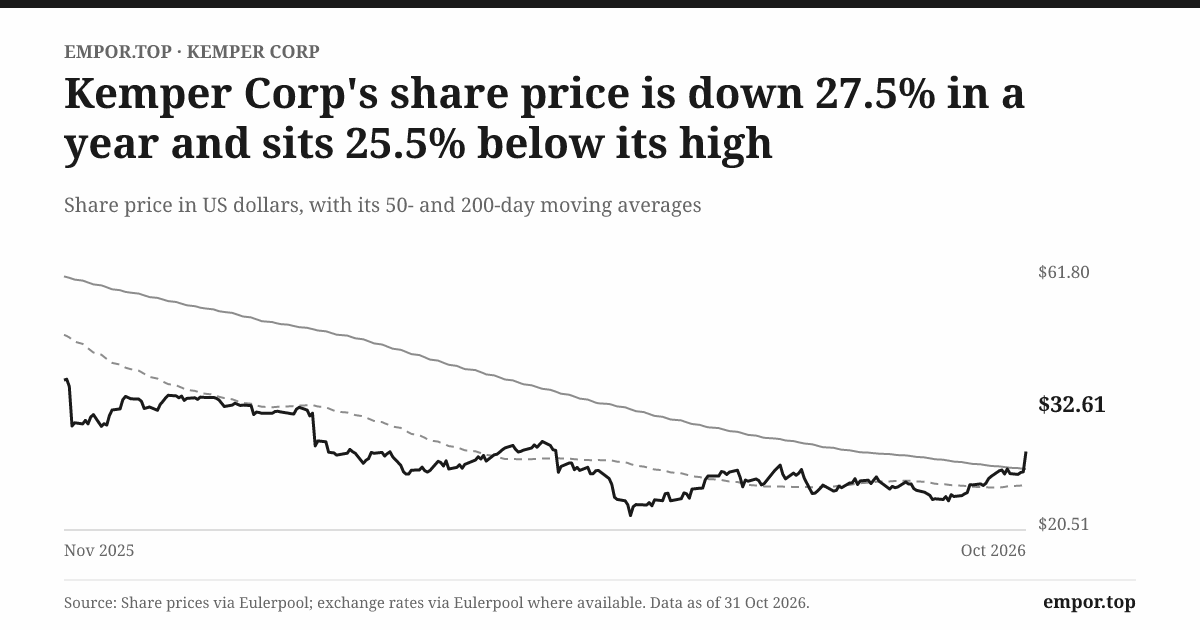
That contradiction is the whole story in miniature. The market has priced it accordingly. As of October 31, 2026, Kemper's shares stood at $32.61, about 27.5% below their 52-week high of nearly $45, and the company was worth about $2 billion.2 Over the twelve months through June it generated about $4.6 billion of revenue and lost $8.42 a share, almost all of it in the quarter that carried a giant goodwill write-down.2 The shares had also bounced hard off a 52-week low near $22.72, which tells you investors were already pricing some of the recovery before the October preview arrived.2
So this episode asks three questions. The first is whether price increases can repair Kemper's California auto book before the book shrinks so much that there is not much left to repair. The second is whether the acquisition-led strategy that turned Kemper into a specialty auto company, starting with the 2018 purchase of Infinity, created value that survives a $460 million write-down. The third is personal: whether McAnena, an outsider who arrived after a seven-month leadership vacuum, can restore underwriting profit that repeats quarter after quarter and earn back investor trust.
It helps to be clear about what Kemper is. Kemper Corporation is a Delaware holding company that owns a group of insurance subsidiaries; it has traded on the New York Stock Exchange as KMPR since August 2011.3 No parent company or private-equity sponsor controls it, so the results here are the economics shareholders actually own. Its largest shareholders are index and active fund managers, not a founding family or a strategic owner.4
The slide into that quarter did not happen overnight, which is part of why the market is skeptical of a single good print. Kemper earned money in every quarter of 2024 and in the first half of 2025. Then the third quarter of 2025 swung to a net loss of about $21 million, the fourth quarter lost about $8 million, and the first quarter of 2026 roughly broke even before the second-quarter collapse.2 Four consecutive quarters without a meaningful profit, in other words, preceded the October preview. Investors have watched this company look like it was turning a corner before.
It also helps to be honest about the clock. The full third-quarter results were scheduled for Monday, November 9, with a conference call on November 10.1 As of the end of October, the latest evidence about the third quarter is a preliminary release, with no segment detail and no analyst Q&A. The verdict on this quarter, then, has to be a careful one. It is a step forward. It is not yet proof of recovery, because the part of the business that decides Kemper's fate was still, on the company's own preferred measure, below break-even.
To understand why a company with more than four million policies is fighting to get from 101.7 to below 100, you have to go back to the bet that made specialty auto the center of Kemper's world.
 Subscribe on LinkedIn
II. The company that bought its way into specialty auto
For most of its history Kemper was not really Kemper. It was Unitrin, a Chicago insurance holding company that owned a sprawling mix of life, health, home and auto businesses. In 2011 Unitrin took the name of one of its best-known brands, Kemper, and the ticker KMPR along with it.3 The rebrand was more than cosmetic. It marked the start of a long effort to simplify a conglomerate into something investors could value, and over the following decade the company kept narrowing its focus. The defining pivot, the one that explains almost everything about today's company, came in February 2018.
That month Kemper agreed to buy Infinity Property and Casualty, a Birmingham, Alabama, insurer that specialized in nonstandard auto: coverage for drivers who struggle to buy a policy from the big standard carriers because of their driving record, credit history, the age of their car, or simply because they want a minimum-limits policy at the lowest possible price.5 Infinity sold mostly through independent agents, with its business concentrated in large Sun Belt auto markets. It wrote about $1.4 billion of direct premiums in 2017.5
The headline price was $1.4 billion in cash and Kemper stock, and the offer represented a premium of about 25% for Infinity shareholders based on Kemper's share price at the time.5 Because part of the consideration was paid in Kemper shares, the deal got more expensive as Kemper's own stock rose. By the time it closed on July 2, 2018, the consideration came to about $1.5 billion.6 Kemper's chief executive, Joseph Lacher, who led the company for nearly a decade,7 presented the deal as the move that would make Kemper a scaled leader in specialty auto rather than one diversified insurer among many.5
Was the price high? A useful clue comes from a contemporaneous table of property-casualty deals compiled in a later merger filing. In that set, the Infinity acquisition was priced at about 1.84 times Infinity's book value, against a median of roughly 1.67 times for comparable transactions.8 So Kemper paid more than the typical buyer of a P&C insurer, measured against the equity on the target's balance sheet. That is a clue, not a conviction. Buyers pay above the median when they expect above-median returns, and in 2018 there was a coherent logic for doing so. Infinity brought national scale in a niche where scale matters for data and claims handling, an agent network Kemper could not have built quickly, and an opportunity to cut overlapping costs.
Management put numbers on that logic. Kemper forecast about $55 million a year of pre-tax cost savings from combining the two businesses, plus another $5 million to $10 million a year from repositioning Infinity's investment portfolio.5 Those are meaningful figures against a $1.5 billion purchase price: if the cost savings were fully realized and sustained, they alone would represent a pre-tax return of more than 3% a year on the price before counting any underwriting profit from the acquired book. The real return was always going to depend on something cost synergies could not guarantee, which was whether the combined company could price nonstandard auto risk correctly year after year.
For a while, that question seemed to answer itself. Kemper's revenue jumped from about $2.7 billion in 2017 to $3.7 billion in 2018 and about $5 billion in 2019, the first full year with Infinity inside the group.9 Net income in 2019 was the best in the decade, at about $531 million.9 That is the version of the story most people remember: the deal that doubled Kemper's scale and delivered a record year almost immediately. The record shows that the 2019 peak came in a benign period for auto claims, and that it did not last.
Kemper kept building. In 2021 it bought American Access Casualty Company, an Illinois-based nonstandard auto insurer, for about $371 million.9 It was a smaller deal, aimed at adding geography and distribution, but it pointed in the same direction as Infinity: more specialty auto, bought rather than grown. By the early 2020s, Kemper's identity was settled. It was a specialty auto insurer with a life insurance business attached.
The trouble is that the record after 2019 is not the record of a deal that obviously compounded. Kemper lost money in 2021, 2022 and 2023 as inflation in used cars, repairs and medical costs surged through the auto industry and its prices lagged behind.9 It recovered in 2024, slipped again in 2025, and in the second quarter of 2026 took a $460 million impairment against the goodwill on its Specialty P&C business.10 Goodwill is the accounting residue of paying more than book value for acquisitions, and Infinity and American Access both contributed to it. The impairment says the expected value of the combined specialty franchise has fallen. It does not, on its own, prove that Infinity specifically was overpaid, because the charge sits on a combined business that has been reshaped by years of later decisions. But it does hand shareholders a fair question: what, exactly, did that premium buy?
The shape of the top line makes the point. Kemper's revenue peaked at about $5.6 billion in 2021 and has drifted down since, to about $4.8 billion in 2025 and about $4.6 billion over the twelve months through June 2026.2 Over three years, revenue has shrunk by about 4% a year. Some of that decline was deliberate, as Kemper raised prices and walked away from business it could not price, and some of it reflects exits from non-core lines. Either way, the company that bought scale has spent much of the time since giving part of it back.
To answer it, start with what Kemper actually sells, and where the money is made and lost.
III. Four million policies, one exposed profit pool
Picture a driver in Los Angeles renewing a six-month auto policy through a neighborhood insurance agent. She pays a premium, perhaps monthly. The agent earns a commission. Kemper's underwriting systems have priced her risk based on her car, her driving record and her zip code, and they have done so months before anyone knows whether she will have an accident. If she does, a claim may take weeks to settle for a damaged fender and years for a disputed injury. Meanwhile, Kemper holds her premium and invests it.
That is the whole business model of an insurer in one loop. Premiums and investment income arrive before many claims are paid. The money held in between, the float, sits in bonds and other securities. If the premiums were priced well, the insurer makes an underwriting profit and investment income on top. If they were priced badly, investment income becomes a subsidy for losing policies.
Kemper runs that loop at scale. At the end of 2025 it had more than 4.5 million policies in force and about 24,100 agents and brokers selling them, with roughly 7,400 employees behind the operation.3 The products sort into two segments of very different size. In 2025, the Specialty Property & Casualty segment earned about $3.93 billion of premiums, while the Life segment earned about $393 million.3 Specialty P&C is roughly nine-tenths of the earned premium. Inside it, personal auto contributed about $3.02 billion of premiums and commercial auto, mostly small-fleet and business vehicles, about $901 million.3
The earnings split looks a little different, and that is revealing. In 2025 Specialty P&C produced about $187 million of adjusted operating income, and Life produced about $69 million.3 So a segment with one-tenth of the premiums earned more than a quarter of the combined segment operating income. Life is small, but it is steady: about $18 million of operating income in each of the first two quarters of 2026 and about $20 million in the preliminary third-quarter results.11121 Management described it on the Q2 call as a source of "stable earnings, consistent cash flow, and valuable diversification."12 That is a fair description of the numbers, and it also tells you its limits. Life cannot carry the company. It can only cushion it.
The real swing factor is personal auto, and the distinction inside P&C matters. Commercial auto has been the better business recently. Its underlying combined ratio was about 93.7% in the second quarter of 2026, meaning it made roughly $6 of underwriting profit on every $100 of premium before old-claim adjustments, and its policy count was growing.12 But it is not a hedge that works automatically. Commercial auto carries about $1 billion of reserves, the great majority tied to bodily-injury claims, and those claims take years to settle, which is how a profitable-looking line can turn when old claims develop worse than expected.12 On the Q1 call, the company's finance team pointed to adverse development in older commercial auto accident years, concentrated in California.11 The line that looks safest is still exposed to the same court system that is hurting personal auto.
How does Kemper win customers? Mainly through agents and short renewal cycles. Auto policies typically last six or twelve months, which means pricing, retention and claims service are tested constantly. Every renewal is a fresh decision by the customer, often with an agent quoting several insurers side by side. That makes auto insurance a fast feedback business: price errors show up quickly, and so do price increases, because customers leave.
The investment side of the loop is large enough to matter. At the end of 2025 Kemper held about $8.7 billion of investments, most of it in fixed-maturity bonds, and earned about $399 million of segment net investment income during the year, roughly $211 million in P&C and $188 million in Life.3 That gives a useful way to think about the current underwriting problem. Specialty P&C earns close to $4 billion of premium a year. At an underlying combined ratio of about 101.7%, the current-year business loses roughly $65 million to $70 million a year before investment income, while the P&C portfolio throws off a little over $200 million. Investment income is therefore covering the underwriting gap with room to spare, which is why the group still reports operating profits. But that is also the trap. An insurer that relies on its bond portfolio to subsidize mispriced policies is earning a bond fund's return on an insurance company's risk.
The nonstandard customer shows up in the receivables, too. Kemper ended 2025 with about $965 million owed by policyholders and a tiny allowance against it, yet over the course of the year it booked about $54 million of provisions and wrote off about $55 million.3 That churn is typical of customers who pay in installments and sometimes stop paying, at which point the policy lapses and the receivable is written off. It is a small number against the premium base, but it says something about who Kemper serves: drivers for whom an insurance bill is a monthly budget decision, and for whom a rate increase is very much noticed.
This loop also explains why some of the screens that investors use for industrial companies do not work for Kemper. The company's operating cash flow was about $584 million in 2025, far above net income, and the screens convert that into a free-cash-flow yield of roughly 23% on today's market value.2 It looks like a cash machine. It is not that simple. In 2025 the cash-flow statement included a $375 million increase in insurance reserves.3 Reserves rising means Kemper booked claims it had not yet paid, so cash stayed in the building for now, but it belongs to future claimants. In 2022 and 2023, when the company was losing money, operating cash flow turned negative.93 For an insurer, cash flow is mostly a timing story about premiums and claims, not a measure of what shareholders can take out. The cash that matters to owners is what the insurance subsidiaries can pay up to the parent after regulators are satisfied with their capital.
The price-to-earnings ratio is just as misleading. The 45.5 times multiple on market screens is built on earnings for the twelve months through March 2026, a period that ended before the second-quarter loss.2 Over the twelve months through June, earnings per share were negative.2 A P/E built on a window that misses the worst quarter tells you almost nothing about what Kemper earns today.
So the business comes down to a single profit pool with a single dominant exposure: personal auto, priced policy by policy and renewed every few months. And within personal auto, one state sets the terms.
IV. California sets the terms of the turnaround
On August 6, 2026, Stephen McAnena sat in on his first earnings call as Kemper's chief executive. He had been in the role for about two months. He was 54 and had spent 25 years at Liberty Mutual, ending as president of its business insurance unit, then ran personal lines and then distribution, life and financial services at Farmers, and most recently served as chief operating officer of Horace Mann, the educators' insurer.13 He arrived from a brief stint as an adviser to MediaAlpha, a platform that helps insurers buy customer leads, which is a revealing line on the resume: he knows how auto insurance customers are acquired, and what it costs.13
When analysts pressed him on California, he did not soften it. "Diagnosis as we sit here today," he said, "is we need double-digit rate in California."12 He also said the company had "slowed down new business anywhere where we thought the calendar year impact was going to be adverse," and he summed up the philosophy in a line that would sound like a platitude anywhere else: "Profitability is a prerequisite for growth."12 For a company whose recent history was built on buying growth, that sentence is a reversal.
Why California is so hard
California and Florida together made up about 82% of Kemper's personal-auto gross written premiums in 2025.3 In the second quarter of 2026, about 64% of Kemper's personal-auto policies in force were still in California.10 That is a concentration most insurers would consider uncomfortable, and in California it comes with a special constraint. The state runs a prior-approval system for auto rates. An insurer cannot simply raise prices when claims costs rise; it has to file a request with the California Department of Insurance, justify it, and wait for approval. The delay is the problem. Claims inflation shows up in real time, while price increases arrive months later and then take another six to twelve months to "earn in" as each policy renews at the new rate.
The claims side got worse at exactly the wrong time. California raised its minimum auto liability limits effective January 1, 2025, the first increase in decades. That change matters disproportionately to Kemper, because its California book is, in the words of the head of its auto business on the Q1 call, "about 90% minimum limits."11 Higher limits meant bigger potential payouts on each bodily-injury claim. Kemper's chief financial officer, Bradley Camden, told analysts in May that the change had "led to greater attorney involvement in claims and higher loss costs," and the interim chief executive at the time, Tom Evans, said it continued to "complicate and exacerbate loss costs."11 Bodily-injury severity, legal costs and higher limits all pushed up claims faster than Kemper could push up prices.
The analogy is a restaurant whose ingredient costs jump overnight but which needs a permit to change its menu prices, and even then the new prices apply only to customers who come back after their next reservation. You can stop taking new reservations, which Kemper effectively did. But every customer you turn away is one fewer paying for the kitchen.
The repair, one filing at a time
The repair has come in stages. On the Q1 call, the company said California had approved a 6.9% rate increase for about two-thirds of the book effective April 6, and a 3% increase on the remaining third effective in early June, with about four California filings expected to take effect during 2026.11 By the second-quarter call, Camden said rate averaging about 5.5% across two programs had begun earning into results, and Kemper had filed for another 6.9%.12 That pending filing is the one that matters for McAnena's "double-digit" diagnosis: approved and pending increases stacked together are how Kemper hopes to get there.
The improvement is real but modest. California's underlying combined ratio was about 107.3% in the second quarter, better than about 109.2% in the first.10 Across all personal auto, the underlying ratio improved to about 105.2% from 106.5%.12 And the preliminary third-quarter Specialty Auto underlying ratio, which blends personal and commercial auto, moved from 102.3% to 101.7%.1 The trajectory points the right way. The level still says that, on current business, Kemper is paying out more than it collects.
The reported third-quarter ratio of 99.2% reflected favorable reserve development.1 It says little about whether the policies Kemper is writing today are priced correctly. A turnaround built on reserve releases eventually runs out of reserves to release.
The cost of the repair is a shrinking book. In the second quarter, California policies in force fell about 10% from the previous quarter, and California's share of the personal auto portfolio dropped by about 2.5 points.12 Some of that shrinkage is deliberate: Kemper chose to stop writing business it believed would lose money in the current year. Some of it is the natural response of price-sensitive customers to higher bills. McAnena said retention "appears to be holding."12 When analysts asked when policy counts would start growing again, the answers were directional rather than dated.12 That is honest, and it is also the crux. A lower policy count reduces exposure to unprofitable risk. It also reduces the premium base that pays for agents, claims staff and technology. Shrink too far and the fixed costs start eating the improvement.
Kemper has run a version of this play before, and the precedent is instructive in both directions. When used-car prices, repair costs and medical bills surged in 2021 and 2022, Kemper's auto prices lagged badly and the company lost money for three years running.92 It responded the same way it is responding now: aggressive rate filings, tighter underwriting and a willingness to shrink. Quarterly revenue fell by around 9% to 14% year over year through much of 2023, and then the repair showed up, with operating margins near 8% to 10% through 2024 and into early 2025.2 So the history does not reject the idea that rate repair works at Kemper. What it shows is that the repair took roughly two years, cost a meaningful slice of the book, and did not last long: within about eighteen months of the recovery, California's limit change and rising bodily-injury costs had pushed the book back above break-even. A company that has to repair its pricing every few years does not yet have a pricing advantage. It has a repeatable recovery routine.
Florida has a different problem. It has a statutory profit limit on auto insurance: if an insurer's profits on a line exceed a threshold measured over three years, it must refund part of the excess to policyholders. Evans described it on the Q1 call as a "function of state law that requires insurers if profits exceed certain thresholds over a 3-year period to return a portion of profits to policyholders."11 In the first quarter of 2026, Kemper increased its refund liability for accident years 2023 through 2025 and set up a new one for 2024 through 2026, and those refunds were the difference between adjusted operating income of about $35 million and the $12.5 million it reported.11 The lesson is subtle but important. In Florida, doing well on underwriting can produce a refund rather than a retained profit. Kemper's Florida and Texas books were running at an underlying combined ratio of about 93.7% in the first quarter with growing policy counts, which is the good news, but the profit cap means Florida cannot fully offset California's losses.11
What about the claim that Kemper has an edge here? Management points to specialty underwriting expertise, long-tenured agent relationships and scale in the nonstandard market. Those are plausible strengths. The test of an edge in auto insurance is whether a company can price risk better than rivals, keep customers longer, or run cheaper. The evidence so far points the other way on the first test: Kemper's California book has needed multiple rounds of rate to get within sight of break-even, which means its pricing lagged its losses for an extended period. On cost, management has a plan rather than a result. It had identified more than $80 million of annualized run-rate savings by the second quarter and is targeting a specialty auto expense ratio below 20%, down from about 22%.1211 If it gets there, that would be a meaningful advantage in a business priced to fractions of a point. It has not yet been demonstrated.
The two calls side by side tell a consistent story with a change of emphasis. In May, under interim leadership, the explanation was external: higher minimum limits, attorneys, the legal system, Florida's refund law. In August, McAnena kept the same diagnosis but added a number and a cost. California needs double-digit rate, and the company will give up growth to get it. That is more concrete than before. Whether California's regulators approve the pending filing on time, and whether customers stay when the new prices land, are the variables McAnena cannot control. And while he waits, the question becomes whether Kemper's position in the wider market is strong enough to survive the wait.
V. A specialty insurer among national giants
Zoom out from the Los Angeles agency to the national map of American auto insurance. In 2025, State Farm and Progressive each wrote about $69 billion of U.S. private-passenger auto premiums, each holding about 18.6% of the market.14 Berkshire Hathaway, mostly through GEICO, held about 11.6%, and Allstate about 10.2%.14 Those four companies together control almost three-fifths of the largest line of property-casualty insurance in the country. Kemper's entire business, auto and life combined, earned about $4.3 billion of premiums in 2025.3 State Farm writes Kemper's annual premium in auto alone roughly every three weeks.
That comparison needs a boundary. Broad market shares are context for scale, not a direct share comparison with Kemper's specialty segment. Kemper is not trying to win the suburban family with three cars and a clean record. It is trying to serve drivers the giants either price out or serve badly. In that narrower market, its real competitors include Progressive, which has a large nonstandard book of its own, and Allstate's National General unit, along with a long tail of regional nonstandard writers. The industry does not publish clean share data for nonstandard auto, and Kemper does not claim a specific share of it.
The war game
Run the competitive forces once, and the shape of Kemper's position becomes clear. Customers have real power, because auto policies renew every six or twelve months and switching costs are low: a price increase at renewal is an invitation to shop. Agents and brokers are an important channel, and they have leverage of their own because they can quote several carriers and steer business to whichever is cheapest that month. Regulators in California and Florida constrain price, which caps how quickly Kemper can respond to rising costs and, in Florida, caps how much it can keep when it gets prices right. And the "supplier" that matters most is not a parts maker but the claims environment itself: bodily-injury severity, litigation and medical costs. Those can overwhelm any amount of distribution scale. Threat of new entrants is moderate: insurtechs have entered and many have struggled, but the giants' direct channels and comparative-rating websites keep pressure on margins.
Against those forces, which sources of lasting advantage might Kemper have? The strongest candidate is counter-positioning combined with a modest cornered resource: a specialist built around nonstandard risks and agent relationships can serve customers that a mass-market direct writer does not want, and decades of claims data on that population could be hard to replicate. The weaker candidates are the ones investors sometimes reach for. Switching costs are low because policy terms are short. There is no network effect in selling auto insurance. Scale economies exist, but they favor the giants: Progressive and GEICO can spread data science, advertising and technology costs across books many times Kemper's size.
Management's case is that its specialty focus and distribution give it a defensible niche. The record narrows that claim rather than confirming it. Kemper's California book has needed repeated rate increases and has continued to lose money as it shrank.1012 A niche where the leading specialist loses money for years and shrinks when it raises prices is not yet a niche with pricing power. Rating agency AM Best captured the balance in September 2026: it described Kemper's balance sheet as very strong but its P&C operating performance as marginal, and it flagged business concentration and California auto exposure as reasons for a negative outlook.15
The more interesting evidence is where Kemper is growing. In the first quarter of 2026, policies in force in its Florida and Texas personal auto books rose about 4.9% from the previous quarter, at an underlying combined ratio of about 93.7%, and commercial auto policies were up about 10% from a year earlier with trailing written premium above $1 billion.11 By the second quarter, commercial auto policies were still growing at about 9% a year.12 So the same company that is shrinking in California is expanding profitably in other states and lines. That pattern fits the counter-positioning idea better than any claim of national strength: Kemper appears to do well where it can price freely and where its specialty data gives it a read on risk, and badly where regulation and courts move the cost of a claim faster than it can move the price. The investment case therefore depends heavily on mix. If the profitable books keep growing while California shrinks to a defensible core, the franchise can look healthier in two years even without California fully recovering. If the profitable lines slow or their reserves develop badly, there is nowhere left to hide.
None of that means the niche is worthless. Its policy base and agent network demonstrate genuine operating reach. Commercial auto and Kemper's Florida and Texas personal auto books show the company can price some specialty risks profitably.1211 The edge, where it exists, looks local and line-specific rather than franchise-wide. The confirmation test is clear: several consecutive quarters with underlying auto combined ratios below 100% while retention holds and the book starts growing profitably again. Until that happens, reach is not the same thing as advantage.
Which raises the uncomfortable question every investor eventually asks of a company in repair mode: did Kemper's leadership allocate capital as though they understood the risks they were carrying?
VI. The buyback before the reset
In 2025 Kemper's board made a confident bet on its own stock. Through an accelerated share repurchase, a structure in which a bank delivers shares up front and settles the final price later, Kemper spent $150 million buying back its stock and ended up receiving about 2.89 million shares at a weighted average price of about $52.3 Combined with other repurchases, the company's share count fell from about 63.8 million at the end of 2024 to about 58.7 million a year later.3 In the same year it redeemed $450 million of senior notes that were coming due.3 The message was easy to read: earnings had recovered in 2024, the balance sheet could carry less debt, and the shares were cheap.
Fourteen months later, the arithmetic looks very different. On October 31, 2026, the stock closed at $32.61, about 37% below the price Kemper paid.2 The shares Kemper bought for $150 million would fetch about $94 million today. That gap of roughly $56 million is a paper loss, not a cash one, but it is real in the sense that matters: the company converted $150 million of capital into an asset now worth much less, just before it needed every dollar of cushion it could find.
Fairness requires the timing to be put in context. Kemper had looked to be recovering, and the scale of what followed was not yet visible.2 But the warning signs were not invisible either. The California exposure was already clear,11 and the third quarter of 2025 swung to a loss.2 A board buying back shares while the most concentrated part of its book is absorbing a known regulatory shock is making a judgment about how quickly that shock can be priced. That judgment turned out to be wrong. In hindsight, the buyback looks poorly timed. A skeptical investor would add that it was a choice, and that capital returned at a high price is capital the repair cannot use.
Where the cash can and cannot move
The more pressing capital question now is not the past buyback. It is whether there is enough room inside the insurance companies for the repair. Start with the parent. At the end of June 2026, Kemper had about $944.5 million of long-term debt at the holding company level: about $398 million of 2.4% notes due 2030, about $397 million of 3.8% notes due 2032, and about $149 million of junior subordinated debentures due 2062.16 Those maturities are not imminent, and the coupons on the senior notes are low, a legacy of borrowing when rates were near zero. Holding company liquidity was about $766 million at mid-year, and debt-to-capital had risen to about 28.3%, mostly because the goodwill write-down shrank equity.12
Separately, Kemper's subsidiary United Insurance borrows from the Federal Home Loan Bank to fund a spread-lending program, investing the proceeds at a margin; about $514 million was outstanding at the end of 2025.3 Those advances belong to the insurance subsidiary and are matched by investments. They are not parent debt, and treating them as such would overstate the holding company's leverage.
The more telling detail came in August 2026. Kemper amended its credit agreement, replacing a covenant based on consolidated net worth with one based on tangible net worth, and adding quarterly minimum risk-based capital tests for two of its insurers, Trinity and United Insurance.16 Risk-based capital, or RBC, is the regulator's yardstick for whether an insurer holds enough capital for the risks it writes. The change makes sense mechanically: after a big goodwill write-down, a covenant on tangible net worth is cleaner because it ignores goodwill altogether. But lenders asking for RBC tests on specific subsidiaries is a signal that subsidiary capital is the constraint that matters. The company stressed that the impairment did not breach any covenant and did not touch statutory capital.10 That is true and important. It is also a different statement from saying capital is plentiful.
AM Best's September action fits the same picture from the outside. It affirmed Kemper's insurers at A- for financial strength, which is a solid rating, while moving the outlooks to negative; the parent's issuer rating was affirmed at "bbb-", the lowest rung of investment grade, also with a negative outlook.15 Put simply: the insurers are well capitalized today, but if the earnings do not come back, that capital becomes the thing the rating depends on. Kemper also completed the sale of Kemper Financial Indemnity Company on September 1, 2026, a further step in narrowing the portfolio.15
One more piece of the structure deserves a sentence because it complicates the capital picture without dominating it. Kemper's only material related-party relationship is with Capitol, a policyholder-owned mutual insurer, and its subsidiary ORCC, connected to Kemper through reinsurance arrangements; premiums Kemper's Trinity unit assumed from ORCC were about $2.2 million in 2025, a rounding error against the group's revenue.3 The economics are small. The strategic question concerns the reciprocal exchange model that prior management pursued, and on which Kemper took the surplus-note write-down in the second quarter; it is now under review by a new chief executive who has asked for time before committing to it.12 A skeptic would want that review to end with a simpler company, not a more complicated one.
The dividend as a decision
Then there is the dividend. Kemper pays 32 cents a share each quarter, which at the October price is an indicated yield of about 3.9%, and it has paid out about $79 million to $80 million a year in dividends for half a decade.122 On a screen, that looks generous. As a decision, it is more complicated. In 2025 the dividend absorbed about 55% of net income; across the past decade, the payout ratio has swung from about 13% in a strong year to about 306% in a weak one.2 In 2022 and 2023, when the company lost money, it paid the dividend anyway. That consistency is a statement of priorities: the board treats the dividend as close to fixed and lets earnings fluctuate around it. In a year of repair, the roughly $80 million it costs is money that could otherwise sit inside the insurers as capital. Management did not signal any change on the Q2 call, and the company has not announced one.
Who is watching these decisions? Kemper has no controlling holder. As of March 2026, its largest shareholders were Vanguard with about 10.3%, BlackRock with about 8.7%, and Fuller & Thaler with about 6.3%.4 Two of those are index giants that rarely agitate. The third is an active manager, and its stake is a reminder that some professional investors had been willing to own Kemper through its difficulties. There is no founder, family or sponsor to absorb the capital decisions, which puts the weight on the board and the new chief executive.
McAnena's own incentives are straightforward. His appointment came with a $1 million base salary, a target annual bonus of 150% of salary, and a $3.5 million equity award.13 Kemper's ownership policy calls for the chief executive to hold stock worth five times his salary.4 He has not had time to build that position, and his first ownership filings will show how far he has gotten. More important than any single figure is what he chooses to do with the next dollar of capital, and the first real test of how management thinks about value arrived in his second month on the job.
VII. The $460 million test of management's story
In early August 2026, Kemper reported a second-quarter net loss of $464.8 million, or $7.90 a share.10 Almost all of it came from a single line: a $460 million non-cash impairment of goodwill on the Specialty P&C business.10 On the call, McAnena and Camden emphasized what the charge did not do. It did not touch statutory capital, the capital regulators measure. It did not reduce holding company liquidity. It did not breach any covenant.12 All of that was true.
What the charge did do was put a number on a weaker franchise. Camden was candid about the trigger: "our goodwill impairment was triggered by the sustained decline in our stock price over the past year," which he put at roughly 50% over twelve months.12 That is an unusual admission, and it cuts in two directions. On one hand, it means the impairment was driven partly by how the market valued Kemper rather than solely by some internal discovery. On the other, accounting rules ask a company to compare the carrying value of a business with its fair value, and when the market says a business is worth far less than the books, the books eventually have to move. After the charge, specialty auto goodwill stood at about $570 million, and Camden warned that a sustained low share price or continued weak results "could result in additional impairment."12 The same quarter also brought a $21.1 million pre-tax write-down on surplus notes tied to Kemper's reciprocal exchange, a separate structure that prior management had built and that McAnena said was "on the agenda" for review.12
The more useful number is the one beneath the impairment. Adjusted operating income, which strips out the goodwill charge and investment gains and losses, was about $26.3 million in the second quarter, against about $84.1 million a year earlier.10 For the first half, adjusted operating income was about $38.8 million versus about $190.5 million in the first half of 2025.10 That is an 80% fall in the measure management itself prefers. The impairment was the headline; the earnings collapse was the substance.
A long record, not a single quarter
Set against the longer record, the preliminary third-quarter rebound to about $60 million of adjusted operating income is encouraging, and it is still only one quarter.1 Kemper's earnings history over the past five years is a roller coaster. The company lost money in 2021, 2022 and 2023, with combined losses across 2022 and 2023 alone of more than half a billion dollars.93 It rebounded in 2024 to a profit of a little over $300 million, then earned less than half that in 2025 before the first-half 2026 slide.3 Over the past five years, net profit has fallen at about 19% a year.2 Against that pattern, one good quarter supported partly by reserve releases is not a trend. It is a data point.
The credibility question therefore turns on behavior over time, and the most dramatic behavior was the leadership change. On October 14, 2025, Kemper's board decided that Joseph Lacher would step down as president and chief executive and leave the board; the company treated it as a termination without cause, with severance worth about $5.7 million, and gave no reason.7 The stock fell about 8% that day.17 Lacher had run Kemper for nearly a decade, through the Infinity deal, the American Access purchase, the inflation losses and the 2024 recovery. His exit, unexplained and abrupt, came as the 2025 earnings decline was becoming visible.
Tom Evans, Kemper's general counsel, who had been with the company since 1992, stepped in as interim chief executive.17 The interim period lasted about seven months. McAnena took over on June 1, 2026, and Evans returned to his legal role.18 Within weeks, McAnena reorganized the P&C business so that underwriting, pricing, product and claims all reported to a new president of P&C, Eric Kappler.12 That is the behavior of a chief executive who thinks the problem is execution inside the core business, not just bad luck in California's courts.
Compensation tells a parallel story. For 2025, Lacher's reported compensation was about $8.4 million, down from about $11.5 million in 2024, and Evans received about $3.1 million for a year that included his interim service; Camden received about $3.3 million.4 Shareholders have registered some dissent. The advisory say-on-pay vote won about 82% support in 2025 and about 84% of votes cast in May 2026, with about 35.2 million shares in favor and 6.8 million against.419 Those are passing marks with a meaningful minority unhappy. The dissent is a signal about pay outcomes in a period of weak results and a costly CEO exit, not a referendum on McAnena, who had not yet started.
The cost program offers a cleaner test of promises against delivery than California does, because management controls it. In May, the company said it had identified more than $60 million of annualized run-rate savings and actioned about $50 million, with a goal of bringing the specialty auto expense ratio below 20% from about 22%.11 By August, cumulative identified savings had passed $80 million, about $20 million more than a quarter earlier.12 That is movement in the right direction, and it is measurable. Two points of expense ratio on close to $4 billion of premium is worth around $80 million a year, which is roughly the size of the gap between today's underlying auto ratio and comfortable profitability. In other words, the cost plan is not a side story. If it lands in full, it alone could carry the auto book from just above break-even to just below it. The next filings will show whether the identified savings become a lower reported expense ratio, or whether they are absorbed by a smaller premium base that spreads fixed costs more thinly.
The tone across calls is worth tracking. In May, under interim leadership, management emphasized external forces: the minimum-limit change, attorney involvement, Florida's refund law.11 It also spoke of early "modest reductions in liability severity."11 By August, after the impairment, McAnena did not walk away from those explanations, but he reframed the franchise around profitability before growth and gave a specific diagnosis: double-digit rate in California.12 Analysts asked for dates, on rate approvals and on when policy counts would turn; the answers on timing stayed directional.12 The most concrete answers in the Q&A were about the reciprocal's surplus notes, an area of mechanical accounting, rather than about California's trajectory.12 That is not evasion so much as honesty about what the company cannot control. It does leave investors grading management on the next few quarters rather than on any commitment it has made.
One last piece of evidence bears on how much trust the numbers deserve. Kemper's auditor, Deloitte, issued an unmodified opinion on the 2025 financial statements and named P&C insurance reserves as a critical audit matter, which means the auditor considered those estimates especially complex and judgment-heavy.3 That is not a qualification or a warning about misstatement. It is a reminder that the reserve releases flattering the third quarter come from estimates, and that estimates can move both ways. Which brings the story to the question investors are actually being asked to answer at today's price.
VIII. Analysis & Bear vs. Bull Case
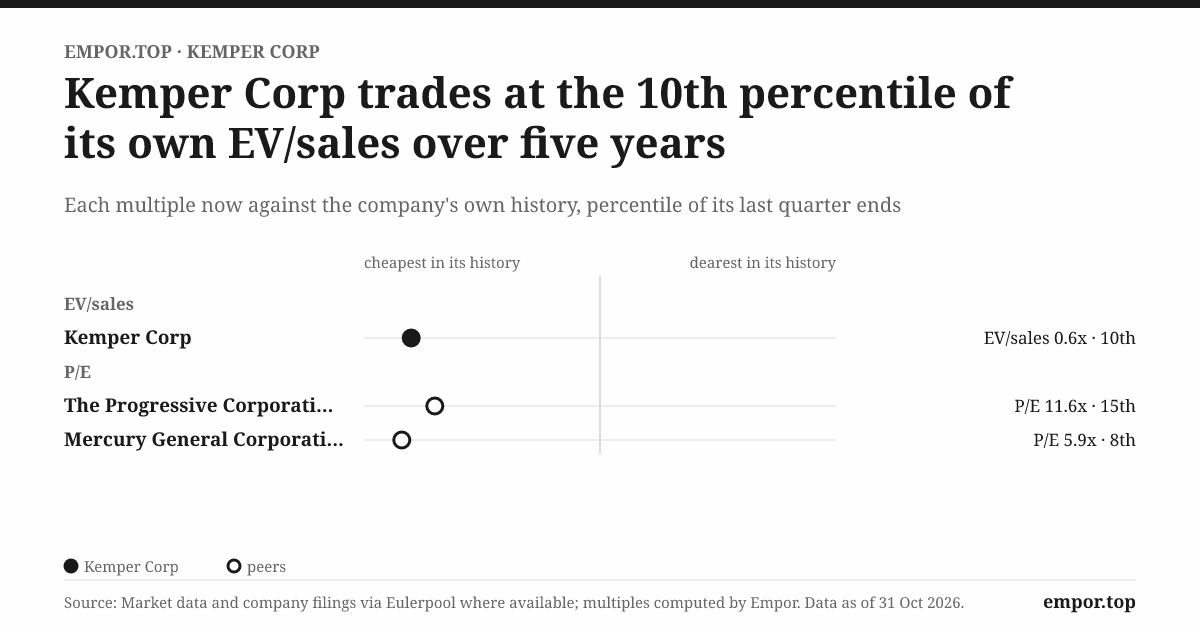
On October 31, 2026, the market valued Kemper at about 0.9 times its book value of roughly $35 a share.2 For a company that just reported a preliminary profit and has a new chief executive talking about rate adequacy, that looks cheap. Compare it with peers and the gap widens: Progressive traded at roughly 3.9 times book in late October, and Allstate at about 1.9 times.2021 Those companies differ from Kemper in scale, mix and returns, so the ratios are descriptive rather than a fair-value guide. But they reveal what the market believes.
A price below book is the market's way of saying that it expects a company to earn less on its equity than investors require. If you think Kemper can earn a sustained return on equity in the low teens, a price below book is a gift. If you think it will earn mid-single digits, a price below book is fair, and maybe generous. The market, in other words, is not making a mistake by default. It is pricing a bet on returns. Over the twelve months through June, Kemper's return on equity was about negative 22.5%, and even in the recovery year of 2024 it was about 11%.2 Book value is only a useful anchor if the business can earn a respectable return on it.
A rough worked example makes the market's assumption visible. Suppose investors want something like a 10% annual return from a mid-sized insurer with Kemper's volatility. A business that could sustainably earn 10% on its book would deserve to trade around book value. Paying 0.9 times book implies an expected return on equity a bit below that, perhaps in the high single digits, after a period in which Kemper's returns ranged from deep losses to about 11%.2 That is not a pessimistic assumption so much as an average of its own recent history. For the discount to close, Kemper does not need to become Progressive. It needs to prove that the 2024 return was the floor of a normal year rather than its ceiling.
The P/E adds no clarity: trailing earnings through June were negative.2
The bull case is measurable, which is its strength. The company says California rate increases are now earning into the book, another filing was pending at the August call, and it has deliberately stopped writing business it expects to lose money on.1112 The preliminary third-quarter underlying Specialty Auto ratio of 101.7% is better than the second quarter's 102.3%, and California's own underlying ratio improved from the first quarter to the second.110 Commercial auto has been profitable on an underlying basis, Florida and Texas personal auto ran well below 100% early in 2026, and Life keeps producing about $18 million to $20 million of operating income a quarter.12111 The company says it is actioning cost savings.12 The balance sheet is rated very strong, parent debt maturities are years away, and the stock trades below book.1516 If the underlying ratio crosses below 100% and holds, earnings could recover substantially on the same premium base, and a stock priced at 0.9 times book would be repriced on returns rather than on fear.
The bear case is that the business remains unprofitable on an underlying basis, with California's slow rate approvals and higher minimum limits still weighing on the book.11 The reported 99.2% third-quarter ratio benefits from reserve releases that cannot recur forever.1 Policy counts are falling, while commercial auto remains exposed to adverse development in older bodily-injury claims.1211 Capital is fine today but tested quarterly under the new covenant, and AM Best's outlook is negative.1615 And the goodwill write-down showed that the market's view of the franchise's value can move the accounts as well as the stock.
Why Kemper could win, and why it may not
The case that Kemper can win rests on four assets: a specialty focus on drivers the giants serve badly, a large agent network, scale in nonstandard auto, and a Life business that cushions earnings. Those assets give it a platform to repair underwriting and then grow selectively.
The case that it may not is that those are assets and capabilities, not proven advantages. Set against the national giants, Kemper showed no clear moat: short policy terms keep switching costs low, scale benefits accrue to the giants, and Kemper's record in California has not shown pricing power. Its loss volatility over five years, from the inflation losses to the 2026 write-down, is the opposite of the steady underwriting profit that would mark a real edge. A franchise repairing itself by shrinking can find that the repair itself makes it less competitive.
An activist looking at Kemper would ask three uncomfortable questions. The first is about capital discipline: the Infinity premium, the buyback and the write-down form a pattern that a board needs to explain, and the stock discount is not, on its own, evidence of value. The second is portfolio simplicity: the reciprocal exchange and its surplus notes, the spread-lending program, and the remaining Life business all add complexity to a company whose investment case depends on one line. The third is accountability for the leadership transition during the worst stretch of results in years.7
Three numbers to watch
Strip it down, and three measures will settle the debate. The first is whether the Specialty Auto underlying combined ratio keeps improving toward below 100%.1 The second is whether California personal-auto retention stabilizes as policy counts shrink.12 The third is whether improved ratios translate into adjusted operating income in P&C, alongside Life's steady contribution.1 Around those three, investors should keep an eye on subsidiary RBC under the amended credit agreement and on whether the parent ever needs to send capital down to the insurers.
None of these requires a forecast. Each requires patience. And the history of how Kemper got here holds a few lessons that would be worth learning even if Kemper were not the one paying for them.
IX. Business & Investing Lessons
Put two moments side by side. In February 2018, Kemper announced the Infinity deal.5 In 2026, Kemper waited, one state approval at a time, to see whether its prices could catch up with its claims.12 The first moment took a press release and a shareholder vote. The second takes quarters, regulators and customers who can leave. The gap between those two speeds is where most of Kemper's lessons live.
The first lesson comes from Infinity. Kemper paid above the median for the business, expecting savings to help justify the premium.85 Eight years later, the combined franchise took a $460 million write-down.10 The savings were promised in the language of integration; the outcome was decided in the language of underwriting. A premium paid for scale is a promise that underwriting can make the scale worth more. For investors evaluating any acquisitive insurer, the question is not whether the acquirer can cut overlapping costs. It is whether the acquirer can price the acquired risks better than the seller did.
The second lesson comes from California. Kemper's rate increases still left the book above break-even as policies fell.1012 Approval was necessary and not sufficient, because a higher price only helps if customers renew at it and claims stop outrunning it. A rate filing is not a rate earned, and a rate earned is not a customer retained. In a prior-approval state, the timing gap between rising claims and rising prices is not an operating accident. It is the structure of the market, and a company concentrated there should be valued as though that gap will recur.
The third lesson comes from the goodwill charge. The $460 million write-down used no cash and did not reduce statutory capital, the company said.12 Management also said the trigger was a share price that had fallen by about half.12 The market had already decided the franchise was worth less, and the accounts eventually agreed. An accounting loss may not use cash, but it can still mark down the future the company once expected. Investors who dismiss impairments as non-cash noise miss what they are: a delayed confession that a past investment will not earn what was assumed.
The fourth lesson comes from the buyback. The buyback came as California absorbed a known shock.311 A year later, the shares were about $33 and lenders had added RBC tests to the credit agreement.216 Capital returned at the wrong moment is capital the recovery cannot use. The broader point is that buybacks are a judgment about the business, not just about the share price, and they are most dangerous precisely when the business is changing faster than the board realizes.
Those four lessons share a theme. In insurance, distribution and premium volume create opportunity, but underwriting decides whether that opportunity turns into value. Scale bought in a day has to be priced correctly for years.
X. Epilogue
As of the last day of October 2026, Kemper is in the strange position of having good news it cannot yet fully explain. The preliminary third-quarter numbers show a profit, a better underlying ratio and steady Life earnings.1 What they do not show is the detail that will decide how much of that improvement belongs to the future rather than the past.
The next moment comes on November 9, when Kemper publishes its full third-quarter results, and November 10, when McAnena and his team take questions.1 The first thing to check is whether the final figures match the preliminary ones, and if they differ, why: reserve development and adjusted earnings are where differences would matter. The second is the California breakdown. If California's own underlying ratio has moved meaningfully toward 100% from the second quarter's 107.3%, the rate actions are working.10 If it has barely moved, the improvement in the blended Specialty Auto ratio came from elsewhere, and the hard part is still ahead.
Then there is the pending California filing. Approval and an effective date would put McAnena's double-digit diagnosis within reach. A delay would push the earn-in further into 2027 and extend the period in which Kemper chooses between shrinking and losing money. Investors will want to know whether policy counts are still falling at a double-digit sequential pace, whether retention is holding, and whether earned premium stabilizes without a return to unprofitable growth.
There is also the question of what the call reveals about the people. This will be McAnena's second earnings call, and Eric Kappler's first as head of P&C.12 The tone of their answers matters as much as the numbers. A management team that gives specific targets for California's underlying ratio, a date for the pending filing and a view on when policy counts stop falling is inviting accountability. One that repeats the language of "more work to do" without milestones is asking for more patience, and Kemper has already asked investors for a great deal of it.
Beyond California, two more threads matter. Life needs to keep doing what it has done, quietly producing earnings and cash. The insurers also need to remain comfortably within the RBC limits in the new covenant, given AM Best's negative outlook; any sign of capital contributions from the parent, limits on subsidiary dividends or a rating downgrade would change the story from repair to defense.1615
Further out, the calendar of proof is longer than one call. California's approved increases need a full policy cycle, six to twelve months, to earn completely through the book, so the rates that began earning in the spring of 2026 will not show their full effect until well into 2027. Any increase approved on the pending filing will take longer still. That means the first half of 2027 is when investors will see whether a fully repriced California book can run below 100% on an underlying basis, and whether the customers who stayed through the rate increases are the profitable ones Kemper wanted to keep.
Each outcome maps onto the questions this story began with. If underlying auto ratios fall below 100% and stay there for several quarters with limited reserve help, while the book stops shrinking, then California is repairable, the specialty franchise retains real value despite the write-down, and McAnena will have earned credibility through delivery rather than tenure. If the improvement stalls, Kemper looks less like a turnaround and more like a controlled retreat: a smaller, safer, less profitable insurer whose book value is a ceiling rather than a floor. The company has not yet published the answer. The trend is improving. Whether it persists across several quarters is the open question that no single release can settle.
XI. Outro
Go back to the driver in Los Angeles renewing her policy through the neighborhood agent. This time the renewal notice shows a higher price, because Kemper's latest California rate increase has finally reached her. She can pay it, or she can let the agent quote someone else. Multiply that decision by hundreds of thousands of California renewals, and you have the entire Kemper investment case playing out one kitchen table at a time.
The company already has that reach.3 What it does not yet have is a book in which those policies pay for themselves, and the preliminary 101.7% says it is close but not there.1 Kemper has plenty of customers; the story is whether it can make the risk pay.
References
-
Kemper Announces Preliminary Third Quarter 2026 Financial Results — Kemper Corporation, 2026-10-28 ↩↩↩↩↩↩↩↩↩↩↩↩↩↩↩↩↩↩↩↩
-
Kemper Investor Relations: stock and financial overview — Kemper Corporation, 2026-10-31 ↩↩↩↩↩↩↩↩↩↩↩↩↩↩↩↩↩↩↩↩↩
-
2025 Form 10-K — Kemper Corporation, 2026-02-11 ↩↩↩↩↩↩↩↩↩↩↩↩↩↩↩↩↩↩↩↩↩↩
-
Kemper to Acquire Infinity in $1.4 Billion Transaction — Kemper Corporation, 2018-02-13 ↩↩↩↩↩↩↩
-
Kemper Completes Acquisition of Infinity, Adds New Director — Kemper Corporation, 2018-07-02 ↩
-
Form 8-K: Departure of Chief Executive Officer — Kemper Corporation, 2025-10-15 ↩↩↩
-
P&C Acquisition Valuation Comparison, Exhibit 99(c)(6) — SEC filing, 2019 ↩↩
-
Q2 2026 Results Release — Kemper Corporation, 2026-08-05 ↩↩↩↩↩↩↩↩↩↩↩↩↩
-
Kemper (KMPR) Q1 2026 Earnings Call Transcript — The Motley Fool, 2026-05-07 ↩↩↩↩↩↩↩↩↩↩↩↩↩↩↩↩↩↩↩↩
-
Kemper (KMPR) Q2 2026 Earnings Call Transcript — The Motley Fool, 2026-08-12 ↩↩↩↩↩↩↩↩↩↩↩↩↩↩↩↩↩↩↩↩↩↩↩↩↩↩↩↩↩↩↩↩↩↩↩↩↩
-
Form 8-K: Appointment of Stephen J. McAnena as President and CEO — Kemper Corporation, 2026-05-27 ↩↩↩
-
2025 U.S. Property and Casualty Market Share Report — NAIC, 2026 ↩↩
-
AM Best Affirms Credit Ratings of Kemper Corporation and Subsidiaries; Revises Outlooks to Negative — AM Best, 2026-09-11 ↩↩↩↩↩↩
-
Kemper CEO Lacher Steps Down; General Counsel Evans Named Interim CEO — Carrier Management, 2025-10-15 ↩↩
-
Kemper names Stephen McAnena permanent CEO after seven-month leadership gap — Insurance Business, 2026-05 ↩
-
2026 Annual Meeting Vote Results, Form 8-K — Kemper Corporation, 2026-05-07 ↩
 LinkedIn
 WhatsApp
 Reddit
 Hacker News
 Email
 Kindle
 RSS Feed
 Spotify
 Apple Podcasts
 Amazon Music
 Audible
 YouTube