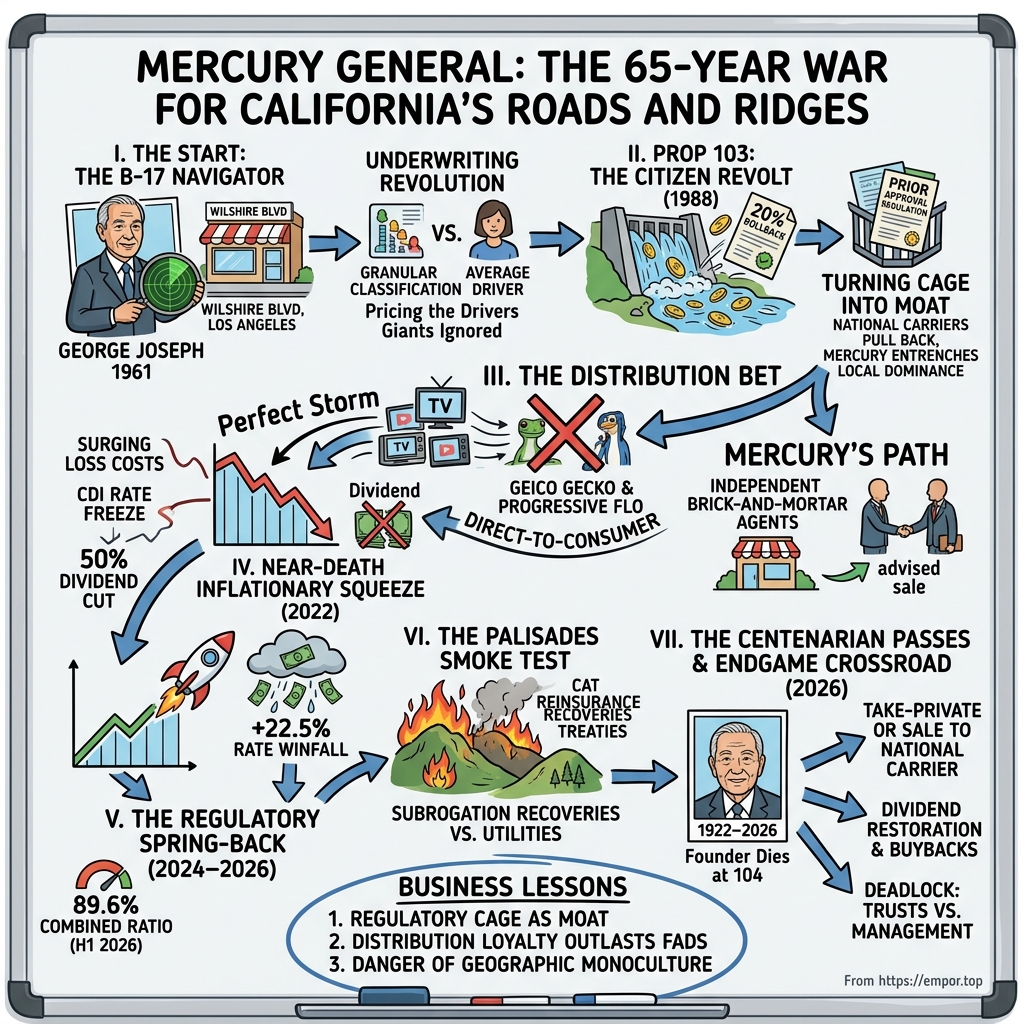
Mercury General: The 65-Year War for California's Roads and Ridges
I. Prologue & Episode Roadmap (00:00–08:00)
On August 26, 2026, Mercury General Corporation filed one of the shortest and most consequential 8-Ks in its history. George Joseph, the company's founder and chairman, had died at 104.1 He had run the company, in one title or another, since 1961. That is sixty-five years. Few public companies anywhere have been shaped so completely by one person for so long. In that time Mercury grew from a small Los Angeles auto underwriter into a California insurance heavyweight that wrote close to $6 billion of direct premiums in 2025.3
The board moved quickly. Chief executive Gabriel Tirador became chairman the same day, a signal that nothing would change.1 Thirty-five days later, something did. On September 30, 2026, Joseph's surviving spouse, the director Vicky Wai Yee Joseph, filed a Schedule 13D. It disclosed that she was now sole trustee of the trust holding George's 19,567,934 shares, about 35.3% of the company. It also reserved her right to talk with management and third parties about extraordinary transactions, including a merger or a take-private that could delist the stock.2
Founders' deaths rarely come with a filing that names "take-private" as an option within five weeks. This one did, and it landed on a company that looks financially very odd.
Here is the oddity. In 2025 Mercury generated about $1.09 billion of cash from operations.3 In the first half of 2026 its combined ratio, the share of every premium dollar spent on claims and expenses, was 89.6%, meaning it kept more than ten cents of underwriting profit on each dollar.4 It held $8.83 billion of cash and investments at mid-year.4 Yet in early October 2026 the stock traded at roughly six times trailing earnings, about a third of the multiple the market gives Progressive.43 Investors are either missing something, or they are pricing a risk the income statement doesn't show.
This story tries to settle which. It runs through six chapters. First, how a former World War II navigator built a business by pricing drivers the big carriers wouldn't touch. Second, how California's 1988 voter revolt, Proposition 103, built the world's strictest insurance pricing regime, and how Mercury learned to live inside it. Third, the stubborn bet on independent agents while GEICO and Progressive spent billions on television. Fourth, the 2022 inflation shock that halved the dividend. Fifth, the 2024–2026 rate rebound, the Palisades and Eaton fires, and the bargain the state now offers insurers that want to price wildfire properly. Sixth, the succession, and the question underneath everything: does the Joseph family keep, privatize, or sell the company it built?
To understand why that question is so hard, start at the beginning, with a navigator who saw risk as a curve.
 Subscribe on LinkedIn
II. The B-17 Navigator and the Birth of Non-Standard Auto (1961–1988) (08:00–24:00)
Picture Los Angeles in 1961. The freeways are new, the suburbs are spreading into the valleys, and nearly every adult in Southern California needs a car to get to work. The big national insurers sell auto policies the way a tailor sells off-the-rack suits: a few sizes, take it or leave it. A driver with a ticket, a young driver, or someone who simply didn't fit the template was often turned away or pushed toward expensive residual pools.
George Joseph had come home from the war having served as a navigator on B-17 bombers, a job that meant doing hard arithmetic under extreme pressure.13 After the war he studied mathematics and drifted into insurance. In 1961 he started Mercury.313 The company has never published a detailed founding ledger, so the origin story is best told through its consequences rather than its anecdotes.
The core idea was simple to state and hard to execute. Driving risk does not jump from "good" to "bad." It slides along a continuum. If an insurer can measure where a driver sits on that slope more precisely than its rivals, it can do two things at once: charge the slightly-blemished driver less than a competitor that lumps him with the worst risks, and still earn a better margin than that competitor. Think of it as a better ruler. The insurer with the finer markings wins customers at the edges of everyone else's categories.
That edge only works if it is paired with cheap distribution, because a better price is worthless if nobody hears about it. Joseph had no money for national advertising. So he tied Mercury to California's independent insurance agents, the small storefront brokers who shop policies across carriers for their clients. Mercury offered them quick policy issuance, decisions made by local underwriters, and a carrier that would not go around them to steal their customers. That pact defined Mercury for the next six decades. Even in 2025, independent agents still produced 88% of direct premiums written.3
Mercury listed on the New York Stock Exchange in 1985, under the ticker MCY.3 By then the template was set: a low-cost, California-centric auto underwriter, deeply loyal to agents, controlled by its founder, and run with a conservative balance sheet.
How durable was that early edge? The long-run record is the honest test. Total revenue grew from about $2.4 billion in 2008 to about $6.0 billion in 2025.3 That sounds like strong growth, but it works out to a premium growth base rate of roughly 4.5% a year over fifteen years, with most of the recent acceleration coming from regulator-approved price increases rather than more policies.34 Mercury is a steady compounder of premium, not a growth machine. Its edge shows up in underwriting margin through the cycle, not in market share explosions.
The pricing unit matters for everything that follows. Mercury's auto policies run for six months; its homeowners policies for twelve.3 That means every half-year, every auto customer gets repriced. In a free market, that is a fast feedback loop. In California after 1988, it became something else entirely, because the price at renewal stopped being Mercury's decision alone.
III. Proposition 103: Surviving the Citizen Revolt (1988–2000s) (24:00–42:00)
In November 1988, Californians angry about rising auto premiums passed Proposition 103 at the ballot box. The measure, championed by consumer advocate Harvey Rosenfield, ordered a 20% rollback of auto and home rates, made the Insurance Commissioner an elected office, and, most importantly, required insurers to get approval before changing their rates.12 It also created an "intervenor" process that lets consumer groups challenge rate filings and recover their costs.12
Insurers fought the measure in court. The California Supreme Court largely upheld it in Calfarm Insurance Co. v. Deukmejian (1989), while affirming that insurers are entitled to a fair and reasonable return.12 That ruling is the hidden hinge of Mercury's history. It means rates can be suppressed, delayed, and contested, but not confiscated forever. Eventually, an insurer that proves its losses gets its price. The question is always when.
To understand why "when" matters so much, consider how prior approval interacts with inflation. Imagine repair and medical costs jump sharply. An insurer files for a higher rate. In California, that filing can take a year or two to be approved, especially if intervenors contest it. Then the new rate applies only as each six-month policy renews, so it takes another half-year or more to reach the whole book. During that entire lag, the insurer pays today's claims with yesterday's prices. The regulatory system turns a cost shock into a multi-year earnings drought, and then, when the rates finally arrive, into a multi-year boom. Mercury's modern financials are almost entirely a story of that pendulum.
George Joseph did not accept the regime quietly. While most national carriers kept low profiles, he became the most visible industry voice against parts of Prop 103, and Mercury backed ballot measures in 2010 and 2012 that would have let insurers offer discounts to drivers who switched carriers with continuous coverage. California voters rejected both.12
Myth versus reality: could political spending break the cage? The claim, implicit in decades of Joseph's combativeness, was that the right campaign could loosen Prop 103. The record says otherwise. Two statewide ballot defeats showed the voters' attachment to the law. Regulatory friction continued afterwards: a California Department of Insurance examination that began in 2014 escalated into a Notice of Non-Compliance, which Mercury resolved only in February 2025 through a consent order.3 Without admitting liability, Mercury agreed to change its rating procedures and pay $5.0 million in policyholder refunds, with a further $1.5 million penalty suspended pending verified compliance.3 The sum is trivial against a $6 billion premium base. The duration is not. An eleven-year dispute over rating practice tells you how the regulator and this company relate.
The history therefore rejects the strong version of the political thesis. Prop 103 is bedrock. What survives is a narrower and more interesting claim: an insurer that accepts the cage, invests in rate-filing skill, and has the patience and capital to wait out the lag can outlast competitors who treat California as just one state among fifty.
That is the version of the moat worth testing later, because by 2025 California still produced 82.1% of Mercury's direct premiums.3 The company had become, for better and worse, a creature of one regulator. The obvious response for a firm that dependent on one state is to diversify. Mercury tried. What happened next tells you a lot about where its edge really lives.
IV. The Distribution Moat: Brick-and-Mortar Agents in an Internet Age (2000s–2019) (42:00–60:00)
By the mid-2000s, the personal auto industry had split into two tribes. On one side stood the direct writers, led by GEICO and Progressive, who spent enormous sums on television and online advertising to sell policies straight to drivers. On the other stood agency carriers like Mercury, which relied on brokers to recommend them. The prevailing wisdom in the tech press was that the brokers were doomed, that insurance would become a click.
Mercury did not take the bait. It kept its distribution centered on independent agents, roughly 8,510 agencies by 2025, including about 2,670 in California and 1,910 in Texas.3 It also owned captive agencies, Auto Insurance Specialists (AIS) and PoliSeek, giving it a direct channel of its own without turning against its broker partners.3 No single agency accounted for more than 3% of direct premiums over the past three years, so no one broker can hold the company hostage.3
The strongest evidence that this choice worked is retention. Mercury's voluntary California auto renewal rate was about 95% in 2023 and 99% in 2024 and 2025.3 Around 85% of its voluntary policies are held by drivers who qualify as statutory "good drivers" under California law.3 Those numbers say something important. When a customer's broker trusts the claims desk, the customer rarely leaves. That is a cheaper way to hold a book than buying it back every year with advertising.
But retention in 2024 and 2025 also flatters the case. Those were years when several large carriers had pulled back from writing new business in California. When your rivals stop quoting, your customers have fewer places to go. A 99% renewal rate in a supply shortage proves less than a 99% renewal rate in a price war. The cleaner test of agency loyalty would be a period when rivals return aggressively. That test has not happened yet.
Myth versus reality: could Mercury export its playbook? For three decades, management pursued growth outside California, in states including Florida, Texas, New York and others. The results are visible in the mix. By 2025, California premiums were $4.91 billion, Texas $401.5 million (6.7%), and the nine other states combined only about 11%.3 Mercury's own Florida business sits outside its main catastrophe treaty, a sign of how differently that state's risks are managed.3 After decades of effort, the out-of-state footprint is a rounding error relative to California, and it hasn't produced a second engine.
The verdict is clear: the moat is not a portable operating model. It is local knowledge of California drivers, California repair shops, California agents and the California regulator. That narrows the thesis considerably. Mercury is not a national insurer in waiting. It is a California specialist, and its value is tied to the health of one market and one regulatory relationship.
Family-company governance runs alongside the distribution story, and the board polices it through a related-party policy. In 2025, Metro West Insurance Services, an agency owned by George Joseph's nephew George Toney, earned about $1.2 million in standard commissions; Toney's brother Charles is Mercury's Chief Actuary.5 Alan Joseph, a son of the founder, worked as a portfolio underwriter earning about $164,000, while his brother Victor Joseph serves as President and Chief Operating Officer.5 The company says these arrangements are on ordinary commercial terms, and they are tiny relative to revenue.5 They matter not for their size but for what they reveal: a company where family and management overlap at many levels. That overlap was invisible as a risk while one man sat at the top. It becomes a governance question when he doesn't.
Meanwhile, the agency model had one weakness that no amount of broker loyalty could fix. It doesn't protect an insurer from the cost of the claims it pays. In 2022 that cost exploded.
V. The Inflationary Heart Attack and the Dividend Cut (2020–2023) (60:00–78:00)
Imagine walking into a body shop in 2022. The bumper on a mid-range sedan now houses radar sensors for automatic braking. Replacing it means recalibrating cameras. Parts are stuck on ships. Technicians are scarce and expensive. The used car the insurer would pay out for a total loss costs far more than a year earlier. Every one of those trends pushed claims costs up at the same time.
For an insurer in a free-pricing state, that was painful but manageable: raise rates at the next renewal. For Mercury, it was a trap. The California regulator approved auto rate increases very slowly through this period, so Mercury kept writing policies at prices set for a world that no longer existed. The combined ratio climbed to 109.5% in 2022, meaning the company was paying about $1.10 in claims and expenses for every dollar of premium it earned.6
The reported number was even uglier. Mercury posted a GAAP net loss of about $513 million in 2022.6 Most of that loss, though, wasn't underwriting at all. It came from an accounting choice that makes Mercury unlike most insurers.
The accounting amplifier, explained simply. Most insurers park the paper gains and losses on their bond portfolios in a balance-sheet account outside net income. Mercury elected the fair value option under accounting rule ASC 825, which sends every mark-to-market change straight through the income statement.3 When the Federal Reserve raised rates aggressively in 2022, bond prices fell, and Mercury recorded about $488 million in non-cash investment losses.6 Those were not realized losses from bad investments. They were the market price of perfectly good bonds dropping because new bonds paid more. Hold to maturity and most of that loss reverses.
The cash told the real story. Even in the loss year of 2022, Mercury produced about $353 million of operating cash flow.6 Over 2021 to 2025, cumulative operating cash flow was roughly four times cumulative net income.3 Insurers collect premiums upfront and pay claims later, so a growing book throws off cash even when reported profit wobbles. Investors who read only the headline loss saw a crisis; the cash statement showed a company under stress, but solvent and liquid.
Stress was real, though, because what governs an insurer's ability to pay dividends isn't GAAP, it's statutory surplus, the regulatory capital cushion behind its policies. Underwriting losses eat surplus directly. So in 2022 management cut the quarterly dividend in half, from $0.6325 to $0.3175 per share, reducing the annual payout to $1.27.3 That ended a long run of annual dividend increases that had made Mercury a favorite of income investors.3 The cut saved roughly $70 million a year.3
Myth versus reality: was the dividend ever "safe"? The old narrative cast Mercury as a reliable income stock. The 2022 record narrows that claim sharply. Mercury's dividend capacity depends on statutory surplus, which depends on California rate approvals, which depend on a regulator's timing. When inflation outruns the regulator, the dividend becomes a casualty. That's not a management failure so much as a structural feature, but it means the old "dividend aristocrat" label was always conditional.
Recovery came slowly. The combined ratio was still 105.8% in 2023, and net income only about $96 million.6 Management did the obvious thing: it filed for large rate increases and waited. The regulator's dam was about to break, and when it did, the pendulum swung harder than almost anyone expected.
VI. The Regulatory Spring-Back: The 22.5% Rate Windfall and Underwriting Rebound (2024–2026) (78:00–96:00)
By early 2024, California's insurance market was in an availability crisis. Several large carriers had sharply restricted new business in the state, and drivers and homeowners were struggling to find coverage. Something had to give, and it did. In February 2024, the California Department of Insurance approved a 22.5% rate increase for Mercury Insurance Company's private passenger auto line.3 Homeowners increases followed: 6.99% in May 2024, 12.0% in March 2025, and 6.9% effective July 2026.34
The math of earning through. A rate approval doesn't hit the income statement on approval day. It applies as each six-month auto policy renews, and then the premium is "earned" day by day over that policy's term. So a February 2024 approval reached the full auto book only by around mid-2025, and the profit showed up gradually over that whole stretch. That's why Mercury's net premiums earned grew about 18.7% in 2024, 8.5% in 2025, and 11.3% in the first half of 2026.34 The cash showed up even sooner: unearned premium balances, the money collected for coverage not yet provided, rose by about $304 million in 2024 and $216 million in 2025.3
The result was a margin snap-back. The combined ratio fell from 105.8% in 2023 to 96.5% in 2025, and then to 89.6% in the first half of 2026.634 Net income reached about $541 million in 2025 and about $454 million in the first half of 2026 alone.34 Part of the 2026 result came from favorable reserve development, about $35 million in the second quarter, when claims from earlier years turned out cheaper than reserved.4
Read that carefully, because it explains the stock's low multiple. Mercury didn't suddenly become a much better insurer. It finally got paid for the inflation it had absorbed two years earlier, at the same moment repair-cost inflation was cooling. Prices caught up and then passed costs. Under Prop 103, that gap is not stable: competitors return, intervenors scrutinize, and future rate requests face pushback. A sub-90% combined ratio in a prior-approval state is closer to a peak than a plateau.
The investment tailwind. Higher interest rates, which wrecked the 2022 income statement, rebuilt the investment engine afterwards. Net investment income rose from about $130 million in 2021 to about $329 million in 2025, as the portfolio's pre-tax yield climbed from 2.8% to 4.7%.3 Investment income was nearly half of 2025 pre-tax income.3 The portfolio is conservative: a weighted average credit quality of A+ and a duration around four years.4 That income is more durable than underwriting margin, because it depends on bond yields that are locked in for years, not on regulator decisions.
Pay against performance. Executive pay rose with the recovery. CEO Gabriel Tirador's total compensation went from about $1.7 million in 2023 to about $5.6 million in 2025, much of it from a non-equity incentive tied to results.5 George Joseph received about $3.6 million in 2025.5 On the surface, pay tracked profit. But the honest framing is that much of the profit came from the regulator's timing rather than managerial genius, which raises the question of whether incentive plans reward cycle luck. Shareholders didn't object: Say-on-Pay passed with about 98.6% support at the May 2026 annual meeting.9 Still, about 1.8 million votes were withheld from long-serving compensation committee director Martha Marcon, a modest sign of dissent in a company where the family alone controls a majority.9
The rebound looked complete by mid-2026. But it had been interrupted, eighteen months earlier, by the most expensive disaster in Mercury's history.
VII. The Palisades Smoke Test: Reinsurance Treaties and the Wildfire Dilemma (96:00–114:00)
In January 2025, Santa Ana winds drove fire through Pacific Palisades and the Altadena foothills around Eaton Canyon. Whole neighborhoods burned. For Mercury, a company that writes a large book of Southern California homeowners policies, the fires were a direct hit.
Insurers protect against such events with catastrophe reinsurance: they buy coverage from global reinsurers that pays once losses from a single event exceed a set retention. Mercury's 2024–2025 catastrophe treaty covered $1,290 million of losses above a $200 million retention.3 The Palisades and Eaton fires exhausted the whole thing.3 Every layer Mercury had bought was consumed.
Subrogation softened the blow. When a utility's equipment is implicated in starting a fire, insurers can pursue the utility to recover what they paid. Mercury recorded about $586 million of expected subrogation recoveries related to the wildfires.3 That's a large number, and it is also an accounting judgment: it reflects estimates of what will eventually be collected from third parties. Reinsurance recoverables on the balance sheet fell from about $110 million at the end of 2025 to about $44 million by June 2026 as cash from reinsurers came in, which is reassuring evidence that the reinsurance side, at least, paid.34 Mercury also requires reinsurers to have A.M. Best ratings of at least A- and uses collateral and letters of credit.3
The more revealing response came afterwards. Mercury expanded its treaty to $2,140 million above the $200 million retention for the year ending June 30, 2026, and then to $2,790 million for the year ending June 30, 2027.34 Buying twice the protection after a catastrophe is prudent, but it is not cheap, and the cost of that cover flows straight into the homeowners line's economics. Another contingent exposure remains in the background: Mercury could be assessed up to about $89 million if a major earthquake exhausted the California Earthquake Authority's resources.3
The Sustainable Insurance Strategy: opportunity or trap? For decades California barred insurers from using forward-looking catastrophe models in rate filings or from passing the cost of reinsurance through to policyholders. Insurers had to price wildfire on historical losses, which, in a warming state, understated the risk. The Department of Insurance's Sustainable Insurance Strategy changed that. Insurers can now use catastrophe models and include reinsurance costs in homeowners rates, and Mercury incorporated those changes in a filing effective July 2026.412
There's a catch. In exchange, insurers must commit to writing homeowners policies in distressed, wildfire-prone areas at levels equal to at least 85% of their statewide market share.412 In plain terms: the state lets you price the risk properly, but only if you take more of the riskiest risk.
Is that a good deal? It depends on whether the models and reinsurance pass-through are accurate enough to price brush-zone homes profitably. If they are, Mercury gets paid properly for a peril it has historically underpriced. If they aren't, every severe fire season could cost up to the $200 million retention per event plus the cost of reinstating reinsurance cover. The first real test arrives in the 2026–2027 offshore wind season. The history of January 2025 is the warning: a single event consumed a treaty Mercury considered adequate.
That is the operational risk. The bigger uncertainty, by late 2026, was about who would decide how much of that risk to take.
VIII. The Centenarian Passes: Vicky Joseph's 13D and the 51.8% Succession Crossroad (114:00–130:00)
The board's August 26, 2026 announcement was meant to reassure. Gabriel Tirador, a Mercury veteran and CEO, was named chairman.1 Victor Joseph, the founder's son, remained President and COO and a director, having joined the board in 2023.5 Continuity was the message.
The September 30 Schedule 13D introduced a second message. Vicky Wai Yee Joseph, a Mercury director and George's surviving spouse, reported sole voting and dispositive power over his 19,567,934 shares as trustee, about 35.3% of the company.2 Her filing reserved the right to seek changes to the board and to explore extraordinary transactions, including mergers, a reorganization, or a take-private that could lead to delisting.2
A 13D's "reservation of rights" language is common boilerplate. But it is unusual to see a family controller file one so soon after a founder's death, and the explicit mention of a take-private matters. The filing does not announce a deal, an advisor, or a bid. It announces optionality, held by one person.
The three factions. Mercury's ownership now sits in three centers of gravity.
The trustee, Vicky Joseph, controls the largest single block. Her obligations run to the trust's beneficiaries, which may push her toward liquidity, higher dividends, or a sale.
Management, led by Tirador and Victor Joseph, has run the business through the cycle and presumably wants continuity, agency loyalty and underwriting discipline.
Then there is Gloria Joseph, George's former spouse, who held 9,160,000 shares, about 16.5%.5 Together with the trust, the family block is about 51.8% of the company.5 Her stance is not publicly disclosed, but any transaction needing majority support essentially requires both family blocks to agree, or at least not to oppose. BlackRock (about 7.3%) and Vanguard (about 5.8%) are the largest institutions, but they are minority voices next to the family.5
The June 2026 balance sheet cleanup. In hindsight, the months before the founder's death look like housekeeping. In June 2026, Mercury issued $525 million of 6.25% senior notes due 2036.7 Later that month it amended its bank credit agreement, extending maturity to 2031 and cutting borrowings from $200 million to $50 million.84 On July 13, it redeemed early its $375 million of 4.40% notes due 2027.4 The effect was to push the debt maturity a decade out at a higher coupon. It's a sensible refinancing on its own terms, and it also left Mercury with a clean capital structure, whatever the family decides.
The liquidity is real. Mercury's insurance subsidiaries can pay up to about $448 million in ordinary dividends to the holding company in 2026 without special regulatory approval.4 That's enough to service debt many times over, fund a larger dividend or buyback, or support a transaction.
Whether any of that happens is now a question for the family and the board, not the founder. Before weighing the scenarios, it is worth pulling out the lessons of six decades that make this company distinct.
IX. Playbook: Business & Investing Lessons (130:00–146:00)
Lesson 1: In California, the regulator is the moat and the jailer. Prop 103 took pricing power away from every insurer in the state, and that's exactly why the ones that stayed and learned the system kept their customers. Mercury's 2024 rate approval arrived only after the market had nearly broken. Survival came from patience, capital, and a filing desk that knew the rules. The lesson for investors is unusual: a hostile regulator can be a barrier to entry as much as a tax. In a prior-approval state, the moat isn't the price you can charge. It's the wait you can survive.
Lesson 2: Loyalty is cheap until someone tests it. Mercury held a 99% California renewal rate while national rivals stopped writing new business. That is an impressive figure built partly on scarcity. The real proof of agency loyalty will come when GEICO, Progressive and State Farm are quoting aggressively again. A broker's loyalty is real; its price will be revealed by the first competitor who comes back.
Lesson 3: A single-state book is a magnifying glass. Writing four out of five premium dollars in California gave Mercury deep actuarial insight, and also meant one regulator and one fire season could reshape the company's year. The Palisades and Eaton fires consumed an entire treaty in one event. Specialization sharpens the pencil, and puts all the pages in one building.
Lesson 4: GAAP shouted, cash whispered. In 2022, a fair-value accounting choice turned falling bond prices into a $500 million headline loss while the business kept generating cash. The dividend cut was driven by statutory surplus, not GAAP, but the headline accelerated the investor exodus. For an insurer, read the cash flow statement before the headline, and the statutory surplus before either.
Lesson 5: The longer the founder stays, the sharper the handover. George Joseph ran Mercury for 65 years. His death moved a 35% block to a new trustee who, within five weeks, put strategic options on the table. When a founder outlives the succession question, the question doesn't disappear; it just arrives all at once.
X. Analysis, Strategy & Bear vs. Bull Case (146:00–164:00)
Put two insurers side by side. Progressive trades at about 16 times earnings and nearly 4 times book value.3 Mercury trades at roughly 6 times trailing earnings and about 1.9 times book value of $51.20 per share.4 Why the gap?
The calculation behind Mercury's multiple is worth showing. Trailing twelve-month net income through June 2026 was about $937 million: full-year 2025 profit of $541 million, minus the first half of 2025's $58 million, plus the first half of 2026's $454 million.34 On about 55.4 million shares, that's around $16.90 per share.4 At a share price near $99 in early October 2026, the market cap is about $5.5 billion, and the trailing multiple is about 6 times.4 That trailing figure includes peak-cycle underwriting, wildfire subrogation estimates and mark-to-market gains. The market is essentially saying: these earnings won't last, and it won't pay for them as if they will.
Hamilton Helmer's 7 Powers
Process Power is Mercury's strongest claim: decades of California claims data, repair-shop relationships and rate-filing experience. But it is hard to quantify, and the 2014-to-2025 regulatory dispute shows the process doesn't always satisfy the regulator.3
Cornered Resource is partly real. The 8,510-agency network and captive AIS/PoliSeek channels are assets competitors can't replicate quickly.3 But agents are independent; they can shift volume to a carrier with better pricing.
Switching Costs are low on paper, since drivers can change insurers at renewal. In practice, 99% retention suggests friction, though in a supply-constrained market.3
Counter-Positioning worked against direct writers when Mercury defended brokers. It's weak against Progressive's telematics: California limits usage-based pricing, which currently blunts both Mercury's MercuryGO offer and rivals' telematics edge.3
Scale Economies are regional. Mercury is big in California and small everywhere else. Network Economies are absent. Branding is moderate locally and overshadowed nationally.
The verdict: Mercury has a real but local and regulator-dependent edge, mainly process power and distribution. It is not a national moat, and the 2022 experience shows it doesn't protect margins from inflation under prior approval.
Porter's Five Forces
Buyers have moderate power. Drivers can switch at renewal, but mandatory coverage and California's availability crisis limit alternatives.
Suppliers have very high power. Reinsurers set catastrophe treaty prices, and Mercury had to more than double its cover after the fires.34 Body shops and medical providers drive claims inflation.
New entrants face a near-wall: prior approval, capital requirements and wildfire exposure discourage new capital in California personal lines.11
Substitutes are minimal. Insurance is mandatory and transit alternatives are weak in suburban California.
Rivalry is intense in normal times, but muted lately as major carriers restricted new business, a vacuum Mercury filled. That vacuum is temporary.
The skeptical investor's stress test
An activist would ask three things.
First, why is the dividend still half its pre-2022 level after a $541 million profit year and statutory surplus of about $2.39 billion at the end of 2025?3 The defensible answer is that management prioritized rating agency confidence and capital rebuilding after the fires. Fitch revised its outlook to Positive in August 2026, citing capital growth and margin improvement, and A.M. Best affirmed an 'A' financial strength rating.1011 That earned something real. But Mercury has paid out only about $70 million a year in dividends against hundreds of millions in earnings.3
Second, why no buybacks? Diluted share count stayed at about 55.4 million from 2023 through mid-2026.4 With the stock near book value in 2023, repurchases would have been accretive. Management chose to hold capital instead. Given the 2025 fires, that caution looks defensible; given the 2026 profits, the question becomes sharper.
Third, what protects the rate gains? Under Prop 103, a sub-90% combined ratio invites scrutiny of future filings. Mercury had planned another 6% auto rate filing for August 2026.4 If that faces resistance, margins will compress.
The bear case
The 89.6% combined ratio is a cyclical high, driven by rate catch-up and reserve releases. As competitors return and the regulator pushes back, margins drift back toward the high 90s. The Sustainable Insurance Strategy commits Mercury to more brush-zone exposure, and the next severe Santa Ana event tests a $200 million retention again. Family estate dynamics, possibly including disagreements among heirs, could freeze capital allocation while the dividend yield sits at roughly 1.3%.4
The bull case
The 13D starts a process. A national insurer or private buyer pays a meaningful premium to book value for a franchise that dominates California personal auto distribution through agents. Alternatively, the board restores the dividend toward its old level and uses dividend capacity of about $448 million for buybacks.4 Catastrophe modeling and reinsurance pass-through make California homeowners structurally profitable for the first time in years.
The honest conclusion: the downside is cushioned by book value, a conservative portfolio and strong liquidity, but current earnings overstate normal profitability. The upside depends heavily on decisions by a small group of family holders rather than on operating results alone.
The KPIs that matter
Three numbers will tell the story.
The combined ratio: 89.6% in the first half of 2026, down from 96.5% in 2025.43 Whether it stays below the mid-90s through year-end shows how much of the margin is durable.
Statutory surplus and holding company dividends: surplus was about $2.39 billion at the end of 2025, up from $1.67 billion two years earlier.3 Upstream dividends declared in late 2026 will show whether capital is being released.
Family filings: any amendment to Vicky Joseph's 13D, or an 8-K on a special committee or advisor, would signal a transaction process.2
XI. Epilogue (164:00–172:00)
Tonight Mercury General sits on the strongest balance sheet in its history. Statutory surplus is around $2.39 billion, cash and investments total about $8.83 billion, and book value is $51.20 a share.34 The underwriting machine is printing profit. The stock trades at a fraction of peers' multiples. And the man who built it is gone.
Three moments will shape the next chapter.
The first is the board's next dividend decision. Restoring the payout toward its old level would tell the market that management sees the margin recovery as durable and is willing to share it. Holding at $0.3175 a quarter would suggest caution, perhaps a board waiting for clarity from the family.
The second is the 13D clock. If Vicky Joseph retains bankers or the board forms a special committee, Mercury moves from operating story to transaction story. If the filing stays quiet, the trust may simply be a patient holder, and the stock will be priced on cycle risk again.
The third is the fire season. The 2026–2027 offshore wind months are the first real test of the expanded $2.79 billion treaty and the new homeowners pricing.4 A quiet season strengthens the case that Mercury can grow in brush zones profitably; a bad one revives every bear argument at once.
Underneath all three sits the tension that defines Mercury now. For six decades the company was built as a fortress: conservative balance sheet, patient with regulators, loyal to agents, skeptical of fads. The fortress is intact. The question is whether its new owners want to live in it, or sell the keys.
XII. Outro (172:00–176:00)
Go back to Los Angeles in 1961. A former bomber navigator, a man whose wartime job was to plot a course through hostile skies, decides that the drivers everyone else refuses are mostly just drivers, priced badly. He builds a company on that arithmetic and spends the next six decades fighting regulators, voters, trial lawyers, inflation and fire, and outlasting nearly all of them.
He kept coming to the office into his second century. In the end, Mercury General proved you could conquer the most hostile insurance market in America by simply refusing to die. The only question left is whether the company he built can survive his passing.
References
-
Form 8-K (Passing of Founder and Chairman George Joseph) — Mercury General Corporation, 2026-08-26 ↩↩↩
-
Schedule 13D (Beneficial Ownership Report by Vicky Wai Yee Joseph) — SEC EDGAR, 2026-09-30 ↩↩↩↩
-
Form 10-K for the Fiscal Year Ended December 31, 2025 — Mercury General Corporation, 2026-02-17 ↩↩↩↩↩↩↩↩↩↩↩↩↩↩↩↩↩↩↩↩↩↩↩↩↩↩↩↩↩↩↩↩↩↩↩↩↩↩↩↩↩↩↩↩↩↩↩↩↩↩↩
-
Form 10-Q for the Quarterly Period Ended June 30, 2026 — Mercury General Corporation, 2026-08-04 ↩↩↩↩↩↩↩↩↩↩↩↩↩↩↩↩↩↩↩↩↩↩↩↩↩↩↩↩↩
-
Form DEF 14A (Definitive Proxy Statement) — Mercury General Corporation, 2026-03-31 ↩↩↩↩↩↩↩↩↩
-
Form 10-K for the Fiscal Year Ended December 31, 2023 — Mercury General Corporation, 2024-02-13 ↩↩↩↩↩↩
-
Form 8-K (Underwriting Agreement for $525M Senior Notes) — Mercury General Corporation, 2026-06-12 ↩
-
Form 8-K (Second Amended Credit Agreement with BofA) — Mercury General Corporation, 2026-06-24 ↩
-
Form 8-K (Voting Results for 2026 Annual Meeting) — Mercury General Corporation, 2026-05-14 ↩↩
-
Fitch Rates Mercury General's Senior Unsecured Notes 'BBB-(EXP)' / Revises Outlook to Positive — Fitch Ratings, 2026 ↩
-
AM Best Commentary on California Property and Casualty Insurance Market Dynamics — AM Best, 2025-06-06 ↩↩
-
California Department of Insurance: Proposition 103 and Sustainable Insurance Strategy Regulations — California Department of Insurance ↩↩↩↩↩↩
-
Mercury Insurance Official Portal — Mercury General Corporation ↩↩
 LinkedIn
 WhatsApp
 Reddit
 Hacker News
 Email
Email Kindle
 RSS Feed
 Spotify
 Apple Podcasts
 Amazon Music
 Audible
 YouTube