Ichor Holdings: The Components Behind the Chip Boom
I. The $35 Share and the $1.3 Billion Peak
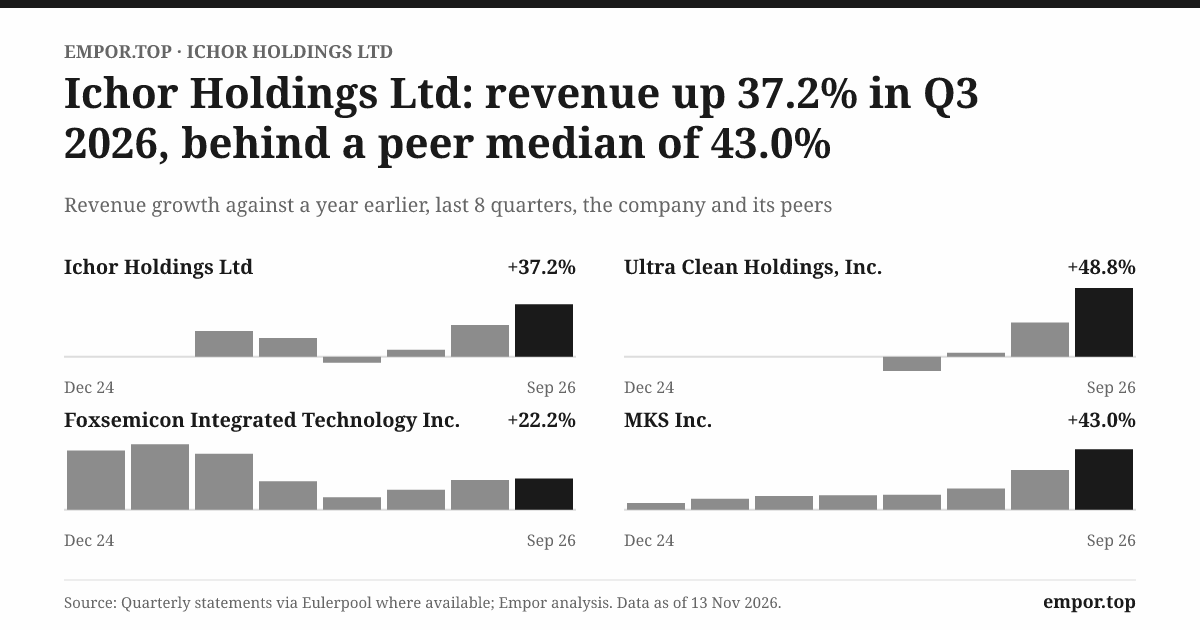
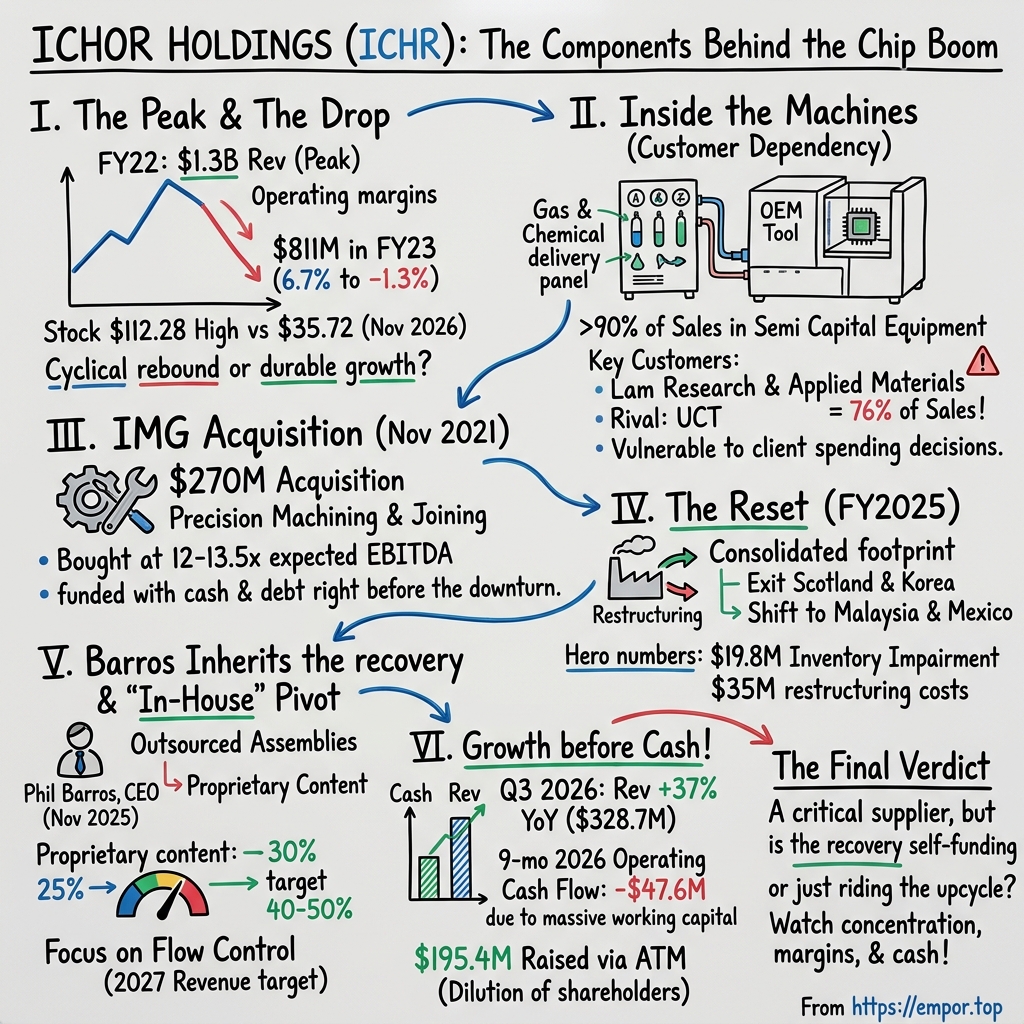
On the first Monday of November 2026, Ichor Holdings told investors it had just finished the steepest run of growth in its recent history. Third-quarter revenue came in at $328.7 million, up 37% from a year earlier and 12% from the quarter before.1
For a company that had spent most of 2025 reporting losses, the more striking line sat lower down the page: operating profit of $22.8 million, a margin of roughly 7%, and net income of about $21 million.1 Three quarters earlier, the same business had been absorbing restructuring charges, writing down inventory and closing factories.
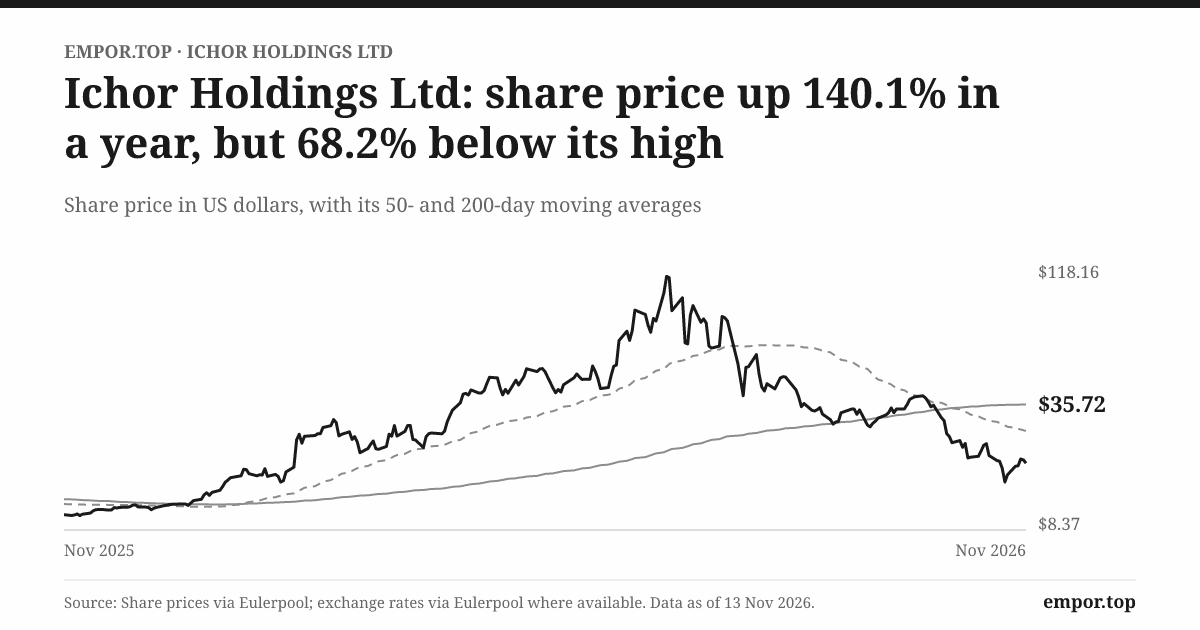
Then look at the share price. On November 13, 2026, Ichor closed at $35.72.2 Within the previous twelve months the stock had touched $112.28 at the top and $14.25 at the bottom.2 So the shares had multiplied nearly eightfold from their low, then given back almost 70% of the peak, all while the operating results kept improving quarter after quarter. A stock that moves like that is not telling you what the business is worth. It is telling you that nobody is sure.
That uncertainty has a history behind it. In fiscal 2022, Ichor booked revenue of about $1.3 billion, its high-water mark.3 A year later revenue had fallen by more than a third and the company was losing money.3 Even in fiscal 2025, after two years of partial recovery, sales of about $948 million were still well short of that peak.4 The 2026 quarters are the first in four years that look like the old Ichor at full stride, and the market has seen this movie before. It knows how the last boom ended.
So the opening puzzle is simple to state and hard to answer. Is the 2026 surge the start of a durable new growth phase, or a cyclical rebound that still has to prove it can earn, and keep, the cash it promises? The verdict this story will build toward is a measured one. The recovery is real in sales and in GAAP profit. A single strong quarter, and a three-quarter ramp built on customers re-accelerating their own equipment orders, cannot yet establish a new cycle or a new earnings base.
It helps to be precise about what Ichor is. Ichor Holdings, Ltd. is a Cayman Islands company listed on the Nasdaq Global Select Market, and it sits at the top of its own corporate tree. There is no parent conglomerate, no controlling shareholder and no private-equity sponsor still pulling strings.4
When this story talks about Ichor's revenue, margins, debt and cash, it means the consolidated manufacturing business that makes fluid-delivery subsystems and precision components for the companies that build semiconductor equipment.4 It does not mean the semiconductor industry. The chip boom is the weather. Ichor is one boat in it, and a relatively small one.
That distinction matters because the semiconductor industry's growth story is easy to borrow. Artificial intelligence, advanced logic, high-bandwidth memory: every one of those trends ends, eventually, in someone buying a deposition or etch tool. Ichor supplies pieces of those tools. But between the AI data center and Ichor's loading dock sit at least two layers of decision-makers, the chipmakers who order the tools and the equipment makers who build them, and each layer can speed up, slow down or redirect its orders without asking Ichor first.
Three questions will travel through the rest of the episode. The first is whether this is a cyclical rebound or a higher-growth business. Ichor's ten-year revenue record compounds at about 12.6% a year, which sounds like a growth company, yet over the three years to fiscal 2025 revenue shrank by about 9.6% a year.4 Both numbers are true, and which one describes the future is the whole debate.
The second question is whether making more of its own parts can produce lasting margin gains. Management's central strategic claim is that Ichor is shifting from assembling other people's components into building more of its own, and that this content shift lifts profitability. The third question is whether growth can finance itself. In 2026 Ichor sold new shares to raise nearly $200 million while its operating cash flow ran negative.5 A business that has to issue equity every time demand turns up is a very different investment from one that funds its own expansion.
To answer those questions, the story has to start inside the machine.
 Subscribe on LinkedIn
II. A Small Part of a Very Expensive Machine
Picture a chip-fabrication tool the size of a small truck, sitting in a cleanroom where the air is filtered to be thousands of times cleaner than the air in a hospital operating theater. Inside it, a silicon wafer waits in a vacuum chamber.
To lay down a film a few atoms thick, or to etch a trench narrower than a virus, the tool must deliver exactly the right gases, in exactly the right amounts, at exactly the right moment. Too much of one gas, a fraction of a second too late, and a wafer worth thousands of dollars becomes scrap.
The piece of hardware that makes that delivery possible is called a gas panel, and it is the heart of what Ichor makes. Think of it as the plumbing and spice rack of a chipmaking tool combined. Gas arrives from a facility line, passes through filters, pressure regulators and valves, and then through a flow controller that meters it precisely, before welded stainless-steel tubing carries it into the process chamber.
Every surface the gas touches must be ultra-clean, because a single particle or a trace of moisture can ruin a wafer. Ichor designs, engineers and manufactures these gas delivery subsystems, along with chemical delivery systems for liquids, and supplies precision-machined parts, weldments and other components that go inside the tools.4
The customer for all this is not the chipmaker. It is the original equipment manufacturer, the OEM, that builds the tool and sells it to the fab. Ichor's revenue model follows from that position.
Most sales come through customer purchase orders with fixed prices for the life of the order; nearly all of Ichor's obligations are for physical goods, generally completed within a year and recognized as revenue when they ship.4 There are no long-term contracts requiring customers to buy fixed or minimum quantities.4 In plain terms, Ichor builds to its customers' schedules, and its customers can change those schedules.
How concentrated are those customers? In fiscal 2025, Lam Research and Applied Materials together accounted for 76% of Ichor's sales.4 Both have bought from Ichor for more than twenty years.4 More than 90% of fiscal 2025 revenue came from the semiconductor capital equipment market.4 So roughly three out of every four dollars Ichor earns depend on the purchasing decisions of two companies, and almost every dollar depends on how much the world's chipmakers spend on new tools in a given year.
There is a useful way to hold those two facts together. Ichor's gas panels are technically important: a deposition tool does not work without one, and the qualification process for a new supplier is slow and expensive. But importance to a process is not the same as control over the customer.
Lam and Applied decide how many tools to build, which suppliers get which share of the work, and whether a design is outsourced to Ichor or brought in-house. When they cut production, Ichor's volumes fall with them. When they push for lower prices, the purchase order is where that fight happens.
The competitive map makes the same point from another angle. Ichor's closest public competitor in overlapping subsystems is Ultra Clean Holdings, known as UCT, which reported 2025 revenue of roughly $1.8 billion, about twice Ichor's.6 The businesses are not identical, because UCT's mix of products, services and customers differs, so the comparison is about scale, not a like-for-like scorecard.
In adjacent areas such as flow control and specialty materials, much larger companies like MKS Instruments and Entegris compete with far deeper resources. Ichor is a specialist among specialists, sized somewhere between a niche supplier and a scale player.
Where does artificial intelligence fit? It matters, but indirectly. More advanced chips need more process steps, more exotic chemistries and tighter control of gas flow, and Ichor argues that this complexity raises both demand for precise gas delivery and the value of proprietary components.4 AI is one of the forces lifting advanced chipmaking. But Ichor does not sell to Nvidia, hyperscalers or AI labs. It sells into the equipment spending cycle that AI helps feed, and that cycle has its own rhythm of over-ordering and digestion.
One more piece of the model is worth absorbing before the story moves forward. Because Ichor holds inventory on its customers' behalf and ships against purchase orders, a large part of its working capital rises and falls with order timing. When customers ramp, Ichor must buy parts and build subassemblies before it is paid.
When customers stop, that inventory can sit. The cash conversion cycle, the number of days between paying suppliers and collecting from customers, stretched from about 16 days in fiscal 2014 to roughly 90 days by fiscal 2025.47 That is the hidden cost of being a supplier in a lumpy industry: it is the supplier's balance sheet that absorbs the lumps.
So Ichor makes technically important subsystems. It has decades-long relationships with the two most important buyers in its corner of the market. And yet nothing in its contracts obliges those buyers to keep buying. A business with technical qualifications and repeat orders can still be badly exposed when OEMs reduce or defer purchases. The best way to see what that exposure looks like is to watch what happened the last time the industry ran hot.
III. The Company That Rode the Upcycle Too Far
The gas-delivery business that became Ichor was already well established when, in 2011, private equity bought it; Ichor Holdings was formed as the holding company in 2012; and in December 2016 it listed on Nasdaq.8 Those early years were a classic sponsor playbook: carve out a focused business, sharpen it, and take it public into a strong market. The more interesting history is what happened next, because the decade after the listing is a near-perfect case study in how a supplier rides an upcycle.
The numbers tell the momentum story. Revenue was about $249 million in fiscal 2014.7 By fiscal 2017, the first full year as a public company, it had reached about $655 million, after expanding by more than 60% in a single year as the memory and logic markets spent heavily on new tools.87 There was a setback in 2019, when revenue fell by about a quarter, and then a surge: fiscal 2020 revenue rose by almost half, and the run peaked in fiscal 2022.73 In eight years it had grown roughly fivefold.
Inside that growth, though, was a pattern worth noticing. Operating margins never escaped single digits. At the peak of fiscal 2018, the operating margin was about 7.8%; at the fiscal 2022 peak, about 6.7%.7 Ichor got bigger much faster than it got more profitable. That is not necessarily a flaw; contract manufacturing is a low-margin business by nature. But it means there was little cushion when volume disappeared.
Fiscal 2022 was a year of strain rather than ease. Demand was strong, but supply chains were in disarray. Parts were late, lead times stretched, and the bottleneck for many equipment makers was not orders but components.
For a supplier like Ichor, that environment encouraged building and holding more inventory, because a missing valve could stop a gas panel and a missing gas panel could stop a tool. Inventory days rose from about 62 at the end of fiscal 2020 to about 97 by the end of fiscal 2022.7 Every link in the chain was stocking up at once.
Then the whiplash. In fiscal 2023, Ichor's revenue fell 36.6% to about $811 million, and the operating margin swung from roughly 6.7% positive to about 1.3% negative.3 The causes compounded each other. Chipmakers cut equipment spending, particularly in memory.
OEMs, now holding the inventory they had built during the shortage, stopped ordering components until they had worked it down. Ichor's factories ran at lower utilization, so the fixed costs of buildings, equipment and salaried staff were spread across fewer units. And the mix worsened, because the higher-margin component business was hit harder than gas panel assembly.
The quarterly path made the depth of the fall concrete. By the third quarter of 2023, quarterly revenue had sunk to about $197 million, roughly 40% below the average quarter of 2022, and gross margin was about 13%, with about half of that quarter's shortfall against guidance tied to inventory reserves.9
For the fourth quarter, management guided revenue of $190 million to $205 million, which is to say it expected the floor to hold rather than the climb to begin.9 For a company that had built its cost base, its inventory and its acquisition financing around a $1.3 billion year, running at an annualized rate below $800 million was a shock that no amount of engineering could absorb.
The calls from that period show how hard demand was to read, even for management. On the third-quarter 2023 call, then-CEO Jeff Andreson told analysts that "the trough quarter for semiconductor process equipment is behind us."9
He described industry expectations for spending to stay roughly flat through the first half of 2024, followed by the beginning of a revenue ramp in the second half, "in advance of an expected strong recovery year in 2025."9 On the component side, he acknowledged that the business had "witnessed deeper and more prolonged cuts as our customers work to reduce their inventory levels."9
The most revealing exchange came when an analyst asked how much inventory customers were still holding. Andreson's answer was candid: "We don't know. We don't have that visibility."9 That honesty is worth crediting. It also exposed the core problem of the business. A supplier whose two largest customers can stop ordering components while they burn through their own shelves cannot forecast its own volume with much confidence, however good its engineering is.
Measured against what actually happened, the 2023 forecast was right on direction and wrong on economics. Revenue did recover: up about 4.7% in fiscal 2024 and about 11.5% in fiscal 2025.4 But the "strong recovery year" of 2025 delivered an operating loss of about $39 million and the worst operating margin of the decade.4 Revenue came back before profit did. That gap, between a sales recovery and an earnings recovery, is the single most important lesson the downturn left behind, and it is why the market treats the 2026 numbers with suspicion.
Step back and the record falsifies the smooth-growth story that a ten-year compound rate seems to tell. Over the decade to fiscal 2025, revenue grew about 12.6% a year; over five years, less than 1% a year; and over the last three, it fell about 9.6% a year.7 Ichor's long-run growth is real and impressive. But the path is jagged, and the same supplier position that lets it ride booms also makes its revenue and margins swing with customer inventory and equipment demand.
The downturn left one question hanging in particular. Just before the 2023 collapse, Ichor had made the largest acquisition in its history and expanded a global footprint across several countries. Would that bigger platform help it through the next cycle, or had it added cost and debt at precisely the wrong moment?
IV. IMG: A $270 Million Bet on More Than Gas Panels
In November 2021, with the industry booming and Ichor's order book full, management announced it would buy IMG Companies, a precision-machining and specialty-joining business.10 The price was approximately $269.5 million.10 It was the biggest single capital decision in Ichor's life as a public company, and it was made at the top of a cycle that nobody yet knew was the top.
The strategic logic was coherent. Ichor's gas panels are assemblies; their value depends on the quality of the parts that go into them. IMG brought deeper capability in precision machining, cutting complex metal parts to tight tolerances, and in specialty joining, the welding and bonding techniques that keep ultra-clean systems leak-free.1011
That capability could make more of the content inside Ichor's own products, which is the seed of the in-house strategy that dominates the 2026 story. IMG also brought exposure to end markets outside semiconductors and a chance to sell higher-value products to a broader base.11 In the language of the deal, it was a step from assembler toward manufacturer.
Management also put numbers on the promise. It said IMG was expected to generate $70 million to $80 million of annual revenue and $20 million to $22 million of annual EBITDA, the rough measure of operating cash earnings before interest, tax and depreciation.1011 Those figures make the price easier to judge. Ichor paid about 3.4 to 3.9 times IMG's expected annual sales, and roughly 12 to 13.5 times its expected EBITDA.
Is that expensive? Against Ichor's own economics, the answer is that it was a premium asset bought at a premium price. IMG's expected EBITDA margin of roughly 27% to 28% was far above anything Ichor itself had earned; Ichor's own fiscal 2021 EBITDA margin was under 10%.7 So the logic was that Ichor was buying a higher-margin business that would lift the mix.
But paying 12 to 13.5 times EBITDA means the acquired earnings must hold up for a long time to earn back the price. At a 13 times multiple, the yield on expected EBITDA was below 8%, before accounting for depreciation and capital spending a machining business requires. That is not a bargain in a cyclical industry, though without a set of comparable transactions it would be unfair to call it an overpayment. The fairer test is whether the returns showed up.
The funding is part of that test. Ichor paid with roughly $140 million of cash and securities and about $130 million of additional borrowing.12 Cash on the balance sheet fell from about $253 million at the end of fiscal 2020 to about $76 million at the end of fiscal 2021, while total borrowings climbed from about $211 million to about $323 million.7 The company went into 2022 more leveraged and with less cash, which was fine as long as the boom continued.
It did not. Within a year of closing, the industry downturn arrived. Weak utilization, falling component orders and customer inventory corrections were exactly the conditions under which a machining business with high fixed costs struggles. Ichor reported consolidated operating losses in every year from fiscal 2023 through fiscal 2025.34 Interest expense, swollen by the larger debt load, reached $19.4 million in fiscal 2023, more than the company's entire operating loss that year.4
Here, though, the evidence runs out. Ichor does not report IMG as a separate segment, and it does not publish the acquired business's stand-alone revenue or EBITDA after the deal. So it is impossible to say from the outside whether IMG met its $20 million to $22 million EBITDA target in any year, or how much of the post-2022 margin damage came from the acquired operations versus the gas panel business.
A skeptic would note that consolidated EBITDA fell from about $121 million in fiscal 2022 to about $23 million in fiscal 2023 and was negative in fiscal 2025.7 A defender would note that the whole sector was in a downturn, and that IMG's machining capability is precisely what the 2026 in-house strategy depends on. Both arguments are consistent with the disclosures.
What can be said with confidence is narrower. IMG broadened Ichor's manufacturing capability and customer reach. The price was not cheap against the economics management itself put forward. The deal used cash and new debt just as cyclicality was about to reassert itself, and the borrowing cost showed up in the income statement during the lean years. And the disclosed evidence does not establish that the promised returns were achieved.
That leaves a capital-allocation test that runs through the rest of the story. If the precision machining Ichor bought in 2021 becomes the engine of higher proprietary content in 2026 and 2027, the acquisition will look, in hindsight, like an early and expensive bet that eventually paid. If margins stay thin even as internal content rises, the deal will look like capacity bought at the top. Either way, the bill for the boom arrived before the payoff, and in fiscal 2025 that bill came due.
V. The Inventory Bill and the Footprint Reset
Fiscal 2025 ended with a set of numbers that looked, on the surface, like progress. Revenue rose about 11.6% to roughly $948 million, driven by increased semiconductor equipment spending.4 And yet the company lost money at every level that matters. The operating loss was about $39.3 million, the gross margin fell to 9.3% from 12.2% the year before, and the net loss was about $52 million.4 Ichor sold more and earned less. That is the signature of a business whose cost structure no longer fit its volume.
Follow the causal chain. Lower volume through most of 2023 and 2024 had already reduced factory utilization. The product mix stayed weak, because components, the higher-margin piece of the business, recovered slowly while customers kept working through their stockpiles. Inventory Ichor had bought in the boom sat on the shelves, aging. And then management made two decisions that turned slow damage into a visible charge: write the inventory down, and shut factories.
The inventory write-down came first. In fiscal 2025, Ichor recorded a $19.8 million inventory impairment.4 To put that in proportion, the impairment alone equals about two percentage points of revenue, which is most of the roughly three-point fall in gross margin. On top of the impairment, the balance sheet carried a $37.5 million reserve for excess and obsolete inventory, the accounting cushion for parts the company does not expect to use or sell at full value.4
That reserve is where the auditor focused its attention. In the 2025 audit report, inventory valuation was identified as a critical audit matter, the auditor's term for the judgment it found most demanding.4 The issue is not fraud or error. It is estimation. To decide how much inventory is worth, management must forecast how much of each part customers will consume in coming periods.
If customers' future demand falls short of those estimates, more write-downs follow. If demand surprises on the upside, some of the reserve may never be needed. Either way, inventory value at Ichor is a forecast, and forecasts about this industry have been wrong before, as the 2023 calls showed. The auditor gave unqualified opinions on both the financial statements and internal controls, and reported no material weakness.4
The footprint reset came second. In 2025 Ichor launched a consolidation plan that exited its operations in Scotland and Korea and shifted more production into higher-volume sites in Malaysia and Mexico.4 Restructuring and exit costs totaled about $35 million.4
The logic was straightforward: fewer, larger factories in lower-cost locations spread fixed costs across more units and, management argued, would improve delivery. A Scottish plant serving European customers or a Korean plant near local fabs made sense in a world of steady growth and local service. In a world where Ichor needed every point of margin, consolidation won.
The trade-off was execution risk. Moving production from one factory to another in this industry is not like moving a call center. Customers qualify specific processes at specific sites. A weld made in Malaysia must be proven to match the weld made in Scotland before Lam or Applied will accept it in a tool.
Each move takes time, consumes engineering attention, and risks delays or quality issues just as demand returns. The fact that Ichor was closing plants and moving lines during the early stages of a recovery meant that any hiccup would show up in deliveries at the worst possible moment.
It is useful to compare this reset with the cost cuts Ichor made in 2023. Then, the message was that the trough was behind the industry and recovery would follow.9 The company trimmed costs, waited for volume and expected margins to come back with it. They did not, at least not fast enough.
By fiscal 2025, the narrative had changed: revenue recovery alone was not enough, and the business needed a structurally different footprint. That shift is to management's credit, because it implies the earlier approach was not working and something more fundamental was required. But it also means the 2023 promise of a "strong recovery year in 2025" was, in profit terms, broken.
What did the reset cost shareholders? In one sense, the $35 million of restructuring charges and the $19.8 million impairment are the price of past decisions, paid in one year. In another sense, the reset is still being paid for: capital expenditure more than doubled to $36.2 million in fiscal 2025, or 3.8% of revenue, from $17.6 million the year before, as the company built capacity in its new hubs.4 Free cash flow turned slightly negative.7
There is a tempting way to read all this. Strip out the charges, call them one-time, and declare the underlying business healthy. Investors should resist that. Inventory write-downs have happened before in this business, including the reserves that dragged down third-quarter 2023 margins.9 Restructuring is a recurring response to recurring cycles. The real test is not whether 2025's charges were one-off. It is whether margins stay higher after the charges fade, and whether the next downturn passes without another round of inventory impairments.
The quarterly shape of 2025 shows how much of the pain was concentrated in the reset itself. Through the first half of the year, operating losses were small, a few million dollars a quarter. Then, in the third quarter of 2025, the operating loss widened to about $19 million on revenue of about $239 million as charges landed, and the fourth quarter added another loss of about $14 million on revenue that dipped to about $223 million.4
Revenue was close to flat across the year while the charges did the damage, which is consistent with management's account that the losses were mostly the cost of restructuring and inventory clean-up rather than a fresh collapse in demand. It is also a reminder that the business, even before charges, was barely breaking even at a revenue run rate below $1 billion.
The early 2026 evidence is encouraging but incomplete. Gross margins rose quarter by quarter, and by the third quarter GAAP gross margin had reached 15.8%.1 That is a long way from 9.3% and a meaningful improvement on 12.2%. But it was achieved during a steep volume ramp, when any factory looks better. The footprint reset had brought in a new cost base. Now someone had to run it, and in November 2025, a new chief executive took the job.
VI. Phil Barros Inherits the Recovery Plan
When Phil Barros became chief executive on November 3, 2025, he was not walking in from outside.13 He had spent more than two decades inside Ichor's engineering organization. Barros started his career at Applied Materials, holding a series of management positions between 1999 and 2004, then joined Ichor as a director of systems engineering.13
He rose through vice president and senior vice president of engineering before serving as chief technology officer from 2015 until he took the top job.13 He trained as a mechanical engineer at San Jose State University.13 At 45, he became CEO of a company whose largest customer list includes his first employer.13
That background shapes how to read his tenure. Barros is a product-and-process leader, not a turnaround financier. The strategy he now champions, more proprietary components, flow-control products and in-house machining, is the strategy his engineering organization was building for years before he was CEO. That is a strength, because he knows the technology and the customers' engineers intimately. It is also a reason for caution, because a CTO-turned-CEO is selling a vision he helped design, and the market should want proof rather than conviction.
He succeeded Jeff Andreson, who had led the company from January 2020 and stayed on as a strategic advisor through August 2026.13 Andreson's era included the 2020 surge, the IMG deal, the 2022 peak and the long slide that followed. Barros inherited the restructuring plan, the inventory reserves and the new footprint, and he took over just as the recovery was about to become visible in the numbers.
The other central figure is the chief financial officer, Greg Swyt. His background is unusual for a semiconductor-supply CFO. He spent twelve years in the U.S. Navy before a finance career that ran through Applied Materials, HP, Intevac, Nanometrics and Onto Innovation, and briefly Silvaco Group as CFO.13 He joined Ichor as chief accounting officer in January 2022 and became CFO in August 2023.13 In this story, Swyt is the steward of the questions that matter most to long-term investors: cash conversion, working capital and the decision to sell shares.
Compensation is where alignment is first tested. In fiscal 2025, Barros's reported total compensation was about $4.61 million, of which about $3.98 million was stock awards.13 Those figures are grant-date accounting values, not cash he received; the stock may be worth more or less when it vests. For comparison, Andreson's reported compensation was about $3.37 million and Swyt's about $1.34 million.13 The pay was awarded in a year when the company lost about $52 million and its operating margin was negative 4.1%, so the more useful question is what the equity is tied to.
The answer is moderately encouraging. About half of Barros's 2025 annual grant came as performance share units, which vest only if targets are met.13 Those targets are measured at the end of fiscal 2027 and rest on three legs: total shareholder return relative to a semiconductor index, weighted 50%; non-GAAP gross margin, weighted 30%, with a target of 19%; and non-GAAP free cash flow as a share of revenue, weighted 20%, with a target of 8%.13
Earlier performance awards vest only if non-GAAP gross margin reaches at least 20% for two consecutive quarters by the end of fiscal 2028.13 These are hurdles above where the business stood in late 2026, so management is paid to deliver the margin and cash outcomes investors care about. The caveat is that they are non-GAAP measures, which exclude items such as restructuring costs and stock compensation that shareholders still bear.
Ownership is modest. As of March 2026, directors and named executive officers together held about 1.7% of the shares, and the largest holders were index and institutional funds: BlackRock with about 14.9%, Invesco with about 8.7%, and Barrow Hanley with about 5.6%.13 There is no controlling shareholder. That means management's wealth is tied more to future equity grants than to existing stakes, and the board, not a dominant owner, is the main check on capital allocation.
Shareholders mostly approved. At the May 2026 annual meeting, the advisory vote on executive pay passed with about 27.2 million votes for and about 846,000 against.14 Director Laura Black drew about 3.3 million votes against, the largest opposition to any board member.14 Those numbers do not suggest a revolt, but they do show non-zero dissent that a board should watch.
The more important evidence is execution. On the second-quarter 2026 call in August, management disclosed that a supply-related issue had delayed about a week of revenue, and said the problem had been fixed.15 It is the kind of disclosure that can easily become a pattern of excuses. In this case, the next quarter tested it.
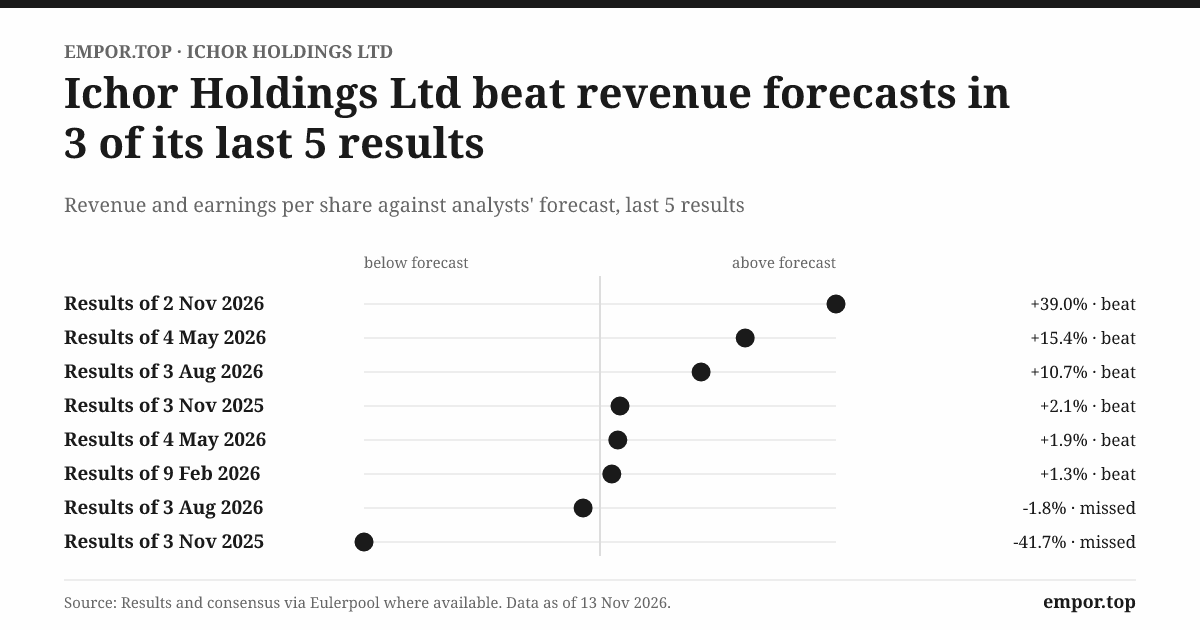
Third-quarter revenue and gross margin both came in above the midpoint of prior guidance, and management guided fourth-quarter revenue to $345 million to $365 million with gross margin of about 16.5%.161 When an analyst pressed on the risk to that guidance from component constraints, Barros answered: "I feel very, very confident that anything we're guiding today is what we're going to hit," and said constraints were "starting to loosen."16
Prepared remarks and analyst Q&A revealed different emphases. In the prepared remarks, the story was momentum: record ramp, rising proprietary content, new platform wins.16 In the Q&A, analysts kept circling back to the harder questions. They asked why incremental margins of roughly 30% in the third quarter would fall to a 25% assumption for 2027, how fast cash conversion would improve, and whether the 20% gross margin target was still realistic.16
Swyt reaffirmed that target, along with 25% to 30% incremental flow-through, while noting management might revisit it.16 Management declined to endorse an analyst's 2027 gross-margin estimate.16 That mix of confidence on volume and caution on margin targets is, if anything, a healthy sign.
So what does a year of Barros tell an investor? Early operating progress is clear: quarterly revenue up sharply, GAAP profitability restored, and guidance met or beaten after the second-quarter stumble. But the record is short and the conditions favorable. A management team earns credibility through a full cycle, not a single upswing. The real verdict on Barros will come from durable GAAP margins, positive cash flow and the dilution used to fund growth, and the clearest window into his thinking is the strategy he spent a decade building as CTO.
VII. From Outsourced Assemblies to Ichor-Made Content
On the third-quarter 2026 call, Barros offered a single number as the scoreboard for his strategy. Proprietary content, the share of Ichor's gas systems sales made up of components Ichor manufactures itself, had passed 30% by the end of the quarter, up from about 25% just one quarter earlier.16 Management expected roughly 35% by the end of the fourth quarter, set a near-term goal of 40%, and described about 50% as a long-term objective.16 In the same breath, it called flow control, the technology that meters gas into the chamber, "a 2027 revenue event."16
To see why that number matters, go back inside the gas panel. A gas panel is built from many smaller parts: valves, regulators, pressure transducers, filters, fittings, the precision-machined blocks called substrates that the components bolt onto, and, most valuable of all, the mass flow controllers that measure and regulate gas flow.
For most of Ichor's history, a large share of those parts came from outside suppliers, often specified by the customer.4 Ichor's value-added lay in the engineering, the cleanroom assembly, the ultra-clean welding and the testing. It was a bit like a high-end restaurant that buys most of its ingredients from specialist suppliers and earns its margin on the cooking.
The proprietary-content strategy is an attempt to grow more of the ingredients in-house. The company says that each time Ichor replaces a purchased valve or fitting with one it makes itself, it captures the supplier's margin as well as its own, and reduces its reliance on outside vendors who may be capacity-constrained in a boom. Management's three connected choices are designed to make that possible: finish moving volume production into the lower-cost hubs in Malaysia and Mexico, bring more component manufacturing in-house, and invest in machining capacity to make the metal parts at scale.1716
There are real proof points. Ichor's machining and welding operations in Malaysia were qualified by both of its largest customers, which matters because qualification is the gate every supplier must pass before high-volume orders arrive.16 All planned moves into Mexico were complete by the third quarter.16 Ichor also reported six new component wins on tool platforms outside the gas panel during the quarter, meaning its machined and welded parts are being designed into other parts of customers' tools.16
The margin evidence is also there: gross margin continued to rise, and GAAP operating margin was about 7%.1 On a non-GAAP basis, gross margin was about 16% and the incremental gross margin, the profit on each extra dollar of revenue, was about 33%.16 In other words, roughly a third of every added sales dollar was turning into gross profit, compared with an average of about 16 cents on the dollar across all sales. That kind of operating leverage is exactly what a supplier with spare capacity and a better product mix should show.
But here the story has to separate three forces that are all lifting margins at once. The first is volume. Revenue rose about 37% year over year, and in a business with factories and salaried engineers, higher utilization alone raises margins.1 The second is the footprint reset, which removed costly sites.
The third is proprietary content. Management's narrative assigns a large role to the third, but the company does not publish a breakdown that isolates how much of the margin gain came from in-house parts rather than from fuller factories. An investor who credits all of the improvement to the strategy may be crediting the cycle.
There is also the question of whether the content gains will survive a slowdown. Third-quarter 2026 gross margin is still below the 20% target that management has carried for years, and below the 19% non-GAAP threshold in Barros's own performance shares.1613 On the call, management guided 2027 incremental gross margin of "at least 25%," a step down from the 33% achieved in the third quarter.16 That is a prudent assumption, but it also concedes that the exceptional flow-through of a ramp quarter is not the steady state.
Flow control deserves its own scrutiny, because it is the most ambitious part of the plan. Mass flow controllers are the most technically demanding component in a gas panel and are dominated by specialized suppliers, including MKS Instruments and several Japanese manufacturers. Entering that market means competing against incumbents with long qualification histories on customers' tools.
Management framed flow control as a 2027 revenue event and listed it among its 2027 capital-spending priorities alongside valves, fittings and substrates.16 What it has not done is disclose a customer qualification, a volume commitment or a revenue target for the product. Until those appear, flow control is a capability, not a business.
That distinction, between capability and commercialization, is the most important frame for this section. A design win in this industry is a door opening. It means a customer has approved Ichor's part for a tool platform. It does not mean the customer will buy in volume, or that the platform itself will sell well, or that the customer will not dual-source the same part from another supplier. Proprietary content of 50% is explicitly a long-term goal, not a commitment.16
The best contrary evidence comes from Ichor's own past. In 2023, management told investors that the trough was behind the industry and that 2025 would be a strong recovery year; what arrived was two more years of operating losses.94 IMG was bought in 2021 partly to deepen in-house capability, and three years of weak results followed.107
Neither of these episodes proves the current strategy will fail. They do establish that Ichor's management has previously overestimated how quickly capability turns into profit, and that the company's results are more sensitive to the cycle than to its internal initiatives. And the 2026 ramp is being accompanied by heavy working-capital use, which means the strategy is consuming cash before it produces it.
What would falsify the in-house thesis? Three things. If qualifications stall before they convert into volume shipments, the 35% and 40% content targets will slip. If gross margins plateau in the mid-teens even as content rises, then the content shift is not earning the margin management claims. And if Ichor's share of its customers' gas panel spending falls, or price pressure intensifies, despite more proprietary content, then the components are not creating any pricing power.
There is a modest side story worth placing in proportion. Ichor has said it is also pursuing work in commercial space and other non-semiconductor markets, building on the machining capability that IMG brought.17 The size of that business is not disclosed, and with more than 90% of revenue tied to semiconductor equipment it is diversification support, not a second core.4
The verdict, then, is that internal components have credible early evidence behind them: qualified sites, new platform wins and margins rising faster than revenue. But 40% to 50% proprietary content and flow-control sales remain targets. The question that has to be answered before they count as a moat is how much they will cost to build, and whether the cash generated by the ramp can pay for it.
VIII. Growth Arrives Before the Cash
There is an old line in the supply-chain business: revenue is vanity, profit is sanity, cash is reality. For most of 2026, Ichor's reality looked different from its income statement. In the first nine months of the year, the company reported net income of about $19.5 million.5 Over the same nine months, cash from operations was negative $47.6 million.5 The business earned money on paper and spent more than that in cash.
Over the long run, the opposite has been true, and that is worth getting right first. From fiscal 2014 through fiscal 2025, Ichor generated about $419 million of operating cash flow against about $213 million of cumulative net profit, roughly twice as much.47 Free cash flow over those twelve years was about $246 million.7
That gap is mostly explained by non-cash charges, depreciation, amortization of acquired intangibles and share-based compensation, and by working capital releasing cash during downturns, when inventory and receivables shrink. In fiscal 2023, for instance, operating cash flow was about $58 million even as the company lost about $42 million.37 A cyclical supplier often looks best on cash in a bust and worst in a boom.
That pattern is exactly what 2026 shows. As customers ramped orders, Ichor had to build more inventory and wait to be paid for more shipments. Receivables, the money customers owe, doubled from about $70.5 million at the end of fiscal 2025 to about $140.6 million by late September 2026.5 Over the same period, quarterly revenue rose by about half.
So receivables grew roughly twice as fast as sales, and the time it takes to collect stretched from about a month of quarterly sales to closer to forty days. Inventory reached about $330 million in the third quarter.5 Across the nine months, the receivables build absorbed about $70 million, the inventory build about $98 million, and higher payables to suppliers offset about $50 million.5 In the third quarter alone, operating cash use was $29 million, driven by about $75 million of added inventory and receivables.16
Is the receivables jump a warning sign? Not on the disclosed evidence. Ichor says its payment terms are generally 15 to 60 days, that it has not experienced significant collection problems, and that allowance activity for bad debts has not been significant.4 The customers are some of the most creditworthy industrial companies in the world.
The concern is concentration and timing: three customers accounted for about two-thirds of receivables at the end of fiscal 2025, and Ichor does not publish ageing detail.4 If receivables keep rising faster than revenue in coming quarters, the question will shift from timing to terms.
Inventory is the more important risk, because of what happened last cycle. On the third-quarter call, management described agreements under which customers back up some of Ichor's inventory positions, so that inventory that does not move within a set period can become the customer's responsibility.16 That is a meaningful protection. It is also limited. The company has not disclosed how much of its inventory is covered, on what terms, or how quickly customers must take it. It is a partial hedge, not a full one, and it did not prevent the 2025 impairment.
Ichor's answer to the cash drain was to raise equity. In June 2026, when the shares were trading far above where they sit now, the company sold about 2.48 million ordinary shares through an at-the-market program at an average price of $80.70, raising about $195.4 million net.5 An at-the-market program lets a company sell shares gradually into normal trading rather than in one large offering. Cash rose to about $213.5 million by late September.5
Judged as a financing decision, the timing was good. Ichor sold shares at more than twice the November price, which means existing holders gave up about 7% of the company in exchange for cash at a valuation the market no longer offers. Judged as a capital-allocation signal, it is more mixed.
The raise implies management did not expect the ramp to fund itself in the near term, and it means every future dollar of profit is shared across a larger share count. A skeptical investor would note that the company raised equity at the moment the stock was richest and growth most visible, which is rational, but would also ask whether the money is being used to fund working capital that should, in a healthy business, be self-financing.
There is also a quieter dilution to keep in view. Stock-based compensation, the equity paid to employees and executives each year, adds shares on top of any offering, and it is one of the non-cash charges that make Ichor's long-run operating cash flow look better than its profit. Cash flow that excludes the cost of paying people in stock overstates what is left for owners. For a company whose own performance awards are measured on non-GAAP free cash flow, that distinction is worth watching.13
The financing context helps. At the end of the third quarter, Ichor had $120.3 million of term-loan principal outstanding and nothing drawn on a $100 million revolving credit facility, and it reported compliance with its covenants.5 The term loan matures in September 2030 and began amortizing in December 2025.54 With cash above debt, the company is, for now, in a net cash position. It has no public credit rating from an agency, so the bank covenants, which depend on EBITDA and leverage, are the real discipline on its borrowing.5
Management expects cash flow to improve. It estimated 2026 adjusted EBITDA above $100 million and targeted 2027 capital expenditure at 3% to 4% of revenue, weighted to the first half.16 The working-capital build should slow if revenue growth moderates, and the inventory agreements should limit the downside. But those are expectations, not results.
The test is simple to state. Operating cash flow less capital expenditure, measured over the next four quarters, should turn positive and begin to track reported profit as receivables and inventory grow more slowly than sales. Until then, Ichor's growth is being financed by its shareholders. Which raises the question of whether the business has the structural position to earn a return on that money.
IX. Five Forces at the Toolmaker's Door
Imagine a negotiation between Ichor and one of its two largest customers. On one side of the table is a supplier with roughly $1 billion of annual revenue, a set of qualified factories and two decades of engineering history.
On the other side is a customer whose purchases make up a large fraction of that revenue, who is under no contractual obligation to buy any minimum volume, and who has other suppliers it could call. That is the structural position in which Ichor competes, and Michael Porter's five forces and Hamilton Helmer's seven powers offer a disciplined way to judge it.
Start with the buyers, because that is where the analysis begins and, largely, ends. Lam Research and Applied Materials accounted for 76% of fiscal 2025 sales, with their combined share ranging from 73% to 82% over the prior two fiscal years.4 The purchase orders leave volume at customers' discretion.4 By any measure, buyer power is high. These are among the most sophisticated procurement organizations in industrial technology, and they use dual-sourcing deliberately to keep suppliers competitive.
Rivalry is real but bounded. UCT and other suppliers give OEMs alternatives on many programs.6 Specialized private suppliers and the OEMs' own in-house capabilities add further competition.
Ichor is not facing a commodity price war, because qualification and reliability requirements limit how quickly a customer can switch suppliers on an existing platform. But those requirements constrain switching rather than prevent it.
Supplier power matters more than it looks. Ichor sources most of its components from a limited group of suppliers, many of them specified by its customers.4 That means Ichor often cannot choose a cheaper alternative, even when one exists. The company does not quantify its supplier concentration. When a customer specifies a part, the supplier's pricing passes through Ichor, and Ichor's margin is squeezed between a powerful customer and a specified supplier. The proprietary-content strategy is, in part, an attempt to reduce this force by making more of the specified parts itself.
The threat of new entrants is moderate. Cleanroom manufacturing, ultra-clean welding and customer qualification create real barriers. But they protect the industry more than they protect Ichor specifically. Nothing in the disclosures shows that these barriers prevent customers from multi-sourcing, adding a new supplier on a new platform or pressing on price. The threat of substitutes is lower: chipmaking tools need precise gas delivery, and no alternative technology replaces it.
Helmer's powers sharpen the question of whether Ichor has a durable advantage. Two powers are plausible. Switching costs exist, because a customer that has qualified Ichor's gas panel on a tool platform would face expense and risk replacing it mid-platform. Process know-how, Helmer's "process power," may exist in Ichor's welding, cleaning and assembly techniques built over decades.
Scale economies could emerge if the Malaysian and Mexican hubs run at high volume. But none of these is proven in the data a moat requires: Ichor does not disclose market share, platform-by-platform retention or price realization over time. Network effects, brand power and counter-positioning do not apply. And cornered resource, an exclusive asset no one else can get, is not supported by anything in the record.
So the moat question has a calibrated answer. Ichor holds a qualified-position advantage: it is an approved, long-standing supplier to the two most important customers in its market, and that position is valuable and hard to replicate quickly. It does not hold a cornered-resource moat or demonstrated pricing power.
The evidence that would upgrade that judgment is specific: GAAP gross margins that hold above the high teens through a downturn, growth in revenue from customers outside the top two, and component wins that convert to recurring volume. Higher proprietary content alone does not prove pricing power; it has to show up in margins that survive the next slowdown.
The final stress test puts the five forces against the cycle. With more than 90% of revenue tied to semiconductor capital equipment, AI-driven demand for advanced chips is a possible tailwind.4 But the forces that govern Ichor's economics, concentrated buyers and specified suppliers, do not change in a boom. They only become less visible.
Export controls on semiconductor equipment sales to China, a slowdown in memory spending or a pause in AI infrastructure could all hit demand, and when they do, buyer power reasserts itself. Which brings the story to the question every investor ultimately must answer: what does the current share price assume about all of this?
X. The Case for the Recovery—and the Case Against It
On November 13, 2026, Ichor's market value was about $1.2 billion.2 Its trailing price-to-earnings ratio was 608.5 times.2 That number looks absurd, and it is meaningless. Over the last twelve reported months, Ichor earned close to nothing, because a loss in the final quarter of 2025 and a roughly breakeven first half of 2026 offset nearly all of the third quarter's profit.1 A P/E built on near-zero earnings tells you about the denominator, not the price. The useful valuation measures are elsewhere.
On sales, the stock traded at about 1.3 times revenue and an enterprise value of about 1.2 times, the small gap reflecting net cash on the balance sheet.25 It traded at about 1.5 times book value. Free cash flow yield was about negative 5%, because cash flow was negative.2 A five-year median P/E for comparison is not available, partly because Ichor has spent three of the last five years losing money. One rough way to see what the price assumes is to run the fourth-quarter guidance forward.
Management guided non-GAAP earnings per share of $0.65 to $0.75 on about 38.5 million diluted shares.16 Annualized, that is roughly $2.60 to $3.00 a share, which would put the stock at about 12 to 14 times earnings. That is not a forecast; it is a description of what the market is paying if the current run rate held, and the history of this business is precisely that run rates do not hold.
The bull case starts with evidence, not hope. Revenue grew 37% in the third quarter and management guided further sequential growth into the fourth quarter and through 2027.116 Gross margin rose from 9.3% in fiscal 2025 to 15.8% in the third quarter, a sign that the footprint reset and higher volumes are working.41
Those customer qualifications, along with new component wins outside Ichor's traditional gas panels, support the bull case.16 If advanced semiconductor demand keeps OEM spending high, the combination of operating leverage and higher proprietary content could push margins toward management's 20% target and make the current price look modest for a business at the start of a multi-year recovery.
The bear case rests on Ichor's own history. From fiscal 2022 to fiscal 2025, revenue declined, and three years of operating losses followed a promised recovery.74 Two customers still account for three-quarters of sales, with no minimum-volume commitments.4 The inventory risk that produced the 2025 impairment is still on the balance sheet, now larger.
Growth in 2026 has consumed cash and required an equity raise. If the equipment cycle turns, the same fixed costs and inventory exposure that caused the last downturn will reappear, now spread across a larger share count. On this view, the price is not cheap; it is pricing a cyclical peak.
There is a popular argument that Ichor is cheap relative to peers. A market-data snapshot from November 10 put Ichor at about 1.2 times sales against a peer median of about 3.8 times for semiconductor equipment and materials companies.18 In the same snapshot, Applied Materials and Lam Research traded at about 32 and 33 times earnings.18 That comparison is less useful than it appears.
The peer set includes equipment makers with gross margins several times Ichor's, proprietary technology and pricing power that Ichor's own customers wield over it. A supplier earning mid-teens gross margins will never deserve the sales multiple of a company earning near 50%. The right comparison is Ichor against its own through-cycle economics, not against its customers.
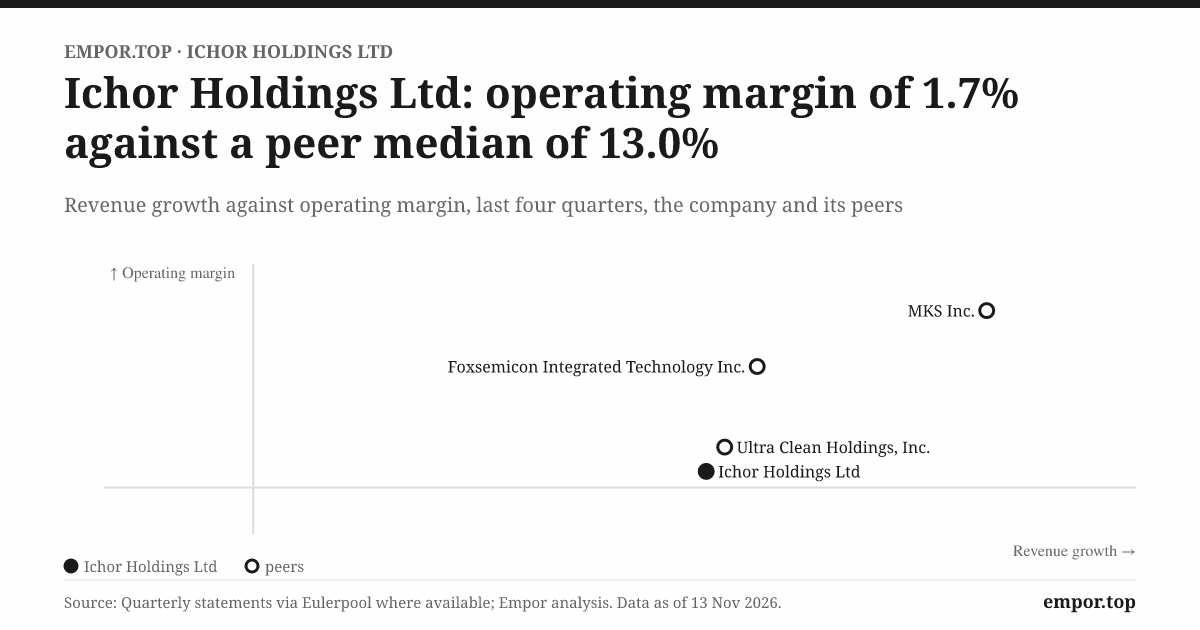
Seen that way, the history weighs more heavily than the recent quarters. Ichor's operating margin peaked at about 7.8% in fiscal 2018 and has never exceeded 8% in any fiscal year since its listing.7 The third-quarter 2026 margin of about 7% matches that ceiling; it does not yet break it.
The bull case, in other words, is not that Ichor is returning to its old peak. It is that the business is about to exceed its historical margin range because of proprietary content. That is a claim the record does not yet support, though it does not refute it either.
The case can be narrowed to three numbers. The first is customer concentration and the growth of revenue outside the top two customers; at 76% for Lam and Applied in fiscal 2025, it has been broadly stable.4 The second is GAAP gross and operating margin, which reached 15.8% and about 7% in the third quarter of 2026 and are rising.1
The third is operating cash flow less capital expenditure relative to revenue and working-capital growth, which was negative in fiscal 2025 and through the first nine months of 2026.75 If all three improve together through 2027, the bull case gains real weight. If margins rise only while cash stays negative and concentration grows, the bear case holds.
An activist would ask one more uncomfortable question. If margins improve only with a booming mix and rising volumes, what evidence shows that the proprietary-content strategy earns its cost of capital when utilization falls? The honest answer, as of November 2026, is that there is none yet, because the strategy has not been tested in a downturn. That is not a criticism of management; it is a description of where the story stands. Ichor's past has more to say about that test than its present does.
XI. Lessons from the Inventory Cycle
Go back to 2022, when Ichor's factories were running hard and inventory piled up amid supply-chain shortages.
A year later, demand had reversed: customers were digesting inventory, and management lacked visibility into how much they still held. That turn, from scarcity to glut in twelve months, is the moment that teaches the most.
The first lesson is that a critical component can still be a cyclical business. Ichor's gas panels are essential to the tools they go into, yet revenue fell 36.6% in a single year regardless of how important the product was. For investors, technical indispensability and demand stability are different things. The question is not whether the customer needs the part. It is whether the customer needs to buy it this quarter.
The second lesson is that a design win is a door opening, not revenue. Ichor's Malaysian hub is qualified by both of its largest customers, and the company has described flow control as a 2027 revenue event. Those are real milestones. But qualification lets a supplier into the room; it does not make the customer buy, and it does not stop the customer from qualifying someone else. The milestone that matters is the third consecutive quarter of shipments, not the first approval.
The third lesson is that growth has a working-capital price tag. In 2026, the ramp consumed cash as receivables and inventory grew, and Ichor sold stock to fund the gap. For a supplier that holds inventory and bills on shipment, a boom is not free. Every dollar of growth needs to be financed before it is collected. The investors who looked at operating cash flow alongside reported profit in 2026 were reading the business correctly.
The fourth lesson is that acquisitions are judged by the returns that survive the cycle, not by the logic at announcement. IMG added machining capability, but its stand-alone contribution remains undisclosed. Whether it was a good deal depends on whether that capability turns into durable margin gains. The verdict is still out, which is itself a lesson about buying at the peak.
Put those four together and they describe a supplier whose importance to its customers is real, but whose bargaining power over those customers is limited. Ichor's history argues for respecting that difference. Strategic importance to a product is not pricing power over a customer, and the gap between the two is where the cycle does its damage.
XII. Epilogue
As 2026 winds down, Ichor stands on firmer ground than it has in years. It is profitable on a GAAP basis, it has more than $200 million in cash, its Malaysian hub has customer qualifications, and management says its order book is growing.
Management has guided to sequential revenue growth through every quarter of 2027, with earnings growing more than twice as fast as revenue, and has said flow control will become a revenue event during the year.16 Management has also told investors it expects operating cash flow to improve in the first half of 2027 as the working-capital build slows.16
The next year will test each of those claims directly. The first test is revenue. If quarterly sales keep rising without a sharp increase in customer concentration, that suggests Ichor is winning share and broadening its base rather than simply riding Lam and Applied's ramps. If concentration climbs back toward the 82% level of fiscal 2023, the business is becoming more dependent, not less.
The second test is margins. As restructuring charges fade and customer mix shifts, GAAP gross margins must hold in the mid-to-high teens. A slip back toward 12% would suggest the 2026 improvement came mostly from volume. A move toward 19% or 20% would suggest the proprietary-content strategy is changing the economics of the business, and it would put within reach the performance awards that management has been paid to pursue.
The third test is conversion. Flow control and the six new component platform wins must generate recurring shipments in 2027. If they remain qualification milestones by the end of the year, the strategy's central claim will have slipped another year.
The fourth test is cash. Inventory and receivables must start growing more slowly than revenue, and operating cash flow must turn positive without another equity raise. That is the single clearest sign of whether growth is now self-funding.
Each outcome points somewhere different. Strong revenue, rising margins and positive cash flow would mean Ichor has built a better business, one that earns more on each dollar it sells and funds its own expansion. Strong revenue with stagnant margins and negative cash would mean it has caught an upcycle at the right moment and will need to prove itself again when it ends. The capacity is being built for demand management sees ahead. The cash still has to catch up.
XIII. Outro
Somewhere in a cleanroom in Malaysia, a technician is welding a stainless-steel line for a gas panel that will ship to an equipment maker in California, then to a fab in Taiwan or Arizona or Korea, where it will meter gases into a chamber that builds chips for machines that train artificial intelligence. Every link in that chain depends on the one before it. And at the start of the chain, Ichor waits for the next purchase order.
That is the image that captures this company. A business that reported its fastest three-quarter ramp in years, and a stock trading near $36, almost 70% below its high. Both are true at once, because the market is not asking whether Ichor makes good gas panels. It is asking whether Ichor can keep the money it makes when its customers stop buying. Ichor helps make the tool work. It still has to prove it can make the cycle work for shareholders.
References
-
Ichor Holdings, Ltd. announces third quarter 2026 financial results, Exhibit 99.1 — Ichor Holdings, 2026-11-02 ↩↩↩↩↩↩↩↩↩↩
-
Investor Relations, stock information — Ichor Holdings ↩↩↩↩↩↩
-
Q4 and FY2023 earnings release — Ichor Holdings, 2024-02-06 ↩↩↩↩↩↩
-
2025 Form 10-K — Ichor Holdings, 2026-02-20 ↩↩↩↩↩↩↩↩↩↩↩↩↩↩↩↩↩↩↩↩↩↩↩↩↩↩↩↩↩↩↩↩↩↩↩↩↩↩↩↩↩
-
Q3 2026 Form 10-Q — Ichor Holdings, 2026-11-03 ↩↩↩↩↩↩↩↩↩↩↩↩↩
-
Ichor Holdings company filings, annual reports FY2014–FY2025 — U.S. Securities and Exchange Commission ↩↩↩↩↩↩↩↩↩↩↩↩↩↩↩↩↩↩
-
Q3 2023 earnings call transcript — Stock Analysis, 2023-11-06 ↩↩↩↩↩↩↩↩↩
-
IMG acquisition announcement and transaction details — Ichor Holdings, 2021-11-16 ↩↩↩↩↩
-
December 2021 investor presentation, including IMG deal economics — Ichor Holdings, 2021-12 ↩↩↩
-
IMG acquisition completion, Form 8-K — Ichor Holdings, 2021-11-19 ↩
-
2026 Definitive Proxy Statement — Ichor Holdings, 2026-04-01 ↩↩↩↩↩↩↩↩↩↩↩↩↩↩↩↩
-
2026 Annual Meeting Voting Results, Form 8-K — Ichor Holdings, 2026-05-14 ↩↩
-
Q2 2026 earnings call transcript — EarningsAPI, 2026-08-03 ↩
-
Q3 2026 earnings call transcript — The Motley Fool, 2026-11-02 ↩↩↩↩↩↩↩↩↩↩↩↩↩↩↩↩↩↩↩↩↩↩↩↩↩↩
-
Q2 2026 investor presentation, Jefferies conference — Ichor Holdings, 2026-08 ↩↩
 LinkedIn
 WhatsApp
 Reddit
 Hacker News
 Email
 Kindle
 RSS Feed
 Spotify
 Apple Podcasts
 Amazon Music
 Audible
 YouTube