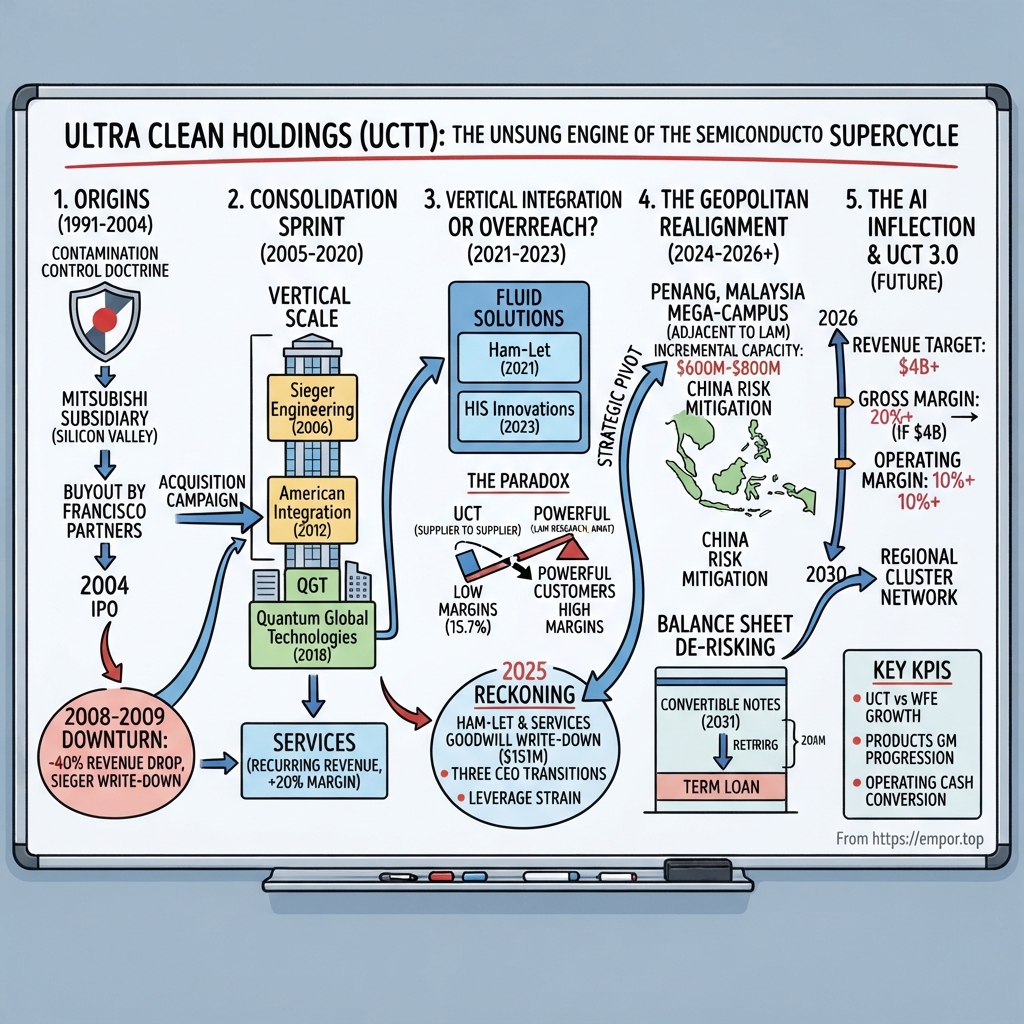
Ultra Clean Holdings: The Unsung Engine of the Semiconductor Supercycle
I. Introduction & Episode Roadmap (00:00 – 08:15)
The Plumbing Behind the Miracle
Stand on the floor of a leading-edge semiconductor fab and the machines look almost serene. Rows of beige and white cabinets hum quietly under amber cleanroom lighting, each bearing a familiar corporate logo: Applied Materials, Lam Research, Tokyo Electron, or ASML. Step behind one of those enclosures, however, and remove an access panel, and the view shifts: it looks less like solid-state computing hardware and more like the engine room of a naval submarine.
Inside runs a dense lattice of stainless-steel tubing, where every joint is orbitally welded and every interior surface electropolished. Dozens of compact pneumatic valves and mass flow controllers stand in tight rows, each metering process gases that can destroy an entire wafer run if delivered a fraction of a second late or carrying chemical impurities of a few parts per billion. Several of those gases are intensely corrosive, others are lethal, and some ignite spontaneously on contact with ambient air. Anchoring the assembly is a rigid, precision-machined steel frame engineered to dampen the slightest tremor, because mechanical vibrations too faint to perceive can distort circuit geometries patterned at the atomic scale.
When Wall Street discusses the artificial intelligence hardware boom, market attention centers on Nvidia's accelerators, TSMC's leading-edge foundries, and ASML's extreme ultraviolet lithography systems. Financial commentary rarely focuses on the underlying fluid and mechanical infrastructure. Yet no etch chamber can strike a plasma and no deposition tool can lay down an atomic layer without that sub-fab plumbing operating flawlessly, cycle after cycle, across years of production.
The Hidden Giant
A substantial share of that critical infrastructure is engineered and manufactured by Ultra Clean Holdings, Inc., traded on the Nasdaq under ticker UCTT and known across the semiconductor supply chain as UCT. In fiscal 2025, the company generated $2.054 billion in revenue, with $1.80 billion derived from its Products division and $255 million from Services.1 UCT designs and integrates ultra-high-purity gas delivery systems, chemical delivery modules, structural weldments, and precision valves and fittings, while also operating specialized facilities that clean and recoat contaminated chamber components cycled out of operating chip fabs.
Ultra Clean defines itself as "a leading developer and supplier of critical subsystems, components, parts, and ultra-high purity cleaning and analytical services primarily for the semiconductor industry."2 While accurate, the corporate description understates the unusual structural position of the business. UCT operates one tier below the original equipment manufacturers, who themselves sit one tier below chipmakers such as TSMC, Samsung, and Intel. It is, in practical terms, a supplier to the suppliers.
The Central Paradox
The central paradox of Ultra Clean is that the company is technologically indispensable yet commercially constrained. Its gas delivery panels sit inside some of the most sophisticated manufacturing systems ever built, yet in fiscal 2025 its GAAP gross margin was just 15.7%.1 That profitability profile aligns more closely with a high-volume contract electronics assembler than with the high-margin toolmakers it supplies.
The structural explanation lies in extreme customer concentration. In fiscal 2025, Lam Research and Applied Materials together accounted for 58.7% of UCT's total revenue.2 By the second quarter of 2026, as capital expenditure tied to artificial intelligence accelerated equipment orders, that combined share rose to 61.3%, with Lam alone representing 39.5%.3 When two equipment giants control more than three-fifths of an order book, commercial leverage rests firmly with the buyer. The core question for investors is not whether UCT's assemblies are essential to the tools, but whether its primary customers will ever permit an outsourced subsystem integrator to retain pricing power. Historical returns suggest they will not.
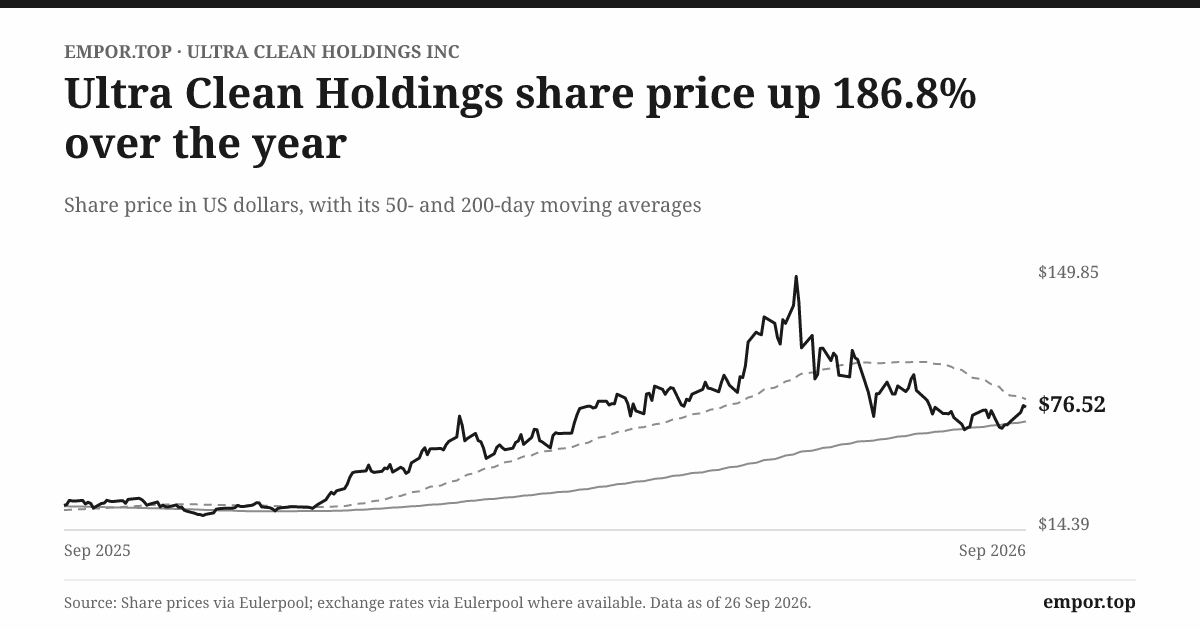
Market trading throughout 2026 brought that tension into sharp relief. By mid-June, UCT's shares had climbed roughly 230% year-to-date as public markets re-rated the business as a leveraged artificial intelligence infrastructure play,4 only to surrender more than half of those gains by late August amid a broader semiconductor pull-back and the launch of a new equity-distribution program.5 Few public companies demonstrate so clearly the divide between operational necessity on the factory floor and durable economic rent capture.
Roadmap
The analysis unfolds across six sections. First, the origins: an operating subsidiary formed by Japan's Mitsubishi Corporation (三菱商事) in 1991 to bring ultra-high-purity gas-handling expertise to Silicon Valley toolmakers. Second, the private-equity buyout, the 2004 initial public offering, and an acute liquidity crisis during the 2008–2009 global chip downturn. Third, the aggressive acquisition campaign that transformed a single-discipline gas-panel assembler into a multi-segment subsystems supplier, incorporating Sieger, AIT, Quantum Global Technologies, Ham-Let, and HIS Innovations.
Fourth, the operational mechanics: the anatomy of a gas box, why semiconductor toolmakers choose to outsource modular integration, and the protracted duopoly battle against Ichor Holdings. Fifth, the operational reckoning of 2025 and 2026: a $151 million goodwill impairment, three chief executive transitions within six months, the expansion of a major manufacturing footprint in Penang adjacent to Lam Research, and an overhaul of the capital structure. Finally, the strategic frameworks, a management scorecard, the bull and bear investment theses, and the operational milestones that will determine which outcome materializes.
The narrative begins where modern semiconductor manufacturing invariably starts: with particulate contamination, and the relentless engineering required to eliminate it.
 Subscribe on LinkedIn
II. Origins: The Japanese Purity Doctrine & The Francisco Partners Buyout (1991–2004) (08:15 – 22:30)
An Enemy Too Small to See
In the early 1990s, the semiconductor industry recognized that its most unforgiving constraint was invisible. As transistor geometries shrank below one micron, a microscopic particle shed from a valve seat or a trace of moisture in a gas line could destroy an entire die. Multiplied across hundreds of chips on a single wafer and thousands of sequential processing steps, sub-micron contamination became a catastrophic yield killer.
To visualize the operational tolerance: imagine painting a mural with a brush so delicate that a single speck of dust on the bristles ruins an entire city block. Now imagine that paint delivered through hundreds of meters of stainless-steel piping, where any internal burr or surface roughness can dislodge particulate. The semiconductor industry responded by treating the delivery infrastructure as a precision system in its own right: electropolishing tubing interiors to a mirror finish, executing orbital welds with tungsten electrodes rotating inside an inert gas shield, and assembling every manifold in cleanrooms with lower particle counts than a hospital surgical suite.
Japan addressed this contamination challenge earlier and more aggressively than Western manufacturers. During the 1980s, Japanese memory makers achieved fabrication yields that stunned American competitors, and much of that manufacturing edge stemmed from obsessive process cleanliness: electropolished tubing, particle-free orbital welding, and specialized fittings engineered to eliminate dead legs where stagnant gases could collect and pool. In Japanese semiconductor manufacturing, ultra-high purity was not merely a procurement specification; it was an operating doctrine.
Mitsubishi's Beachhead
Against that backdrop, Ultra Clean Technology Systems and Service, Inc. was established. According to company filings, the business was founded in 1991 by Mitsubishi Corporation and operated as a Mitsubishi subsidiary for more than a decade.6 The commercial rationale was direct: the world's leading semiconductor equipment makers were clustered in Silicon Valley, and those toolmakers urgently required the ultra-high-purity gas-handling expertise that Japanese suppliers had perfected.
While specific early operational records remain sparse in public disclosures, the critical takeaway for investors is the manufacturing heritage the enterprise inherited. UCT did not begin as an industrial sheet-metal fabricator that subsequently learned cleanroom hygiene; it began as a contamination-control specialist that evolved into an integrated subsystem builder. That foundational heritage continues to differentiate its market positioning.
The Outsourcing Epiphany
Throughout the 1990s, original equipment manufacturers built most of their gas panels, structural frames, and electrical wiring harnesses in-house. Over time, however, the severe volatility of semiconductor capital cycles forced a structural rethink. When equipment demand plunged during an industry downturn, an OEM carrying dedicated internal fabrication shops and assembly lines remained burdened with underutilized plant capacity and fixed labor costs. Outsourcing converted those fixed overhead costs into variable expenses, transferring the cyclical shock-absorption to external suppliers.
That structural trade-off sits at the center of UCT's business model. For toolmakers, outsourcing provides operational flexibility and frees core engineering talent to focus on proprietary process chambers, RF plasma physics, and control software. For the contract supplier, outsourcing offers substantial manufacturing volume, but at the cost of absorbing the very operational whipsaw the OEMs sought to shed. UCT capitalized on this transition by positioning itself beyond simple contract assembly: it partnered with toolmakers to co-design gas delivery architectures, delivering fully integrated, tested, and certified modules straight from its cleanrooms.
The Buyout
The collapse of the dot-com bubble and the severe 2001 semiconductor downturn altered Mitsubishi's strategic calculus. In November 2002, Ultra Clean Holdings, Inc. was incorporated in Delaware to acquire the business, and prior to its initial public offering, the company was principally owned by FP-Ultra Clean, L.L.C., an affiliate of private equity firm Francisco Partners.6
The executive who came to define UCT's operational identity over the subsequent two decades was Clarence Granger. Granger joined the company in 1996, serving as chief operating officer and executive vice president of operations before spending twelve years as chief executive officer; he joined the board of directors in May 2002 and was named chairman in October 2006.7 Granger became an enduring figure in UCT's history, steering the company through its public listing, the 2008 global financial crisis, and its initial wave of strategic acquisitions, before returning to executive leadership during subsequent operational transitions.
The 2004 IPO and the Early Thesis
UCT completed its initial public offering on Nasdaq in March 2004 under ticker UCTT.6 The timing coincided with a broader cyclical recovery: revenue expanded rapidly from $77.5 million in 2003 to $184.2 million in 2004 as industry equipment spending rebounded.6 The core investment thesis pitched to public markets was straightforward: as chip complexity multiplied, toolmakers would outsource an expanding share of subsystems to specialized integrators, allowing those suppliers to outgrow the broader wafer fab equipment market.
Regulatory disclosures from those formative public years also revealed the structural price of admission. Applied Materials, Lam Research, and Novellus Systems together generated roughly 90% of total sales in the mid-2000s.6 That degree of concentration represented less of a diversified commercial customer base and more of an existential dependency.
The commercial economic exchange was clear. An OEM outsourcing a gas delivery panel to UCT was not simply purchasing assembled stainless-steel tubing and valves; it was buying the balance-sheet flexibility to scale manufacturing capacity up or down without managing direct cleanroom payroll. UCT's core value proposition was precision cleanliness paired with variable manufacturing capacity. While valuable, the economic ceiling of that service was ultimately bounded by the customer's internal cost of production—a benchmark the equipment makers knew intimately.
By 2006, UCT's operational footprint signaled its long-term manufacturing trajectory. The company maintained cleanroom facilities in Menlo Park, California; Austin, Texas; and Tualatin, Oregon; and in March 2005, it opened an international manufacturing facility in Shanghai.6 That expansion into China targeted lower direct labor costs and closer geographical alignment with customer assembly hubs across Asia, initiating a cross-border manufacturing footprint—and accompanying geopolitical exposure—that would influence the company for the next two decades.
Historical Falsification: The First Bust
The structural outsourcing thesis faced its first severe test during the global financial crisis of 2008–2009, and the results were sobering. Revenue fell from $403.8 million in fiscal 2007 to $266.9 million in 2008, a 34% drop that the company attributed to a weakening global economy and severe credit tightening.8 Top-line contraction worsened in fiscal 2009 as revenue dropped further to $159.8 million, down roughly 40% year-over-year.9 Across a two-year collapse, roughly three of every five revenue dollars vanished.
Operating losses mounted rapidly. The company recorded net losses of $52.4 million in 2008 and $20.0 million in 2009.9 The 2008 loss included $55.1 million in impairment charges associated with the 2006 acquisition of Sieger Engineering.8 Filings from that period acknowledged that key customers exerted "significant influence and pricing pressure in the negotiation of our commercial agreements."8
The downturn exposed a fundamental reality of the outsourced subsystems model: outsourcing did not insulate contract suppliers from the capital cycle; it concentrated the cyclical volatility directly upon them. The primary IPO-era narrative—that structural outsourcing would allow subsystem specialists to outpace broader industry growth through every environment—held true over long secular horizons, but offered no protection during cyclical retrenchments. That persistent tension between capturing long-term outsourcing growth and absorbing violent cyclical shocks would dictate UCT's strategic playbook for the subsequent fifteen years, initiating an aggressive acquisition campaign designed to build scale, expand into components, and fortify the franchise.
III. The Consolidation Sprint: Building Vertical Scale (2005–2020) (22:30 – 42:00)
The First Acquisition, and the First Write-Down
In June 2006, UCT initiated that consolidation strategy by agreeing to acquire Sieger Engineering, a South San Francisco supplier of critical subsystems to the semiconductor, flat-panel display, and medical sectors. The transaction was valued at approximately $50 million, comprising $16 million in cash, roughly 2.47 million UCT common shares, and the assumption of around $15 million in debt.10 Sieger had generated about $86 million in revenue in 2005, but produced only about $4 million in operating income—an operating margin of under 5%.10
That thin margin profile proved fragile. Within two and a half years, as the 2008 downturn took hold, UCT wrote off $55.1 million in goodwill and long-lived assets tied directly to the deal.8 The first acquisition of the company's public era proved to be a costly capital-allocation misstep, demonstrating early on the hazards of buying low-margin manufacturing capacity ahead of a cyclical contraction.
AIT and the Arizona Leg
UCT made its next major move in 2012. In May of that year, it agreed to merge with American Integration Technologies, a Chandler, Arizona supplier of subsystems to the semiconductor, medical, energy, industrial, and aerospace industries, for approximately $74 million in cash and 4.5 million UCT shares, bringing the total consideration to roughly $99 million.11 AIT had generated about $170 million in revenue in 2011.11 Granger pitched the combination as providing "scale and new capabilities and full systems integration."11
Operationally, AIT fulfilled its core mandate: it broadened UCT's revenue base and added structural frame fabrication along with complex systems integration. Yet it did not shift the underlying economics. In contract subsystems manufacturing, added scale can capture incremental customer build volume, but it rarely produces commercial pricing leverage against concentrated buyers.
The Scholhamer Playbook
In January 2015, Granger stepped down as chief executive, remaining on the board as non-executive chairman, and handed executive leadership to James Scholhamer. Scholhamer arrived directly from Applied Materials, where he had served as corporate vice president and general manager of the Equipment Products Group and Display Services Group, after earlier leadership roles as chief operating officer and chief technology officer at Applied Films prior to its 2006 sale to Applied Materials.12 A materials engineer by training from the University of Michigan,12 his professional career had unfolded almost entirely within capital equipment, spanning operating and technology leadership at Applied Films followed by eight years at Applied Materials leading display, energy, and services operations.12 Having managed equipment manufacturing from inside the industry's largest toolmaker, he understood the cyclical pressures that dictate what tier-one OEMs are willing to pay their component suppliers.
Scholhamer brought the customer's procurement perspective inside UCT. He understood how an Applied Materials business unit evaluated suppliers, which delivery bottlenecks created friction, and what operational lapses prompted toolmakers to qualify secondary sources. Under his leadership, UCT pursued a dual-track strategy: expand component categories and modular assemblies to capture more revenue per tool, while building higher-margin, recurring revenue to cushion pure equipment cycles.
The approach contained an inherent tension. While broadening product breadth increased dollar content per tool, each new module had to be acquired, integrated, and qualified with the same two dominant customers. The strategic question was how far UCT could push that model without overextending its operational base.
The Quantum Leap into Services
The most ambitious step in that direction arrived in July 2018, when UCT announced the acquisition of Quantum Global Technologies, a parts-cleaning, coating, and contamination-analysis business, for $342 million in cash plus up to $15 million in contingent consideration tied to 2019 revenue targets.13 QGT had generated $217.9 million in revenue and $50.5 million in adjusted EBITDA in 2017, representing a 23.2% EBITDA margin; UCT calculated the purchase multiple at 6.8 times trailing EBITDA.13 The transaction was funded entirely with committed debt financing.13
The industrial logic centered on recurring operational maintenance. Inside an active fab, etch and deposition chambers accumulate corrosive chemical residues on their interior surfaces after weeks of continuous production. Those components must be removed, stripped, cleaned to sub-nanometer standards, recoated with protective ceramics, and reinstalled. Because this maintenance cycle tracks ongoing wafer processing rather than new tool installations, it offered a recurring revenue stream tied to fab utilization. In addition, QGT's ChemTrace unit contributed analytical laboratories capable of detecting contamination down to parts-per-trillion levels.
Scholhamer framed the acquisition as expanding UCT "into an adjacent market," emphasizing that QGT provided a recurring, wafer-starts-based revenue stream and direct commercial relationships with chipmakers rather than tool OEMs alone.13 At 6.8 times EBITDA for an asset generating margins above 20%, the purchase multiple appeared reasonable relative to the target's cash flow.
Did Services Hold Up?
From a margin perspective, the Services division performed as expected. In fiscal 2024, Services generated a 28.1% GAAP gross margin, nearly double the 14.9% recorded by the Products division.14 In the second quarter of 2026, that spread remained consistent: 27.4% for Services compared to 14.6% for Products.15
However, the segment did not expand into the corporate ballast management had envisioned. Services revenue peaked at $297.7 million in 2021,16 before softening to $243.9 million in 2024 and $254.7 million in 2025.141 The business settled at roughly 12% of total corporate revenue, leaving the parent company dominated by equipment cycles. In the second quarter of 2025, UCT wrote off the remaining $73.5 million of goodwill in the Services reporting unit, reducing its carrying value to zero.1
The historical record presents a divided outcome. The broader proposition that specialized cleaning would serve as an effective counter-cyclical hedge did not materialize; when chipmakers throttled fab output, cleaning volumes declined as well, and the division remained too small to insulate the broader enterprise. By contrast, the narrower thesis—that precision chamber cleaning constituted a stickier, higher-margin profit pool—held true. Nonetheless, the 2025 goodwill write-down showed that even that higher-margin revenue stream had been overvalued on the balance sheet.
Capital Allocation Benchmark
Comparing UCT's major acquisitions reveals a distinct pattern in capital allocation. In 2018, UCT paid roughly 6.8 times EBITDA for QGT, securing a business with an EBITDA margin above 20%.13 At the close of 2020, it paid approximately 14.5 times EBITDA to acquire Ham-Let, an industrial fitting and valve supplier generating an EBITDA margin of around 12%.17 In 2023, it acquired HIS Innovations at roughly 8.3 times expected EBITDA, using earnouts tied directly to subsequent financial performance.18
The transaction history shows an inverse relationship between purchase multiples and underlying profitability. Measured by valuation multiples, UCT's least expensive major deal delivered its highest operating margins, whereas its most expensive acquisition bought lower margins at the height of a cyclical upturn, funded with floating-rate debt. While the structured earnouts in the HIS transaction demonstrated tighter valuation discipline, that adjustment arrived after the balance-sheet leverage from Ham-Let was already in place.
By 2020, fifteen years of consolidation had widened UCT's footprint and scaled its revenue. What it had not changed was customer leverage. The company's subsequent move sought to challenge that reality directly: manufacturing the proprietary fluid-handling components that went inside its own gas delivery assemblies.
IV. Vertical Integration or Overreach? Ham-Let & Sub-Fab Expansion (2021–2023) (42:00 – 01:00:30)
A Chess Move in a Hot Market
December 2020 was an exuberant period across the semiconductor industry. Pandemic-driven demand for personal computers, enterprise servers, and automotive electronics triggered widespread component shortages, and fab equipment bookings surged. On December 16, UCT announced an agreement to acquire Ham-Let (Israel-Canada) Ltd., a manufacturer of industrial flow-control products, including connectors, fittings, and valves engineered for high-pressure and high-temperature systems.17
The purchase price totaled approximately $348 million, including $61 million in net debt. Ham-Let had generated $201 million in trailing twelve-month revenue and $24 million in adjusted EBITDA, representing a transaction valuation of roughly 14.5 times EBITDA.17 That valuation was more than double the multiple UCT had paid for QGT two years prior, for an asset operating at substantially lower operating margins.
The acquisition closed on March 31, 2021, at an enterprise value of approximately $351 million, funded via a Term Loan B facility arranged by Barclays.19 Ham-Let's component portfolio became the foundation of what UCT designated its Fluid Solutions division.
The Industrial Logic
The industrial rationale appeared straightforward. A semiconductor gas delivery panel is an intricate assembly of specialized fittings, regulators, and valves. Historically, every panel UCT integrated incorporated components purchased from third-party manufacturers such as Swagelok, Parker Hannifin, and Japan's Fujikin (フジキン). By bringing a component manufacturer in-house, UCT intended to replace third-party parts with its own hardware, capturing two margin layers on a single integrated system.
Management's initial transaction presentation outlined an addressable market expansion exceeding $2 billion, margin expansion via vertical integration, $20 million in annualized run-rate cost synergies within three years, and adjusted earnings accretion within the first full year following completion.17 Scholhamer characterized the purchase as "another meaningful step in executing our long-term strategy to grow and diversify our business by adding complementary, high value, high margin product offerings."17
Historical Falsification: Who Owns the Bill of Materials?
The operational vulnerability in that strategy rested on procurement authority: UCT does not determine which fittings are installed inside a gas panel. The tool OEMs control the engineering bill of materials, and downstream chipmakers frequently lock in tool configurations once a fabrication recipe is qualified. Replacing an approved valve or fitting with an in-house alternative requires formal requalification, introducing process risk into customer fabs where an unproven component shedding particulate can scrap millions of dollars in silicon wafers.
Management's subsequent commentary reflected that friction. More than four years after completing the transaction, executives acknowledged on the third-quarter 2025 earnings call that Fluid Solutions was designed to expand margins rather than drive top-line growth by substituting internally manufactured components for purchased parts; on the preceding call, leadership had noted that customer qualifications for Fluid Solutions components were expected to aid gross margins starting in early 2026.2021 In practice, the internal component capture underpinning the transaction remained subject to an extended, tool-by-tool qualification process years after closing.
The financial reckoning arrived in the second quarter of 2025, when UCT recorded a $77.6 million goodwill impairment against the Fluid Solutions reporting unit, entirely eliminating its remaining carrying goodwill.1 Addressing the write-down on the July 2025 earnings call, then-CFO Sheri Savage explained that the charge was triggered by a decline in UCT's equity valuation and market capitalization, noting that "our assumptions now are a little more conservative than when we initially bought the business."21
Evaluating the $20 million in targeted cost synergies is more ambiguous. UCT provided no dedicated disclosures tracking progress against that specific synergy target in subsequent financial reports or earnings calls through mid-2026, leaving the final realized savings undisclosed rather than definitively confirmed.
The empirical record does not invalidate the concept of vertical integration, but it substantially curtails its initial ambitions. What had been presented as a high-growth platform accessing an addressable market exceeding $2 billion evolved into an internal cost-reduction program contingent on OEM approvals. The critical operational benchmark remains the Products segment gross margin: if component substitution succeeds, gross margins should expand as customer qualifications materialize. Through the second quarter of 2026, however, Products GAAP gross margin registered at 14.6%,15 trailing the 14.9% recorded in fiscal 2024.14
The Leverage Trap
The capital structure chosen to fund the acquisition compounded the operational challenges. Borrowing through a floating-rate Term Loan B in early 2021 appeared manageable when benchmark interest rates hovered near zero. When the Federal Reserve initiated aggressive monetary tightening throughout 2022 and 2023, UCT's debt-service burden escalated sharply. Annual interest expense climbed to approximately $49 million in 2023 and remained around $38 million in 2025, according to regulatory filings.2 That cash outflow absorbed operating earnings precisely as the semiconductor memory sector entered a severe cyclical contraction.
Cyclical top-line contraction magnified the debt strain. After peaking at approximately $2.37 billion in 2022, UCT's total revenue dropped to $1.73 billion in 2023, resulting in a GAAP net loss of $31.1 million.2214 Executing a highly leveraged acquisition at the peak of an equipment cycle with unhedged floating-rate debt exposed the enterprise to compounding macro headwinds. The outcome reflected less a failure of the underlying industrial premise than an acute miscalculation in cyclical timing and balance-sheet risk.
The Sub-Fab Bet
UCT's final acquisition of that cycle was more modest in size and structured with greater valuation discipline. On October 25, 2023, the company acquired HIS Innovations Group, based in Hillsboro, Oregon, a manufacturer supporting the "sub-fab"—the utility level beneath the cleanroom housing vacuum lines, turbomolecular pumps, and exhaust-abatement systems.18 UCT structured the transaction with $50 million in upfront cash, alongside contingent earnouts of up to $50 million tied to 2023 EBITDA and up to $20 million linked to 2024–2025 performance milestones, reflecting an aggregate valuation multiple of 8.3 times expected 2023 adjusted EBITDA.18 At the time of the transaction, HIS was projected to generate $56.7 million in 2023 revenue with a 38.4% gross margin.18
Scholhamer stated that the transaction broadened UCT's presence across the sub-fab ecosystem while expanding its addressable market by roughly $1.5 billion.18 Two years later, during the third-quarter 2025 earnings call, leadership disclosed that HIS operations were undergoing strategic evaluation, including potential facility consolidation.20 While stopping short of an asset write-down, the operational review indicated that integration had encountered friction rather than immediate scaling. Whether the sub-fab expansion will yield a durable growth engine remains an open question.
The acquisitions materially broadened the catalog of subsystems and components UCT sells. Evaluating whether they altered the company's underlying commercial pricing power requires opening up the operational mechanics of the core integration business.
V. Inside the Core Business: Anatomy, Economics & Competition (01:00:30 – 01:21:45)
Anatomy of a Gas Box
A semiconductor fabrication tool functions much like a kitchen engineered to cook with atoms: the process chamber is the oven, while the gas delivery system serves as the pantry, spice rack, and measuring spoons combined—except the chemical ingredients are intensely toxic or pyrophoric, flow rates are metered in fractions of a standard cubic centimeter per minute, and recipes shift every few seconds.
In hardware terms, a gas box—often called a gas panel—is an organized array of parallel fluid lines known across the industry as "sticks." Each stick forms a dedicated sequence of manual and pneumatic valves, particulate filters, pressure regulators, and a mass flow controller governing a single process gas. The mass flow controller functions as a high-precision digital faucet, measuring gas volume in real time and adjusting internal apertures within milliseconds. Advanced etch and deposition tools carry dozens of these parallel lines within a single chassis, and every flow path must remain leak-tight, chemically unreactive, and assembled inside certified cleanrooms.
UCT's Products division integrates these gas panels alongside chemical delivery systems for liquid-phase processes, structural frames and weldments that anchor the tools, and precision valves and fittings manufactured by Fluid Solutions. In fiscal 2025, that Products segment generated $1.80 billion in revenue.1 The Services segment, dedicated to cleaning, recoating, and conducting analytical testing on chamber components, contributed $254.7 million.1
Beyond the Gas Box
Chemical delivery modules perform the identical contamination-control mandate for liquid chemistry that gas panels execute for process gases. Wet cleaning steps and chemical mechanical planarization—the critical process that buffs wafer topography flat between deposition layers—rely on abrasive slurries and aggressive acids delivered at exact concentrations, temperatures, and flow rates. In planarization, a chemical slurry harboring a single agglomerated abrasive particle can scratch across a patterned silicon wafer, destroying dozens of dies simultaneously.
Precision frames and structural weldments constitute the skeleton of the equipment. A modern etch or deposition system can weigh several metric tons, housing high-speed vacuum transfer robots, reaction chambers, and automated load ports that must maintain sub-millimeter alignment across years of continuous fab operation. While structurally unglamorous, structural rigidity is decisive: a frame that flexes by a fraction of a millimeter under thermal or mechanical stress can misalign an end-effector robot and drop a cassette of production wafers.
The Services division operates at the opposite end of the equipment lifecycle. During active fabrication, reaction chamber interiors accumulate corrosive and hazardous chemical byproducts. Chipmakers cycle these contaminated components out of the line, transferring them to UCT's regional cleaning hubs. Technicians strip chemical residues, inspect surfaces for micro-pitting, apply specialized ceramic coatings, and return the hardware alongside analytical certificates verifying contamination thresholds down to parts per trillion. The chipmaker compensates UCT on a per-part, per-cycle basis—establishing a maintenance loop where revenue recurs as long as the fab operates.
The Economics of a Subcontractor
The structural margin disparity between these operating units exposes the underlying economics of contract subsystem manufacturing. In fiscal 2024, Products delivered a GAAP gross margin of 14.9%, whereas Services generated 28.1%.14 Products margins remain structurally compressed because the bill of materials for a gas panel is dominated by pass-through components—valves, mass flow controllers, and pressure transducers—purchased directly from customer-approved third-party vendors. UCT's gross value add consists of modular engineering, orbital welding, cleanroom integration, helium leak testing, and supply-chain orchestration. Because tier-one toolmakers assemble similar modules internally, they know the labor and material costs to the penny.
The profitability swings across industry cycles demonstrate the economic ceiling of the model. During the peak pandemic equipment surge of 2020 and 2021, when manufacturing plants operated at maximum capacity, UCT achieved GAAP gross margins of 20.9% and 20.5%, yielding GAAP operating margins of 8.7% and 8.8%.16 That period established the high-water mark for the enterprise. By fiscal 2025, as industry demand softened and mix shifted, GAAP gross margin compressed to 15.7%, while operating margin fell to negative 5.2% following the goodwill impairment.1 That dramatic spread between peak and trough profitability reflects the financial price of functioning as an outsourced shock absorber for capital equipment OEMs.
The Customer Hegemony
Customer concentration metrics have oscillated within an intensely tight corridor. UCT's top two customers—Lam Research and Applied Materials—accounted for 62.7% of total revenue in 2022, 57.4% in 2023, 54.5% in 2024, and 58.7% in 2025.222 During the first half of 2026, as equipment deliveries for artificial intelligence infrastructure accelerated, their combined contribution climbed back to 60.1%.3 On the second-quarter 2026 earnings call, executive leadership argued that customer engagements were broadening—highlighting expanding modular work for lithography OEMs—and pointed out that top-two concentration had declined from historical highs near 64% into the high 50% range over time.23 Yet the 2026 delivery cadence demonstrated the opposite dynamic: whenever leading-edge equipment spending surges, UCT's reliance on Lam and Applied intensifies rather than dilutes.
That concentration is echoed in geographic exposure. Revenue derived outside the United States expanded to 75.9% in fiscal 2025, up from 69.6% in 2023.2 That migration mirrors the physical realignment of semiconductor capital spending, as tool manufacturers expanded integration facilities across Asia and leading chipmakers concentrated fab construction across Taiwan, South Korea, China, and Southeast Asia.
Myth vs Reality: "UCT Has Pricing Power Because It Is Essential"
The Myth: Because UCT's gas and chemical delivery subsystems sit inside mission-critical fabrication tools and require exhaustive multi-month engineering qualifications, UCT commands durable commercial pricing power.
The Reality: Rigorous qualification creates formidable switching barriers against outside entrants, but confers minimal pricing leverage against the equipment makers themselves. Tier-one OEMs deliberately maintain a dual-sourcing architecture, qualifying both UCT and a direct peer on major equipment platforms. Once two integrators are qualified to build a specific gas box, the OEM's procurement group can reallocate build volume between them based on cost and lead times. Ichor Holdings, UCT's primary competitor, explicitly disclosed in its annual filing that "our customers exert significant influence and pricing pressure in the negotiation of our commercial arrangements" and that toolmakers "often require price reductions" as a condition of ongoing procurement.24 UCT acknowledged the identical commercial pressure in its 2009 regulatory disclosures.8 Furthermore, across four consecutive quarterly earnings calls spanning mid-2025 to mid-2026, management consistently attributed gross margin variability to factory absorption, product mix, global footprint transitions, and tariff friction—never to realized price increases.21202523 The empirical record demonstrates that while UCT's manufacturing capabilities are indispensable to tool production, that indispensability does not translate into commercial pricing power.
The Chief Nemesis: Ichor
In the outsourced gas delivery market, Ichor Holdings serves as UCT's direct counterpart. In fiscal 2025, Ichor reported $947.7 million in revenue, with Lam Research and Applied Materials together accounting for 76% of total sales.2624 Ichor's annual regulatory filings explicitly identify Ultra Clean as its primary operational competitor,24 and like UCT, Ichor operates high-volume integration facilities in Malaysia to shadow OEM manufacturing centers.24
A comparative look at operating profitability illustrates the structural difference in their corporate models. In fiscal 2025, Ichor generated a GAAP gross margin of 9.3%, or 12.2% on a non-GAAP basis.26 By comparison, UCT's 15.7% GAAP gross margin in the same fiscal year demonstrated greater margin resiliency.1 That spread offers the most compelling empirical support for UCT's diversification playbook: by layering chamber cleaning services and proprietary fluid components on top of core gas-panel integration, UCT built an earnings profile structurally higher than that of a pure-play contract assembler, even if that buffer remains insufficient to fully immunize the enterprise during cyclical downturns.
The Wider Field
The competitive arena extends well beyond the duopoly with Ichor. In its annual regulatory filing, UCT categorizes its competitive landscape across five distinct disciplines: in gas delivery, Ichor and Fujikin; in specialized subsystems, Foxsemicon, Jabil, VDL ETG, Celestica, and Benchmark; in fluid-handling components, Swagelok, Parker Hannifin, and Watlow; in chamber parts cleaning, KoMiCo, SHT, EnPro, and Pentagon; and in micro-contamination analytics, Balazs, Eurofins, and SCAS.2
Several of these competitors wield considerable strategic leverage. Foxsemicon Integrated Technology (京鼎精密科技), a Taiwan-based subsystem integrator affiliated with the Hon Hai Precision Industry group, maintains entrenched ties to regional foundry ecosystems. In chamber services, South Korea's KoMiCo (코미코) represents a formidable competitor positioned adjacent to major memory manufacturers Samsung Electronics and SK Hynix. Meanwhile, multinational contract electronics giants such as Celestica and Jabil deploy expansive global manufacturing networks and balance sheets that toolmakers can selectively tap whenever subsystem capacity constrains tool shipments.
The strategic takeaway is that UCT operates in an ecosystem contested on every operational flank. Its competitive moat consists not of insurmountable intellectual property, but of an accumulated web of platform-specific tool qualifications, cleanroom capacity, and joint-engineering trust—assets that competitors can replicate given sufficient capital and time. In that commercial environment, physical proximity to customer manufacturing hubs emerged as the decisive strategic differentiator, setting the stage for a high-stakes relocation of the global supply chain.
VI. The Geopolitical Pivot: The Batu Kawan Mega-Campus & Supply Chain Realignment (01:21:45 – 01:38:00)
A Pandemic-Era Decision
In July 2020, amid widespread pandemic lockdowns and intensifying supply-chain strain, UCT announced plans to construct a major manufacturing facility in the Batu Kawan Industrial Park in Penang, Malaysia, projecting that the site would employ more than 650 people over five years.27 Then-chief operating officer Vijay Chinnasami framed the investment as an operational safeguard, stating that the facility would "ensure business continuity, enable us to better serve our customer base."27
In practical terms, business continuity was corporate shorthand for mitigating China risk. UCT had operated manufacturing facilities in Shanghai since the mid-2000s.6 As geopolitical tensions escalated and Washington tightened export restrictions on advanced semiconductor manufacturing equipment, toolmakers increasingly pressed suppliers to establish redundant manufacturing capacity outside China to support tools bound for non-Chinese fabs.
Lam Moves First
Lam Research made the identical strategic pivot at an even larger scale. In August 2021, Lam opened an advanced manufacturing facility in Batu Kawan—its largest factory globally—having expanded the initial plan from 700,000 to more than 800,000 square feet.28 Lam chief executive Tim Archer stated that the Malaysian campus would allow the toolmaker to "expand our global footprint to better serve our customers."28
For an outsourced subsystem integrator whose largest customer was Lam Research, the industrial logic was inescapable. Building adjacent to a customer's primary manufacturing hub shortened transit times, streamlined engineering change orders, and positioned UCT as the natural supplier of choice whenever tool assembly schedules accelerated.
The Inauguration
UCT formally opened its Penang campus in April 2024, representing a RM250 million investment and employing approximately 600 local workers at opening.29 Management projected that upon full completion across all development phases, the site would add incremental annual revenue capacity of US$600 million to US$800 million.29 Scholhamer underscored the location's regional importance, describing Penang as "the epicentre of the establishing and growing semiconductor ecosystem" across the Asia Pacific region.29
Did the Capacity Pay Off?
The operational payoff proved neither immediate nor straightforward. Manufacturing capacity generates financial return only when production lines are utilized. On the July 2025 earnings call, Granger acknowledged that UCT had built well ahead of prevailing equipment demand, conceding that the business had been "scaled to grow at a $4 billion run rate" while "currently operating at a $2 billion run rate," an overhang that forced workforce reductions in April and July of that year.21 It was an unusually stark admission of operational leverage working in reverse: the company had absorbed fixed cleanroom overhead and staffing for an equipment surge that stalled.
By February 2026, under new executive leadership, the strategic framing shifted. Management reported that existing facilities could support roughly $3 billion in annual revenue at approximately 65% factory utilization, with Asian operations accounting for roughly half of corporate capacity and projected to approach 60%, while reaching a $4 billion revenue run rate would require only "modest incremental clean room investment."25 On the August 2026 earnings call, leadership outlined a substantial multi-year expansion, describing the addition of 26,000 square feet of cleanroom space in Malaysia alongside planned projects in Singapore and the Czech Republic, establishing a capacity roadmap expanding to $3.5 billion by the end of 2026, $4 billion by mid-2027, and $5 billion in the second half of 2028.23
China Exposure
On the October 2025 call, management disclosed that direct sales inside China represented slightly under 7% of corporate revenue, noting that production supporting non-Chinese customers would be fully migrated out of China by the end of the fourth quarter.20 In February 2026, the company reiterated that direct China exposure remained below 7% of revenue and was expected to be flat through 2026.25
Direct customer exposure within China is therefore limited. The secondary exposure, however, is structural. Because Lam Research and Applied Materials derive significant equipment revenue from Chinese domestic fabs, any trade restrictions or export controls that curb OEM shipments into China inevitably reduce UCT's production volumes, regardless of where its gas panels are assembled.
Tariffs and the Other Map
Geographic realignment also introduced trade-policy friction. When renewed U.S. tariffs took effect in 2025, UCT had to absorb rising costs on cross-border component shipments. On the July 2025 earnings call, management disclosed that the company had incurred approximately $3 million in tariff expenses while having been reimbursed only about $300,000 up to that point.21 By October, Granger reported that commercial negotiations had progressed, stating that UCT was recovering "approximately maybe a little over 90% of the tariffs" directly from customers.20 While a few million dollars is modest against a $2 billion revenue baseline, the recovery lag demonstrated the commercial power dynamic: when macroeconomic policy raises input costs, an outsourced supplier must carry the initial financial burden until concentrated buyers agree to price adjustments.
Simultaneously, UCT widened its manufacturing network beyond Asia. On the July 2025 call, management announced that the company had secured new business at its Czech facility commencing in the fourth quarter of that year.21 By August 2026, executives outlined planned cleanroom expansions across both Singapore and the Czech Republic.23 The operating model, which management termed a cluster-based regional manufacturing network, seeks to locate production hubs adjacent to wherever major toolmakers assemble equipment.20
What It Means
The decision to establish the Batu Kawan campus was strategically sound: it shadowed Lam Research's primary international hub, reduced direct reliance on Chinese production, and positioned UCT to capture build volume during the artificial intelligence equipment upcycle. Yet physical proximity does not confer commercial exclusivity. Ichor also manufactures in Malaysia.24 The operational benefits of co-location—short transit routes, shared regional supply chains, and rapid engineering coordination—are shared across a duopoly rather than monopolized by UCT. Furthermore, UCT bore the carrying costs of that expanded footprint through two years of factory under-utilization before sustained demand materialized. That financial strain and unabsorbed overhead formed the backdrop for an acute corporate reckoning.
VII. The Reckoning: The 2025 Financial Shock, Management Transition & Refinancing (01:38:00 – 01:54:15)
A Sudden Departure
On March 5, 2025, UCT announced that Jim Scholhamer had stepped down as chief executive officer, effective immediately, for personal health reasons.7 Clarence Granger, a decade removed from day-to-day executive leadership, stepped back into the organization as interim CEO while the board formed an executive search committee.7 Granger credited Scholhamer with steering the enterprise through "significant growth throughout several semiconductor cycles and a global pandemic."7
The timing was precarious. Memory spending was only beginning a fragile recovery, leading-edge logic demand remained uneven, and renewed tariff threats loomed over cross-border supply chains. UCT found itself managing an operational transition without a permanent chief executive.
The Impairment
The financial reckoning arrived in the second quarter of 2025. UCT recorded a $151.1 million non-cash goodwill impairment charge, of which $77.6 million eliminated the remaining goodwill in Fluid Solutions and $73.5 million wiped out the goodwill carrying value in Services.1 Alongside the write-downs, the company recorded $4.8 million in quarterly restructuring charges covering severance, employee retention, and facility closures.30
For full-year fiscal 2025, UCT reported $2.054 billion in revenue and a GAAP net loss of $181.2 million, or $4.00 per diluted share.1 Excluding the impairment charges and other one-time items, non-GAAP net income stood at $47.7 million.1
In corporate accounting, a goodwill write-down represents an explicit acknowledgment: the enterprise paid more for acquired assets than their subsequent cash flows justify. With Ham-Let and Quantum Global Technologies fully written down, two of the three largest acquisitions in UCT's history saw their goodwill eliminated, repeating the pattern established with Sieger Engineering during the 2008 downturn. Across two decades, three major cyclical consolidation bets culminated in three goodwill write-downs—a track record that complicates management's historical claims of disciplined capital allocation.
"AI Is a Little Distant From Us"
The most revealing moment of mid-2025 arrived during the second-quarter earnings call in July. When analysts inquired about artificial intelligence equipment demand, Granger offered a remarkably unvarnished assessment: "AI is -- that's a little distant from us… we don't have specific orders tied to that right now."21 It was a candid acknowledgment of the temporal lag separating headline chip enthusiasm from physical subsystem bookings on the factory floor, contrasting sharply with how quickly corporate messaging would pivot over the subsequent six months.
The Xiao Appointment
On August 6, 2025, UCT named Jinsong "James" Xiao as chief executive officer, effective September 2, 2025.31 Xiao brought more than two decades of operating experience across the semiconductor, solar, and display industries, having previously led multi-billion-dollar business units at Applied Materials.31 He held a degree in applied physics from Dalian University of Technology and an MBA from Indiana University's Kelley School of Business.31 With the succession settled, Granger returned to his post as non-executive chairman, commending Xiao's "strong strategic mindset."31
Xiao moved quickly to reshape corporate messaging. During his debut earnings call in October 2025, he unveiled "UCT 3.0," articulating a vision to elevate the company "from a trusted partner into a trusted strategic partner and co-innovator."20 By February 2026, his characterization of market conditions turned bolder: "What we are witnessing is not a normal cyclical upturn. It is an AI technology inflection."25 Public markets routinely hear that a prevailing cycle is structurally different, and investors should evaluate such claims against operational realities.
Stripped of corporate branding, the substance of UCT 3.0 represents a collection of operational improvements. On the October 2025 call, Xiao outlined initiatives spanning lean manufacturing disciplines, automation and AI-driven optical inspection, a regional manufacturing cluster network, and accelerated design-to-production cycles for new products.20 By August 2026, he framed the strategy around "expanding our global manufacturing capacity, enhancing engineering and operational capabilities, and accelerating digital transformation," underscored by the opening of a new product introduction center in Hillsboro, Oregon.1523 Portions of this groundwork predated Xiao's arrival: Granger noted on the October 2025 call that an organizational flattening was already largely complete and that an enterprise SAP deployment had gone live within Fluid Solutions that July.20
These initiatives do not constitute a structural revolution. They represent the standard playbook of a disciplined contract manufacturer striving to lower unit costs and improve customer delivery metrics. In an outsourced model where pricing power rests with the buyer, operational execution remains the primary lever within management's direct control. The ultimate validation of UCT 3.0 will appear not in marketing nomenclature, but in factory absorption, on-time delivery rates, and gross margins.
The Refinancing
The balance-sheet restructuring followed rapidly. On February 25, 2026, UCT announced a proposed $400 million private placement of convertible senior notes due 2031, intending to allocate net proceeds toward capped call transactions, up to $40 million in share repurchases, prepayment of outstanding term loan debt, and general corporate purposes.32 Robust market demand expanded the placement: on March 3, 2026, UCT closed an upsized $600 million offering of 0% convertible senior notes due 2031, with an initial conversion price of approximately $84.75 per share.3
The financial relief was immediate. Regulatory disclosures for the second quarter of 2026 confirmed that the term loan, which stood at $481.4 million at the close of 2025, was fully retired during the period.3 On April 23, 2026, UCT amended its revolving credit facility, expanding borrowing capacity from $150 million to $250 million and pushing maturity out to April 2031, with $15 million drawn as of late June.3 Simultaneously, the company repurchased approximately 0.7 million common shares for $40.3 million through a privately negotiated transaction.3 Net interest expense dropped to $1.1 million in the second quarter of 2026.3
The transaction was opportunistic balance-sheet engineering: UCT exchanged floating-rate bank debt carrying double-digit interest burdens for zero-coupon paper when its equity valuation traded near cyclical highs. The trade-off was potential equity dilution. If share prices appreciate beyond conversion thresholds, noteholders will capture equity upside that the companion capped call only partially hedges.32
What the Analysts Asked
The second-quarter 2026 earnings call in August illustrated how Wall Street evaluated the updated corporate narrative. Research analysts concentrated their inquiries on three core areas: the timeline for reaching a $4 billion revenue run rate, the margin trajectory beyond that milestone, and the risk that component bottlenecks might impede production ramps. Regarding profitability, management reiterated that achieving a 20% gross margin depended on operating at a $4 billion annualized revenue scale, while cautioning that product mix, manufacturing jurisdiction, and shipping origin would dictate the realized result.23 Addressing component constraints, executives stated that UCT had secured critical inventory early and experienced no material delivery delays during the quarter.23 Asked to project operating margins beyond the $4 billion threshold, leadership replied that the long-term margin model remained to be determined.23
The dynamic was characteristic of contract manufacturing: management spoke with concrete precision regarding short-term cleanroom schedules, but remained measured on structural economics. For an outsourced supplier whose margins depend on customer negotiations, that caution is warranted. It also signals that investors should treat the 20% gross margin target as a conditional operating target rather than a guaranteed baseline.
And Then an ATM
Five months after completing the convertible debt refinancing, on August 14, 2026, UCT entered into an equity distribution agreement with UBS, Barclays, Craig-Hallum, and Oppenheimer to sell up to $400 million in common stock through an at-the-market equity program, paying the placement agents commissions of up to 3% of gross proceeds.33 The regulatory filing did not specify designated uses for the capital.33 The announcement unsettled public markets, sending UCT's shares down 8.5% that trading day.34
The operational context explained the timing. Operating cash flow across the first six months of 2026 registered at negative $41.1 million as working capital expanded to build pre-ramp inventory, reducing cash balances to $255.9 million.2315 Scaling cleanrooms and working capital to support an eventual $4 billion to $5 billion revenue run rate absorbs substantial liquidity before delivering cash collections. While the at-the-market facility provided liquidity insurance, it served notice to shareholders that expanding production capacity would likely require equity-dilutive funding.
The Succession Wave
Corporate governance turned over in tandem with the executive suite. On April 23, 2026, UCT announced that Granger would retire as board chairman effective May 22, 2026, remaining as a director, while long-serving board member Tom Edman assumed the chairmanship.35 Reflecting on his tenure, Granger characterized leading the board as "a privilege" after "three decades" with the company.35 Following the planned retirement of long-time chief financial officer Sheri Savage, UCT on July 8, 2026 named Michael Keogh as CFO, effective August 5.36 Keogh arrived from Ford Motor Company, where he had served as chief financial officer of Ford Model e and Integrated Services, following senior finance positions across Apple, Stanley Black & Decker, and Intel.36
Within eighteen months, UCT turned over its chief executive twice, appointed a new chairman, and replaced its chief financial officer. That sweeping leadership transition provides the incoming executive team a clean mandate to reset operating priorities. It also means the leaders now committing to multi-year targets bear no responsibility for the capital allocation choices of the prior cycle. Examining the strategic frameworks that follow helps differentiate between structural industry realities and company-specific execution.
VIII. Strategy Tear-Down: 7 Powers & 5 Forces (01:54:15 – 02:11:30)
A War-Game Frame
To evaluate Ultra Clean's strategic position, consider the procurement office of a tier-one equipment toolmaker. On the wall hangs a qualification dashboard for each gas-panel platform. For the vast majority of critical assemblies, exactly two names appear: Ultra Clean and Ichor. The procurement officer's mandate is straightforward: keep both suppliers operationally viable, keep them competing aggressively on lead times and cost, and ensure neither ever becomes the sole source. Every rigorous analysis of UCT's competitive power begins inside that room.
Hamilton Helmer's 7 Powers
Process Power: Moderate. UCT commands decades of specialized know-how in ultra-high-purity orbital welding, cleanroom assembly, micro-contamination control, and rapid new-product introduction. That accumulated manufacturing expertise is genuine and cannot be replicated overnight. The strategic limitation is that direct peers like Ichor possess comparable processes, and equipment toolmakers actively assist secondary suppliers to ensure parity. Process power establishes a formidable barrier against unproven outsiders, but it confers virtually no pricing leverage against incumbent buyers.
Switching Costs: Moderate at the tool level, weak at the account level. Once a subsystem architecture is certified inside a specific equipment platform, requalifying an unproven alternative introduces severe yield risk. However, because OEMs deliberately maintain dual-sourced qualifications on mature platforms, shifting production volume between UCT and Ichor carries negligible friction. Customer concentration metrics—with the top two buyers accounting for roughly 54% to 63% of total revenue annually since 2022222—demonstrate how directly UCT's revenue trajectory hinges on procurement allocation decisions made entirely outside the company.
Scale Economies: Moderate and largely captured by customers. Larger manufacturing facilities dilute fixed cleanroom overhead, an advantage the Batu Kawan campus was designed to enhance. Yet contract manufacturing norms dictate annual cost-reduction discussions that transfer manufacturing efficiencies directly back to the OEM. The most tangible evidence of this dynamic appears in historical profitability: UCT's GAAP gross margin at $2.05 billion in revenue in 2025 was lower than what it achieved on $1.40 billion in 2020.161
Cornered Resource: Weak. While the acquisition of Ham-Let brought proprietary fitting geometries, valves, and patents, the subsequent goodwill write-off underscored that its economic rent capture fell short of initial projections. High-purity industrial valves and fittings remain available from established global competitors such as Swagelok and Parker Hannifin.2
Counter-Positioning: None. UCT operates on the standard outsourced modular assembly model that has defined the semiconductor capital equipment supply chain for three decades.
Network Economies: None. Subsystem contract manufacturing exhibits no two-sided or direct network effects; adding another gas box to a production run creates no self-reinforcing advantage for other customers.
Branding: Weak. The brand emblazoned across the cleanroom enclosure belongs to Applied Materials or Lam Research. Downstream semiconductor manufacturers may never know—or require knowledge of—which contract integrator assembled the underlying gas panel.
What could structurally shift this competitive assessment? Three potential catalysts exist. First, if Fluid Solutions components become the locked-in default specification across customer bills of materials, UCT would establish proprietary product capture approaching a cornered resource. Second, if UCT's joint co-design initiatives—the co-innovator framework championed under executive leadership—prompt OEMs to architect equipment around proprietary UCT subassemblies, platform switching costs would deepen materially. Third, if Services expands significantly faster than Products, favorable segment mix would lift blended corporate margins independent of underlying contract pricing power. Executive leadership projected Services to expand at double-digit rates across 2026 and 2027, supported by leading-edge fab build-outs across the United States, South Korea, and Taiwan.2523 Through mid-2026, however, none of these catalysts has materialized at a scale sufficient to alter the structural reality.
On balance, Helmer's framework reveals that Ultra Clean commands one definitive power—process power—and one partial power in platform-level switching costs. Crucially, neither confers durable commercial pricing power. That conclusion aligns with two decades of financial history: operating margins that expand during volume surges and compress sharply the moment factory utilization wanes.
Porter's Five Forces
Buyer Power: Extreme. Two equipment makers accounted for roughly 60% of UCT's revenue in the first half of 2026.3 Both customers are technically sophisticated, command detailed insight into component bills of materials, and systematically cultivate dual-source suppliers. Ichor explicitly acknowledged this dynamic in its regulatory filings, disclosing that customers routinely mandate price reductions as a prerequisite for continued business.24
Supplier Power: Moderate to High. Critical active components, such as mass flow controllers and optical pressure transducers, are typically specified by the OEM's engineering team, preventing UCT from marking up pass-through component costs. While Fluid Solutions was acquired to capture internal margin on fittings and valves, customer qualification cycles mean that contribution is being qualified on a platform-by-platform basis.20
Threat of New Entrants: Low to Moderate. Multi-month qualification protocols, capital-intensive cleanroom infrastructure, and decades of operational trust establish substantial barriers against de novo start-ups. The tangible competitive threat stems instead from scaled contract electronics manufacturers, such as Celestica, Jabil, and Foxsemicon, which already possess global facilities and balance sheets capable of supporting toolmaker overflow.2
Threat of Substitutes: Very Low. Physics dictates that plasma etch, chemical vapor deposition, and wet-clean processes require ultra-high-purity gas and liquid distribution. There is no alternative technology that eliminates physical fluid delivery. The relevant strategic hazard is not technological substitution, but OEM in-sourcing during cyclical downturns.
Competitive Rivalry: Intense. UCT and Ichor compete directly for build allocations across the same equipment platforms, shadowing each other's manufacturing expansions and answering to the same two dominant buyers.24
The Peer Comparison
The most direct operational benchmark is Ichor Holdings. In fiscal 2025, UCT generated a GAAP gross margin of 15.7%, compared to 9.3% for Ichor.126 Across full semiconductor cycles, UCT's diversified portfolio—incorporating high-margin chamber cleaning services and structural weldments alongside gas panels—has consistently supported an earnings profile superior to its pure-play peer. That margin spread represents an authentic, structural operating advantage. Yet both companies remain tethered to the capital expenditure cycles of the same two primary customers. UCT stands as the better-positioned supplier within a structurally constrained commercial niche.
These strategic frameworks define what the business can theoretically earn. Whether executive leadership has stewarded that earning power effectively across cycles is a distinct question—one addressed directly by the management scorecard.
IX. Management Credibility & Historical Falsification Scorecard (02:11:30 – 02:26:00)
The Pattern Over Twenty Years
An objective evaluation of management begins with the acquisition record, where UCT deployed the vast majority of its capital over two decades. Sieger Engineering, acquired in 2006, was largely written down two years later in 2008.108 American Integration Technologies, acquired in 2012, broadened manufacturing capabilities and structural weldments without subsequent write-downs in public filings.11 Quantum Global Technologies, acquired in 2018 at 6.8 times EBITDA, contributed a durable, higher-margin services business but had its goodwill fully written off in 2025.131 Ham-Let, acquired in 2021 at roughly 14.5 times EBITDA, also saw its goodwill eliminated in 2025 while its proprietary components remained subject to ongoing qualification cycles across customer tools.17120 Finally, HIS Innovations, acquired in 2023, was placed under strategic evaluation two years after closing.20
This is not a record of unmitigated failure: top-line revenue expanded from $77.5 million in 2003 to more than $2.05 billion in fiscal 2025.61 Yet the historical pattern is unmistakable. The enterprise demonstrated consistent success in buying revenue, but struggled to capture durable economic returns. Transactions negotiated during cyclical peaks were repeatedly written down during subsequent cyclical downturns.
Target Models vs Reality
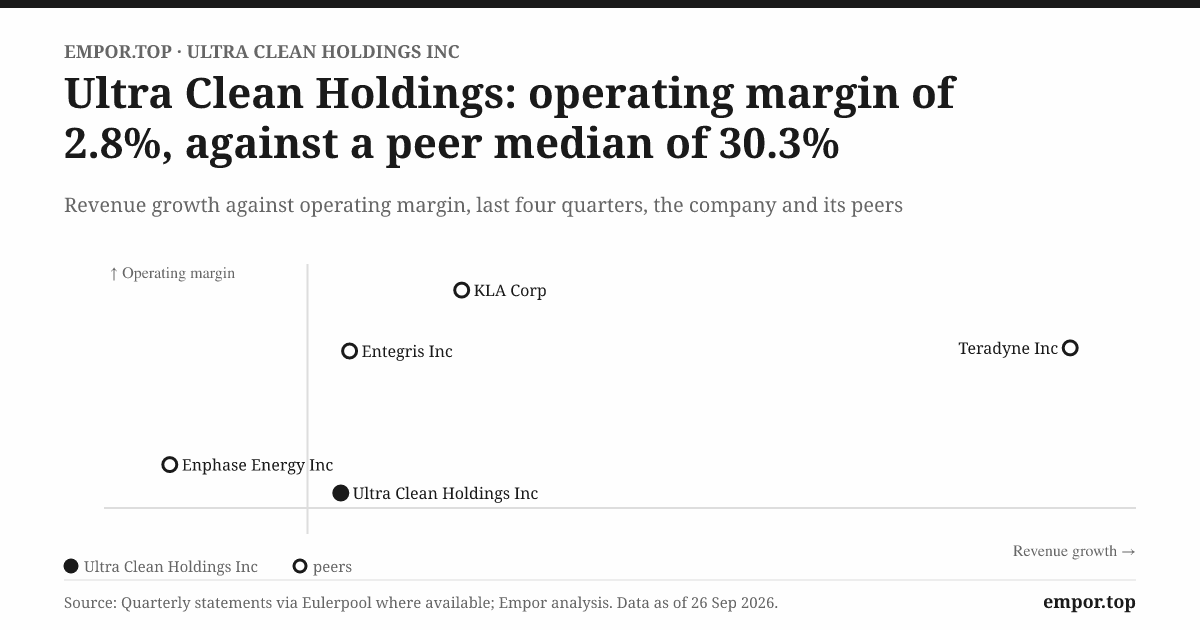
The high-water mark of UCT's modern operating model was set during the pandemic-era surge of 2020 and 2021, when GAAP gross margin averaged approximately 21% and GAAP operating margin hovered just below 9%.16 Profitability has not matched that benchmark since. GAAP operating margin compressed to 2.0% in 2023 and 4.3% in 2024,14 before falling to negative 5.2% in 2025 following the goodwill impairment.1 In the strongest quarter of the 2026 cyclical rebound, the second quarter, GAAP operating margin recovered to 4.6%, or 7.0% on a non-GAAP basis.15
Against that historical baseline stands management's current long-term financial model. Alongside first-quarter 2026 results, UCT outlined an operating goal of $4 billion in revenue with gross margins above 20% and operating margins above 10%, a roadmap that investor presentation materials linked to 2030.37 On the August 2026 earnings call, executive leadership accelerated that operating timeline, stating that the company expected to achieve a 20% gross margin once it reached a $4 billion annualized revenue run rate in 2027.23 Asked by research analysts how margins might trend beyond that $4 billion threshold, management stated that the long-term margin profile remained to be determined.23
The critical test for investors is whether operating margins expand in tandem with volume during this cycle. In 2021, on approximately $2.10 billion in revenue, UCT achieved a 20.5% gross margin.16 In the second quarter of 2026, running at an annualized revenue pace exceeding $2.5 billion, non-GAAP gross margin registered at 16.7%.15 While top-line revenue expanded, gross margins have not yet followed to prior cyclical heights. The 20% margin target remains unproven rather than disproven, with gross margin progression at each step up in quarterly revenue serving as the primary benchmark to validate operating leverage.
Guidance and Candor
Leadership has demonstrated genuine candor during difficult operating periods. Granger's admission that UCT's cleanroom footprint had been built for a $4 billion run rate while operating at $2 billion was an unusually blunt acknowledgment of factory under-absorption.21 Similarly, on the October 2025 earnings call, executive leadership openly conceded the limits of prior forecasting, noting that "we've had 2 or 3 or 4 years of saying second half growth."20 That level of transparency provides a credible foundation for evaluating executive commentary.
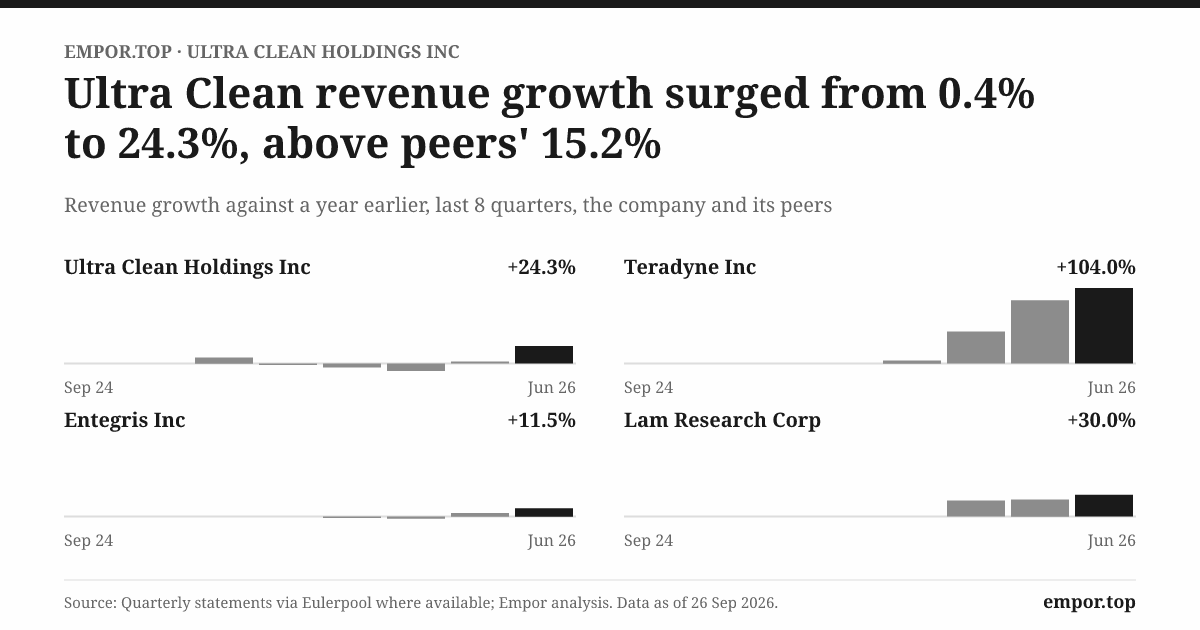
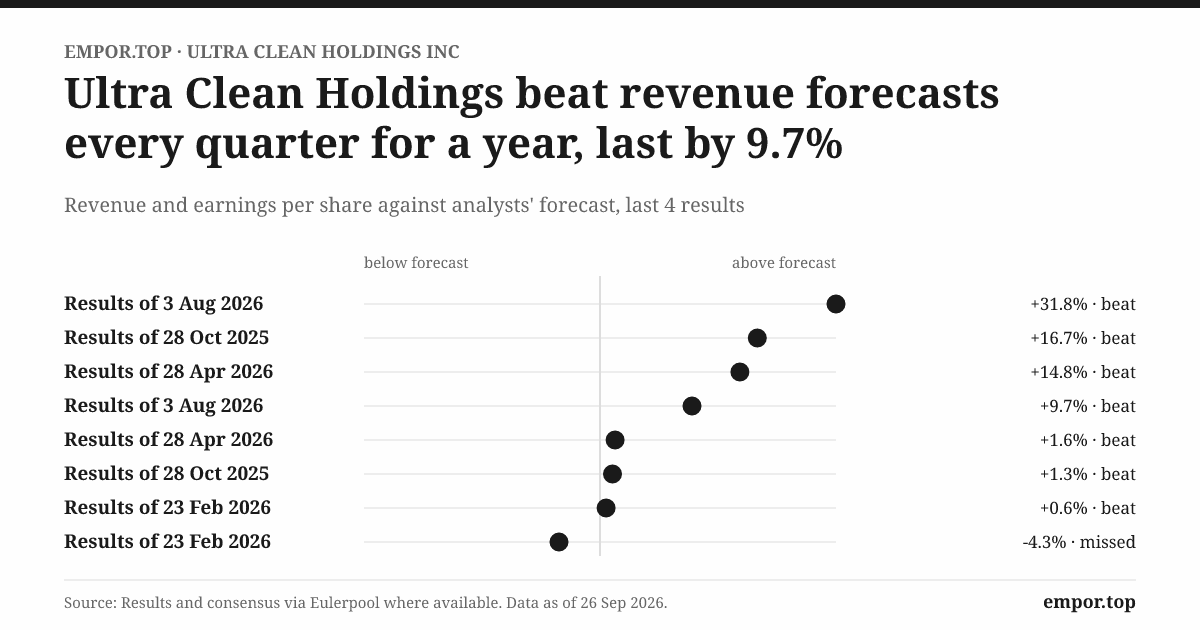
Short-term operational execution has likewise proven disciplined during the 2026 recovery. Second-quarter 2026 revenue of $644.9 million comfortably exceeded the guidance range of $565 million to $605 million issued in April,1538 while third-quarter guidance of $700 million to $750 million signaled ongoing sequential expansion.15
Where corporate disclosures remain guarded is on commercial pricing power and platform market share. While leadership reiterated that UCT would expand "on par with WFE growth or even higher,"25 it has refrained from quantifying platform-level market share gains against direct peers. Furthermore, management provided no standalone revenue or margin disclosures for Fluid Solutions or HIS Innovations on quarterly earnings calls spanning late 2025 through mid-2026,2023 leaving the underlying financial performance of those acquired units undisclosed. Finally, the $400 million at-the-market equity program was filed without designating specific uses of proceeds.33
The Capacity Promise, Round Two
The most consequential operational commitment facing the business centers on manufacturing capacity. In 2025, executive leadership acknowledged that manufacturing facilities had been constructed to support $4 billion in run-rate revenue while demand hovered near $2 billion.21 By mid-2026, leadership outlined an aggressive multi-year expansion, targeting $5 billion in revenue capacity by the second half of 2028.23 When analysts on the August 2026 earnings call questioned why near-term revenue guidance trailed the growth rates projected by its largest customer, management highlighted the standard delivery lag separating OEM equipment bookings from subsystem shipments, asserting that across a two-quarter window UCT's growth would match or exceed customer delivery rates.23 That explanation aligns with the physical mechanics of the equipment supply chain.
Nevertheless, historical precedent counsels analytical caution. UCT has repeatedly added fixed overhead ahead of end-market demand, most acutely in 2025 when the company executed two separate workforce reductions to right-size operations after plant capacity outran equipment orders.21 Executive leadership contends that current conditions are fundamentally different, arguing that tier-one toolmakers are providing longer-horizon demand visibility and explicitly requesting suppliers to establish buffer capacity.2523 Yet in capital equipment, customer demand forecasts do not represent binding purchase commitments. If fab schedules slip, UCT absorbs the unutilized cleanroom carrying costs.
The Activist's Questions
A disciplined institutional investor or activist shareholder would focus on four central vulnerabilities:
- Capital Allocation: Why should public markets endorse aggressive balance-sheet expansion following three successive cycles in which major acquisitions culminated in goodwill write-downs?
- Equity Dilution: The combination of a $600 million convertible note offering and a $400 million at-the-market equity program represents substantial potential share dilution if fully exercised.
- Cash Conversion: Despite delivering record quarterly revenue during the first half of 2026, the company generated negative operating cash flow as working capital requirements and inventory pre-builds absorbed liquidity.23
- Customer Concentration: What contingency safeguards exist if either Lam Research or Applied Materials accelerates internal subsystem assembly or reallocates platform volume to a qualified competitor?
The Xiao Test
Chief executive James Xiao's long career inside Applied Materials represents a double-edged strategic asset. Having directed multi-billion-dollar business units at the industry's premier toolmaker, he commands an intimate understanding of OEM procurement requirements, and his operational focus on rapid new-product introduction and joint engineering reflects that insider perspective.20 Yet the governance hazard mirrors the challenge that accompanied his predecessor: an executive trained within a dominant customer organization may instinctively optimize for customer responsiveness over corporate pricing discipline and return on invested capital.
The decisive test of Xiao's tenure will emerge across three measurable milestones: whether gross margins expand toward target thresholds as factory volume scales, whether future capital deployment avoids cyclical overreach, and whether management exercises discipline in drawing upon the at-the-market equity program. With this operational scorecard established, the competing investment theses for Ultra Clean come into focus.
X. The Bull vs. Bear Case & Key KPIs (02:26:00 – 02:40:00)
Where the Stock Stands
By mid-June 2026, UCT's shares had surged roughly 230% year-to-date, briefly trading near $105 at approximately 21 times forward EV/EBITDA.4 By August 28, the stock had surrendered more than half those gains, closing at $69.48—down over 51% from its 52-week peak—and compressing its valuation to about 9.9 times forward EV/EBITDA.5 Few mid-cap industrial suppliers have compressed an entire cycle of artificial intelligence enthusiasm and retrenchment into a single summer so dramatically. That volatility reflects genuine market uncertainty over which structural narrative will ultimately prevail.
The Bull Thesis
1. Architectural complexity is compounding. The transition to gate-all-around nanosheets, backside power delivery, and taller 3D NAND architectures requires an expanding sequence of deposition and etch cycles, each demanding tighter chemical and gas delivery control. More processing steps translate into additional gas lines and modular subsystems per tool chassis. On the August 2026 earnings call, executive leadership emphasized that customers were outsourcing larger modular assemblies to UCT while extending forward delivery forecasts.23
2. Manufacturing capacity is established. Executive leadership indicated that existing infrastructure can accommodate approximately $3 billion in annual revenue, with an expansion toward $4 billion requiring only modest incremental cleanroom investment.25 If equipment volume absorbs that fixed footprint, operating leverage should lift margins.
3. The balance sheet has been de-risked. The company fully retired its floating-rate term loan, lowering quarterly net interest expense to approximately $1 million,3 while extending its revolving credit facility through 2031.3
4. Portfolio diversification yields a structural margin buffer. Benefiting from its chamber-cleaning services and integrated fluid components, UCT generated a gross margin in fiscal 2025 substantially higher than that of its pure-play rival, Ichor.126
Testing the Bull Case
Scrutinizing these points reveals where the bull thesis meets operational resistance. The secular tailwind of semiconductor complexity is genuine, but it benefits the entire subsystem ecosystem: Ichor, Foxsemicon, and competing contract assemblers ride the identical architectural wave. Management's capacity roadmap is technically credible, yet recent history provides a cautionary precedent: while UCT can construct cleanroom capacity rapidly, its experience in 2025 demonstrated the painful financial consequences of carrying substantial unabsorbed overhead when end-market demand pauses.21 Furthermore, while the balance-sheet de-leveraging is real, that debt retirement was financed by shifting risk from commercial credit lenders to equity holders via convertible notes and an at-the-market equity program. The core of the bull argument rests on operating leverage—and that is precisely the variable that remains unproven in the current upcycle.
The Bear Thesis
1. The structural margin ceiling. Across twenty years of public operating history, gross margins have fluctuated with cyclical factory absorption without permanently breaking above the 2020–2021 peak of roughly 21%.16 Dominant OEMs that systematically cultivate dual-sourcing retain both the commercial leverage and the incentive to capture manufacturing efficiencies for themselves.
2. Severe customer concentration. Lam Research and Applied Materials together represented 61.3% of total revenue in the second quarter of 2026.3 An unfavorable platform allocation, an OEM in-sourcing initiative, or a lost platform qualification would inflict immediate operational damage.
3. Prospective shareholder dilution. The combination of an upsized $600 million convertible note offering and a $400 million at-the-market equity program establishes substantial dilution overhang for existing equity holders.333
4. Inherent cyclical vulnerability. Management frames current market conditions as an enduring "AI technology inflection" rather than a conventional cyclical expansion.25 Yet UCT's operating record, particularly during the contractions of 2009 and 2023, demonstrates how rapidly top-line revenue can plunge when capital equipment spending pauses.914
5. Indirect geopolitical exposure. While direct sales within China account for less than 7% of corporate revenue, tighter cross-border export controls on advanced wafer fab equipment threaten to curb total tool shipments by UCT's primary OEM customers.25
The Risk Radar
Beyond the headline bull and bear arguments, five operational risks operate directly through UCT's underlying business mechanics:
Downstream demand digestion. Semiconductor manufacturers periodically pause capital deployments to absorb newly installed tool capacity. When chipmakers pause, equipment OEMs trim procurement orders, and outsourced subsystem integrators absorb the inventory correction first and most acutely. On the August 2026 call, executive leadership projected 2027 wafer fab equipment spending across an expansive range of $190 billion to $220 billion,23 a $30 billion spread that underscores the difficulty of forecasting equipment demand over a multi-year horizon.
Memory market volatility. Management characterized the memory sector as entering a multi-year structural expansion, projecting supply shortages to persist through 2028.25 Historically, however, memory spending has represented the most volatile pocket of the equipment landscape; the 2023 downcycle was precipitated by an abrupt memory retrenchment that severely depressed UCT's revenue and operating results.14
Working capital absorption. Rapid production ramps consume liquidity long before finished assemblies generate cash collections. The negative operating cash flow recorded across the first six months of 2026 provided early empirical evidence of that working capital strain as inventory expanded ahead of tool shipments.23
Executive transition during an operational ramp. Ultra Clean is executing this expansion under entirely new organizational leadership, with a chief executive, chief financial officer, and board chairman all assuming their roles within the prior twelve months during one of the steepest production ramps in corporate history.313635
Insider sentiment. Regulatory tracking compiled by market observers recorded 83 insider transactions across the six months preceding the announcement of the at-the-market equity program—all consisting of share sales without open-market insider purchases.34 While executive divestments following a sharp stock appreciation are standard practice, the sustained cadence of insider selling warrants attention when paired with concurrent corporate equity-distribution filings.
Weighing the Two
Synthesizing the empirical evidence clarifies the boundaries of both investment theses. The bull proposition that UCT commands stronger positioning and better structural margins than pure-play subsystem peers is well supported by historical data. Conversely, the assertion that expanded manufacturing scale will grant UCT authentic commercial pricing leverage remains unproven. On the bear side, the argument that tier-one equipment makers will cap supplier margins is reinforced by two decades of contract manufacturing precedent. However, with an expanded cleanroom network and interest expense sharply reduced, UCT can generate substantially higher absolute earnings even if percentage gross margins remain range-bound. The deciding test centers on operational execution: whether management can convert an annualized revenue run rate approaching $4 billion into a 20% gross margin without triggering extensive shareholder dilution.
The Three KPIs That Matter
1. UCT revenue trajectory relative to broader wafer fab equipment spending. Executive leadership has committed to expanding corporate revenue on par with or faster than the broader equipment market.25 Tracking relative growth rates quarter by quarter offers the cleanest proxy for platform share gains or losses against Ichor and secondary integrators.
2. Products segment gross margin progression. The Products division represents the testing ground where cleanroom absorption, bill-of-materials pricing discipline, and internal component substitution from Fluid Solutions must register. If management's consolidated 20% gross margin target is attainable, Products gross margin must climb decisively from the mid-teens as quarterly build volumes expand.1523
3. Operating cash conversion and diluted share count. Delivering record quarterly revenue while burning cash through working capital is viable only across limited ramp windows.23 Investors should monitor whether operating cash flow turns solidly positive as cleanroom inventory converts into receivables, while watching the diluted share count to evaluate whether management activates the at-the-market equity facility.33
The incoming operational data will resolve which narrative holds. The commercial lessons of the past three decades, however, are already written.
XI. Epilogue & Playbook Lessons (02:40:00 – 02:50:00)
Back Behind the Panel
Return to the tool on the fab floor, and to the intricate lattice of stainless-steel tubing behind the service panel. It represents some of the most meticulously engineered manufacturing hardware in the world. The engineers who designed it solved complex challenges in metallurgy, fluid dynamics, and micro-contamination control that most industrial designers never encounter. Yet the company that integrated that assembly captured barely sixteen cents of gross profit on every dollar of revenue.
That persistent divide between extraordinary technical difficulty and ordinary economic return is the foundational reality of Ultra Clean.
Lesson 1: The Monopsony Customer
A two-billion-dollar enterprise can still remain a price-taker. When roughly 60% of total revenue flows from two dominant buyers who systematically maintain dual-sourced supply chains by design, those buyers dictate the commercial terms.3 UCT's operating record from the 2008 financial crisis through the 2025 downcycle demonstrates that customer concentration invariably overpowers manufacturing scale.
Lesson 2: Vertical Integration Needs the Customer's Permission
Acquiring Ham-Let to capture component-level profit margins was strategically viable only if tier-one toolmakers agreed to install UCT's proprietary fittings inside their equipment. The protracted qualification cycle and the subsequent complete write-off of carrying goodwill demonstrated the boundaries of that thesis.120 In an outsourced manufacturing supply chain where the customer controls the engineering bill of materials, vertical integration is an external commercial negotiation, never an internal operational fiat.
Lesson 3: Proximity Is Necessary, Not Sufficient
Constructing the Batu Kawan campus positioned UCT immediately adjacent to its largest customer's flagship manufacturing facility.2829 That physical co-location provides essential operational advantages: it streamlines build schedules, secures manufacturing volume, and buffers against logistics shocks. Yet proximity confers no exclusive commercial monopoly: qualified competitors can build nearby as well, and cleanroom capacity constructed ahead of underlying equipment demand can burden operating results with unabsorbed overhead for years.21
Lesson 4: Every Upcycle Feels Different
In July 2025, artificial intelligence demand appeared "a little distant" to UCT's executive leadership.21 Seven months later, management described market conditions as an enduring "AI technology inflection."25 Both characterizations reflected genuine operational assessments in their respective moments. The enduring lesson for public market investors is that narrative framing in the semiconductor capital equipment sector pivots far faster than the underlying commercial economics.
Lesson 5: Buy in the Bust, Not the Boom
UCT's costliest asset write-downs trace directly back to acquisitions completed near cyclical peaks: Sieger Engineering in 2006 and Ham-Let at the close of 2020.1017 Both transactions were subsequently stress-tested by industry downturns that materialized within two years of closing. In a cyclical manufacturing sector, the purchase valuation paid and the debt structure assumed matter just as much as industrial logic. The early 2026 convertible debt refinancing demonstrated counter-cyclical financial discipline by raising low-cost capital when equity valuations traded near cyclical highs. Whether that balance-sheet discipline extends to the next corporate acquisition—and to the measured deployment of the at-the-market equity facility—represents the critical test confronting incoming executive leadership.
Final Takeaway
Ultra Clean Holdings operates as a supplier of picks and shovels to the picks-and-shovels makers: technologically indispensable to the physical scaling of Moore's Law, yet commercially constrained by the structural power dynamics of the semiconductor equipment food chain. The reconstituted leadership team has restructured the balance sheet, refreshed executive governance, and committed to ambitious revenue and margin targets. What it has yet to prove is the single milestone that has eluded every management team across UCT's corporate history: demonstrating that expanding manufacturing scale can permanently alter commercial pricing power and deliver superior economic returns.
References
-
Ultra Clean Reports Fourth Quarter and Full Year 2025 Financial Results — PR Newswire, 2026-02-23 ↩↩↩↩↩↩↩↩↩↩↩↩↩↩↩↩↩↩↩↩
-
Ultra Clean Holdings, Inc. Form 10-K for Fiscal Year Ended December 26, 2025 — U.S. Securities and Exchange Commission, 2026-02-23 ↩↩↩↩↩↩↩↩↩
-
Ultra Clean Holdings, Inc. Form 10-Q for Quarter Ended June 26, 2026 — U.S. Securities and Exchange Commission, 2026-08 ↩↩↩↩↩↩↩↩↩↩↩↩↩
-
Ultra Clean Holdings Stock Has Surged 230% in 2026. Is UCTT Still Worth Buying at $105? — TIKR, 2026-06-12 ↩↩
-
Ultra Clean Stock Fell 7% in a Day as the Chip Selloff Deepened — TIKR, 2026-08-28 ↩↩
-
Ultra Clean Holdings, Inc. Form S-1 Registration Statement — U.S. Securities and Exchange Commission, 2006 ↩↩↩↩↩↩↩↩
-
Ultra Clean Announces Clarence Granger as Interim CEO (Form 8-K Exhibit) — U.S. Securities and Exchange Commission, 2025-03-05 ↩↩↩↩
-
Ultra Clean Holdings, Inc. Form 10-K for Fiscal Year 2008 — U.S. Securities and Exchange Commission, 2009-03-19 ↩↩↩↩↩↩
-
Ultra Clean Holdings, Inc. Form 10-K for Fiscal Year 2009 — U.S. Securities and Exchange Commission, 2010-03-30 ↩↩↩
-
Ultra Clean buys Sieger Engineering — EE Times, 2006-06-29 ↩↩↩↩
-
Ultra Clean Holdings, Inc. Announces Merger Agreement with American Integration Technologies (Form 8-K Exhibit 99.1) — U.S. Securities and Exchange Commission, 2012-05-18 ↩↩↩↩
-
UCT announces new Chief Executive Officer — Semiconductor Digest, 2015-01 ↩↩↩
-
UCT Agrees to Acquire Quantum Global Technologies, LLC (Form 8-K Exhibit 99.1) — U.S. Securities and Exchange Commission, 2018-07-24 ↩↩↩↩↩↩
-
Ultra Clean Reports Fourth Quarter and Full Year 2024 Financial Results (Form 8-K Exhibit) — U.S. Securities and Exchange Commission, 2025-02-24 ↩↩↩↩↩↩↩↩
-
Ultra Clean Reports Second Quarter 2026 Financial Results (Form 8-K Exhibit 99.1) — U.S. Securities and Exchange Commission, 2026-08-03 ↩↩↩↩↩↩↩↩↩
-
Ultra Clean Reports Record Fourth Quarter and Full Year 2021 Financial Results (Form 8-K Exhibit 99.1) — U.S. Securities and Exchange Commission, 2022-02-23 ↩↩↩↩↩↩
-
UCT Agrees to Acquire Ham-Let (Israel-Canada) Ltd. (Form 8-K Exhibit 99.1) — U.S. Securities and Exchange Commission, 2020-12-16 ↩↩↩↩↩↩↩
-
UCT Acquires HIS Innovations Group — PR Newswire, 2023-10-25 ↩↩↩↩↩
-
UCT Completes Acquisition of Ham-Let (Israel-Canada) Ltd. — PR Newswire, 2021-03-31 ↩
-
Ultra Clean (UCTT) Q3 2025 Earnings Call Transcript — The Motley Fool, 2025-10-28 ↩↩↩↩↩↩↩↩↩↩↩↩↩↩↩↩
-
Ultra Clean (UCTT) Q2 2025 Earnings Call Transcript — The Motley Fool, 2025-07-28 ↩↩↩↩↩↩↩↩↩↩↩↩↩
-
Ultra Clean Holdings, Inc. Form 10-K for Fiscal Year Ended December 27, 2024 — U.S. Securities and Exchange Commission, 2025-02-25 ↩↩↩
-
Earnings call transcript: Ultra Clean tops Q2 2026 estimates, shares jump — Investing.com, 2026-08-03 ↩↩↩↩↩↩↩↩↩↩↩↩↩↩↩↩↩↩↩↩↩↩
-
Ichor Holdings, Ltd. Form 10-K for Fiscal Year Ended December 26, 2025 — U.S. Securities and Exchange Commission, 2026 ↩↩↩↩↩↩↩
-
Ultra Clean (UCTT) Q4 2025 Earnings Call Transcript — The Motley Fool, 2026-02-23 ↩↩↩↩↩↩↩↩↩↩↩↩↩
-
Ichor Holdings, Ltd. Announces Fourth Quarter and Fiscal Year 2025 Financial Results (Form 8-K Exhibit 99.1) — U.S. Securities and Exchange Commission, 2026-02-09 ↩↩↩↩
-
Ultra Clean Expands Global Footprint — PR Newswire, 2020-07-29 ↩↩
-
Lam Research Strengthens Global Manufacturing Network by Opening Its Largest Manufacturing Facility in Malaysia — PR Newswire APAC, 2021-08-04 ↩↩↩
-
UCT Opens New RM250 Mln Manufacturing Facility in Penang — Bernama, 2024-04-23 ↩↩↩↩
-
Ultra Clean Reports Second Quarter 2025 Financial Results (Form 8-K Exhibit) — U.S. Securities and Exchange Commission, 2025-07-28 ↩
-
Ultra Clean Names James Xiao as Chief Executive Officer — PR Newswire, 2025-08-06 ↩↩↩↩↩
-
Ultra Clean Announces Proposed Convertible Senior Notes Offering (Form 8-K Exhibit 99.1) — U.S. Securities and Exchange Commission, 2026-02-25 ↩↩
-
Ultra Clean Holdings, Inc. Form 8-K: At-the-Market Sales Agreement — U.S. Securities and Exchange Commission, 2026-08-14 ↩↩↩↩↩
-
Ultra Clean Holdings Falls After Setting Up a $400 Million ATM Stock Program — Quiver Quantitative, 2026-08-14 ↩↩
-
Ultra Clean Announces Board Leadership Transition — PR Newswire, 2026-04-23 ↩↩↩
-
Ultra Clean Appoints Michael Keogh as Chief Financial Officer (Form 8-K Exhibit) — U.S. Securities and Exchange Commission, 2026-07-08 ↩↩↩
-
Ultra Clean Q1 2026 slides: AI growth targets $4B revenue by 2030 — Investing.com, 2026-04-28 ↩
-
Ultra Clean Reports First Quarter 2026 Financial Results (Form 8-K Exhibit) — U.S. Securities and Exchange Commission, 2026-04-28 ↩
 LinkedIn
 WhatsApp
 Reddit
 Hacker News
 Email
Email Kindle
 RSS Feed
 Spotify
 Apple Podcasts
 Amazon Music
 Audible
 YouTube