Hub Group, Inc.: The Freight Network That Lost Its Numbers
I. The Numbers Went Dark
In the middle of September 2026, Hub Group published the sort of document a public company hopes it will never need to write. It contained no finished annual report, no audited balance sheet and no clean quarter to compare with the last one. It was an update on a delay. The company said it still expected to complete its restated accounts in the fourth quarter of 2026. It said its lender had pushed back the deadline for delivering financial statements. And, almost in passing, it said it had drawn $75 million on its revolving credit line in August.1
For a company that had spent five decades selling reliability, the line about the revolver was a strange one to pass over. Hub Group sells the promise that a container loaded in one city will turn up in another on schedule, moved by truck, then train, then truck again, with a single company answerable for the whole trip. It had now missed its own schedule for the most basic delivery a listed company makes: numbers that investors can believe.
The trouble had been coming into view for months. On May 11, 2026, Hub's audit committee concluded that the company's financial statements for 2023 and 2024 were materially misstated and should no longer be relied on.2 The committee expected management to conclude that both disclosure controls and internal control over financial reporting had been ineffective in both years.2 The review had turned up transactions that were, in the committee's words, prematurely or incorrectly recognized or not adequately supported, and further issues were still being examined, although the company did not expect them to change the conclusion.2 Ernst & Young, the auditor, had discussed the findings with management and the committee.2 It had also given those same years a clean opinion and reported effective internal controls, so investors who had read the 2024 annual report in good faith now had to treat it as a draft.3 Earlier still, in February 2026, Hub had disclosed an error in its 2025 accounts: across the first three quarters of that year, purchased transportation costs and accounts payable had been understated by about $77 million.4 For a business that keeps only a few cents of each revenue dollar as operating profit, $77 million of unrecorded cost is not a footnote. It is roughly half a year's operating profit.
By the time the September update arrived, the numbers it did contain told investors that the operating business had not stood still while the accountants worked. Management's preliminary figures put cash at about $132 million and debt at about $198 million at the end of June 2026, which works out to net debt of roughly $66 million.1 That is not a balance sheet in crisis. A company with that much cash does not usually borrow under its revolver, though, unless it wants a cushion against something it cannot yet see. Then, in the same week, Nasdaq began delisting proceedings because Hub had not filed its periodic reports on time.5 The exchange had already granted the company an exception running through September 14, 2026, the day of the update, and Hub said it would request a hearing and expected its shares to keep trading while the appeal ran its course.1
The scope of what has to be rebuilt is wide. Hub is restating its full-year 2023 and 2024 accounts and all three quarters it reported in 2025. On top of that, it still has to file its first audited 2025 annual report, which has never been issued, and its quarterly reports for the first half of 2026.1 That is more than three years of financial history, much of it being reconstructed at once by a finance team that has itself been changing.
This is the strange position Hub Group occupies tonight. Its share price is near its lowest point of the past year, its controlling family has just reshaped its board, and almost every figure an investor would normally use to judge the company sits under the shadow of a restatement. The supplied record of 2023, 2024 and the first three quarters of 2025 still exists, and it is the best evidence available. But it is provisional evidence, the way a draft budget is evidence of what a government will spend.
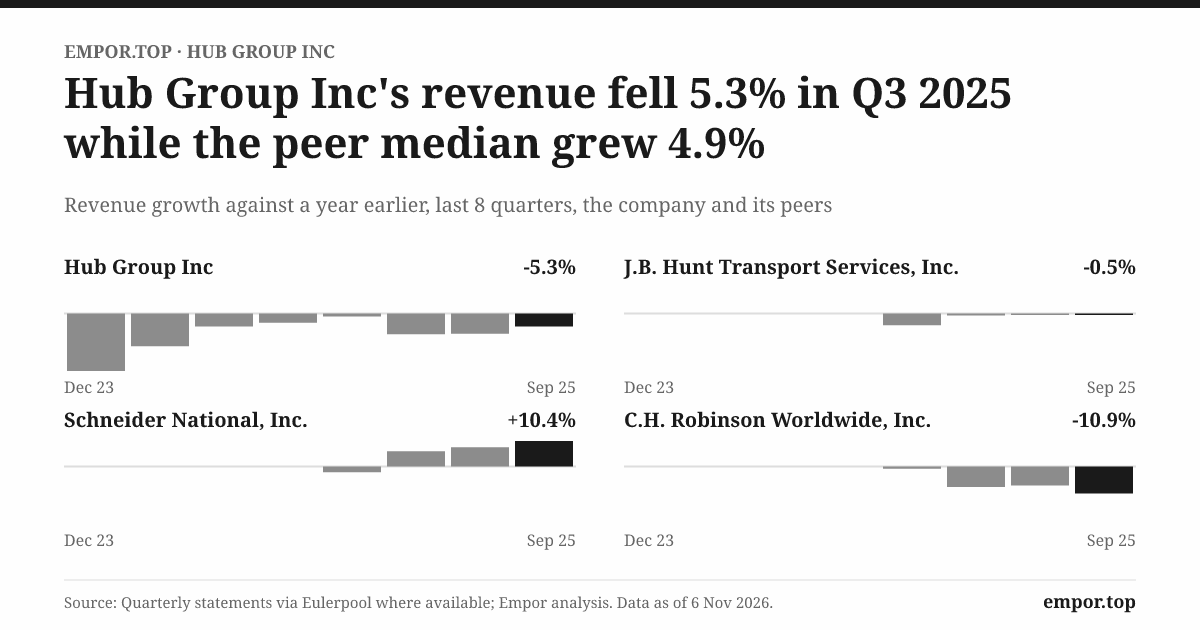
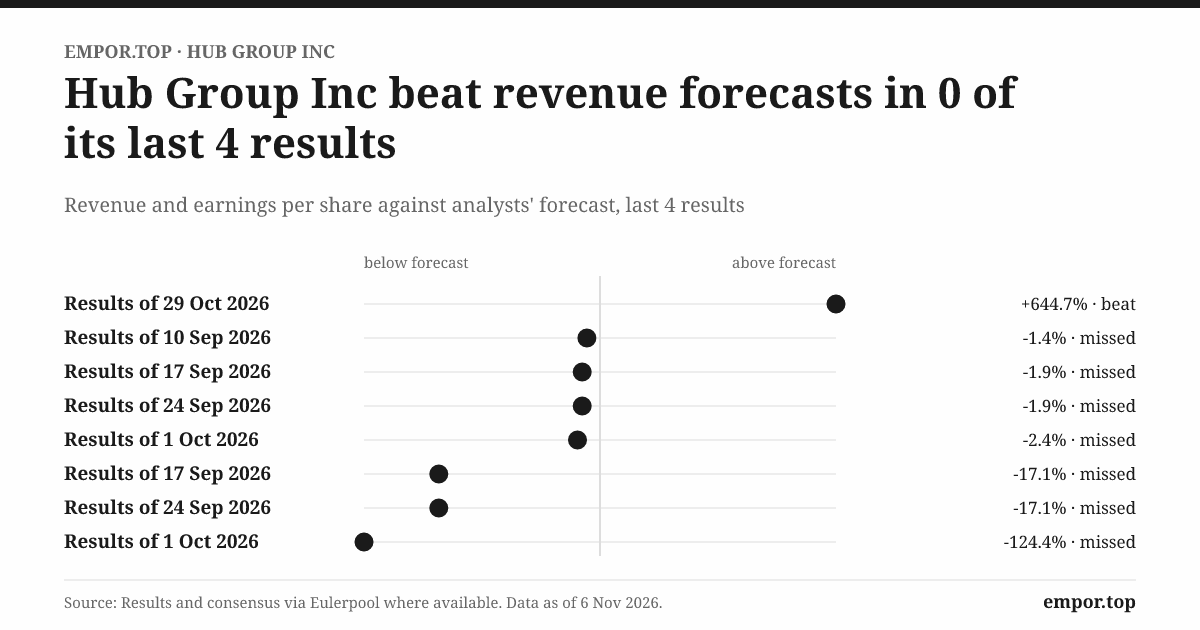
The last quarter in that provisional record, the three months to September 2025, looked at first glance like the beginning of a recovery. Revenue was down about 5% from a year earlier, at roughly $934 million, yet operating profit rose about 23%, to around $39 million, and operating margin improved by a full percentage point to about 4.2%.[^6] On a normal day, a freight company that grows profits while revenue shrinks is telling a story about cost discipline and better pricing. On this day, nobody can be sure that quarter's purchased transportation bill was complete. It belongs to the same period whose costs had been understated.4
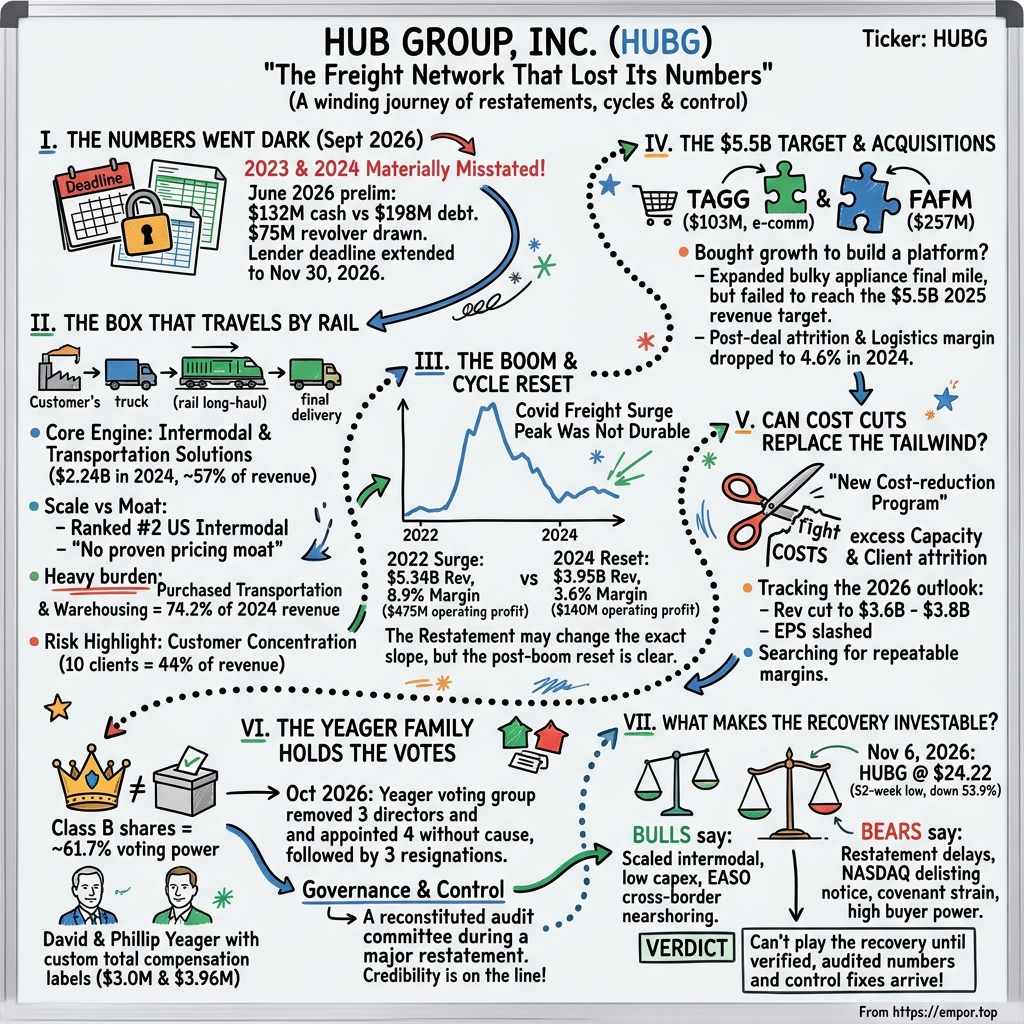
So the story of Hub Group in late 2026 has three layers, and they cannot be separated. The first is the freight business: whether Hub's network of rail partners, containers, drivers and logistics warehouses can earn back the margins it enjoyed during the pandemic boom, or whether those were a once-in-a-generation fluke. The second is strategy: whether the acquisitions Hub made as the boom faded, in fulfillment, final-mile delivery and Mexico, built a better company or merely a larger one. The third is control: whether the Yeager family, which holds a majority of the votes, can oversee a credible recovery when the numbers themselves have failed.
Reporting integrity is now part of the operating story. Until audited figures and the control fixes arrive, no one can settle the recovery case, because the recovery would have to be measured with a ruler the company has just admitted was bent. To understand what is at stake, though, it is worth starting where Hub's money is actually made: at a loading dock, with a container waiting for a truck.
 Subscribe on LinkedIn
II. The Box That Travels by Rail
Picture a fifty-three-foot container backed up to a distribution center in the Midwest, being filled with appliances, packaged food or retail goods. A drayage driver, the trucker who handles the short first and last legs, hooks it up and pulls it to a rail ramp. There, a crane lifts the container onto a railcar, often stacked two high, and a freight train carries it across half a continent. At the other end, another crane lifts it off, another drayage driver collects it, and a few hours later it backs into a different loading dock. One customer, one bill, three handoffs.
That is intermodal freight, and it is the heart of Hub Group. The company, founded in 1971, describes itself as a supply chain solutions provider, but its larger segment, Intermodal and Transportation Solutions, produced about $2.24 billion of 2024 revenue, roughly 57% of the total.3 The rest came from Logistics, a collection of services that includes truck brokerage, managed transportation, warehousing and fulfillment, and final-mile delivery into homes and businesses.3
The economics of the intermodal box start with a simple comparison. A train can move a container a long way using far less fuel and labor per mile than a truck, because one crew and a few locomotives pull a hundred or more boxes at once. For a shipper, that usually means a cheaper long haul, at the cost of a slower and less flexible journey. Hub's job is to package that cheaper long haul into something that feels almost as convenient as a truck. It arranges the drayage, supplies the container, books space with the railroads, tracks the shipment and handles the problems when a train is late or a ramp is congested.
Hub does not own the railroads. That fact matters more than any other in judging the business. The long-haul movement depends on rail partners, and the railroads charge Hub for it. Hub owns or leases containers, operates a fleet of drayage tractors and employs drivers, and it supplements its own fleet with outside carriers.3 It sells transportation service and recognizes most of its revenue over the period the freight is in transit, reporting revenue gross where it is the party primarily responsible for delivering the service.3 That accounting choice makes the company look bigger than its value added. Hub records the full price the customer pays and then records what it pays railroads, truckers and warehouses as a cost.
The size of that cost tells you what kind of business this is. Purchased transportation and warehousing consumed about 74% of Hub's reported 2024 revenue.3 Out of every $100 a customer paid Hub that year, about $74 went straight out the door to other companies that physically moved, stored or handled the freight. From the remaining $26 or so, Hub had to pay its own drivers, staff, technology, equipment depreciation and offices, and what was left as operating profit was under $4.3 Hub, in other words, is a business of thin spreads on large flows. A small change in what it charges customers or pays carriers has a big effect on profit.
It has also become a heavier business than it used to be. A decade ago, Hub was close to a pure coordinator, and every dollar of assets on its balance sheet supported more than three dollars of annual revenue. By 2024, after years of buying containers, tractors and warehouses and then acquiring fulfillment and final-mile operations, that figure had fallen to under one and a half.3 Net property and equipment almost quadrupled over the period, to almost $1 billion.3 Owning more of the chain gave Hub more control over service quality and cost in drayage, which matters in a business where a missed pickup can strand a container at a ramp. It also meant that a downturn hit a larger fixed base, with depreciation, leases and payroll that do not shrink when volumes do. The old Hub could flex its costs almost as fast as its revenue. The new Hub cannot.
A strong network, and a crowded market
How big is Hub's network relative to the competition? Transport Topics' 2022 ranking of U.S. intermodal and drayage carriers put Hub second, with about 2.39 million units, against J.B. Hunt's 5.45 million.6 J.B. Hunt's intermodal operation, built over decades in partnership with BNSF in the West, was more than twice Hub's size in that list, while Schneider ranked below Hub.6 Those figures measure relative scale rather than a precise market share, because carriers count units differently and the ranking mixes intermodal with drayage. The picture is still clear enough. Hub is a large, established player, comfortably ahead of most rivals and clearly behind the leader.
Scale matters in intermodal for practical reasons. A bigger container fleet means more boxes in the right places when customers need them. More volume on a lane means better density for drayage drivers, who can be routed with fewer empty miles. And large, steady volume gives a company more leverage in negotiating rail contracts and terminal access. A newcomer cannot easily replicate a nationwide fleet of containers, long-standing rail agreements and the operating know-how to keep boxes turning. Those are real barriers, and they give Hub a real operating position.
The harder question is whether that position translates into pricing power. A moat, in the investor's sense, is the ability to keep earning good returns even when rivals try to take your business. The way to test it is to look at what happens to customers and prices when competition intensifies.
The first test is concentration. Hub's ten largest customers accounted for 44% of 2024 revenue, and the top fifty for about 68%.3 A single unnamed customer, large enough to exceed 10% of revenue in both segments, generated about 15% of Hub's total revenue in 2024, up from 13% in each of the two previous years.3 That is a lot of bargaining power on the other side of the table. A shipper that sends Hub roughly one dollar in every seven of its revenue knows exactly how much it matters, and it can split its freight among several intermodal providers, award lanes through competitive bids or shift volume back to trucks when truck rates fall. Hub does not name this customer, nor does it disclose retention rates, competitive bid losses or customer-level price realization.
The second test is attrition. Hub's own disclosures cite lost customers as a reason dedicated trucking revenue fell in 2023, and the company says dedicated and logistics contracts may be cancelled.3 In September 2026, management cited select customer attrition in its Consolidation and Fulfillment business.1 Some customer churn is normal in logistics. But a business with strong switching costs does not typically need to explain losses in successive years, and the contracts themselves give customers a way out.
The third test is the relationship between volume and profit. Hub likes to talk about intermodal conversion, the process of persuading shippers to move freight from long-haul trucks onto rail. When conversion works, it is the best version of the Hub story. The customer saves money and cuts emissions, the railroads fill trains and Hub earns a fee for orchestrating the switch. And in 2024, intermodal volume did grow, by about 5%.3 Yet revenue per load fell, and the segment's operating income fell to about $57 million from about $107 million the year before.3 Hub moved more boxes and earned roughly half as much doing it.
That result is the most revealing clue in the intermodal story, because it shows where the bargaining power sat. In 2024 the U.S. trucking market was oversupplied. Weak freight demand and excess truck capacity pushed down truck rates, which Hub cited as a pressure.3 Intermodal's appeal depends on being cheaper than trucks over long distances, so when truck rates fall, intermodal rates must follow or customers drift back to the highway. Hub could win volume, but only at prices that left far less for itself after paying the railroads and drayage costs. The network was valuable. It was not valuable enough to resist the market.
Who else wants the same box
The live competition, then, is not mainly about technology, whatever the marketing says. J.B. Hunt is the scale leader in intermodal, Schneider competes with its own container network, and trucking companies, truck brokers, the railroads' own programs and integrated logistics providers all chase the same freight. The contest is decided by cost, available capacity, service reliability and yield, meaning the price earned per load relative to what it costs to deliver. Hub invests in technology for tracking, pricing and coordination, but its filings do not quantify technology-driven switching costs or any distinct revenue stream from software.3
The Logistics segment is a different animal. Brokerage, where Hub finds outside trucks for customers' loads and earns the spread, is asset-light and intensely competitive, with low barriers to entry. Managed transportation, where Hub runs a customer's freight program, can be stickier because it embeds Hub in the customer's operations. Fulfillment and final mile, which Hub expanded through acquisitions, involve warehouses, labor and delivery crews, and they depend on keeping facilities full. Those businesses broaden Hub's offering. They also bring their own cycles and capacity risks, as the September 2026 comments on excess Consolidation and Fulfillment capacity suggest.1
Put together, the evidence supports a narrower claim than "moat." Hub has a strong network and real service capability, built on scale, rail partnerships and operating experience. Customer concentration, repeated attrition and the 2024 collapse in intermodal profit despite rising volume leave switching costs and pricing power unproven. The test that would change that verdict is straightforward: restated segment margins that hold up through a soft freight market, alongside evidence of stable customer retention and revenue per load.
Which raises the obvious puzzle. If the network was valuable enough to post spectacular profits only a few years earlier, why did the margin fall so far, so fast? The answer starts with a boom that made Hub's model look like something it was not.
III. The Boom Made the Model Look Different
Open Hub Group's 2022 income statement and it reads like a different company. Revenue reached about $5.34 billion. Operating profit was about $475 million, and operating margin about 8.9%.7 For a business that had spent much of the previous decade earning margins in the low single digits, this was a new world. Investors who bought into the 2022 story were buying what looked like a step-change: a larger, more profitable Hub with a broader service offering and a freight market that seemed permanently short of capacity.
The record before the boom tells a quieter tale. Over the decade to 2024, Hub's revenue grew only about 1% a year, and operating margin hovered mostly between 2% and 4% through the 2010s.37 This was a company that grew slowly, earned modest spreads and survived several freight cycles without ever becoming especially profitable. Then came the pandemic.
In 2020 and 2021, American consumers stopped spending on services and started buying goods, which flooded ports with imports and warehouses with inventory. Container ships waited offshore, rail ramps jammed and trucks became scarce. Every company that could move a box had pricing power, because shippers would pay almost anything to get goods to shelves. Hub's operating profit more than doubled, from about $238 million in 2021 to about $475 million in 2022, while revenue grew roughly a quarter.7 The extra profit came less from moving vastly more freight than from charging much more for each load while capacity was tight.
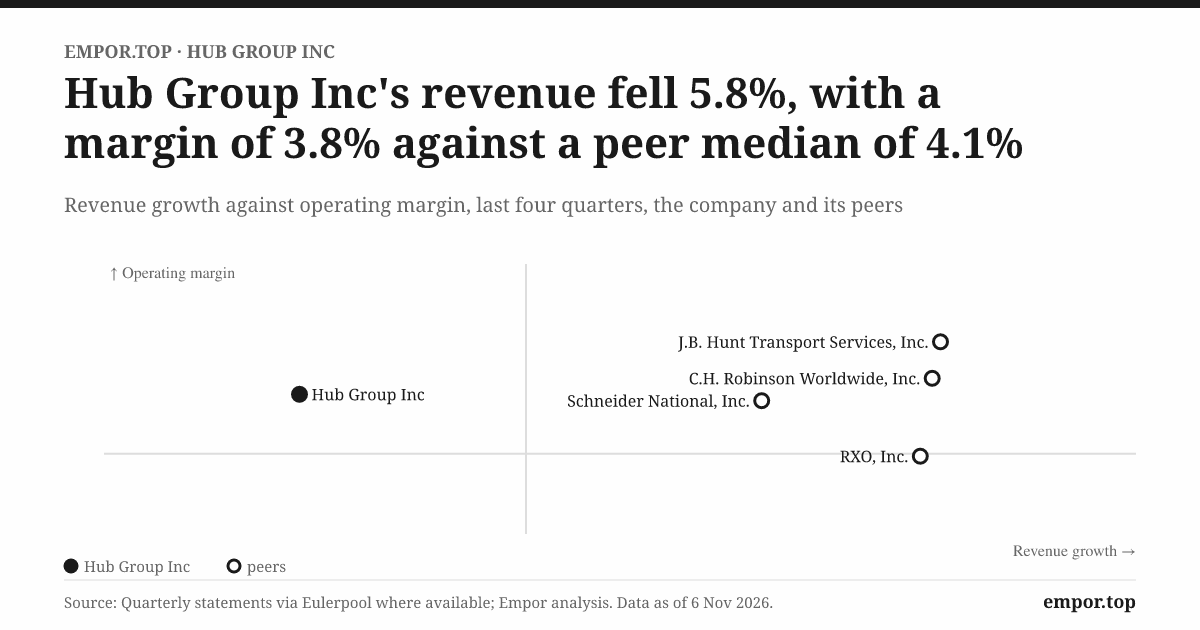
Then the cycle turned. Consumers shifted back to services, retailers found themselves with too much inventory, imports fell and the trucking industry, which had added drivers and trucks during the boom, found itself with too many of both. Hub's revenue fell about 21% in 2023 and another 6% in 2024, to about $3.95 billion.3 Operating profit fell to about $212 million in 2023 and then about $140 million in 2024, with operating margin dropping from 8.9% to 3.6%.3 In two years, the company gave back about $1.4 billion of revenue and roughly 70% of its peak operating profit.
Not all of that decline was the market's fault, though much of it was. Hub cited weak freight demand and excess truck capacity, which hit everyone in the industry.3 But the company's own disclosures also point to controllable factors: lower customer rates, lost customers in parts of Logistics, and the economics of purchased transportation, where the cost of buying rail and truck capacity did not fall as fast as the prices Hub could charge.3 On the fourth-quarter 2024 earnings call, management framed 2025 as a year of recovery driven by yield improvement, cost actions and network alignment, while acknowledging that the freight market remained soft.8
There is a boundary around all these figures that matters to the story. The 2023 and 2024 annual numbers are among those the audit committee said should not be relied on.2 The direction of the reset is not in serious doubt, because revenue fell across the industry and Hub's peers reported similar declines. But the exact slope of the decline, how much profit Hub earned in each year and how much of the fall came from pricing versus costs, may change when the restated accounts arrive. The errors identified so far concern costs being recorded too late or too low and transactions recognized prematurely or without adequate support.24 If those patterns reach back into 2023 and 2024, the trough may have been deeper than reported.
The receivables line deserves particular attention, because it is where premature recognition would leave its fingerprints. Hub collected its bills more slowly over the decade: receivables equaled about 43 days of revenue in 2013, peaked at about 61 days in the boom year of 2021 and stood at about 55 days in 2024.3 Hub reported trade receivables of about $582 million at the end of 2024, with a reserve for bad debts of about $27 million, and said it had historically collected more than 98% of receivables less than a year old.3 It publishes no ageing schedule, so investors cannot see how much of that balance was overdue. None of this proves anything was wrong with the receivables. It does mean that when the restated balance sheet arrives, the receivables and payables lines will be the first places a careful reader should look.
The peak, in short, was not a durable run rate. The 2022 margin reflected a freight market of unusual scarcity, not a structural improvement in Hub's bargaining position. Seen across the full decade, Hub looks like a business that earns margins of roughly 3% to 4% in ordinary conditions, more when capacity is tight and less when it is loose. Restated numbers will refine that picture without overturning it.
That makes the latest provisional quarter both encouraging and inconclusive. In the third quarter of 2025, revenue was still shrinking from a year earlier even as operating profit improved.[^6] That is what a cost and yield program would produce if it were working. It is also what a quarter with understated purchased transportation costs would look like.4 Hub's management had a plan to turn shrinking revenue into rising profit. To judge it, one has to look at the moves Hub made while the boom was ending, because those moves shaped the company that now has to recover.
IV. The $5.5 Billion Target Met Two Acquisitions
On December 20, 2023, Hub Group announced that it would buy Forward Air Final Mile, the business that delivered and installed bulky goods, mostly large appliances, for retailers and manufacturers across the United States.9 The pitch was confident. Hub said the deal would more than double its final-mile revenue, from about $192 million to about $481 million, and that it would be immediately accretive to 2024 earnings per share on both a GAAP and a cash basis.9 Final mile, the last stretch from a warehouse into a customer's kitchen or basement, was one of the few corners of logistics where a company could charge for more than distance: carrying, connecting, installing and hauling away the old machine.
The deal capped a strategic turn. During the boom years, with revenue already above $5 billion, Hub's management had set out to build a larger, more diversified company, partly through acquisitions that would extend it from intermodal into more of the customer's supply chain.7 The idea made sense on paper. A shipper that already trusted Hub to move its containers might also hand over warehousing, e-commerce fulfillment and delivery to the end customer. Each additional service would make the relationship deeper, and a deeper relationship should be harder to replace.
Buying the warehouse and the doorstep
The first major step was TAGG Logistics, acquired in 2022 for about $103 million.7 TAGG brought e-commerce and omnichannel fulfillment, the business of storing goods, picking and packing orders and shipping them to consumers or stores, with more than four million square feet of warehousing.7 It arrived at the height of the online shopping surge, when fulfillment space was scarce and valuable.
Forward Air Final Mile came at a very different moment. By late 2023 the freight downturn was in full swing, and Hub paid about $257 million for a business with about $289 million of trailing revenue at announcement.910 That is a price of roughly 0.9 times revenue, which sounds cheap for a services business until you remember that final-mile margins are thin. The relevant comparison would be earnings, but Hub did not disclose a like-for-like EBITDA figure for the acquired business at announcement that would allow investors to compare the price with industry transaction multiples. The seller, Forward Air, was reshaping its own portfolio and chose to part with the unit, which tells you something about how the people who knew the business best valued it relative to their other options.10
The promise of immediate accretion was a claim about earnings per share, not about returns on capital. A deal can raise EPS in its first year simply because the acquired profits exceed the interest cost or the forgone return on cash, without earning a return that justifies the price. The test for FAFM, then, is not whether it added to 2024 earnings, but whether Logistics became a better business afterwards.
The evidence so far points the other way. Reported Logistics operating margin fell to about 4.6% in 2024 from about 5.8% in 2023, the first full year with FAFM included.3 Hub cited customer losses in dedicated operations, and later disclosed select attrition in Consolidation and Fulfillment along with excess capacity in that business.31 Those are exactly the risks a fulfillment and final-mile strategy carries: warehouses built or leased for volumes that do not arrive, labor that must be paid whether or not boxes move, and customers who can move their programs elsewhere when contracts end. The restatement could alter the exact segment comparison, but it is unlikely to turn a declining margin into a rising one.
The third deal was smaller and pointed somewhere new. In October 2024, Hub bought a 51% stake in EASO, a Mexico-based intermodal and trucking operator, valued at about $55 million.3 The logic was nearshoring. As manufacturers moved production from Asia to Mexico, cross-border freight between Mexico and the United States was expected to grow, and a company that could handle the whole journey, from a Mexican factory to an American store, would have something to sell. EASO contributed only about 0.5% of Hub's 2024 revenue in its first few months, and its 477 employees accounted for most of the company's headcount increase that year.3 Today it is a cross-border option, not an earnings driver. Its value depends on whether Hub can turn a small Mexican foothold into meaningful cross-border volume, and that remains to be demonstrated.
The structure of the EASO deal also brought new kinds of exposure. Because Hub owns only 51%, it consolidates all of EASO's results and shows the partners' share separately as non-controlling interest, so every dollar of EASO revenue flows into Hub's top line while only about half of its profit belongs to Hub's shareholders.3 And Mexico brought currency risk. Hub's exposure is primarily to the Mexican peso, and the company said it had not used forwards or other derivatives to hedge it.3 For now, with EASO so small, that is a secondary risk next to freight demand and the reporting crisis. If the cross-border bet works and EASO grows into a meaningful part of the business, an unhedged peso becomes a larger question, which is the price of success in this particular option.
What the deals did not do
Set the deals beside the ambition and the gap is stark. Hub's revenue did not climb toward the higher range its boom-era materials described; it fell to about $3.95 billion in 2024, and management's own 2026 outlook puts revenue at about $3.6 billion to $3.8 billion.31 The acquisitions added revenue at the margin, but they did not neutralize the downturn, and they did not deliver a straight-line growth story. The organic business was shrinking faster than acquired revenue could replace it.
Capital allocation around the deals deserves the same scrutiny. Hub did not only spend on acquisitions. It spent about $118 million on share repurchases in 2022, $154 million in 2023 and $79 million in 2024.3 In 2022, it also bought shares from entities affiliated with David Yeager's brother for about $34.8 million, a transaction that will matter again when we come to the question of family control.3 Buybacks at boom-era prices, followed by acquisitions into a downturn, are not by themselves evidence of poor judgment. But they do mean that Hub's shareholders committed roughly $750 million to buybacks and acquisitions over three years, and the returns on that capital now look meager. Return on invested capital fell from about 20% in 2022 to about 5% in 2024.3
The verdict on the acquisition program is therefore incomplete rather than damning. TAGG and FAFM did broaden Hub's offering, and EASO gives it a plausible route into cross-border freight. None of them has yet demonstrated value creation, and the margin evidence in Logistics points to integration and capacity problems rather than synergies. The deals bought a broader menu. Whether customers value the bundle enough to pay for it is a question the restated segment accounts will start to answer.
Which brings the story to management's current response. With the boom gone and the acquisitions not yet paying their way, Hub turned to the oldest tool in the operator's kit: cutting costs and fixing prices.
V. Can Cost Cuts Replace the Freight Tailwind?
In its September 2026 update, management described a business with too much space. The Consolidation and Fulfillment operations, the warehouses and cross-dock facilities assembled through acquisitions and expansion, had excess capacity, and select customers had left.1 Brokerage volumes were down. The company expected an operating loss for the first half of 2026.1 Against that backdrop, it pointed to a new cost-reduction program and a preliminary 2026 revenue outlook of about $3.6 billion to $3.8 billion.1
For a company that had reported operating profit of almost half a billion dollars four years earlier, a first-half operating loss was a jolt. It also clarified the challenge. The recovery case cannot rest on a rebounding freight market alone, because Hub cannot control when that comes. It has to rest on levers management can pull: yield, cost containment, network alignment and a better balance between the freight Hub sells and the transportation it buys.
Start with what the segments looked like before the latest troubles. In 2024, Intermodal and Transportation Solutions produced about $2.24 billion of revenue and Logistics about $1.71 billion.3 Intermodal brought in most of the revenue, but both segments' margins matter, because the consolidated operating margin of 3.6% was the blend of an intermodal business whose income had roughly halved and a Logistics business whose margin had slipped by more than a point.3 There was no healthy segment carrying a sick one. Both were under pressure at once.
The levers management described across its filings and calls are consistent, and that consistency is itself worth noting. Hub has talked about yield management, meaning pricing loads to cover their true cost rather than chasing volume; cost containment in headcount and overhead; operating efficiency in drayage, where better routing and fewer empty miles lower the cost of each move; network alignment, which means matching container and driver capacity to where demand actually is; and reducing lower-margin brokerage activity rather than defending volume at any price.83 In 2026, the excess capacity in Consolidation and Fulfillment joined that list.1
How do these levers translate into profit? Recall that purchased transportation and warehousing take roughly three-quarters of every revenue dollar. If Hub can raise its average price per load by even 1% while holding what it pays the railroads and carriers steady, nearly all of that 1% falls through to operating profit. On revenue of about $3.7 billion, that is roughly $37 million, or about a quarter of 2024's reported operating profit. The reverse is also true. A 1% squeeze in yield, which is easily caused by a few big customers rebidding their freight in a soft market, can wipe out a quarter of the year's earnings. This leverage is why the cost program and the yield story matter so much, and why a single large customer can matter so much to both.
Promises and outcomes
Management's guidance path is the best way to test how well it understood these levers. On the fourth-quarter 2024 call, held in February 2025, Hub guided to 2025 revenue of about $4.0 billion to $4.3 billion and diluted EPS of about $1.90 to $2.40.8 The tone was of a company emerging from the trough, with management citing intermodal volume growth, cost savings and the EASO acquisition as reasons for confidence.8 Over the following months, as the freight market stayed weak, the range came down. By the middle of the year, revenue guidance had been cut to about $3.6 billion to $3.8 billion and EPS to roughly $1.80 to $2.05.[^6] At the top end, the revenue cut was more than $500 million.
A guidance cut in a weak freight market is not unusual. What matters is whether the explanations got more concrete as the year went on, and whether the cost actions showed up. The listening route through the year is a useful one. The fourth-quarter 2024 call sets out the recovery and network-alignment claims in their most confident form.8 The first- and second-quarter 2025 calls show how those claims bent as guidance came down. The third-quarter 2025 call, held on October 30, 2025, is the one where the margin argument was made with the most evidence behind it, because the quarter showed operating profit rising while revenue fell.[^12][^6] The questions worth carrying into each recording are the ones a skeptical analyst would ask: how much of the margin gain came from price rather than cost, which customers were lost in Logistics and why, and in which quarter the cost actions were supposed to appear in the numbers.
Barely three months after that third-quarter call, the February 2026 disclosure changed how its answer should be read. The understatement of purchased transportation costs and accounts payable in the first three quarters of 2025 meant that some of the margin improvement management had pointed to was, at least in part, a recording error.4 Purchased transportation is precisely the cost line the yield story depends on. If it was understated, then the spread between what Hub charged and what it paid was narrower than reported, and the improvement was smaller than it looked. Hub has not yet published the restated quarterly figures that would show how much of the reported progress survives.
That is why the third-quarter 2025 figures are a clue, not proof. The decisive evidence will be restated segment profit, with the change separated into volume, yield and purchased transportation cost. Only that breakdown can show whether Hub's cost and pricing levers are genuinely restoring margins, or whether the improvement was mostly an artifact of accounts that did not capture all the bills.
When the market tightens, the bill arrives first
The first half of 2026 added a twist that cuts against the simplest version of the recovery story. Investors had long assumed that Hub's margins would come back when freight capacity tightened, because tight capacity is what produced the 2022 peak. By 2026, according to management, capacity was in fact tightening, and intermodal volumes were relatively stable.1 Yet first-half revenue came in at only about $1.70 billion to $1.80 billion, and Hub expected an operating loss for the period before one-time charges.1
The reason lies in the order in which prices move. In the Intermodal segment, management said higher fuel, rail and drayage costs hurt results before Hub's own rate increases began to take effect in the third quarter of 2026.1 That is the spread business at its most unforgiving. Hub's suppliers, the railroads and truckers, reprice quickly when capacity tightens, while Hub's customer contracts reprice on their own schedule, often through annual bids. For a few quarters, Hub pays the new price for transportation and charges the old price for its service. The squeeze is temporary if customers accept the increases, and it becomes permanent if they respond by rebidding freight or moving it elsewhere. A tightening market, in other words, is not automatically good news for an intermediary. It is good news only after the intermediary has passed the cost through.
Logistics told a more mixed story. Final Mile, the business built on the Forward Air acquisition, added new customers, which is the first concrete sign in some time that the deal's commercial logic can work.1 Managed Transportation revenue fell modestly, brokerage revenue and volume declined, and Consolidation and Fulfillment suffered from the customer attrition and excess capacity already described.1 The segment that was supposed to diversify Hub away from intermodal was itself pulling in several directions at once.
Management's answer was a second cost program, launched in the second quarter of 2026 on top of the one it had already announced. It focuses on yield management, consolidating warehouse space, improving driver and warehouse productivity, targeted cost reductions and the order-to-cash process, the chain that runs from booking a load to collecting payment for it.1 Hub has not attached a dollar figure to the program and has said it will give more detail alongside its 2025 results.1 Two items on that list deserve attention. Consolidating warehouse space is an admission that the fulfillment footprint is larger than current demand justifies. And including order-to-cash in a cost program, during a restatement that involves transactions recognized prematurely or without adequate support, suggests the operational fixes and the accounting fixes are not entirely separate projects.2 Until the company puts numbers on the program, investors have a direction of travel rather than a target to hold management to.
Technology deserves a proportionate place in this story. Hub invests in pricing tools, tracking and coordination systems, and the 2024 capital spending included about $19 million of technology.3 Overall capital expenditure fell sharply that year, to about $51 million from about $140 million, as the company bought fewer tractors and containers.3 Management expects 2026 capex of about $40 million to $50 million.1 The filings do not quantify an artificial intelligence growth engine or technology-driven switching costs, and the restatement itself, a failure of the systems that capture and record costs, sits awkwardly beside any claim of technological sophistication.
The recovery case, then, has identifiable levers, and management has described them consistently for nearly two years. What it lacks is settled evidence that the levers can restore pre-downturn returns. The guidance reset, the first-half 2026 operating loss and the cost understatement in 2025 all point to a slower and harder recovery than the February 2025 call implied. And the people responsible for delivering that recovery have, in the past few months, changed dramatically.
VI. The Yeager Family Holds the Votes—and the Board
On October 1, 2026, a group of Hub Group stockholders acting together under a long-standing agreement signed a written consent. In a single action, without a shareholder meeting, they removed three directors from the board without cause and appointed four new ones.11 Within days, three more directors resigned.11 In the space of a week, a board that had been described the previous year as having eight independent directors among ten nominees was substantially remade.1211
The stockholders who signed that consent were the Yeager family and its affiliates. And the action showed, more vividly than any proxy statement could, where power at Hub Group actually sits.
A family company with a public listing
Hub Group has been a Yeager-led company across generations. David Yeager ran the business for decades, as CEO and later as executive chairman, before his son Phillip became CEO on January 1, 2023.312 Phillip inherited the top job just as the freight boom was ending, and his tenure coincided with the downturn, the acquisitions of FAFM and EASO and, as it turned out, the years whose accounts are now being restated. In September 2026, Hub announced that David Yeager would return as CEO.13 Father replaced son at the helm of a company whose books were under review for the son's years in charge.
The leadership change came with others. Chief financial officer Kevin Beth and chief operating officer Brian Meents left their executive roles in 2026 while the restatement work continued; Todd Heeter became interim CFO, and Patrick O'Donnell was designated to take over as CFO once the delayed 2025 annual report is filed.13 Losing the CFO during a restatement is common enough, because restatements usually require new eyes. But losing the CFO, the COO and the CEO in the same period means that almost the entire leadership team that set the 2025 guidance and oversaw the reporting systems has turned over.
The control structure explains why the family could act so quickly. Hub has two classes of stock. Class A shares trade on Nasdaq and carry one vote each. Class B shares, all owned by the Yeager family, carried about 170 votes each.12 In March 2025, the family's roughly 575,000 Class B shares gave it about 61.7% of total voting power, and David Yeager could direct the votes of the Class B shares covered by the family stockholders' agreement.12 The family's economic ownership, meaning its share of the company's profits and assets, is far smaller than that voting power. Large institutions held big stakes in the Class A shares: BlackRock reported about 15.6%, Vanguard about 11.4%, Dimensional about 8.2% and Victory Capital about 5.2%.12 Together they owned far more of Hub's economic value than the family did, and they could not outvote it on anything. In early 2025, the company counted ten holders of record of Class B stock against roughly 46,000 estimated beneficial owners of Class A shares.3 Ten holders decide; tens of thousands watch. That arithmetic is the whole governance story in a sentence, and it explains why the October written consent required no meeting, no proxy fight and no vote count from anyone outside the family group.11
Supporters of dual-class structures argue that they let long-term owners resist short-term pressure, and Hub's history offers some support for that view. The Yeagers built the company over half a century and own it through good cycles and bad. They have every incentive to keep it alive and profitable. The family's long operating record, its procedures requiring related-party transactions to be reviewed and conflicted directors to recuse themselves, and the presence of independent directors were all features of the governance system before 2026.12
Oversight when the numbers fail
The trouble is that a dual-class structure concentrates responsibility as well as power. When the audit committee concluded in May 2026 that two years of statements were materially misstated and that controls had been ineffective, it was doing the work that independent directors are meant to do.2 The question every outside shareholder now faces is whether the reconstituted board, with directors chosen by the controlling family in an action that bypassed a shareholder meeting, can oversee the restatement, the remediation of controls and the accountability of executives who are themselves members of that family.
The pay record does not answer that question, but it frames it. Phillip Yeager's reported total compensation rose from about $2.61 million in 2023 to about $3.96 million in 2024, a year in which reported net income fell by about 38%.123 David Yeager's 2024 compensation was about $3.0 million.12 The proxy also reports "compensation actually paid," an SEC-mandated calculation that adjusts for changes in the value of equity awards, at about $4.61 million for Phillip in 2024; it is not the cash an executive actually received.12 Shareholders approved the advisory say-on-pay proposal at the May 2025 meeting.14 But the family's voting power means that a say-on-pay vote at Hub tells you less than it would at a widely held company, and the reported pay figures rest partly on financial results that are themselves now being restated.
The related-party transactions that matter are few but notable. In 2022, entities affiliated with David Yeager's brother exchanged Class B shares for Class A shares and then sold those, along with remaining Class B shares, back to Hub for about $34.8 million.3 Family members also work at the company: the 2025 proxy reports that David Yeager's son Matthew and director Martin Slark's son were each paid more than $120,000 in 2024, with compensation described as comparable to similar employees.12 The September 2026 filing identified Matthew Yeager as executive vice president of procurement, with a 2025 base salary of $375,000.13 Hub does not quantify related-party operating flows as a share of revenue or costs, and the filings show no royalties, management fees or intercompany loans to family entities. The issue is not money siphoned out of the business. It is concentration: the family controls the votes, sits in the executive suite and now has a decisive say over who sits on the board that judges its own performance.
Independence is a label, not a guarantee. The test is whether the newly composed board demonstrates it in action: by publishing a credible remediation plan, by holding executives accountable for the reporting failure and by allowing future meeting votes to provide a meaningful check. Until then, the governance verdict cuts both ways. Family control aligns ownership with a long operating history and gave the company the ability to act decisively. It also showed that voting control can reshape oversight in a matter of days, during the very period when independent oversight is most needed.
The governance question does not stay in the boardroom. A federal securities class action, Lawler v. Hub Group, was filed on June 29, 2026, and is pending; filing a complaint is not a finding of liability.15 Nasdaq has begun delisting proceedings, and the lender has extended its deadlines.51 Each of those is a test of whether the company's reporting crisis can be contained. And all of them bear on the question that ultimately matters to an outside investor: what the shares are worth.
VII. What Would Make the Recovery Investable?
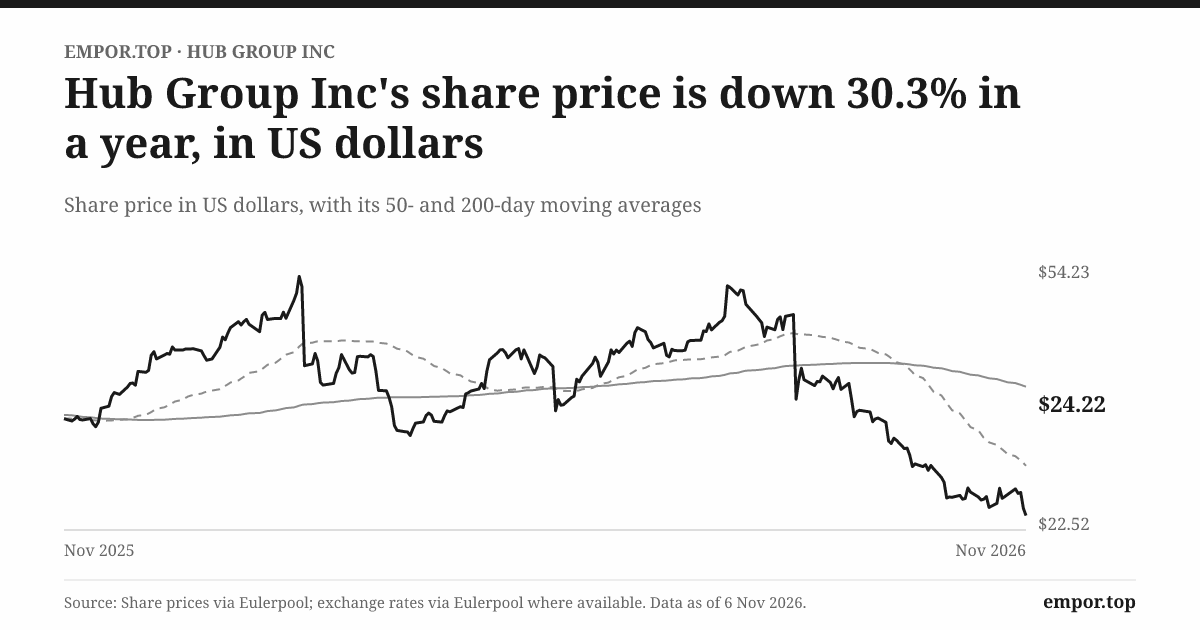
On November 6, 2026, Hub Group's Class A shares closed at $24.22. It was the lowest close of the previous twelve months, and it left the stock about 54% below its 52-week high of about $52.53. The company's market value was roughly $1.5 billion, against revenue still running at more than twice that.[^18]1
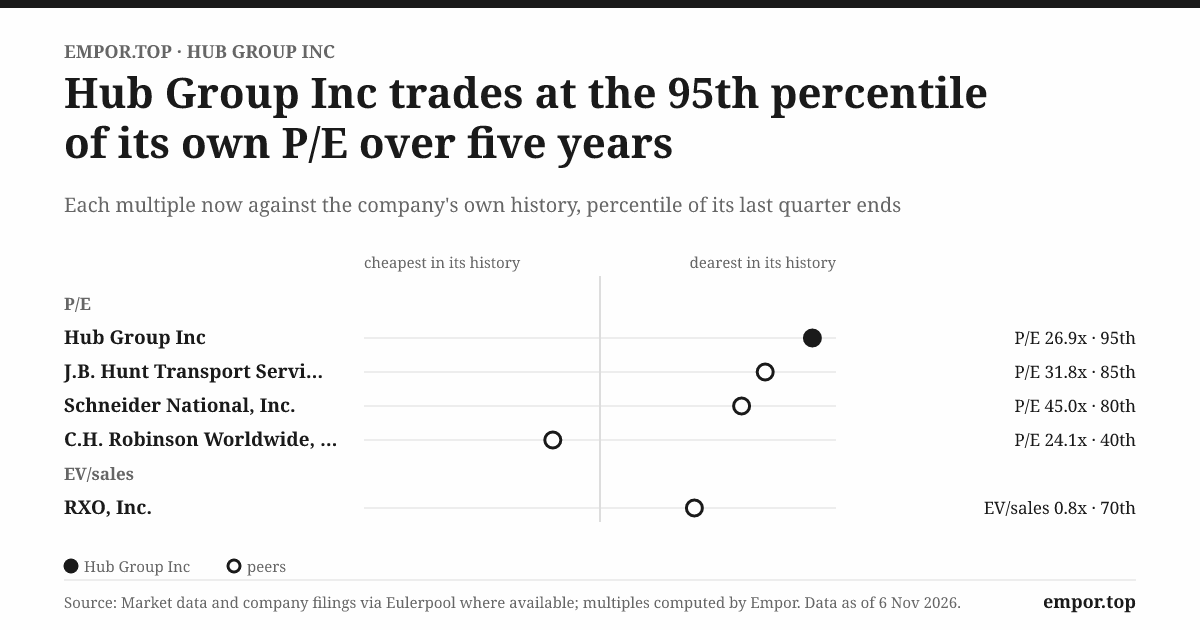
A share price that has halved in a year usually means the market has stopped believing something. In Hub's case, it is easier to list what the market still believes than what it has stopped believing. Investors are paying about 0.4 times sales and about 0.9 times book value, which is cheap by almost any standard for a going concern in logistics.3[^6] On enterprise value, which adds debt and subtracts cash, the stock trades at about 5.5 times trailing EBITDA. Yet on trailing earnings, the price is about 27 times, well above Hub's own five-year median of about 20 times.[^6]3 The stock looks cheap on sales and assets and expensive on earnings, because earnings have fallen so far. And every one of those earnings-based multiples uses provisional figures from statements that are being restated.
For comparison, other listed transportation companies traded at similar or higher trailing P/Es at the same close: about 31 times for J.B. Hunt, about 34 times for Schneider National, about 62 times for Knight-Swift and about 30 times for Landstar.16171819 Those comparisons show that the whole sector is priced on depressed, mid-cycle earnings, with the market expecting a recovery. Hub's discount to those peers on earnings is modest; its discount on sales and book value is larger. That gap is the market's way of saying it doubts Hub will earn the same margins on its revenue as its peers, or that it doubts the revenue and book value figures themselves.
The bull case and its limits
The bull case begins with what Hub is. It is a scaled intermodal operator with established rail partnerships, a nationwide container fleet and a broad logistics offering that can serve a customer from the factory floor to the living room. Its physical capital needs are modest relative to its revenue, with 2026 capex expected at about $40 million to $50 million against revenue of more than $3.5 billion.1 EASO gives it a route into cross-border freight with Mexico, which could grow if manufacturing continues to shift closer to the United States. And when freight markets tighten, as they eventually do, intermodal operators with spare container capacity can earn far higher margins, as Hub showed in 2022.
The bull case has to survive several hard questions. Customer concentration is high, with one customer contributing about a seventh of revenue. The core business is exposed to freight cycles, and purchased transportation dominates the cost base, which means Hub has limited control over its largest expense. Margins remain well below the 2022 peak, and the acquisitions have not yet proved they can overcome the cycle. A recovery that depends on the next freight boom is a bet on the market, not on Hub.
The bear case and its limits
The bear case begins with the reporting crisis. Restatement delays, ineffective controls, senior finance departures, Nasdaq proceedings and reliance on lender accommodation can compound operating weakness. The lender extended the deadline for delivering financial statements to November 30, 2026, and allowed restatement costs to be added back to covenant EBITDA.1 That is accommodation, not distress, but it also signals that covenant headroom was tight enough to need adjusting. Hub does not disclose its current covenant headroom. And a company that cannot file its accounts on time faces a higher cost of capital, more cautious customers and, if delisted, a smaller pool of investors able to own its shares.
The bear case, too, has limits. At the end of June 2026, management estimated net debt of about $66 million, a modest figure against an annual EBITDA that, even at its reduced level, was several times that.1 The company still expected to spend $40 million to $50 million on capex in 2026, which does not suggest a business starved of cash, and it had spent only about $12 million in the first half.1 Not every dollar on the balance sheet is free, though. Hub also held about $28 million of restricted cash at the end of June, money that is not freely available to pay down debt or fund operations, and the $75 million August revolver draw arrived after those June figures.1 The true liquidity position at the moment of the lender's deadline is therefore not something outsiders can see. Over the twelve years to 2024, Hub generated about $2.6 billion of operating cash against about $1.6 billion of reported net profit, largely because depreciation and amortization are big non-cash charges in a business with containers, tractors and warehouses.3 That long record says the business has historically turned profit into cash. The last two years of that record, though, are not settled, and the debt figures in the fact sheet combine about $264 million of real debt with about $244 million of lease liabilities at the end of 2024, which is worth remembering when reading headline leverage ratios.3
A single pass through the forces that shape Hub's industry clarifies what kind of business this is. Buyer power is high, because customers are concentrated, can split freight among providers and can switch between intermodal and trucks as rates change. Supplier power is meaningful, because purchased transportation, mostly from railroads and outside truckers, is Hub's largest cost, and there are only a handful of Class I railroads on which intermodal depends. Rivalry is intense among intermodal providers, trucking companies, brokers and integrated logistics firms. All-truck transport is a constant substitute whose price falls whenever trucking capacity is loose. The threat of new entry into nationwide intermodal is limited by the need for rail agreements, container fleets and operating scale, but entry into brokerage and logistics services is far easier.
Through the lens of Hamilton Helmer's powers, Hub's strongest claim is scale economies in intermodal: a bigger network spreads fixed costs and gives better container availability. That advantage is real but relative. J.B. Hunt's larger network means Hub is not the scale leader, so its scale benefit is defensive rather than dominant. Switching costs are weak in the core, as the attrition record shows, and may be modestly stronger in managed transportation and fulfillment, though those are the businesses where attrition has been most visible. There is no evidence of network effects, a cornered resource or a counter-positioning advantage. Process power, in the sense of operating know-how that is hard to copy, is plausible in drayage and container management, but the restatement suggests the company's financial processes, at least, were weaker than believed.
That analysis points to three measures that will decide the next chapter. The first is restated segment operating margin, the clearest measure of whether Hub's levers work; the latest reported reading, for 2024, showed intermodal income roughly halved and Logistics margin down to about 4.6%, both moving the wrong way.3 The second is intermodal volume and revenue per load, which together reveal whether Hub is winning freight at workable prices; in 2024, volume rose about 5% while revenue per load fell.3 The third is customer retention or attrition, especially among the largest accounts and in Consolidation and Fulfillment, where the latest disclosures point to customer losses.1 Alongside those three, filing timeliness, control remediation and covenant headroom are gates to trusting the figures at all.
The next proof points are clear. Investors need audited restated statements and 2025 results; a detailed account of the adjustments to revenue, receivables, payables and profit; segment bridges separating yield from volume and cost; and Nasdaq's final listing decision. Hub has a credible answer to the question of how it competes. The evidence for durable pricing power and dependable reporting is, for now, insufficient. That gap between a plausible business and an unproven one is where the share price sits, and it is also where the lessons of Hub's story begin.
VIII. Playbook: Business & Investing Lessons
When Hub Group agreed to pay roughly $257 million for Forward Air Final Mile, it was buying about $289 million of trailing revenue and a promise of immediate accretion.9 Two years later, Hub's reported operating margin had fallen from about 5.1% in 2023 to about 3.6% in 2024, its Logistics margin had slipped, its 2025 revenue guidance had been cut by hundreds of millions of dollars, and the accounts that recorded all of this were being rewritten.32 The deal was not the cause of every problem. It is, however, the clearest single image of the lessons Hub's story holds.
The first lesson is that a broader menu is not automatically a stronger business. TAGG and FAFM gave Hub a service map that reached from the rail ramp to the customer's front door, and on a slide that map looks like a moat. But customers do not pay for maps. They pay for each service at the price the market sets, and they can buy the warehouse from one company, the truck from another and the delivery crew from a third. The breadth of Hub's offering is a strength only if customers stay longer, consolidate more of their spending with Hub or pay more for the bundle than for the parts. The attrition in Consolidation and Fulfillment suggests they have not yet done so. Bundling is a hypothesis about customers, not a fact about the company.
The second lesson is that a freight peak is a terrible base case. In 2022, Hub earned nearly 9 cents of operating profit on each revenue dollar, and it would have been easy to believe that a new, more profitable company had emerged. It had not. The margin came from scarcity in trucks, rail ramps and containers, and scarcity in a market with low barriers to adding trucks is temporary. Within two years, the industry had added capacity and demand had cooled, and Hub's margin was back below 4%. In transportation, the cycle is the business, and the margin you should pay for is the one the company earns in an ordinary year, not the best one.
The third lesson is that control is a business risk when trust is already damaged. A dual-class structure can protect a company's long-term owners from short-term pressure, and the Yeagers have stayed with Hub through every cycle. But when the audit committee found that two years of accounts were wrong, the family's control meant that the board overseeing the repair, the CEO in charge of it and the voting power that could replace either were concentrated in the same hands. Concentrated control is a gift in good times and a question in bad ones. At Hub, the family's power to reshape the board in a week is precisely why outside shareholders need to see the reshaped board act independently.
The fourth lesson is that cash conversion deserves a bridge, not a slogan. Hub's twelve-year record shows operating cash well above net profit, the kind of figure that usually reassures investors. Yet the cost error disclosed in early 2026 was an understatement of purchased transportation and accounts payable, which means bills that had been incurred but not recorded. In a business where three-quarters of revenue goes out the door to carriers, the payables ledger is where profit becomes real or imaginary. A long record of strong cash conversion is only as good as the most recent reconciliation of what a company owes.
IX. Epilogue
Tonight, Hub Group is a company in suspension. Its containers are still moving, its drivers are still on the road and its customers are still paying invoices. But its most important deliverable is overdue, and the next few months will decide whether that becomes a footnote in its history or the opening of a longer decline.
The first date on the calendar is November 30, 2026, the extended deadline for delivering financial statements to Hub's lender.1 The company has said it expects to complete its restatement in the fourth quarter.1 If it does, investors will finally see restated figures for 2023 and 2024 and audited results for 2025, with quantified effects on revenue, purchased transportation, receivables, payables, cash flow and controls. The size and nature of those adjustments will matter as much as their completion. A restatement that mostly shifts the timing of costs between quarters would be painful but contained. One that shows revenue recognized too early, receivables overstated or costs missing across many periods would raise harder questions about the reliability of the whole earnings record.
The second test is governance. The reconstituted board and its audit committee will need to publish a credible remediation plan for internal controls, and Hub will need to file its subsequent reports on time. If the new directors show visible independence, by holding management to account and explaining what went wrong, the governance overhang can begin to lift. If the board's first act is to rubber-stamp the family's choices, it will confirm the market's fears.
The third test is the business. Restated segment margins, intermodal volume and revenue per load, and customer attrition will reveal whether the cost-reduction program and the yield strategy are working, or whether the 2025 improvement was largely an accounting mirage. Against a 2026 revenue outlook of about $3.6 billion to $3.8 billion and a first half that management expected to show an operating loss, any recovery will have to come from margin rather than growth.1
And running beneath all three is the Nasdaq process. Hub said in September that hearings are typically held about 30 to 45 days after a request, and that it expected its shares to keep trading on the Nasdaq Global Select Market while the process continued.1 A company that files late can regain compliance; a company that cannot file at all faces delisting.5 The two calendars, the exchange's and the lender's, are now running side by side, and the restated accounts are the one document that can satisfy both. The listing decision, the lender's covenant calculations and the company's liquidity are connected tests of whether the reporting crisis can be contained before it becomes a financing crisis. The recovery story will turn first on accounts and controls that can be verified, and only then on whether segment margins improve without relying on a freight rebound alone. That order matters. Until the numbers are trusted, no margin improvement can be believed.
X. Outro
Somewhere tonight, a container is sitting on a railcar in the middle of the country, double-stacked and rolling east. It left a loading dock on a truck, it will leave a rail ramp on another truck, and before the week is out, it will back into a dock where someone is waiting for it. Hub Group arranged every leg. That handoff, from road to rail and back again, is the thing Hub has always done well, and the freight keeps moving whatever happens in the boardroom.
The other handoff is harder. Hub now has to move its own story, its accounts, controls and credibility, from the family that holds the votes to a board that outside shareholders can trust and back into audited filings that the market can believe. It is a network built to move other people's freight across modes. The question for its next chapter is whether a controlled company can move its own reporting back onto solid ground, and whether the next audited filing arrives on schedule.
References
-
Preliminary 2026 results and restatement update — Hub Group, Inc./SEC, 2026-09-15 ↩↩↩↩↩↩↩↩↩↩↩↩↩↩↩↩↩↩↩↩↩↩↩↩↩↩↩↩↩↩↩↩
-
Form 8-K: Non-reliance on previously issued financial statements — Hub Group, Inc./SEC, 2026-05-12 ↩↩↩↩↩↩↩↩↩
-
Form 10-K for the year ended December 31, 2024 — Hub Group, Inc./SEC, 2025-02-25 ↩↩↩↩↩↩↩↩↩↩↩↩↩↩↩↩↩↩↩↩↩↩↩↩↩↩↩↩↩↩↩↩↩↩↩↩↩↩↩↩↩↩↩↩↩↩↩↩↩
-
Form 8-K exhibit: 2025 accounting error and preliminary results — Hub Group, Inc./SEC, 2026-02-05 ↩↩↩↩↩
-
Nasdaq Staff Delisting Determination — Hub Group, Inc./SEC, 2026-09-17 ↩↩↩
-
2022 Annual Report and Form 10-K, including TAGG Logistics acquisition — Hub Group, 2023 ↩↩↩↩↩↩
-
Q4 2024 Earnings Call Transcript — ROIC.ai, 2025-02-06 ↩↩↩↩↩
-
Hub Group expands its final mile service offering through the acquisition of Forward Air Final Mile — Hub Group/GlobeNewswire, 2023-12-20 ↩↩↩↩
-
Forward Air Final Mile purchase agreement, Form 8-K — Forward Air Corporation/SEC, 2023-12-20 ↩↩
-
Form 8-K: Board changes and written consent — Hub Group, Inc./SEC, 2026-10-02 ↩↩↩↩
-
2025 Proxy Statement — Hub Group, Inc./SEC, 2025-04-03 ↩↩↩↩↩↩↩↩↩↩
-
Form 8-K exhibit: Leadership changes — Hub Group, Inc./SEC, 2026-09-15 ↩↩↩
-
2025 Annual Meeting voting results, Form 8-K — Hub Group, Inc./SEC, 2025-05-13 ↩
-
Lawler v. Hub Group, Inc. docket — U.S. District Court for the Northern District of Illinois, 2026-06-29 ↩
-
Schneider National statistics — Stock Analysis, accessed 2026-11-08 ↩
-
Knight-Swift statistics — Stock Analysis, accessed 2026-11-08 ↩
 LinkedIn
 WhatsApp
 Reddit
 Hacker News
 Email
 Kindle
 RSS Feed
 Spotify
 Apple Podcasts
 Amazon Music
 Audible
 YouTube