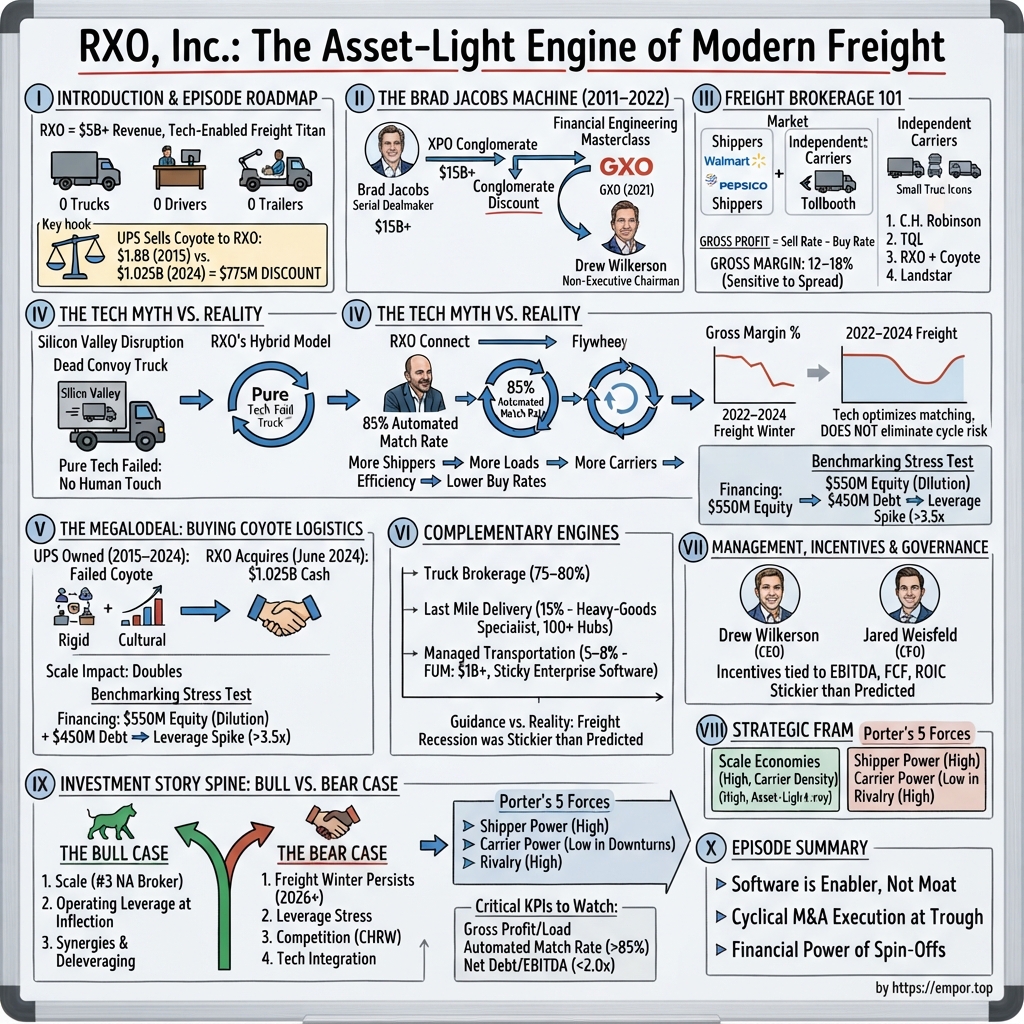
RXO, Inc.: The Asset-Light Engine of Modern Freight
I. Introduction & Episode Roadmap
In early August 2026, Chief Executive Drew Wilkerson presented quarterly results showing that the freight market was working in RXO's favor for the first time in three and a half years. Truckload volumes grew, gross profit per load expanded at its fastest sequential rate in four years, and spot freight — the volatile, high-beta segment of the market — swelled to 42% of the truckload mix, reaching roughly half by July.26
Yet RXO still posted a loss.
That single outcome captures the company's core operational reality. RXO, Inc. is a $5.7 billion revenue transportation platform that owns virtually no trucks, employs no long-haul drivers, and carries a net book value of property and equipment of just $134 million — less than many mid-sized trucking fleets spend on tractors in a single year.1 As one of the largest freight brokers in North America, RXO sits at a central intersection of the physical economy, arranging transportation for retailers, food and beverage companies, industrial manufacturers, and automakers. In theory, its business operates like a tollbooth: capital-light, cash-generative, and highly scalable.
In practice, RXO has been unprofitable on a GAAP basis for most of its history as an independent public company, recording net losses of $290 million in 2024 and $100 million in 2025.1
The central question is not whether asset-light freight brokerage is a valid model, but rather what happens when an asset-light, technology-focused platform operates through a three-and-a-half-year commodity market downturn. RXO provides a clear case study. Spun out of Brad Jacobs' XPO conglomerate on November 1, 2022 — near the peak of the post-COVID freight cycle — RXO spent its initial years as a public company navigating the longest freight recession in modern American trucking.1[^2] In the middle of that downturn, RXO executed a major acquisition, buying Coyote Logistics from United Parcel Service for $1.025 billion — a business UPS had purchased for $1.8 billion less than a decade earlier.35
Four primary themes shape this story:
First, the mechanics of freight brokerage. Matching a fragmented pool of small trucking operators with concentrated Fortune 500 shippers fulfills a clear economic function. However, a broker's gross margin remains constrained by the spread between two market prices it does not control.
Second, the digital freight market shift. Between 2015 and 2021, venture capital poured billions into startups premised on software eliminating human freight brokers. Convoy, valued at $3.8 billion at its peak, shut down in October 2023 and sold its assets to Flexport for a reported $16 million.[^15] RXO survived, but survival alone does not prove structural superiority; the deeper question is what the industry learned from that capital cycle.
Third, cyclical consolidation. Acquiring scale near the trough of a freight cycle is a standard strategy, and RXO executed it. Whether the Coyote transaction succeeds depends largely on how it was financed and the resulting dilution and debt burden for existing shareholders.
Fourth, the unrealized free cash flow engine. RXO's model promises high conversion of EBITDA into cash because annual capital expenditures run near 1% of revenue.1 That mathematical framework requires underlying earnings power. In 2025, RXO generated $109 million in adjusted EBITDA, falling well short of the roughly $500 million target by 2027 outlined at the time of the spin-off.147
That gap — between the model as designed and the model as delivered — is the central tension of the RXO story. It begins, as so much in modern logistics does, with a dealmaker who built platforms designed for eventual corporate separation.
 Subscribe on LinkedIn
II. The Brad Jacobs Machine: From XPO Conglomerate to Pure-Play Spin (2011–2022)
In the summer of 2011, Express-1 Expedited Solutions was a micro-cap freight operator running expedited trucking, a small brokerage, and a modest forwarding division. Its stock traded for a couple of dollars. Then Bradley Jacobs — who had previously built and sold United Waste Systems and turned United Rentals into an industry leader — announced he would lead an equity investment of up to $150 million, with his vehicle, Jacobs Private Equity, committing up to $135 million.8
The transaction structure revealed Jacobs' playbook. He acquired $75 million of convertible preferred stock converting into roughly 43 million common shares at $1.75 each, alongside warrants for roughly 43 million more shares at the same strike price — an enormous bet on his own execution.8 He made his strategic ambition explicit at the outset: "I plan to build a multi-billion dollar transportation brokerage business over the next several years," he said at the time.8
Over the next four years, Express-1 was renamed XPO Logistics and transformed into an active acquirer, absorbing competitors across North America and Europe. The expansion accelerated in 2015 with two landmark acquisitions: French contract logistics provider Norbert Dentressangle and American less-than-truckload carrier Con-way, purchased for roughly $3 billion. By the late 2010s, XPO had grown into a global transportation and logistics conglomerate generating revenue in the mid-teens of billions of dollars.
Yet public markets penalized the conglomerate's multi-layered structure.
The conglomerate discount, in one paragraph
The valuation discount stemmed from bundling three distinct operational models with incompatible financial profiles under a single corporate header. Contract logistics — running warehouses for third parties — operates as a labor-intensive, contract-backed business with steady margins that public markets price like an outsourcing service company. Less-than-truckload (LTL) shipping requires heavy capital investments in freight terminals, tractors, and trailers, with valuations tied to network density and operating ratio. Truck brokerage functions as a working-capital business with almost no physical assets, valued on revenue growth and margin conversion. Combining all three led to a conglomerate discount, as investors struggled to underwrite three separate asset classes and defaulted to lower valuation multiples. Jacobs set out to eliminate that gap by systematically dismantling the conglomerate structure.
The breakup proceeded in three moves. First, XPO spun off its contract logistics division as GXO Logistics in 2021. Second, XPO sold its capital-heavy North American intermodal business to STG Logistics on March 25, 2022, for $710 million in cash — a unit that had generated $1.2 billion of revenue the prior year.9 Jacobs framed the divestiture as a step that would "simplify our business model and moves our capital structure closer to investment-grade — two priorities in our strategic plan."9 Third, XPO separated its technology-enabled truck brokerage and related services into RXO, Inc., which began trading on the New York Stock Exchange on November 1, 2022.1[^2]
The spin-off left XPO with the LTL business — complete with physical freight terminals, pricing power, and an established physical moat. RXO received the brokerage operation, inheriting digital matching algorithms, volume scale, and virtually no physical assets. Whether an asset-light digital platform represents a structurally superior business or merely a large working-capital position with a clean software interface became the central underwriting question for investors.
The separation also fundamentally altered RXO's risk profile. Within a conglomerate structure, steady cash flows from LTL and contract logistics cushion cyclical collapses in brokerage margins. Independent pure-play status eliminated that internal risk-sharing mechanism. For a freight broker whose gross margin can swing by seven percentage points across a market cycle, independence meant facing severe industry downturns without supporting business lines — the exact environment RXO encountered between 2023 and early 2026.
The handoff
To lead the newly public entity, XPO selected Drew Wilkerson. Wilkerson joined XPO in May 2012 to establish the company's flagship truck brokerage hub in Charlotte, North Carolina. He rose through the executive ranks, serving as regional vice president in May 2014, president of North American brokerage in March 2017, and head of North American transportation in February 2020, carrying full P&L responsibility for brokerage, expedite, intermodal, drayage, managed transportation, last mile, and freight forwarding. Earlier in his career, he held sales and operations roles at C.H. Robinson — the company that pioneered modern American truck brokerage and remains RXO's largest competitor.1
Unlike corporate financiers who build scale through leverage, Wilkerson developed his career inside carrier networks and load boards. He was 42 years old at the end of 2025.1 The financial seat went to Jamie Harris, a veteran CFO with more than 37 years of experience across B2B sectors — including eight years as CFO of Coca-Cola Consolidated and a period at SPX Technologies — who joined XPO's North American transportation division in September 2022 specifically to manage RXO's finances after separation.1 Jared Weisfeld, a former sell-side equity analyst, joined as chief strategy officer and became the primary point of contact for the investment community — a role that proved pivotal as market conditions softened.25
Jacobs initially remained as non-executive chairman, providing public markets with a signal of continued sponsorship. That setup shifted when Jacobs chose not to stand for re-election, and by the time the company filed its fiscal 2025 annual report, Wilkerson held both the chairman and CEO titles.1 With Jacobs refocusing his attention on his building-products venture, QXO, any remaining valuation premium tied to his capital allocation record dissipated, requiring investors to evaluate RXO on its standalone operating performance.
The early scorecard for the spin-off thesis underscored the impact of cycle timing. In its 2025 annual report, RXO disclosed that a $100 investment in its common stock at separation was worth $66.32 at the end of 2025. Over that same timeframe, the Dow Jones Transportation Average reached $128.37 and the S&P SmallCap 600 stood at $122.22.1 While three years of underperformance coincided with a broad freight recession, it demonstrated that the separation transferred cyclical market risk directly to public shareholders rather than unlocking immediate equity value.
III. Freight Brokerage 101: Industry Structure, Economics & Market Makers
Picture a food company in Bentonville that needs forty-two truckloads of packaged goods moved to distribution centers across six states next Tuesday. Now picture the supply side: a landscape of thousands of trucking companies, an enormous share of them owning a handful of tractors, run out of a home office by an owner who also drives. The shipper needs certainty, invoicing infrastructure, insurance verification, tracking, and someone to call when a trailer is sitting at a closed dock at 6 p.m. The carrier needs one thing above all: the next load, ideally one that starts near where the last one ended.
Neither side can efficiently find the other at scale. That gap is the freight broker's entire reason to exist, and RXO's own annual report describes the industry it operates in as "highly fragmented," with thousands of companies competing to provide brokered transportation.1
The spread, explained without jargon
A broker quotes the shipper a price to move the load. That is the sell rate. The broker then finds a carrier willing to haul it and pays them the buy rate. The difference is gross profit. There is no inventory, no manufacturing, no depreciation of any consequence — just the spread, multiplied by loads.
Two prices drive everything. Contract rates are negotiated in annual bid seasons and hold, roughly, for a year. Spot rates move daily with supply and demand. When trucks are abundant and freight is scarce, spot rates collapse below contract rates, and the broker earns a wide spread on contractual freight — the good years. When capacity tightens, spot rates spike above contract rates, and the broker is caught: obligated to honor contract prices while paying more to buy the truck. That is the mechanism, and it explains almost every quarter in RXO's short public history.
Companywide gross margin stood at 19.6% in the fourth quarter of 2022, with brokerage gross margin at 17.9% — the top of the cycle, when the broker was buying cheap and selling dear.7 By the fourth quarter of 2025, brokerage gross margin had fallen to 11.9%, and full-year 2025 brokerage gross margin was 13.3%.14 By the second quarter of 2026 it had compressed further to 10.7%, even as revenue grew 25% year over year.2
Consider that last figure closely, as it highlights a fundamental dynamic of the industry. Revenue growing 25% while gross margin percentage falls is not a failure — it is what a market inflection looks like from inside a brokerage. When buy rates rise, revenue per load rises with them; the percentage margin compresses mechanically even if gross profit dollars per load are climbing. And climbing they were: RXO reported an 11% sequential increase in truckload gross profit per load in Q2 2026, its fastest in four years.2 The company's own annual report is candid about the earlier, more painful phase of the same dynamic, attributing 2025's margin deterioration to a market that tightened "with capacity rapidly exiting in certain regions driven primarily by regulatory changes and enforcement, which caused buy rates to increase faster than our contractual sell rates."1
That is a broker admitting, in a regulatory filing, that the early phase of a market tightening can squeeze earnings. For investors who assume tightening capacity immediately boosts broker profitability, that disclosure offers a reality check.
The asymmetry governs how a brokerage behaves at every point in the cycle. On contract freight, the sell rate is fixed for roughly a year while the buy rate floats daily. When trucks are plentiful, that asymmetry works in the broker's favor: collecting a locked-in price while the cost of purchasing capacity falls beneath it. When trucks disappear, the same asymmetry becomes a trap, forcing the broker to absorb the margin compression or refuse the load and risk damaging key customer relationships. Spot freight inverts the arrangement: both sides reprice continuously, producing thinner percentage margins that react much faster to market shifts. This explains why RXO's quarterly spot mix is a key structural indicator. A rising spot mix shows the order book repricing in real time, whereas a falling mix indicates reliance on fixed contracts regardless of market shifts.
Why the model is supposed to be beautiful
The financial appeal of brokerage economics lies on the cost side, where the asset-light model performs as designed. RXO spent $59 million on property and equipment in 2025 against $5.7 billion of revenue — roughly one cent of capital per dollar of sales.1 The net book value of its capitalized internally-developed software was $63 million.1 Management's through-cycle framing is that the business converts 40% to 60% of adjusted EBITDA into free cash flow.25
The catch is that high conversion requires underlying earnings power. A strong conversion rate applied to $109 million of adjusted EBITDA — RXO's 2025 result — yields limited cash relative to a $3.5 billion balance sheet.141 Furthermore, brokerage carries a working-capital structure that penalizes short-term expansion: brokers must pay carriers before receiving payment from shippers. RXO's adjusted free cash flow was negative $42 million in the second quarter of 2026, which management attributed to working capital demands as volumes and rates rose simultaneously.6 In this business model, volume growth consumes cash before generating it.
The scale order, and a claim worth checking
RXO describes itself, and has since the Coyote deal, as the third-largest provider of brokered transportation in North America.3 That framing deserves scrutiny, because it depends on how the market is defined.
Transport Topics' 2026 ranking of freight brokerage firms, which uses 2025 gross brokerage revenue, placed C.H. Robinson first at $11.56 billion, Total Quality Logistics second at $7.36 billion, J.B. Hunt third at $7.08 billion, WWEX Group fourth at $5.18 billion, and RXO fifth at $4.23 billion, with net revenue of $563 million.12 Echo Global Logistics, Arrive Logistics, Landstar System, Schneider and Mode Global filled out the top ten.12
Both characterizations hold merit — RXO's ranking improves if intermodal-heavy and parcel-heavy competitors are excluded to isolate asset-light truckload brokerage — but investors should recognize that third place reflects a selective filter rather than an absolute industry standing. On the primary third-party ranking, RXO stands fifth, with gross revenue less than half that of the market leader.
The competitive set RXO itself names in its annual report is broader and more revealing: C.H. Robinson, Echo Global Logistics, Expeditors, Forward Air, Flexport, J.B. Hunt, Landstar System, Total Quality Logistics, and Uber Freight.1 That list spans four distinct business models — the incumbent network broker, the private sales machine, the agent-network model, and the venture-funded software platform — all competing for the same freight loads. Which brings the story to the question the market spent five years and several billion dollars of venture capital trying to answer.
IV. The Tech Myth vs. Reality: RXO Connect & The Digital Broker Shakeout
In 2016, the investment thesis for digital freight brokerage appeared straightforward. North American trucking was a trillion-dollar industry relying heavily on phone calls, manual dispatching, and legacy load boards. With roughly 20% of truck miles driven empty, venture investors bet that a software-driven matching platform could eliminate traditional brokerage intermediaries.
Convoy raised nearly $1 billion on that premise from prominent backers including Jeff Bezos, Bill Gates, and Marc Benioff, reaching a peak valuation of $3.8 billion. However, on October 19, 2023, Chief Executive Dan Lewis announced that the company was ceasing operations, citing a prolonged freight recession and tightening capital markets. Flexport acquired Convoy's technology assets weeks later for a reported $16 million.[^15]
The strategic takeaway extends beyond a single startup's closure. Convoy's model failed not because of software flaws, but because the digital brokerage thesis underweighted a fundamental market reality: in a commodity service, technology lowers the cost to serve but does not confer pricing power. When spot rates dropped sharply in 2022 and 2023, automated platforms and traditional telephone brokers offered identical underlying capacity, leading shippers to select transportation primarily on price. At the same time, operational exceptions that software handles poorly—such as loading dock detention disputes, temperature variations in refrigerated units, cargo damage claims, and carrier cash-flow needs—became paramount. Operational relationships and human problem-solving remain essential mechanisms for securing carrier capacity when prices are uniform.
A second structural limitation involves market selection. Digital brokerage algorithms capture efficiency gains most easily on standardized freight—such as dry van shipments on high-density lanes with flexible appointment windows. Because those routine loads are easily automated by competitors, price competition on them is intense. Higher-margin freight—such as flatbed transport, temperature-sensitive goods, oversized loads, and deliveries with complex facility requirements—resists full automation precisely because of its operational complexity. As a result, pure-play software brokers risk capturing market share primarily in the lowest-margin freight categories. This dynamic helps explain how a platform can automate most of its transactions while experiencing multi-year gross margin compression.
What RXO actually built
RXO's core proprietary platform, RXO Connect, functions primarily as an integrated workflow and dynamic pricing system. In regulatory filings, the company describes RXO Connect as a cloud-based architecture featuring a load-optimization engine, a driver mobile application, shipper API integrations, and pricing algorithms trained on internal historical transactions.1 Management explicitly defines its core economic objective: the technology aims to boost productivity by automating load matching and messaging, "enabling our business to manage more volume without a commensurate increase in expense."1
This framing positions technology as a driver of operating leverage rather than an unassailable competitive moat.
Operating disclosures offer partial support for this thesis, though reporting formats have shifted over time. Following its spin-off in the fourth quarter of 2022, RXO reported that 87% of its brokerage loads were created or covered digitally, driver app downloads had increased 45% year over year to exceed 920,000, and registered carrier accounts had grown by 42%.7 In 2026 disclosures, management transitioned to reporting sequential growth metrics. The company reported a 30% quarter-over-quarter increase in digitally quoted truckloads and a 15% rise in digital carrier offers in the first quarter of 2026.16 By the second quarter of 2026, RXO reported a fivefold increase in spot quotes processed by an automated email AI tool, alongside a further 25% sequential increase in digital carrier offers.6 Management stated that representatives using the AI spot-quoting system handled 15% higher load volumes while improving per-load margins,16 and asserted that the platform can absorb at least 15% in additional volume without a meaningful increase in headcount.25
While these operational gains demonstrate functional progress, RXO no longer consistently reports the baseline headline automation percentage provided at separation. Relying on period-over-period percentage growth rather than absolute levels makes it more difficult for external analysts to measure cumulative automation progress over time.
Historical falsification pass: testing the "tech moat" claim
The claim: RXO's machine-learning pricing and matching technology confers a structural gross margin advantage over conventional brokers.
The strongest disconfirming evidence, drawn from RXO's own record over the full span of its public life: RXO's brokerage gross margin measured 17.9% in the fourth quarter of 2022 at separation,7 13.2% in the fourth quarter of 2024,18 11.9% in the fourth quarter of 2025,14 and 10.7% in the second quarter of 2026.2 This represents a margin compression of more than seven percentage points across three and a half years, spanning both market downturns and early recovery phases. Had dynamic pricing algorithms generated a persistent spread advantage, brokerage gross margins would have demonstrated relative stability rather than steady compression.
Comparative peer performance presents a similar contrast. In the second quarter of 2026, industry leader C.H. Robinson increased adjusted gross profit by 6.5% to $738.0 million and income from operations by 18.4% to $255.7 million, while its North American Surface Transportation segment generated an adjusted operating margin of 40.9%—up 280 basis points year over year.13 Chief Executive Dave Bozeman attributed the financial improvement to a "Lean AI" operational strategy, noting a 10.8% year-over-year reduction in average headcount and thirteen consecutive quarters of volume growth exceeding the Cass Freight Shipment Index.13 By comparison, RXO recorded an adjusted EBITDA margin of 2.3% of total revenue in the same quarter.2
Although the two profitability metrics differ in methodology—C.H. Robinson evaluates operating margin as a percentage of adjusted gross profit, whereas RXO calculates EBITDA margin against total revenue—the performance divergence remains notable. The established incumbent has demonstrated clear operating leverage by reducing headcount and expanding margins while expanding market share.
The verdict. Historical results do not substantiate a structural gross margin advantage derived from proprietary technology. Instead, empirical disclosures support a more modest proposition: RXO's platform reduces the unit labor cost of handling additional freight, producing operational leverage when volumes and gross profit per load expand concurrently, as observed in the second quarter of 2026. While Convoy's closure demonstrated that software alone cannot secure freight, RXO's margin trajectory indicates that software and scale combined cannot insulate a broker from market pricing pressures.
What would falsify the narrowed claim. Watch whether RXO's gross profit and adjusted EBITDA expand meaningfully faster than headcount and overhead expenses as freight volumes expand. If the company handles its targeted volume growth without a corresponding rise in operating costs, the operating leverage thesis will be validated. Conversely, if overhead scales in direct proportion to volume, software automation functions merely as a standard operating requirement in a relationship- and scale-driven industry.
V. The Megadeal: Buying Coyote Logistics from UPS & Benchmarking M&A
In 2006, Chicago entrepreneur Jeff Silver launched Coyote Logistics, a truckload brokerage that grew rapidly behind proprietary technology and an aggressive sales culture. By 2014, Coyote was generating $2.1 billion in revenue, prompting United Parcel Service to purchase the company from private equity firm Warburg Pincus in July 2015 for $1.8 billion.5
The strategic logic appeared sound on paper: UPS intended to fill predictable empty capacity across its parcel network with Coyote’s truckload freight. In practice, operational integration proved difficult. Freight brokerage relies on rapid, decentralized execution, while a parcel network depends on strict operational standardization and safety protocol. Silver departed less than three years later. By the time UPS placed Coyote back on the market, the unit was a scaled yet structurally under-earning asset inside a corporate parent shifting its focus toward higher-margin healthcare logistics.
The transaction
On June 23, 2024, RXO announced an agreement to acquire Coyote for $1.025 billion in cash.34 Disclosed transaction terms were detailed. In 2023, Coyote generated approximately $3.2 billion in revenue, $470 million in gross profit, and $86 million in adjusted EBITDA—implying an acquisition multiple of roughly 11.9 times earnings.3 Under the agreement, RXO secured a commercial contract with UPS extending through January 2030 and projected the deal would expand its roster of customer relationships generating over $1 million in annual revenue by roughly 80%.3 Management initially targeted run-rate cost synergies of "at least $25 million."3
The transaction closed on September 16, 2024.120 Final net consideration came in at $1.038 billion, which subsequently reached $1.048 billion after $10 million in working capital and post-closing adjustments were settled during the first quarter of 2025.1 Purchase accounting allocated $492 million to goodwill and $459 million to identifiable intangible assets, dominated by $444 million in customer relationships amortized over fifteen years.1
For UPS, selling at roughly $775 million below its purchase price nine years earlier marked a substantial loss on paper.35 Yet the divestiture reflected the structural mismatch of housing a truck brokerage inside a parcel network. Brokerage operations require working capital, produce volatile quarterly earnings, and rely on commission-heavy sales cultures that clash with unionized, highly standardized parcel systems. For UPS, taking the loss to redeploy capital represented a deliberate exit from an incompatible asset class—meaning RXO did not outmaneuver UPS so much as it offered a natural corporate home for an asset UPS had no strategic reason to keep.
Market observers evaluated the acquisition through two contrasting lenses.
Framing one, aligned with management's perspective: RXO acquired $3.2 billion in annual revenue for a third of a turn of sales near the trough of an extended freight downturn, purchasing from a motivated seller taking a 43% haircut on its original purchase price. Because scale in brokerage accumulates over time, securing trough-priced volume locks in long-term market position.
Framing two, a skeptic's counterpoint: RXO paid nearly twelve times trough EBITDA for a business whose earnings power had suffered structural impairment under UPS, and which contributed a $21 million pre-tax loss on $796 million in revenue during its first three and a half months under RXO.1 A trough valuation multiple creates value only if underlying earnings are cyclically depressed rather than competitively diminished—a distinction that remains unresolved.
Operationally, integration progressed faster than initial financial returns suggested. RXO raised its cost synergy target to at least $50 million by the fourth quarter of 2024, and by the first quarter of 2025 had migrated Coyote's coverage operations onto RXO Connect while raising the synergy estimate above $70 million—comprising $60 million in operating expense reductions and $10 million in capital savings, explicitly excluding purchased-transportation savings.1819 Wilkerson highlighted the operational milestone: "Carrier and coverage operations are now happening in one system, which will enable us to leverage our scale and realize future cost-of-purchased-transportation synergies."19 Completing a major systems migration within seven months represented a notable execution achievement in an industry with a history of troubled platform consolidations.
Historical falsification pass: the capital allocation and dilution stress test
The claim: Management executed a disciplined, bottom-of-the-cycle acquisition that created value for shareholders.
The disconfirming evidence begins with how it was paid for, and it is severe.
Rather than using a balance of debt and corporate cash, RXO funded the purchase almost entirely through new equity. On August 12, 2024, the company announced a $550 million private placement with MFN Partners and accounts managed by Orbis Investments, issuing 20,954,780 common shares at $20.21 each along with pre-funded warrants for 6,259,471 shares at $20.20.17 The issue price was fixed at "the closing price of RXO's stock on June 21, 2024, the last day of trading before RXO announced it had reached a definitive agreement to purchase Coyote Logistics."17 A subsequent public offering in September completed the financing, bringing total net equity proceeds to approximately $1.1 billion, which the company noted "were used to fund the acquisition of Coyote."1
This funding structure created two major financial consequences.
First, shareholder dilution was substantial. RXO's weighted average share count expanded from roughly 116.9 million in 2023 to 168.5 million in 2025—an increase exceeding 44% in two years.1 Existing shareholders effectively surrendered nearly a third of their ownership claim to acquire Coyote, requiring the unit to contribute more than a third of RXO's long-term earnings power to prevent value destruction.
Second, setting the offering price prior to announcement triggered a significant accounting adjustment. RXO recorded a one-time $216 million charge in 2024 categorized as a "deemed non-pro rata distribution" tied to the private placement, reflecting the gap between the fixed offering price and the prevailing market price at closing.1 This accounting item accounted for the vast majority of RXO's $290 million net loss in 2024.1 In practice, locking in the price prior to announcing the deal transferred $216 million in value from the general shareholder base to the participating institutional investors, who subsequently held 21.1% and 19.2% of the company's outstanding equity.10
While securing committed equity capital ensured transaction certainty during a severe industry downturn when public debt markets were constrained, the financing structure heavily favored existing major shareholders.
The leverage impact has also persisted longer than anticipated. Because equity funded the purchase price, headline debt appeared modest, ending 2025 at $404 million.14 However, earnings compression elevated leverage ratios. By the second quarter of 2026, RXO's net leverage reached 4.1 times trailing twelve-month bank-adjusted EBITDA, alongside $350 million in total liquidity and $15 million in cash.6 The company's credit facility required maintaining a maximum consolidated leverage ratio of 4.50 to 1.00, a covenant threshold management had amended upward in August 2024 to accommodate the transaction.1
The restrictive impact of these covenants appeared in the company's annual disclosures. As of December 31, 2025, RXO reported $565 million in committed revolving credit net of borrowings, but noted that "available borrowing capacity under the Revolver, after giving effect to the financial covenants described above, was $202 million."1 Financial covenants effectively rendered over $360 million of committed credit line unavailable. Consequently, on February 5, 2026, RXO replaced its unsecured credit facility with a $450 million asset-based facility secured by receivables, and on February 11 issued $400 million in 6.375% senior notes due 2031 to refinance its 7.500% senior notes due 2027, incurring an $11 million debt extinguishment loss.12115
Transitioning from unsecured credit to an asset-backed facility reflects tighter borrowing conditions where lenders require specific collateral. While refinancing lowered coupon interest costs, it highlighted constraint in RXO's uncollateralized borrowing capacity.
The verdict. Empirical disclosures do not invalidate the strategic rationale for acquiring Coyote, as scale remains critical in freight brokerage and operational integration proceeded ahead of schedule. However, the evidence refutes the characterization of the transaction as disciplined capital allocation. RXO acquired an asset suffering from cyclical and operational headwinds at nearly twelve times trough EBITDA, funded the deal via a 44% share expansion priced prior to announcement, recorded a $216 million distribution charge benefiting key institutional holders, and reached 4.1 times net leverage with $15 million in cash while covenant limits restricted credit availability. The surviving conclusion is that management secured substantial operational scale and integrated it efficiently, but structured the transaction in a manner that transferred significant equity upside to major holders before operational gains materialized.
What would confirm or falsify the revised claim. Management projected that net leverage will approach 3.0 times by the end of 2026 as working capital normalizes and earnings improve.25 If net leverage reaches 3.0 times on schedule while gross profit dollars continue to expand, the long-term economics of the deal will appear more favorable. Conversely, if net leverage remains above 3.5 times into 2027, the 2024 equity issuance will have secured scale at a high long-term cost to public shareholders.
VI. Complementary Engines: Managed Transportation & Last Mile Delivery
Outside a mid-sized American city, a refrigerator sitting in a logistics warehouse begins the final three hundred miles of a journey that originated in an overseas factory. It will be cross-docked, loaded onto a box truck with a two-person crew, driven to a suburban home, carried inside, uncrated, installed, leveled, tested, and cleared of packaging—all within a two-hour appointment window selected on a retailer's website. Nobody performing that final delivery works for RXO. Yet RXO arranged the entire sequence.
This non-brokerage operation receives less investor attention than the core truckload business, but it reveals critical structural dynamics about the platform's broader operational framework.
The three engines, sized honestly
While RXO reports financial results as a single operating segment, its revenue disclosures by service line provide essential structural context. In 2025, truck brokerage generated $4,225 million, last mile delivery contributed $1,196 million, and managed transportation added $549 million. After accounting for $228 million in intercompany eliminations, total consolidated revenue reached $5,742 million.1 On a gross service revenue basis, brokerage represents approximately 74% of the business, last mile accounts for roughly 21%, and managed transportation makes up the remaining 10%.
The customer base is more diversified than the concentration in truckload freight suggests. RXO's top twenty customers accounted for approximately 37% of 2025 revenue, while its top five generated 23%, with the largest single client representing approximately $653 million, or 11.4% of total sales.1 By end market, retail and e-commerce contributed $2,147 million, industrial and manufacturing accounted for $1,077 million, food and beverage generated $907 million, logistics and transportation added $519 million, and automotive represented $369 million.1 This distribution demonstrates broad exposure across the goods economy, leaving RXO with minimal single-industry demand risk and rendering it primarily a pure play on broader industrial and retail freight volumes.
Last mile: the number-one position nobody talks about
RXO's annual report claims the leading position in outsourced last mile delivery for heavy goods across the United States, with facilities located within 125 miles of the vast majority of the U.S. population, serving omnichannel retailers, e-commerce platforms, and direct-to-consumer manufacturers.1 At the end of 2025, the company operated 171 principal locations—152 of them in North America, including 20 owned or leased directly by customers.1 Deliveries are performed by third-party independent contractors rather than employees, applying the asset-light framework to the most logistically complex leg of the supply chain.
For a period, this division served as RXO's primary growth driver. Last mile delivery stops grew 15% year over year in the fourth quarter of 2024 and 24% in the first quarter of 2025, helping drive a $141 million increase in last mile revenue for 2025 on 13% volume growth.18191
However, demand contracted sharply in early 2026. Delivery stops fell 8% year over year in the first quarter of 2026, compounded by approximately $3 million in severe weather disruptions.1516 The operational driver is clear: heavy-goods home delivery is directly linked to housing turnover. Consumers typically purchase major appliances, furniture, and fitness equipment when relocating. When existing-home sales slow, the heavy-goods delivery market contracts regardless of carrier execution. Although delivery stops recovered to 3% growth in the second quarter of 2026, management projected an incremental $3 million to $5 million sequential headwind for the third quarter beyond normal seasonal patterns, citing soft demand and higher carrier costs.26
This creates a significant and underappreciated concentration of risk. Representing a fifth of consolidated revenue, last mile delivery is tied directly to the most interest-rate-sensitive segment of the consumer economy. As ACT Research observed in commentary accompanying the Cass freight indexes, elevated interest rates and high fuel costs continue to weigh on the freight demand outlook.11 Consequently, RXO's complementary business lines do not provide a countercyclical hedge against freight market downturns; instead, they remain vulnerable to a separate macro cycle that experienced weakness over the same period.
Managed transportation: the shrinking anchor
Managed transportation represents RXO's enterprise offering, managing shippers' overall transportation operations through load planning, carrier procurement, control-tower visibility, analytics, freight forwarding, and technology-enabled expedite services for time-critical shipments.1 The strategic objective is to establish multi-year client relationships that yield steady fee income while naturally routing a portion of managed freight into RXO's brokerage network. Historical cross-selling data offers partial support for this thesis: approximately 62% of RXO's 2022 revenue came from customers utilizing multiple service offerings.7
However, multi-year financial trends directly challenge the narrative of an expanding enterprise anchor. Managed transportation revenue has declined in every year following the spin-off: falling from $690 million in 2023, to $600 million in 2024, and $549 million in 2025—a cumulative reduction of roughly 20%, driven primarily by lower automotive expedite volumes.1 Additionally, RXO recorded a $12 million goodwill impairment in 2025 on its ground and air express reporting unit following its annual valuation review.1 While relatively small in magnitude, this marked the first goodwill impairment in RXO's history as an independent public company and occurred within the segment central to its customer-stickiness argument.
In contrast, management has regularly announced significant new contract wins, reporting over $200 million in gross freight under management awarded in the fourth quarter of 2025, over $100 million in the first quarter of 2026, approximately $100 million in the second quarter, and roughly $100 million in July.1415225
However, new-business awards reflect gross contract bookings rather than net recognized revenue. Three consecutive years of contract wins alongside three consecutive years of revenue declines indicate either that customer churn is matching new business or that awarded freight under management converts to recognized revenue far more slowly and thinly than headline figures suggest. Either explanation undermines the premise that managed transportation acts as a stable growth anchor.
The broader conclusion is that while RXO's complementary services provide end-market diversification, they do not insulate the business from underlying freight cycle volatility. The managed transportation business contracted steadily following separation, while last mile delivery remains exposed to housing market fluctuations. Neither division currently offsets margin volatility in the primary brokerage segment.
Furthermore, analyzing the business poses transparency challenges for outside investors. Because RXO reports as a single operating segment, it does not disclose profitability by service line, reporting only revenue and a consolidated "complementary services" gross margin—which stood at 21.1% in the second quarter of 2026, compared to 10.7% for truck brokerage.2 This wide margin differential indicates that complementary services generate a share of gross profit well above their share of total revenue. However, without segment-level operating income disclosures, investors cannot determine how much of RXO's consolidated earnings power resides in last mile delivery, nor evaluate the financial impact of a prolonged real estate slowdown. While single-segment reporting complies with accounting rules, it leaves a meaningful analytical gap for public market investors.
That places nearly the entire burden of the investment case back on the core truckload brokerage—and on the execution of the management team directing it.
VII. Current Management, Incentives & Governance
The most revealing document RXO has published is not an earnings release. It is a compensation table.
For the 2025 performance year, RXO's named executive officers received exactly 50% of their target short-term incentives under a structure designed to enforce strict profit accountability. The plan evaluated three performance metrics: adjusted EBITDA weighted at 50%, adjusted free cash flow conversion at 25%, and cost synergy savings at 25%. On free cash flow conversion, achievement reached 167.5%, while cost synergies hit 200%. However, adjusted EBITDA reached only 57.8% of its target—falling below the minimum performance threshold and generating zero payout. Under the plan's governance rules, missing the primary earnings goal capped payouts on the secondary metrics at 100%, resulting in a blended 50% payout with no discretionary upward adjustments.10
Chief Executive Drew Wilkerson had an annualized base salary of $705,665 with a target short-term incentive of 150% of salary, or $1,058,498; under the plan formula, he received $529,249.10
That outcome contrasts with typical executive compensation arrangements. Without the capping rule, weighting the three metrics independently would have yielded a payout of roughly 92% of target—paying near-full bonuses during a year in which adjusted EBITDA declined and RXO recorded a $100 million net loss.141 The cap prevented that outcome.
This structure reflects disciplined oversight. By blocking above-target payouts on secondary metrics whenever the core earnings metric misses its threshold, the plan prevents executives from receiving full incentive compensation driven by cost cuts or working capital timing while underlying operating profits compress.
The long-term incentive plan applies a similar constraint. Half of the 2025 executive equity grant consists of performance restricted stock units tied to relative total shareholder return against the S&P Transportation Select Industry Index. Payouts require reaching the 55th percentile, scale to a maximum of 225% at the 90th percentile, and yield zero below the 55th percentile. Critically, the plan enforces a hard cap at 100% of target if RXO's absolute total shareholder return is negative.10 The remaining half consists of time-vesting restricted stock. The compensation committee cited relative return as the most effective alignment metric "particularly in cyclical freight markets."10 Given the drop in share value since the spin-off disclosed in RXO's annual report, that negative-return cap imposes meaningful discipline.1 Shareholders endorsed the program, passing the 2025 advisory say-on-pay vote with over 95% approval.10
Historical falsification pass: guidance discipline and cycle timing
The claim: Management sets credible targets and executes consistently against them.
The strongest disconfirming evidence comes from the company's original long-term financial target. In its fourth-quarter 2022 earnings release—its first as an independent public company—RXO stated it remained confident in achieving five-year targets that called for "the company to deliver $500 million of adjusted EBITDA at the midpoint in 2027."7
Financial results have fallen far short of that trajectory. RXO generated $118 million of adjusted EBITDA in 2024 and $109 million in 2025.14 Through the first half of 2026, the company posted $6 million in the first quarter and $40 million in the second, while guiding third-quarter adjusted EBITDA to between $35 million and $45 million.152 Even a strong fourth quarter would leave 2026 earnings at roughly one-quarter of the 2027 goal, with only one year remaining.
While an extended freight recession explains part of the gap, executive communication around the target evolved significantly. Rather than formally revising or reaffirming the $500 million baseline, management reframed financial ambitions in margin terms. At an investor conference on August 11, 2026, Chief Strategy Officer Jared Weisfeld characterized normalized earnings power as mid-single-digit EBITDA margins, with high-single to low-double-digit margins achievable at a market peak.25 On RXO's current revenue base, mid-single-digit margins yield approximately $300 million in EBITDA—repositioning the $500 million figure as a peak-cycle scenario rather than a 2027 baseline target.
This transition represents a material reduction in financial expectations, executed via a shift in reporting metrics rather than a direct guidance revision.
Management's record on forecasting market cycles is similarly mixed. Throughout 2023, 2024, and early 2025, executive commentary regularly projected a freight rate recovery within a few quarters that failed to materialize. Recent guidance, however, shifted toward supply-side fundamentals rather than demand forecasts. On the first-quarter 2026 conference call, Wilkerson noted that capacity continued to exit the market, "a trend that began to accelerate late last year due to regulatory changes"—a supply-focused thesis independent of macro freight demand.16 That assessment proved directionally accurate: following bid season, contract rate expectations for 2026 were revised from low-to-mid single-digit growth to high single digits, while RXO's spot freight mix expanded from 33% in the first quarter to 42% in the second and reached roughly 50% in July.16225
This pricing approach invited analyst scrutiny. During the first-quarter 2026 conference call, analysts questioned why RXO's truckload volume fell 12% year over year against a broader market contraction of roughly 6%, pressing management on whether rejecting unprofitable or negative-margin loads reflected pricing discipline or market share loss.16 Second-quarter 2026 results provided initial evidence supporting management's strategy: truckload volume grew 2% in a market management estimated declined 3%, while gross profit per load expanded at its fastest sequential rate in four years.225 While a single quarter does not establish a multi-year trend, it indicates that volume growth resumed alongside expanding unit margins.
Governance, ownership and a few second-layer signals
Beyond executive compensation and guidance discipline, three governance and risk factors warrant close monitoring.
First, the ownership register is extraordinarily concentrated for a public company of RXO's scale. Orbis Investment Management held 21.1% of outstanding equity, MFN Partners held 19.2%, BlackRock held 13.7%, The Vanguard Group held 10.4%, and Finepoint Capital held 5.7%, relative to 164,711,222 shares outstanding at the 2026 record date.10 The combined 40% holding by Orbis and MFN—the two institutional managers that funded the Coyote acquisition on negotiated private terms—represents a double-edged ownership structure: it provides patient capital aligned with long-term strategy, but also creates a concentrated voting bloc that benefited directly from the equity financing terms that diluted retail and public shareholders.
Second, RXO changed independent auditors early in its public history, transitioning from KPMG (auditor from 2022 to 2023) to Deloitte starting in 2024.1 Regulatory filings reflect no disagreements over accounting principles, and auditor changes following corporate spin-offs represent common corporate administrative transitions.
Third, the critical audit matter identified in the fiscal 2025 audit involved self-insured automobile liabilities, specifically the estimation of claims incurred and incurred-but-not-reported requiring actuarial evaluation.1 This exposure intersects with legal risk in the last mile business, where RXO faces class and collective actions alleging that independent contract carriers or delivery workers should be classified as employees. RXO's liability and excess umbrella policies generally exclude worker misclassification claims. The company settled one proceeding, Gonzalez v. RXO Last Mile, for an immaterial amount, but has not recorded accruals for remaining actions because plaintiffs have not quantified damages.1 Under its separation agreement with XPO, RXO assumes these liabilities and indemnifies XPO against related claims.1 Because the last mile business model relies on independent contractor delivery networks, worker misclassification disputes represent an active structural risk.
That risk has a much larger sibling, and it arrived in May 2026.
VIII. Strategic Frameworks & Historical Falsification Pass
On May 14, 2026, the Supreme Court of the United States decided Montgomery v. Caribe Transport II, LLC. The decision was unanimous. It held that state-law negligent hiring claims against freight brokers are not preempted by the Federal Aviation Administration Authorization Act, because such claims fall within the statute's safety exception preserving state authority over motor vehicles.22
For twenty years, the preemption defense served as the freight brokerage industry's structural shield. A broker sued after a highway accident involving a hired carrier could move to dismiss on federal preemption grounds and frequently win before discovery. That shield is gone. Brokers now face state tort claims over carrier selection that will survive motions to dismiss, with consequences flowing into contract terms, indemnity provisions, insurance requirements, underwriting, and premiums.22 RXO's own FY2025 annual report had flagged the pending case, noting that private litigants were "more regularly adding brokers as defendants in lawsuits arising from highway accidents."1
What makes this ruling strategic rather than merely burdensome is its economic asymmetry: a liability regime that raises carrier-vetting costs functions, structurally, as a scale advantage. A broker that spends $15 million to $20 million annually on casualty insurance, maintains a formal vetting apparatus, rejects conditional-rated carriers, and requires 90 or more days of active operating authority before tendering freight can absorb those overhead costs across billions of dollars in volume. A four-person brokerage cannot.6 RXO's management has been explicit about leveraging this position, telling investors it expects rate increases at its late-December 2026 insurance renewal to be "significantly better than industry" based on its vetting and claims history, citing recognition from CargoNet and FreightWaves.6
That projection remains a claim rather than a proven outcome; the December 2026 renewal will serve as its first hard test.
The court ruling coincided with broader regulatory pressure. Reporting on RXO's second-quarter results noted that the Department of Transportation simultaneously accelerated capacity exits through stricter enforcement of driver qualification standards—specifically non-domiciled commercial driver's licenses and language proficiency requirements. Wilkerson described the combination as a "structural change to the market" that would improve safety while spurring a supply-driven recovery.24 Investors should separate the two halves of that assertion. The safety and supply impacts are visible in empirical data. However, framing the shift as a permanent structural change rather than a multi-year adjustment that eventually rebalances is a forecast—and one on which much of RXO's medium-term earnings trajectory relies. Capacity removed by regulatory enforcement can eventually be replaced by compliant capacity. The history of American trucking includes numerous regulatory shocks—from electronic logging devices to hours-of-service revisions—that tightened capacity sharply before the market adapted.
Hamilton Helmer's 7 Powers, applied with the evidence in hand
Scale Economies — present, but weaker than advertised. The underlying mechanism functions as expected: fixed technology and compliance costs spread across a larger load base, while denser lane coverage reduces carrier empty miles to enable narrower bid spreads. However, evidence that scale translates into durable excess returns remains thin. RXO ranks fifth on the Transport Topics list with $4.23 billion in gross brokerage revenue—roughly a third of C.H. Robinson's $11.56 billion—and the market leader continues to outperform RXO across every primary profitability metric.1213 In freight brokerage, scale appears to be a necessary table-stakes requirement for competing on national RFPs rather than a standalone engine of superior returns.
Counter-Positioning — largely a misapplication. Counter-positioning requires that an incumbent be unable to adopt a newcomer's model without cannibalizing its existing core business. Asset-heavy truckload carriers are not structurally barred from brokering freight; on the contrary, they actively operate large brokerage divisions. J.B. Hunt ranked third and Schneider ninth on the same brokerage list, and RXO explicitly names J.B. Hunt as a primary competitor in its annual report.121 Operating an asset-light model provides genuine cost flexibility during cyclical troughs—since RXO avoids tractor depreciation—but it does not constitute counter-positioning when asset-based peers routinely build parallel brokerage operations.
Process Power — plausible, unproven, and challenged by peer execution. Proprietary pricing algorithms trained on years of transaction data are difficult to copy quickly, and agentic AI tools deployed through 2026 have generated measurable throughput improvements.616 Yet C.H. Robinson's Lean AI initiative has driven what the company reports as more than a 60% productivity gain since late 2022, while reducing average headcount by nearly 11% year over year.13 If the industry incumbent is compounding operational productivity faster than the challenger, process power is not accruing uniquely to RXO.
Cornered Resource, Branding, Switching Costs, Network Economies — none reach the threshold of a true Power. Enterprise shippers intentionally split volumes across multiple brokers. Disclosures show no evidence of a pricing premium linked to brand reputation. The two-sided carrier-shipper network is functional but shallow: carriers utilize multiple broker mobile applications simultaneously, while shippers routinely divide tenders among four or five providers.
The most grounded assessment is that RXO possesses moderate scale economies and potential process power within an industry where the strongest competitive moat may ultimately stem from regulatory compliance costs—a rising barrier that favors larger platforms, but one created entirely by external legal shifts.
Porter's Five Forces, in the market as it actually stands in 2026
Rivalry: intense and structurally embedded. The market features thousands of brokers, an undifferentiated core commodity service, and annual competitive bidding. Although the 2026 bid season yielded better-than-expected results for brokers—prompting RXO to raise its full-year contract rate growth outlook to high single digits after bidding concluded—that improvement reflects tightening market supply rather than diminished competitive rivalry.16
Bargaining power of shippers: high, though showing cyclical softening. Enterprise shippers routinely conduct RFPs and divide lane allocations. In a tight capacity environment, however, a shipper's threat to switch brokers becomes less effective because alternative providers face the same truck shortages. Tender rejection rates approaching 18% in June 2026—the highest level in over four years—reflected that shifting balance, leading Wilkerson to observe on the second-quarter call that shippers seek out trusted partners during supply crunches.6 Notably, tender rejection rates moderated from those early-summer peaks by late August.
Bargaining power of carriers: rising, driven by supply contraction. Regulatory enforcement has created a documented supply shock. The FMCSA introduced emergency restrictions on non-domiciled commercial driver's licenses in September 2025, followed by a final rule in March 2026, estimating that 97% of roughly 200,000 non-domiciled CDL holders would fail to meet the new standards. Concurrently, English language proficiency enforcement generated over 19,000 violations and more than 5,000 out-of-service orders, with annual driver removals estimated near 20,000. Industry research published by J.B. Hunt estimated the total at-risk driver population at up to 600,000—approximately 16% of active commercial drivers—exiting over a two- to three-year period.23 Management went further, suggesting to investors that up to 25% of the for-hire truckload market could eventually exit, with the industry roughly midway through the adjustment.25
While executive projections represent an interested party's outlook, independent market data confirms the underlying trend. The Cass Truckload Linehaul Index rose 8.6% year over year to 152.9 in July 2026, even as Cass shipment volumes fell 4.8%. Rising freight rates alongside falling shipment volumes signal a classic supply-side squeeze, leading Cass to note that overall volumes remain soft primarily because available driver capacity is contracting.11
Threat of substitutes: low, but gradually expanding. Truckload freight remains the dominant mode for surface transportation, but Cass noted that rail intermodal has gained market share as truckload rates escalated.11 For freight brokers, mode shifting represents a minor, gradual headwind rather than an immediate disruption.
Threat of new entrants: bifurcated, and shifting in favor of established players. Launching a small brokerage remains straightforward. However, establishing national density, enterprise software integrations, and a legally defensible carrier-vetting infrastructure in a post-Montgomery legal environment is far more challenging than it was eighteen months ago. This force has meaningfully strengthened incumbent positions—though driven by legal precedent rather than internal strategic differentiation.
The composite evaluation reveals a platform operating within a structurally challenging industry that is experiencing a cyclical and regulatory reprieve. RXO holds moderate rather than dominant competitive advantages, positioned at a cycle juncture where operating leverage works in its favor for the first time in four years.
IX. Investment Story Spine: Bull vs. Bear Case & Critical KPIs
Why RXO wins from here
The bull case for RXO rests fundamentally on an operating-leverage argument built on three pillars.
First, operating leverage creates a coiled spring. RXO processes roughly $5.7 billion of freight annually across a cost base that is largely fixed in the short term.1 Between January and July 2026, gross profit per load rose approximately 40%, while the spot mix—the highest-margin, most rate-sensitive segment of the book—roughly doubled from its start-of-year baseline.252 Because incremental gross profit dollars flow directly to earnings with minimal added cost, operating swings occur rapidly: adjusted EBITDA expanded from $6 million in the first quarter of 2026 to $40 million in the second quarter on essentially flat headcount.152 Management contends the platform can absorb at least 15% more volume without adding headcount and stands ready for a 15% to 20% surge in overnight volume.256
Second, the market tightening is driven by supply rather than demand. This represents the most significant structural shift from conditions in 2023 and 2024. Overall freight demand remains subdued—Cass shipments fell 4.8% year over year in July 2026, and Chief Strategy Officer Jared Weisfeld noted that demand remains below 2019 levels after three and a half years of contraction.1125 Nevertheless, rates are climbing because carrier capacity is exiting the market. If regulatory enforcement continues to shrink the pool of drivers, brokers stand to gain from rising prices even without a broader macroeconomic recovery.
Third, operational integration and balance-sheet deleveraging follow a concrete timetable. RXO completed the Coyote systems migration, raised expected cost synergies twice to over $70 million, and committed to reducing net leverage from 4.1 times at mid-year 2026 to near 3.0 times by year-end.19256 Additionally, a February 2026 debt refinancing reduced the coupon on the company's principal senior notes from 7.500% to 6.375%.21
What breaks the case
A rate recovery without volume expansion carries margin risk. Rising buy rates without a corresponding increase in sell rates represents the most challenging operational environment for a broker. RXO experienced this dynamic in 2025, attributing margin compression to buy rates rising faster than contractual sell rates as regulatory enforcement removed capacity.1 While the 2026 bid season allowed contracts to reprice upward, that adjustment protects margins only for freight currently under contract; it does not protect future margins if carrier buy rates continue to escalate. Furthermore, tender rejection rates eased by late August from their early-summer peaks, signaling that the spot market surge may be partially seasonal rather than structural.
Financial flexibility remains constrained by debt and working capital requirements. A balance sheet featuring 4.1 times net leverage, $15 million in cash, negative free cash flow in the second quarter of 2026, and an asset-backed credit facility replacing a covenant-constrained line leaves little room for operational disruption.61 Because freight brokerage requires upfront working capital as volume and rates rise, expansion consumes cash before generating it. Should the market recovery stall in the second half of 2026, RXO would enter 2027 with elevated leverage and limited financial flexibility after having already issued substantial equity to fund its recent acquisition.
The industry leader is outperforming on key operating metrics. C.H. Robinson's performance presents a direct challenge to the bull case: thirteen consecutive quarters of volume growth exceeding the Cass shipment index, a 40.9% adjusted operating margin in its primary surface transportation segment, and a double-digit reduction in headcount demonstrate clear operational execution.13 While the bull thesis assumes RXO will capture a disproportionate share of a market turnaround, the market leader is currently converting identical industry conditions into superior profit margins.
Exogenous legal and liability risks persist independent of the freight cycle. The Supreme Court's ruling in Montgomery v. Caribe Transport II exposes freight brokers to state-level negligent hiring lawsuits, driving up compliance and legal costs across the industry; RXO's December 2026 casualty insurance renewal will provide the initial test of those financial impacts.226 Simultaneously, worker misclassification litigation in the last mile delivery business poses an unhedged risk to the company's independent contractor model, which company disclosures indicate remains uninsured against misclassification claims.1
An activist's critique exposes historical execution gaps. A skeptical analysis relies on four documented factors: a 44% expansion in share count to purchase Coyote Logistics at nearly twelve times trough earnings; a $216 million non-pro rata distribution charge resulting from a fixed equity placement price; the reframing of a $500 million target for 2027 adjusted EBITDA into a peak-cycle margin aspiration; and three consecutive years of revenue contraction in managed transportation alongside a goodwill impairment, despite continuous announcements of gross contract wins.172510
Weighing the two cases
A synthesis of the evidence indicates a genuine cyclical inflection in RXO's favor, driven by supply contraction rather than demand growth, alongside support for the narrowed operating-leverage thesis. The record does not, however, demonstrate a durable structural competitive advantage, a defensible margin moat, or the baseline financial performance projected at separation. The most supported characterization positions RXO as an efficiently operated, sub-scale platform in a consolidating market, carrying a leveraged balance sheet into a supply-driven rate recovery—making the equity a high-beta play on the freight cycle rather than a long-term compounder trading at a discount.
This distinction dictates the primary metrics investors must evaluate. A compounding investment thesis relies on sustained market share gains and margin expansion across full economic cycles. Conversely, a cyclical leverage thesis depends on whether earnings expand rapidly enough to reduce net debt before the next industry downturn. RXO's financial disclosures and management's deleveraging targets align directly with the latter framework.
The three KPIs that actually matter
Evaluating RXO's forward trajectory depends primarily on three quarterly key performance indicators:
1. Truckload gross profit per load combined with spot freight mix. This metric serves as the primary gauge of operational performance, capturing pricing power, the spread between contract and spot rates, and freight cycle timing. The key operational indicators to track are sequential profit growth per load and whether the spot freight mix remains near the elevated levels recorded in mid-2026 or declines toward historical baselines near 30%.
2. Adjusted EBITDA expansion relative to headcount and overhead growth. This metric evaluates the narrowed technology thesis: whether software automation allows RXO to scale volume without a corresponding increase in operating expenses. Volume growth achieved alongside stable overhead expenses validates the operating leverage thesis, whereas operating expenses scaling in step with volume indicates standard cost behavior.
3. Net leverage progression toward management's 3.0 times target. This metric measures balance sheet recovery against a specific executive commitment and timeline, testing debt reduction and management's forecasting reliability.
Notably absent from key monitoring metrics is any single technology-adoption statistic. RXO no longer discloses a consistent, standardized automation percentage comparable to the metrics published at separation, relying instead on quarter-over-quarter growth figures that reset periodically. Until standardized disclosures resume, RXO's technological efficiency is evaluated most accurately through its financial results rather than reported software usage metrics.
X. Epilogue & Business/Investing Playbook
There is a version of this story that reads as a triumph. A management team took a company public near the peak of a freight cycle, endured the longest freight recession in modern American trucking, acquired a competitor of comparable scale at a depressed valuation, integrated its operations onto a single platform within seven months, raised synergy targets twice, refinanced senior notes at a lower interest rate, and expanded to twice its initial scale just as a supply-driven recovery began—all while a Supreme Court ruling raised regulatory compliance barriers in favor of large, well-capitalized brokers.
There is another version that reads as a cautionary tale. The same leadership team targeted $500 million in 2027 adjusted EBITDA and delivered a fraction of that pace, funded its primary acquisition through a 44% share expansion priced prior to announcement that recorded a $216 million value transfer to key institutional holders, recorded three consecutive years of revenue declines in managed transportation, transitioned from unsecured to asset-backed credit as covenant limits tightened, and underperformed both transport sector benchmarks and small-cap indices following its public listing.7110
Both perspectives are supported by empirical evidence, and an accurate assessment requires weighing both realities simultaneously.
Three core lessons extend beyond RXO:
Software is an enabler rather than a competitive moat in a commodity market. Convoy raised nearly $1 billion on the premise that algorithms would disassociate shippers from traditional brokers, only to shut down during a prolonged spot-rate collapse.[^15] RXO survived by leveraging enterprise shipper relationships, broad service offerings, and volume scale rather than software alone. Yet survival did not protect unit profitability: company brokerage gross margin compressed by over seven percentage points across the cycle.72 In a commodity logistics market, technology serves to lower the unit cost to serve rather than establish pricing power. Software efficiency must be evaluated on operating expense leverage rather than gross margin expansion.
Cyclical mergers and acquisitions are fundamentally financing decisions disguised as strategic initiatives. The strategic rationale for acquiring Coyote Logistics was logical, and operational integration proceeded rapidly. However, strategic scale provides limited immediate value to shareholders whose ownership claim was diluted by 44% to purchase an asset carrying 4.1 times net leverage. Acquiring a complementary asset using dilutive equity capital during a market trough can impair per-share value as effectively as an ill-conceived transaction. Assessing trough acquisitions requires evaluating equity dilution and balance-sheet leverage alongside transaction multiples.
Corporate spin-offs redistribute market risk before unlocking shareholder value. XPO's structural breakup was strategically coherent, establishing focused management structures across its successor entities. For RXO shareholders, however, independence isolated the company's pure-play exposure to the most rate-sensitive, low-moat segment of the former conglomerate at the top of the market cycle. Spin-offs do not inherently eliminate risk; instead, they concentrate specific cyclical exposures within standalone entities, requiring investors to evaluate pure-play vulnerabilities independently.
What remains is an active test of asset-light scale economics in North American surface transportation. RXO operates with minimal physical capital, established software automation, national volume scale, and no underlying physical asset moat, entering a market cycle turning in its favor for the first time since its spin-off. Over the coming quarters, performance across gross profit per load, operating expense leverage on expanding volume, and debt reduction toward 3.0 times net leverage will determine whether the asset-light business model is structurally sound or primarily an efficient mechanism for absorbing broader cyclical swings.
References
-
RXO, Inc. Form 10-K Annual Report for FY 2025 — U.S. Securities and Exchange Commission, 2026-02-09 ↩↩↩↩↩↩↩↩↩↩↩↩↩↩↩↩↩↩↩↩↩↩↩↩↩↩↩↩↩↩↩↩↩↩↩↩↩↩↩↩↩↩↩↩↩↩↩↩↩↩↩↩
-
Market Share Gains and Improved Profitability Drive Strong Second-Quarter Results for RXO — RXO, Inc., 2026-08-06 ↩↩↩↩↩↩↩↩↩↩↩↩↩↩
-
RXO To Acquire Coyote Logistics From UPS — RXO, Inc., 2024-06-23 ↩↩↩↩↩↩↩
-
UPS to Sell Coyote Logistics to RXO for $1.025 Billion — Reuters, 2024-06-23 ↩
-
UPS Acquires Coyote Logistics for $1.8 Billion — Wall Street Journal, 2015-07-31 ↩↩↩
-
Earnings Call Transcript: RXO Beats Q2 2026 Estimates as Stock Jumps Premarket — Investing.com, 2026-08-06 ↩↩↩↩↩↩↩↩↩↩↩↩↩
-
RXO Delivers Strong Fourth Quarter Driven by Brokerage Volume Growth (Form 8-K Exhibit 99.1) — U.S. Securities and Exchange Commission, 2023-02-07 ↩↩↩↩↩↩↩↩↩
-
Brad S. Jacobs to Lead Equity Investment of up to $150 Million in Express-1 Expedited Solutions — XPO, Inc. Newsroom, 2011 ↩↩↩
-
XPO Sells Intermodal Business to STG Logistics in $710M Deal — Trucking Dive, 2022-03-25 ↩↩
-
RXO, Inc. Definitive Proxy Statement (DEF 14A) — U.S. Securities and Exchange Commission, 2026-03-30 ↩↩↩↩↩↩↩↩↩
-
Cass Transportation Index Report, July 2026 — Cass Information Systems, 2026 ↩↩↩↩
-
2026 Top Freight Brokerage Firms — Transport Topics, 2026 ↩↩↩↩
-
C.H. Robinson Reports 2026 Second Quarter Results — C.H. Robinson Worldwide, Inc., 2026-07-29 ↩↩↩↩↩
-
RXO Announces Fourth-Quarter Results — RXO Investor Relations, 2026-02-06 ↩↩↩↩↩↩↩↩
-
RXO Announces First-Quarter Results and Second-Quarter Outlook — RXO, Inc., 2026-05-07 ↩↩↩↩↩
-
RXO (RXO) Q1 2026 Earnings Call Transcript — The Motley Fool, 2026-05-07 ↩↩↩↩↩↩↩↩
-
RXO Announces $550 Million Private Financing — RXO Investor Relations, 2024-08-12 ↩↩
-
RXO Reports Fourth-Quarter Results — RXO, Inc., 2025-02-05 ↩↩↩
-
RXO Announces First-Quarter Results, Successful Migration of Coyote Coverage Operations to the RXO Connect Platform — RXO, Inc., 2025-05-07 ↩↩↩↩
-
RXO Completes Acquisition of Coyote Logistics from UPS — FreightWaves, 2024-09-16 ↩
-
RXO Prices $400 Million Senior Notes Offering (Form 8-K Exhibit 99.1) — U.S. Securities and Exchange Commission, 2026-02-11 ↩↩
-
Supreme Court Holds Negligent Hiring Claims Against Brokers Not Preempted by FAAAA — Clyde & Co, 2026-05 ↩↩↩
-
Immigration Policy and Enforcement Impact on U.S. Commercial Driver Supply — J.B. Hunt Transport Services ↩
-
RXO Sees Advantage as Freight Broker Regulations Shift — Transport Topics, 2026-08 ↩
-
RXO at Deutsche Bank's Chicago Industrials Summit: Growth Offsets Freight Weakness — Investing.com, 2026-08-11 ↩↩↩↩↩↩↩↩↩↩↩↩↩↩
 LinkedIn
 WhatsApp
 Reddit
 Hacker News
 Email
Email Kindle
 RSS Feed
 Spotify
 Apple Podcasts
 Amazon Music
 Audible
 YouTube