Hilltop Holdings: Three Businesses, One Texas Balance Sheet
I. The Bank Is Growing; the Mortgage Company Is Losing Money
September 2026 started as an ordinary month for a Texas bank. Commercial borrowers in Dallas and Houston drew on their credit lines, depositors kept their money where it was, and the spread between what PlainsCapital Bank earned on its loans and paid on its deposits kept widening. Then mortgage rates jumped within weeks. Across the country, loan officers at PrimeLending watched buyers who had locked in rates and booked appraisals pull back or lose their place in the queue. Loans already in the pipeline, which PrimeLending had priced and hedged on the assumption that markets would move at a normal pace, were suddenly worth less than the hedges allowed for.
When Hilltop Holdings reported its third quarter on October 22, the two halves of that month arrived in the same press release. PlainsCapital earned about $44 million before tax. PrimeLending lost about $10.8 million.1 The bank's net interest margin, the gap between its yield on assets and its cost of funds, rose to 3.33% from 3.21% in the previous quarter.1 Consolidated net income still fell to about $24 million, from about $45 million a year earlier. That was a drop of roughly 47%, and diluted earnings per share fell from 76 cents to 44 cents.1
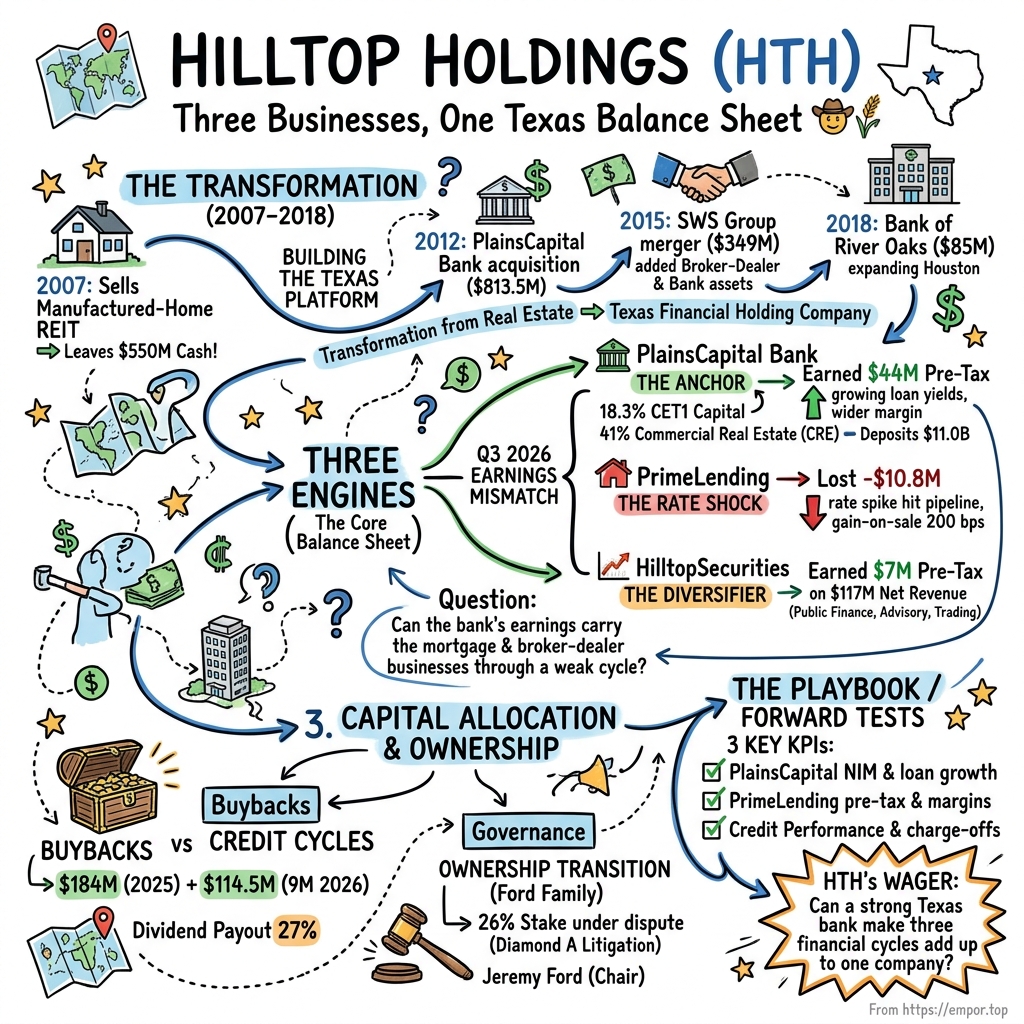
On the surface that looks like a contradiction. The bank was doing what a bank should do, and the holding company had its weakest quarter in about two years. It stops looking contradictory once you see what Hilltop is. It is not a regional bank that happens to own a mortgage desk. It is a publicly traded financial holding company with three operating businesses, each run under its own brand and regulator, and each tied to a different part of the economy.2 PlainsCapital Bank is a Texas commercial bank. PrimeLending is a national retail mortgage originator. HilltopSecurities is a broker-dealer whose biggest franchise is municipal and public finance.2 Above them sits a parent company that mostly holds those subsidiaries, collects their dividends, pays its own debts and decides how much capital to send back to shareholders.2
That structure explains why the third quarter mattered more than a 47% earnings decline usually would. Hilltop's defenders have long described it as a diversified financial company: when one business is under pressure, another should help. The third quarter tested that claim live. The bank did its part. The broker-dealer added a modest profit. The mortgage company, hit by a rate shock it could neither avoid nor fully hedge, took back almost a quarter of what the bank earned. The earnings that survived were real, but they were not the steady, offsetting stream the word "diversified" implies.
Three questions run through Hilltop's story. The first is whether the bank's earnings can carry the mortgage and broker-dealer businesses through a weak housing and rate cycle without the bank taking on credit risk it later regrets. The second is whether Hilltop's large share buybacks, about $184 million in 2025 and about $114.5 million in the first nine months of 2026, create value for each share without draining the flexibility the bank may need in a downturn.23 The third is the newest and least comfortable. The Ford family, whose holdings have shaped Hilltop's direction since before it owned a bank, is in a legal dispute over who controls a block of about 15.5 million shares, and the holders of that block have said they intend to sell some or substantially all of it over time.45
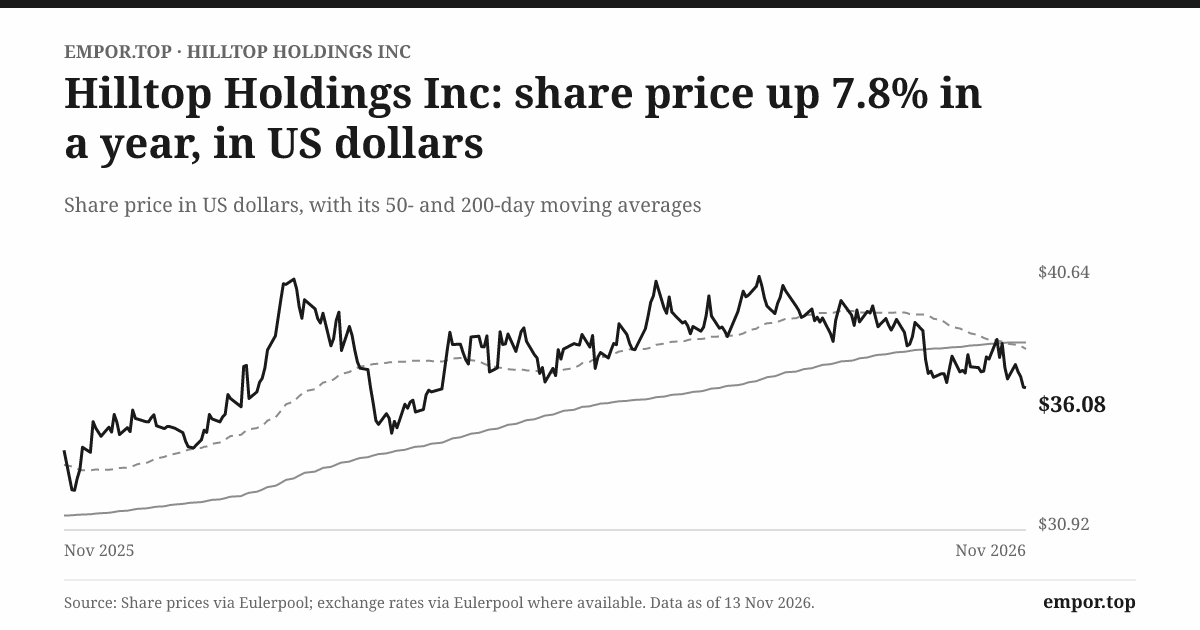
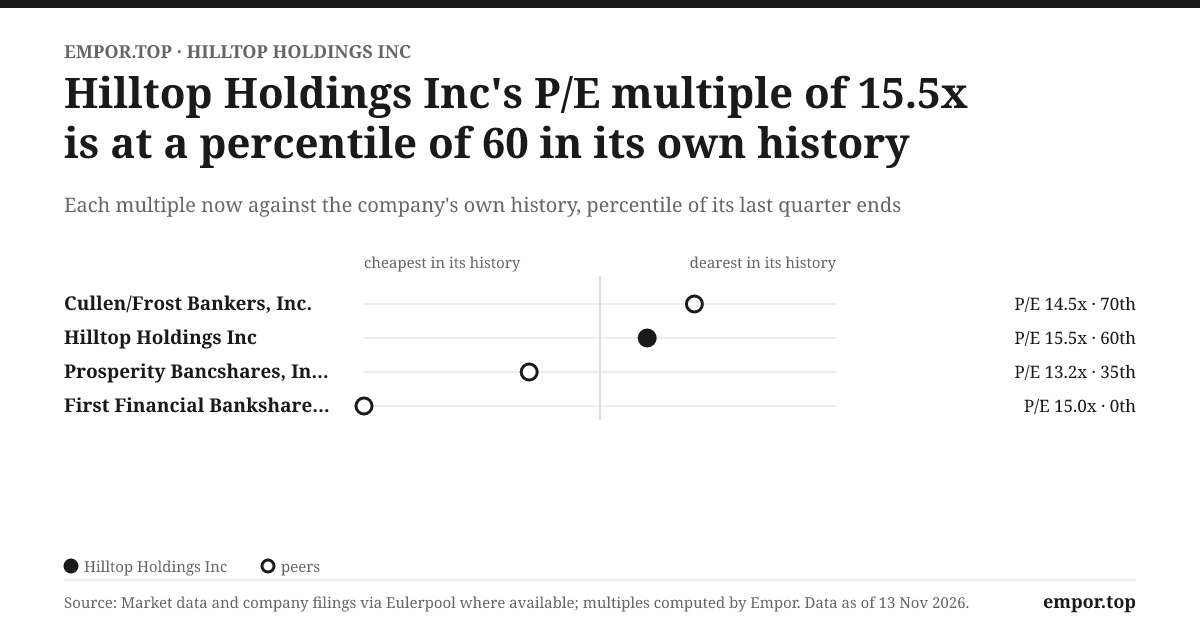
The investor's question, then, is not whether Hilltop is a good bank. It is whether a good bank is enough. At about $36 a share, the market values the company at roughly its book value of about $35 a share and at about 15.5 times trailing earnings, close to its own five-year median of about 15 times.61 That price assumes neither collapse nor triumph. It assumes the company keeps muddling through. To judge whether that is too generous or too cautious, you have to go back to the strange moment when a company that owned trailer parks decided to buy a bank.
 Subscribe on LinkedIn
II. From a Manufactured-Home REIT to a Texas Financial Holding Company
Before Hilltop owned a bank, it owned land under manufactured homes. The company began as Affordable Residential Communities, a real estate investment trust that ran manufactured-home communities: rows of factory-built houses on leased lots, with rent collected on the land beneath them.7 It was not a glamorous business, and by the mid-2000s it was not a particularly successful one. In 2007 the company sold its manufactured-home communities and was left with something unusual for a listed company: a small Texas property and casualty insurer, National Lloyds, and roughly $550 million in net cash.7
A shell with half a billion dollars in cash has two obvious options. It can hand the money back to shareholders and close down, or it can bet on a new platform. Hilltop's chairman, Gerald J. Ford, chose the second. Ford was already a well-known figure in Texas banking. American Banker described the newly renamed Hilltop as a holding company "set up to buy banks and headed by noted bank investor Gerald Ford."8 Ford's name carried weight because he had spent decades as a buyer and seller of banks. Hilltop was meant to be his next vehicle.
Then came the waiting. The financial crisis followed the asset sale almost immediately, and from 2008 through 2011 Hilltop held its cash while hundreds of American banks failed or were sold. A patient buyer might have expected a bargain in that wreckage. Hilltop did not do a bank deal for years. That restraint is worth noting. Many cash-rich vehicles of the time either overpaid early or never bought anything at all. Hilltop waited, and when it finally moved, it did not buy a failed bank. It bought one of the best-known independent financial franchises in Texas.
The deal that made the company
In May 2012 Hilltop agreed to buy PlainsCapital Corporation, the Dallas-based parent of PlainsCapital Bank, PrimeLending and the public-finance firm First Southwest, in a cash-and-stock deal worth roughly $520 million at announcement.8 By the time it closed at the end of November 2012, Hilltop's own share price had risen enough that the consideration was worth about $700 million.9 For accounting purposes, which also counted the preferred stock Hilltop assumed, the total purchase price was about $813.5 million.10 PlainsCapital brought about $6.4 billion of assets, roughly 3,700 employees and around 330 locations in 42 states.9 At closing, Gerald Ford remained Hilltop's chairman, his son Jeremy B. Ford continued as Hilltop's president and chief executive, and PlainsCapital's chairman and CEO, Alan B. White, became vice chairman of Hilltop while continuing to run the PlainsCapital businesses.9
The three numbers for one deal are not just an accounting curiosity. The gap between them shows something lasting about Hilltop: because it paid partly in its own stock, PlainsCapital's owners became significant Hilltop shareholders, and the price of the deal depended partly on how the market valued Hilltop itself. More important, the deal changed what Hilltop was. Before it, Hilltop was a cash pile with a promise. After it, Hilltop was a bank, a mortgage company and a public-finance firm under one roof. The three-engine structure that defined the third quarter of 2026 was not designed piece by piece over a decade. It arrived as a package in a single transaction.
The next steps widened that package. In September 2013 PlainsCapital Bank took over the failed First National Bank of Edinburg in South Texas in an FDIC-assisted deal, adding deposits and branches in the Rio Grande Valley with the government sharing part of the loss risk.11 On January 1, 2015, Hilltop completed its acquisition of SWS Group, a Dallas brokerage and banking company, for consideration of about $349 million.1211 SWS brought a retail and institutional brokerage, a clearing business and a bank. Hilltop folded the SWS bank into PlainsCapital and combined the SWS broker-dealer with First Southwest to create what became HilltopSecurities.1113
The SWS accounting is often cited as proof that Ford's team bought well. Hilltop recognized a bargain-purchase gain on the deal, which means the fair value of the net assets acquired was judged to exceed the price paid.11 That is meaningful evidence that Hilltop did not overpay against the balance sheet it received. It is weaker evidence than it sounds. A bargain-purchase gain says the assets were bought below their estimated fair value on one day. It does not show that the businesses would earn good returns afterwards, and Hilltop does not publish a peer-deal comparison on normalized earnings or tangible book value that would settle whether the price was cheap against what other buyers were paying for similar franchises.
Filling out the map, then pruning it
In 2018 Hilltop paid $85 million for Bank of River Oaks in Houston, which brought roughly $342 million of loans and $369 million of deposits and more than doubled PlainsCapital's Houston-area portfolio at the time.7 For a Dallas-based bank, Houston was the large, energy-linked market where it had been too small to matter. Paying about a quarter of the acquired deposit base was a reasonable entry price for a foothold in Texas's largest city, although it was a foothold rather than a position of strength.
Two years later Hilltop went the other way. In 2020 it sold National Lloyds, the insurer it had carried since its pre-bank years, for about $154 million gross.7 It is tempting to read the PlainsCapital purchase, the bargain-gain SWS deal, the Houston bank and the insurance sale as a repeatable buy-cheap, sell-well formula. The record supports a smaller conclusion. Hilltop made a few large, consequential purchases at prices that did not obviously overpay against the assets acquired, and it later trimmed the business that fit least. Because the company's mix kept changing, with insurance in some years and SWS in others, there is no clean, same-business series that shows whether each deal earned more than its cost of capital.
So the company that reported in October 2026 is mostly the product of acquisitions, not slow organic growth. That matters because acquired businesses keep the economics they had when they were bought. To see what Hilltop actually owns, follow a single dollar through each of the three engines.
III. Three Engines, Three Different Ways to Make a Dollar
Imagine three customers walking through Hilltop's doors on the same Tuesday.
The first is the owner of a mid-sized Texas distribution business who needs a $5 million credit line to carry inventory. She goes to PlainsCapital Bank. The bank lends her money that came mostly from other customers' deposits. It charges her more interest than it pays its depositors, sets aside a reserve in case she cannot repay, and keeps the difference after paying its bankers and its regulators. Her loan will sit on the bank's books for years, and its value to Hilltop depends on whether she pays it back.
The second customer is a couple in South Carolina buying their first house. They work with a PrimeLending loan officer, who takes their application, locks their rate, closes the loan and then sells it, usually within weeks, to an investor or a government-sponsored agency. PrimeLending earns origination fees and a gain on the sale, the difference between what the buyer of the loan pays and what the loan cost to make.2 The couple will remember PrimeLending's name. Hilltop, in most cases, will not keep their loan.
The third customer is a mid-sized Texas school district that needs to borrow money for a new building. It hires HilltopSecurities as financial adviser, and the firm helps structure and price the bond issue. HilltopSecurities earns advisory and underwriting fees on the deal, and its traders earn commissions and trading gains when buying and selling bonds for institutional clients.2 The fee arrives only if the deal closes.
Each dollar behaves differently. The bank's dollar is slow, recurring and exposed to credit losses. The mortgage dollar is fast and depends on two variables at once: how many loans PrimeLending can close, and how much margin it earns when it sells them. The broker-dealer's dollar depends on deal timing and market activity. Hilltop's own description of these businesses is plain about this. Advisory fees often depend on successful client transactions, and trading and structured-finance revenue is sensitive to interest rates.2
Where the earnings actually come from
In 2025, the year Hilltop's earnings recovered most strongly, the broker-dealer produced about $254 million from principal transactions, commissions and fees and about $181 million from investment banking, advisory and administrative fees.2 PrimeLending's operations produced about $301 million from loan-sale gains, production income and origination fees.2 These are not miscellaneous "other income" lines tucked under the bank. They are the core revenues of two operating businesses. A reader who sees Hilltop's consolidated revenue of about $1.6 billion and compares it with a conventional bank's net interest income will be comparing different things, because Hilltop's revenue includes fee businesses with their own large costs, especially commissions for loan officers and brokers.2
Revenue, then, is the wrong place to look. Pretax profit by segment shows who carries the company. In the third quarter of 2026 the bank earned about $44 million before tax, HilltopSecurities about $7 million, and PrimeLending lost about $10.8 million.1 The bank produced well over the consolidated total before corporate costs. That is the position the company is in now: one business generating the earnings, one adding a smaller profit, and one consuming part of the total.
It helps to picture the size of the machine behind those three dollars. Hilltop employed about 3,500 full-time staff at the end of 2025, and by the third quarter of 2026 it counted roughly 3,530 employees working from about 304 locations.142 Many of those locations are PrimeLending offices spread across the country rather than bank branches in Texas, which is a reminder that much of Hilltop's physical footprint belongs to its most volatile business. The company spends little on fixed assets: purchases of premises and equipment were about $16.8 million in 2025, small against a revenue base measured in billions.2 Hilltop's real investment is in people, commissions and systems, which means its costs move with production in good years and have to be cut by hand in bad ones. Even the cash-flow statement offers little help. Operating cash flow was negative by about $39 million in 2025 despite healthy profits, because mortgage loans held for sale and trading assets pass through it.2 For a business like this, the meaningful signals are capital, credit quality and liquidity, not free cash flow.
It has not always looked like that. In the rate collapse of 2020 and 2021, when Americans refinanced in record numbers, Hilltop earned about $447 million and then about $374 million, by far its best years.2 Mortgage and broker-dealer activity drove those results, not the bank. When rates rose sharply in 2022, net income fell to about $113 million and stayed close to that level through 2024.2 The businesses that made Hilltop's best years are the same ones that made its worst.
What "diversified" means here
That is the key point about Hilltop's model. Diversification can mean two things. In the strong form, the businesses move against each other: when rates rise, the bank's margin improves while mortgage volume falls, so the losses in one are offset by gains in the other. In the weak form, the businesses are simply exposed to different risks: rates, credit, housing and capital markets, with no promise that one rises when another falls.
There is some evidence for the strong form. Rising rates did help the bank's margin in 2026 while they hurt mortgages. But the 2022–2024 period shows the limit. Rates rose, the mortgage business shrank, and the bank's improvement did not come close to replacing what mortgages and trading had earned. Consolidated profit fell by about 70% in 2022 and did not recover for three years.2
Hilltop does not publish the figures that would make the strong claim testable. It does not disclose a consolidated recurring-revenue share, customer concentration by revenue or contract commitments that would show a stable fee base.2 KBRA points to the share of revenue that comes from fees as one of Hilltop's strengths, but fee revenue that depends on transactions closing is not the same as recurring revenue.15 The honest reading is the weaker one. Hilltop's three businesses broaden its opportunity set and spread its risks, but they have not shown that they reliably offset each other through a cycle.
That leaves the bank as the engine the case depends on. If PlainsCapital is a real franchise, Hilltop has a floor beneath its earnings. If it is just one more Texas lender earning an ordinary spread, the floor is lower than it looks.
IV. The Texas Bank Has to Earn Its "Relationship Franchise"
The third-quarter numbers for PlainsCapital show a bank that is growing and getting more profitable. Loans held for investment reached about $8.8 billion and deposits about $11.0 billion at the end of September.1 Both grew from the previous quarter. The net interest margin rose to 3.33%, which meant the bank was earning more on each dollar of assets after paying for its funding.1 The bank's common equity tier 1 ratio, the main regulatory test of how much loss-absorbing capital it holds against risk-weighted assets, was 18.3%.3 For context, U.S. regulators generally treat a ratio of about 7% (including the conservation buffer) as the minimum for a bank to operate without restrictions. Hilltop holds more than two and a half times that.
One line pulled against the good news. The bank recorded a credit-loss provision of about $10.1 million in the quarter, the money set aside to cover loans expected to go bad.1 Part of that reflected loan growth, because a bank reserves against new loans when it makes them. Part reflected specific credits. Non-performing assets fell from the previous quarter, which suggests the provision was not the start of a broad deterioration.1 It was, however, a reminder of how quickly credit costs can eat into a margin improvement. The extra income from a wider margin can disappear in one quarter of loan losses.
The claim and the market it competes in
Hilltop's management describes PlainsCapital as a relationship-based bank, built on long-standing ties with Texas businesses, professionals and families. KBRA's September 2026 rating review described its deposit franchise as defensible and its credit history as favorable.15 Those are the bull case's words. The task is to test them.
Start with the field. Texas is one of the most competitive banking markets in the United States. JPMorgan Chase, Bank of America and Wells Fargo all have large Texas operations. Cullen/Frost and Prosperity Bancshares are among the state's largest homegrown banks, and dozens of smaller community banks fight for the same business owners. PlainsCapital, with about $11 billion of deposits, is a meaningful Texas bank but much smaller than the largest franchises in its own state.1 Its branch network gives it presence across the state's major metropolitan markets, but presence is not leadership, and nothing in Hilltop's disclosures establishes leading share in any of those markets.
What would a real relationship advantage look like? The mechanism is simple. A bank that knows its borrowers can lend to them on better terms than a stranger, because it can judge risk more accurately and spot trouble earlier. A business owner who keeps her operating accounts at the same bank that finances her inventory is less likely to move her deposits for a slightly higher rate somewhere else. If that mechanism works, it shows up in four ways: deposits that grow without paying top-of-market rates, loans that grow without loosening standards, credit losses below peers through a downturn, and returns that stay healthy over a full cycle. The bank's numbers can be checked against each test.
The deposit test is mixed. About 55% of Hilltop's deposits were uninsured at the end of the third quarter, meaning they exceeded the FDIC's $250,000 per-account guarantee.3 After the bank failures of 2023, that kind of headline number makes investors nervous, because uninsured depositors have the most reason to move quickly in a panic. The headline overstates the risk. Some of those balances are collateralized public deposits, such as funds held for Texas municipalities and backed by pledged securities, and some are internal balances from Hilltop's own broker-dealer and mortgage businesses.3 The right way to judge them is by composition and behavior: how many come from operating accounts, how sticky they were in 2023 and how much the bank had to pay to keep them. Hilltop got through 2023 without a deposit crisis, which supports the franchise argument, but the uninsured share is still high enough that funding cost remains a test, not a closed question.
The credit test is where the record is most informative. Commercial real estate made up about 41% of the banking segment's loan portfolio at the end of 2025.2 That is the category that concerns regulators most in this cycle, because office buildings, retail centers and some apartment projects financed at low rates now face higher refinancing costs and, in some cases, lower occupancy. A bank with that concentration is betting that its underwriting and its knowledge of local markets protect it from the worst outcomes. So far the evidence is reasonably good. Non-accrual loans, those on which the bank has stopped recording interest because repayment is in doubt, were about $51 million at the end of September 2026, or about 0.54% of total loans.3 The allowance for losses covered about 1.15% of loans excluding broker-dealer margin loans and mortgage warehouse lines.3
But the credit record also has its warning. In 2025 the bank wrote off about $16.9 million of loans, and about $11.5 million of that came from just three commercial and industrial relationships in auto-note financing, lenders that themselves finance used-car loans.2 That was not commercial real estate. It was a small group of business borrowers in a specialty niche where a relationship bank is supposed to know its customers well. Three relationships producing more than two-thirds of a year's charge-offs does not prove that PlainsCapital underwrites poorly. It does show that the relationship model does not, on its own, protect the bank from concentrated losses. PwC, Hilltop's auditor, chose the allowance for collectively evaluated loans as its critical audit matter for 2025, because the reserve depends on management's judgment about economic forecasts and qualitative adjustments.2 In other words, the most important number on the bank's balance sheet is also the one most dependent on judgment.
Who holds the bargaining power
Put the bank through a competitive stress test and its position becomes clear. Borrowers have real bargaining power. A creditworthy Texas business can ask a national bank, a regional competitor and a private credit fund for terms, and the best ones do. Depositors have power too, especially when rates are high and money-market funds pay well. The threat of new entrants is limited, because charters and capital requirements make starting a bank hard, but the threat of substitutes is not, since nonbank lenders and online deposit platforms compete for both sides of the balance sheet. Rivalry among existing Texas banks is intense. Regulation constrains everyone, which helps PlainsCapital in one way, by raising the cost of entry, and limits it in another, by capping how much risk it can take for extra return.
Seen through Hamilton Helmer's framework of durable competitive powers, the case is narrower still. PlainsCapital does not have network effects or a proprietary technology. It does not have the scale economies of a JPMorgan. Its most plausible power is a modest form of switching costs: a business with its payroll, operating accounts and credit line all at one bank faces some hassle and some risk in moving. Hilltop does not disclose deposit retention rates, average relationship tenure or pricing compared with peers, so even that power cannot be measured. A second possible power is a cornered resource: experienced local bankers and their relationships. That one leaves when the bankers do.
The verdict is that PlainsCapital's franchise is real but unproven as an advantage. The bank has Texas roots, a deposit base that held through 2023, strong capital and a recent record of growing loans while widening its margin. Those facts establish it as a competent, well-capitalized regional lender. They do not establish pricing power or returns above what a good Texas bank would earn anyway, and the 41% concentration in commercial real estate and the auto-note losses are the main counterweights. The bank wins if relationship-led loan and deposit growth continues without credit costs above peers. It loses if competition pushes up funding costs or if commercial real estate and specialty borrowers consume the extra margin.
Three numbers will tell which way that goes: the net interest margin, now 3.33% and rising; loan growth excluding mortgage warehouse lending, which removes the swings from lines extended to other mortgage companies; and non-accruals and charge-offs, which showed improvement in the third quarter after a costly 2025.12 If those hold, the bank can carry its siblings. Whether it should have to depends on what is happening inside PrimeLending.
V. PrimeLending's Purchase-Mortgage Bet Meets the Rate Shock
A mortgage pipeline works like a fruit stand where prices are set at dawn and the fruit is sold at dusk. When a borrower locks a rate, PrimeLending promises to lend at that rate for a set period, often 30 to 60 days. Between the lock and the sale of the finished loan to an investor, the value of that promise changes every time market rates move. If rates rise, a loan locked at a lower rate is worth less to the buyer. PrimeLending hedges against that by selling forward commitments on mortgage-backed securities, so that a loss on the loans is offset by a gain on the hedges.2 It works well when rates move gradually and when a predictable share of locked borrowers actually close. It works much worse when rates jump quickly and borrowers drop out in unexpected numbers.
That is roughly what happened in September 2026. On the third-quarter call, Jeremy Ford attributed PrimeLending's loss to the sharp rate move during the month, weaker purchase activity and hedge ineffectiveness that came with the unusual speed of the move.16 PrimeLending originated about $2.2 billion of mortgages in the quarter, only slightly less than the $2.3 billion a year earlier.1 Volume, then, was not the main problem. Margin was. The gain-on-sale margin, how much PrimeLending earns on each dollar of loans it sells, fell to about 200 basis points, or 2%.1 When a business that keeps only a small slice of each loan sees that slice shrink while its loan officers, processors and offices still need paying, a small loss arrives quickly.
Purchase, not refinance
PrimeLending's strategy is built on home purchases rather than refinancing. In 2025 it originated about $8.9 billion of mortgages, and about 86% of that volume came from purchase loans.2 That matters because refinancing is the most volatile part of the mortgage market. When rates fall, homeowners refinance in waves, and lenders that depend on refinancing post extraordinary profits. When rates rise, refinancing disappears almost overnight. Purchase demand, driven by people moving for jobs, families or retirement, is steadier. A lender that lives on purchase business, with loan officers who know local real estate agents and builders, should hold up better in a high-rate market.
The record supports half of that argument. PrimeLending did avoid the complete collapse that hit refinance-focused lenders in 2022. It has not, however, found a way to earn reliable profits in a market where purchases also became difficult. Purchase demand depends on affordability, and affordability has been squeezed from every direction: home prices that remain high, insurance premiums that have risen sharply in states such as Texas and Florida, rising property taxes and a shortage of entry-level homes. Purchase focus is a sensible strategy. It is not a moat. When the buyers cannot afford to buy, a lender's relationships with real estate agents do not create demand.
Scale gives the same answer. With about $8.9 billion of annual originations, PrimeLending is a real national operation with about 1,300 employees, including about 800 loan officers.2 It is also far smaller than the biggest U.S. originators, such as Rocket and UWM, which each originate many times that amount in a typical year. PrimeLending's volume is also concentrated: about two-thirds came from ten states in 2025, and Texas, California and South Carolina accounted for about 44%.2 Nothing in Hilltop's disclosures establishes a leading national market share or a structural cost advantage over larger, more automated competitors. PrimeLending competes on its loan officers and their local relationships, and those loan officers are paid largely by commission.
What management said, and when
The way management talked about PrimeLending over 2026 is useful for judging credibility. In the second quarter PrimeLending was back in the black, and the July results and call presented a business whose cost cuts were starting to show.1718 The September rate move reversed that within one quarter. On the October call, management described the loss in specific terms, as a rate shock, softer purchase demand and hedge ineffectiveness, and pointed to cost reductions and lower variable compensation that had kept expenses in check.16
That is a clear causal explanation, and it is better than the vague answers some lenders give. But a clear explanation of one quarter's loss is not evidence that the business has fixed its underlying economics. PrimeLending's 2025 originations were broadly flat in units against 2023 and 2024, which suggests management has focused on cutting costs and adjusting pricing rather than growing production.2 Three years of cost-cutting in a weak market have produced a business that can break even or earn a small profit in a calm quarter and lose money in a volatile one. That is survival, not recovery.
There is also a cost to the parent. In the second quarter of 2026 Hilltop injected about $5 million of capital into PrimeLending.3 The amount is small against Hilltop's scale. Its significance is in what it shows: a mortgage company subject to state licensing and agency capital requirements needs capital from its parent even as the parent returns hundreds of millions of dollars to shareholders. Money does not flow only upward in Hilltop's structure.
A little arithmetic shows why the margin matters more than the volume. At a 2% gain-on-sale margin, $2.2 billion of quarterly originations produces something on the order of $44 million of sale-related revenue before fees. Every tenth of a percentage point on that margin is worth roughly $2 million a quarter, and the loss PrimeLending reported was about $10.8 million.1 In other words, the gap between a small loss and a small profit is about half a percentage point of margin. That is why a single fast-moving month can swing the business, and why management's cost reductions, however disciplined, can only narrow the gap rather than close it if margins stay compressed.
The forward test for PrimeLending is straightforward. Look at pretax income alongside origination volume and the gain-on-sale margin. Higher volume at margins that do not cover costs would not answer the question. A run of profitable quarters through a period that includes at least one sharp rate move would. Until that happens, the verdict is that purchase focus has narrowed PrimeLending's losses but has not made it a reliable earner.
If PrimeLending is the business that can take away a quarter's profit, HilltopSecurities is supposed to be the one that adds a different rhythm. Its rhythm, it turns out, is not always the one investors want.
VI. HilltopSecurities Adds a Different Cycle, Not a Guaranteed Hedge
Somewhere in Texas every week, a city council or school board votes to borrow money. A new water treatment plant, a high school, a bridge repair. Before the bonds can be sold, someone has to advise the issuer on structure, timing and pricing, and someone has to underwrite and distribute the bonds to investors. That someone is often HilltopSecurities. Its public-finance business is the part of Hilltop that most resembles a franchise built on relationships with clients who come back year after year.
In the third quarter of 2026 HilltopSecurities earned about $7 million before tax on about $117 million of net revenue, and public-finance services alone produced about $37 million of that revenue.1 Public finance held up while other parts of the broker-dealer, especially rate-sensitive trading and mortgage-related activity, came under pressure.116 So the quarter showed both sides of the business at once: a steady advisory line, and trading lines that moved with the same rate shock that hurt PrimeLending.
The acquisitions left Hilltop with a platform spanning public finance, institutional fixed-income sales and trading, structured finance, clearing, advisory work and retail brokerage.1113 Those remained the segment's core revenue lines in 2025.2
Size it against its siblings. A $7 million quarterly pretax profit is real money, and it is a business with a different cycle from both banking and mortgages. Municipal issuance depends on public spending decisions, tax policy and rate levels; it is not tied to whether a family in Phoenix can afford a house. But it was not large enough to make up for PrimeLending's loss in the third quarter, and the bank's $44 million dwarfed both.1
Where the edge might be, and where it isn't proven
The competitive field is crowded. Large investment banks dominate the biggest municipal deals, while regional firms such as Raymond James, Stifel, Piper Sandler and RBC Capital Markets compete hard for mid-sized issuers and advisory work. Public finance is a business where relationships and local knowledge matter. A school district that has worked with the same adviser through several bond issues has reasons to keep working with it. Execution matters too: getting bonds priced well on a volatile day can save an issuer real money.
That is the plausible version of HilltopSecurities' advantage. The proven version is smaller. Hilltop does not disclose client retention rates, wallet share with its top issuers, fee rates compared with competitors or margins against named peers. Without those, the claim that public-finance relationships create switching costs remains a reasonable hypothesis. Advisory fees that depend on transactions closing are also inherently lumpy; a strong pipeline can slip by a quarter if markets turn volatile, and Hilltop's own disclosures say as much.2
The live question for HilltopSecurities, on earnings calls and off them, is how much of the recent public-finance strength can last.16 The useful discipline for an investor is to separate pipeline commentary, which describes deals management expects, from closed transactions and recognized revenue, which describe deals that actually happened. Pipeline optimism in October is not revenue in January.
The verdict on HilltopSecurities, then, is that it is a meaningful, distinct earnings stream with a plausible but undocumented edge in public finance, and a trading business that shares Hilltop's exposure to rate shocks. It adds breadth. It is not a hedge.
Three businesses, then, with three different cycles and one parent that has to decide what to do with what they earn. In the past two years, that decision has mostly meant buying back stock.
VII. The Buyback Has to Compete With the Next Credit Cycle
In the second quarter of 2026 Hilltop spent about $47 million buying back its own shares.173 Three months later it reported its weakest quarterly profit in about two years. It still had about $86 million left under a $200 million repurchase authorization that runs through January 2027.3 Those two facts sit together uncomfortably. A company returning capital at a steady pace while one of its businesses loses money raises an obvious question: is this disciplined use of surplus capital, or is the buyback running on autopilot?
A long record of giving money back
Hilltop's habit of returning capital goes back years. Between 2020 and 2022, during and after its most profitable years, it ran a series of modified Dutch auction tender offers, in which shareholders offer to sell at prices within a range and the company buys at the lowest price that fills its target. Those tenders retired about a quarter of the company's shares for roughly $636 million.7 Buying back a quarter of a company in about three years is aggressive by any standard. It was funded largely by the extraordinary mortgage and broker-dealer profits of 2020 and 2021, which makes it look, in hindsight, like a sensible way to return windfall profits rather than build costs around them.
The repurchases continued in 2025 and the first nine months of 2026. During the latter period, Hilltop bought about 3.0 million shares at an average price of about $38.15.23 It also paid dividends, which in 2025 amounted to about 27% of net income.2 And it reduced debt: it redeemed $150 million of senior notes in January 2025 and repaid $200 million of subordinated notes due 2030 during that year.2
How good were those purchases? On November 13, 2026, the shares closed at about $36.08, with book value per share of about $35.34.61 So Hilltop paid an average of a little over $38 in 2026 for shares that now trade slightly lower, at roughly book value. That is not evidence of a mistake; a few dollars of difference over a few months says little. It is a reminder that buybacks at book value create value only if the business earns more than its cost of equity on that book. Hilltop's return on equity over the past twelve months was about 6.6%.1 Most investors would set the cost of equity for a bank-plus-mortgage-plus-broker-dealer at well above that. If Hilltop's businesses earn 6.6% on equity, buying back stock at book value does not destroy value, but it does not create much either. The case for buybacks rests on the belief that normalized returns are higher than the last twelve months suggest.
The arithmetic is worth making concrete. When Hilltop buys a share at roughly book value, it retires about $35 of equity that, at a 6.6% return, would have earned about $2.30 a year, close to the trailing earnings per share of $2.42.1 The remaining shareholders gain a slightly larger slice of the same earnings, so earnings per share rise, but the return on the capital spent is simply the company's own return on equity. If normalized returns are closer to the 7.6% Hilltop earned in 2025, the buyback looks better; if the third quarter's run rate is closer to the truth, it looks no better than holding the cash.2 A buyback, in that sense, is a bet on the company's own normalized profitability, made with money that could otherwise cushion the bank.
Capital is not the same as cash
The bull case for continued buybacks begins with capital. KBRA's September 2026 review affirmed Hilltop's senior unsecured debt at A-minus with a stable outlook and highlighted a CET1 ratio of about 18.3% and nearly $1 billion of capital above both regulatory minimums and the company's own internal buffers.15 On that view Hilltop has much more capital than it needs, and returning some is responsible, not reckless.
But capital ratios measure the regulated subsidiaries' ability to absorb losses. They do not show how much cash the parent company has free to spend. At the end of 2025 the parent held about $212.7 million in cash, down from about $420.5 million a year earlier.2 The decline reflected debt redemptions, buybacks and dividends, partly offset by about $249 million of dividends from subsidiaries.2 The parent's cash is replenished largely by those subsidiary dividends, and the subsidiaries' ability to pay dividends is limited by their regulators. A bank with excess capital cannot simply send it upstream if its regulator objects, and the broker-dealer and mortgage company have their own capital requirements, as the $5 million infusion into PrimeLending showed.
The balance sheet invites another misreading. Hilltop's reported borrowings of about $927 million at the end of 2025, and a debt-to-equity ratio of about 0.43, look like the leverage of an industrial company.2 They are not. Much of a financial company's funding comes from deposits, securities-lending balances and secured borrowings that support its operating businesses, and the bank segment alone carried about $1.08 billion of notes payable and other borrowings at the end of September 2026.3 The relevant debt question for the parent is its own notes. The remaining subordinated notes are due 2035 and are not callable until 2030, subject to Federal Reserve approval.2 No covenant breach or near-term refinancing pressure appears in Hilltop's recent filings.
KBRA itself offered the strongest counterargument. In the same review that praised Hilltop's capital, it noted that capital had been trending down and could keep falling through organic growth, repurchases and opportunistic acquisitions.15 That is a polite way of saying that a strong capital position is a resource, not a permanent condition, and that the rating depends on how it is used.
An activist would sharpen the point. Hilltop has spent heavily on buybacks while its return on equity has stayed in the single digits. It has shown it can buy businesses cheaply against their balance sheets, but it has not shown that its three-business structure earns more than a simpler company would. A skeptic would ask whether the right use of nearly $1 billion of excess capital is more buybacks at book value, a special dividend, a larger move to strengthen the bank, or a structural change such as selling or separating one of the non-bank businesses. Management's record answers some of that challenge. Hilltop has deployed cash into acquisitions, sold the insurance business, paid down notes and bought back a large share of its stock. That shows a willingness to reshape the portfolio and return capital. It does not prove that every acquired business earns a good return, and the persistent mortgage losses suggest at least one does not.
The verdict is that Hilltop's capital position is genuinely strong and its buybacks have not, so far, been reckless. Their quality depends on four things that the next year will test: the price paid, the bank's capital needs if loan growth continues, the subsidiaries' ability to keep paying dividends to the parent, and the earnings left when the mortgage cycle turns. Watch CET1, capital above internal buffers and repurchases relative to earnings. A falling capital cushion alongside continued losses would change the conclusion.
There is one more party with a stake in how Hilltop uses its capital, and its own position is now in question. The family that built Hilltop is fighting over who controls its shares.
VIII. A 26% Holder, a Contested Vote, and a CEO Who Passed on His Bonus
Hilltop's 2026 annual meeting looked routine from the outside. Shareholders voted on directors, executive pay and the auditor, and the proposals passed. Underneath was a fight that would be dramatic in any company and was especially so in one built around a single family. Litigation concerned who had the authority to vote about 15.5 million shares held by Diamond A Financial, the Ford family partnership that holds the largest block of Hilltop stock.4 Hilltop was not a party. But because the outcome could affect the votes, the company took the unusual step of reporting the results on alternative bases, one counting those shares one way and one counting them another.4 The proposals passed under both.4
In October, the holders' amended Schedule 13D reported about 15.65 million shares and reiterated their intention to sell some or substantially all of them over time.5 For a company whose largest shareholder has been its architect for nearly two decades, that is a material statement.
The family behind the company
The ownership chain needs care. Gerald Ford and his associated entities held about 26% of Hilltop's shares in the ownership table of the 2026 proxy, measured as of April 27, 2026.19 Diamond A Financial owned about 26.1% at the end of 2025.2 Jeremy Ford, Hilltop's chief executive, is a beneficiary of a trust that holds a 49% limited partnership interest in Diamond A.2 So the CEO has an economic interest in the same block whose voting control is disputed. The next-largest holder, BlackRock, held about 11.8%.19
The leadership has also changed. Jeremy Ford, who had served as Hilltop's president and CEO since before the PlainsCapital deal, became chairman in April 2025, and Gerald Ford resigned from the board in July 2025.919 The founder-investor who built Hilltop from a cash shell into a financial group is no longer in the boardroom, and his family's stake may be sold. Hilltop's governance is no longer controlled by Gerald Ford's judgment, but it is not yet free of the family dispute either.
Why does that matter to an outside investor? There are two reasons. The first is control. A holder of about a quarter of the shares has significant influence over board elections and any major transaction, and if it is unclear who votes those shares, that influence becomes unpredictable. The second is supply. A block of about 15.5 million shares, roughly a quarter of the company, sold gradually into the market could weigh on the share price for a long time, while a sale to one buyer could change who controls Hilltop. Either outcome is material; neither has happened yet.
Pay, dissent and a response
The other governance thread is about pay. At the July 2025 annual meeting, only about 42% of votes supported Hilltop's say-on-pay proposal, an unusually poor result that signaled widespread dissatisfaction with how executives were paid.19 Jeremy Ford responded by declining his 2025 annual cash incentive, even though the company had met its performance goals under the plan.19 His reported total compensation fell to about $3.53 million in 2025, from about $4.39 million in 2024 and $4.23 million in 2023.19 Meanwhile Hilltop's attributable net income rose to about $165.6 million in 2025 from about $113 million the year before.19 So the CEO's pay fell while profits rose, and his 2025 compensation equaled roughly 2% of the year's earnings.
That was a responsive gesture, and a meaningful one: giving up a bonus that was earned under the plan is not common. It deserves weight as evidence that management listens to shareholders. It deserves less weight as evidence about governance overall. One year's bonus decision does not settle whether the long-term incentive plan rewards per-share value creation, and it does not resolve why shareholders were unhappy in the first place. The 2026 say-on-pay proposal passed, but the fact that its result had to be reported on alternative bases shows how much uncertainty the Ford dispute has introduced into even routine votes.4
The board structure offers some reassurance. Hilltop has a lead independent director and a majority of independent directors, and its audit committee reviews related-party transactions.19 The disclosed related-party dealings are small. No related-party loans were outstanding at the end of 2025, down from about $0.5 million a year earlier.2 A former related party leases property to Hilltop for about $0.6 million a year through 2028, and Hilltop and the bank lease headquarters space in Hilltop Plaza, a property partly owned by an affiliate of Gerald Ford.2 Hilltop does not disclose a total for related-party transactions as a share of revenue or costs, so the precise figure is not known, but the items it does list are small against a company with about $16 billion of assets.
The verdict is that the ownership dispute matters more than the pay controversy. The bonus decision suggests a management team that responds to shareholder pressure. The Diamond A dispute and the prospect of a large share sale leave open who will influence Hilltop's direction for the next several years. The decisive evidence will be a court ruling on voting authority and any disclosure of a material sale. Until those arrive, the market has to price Hilltop's businesses alongside an unresolved question about its owners. That raises the obvious question: what is the market paying for all of this today?
IX. The Case for Hilltop Depends on Three Operating Tests
At about $36 a share, Hilltop trades at about 15.5 times its trailing twelve months of earnings, slightly above its own five-year median of about 14.9 times, and at about 1.0 times book value.61 Its market value is about $2.1 billion.6 Its third-quarter profit fell by nearly half from a year earlier.1 On those numbers alone, the shares look neither cheap nor expensive. The question is what earnings that price is really being applied to.
The recent record looks encouraging. From 2022 to 2025, net income grew at about 13% a year, and 2025 earnings per share rose to about $2.74 from about $1.74 in 2024.2 The longer record looks very different. Over the ten years to 2025, net income fell by about 2.4% a year.2 Hilltop earned about $210 million in 2015 and about $165 million in 2025.2 It earned far more in between, in 2020 and 2021, but those years were driven by an extraordinary refinancing boom that is unlikely to return in that form.
So which record matters? The ten-year series is not a clean same-business comparison. It includes the insurance business that was later sold and the early years of integrating SWS.2 But that does not make it irrelevant. It shows that, across one full rate cycle, the three-business combination did not produce growing earnings. The three-year recovery is real but started from a low base in 2022, and the third quarter of 2026 showed how quickly it can reverse. The recovery is not yet proof of a stronger through-cycle earnings base.
The bull case starts with the bank. PlainsCapital is growing loans and deposits, its margin is rising and it holds substantial capital. If the bank can sustain something like its third-quarter earnings after normal provisions, it alone could provide a solid base of profit. On top of that, PrimeLending need only return to modest profitability in a calmer rate environment, and public finance continues to provide useful fee income. Add the effect of buybacks on share count, and per-share earnings could grow even if total profit grows only slowly. With nearly $1 billion of excess capital, the company also has the flexibility to make acquisitions or return more capital if opportunities appear.15
The bear case starts with the ten-year record. Hilltop's profit has not grown over a full cycle, its quarterly results swing sharply, and its return on equity of about 6.6% over the past year is too low for a company trading at book value to create much value for shareholders.1 PrimeLending remains exposed to affordability problems and rate shocks and has not shown it can earn steady profits. HilltopSecurities has its own market-cycle risks. The bank's commercial real estate concentration has not yet been tested by a severe Texas downturn. And a large share block may come to market at an uncertain time and price.
A skeptic's sharpest question is about where per-share growth comes from. If buybacks are the main driver of per-share value, what return is the bank earning on the capital it retains, and how much should stay available for credit stress or organic lending? Shrinking the share count at book value while earning single-digit returns on equity is a financial maneuver, not a growth engine.
What the market is paying for
This is the place to bring the competitive analysis together. Porter's five forces showed a bank operating in an intense market with powerful borrowers and depositors, protected somewhat by regulation and capital requirements. Helmer's seven powers found, at most, modest switching costs in commercial banking and relationship-based client stickiness in public finance, neither measured by any disclosed retention or pricing data. PrimeLending showed no clear power beyond its loan officers' relationships, and it lacks the scale economies of its largest competitors. The holding-company structure itself does not create a power. It may even reduce value if investors mark down a complex financial group compared with a simpler bank.
How does the market price that? Cullen/Frost, the largest independent Texas bank, traded at about 14.7 times trailing earnings, and Prosperity Bancshares at about 13.4 times, with a price-to-book of about 0.9 times.2021 Hilltop sits slightly above both on earnings. These are rough references, not clean peers; neither company has a national mortgage originator or a broker-dealer of Hilltop's scale. Hilltop's slightly higher earnings multiple might reflect the market's expectation that its mortgage and broker-dealer earnings will recover, or simply that its trailing earnings are depressed by the weak third quarter. It is not obviously cheap or obviously expensive. The multiple only makes sense once you decide what normalized earnings are: what the bank can earn after normal provisions, and whether PrimeLending can make money over a full rate cycle.
A rough, segment-aware exercise shows what is at stake. Suppose the bank could sustain something like its third-quarter pretax profit of about $44 million every quarter. That is about $176 million a year before tax, or roughly $135 million after tax at the low-20s tax rate Hilltop has recently paid.12 Against a market value of about $2.1 billion, that alone would be about 15 to 16 times earnings, before corporate costs and before any contribution from the other two businesses.6 Read that way, the market is paying roughly a bank-only multiple for the bank and giving PrimeLending and HilltopSecurities little net value, which is either a sensible discount for their volatility or an opportunity, depending on whether the bank's third quarter was a peak or a floor. The weakness in the exercise is its first assumption. One quarter of bank earnings at a rising margin, with credit costs still in motion, is not a normalized number, and the 2025 charge-offs showed how quickly provisions can change the picture.
Three numbers that will decide it
Three operating measures will decide which case wins. The first is PlainsCapital's net interest margin and loan growth, now 3.33% and rising, with loans growing sequentially.1 The second is the bank's credit quality: non-accruals at about 0.54% of loans, charge-offs after the auto-note losses of 2025, and the performance of a commercial real estate book that makes up about two-fifths of the portfolio.32 The third is PrimeLending's pretax income, read together with its origination volume and gain-on-sale margin, now a loss of about $10.8 million on about $2.2 billion of volume at a 2% margin.1
The investment case has a clear spine. Hilltop has a credible answer to "why win" in Texas banking: relationships, a deposit base that held up in 2023 and very strong capital. It has a much thinner answer in mortgages and brokerage, where its businesses are competent but not demonstrably advantaged, and where the latest quarter showed how quickly they can damage consolidated earnings. The bank can carry the company. Whether investors are well served by asking it to is the open question.
X. Playbook: Business & Investing Lessons
Hilltop's shift from real estate to a three-business financial group is unusual enough to teach things that a plain regional bank could not. Four lessons belong to that story and no other.
The first is about what a pivot actually buys. "A holding company can change its industry, but it cannot escape the price of the platform it buys." In 2007 Hilltop had about $550 million of cash.7 Its later PlainsCapital deal, accounted for at about $813.5 million, brought a set of businesses with distinct economic exposures.10 Later portfolio changes reshaped the package rather than letting Hilltop choose a new industry. For founders and acquirers the lesson is that a transformational deal is a long-term commitment to the economics of what you bought, not just to its balance sheet on the day you buy it.
The second is about diversification. "Diversification only helps when the cycles actually disagree." Hilltop's earnings history shows that its businesses have not reliably offset one another when rates move.12 Investors who hear "three businesses" should ask not how many businesses a company has, but whether their profits actually move in opposite directions when it matters.
The third is about capital. "Capital returned is a decision about the next loan as much as the next share." Hilltop has substantial capital, but the parent's cash, regulated subsidiary dividends and PrimeLending's need for support show that it is not all freely deployable.1523 Every dollar spent on a share at book value is a dollar that is not available to absorb a bad loan or fund a good one. The quality of a buyback cannot be judged by the capital ratio alone; it depends on what the capital would otherwise have to do.
The fourth is about franchise claims. "A relationship franchise is a hypothesis until credit stays clean through a downturn." PlainsCapital's past charge-offs and commercial real estate concentration remain tests for that claim.2 Relationship banking claims to know borrowers better than competitors do. The proof is in losses that stay low when the economy turns, and that test has not yet been fully run.
Each lesson points back to the same truth. Hilltop has shown it can assemble financial businesses and return capital. It has not yet shown that the assembly is worth more than its parts.
XI. Epilogue
Tonight, Hilltop stands with a bank earning more on every dollar it lends, a capital ratio that would satisfy almost any regulator, a mortgage company still recovering from a September shock, a broker-dealer that kept its public-finance clients busy, and a largest shareholder whose voting rights are being argued over in court. The fourth quarter is already underway. The next several months will tell whether the third quarter was a sharp but contained shock or a sign that the three-business model amplifies pressure instead of absorbing it.
The first moment that matters is in the bank's credit book. PlainsCapital is growing loans and widening its margin, and that is the best news in the company. But growth is easiest when standards are loose, and the bank has already shown, through the auto-note charge-offs, that concentrated losses can arrive from unexpected corners. If non-accruals and charge-offs stay low as the loan book grows, the relationship-franchise claim gains real support. If provisions rise for a second straight quarter, the margin gains will begin to look like compensation for risk rather than evidence of an advantage.
The second moment is PrimeLending's next rate shock. Mortgage rates will move quickly again at some point; they always do. The question is whether PrimeLending's hedging and cost structure have been adjusted enough to get through the next one without a loss. A profitable quarter during a volatile period would mean more than any amount of volume growth in a calm one.
The third moment is the capital left after the buybacks. Hilltop's authorization runs through January 2027, and the board will soon have to decide whether to renew it, at what size, and with what earnings to support it.3 A renewed program alongside a stable CET1 ratio and a profitable PrimeLending would strengthen the case. A renewed program alongside falling capital and continuing losses would invite exactly the question KBRA raised in September.15
The fourth moment is in a courtroom, not on a balance sheet. A ruling on who votes Diamond A's shares, and any disclosure of how and when those shares will be sold, will decide whether Hilltop's next chapter is shaped by a single dominant holder, by a set of institutional investors, or by a buyer nobody has named yet.45
What would strengthen the case is clear enough: PrimeLending returning to profit without the bank loosening its underwriting, and capital staying comfortably above internal buffers while buybacks continue. What would weaken it is just as clear: further earnings declines, rising credit costs, mortgage losses persisting even as rates settle, or the ownership dispute spilling into governance. Hilltop's most valuable asset may well be its bank. But its market identity will still be shaped by what the other two businesses do next.
XII. Outro
Go back to that September. In Dallas, a commercial banker renewed a credit line at a slightly better spread than a year before. In South Carolina, a couple who had locked a mortgage rate watched the market move against them, and somewhere in PrimeLending's hedging books the move cost more than the models allowed. In a school district's boardroom, a HilltopSecurities adviser walked through the pricing of a bond issue. Three businesses, three rhythms, one ticker.
When the quarter closed, the bank had earned about $44 million before tax and PrimeLending had lost about $10.8 million.1 That is the wager in brief: the bank must carry its siblings through different cycles.
References
-
Hilltop Holdings Inc. Announces Financial Results for Third Quarter 2026 — Hilltop Holdings, 2026-10-22 ↩↩↩↩↩↩↩↩↩↩↩↩↩↩↩↩↩↩↩↩↩↩↩↩↩↩↩↩
-
Hilltop Holdings Inc. 2025 Form 10-K — SEC, 2026-02-13 ↩↩↩↩↩↩↩↩↩↩↩↩↩↩↩↩↩↩↩↩↩↩↩↩↩↩↩↩↩↩↩↩↩↩↩↩↩↩↩↩↩↩↩↩↩↩↩↩↩
-
Hilltop Holdings Inc. Q3 2026 Form 10-Q — SEC, 2026-10-23 ↩↩↩↩↩↩↩↩↩↩↩↩↩↩
-
Hilltop Holdings Inc. 2026 Annual Meeting Results (Form 8-K) — SEC, 2026-08 ↩↩↩↩↩↩
-
Group Led by Gerald Ford to Buy PlainsCapital in Texas for $520 Million — American Banker, 2012-05-09 ↩↩
-
Hilltop Holdings Completes Acquisition of PlainsCapital Corporation (Form 8-K, Exhibit 99.1) — SEC, 2012-12 ↩↩↩↩
-
Hilltop Holdings Inc. Completes Acquisition of SWS Group, Inc. — Hilltop Holdings, 2015-01-01 ↩
-
Investor Presentation, September 2016 — Hilltop Holdings, 2016-09 ↩↩
-
Hilltop Holdings Inc. Announces Third Quarter 2026 Earnings Conference Call and Webcast — Hilltop Holdings, 2026-10-14 ↩
-
KBRA Affirms Ratings for Hilltop Holdings Inc. and Hilltop Securities Inc. — KBRA, 2026-09-21 ↩↩↩↩↩↩↩
-
Hilltop Holdings (HTH) Q3 2026 Earnings Call Transcript — The Motley Fool, 2026-10-23 ↩↩↩↩
-
Hilltop Holdings Inc. Announces Financial Results for Second Quarter 2026 — Hilltop Holdings, 2026-07-23 ↩↩
-
Hilltop Holdings Q2 2026 Earnings Call Transcript — Stock Analysis, 2026-07-24 ↩
-
Hilltop Holdings Inc. 2026 Proxy Statement — SEC, 2026-07-23 ↩↩↩↩↩↩↩↩
-
Cullen/Frost Bankers Market Data — Stock Analysis, 2026-11-13 ↩
-
Prosperity Bancshares Statistics — Stock Analysis, 2026-11-13 ↩
 LinkedIn
 WhatsApp
 Reddit
 Hacker News
 Email
 Kindle
 RSS Feed
 Spotify
 Apple Podcasts
 Amazon Music
 Audible
 YouTube