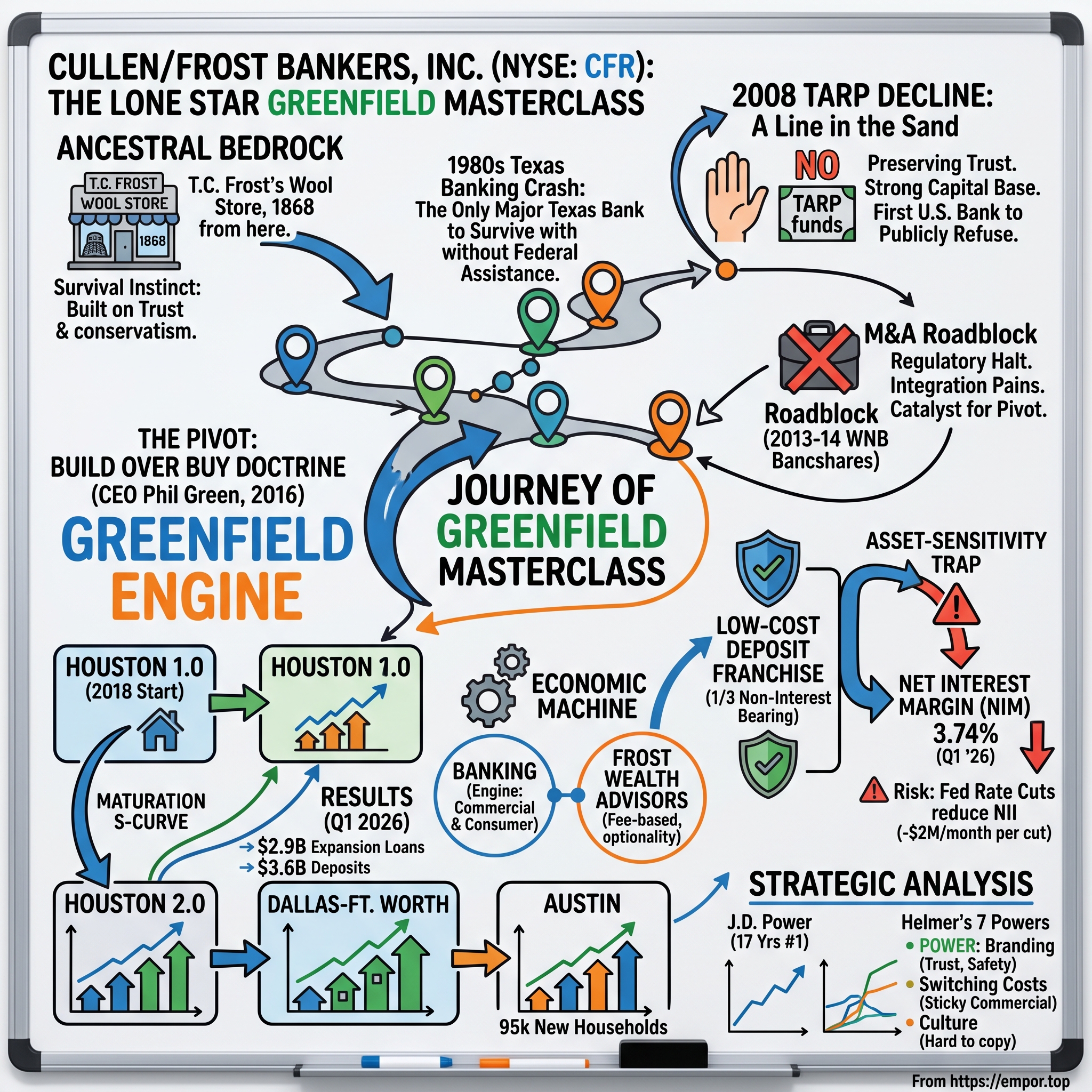
Cullen/Frost Bankers, Inc. (NYSE: CFR): The Lone Star Greenfield Masterclass
I. Introduction & Episode Roadmap
Picture a banking conference in 2018. On stage, fintech founders promise that the branch is dead. Analysts nod along; the consensus is that brick-and-mortar banking is a stranded asset, a depreciating relic to be shuttered as customers migrate to their phones. And then, quietly, a $30-billion Texas bank from San Antonio announces that it is going to do the opposite of everything the room believes. It is going to build branches. Twenty-five of them, from scratch, in a city where it barely competes. By hand, one dirt lot at a time.
That decision looks, in hindsight, like one of the more contrarian — and more profitable — capital-allocation bets in modern American banking. In an era defined by consolidation, deposit flight, and the 2023 collapse of Silicon Valley Bank, Cullen/Frost grew its deposit base organically, pushed its net interest margin up to 3.74% in the first quarter of 2026, and still funds roughly a third of its balance sheet with deposits that pay depositors nothing at all.12 The company earned $169.3 million in that quarter alone, up 13.4% year over year, on a return on average assets of 1.32% — a figure most regional banks would envy.1
Here is the paradox this article unpacks. How did a physical branch-building program — "greenfield expansion," in the jargon — become a share-taking machine against JPMorgan Chase, Bank of America, and Wells Fargo, the very money-center giants whose scale was supposed to make a Texas regional obsolete? And the harder question, the one a skeptical investor should keep asking: is the moat real, or is it a cyclical story dressed up as a structural one — a bank that happens to look brilliant because interest rates went up, and whose margin math runs in reverse when they come back down?
The central character is Phillip "Phil" Green, Chairman and CEO. Green is a Cullen/Frost lifer who joined the company in 1980, served as chief financial officer for two decades, and took the CEO chair in 2016.3 That biography matters, because Green personally lived through the two existential crises that forged this bank's DNA: the 1980s Texas banking collapse that killed nearly every one of Frost's peers, and the 2008 financial crisis, when Frost became the first bank in America to publicly refuse a federal bailout. Understanding those two crucibles is the only way to understand why this management team is so allergic to the things other banks love — cheap deposits bought with high rates, and growth bought through acquisition.
Our roadmap: We start with the ancestral bedrock — Colonel T.C. Frost's wool store and the survival story that gave the bank its Texas mythology. We move to the TARP reject, the 2008 line in the sand. We examine the M&A roadblock — how a bruising regulatory episode during a 2013 acquisition cured management of the deal-making bug and catalyzed the pivot to building. We deconstruct the greenfield engine across Houston, Dallas, and Austin, and stress-test the unit economics. We open up the financial machine — the two operating segments, the low-cost deposit franchise, and the asset-sensitivity trap. And we close with a strategic and bull/bear analysis using Porter's Five Forces and Hamilton Helmer's 7 Powers, testing what could break the thesis. Let's begin where every Texas institution begins — with a story about survival.
 Subscribe on LinkedIn
II. The Texas Foundation: Mercantile Roots and the Ultimate Survival Test
In 1868, three years after Appomattox, a former Confederate officer named Colonel Thomas Claiborne Frost hung out a shingle in San Antonio.4 He wasn't, at first, a banker. He was a merchant — a wool-and-hide man in a frontier economy where the "currency" was often a rancher's clip of raw wool sitting in a warehouse waiting for a buyer. Frost advanced supplies to wool growers, held their crop as collateral, and settled up when the market cleared. In practice, he was already doing what a bank does: extending credit against a productive asset and getting paid back over a cycle. The mercantile business evolved into a private bank, and the private bank into a chartered one. The governing philosophy Frost handed down was almost aggressively plain: "A square deal to every man."4
Keep the pre-modern chronology brief, because it is the epilogue, not the plot. The holding company, Cullen/Frost Bankers, was formed in 1973; a 1977 merger with Houston's Cullen Bankers added the first half of the hyphenated name and a foothold in the state's largest city; the stock later graduated to the New York Stock Exchange in 1997.4 For a century, Frost was simply a well-run San Antonio bank. What turned it into a Texas legend was a decade of carnage that it, almost alone, walked out of alive.
The Great Texas Banking Crash. In the early 1980s, oil was king and Texas real estate was a one-way bet. Banks across the state lent aggressively against both. Then the floor gave way. Crude, which had traded near $28 a barrel, collapsed toward $10 by 1986, and the speculative real estate that oil money had inflated collapsed with it.5 What followed was not a recession but a systemic annihilation of the Texas banking industry. Seven of the state's ten largest banking companies failed, were seized, or were swallowed by out-of-state acquirers — names that had seemed permanent, like First RepublicBank, MCorp, InterFirst, and Allied Bancshares, simply ceased to exist as independent Texas institutions.5
Cullen/Frost was the only one of the ten largest Texas-based banking companies to survive without federal assistance or a takeover by an out-of-state institution.5 Not one of the survivors — the survivor. Why? The answer is a credit philosophy that sounds like a bumper sticker until you watch it save a company. While rivals piled into speculative real-estate ventures, Frost concentrated on commercial loans to longtime customers and well-secured mortgages.5 The maxim that has been passed down inside the bank captures the discipline: Frost was not in the oil-and-cattle business; it was in the people business, lending to individuals who happened to be in those industries — borrowers chosen because they could repay under stress, not because a collateral appraisal looked good at the top of the cycle.
Survival still required brutal measures. To preserve liquidity when liquidity was everything, the bank sold its own headquarters building and leased it back, raising roughly $20 million in cash, and did the same with its computer and accounting systems.5 It absorbed heavy loan losses through the decade and kept lending anyway. By 1987, Cullen/Frost was the only Texas bank with more than $1.5 billion in assets to turn a profit.5 The man at the center of that discipline was Tom Frost, the founder's descendant, whose fingerprints on the franchise's conservatism lasted the rest of his life.
Here is what matters for an investor looking at the stock in 2026, not 1986. The 1980s are not nostalgia; they are the source code. When Texas businesses watched the national banks flee and the local ones fail while Frost stayed open and liquid, the bank earned a reservoir of trust that no marketing budget can buy — and trust, in banking, converts directly into cheap, sticky deposits. That reservoir would be drawn down again, and just as publicly, twenty years later.
III. The Line in the Sand: Declining TARP in 2008
October 2008. Credit markets had seized; Lehman Brothers was two weeks in the grave; and inside the U.S. Treasury, officials were engineering a program to force capital into the banking system whether individual banks wanted it or not. The Troubled Asset Relief Program's Capital Purchase Program was deliberately designed to be universal — healthy banks were encouraged to take the money precisely so that accepting it would not single out the weak ones. The theory was that if everyone took a bailout, no one would look like they needed one.
Cullen/Frost looked at the offer and said no — out loud, and first. On October 27, 2008, then-Chairman and CEO Richard "Dick" Evans announced that the company would not participate in the Capital Purchase Program.6 "After careful consideration, we have made a business decision that Cullen/Frost will not seek federal CPP funds," Evans said, noting the company was already well capitalized with enough capital to grow and to pursue opportunities.6 It was, as far as the record shows, the first U.S. bank to publicly turn the money down. (Phil Green, the future CEO, was then a senior executive and the company's longtime CFO — a participant in, not the public face of, the decision.3)
Why refuse hundreds of millions of dollars of essentially free federal capital in the middle of a panic? Because Frost had done the math and concluded it did not need it. The bank carried no exposure to the toxic subprime mortgage securities that were vaporizing balance sheets elsewhere, and it ran a conservative loan-to-deposit posture funded by its own customers rather than by wholesale markets. Against that backdrop, the "help" carried real costs: regulatory strings, executive-compensation caps, and — most corrosively for a franchise built on trust — a signal to customers that Frost needed Washington to survive. For a bank whose entire brand was we are the ones who don't need rescuing, accepting a rescue would have been an act of self-sabotage.
Read skeptically, the decision was also good marketing, and management surely knew it. But the distinction that matters is between a slogan and a demonstrated behavior. Turning down federal capital when your competitors are taking it is a costly, falsifiable signal — the kind that is expensive to fake. To Texas middle-market companies deciding where to park their operating cash in the scariest quarter of their business lives, the message landed with force: we survived the 1980s, and we do not need Washington's help to survive 2008. Over the following decade, that reputation functioned as a customer-acquisition engine, particularly for commercial treasury clients hunting for the safest possible home for operating balances.
The through-line from 1986 to 2008 is a management culture that treats capital and liquidity as sacred and reputation as an asset to be defended at the cost of short-term optics. It is a genuine competitive edge — but it is worth noting that both crises rewarded conservatism in a downturn. The bank had not yet been tested on the opposite problem: how to grow aggressively without betraying that conservatism. That test arrived not in a crisis, but in a deal.
IV. The M&A Roadblock: WNB Bancshares and the Regulatory Pivot
For most of its history, Cullen/Frost grew the way banks always have — by buying other banks. So in the summer of 2013, when the company announced its first bank acquisition in years, it looked like business as usual. On August 13, 2013, Frost agreed to acquire WNB Bancshares, Inc., the Odessa-based parent of Western National Bank, for $220 million.78 WNB was a jewel of the Permian Basin: eight branches concentrated around Midland and Odessa, roughly $1.4 billion in assets, $1.2 billion in deposits, and $656 million in loans, all sitting atop the most productive oil field in North America.8
The multiple tells the story. The consideration — two million Cullen/Frost shares plus cash to reach $220 million, subject to a targeted tangible book equity of about $87 million at closing — implied paying roughly 2.5 times tangible book value.7 That is a rich price, and it was rich for a reason: WNB's deposits and its energy-banking franchise were genuinely lucrative when oil was flowing. But a 2.5x book multiple is also a bet. It front-loads a large premium in exchange for a legacy loan book, a culture you did not build, and integration risk you inherit — and in WNB's case, it leaned heavily on continued Permian energy activity to justify the price. The deal was expected to be about 4% accretive to 2014 earnings before one-time charges.8 On paper, standard fare for a high-performing Permian franchise at the time.
Then the process hit a wall. As the Federal Reserve reviewed the application through 2014, it identified deficiencies in Frost's own compliance and fair-lending systems. The approval, when it finally came on May 14, 2014, arrived with a leash attached: as a condition, Cullen/Frost committed not to engage in any expansionary activities — including branching within its existing markets — until the Board was satisfied that the bank had built out a compliance program, including fair lending, and hired staff with the expertise to manage that risk.910 A carve-out was permitted for branches serving majority-minority areas.9 The deal closed on May 30, 2014, after a scramble to upgrade compliance.7
Sit with the irony. A bank that had spent a century cultivating a reputation for prudence was told by its regulator that its own internal controls were not up to standard, and was temporarily barred from opening branches — the very activity that would later define it. The episode left a scar, and out of that scar came a doctrine.
The strategic awakening. The WNB experience crystallized a conclusion that Green and his colleagues had been circling for years: bank M&A is an inefficient way to grow. You pay a fat premium for someone else's loan book, you subject yourself to an unpredictable and sometimes hostile regulatory timeline, and then you undertake a grinding technology integration that changes customers' account numbers, reassigns their bankers, and too often alienates the very relationships you paid up to acquire — while dissolving the target's local culture in the process. Green would later put the comparison in vivid terms on an earnings call: recent Texas bank deals were being struck at roughly $220 million per $1 billion of acquired assets, whereas Frost's first organically built $1 billion of Houston business had cost it around $90 million, all in — and delivered the 25 best locations it could identify rather than a set of branches it had to rationalize after the fact.2
The alternative wrote itself. Instead of buying banks to get their branches and deposits, what if Frost built its own branches, hired local relationship managers, and imported its own culture — undiluted — directly into Texas's fastest-growing metros? When Green took the CEO reins in 2016, he formalized the "build-over-buy" doctrine.3 It would prove to be the most consequential strategic decision of his tenure, and it set up the expansion run that the rest of this story is about.
V. The Greenfield Masterclass: The "Build Over Buy" Expansion Strategy
Late 2018. Frost was a San Antonio institution with a national reputation for prudence and a glaring strategic gap: in Houston, the largest city in Texas and one of the largest metros in America, it was an also-ran. So management made the bet described at the top of this article. It would open 25 brand-new "financial centers" across the Houston metro — greenfield, from empty corridors — and staff them with seasoned local commercial bankers poached from the national giants.
The skepticism was loud. This was the high-water mark of "the branch is dead." Analysts argued that physical locations were a depreciating drag, that digital was the future, and that pouring capital into brick-and-mortar would wreck the efficiency ratio. The critique was not stupid — for a transaction-oriented consumer bank, it was largely correct. What the critics missed was the specific customer Frost was hunting: the Texas middle-market business owner who wants a banker who can approve a loan across a desk, not a call center that routes a request to a centralized underwriting queue three states away.
The execution. Frost targeted high-visibility, high-traffic corridors and — crucially — hired commercial bankers who arrived with pre-existing books of business, bankers who were frustrated by the slow, centralized credit decisions at the money-center banks. A relationship manager who can bring their clients with them and say "yes" faster is a branch that funds itself. The Houston rollout matured ahead of the bank's internal payback expectations and became the template.
The rollout, extended. Houston 1.0 was followed by Houston 2.0, a Dallas–Fort Worth expansion, and an Austin push, plus a growing number of locations opened outside those announced regions — eight such financial centers since the 2018 launch, which management, as of the Q1 2026 call, folded into the reported expansion results for the first time.1 The company opened ten new locations in 2025 and guided to another twelve to fifteen per year as a sustainable run rate, having crossed roughly 204 financial centers company-wide by year-end 2025.112 Management frames a typical new branch as costing on the order of a couple of million dollars to build and equip, reaching deposit self-funding and profitability within roughly eighteen to twenty-four months once a local team with an existing book is in place.2
The proof points — and how to read them. By the first quarter of 2026, the expansion footprint had accumulated about $2.9 billion in loans and $3.6 billion in deposits, and had added roughly 95,000 new households.1 Those balances represented 12.7% of the bank's loans and 8.3% of its deposits, up from 10.1% and 7.0% a year earlier — meaning the built-from-scratch branches were growing materially faster than the legacy franchise, with expansion loans up 33% and deposits up 21% year over year.1 In 2025, the expansion accounted for 42% of total loan growth and 38% of total deposit growth, and roughly 20% of the bank's new commercial relationships came from expansion markets.12
The unit economics show up cleanly in earnings. Management attributes a specific EPS contribution to the expansion — $0.14, or 5.6% of EPS, in Q1 2026, up from $0.12 the prior quarter — and discloses the maturation curve behind it: Houston 1.0 was generating roughly $0.15 per share, Houston 2.0 and Dallas had reached breakeven, and Austin, the newest region, was still a $0.03 drag as it scaled.121 That disclosure is the tell. Each vintage moves along an S-curve from cost center to profit center, and because the branches are built rather than bought, there is no goodwill to impair and no acquired culture to lose.
Two cautions keep the analysis honest. First, "expansion" is now a moving definition — folding in the eight out-of-region branches flatters year-over-year comparisons, and an investor should watch that the underlying markets keep compounding on a like-for-like basis rather than on a widening perimeter. Second, the strategy has not yet been tested through a genuine Texas downturn. Rapidly grown loan books look pristine until a cycle turns; the real proof of Frost's underwriting will be how these young vintages behave under stress, not how fast they funded in a boom. What the greenfield engine has clearly proven is demand and execution. Whether it has proven durable credit discipline is a question only time and a recession can answer — which brings us to the machine that all of this feeds.
VI. Inside the Economic Machine: Segment Performance & Operating Economics
Strip away the Texas mythology and Cullen/Frost is, at its core, a beautifully simple money machine. It reports through two segments, and the split tells you exactly where the profit lives. The Banking segment — commercial and consumer lending, treasury services, and insurance brokerage — is the engine, generating on the order of $626 million of net income in 2025, an increase of roughly $65 million, or 11.6%, year over year.11 Frost Wealth Advisors — financial planning, trust, and asset management, sitting on about $51.0 billion of trust assets — contributed roughly $36 million, with a non-bank holding company loss of about $20 million rounding the total to the company's $641.9 million of 2025 net income (diluted EPS of $9.92).1113 Wealth is small today, but it is high-quality, fee-based, and carries real optionality if Frost can cross-sell it into the tens of thousands of new commercial and consumer households the expansion is generating — a stated management priority, with a reorganization of the wealth business underway to sharpen its sales culture.12
The low-cost deposit franchise. Now to the heart of the model, and the single most important thing to understand about this bank. The lifeblood of Frost's profitability is the cost of its funding. In 2025, non-interest-bearing deposits averaged roughly $13.9 billion — about a third of average total deposits.11 These are checking accounts that pay depositors nothing. They exist because commercial clients use Frost's high-touch treasury management services — the plumbing of corporate cash: payroll, ACH, wires, fraud controls — as their primary operating accounts, and they leave large balances parked in non-interest-bearing checking either as compensating balances that pay for those services or simply out of relationship inertia. In the zero-rate era, that non-interest-bearing share ran closer to 40%; it has drifted down as rate-hungry treasurers moved some cash into interest-bearing options, a dynamic worth watching, but a franchise still funded roughly one-third by zero-cost money is a rare and valuable thing.
Why the margin behaves the way it does. Here is the mechanism in plain English. When the Federal Reserve raises interest rates, the yield Frost earns on its loans and its bond portfolio rises quickly, while the cost of a deposit that already pays 0.00% cannot rise at all. The spread between the two — the net interest margin — widens. That is precisely what happened: Frost's NIM reached 3.74% in the first quarter of 2026, up eight basis points from the prior quarter and up from 3.66% for full-year 2025, even as many peer banks were forced to pay up on certificates of deposit to hold onto skittish depositors.111 The industry term for this profile is "asset-sensitive": the balance sheet is tilted so that rising rates help and falling rates hurt. Frost's cost of interest-bearing deposits actually fell to 1.55% in Q1 2026 as rates eased, which flattered the margin — but that lever has a floor.1
The efficiency question. The obvious objection: doesn't building hundreds of branches and hiring expensive relationship managers wreck the cost structure? The efficiency ratio — operating expense as a share of revenue, where lower is better — has indeed drifted up toward the low-60% range from the mid-to-high 50s of a few years earlier, as branch-building and technology investment flowed through, and management guided 2026 non-interest expense growth of 5% to 6%.12 But the low-cost deposit base is the offset: revenue per dollar of expense stays competitive because the funding is so cheap. The honest read is that the investment is capital- and expense-intensive up front and lucrative at maturity — an operating-leverage story that only works if the young branch vintages keep converging toward the returns of Houston 1.0.
The skeptic's rejoinder writes itself, and management does not hide from it. On the Q4 2025 call, CFO Dan Geddes laid out 2026 guidance built on an assumption of Federal Reserve rate cuts — three cuts in the original guide, later reframed on the Q1 2026 call as a 125-basis-point cut concentrated in the fourth quarter — and quantified the sensitivity bluntly: each cut is worth roughly $2 million a month of net interest income to the downside.121 That is the asset-sensitivity trap in a single number, and it is the hinge on which the entire bull case turns. Before we resolve it, we need to place Frost inside the most competitive banking market in America.
VII. Strategic Analysis: Competitive Landscape, Porter's 5 Forces & Helmer's 7 Powers
Texas is the prize that everyone in American banking is fighting for — a state with a booming population, relentless corporate relocations, and an economy that would rank among the largest in the world on its own. That makes it a war zone. On one flank sit the national giants — JPMorgan Chase, Bank of America, Wells Fargo — with unmatched scale, technology budgets, and balance sheets. On the other sit the regionals: Comerica, which relocated its headquarters to Dallas to plant its flag in the market; Texas Capital Bancshares, remaking itself into a full-service commercial and investment bank; and Prosperity Bancshares, the serial acquirer stitching together community banks across the state. And the new entrants keep coming — on the Q4 2025 call, an analyst noted that Fifth Third planned to open dozens of branches in Texas, and pressed Green on whether price competition from newcomers would become a headwind.12
How Frost wins — the evidence, not the slogan. The proof points are unusually concrete. In the J.D. Power 2026 U.S. Retail Banking Satisfaction Study, Frost ranked highest in Texas for the seventeenth consecutive year, with a satisfaction score of 757 — 76 points above the Texas regional average — and ranked first across all eight dimensions the study measures, from trust to problem resolution to digital channels.14 Seventeen years is not a fluke; it is a durable, measurable brand advantage that persisted even as the bank tripled its Dallas footprint and doubled Houston and Austin — evidence that the culture scaled rather than diluting.1 That satisfaction converts into behavior: consumer checking households grew 5.8% in 2025, a fifth straight year of what management believes is industry-leading growth, and the commercial bank booked a record 4,091 new relationships.12 Green's own color on the Q4 call is telling — historically about half of new relationships came from the "too big to fail" trio, a share that dipped as disruption from mid-tier bank mergers sent more customers Frost's way.12
Porter's Five Forces. Threat of new entrants is structurally low — charters, capital requirements, and decades-deep local relationships are formidable barriers — though, as Fifth Third shows, well-capitalized incumbents can and do enter with price. Bargaining power of buyers (depositors) has risen in a digital, rate-shopping era; the mitigant is Frost's high-touch model, and the roughly one-third non-interest-bearing share is the evidence that it works, though the drift down from ~40% shows the pressure is real. Threat of substitutes — fintechs, money-market funds, off-balance-sheet yield — is genuine and is precisely what pulls rate-sensitive balances away. Competitive rivalry is extreme. Frost's answer is to occupy a sweet spot: larger and more sophisticated than community banks that lack robust treasury systems, yet more local and responsive than the national behemoths.
Hamilton Helmer's 7 Powers. Three of Helmer's seven powers plausibly apply, and it is worth being precise about which.
Branding. The strongest case. The Frost name signals safety, Texan identity, and service, earned across two crises and quantified by the J.D. Power streak. It lets Frost attract deposits without leading on price — a durable power, not mere reputation.14
Switching costs. Real, and concentrated on the commercial side. Once a middle-market company routes its payroll, ACH, and treasury operations through Frost, ripping that plumbing out and re-integrating it at a competitor is genuinely disruptive — which is exactly why those clients tolerate low or zero interest on operating balances. This is the mechanism behind the deposit franchise, and it is stickiest for the businesses that matter most.
Cornered resource. The most debatable. Management would point to Frost's decentralized, empowered credit culture — local bankers who can make real decisions fast — and to long employee tenure as a resource competitors cannot easily copy. Culture is a plausible cornered resource because it is hard to replicate and, at Frost, demonstrably durable. But "culture" is also the claim every bank makes; the honest analyst treats it as supported by the satisfaction and retention data rather than proven by assertion. What Frost does not obviously have is scale economies (the giants dwarf it), network effects, or process power in the Helmer sense. Its edge is brand and switching costs, anchored by culture — a narrower but real moat.
The competitive picture, then, is of a bank with a genuine and evidenced advantage in attracting and keeping low-cost relationships, operating in the best market in the country, against opponents who are larger, richer, and increasingly willing to buy share with price. Whether that advantage is enough to protect earnings through a rate-cutting cycle is the question the final section confronts head-on.
VIII. Playbook: Durable Lessons & Investor Stress Test (Bull vs. Bear)
Management credibility, judged by behavior. Start with the record, because in banking the CEO's temperament is the risk model. Phil Green's roughly four-and-a-half-decade career is a study in narrative consistency — and the filings back it up rather than contradict it. Across calls, the message is unchanged: build, don't buy; protect the low-cost deposit base; grow relationships, not assets for their own sake. When pressed on M&A on the Q4 2025 call, with the bank's CET1 ratio sitting comfortably above peers, Green did not hedge: "I have zero interest in making an acquisition," and he walked through the organic-versus-acquired cost math to explain why.12 That is a management team declining to do the empire-building that inflates a CEO's résumé — and doing so consistently, which is the opposite of the classic regional-bank pattern of promising discipline and then chasing a deal at the top of a cycle. Executive incentives tied to returns and deposit growth rather than sheer size reinforce the alignment.
An activist stress test finds relatively little obvious to attack: capital is strong (management deployed the remainder of a $150 million buyback in late 2025 and authorized a new $300 million program), disclosure on the expansion economics is unusually granular, and there is no portfolio complexity or related-party murk to unwind.12 The sharpest critique is the mirror image of the strength — a bank this conservative and this concentrated in one state is, by construction, a bet on Texas and on the rate environment. That is not mismanagement; it is a strategy whose risks the buyer must underwrite with eyes open.
Durable lessons. Two stand out. First, don't outsmart your own culture: when the entire industry declared branches obsolete, Frost doubled down because it understood its specific customer — the Texas business owner who values a face and a fast "yes" — better than the consensus did. Second, M&A is often a distraction dressed as growth: organic compounding is slower, but it carries no integration risk, preserves capital, and guarantees cultural alignment. Neither lesson is universal — branches would be a terrible bet for a purely transactional consumer bank — but both are instructive examples of a company matching strategy to its actual, particular edge.
The risk radar. Two risks are material; the rest are noise. The first is commercial real estate. Texas metros carry meaningful office and multifamily exposure, and Frost has been actively working down a pipeline of challenged multifamily loans — management flagged roughly $255 million of multifamily paydowns expected in early 2026 and disclosed a shared-national-credit beverage-distribution borrower moving into non-performing status with a $10 million specific reserve.12 Credit metrics remain strong by historical standards — net charge-offs ran just 11 basis points of average loans in Q1 2026, and management guided full-year 2026 net charge-offs to 20–25 basis points — but rapid organic loan growth has not yet met a real Texas downturn.112 The second, and larger, is the asset-sensitivity trap. Because a third of deposits already cost nothing, Frost's funding costs cannot fall much further when the Fed cuts — but its loan and securities yields will. That asymmetry is the single biggest threat to the earnings power the market currently prizes.
The bull case. Frost keeps taking share in Houston, Dallas, and Austin; the greenfield vintages march up the S-curve from cost centers to profit centers; the Texas demographic and corporate-relocation boom keeps feeding fresh relationships into a franchise that converts them at industry-leading rates; and the wealth and insurance businesses finally scale across the enlarged household base. Disruption from rival bank mergers — which management says is already sending it roughly twice as many defecting relationships as before — accelerates the flywheel.12
The bear case. A faster or deeper rate-cutting cycle than guided compresses the net interest margin while the expense base built for branch expansion stays sticky, driving the efficiency ratio up and operating leverage into reverse. A Texas real-estate correction tests underwriting that has only ever been proven in the good times. And new entrants willing to buy deposits with price chip at the low-cost franchise that is the whole thesis. In this scenario, the very asset-sensitivity that made Frost look brilliant on the way up makes it look ordinary on the way down.
What to actually watch. Three KPIs cut through the noise. First, the non-interest-bearing deposit share — the health gauge of the low-cost franchise; erosion here attacks the core advantage directly. Second, greenfield loan and deposit growth — the confirmation that Houston, Dallas, and Austin keep climbing their payback curves rather than plateauing, ideally tracked on a like-for-like basis as management widens the "expansion" definition. Third, the net charge-off ratio — the proof that fast organic loan growth did not quietly relax underwriting standards, the one number that would reveal whether the 1980s discipline survived the 2020s land-grab. Track those three, and you are watching the exact hinges on which the Cullen/Frost story turns.
References
-
Cullen/Frost Bankers, Inc. (CFR) Q1 2026 Earnings Call Transcript — Cullen/Frost Bankers, 2026-04-30 ↩↩↩↩↩↩↩↩↩↩↩
-
Cullen/Frost Bankers, Inc. (CFR) Q4 2025 Earnings Call Transcript — Cullen/Frost Bankers, 2026-01-29 ↩↩↩↩
-
Cullen/Frost Announces Executive Leadership Transition — PR Newswire, 2015-07-30 ↩↩↩
-
About Frost — A History of Growth, Stability and Innovation — Frost Bank ↩↩↩
-
At 90, Tom Frost Still Shapes San Antonio's Growth and Transformation — San Antonio Report ↩↩↩↩↩↩
-
Cullen/Frost Bankers Inc. Form 8-K, Capital Purchase Program press release — SEC EDGAR, 2008-10-27 ↩↩
-
Cullen/Frost and WNB Bancshares Announce Merger Agreement — PR Newswire, 2013-08-13 ↩↩↩
-
Frost Buys Out Western National Bank For $220 Million — Houston Public Media, 2013-08-15 ↩↩↩
-
FRB Order No. 2016-02, Frost Bank — Federal Reserve System, 2016-03-14 ↩↩
-
Federal Reserve Board announces approval of applications by Cullen/Frost Bankers, Inc. — Federal Reserve Board, 2014-05-14 ↩
-
Cullen/Frost Reports Fourth Quarter and 2025 Annual Results — PR Newswire, 2026-01-29 ↩↩↩↩↩
-
Cullen/Frost Bankers, Inc. (CFR) Q4 2025 Earnings Call — prepared remarks and Q&A, Cullen/Frost Bankers, 2026-01-29 ↩↩↩↩↩↩↩↩↩↩↩↩↩
-
Cullen/Frost Bankers, Inc. Form 10-K for fiscal year 2025 — SEC EDGAR, 2026-02-05 ↩
-
For 17th Consecutive Year, Frost Bank Ranks Highest in the J.D. Power Retail Banking Satisfaction Study in Texas — PR Newswire, 2026-03-26 ↩↩
 LinkedIn
 WhatsApp
 Reddit
 Hacker News
 Email
Email Kindle
 RSS Feed
 Spotify
 Apple Podcasts
 Amazon Music
 Audible
 YouTube