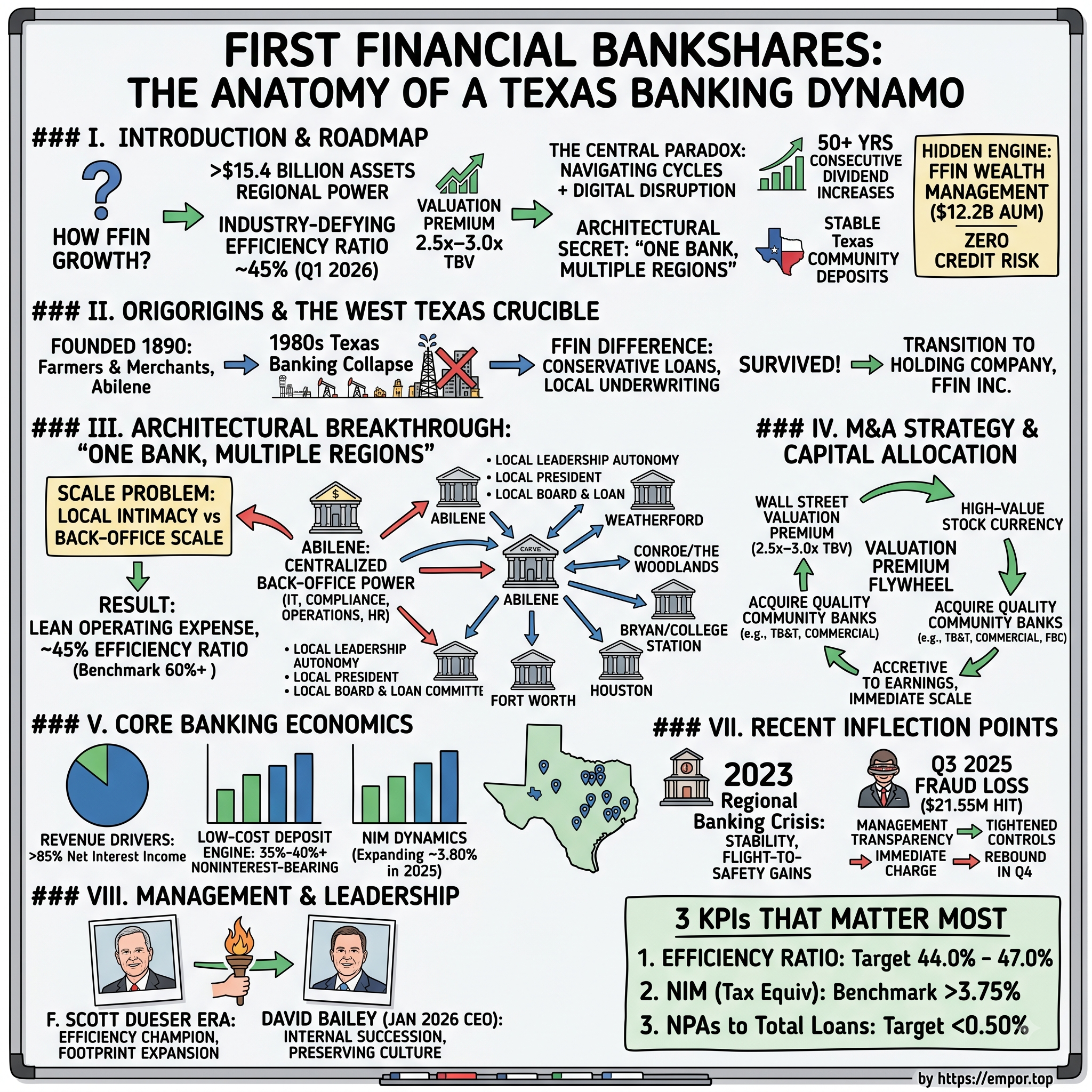
First Financial Bankshares: The Anatomy of a Texas Banking Dynamo
I. Introduction & Episode Roadmap
Drive west out of Fort Worth on Interstate 20 and the landscape empties out fast. Mesquite scrub, oil pumpjacks nodding in slow motion, wind turbines turning above cotton fields, and then, about 150 miles in, Abilene — a city of roughly 130,000 people that most Americans could not place on a map. On Pine Street sits a building that houses the corporate headquarters of a bank holding company that, at the end of June 2026, controlled $15.31 billion in assets, ran 79 banking locations across Texas, and managed another $12.23 billion of client assets through its wealth arm.1
That is the first notable contrast surrounding First Financial Bankshares. The second is the arithmetic of how it makes money. In the second quarter of 2026, the company earned $71.89 million, or $0.50 per share, on a tax-equivalent net interest margin of 3.90% — a margin that expanded while most of the industry watched its own compress.1 In the first quarter of 2026, its efficiency ratio — the share of every revenue dollar consumed by operating expense — was 44.98%, meaning the bank kept roughly 55 cents of every dollar of revenue before credit costs and taxes.3 For 2025 as a whole, the figure was 45.53%, compared with 47.23% in 2024.2 Many well-run American banks operate in the high 50s or low 60s.
Combined, those metrics generated a return on average assets of 1.76% and a return on average equity of 14.59% for 2025 — a level of profitability that, in banking, is usually purchased with either leverage or risk.2 First Financial appears to have bought it with neither. Its common equity tier 1 ratio stood at 20.40% at mid-2026, roughly double what regulators require of a bank of its size.1 It is, in the most literal sense, over-capitalized and over-earning at the same time.
The market has noticed for a very long time. In early August 2026, the shares traded around $34.67, representing a market capitalization near $5.0 billion.4 Against shareholders' equity of $2.00 billion less roughly $314 million of goodwill and other intangibles, that valuation placed the stock near three times tangible book value.12 Most American regional banks change hands somewhere between one and two times. The valuation premium is the central narrative — and also the principal risk.
There is a reason that premium exists, and it is not sentiment. Banking is a highly commoditized industry. Every institution sells the same product — a dollar — sourced from similar customers and lent to similar borrowers under identical rules. In an industry structured this way, an operator that consistently earns more per dollar of assets than its peers is either taking hidden risk or benefiting from a genuine structural advantage. Dissecting which factor explains First Financial is the central objective of this analysis.
The paradox, stated honestly. It is tempting to describe First Financial as a machine that has never missed. That narrative is incomplete, and the exceptions matter. The company's most famous statistic — a streak of consecutive annual earnings increases that reached its 32nd year in 2018 — was real, and it began in the wreckage of the Texas banking collapse.6
But that streak ended. Net income fell from $234.48 million in 2022 to $198.98 million in 2023 as funding costs surged.2 The dividend has kept climbing — the board raised the quarterly payout 15.8% to $0.22 a share in April 2026 — but the claim, occasionally repeated in secondary sources, that First Financial has raised its dividend for fifty consecutive years is not supported by the company's filings.5 And in the third quarter of 2025, this institution of credit discipline wrote off a single commercial relationship it believed to be fraudulent, an event that cut quarterly earnings by roughly a third.7
The central question is not whether First Financial is a good bank. By almost any conventional measure, it is. The critical question is whether the specific machinery that produces those numbers — the operating architecture, the deposit base, the acquisition currency, the credit culture — is durable enough to justify a valuation that assumes continued outperformance under a new chief executive, in more competitive markets, and with a deposit mix that has quietly evolved.
The architecture. The core of the answer lies in an organizational design the company describes as regional banking on a single charter. First Financial operates one bank, one core technology platform, one compliance function, and one credit administration group — while deliberately decentralizing the customer-facing half of the business into regions with their own presidents, advisory boards of local business owners and ranchers, and lending authority.2 It represents an attempt to capture the cost structure of a consolidated regional bank while retaining the decision speed of a hometown institution. Whether this constitutes a durable, hard-to-copy capability or simply reflects operating in markets with limited competition is the central analytical question.
A human dimension is also worth noting early. This is an organization of roughly 1,600 employees whose thirteen regional and divisional chief executives and presidents average about 27 years of banking experience and 15 years of service, with eight of those leaders having started their careers inside the organization.2 Institutional knowledge that deep is both an asset and a constraint: it reinforces operational reliability while making the company slower to import outside perspective.
The quiet engine. Alongside the banking franchise sits a wealth management business that has been administering trusts since 1927 and was renamed First Financial Wealth Management on July 9, 2026.222 It generated $51.86 million of fee income in 2025 while requiring minimal capital and taking almost no credit risk.2 For a bank whose earnings otherwise rise and fall with the yield curve, that provides a meaningful diversifier — though it remains smaller relative to the consolidated institution than the headline asset number suggests.
The analytical roadmap follows a clear progression. First, the crucible: how a West Texas bank survived a collapse that killed eight of the ten largest bank holding companies in the state. Second, the architectural decision of 2012 that consolidated eleven banks into one. Third, the acquisition flywheel — fourteen deals since 1997 — and the questions that arise when that acquisition currency faces pressure. Fourth, the core economics of the deposit franchise, including trends management does not emphasize. Fifth, the wealth business. Sixth, three stress tests: the 2023 regional banking panic, the 2025 fraud loss, and the commercial real estate cycle. Seventh, executive leadership — including a chief executive who started as a teller. Finally, the competitive moat tested against operational realities, the bull and bear cases, and the key indicators a long-term owner should monitor.
The story begins in Abilene, in 1890, with two brothers and a cattle economy.
 Subscribe on LinkedIn
II. Origins & The West Texas Crucible
The bank opened its doors in 1890 as Farmers and Merchants National Bank of Abilene in a town barely nine years old — a stop on the Texas and Pacific Railway where cattle were loaded and cotton was weighed.2 Its founders were brothers Fleming Wills James and John Garland James; John Garland James also served as the second president of the Agricultural and Mechanical College of Texas, which the brothers helped establish.9 It is a historical detail the company still highlights, and it offers genuine context for the institution: this was never a merchant bank chasing capital-market returns. It was built to finance cattle, cotton, and the towns that served them, led by founders whose reputations were local and permanent.
For most of the next century, the institution's history remained deliberately unremarkable. The bank took deposits from ranchers and small businesses, lent against land and livestock, renamed itself First National Bank of Abilene in 1957 as the local economy diversified, and in 1956 organized a holding company originally named F & M Operating Company.2 That holding-company structure provided the legal chassis that would later allow the bank to own multiple financial institutions. The holding company adopted the name First Financial Bankshares in 1993.
One structural decision from that quiet century shaped everything that followed. Under long-standing American banking regulations, expansion by a single chartered bank across multiple locations was heavily restricted. A holding company operated as a regulatory solution, permitting one parent company to own multiple distinct banks across different markets, each retaining its charter and identity while centralizing capital and strategy. First Financial established that chassis in 1956 and spent the next four decades acquiring small Texas banks rather than building branches from scratch.2
Buying an existing bank meant acquiring its deposit base, customer relationships, and — most critically in rural Texas — its local standing. Opening a de novo branch in a county seat cannot replicate decades of established trust; acquiring an incumbent bank secures it immediately.
The crucible. The Texas banking collapse of the 1980s was an extinction event rather than a routine cyclical downturn. Between 1980 and 1989, 425 Texas commercial banks failed, and eight of the state's ten largest bank holding companies in 1985 were wiped out before the decade ended.11 The failures claimed major institutions: First RepublicBank Corporation, with $33.4 billion in assets, was the fourteenth-largest bank holding company in the nation when regulators closed its banks in 1988, marking the largest U.S. bank failure up to that time.10 Other prominent holding companies — including MCorp, National Bancshares of Texas, Texas American Bancshares, and First City — similarly collapsed.
The underlying mechanism recurs throughout financial history. Driven by surging oil prices through the 1970s, Texas lenders expanded credit aggressively as collateral values rose. Banks financed energy production, real estate projects funded by energy wealth, and commercial properties whose values were inflated by speculative lending. When crude oil prices collapsed and the Tax Reform Act of 1986 eliminated tax-shelter incentives for commercial real estate, non-performing loans mounted simultaneously across portfolios.11 Severe concentration proved fatal. Institutions that believed they held diversified portfolios of energy and real estate loans were in fact holding a single unhedged exposure to crude oil prices.
Concentration is uniquely dangerous in banking because of financial leverage. Banks operate with a thin layer of equity supporting a large asset base. Even in 2026, with First Financial maintaining unusually conservative capital buffers, shareholders' equity represents roughly thirteen cents of every asset dollar.1 That leverage amplifies credit losses: a loan book that loses eight to ten cents on the dollar strips away most of an institution's equity. Consequently, portfolio diversification is not merely a prudent practice, but the primary safeguard against insolvency.
Texas banks in 1985 believed their portfolios were diversified across energy, commercial real estate, and consumer lending. In reality, all three categories depended on the same regional economic driver. When crude oil prices fell, loan performance, collateral values, borrower incomes, and local business activity deteriorated together.
What First Financial did differently. Contemporaneous underwriting documents laying out specific loan-to-value limits from that era are not publicly available. What is documented, however, is the institution's survival and subsequent trajectory. First Financial maintained its independence and preserved its capital throughout the collapse while larger regional peers were acquired by out-of-state buyers. Furthermore, the earnings streak that management later cited as a defining benchmark — 32 consecutive years of annual net income growth by 2018 — began in 1987, at the nadir of the state's banking crisis.6
That timing indicates that First Financial entered the crisis with a sound loan portfolio rather than relying on luck. The strategic lessons drawn from that period continue to guide the institution: operate in familiar markets, lend against accessible physical collateral, and avoid volume growth when credit pricing compresses.
The company's 2025 annual report continues to frame its expansion strategy around these conservative principles, noting that it has "traditionally served rural and suburban communities," focuses on "non-metropolitan markets" adjacent to Texas's four primary metropolitan areas, and selects acquisition targets that "align with our corporate culture."2 That strategy reflects operational lessons solidified during the 1980s depression.
Why this matters now. This historical experience carries two distinct implications for present evaluation.
On the positive side, institutional memory of a severe solvency crisis remains rare among U.S. bank management teams in 2026. First Financial's conservative stance is reflected in a common equity tier 1 ratio near 20% and an allowance for credit losses equal to 1.35% of total loans — metrics significantly higher than those of peers focused on maximizing short-term return on equity.1 Carrying capital buffers of this magnitude represents a deliberate choice to sacrifice marginal equity returns to ensure durability across stressed economic scenarios.
Conversely, historical conservatism does not guarantee an enduring competitive moat. Institutional memory fades as executive leadership turns over. Moreover, as demonstrated by the bank's 2025 fraud loss, credit discipline does not fully protect against fraudulent borrower representations — a risk category distinct from collateral depreciation in rural lending markets.
Finally, surviving the 1980s collapse established First Financial's long-term competitive positioning. As major state rivals failed and were acquired by out-of-state banking conglomerates, the market for small-town Texas banking relationships was left wide open. As one of the few surviving Texas-based bank holding companies with intact capital, First Financial possessed both the financial strength and the local reputation to acquire community banks across the state. Over the next three decades, the company capitalized on this opening — but executing that strategy at scale required solving a complex structural challenge beyond credit underwriting.
III. The Architectural Breakthrough: "One Bank, Multiple Regions"
Picture the company as it existed in 2011. It owned eleven separate banks. Eleven separate national charters. Eleven boards of directors with full fiduciary duties, eleven sets of regulatory examinations, eleven internal audit programs, eleven compliance officers reading the same Dodd-Frank rulemakings and reaching eleven slightly different conclusions about them. Each of those banks was locally beloved and locally responsive. Collectively they were an administrative tax that grew every year Congress passed a banking law.
This is the structural trap of community banking, and it is worth understanding in plain terms because it explains most bank consolidation in America. A small bank's advantage is that the person deciding on your loan knows your business and can say yes on Thursday. Its disadvantage is that the fixed cost of being a bank — core processing systems, cybersecurity, BSA and anti-money-laundering surveillance, treasury management products, mobile apps, model validation, regulatory reporting — is almost the same whether you have $500 million of assets or $5 billion. Those costs have risen relentlessly since 2010. Spread over a small deposit base, they crush returns. That is why thousands of American community banks have sold.
It helps to make the fixed cost concrete. A modern bank of any size must run a core processing system that records every transaction in real time; a cybersecurity operation capable of defending against nation-state-grade intrusion attempts; software that screens every payment against sanctions lists and flags suspicious patterns for regulatory filing; models that estimate expected credit losses under accounting rules, which must themselves be independently validated; a mobile application that customers compare, unforgivingly, against the one their national-bank friends use; and an internal audit function that proves all of it works.
None of that scales down. The bank with $500 million of deposits buys almost the same package as the bank with $5 billion, and pays for it out of a tenth of the revenue.
Think of it as the cost of the airport: whether you fly two routes or two hundred, you still need the runway, the tower, and the security checkpoint.
The conventional solution is to merge everything into one institution and centralize decision-making — which fixes the cost problem and destroys the thing customers were paying for. First Financial tried to take one half of the trade without the other.
The 2012 decision. Effective December 30, 2012, the company consolidated its eleven bank charters into a single charter, citing regulatory, compliance, and technology complexity and the opportunity for cost savings.12
Critically, it did not consolidate the customer-facing organization. The 2025 annual report states the arrangement plainly: although the charters were merged in 2012, the company continues to manage operations regionally, with local advisory boards, local regional presidents, and local decision-making, while having centralized "substantially all of the non-customer facing operations" — investment portfolio management, accounting, check processing, compliance, credit administration, risk management, treasury management, marketing, the contact center, technology, training, and human resources.2
Read that list again, because the line it draws is the entire business model. Everything a customer experiences — the loan conversation, the relationship, the local board member who vouches for you — stays in the region. Everything a customer never sees is done once, in Abilene, for the whole company. The bank even houses its technology in a dedicated subsidiary, First Technology Services, Inc.1
The subtlety that makes the design work is where lending authority sits. Regional presidents and local loan committees can approve credit up to defined limits; beyond those limits, decisions escalate to a centralized credit function in Abilene that applies one standard across all eight regions. That arrangement solves the problem that destroys most decentralized lenders — the tendency for local officers, competing for local business and judged on local growth, to progressively loosen terms until the whole portfolio is underwritten to the standard of the weakest region. Centralized credit administration is the governor on the engine. The 2025 fraud loss, discussed later, is the exception that shows what the governor cannot catch.
The structure has continued to evolve. In 2024 the bank and the trust company converted from national charters to Texas state charters, which moved primary supervision to the Texas Department of Banking alongside the Federal Reserve.13 And the regional count itself has consolidated: the 2025 annual report describes eight banking regions, down from the eleven charters of 2012, though the company still fields thirteen regional or divisional chief executives and presidents who average roughly 27 years of banking experience and 15 years with the company.2
Does it actually work? Here the evidence is unusually clean, because efficiency is measurable and the comparison set is large.
Think of the efficiency ratio as the cost of running the store as a percentage of the store's revenue. First Financial's was 45.53% for 2025 and 47.23% for 2024, and it has been improving.2 The improvement, though, is not primarily a cost story — noninterest expense actually rose 10.69% in 2025, to $293.39 million, driven by salaries, profit-sharing accruals tied to earnings growth, and software amortization for new loan origination and account-opening platforms.2 The ratio improved because revenue rose faster, chiefly net interest income. That is an important distinction for anyone modeling the business: a meaningful part of the recent efficiency gain is margin-driven and therefore rate-cycle-dependent, not purely structural.
The second-quarter 2026 figure makes the point uncomfortably. Efficiency deteriorated to 45.94% from 44.98% in the linked quarter, as noninterest expense jumped to $81.11 million from $76.77 million, on merit increases effective March 1, higher mortgage incentives, software amortization, and professional fees.1 One quarter is noise. But it is a reminder that the low-40s prints of 2025 were a cyclical high-water mark, not a floor.
The honest assessment. Is this architecture a durable advantage or a description of favorable geography? The strongest evidence for the former is that First Financial sustains its cost position while operating a geographically scattered branch network — 79 locations spanning from Hereford in the Panhandle to Orange near the Louisiana line.1 Scattered networks are normally expensive; that this one is not suggests the centralization is doing real work. The strongest evidence for the latter is that the bank's best markets have historically had little serious competition, which permits both lower deposit pricing and lower service intensity. Both things can be true, and probably are.
What can be said with confidence is that the model has a specific vulnerability: it is optimized for markets where the local relationship is decisive. In Fort Worth, Southlake, and the Houston suburbs — where the company has been growing — the relationship matters less, the competition prices more aggressively, and the cost of acquiring a deposit is higher. Every incremental dollar of growth in metro Texas is a dollar earned in an environment the architecture was not built for.
One further observation about the model's economics. Because the customer-facing layer is where the differentiation lives, the company spends real money there and is candid about it. Employee benefit costs alone ran $35.23 million in 2025 against $30.00 million in 2024, and salaries and benefits rose 13.87% to $174.55 million, partly from profit-sharing and incentive accruals that mechanically increase when earnings grow.2
That is a compensation structure that pays out more when the company does well — good alignment, but also a reason expense growth will look alarming in strong years and reassuring in weak ones. Investors reading the efficiency ratio should understand that a meaningful slice of the cost base is variable and tied to the same earnings the ratio measures.
Which raises the question of how the company got into those metros in the first place. The answer is that it bought its way in, using a currency most banks do not have.
IV. M&A Strategy & Capital Allocation: The Valuation Premium Flywheel
There is a particular kind of financial leverage available to a banking company whose equity trades well above the value of the assets it seeks to buy, and First Financial has spent nearly three decades deploying it. Since 1997, the company has completed fourteen bank acquisitions, expanding total assets from $1.57 billion to $15.45 billion by the end of 2025.2 Crucially, almost all of the significant transactions were funded using common stock.
Why the currency matters. The underlying mechanics are straightforward. Consider an institution whose shares trade near three times tangible book value attempting to acquire a well-run community bank valued at two times tangible book. When the acquirer issues equity for the target, it exchanges high-multiple stock for lower-multiple assets. Provided the acquired earnings perform as expected, the transaction boosts earnings per share without permanently diluting tangible book value per share — effectively funding expansion with a premium equity currency rather than accumulated cash.
This dynamic drives an acquisition flywheel: a high valuation multiple enables accretive deals; acquisitions expand earnings and geographic reach; and those gains reinforce the valuation multiple. However, the mechanism also works in reverse. If the multiple compresses, the arithmetic that made transactions attractive breaks down, leaving a company built for acquisition-led growth facing a choice between overpaying or standing still.
Three deals that built the modern footprint.
The 2015 entry into Conroe marked a clear strategic pivot. On July 31, 2015, the company acquired FBC Bancshares and its subsidiary, First Bank, N.A. of Conroe, issuing 1,755,374 shares valued at roughly $61.0 million for an institution with approximately $372 million in assets, $257 million in loans, and $339 million in deposits.14 Conroe sits in Montgomery County, north of Houston, alongside The Woodlands — a fast-growing suburban corridor where population expanded 45.0% over the decade through 2024, according to the bank's 2025 annual report.2 The transaction represented First Financial buying directly into high-growth demographics.
Kingwood followed three years later. Effective January 1, 2018, First Financial acquired Commercial Bancshares and its Commercial State Bank subsidiary, issuing 1,289,371 shares valued at approximately $59.4 million for an institution with roughly $390 million in assets, $272 million in loans, and $346 million in deposits, while the seller distributed a $22.3 million special dividend to its shareholders prior to closing.15 The strategic rationale centered on geographic contiguity — expanding into northeast Houston next to the Conroe footprint — with a focus on acquiring a funding base where deposits exceeded loans by a wide margin.
The largest transaction occurred in Bryan/College Station. Announced September 19, 2019, the acquisition of TB&T Bancshares and The Bank & Trust of Bryan/College Station was valued at approximately $190 million, based on a First Financial share price of $30.28 on the announcement date, structured entirely as an issue of roughly 6.276 million shares.9 The strategic driver was access to the Texas A&M University ecosystem — an economic market anchored by more than 60,000 students alongside Blinn College and the RELLIS academic campus.9
Between signing and closing, First Financial's stock appreciated. By the time the deal closed on January 1, 2020, the issued shares were valued at approximately $220.3 million against the target's $631 million in total assets.16
That $30 million value expansion illustrates the currency effect in practice. Under a fixed-exchange-ratio agreement, the target participates in the acquirer's stock appreciation prior to closing. It highlights the advantage of deploying equity when the currency commands a premium, but also underscores how share appreciation quietly increases the effective purchase price.
Did First Financial overpay? Because transaction-level price-to-tangible-book multiples were not disclosed in the deal announcements, a precise valuation assessment cannot be calculated. However, corporate behavior offers clear signals. First Financial has consistently targeted contiguous, non-metropolitan, or suburban markets rather than competing in high-priced auctions for core franchises in downtown Dallas, Austin, or Houston. In its 2025 annual report, management explicitly defined its target focus as banks holding between $1.0 billion and $5.0 billion in assets.2 Moreover, executive leadership at target institutions has typically been retained, reflecting a structured acquisition strategy rather than opportunistic bidding.
Integration, and why sellers keep saying yes. Public statements surrounding these acquisitions reveal a consistent pattern. In both the Conroe and Kingwood transactions, target chief executives assured customers that they would "continue to see the same friendly, local employees and the same strong commitment to the local community."1415 Similarly, during the Bryan/College Station transaction, First Financial confirmed that target bankers "will continue in their present positions."9
This messaging reflects a core element of the seller pitch. Community bank owners weighing a sale between a national consolidator that replaces local branding and a Texas buyer that preserves local leadership, advisory boards, and credit authority have a clear incentive to accept terms from the latter. Cultural continuity serves as non-cash consideration, allowing First Financial to secure targets without routinely submitting the highest bid.
The trade-off is that retaining staff and local operations caps potential cost savings. An acquirer that eliminates duplicate branch personnel and back-office functions extracts greater immediate expense synergies than one that preserves customer-facing teams. First Financial's model prioritizes funding stability and loan growth over aggressive cost reduction. Judged by that standard, the strategy has delivered results: all three transactions brought in more deposits than loans, expanding low-cost funding in markets growing faster than legacy West Texas.
The elephant: six years without a deal. The company has not closed a bank acquisition since completing the TB&T deal at the start of 2020. Although management has noted in annual disclosures that capital remains available to fund expansion or acquisitions, no transaction has closed in more than six years.2
This pause reflects broader industry dynamics alongside shifting target expectations. Industrywide bank M&A slowed significantly following the 2022–2023 interest rate shocks, as unrealized losses on bond portfolios complicated target balance sheet valuations. At the same time, high-performing Texas franchises have demanded higher selling multiples. Meanwhile, peer institutions have consolidated aggressively; for instance, Prosperity Bancshares completed acquisitions of American Bank Holding Corporation and Southwest Bancshares in early 2026 before finalizing its merger with Stellar Bancorp on July 1, 2026, creating a pro forma entity with over $53 billion in assets.20
This divergence is striking. While its primary in-state competitor roughly doubled its asset base through consolidation, First Financial completed no bank acquisitions. For an investment thesis reliant on acquisition-led growth, this extended hiatus requires demonstration that the M&A engine remains active and viable.
The buyback signal. In July 2026, the board of directors expanded the company's share repurchase authorization to 7,200,000 shares — approximately 5% of outstanding stock — through July 31, 2027, with the chief executive stating that the program provides flexibility to repurchase shares "when we believe they are attractively priced."24
However, SEC filings indicate that First Financial made zero share repurchases during 2024 or 2025.2 While an authorization creates capital optionality, the absence of repurchases signals that management views its own equity as fully valued at prevailing market prices — representing disciplined capital allocation, but also reinforcing valuation limits.
Accumulating excess capital without active M&A or share repurchases creates an operational drag on return on equity. Unless deployed into accretive growth or returned to shareholders, this capital buffer remains an unutilized asset.
Evaluating whether this capital represents a defensive fortress or an underperforming allocation requires examining the underlying earning power of the deposit franchise itself.
V. Core Banking Economics & Texas Competitive Landscape
Strip away the holding-company structure and First Financial is fundamentally a spread business: it gathers deposits at low cost, lends a portion, invests the rest in securities, and keeps the difference. In 2025, that spread — tax-equivalent net interest income — reached $513.63 million, compared with $130.72 million in noninterest income.2 Roughly eighty cents of every revenue dollar generated by the bank came from this spread, making the mechanics of that core trade central to evaluating the institution.
The funding side, including the part management does not lead with. The traditional narrative surrounding First Financial’s deposit franchise emphasizes a deep pool of noninterest-bearing checking accounts across small-town Texas. That narrative rests on solid evidence: average noninterest-bearing deposits — funds on which the bank pays no interest — totaled $3.38 billion in 2025.2 The deposit base remains highly granular across dozens of communities, keeping the bank's total cost of deposits to 1.60% in 2025 and 1.48% in the second quarter of 2026.217 In an industry where corporate depositors routinely demand market rates, that low-cost liability base provides a distinct structural advantage.
However, the composition of those deposits has steadily shifted against the bank. Average noninterest-bearing accounts represented roughly one-third of total deposits in 2023, but declined to about 27% in 2025 and approximately 26% by the second quarter of 2026.217 This shift occurred not because noninterest balances departed, but because interest-bearing balances expanded around them. As a result, market claims that zero-cost accounts make up 35% to 40% of the deposit base conflict with company disclosures. This trend indicates that depositors have increasingly sought yield, forcing the bank to rely more heavily on paid funding and narrowing its long-term cost advantage relative to historical levels.
Securing total balances has also required active effort. Total deposits and customer repurchase agreements fell by $234.85 million in the first half of 2026, driven primarily by seasonal run-off in public fund accounts following year-end; excluding those public funds, core deposits grew by $149.57 million.1 Because municipal funds are inherently volatile and rate-sensitive, their prominent role underscores that the bank's liability structure is not exclusively composed of sticky retail deposits.
The securities question. Beyond the deposit base, the allocation of assets presents another key feature of the balance sheet. While most regional peers deploy three-quarters or more of their deposit base into loans, First Financial maintains a heavy allocation in investment securities. Total securities stood at $5.51 billion at year-end 2025, compared with $8.16 billion in net loans.2
This conservative positioning supports two differing interpretations. The positive view points to underwriting discipline: when acceptable loan yields matching credit standards were unavailable, management selected securities over looser credit terms — a stance supported by 2025 loan growth of 3.32%, which fell below internal incentive targets.23 The counter-argument highlights the yield drag: investment securities yield less than loans, placing a ceiling on net interest margin and exchanging credit risk for interest-rate exposure. The sharp decline in tangible book value during the 2022 rate hikes demonstrated the cost of that trade-off when rate benchmarks rise rapidly.
The bond portfolio also mirrors the institution's regional focus. As of June 30, 2026, 72.5% of available-for-sale municipal securities were issued by Texas entities, with 54.9% backed by the Texas Permanent School Fund — an endowment guarantee that enhances credit quality for public school debt.17 As a result, even the investment portfolio represents a concentrated exposure to Texas credit risk, albeit backed by strong state guarantees.
The asset side. Total loans expanded to $8.35 billion by June 30, 2026, representing an annualized growth rate of 4.66% over the first six months of the year.1 The internal mix of that portfolio provides context on its risk profile. Owner-occupied and non-owner-occupied commercial real estate combined accounted for 23.94% of total loans at year-end 2025, with non-owner-occupied properties representing $832.82 million, or 10.21% of the portfolio.2
The remainder of the loan portfolio is distributed across construction, commercial and industrial, agricultural, residential, and consumer lending. Within commercial real estate, property exposures remain diversified; industrial and manufacturing assets represented the largest property type at approximately 18.60%, followed by multifamily projects at roughly 7.75%.2 No single property category dominates the book, and less than 1% of total commercial real estate collateral is located outside Texas.2
Margin mechanics, explained simply. Net interest margin expanded from 3.29% in 2023 to 3.79% for full-year 2025, reaching 3.90% in the second quarter of 2026.21 This expansion resulted primarily from bond portfolio turnover rather than aggressive loan growth. As low-yielding securities purchased during 2021 matured, cash flows were reinvested at higher prevailing rates, lifting the investment portfolio's tax-equivalent yield to 3.10% in 2025 from 2.55% in 2024.2 Concurrently, deposit costs eased following policy rate cuts by the Federal Reserve, improving spread margins on both sides of the balance sheet.
This dynamic indicates that recent margin gains reflect mechanical balance-sheet repricing rather than structural franchise expansion. While this repricing benefit remains active as low-yielding bonds mature, its financial contribution is inherently finite. Modeling a 3.90% net interest margin over the long term assumes the continuation of a temporary repricing tailwind.
Comparing performance across recent quarters highlights this structural shift. In the second quarter of 2025, the net interest margin stood at 3.81% and the efficiency ratio was 44.97%, supported by average interest-earning assets of $13.34 billion.19 By the second quarter of 2026, average earning assets reached $14.46 billion and the margin widened by nine basis points, yet the efficiency ratio rose to 45.94%.1 This comparison indicates that while asset yields continue to expand revenue, operating expenses are rising at a matching pace, stabilizing operating leverage.
The competitive landscape, war-gamed. First Financial occupies a middle position within the Texas banking landscape. For comparison, Cullen/Frost Bankers closed the second quarter of 2026 with $53.88 billion in assets, a 3.75% net interest margin, a 1.30% return on average assets, and a 15.41% return on average common equity.21 Prosperity Bancshares held $43.87 billion in assets with a 3.47% net interest margin prior to completing its merger with Stellar Bancorp.20 Operating at roughly one-third the asset size of these regional peers, First Financial generates higher asset returns, evidenced by its 1.76% return on average assets in 2025 compared to Frost's recent quarterly level.221
When competing against national institutions, the bank relies on localized decision-making and executive access: commercial borrowers in smaller markets interact directly with regional presidents rather than centralized call centers, streamlining approval timelines relative to multi-tiered money-center banks. However, this positioning primarily appeals to mid-sized commercial clients, while facing intense price competition for large, prime middle-market accounts.
Against smaller community banks, First Financial leverages superior operational scale: higher lending limits, updated digital banking platforms, comprehensive treasury management services, and an established trust arm. As regulatory and technology expenses continue to rise for smaller institutions, this scale advantage provides a consistent driver for organic market share gains and future acquisition opportunities.
The primary strategic challenge remains expansion into major metropolitan markets across Texas, where First Financial competes against Frost's established urban relationships, Prosperity's expanded asset base, national banks with lower wholesale funding costs, and non-bank commercial lenders. Holding less than 1% of total Texas deposits, the bank operates largely as a price-taker in dense urban corridors.2
Credit quality: the number that has drifted. While historical commentary has often highlighted nonperforming assets remaining below 0.50% of loans, recent disclosures reflect a higher baseline. Nonperforming assets as a percentage of loans and foreclosed assets stood at 0.38% at year-end 2022, 0.49% in 2023, 0.80% in 2024, 0.69% in 2025, and 0.80% as of June 30, 2026.21 Total nonaccrual and past-due loans increased to $67.0 million at mid-2026 from $56.5 million at year-end 2025, while classified loans reached $283.10 million.171 While these metrics remain manageable given the bank's 1.35% allowance for credit losses and 20% CET1 capital ratio, they indicate an upward trajectory in credit stress over recent periods.
Before evaluating how the bank navigated its largest credit event in recent years, one segment of the franchise operates entirely free of credit exposure.
VI. Hidden Gem: First Financial Wealth Management ($12.2B AUM Engine)
On July 9, 2026, First Financial retired a name it had used for decades. The trust company became First Financial Wealth Management, with the chief executive explaining that "First Financial Trust was a name that no longer told our full story," and the unit's president, Lon Biebighauser, noting that the refreshed name "better reflects how we work with clients, and how we have been serving them for almost a century."22 The company emphasized that operational structures remained unchanged, retaining the same team, services, nine Texas locations, and leadership.22
Corporate renamings are frequently cosmetic, but this rebranding highlights a strategic transition: moving from a traditional fiduciary repository to an active investment manager.
What the business actually is. The institution has offered trust services since 1927.2 Today, the unit administers personal trusts, wealth management accounts, estates, testamentary and revocable trusts, agency accounts, and employee benefit plans — including 401(k) and IRA administration — across offices in Abilene, Beaumont, Bryan/College Station, Fort Worth, Houston, Odessa, San Angelo, Stephenville, and Sweetwater.2 Alongside standard fiduciary services, the division operates two specialized lines uncommon outside the region: oil and gas mineral management, and farm and ranch property management.2
Those specialized capabilities provide a distinct competitive advantage. A West Texas client whose wealth rests on acreage with producing mineral rights requires more than standard asset allocation; the account demands auditing royalty statements, negotiating lease agreements, managing surface rights, and structuring tax and estate transfers across multiple generations of heirs. Few financial institutions maintain the personnel to execute that work. A bank already providing operational accounts for the family's cattle operations, holding the land mortgage, and maintaining long-standing local relationships holds a structural advantage in securing that business — creating a retention barrier built on specialized labor rather than digital features.
The economics, honestly sized. Client assets under management reached $12.23 billion by June 30, 2026, up from $11.46 billion a year earlier, generating $13.96 million in quarterly fee revenue.1 For full-year 2025, the unit produced $51.86 million in trust fees on $11.94 billion in ending managed assets.2
Evaluating the unit requires distinguishing managed assets from institutional balance-sheet assets. Comparing $12.2 billion in client assets to the bank's $15.3 billion asset base overstates the division's scale, as managed funds belong to clients and yield fees measured in fractions of a percent. Revenue provides the appropriate metric: trust fees of $51.86 million accounted for roughly eight percent of total 2025 revenue — tax-equivalent net interest income plus noninterest income totaling approximately $644 million.2 While the division does not represent half of the institution, it provides a growing, high-margin revenue stream.
The primary financial value rests in revenue quality. Fee income from managed assets operates free of credit loss provisions, risk-weighted capital requirements, or deposit funding costs. This revenue expands through market appreciation and new account acquisition rather than net interest margin spreads. As balance-sheet tailwinds from bond portfolio repricing eventually diminish, wealth management fees provide an unlevered earnings offset.
Second-quarter 2026 performance illustrated another analytical nuance: fee income expanded sequentially in part because rising oil prices lifted mineral management revenues.1 This fee structure provides shareholders with modest, unlevered participation in Texas commodity cycles, acting as a partial counterweight to the credit headwinds that depressed energy prices historically create across regional banking portfolios.
Why the rename is more than cosmetic. Traditional trust operations function primarily as fiduciary back offices — holding assets, executing legal documents, filing tax returns, and distributing income according to established instruments. Wealth management, by contrast, operates as a competitive advisory model seeking a broader share of client assets. Fiduciary administration fees are stable, contractually bound, and slow-growing, whereas advisory revenues scale directly with asset growth and can be captured from external competitors rather than relying on generational wealth transfers.
The rebranding reflects management's intent to compete directly in advisory services, which increases competitive demands. While basic trust administration attracts limited competition, wealth management requires competing against national wirehouses, independent registered investment advisers, and low-cost digital platforms on pricing and performance. The critical metric for evaluating this strategy over coming cycles will be whether assets under management grow faster than underlying equity indices, signaling net organic client acquisition rather than passive market expansion.
The limits. Recent expansion in managed assets relies heavily on broad equity market appreciation, leaving the fee base vulnerable to market downturns without client attrition. Operationally, the division remains concentrated across nine Texas markets, facing direct competition from national wealth managers, regional RIAs, and Frost's established wealth franchise. Furthermore, cross-selling efficacy — the assumption that commercial banking clients automatically convert into wealth management accounts — is not explicitly quantified in public filings, as the company does not disclose the proportion of trust clients originating from bank relationships.
Despite these constraints, the division aligns with the overall franchise strategy while operating free of direct credit exposure. That operational separation stands out in light of third-quarter 2025 results, when the primary financial shock to the institution emerged not from asset management, energy markets, or commercial real estate, but from a single commercial borrower.
VII. Recent Inflection Points, Stress Tests, & The 2025 Fraud Loss
Three operational episodes between 2023 and 2026 tested different facets of First Financial's business model, offering clearest evidence of the bank's structural strengths and balance-sheet vulnerabilities.
March 2023: the panic that did not arrive. When Silicon Valley Bank collapsed in early 2023 and depositors nationwide questioned the safety of regional financial institutions, equity markets evaluated regional lenders against two primary criteria: reliance on uninsured deposits and the scale of paper losses in investment securities.
First Financial passed the funding test comfortably while displaying clear paper vulnerability on its balance sheet. Its deposit base remained granular and distributed across dozens of Texas communities, free of concentration in venture capital or cryptocurrency firms. As of June 30, 2026, estimated uninsured and uncollateralized deposits totaled approximately $4.0 billion, or 30.5% of total deposits — a manageable proportion supported by substantial contingent liquidity, including available lines of $2.25 billion at the Federal Home Loan Bank of Dallas and $1.63 billion at the Federal Reserve discount window, with zero discount window borrowings outstanding.17
The investment securities portfolio presented a sharper accounting strain. Driven by rapid interest rate increases that reduced the market value of low-yielding bonds purchased when rates were lower, shareholders' equity dropped from $1.76 billion at year-end 2021 to $1.27 billion at year-end 2022, while book value per share declined from $12.34 to $8.87.2 Unlike institutions that experienced liquidity runs, First Financial's retail and commercial depositors maintained their balances, allowing the bank to hold securities to maturity rather than realizing losses. By June 30, 2026, the after-tax unrealized loss on available-for-sale securities had narrowed to $279.67 million from $373.46 million a year earlier as the portfolio approached par.1
This resilience demonstrated that the institution's defense in 2023 resulted not from avoiding duration risk — as management took on significant interest-rate exposure — but from maintaining a stable, relationship-driven deposit base. That liability stability converted potential solvency pressure into a temporary earnings drag, revealing the bank's core operational moat.
October 2025: the fraud. On October 23, 2025, the company reported third-quarter net income of $52.27 million, or $0.36 per diluted share, down from $0.47 in the prior quarter. The earnings reduction stemmed from a single credit exposure. "This quarter was impacted by a $21.55 million credit loss believed to be due to fraudulent activity associated with a commercial borrower," then-Chairman and Chief Executive F. Scott Dueser stated in the earnings release. "We have reviewed our portfolio to look for systemic issues and believe this to be isolated. We have initiated legal action and are continuing to work with law enforcement."7
The financial mechanics were pronounced: the quarterly provision for credit losses rose to $24.44 million from $3.13 million in the second quarter, pushing net charge-offs to $22.34 million compared with $786 thousand in the third quarter of 2024.7 For full-year 2025, net charge-offs reached 0.29% of average loans, up from 0.05% in 2024 and 0.03% in 2023 — roughly a tenfold increase driven almost entirely by the single commercial borrower.2 Management noted it was pursuing all legal avenues for recovery but indicated that the timing and potential recovery amount could not be determined,7 with no recovery quantified in the 2025 annual report.2
The institution's handling of the disclosure reflected two contrasting operational practices.
On one hand, management recognized the full loss in the quarter it was identified, explicitly citing fraudulent activity in the opening sentence of its release without restructuring the loan or introducing non-GAAP earnings exclusions.
On the other hand, critical operational details — including collateral verification breakdowns, internal control revisions, and pre-write-off exposure size — were not addressed in a public analyst Q&A. First Financial does not conduct quarterly investor conference calls, and its primary live forum, the annual shareholders' meeting, featured an external presentation by Keefe, Bruyette & Woods Chief Executive Tom Michaud in 2026 rather than an open analyst question period on banking operations.5 For a company with a $5 billion market capitalization, the absence of a quarterly call limits direct public examination following a major credit event.
Accountability was reflected in executive compensation scorecards. The 2026 proxy statement revealed that the Chief Credit Officer's annual incentive scorecard carried a net charge-off target of 0.05% with a 0.07% threshold; with measured charge-offs reaching 1.07%, the executive earned 68% of his target incentive award, while the chief executive and corporate officers received between 87% and 94%.23 This reduction demonstrated that formulaic incentive scorecards functioned as designed rather than being adjusted after the fact.
The recovery, and what it proved. The company rebounded in the fourth quarter of 2025, posting record quarterly earnings of $73.31 million, or $0.51 per diluted share, as net charge-offs fell back to $391 thousand and full-year net income reached $253.58 million, up 13.45% over 2024.18 The rapid earnings recovery demonstrated strong underlying earning capacity.
However, the credit failure also exposed operational limits: local market relationships and physical collateral inspections do not fully eliminate deception risk. The bank's formal risk disclosures explicitly acknowledge that misrepresentation by borrowers represents an unhedged exposure that internal controls "may not have detected, or may not detect all" instances of.2
Additionally, third-quarter disclosures noted $150.00 million in one-way insured cash sweep deposits at quarter-end — wholesale funds acquired at market rates where zero were held three months earlier.7 Although standard treasury practice, relying on priced wholesale deposits reflects that even relationship-focused franchises utilize market funding when internal liquidity balance requires it.
The CRE cycle: the dog that has not barked. Unlike urban regional institutions exposed to central business district office vacancies, First Financial's non-owner-occupied commercial real estate portfolio represents roughly ten percent of total loans, spread across Texas property types with no significant office concentration. Management has also implemented enhanced stress testing specifically targeting borrowers facing interest-rate resets as low-rate fixed loans renew.2
While rising classified-loan balances indicate ongoing repricing stress, credit data through mid-2026 show no concentrated commercial real estate distress across the bank's regions.
All three stress tests were managed under a long-tenured executive leadership team — an era that began transitioning in 2026.
VIII. Management & Leadership: The Dueser Era to David Bailey's Next Act
In 1971, a college student named Scott Dueser took a job as a bookkeeper at First National Bank in Breckenridge, Texas. He later worked as a teller at Plains National Bank in Lubbock while completing finance and accounting degrees at Texas Tech University, graduating in 1975, before serving as an assistant bank examiner at the Federal Reserve Bank of Dallas. In 1976, he joined First National Bank of Abilene as a management trainee. Five decades later, the company's 2025 annual report noted that its Executive Chairman had spent over forty-nine years with the organization.2
That professional trajectory reflects the institution's operational orientation. Dueser developed within the West Texas banking system, having evaluated regional lenders for the Federal Reserve shortly before the state's banking crisis of the 1980s. He managed First Financial Bank in Abilene through the 1990s, assumed the roles of President and Chief Executive of the holding company in 2001, and added the chairmanship in 2008, later gaining election to the Texas Bankers Hall of Fame in 2015.
A distinctive element of his leadership involved adapting hospitality practices to retail banking. For seven years, the company retained Horst Schulze — a co-founder and former president of The Ritz-Carlton Hotel Company — as an independent customer service consultant, codifying the resulting principles into a framework titled the 21 Non-Negotiables of Customer Service taught to every new employee.2 Schulze received recognition for this partnership at the 2026 annual shareholders' meeting.5
While adopting luxury hotel service standards might appear unconventional for a West Texas financial institution, the approach serves a direct economic function. The company's deposit funding model relies on customer relationship loyalty to maintain low-cost deposits without competing aggressively on yield. Customer service quality functions directly as a liability pricing strategy.
Management also established a formal internal talent development pipeline. Employees across lending, wealth management, risk, and operations are required to earn professional certifications, while prospective managers attend graduate banking programs, Texas Bankers Association leadership courses, and an internal year-long curriculum designated as FFIN University. Reflecting this internal development model, eight of the bank's current regional chief executives and presidents started their careers within the institution.2
The handoff. On January 28, 2026, the boards of directors of the holding company and the bank announced the promotion of David Bailey to Chief Executive of both entities, effective February 1, as Dueser transitioned to Executive Chairman.8 Bailey's career path followed the internal development structure: he began as a teller, advanced to President and Chief Executive of the Eastland Division, served as Executive Vice President and Head of Commercial Banking, and subsequently became Executive Vice President and Chief Banking Officer overseeing lending and treasury management, while co-chairing the internal Service Improvement Team.
Bailey holds degrees from McMurry University, FFIN University, and the Southwestern Graduate School of Banking at Southern Methodist University, and serves on local civic boards including the McMurry University board of trustees, the Abilene Chamber of Commerce, and the Abilene Philharmonic.8 The company's 2025 annual report documented his tenure with the institution at twenty-two years.2
Dueser framed the executive transition around operational continuity, citing Bailey's progression from teller to chief executive and confirming that, under a formal transition and retirement agreement, he would remain Executive Chairman through the 2028 annual meeting.8
The outsider in the room. In contrast to the predominantly internal executive team, Michelle S. Hickox, 58, joined the institution from external ranks, serving as Executive Vice President and Chief Financial Officer since January 2023. She previously served as chief financial officer of Independent Bank Group from 2012 to 2022, a decade during which that Texas institution expanded through acquisitions before entering a merger agreement.23 Hickox functions as the primary financial contact for external disclosures, with quarterly earnings releases listing her contact details.1
Her appointment introduced external perspective to a leadership team dominated by long-tenured internal executives. While promotion from within preserves institutional memory, it can limit exposure to outside practices. Bringing in a chief financial officer with external acquisition and capital markets experience coincided with a period of capital accumulation and a pause in bank acquisitions. A key dynamic to monitor under the new chief executive is whether this external experience influences future capital allocation decisions.
Evaluating the executive succession. The optimistic interpretation of the transition emphasizes Bailey's twenty years of internal experience, a background centered in credit and treasury management, and Dueser's ongoing presence as Executive Chairman through 2028 to assist with client relationships and deal evaluation. Under this view, credit underwriting and the regional operating model are expected to remain consistent.
The cautious perspective highlights three potential structural challenges. First, the continued presence of a long-tenured Executive Chairman could limit strategic adjustments, even as the company faces a six-year pause in bank acquisitions and expanding excess capital. Second, performance during Bailey's initial quarters as chief executive reflected strong net income alongside a modest rise in the efficiency ratio and higher nonperforming assets. Third, leadership inherits a core capital allocation decision: determining how to deploy surplus capital effectively given a lower equity valuation multiple and an unused share repurchase authorization.
Executive compensation disclosures surrounding the leadership transition outlined revised incentive structures. Dueser's target annual incentive opportunity was adjusted from 90 percent to 80 percent of base salary, while Bailey's target increased from 60 percent to 85 percent.23 The 2025 incentive scorecard for corporate officers allocated 40 percent of its weighting to net income growth, 25 percent each to loan and deposit expansion, and 10 percent to the efficiency ratio. Performance metrics showed net income growth of 14.50 percent against a 15.00 percent maximum target, deposit expansion of 10.30 percent exceeding the 8.00 percent maximum threshold, and an efficiency ratio of 45.44 percent outperforming the 46.00 percent target hurdle. Conversely, loan growth reached 3.32 percent, falling below the 6.00 percent minimum performance threshold.23
Long-term equity awards are divided equally among performance stock units, stock options, and restricted stock units. Performance units are evaluated based on return on average assets relative to a peer group of over sixty publicly traded banks holding between $10 billion and $50 billion in assets.23
This incentive structure reflects executive priorities during periods of slow credit demand. Although loan expansion missed its minimum target, overall incentive payouts were supported by deposit growth and earnings performance, discouraging aggressive loan originations during tight credit conditions. Furthermore, benchmarking long-term equity awards against peer-relative return on average assets ties executive rewards to asset efficiency rather than balance sheet expansion alone.
Disclosures regarding insider ownership provide additional governance context. Director nominees and executive officers held an aggregate of 5,445,079 shares, representing 3.80 percent of outstanding common stock as of March 2, 2026.23
The distribution of insider holdings shows a concentration among long-tenured leadership. As of the proxy record date, Dueser held 1,674,316 shares, representing 1.17 percent of total outstanding stock, while Bailey held 47,433 shares — approximately one-thirty-fifth of Dueser's total.23 This variance reflects decades of equity accumulation, resulting in the Executive Chairman retaining a significantly larger direct financial stake in company stock than the incoming chief executive during the transition period.
Board composition also experienced modest turnover, with shareholders electing thirteen directors at the 2026 annual meeting following the retirement of Johnny E. Trotter after 32 years of board service.5 Institutional investors held approximately 61 percent of outstanding stock as of the first quarter of 2026, creating a diversified shareholder base composed primarily of institutional and index funds.
With leadership dynamics established, the analysis moves to the structural factors that protect the bank's earning power.
IX. The Playbook: 7 Powers & Strategic Moat Analysis
Hamilton Helmer’s 7 Powers framework asks a straightforward question: what prevents a competitor from arbitraging away an institution's excess returns? Applied to First Financial, some of the traditional moat arguments prove durable, while others disintegrate under scrutiny.
Process Power — the strongest claim, with a caveat. Process power represents an organizational capability built over decades that competitors cannot easily replicate, even with full visibility into the operating design. For First Financial, this capability rests on centralizing back-office operations in Abilene while delegating credit and relationship authority to local leadership across a scattered branch network — a structure that generated efficiency ratios in the mid-40% range despite maintaining dozens of small-town locations.2
Replicating that design requires more than drawing an organizational chart; it demands institutional judgment honed over decades. Management must determine which decisions remain local, calibrate lending limits for individual regional presidents, and enforce uniform credit underwriting across eight regions without dampening local initiative. The internal talent pipeline that develops these regional leaders over long careers forms the true operational asset.
However, a key qualification applies. The efficiency improvements in 2025 stemmed primarily from expanding net interest margins rather than absolute cost reductions, with noninterest expenses increasing by double digits in both 2025 and the second quarter of 2026.21 Genuine process power should deliver a structural cost advantage across all economic cycles, not merely during periods of widening margins. Operating efficiency over coming quarters — as bond portfolio repricing tailwinds moderate — will provide the true test of this advantage.
Cornered Resource — weaker than commonly asserted. Market commentary often attributes First Financial’s success to dominant deposit share across West and Central Texas. While county-level market share varies and is not detailed in annual reporting, corporate disclosures show the bank controls less than 1% of total Texas deposits.2 A more defensible interpretation points to localized niches: in select rural communities, the bank has served as the anchor institution for generations, while its wealth division maintains specialized mineral and ranch management capabilities that few competitors offer. This dynamic represents a cornered resource within specific regional niches rather than a statewide competitive barrier.
Switching Costs — real and layered. Moving a comprehensive commercial relationship — encompassing transaction accounts, treasury services, credit lines, personal mortgages, and family trusts — involves substantial operational friction for clients. Managing trusts tied to complex mineral rights and multi-generational beneficiaries introduces additional legal complexity, creating strong retention. This friction is reflected in the bank's low deposit costs and the stability of its core balance sheet during the 2023 regional banking turbulence.
Scale Economies — present but bounded. Operating a single technology and compliance infrastructure across $15.31 billion in assets yields significant cost advantages over smaller $500 million community banks.1 However, that scale advantage reverses when competing against larger institutions like Cullen/Frost Bankers, with $53.88 billion in assets, or money-center national banks.21 First Financial occupies an intermediate tier where scale secures an advantage in rural markets while imposing a cost disadvantage in major urban centers.
The remaining four powers in Helmer’s framework — pricing-driven branding, counter-positioning, network economies, and cornered supply — are absent. Commercial deposits remain a commodity sensitive to interest rates, and retail banking operates without network effects.
Porter's five forces, applied concretely.
Threat of new entrants: low for de novo banks, but active digitally. Regulatory barriers and capital requirements limit new de novo bank charters, while establishing local trust requires years of operation. However, competition has shifted: digital deposit platforms and brokered money-market funds can capture deposit balances without establishing a physical footprint. This displacement is already evident in the shifting mix of interest-bearing deposits across the franchise.
Bargaining power of depositors: rising. Depositor sensitivity represents the fastest-shifting force facing the institution. Digital banking enables instant rate comparisons, accelerating the transition from noninterest-bearing to paid deposit accounts. While rural retail depositors remain relatively inelastic, commercial and public-fund clients actively seek competitive yields — as demonstrated by seasonal public-fund outflows during the first half of 2026.1
Bargaining power of borrowers: moderate to high in metro markets. Prime middle-market commercial borrowers in Fort Worth, Houston, and surrounding metropolitan areas can solicit competitive bids from numerous institutions. Loan growth of 3.32% in 2025 fell short of internal incentive targets, reflecting management's refusal to compromise pricing or credit standards to win competitive loan auctions.23
Threat of substitutes: moderate and structural. Treasury bills and money market funds present alternatives to bank deposits, while private credit providers compete directly for commercial loans. Concurrently, digital payment networks disintermediate routine transaction accounts. While none of these substitutes threatens overall solvency, they exert ongoing pressure on net interest margins.
Rivalry: bifurcated. Competitive intensity varies dramatically by region. Across West and Central Texas, limited bank competition supports strong profitability. Conversely, metropolitan markets feature intense competition against well-capitalized regional peers and national banks — a dynamic reinforced by Prosperity Bancshares’ 2026 acquisition spree, which expanded a major in-state competitor.20
The technology question, addressed directly. Evaluating a regional bank in 2026 requires assessing whether digital automation diminishes the value of local banking relationships. Standardized credit underwriting — such as consumer loans, residential mortgages, and small-business credit lines — is increasingly driven by automated platforms where scale, data volume, and capital costs favor major national institutions. First Financial continues to upgrade its digital capabilities, with software amortization for new loan origination and digital account-opening platforms increasing operating expenses.21 However, technology investments represent operational necessities rather than proprietary competitive moats.
Conversely, automated underwriting struggles with complex, specialized credit that forms a core portion of First Financial's portfolio: agricultural operating lines backed by livestock and land, suburban commercial real estate developments, and mineral-encumbered properties. Underwriting these assets requires local market knowledge and physical collateral evaluation. The principal risk to the model is not that digital automation replaces complex lending, but that third-party fintech applications continue to disintermediate deposit relationships, eroding the low-cost funding base that underpins profitability.
The synthesis. First Financial's elevated returns stem from a distinct combination: low-cost deposits in sheltered markets, an efficient operational structure that serves smaller communities profitably, and conservative credit underwriting that avoids severe loss cycles. While this competitive moat remains effective in legacy markets, expansion is increasingly directed toward competitive metropolitan regions where these traditional advantages carry less weight. The core strategic question for long-term investors is whether this operating model can be successfully extended into high-growth urban markets.
X. Investment Thesis: Bull vs. Bear Case & Key Operating KPIs
The bull case.
Start with geography. First Financial represents a pure-play bet on Texas — maintaining one bank, one state, and one line of business, as described in its annual report, across a state whose population reached approximately 31.7 million by late 2024 after expanding 17.60% over the preceding decade.2 Key sub-markets expanded even faster: Conroe and Montgomery County grew by 45.0%, Weatherford and Parker County by 47.1%, and Cleburne and Johnson County by 34.3%.2 In these corridors, deposit and credit demand benefit from structural demographic tailwinds rather than zero-sum market-share battles.
Layer on the core earning power. Generating a 1.76% return on average assets and a 14.59% return on average equity while maintaining capital buffers at roughly twice regulatory minimums represents an unusual financial profile in regional banking.21 Net interest margin continues to benefit as low-yield securities mature into higher-yielding assets. Concurrently, the wealth management arm scales alongside asset markets and Texas mineral production without requiring balance-sheet capital. A common equity tier 1 ratio above 20% provides substantial flexibility — offering reserves to fund selective bank acquisitions if deal pricing rationalizes, execute share buybacks if valuation compresses, or absorb credit losses if the economic cycle turns.
Finally, consider the consolidation logic. Escalating compliance and technology expenses continue to squeeze smaller community banks, creating a steady stream of willing sellers, while First Financial maintains a defined, repeatable framework for acquiring targets.2 Completing fourteen transactions over three decades demonstrates proven institutional integration capability rather than an unproven strategic hypothesis.
The bear case, stress-tested.
Valuation anchors the central risk. Trading around three times tangible book value, the stock price assumes uninterrupted operational outperformance.142 The key contradiction lies in corporate capital allocation: despite holding substantial excess capital and maintaining a share repurchase program authorizing up to 5% of outstanding stock, the company executed zero share buybacks during 2024 or 2025.224 When executive leadership refrains from purchasing its own shares, that choice provides a clear signal regarding valuation limits.
The deposit composition is shifting. The contraction in zero-cost noninterest-bearing deposits — falling from approximately one-third to roughly one-quarter of total deposits over three years — represents the franchise's most significant structural headwind, though it receives little emphasis in company commentary.217 If this transition toward yield-bearing funds persists, the low-cost liability advantage supporting both net interest margin and operating efficiency will continue to compress.
Margin expansion reflects temporary repricing. Recent net interest margin improvements were driven primarily by bond portfolio turnover and lower funding costs rather than organic loan expansion.2 Reinvesting maturing securities represents a mechanical balance-sheet effect rather than a permanent competitive moat, and its financial contribution will naturally diminish over time.
Credit metrics show upward pressure. Nonperforming assets reaching 0.80% of total loans, combined with nonaccrual and past-due balances of $67.0 million, classified loans rising to $283.10 million, and a 2025 net charge-off rate roughly ten times higher than in 2024, signal emerging portfolio stress.1172 Because the charge-off spike stemmed from a single commercial fraud loss, it directly challenged the assumption that localized relationship underwriting provides complete immunity against borrower default.
Metropolitan competition is intensifying. Competitors have expanded rapidly, highlighted by Prosperity Bancshares' 2026 acquisition sequence that created a significantly larger Texas rival while First Financial completed no bank mergers.20
Governance and communication constraints persist. Abstaining from quarterly earnings conference calls leaves public investors without a direct forum to examine executive leadership on credit events, expense growth, or capital strategy. Combined insider ownership of 3.80% offers alignment but not a controlling stake.23 Concurrently, the incoming chief executive operates alongside an Executive Chairman contracted through 2028.8
Concentration risk remains absolute. Operating within one state, one regional economy, and one primary business line leaves the institution exposed to regional downturns. While Texas has expanded for two decades, historical precedent underscores the vulnerability of concentrated banking models. A broad energy contraction would compress commercial loan performance, mineral management fee revenue, deposit accumulation, and real estate collateral values simultaneously.
The activist's memo. A value-oriented institutional investor would frame the capital structure challenge directly. First Financial generates an impressive return on assets, yet its 14.59% return on equity in 2025 remains modest relative to asset profitability — a disparity driven almost entirely by maintaining capital reserves at roughly double regulatory requirements.21 Excess capital that is neither deployed into accretive M&A, returned via share buybacks, nor distributed beyond a dividend payout ratio in the low forties creates an ongoing mathematical drag on return on equity.2
An activist would raise three core questions. If management considers the stock too expensive to execute buybacks, why has equity not been deployed as currency for bank acquisitions? If no regional targets meet pricing discipline, when will excess capital be returned to shareholders? Finally, if leadership is preserving capital for an economic dislocation, is the board actively managing that option or merely deferring capital allocation decisions?
The counterargument is rooted in institutional history: during the 1980s Texas banking crisis, well-capitalized institutions acquired distressed franchises at severe discounts, while institutions optimized strictly for short-term return on equity went out of business. Whether market participants find that historical defense persuasive depends on how much of a premium they are willing to pay for balance-sheet safety.
Myth versus reality. Three persistent market assumptions regarding First Financial are contradicted by official filings. First, the bank does not possess a fifty-year streak of annual dividend increases; its documented milestone was a 32-year run of consecutive annual net income growth that concluded in 2023 when net income contracted.62 Second, zero-cost noninterest-bearing deposits do not constitute 35% to 40% of the deposit base, averaging roughly a quarter of the total by the second quarter of 2026.17 Third, nonperforming assets are not anchored comfortably below 0.50% of loans, having reached or hovered near 0.80% in three of the last seven reported quarterly periods.21
Dispelling these misconceptions does not diminish First Financial's fundamental quality as a banking franchise. However, it reframes the institution as a more conventional regional lender than market folklore suggests — a distinction that carries significant weight when that folklore is embedded in a premium stock valuation.
The three KPIs that matter.
First, the efficiency ratio. This metric provides the clearest indication of whether the single-charter regional structure represents a structural cost advantage or a cyclical reflection of margin expansion. Evaluating efficiency during quarters when net interest margin compresses will test genuine operating discipline rather than top-line revenue tailwinds. The ratio's recent baseline has ranged between the mid-40s and low-47s.21
Second, the proportion of noninterest-bearing deposits. While net interest margin can be temporarily inflated by fixed-income repricing, the share of zero-cost funding represents the true measure of deposit franchise strength. If noninterest balances stabilize near current levels, the low-cost deposit thesis remains valid; if erosion continues, overall liability costs will gradually converge toward peer averages.
Third, nonperforming assets and classified loan trajectories. Given that bank valuations depend heavily on underwriting quality, credit performance remains the ultimate risk metric. Tracking classified loans provides an early indicator of emerging weakness, while nonperforming asset levels confirm whether credit stress is translating into non-accrual status.
These three indicators map directly to the pillars of the investment thesis: operational cost efficiency, low-cost deposit funding, and underwriting discipline. If all three metrics remain stable, the business model remains intact. If two or more deteriorate concurrently, the rationale for a premium valuation collapses.
XI. Epilogue & Strategic Lessons
There is a version of this story that reads as a simple celebration: a small-town bank does everything right for 136 years, compounds quietly, and rewards patient owners. The filings support a more nuanced reality.
The lesson for operators is embedded in the 2012 charter consolidation. Most companies facing the trade-off between scale and customer intimacy pick a side. They either centralize and lose the local relationship that won their customers, or they stay decentralized and get slowly crushed by fixed overhead. First Financial drew its line at the customer's line of sight: everything the customer touches stays local; everything the customer never sees gets executed once in Abilene.
That is a generalizable design principle for any business where the product relies on personal relationships — professional services, healthcare, specialty retail, insurance distribution. The hard part is not making the strategic decision; it is building the decades of institutional judgment required to keep that boundary intact as the business expands. What travels is the structural framework. What does not travel as easily is the 27-year average tenure of the executives operating it.
The lesson for investors is subtler and cuts against standard compounder narratives. First Financial's outperformance in a commoditized industry did not stem from financial engineering, exotic products, or a proprietary technological edge. It rests on three unglamorous operational facts: it funds itself more cheaply than peers, operates at a lower cost than peers, and historically loses less money on loans than peers. All three are measurable, and all three can erode so gradually that market narrative outlives financial reality for years — which is precisely why the shifting deposit mix deserves more attention than any single quarterly earnings report.
The corollary involves valuation and reflexivity. For a bank with an acquisition-driven history, a premium valuation multiple is not merely a scoreboard; it functions as an operating asset by serving as currency for deals. This creates a two-way feedback loop. When the stock trades at a high multiple, acquisitions enhance earnings without diluting tangible book value, driving further expansion. When the multiple compresses, the deal engine stalls, excess capital accumulates on the balance sheet, returns on equity drift lower, and the valuation faces further pressure. The six-year gap since the company's last completed acquisition offers clear evidence that this flywheel has slowed.
A final lesson concerns corporate transparency and the cost of management silence. First Financial has demonstrated written candor — identifying fraud directly in the opening line of an earnings release, absorbing the full loss immediately, reflecting the hit in executive compensation scorecards, and disclosing detailed governance practices. Yet the company provides no routine forum for analysts to ask unscripted questions on quarterly calls.
These two practices coexist uncomfortably. Detailed written disclosures cannot fully replace live analytical dialogue, because written reports answer only the questions management chooses to address. For investors, the practical result is that the entire diligence burden falls on corporate filings — explaining how several widely repeated assumptions about the bank's dividend history, deposit mix, and credit metrics diverged from documented reality.
Where the company stands in August 2026. First Financial enters its next phase with a new chief executive developed through its branch network, an Executive Chairman contracted through 2028, a conservative balance sheet, an expanding margin supported by a finite bond-repricing tailwind, a wealth division growing faster than the banking unit, and an unused authorization to repurchase 5% of its shares.8241 At the same time, the institution faces a deposit mix shifting toward interest-bearing accounts, credit metrics drifting above historical baselines, a fraud loss that highlighted the limits of local relationship underwriting, and a Texas competitive landscape where major peers have consolidated aggressively.
The central strategic question for the coming years is not whether First Financial can maintain its core operating model. The evidence indicates it can. The question is how a bank holding substantial excess capital, operating with a less potent acquisition currency, and concentrated in mature markets navigates its next phase of growth — and whether the strategic response originates from a new generation of executive leadership or the team that has guided the institution since 2001.
References
-
First Financial Bankshares Announces Second Quarter 2026 Earnings (Form 8-K, Exhibit 99.1) — U.S. SEC, 2026-07-16 ↩↩↩↩↩↩↩↩↩↩↩↩↩↩↩↩↩↩↩↩↩↩↩↩↩↩↩↩↩↩
-
First Financial Bankshares, Inc. Annual Report on Form 10-K for the Fiscal Year Ended December 31, 2025 — U.S. SEC, 2026-02-25 ↩↩↩↩↩↩↩↩↩↩↩↩↩↩↩↩↩↩↩↩↩↩↩↩↩↩↩↩↩↩↩↩↩↩↩↩↩↩↩↩↩↩↩↩↩↩↩↩↩↩↩↩↩↩↩↩↩↩↩↩↩↩↩↩↩↩↩
-
First Financial Bankshares Announces First Quarter 2026 Earnings (Form 8-K, Exhibit 99.1) — U.S. SEC, 2026-04-16 ↩
-
First Financial Bankshares, Inc. Stock Overview and Market Activity — Nasdaq, 2026 ↩↩
-
First Financial Announces Board Election and Increased Dividend at Annual Meeting (Form 8-K, Exhibit 99.1) — U.S. SEC, 2026-04-28 ↩↩↩↩
-
First Financial Bankshares Announces Fourth Quarter and Year Ended December 31, 2018 Earnings (Form 8-K, Exhibit 99.1) — U.S. SEC, 2019-01-24 ↩↩↩
-
First Financial Bankshares Announces Third Quarter 2025 Earnings (Form 8-K, Exhibit 99.1) — U.S. SEC, 2025-10-23 ↩↩↩↩↩
-
First Financial Bankshares, Inc., First Financial Bank Announce Promotion of David Bailey to CEO (Form 8-K, Exhibit 99.1) — U.S. SEC, 2026-01-28 ↩↩↩↩↩
-
First Financial Bankshares to Acquire The Bank & Trust of Bryan/College Station (Form 8-K, Exhibit 99.1) — U.S. SEC, 2019-09-19 ↩↩↩↩
-
1980–1989: FDIC Historical Timeline — Federal Deposit Insurance Corporation ↩
-
The Texas Banking Crisis: Causes and Consequences 1980–1989, John O'Keefe, FDIC Banking Review — Federal Reserve Bank of St. Louis (FRASER) ↩↩
-
First Financial Bankshares, Inc. Annual Report on Form 10-K for the Fiscal Year Ended December 31, 2012 — U.S. SEC, 2013-02-22 ↩
-
First Financial Announces Conversion of the Bank and Trust Company to State Charters and Board Election at Annual Meeting — PR Newswire, 2024 ↩
-
First Financial Bankshares Completes Acquisition of First Bank, N.A. — PR Newswire, 2015-07-31 ↩↩
-
First Financial Bankshares, Inc. Completes Acquisition of Commercial Bancshares, Inc., Kingwood, Texas — PR Newswire, 2018-01-01 ↩↩
-
First Financial Bankshares, Inc. Completes Acquisition of TB&T Bancshares, Inc., Bryan, Texas (Form 8-K, Exhibit 99.1) — U.S. SEC, 2020-01-02 ↩
-
First Financial Bankshares, Inc. Quarterly Report on Form 10-Q for the Quarter Ended June 30, 2026 — U.S. SEC, 2026-08-04 ↩↩↩↩↩↩↩↩
-
First Financial Bankshares Announces Fourth Quarter and Year Ended December 31, 2025 Earnings — PR Newswire, 2026-01-22 ↩
-
First Financial Bankshares Announces Second Quarter 2025 Earnings (Form 8-K/A, Exhibit 99.1) — U.S. SEC, 2025-07-17 ↩
-
Prosperity Bancshares, Inc. Reports Second Quarter 2026 Earnings — PR Newswire, 2026-07-29 ↩↩↩↩
-
Cullen/Frost Reports Second Quarter Results — PR Newswire, 2026-07-30 ↩↩↩
-
First Financial Bankshares Renames Wealth Company to First Financial Wealth Management — PR Newswire, 2026-07-09 ↩↩↩
-
First Financial Bankshares, Inc. 2026 Definitive Proxy Statement (Schedule 14A) — U.S. SEC, 2026-03-06 ↩↩↩↩↩↩↩↩↩↩
-
First Financial Bankshares Announces 2026 Share Repurchase Plan (Form 8-K, Exhibit 99.1) — U.S. SEC, 2026-07-30 ↩↩↩
 LinkedIn
 WhatsApp
 Reddit
 Hacker News
 Email
Email Kindle
 RSS Feed
 Spotify
 Apple Podcasts
 Amazon Music
 Audible
 YouTube