Harmony Biosciences: One Drug, Three Distributors, and the Next Bet
I. The Company Built Around One Pill
In November 2019, a small tablet with a hard-to-pronounce generic name began reaching American pharmacies. Its brand name was WAKIX, its active ingredient was pitolisant, and the Food and Drug Administration had approved it three months earlier to treat excessive daytime sleepiness in adults with narcolepsy.1
For the patients who would eventually take it, the launch meant one more option for a disease that drags people into sleep in the middle of a conversation, a meeting or a drive. For the company selling it, a two-year-old business from suburban Philadelphia called Harmony Biosciences, the launch meant something more basic. It was the day Harmony stopped being a research project and became a shop.
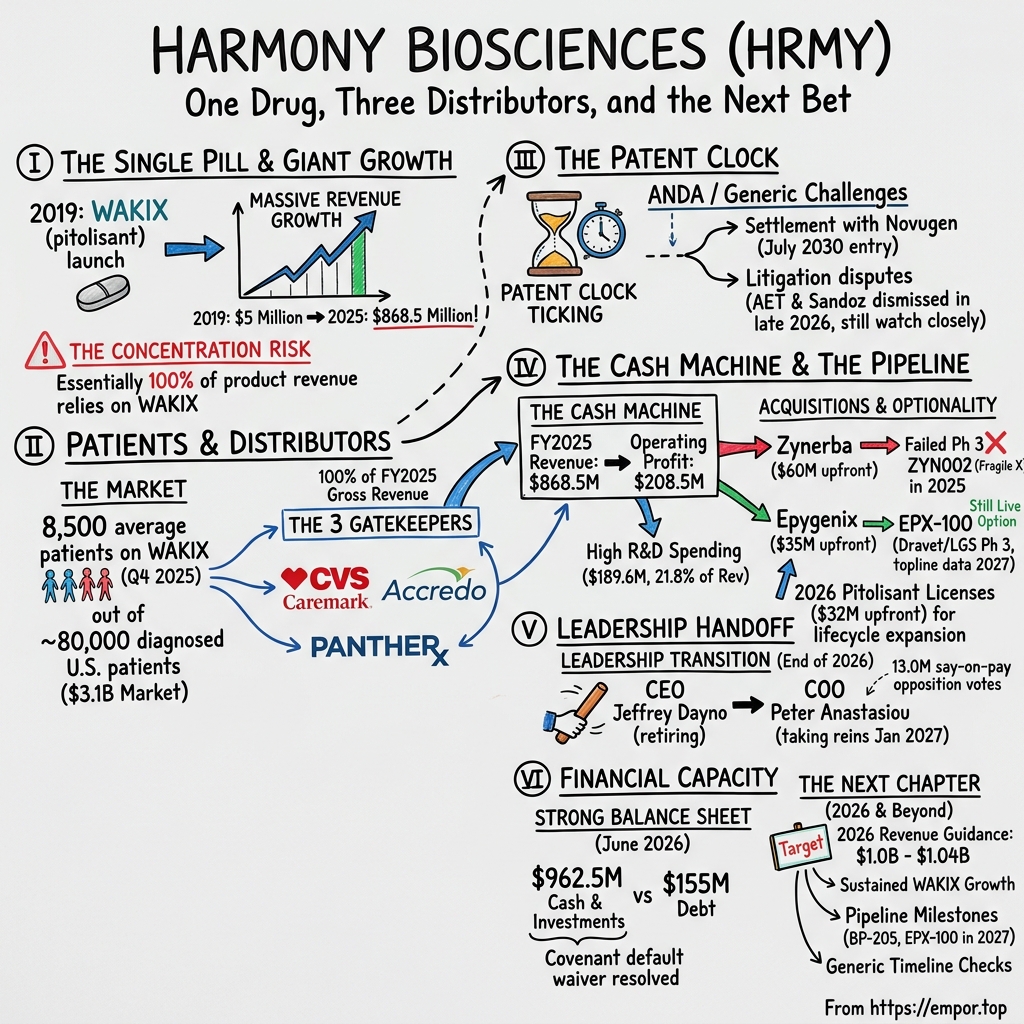
The shop did well. Harmony booked about $5 million of revenue in those last weeks of 2019. Six years later, in 2025, WAKIX brought in $868.5 million, close to 175 times as much.1 Over that span the company went from losing about $151 million a year to earning about $159 million.1
It went public, bought back shares, bought two small drug developers and built a cash pile that, by the middle of 2026, came close to a billion dollars.[^2] Few young biotechs ever get to that point. Most never sell a single product, and most of those that do never turn a reliable profit.
Here is the paradox at the heart of this story. Harmony is profitable, cash-rich and still growing faster than 20% a year, and almost all of that rests on one approved medicine. Nearly every dollar of product revenue in 2025 came from WAKIX.1 Every share of Harmony stock is, at bottom, a claim on how many people with narcolepsy keep taking one pill, at what price, and for how many more years before a generic copy arrives.
That raises four questions, and the rest of this story tries to answer them. The first is whether WAKIX can keep growing as the patient base gets bigger and the easy prescriptions have already been written. The second is how much protection its clinical profile and its patents really give, given that seven generic drugmakers have filed to copy it.
The third is whether hundreds of millions of dollars in research and acquisitions will produce a second product that lasts, or just a string of interesting trials. The fourth is newer and more personal: whether the leadership team that takes over on January 1, 2027 can spend the cash well.
First, it helps to be clear about who is who. The company listed on Nasdaq under the ticker HRMY is Harmony Biosciences Holdings, Inc., a Delaware holding company whose operating subsidiaries sell WAKIX and run the research.1 Harmony was founded by Jeffrey Aronin, a serial pharmaceutical entrepreneur who in June 2017 also founded Paragon Biosciences, a Chicago investment and company-building firm that he still runs as chairman and chief executive.2
Paragon helped get Harmony started and still shares common ownership with it, and Aronin chairs Harmony's board. But Paragon is not the listed business, and its own portfolio, returns and other companies are not part of Harmony's economics. What crosses between the two is small and is covered later, when this story turns to governance.
The founding deal was not a discovery in a laboratory. It was a licence. In July 2017, Harmony obtained the U.S. rights to pitolisant from Bioprojet, the privately held French drugmaker that had invented the molecule and already sold it in Europe.1
That one decision shaped everything that followed. Harmony did not have to spend a decade proving the chemistry. In exchange, it would pay Bioprojet a royalty on every American sale for as long as the arrangement lasted, and it would never fully own the molecule that paid its bills.
The pre-IPO years were short and expensive. The company had about two years to get through the American regulatory process, hire a sales force and prepare a launch, and it lost money heavily while doing so. The figure from 2019, when operating losses were nearly thirty times that year's sliver of revenue, tells the story of a company spending ahead of its first sale.1 Then came the turning point.
Harmony filed to go public in July 2020, and the SEC declared the registration effective on August 18, 2020.34 The IPO came less than a year into the WAKIX launch, in the middle of a pandemic that kept many neurologists and sleep specialists away from their patients. Public investors were not buying a pipeline dream. They were buying an early commercial ramp, with a stock that would rise or fall on how fast that ramp kept climbing.
In 2020, the first full year of sales, revenue rose to about $159 million, and by 2021 it had nearly doubled again.1 The pattern was set. Harmony was a commercial company with a biotech's risk profile: a single product, a licensed molecule, a fixed patent life and a research budget hunting for the next thing.
The rest of the story follows that tension. It starts where the revenue starts, with a patient who keeps falling asleep and a doctor trying to decide what to do about it.
 Subscribe on LinkedIn
II. The Patient Who Became the Market
Picture the appointment. A young adult sits across from a sleep specialist and describes a life organised around fatigue. They nap in the car between classes. They have nodded off at dinner. Some patients with narcolepsy also have cataplexy: a sudden loss of muscle tone set off by strong emotion, so that a good joke can make their knees buckle or their head drop.
The physician has a handful of options, and each comes with a trade-off. Some must be taken twice a night. Some are controlled substances, with the paperwork, prescribing limits and abuse concerns that bring. Some are cheap generics that insurers like and patients often find hard to live with.
WAKIX entered that conversation with a distinctive pitch. It is a once-daily tablet taken in the morning. It works through a different part of brain chemistry from the older drugs. And the Drug Enforcement Administration does not schedule it as a controlled substance.1 In plain terms, it is the narcolepsy medicine a doctor can prescribe without filling in the forms that come with a stimulant or an oxybate.
The science fits in one analogy. Histamine, best known for its role in allergies, also works in the brain as a wake-up signal: neurons that release it help keep the brain alert. Those neurons have their own brake, a sensor called the H3 receptor, which tells them to ease off when histamine levels rise.
Pitolisant is a selective H3 antagonist, or inverse agonist, which means it disables the brake.1 The brain releases more of its own wake-promoting signal. It does not push the brain from outside the way an amphetamine does.
That pitch earned approvals beyond the first one. The FDA added cataplexy in adults in October 2020, excessive daytime sleepiness in children aged six and older in June 2024, and pediatric cataplexy in February 2026.15 Each new indication widened the set of patients a doctor could prescribe WAKIX for, and, as the patent fight later shows, the pediatric work had legal value as well as medical value.
Now follow the money. Harmony does not sell to patients and does not, for the most part, sell to ordinary retail pharmacies. It sells WAKIX to a few specialty distributors and pharmacies. They dispense it to patients whose insurers have agreed to pay, and Harmony books revenue when the product changes hands.1
So every sale depends on a chain of conditions. A patient has to be diagnosed. A physician has to choose WAKIX. An insurer has to approve it, often only after the patient has tried something cheaper. Then the patient has to keep filling the prescription month after month, at a net price that has survived rebates to payers and government programmes.
That chain is why WAKIX revenue recurs without being a subscription. Narcolepsy is a chronic condition, and a patient who does well on a medicine tends to keep taking it, so demand follows ongoing care. But no contract binds the patient, the doctor or the insurer.
A formulary change, a new competitor or a side effect can end a patient's treatment at any time. Harmony's own disclosures describe payment terms of no more than a year with its customers and no minimum purchase commitments.1 The revenue is repeatable, but it is not locked in.
Harmony tracks how many patients are actually on the drug, and the count has kept rising. The company averaged about 8,500 WAKIX patients in the fourth quarter of 2025 and about 8,950 in the second quarter of 2026.15 Set that against the revenue and you get a striking number.
Second-quarter 2026 net revenue was $261.3 million, which, spread over roughly 8,950 patients, works out to well over $100,000 a year for each patient on therapy.5 That is the economics of a rare-disease drug: a small base of patients, each worth a great deal, so every few hundred net additions show up clearly in the quarterly results.
The 2025 numbers show what drives growth. Product revenue rose about 21.5% for the year. Harmony attributed that to roughly 18.3% more units shipped and a 7.0% list-price increase in January, partly offset by rebates that rose about 3.6%.1 That breakdown answers a question worth asking of any growing drug: is the company selling more, or just charging more?
In 2025 the answer was mostly more. Volume did the heavy lifting, and price added a bit after rebates. The gap between list price and net price is worth watching, though. A 7% sticker increase that turned into only a few points of net price realisation shows how much of each price rise insurers and government programmes take back.
Then there is the size of the prize. Harmony puts total U.S. net sales of narcolepsy medicines at about $3.1 billion in 2025, and notes that around 9,000 healthcare professionals treat the disease, about 4,000 of whom are enrolled in the restricted programmes needed to prescribe oxybates.1 On those figures WAKIX already took more than a quarter of the market's dollars, which is a real achievement for a drug launched in 2019.
The same figures also explain the limits. Harmony does not publish how many Americans have a confirmed narcolepsy diagnosis, and a total market number says nothing about how many of those patients will ever be prescribed, approved for and kept on WAKIX in particular. Market size is an invitation, not a forecast.
The honest reading has two halves. On the clinical side, WAKIX has a coherent and distinctive proposition: once daily, non-scheduled, working through a different mechanism, and approved for both of narcolepsy's main symptoms in adults and children. On the commercial side, the proof is the steady rise in patients and units, not the size of the market.
And one thing that is missing matters: Harmony has never run a head-to-head trial showing WAKIX works better than the main alternatives.1 Its advantage over rivals is about convenience, safety profile and fit, not proven superiority. That is a real advantage, but it is the kind that has to be won again with each doctor and each insurer. Which leads to the pharmacy counter.
III. The Drug Has to Win at the Pharmacy Counter
Every bottle of WAKIX sold in America in 2025 passed through one of three companies. CVS Caremark's specialty pharmacy accounted for about 38% of Harmony's gross product revenue, Accredo, part of Cigna's Express Scripts, for about 36%, and PANTHERx, a rare-disease specialty pharmacy, for the remaining 26%.1
Together they made up all of it, and the same three had done so in 2023 and 2024 as well. At the end of June 2026, the three accounted for all of Harmony's gross receivables, with Accredo the largest at about 41%.5
There is no fourth door. A drugmaker selling hundreds of millions of dollars of medicine through just three counterparties has a very short supply chain and very little room to bargain. The arrangement has clear benefits. Specialty pharmacies handle prior authorisations, patient onboarding, refill reminders and insurance paperwork that a company with a few hundred employees could not do itself.
Harmony says it extends credit without collateral, monitors its customers closely and has never recorded a credit loss.1 But the arrangement also concentrates leverage. Two of the three channels sit inside the same vertically integrated healthcare giants that run pharmacy benefit managers and help set formulary terms. When the parent company of the pharmacy that ships your drug also helps decide whether the insurer will cover it, the pharmacy counter is not a neutral place.
Then there are the competitors. The biggest presence in narcolepsy has long been Jazz Pharmaceuticals, whose oxybate franchise includes the original Xyrem and its lower-sodium successor, Xywav. Jazz reported about $1.66 billion of Xywav sales in 2025, across narcolepsy and idiopathic hypersomnia.6 That figure is a scale reference, not a market-share comparison, because Xywav's sales are not limited to narcolepsy.
What it shows is the size of the rival WAKIX has to sell against: one Jazz product took in almost twice Harmony's entire revenue. Avadel's Lumryz, a once-nightly oxybate, offers patients who want that drug class a way to avoid waking in the middle of the night for a second dose. Sunosi is another daytime wake-promoting agent. Behind all of them stand old, cheap generic stimulants and wake-promoting drugs that insurers often require patients to try first.
Each option has its own trade-offs. Oxybates can be powerful against cataplexy and disturbed night-time sleep, though their restricted prescribing programmes remain a trade-off.1 Stimulants are cheap and familiar, but cardiovascular concerns can matter.
WAKIX sits in the middle. Its advantage is a matter of fit, not proven superiority. For a doctor that is a judgement call. For an insurer it is an invitation to make the patient try the cheaper option first.
Harmony's answer is access. The company says WAKIX has formulary coverage for more than 80% of insured lives across commercial, Medicare and Medicaid plans, and that its prescriber base keeps growing.15 Those claims are worth taking seriously, because coverage is hard to win for a premium-priced branded drug in a category full of generics. But coverage does not equal demand. Coverage only opens the door.
The evidence that patients actually walk through it comes from patient additions, unit growth and net sales, and here that evidence is solid: more than 18% unit growth in 2025 and a patient count still rising into 2026.15
The company does not publish how many of its covered lives require a step through generics first, or what share of new patients stay on therapy after a year, and those figures would show how much of the coverage is real preference and how much is permission.
Put the whole industry structure together and it shows WAKIX's position fairly clearly. Buyer power is high: three distributors take all of the product, and payers stand behind them deciding who gets reimbursed. Prescribers and payers together control the gate to each patient. The threat of substitutes is real, ranging from billion-dollar oxybate franchises to generic stimulants that cost a fraction as much, and those substitutes cap how far Harmony can push price.
Barriers to entry are high for brand-new products because FDA approval needs product-specific clinical evidence, but they are low for a pitolisant copy once patents expire. A generic needs only to show it is equivalent, not run new efficacy trials.
Supplier power is moderate but concentrated in one place: Bioprojet, which owns the molecule and takes a large share of every sale. Rivalry among the existing branded players is real but disciplined, because each drug serves a somewhat different patient and dosing profile.
That makes the moat narrow and built on evidence that has to keep being renewed. Being non-scheduled and taken once a day are real, durable product features, and they explain why WAKIX can win prescriptions that an oxybate or stimulant would not. But neither feature locks a patient in, and neither gives Harmony pricing power independent of payers.
Switching costs exist mainly in the patient's own reluctance to change a medicine that works, which is real but cannot be measured from the outside. The strongest part of the position is not the clinic at all. It is the legal protection that keeps a cheaper pitolisant off the market, and that protection runs on a clock.
There is one test worth running every quarter, before turning to that clock. Track three figures together: the average number of patients on therapy, the growth in units shipped, and the gap between gross and net revenue. If net revenue grows faster than shipments, price is doing the work, and that depends on payers continuing to accept it.
If shipments grow faster than net revenue, rebates or discounts are eating into price, and the company is buying volume with concessions. If the two move together, demand is doing the work. In 2025 they moved fairly close together, with units slightly ahead and modest net price gains on top.1 That is a healthy sign today. It will matter even more once the patents start to bend.
IV. The Patent Clock Behind the Growth Curve
On February 17, 2026, lawyers for Harmony and for a German-American generic drugmaker group known as AET walked into a federal courtroom in Delaware for a three-day bench trial.15 There was no jury and no dramatic cross-examination of the kind television courtroom dramas show.
The audience was a single judge, and the argument was over patents most investors could not name. The stakes were simple, though. If AET won, a cheaper copy of pitolisant could come to market sooner than Harmony's settlements assumed. If Harmony won, the copies would wait.
To see why that matters, it helps to understand how American generic drug entry works. A company that wants to sell a copy of a branded drug files an Abbreviated New Drug Application, or ANDA. It does not have to repeat the original clinical trials. It needs only to show that its version is bioequivalent, meaning it gets into the bloodstream the same way.
If the branded drug is still protected by listed patents, the generic filer must either wait for them to expire or argue that they are invalid or not infringed. That argument triggers a lawsuit, a stay on approval while the case runs, and usually a negotiation.
Most such cases end not in a verdict but in a settlement that sets a date when the generic may launch. The patent says what the protection should be. The settlement says what it actually is.
WAKIX has attracted seven ANDA filers: Lupin, Novugen, Novitium, Zenara (whose application later moved to Hikma), AET, Annora and MSN.1 Its key listed patents run on staggered dates. A patent covering the method of treating excessive daytime sleepiness expires in September 2029, one covering a specific crystalline form of the drug runs to March 2030, and another, covering a second crystalline form, runs to March 2044.1 The later patent is the one generics would most want to break, because if it holds, it reaches far beyond the end of the decade.
Harmony's strategy has been to settle, one filer at a time. Novugen settled in October 2024 and received a licence to launch a generic from July 2030.1 Annora and Lupin followed in 2025 on the same July 2030 date. In January 2026, Novitium also settled for July 2030, Hikma settled for March 2030, and MSN settled on terms that remain confidential.1 The settlements share one caveat.
The licensed dates assume WAKIX receives pediatric exclusivity, a six-month regulatory bonus the FDA grants to companies that study a drug in children, and each licence allows an earlier launch "under certain circumstances."1 That is why the pediatric approvals in 2024 and 2026 mattered for business as well as medicine. Six of the seven filers had settled by the time of Harmony's second-quarter 2026 update, and the seventh was AET.[^2]
It is worth being clear about what a settlement does and does not mean. It is not a court finding that Harmony's patents are valid. It is a negotiated truce in which both sides trade the risk of losing at trial for certainty. A generic company that accepts July 2030 is saying that a guaranteed launch then is worth more than the chance of an earlier launch through litigation.
That tells investors something about how strong the generic side thought its case was, but not everything. The "certain circumstances" clauses are not public, and MSN's terms are entirely confidential, so outsiders cannot fully map when the first copy could arrive. The best public summary is that most filers have agreed to wait until around the middle of 2030, and that the agreements contain triggers that could bring the date forward.
AET is where the clock could still move. Its main case challenges the two patents that matter most this decade, the 2029 method-of-use patent and the 2030 crystalline-form patent. It went to trial in February 2026, and closing arguments were scheduled for October 22, 2026.578
On the August call, management said it expected WAKIX exclusivity to run into March 2030, counting six months of pediatric exclusivity it said it was on track to receive, and added: "We are confident that we will prevail in both of these legal proceedings."8 That confidence is a claim, not a judgment.
Around that core fight, the litigation spread. In April 2026, Harmony and Novitium together sued AET, its parent Tiefenbacher and two Sandoz entities over a patent covering an amorphous form of pitolisant, and the defendants answered with antitrust counterclaims.578
The two Sandoz entities were dismissed from that suit without prejudice in July.5 Then, in late October 2026, Harmony and Novitium voluntarily dismissed a separate suit filed in September against AET, Tiefenbacher and Sandoz over yet another patent, again without prejudice, and the Delaware court closed that case a day after being told.9
Each of those words matters. A voluntary dismissal without prejudice means the plaintiffs walked away from that particular suit while keeping the right to file it again. It is not a ruling on whether the patent was valid or infringed, and it should not be read as either a win or a loss.
Harmony had not announced a decision in the main bench-trial case by November 1, 2026. So the most important legal question in the story, whether any generic can enter before the settled 2030 dates, was still open as this episode went to air.
There is also a twist worth pausing on. Novitium began as one of the generic companies trying to copy WAKIX. It ended up settling, then joining Harmony as co-plaintiff against AET, and, separately, licensing pitolisant formulation intellectual property to Harmony for $15 million upfront.5 A would-be competitor became a partner.
Commercially, that can make sense: Novitium had technology Harmony wanted, and a settled generic has its own interest in keeping later entrants out. But a sceptical investor will notice that the line between defending a franchise and paying adjacent parties is not always easy to see from outside, and that Harmony's patent defence now costs money as well as legal fees.
Why does a single date matter so much? The answer lies in the patient line. At today's scale, every year of exclusivity is worth around a billion dollars of sales, and that figure rises as the patient base grows.5
Generic entry in rare-disease drugs is not always a cliff, because specialty distribution and patient loyalty can slow the switch. But history in American pharmaceuticals is not kind to branded small-molecule pills once multiple copies arrive. A few months moved earlier or later is therefore a large number, and the bigger WAKIX gets, the more is at stake on each patent ruling.
Harmony's longer answer is lifecycle management: new versions of pitolisant with potential patents of their own. A gastro-resistant formulation, Pitolisant GR, was submitted to the FDA in June 2026 with a target decision date of April 1, 2027.5 A high-dose version, Pitolisant HD, is in Phase 3 trials in narcolepsy and idiopathic hypersomnia, with topline data expected in 2027 and a target approval date in 2028.5 Patent applications for those formulations, if granted, would run to about October 2044.1
The logic is familiar in the industry: move patients to a newer, protected version before the original goes generic. The weakness is just as familiar. A new formulation protects revenue only if doctors and payers see enough added benefit to prefer it over a cheap copy of the original, and Harmony's record on extending pitolisant into new uses is mixed.
A trial in idiopathic hypersomnia missed statistical significance against placebo, and the FDA issued a refusal-to-file letter on that application in February 2025, which is why the company is now pursuing the condition with the high-dose version instead.1
That history points to the real test of the patent moat, and it is one that can be tracked from outside: the court's ruling in the AET case, whether any FDA approval of a generic pitolisant comes with an early launch, how many patients move to Pitolisant GR or HD if those versions are approved, and whether unit growth and net price hold steady as 2030 approaches.
Other dependencies matter too, but in proportion. Harmony relies on Bioprojet for the licensed rights and on outside manufacturers and distributors to make and move the drug. The 10-K reports that WAKIX has two active-ingredient suppliers, which reduces one supply risk, while each pipeline candidate relies on a single supplier.1 None of that matters as much as the clock.
Settlements bought time. The open question is how well Harmony spends it, which means following the money from WAKIX's revenue line to the shareholder.
V. The Cash Machine Meets the Pipeline Bill
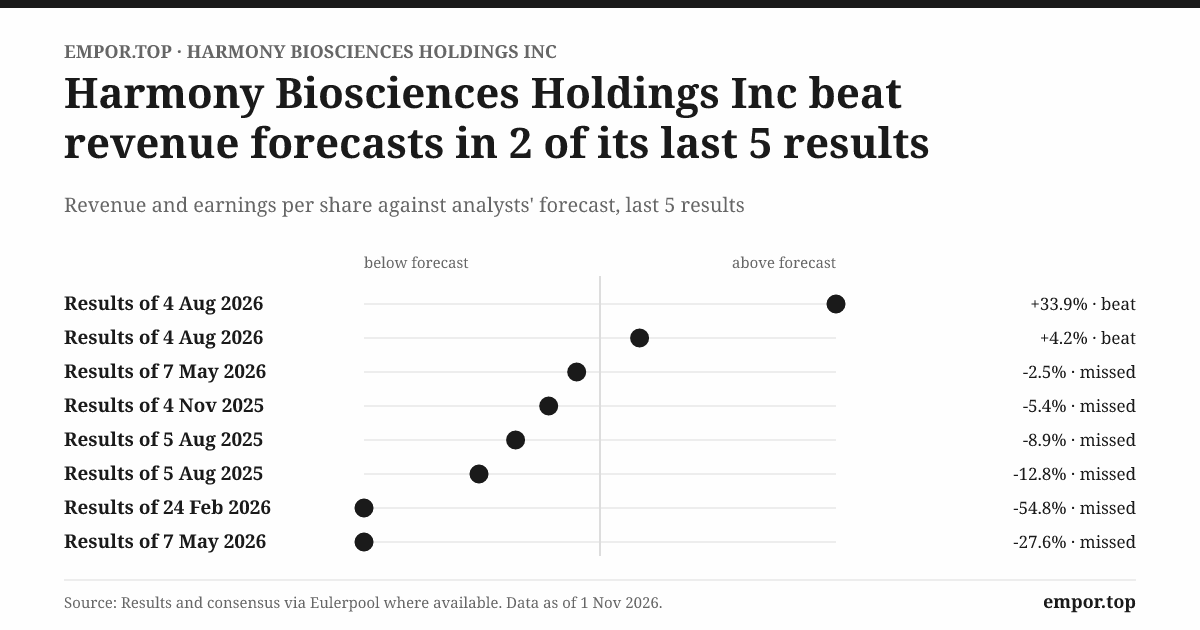
In February 2026, Harmony reported the best year in its history, and a careful reader of the fourth-quarter line could have been forgiven for frowning. Full-year 2025 revenue reached $868.5 million, a record.1 Yet net income for the final three months of the year fell to about $22.5 million, less than half the $49.5 million earned in the same quarter a year earlier.[^11]
Sales were up by about a fifth, and profit was down by more than half. For a company whose investment case is that one drug throws off enough cash to fund the future, that is the kind of quarter that sends investors into the cost lines.
The way to read Harmony's income statement is to follow a single dollar of WAKIX net sales downward. Start with what is left after gross-to-net deductions, the rebates and discounts already taken by payers and government programmes. From that dollar, Harmony pays to make the pill, which for a small-molecule tablet is cheap. Then comes the cost that defines this company: the royalty to Bioprojet.
Under the 2017 licence, Harmony pays tiered royalties of 13% to 24% of net sales, plus a fixed trademark royalty whose rate is not disclosed, and the tiers climb as annual sales rise.1 Combined royalty expense was about $112 million in 2023, $147 million in 2024 and $188.5 million in 2025.1
Measured against revenue, that is a rise from a little over 19 cents of every sales dollar to almost 22 cents. In 2025 Harmony paid Bioprojet almost as much as it spent on research and almost as much as it earned in operating profit.
That single relationship explains a lot. A royalty that rises in tiers works like a progressive tax on success: the more WAKIX sells, the higher the rate on the next dollar. Harmony has said a higher royalty tier contributed to cost pressure in 2025.1
Investors who model WAKIX growth at a steady margin are missing a structural headwind built into the founding licence. At the scale WAKIX has now reached, a big share of each incremental dollar goes to France before it reaches the shareholder.
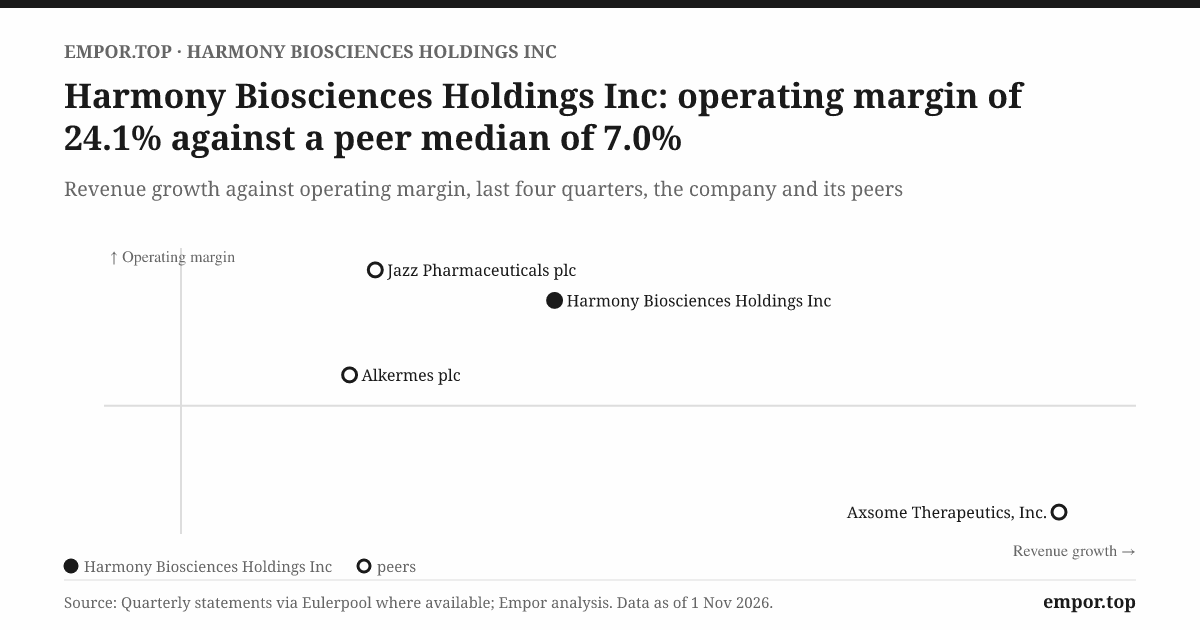
Below the royalty sits research. Harmony spent about $189.6 million on R&D in 2025, up roughly 30% from about $145.8 million in 2024, taking the research budget to about 21.8% of revenue.1 Selling, general and administrative costs rose too, including the expense of litigating and settling patents. What was left was operating profit of $208.5 million, a margin of about 24%, down from about 33% in 2023.1 Net income, after interest, other items and tax, was $158.7 million.1
The longer view sharpens the puzzle. From 2022 to 2025, revenue compounded at about 26% a year while net profit fell by about 4% a year.1[^12] Part of that is an accounting quirk at the start of the period: 2022's net profit was inflated by a large tax benefit, when the reported tax rate was negative, so the base is unusually high.[^12] Strip that out and the story is less dramatic but still real.
Operating margins compressed by about nine percentage points over two years because royalties rose faster than revenue, research spending rose faster still, and one-time charges for acquired research programmes landed on the income statement.
Acquired in-process research and development alone—the accounting label for paying to buy a programme that has no approved product yet—cost about $34.3 million in 2025, including a $15 million payment to a related party called CiRC that comes up again in the governance story.1
Quarters swing harder than years. The weak fourth quarter of 2025 combined a lower operating margin with an unusually high tax rate, about 45%.[^11][^12] Six months later the picture had reversed. Second-quarter 2026 net income came in at $75.4 million on record revenue of $261.3 million, nearly double the year-earlier figure.58
A business that can swing from $22 million to $75 million of quarterly profit within half a year, on revenue that never stopped growing, is a business whose earnings are driven by spending decisions and one-off items as much as by demand. Any single quarter is noise. The trend across years is the signal.
One part of the model is unambiguously light. Harmony does not own factories, does not build plants and does not carry a big balance sheet of equipment. Purchases of property and equipment in 2025 came to about $0.3 million, a rounding error next to the research bill.1
At the end of 2025 the company had 293 full-time employees, with about 103 in research and development and 135 in commercial roles.1 Almost all of the capital this business consumes goes into ideas, licences and trials rather than concrete and steel. That is good for cash flow and bad for predictability, because the return on a trial is binary in a way the return on a factory is not.
Then there is cash, where Harmony looks best. From 2018 through 2025, the company generated about $912 million of cash from operations against about $420 million of cumulative net profit, so cash ran at more than twice reported earnings.1[^12]
In 2025 alone, operating cash flow was $348.2 million against net income of $158.7 million.1 Some of that gap is structural and lasting. Stock compensation of $44.9 million, amortisation of $23.8 million and the $34.3 million of acquired research charges all reduce profit without consuming operating cash in the same year.1
Some of it is timing. A $68.0 million increase in other liabilities, much of it rebate and royalty accruals that will eventually be paid, and a $31.8 million release from prepaid expenses flattered the year, while rising receivables absorbed $13.8 million.1 The honest translation is that WAKIX generates a lot of cash, but 2025 was not a clean measure of how much. Accruals that build up are bills that come due later.
Treasury income adds a little cushion. Interest income was about $21.9 million in 2025, roughly a tenth of pretax income, because the growing cash pile earned real yields.1 That helps, but it is not the engine, and it would shrink if the cash were spent on deals or if rates fell.
The verdict follows from the arithmetic. The WAKIX core is a profitable, cash-generating business, and it is funding a research programme of real size. But revenue growth has outpaced profit growth for three years, and the reasons are structural: a royalty that rises with success, a deliberate step-up in research and a habit of buying programmes whose cost hits earnings upfront.
The test for shareholders is not revenue, and not the adjusted earnings figures companies like to quote, but operating margin and net income after royalties, rebates and pipeline spending. If those keep sliding while WAKIX grows, the cash machine is being drained faster than it fills. If they hold, the pipeline is being funded from strength. Which raises the obvious question: what has Harmony actually bought with that money so far?
VI. Two Acquisitions, One Expensive Lesson in Optionality
In October 2023, Harmony closed the purchase of Zynerba Pharmaceuticals, a small Pennsylvania developer whose lead product was ZYN002, a cannabidiol gel rubbed into the skin, intended for children and adults with Fragile X syndrome.[^13] Fragile X is the most common inherited cause of intellectual disability, and it has no approved treatment. The deal looked built to limit the downside.
Harmony paid about $60 million in cash upfront, and Zynerba's shareholders received contingent value rights that could have paid up to another $140 million if ZYN002 hit clinical, regulatory and sales milestones.[^13] If the drug worked, Harmony would have paid more, but it would also have owned a first-in-class product. Because it failed, Harmony was out the upfront cash and the trial costs, and the rest was never owed.
The scientific bet was specific. An earlier study, CONNECT-FX, had missed its primary endpoint in the overall Fragile X population. Within that population, however, patients with a particular genetic profile, a fully methylated gene, appeared to respond.10 So Harmony designed a new Phase 3 trial, RECONNECT, around those patients and around behavioural outcomes, chiefly social avoidance. On the first-quarter 2025 call, the tone was confident.
Jeffrey Dayno said a positive outcome "could position us to deliver the first-ever FDA-approved treatment for Fragile X syndrome," and the company's chief medical officer, Kumar Budur, spoke of "a strong conviction in the program's success," citing the mechanism, the earlier subgroup data and design changes. He said the study was powered at more than 90% to detect an effect on its primary endpoint, and he described plans to file quickly if the data were positive.10
The data came in the third quarter of 2025, and RECONNECT missed its primary endpoint. Harmony attributed the failure to a high placebo response, a common problem in behavioural trials where caregivers' observations drive the outcome measure.1[^15] The company stopped further development in Fragile X and dropped a second planned indication in 22q11.2 deletion syndrome.1 An acquired Phase 3 asset, a confident management team and a trial powered above 90% had produced exactly no commercial product.
The lesson is not that the deal was reckless. Its structure did what structures are supposed to do, capping the loss at the upfront cash plus development spending rather than the full headline value. The lesson is about what milestones mean.
A drug reaching Phase 3 sounds like a drug that is almost there. In fact, late-stage trials in neuropsychiatric and behavioural conditions fail often, and a subgroup that looked promising in a failed trial is one of the weakest foundations for a new one.
"Phase 3" is a description of a trial, not a probability of approval. It also matters who made the call. The same leadership team that built the WAKIX business picked this asset, designed the trial and spoke confidently about it six months before it failed. That does not make them bad scientists. It does mean their confidence about pipeline outcomes should be weighed with that record in mind.
Harmony's second deal was already in the portfolio by then. In April 2024 it acquired Epygenix Therapeutics, a private company developing EPX-100, a drug called clemizole hydrochloride, for rare childhood epilepsies.[^16] The structure was even more back-loaded than Zynerba's: $35 million upfront, up to $130 million in development and regulatory milestones, and up to $515 million in sales milestones.[^16]
Clemizole began life decades ago as an antihistamine, and Harmony is testing it in Dravet syndrome, a severe genetic epilepsy that begins in infancy.[^16] EPX-100 is now in two registrational Phase 3 trials: ARGUS in Dravet syndrome and LIGHTHOUSE in Lennox-Gastaut syndrome, another severe childhood epilepsy. Topline data are expected in mid-2027 and a target approval date in 2028.58
Epygenix is a live option, and it should be valued as one. It has no revenue, and its two trials are in conditions with established treatments, including Jazz's own cannabidiol medicine, Epidiolex.6 Success would give Harmony a genuine second leg in a well-defined specialist market with a sales force that knows how to sell to neurologists. Failure would add another line to the record of acquired assets that did not convert.
The structure means the realised cost depends on the outcome: if EPX-100 fails, Harmony will have spent $35 million plus trial costs; if it succeeds spectacularly, it will pay hundreds of millions more, out of the sales the drug produces.
Whether either deal was a bargain cannot be judged from the disclosed terms. Harmony does not publish the internal probability assumptions behind its offers, and there is no clean peer set of comparable clinical-stage epilepsy deals with disclosed prices to benchmark against.
The pipeline has moved on beyond those two purchases. In April 2024, Harmony sublicensed from Bioprojet an orexin-2 receptor agonist now called BP-205, with rights that originate with Japan's 帝人ファーマ Teijin Pharma, for the United States and Latin America.1 Orexin is the brain chemical that people with the most common form of narcolepsy have lost, and a drug that mimics it attacks the disease's root cause rather than its symptoms.
It is the most exciting idea in the field, which is precisely why it is crowded. On the August 2026 call, an analyst asked how BP-205's timing compared with the lead orexin programme at 武田薬品 Takeda, and management's answer was that "the first or second asset isn't necessarily the best asset."8
That may be true, but it was also a concession that Harmony is not first. Single-dose Phase 1 data were described as encouraging, and multiple-dose data were expected in the fourth quarter of 2026.511
In early 2026, Harmony also paid to extend pitolisant itself into new territory. In January it licensed additional intellectual property from Novitium, including a co-exclusive right to develop an amorphous formulation of pitolisant for central nervous system conditions outside sleep, paying $15 million upfront with a $10 million development milestone and low single-digit royalties.5 In February it licensed intellectual property from MSN, including pending patents, for another new pitolisant formulation in CNS indications outside sleep.
That deal carried $17 million upfront and another $25 million payable if the U.S. Patent and Trademark Office grants the patents. The $25 million is held in escrow and returned to Harmony if the patents are not granted by November 25, 2027.5
Together, those deals cost $32 million upfront, and both counterparties were among the generic companies that had filed to copy WAKIX.15 The new formulations are a way to stretch the pitolisant franchise past 2030 and into new diseases. They are also a reminder that Harmony's search for a second act keeps leading back to the first one.
Management's stated plan is more deals. On the second-quarter 2026 call, the company said it was targeting late-stage or marketed assets that could produce revenue between 2028 and 2032, in sleep, epilepsy and rare and broader CNS disease, that it had "both the capacity and the conviction to transact," and that it "will likely engage in multiple transactions" rather than one large one.8
That is where the shareholder's version of the question gets sharp. How much cash should a company with one product, a patent clock and a falling operating margin recycle into diversification before it knows how long that product will last? There is a real argument for spending now. The cash is available, the market values the WAKIX stream modestly, and a second product is the only thing that ends the concentration risk.
There is a real argument for patience too. The company's record so far is one acquired Phase 3 asset that failed, one that has not read out, a failed attempt to extend WAKIX into idiopathic hypersomnia, and a pipeline whose most important programme is following a bigger competitor.
That record does not refute the strategy. It narrows it. The case for buying growth is no stronger than the next readout, and the people choosing the next deal are about to change.
VII. The Chairman's Company Becomes the CEO's Test
On October 12, 2026, Harmony announced that Jeffrey Dayno would retire as president and chief executive at the end of the year, and that Peter Anastasiou, the company's chief operating officer, would succeed him on January 1, 2027.1211
Dayno would leave the board on December 31 and stay on as a non-executive adviser through 2027.11 The release carried the usual language of continuity. Read alongside the rest of 2026, it also marked the end of a year in which an unusual number of senior people came and went.
Dayno's career explains much of how Harmony behaved. He is a neurologist by training, with a medical degree from Temple, a neurology residency there and a stroke fellowship at Henry Ford.2 He spent years in pharmaceutical medical affairs, at Merck, at Cephalon, the company that built the wakefulness drug Provigil into a franchise, and at ViroPharma, before serving as chief medical officer of Egalet.2
He joined Harmony as chief medical officer in November 2017, a few months after the Bioprojet licence, served as interim chief executive from January 2023 and became chief executive that April.2 So the man who led WAKIX through its clinical expansion, its pediatric approvals and its pipeline buildout was a physician who had spent his career in the medical side of pharma, not the deal side. The pipeline's clinical ambition, including the conviction behind RECONNECT, carries that imprint.
His successor comes from the opposite side of the business. Anastasiou spent twelve years at the Danish neuroscience drugmaker Lundbeck, rising from vice president of psychiatry to U.S. chief commercial officer and then to executive vice president and president of North America, and sat on Lundbeck's board from 2016 to 2021.2
He went on to run Capsida, a gene therapy company, as chief executive from 2022 to 2025, and before Lundbeck he worked at Neuronetics, Bristol Myers Squibb and Eli Lilly.211 He joined Harmony's board in November 2023 and left it in April 2026 to become chief operating officer, which made him the obvious heir less than six months before the announcement.2
One more detail rounds out the picture. Aronin founded Ovation Pharmaceuticals, sold it to Lundbeck and then ran Lundbeck's U.S. business until 2011, and Anastasiou joined Lundbeck in November 2009, so the two careers overlapped inside the same company.2
A commercial operator who knows CNS drug launches, payers and sales forces is a natural fit for a company whose revenue depends on exactly that. It is a less natural fit for the job management has described for the cash: picking late-stage assets and deciding which trials to back.
Then there is the chairman. Aronin founded Harmony and has served as a director since October 2017. He was executive chairman briefly in early 2023 and has been non-executive chairman since that April.2 Before Paragon he founded and ran Ovation, and later Marathon Pharmaceuticals, a pattern of building rare-disease companies around licensed or acquired products and then selling or spinning them out.2
Aronin was reported to own about 3.8% of Harmony's stock, and a family trust whose trustees include Aronin family members, Marshman Fund Trust II, held about 10.5%, although the proxy says the trustees disclaim beneficial ownership.2 BlackRock was the other large holder, reporting about 11.3% at the end of June 2026.13 No shareholder controls Harmony, but the founder's influence runs through both the chair and a large related holding.
The related-party flows matter more for what they reveal than for their size. Harmony paid Paragon about $0.5 million in 2025 for Chicago office space and consulting, about six hundredths of one percent of revenue, and owed it nothing at the end of June 2026.15
That is trivial. The separate $15 million CiRC payment was charged to acquired research, not Paragon.1
It is larger, and it is the kind of related-party deployment of shareholder cash that independent directors should be able to explain in detail. Neither is the real economic burden on WAKIX. That burden is the royalty owed to Bioprojet, an arm's-length licensor, which runs to about twelve times the size of the research spending on CiRC.
The finance function had a turbulent 2026. Sandip Kapadia, chief financial officer since March 2021 and formerly finance chief at Intercept after nearly two decades at Novartis, signed a separation agreement dated April 14, 2026.25 A successor, Glenn Reicin, was hired the same day, and his own separation agreement was dated July 16, 2026.5
The second-quarter 10-Q was signed by Stephen Mollichella as interim principal financial officer.5 The company does not explain either departure in detail in the quarterly filing. Two finance chiefs leaving over about three months, in a year with a covenant waiver, a patent trial and an expanding deals programme, is a pattern a board should explain to shareholders, not just disclose.
Shareholders did not fully sign off on how management was paid either. Dayno's total 2025 compensation was about $7.9 million, up from about $7.15 million in 2024, and about $6.6 million of it was stock and option awards, with incentive cash of about $558,000.2 An equity-heavy package should, in principle, line up the chief executive's wealth with the stock price. At the May 2026 annual meeting, about 13.0 million votes went against the say-on-pay resolution.14
Director Andreas Wicki received about 21.4 million withheld votes against about 25.1 million for, close to a split decision for a board seat.14 Those votes are not binding, and they did not change the board. But they are a measurable signal that a significant share of institutional holders was dissatisfied with pay or with board oversight, and they arrived months before the succession announcement.
Credibility, in the end, is best judged by behaviour. On the commercial side, the record is good. Harmony began 2025 guiding to WAKIX net revenue of $820 million to $860 million, reiterated that range in May, raised it to $845 million to $865 million with the third-quarter results, and finished the year at $868.5 million, above the top of the raised range.10[^15]1 That is a team that knows its own business and guides conservatively. On the pipeline side, the record is mixed.
The RECONNECT failure followed confident public statements, and a prior attempt to win approval in idiopathic hypersomnia ended with an FDA refusal to file.101 The August 2026 call showed the same split: concrete answers on patient additions, the patent estate and BP-205's pharmacokinetics, and vaguer ones when analysts pressed on the efficacy thresholds that would decide whether BP-205 advances or on how the company would prioritise its many indications.8
So the handoff is orderly but not simple. The new chief executive is an insider who knows the operating business. He inherits a company whose revenue is still concentrated, whose patent outcome is unresolved, whose finance chair has turned over twice in a year and whose pipeline record has been tested and found wanting at least once.
A planned succession reduces one kind of risk, a sudden vacuum. It does not reduce the others. What Harmony needs from the next leader is commercial execution, which the record says the company can deliver, combined with capital-allocation judgement, which the record has not yet shown. The balance sheet will set how much room he has to make mistakes.
VIII. A Cash-Rich Balance Sheet With a Small Warning Light
At the end of June 2026, Harmony's balance sheet looked like a fortress with one misplaced brick. On one side sat about $962.5 million of cash, cash equivalents and investments.[^2]5 On the other side sat about $155 million of principal on a secured term loan, of which $20 million was due within a year and $125 million matures in 2028.5
Cash exceeded debt by more than six times. A company in that position does not worry about paying its lenders. Yet for most of the previous year, Harmony had been technically in default on its loan.
The cause was mundane. Harmony's credit agreement required each relevant subsidiary to join the loan as a guarantor, a standard protection that lets lenders claim on the assets of the whole group, not just the parent. One subsidiary had not done so, which put Harmony in a non-financial covenant default dating back to July 2025.5
There was no missed payment, and Harmony says all principal and interest were paid on time. The lenders waived the default on May 4, 2026, and the company reported that it was in compliance with its covenants at June 30.5
It is worth being precise about what this was and was not. It was not a liquidity crisis, and it never threatened Harmony's ability to operate, because cash covered the loan many times over. But it was a controls failure, and a slow one. A paperwork obligation that any well-run treasury and legal function checks after creating or restructuring subsidiaries went unnoticed or unresolved for about ten months.
It overlapped with the year's churn in the finance chief's office, and it was the kind of detail that a company preparing for a busy year of deals should have under control. It does not change the solvency picture. It does add weight to the argument that the company's administrative machinery has not always kept pace with its commercial growth. Clean compliance over the next several reporting periods is the simple way to put the issue to rest.
The capital history adds context. Since the 2020 IPO, Harmony has never paid a dividend.1[^12] It did return cash through buybacks: the board authorised up to $125 million of repurchases in 2023, Harmony bought back $50 million of stock that year and then $100 million in 2024.1 It made no repurchases in 2025.1
Meanwhile, stock compensation and option exercises kept issuing new shares, so diluted weighted-average shares still rose from about 57.9 million in 2024 to about 58.5 million in 2025.1 The buybacks returned capital, but they did not shrink the share count over time. They mostly offset the shares issued to employees.
The harder question is where the next dollar goes. On the August call, the interim finance chief said the cash would be deployed to business development and pipeline investment, and management said it expected multiple transactions.8 The company made no mention of buybacks on that call.8
That is a clear choice: the company is betting that buying and building assets is worth more than retiring stock that trades at a low multiple of earnings. That choice may be right. It is also a bet on exactly the skill the record has not yet proven.
The balance sheet's other details are reassuring but worth naming. The cash is held mainly in cash equivalents, commercial paper, corporate bonds and U.S. government securities, and Harmony says substantially all of its cash and money-market funds sit with five financial institutions.5
Lease liabilities were small at about $6 million, so the borrowings are real term debt rather than accounting obligations for office space.5 The loan carries a floating rate linked to SOFR, which made the interest bill rise with rates even as the cash pile earned more.5 No credit rating rationale is published in Harmony's filings, and the covenant episode should not be read as a judgement by any rating agency.
Cash conversion needs one more look, because the balance sheet is only as strong as the cash flowing into it. The previous year's operating cash flow benefited partly from timing effects.1
If those accruals unwind as rebates and royalties are paid, the next year's operating cash flow could look weaker even if WAKIX keeps growing. Recurring cash generation, not a single strong year, is the measure that tells investors how long the fortress will last if the deals programme accelerates.
The net reading is clear. Harmony has the financial room to diversify, and enough to absorb a failed trial or two without strain. The covenant default was a blemish that the lenders forgave and the company fixed, not a sign of distress. What the balance sheet cannot do is choose. Which brings the story to what the market is actually paying for, and what would change its mind.
IX. The Investment Case Fits in Three Numbers
Every quarter, Harmony releases a set of results, and a lot of it is noise: adjusted earnings, pipeline slides, upbeat commentary about momentum. Strip it down and the company's next chapter can be followed through three numbers. Each one answers one of the questions this story began with.
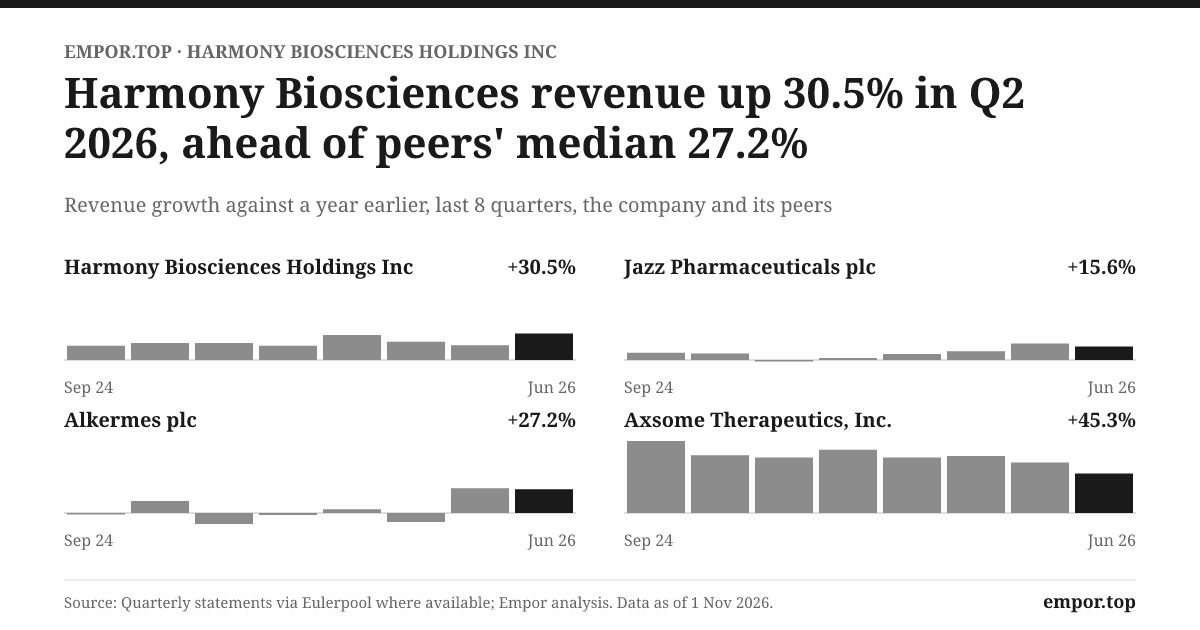
The first is the WAKIX patient count together with its net revenue. The latest reading was up about 450 patients from the first quarter, which management called the biggest second-quarter increase in the brand's history. Second-quarter net revenue was up about 30% from a year earlier.58
The direction is up and, on recent evidence, accelerating, helped by a field-force expansion that the company says added roughly a fifth more sales and reimbursement coverage.8 If patient additions slow while revenue keeps rising, price is doing more of the work. If both slow together, demand is maturing.
The second is operating margin after royalties, rebates and research. It rebounded to about 34% in the strong second quarter of 2026, after falling over the previous two years.1[^12]
The trend over years has been down and the latest quarter has been up, so the next few quarters will show which one is the anomaly. This is the number that shows whether WAKIX growth is reaching shareholders or being absorbed by the Bioprojet royalty tiers and the research budget.
The third is pipeline conversion, measured not by trials started but by readouts that become approved products and then sales. Today the reading is zero.1 The next events on this line are a decision on Pitolisant GR in April 2027, Phase 3 data for EPX-100 and Pitolisant HD in 2027, and data from BP-205 along the way.58
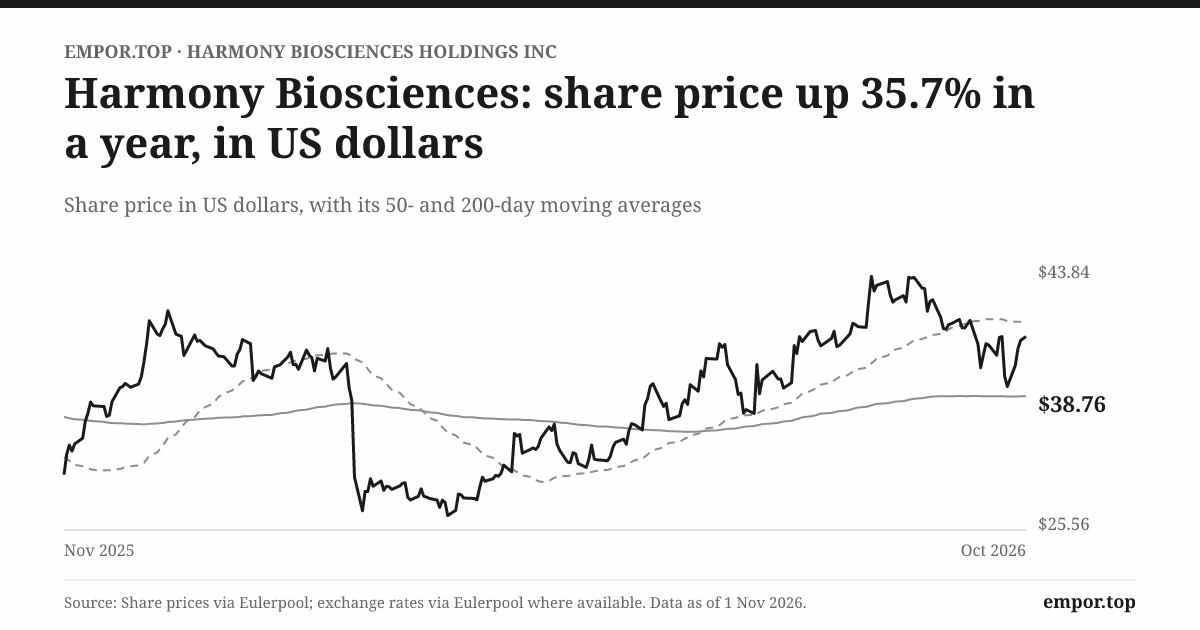
Set against those three numbers, the market's price looks like a statement of doubt. On November 1, 2026, Harmony's shares traded at $38.76, about 10% below their 52-week high, for a market value of about $2.2 billion. Netting off the cash pile and the debt gives an enterprise value of about $1.7 billion, a little less than twice annual sales.[^2][^12]
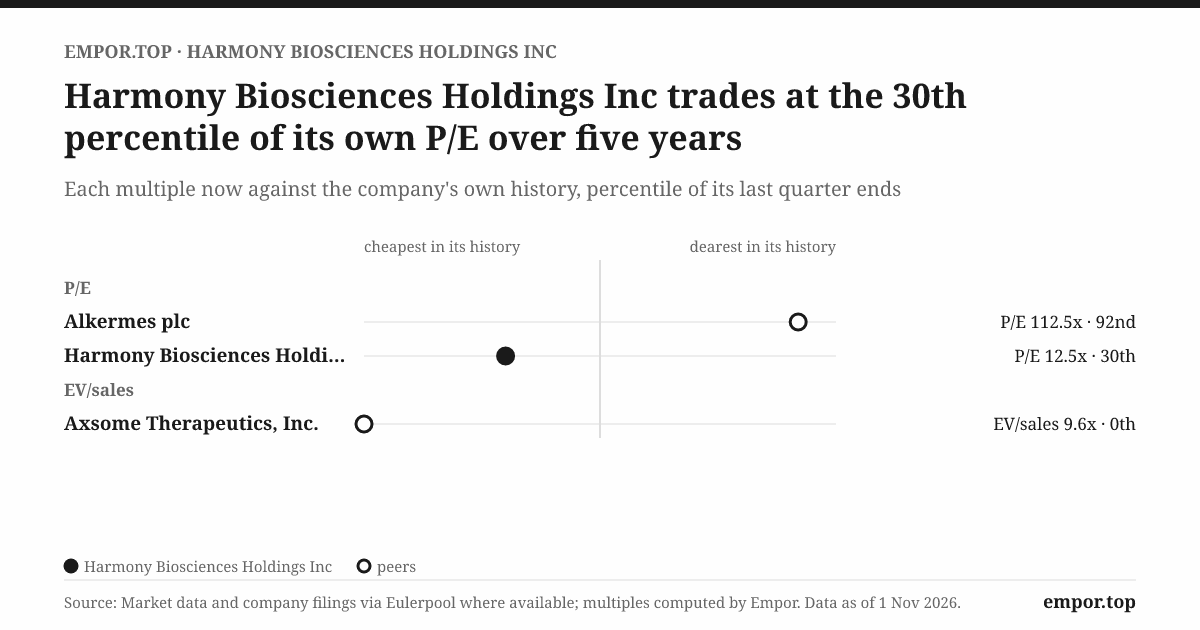
The stock traded at about 12.5 times trailing earnings, below its own five-year median of about 14 times, with an earnings yield of about 8% and a free-cash-flow yield of about 16%.[^12] That cash-flow yield overstates the steady-state picture, because the previous year's cash flow was flattered by accruals and non-cash charges.
Even so, the price implies that investors are not paying for much growth beyond the current WAKIX stream, or much value for the pipeline. They are paying for a franchise with a clock on it. The stock's history shows how quickly sentiment can move: at its worst in the past five years, it fell almost 70% from peak to trough.[^12]
Without same-date peer multiples to set this price against comparable specialty pharma companies, the honest comparison is with Harmony's own history, which says the market is currently more sceptical than usual.
The bull case is easy to state. WAKIX keeps adding several hundred patients a quarter, holds net price, and the company hits its guidance of more than a billion dollars of revenue in 2026.11 Settlements hold generics off until 2030, and the AET case goes Harmony's way. Pitolisant GR wins approval in 2027 and moves patients onto a formulation with patents running into the 2040s.
And the cash pays for at least one second product, whether EPX-100, BP-205 or an acquired late-stage asset, that turns the company from a single-product story into a CNS portfolio before the original patents expire. On that path, a business valued at less than twice sales and about 12 times earnings would have been cheap.
The bear case is just as specific. AET wins and a generic arrives earlier than 2030, or the "certain circumstances" clauses in the settlements are triggered and several copies launch together. Payers tighten access once a cheaper pitolisant exists, and the newer formulations fail to persuade them.
Royalty tiers and research spending keep compressing the margin even before generics. Business development uses the cash on assets that, like ZYN002, fail at the last hurdle. And the leadership change, combined with finance turnover, slows execution just as the decisions get harder.
The frameworks help decide which case the evidence leans toward. The industry structure from the pharmacy-counter fight, with powerful buyers, real substitutes and a licensor that takes a large share, explains why WAKIX's economics are good but not unassailable. Hamilton Helmer's seven powers ask a narrower question: what lets a company earn superior returns that rivals cannot compete away?
Harmony has one of them in clear form, and it is a cornered resource: an exclusive U.S. licence to a differentiated molecule, protected by patents and settlements. It is real, but it is borrowed from Bioprojet and it expires. Switching costs exist in a soft form, because patients who are stable on a medicine rarely want to change. But they cannot be measured, and payers can override them.
Harmony has some counter-positioning against oxybate makers, since a non-scheduled drug can be sold to the thousands of prescribers who never enrolled in an oxybate programme, and a rival with a big oxybate franchise has reasons not to chase the same pitch. That advantage is about the molecule, though, not the company, and a generic pitolisant would inherit it.
Scale economies, network effects, brand power and process power do not show up in any meaningful way: Harmony's sales force is smaller than Jazz's, there is no network, and doctors prescribe molecules, not brands. The conclusion is that Harmony's advantage is a time-limited licence, not a lasting structural moat. That is not a criticism. It is the normal state of specialty pharma, and it is why the third number, pipeline conversion, matters so much.
A sceptical investor would push on three points. The first is reach: how much of the $3.1 billion market can WAKIX actually reach, given that Harmony does not publish a confirmed diagnosed-patient count or the share of covered lives that face step edits? The second is preference: what evidence, beyond formulary coverage, shows that payers prefer WAKIX rather than merely tolerating it, and what happens to that preference when a generic pitolisant costs a fraction as much?
The third is conversion: across RECONNECT, the idiopathic hypersomnia application and the programmes still in trials, what share of the company's technical milestones have become revenue? So far the answer to the last question is none outside WAKIX itself.
The evidence supports a clear but bounded conclusion. Harmony is a profitable growth franchise with a large cash cushion and a credible commercial team. It is not yet a durable multi-product company, and it does not have an unassailable moat. The three numbers will show which way it is moving. The stories behind them show what the company has already learned.
X. Business & Investing Lessons
Harmony's story is short by corporate standards, less than a decade from licence to the eve of a leadership handoff. It still packs in more lessons than many companies three times its age, because it has lived both the best and the most common outcomes in drug development within the same few years.
The first lesson is that a licence and approval were only the start; the slow commercial work built WAKIX into a business.15
Founders who think the regulatory finish line is the end of the race should study how much of WAKIX's value was built after it. A medicine becomes a business only when patients, prescribers and payers keep choosing it.
The second lesson is the leverage created by Harmony's concentrated distribution channel: it gives a small company national reach, but leaves it dependent on a few counterparties.1 Investors who see high, steady margins in a concentrated channel should ask who could take them away.
The third lesson is ZYN002: even a well-designed Phase 3 trial built on promising subgroup data can fail.101
Epygenix and BP-205 are now walking the same path, and the language around them is the language that surrounded RECONNECT. The wider rule for investors is to price clinical progress as a probability, not a promise, and to remember that even approval is a long way from durable revenue. A milestone is a door, not a destination.
The fourth lesson comes from the cash record. WAKIX has generated substantial cash, giving Harmony time and options.1[^2] But cash is not a strategy.
It did not prevent the Fragile X failure, it did not stop the covenant lapse, and it does not tell the board whether the next deal should be an epilepsy asset, a CNS licence or a buyback at 12 times earnings. Strong cash flow buys time; it does not tell you what to buy.
The fifth lesson is the leadership handoff due on January 1, 2027.11 A tidy handoff takes away the drama of a sudden departure, but not the unfinished business. A planned successor inherits the product, the patent clock and every unfinished bet.
XI. Epilogue
As November 2026 begins, Harmony stands at a point where several clocks are ticking at once, and the next eighteen months will settle more of its story than the previous five years did.
The nearest clock is commercial. The company has guided to WAKIX net revenue of $1.0 billion to $1.04 billion for 2026, which would make it a billion-dollar drug for the first time.11 The first half delivered about $477 million, so the second half has to bring in roughly $525 million to $565 million, a pace a little above the record second quarter.5
The next two sets of quarterly results and the patient counts that come with them will show whether the acceleration seen in the summer was a new trend or a strong season. If the patient, unit and net-price measures move in step, demand is driving growth. If they diverge, something else is.
The second clock is legal. The separate suit over a later patent was dismissed without prejudice in October, while the AET case remains open.97 A ruling for Harmony would reinforce the settled 2030 timetable and leave the generic question for the end of the decade.
A ruling for AET could bring a generic forward, depending on how the rest of the patent estate and the settlement triggers interact. Either way, the decision will be the first time a court, rather than a negotiation, says something about the strength of WAKIX's protection.
The third clock is scientific. The company expected BP-205's multiple-dose data in the fourth quarter of 2026, with a further study reading out in early 2027.8 The FDA's decision on Pitolisant GR is due by April 1, 2027.5 Several Phase 3 readouts are expected in 2027, including data for pitolisant in Prader-Willi syndrome.58
That is an unusually dense year of binary events for a company of this size. Each positive result would be a door opening. None would be revenue until doctors prescribe it, payers cover it and patients stay on it, which is the standard WAKIX itself had to meet.
The fourth clock is about leadership. Peter Anastasiou takes over in January, with Dayno advising through 2027.11 The first test will not be a deal or a readout. It will be the first time he has to explain a miss, whether a soft quarter, a failed trial or an adverse ruling, with the same detail management has used for its successes.
A permanent finance chief, clean covenant compliance and a clear explanation of how acquired assets will be judged would all help. The 2028 loan maturity is a minor secondary check on financial housekeeping, not a threat.
If those clocks mostly go Harmony's way, the company will enter the late 2020s with a billion-dollar drug, a protected new formulation and at least one credible second product. If they mostly go against it, it will enter the same years with a cash pile, a shrinking franchise and a pressing need to buy something good.
The central question from the first page is still open: can Harmony turn WAKIX's growth into a lasting company before its dependence on one drug catches up with it? The answer will not come from strategy decks. It will come from a judge, a regulator and a few hundred patients at a time.
XII. Outro
Go back to that first pharmacy delivery in November 2019.
Multiply that patient by about nine thousand and you have a company of real scale, with a near-billion-dollar cash pile and a share price that has fallen sharply in the past five years.1[^2]5[^12]
That is what makes Harmony unusual. Most biotechs are pipelines looking for a product. Harmony is a product looking for a pipeline, a commercial business with real cash flow wrapped around a biotech's uncertainty. WAKIX pays for every bet the company makes, and every one of those bets is an attempt to escape WAKIX's limits.
The same drug that gives Harmony the freedom to take risks also concentrates the consequences if its growth slows or its protection weakens. Harmony has built a company around one medicine; the next medicine has to prove the company can outgrow it.
References
-
2025 Form 10-K — Harmony Biosciences Holdings, Inc., SEC, 2026-02-24 ↩↩↩↩↩↩↩↩↩↩↩↩↩↩↩↩↩↩↩↩↩↩↩↩↩↩↩↩↩↩↩↩↩↩↩↩↩↩↩↩↩↩↩↩↩↩↩↩↩↩↩↩↩↩↩↩↩↩↩↩↩↩↩↩↩↩↩↩
-
2026 Proxy Statement — Harmony Biosciences Holdings, Inc., SEC, 2026-04-03 ↩↩↩↩↩↩↩↩↩↩↩↩↩
-
Form S-1 Registration Statement — Harmony Biosciences Holdings, Inc., SEC, 2020-07-27 ↩
-
Q2 2026 Form 10-Q — Harmony Biosciences Holdings, Inc., SEC, 2026-08-04 ↩↩↩↩↩↩↩↩↩↩↩↩↩↩↩↩↩↩↩↩↩↩↩↩↩↩↩↩↩↩↩↩↩↩↩↩↩↩
-
Harmony Biosciences v. AET Pharma docket — U.S. District Court for the District of Delaware ↩↩↩
-
Harmony Biosciences (HRMY) Q2 2026 Earnings Call Transcript — The Motley Fool, 2026-08-11 ↩↩↩↩↩↩↩↩↩↩↩↩↩↩↩
-
Harmony, Novitium Drop Sleep Drug Patent Suit Against Generic — Bloomberg Law, 2026-10-27 ↩↩
-
Harmony Biosciences Q1 2025 Earnings Call Transcript — MarketBeat, 2025-05-06 ↩↩↩↩↩
-
CEO Succession Announcement, Exhibit 99.1 — Harmony Biosciences Holdings, Inc., SEC, 2026-10-12 ↩↩↩↩↩↩↩↩
-
Leadership Transition, Form 8-K — Harmony Biosciences Holdings, Inc., SEC, 2026-10-12 ↩
-
BlackRock Schedule 13G/A for Harmony Biosciences — SEC, 2026-07-28 ↩
-
2026 Annual Meeting Results, Form 8-K — Harmony Biosciences Holdings, Inc., SEC, 2026-05-14 ↩↩
 LinkedIn
 WhatsApp
 Reddit
 Hacker News
 Email
 Kindle
 RSS Feed
 Spotify
 Apple Podcasts
 Amazon Music
 Audible
 YouTube