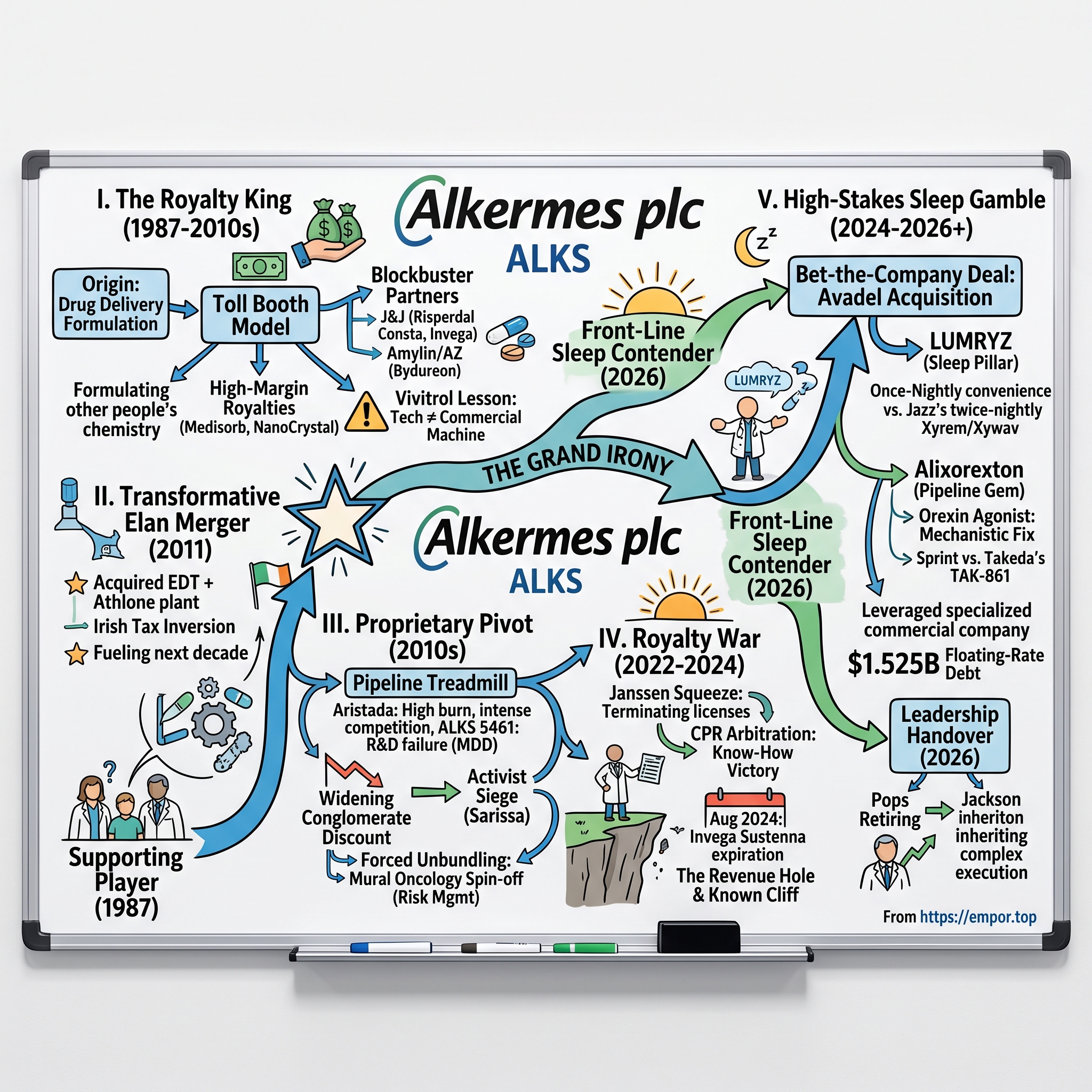
Alkermes plc: The Royalty King's High-Stakes Sleep Gamble
I. Introduction & The July 2026 Leadership Handover
It is mid-July 2026, and in a low-slung office park in Waltham, Massachusetts, one of the longest-running one-man shows in biotechnology is quietly reaching its final act. In fourteen days, on July 31, 2026, Richard Pops will vacate the chief executive's office at Alkermes plc for the first time since 1991—a 35-year run that began when he was a 28-year-old with a Stanford economics degree and no drug to his name, and that is ending with a company few of his early backers would recognize.127 On August 1, his long-time deputy, Blair Jackson, will take the keys.1
What makes this a story rather than a press release is what Jackson is inheriting. For most of Pops's tenure, Alkermes was the closest thing the drug industry had to a toll booth: it made other companies' medicines last longer, then collected high-margin royalty checks while someone else did the selling. The crown jewel was Johnson & Johnson's Invega franchise—long-acting antipsychotic injections built on Alkermes' particle-shrinking chemistry—which for years threw off hundreds of millions of dollars in near-pure-profit royalties. It was a beautiful, boring, capital-light machine.
That machine is now dismantled. The most lucrative of those royalty streams expired in August 2024, on a schedule set not by Alkermes but by an arbitration panel.22 And rather than glide gently into a lower-revenue future, Alkermes did the opposite of everything its cautious history would predict. In February 2026 it closed the largest deal in its history, buying Avadel Pharmaceuticals for roughly $2.37 billion—$21.00 a share in cash plus a contingent value right—and, for the first time ever, buried its famously conservative balance sheet under $1.525 billion of term loans.345
The prize was a single sleeping pill: LUMRYZ, a once-a-night version of a narcolepsy drug that patients had, for two decades, been forced to take twice a night—waking in darkness to swallow a second dose.24 With that purchase, a company built on formulating other people's chemistry bet its independence on becoming a sleep-medicine contender in its own right, going head to head with two of the toughest incumbents in specialty pharma: Jazz Pharmaceuticals in oxybates, and Japan's 武田薬品工業 Takeda Pharmaceutical in the emerging science of orexin.28
So the core question this episode circles is not whether Alkermes was a good business. For thirty years it mostly was. The question is whether the specific kind of good business it was—patient, royalty-fed, engineering-driven—can be converted, under a brand-new CEO carrying brand-new debt, into a very different kind of good business: a leveraged commercial sleep company that has to win share by outselling entrenched rivals, not by out-formulating them. That is a transition the graveyard of specialty pharma is littered with, and the reasons it fails are almost always the same—the acquired product ramps slower than the debt model assumed, or a competitor's next-generation drug arrives before the buyer has paid down the loan.
For a long-term investor, this is what makes Alkermes such a clean case study. Strip away the ticker and you have a company standing at the exact hinge between two identities, with the transition documented in real time across arbitration rulings, activist filings, and a leadership handoff. The facts are unusually legible; the outcome is genuinely uncertain. That combination—clear evidence, open verdict—is rarer than it sounds, and it is the whole reason this story is worth telling carefully rather than cheering or dismissing.
Here is the road we'll travel. First, the drug-formulation origins (1987–2010), when Alkermes learned to make existing molecules behave better. Then the transformative 2011 Elan merger, an Irish tax inversion that turned the company into a royalty cash machine. Then the costly proprietary treadmill of the 2010s—heavy R&D, a humiliating clinical failure, and a widening "conglomerate discount." Then the activist siege by Alex Denner's Sarissa Capital, which forced a spin-off that, in hindsight, may have saved the company. Then the extraordinary royalty war with Johnson & Johnson, fought in a private arbitration room. And finally the sleep pivot itself—the Avadel deal, LUMRYZ, and the make-or-break race in orexin. Let's start where every Alkermes story starts: with the unglamorous business of drug delivery.
 Subscribe on LinkedIn
II. The Origins of Drug Delivery: Formulating Other People's Chemistry (1987–2010)
In 1987, the fashionable thing to do in Cambridge, Massachusetts was to hunt for a molecule. The biotech gold rush spilling out of MIT and Harvard was about discovery—finding a novel protein, cloning a gene, patenting a receptor. Alkermes, founded that year by the serial entrepreneur Michael Wall—who had earlier built the antibody pioneer Centocor—set out to do something almost willfully unglamorous by comparison.7 It didn't want to discover new drugs. It wanted to take drugs that already worked and fix the thing patients hated most about them: having to take them constantly.
The insight was quietly radical. A huge share of medicine's real-world failures aren't failures of chemistry; they're failures of compliance. A schizophrenia patient who must swallow a pill every single day will, statistically, eventually stop—and relapse. So Alkermes bet its future on delivery: encapsulating existing molecules inside biodegradable polymer microspheres—its Medisorb technology—so that a single injection could release the drug slowly over weeks. Think of it as wrapping a medicine in a time-release shell that dissolves on a schedule, converting a daily chore into a monthly appointment. The molecule was somebody else's. The shell was Alkermes'.
The 28-year-old who chose the toll booth
Into this engineering shop walked Richard Pops in 1991. He was, by any conventional measure, an odd choice to run a drug company: 28 years old, no scientific PhD, a background that ran through a telecom startup and a New York firm that structured biotech financings, where he'd met Wall.7 The company had roughly 25 employees. What Pops brought wasn't bench science—it was a strategic temperament. He grasped that a platform company shouldn't gamble on the lottery of clinical discovery if it could instead sell picks and shovels to the people already running the lottery.
That philosophy produced the two royalty engines that defined Alkermes for a generation. The first was Risperdal Consta, a long-acting injectable form of Janssen's antipsychotic risperidone, built on Medisorb and approved by the FDA in October 2003 as the first long-acting atypical antipsychotic.8 Consider what that meant clinically. Schizophrenia is a disease of relapse; each psychotic break can cause lasting cognitive damage, and the single biggest predictor of relapse is a patient quietly stopping their daily pill. Convert that pill into a shot a nurse administers every two weeks, and you remove the daily decision entirely. Janssen—part of Johnson & Johnson—did the trials, the marketing, and the selling; Alkermes collected a royalty on every dose. It was the ideal arrangement for a small company: exposure to a blockbuster's upside with none of the blockbuster's commercial cost.
The second engine was Bydureon, a once-weekly version of the diabetes drug exenatide, approved in January 2012 and originally partnered through Amylin and Eli Lilly before AstraZeneca took control of the diabetes franchise.9 Same model, different disease: Alkermes supplied the release technology that stretched a twice-daily injection into a weekly one, and a large partner supplied the commercial muscle. Two therapeutic areas, two giant partners, one repeatable trick. By the late 2000s, Alkermes had quietly become one of the few drug-delivery specialists whose technology sat inside genuine blockbusters—and it had done so without ever having to build a national sales force or win a formulary fight. It was, for a company its size, an almost suspiciously good position. Which raised the obvious question: if the toll-booth model worked so well, why would Alkermes ever want to leave it?
For an investor, the beauty of this arrangement is worth dwelling on, because it explains everything the company later struggled to give up. Royalties are the highest-quality revenue in pharma: no sales force, no manufacturing risk on the finished sale, no reimbursement fights—just a percentage that lands on your income statement at nearly 100% margin. Alkermes had, in effect, engineered its way into the toll booths of other companies' highways.
The Vivitrol lesson: technology is not a commercial machine
Then, in 2006, Alkermes tried to keep a highway for itself. It launched VIVITROL, an extended-release naltrexone injection for alcohol dependence—its first fully proprietary product—later expanded to opioid dependence in October 2010.10 On paper, it was the same trick applied to addiction: one monthly shot instead of a daily pill a struggling patient would inevitably skip.
Reality was humbling. Selling an injectable addiction drug turned out to be a completely different animal from licensing microspheres to J&J. Writing a prescription is frictionless; administering a monthly depot injection is a logistical project. It meant persuading clinics to stock and administer the shot, training staff on injection protocols, fighting the deep social stigma that still surrounds addiction treatment, and grinding through the labyrinth of Medicaid reimbursement, since so many addiction patients are publicly insured and coverage decisions are made state by state. Each of those was a wall that a licensing deal with J&J had never required Alkermes to climb.
Vivitrol's ramp was correspondingly slow and expensive—early on Alkermes even leaned on a partner, Cephalon, before taking U.S. commercialization back in-house at the end of 2008.10 The drug eventually found a durable niche, particularly in the criminal-justice system, where courts and drug-treatment programs valued an injection that couldn't be diverted or skipped. But the years it took to get there taught a lesson the company would spend the next fifteen years relearning: a brilliant formulation is worthless without a specialized commercial machine to push it—and building that machine burns the very royalty cash the toll booths generate. Alkermes had proved beyond doubt that it could engineer better drugs. Whether it could sell them at the scale of its ambitions was, and remained, the open question. In 2011, a merger arrived that let the company postpone answering it—and handed it a cash engine large enough to fund a decade of trying.
III. The Transformative 2011 Merger: Elan Drug Technologies and the Tax Inversion
To understand the deal that made Alkermes rich, you have to understand the mess it was buying out of. In 2011, Ireland's Elan Corporation was a wounded giant—famous for a near-collapse accounting scandal a decade earlier and for the multiple-sclerosis drug Tysabri. Buried inside it was a formulation division, Elan Drug Technologies (EDT), that did essentially what Alkermes did: it made other people's molecules behave better. Two formulation shops, an ocean apart, doing the same thing. The logic of putting them together was almost gravitational.
On September 16, 2011, Alkermes completed the merger, paying Elan $500 million in cash and issuing 31.9 million new shares—about a 25% stake in the combined company—for a total value commonly pegged near $1 billion.11 But the structure was as important as the price. The deal was executed as a corporate inversion: the merged entity was reincorporated as Alkermes plc, domiciled in Dublin. An American drug-delivery company went to sleep in Massachusetts and woke up an Irish plc, with the lower effective tax rate that implied. It was financial engineering as much as industrial logic, and it planted the corporate flag that still flies on the ticker today.
Inversions have since become politically radioactive, but in 2011 the logic was hard to argue with from a shareholder's chair: a company earning much of its money from royalties on global drug sales could shelter far more of it under an Irish domicile than an American one. Alkermes kept its operational heart in Massachusetts—research, management, most of its people—while its legal home and tax residence moved to Dublin. For a business whose economics were built on high-margin, cross-border royalty income, the arithmetic of the inversion arguably added as much value as the technology it acquired. It was the first sign that Pops thought about Alkermes not just as a drug-delivery lab but as a capital structure to be optimized.
The secret sauce: NanoCrystal and Athlone
What Alkermes actually got for its money were two assets that would define its next decade. The first was NanoCrystal technology—a process for grinding a drug's particles down to the nanometer scale. Here's the plain-English version: many promising molecules fail not because they don't work but because the body can't absorb them; they're too poorly soluble. Shrink the particles small enough and you dramatically increase the surface area, and suddenly a compound the body used to ignore becomes usable, even in a long-acting depot injection. The second asset was a state-of-the-art sterile manufacturing plant in Athlone, Ireland, capable of the finicky, high-purity work these formulations demanded.
The reason those two assets mattered so much has a name: paliperidone palmitate. NanoCrystal was the enabling technology behind Janssen's next generation of long-acting antipsychotics—INVEGA SUSTENNA, dosed once a month; INVEGA TRINZA, once every three months; and later INVEGA HAFYERA, once every six months. Alkermes was already Janssen's partner on Risperdal Consta; now, through EDT, it also underpinned Janssen's successor franchise. The company had quietly cornered the chemistry behind the entire long-acting-injectable antipsychotic category that J&J was building into a multibillion-dollar business.
The trajectory of that franchise is worth appreciating, because it explains why the eventual loss of it was so traumatic. Each successive Invega product stretched the dosing interval further—monthly, then quarterly, then twice a year—which is exactly the direction psychiatry wanted to go, since a patient who needs an injection only twice a year is far likelier to stay on therapy than one who must show up monthly. Every extension deepened J&J's franchise and, mechanically, deepened Alkermes' royalty base. NanoCrystal wasn't just a one-time contribution; it was the platform on which an ever-longer-acting product line was built, and Alkermes rode the whole escalator up.
The cash cow, and the temptation it created
Stack it up and the picture is remarkable. By combining Medisorb and NanoCrystal under one roof, Alkermes owned the delivery technology behind two overlapping J&J blockbuster families. The Invega franchise alone grew into billions of dollars of annual sales, and Alkermes' royalty on it flowed to the bottom line at the margins only royalties enjoy. For a company of its size, this was a firehose of non-dilutive, high-quality cash.
And here is where the story turns from triumph to temptation—the pivot on which everything that follows depends. A firehose of "free" cash is one of the most dangerous things a management team can be handed, because it detaches spending from the discipline of having to raise money. When a company must go to the capital markets to fund a project, investors act as a filter, killing weak ideas before they consume cash. When the money simply arrives every quarter from someone else's blockbuster, that filter disappears, and the temptation to fund everything—including the projects that would never survive outside scrutiny—becomes enormous.
Alkermes now had a choice. It could remain a lean, cash-returning toll operator, handing the royalty stream back to shareholders. Or it could pour the Invega royalties into building the very thing Vivitrol had shown was so hard: a fully integrated, proprietary neuroscience company with its own discovery labs, its own trials, and its own sales force. Pops chose the second, more ambitious, and far riskier path—the choice of a builder rather than a steward. For the next eight years, the market would debate whether that was vision or vanity, and the answer would not be flattering.
IV. The Proprietary Pivot and the Costly R&D Treadmill (2012–2020)
Every royalty company eventually faces the same existential anxiety: royalties expire. Patents lapse, contracts end, and the toll booth someone else owns can be torn down without your permission. Flush with J&J's cash but haunted by that clock, Richard Pops spent the 2010s trying to build Alkermes an escape hatch—a portfolio of proprietary, high-margin neuroscience drugs the company would own outright. It was the right anxiety. The execution is what investors would spend years arguing about.
Aristada: winning the science, bleeding on the sales floor
The first big proprietary swing landed in October 2015, when the FDA approved ARISTADA, an extended-release injectable of aripiprazole for schizophrenia, built on a new Alkermes chemistry platform called LinkeRx.12 Clinically, it was legitimate—dosing intervals stretching up to two months, giving psychiatrists real flexibility. Commercially, it walked into a knife fight.
The long-acting antipsychotic market Aristada entered was not empty; it was owned. On one side stood Alkermes' own royalty partner, J&J, with the entire Invega family. On the other stood Japan's 大塚製薬 Otsuka Pharmaceutical with Abilify Maintena—the same aripiprazole molecule Aristada was based on, dosed monthly, and backed by Otsuka's deep psychiatry franchise. There was an awkwardness to the whole endeavor worth pausing on: in Aristada, Alkermes was now competing head-on against the very J&J franchise whose royalties funded its R&D. The toll collector had decided to build a rival highway next to its best customer's road.
Aristada was, in effect, competing with two giants who had reps in every clinic and years of relationships with prescribers, in a therapeutic area where doctors are especially conservative because their patients are fragile and stability is hard-won. To win even modest share, Alkermes had to field its own expensive sales force, medical science liaisons, and patient-assistance programs to help patients navigate coverage. The drug sold and carved out a real, if secondary, position—but the cost of selling it compressed the company's operating margins, precisely the trap Vivitrol had foreshadowed. Alkermes was learning, again and at scale, that owning the molecule means owning the burn, and that a great injectable is only as valuable as the salesforce willing to fight trench warfare for every prescriber.
ALKS 5461: the pipeline crown jewel that shattered
While Aristada ground for share, the real money and the real hopes were flowing into ALKS 5461, an oral combination of buprenorphine and samidorphan for major depressive disorder. This was to be the payoff of the whole strategy: not a reformulation of someone else's drug, but a novel neuroscience product Alkermes discovered and would own end to end, in one of the largest markets in medicine.
It became a case study in how proprietary R&D humbles even smart companies. Depression trials are notoriously treacherous—the placebo response is high and variable, and small molecules with plausible mechanisms fail all the time. ALKS 5461's Phase 3 program produced mixed, hard-to-interpret data, complicated by trial designs and novel statistical approaches that critics found aggressive, even results-shopping. When a company designs unconventional trials and then reports success on unconventional endpoints, regulators grow suspicious, and the FDA did.
On November 1, 2018, a joint advisory committee delivered a brutal verdict, voting 21 to 2 that the drug's benefit-risk profile did not support approval, with a near-unanimous finding that substantial proof of efficacy was lacking.13 An adcom vote is only advisory, but a 21-2 rejection is not a close call a company can spin. The FDA followed with a Complete Response Letter in early 2019, and the drug—years of work and hundreds of millions of dollars—was effectively dead. Layoffs followed, and so did something harder to repair: a crack in management's credibility. Wall Street began to suspect that Alkermes' scientists were better at chemistry than at picking clinical bets, and that the company had talked itself into believing a marginal asset was a blockbuster. Once a management team loses the benefit of the doubt on R&D, every subsequent pipeline dollar is scrutinized as potential waste rather than potential value—and that shift in perception is precisely what invited the reckoning that came next.
The conglomerate discount
By 2019, that suspicion had a price. Alkermes traded at a persistent discount, and the bear case was easy to articulate: the company was taking pristine, high-margin J&J royalty cash and setting fire to it in speculative, sometimes poorly designed clinical programs while carrying bloated overhead. A skeptic could look at Alkermes and see two companies stapled together—a wonderful royalty business subsidizing a value-destroying R&D habit—and conclude the whole was worth less than the parts.
That is the exact perception that draws activists the way blood draws sharks. A great cash engine, an undisciplined spender, a depressed valuation, and a long-tenured CEO whose signature bet had just imploded: to the right investor, that wasn't a troubled company. It was an opportunity. In late 2020, that investor showed up.
V. The Activist Proxy War: Sarissa Capital & The Forced Unbundling (2020–2023)
Alex Denner does not fit the caricature of the loud, table-pounding activist. A quiet PhD who spent years as a portfolio manager in Carl Icahn's orbit—where he sat on the boards of Biogen, Amgen, and Ariad and learned the biotech-activist playbook at the master's elbow—before founding Sarissa Capital Management, Denner built a reputation as a specialist in one thing: healthcare companies that generate real cash but squander it. His method is less brawl than dossier: deeply researched critiques of capital allocation, delivered with the patience of someone who understands drug development well enough to argue the science, not just the balance sheet. By that definition, Alkermes was almost designed in a laboratory to attract him—a company with an enviable cash engine, a decade of R&D disappointments, a bloated cost base, and a stock the market plainly distrusted. In late 2020, as the ALKS 5461 wound was still fresh and the shares languished, Sarissa built its position and went active.15
The thesis, in three sentences
Sarissa's argument was devastating precisely because it was simple. First, over three decades Alkermes had generated enormous cash from J&J royalties and destroyed a meaningful chunk of it through undisciplined, sprawling R&D. Second, the most egregious example was oncology—chiefly nemvaleukin alfa, an engineered version of the immune-signaling protein IL-2 that Alkermes was pushing into high-risk solid-tumor trials for ovarian cancer and mucosal melanoma. Third, a neuroscience company had no business running a cash-devouring cancer program at all, and the market's persistent discount was the direct, measurable cost of that lack of focus.
The oncology figure was the smoking gun Sarissa waved hardest. By the activist's own accounting, nemvaleukin was consuming on the order of $170 million a year, with cumulative spending on the program running past $650 million—an extraordinary sum for a single, unproven asset far outside the company's core competence.[^18] Sarissa's demand was blunt: separate the oncology business, cut corporate overhead, and refocus Alkermes exclusively on the CNS commercial portfolio that actually made money.
From détente to open warfare
Alkermes first tried to buy peace. On April 30, 2021, it signed a cooperation agreement with Sarissa—then holding around 5% and later building toward roughly 8%—that gave the fund the right to seat a director, and Sarissa's designee, the physician-scientist Cato Laurencin, joined the board that November.1516 For a while, the ceasefire held.
It didn't last. By 2023, with the discount stubbornly intact, Sarissa escalated to a full proxy contest, nominating three directors—Denner himself, Patrice Bonfiglio, and Sarah Schlesinger—and accusing management of chronic underperformance, excessive executive pay, and defensive, entrenched governance.17 Alkermes fought back hard, leaning on board refreshment and a public strategic review to argue it was already fixing itself. The vote, at the June 29, 2023 annual meeting, was a genuine cliffhanger: the influential proxy advisor ISS backed Sarissa, yet shareholders re-elected all seven of the company's nominees and rejected all three of Sarissa's.17 Management had, technically, won.
Winning the vote, losing the argument
Here is the twist that makes this chapter more than a governance footnote. Having beaten the activist at the ballot box, the board turned around and did roughly what the activist had demanded. On November 15, 2023, Alkermes completed the spin-off of its oncology business into a separate public company, Mural Oncology plc, seeded with $275 million in cash and a runway management projected into late 2025.18 The proxy fight was lost by Sarissa; the war was won.
And then came the vindication that turns a good corporate-governance story into a cautionary tale. Freed from Alkermes, Mural's lead asset failed comprehensively: nemvaleukin missed its primary overall-survival endpoint in the Phase 3 ARTISTRY-7 ovarian-cancer study and flopped in Phase 2 melanoma, leading Mural to discontinue the program entirely in April 2025.19 The company laid off roughly 90% of its staff and, in August 2025, agreed to sell itself to XOMA Royalty for about $2.035 a share—a total near $36 million, a rounding error against the hundreds of millions once poured into it.1920
For Alkermes shareholders, the counterfactual is the whole point. Had the company kept nemvaleukin in-house out of pride, it would have absorbed that entire collapse—another several hundred million dollars of neuroscience cash incinerated on a cancer drug that never worked. The spin-off, forced by an activist management had just defeated, localized the damage to a company Alkermes no longer owned.
The episode leaves an uncomfortable question hanging over management's record. On one reading, the board deserves credit for ultimately doing the right thing—separating the oncology risk before it detonated, and thereby protecting shareholders. On a less charitable reading, the whole affair is an indictment: it took an outside investor, a public campaign, and a proxy fight to force a decision that a disciplined management would have reached on its own, years and hundreds of millions of dollars earlier. Both readings can be true at once, and sophisticated investors tend to hold them together. What is not in dispute is that the Mural spin-off was one of the most valuable things Alkermes did in the decade—and that management had to be dragged into doing it. That tension between engineering brilliance and capital-allocation discipline is the real through-line of the Alkermes story, and it was about to be tested again, this time against the largest healthcare company on earth.
VI. The Janssen Royalty War: Alkermes vs. Johnson & Johnson (2022–2024)
For twenty years, the relationship between Alkermes and Johnson & Johnson had been the picture of a happy pharmaceutical marriage: Alkermes supplied the technology, J&J supplied the scale, and the royalty checks arrived like clockwork. Then, in late 2021, the checks stopped—and the partner that had made Alkermes rich tried to walk away without paying.
The squeeze
J&J's Janssen unit made a coldly logical move. It argued that because the core patents behind Invega Sustenna had expired, and because it contended it no longer relied on Alkermes' NanoCrystal technology, it could terminate the U.S. license and cease paying royalties on U.S. sales of the Invega Sustenna, Trinza, and Hafyera franchise—while continuing to manufacture and sell the products.21 In plain terms: keep using what you learned from us, stop paying us for it.
The financial threat was immediate and severe. Those U.S. royalties represented tens of millions of dollars a quarter of the highest-margin revenue Alkermes had, and their sudden freeze struck at the cash the company needed to fund its commercial and pipeline operations. The stock sagged toward multi-year lows. There is a certain corporate ruthlessness on display here worth naming: J&J is one of the largest, most sophisticated healthcare companies on earth, and it calculated that a smaller partner might rather accept a haircut than fight a multi-year legal war against a giant. For a partner to attempt this at all is itself a lesson for anyone whose business model depends on royalties: when a stream grows large enough, even a decades-long, blue-chip customer may decide the contract is worth breaking, and simply dare you to do something about it. The entire value of an intellectual-property business rests on the answer to that dare.
The counter-punch, and the know-how doctrine
Alkermes did something about it. Rather than negotiate from weakness, it commenced binding arbitration on April 19, 2022—not, as is sometimes misreported, before the International Chamber of Commerce, but under the CPR (Institute for Conflict Prevention and Resolution) rules, before a three-arbitrator panel.21 The distinction matters only to lawyers; the stakes mattered to everyone.
Alkermes' case rested on a subtle but powerful idea: that its license covered not just patents but know-how—the accumulated, proprietary practical knowledge of how to actually make these complex formulations. Patents expire; know-how doesn't lapse on a schedule, and you can't unlearn it just to stop paying for it. On May 31, 2023, the tribunal issued its final award and sided overwhelmingly with Alkermes.22 J&J could not keep using Alkermes' proprietary know-how for free. It was ordered to pay roughly $194 million in withheld royalties and interest for 2022 U.S. sales, and the ruling laid out the precise dates on which the various royalty streams would end.22
The victory that was also a countdown
But read the fine print and the win looks more like a stay of execution. The tribunal confirmed that U.S. royalties on Invega Sustenna—the largest and most lucrative piece—would terminate on August 20, 2024. Royalties on Trinza and Hafyera would run toward 2030, and royalties on the HIV therapy Cabenuva, partnered through J&J and ViiV, would continue all the way to December 31, 2036.22 Alkermes had won its money and its principle, but it had also received, in writing, the death certificate for its single richest cash stream, with the date filled in.
There is a subtler strategic point buried in the ruling, too. By grounding the case in know-how rather than patents, Alkermes established that its licensing agreements had teeth that outlasted the patent estate—a precedent that quietly reinforced the value of its remaining royalty streams, including the long-dated Cabenuva economics running to 2036. For a company whose entire original business model was licensing formulation expertise, winning the principle that expertise itself is a compensable asset was arguably as valuable as the cash award. It was a rare instance of Alkermes' legal strategy protecting the conceptual foundation of the whole enterprise.
But that is the paradox that hands the story to its final act. The arbitration was a triumph of will and lawyering, and it removed a threat that could have crippled the company. It also converted a vague fear—"the royalties will run out someday"—into a hard, calendar-marked cliff. When August 20, 2024 arrived and the Invega Sustenna checks stopped for good, Alkermes faced a revenue hole it had known about for over a year, with the mature commercial portfolio unable to grow fast enough to fill it. A management team could respond to a known cliff in one of two ways: shrink gracefully into a smaller, cash-returning company, or swing hard for a new growth engine. Pops chose to swing—and the decision would be the most consequential of his entire tenure.
VII. Operational Streamlining and the Sleep Medicine Leap (2024–2026)
Numbers tell the first part of the story bluntly. In fiscal 2025, the first full year without U.S. Invega Sustenna royalties, Alkermes' total revenue fell to about $1.48 billion, down from roughly $1.56 billion the year before.6 For most companies a 5% revenue decline is a bad quarter's headline; for Alkermes it was the visible edge of the cliff the arbitration had drawn on the calendar. The pristine royalty cash was gone, and what remained had to stand on its own.
The three pillars holding up the house
Strip out the royalties and Alkermes in 2025 rested on three proprietary commercial products, each telling a different story about the company. VIVITROL, the addiction injectable, generated $467.9 million—mature, cash-generative, and slow-growing, the reliable but tired workhorse.6 ARISTADA contributed $370.0 million—a steady performer in the brutal schizophrenia-injectable market, but essentially flatlining, its growth long since capped by J&J and Otsuka.6
The genuine bright spot was LYBALVI, the oral combination of olanzapine and samidorphan approved in mid-2021 and launched that October, which reached $346.7 million in 2025.614 Its clinical pitch is elegant. Olanzapine is one of the most effective antipsychotics ever made and one of the most avoided, because it causes severe weight gain—patients on it can gain dozens of pounds, which drives them to quit and drives clinicians to prescribe less-effective alternatives. Alkermes' insight was that samidorphan, the same opioid antagonist it had tried to build a depression drug around, appeared to blunt olanzapine's weight gain when co-administered. Paired together, the combination offered psychiatrists olanzapine's efficacy without the full metabolic penalty, and it captured real share in oral schizophrenia and bipolar I disorder.14
There's a quiet irony worth noting: the samidorphan molecule that failed so publicly in the ALKS 5461 depression program became the differentiating ingredient in Lybalvi, the company's most successful homegrown launch. It is the clearest proof that Alkermes' proprietary strategy can work when the clinical differentiation is genuine and the trial design is clean. But note what Lybalvi also reveals: even the company's biggest organic success, four years after launch, was still a mid-$300-million product—respectable, but not the kind of blockbuster that refills a royalty hole. Do the arithmetic across all three pillars and the strategic problem becomes obvious: two mature products barely growing, one good product growing but nowhere near large enough, and a royalty stream gone. Organic evolution wasn't going to close the gap fast enough. That math is what set the stage for the boldest move in the company's history.
Getting lean
So management first made the company smaller and cleaner. In May 2024, Alkermes sold the crown-jewel Athlone manufacturing facility—the NanoCrystal plant it had acquired in the Elan merger—to Novo Nordisk for about $91 million in cash.23 The symbolism was hard to miss: the plant that had made other companies' long-acting injectables, the physical heart of the old royalty model, was sold to the maker of the world's hottest weight-loss drugs. Manufacturing consolidated at Wilmington, Ohio, and Alkermes emerged a leaner, pure-play neuroscience company—shedding the very drug-delivery infrastructure on which it had been founded.
The bet-the-company deal
Then, having gotten lean, management did the opposite of cautious. On February 12, 2026, Alkermes closed its acquisition of Avadel Pharmaceuticals for roughly $2.37 billion—$21.00 per share in cash plus a contingent value right of up to $1.50 per share tied to a future FDA approval of the lead drug in idiopathic hypersomnia by the end of 2028.3 The deal itself had a competitive back-story: an earlier September 2025 agreement near $2.1 billion had been chased by a surprise rival bid from Lundbeck, forcing Alkermes to sweeten its offer to win.4
The financing is what should make any long-term investor sit up. To pay for Avadel, Alkermes drained roughly $775 million of its hard-won cash and took on $1.525 billion of term loans—structured as two tranches maturing in 2031, priced at a floating rate of SOFR plus 2.75%.35 The floating rate matters: it means Alkermes' interest bill rises and falls with prevailing rates, so the company's cost of servicing this debt is now partly hostage to central-bank policy it cannot control. For a business that had spent its entire life proudly net-cash, refusing to bet the balance sheet even at the height of the R&D-treadmill years, this was a radical inversion of identity. The royalty king that had lectured the market on its conservatism had just leveraged itself to become a sleep company.
The contingent value right embedded in the deal is a small but telling detail. By paying part of the price only if LUMRYZ eventually wins approval in idiopathic hypersomnia—a second, larger sleep indication—by the end of 2028, Alkermes bridged a valuation gap with Avadel's holders while shifting some downside risk back onto the sellers.3 It is a sensible piece of deal design. But it also signals that even Alkermes wasn't certain enough of LUMRYZ's full potential to pay for it all upfront in cash—a quiet acknowledgment that the thesis it borrowed $1.5 billion to pursue still carries real clinical and regulatory uncertainty.
There is a strategic logic to the deal that partly answers the "why now" question. Alkermes did not buy a science project; it bought an already-approved, already-selling product with a commercial team and a defined market—precisely the kind of de-risked revenue that could begin servicing debt immediately, rather than years hence. In a sense, Avadel let Alkermes short-circuit the very treadmill that had burned it for a decade: instead of discovering and commercializing a new drug from scratch, it bought a finished one. The catch is that finished products command premium prices, and Alkermes paid up—turning what had always been a technology-and-royalty company into, functionally, a leveraged buyout of a sleep franchise it now has to defend.
And the object of all this risk was a single asset: LUMRYZ, a once-nightly, extended-release formulation of sodium oxybate approved for narcolepsy.24 To understand why a formerly conservative company would mortgage itself for one sleeping pill, you have to walk onto the battlefield it was buying into.
VIII. Inside the Narcolepsy & Orexin Battlefield
Narcolepsy is one of medicine's cruelest paradoxes: a disease of sleep whose sufferers can neither stay awake by day nor rest properly by night. Beyond overwhelming daytime sleepiness, many patients suffer cataplexy—sudden losses of muscle tone, sometimes collapsing, triggered by strong emotion like laughter. It is a chronic, life-shaping condition, and for two decades, the multibillion-dollar market to treat it belonged, almost as a monopoly, to Jazz Pharmaceuticals and its oxybate franchise—first Xyrem, then the lower-sodium successor Xywav. Jazz defended that franchise ferociously, building an intricate fortress of patents, a controlled central-pharmacy distribution system, and payer contracts that made the oxybate business one of the most durable moats in specialty pharma. And for two decades, patients paid for that monopoly with their sleep.
The alarm-clock problem
Here is the indignity that Avadel's LUMRYZ was built to erase. Sodium oxybate has a short half-life, so Jazz's drugs must be taken twice a night: one dose at bedtime, and then a second dose 2.5 to 4 hours later—meaning a narcolepsy patient, of all people, has to set an alarm to wake up in the middle of the night, in the dark, to drink a second dose of medicine.24 It is as disruptive as it sounds, shredding the very sleep architecture the drug is meant to restore and driving real-world non-compliance.
LUMRYZ's proprietary extended-release design solves exactly this. It delivers the full dose in a single serving at bedtime, letting patients sleep through the night undisturbed—the FDA approved it in May 2023 as the first once-at-bedtime oxybate.24 Alkermes' commercial thesis is straightforward: point its streamlined neuroscience sales force at sleep specialists and sell LUMRYZ as a quality-of-life upgrade over a regimen that forces the sickest sleepers awake every night.
It is a genuine, patient-obvious advantage—but here it is worth separating the marketing narrative from what is actually proven. The consensus story is that once-nightly dosing is so plainly better that share will simply migrate to LUMRYZ. The reality is more contested. There are no head-to-head trials demonstrating that LUMRYZ produces better clinical outcomes than Xywav; the pitch rests on convenience, not superiority of efficacy. Jazz, meanwhile, counters with a different argument entirely—that its low-sodium Xywav is safer for the cardiovascular health of a population that takes the drug for life, since standard sodium oxybate delivers a substantial daily sodium load. And Jazz holds the entrenched incumbent's weapons: established payer contracts, a decade of prescriber relationships, and every incentive to defend a multibillion-dollar franchise through pricing and access tactics. LUMRYZ's ramp is therefore a real test of whether a genuine convenience benefit can overcome an incumbent's structural grip—not a foregone conclusion.
The real prize: replacing the missing signal
But LUMRYZ, for all its cash-generating promise, is not why Alkermes' long-term valuation lives or dies. That distinction belongs to alixorexton, formerly ALKS 2680—an organic, homegrown molecule that represents Alkermes' bet on the future of the entire field.
To grasp why the science is so exciting, start with the biology. Deep in the brain's hypothalamus, a small population of neurons—only tens of thousands of them—produces a signaling molecule called orexin (also known as hypocretin), which functions as the master switch for wakefulness, the brain's own "stay awake" signal that holds the sleep-wake system in a stable waking state during the day. In narcolepsy type 1, the most severe form, the immune system mistakenly destroys those orexin-producing neurons. The patient isn't lacking willpower or sleeping poorly by choice; they're physically missing the molecule that keeps a healthy brain awake, so the switch flickers uncontrollably between wake and sleep.
Every existing therapy attacks the problem sideways. Stimulants force alertness through unrelated pathways; oxybates consolidate nighttime sleep to reduce daytime crashes. Both manage symptoms without touching the cause. Alixorexton is designed to do something categorically different: as a selective orexin-2 receptor (OX2R) agonist, it acts as a chemical stand-in for the missing signal, walking up to the very receptors that lost their input and switching them back on.25 The analogy is a house whose main light switch has been ripped out of the wall—stimulants are like lighting candles in every room, while an orexin agonist reconnects the switch itself. If it works as hoped, it treats the root cause rather than the symptoms, and it is potentially the closest thing narcolepsy has ever had to a mechanistic fix.
The regulatory and clinical signals so far are encouraging. The FDA granted alixorexton Breakthrough Therapy designation for narcolepsy type 1 on the strength of early data—a status the agency reserves for therapies that may offer substantial improvement over existing options, and one that can accelerate review.25 The drug then produced positive Phase 2 results in both narcolepsy type 1 (the VIBRANCE-1 study) and the milder, more prevalent type 2 (VIBRANCE-2), with the once-daily oral regimen a meaningful convenience advantage.2526 On the strength of those readouts, Alkermes launched its pivotal Phase 3 "Brilliance" program.27
But encouraging is not the same as approved, and this is exactly the juncture at which Alkermes has stumbled before. ALKS 5461 also looked promising in mid-stage data before the Phase 3 program unraveled; orexin agonists as a class carry their own historical baggage, including earlier compounds from other companies flagged for liver-safety signals that ended programs. The whole point of Phase 3 is to test whether a mid-stage signal survives contact with larger, more rigorous trials—and Alkermes' own track record is a standing reminder that confident Phase 2 assets can meet Phase 3 walls. The Breakthrough label lowers some regulatory friction; it does not lower the biology's bar.
The race against Takeda
Alixorexton is not entering an empty field. It is entering a sprint that has already begun, against a far larger runner. 武田薬品工業 Takeda Pharmaceutical, Japan's biggest drugmaker, has been developing its own OX2R agonist, TAK-861 (oveporexton), and it is ahead. In July 2025, Takeda reported that both of its pivotal Phase 3 studies in narcolepsy type 1, FirstLight and RadiantLight, hit all primary and secondary endpoints, with regulatory submissions to follow.28 Takeda is, on the current timeline, likely to reach the market first.
That is the crux of the war-game. If oral orexin agonists work as hoped, they could displace both the stimulants and the oxybates—including Alkermes' own freshly acquired LUMRYZ—transforming narcolepsy from a poorly managed chronic condition into a genuinely treatable one. It would be the rare disruption where a company's late-stage pipeline (alixorexton) threatens to cannibalize the very product it just took on $1.5 billion of debt to buy (LUMRYZ). And whoever lands first, with the best efficacy and the most convenient dose, may define the category for a decade. Alkermes is betting that a once-daily, well-tolerated alixorexton can be best-in-class even as a second mover. Takeda is betting that first-mover scale and its own strong data settle the matter. Both cannot be right.
IX. Playbook: Business & Investing Lessons
Step back from the drama, and the Alkermes story turns out to be a compact seminar in several of the most durable hazards in specialty pharma. It's worth extracting the lessons deliberately, because each one recurs across the industry.
The platform-to-proprietary transition is treacherous. Using high-margin royalty cash to fund proprietary R&D is a classic biotech ambition, and it is punishingly hard to pull off. It requires a company to change its own DNA—from risk-averse engineering, where success means a formulation that works exactly as designed, to high-failure clinical development, where most bets die no matter how well designed. Alkermes was superb at the first and repeatedly humbled by the second. The skill that built the toll booths did not transfer to picking winning drugs.
"Free" cash breeds indiscipline. The J&J royalties were non-dilutive, high-margin, and reliable—which is precisely what made them dangerous. Because the money didn't have to be raised, its spending wasn't disciplined by the market, and a decade of R&D expansion culminated in the ALKS 5461 write-off and a portfolio sprawling into oncology. The lesson isn't that royalty cash is bad; it's that a cash cow with no capital-allocation discipline tends toward empire-building rather than value creation, and the market will apply a conglomerate discount until forced focus arrives.
Spin-offs are underrated risk management. The Mural Oncology carve-out is close to a textbook case. By separating its highest-risk assets—under duress, admittedly—Alkermes walled off a program that then failed almost completely. When nemvaleukin collapsed, the damage landed on Mural's shareholders, not Alkermes'. Sometimes the most value-creating thing a company can do is stop owning something before it blows up. The uncomfortable corollary is that management had to be pushed into it by an activist it had just defeated at the ballot box—discipline was imposed, not chosen.
Royalties must be defended, sometimes against your best partner. The J&J arbitration is a reminder that intellectual property is only as valuable as your willingness to enforce it. When a royalty stream grows large enough, even a two-decade blue-chip partner may try to break the contract. Alkermes' victory turned on having licensing agreements grounded in know-how, not just expiring patents, and on the nerve to litigate against a partner many times its size. A contract you won't enforce is a suggestion.
Leverage is a new kind of experiment for a company that never ran one. The final, still-unfolding lesson is about the Avadel deal itself. For decades, Alkermes' financial conservatism was a genuine asset—it meant the company never faced a forced seller's dilemma, never had a covenant dictate its strategy, never had to refinance into a hostile market. Trading that away for growth is a legitimate choice, but it is a different game, one whose failure modes (missed ramps, covenant pressure, refinancing risk) are foreign to the muscle memory of everyone who built the company. The discipline that matters now is not R&D restraint but debt-paydown execution—a skill Alkermes has never had to demonstrate. Whether a management culture forged in a net-cash world can operate a leveraged balance sheet is the open experiment the next few years will grade.
Taken together, these lessons frame the central tension an investor must weigh in the company that Blair Jackson now inherits.
X. Strategic Analysis & Bear vs. Bull Case
Reading the moat: Seven Powers and Five Forces
Where, concretely, does Alkermes have durable advantage, and where is it exposed? Two frameworks help cut through the narrative.
Through Hamilton Helmer's Seven Powers lens, the clearest current source of power is switching costs, and it lives in the injectable psychiatric portfolio. Once a clinic has built its administration protocols around a specific long-acting injectable—Aristada or Vivitrol—and a patient has stabilized on a monthly or bimonthly shot, both physicians and patients become deeply reluctant to switch. Stability in serious mental illness is precious and hard-won; nobody changes a working regimen casually. That inertia is a real, if unglamorous, moat around the mature portfolio.
The second potential power is a cornered resource: the intellectual property around alixorexton and its specific once-daily OX2R selectivity profile. If the Phase 3 data confirm best-in-class convenience and tolerability, that IP becomes a genuinely scarce asset in the most valuable corner of sleep medicine. The crucial word is if—a cornered resource that fails in Phase 3 is just a patent on a molecule nobody wants.
Running Porter's Five Forces over the narcolepsy market surfaces the dominant risk: the threat of substitutes, and it is severe and self-inflicted. Oral orexin agonists—Takeda's oveporexton and Alkermes' own alixorexton—loom as substitutes not just for Jazz's twice-nightly oxybates but for LUMRYZ, the once-nightly product Alkermes just borrowed heavily to acquire. Buyer power is also rising, concentrated in the specialty payers and pharmacy-benefit managers who gate access to expensive sleep drugs and can extract steep discounts. Rivalry, meanwhile, is intense and asymmetric: Jazz has every incentive to defend billions in oxybate revenue, and Takeda brings the R&D budget of Japan's largest drugmaker to the orexin race. The one force working in Alkermes' favor is the threat of new entrants, which is low: developing a novel CNS drug and building a specialty sleep sales force are formidable barriers, and Alkermes already has the commercial infrastructure in place. But on balance, this is not a market with comfortable structural margins waiting to be harvested; it is a contested field where Alkermes is simultaneously incumbent and disruptor of its own product.
Management credibility: the record cuts both ways
Any honest assessment of this company has to grapple with a thirty-five-year record that resists a simple verdict. On the debit side, the ALKS 5461 saga showed a management team that talked itself into an over-optimistic view of a marginal asset and designed trials aggressive enough to draw a near-unanimous regulatory rebuke.13 The decade of R&D sprawl that drew Sarissa, and the fact that the company's single best capital-allocation decision—the Mural spin-off—had to be forced on it by an activist it had just defeated, both point to a leadership more comfortable spending its royalty windfall than disciplining it.1718 A skeptic would add that piling on $1.5 billion of floating-rate debt at the very moment of a CEO handoff is precisely the kind of aggressive, hard-to-reverse move that warrants scrutiny rather than applause.
On the credit side, the same team engineered a value-additive inversion, won a bruising arbitration against a partner many times its size, produced a genuinely differentiated success in Lybalvi, and—crucially—was ultimately willing to shed oncology and sell Athlone rather than cling to legacy assets.112223 The consistency of the strategic story across recent filings and calls has improved markedly since the activist era: the narrative is now unambiguously "focused neuroscience and sleep," not "sprawling platform." The open question the Avadel deal poses is whether that hard-won discipline survives contact with a leveraged, high-stakes bet—or whether the company has simply swapped R&D empire-building for M&A empire-building, financed this time with debt instead of royalty cash.
The bull case
The optimistic path is coherent. LUMRYZ, riding its once-nightly advantage, takes meaningful share from Jazz's twice-nightly franchise and drives 2026 revenue toward the high end of management's $1.73–1.84 billion guidance, throwing off strong operating cash flow.6 Lybalvi keeps climbing its adoption curve toward true blockbuster scale as the go-to weight-sparing antipsychotic. Alixorexton clears Phase 3 with a best-in-class profile and beats Takeda where it can—on the convenience of a once-daily oral pill—establishing Alkermes as a durable leader in sleep. And under an operations-focused Jackson, the company channels its surging cash flow into rapidly retiring the $1.525 billion term loan, converting a scary balance sheet into a virtuous deleveraging story. In this world, the Avadel gamble looks like the boldest and best capital-allocation decision in Alkermes' history.
The bear case
The pessimistic path is equally coherent, and it starts with the debt. The $1.525 billion loan, at a floating rate, sharply narrows the company's margin for error; if LUMRYZ's ramp underwhelms or rates stay elevated, the capital structure turns from tool into anchor, and a company that spent its life net-cash finds itself managing to its lenders.5 Jazz, defending a franchise worth billions, does not roll over—it fights with aggressive payer contracting, pricing, and litigation to slow LUMRYZ at every turn. Takeda's oveporexton reaches the market first, locks up relationships with sleep clinics, and relegates a later alixorexton to a distant second place—while simultaneously eroding LUMRYZ from the other side. And the leadership handover itself, coming at the single most operationally demanding moment in the company's history, produces the kind of strategic drift or execution stumble that new-CEO transitions so often do. An activist looking at this setup today would ask the sharpest question of all: why pile on maximum leverage and maximum execution risk at the exact moment you're also changing the person in charge?
The one to three KPIs that actually matter
For all the moving parts, a long-term investor can track this company through a very short list.
First and most immediate: LUMRYZ quarterly net sales and patient additions. This is the engine that must service the debt; management guided LUMRYZ to $315–335 million in 2026, and whether it beats or misses that range is the single cleanest near-term read on whether the Avadel thesis is working.6 Second, and most important to the long-term equity value: alixorexton's Phase 3 Brilliance readouts. Everything about Alkermes' future as a sleep leader—versus a leveraged also-ran—runs through that data. Third, as the discipline check: net debt-to-EBITDA and the pace of deleveraging. For a newly leveraged company under a new CEO, the trajectory of that ratio is the truest measure of whether management is allocating capital with the discipline its history so often lacked.
Everything else—Vivitrol's maturity, Aristada's flatline, Lybalvi's grind—is context. These three numbers are the scoreboard, and they map neatly onto the three ways the story can go: LUMRYZ sales tell you whether the deal is paying for itself in the near term, the Brilliance readouts tell you whether Alkermes has a long-term future as a sleep leader or an also-ran, and the leverage ratio tells you whether the company survives the gap between the two with its independence intact. Watch those, and the noise of any single quarter matters far less.
XI. Epilogue & Outro
There is a tell buried in the February 25, 2026 earnings call, and it rewards close reading. In the prepared remarks, management painted a confident picture of a "new era of sleep medicine"—the transformation complete, the strategy set, the future bright. Then the analysts got the microphone, and the tone sharpened considerably. They pressed, repeatedly, on the two questions that hang over the whole enterprise: Why load up more than $1.5 billion in debt at the precise moment the high-margin J&J royalty cash finally evaporated? And is Richard Pops really retiring because the company is "in a demonstrably strong position," as he framed it—or is he handing Blair Jackson the keys precisely because the grinding, unglamorous work of deleveraging and out-executing Jazz and Takeda is someone else's job now?29
Management's answers were more reassuring in tone than in specificity. On leverage, executives framed the term loans as debt they expected to "pay down quickly" from business cash flow, pointing to a cash-generative 2026 profile—adjusted EBITDA guided to roughly $370–410 million—even as they acknowledged a projected GAAP net loss driven by the acquisition's accounting; notably, they declined to commit to a specific net-leverage target.629 For a company making its first serious foray into leverage, the absence of a hard deleveraging milestone is exactly the sort of thing a skeptical analyst files away. On succession, Pops called it "a very logical time" to pass the baton and praised Jackson as the partner who had been "at the helm for much of the transformation."129 Whether those are the words of a founder timing his exit to a peak of strength or to the top of the risk curve is exactly the judgment each investor now has to make.
It is worth sitting with the human dimension of this handoff, because it is unusual. Blair Jackson is not a celebrity outside hire brought in to shake things up; he joined Alkermes in 1999 and served as chief operating officer from January 2021, meaning he helped architect the very transformation he now inherits.1 Continuity of this kind cuts both ways. It lowers the risk of a jarring strategic reversal—Jackson believes in the plan because he built much of it. But it also means the new CEO owns the Avadel bet as fully as his predecessor, with none of the fresh-eyes license an outsider might use to reverse course if LUMRYZ stumbles or the orexin race turns against alixorexton. The person who must now execute the deleveraging is the same person who signed off on taking the debt.
The grand irony writes itself. Alkermes began, in a Cambridge lab in 1987, as a humble drug-delivery shop whose entire purpose was to make other companies' medicines safer and easier to take—the ultimate supporting player, collecting tolls while others took the stage. Thirty-five years later, under the only CEO most of its investors have ever known, it has become the opposite: a focused, heavily leveraged, front-line developer of its own sleep therapies, betting its balance sheet on its ability to win a market rather than to enable one. The royalty king has abdicated. What remains is a company that has traded the safety of other people's chemistry for the risk—and the potential reward—of its own. Whether Blair Jackson can execute that trade will be the next, and perhaps the most important, chapter of a story that has already run for a generation.
References
-
Alkermes Announces Planned CEO Succession — Richard Pops to Retire — Alkermes / SEC 8-K Exhibit 99.1, 2026-02-25 ↩↩↩↩
-
Alkermes long-serving CEO Richard Pops to step down — BioPharma Dive, 2026-02-25 ↩
-
Alkermes plc Completes Acquisition of Avadel Pharmaceuticals plc — BioSpace / Alkermes Press Release, 2026-02-12 ↩↩↩↩
-
After Lundbeck's surprise bid, Alkermes sweetens deal to acquire Avadel — Fierce Pharma, 2025 ↩↩
-
Alkermes plc 8-K reporting material event (term loan terms) — SEC / StockTitan, 2026 ↩↩↩
-
Alkermes Reports Fourth Quarter and Full Year 2025 Financial Results — Alkermes / SEC 8-K Exhibit 99.2, 2026-02-25 ↩↩↩↩↩↩↩
-
Alkermes and Richard Pops: The Evolution of a Company and Its Leader — Life Science Leader ↩↩↩
-
FDA Approves Risperdal Consta for Treating Schizophrenia, First Long-Acting Atypical Antipsychotic — Alkermes Press Release, 2003 ↩
-
Bydureon: First and Only Once-Weekly Type 2 Diabetes Treatment Now Available in US Pharmacies — PR Newswire, 2012 ↩
-
Alkermes Announces FDA Approval of VIVITROL for Prevention of Relapse to Opioid Dependence — Alkermes Press Release, 2010 ↩↩
-
Alkermes plc and Elan Corporation plc Announce Completion of Merger — Alkermes Press Release, 2011-09-16 ↩↩
-
FDA Approves ARISTADA for the Treatment of Schizophrenia — Alkermes Press Release, 2015-10-05 ↩
-
Alkermes Reports on Outcome of FDA Advisory Committee Meeting on ALKS 5461 for Adjunctive Treatment of MDD — PR Newswire, 2018-11-01 ↩↩
-
Alkermes Announces FDA Approval of LYBALVI for the Treatment of Schizophrenia and Bipolar I Disorder — Alkermes Press Release, 2021 ↩↩
-
Alkermes Announces Agreement with Sarissa Capital — PR Newswire, 2021-04-30 ↩↩
-
Alkermes clears activist investor Denner's Sarissa to fill board seat — Fierce Pharma, 2021 ↩
-
Alkermes Shareholders Re-Elect All Seven Company Director Nominees at 2023 Annual General Meeting — PR Newswire, 2023-06-29 ↩↩↩
-
Alkermes spins off oncology business with $275M to focus on neuroscience — BioSpace, 2023-11-15 ↩↩
-
XOMA adds fading Mural Oncology to its portfolio of struggling biotechs — Fierce Biotech, 2025 ↩↩
-
Mural Oncology Announces Entry into Agreement to be Acquired by XOMA Royalty — XOMA Press Release, 2025-08-20 ↩
-
Alkermes Commences Arbitration Related to License Agreements with Janssen Pharmaceutica — PR Newswire, 2022-04-19 ↩↩
-
Alkermes Announces Final Award in Janssen Pharmaceutica Arbitration and Provides Updated Financial Expectations — PR Newswire, 2023-05-31 ↩↩↩↩↩
-
Alkermes plc Completes Sale of Athlone, Ireland Facility to Novo Nordisk — PR Newswire, 2024-05-02 ↩↩
-
FDA Approves Once-Nightly Formulation of Sodium Oxybate (LUMRYZ) to Treat Narcolepsy — NeurologyLive, 2023 ↩↩↩↩
-
FDA Grants Orexin Agonist Alixorexton Breakthrough Therapy Designation for Narcolepsy Type 1 — NeurologyLive, 2025 ↩↩↩
-
Alkermes Announces Positive Topline Results from VIBRANCE-2 Phase 2 Study of Once-Daily Alixorexton in Narcolepsy Type 2 — PR Newswire, 2025 ↩
-
Alkermes Announces Initiation of Phase 3 Brilliance Studies of Alixorexton — Alkermes Press Release, 2025 ↩
-
Positive Results from Phase 3 Studies of Oveporexton (TAK-861) in Narcolepsy Type 1 — Takeda Press Release, 2025-07-14 ↩↩
-
Alkermes (ALKS) Q4 2025 Earnings Call Transcript — The Motley Fool, 2026-02-25 ↩↩↩
 LinkedIn
 WhatsApp
 Reddit
 Hacker News
 Email
Email Kindle
 RSS Feed
 Spotify
 Apple Podcasts
 Amazon Music
 Audible
 YouTube