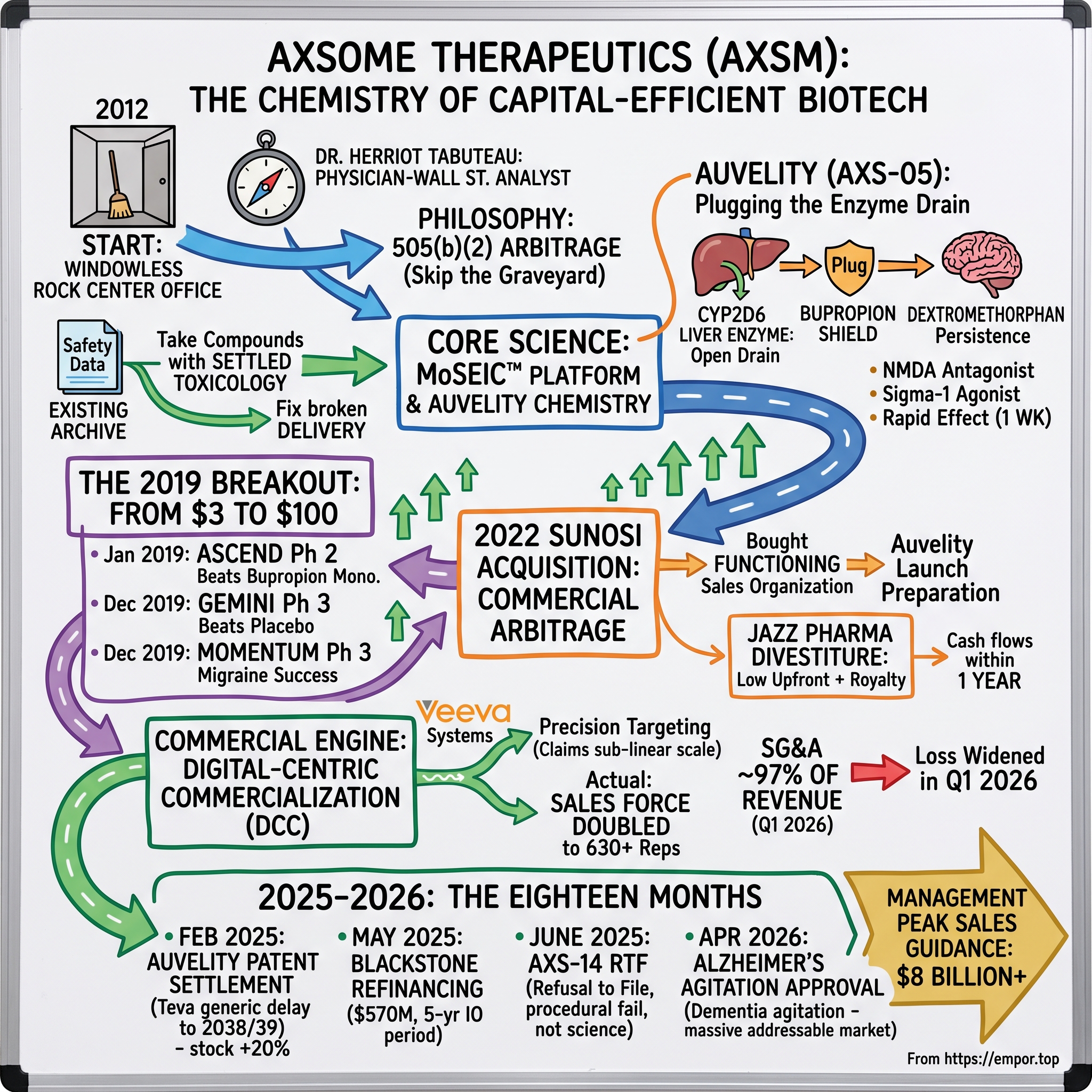
Axsome Therapeutics: The Chemistry of Capital-Efficient Biotech
I. Introduction & Episode Roadmap
In 2012, in a windowless interior office in Rockefeller Center that its occupant cheerfully called "the broom closet," a Haitian-born physician who had spent nearly two decades on Wall Street rather than in a hospital sat down to build a drug company.1 He had no venture capital. He had no laboratory. He had no molecules of his own. What he had was a medical degree from Yale, a hedge-fund analyst's instinct for mispriced risk, and a conviction that the pharmaceutical industry had been running the wrong experiment for forty years.
The wrong experiment goes like this. A biotech raises money to discover a brand-new chemical entity — a molecule no human being has ever swallowed. It spends eight years and several hundred million dollars establishing whether that molecule is safe before it can even begin to ask whether it works. Roughly nine out of ten candidates that enter human trials never reach a pharmacy shelf. The industry accepts this arithmetic as a law of nature, the price of admission to a business where the winners earn monopoly economics for a decade.
Dr. Herriot Tabuteau looked at that arithmetic the way a distressed-debt investor looks at a bankruptcy: not as a tragedy, but as a pricing error. If most of the capital destruction in drug development happens in the safety phase, and if the U.S. Food and Drug Administration maintains an enormous public archive of safety data on molecules that have already been approved, then why start from zero? Take compounds whose toxicology is already settled. Fix what is broken about them — usually not their biology but their delivery, the unglamorous question of how much drug actually reaches the organ you are aiming at. File under Section 505(b)(2) of the Federal Food, Drug, and Cosmetic Act, which permits an applicant to lean on the agency's existing findings for the underlying molecule.2 Skip the graveyard.
Fourteen years later, the results are legible in the financial statements. Axsome Therapeutics reported total revenue from its three marketed products of $638.5 million for 2025, representing 66% annual growth, and $191.2 million in the first quarter of 2026 — a 57% increase over the same quarter a year earlier.34 The company's shares closed at $221.64 on July 17, 2026, giving it a market capitalization of roughly $11.4 billion.5 Tabuteau, who beneficially owned 8,992,422 shares — 16.4% of the company — as of the 2026 proxy statement, has become one of the very few self-funded biotech founders to build a multi-billion-dollar franchise without ever taking a venture round.61
That is the story management tells, and the numbers above are real. But this episode is not a victory lap, because the more interesting question is whether the machine that produced those numbers is genuinely durable or merely early. Axsome has never earned a profit. It reported a net loss of $183.2 million in 2025 and carried an accumulated deficit of $1,306.0 million at year end — meaning the company has consumed more cash over its life than it has yet returned in any form.3 In the first quarter of 2026 it spent $185.0 million on selling, general and administrative expenses against $191.2 million of revenue, a ratio that would be alarming in almost any other industry.4 Its regulatory record includes a year-long approval delay on its flagship product and, more recently, a Refusal to File letter that suggested management had misjudged what the FDA required. And the company's core intellectual property is licensed from a private entity owned by the chief executive, who collects a royalty on every dollar of its best-selling drug.
Here is where we are going.
We start with Tabuteau himself — the Wall Street career, the immigrant biography, and the specific intellectual move that 505(b)(2) represents. Then we get into the chemistry, because Auvelity's mechanism is genuinely clever and genuinely explicable without a pharmacology degree. We revisit 2019, the year a nearly forgotten microcap became the best-performing stock in America. We examine the Sunosi acquisition, which is the single best illustration of how this management team thinks about capital. We look at the commercial engine — the "Digital-Centric Commercialization" platform — and ask whether it is a real structural advantage or a branded name for ordinary pharmaceutical sales operations. We work through the extraordinary eighteen months from February 2025 to April 2026, which contained a patent settlement that removed the company's largest existential risk, a refinancing that reset its cost of capital, a regulatory embarrassment, and a second major approval that roughly doubled the addressable market for its lead drug. And we finish with the investment spine: what has to be true for this to work from here, what would break it, and the two or three numbers that actually matter.
Let us begin with the man who decided that the graveyard was optional.
 Subscribe on LinkedIn
II. Dr. Herriot Tabuteau & the Philosophy of 505(b)(2) Arbitrage
He was born in Haiti and, by his own account, experienced significant neglect in his earliest years. At nine, he moved to Manhattan's Upper East Side with his father and adoptive mother, landing a few blocks from Memorial Sloan Kettering and Rockefeller University — two of the densest concentrations of biomedical ambition on the planet.1 It is the kind of detail that would feel invented in a novel: a child arrives from one of the poorest countries in the hemisphere and is deposited, geographically, inside the American research establishment.
He studied molecular biology and biochemistry at Wesleyan, then went to Yale School of Medicine intending to become a neurosurgeon.16 And then he did something that, in the culture of academic medicine, reads as close to apostasy. He never completed a residency. Instead he joined the healthcare investment banking group at Goldman Sachs.
What followed was not a detour but a second education. Axsome's own proxy statement traces the arc: from Goldman to Bank of America Securities as a senior research analyst covering hospital supplies, then to Kingdon Capital as its healthcare analyst, and finally to Healthco/S.A.C. Capital — the healthcare arm of one of the most aggressive hedge funds of its era, now known as HealthCor — where he was a senior analyst and partner.6 He also founded and managed his own investment vehicle, Antecip Capital LLC.6 Across roughly two decades, his job was to look at clinical data and translate it into a probability, and then to translate that probability into a position size.
This is the formative fact about Axsome, and it explains nearly everything downstream. Most biotech founders are scientists who learn finance reluctantly, late, and often badly — which is why so many biotechs are exquisite science projects with catastrophic capital structures. Tabuteau arrived with the inverse problem set. He could read a Phase 2 readout, but he had spent twenty years being paid to ask a different question than the one scientists ask. Not is this interesting? but what is the risk-adjusted return on the next dollar of capital, and who else has to be wrong for me to make money?
Apply that lens to drug development and the 505(b)(2) pathway stops looking like a regulatory footnote and starts looking like an arbitrage.
Here is the mechanic, in plain terms. The standard path to a new drug is a 505(b)(1) application, in which the sponsor owns and generates every piece of the evidentiary package — chemistry, animal toxicology, human safety, human efficacy. At the other extreme sits the abbreviated application, the ANDA, used by generic manufacturers, which requires only a demonstration that your copy behaves in the body like the original. Section 505(b)(2) is the door in between. It permits a sponsor to file a full new drug application while relying, for some portion of the safety case, on the FDA's prior findings for an already-approved active ingredient — data the sponsor neither generated nor paid for. In Axsome's own framing in its annual report, using well-characterized molecules "has allowed us to rapidly complete early clinical development of our product candidates and may reduce the risk of late-stage clinical failures due to unexpected toxicities."3
That last clause is the whole thesis compressed into eleven words. The dominant reason late-stage trials fail catastrophically — the reason a company can be worth $2 billion on Monday and $300 million on Tuesday — is that a molecule turns out to do something to the liver, or the heart, or the immune system, that nobody anticipated. If you begin with dextromethorphan, which has been sold over the counter as a cough suppressant for decades and consumed by hundreds of millions of people, that particular species of disaster is largely off the table. The risk does not vanish; it changes character. It shifts from will this poison someone to can we get enough of it into the brain, at the right concentration, for long enough, to produce a clinically meaningful effect that a placebo cannot match.
That second question is a formulation and pharmacokinetics problem. Formulation problems are cheaper, faster, and more tractable than toxicology problems. They are also, critically, the kind of problem where a small team of specialists can beat a large organization, because the answer depends on chemistry insight rather than on the brute-force capital that big pharma deploys better than anyone.
And here is the part that a pure scientist might have missed but a portfolio manager would not: the market systematically underprices this. Investors trained on binary biotech outcomes assign roughly the same discount to every clinical-stage company, because they are pattern-matching on stage rather than on the specific failure mode being taken. A company that has removed the safety risk but retained the efficacy risk should, in theory, trade at a premium to one carrying both. In 2018, Axsome traded as though it carried both and then some.
Two structural decisions from those early years deserve attention, because both still shape the company today.
The first is that Tabuteau refused venture capital. He self-funded Axsome with support from friends and family, deliberately avoiding institutional VC in order to preserve independence.1 The conventional read is that this reflects conviction. The unconventional read — equally true — is that it reflects an understanding of who captures the returns. Venture rounds in biotech are structured with liquidation preferences and anti-dilution provisions that transfer most of the upside away from founders in any scenario short of a spectacular exit. A man who had spent two decades on the other side of the table knew exactly what he was declining. The consequence is that he retained beneficial ownership of 16.4% of an $11 billion company — with a further 13.4% held directly by Antecip Capital LLC, his own vehicle — an ownership concentration essentially unheard of in commercial-stage biopharma.65 Before the IPO, he held 54.6%.6
The second decision is more complicated, and it is the one skeptics have never stopped raising. In 2012, before Axsome was public, Tabuteau entered into three exclusive license agreements between Axsome and Antecip Bioventures II LLC — an entity he owns — granting Axsome rights to develop and commercialize the patents underlying AXS-05.3 Under those agreements, Axsome pays Antecip a royalty equal to 3.0% of net sales of products containing the licensed technology, subject to reduction by up to 50% of any required payments to third parties.3
Note that number carefully, because it is frequently misstated in secondary commentary as 4.5%. The three agreements carried three different rates, set out in the original exhibits filed with the IPO prospectus: 1.5% for AXS-04, 3.0% for AXS-05 under an agreement effective April 17, 2012, and 4.5% for AXS-02.7 It is the AXS-02 rate that gets quoted — and AXS-02 is a program that no longer matters. For AXS-05, the molecule that became Auvelity and therefore the overwhelming majority of the company's economics, the rate confirmed in the 2025 annual report is 3.0%.3
What this arrangement does, structurally, is create a second and entirely separate claim on Axsome's revenue that flows to the chief executive personally, sitting alongside his equity. Equity aligns him with shareholders: he wins when they win, loses when they lose. A royalty on net sales does not work that way. A royalty is paid off the top line, before expenses, before profitability, before shareholders receive anything. It pays in full during precisely the years in which the company is losing money — which is to say, every year so far.
We will return to this in the stress test, with numbers. For now the point is narrower: Axsome was constructed from the beginning as a vehicle in which the founder's personal interests were embedded at multiple layers of the capital structure. That is a governance fact investors should hold in mind, not a scandal. It was disclosed in the IPO prospectus, it is disclosed annually, and it is overseen by an audit committee policy governing related-party transactions.3 Sophisticated investors can price it. They simply have to know it is there.
What they also had to know, in those early years, was whether the science actually worked. Which brings us to a cough suppressant, a liver enzyme, and one of the more elegant pieces of applied pharmacology in modern psychiatry.
III. The Chemistry of Auvelity and the MoSEIC™ Platform
Consider what it means to be handed a prescription for depression in, say, 2015.
Your physician selects a selective serotonin reuptake inhibitor — the class that began with Prozac in the late 1980s and has dominated ever since. You are told to take it daily and to wait. Not days. Four to six weeks, sometimes longer, before anyone can judge whether it is working. During that interval you may experience the side effects without any of the benefit. And at the end of the wait, the most likely outcome is that this particular drug does not put you into remission, at which point the process begins again with a different molecule from a broadly similar class. Clinicians call this antidepressant roulette. Patients experience it as months of their life spent as a chemistry experiment, conducted while they are least equipped to endure one.
The four-to-six-week lag is not a minor inconvenience. It is the central clinical failure of the field. Depression carries meaningful mortality risk, and the period during which a patient is waiting to find out whether treatment will help is precisely the period of greatest danger. Any drug that could compress that window would be valuable almost regardless of how its ultimate efficacy compared to existing options.
The field knew where to look. Beginning in the early 2000s, researchers established that ketamine — an anesthetic acting on the brain's glutamate system rather than its serotonin system — could lift severe depression within hours. The finding was among the most important in psychiatry in half a century. It also came with a problem: ketamine is administered by infusion or nasal spray under medical supervision, carries dissociative effects, and has abuse potential. It is not something you hand a patient in a bottle.
So the question became: is there an oral molecule that touches the same machinery?
There is, and it has been in supermarkets for decades. Dextromethorphan, the active ingredient in cough syrup, is in the brain a non-competitive antagonist at the NMDA receptor — the same glutamate receptor ketamine blocks — and an agonist at the sigma-1 receptor, which is involved in cellular stress responses and neuroplasticity.8 On paper, it looks like an oral ketamine analogue.
In practice it does almost nothing, and the reason is a liver enzyme called CYP2D6.
Here is the analogy that makes this intuitive. Imagine trying to fill a bathtub through a tap while someone stands at the drain with the plug pulled out. You can run the tap as hard as you like; the water leaves as fast as it arrives, and the tub never fills. CYP2D6 is that open drain. It metabolizes dextromethorphan with such speed and efficiency that swallowing an ordinary dose produces only a brief, low concentration in the bloodstream — nowhere near enough to sustain a meaningful effect at receptors behind the blood-brain barrier. Drinking an entire bottle of cough syrup does not fix this; it mostly produces a large quantity of metabolite and a very unpleasant evening.
Axsome's insight was not to redesign the molecule. It was to plug the drain.
Bupropion — the active ingredient in Wellbutrin, itself an approved antidepressant with more than thirty years of clinical history — happens to be a potent inhibitor of CYP2D6. Combine the two in a single tablet and bupropion occupies the enzyme, dextromethorphan is no longer cleared at the same rate, and its plasma concentrations rise and persist at levels that can actually engage the target receptors.8 One approved molecule is used as a pharmacokinetic shield for another. Neither component is new. The combination, and the specific ratio and release profile, is.
There is an additional elegance worth noting: bupropion is not a passenger. It is an antidepressant in its own right, working through norepinephrine and dopamine. So the combination is not merely a delivery trick — it is a delivery trick in which the delivery agent independently contributes therapeutic activity. This is also why the FDA requires Axsome to demonstrate what regulators call component contribution: for a combination product, the sponsor must show the combination beats each component alone, not merely placebo. As Tabuteau noted on the Q2 2025 call when asked about extending AXS-05 into smoking cessation, "in order for the product to be approved, there does need to be a demonstration of component contribution. So by definition, any registration study would involve a bupropion arm."9 That requirement is a real cost — it means running comparators most sponsors would not need — but it is also, once cleared, a durable barrier.
The FDA approved the combination as Auvelity in August 2022 for major depressive disorder in adults. Its label carries statistically significant improvement in depressive symptoms versus placebo beginning at one week — the first oral antidepressant to earn that language — and it represented the first new oral mechanism of action approved for MDD in decades.8
Axsome's second proprietary technology solves a different delivery problem, and it powers the company's third product.
Many effective molecules are poorly soluble in water. Since absorption from the gut depends on a drug dissolving before it can cross into the bloodstream, poor solubility means slow absorption — which is a nuisance for a cholesterol drug and a disqualification for a migraine drug, where the entire clinical proposition is stopping an attack in its first minutes. The MoSEIC™ platform — Molecular Solubility Enhanced Inclusion Complex — is designed to substantially increase the solubility and speed the absorption of target drug molecules.3
The intuition: think of a poorly soluble molecule as a stone dropped in water, and MoSEIC as a molecular scaffold that wraps it in a water-friendly shell so it disperses almost immediately.
Symbravo, approved by the FDA on January 30, 2025 for the acute treatment of migraine with or without aura in adults, is the payoff. It pairs meloxicam — a COX-2 preferential anti-inflammatory with a long plasma half-life but ordinarily slow absorption — with rizatriptan, a fast-acting triptan.10 The MoSEIC formulation makes meloxicam a viable migraine drug by accelerating its absorption while preserving the long half-life.10 The clinical logic is that the triptan handles onset and the reformulated meloxicam handles duration, addressing the recurrence problem that sends so many migraine patients back for a second dose.
Two platforms, one philosophy: the biology of these molecules was never the constraint. Getting them to the right place, at the right concentration, for the right length of time was. That is a solvable engineering problem, and solving engineering problems is dramatically cheaper than discovering new biology.
Elegance, however, does not automatically translate into capital. By late 2018, Axsome had the chemistry and almost nothing else.
IV. The Breakout Year: Going from $3 to $100 (2018–2019)
By the last week of December 2018, Axsome Therapeutics shares closed at $2.00 — the lowest close in the company's history. It had gone public a little over three years earlier, on November 19, 2015, pricing 5,666,667 shares at $9.00 for gross proceeds of approximately $51.0 million and net proceeds of about $45.5 million, with Ladenburg Thalmann as sole book-running manager and Cantor Fitzgerald as lead manager.11
Read that underwriting line again, because it tells you how the market regarded this company. A sole book-runner outside the biotech banking establishment, a raise barely above $50 million, and a listing that opened flat. This was not a hot deal. This was a small company with an unconventional founder and a strategy — recycling known molecules — that many specialists considered déclassé. In an industry that awards prestige for novel targets and first-in-human science, "we combined a cough suppressant with an old antidepressant" did not read as visionary. It read as derivative.
Three years later the market's verdict had hardened into something close to dismissal. At a share price under $2, Axsome's entire enterprise was valued at roughly the cost of a mid-sized Phase 3 trial. The company entered 2019 with a market capitalization of about $85 million.12 Whatever probability the market assigned to Auvelity working, it was small.
Then the data arrived.
The first readout came on January 7, 2019, when the Phase 2 ASCEND trial in major depressive disorder met its primary endpoint.13 ASCEND mattered disproportionately because of its design. It compared AXS-05 not against placebo but against bupropion alone — and delivered a 13.7-point average reduction on the standard depression rating scale versus 8.8 points for bupropion over six weeks.13 That is the harder comparison and the one that answers the skeptic's question directly: is the dextromethorphan doing anything, or have you simply repackaged Wellbutrin? Beating the active component is the evidentiary bar that separates a genuine combination product from a marketing exercise.
The stock began to move, violently. Then it kept moving, because Axsome's trial calendar happened to cluster.
On December 16, 2019, the company announced that AXS-05 had met its primary endpoint in the GEMINI Phase 3 trial, a randomized, double-blind, placebo-controlled U.S. study in which 327 adults with moderate to severe MDD received either AXS-05 or placebo over six weeks.14 Two weeks later, on December 30, AXS-07 achieved both co-primary endpoints in the MOMENTUM Phase 3 migraine trial — pain freedom at two hours and freedom from most bothersome symptom at two hours — and outperformed rizatriptan alone on several secondary measures.15 MOMENTUM had deliberately enrolled only patients with a history of inadequate response to prior acute migraine treatment, which made success in that population more commercially meaningful than a win in an easier group.
Two Phase 3 successes, in two different indications, from two different in-house programs, inside a fortnight, at a company the market had valued at $85 million eleven months earlier.
The stock rose roughly 3,600% over the course of 2019, among the very best performances of any U.S. equity that year.12
It is worth being precise about what that move did and did not prove. It did not prove the strategy was correct in some general sense. What it proved was narrower and more interesting: the market had priced Axsome as though it carried full binary biotech risk, when the specific risk it carried had a materially different shape. The safety profiles of dextromethorphan, bupropion, meloxicam, and rizatriptan were not in question. The open question was whether the formulations delivered clinically meaningful effects. When two independent programs answered yes within weeks of each other, the correlation was not coincidence — it was evidence that the underlying method had merit. One success is a data point. Two, from unrelated therapeutic areas using the same development philosophy, is a signal about process.
For a shareholder who had held from the IPO through the December 2018 low, however, the honest lesson is less inspiring. The path from $9.00 to $1.94 to over $100 involved a drawdown of nearly 80% from the offering price. Anyone whose position sizing, redemption terms, or nerve failed during 2018 captured none of what followed. This is the structural cruelty of pre-commercial biotech: correct theses and survivable ones are different things, and the market provides no mechanism for distinguishing them in real time.
Nor did the vindication run in a straight line. Axsome submitted its MDD application and received a Priority Review with a target action date of August 22, 2021 — and then, on August 20, two days before that deadline, the FDA informed the company that it had identified deficiencies precluding labeling discussions.16 Approval did not arrive until August 2022, a full year late.8 That episode is the first documented instance of a pattern that recurs: Axsome's clinical science has been consistently strong, while its management of the regulatory interface has been less reliable than its own public confidence implied. Hold that thought; it becomes relevant again in 2025.
What the 2019 rally did change, immediately and decisively, was the company's access to capital. A business that had been unable to fund its own trials could now raise on favorable terms and start thinking about the problem every clinical-stage biotech eventually faces and most handle badly: how do you actually sell a drug?
V. The Sunosi Acquisition: A Masterclass in Asset Arbitrage
Every biotech that succeeds in the clinic arrives at the same uncomfortable doorway, and most walk through it badly.
You have a drug the FDA is likely to approve. Now you need a commercial organization — sales representatives who can obtain time with psychiatrists, a market-access team that can negotiate with pharmacy benefit managers, a medical affairs function that can answer clinical questions from physicians, distribution relationships with the three wholesalers who control American drug logistics, and a patient-support apparatus for prior authorizations. Building this costs well over a hundred million dollars and takes eighteen months to two years. You must spend the money before the approval, because a sales force hired the week of approval is useless for a year.
So you are being asked to make an enormous, irreversible investment against a regulatory decision that has not happened yet. Most biotechs respond in one of two ways. They partner the drug away to a large pharmaceutical company, surrendering the majority of the economics. Or they build the infrastructure on hope and, when the approval slips or the launch disappoints, discover that they have constructed an expensive machine with nothing to run through it.
Axsome, which had just endured a year-long approval delay and therefore understood the timing risk viscerally, chose a third path.
In March 2022, Jazz Pharmaceuticals — a company then reorienting around oncology and its higher-value sleep franchise built on Xywav — announced a definitive agreement to divest Sunosi (solriamfetol) to Axsome.17 Sunosi is a dual-acting dopamine and norepinephrine reuptake inhibitor approved to improve wakefulness in adults with excessive daytime sleepiness due to narcolepsy or obstructive sleep apnea. Within Jazz it was a modest, non-core asset competing for attention against much larger priorities. The U.S. divestiture completed in May 2022, with the ex-U.S. transaction following in November.18
The headline price was $53 million in upfront cash, plus a high single-digit royalty to Jazz on U.S. net sales in current indications and a mid-single-digit royalty on future indications.17 Axsome also assumed Jazz's obligations to the drug's originators — 에스케이바이오팜 SK Biopharmaceuticals and Aerial Biopharma — including single-digit tiered royalties and commitments of up to $162.5 million tied to revenue milestones.3
Now consider what that $53 million actually purchased.
The obvious answer is a revenue stream. Sunosi generated $124.8 million of revenue for Axsome in 2025, a 32% increase over the prior year, and $33.9 million in the first quarter of 2026.34 Measured against the upfront payment alone, the asset repaid its purchase price within roughly a year of ownership. That is a strong outcome, though the royalty and milestone obligations mean the true economics are meaningfully less attractive than the $53 million headline suggests — a distinction promotional accounts of this deal routinely elide.
The less obvious answer, and the one that matters more, is that $53 million bought a functioning commercial organization roughly six months before Auvelity's approval.
By acquiring a marketed product, Axsome acquired the reason to build everything a marketed product requires. It hired sales representatives who had a drug to sell from day one, rather than sitting in training rooms awaiting an FDA decision. It negotiated with payers as a company with a product on formulary. It established wholesaler relationships and the specialty pharmacy plumbing that turns a prescription into a shipment. It learned — with real money, on a real product, at modest scale — how its own commercial machinery performed.
Then Auvelity was approved, and the representatives added a second product to the bag.
The synergy was unusually clean because the customer overlap was high. Sunosi's prescribers are sleep specialists, neurologists, pulmonologists, and primary care physicians. Auvelity's are psychiatrists and primary care physicians. These are adjacent, sometimes identical, call points. The infrastructure built for one drug largely transferred to the other.
The strategic lesson generalizes beyond biotech. Axsome did not buy Sunosi primarily for its cash flows; it bought Sunosi to convert a speculative pre-launch investment into an operating business with revenue attached. The commercial organization was going to cost roughly the same either way. Attaching it to a product that was already selling meant the capital was productive during the waiting period rather than idle — and, crucially, it meant the organization made its inevitable early mistakes on a $60-million asset rather than on the launch that would determine the company's future.
Two caveats belong here, because the deal is usually narrated without them.
The first is that Jazz was not obviously foolish. Sunosi's growth under Axsome has been real but not explosive — approximately 54,000 prescriptions in the first quarter of 2026, representing 16% year-over-year growth but a 3% sequential decline, in a wake-promoting agent market that grew 1% year-over-year and declined 5% sequentially.19 Sunosi outperformed a shrinking category, which is creditable. It did not transform into something Jazz would regret selling. Management's own peak sales guidance for the product is $300 million to $500 million annually — a good asset, not a great one.19 For a company of Jazz's scale, redeploying management attention toward larger opportunities was defensible.
The second is that a strategy Axsome executed once has not been repeated. When asked on the Q1 2026 call whether the expanded commercial infrastructure created appetite for acquiring another marketed asset, Tabuteau acknowledged the precedent and then declined: the company has "such a rich portfolio marketed assets, new indications and also a very late-stage pipeline that we have enough to focus on."19 That is a coherent answer. It is also a reminder that the Sunosi transaction was a specific solution to a specific timing problem, not a repeatable capital allocation program.
What it did enable was the launch that followed — and the commercial model management has spent four years telling investors is genuinely different.
VI. Auvelity's Launch & The Digital Centric Commercialization (DCC) Engine
The traditional pharmaceutical sales model rests on a doctrine called share of voice. The logic is brutally simple: physicians prescribe what is front of mind, so flood the field with representatives, secure as many minutes of physician attention as competitors do, and prescriptions follow. It produced the sales forces of the 1990s and 2000s — armies of thousands, catered lunches, and selling, general and administrative expenses that consumed a third of revenue.
It also produced a backlash. Physicians restricted access. Health systems banned representatives outright. The model's core assumption — that attention could be purchased at scale — degraded as the supply of purchasable attention collapsed.
In November 2020, two years before Auvelity's approval, Axsome announced a partnership with Veeva Systems to build what it branded the Digital-Centric Commercialization platform.20 The stack included Veeva's multichannel CRM as the technology foundation, the MyVeeva for Doctors application enabling compliant real-time messaging between physicians and Axsome, and Veeva Data Cloud supplying longitudinal patient data to power targeting.20 Axsome received early access to Veeva technologies in development and helped shape product direction.20
The stated premise: rather than maximizing the number of physician interactions, maximize the information content of each one. Use longitudinal prescription data to identify which physicians are actively treating patients who are failing on current therapy, and direct a smaller field force to those specific physicians at those specific moments.
Here is the honest assessment, and it requires separating two claims.
The first claim — that Auvelity's commercial performance has been strong — is well supported. Auvelity generated $507.1 million in net product sales in 2025, a 74% increase, surpassing $500 million in only its third full year from launch.3 In the first quarter of 2026 it delivered $153.2 million, up 59% year over year.4 More than 223,000 prescriptions were written in that quarter, 35% growth against an antidepressant market that grew 1% year over year and declined 1% sequentially.19
That last comparison is the one that carries analytical weight. Growing 35% in a category growing 1% means essentially all of Auvelity's volume is coming from displacement — physicians actively choosing it over alternatives — rather than from a rising tide. Cumulative unique prescribers reached approximately 60,000 since launch, with more than 5,500 new prescribers activated in the quarter.19 Prescriptions written first-line or at first switch rose to 56% of demand, and primary care physicians now represent 35% of prescribers.19 Both trends matter: earlier-line usage indicates the drug is being chosen on its merits rather than as a last resort, and primary care penetration indicates it is escaping the specialist ghetto where most novel psychiatric drugs remain trapped.
The second claim — that this performance is attributable to a structurally superior commercial model that scales sub-linearly with headcount — is where skepticism belongs, because Axsome's own disclosures have quietly undermined it.
As of mid-2025, the company operated three distinct sales forces: approximately 300 representatives on Auvelity and roughly 100 each on Sunosi and Symbravo.9 On the fourth-quarter 2025 call, management announced its third and largest Auvelity expansion, to approximately 600 representatives.21 By the first quarter of 2026 that number had become approximately 630, calling on 68,000 physician targets, with the Symbravo team expanding by about 50 to 150.19
A doubling of the Auvelity field force in roughly twelve months is not what sub-linear scaling looks like. It is what conventional pharmaceutical scaling looks like. Management's justification — preparing for a second indication with distinct call points in long-term care and geriatrics — is entirely reasonable. But the expansion is difficult to reconcile with a narrative in which digital precision substitutes for physical presence.
The expense line tells the same story. SG&A reached $570.6 million for full-year 2025, a 39% increase, driven by sales force expansion and a national direct-to-consumer television campaign launched around September 2025.321 In the first quarter of 2026, SG&A hit $185.0 million against revenue of $191.2 million — meaning the company spent roughly 97 cents on commercial and administrative activity for every dollar of product revenue it recognized.4
A national DTC television campaign is, it should be said, the single most traditional promotional tactic in the American pharmaceutical playbook. It is the opposite of digital precision targeting. Management reports it produced an inflection in new patient starts and that analysis by media channel enabled spend optimization for 2026 — plausible, and consistent with the acceleration in prescriber activation, though the company has not disclosed data permitting independent verification.21
The defensible version of the operating leverage claim is narrower than the branding implies, and CFO Nick Pizzie has stated it carefully. On the Q4 2025 call he noted that in 2025 revenues grew roughly three times faster than operating expenses.21 On the Q1 2026 call, pressed by an analyst on the SG&A ramp, he broke the increase into four components — normal first-quarter phasing, accelerated pre-launch marketing for the Alzheimer's indication, faster-than-expected field force hiring, and continued DTC spending in depression — and guided that SG&A would rise again in the second quarter but at a slower rate before leveling out.19 That is a specific, falsifiable answer rather than a deflection, and it is the kind of disclosure that makes management easier rather than harder to hold accountable.
So the fair conclusion is this. Axsome has executed a genuinely successful launch, demonstrably taking share in a stagnant category, with earlier-line adoption and prescriber breadth that suggest real clinical pull rather than promotional push. Whether "Digital-Centric Commercialization" constitutes a durable structural advantage — as opposed to competent modern pharmaceutical commercial execution with a trademark attached — remains unproven. The test will come over the next several quarters: if revenue growth substantially outpaces the now much larger cost base, the leverage argument gains real evidence. If SG&A must keep rising proportionally to sustain growth, the model is ordinary, and the company's path to profitability is longer than its narrative suggests.
Rounding out the portfolio, Symbravo generated $6.6 million in 2025 following its June launch, of which $4.1 million came in the fourth quarter — and then $4.1 million again in the first quarter of 2026.34
That flat sequential number deserves a moment, because it is easy to skim past. Prescriptions grew 36% quarter over quarter, to more than 17,000, with over 5,000 new patients starting therapy.19 Volume rose by a third; revenue did not move. The reconciliation is the gross-to-net discount, which sat in the high 70% range — meaning Axsome retains roughly a fifth to a quarter of list price.19 In a launch phase, most prescriptions are effectively bought down through copay support because payer coverage has not yet arrived, so incremental scripts convert to very little incremental revenue. Symbravo's coverage stood at approximately 57% of lives, and management announced a commercial payer contract effective in the second quarter securing roughly 17 million additional lives.19
The analytical point is that Symbravo is currently a demand-generation exercise being funded almost entirely out of Axsome's own pocket. That is a defensible investment if coverage improves and the discount compresses. It is also precisely the sort of line item that quietly consumes cash while showing negligible revenue — and management has been explicit that the discount will stay elevated in the near term.19
Which brings us to the eighteen months that reshaped the company's risk profile.
VII. Regulatory Triumphs, Speedbumps & Corporate Governance (2025–2026)
For most of Auvelity's commercial life, one question sat underneath every valuation model, and it was not about efficacy or market share.
It was this: what happens when the generics arrive?
Auvelity is composed of two molecules that have been off-patent for years. The intellectual property protecting it covers the specific combination, the formulation, the ratio, and the methods of use — not the underlying chemistry. That is a genuinely defensible estate, but it is a fundamentally different kind of fortress than a composition-of-matter patent on a novel molecule. And generic manufacturers, led by Teva, had filed an abbreviated application seeking to market a generic version before those patents expired.
Then, on February 10, 2025, Axsome announced a settlement resolving all outstanding patent litigation related to Auvelity. Under its terms, Axsome grants Teva a license to sell a generic version beginning on or after March 31, 2039 if pediatric exclusivity is granted, or on or after September 30, 2038 if it is not.223 The stock rose 20.2% on the announcement.23
The market reaction was proportionate to what had been removed. In a single agreement, the company converted its most significant existential uncertainty into a defined runway of more than thirteen years. It is difficult to overstate how much that changes the analytical exercise. A drug facing genericization in, say, 2029 is a cash-flow annuity of limited duration. A drug protected into 2038 justifies exactly the sort of expenditure Axsome is now making — building an expensive commercial organization, running additional indication trials, funding a DTC campaign — because there is enough protected life remaining to amortize the investment.
Tabuteau made this reasoning explicit on the Q1 2026 call, when an analyst asked how the IP runway shapes indication expansion. "We're in a very favorable position given that there is a very long exclusivity runway for AUVELITY and also the fact that the product is commercialized, we are not resource constrained as it relates to potentially developing for other indications."19 That is the settlement's real value: it does not merely protect existing revenue, it makes forward investment rational.
The settlement was also part of a broader pattern of litigation cleanup. In March 2025 Axsome settled with Hikma and in May 2025 with Hetero, each permitting generic Sunosi from September 1, 2040, or earlier under certain circumstances; Sandoz had withdrawn its application in August 2024.3
Three months after the Teva settlement, the company addressed its balance sheet. On May 13, 2025, Axsome entered a $570 million facility with funds managed by Blackstone Life Sciences and Blackstone Credit & Insurance, comprising a $500 million term loan and a $70 million revolver, and simultaneously retired its existing Hercules Capital term loan.24 The term loan bears interest at SOFR plus 4.75% and the revolver at SOFR plus 4.00%; the facility matures in May 2030 and carries a 60-month interest-only period.24 An additional $250 million may be drawn at the company's option, with a further $200 million available subject to Blackstone's approval.24 Concurrently, Blackstone purchased $15 million of common stock at $107.14 per share.24
Three features deserve attention. The five-year interest-only period is the most important: it means Axsome services interest without amortizing principal through the entire period during which it expects to reach cash-flow positivity, which is precisely when principal repayments would be most damaging. The accordion structure provides optionality without present dilution. And the equity purchase aligns Blackstone with the outcome rather than leaving it a pure creditor — meaningful, though $15 million against a $570 million facility is a modest alignment.
The company has drawn conservatively. At December 31, 2025, outstanding principal stood at $120.0 million under the term loans and $70.0 million under the revolver, with the effective interest rate on the term loans at 9.58% for the year; the revolver balance was repaid in full in January 2026.3 Roughly 9.6% money is not cheap capital, but for a company still posting losses it is materially better than issuing equity at a depressed price — and it is a genuine improvement over the retired facility.
Then came the reminder that this management team's regulatory judgment is not infallible.
On June 9, 2025, Axsome disclosed that the FDA had issued a Refusal to File letter for AXS-14, its esreboxetine candidate for fibromyalgia — licensed from Pfizer in 2020 — finding the application insufficiently complete to permit substantive review.253 The agency's objection was specific and structural: the second placebo-controlled trial used an eight-week primary endpoint and a flexible-dose design, whereas the first trial's twelve-week endpoint and fixed-dose design was deemed adequate.25
The nuance matters. This was not a finding that the drug does not work. Both underlying trials, conducted by Pfizer, met their primary endpoints, and the agency did not dispute those results.253 It was a finding that the trial design of one study did not satisfy the agency's evidentiary requirements — a procedural failure, not a scientific one.
Which is precisely why it is damaging to management credibility rather than to the asset. A Refusal to File is the FDA declining even to begin review. It indicates the sponsor and the agency were not aligned on what the package needed to contain before the submission was made. For a company whose entire founding thesis is superior navigation of the regulatory pathway — whose competitive edge is explicitly regulatory strategy rather than novel biology — being told the application was not reviewable is a failure at the exact point where this management claims distinctive competence. It is also, uncomfortably, the second instance of the same pattern, following the 2021 labeling deficiencies that delayed Auvelity by a year.
The response was fast. Axsome initiated the FORWARD study, dosing its first patient on January 15, 2026 — a Phase 3, double-blind, placebo-controlled, multicenter randomized withdrawal trial in which patients receive twelve weeks of open-label AXS-14 and responders are then randomized to continue 8 mg once daily or switch to placebo, with the primary endpoint being time from randomization to loss of therapeutic response.263
The randomized withdrawal design is worth understanding, because it is a recurring feature of Axsome's playbook. Instead of asking whether a drug beats placebo in an unselected population, it enrolls everyone on active drug, identifies responders, and then withdraws half of them. The question becomes: do patients who were doing well deteriorate when the drug is removed? For conditions with large placebo responses — depression, fibromyalgia, agitation — this design substantially improves the probability of a clean result. Tabuteau explained the same logic on the Q1 2026 call regarding a solriamfetol depression study: "what we wanted to make sure is that we're able to tease out and really demonstrate that this is a drug effect. And while minimizing the impact of the placebo response."19
That is sophisticated trial design. It is also, viewed skeptically, a design that answers a slightly easier question than a conventional parallel-group study — durability of effect in confirmed responders rather than efficacy in all comers. Both regulators and clinicians accept it; investors should simply understand what is and is not being demonstrated.
And then, on April 30, 2026, the largest event in the company's history since Auvelity's original approval.
The FDA approved Auvelity for the treatment of agitation associated with dementia due to Alzheimer's disease.27 The approval rested on ADVANCE-1, a five-week double-blind study in which Auvelity was statistically superior to placebo on the Cohen-Mansfield Agitation Inventory total score at week five, and ACCORD-2, a long-term randomized withdrawal trial demonstrating significantly longer time to agitation relapse.27 The program held Breakthrough Therapy designation and Priority Review — the second time Auvelity had earned both.19
The commercial logic is substantial. Alzheimer's disease affects more than 7 million Americans, and up to 76% of them experience agitation symptoms.27 Only one other product had been approved for this indication. The default treatment has been off-label atypical antipsychotics, which carry boxed warnings regarding increased mortality in elderly dementia patients — a real clinical liability that clinicians dislike and families increasingly resist.
The safety data are the differentiator. Discontinuation due to adverse reactions ran at 1.3%, identical to placebo, with dizziness and dyspepsia the most common events.2719 In a frail elderly population, tolerability is often more decisive than efficacy, because a drug that patients cannot stay on has no effect at all.
Management responded by raising peak sales guidance for Auvelity to at least $8 billion annually, split roughly evenly between depression and Alzheimer's agitation.19 When Leerink's Marc Goodman asked directly why the number had to be raised now, chief commercial officer Ari Maizel pointed to the finalized label, the size of the addressable population, proprietary physician research, the market access foundation, and the expanded field force.19 Pizzie added that the $8 billion figure contemplates Inflation Reduction Act price negotiation impact, with the earliest possible effect in 2031.19
An $8 billion peak sales estimate deserves genuine skepticism. It represents more than twelve times the company's entire 2025 revenue and would place Auvelity among the best-selling CNS drugs ever marketed. Management supplied reasoning rather than assertion, which is to their credit. But this is a forecast constructed by the party with the strongest interest in it being believed, resting on internal market research investors cannot inspect, in an indication where the one existing comparator has seen only modest uptake — a limitation an analyst raised directly and management acknowledged.21 Treat it as a statement of ambition, not a base case.
VIII. Playbook: Business, Science, & Capital Allocation Lessons
Strip away the specifics and Axsome offers three transferable lessons, each with a limitation attached.
Choose which risk you are taking. The deepest idea here is not that 505(b)(2) is a shortcut — it is that risk in any venture is composed of separable elements, and a founder can often choose which ones to hold. Axsome accepted efficacy risk, formulation risk, commercial risk, and regulatory risk. It largely declined toxicology risk. That single choice altered the entire capital profile of the business, because toxicology risk is the expensive, slow, binary component that destroys biotechs. Removing it made the company fundable by friends and family rather than by institutions demanding control.
The limitation is that the discarded risk was also a source of protection. A novel molecule with composition-of-matter protection is defended by chemistry itself. A combination of two generic molecules is defended by patent claims of narrower scope — which is exactly why the Teva litigation was so consequential and why its resolution moved the stock 20% in a day. Axsome traded development risk for intellectual property risk. That trade worked. It was not free.
Commercial infrastructure is an asset class, not an expense line. The Sunosi transaction's real insight was recognizing that a sales organization is a durable capability that can be built once and amortized across multiple products, and that the cheapest time to build it is when there is already something to sell. The near-perfect overlap between Sunosi's prescriber base and the anticipated targets for AXS-12 in narcolepsy — a point Maizel has made repeatedly — extends the same logic prospectively.919 Pizzie framed the economics plainly on the Q1 2026 call: with the sleep infrastructure already established, an AXS-12 launch would carry "a lot of synergies with AXS-12 in the current infrastructure and improving — continuing to improve the operating leverage within the P&L."19
The limitation is that overlap is a genuine constraint on strategy, not merely an enabler. A portfolio built around shared call points is a portfolio that must stay inside neuroscience. Axsome's pipeline is unusually concentrated — six candidates across ten conditions, all in psychiatry and neurology.19 That focus is a real asset. It also means that if the CNS commercial environment deteriorates — through payer pressure, a competitive entrant, or regulatory change — there is nowhere to hide.
Understand who else has a claim on the revenue. The Antecip royalty is not the largest number in Axsome's financial statements, but it is the most instructive, because it demonstrates how founders can construct claims on a public company's revenue that sit outside the equity stack entirely.
The escalation is now visible. Royalty expense to Antecip was $8.7 million in 2024 and $15.2 million in 2025 — equal to 3.0% of Auvelity net sales in each year.3 Applied to the $507.1 million of Auvelity sales recorded in 2025, that is arithmetic anyone can check.3 Applied to a hypothetical $8 billion peak, it would be roughly $240 million annually flowing to an entity owned by the chief executive, on top of whatever his equity stake is then worth.
Two observations. First, this is fully disclosed, was in place before the IPO, and is subject to audit committee oversight — investors bought in knowing.3 Second, the structure has become more deeply embedded in the company's financing: in connection with the Blackstone facility, Antecip consented to the collateral assignment of one of the license agreements under a direct agreement among Axsome, Antecip, and Blackstone, superseding an equivalent arrangement that had existed with Hercules.3 The chief executive's private entity is now a necessary counterparty to the company's senior secured debt.
That is not improper. It is a structural entanglement worth understanding, and it becomes materially more consequential if the $8 billion ambition is even partially realized.
IX. The Investor Spine: Bear vs. Bull & 7 Powers Analysis
Let us war-game this properly.
Porter's five forces. The competitive environment is more favorable than the loss statement implies. Rivalry in depression is nominally intense — dozens of generic antidepressants at pennies per dose — but Auvelity does not really compete with them on price; it competes for patients those drugs have failed, a segment defined by clinical inadequacy rather than cost. The 35% prescription growth against a 1% market makes this concrete.19 Barriers to entry are high: any competitor must run its own trials, clear FDA review, and secure formulary access. Buyer power is the genuine pressure point. American pharmacy benefit managers are among the most powerful buyers in any industry, and their leverage is visible in gross-to-net discounts of low-to-mid 50% on Auvelity and Sunosi — meaning Axsome retains under half of list price — and high 70% on Symbravo.19 Supplier power is low. Substitutes are the live threat: psychedelic-assisted therapies, next-generation glutamatergic agents, and neurostimulation are all advancing. An analyst raised psychedelics directly on the Q1 2026 call; management's answer emphasized Auvelity's novelty and clinical profile rather than addressing the substitution question head-on.19
Hamilton Helmer's 7 Powers. Three apply with varying strength.
Cornered resource is the strongest and most verifiable. Axsome holds exclusive rights to a patent estate protecting Auvelity, validated not by management assertion but by an adversary's decision to settle rather than litigate — a generic manufacturer with every incentive to press its case agreed to stay off the market until at least September 30, 2038.22 That is third-party evidence of a durable moat.
Scale economies are claimed but not yet demonstrated. The commercial infrastructure argument is directionally sound — the same field force selling two indications of the same drug to overlapping physicians is genuinely more efficient than two separate organizations, and the Alzheimer's launch tests this precisely, since roughly half of the 68,000 targets are high-volume treaters of both conditions.19 But SG&A grew 39% in 2025 and consumed nearly all of first-quarter 2026 revenue.34 The leverage is a forward-looking claim, not a demonstrated characteristic.
Switching costs are real but frequently overstated. In psychiatry, a patient stabilized on a medication that works is genuinely reluctant to change, and physicians are reluctant to disturb a stable patient. But management disclosed on the Q2 2025 call that average duration runs around six to seven prescriptions over the course of a year — meaning the typical patient is not on the drug continuously for years.9 Some achieve remission and stop; some discontinue. Real stickiness, but not the near-permanent lock-in the framing sometimes implies.
The other four powers do not meaningfully apply. There are no network effects. There is no counter-positioning — large pharmaceutical companies could pursue this strategy and increasingly do. Branding matters modestly in DTC-supported categories. Process power is essentially the DCC claim, discussed above and unproven.
The bear case, argued seriously.
Start with the cash. Axsome ended the first quarter of 2026 with $305.1 million in cash and equivalents, down from $323 million at year-end 2025, having recorded a net loss of $64.5 million in the quarter — of which $23.4 million was non-cash stock compensation.419 Management states this balance is sufficient to fund operations into cash-flow positivity, a claim it has repeated consistently across multiple calls, which counts for something.4219 But the loss widened year over year, from $59.4 million in the first quarter of 2025, despite revenue growing 57%.4 Growing revenue while growing losses is defensible during a launch investment cycle. It is not indefinitely defensible. The company retains substantial undrawn Blackstone capacity, so the practical question is not solvency but whether reaching profitability requires more leverage — and at roughly 9.6% effective cost, that debt is not cheap.3
Note also that the first quarter of 2026 missed consensus on both lines: EPS of negative $1.26 against an expected negative $0.83, and revenue of $191.2 million against roughly $193.5 million expected.28 The revenue miss was trivial; the earnings miss was not, and it was driven by the SG&A ramp.
Second, concentration. Auvelity represented roughly 80% of first-quarter 2026 product revenue.4 Anything that impairs this single asset — a safety signal in the elderly population now being treated, an unexpected patent challenge, a competitive entrant — impairs the entire company.
Third, the regulatory execution record. Two instances of misjudging FDA requirements — 2021 and 2025 — in a company whose differentiation is regulatory navigation. Neither was fatal. Both were self-inflicted. The pattern is worth tracking, particularly with multiple applications pending.
Fourth, the governance stack. An activist would note that the chief executive holds approximately 15% of the equity, collects a 3.0% royalty on the lead product's net sales through a private entity, and that this entity is now a party to the senior debt arrangements.13 Individually explicable; collectively, an unusual concentration of founder claims.
Fifth — and this is the subtlest — the pipeline has recently expanded through acquisition in ways that complicate the capital-efficiency story. In late 2025 and early 2026 Axsome acquired Baergic, in-licensed AZD7325 as AXS-17 for epilepsy, acquired deuterium-stabilized S-bupropion from DeuteRx, and added AXS-20 (balipodect), a PDE10A inhibitor previously developed by 武田薬品工業 Takeda Pharmaceutical, for schizophrenia and Tourette syndrome.3419 A first-quarter 2026 one-time acquisition-related expense contributed to R&D rising to $52.7 million.4
Each transaction may be individually sensible. But a company that built its identity on ruthless focus and capital discipline has, within about twelve months, added several early-stage programs — and balipodect is notable precisely because its Phase 2 in schizophrenia did not achieve statistical significance. Tabuteau's defense is that the trial was underpowered and showed "clear separation," with discontinuations for lack of efficacy running at roughly half of placebo patients versus low double digits on drug.19 That is a reasonable hypothesis. It is also exactly the reasoning that has preceded a great many failed Phase 3 trials. When management says, as it did on the Q1 2026 call, "we don't really need to add anything anymore," an investor is entitled to ask why so much was added so recently.19
The bull case, argued seriously.
The core asset now has two approved indications, each supported by Breakthrough Therapy designation and Priority Review, protected until at least 2038, sold by a field force with 86% coverage of lives across channels and 100% government coverage.1922 That combination — differentiated efficacy, favorable tolerability, protected exclusivity, and established access — is genuinely rare.
The pipeline provides multiple independent shots. Solriamfetol succeeded in the FOCUS Phase 3 trial in adult ADHD announced March 25, 2025, where 516 adults were randomized and the 150 mg arm produced a mean 17.7-point reduction in symptom score versus 14.3 for placebo, with response in 53.5% versus 41.3%, and onset as early as week one.29
One caveat belongs alongside that result, and it is not one the company emphasizes: the 300 mg arm was numerically better than placebo but did not reach statistical significance.29 A dose-response relationship that inverts — where the lower dose works and the higher one does not — is not disqualifying, and there are plausible tolerability explanations. But it is the kind of untidiness that regulators notice and that makes replication in a second trial genuinely uncertain rather than a formality. Pediatric trials in children and adolescents were on track to initiate in the second quarter of 2026.19 An NDA for AXS-12 in cataplexy associated with narcolepsy was submitted following the Alzheimer's approval, targeting roughly 185,000 U.S. patients, and would launch into the existing sleep infrastructure.193 Additional readouts include the ENGAGE trial in binge eating disorder in the second half of 2026 and shift work disorder in 2027.19
And the operating leverage argument, while unproven, is not unreasonable. The commercial build now largely complete was sized for a much larger revenue base. If the Alzheimer's launch performs even moderately, incremental revenue flows across a cost structure that has already absorbed the expansion.
Management credibility, assessed on behavior.
The record is genuinely mixed, which is more useful than a verdict.
On the positive side, the narrative has been remarkably consistent across calls. Peak sales guidance is stated, quantified, and repeated rather than left vague. Pizzie's ranking on the Q1 2026 call was refreshingly blunt: "revenue growth is number one. Then getting the cash flow positivity is two, and then profitability shortly thereafter."19 Guidance on trial timing has generally been met — the FORWARD trial promised for the fourth quarter of 2025 began in January 2026, a modest slip disclosed without spin.926 Management has declined to over-forecast the Alzheimer's ramp, repeatedly telling analysts it is too early rather than supplying a number that would be easier to sell than to defend.1921
On the negative side: two regulatory misjudgments; a commercial narrative emphasizing digital leverage while the field force doubled; the assertion that "we don't really need to add anything" following a burst of business development; and the timing of the $8 billion peak sales raise, announced in the same quarter as an earnings miss driven by the very spending that estimate helps justify. That sequencing may be coincidence. It is the kind of coincidence a skeptical investor should notice.
The three numbers that matter.
Auvelity total prescriptions, tracked monthly, with the Alzheimer's contribution disclosed separately. This is the company. Management has committed to sharing an approximate percentage of prescriptions attributable to Alzheimer's agitation, since standard prescription data does not break out by indication.21 Whether that disclosure actually materializes — and how promptly — is itself a test of transparency.
SG&A as a percentage of net product revenue. This is the single cleanest test of whether the commercial model is structurally advantaged or conventionally expensive. The leverage thesis requires this ratio to fall meaningfully now that the field force expansion is complete. If it plateaus near current levels through the second half of 2026, the DCC narrative should be discounted accordingly.
Cash and equivalents relative to undrawn Blackstone capacity. Not cash alone, but the relationship between the balance, quarterly burn, and remaining committed capital. This determines whether the company reaches self-funding on its own terms or on a lender's.
X. Epilogue & Outro
On the morning of May 4, 2026, after nearly ninety minutes of analyst questions ranging from long-term care formulary review cycles to receptor occupancy in schizophrenia, Herriot Tabuteau closed the call with a phrase he has used before: Axsome represents "a singular CNS platform."19
It is worth pausing on that word. Singular means both unique and single — and both meanings are load-bearing. The company is unusual: no venture capital, a founder-scientist who trained as a hedge fund analyst, a development strategy that treats the FDA's archive as a raw material, and a portfolio deliberately confined to the brain. It is also concentrated to a degree that would make most boards uncomfortable, with roughly four-fifths of revenue riding on one product whose second indication launched only weeks ago.
The next eighteen months will resolve much of this. The Alzheimer's agitation launch began in June 2026, and its trajectory will be visible in prescription data long before it appears in revenue — the first real test of whether a first-in-class, non-antipsychotic option can displace decades of off-label prescribing in a population where clinicians have been actively looking for alternatives. On July 15, 2026, the FDA accepted the AXS-12 filing for cataplexy in narcolepsy, setting a target action date of May 1, 2027 with orphan drug designation and no advisory committee currently planned.30 The ENGAGE binge eating disorder readout is expected in the second half of 2026. The FORWARD trial continues enrolling toward a readout that will determine whether the fibromyalgia program recovers from its procedural stumble. Pediatric ADHD trials, a smoking cessation pivotal study, the CLARITY depression trial, and Phase 3-enabling work on balipodect all sit in the queue. Second-quarter results are scheduled for August 10, 2026, and the company has issued no revenue guidance for the period.31
That is a great deal of activity for a company that has never turned a profit and finished its most recent quarter with $305.1 million in the bank.4
The bull and bear cases here are unusually easy to state, because they turn on the same set of facts read at different speeds. Axsome has built a genuinely differentiated product, protected it into the late 2030s, sold it successfully into a stagnant market, and just doubled its addressable population — and it has done so while spending nearly a dollar of commercial and administrative cost for every dollar of revenue, on a strategy whose claimed structural advantage remains, after four years, more asserted than demonstrated. The company either grows into the enormous infrastructure it has now built, or it discovers that the infrastructure was the point at which capital-efficient biotech stopped being capital-efficient.
There is a certain symmetry in this. A man who spent two decades pricing other people's clinical risk built a company by identifying which risks were mispriced and declining to hold them. He now runs a business whose remaining risks — commercial execution, spending discipline, concentration, and the credibility of a very large forecast — are precisely the ones that cannot be arbitraged away. They have to be earned out, quarter by quarter, in prescriptions written and dollars retained.
The chemistry, it turns out, was the easy part.
References
-
This Haiti-Born Doctor Built A $6 Billion Business Developing Drugs For Depression And Alzheimer's — Forbes, 2025-10-01 ↩↩↩↩↩↩
-
Axsome Therapeutics, Inc. Form 10-K for fiscal year ended December 31, 2025 — SEC EDGAR ↩↩↩↩↩↩↩↩↩↩↩↩↩↩↩↩↩↩↩↩↩↩↩↩↩↩↩↩
-
Axsome Therapeutics Reports First Quarter 2026 Financial Results and Provides Business Update — GlobeNewswire, 2026-05-04 ↩↩↩↩↩↩↩↩↩↩↩↩↩↩
-
Axsome Therapeutics (AXSM) Stock Overview — Stock Analysis ↩↩
-
Axsome Therapeutics, Inc. Definitive Proxy Statement (Schedule 14A) — SEC EDGAR, 2026-04-24 ↩↩↩↩↩↩
-
Exclusive License Agreement between Axsome Therapeutics, Inc. and Antecip Bioventures II LLC (AXS-05), Exhibit 10.3 to Form S-1 — SEC EDGAR, 2015-10-13 ↩
-
Axsome Therapeutics Announces FDA Approval of AUVELITY, the First and Only Oral NMDA Receptor Antagonist for the Treatment of Major Depressive Disorder in Adults — GlobeNewswire, 2022-08-19 ↩↩↩↩
-
Axsome (AXSM) Q2 2025 Earnings Call Transcript — The Motley Fool, 2025-08-04 ↩↩↩↩↩↩
-
Axsome Therapeutics Announces FDA Approval of SYMBRAVO (meloxicam and rizatriptan) for the Acute Treatment of Migraine with or without Aura in Adults — GlobeNewswire, 2025-01-30 ↩↩
-
Axsome Therapeutics Announces Pricing of Initial Public Offering — GlobeNewswire, 2015-11-19 ↩
-
4 Reasons Axsome Therapeutics Soared 3,600% in 2019 — The Motley Fool, 2019-12-31 ↩↩
-
Axsome Therapeutics Provides Year End 2018 Clinical Update — GlobeNewswire, 2018-12-27 ↩↩
-
Axsome Therapeutics Announces AXS-05 Achieves Primary Endpoint in GEMINI Phase 3 Trial in Major Depressive Disorder — GlobeNewswire, 2019-12-16 ↩
-
Axsome Therapeutics Announces AXS-07 Achieves Co-Primary and Key Secondary Endpoints in MOMENTUM Phase 3 Migraine Trial in Patients with History of Inadequate Response — GlobeNewswire, 2019-12-30 ↩
-
Axsome sees depression drug decision delayed as FDA kicks expected CRL can down the road — Fierce Biotech, 2021 ↩
-
Axsome Therapeutics to Acquire Sunosi from Jazz Pharmaceuticals, Expanding Axsome's Leadership in Neuroscience — GlobeNewswire, 2022-03-28 ↩↩
-
Jazz Pharmaceuticals Completes U.S. Divestiture of Sunosi (solriamfetol) to Axsome Therapeutics — PR Newswire, 2022-05 ↩
-
Axsome (AXSM) Q1 2026 Earnings Call Transcript — The Motley Fool, 2026-05-04 ↩↩↩↩↩↩↩↩↩↩↩↩↩↩↩↩↩↩↩↩↩↩↩↩↩↩↩↩↩↩↩↩↩↩↩↩↩
-
Axsome Therapeutics and Veeva Systems Partner to Build Axsome's Digital-Centric Commercialization Platform — Veeva Systems Investor Relations, 2020-11-04 ↩↩↩
-
Axsome (AXSM) Q4 2025 Earnings Call Transcript — The Motley Fool, 2026-02-23 ↩↩↩↩↩↩↩↩
-
Axsome Therapeutics Announces Settlement Agreement Resolving AUVELITY (dextromethorphan HBr – bupropion HCl) Patent Litigation — GlobeNewswire, 2025-02-10 ↩↩↩
-
Axsome Stock Surges 20% on Auvelity Patent Settlement With Teva — Zacks, 2025-02-11 ↩
-
Axsome Therapeutics Enters $570 Million Term Loan and Revolving Credit Facility with Blackstone — Blackstone, 2025-05-13 ↩↩↩↩
-
Axsome Therapeutics Provides Update on the New Drug Application (NDA) for AXS-14 for the Management of Fibromyalgia — GlobeNewswire, 2025-06-09 ↩↩↩
-
Axsome Therapeutics Initiates FORWARD Phase 3 Trial of AXS-14 for the Management of Fibromyalgia — GlobeNewswire, 2026-01-15 ↩↩
-
Axsome Therapeutics Announces FDA Approval of AUVELITY (dextromethorphan HBr and bupropion HCl) for the Treatment of Agitation Associated with Dementia due to Alzheimer's Disease — GlobeNewswire, 2026-04-30 ↩↩↩↩
-
Earnings call transcript: Axsome Therapeutics Q1 2026 misses forecasts — Investing.com, 2026-05-04 ↩
-
Axsome Therapeutics Announces FOCUS Phase 3 Trial of Solriamfetol in Adults with Attention Deficit Hyperactivity Disorder (ADHD) Achieves Primary Endpoint — GlobeNewswire, 2025-03-25 ↩↩
-
Axsome Therapeutics Announces FDA Acceptance of New Drug Application for AXS-12 — StockTitan, 2026-07-15 ↩
-
Axsome Therapeutics to Report Second Quarter 2026 Financial Results on August 10 — GlobeNewswire, 2026-07-14 ↩
 LinkedIn
 WhatsApp
 Reddit
 Hacker News
 Email
Email Kindle
 RSS Feed
 Spotify
 Apple Podcasts
 Amazon Music
 Audible
 YouTube