Healthcare Services Group: The 90-Day Contract
I. The $93.5 Million Test
In the first week of October 2026, a company that had spent half a century cleaning floors and planning menus in American nursing homes wrote the biggest cheque of its recent history. Healthcare Services Group, the Bensalem, Pennsylvania-based company that investors know by its ticker, HCSG, paid $93.5 million in cash for NEXDINE Hospitality, a dining and hospitality operator serving senior living and other institutional clients.1 There was no share issue and no new debt. The money came out of the company's own bank account, and management told the market that the business it was buying should bring in more than $150 million of revenue a year at margins comparable to HCSG's own.12
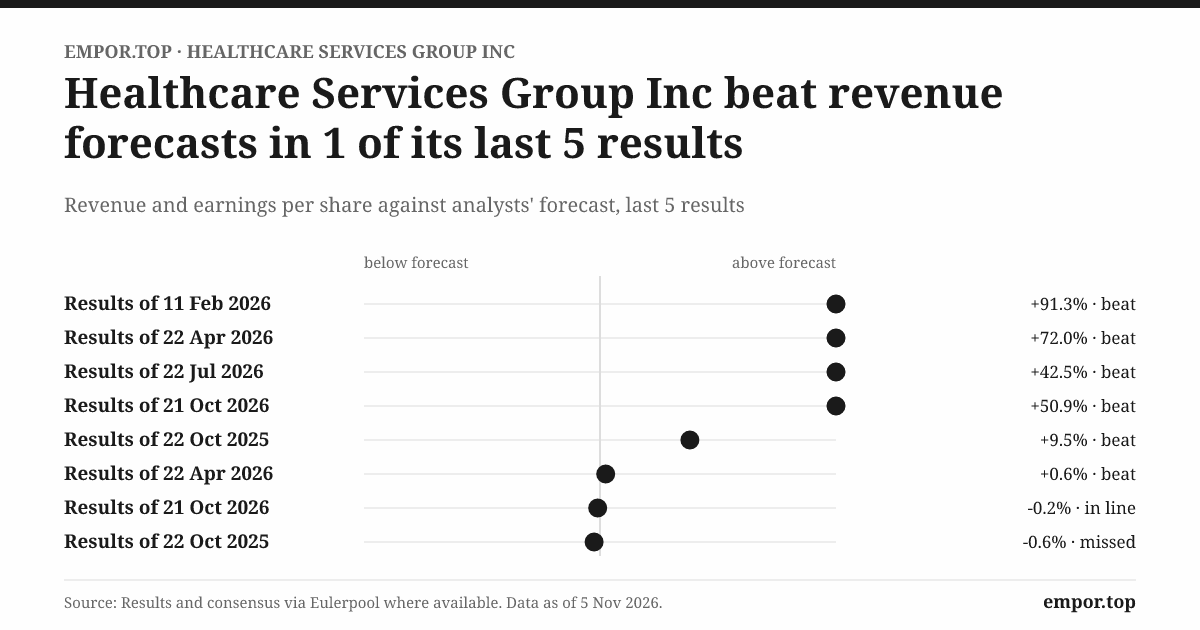
Two weeks later, on October 21, the company reported its third-quarter results, and the news arrived in two very different sizes.3 The small item was a $6.1 million release from a reserve the company had set aside against Genesis Healthcare, a former giant customer that had filed for bankruptcy the year before.34 The large item was a new promise. HCSG raised its outlook for 2027 revenue growth to the low double digits, a pace this business had not sustained since the late 2010s, and it was explicit that the figure included NEXDINE alongside a mid-single-digit organic growth target for the existing business.5
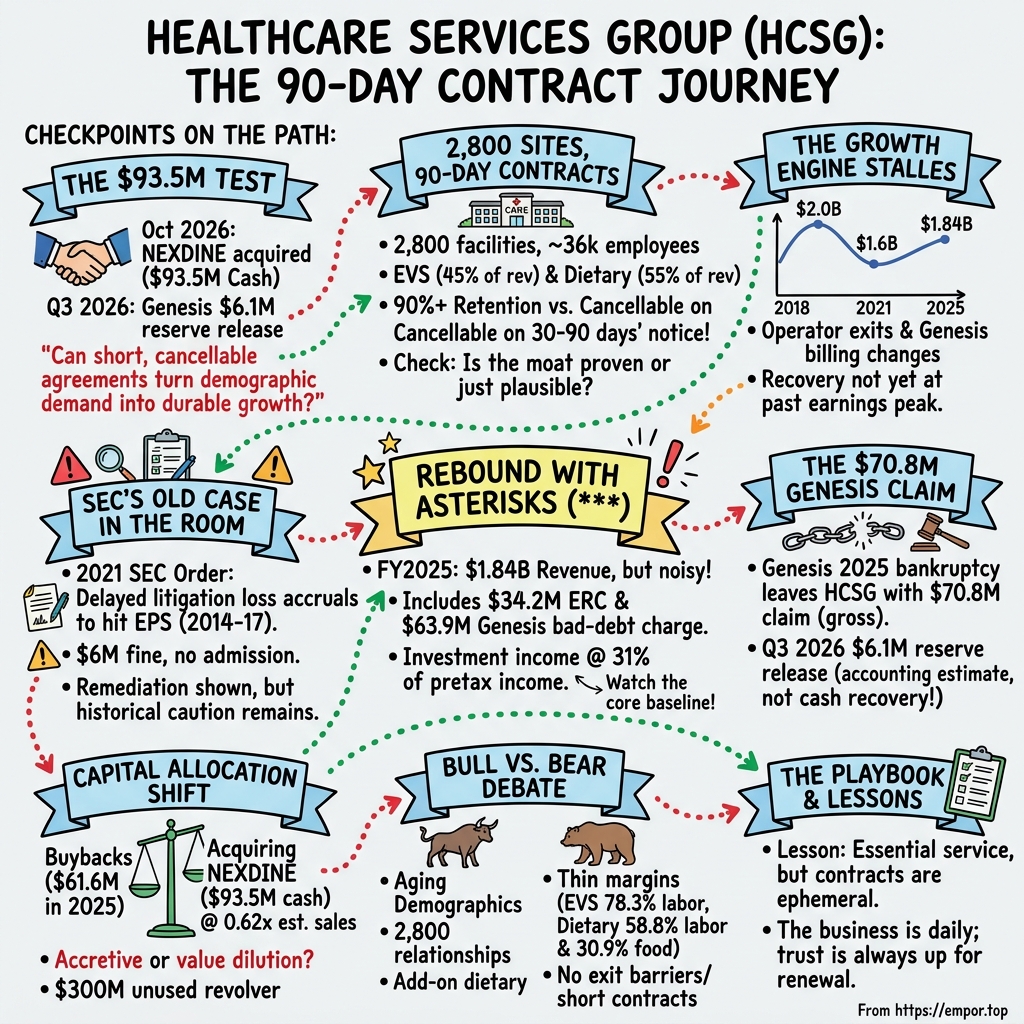
Put those two events side by side and the shape of the story appears. HCSG reported $1.84 billion of revenue in 2025, about 7% more than the year before.6 It serves roughly 2,800 facilities across the continental United States, and it describes itself as the largest provider of housekeeping, laundry and dietary management to American long-term care.6 The demographic tailwind is the one everybody can recite: the population of very old Americans is rising, and very old Americans increasingly live in places where someone else does the laundry and cooks dinner. The question is whether HCSG can turn that demand into durable growth, and whether a $93.5 million acquisition speeds the process up or merely changes the arithmetic of the headline.
The reason that question is hard is written into the company's contracts. A typical HCSG service agreement runs for an initial period of 60 to 120 days, after which either side can cancel on 30 to 90 days' notice.6 Read that again, because it is the most important sentence in this story. A company with $1.84 billion of revenue does not have a single remaining performance obligation lasting a year or more on its books.6 Every one of those 2,800 relationships is, in a legal sense, a few months from the exit. The revenue repeats because the work repeats and because customers choose to keep it, not because anyone signed a decade-long deal.
That turns the investment case into four questions, each of which this story will keep returning to. Is customer retention strong enough to overcome contracts that can be walked away from in a season? Is the margin recovery of the last two years repeatable, or is it the product of one-time credits and released reserves? Does NEXDINE earn more for shareholders than the cash it replaces, which until October was quietly earning interest? And can a leadership team that was in place when the Securities and Exchange Commission found serious accounting failures, and when the company settled in 2021, allocate capital well while continuing to rebuild trust?7
The guidance path deserves a careful reading, because it is where narrative and numbers can drift apart. On the second-quarter call in July 2026, management reaffirmed an expectation of mid-single-digit revenue growth.8 Three months later, after the NEXDINE purchase, the 2027 outlook jumped to low double digits.5 Nothing about the organic target changed in between; what changed was that the company had bought roughly 8% of a year's revenue. That is a perfectly legitimate way to grow. It is also a reason to read the new headline with two numbers in mind rather than one. If the core business delivers mid-single-digit growth and NEXDINE contributes a full year of revenue, the low-double-digit number largely follows by construction. The real test is whether both pieces show up in reported results.
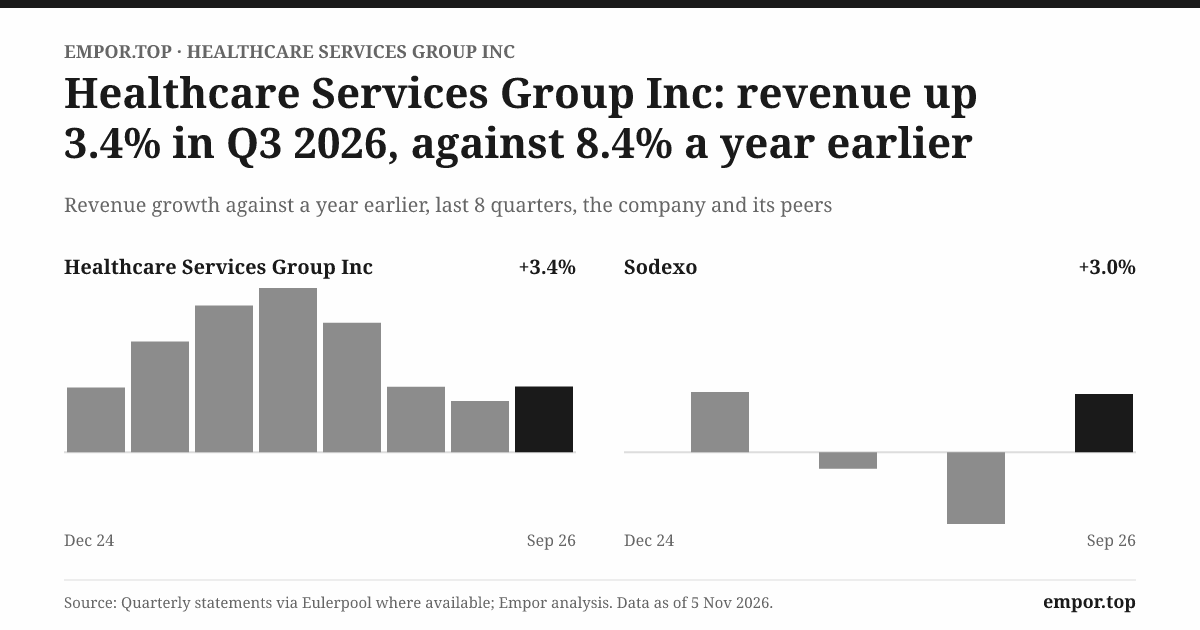
Look at 2026 itself and the challenge becomes clearer. Revenue grew at about 7.5% to 8.4% a year in the middle quarters of 2025, then slowed to between roughly 2.6% and 3.4% across the first three quarters of 2026.34 Third-quarter revenue was $480 million, up 3.4% from a year earlier.3 So the existing business was running below the mid-single-digit pace management talks about at the very moment management raised the overall outlook. That is not proof the target is wrong, since contract starts can bunch and pricing resets happen on calendars, but it is the gap the next few quarters must close.
Which brings the story back to that $6.1 million Genesis release. It is small, a little more than 1% of a single quarter's revenue, and it is an accounting estimate rather than money in the bank.4 But it is the latest entry in a long-running credit saga that cost HCSG far more than that on the way in, and it sits right next to an acquisition that will reshape every growth number the company reports next year. One item looks backward at how much risk lives inside HCSG's customer base. The other looks forward at how management intends to spend the cash that business generates. To understand either one, it helps to start where the money is actually made: inside a nursing home, at six in the morning, with a schedule to fill.
 Subscribe on LinkedIn
II. A 90-Day Contract, Repeated 2,800 Times
Picture a mid-sized skilled nursing facility somewhere in Pennsylvania or Ohio before breakfast. The residents are mostly in their eighties. The operator, which may own a handful of buildings or several hundred, is focused on nursing staff, state surveys and Medicaid rates. Down the hall, an HCSG facility manager is doing a different job. The housekeeping roster has two call-outs. The linen carts from overnight need to be sorted before the first bed changes. The food delivery is due, menus for residents on restricted diets have to be checked against the dietitian's plan, and the administrator wants to know why a family complained about a cold lunch tray yesterday. None of this is glamorous. All of it has to happen every day, and most of the people doing it used to work directly for the facility.
That last detail is the key to understanding what HCSG actually sells. When the company starts work at a new facility, it typically hires and trains the employees who were already there and installs its own on-site manager to supervise them.6 Above that facility manager sits a district manager who specializes in the service, then a director of operations, then a vice president.6 The customer is not buying mops or meals. It is buying a management system: someone to recruit, schedule, train and discipline a low-wage frontline team, to buy supplies at scale and to hold quality steady when staff turn over. About 36,000 people worked for HCSG at the end of 2025, of whom roughly 4,000 were corporate and field managers.6 That ratio, about one manager for every eight people, tells you this is a company built around supervision.
There are two businesses here, and residents experience them in a particular order. Environmental Services, or EVS, is the older one: cleaning and disinfecting rooms and common areas, and laundering bed linens, uniforms and residents' own clothing.6 It produced about 45% of 2025 revenue, or roughly $825 million.6 Dietary is the larger and newer engine. HCSG manages the facility's food purchasing, meal preparation and dietitian services, including menus built around residents' medical needs, and it served about 1,600 facilities in this segment at the end of 2025.6 Dietary made up the other 55% of revenue.6
Revenue size and profit size point in opposite directions, and that inversion matters. In the third quarter of 2026, EVS earned a segment margin of 13.3%, while Dietary earned 8.7%.3 Over the first nine months of 2026, the smaller EVS segment generated more segment profit than the larger Dietary business.4 The reason is visible in the cost lines. In EVS, labor consumed about 78.3% of segment revenue in 2025.6 In Dietary, labor took about 58.8% and food-related supplies another 30.9%.6 Housekeeping is almost pure labor management, where a good manager's scheduling skill drops straight to the margin. Dietary carries a large pass-through of groceries on which the company earns comparatively little. So when HCSG says Dietary is its growth driver, the listener should hear both halves: more revenue, at a thinner margin per dollar.
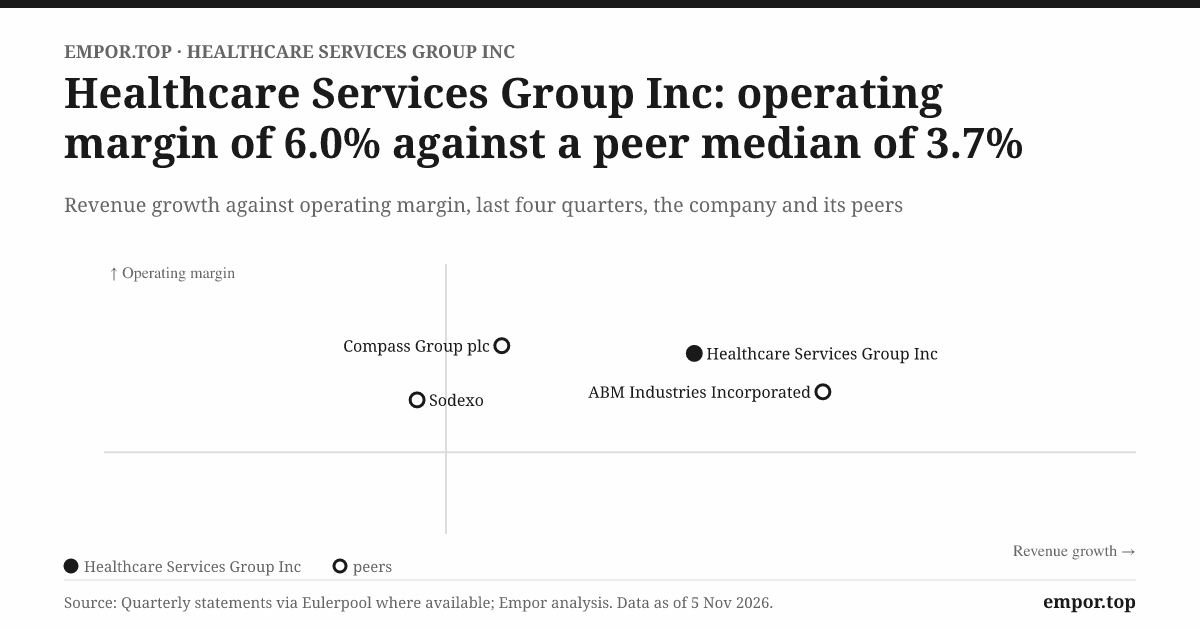
These segment margins are not the company's profit margin. They are measured before the corporate costs of running a 36,000-person organization, and the consolidated operating margin for 2025 was only 2.6%.6 That figure was distorted by a government refund and a customer bankruptcy landing in the same year, but even in good years HCSG has rarely kept more than seven or eight cents of operating profit from each dollar of revenue. This is a business of pennies, multiplied across thousands of buildings.
Who holds the power
The structure of the industry explains why the pennies are hard to keep. Start with the buyer. Facility operators can cancel on short notice and rebid the work, and many of them are financially stretched because their own revenue depends on government reimbursement.6 HCSG does not bill Medicare or Medicaid itself, but its customers do, so any squeeze on reimbursement rates travels down the hallway to the vendor.6 Then the supplier side. Although HCSG negotiates most of its food and dining-supply pricing directly with national manufacturers, it procures those products through Sysco, which tracks orders and delivers to individual facilities, and Sysco distributed more than half of HCSG's dining supplies.6 If that relationship were disrupted, the company says it would need alternative distributors and its costs could suffer.6 Labor is the largest cost of all, and in some facilities collective bargaining agreements negotiated by the customer bind HCSG as employer, so a dispute between a nursing home and its union can become HCSG's problem overnight.6 Insurance is a quieter supplier of risk. HCSG carries high-deductible programs for workers' compensation and general liability and retains a substantial portion of the losses itself, which means that a bad year for slips, back injuries or kitchen burns flows straight into cost of services, and so do the actuarial revisions to those reserves in either direction.6
And the competition? Here the filing contains a line that should reframe the whole discussion. HCSG says it competes primarily with the in-house service departments of its potential customers, and secondarily with regional and national firms.6 The biggest rival is the option of doing nothing, of the facility running its own kitchen and housekeeping staff as it always has. Among outside firms, the giants are much larger and much broader. Aramark reported about $17.4 billion of revenue for fiscal 2024, spread across stadiums, universities, prisons, hospitals and uniforms.9 ABM Industries reported about $8.7 billion for fiscal 2025, mostly from janitorial, engineering and parking services for offices, airports and other commercial property.10 Neither is a pure long-term-care specialist, and neither competes with HCSG across its whole footprint. HCSG publishes no market share figure and no direct peer cost comparison, so its claim to be the largest provider in its niche cannot be tested against an independent share number.6
What, then, is the edge? The plausible version runs like this. Running a nursing-home kitchen well is a local, operational craft, but doing it in 1,600 buildings lets HCSG spread training programs, procurement contracts, compliance know-how and management depth across a base that no single facility could afford. A new customer gets a trained manager on day one and a district manager with dozens of comparable kitchens behind them. Bundling helps too: a facility that already trusts HCSG with housekeeping is an easy candidate for dietary services, and the company has grown Dietary largely by selling into existing relationships. Contracts that allow pass-through of some cost increases give partial protection when wages or food prices rise.
The cross-selling runway is visible in the facility counts. HCSG serves about 2,800 facilities in total but provides Dietary services to only about 1,600 of them.6 Simple subtraction suggests that well over a thousand customers already let HCSG staff run their housekeeping and laundry but still run their own kitchens. Each of those is a warm lead: a buyer that knows the company's managers, has seen its compliance record and has a vendor relationship already in place. That is the strongest version of the organic growth story, because selling a second service to an existing customer is cheaper and lower-risk than winning a cold facility from a rival. The limit is that HCSG does not report how many Dietary starts came from existing EVS customers or how quickly that pool is being converted, so the runway is an inference, not a disclosed pipeline.
Sticky service, short paper
Now test that edge against the contract. Management said on the third-quarter call that client retention was above 90%.5 The 10-K is careful to say the company has "historically had a favorable customer retention rate," while acknowledging that many agreements are cancellable on short notice.6 Both can be true. A facility that switches housekeeping vendors faces real disruption: a transition of staff, a new manager learning the building, the risk of a bad state survey during the handover. That friction is a switching cost, but it is a soft one. It does not appear on paper, and it does not stop a customer from walking away when it is acquired by a new operator with its own vendor list or when it simply cannot pay.
So the moat is plausible rather than proven. Retention above 90% is encouraging, but it is a company-defined statistic, published without a consistent historical series, without a dollar-weighted version and without disclosure of how many facilities left versus how many were added. The measures that would turn the claim into proof are facility wins and losses, the net change in facility count and the price increases realized on renewals. Until HCSG reports those consistently, the honest description of its competitive position is a daily operational dependency held together by service quality, not by contract.
And there is a reason to be cautious about stickiness: HCSG's own history includes a period when thousands of those cancellable agreements turned out to be cancellable in practice. The growth engine that built the company to $2 billion of revenue stalled, and the record of how it stalled is the best evidence about what the contracts are really worth.
III. The Growth Engine Stalled After 2018
For most of its life, HCSG looked like the kind of company that compounds quietly. It was incorporated in Pennsylvania in November 1976 and spent the following decades rolling out the same playbook: win a nursing home's housekeeping department, install a manager, then add laundry, then the kitchen.6 In the five years to 2018, the playbook ran at full speed. Revenue rose from about $1.3 billion in 2014 to about $2.0 billion in 2018, with growth of nearly 20% in 2017 alone.11 Net income peaked at about $88 million in 2017.11
That peak is a useful benchmark, but it is not proof of durable economics. In hindsight, some of the growth came with conditions that would not survive contact with a stressed customer base. Receivables were stretching: debtor days, a measure of how long customers take to pay, climbed from the mid-50s in 2014 and 2015 to the mid-70s by 2017.11 And a later regulatory investigation would conclude that some of the reported earnings growth in that era was flattered by accounting choices, a finding that still shadows the management team. The point for now is that the expansion was fast, the customers were fragile, and the bills were getting slower to collect.
The year the operators changed
Then, in 2019, revenue fell by about 8%.12 For a business that had been adding a tenth of its revenue every year, this was a shock, and HCSG's explanation is revealing. Part of the decline came from facilities the company chose to exit after it could not agree with new operators on terms. Nursing homes change hands frequently, and when a new owner arrived, HCSG sought accelerated payment and tighter credit terms; where the new operator refused, the company walked away.12 In other words, the short contract cut both ways. It let customers leave, and it let HCSG leave customers it judged too risky.
The second part came from Genesis Healthcare, a customer that on its own accounted for more than 15% of HCSG's revenue. Genesis changed its arrangement so that it would pay certain food suppliers directly rather than through HCSG, which removed those purchases from HCSG's reported Dietary revenue.12 That change lowered the top line without necessarily changing the profit HCSG earned for managing the kitchen. It is a reminder that in a pass-through business, revenue is partly an accounting artifact of who pays the grocer. But it also showed something about power: one customer could rearrange a large slice of HCSG's revenue with a change of billing practice.
The easy version of the next chapter is "and then COVID happened." Revenue did keep falling, by about 4% in 2020 and another 6.7% in 2021, down to about $1.6 billion.1311 But HCSG's own 2021 account does not support making the pandemic a catch-all. The company attributed the 2021 decline to fewer facilities served, census-driven reductions in staffing and purchasing, and changes to a significant customer's pricing and payment terms.13 It said COVID had no material net impact on its consolidated results that year.13 The pandemic emptied nursing-home beds and strained operators' finances, which shaped those drivers; but the more precise reading is that the contraction combined pre-existing customer exits, a customer renegotiation and lower volume per facility.
Cash told a parallel story. Operating cash flow swung from about $217 million in 2020 to roughly $37 million in 2021 and turned negative, by about $8 million, in 2022.11 In that same period the company kept paying a dividend that exceeded its earnings: dividends paid were about 129% of net income in 2021 and 185% in 2022, before the payments stopped entirely after 2022.11 A company that pays out more than it earns while its customers pay more slowly is drawing down its cushion, and HCSG eventually did the sensible thing and stopped. But it is worth remembering that the dividend, long a central part of the stock's appeal, did not survive the stall.
Revenue back, earnings not
The rebound is real but partial. Revenue returned to $1.84 billion in 2025, close to the old peak.6 Net income was $59 million, still about a third below 2017.611 Over the ten years to 2025, revenue grew at about 2.5% a year, and net profit was essentially flat, growing by about 0.2% a year.611 Even the more flattering three-year earnings growth rate, about 20% a year, starts from the trough of 2022, when net income was only about $34 million.11
Put plainly, the history narrows the growth claim rather than rejecting it. HCSG has proven it can win and keep facilities over long periods. It has not proven that this demand translates into rising profits per share across a full cycle, because the decade's evidence shows revenue recovering to the old level while earnings have not. The confirmation would be several years in which facility count, revenue and earnings rise together without unusual items doing the lifting.
The episode also sets up the credit question that dominates the next chapter. Genesis was large enough in 2019 to account for about 15.6% of HCSG's revenue.6 By 2025, after years of shrinking, it was down to about 7%.6 Investors who watched that concentration fall might have concluded the risk was fading. They were half right.
IV. The Customer That Became a $70.8 Million Claim
On July 9, 2025, Genesis Healthcare filed for Chapter 11 bankruptcy protection.614 For HCSG, the filing did not end a relationship so much as freeze a bill. At that point, HCSG was owed about $50.4 million in accounts receivable and another $20.4 million in notes receivable by Genesis, a combined gross claim of $70.8 million.6 HCSG's shares fell as the company disclosed charges tied to the bankruptcy.14
The notes receivable deserve explanation, because they are a distinctive feature of how HCSG manages its customers. When a facility falls behind, HCSG sometimes converts overdue invoices into interest-bearing promissory notes, which set out a definitive repayment plan and provide stronger evidence of the debt.6 It may also shift a struggling customer from full service to a management-only arrangement, or adjust payment terms for customers that have "in good faith" established plans to fix their cash flow.6 The company also admits that it has sometimes extended payment beyond contractual terms for customers that terminated service or were experiencing financial difficulty.6 This is the hidden half of the business model. HCSG keeps providing an essential service to customers who cannot always pay on time, and it finances them in the meantime.
From full write-down to partial release
Genesis shows how that financing works under stress. HCSG recorded a $63.9 million bad-debt charge in 2025, essentially reserving the full Genesis balance.6 That charge pushed the second quarter of 2025 to an operating loss of about $41.6 million.4 The charge was non-cash when booked; it reflected bills HCSG did not expect to collect, not money flowing out. At the end of 2025 and still at September 30, 2026, the gross Genesis receivables stood at the same $50.4 million and $20.4 million, fully reserved.4
Then, in the third quarter of 2026, the bankruptcy court approved a plan and a sale of Genesis assets, and HCSG used that new information to reduce its allowance by $6.1 million, reflecting an expected partial recovery.43 That release flowed through the income statement as lower cost of services. It is crucial to understand what it is not. It is not cash received. It is management's estimate of what a bankruptcy estate will eventually distribute, and HCSG's filing says the recovery still depends on the timing of distributions, the enforceability of claims, payments by successor notes and the market for claims.4 On the third-quarter call, management told analysts that the final distributions, the amount of allowed claims and the timing all remained unknown.5
So the scoreboard is lopsided in time. The loss arrived in full and at once. The recovery, if it comes, arrives in pieces, as estimates first and cash later, each subject to revision. A reader who sees "reserve release" and thinks "money recovered" is giving HCSG credit for a check that has not cleared.
The broader collection record improves the picture, but only modestly. Debtor days peaked at about 84 in 2023 and improved to about 67 in 2025.611 That is a genuine tightening, partly because Genesis receivables were written down, and partly because the company pressed customers harder. Away from Genesis, HCSG reported about $67.3 million of standard notes receivable at September 30, 2026, plus a relatively small $1.6 million of delinquent notes.4 Standard notes count as current when paid within 60 days of terms.4
Two details keep the improvement in perspective. First, HCSG recognizes interest on its notes only when it actually receives cash, because it does not consider collection of substantially all that interest probable.4 A lender who books interest only when paid is telling you how much it trusts its borrowers. Second, the allowance for doubtful accounts is the critical audit matter that Grant Thornton flagged in its 2025 report, which means the auditor judged it the most subjective, judgment-heavy estimate in the financial statements.6 Total bad-debt provisions rose from about $35.6 million in 2023 to about $83.1 million in 2025, with the 2025 figure equal to about 4.5% of revenue, up from 2.1% in 2023.6 Strip out the Genesis charge and 2025 still carried around $19 million of provisions, a meaningful cost against a 2.6% operating margin.
The lesson Genesis carries forward
The convenient interpretation is that Genesis was a one-off: a big customer, long troubled, finally collapsed, now mostly reserved. The record supports a narrower but more useful verdict. Genesis was a contained loss in the sense that HCSG absorbed it without borrowing, without a dividend to cut and without breaching any covenant. But it was not an isolated failure of a single risky account. It was the most visible case of a structural feature: HCSG serves operators whose revenues depend on government reimbursement and occupancy, and it is expected to keep the lights on in their kitchens even as their solvency fades. Lower customer concentration reduced the size of any single hit; it did not remove the type.6
The confirming evidence from here is cash: how much Genesis actually distributes, and how the final net recovery compares with the $70.8 million gross claim. Alongside it, debtor days and the bad-debt line outside Genesis will show whether the collection discipline of 2025 is a new standard or a cyclical reprieve. And that bad-debt line leads directly to the next puzzle, because in the same year HCSG lost $63.9 million to Genesis, a government refund handed it almost half of that back.
V. The Rebound Has Three Asterisks
Open HCSG's 2025 accounts and two numbers jump out of the same year like a pair of opposing headlines. One is a $63.9 million charge for Genesis. The other is a $34.2 million benefit from the Employee Retention Credit, a pandemic-era federal payroll tax credit that HCSG finally recognized in 2025, years after the payroll periods it related to in 2020 and 2021.6 The company booked the ERC as a reduction of its cost of services, which means it flowed directly into operating profit.6 It also recorded about $5.3 million of interest on the refunds.6
These two items explain much of the strange quarterly pattern of 2025. The second quarter showed an operating loss of about $41.6 million when the Genesis charge landed.4 The third quarter swung to an operating profit of about $49.6 million, an operating margin above 10%, which was roughly double anything the business had produced in years.4 Neither quarter described the business. One was a funeral, the other a windfall.
Taking the noise out
So what does the engine actually earn? Start with the full-year 2025 figures. HCSG reported operating profit of about $48.5 million, an operating margin of 2.6%.6 Add back the $63.9 million Genesis charge and take out the $34.2 million ERC benefit, and the adjusted figure comes to roughly $78 million, or a little over 4% of revenue. That is a back-of-the-envelope calculation, not a company figure, and it ignores smaller one-offs in both directions. But it gives a listener something to hold: the core business earned roughly four cents of operating profit on each dollar of 2025 revenue, not two and a half, and not the ten cents the third quarter of 2025 might suggest.
Even that underlying figure carried a warning. HCSG's own discussion of 2025 shows core service costs rising faster than revenue in both segments before the ERC benefit, meaning the company paid more for labor and supplies than it captured through price increases and new business.6 That is precisely the squeeze a thin-margin service company fears: a business that keeps four cents on the dollar has very little room if wages outrun billing.
The ERC story also has a tail. At September 30, 2026, another $12.3 million of ERC refunds remained deferred as a liability, pending reasonable assurance that HCSG had met the credit's conditions.4 If and when that assurance arrives, it could produce another one-time gain. Investors should expect it to flatter some future quarter and should mentally remove it when it does.
The third item is quieter but material. Investment and other income reached about $20.9 million in 2025, up from $14.3 million in 2024 and $12.9 million in 2023.6 Against pretax income of about $67.9 million, that is roughly 31% of HCSG's pretax profit.6 Some of this is genuine interest earned on the company's cash and the fixed-income portfolio its captive insurer holds to meet regulatory capital requirements.6 Some is the ERC interest. And some reflects gains on investments held to fund the deferred-compensation plan, which are matched by a corresponding expense elsewhere; excluding changes in deferred-compensation assets, investment and other income was about $13.6 million.6
This matters for two reasons. First, it means net income cannot be read as pure service economics: almost a third of the 2025 pretax figure came from the treasury, not the hallway. Second, it sets up an important point about NEXDINE. The roughly $90 million to $100 million of cash HCSG spent on the acquisition was cash that had been earning interest, so part of the deal's cost is the investment income it gives up.
What 2026 shows, and what helped
The 2026 quarters look healthier than 2025's whiplash. Operating margins ran at about 7.3%, 4.7% and 6.7% over the first three quarters.4 Third-quarter segment margins of 13.3% in EVS and 8.7% in Dietary were strong by recent standards.3 Management said that, excluding the Genesis reassessment and the prior-year ERC refund, cost of services rose only about 0.8% year over year, against revenue growth of 3.4%, which would imply real operating leverage.3
The question-and-answer session put limits on that story. On the third-quarter call, HCSG's chief financial officer, Vikas Singh, said cost of services had benefited from strong execution and from lower bad debt, while workers' compensation reserve benefits, which come from actuarial revisions to the company's self-insurance estimates, should trend toward zero over time.5 He added that, excluding bad debt and those insurance benefits, the latest cost-of-services ratio was comparable to the average of the prior three years.5 That is a revealing and admirably candid answer. It means the 2026 margin improvement was not mainly a structural step-up in how efficiently HCSG runs a kitchen or a laundry. It was mainly the absence of last year's credit losses plus favorable insurance revisions, on top of a steady core.
Singh, it is worth noting, is an outsider to the company's operating culture. He became CFO in 2024 after nearly fifteen years at Bank of America Securities, where he was a managing director in global capital markets.15 A capital-markets banker in the finance seat may help explain both the candor about normalizing items and the appetite for acquisitions that follows later in this story.
Is this a company whose profits turn into cash? Over the dozen years from 2014 through 2025, HCSG generated about $805 million of operating cash flow against about $707 million of net income, roughly 114%.611 Over the long run, that is a reassuring ratio for a business with little machinery to depreciate, and it suggests the reported profits were broadly real. But the year-to-year path was erratic. Operating cash flow was barely $7 million in 2017, swelled to about $217 million in 2020, was negative in 2022 and rebounded to about $145 million in 2025.11 Quarter-level timing still matters. Third-quarter 2026 operating cash flow was $30.2 million, but only about $20.7 million excluding the change in the payroll accrual, which moves around depending on where payday falls relative to the quarter end.3 Across the first nine months of 2026, operating cash flow was about $95.8 million.4
Capital needs are small. Capital expenditure was about $5.8 million in 2025, a third of a cent per dollar of revenue, and the company expected $5 million to $7 million in 2026, largely for equipment at new customer sites and computer systems.6 HCSG does not separately report research and development, which fits a business whose reinvestment is in people and processes, not products.6 The real reinvestment is invisible on the cash-flow statement: the cost of recruiting and training the next generation of facility and district managers, which runs through operating expenses rather than capital spending. That is why management depth, not equipment, is the scarce resource in this business, and why a period of rapid facility growth can temporarily depress margins as new managers learn new buildings. That makes the cash engine real: little capital goes in, and over long periods most of the profit comes out. The volatility comes from working capital, which in this business means customers' willingness to pay on time.
So the verdict on the rebound is that service execution and revenue growth are real, but reported earnings remain noisy. The 2025 ERC benefit, the Genesis loss and the size of investment income all distort the headline, and 2026's segment margins were helped by lower bad debt and insurance-reserve benefits that the CFO himself expects to fade. A higher operating baseline is possible but not yet established. Several clean quarters, with segment margins that hold after bad debt and insurance effects are stripped out, are what would prove it. The three measures that matter most are the segment margins excluding one-time items, the combination of bad-debt expense and debtor days, and organic facility growth and retention.
Those clean quarters matter for another reason. HCSG has a history in which reported earnings were found not to reflect economic reality, and that history happened while much of today's leadership was in the building.
VI. The SEC's Old Accounting Case Still Belongs in the Room
On August 24, 2021, the Securities and Exchange Commission published an administrative order with three names at the top: Healthcare Services Group, its former chief financial officer John C. Shea, and its controller Derya D. Warner.7 The order's subject sounded technical. Its substance was not. The SEC found that HCSG had failed to accrue for, and in some cases to disclose, losses from litigation when accounting rules required it to, and that the timing of those accruals had helped the company report earnings growth and meet analysts' consensus estimates in multiple quarters.7
The mechanism is simple enough to explain to anyone who has ever put off opening a bill. Under U.S. accounting rules, when a company faces a lawsuit and a loss becomes probable and reasonably estimable, it must record that expected loss, even before it pays. The lawsuits in question came from HCSG's own workforce. By 2013 the company faced at least ten class or collective actions on behalf of current or former employees alleging violations of wage-and-hour laws, and through 2014 and 2015 it was negotiating out-of-court settlements and submitting them to courts for approval.7 For a company whose entire product is hourly labor, those claims were not peripheral. They were a cost of doing business.
According to the SEC, Shea, as CFO, did not direct the company to accrue for and disclose those settlements when the accounting standard required.7 The consequence is the most damning sentence in the order. Had HCSG recorded the losses on time, the SEC said, it would have reported lower earnings per share and missed analysts' consensus estimates in many of the affected quarters, in some cases by as little as a penny, and it would not have been able to report multiple quarters of earnings growth, including what was then record earnings per share.7 When the accruals were finally booked, they landed in quarters that showed a loss or missed consensus by a wide margin.7 Separately, the SEC found that Warner, as controller, had made period-end journal entries during the closing process without the supporting documentation the company's own policies required, and that HCSG lacked internal controls sufficient to prevent or detect either problem.7 Those were the years when the growth story was at its strongest, and the order effectively says that part of that story's smoothness was manufactured.
The outcome was a settlement. HCSG agreed to the order without admitting or denying the findings and paid a $6 million civil penalty.716 Shea paid a $50,000 penalty and was denied the privilege of appearing or practicing before the SEC as an accountant, with the right to apply for reinstatement after two years; Warner agreed to a cease-and-desist order.7 The order did not name the chief executive individually.7 Reuters' coverage at the time summarized the case as HCSG concealing legal settlements and inflating earnings.16
The people still in the building
It would be easy, and wrong, to treat this as ancient history. The case belongs in the room because the management regime is continuous. Theodore Wahl joined HCSG in 2004 after working as a senior manager in Ernst & Young's transaction advisory group, and he climbed nearly every rung of the operating ladder: facility manager, district manager, regional sales director, regional manager, vice president of finance, chief operating officer, then president and COO, before becoming president and CEO in 2015.15 He has sat on the board since 2011.15 That is a rare biography for a public-company chief executive: someone who has personally run a nursing-home housekeeping department, and who understands the economics of the hallway from the bottom up. It also means he was a senior leader, and from 2015 the CEO, during part of the period the SEC examined.
John Shea, the CFO named in the order, has an equally long tenure. He joined in 2009 as director of regulatory reporting, also an Ernst & Young alumnus, and served as chief accounting officer and then CFO.15 Since 2021 he has been executive vice president and chief administrative officer, still among the company's most senior executives.15 He remained with the company after the order, moving out of the finance chair in the same year the SEC barred him from practicing before it as an accountant.715 Shareholders are entitled to weigh that choice. Retaining an executive whose conduct as CFO was described in an SEC order signals either deep confidence in his value or a tolerance for continuity that outside investors might not share; the record does not say which, and the company has not explained it at length.
The governance picture has other details that a skeptic would raise. The 2026 proxy discloses that Wahl's brother-in-law, Matthew McKee, works for the company as chief communications officer and earned about $816,000 in 2025; the audit committee reviewed the arrangement and concluded his pay was comparable to what a non-relative would receive.15 The same proxy reports that certain Section 16 ownership filings by several executives, including Wahl and Shea, were filed late.15 Neither item is large. Together, they describe a tightly knit, long-tenured leadership group in which family and veteran relationships run close to the top.
Pay, ownership and the shareholder vote
What about incentives today? Wahl's 2025 total compensation, as reported in the summary table, was about $4.7 million, roughly flat with about $4.6 million in 2023.15 His base salary has not changed since 2016, which means the growth in his pay over the decade has come from incentives and equity.15 The SEC's "compensation actually paid" calculation, which marks equity awards to market, rose to about $12.2 million in 2025 as the stock recovered.15 Annual incentives combine cash and equity, and long-term awards mix options, restricted shares and performance shares.15
Wahl's ownership requirement is six times salary; his reported holdings equaled about sixteen times salary.15 He beneficially owned about 1.28 million shares, roughly 1.9% of the company, including exercisable options.15 That is meaningful alignment for a company of this size, though not control. The largest holder on the proxy's list was BlackRock, with about 16.2%, and no shareholder controls the company.15
The shareholders, for their part, have not revolted. At the May 2026 annual meeting, the say-on-pay resolution received about 61.1 million votes in favor and 1.3 million against.17 The proposal to add 2.5 million shares to the 2020 Omnibus Incentive Plan drew more opposition, about 2.75 million votes against, but still passed.17 Those numbers suggest institutional holders are broadly comfortable with how management is paid, and somewhat less comfortable with the dilution that a bigger equity pool implies.
How much should this episode weigh now? The later audit record is genuine evidence of remediation. For 2025, Grant Thornton issued an unqualified opinion on both the financial statements and internal control over financial reporting, and management reported no material weakness.6 The critical audit matter was the allowance for doubtful accounts, the same judgment-heavy estimate at the center of the Genesis story.6 So the area of greatest risk is now the area of greatest scrutiny.
The verdict is that the SEC findings are a material trust issue, not evidence that current figures are misstated. They tell an investor what this organization did when it was under pressure to keep a growth record intact: it managed the timing of bad news. The best test of whether that culture has changed is how management handles the estimates where it has the most discretion today, namely bad-debt reserves, the Genesis recovery, insurance reserves and the deferred ERC liability. The candor of the third-quarter call about which cost benefits will fade is a point in management's favor. A release of reserves that later has to be reversed would be a point against.
And discretion is about to expand, because the company now has a second lever to pull besides its reserves: a pile of cash and a newly acquired business.
VII. From Buybacks to NEXDINE: What Gets the Next Dollar?
For three years, HCSG's answer to the question of what to do with its cash was mostly to buy its own stock. The dividend that had defined the shares for a generation stopped after 2022.11 In its place came repurchases. In 2024 the company bought about 0.4 million shares for $5.0 million; in 2025 it accelerated sharply, repurchasing about 4.0 million shares for $61.6 million, an average of roughly $15 a share.6 The board approved a new authorization of up to 10 million shares in February 2026, and by the end of the third quarter the company had bought back $56.6 million of stock year to date under a $75 million program running through January 2027.4 Shares outstanding were about 69 million at the end of March 2026.15
At the 2025 price, that looks like a good trade: the stock was recently around $25, well above where much of the buyback was executed.18 But share repurchases are only as good as the price paid relative to value, and the company has not committed to a framework for when it buys and when it stops.
Then came October. With $204.3 million of cash and marketable securities at September 30, including restricted securities held by its captive insurer, and an undrawn $300 million revolving credit facility, HCSG decided its next big dollar would go to an acquisition.4 The NEXDINE purchase, paid in cash, used most of the company's unrestricted liquidity in one move.14 The balance sheet can carry it. The revolver, amended in April 2026, requires funded debt of less than 3.5 times EBITDA and interest coverage of at least 3.0 times; with no funded debt outstanding, the leverage test was not even applicable, and the interest-coverage ratio stood at about 90 times.4 The facility is floating-rate and payable on demand, so it is a liquidity backstop rather than permanent capital, but it means HCSG could fund another deal, or resume buybacks at pace, by borrowing if it chose.4 The constraint on the next dollar is judgment, not money.
NEXDINE is a hospitality and dining operator, and the strategic logic is straightforward. It extends HCSG's dietary capability from nursing homes into senior living, where residents typically expect something closer to a restaurant than a tray line.12 Management expects it to add more than $150 million of annual revenue, which is roughly 8% of HCSG's 2025 sales.16 That makes it a meaningful but bounded addition: large enough to change the growth rate for a year, not large enough to transform the company. It is also new money. NEXDINE closed on October 6, after the third quarter ended, so none of its revenue sits in the historical figures.4
Is the price right? A rough screen helps. The upfront payment of $93.5 million against more than $150 million of expected revenue works out to about 0.62 times sales. HCSG itself traded at about 0.8 times enterprise value to sales in early November.18 On that screen, HCSG paid less per dollar of revenue than the market pays for its own revenue. But the comparison is a screen, not a verdict. The $93.5 million is not necessarily NEXDINE's full enterprise value, because the deal includes contingent consideration that HCSG has not quantified, and the company has not disclosed NEXDINE's profit, its debt, or what it earned before the deal.5 Revenue is not earnings. Two companies with identical sales can be worth wildly different amounts depending on whether they keep two cents or eight cents of every dollar.
The accretion test
The third-quarter call provided the most detail. Management said NEXDINE's margins were comparable to HCSG's and that the deal should be accretive to earnings per share immediately, even after losing the interest income on roughly $90 million to $100 million of cash.5 That is the right test to set, because the cash was not idle; it was earning a return in the treasury, and some of that return was helping to make up the 31% of pretax profit that came from investment and other income. But management had not yet quantified the contingent payment or the intangible assets that purchase accounting will create, whose amortization will reduce reported earnings.5
A simple sketch shows why the margin question matters. If NEXDINE really delivers $150 million of revenue at a segment-style margin in the high single digits, it would generate something like $10 million to $15 million a year of segment profit before corporate costs. Against that, giving up interest on $90 million to $100 million at money-market rates of a few percent costs perhaps $3 million to $4 million a year before tax. On those assumptions, accretion is plausible. If NEXDINE's true margin is closer to HCSG's consolidated 3% to 4%, the picture tightens considerably once amortization and integration costs are included. These are illustrations, not forecasts; the company has not provided the inputs needed to do better.
Buyback or acquisition?
A skeptical shareholder would ask the obvious question. At about 15 times trailing earnings, HCSG's own stock offers an earnings yield of roughly 6.6%.18 Would another $93.5 million of buybacks have created more value per share than an acquisition with undisclosed margins and an unquantified earnout? The answer depends entirely on NEXDINE's post-close earnings and cash contribution, which no one outside the company yet knows. What the deal undeniably does is shift the company's capital allocation from returning cash to deploying it, and it creates a new source of growth that, unlike buybacks, can compound if it works and leave a write-down if it does not.
HCSG's record offers few data points on how it integrates acquisitions, because its growth has been overwhelmingly organic, built facility by facility. That is the key gap in the evidence. Management has proven it can run thousands of kitchens. It has not yet proven it can buy and absorb a business with a different customer base and a different service culture.
The guidance sequence, from mid-single-digit growth in July to low double digits in October, is the credibility check.85 Management did not dress up the acquisition as organic momentum, which is to its credit. But the organic run rate in 2026 was closer to 3% than to 5%, so the existing business needs to accelerate even as the company absorbs a new one.3 For investors, the right way to hold the 2027 number is in two pieces: the organic piece, which tests whether HCSG's sales engine is speeding up, and the acquired piece, which tests whether the deal earns more than the cash it replaced.
VIII. Analysis & Bear vs. Bull Case
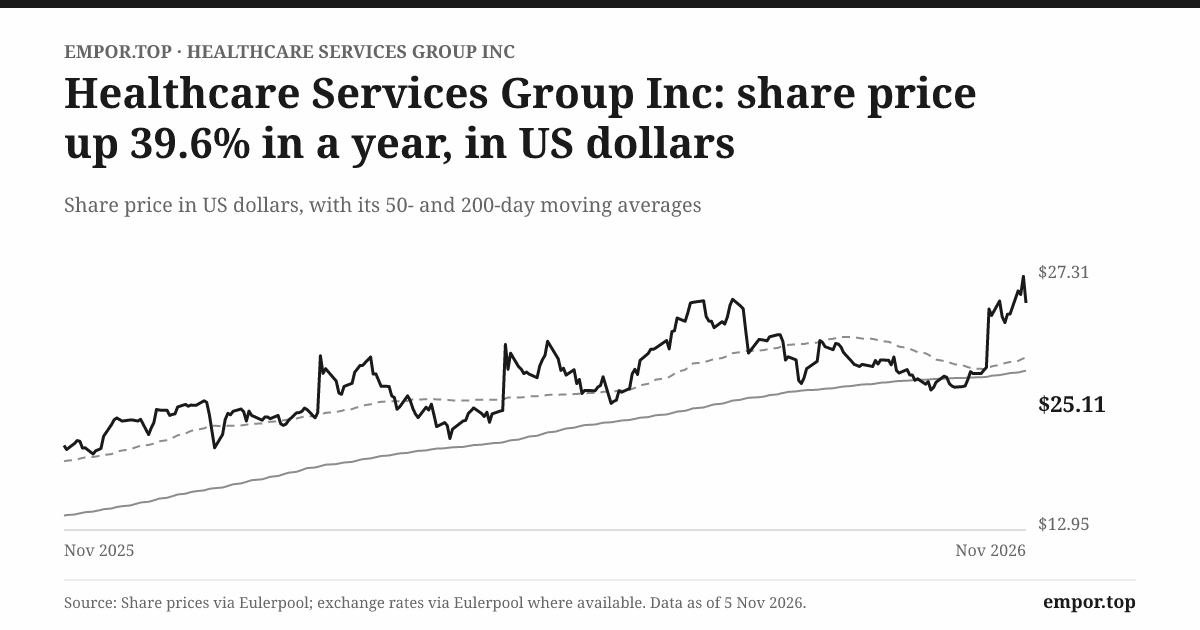
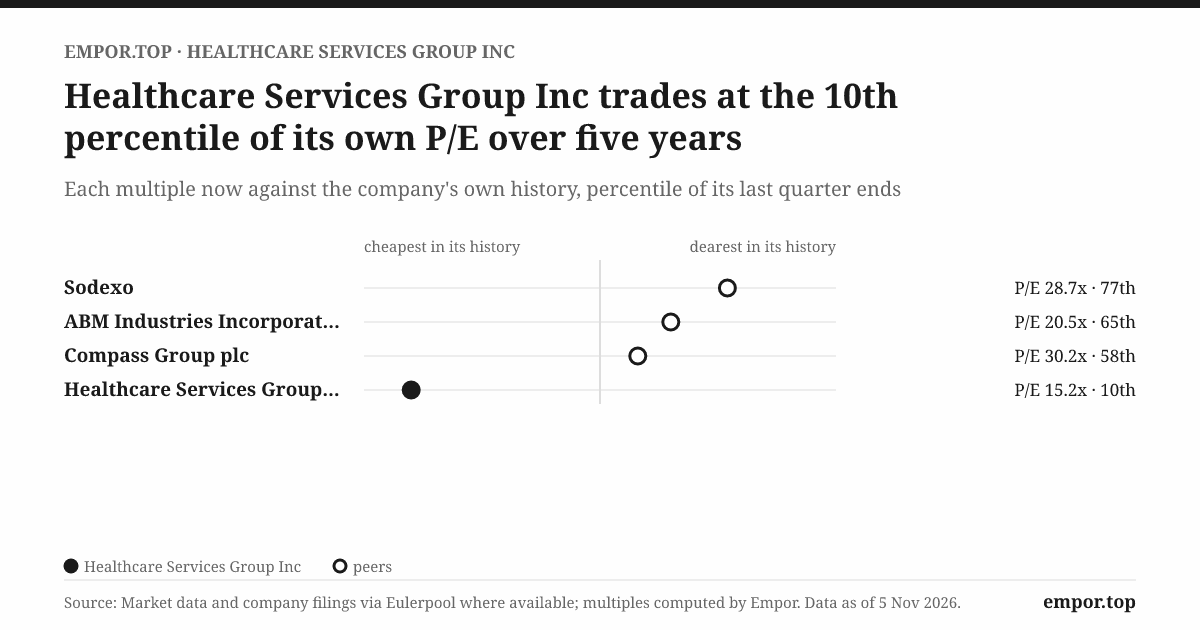
On November 5, 2026, HCSG's shares closed at $25.11, about 5.4% below their 52-week high of $26.54 and well above the 52-week low of about $17.18 The market valued the equity at about $1.8 billion and the whole enterprise, net of cash, at about $1.6 billion.18 On trailing earnings, the stock traded at about 15.2 times, far below its own five-year median of about 25.2 times.18 ABM, the closest large listed facilities-services comparison, traded at about 19.4 times trailing earnings on the same day.19
The tempting reading is that the stock is simply cheap. The fuller reading is that the multiple is low partly because the earnings it is dividing are unusual. Trailing twelve-month earnings include part of the ERC windfall, a Genesis reserve release, a fourth-quarter 2025 tax benefit and material investment income.64 The five-year median of 25 times was computed in years when earnings were depressed, which inflates the multiple. A low price-to-earnings ratio on flattered earnings is less of a bargain than it appears, and a high historical median on depressed earnings is less of a benchmark than it appears. The stock has also been volatile, with a one-year volatility of about 42% and a peak-to-trough fall of about 55% within the past five years.18
The optimistic version begins with demand. The number of very elderly Americans is rising, and the facilities that care for them need clean rooms and safe food every day of the year. HCSG has about 2,800 facility relationships, management reports retention above 90%, and it can sell additional services inside customers that already know it.65 Dietary has been the growth engine, and NEXDINE extends that capability into senior living, a market that tends to rely more on residents' own money than on Medicaid.1 The business needs very little capital, generated about $139 million of free cash flow in 2025, has no drawn debt on its revolver and has wide covenant headroom, with interest coverage reported at over 90 times.64 A bull would argue that the market is still pricing HCSG as the stalled, accounting-tainted company of 2019 to 2022, rather than as a cleaner, more cash-generative operator with a new growth channel.
The pessimistic version begins with the contract. Every relationship can be cancelled on 30 to 90 days' notice, and HCSG has a documented history of losing facilities when terms could not be agreed.612 The company does not disclose market share, top-customer rankings beyond regulatory thresholds, or facility wins and losses, so outside investors cannot verify the retention claim independently. Margins are thin enough that small changes in wage inflation, food costs or bad debt swing profit dramatically. Earnings over the past decade have gone nowhere, and the recent rebound depends partly on items that management itself says will fade. The SEC case showed what pressure to deliver can do to reported numbers. And the company has just spent most of its free cash on a business whose profitability it has not disclosed.
Porter's five forces explain why margins stay thin. Buyer power is high: customers can cancel quickly, rebid the work and, critically, take the service back in-house, which HCSG names as its primary competitor.6 The threat of substitution is therefore built into every contract. Supplier power is moderate but concentrated: labor, the largest cost by far, is a tight market for low-wage workers, and food distribution runs through Sysco.6 The threat of new entrants is moderate, because starting a regional housekeeping firm is not hard, but building management depth across thousands of sites is. Rivalry is real from diversified giants such as Aramark and ABM and from regional specialists.910
Hamilton Helmer's seven powers framework helps sort out which advantages might be durable. HCSG plausibly has a modest form of scale economy: training systems, procurement, compliance expertise and a deep bench of managers spread across a base no single facility could match. It has a soft switching cost in the disruption of changing vendors. It may have process power, an accumulated know-how about running nursing-home kitchens and laundries cheaply and compliantly, which is hard to observe but is implied by long customer relationships. It does not have network effects, cornered resources, counter-positioning or a brand that customers pay a premium for. The honest verdict is that HCSG's moat is narrow and operational. It is real enough to sustain retention and steady cash generation, but it is not strong enough to protect margins from labor inflation or customer insolvency.
A skeptical long-term shareholder, or an activist with a few percent of the stock, would not need to argue that HCSG is a bad business. The challenge would be to its disclosure and its accountability. Such an investor would ask the company to publish facility wins, losses and net starts every quarter, so that the retention claim can be tested; to report segment margins with bad debt and insurance-reserve revisions shown separately, so that the run rate is visible; and to commit to a capital-allocation framework that explains when buybacks beat acquisitions and what return NEXDINE must earn. The same investor would ask why the executive whom the SEC barred from practicing before it as an accountant remains in the senior team, and whether a board overseeing such a long-tenured management team is independent enough to say no to the next deal. None of these questions implies wrongdoing today. Each would make the case easier to underwrite, and the company's willingness to answer them is itself evidence about its culture.
The cost structure makes this concrete. In 2025, labor consumed about 78% of EVS revenue and 59% of Dietary revenue, with food-related supplies taking another 31% of Dietary revenue.6 Contracts that pass through some cost increases help, but they do not remove the risk of staffing shortages, productivity loss or a customer who cannot pay the higher bill. The material risks follow directly: wage rates and labor availability, food and supply inflation, customer reimbursement pressure and bankruptcy, dependence on Sysco for distribution, actuarial swings in a self-insured program for workers' compensation and general liability, and now the integration of NEXDINE.6 Technology and AI could eventually reshape scheduling and procurement, but service still depends on on-site people, and the company has published no quantified productivity target from technology.
Where the debate settles
The valuation debate, then, is not whether 15 times earnings is low in the abstract. It is whether HCSG's clean, repeatable earnings are higher or lower than the trailing number suggests. If the core business earns something like four cents of operating profit per dollar of revenue, grows mid-single digits organically and adds NEXDINE at comparable margins, the current price looks undemanding against the cash the business produces. If organic growth stays near 3%, bad debt returns to its historical range and NEXDINE's contribution disappoints, the low multiple is not mispricing but an accurate discount for a thin-margin business with volatile earnings. The market is effectively pricing something between those two outcomes.
The proof points are concrete. The first is same-store organic revenue growth together with net facility starts, which shows whether demand converts into durable volume. The second is EVS and Dietary segment margins after stripping out bad-debt and insurance-reserve effects, which shows whether execution is improving or merely being flattered. The third is NEXDINE's post-close revenue, margin and cash contribution, alongside the actual cash recovered from Genesis. Those three readings will tell investors more than any multiple.
IX. Playbook: Business & Investing Lessons
Somewhere tonight, a facility manager on HCSG's payroll is finishing a shift in a building whose owner could, in principle, send a cancellation letter tomorrow. The residents will still be fed breakfast, the linen will still be washed and the floors will still be mopped. The relationship looks permanent from the inside and provisional on paper. That gap is the source of every lesson this company teaches.
The first lesson is that a service can be essential and its contract still short.6 Founders building service businesses often confuse dependence with durability. Dependence is what keeps a customer from leaving on a whim. Durability is what keeps a customer when a new owner arrives, a cheaper bid appears or the money runs out, and only the contract, or the price, protects that.
The second lesson is that retention is a moat signal; a market-share figure would be proof. Retention above 90% is encouraging, but without independent market-share data or disclosed wins and losses, investors cannot tell whether HCSG is gaining ground or merely holding it.5 The broader principle applies far beyond nursing-home services: a moat that can only be described in the company's own words has not yet been proven in the market's.
The third lesson is that a customer can be under 10% of sales and still dominate the bad-debt story. Genesis showed that falling below that threshold did not remove substantial credit exposure.6 Concentration statistics measure revenue exposure. Credit exposure is measured in receivables and notes, and it can stay large long after a customer's share of sales has shrunk.
The fourth lesson is that a good acquisition multiple is only the first line of the underwriting. The NEXDINE price screen is only a starting point; undisclosed earnings, contingent payment and integration costs will decide whether shareholders were well served.15 Paying less per dollar of sales than your own stock is worth is not the same as creating value; the earnings and cash that come with those sales are what count.
The fifth lesson is that cash conversion does not excuse weak controls. HCSG's long-term cash conversion record suggests its profits were broadly real,611 yet the SEC findings show that genuine cash generation does not guarantee accurate cost timing.7 Investors who rely on cash flow alone as a lie detector are listening for the wrong kind of lie.
X. Epilogue
Tonight, HCSG stands at a hinge. NEXDINE is now part of the company, but its revenue has not yet appeared in a single reported quarter. The Genesis claim has a court-approved plan behind it, but no distribution has been finalized. And the 2027 outlook has been raised, but the organic business inside it was growing at roughly 3% during 2026, short of the mid-single-digit target management attaches to it.35
The first moment that will begin to settle these questions is fourth-quarter results, expected early in 2027. Management guided fourth-quarter revenue to between $535 million and $545 million.5 Against $466 million in the fourth quarter of 2025, that implies growth of roughly 15% to 17%.3 Mid-single-digit organic growth would explain only about a third of that jump; the rest has to come from almost three months of NEXDINE. So the quarter will be the first chance to see whether NEXDINE's revenue is running at or above the $150 million annual pace management described. If the guidance is met mostly through acquired revenue while organic growth stays near 3%, the story becomes acquisition-led. If organic growth moves toward 5% while NEXDINE delivers its share, the inflection is real.
The second set of moments comes through 2027's filings. Investors should look for segment margins that remain comparable as acquired revenue enters the base, and for evidence that accretion survives the foregone interest income, the amortization of acquired intangibles and any contingent payment. They should watch cash distributions from Genesis against the $70.8 million gross claim, while tracking whether those payments support the $6.1 million reserve release, because each payment either validates or revises that estimate.4 And they should follow retention, new facility starts, debtor days, bad-debt expense and the pace of buybacks against post-acquisition liquidity.
There is a third, quieter test in the same filings. The deferred $12.3 million of ERC refunds may eventually be recognized, and workers' compensation reserve benefits, according to the CFO, should fade toward zero.45 If the next few quarters show strong margins without either crutch, the case for a higher operating baseline strengthens considerably. If margins sag as those benefits disappear, the market will learn that 2026's improvement was mostly a lull in bad news rather than better execution. Either way, the reader should know which kind of quarter is being reported before deciding what it means.
The unresolved issues remain precise. HCSG has not disclosed NEXDINE's full earnings profile or the contingent consideration it may owe. It has not disclosed the final Genesis recovery, because the bankruptcy estate has not yet determined it. Those two unknowns, one forward-looking and one backward-looking, are where the next year of this story will be written.
XI. Outro
Go back to the facility manager in that nursing home at six in the morning, filling the call-outs on the housekeeping roster, checking the menus, answering to an administrator who could, under the contract, replace the whole operation in a matter of months. That manager is the company. Not the headquarters in Bensalem, not the treasury portfolio, not the acquisition announced in October, but thousands of people doing the same work in thousands of buildings, earning the right to come back the next day.
The model's ability to compound earnings, manage customer risk and deploy cash well remains unproven. At Healthcare Services Group, the service is daily; the trust is always up for renewal.
References
-
Healthcare Services Group Announces Acquisition of NEXDINE Hospitality — Healthcare Services Group, 2026-10-07 ↩↩↩↩↩↩↩
-
Healthcare Services Group Buys Nexdine for $93.5M — Philadelphia Business Journal, 2026-10-07 ↩↩
-
Healthcare Services Group Reports Third Quarter Results — Healthcare Services Group, 2026-10-21 ↩↩↩↩↩↩↩↩↩↩↩↩
-
Healthcare Services Group Q3 2026 Form 10-Q — SEC, 2026-10-23 ↩↩↩↩↩↩↩↩↩↩↩↩↩↩↩↩↩↩↩↩↩↩↩↩↩↩
-
Healthcare Services Group Q3 2026 Earnings Call Transcript — Stock Analysis, 2026-10-21 ↩↩↩↩↩↩↩↩↩↩↩↩↩↩↩↩
-
Healthcare Services Group 2025 Form 10-K — SEC, 2026-02-13 ↩↩↩↩↩↩↩↩↩↩↩↩↩↩↩↩↩↩↩↩↩↩↩↩↩↩↩↩↩↩↩↩↩↩↩↩↩↩↩↩↩↩↩↩↩↩↩↩↩↩↩↩↩↩↩↩↩↩↩↩↩↩↩↩↩↩↩
-
SEC Administrative Order on Healthcare Services Group, John C. Shea and Derya D. Warner — SEC, 2021-08-24 ↩↩↩↩↩↩↩↩↩↩↩↩↩
-
Healthcare Services Group Q2 2026 Earnings Call Transcript — Stock Analysis, 2026-07-22 ↩↩
-
Healthcare Services Group 2019 Form 10-K — SEC, 2020-02-21 ↩↩↩↩
-
Healthcare Services Group 2021 Form 10-K — SEC, 2022-02-18 ↩↩↩
-
Healthcare Services Falls on Charges Tied to Genesis Bankruptcy — Bloomberg Law, 2025-07-10 ↩↩
-
Healthcare Services Group 2026 Proxy Statement — SEC, 2026-04-15 ↩↩↩↩↩↩↩↩↩↩↩↩↩↩↩↩
-
Healthcare Services Group to Pay $6 Million SEC Fine Over Inflated Earnings — Reuters via Investing.com, 2021-08-24 ↩↩
-
2026 Annual Meeting Voting Results, Form 8-K — SEC, 2026-05-27 ↩↩
 LinkedIn
 WhatsApp
 Reddit
 Hacker News
 Email
 Kindle
 RSS Feed
 Spotify
 Apple Podcasts
 Amazon Music
 Audible
 YouTube