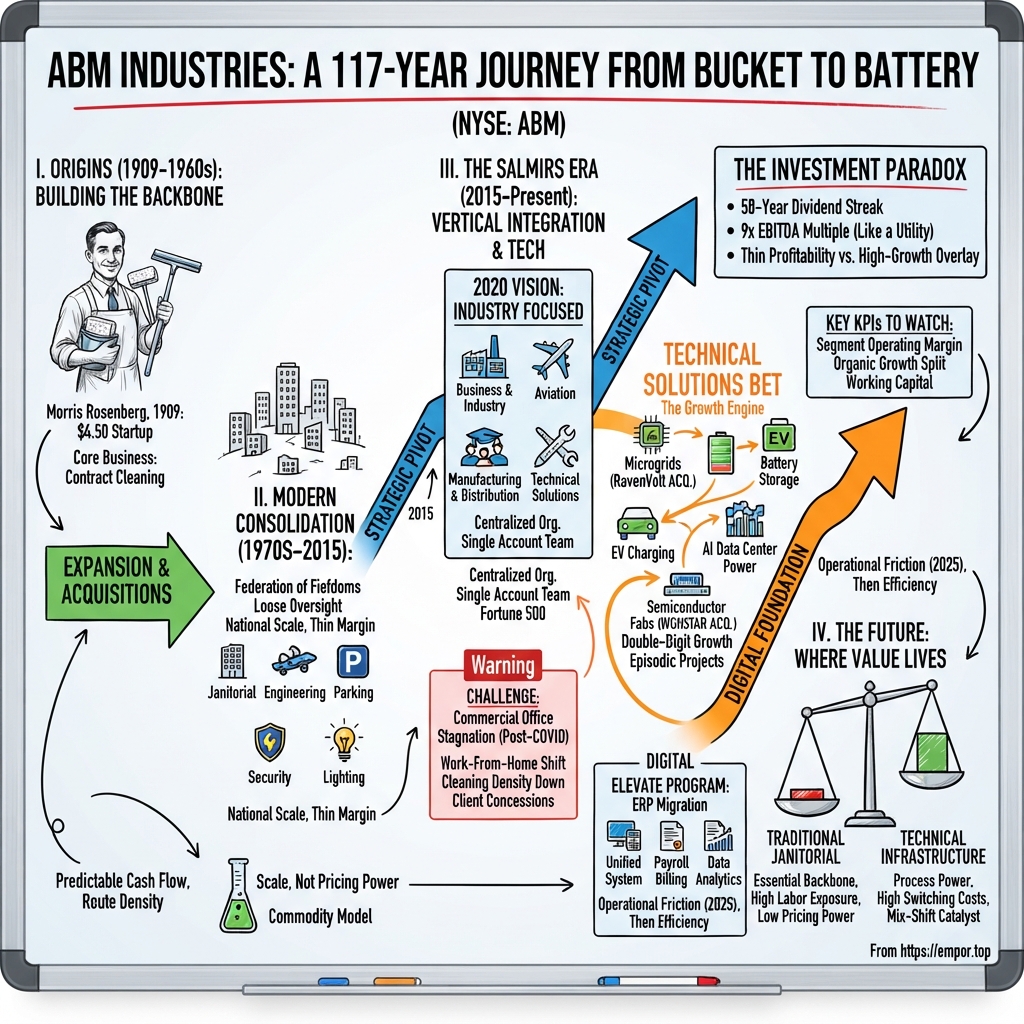
ABM Industries: The 115-Year Janitorial Giant Betting on Megawatts
I. Introduction & The $8.4 Billion Facility Backbone (0:00 – 15:00 / 15 min)
The Night Shift
It is 11 p.m. on a weeknight in Midtown Manhattan. The trading desks have emptied, the lobby lights are dimmed, and the elevators of an investment bank headquarters begin to fill with workers most office tenants never see. They wear ABM badges. They vacuum trading floors, reset conference rooms, and haul away the night's trash. A few floors down, an ABM engineer monitors the chillers keeping the building's server rooms cool. Across the country, other ABM crews are cleaning aircraft cabins between red-eye flights, scrubbing school corridors before the morning bell, and servicing semiconductor cleanrooms where a single stray particle can ruin a silicon wafer.
More than 100,000 workers report for duty every day across ABM Industries (NYSE: ABM), according to CEO Scott Salmirs.[^1] At the end of fiscal 2024, the company employed about 117,000 people, roughly 42% of whom were covered by collective bargaining agreements.1 In fiscal 2025, which ended October 31, 2025, that workforce generated a record $8.7 billion of revenue.2 ABM occupies a distinct position in the corporate landscape: essential to the daily operation of American physical infrastructure, yet largely invisible to the people who inhabit it.
The Investor Paradox
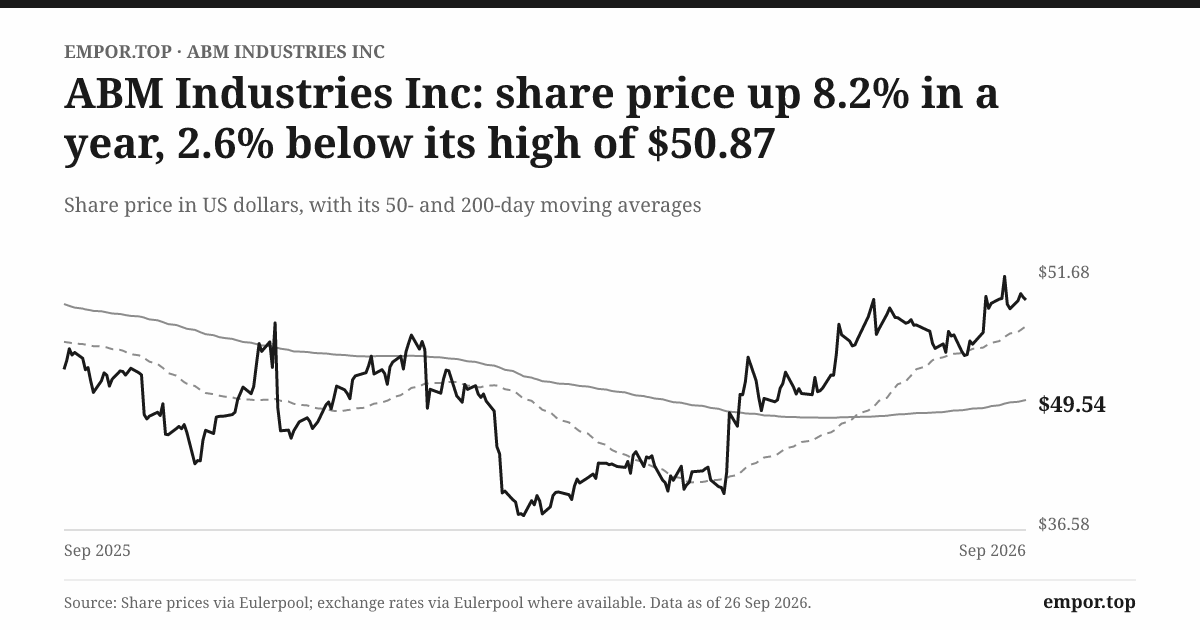
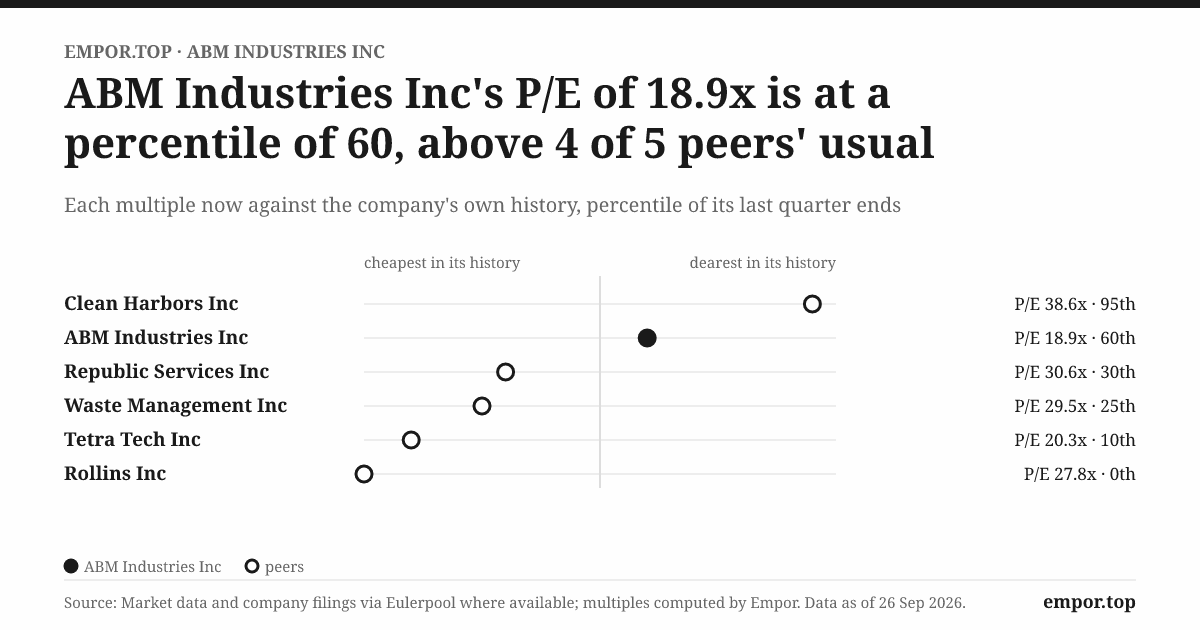
For investors, ABM presents an unusual combination of characteristics. It ranks among the most reliable dividend payers in American public markets. In December 2025, the board raised the quarterly dividend 9% to $0.29 per share, the 58th consecutive year of annual increases.2 Yet the stock has rarely been valued like a durable compounder. In late September 2026, the shares traded near $50, for an equity value of roughly $2.9 billion.3 Factoring in about $1.78 billion of debt at the end of July 2026,4 the business is valued at roughly nine times trailing adjusted EBITDA—a valuation multiple typical of a regulated utility, but for an enterprise with none of a utility's guaranteed returns.
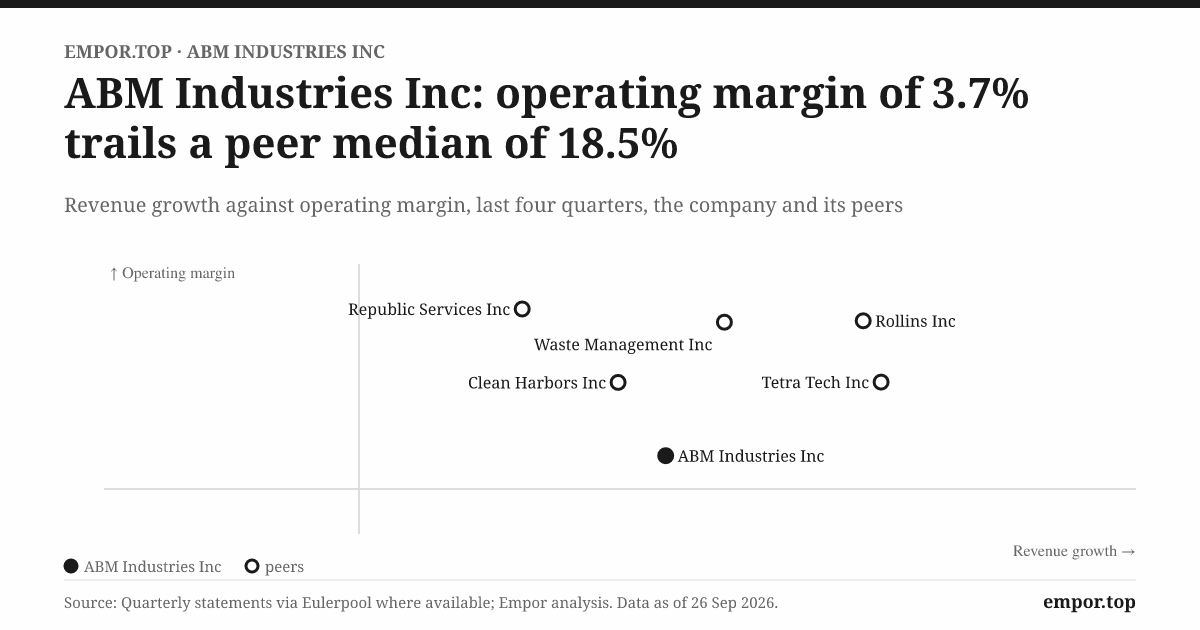
The root cause is thin profitability. ABM's fiscal 2025 adjusted EBITDA margin was 5.9%, unchanged from the year before under the company's revised non-GAAP definition.2 Out of every dollar a client pays, virtually all of it is consumed by wages, payroll taxes, healthcare benefits, workers' compensation insurance, and cleaning supplies. To Wall Street, the company has long resembled an hourly labor broker heavily exposed to structural vacancies in commercial office buildings.
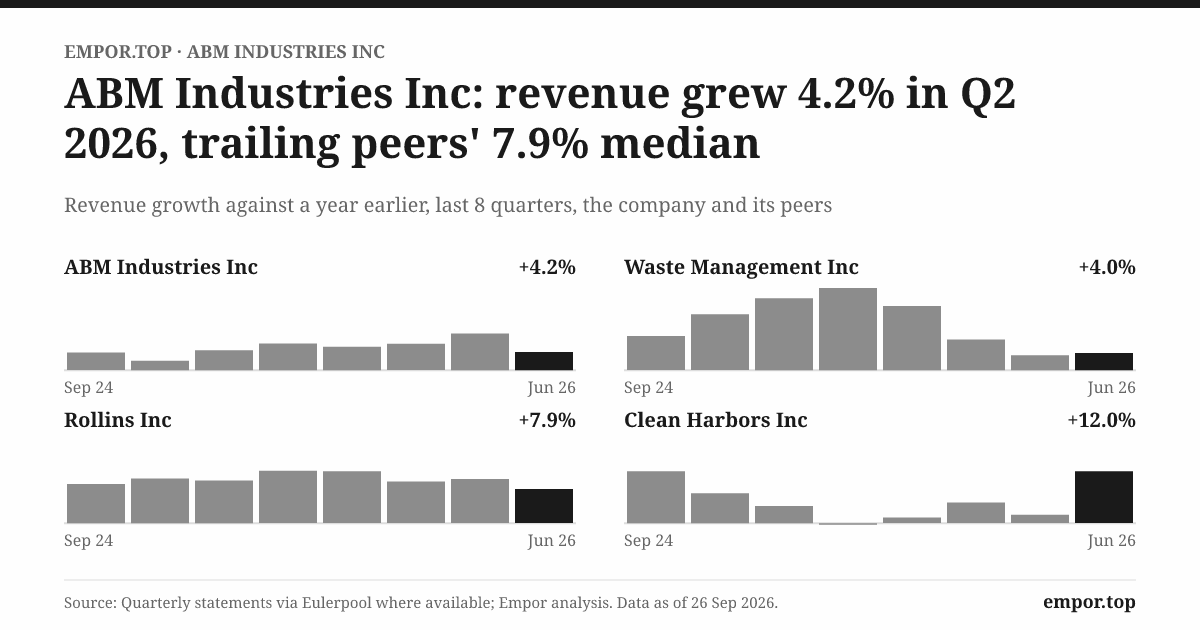
Beneath that traditional profile, management is navigating two operational shifts simultaneously. The first is an expensive overhaul of ABM's internal infrastructure—the multi-year ELEVATE program and an enterprise cloud ERP migration—that disrupted billing and cash collection during fiscal 2025 before yielding initial operational efficiencies. The second is an expansion into higher-margin technical and energy solutions: on-site microgrids for big-box retailers, battery energy storage systems, backup power for AI data centers, and, beginning in February 2026, specialized tool maintenance inside semiconductor fabs. On the fiscal third-quarter 2026 call, Salmirs said ABM's semiconductor, microgrid, and data center businesses generated nearly $775 million of revenue in the first nine months of the year, now make up more than 11% of company revenue, and carry a "double digit blended operating margin."[^1]
The Questions This Story Must Answer
Four central questions frame this analysis. First, how did a one-man window-washing route founded in San Francisco expand over more than a century into North America's largest facility services provider? Second, can an hourly, unionized, variable-cost contractor build a defensible economic moat, or does routine competitive bidding by commercial property managers establish a permanent ceiling on operating margins? Third, how have capital-intensive acquisitions—including GCA Services in 2017, Able Services in 2021, RavenVolt in 2022, and WGNSTAR in 2026—affected long-term returns on invested capital? Fourth, and most critical for valuation: does empirical performance support management's thesis that ABM is transitioning into a higher-margin technical infrastructure specialist, or is technical work simply a high-growth overlay on a mature janitorial foundation?
The financial record offers evidence for both perspectives. Evaluating the true balance begins in 1909, with a bucket and a sponge.
 Subscribe on LinkedIn
II. Origins: The Window Washer of San Francisco (1909–1965) (15:00 – 35:00 / 20 min)
Four Dollars and Fifty Cents
San Francisco in 1909 was still rebuilding. The earthquake and fire of 1906 had leveled much of downtown, and new commercial blocks were rising rapidly across the city. Morris Rosenberg was not preoccupied with urban reconstruction, however; he was focused on paying rent. His restaurant and hotel business had collapsed during an economic downturn, leaving him in immediate need of income.5
The improvised response to that setback became the company's founding lore. Rosenberg spent $4.50 on a bucket, mop, sponge, broom, and brush, then walked from storefront to storefront offering to wash windows for whatever price the shopkeeper felt the work was worth.5 By the end of his first day, he had recouped his $4.50 outlay and generated an additional $3.50 in profit.6 There was no formal business plan and no capital beyond those few hand tools. The venture's sole asset was a willingness to perform physical labor that property owners preferred not to do themselves.
That core insight has endured for 117 years. Commercial building owners require clean, safe, and operational facilities, but few wish to recruit, schedule, train, insure, and supervise the workforce needed to maintain them. At its foundation, ABM's business model still centers on absorbing that administrative and operational friction for a recurring fee.
From Windows to Whole Buildings
Rosenberg expanded the business by layering additional tasks onto properties his crews were already visiting. By 1913, he renamed the enterprise American Building Maintenance Company to reflect services extending well beyond exterior glass. Geographic expansion followed: by 1920, the firm had opened branch offices in Los Angeles, Portland, and Seattle.6 In 1921, the company secured an agreement to service Stanford University, marking what it describes as the first janitorial contract awarded to an outside provider for a major university campus.6 That assignment initiated an education specialty that would evolve into an independent reporting segment a century later.
The operational dynamics behind this early expansion still govern ABM's business today. A window-cleaning route generates revenue only while squeegees are on glass; time spent walking or driving between dispersed assignments produces no billable hours. Securing contiguous clusters of buildings—and migrating clients from intermittent window washing to recurring monthly janitorial agreements—converted casual day labor into a dense route network supported by predictable cash flows. That shift represented an early blueprint for the long-term contract base that equity analysts continue to prize in ABM's core janitorial divisions.
Surviving the Depression, Serving the War
The Great Depression might easily have wiped out an outsourced contractor dependent on clients desperate to trim overhead. Instead, according to a company history, ABM navigated the 1929 market crash and subsequent downturn "without losing ground and, in fact, with a slight increase in business," as building managers discovered that contracting out cleaning cost less than maintaining in-house custodial payrolls.5 That structural dynamic has insulated ABM across multiple subsequent recessions: during corporate budget contractions, outsourcing labor-heavy tasks becomes more compelling, even as contract pricing per square foot faces renewal pressure.
The Depression era also initiated ABM's first generational transition. In 1932, Morris sent his son Theodore to New York to establish an East Coast presence. When Morris retired due to failing health in 1935, Theodore assumed executive leadership at age 26.5 ABM's corporate archives date its initial New York branch to 1933, staffed by 1,500 employees. That same year, the company introduced mechanical and electrical services under the banner of APEX Electrical and Mechanical Company.6 The historical timing is notable for understanding the company's modern identity: ABM's technical capabilities did not originate with recent acquisitions like RavenVolt in 2022. They possess a lineage spanning more than nine decades, even though specialized mechanical work remained secondary to volume janitorial services for most of that period.
World War II accelerated operational scale. ABM secured contracts to clean and service U.S. Navy aircraft carriers and destroyers calling at West Coast shipyards, and it began recruiting women to maintain operations amid severe wartime labor shortages.5 Servicing naval vessels on demanding military schedules under strict defense protocols differed dramatically from sweeping commercial lobbies. The work gave the organization early experience in executing specialized, checklist-governed maintenance under exacting standards—the operational precedent ABM now cites as it markets cleanroom services to modern semiconductor fabrication plants.
Postwar Expansion and the Public Markets
The postwar economic boom fueled the development of suburban corporate campuses, regional shopping centers, and commercial airports, and ABM followed commercial developers into each category. The company provided facility services for the opening of Disneyland in 1955, and by 1959 its workforce exceeded 6,000 employees operating across 45 metropolitan markets.6 Commercial parking management was incorporated into the service portfolio during the same era. Operating garages adjacent to the office towers ABM already cleaned offered downtown property owners a convenient bundled vendor relationship, establishing an operational footprint that remains part of the Business & Industry segment today.1
ABM dates its listing on the American Stock Exchange to 1965 and its subsequent transfer to the New York Stock Exchange to 1972.6 (Some third-party corporate histories trace its public equity roots to an earlier over-the-counter market debut.5) By 1979, the company ranked among the country's most consistent dividend-growing corporations.6 That early institutional commitment to regular dividend increases became integral to ABM's identity with retail and income-focused investors, though it would eventually limit management's flexibility to redeploy capital aggressively through the balance sheet.
For modern equity investors, ABM's origin story carries an instructive lesson. The enterprise's longevity does not stem from proprietary software, patent portfolios, or pricing power. It has rested instead on dependable execution of unglamorous, labor-intensive tasks delivered at a cost below what building owners would spend to perform them internally. That dynamic provides an undeniable operational and logistical moat, but it confers minimal leverage to raise contract margins at will. That basic tension defined the company's next phase of growth, as ABM evolved into a decentralized national federation that stretched corporate oversight to its limits.
III. The Modern Consolidation & The 2020 Vision Reorganization (1970s–2015) (35:00 – 55:00 / 20 min)
A Federation of Fiefdoms
By the 1990s, ABM had outgrown its founding family's direct control. The company renamed itself ABM Industries Incorporated in 1994 and passed $1 billion of annual revenue in 1996.5 It was also a tragically visible part of American life on September 11, 2001, when 17 ABM employees were lost in the attack on the World Trade Center, where the company provided services. A decade later, ABM took on facility services at the National September 11 Memorial & Museum.6
Structurally, however, ABM operated for decades as a loose federation. Local branches and separate service-line divisions—janitorial, engineering, parking, security, and lighting—each maintained their own leadership, separate profit-and-loss accounts, and wide latitude over bidding and staffing. That decentralized model functioned adequately when the typical client was a regional landlord. It proved far less effective when a national financial institution sought a single contract spanning fifty cities, or when an airline wanted cabin cleaning, wheelchair passenger assistance, and terminal janitorial services bundled across dozens of airports. Internal divisions competed against one another for credit, leaving enterprise clients managing multiple uncoordinated ABM contacts instead of a unified service partner.
Henrik Slipsager, who served as chief executive officer from November 2000, devoted much of his tenure to pursuing acquisitions and initiating the integration of those disparate units. ABM's board chair later described his time in charge as "ABM's greatest period of expansion and growth."7 Yet resolving the underlying organizational fragmentation remained a task for his successor.
Scott Salmirs: The Client Who Crossed Over
In January 2015, ABM's board named Scott Salmirs to succeed Slipsager, effective March 31, 2015.7 Salmirs did not rise through the custodial trade. Before joining ABM in 2003, he spent his career on the client side of facility management, serving as a senior vice president in Lehman Brothers' North American facilities group and holding facilities leadership roles at Goldman Sachs and CBRE.7 At ABM, he ran the Northeast onsite services business and then took global responsibility for the aviation division and all international operations.7
That background directly shaped his management philosophy. A former corporate facility buyer understood how the client side evaluated maintenance contractors: janitorial work was treated as an operating expense to minimize, service providers were seen as interchangeable until operational failures occurred, and the most compelling offering was a single accountable relationship rather than a patchwork of uncoordinated subcontractors. Salmirs' strategic roadmap over the subsequent decade effectively sought to transform ABM into the integrated vendor he would have wanted to hire.
On quarterly earnings calls, Salmirs presents more as a relationship-driven commercial leader than a financial engineer. He frequently relies on visual analogies ("think of a bull's eye"), routinely praises frontline teams, and consistently describes operational setbacks as "episodic"—a rhetorical pattern that proves central when evaluating management credibility and execution in later chapters.
The 2020 Vision
In September 2015, months into his tenure, Salmirs launched the "2020 Vision." The initiative reorganized ABM around industry groups rather than geography and service line, centralized functions such as procurement and IT, and sold businesses that did not fit.8 ABM divested its Security and Government Services businesses because, in the company's words, they "did not align with ABM's long-term industry-group focus."8 The first phase, focused on organizational realignment, was completed on November 1, 2016. The second phase pursued procurement and operating savings, including about $10 million of procurement savings in fiscal 2017.8
The strategic rationale was sound. Maintaining a pharmaceutical cleanroom, turning around an aircraft cabin in 25 minutes, and cleaning a Class A commercial office tower represent distinct operational challenges with different certifications, service-level agreements, labor models, and procurement buyers. Organizing by client industry allowed ABM to develop deeper vertical expertise, price to the specific operational risks of each facility type, and cross-sell its full suite of capabilities through a single relationship.
The reorganization did not conclude overnight, however. The segment structure familiar to investors today—Business & Industry, Manufacturing & Distribution, Aviation, Education, and Technical Solutions—took final shape only in December 2021. That month, ABM created the Manufacturing & Distribution group to replace its former Technology & Manufacturing division and moved technology-campus clients into Business & Industry.9 Fully calibrating the operating model required roughly six years—an initial case study in ABM's execution pace, where strategic transformations have proven genuine, yet deliberately gradual.
Myth vs. Reality: Did Reorganization Fix the Margin?
A common narrative contends that the 2020 Vision transformed a fragmented contractor into a disciplined, industry-focused platform with structurally superior margins. It accomplished the first objective. Pitching to a bank, an airline, or a school district through one accountable account team represented a meaningful operational upgrade that made later acquisitions far easier to absorb.
The margin thesis, however, proved considerably weaker. While organizational redesign can streamline service delivery and eliminate redundant administrative overhead, it cannot single-handedly overcome an industry dynamic where property managers and corporate buyers command superior bargaining power. Furthermore, divesting Security and Government Services pruned the revenue base just before management pivoted toward aggressive balance-sheet expansion.
The 2020 Vision did succeed in establishing a more coherent operating foundation. ABM joined the Fortune 500 in 2016,6 and fiscal 2017 revenue reached $5.45 billion.8 With its industry-focused architecture in place, the company was primed to acquire scale within those targeted verticals—and within two years of initiating the restructuring, management launched the largest acquisition in ABM's history.
IV. The Megadeal Playbook: GCA Services & Able Services (55:00 – 80:00 / 25 min)
September 1, 2017: Buying a School System's Janitor
GCA Services Group was a major facility services contractor concentrated in education—serving K-12 school districts and higher education campuses—and commercial facilities, with a predominantly non-union labor force. Owned by private equity affiliates of Thomas H. Lee Partners and Goldman Sachs' merchant banking division, GCA became the centerpiece of ABM's balance-sheet expansion when the acquisition closed on September 1, 2017, marking the largest transaction in ABM's history.8
In its fiscal 2017 annual report, ABM valued the total consideration at approximately $1.3 billion, consisting of $839.9 million in cash alongside roughly 9.4 million common shares valued at $421.3 million at closing.8 While initially announced as a $1.25 billion transaction, funding the cash component required tapping a newly established syndicated credit facility that paired a $900 million revolving credit line with an $800 million term loan. By the close of fiscal 2017, ABM had drawn roughly $1.2 billion under that facility.8
The strategic rationale was straightforward. GCA instantly established Education as a standalone core segment, introduced a substantial non-union workforce to counterbalance ABM's unionized urban core, and diluted the company's exposure to downtown commercial office buildings. Public school districts and university campuses do not relocate to suburban office parks or pivot to hybrid work arrangements.
The Stock-Paid Portion Deserves Attention
The equity component warrants scrutiny. By funding nearly a third of the purchase price with equity, ABM diluted existing shareholders while trading at a modest valuation multiple. Issuing shares can be justifiable if the acquired earnings yield exceeds the cost of equity, but it linked the true acquisition cost directly to the stock's future performance. In practice, ABM spent much of the subsequent decade allocating operating cash flow toward share repurchases that effectively absorbed the dilution created to buy GCA.
Falsification Test No. 1: What Happened to Education?
The first empirical stress test for the GCA acquisition arrived in fiscal 2020. During that fiscal year, ABM recorded a $172.8 million pre-tax goodwill and intangible impairment charge. The single largest component, totaling $99.3 million, fell squarely within Education, the segment built directly around GCA.10 In accounting terms, an impairment charge acknowledges that projected cash flows can no longer justify the valuation premium paid at acquisition. While campus closures during the initial pandemic outbreak were an unprecedented operational shock, the write-down occurred just three years after closing and erased a significant portion of the acquired intangible value.
Operationally, the Education segment subsequently stabilized. In fiscal 2025, the division generated $922.0 million in revenue and $67.7 million in operating profit, representing a 7.3% margin.2 Management consistently characterizes Education as a steady, cash-generative business that tracks broader economic growth rather than serving as an earnings accelerator.[^12] The evidence indicates that while GCA successfully diversified ABM's revenue base and secured a predictable contractual annuity, the transaction failed to demonstrate that the acquisition premium translated into structurally higher operating margins.
September 2021: Doubling Down on Engineering with Able
Four years after GCA, ABM executed another major acquisition. On August 25, 2021, the company announced an agreement to acquire Able Services for $830 million in cash.11 Founded in San Francisco in 1926, Able was described as the nation's largest family-owned provider of building maintenance, engineering, and facility operations. The business contributed approximately $1.1 billion in annual revenue and $65 million in adjusted EBITDA on a pandemic-normalized basis.11 Engineering services generated roughly 60% of Able's revenue with janitorial accounting for the remaining 40%, supported by a labor force that was approximately 80% unionized.11 Management targeted $30 million to $40 million in annual cost synergies, expecting to realize the majority within a year of closing.11
ABM had paved the way for the transaction in June 2021 by expanding its credit facility to $1.95 billion, structured as a $1.3 billion revolver and a $650 million term loan, and stated that it expected to close the deal by the end of September 2021.12 The purchase multiple illustrates the transaction's hurdle rate. At $830 million against $65 million of trailing EBITDA, ABM paid roughly 13 times standalone earnings. Assuming management achieved the midpoint of its synergy target—$35 million—the effective post-synergy multiple dropped to roughly eight times adjusted EBITDA, closely aligning with ABM's historical trading multiple. Consequently, the transaction's financial logic depended entirely on extracting operational synergies, which primarily consisted of consolidating redundant branch offices, centralizing administrative functions, and capturing procurement scale rather than accelerating top-line revenue.
Able also deepened ABM's exposure to the commercial real estate markets that faced the most severe post-pandemic structural headwinds. Headquartered in San Francisco, heavily unionized, and concentrated in West Coast commercial properties, the business tied ABM further to regional real estate distress. On an earnings call in fiscal 2026, Salmirs specifically identified Northern California as ABM's most difficult commercial office market.[^1]
Falsification Test No. 2: Did Scale Buy Margin?
Serial consolidations in facility services typically rely on a familiar core thesis: greater scale unlocks purchasing discounts, densifies service routes, and dilutes fixed overhead across a broader revenue base, thereby expanding operating margins. ABM's eight-year financial trajectory provides a direct empirical test of that thesis.
Revenue expanded from $5.45 billion in fiscal 20178 to $8.7 billion in fiscal 2025.2 Operating margins, however, failed to expand in tandem. In fiscal 2020, management announced that the company had achieved its "longer term target" by reaching a 6.0% adjusted EBITDA margin.10 While that metric climbed to 6.6% in fiscal 2022 and 6.8% in fiscal 2023,13 it retreated to 6.2% in fiscal 2024.14 By fiscal 2025, under a revised non-GAAP definition incorporating prior-year self-insurance adjustments, adjusted EBITDA margin stood at 5.9%.2 Across eight years, more than $2 billion deployed in acquisitions, and a substantial expansion of the frontline workforce, ABM's headline profitability metric effectively returned to its starting baseline.
The balance sheet reflects the structural cost of that expansion. As of July 31, 2026, ABM carried $2.74 billion of goodwill and $328.5 million of other intangible assets, collectively representing roughly 55% of its $5.60 billion in total assets.4 In accounting terms, more than half of the company's asset base consists of capitalized purchase premiums paid for acquired client relationships.
The historical record narrows rather than outright refutes the scale thesis. Strategic acquisitions undeniably secured top-line scale, geographic density, technical engineering competencies, and the operational reach required to service nationwide enterprise accounts. What they did not deliver was structural pricing leverage or an enduring step-up in operating margins. M&A has functioned primarily as a defensive mechanism to sustain client relevance and support recurring cash flow, rather than an engine of compounding profitability. Validating a more bullish interpretation would require sustained expansion in ABM's newer "segment operating margin" metric beyond the roughly 7.9% reported for fiscal 2025,[^17] driven by underlying operating leverage across acquired units rather than reporting adjustments or portfolio mix shifts. Meanwhile, the pandemic disruptions that emerged between those two landmark transactions tested the resilience of ABM's acquired footprint in ways no financial underwriting model had anticipated.
V. The Pandemic Whiplash: Disinfection Bonanza to Office Stagnation (2020–2023) (80:00 – 105:00 / 25 min)
April 2020: The Cleaners Become Essential
In March 2020, commercial office towers emptied almost overnight. For a contractor whose largest division cleans commercial real estate, the abrupt evacuation initially resembled a catastrophe. The operational reality that unfolded, however, proved considerably more nuanced.
On April 7, 2020, ABM launched EnhancedClean, an upgraded disinfection program combining EPA-registered disinfectants, specialized sanitization protocols for high-touch surfaces, and service frequencies calibrated to building occupancy levels.15 Management supported the initiative with an expert advisory council, marketing the offering as a certified clinical process rather than a standard custodial sweep. Corporate clients facing intense health anxieties responded: high-margin disinfection assignments, frequently billed as supplemental work orders on top of baseline service agreements, partially cushioned the loss of routine cleaning volume across vacated properties.
ABM's fiscal 2020 financial results captured the dramatic operational swing. Full-year revenue contracted 7.9% to $5.99 billion, and net income dropped to just $0.3 million. That sharp bottom-line decline stemmed largely from the $172.8 million pre-tax impairment charge recorded that year, which—alongside the write-down in Education—erased $61.1 million of carrying value in Aviation and $12.4 million in Technical Solutions.10 Paradoxically, cash generation surged: ABM produced a record $419.5 million in free cash flow, debt leverage fell to 2.1 times trailing adjusted EBITDA, and adjusted EBITDA margin climbed to 6.0%.10
That cash windfall, however, reflected temporary working capital mechanics rather than durable compounding power. In an outsourced labor-services model, contracting revenue accelerates the collection of past receivables while the outflow of new vendor payables and payroll liabilities declines, generating a transient surge in liquid balances. When business activity normalizes and operations re-expand, working capital reverses just as rapidly. That mechanical snapback materialized promptly: by fiscal 2022, ABM's free cash flow swung to negative $30.4 million.13 Rather than generating lasting economic value, the initial pandemic shock had merely shifted multi-year cash flows forward in time.
The Hybrid Hangover
As emergency health protocols eased, the commercial office sector failed to return to its pre-pandemic routines. Flexible hybrid work schedules took hold permanently, especially among technology and professional services tenants, elevating office vacancies across major gateway metropolitan centers. Confronting diminished physical utilization, commercial landlords adopted predictable defensive measures: reducing custodial schedules, mothballing underused floors, and demanding price concessions at contract renewal.
The resulting drag on ABM's cornerstone Business & Industry segment was gradual yet relentless. In fiscal 2023, B&I revenue edged down 0.2% while segment operating profit dropped 5.7%.13 The erosion persisted in fiscal 2024, with revenue slipping another 0.7% and operating profit declining 2.7%.14 While these decreases did not represent an outright operational collapse, they directly afflicted the engine that generated roughly half of company-wide revenue and nearly half of segment operating income. To keep overall corporate earnings flat, ABM's remaining operating units had to expand merely to offset the slow attrition in its commercial core.
The Recovery That Kept Getting Rescheduled
The more revealing dimension of this stagnation was how executive commentary repeatedly revised the expected timing of a turnaround.
In December 2024, Salmirs told analysts that commercial real estate markets were "nearing an inflection to growth."14 Six months later, on the June 2025 call, he announced that B&I had returned to organic expansion, asserting: "we like to believe now we're in positive organic growth territory for B&I from here on out."[^12] To substantiate that optimism, he cited CBRE market data indicating prime Class A office vacancy stood at 14.8% compared with 19% across the broader commercial market, presenting it as evidence that ABM's portfolio focus on premier properties was paying off.[^12]
Just three months later, that narrative unraveled. On the September 2025 earnings call, Salmirs disclosed that a cluster of major property owners across distressed regional markets—specifically citing Portland, Seattle, downtown Los Angeles, parts of Minneapolis, and Washington, D.C.—had simultaneously approached ABM seeking contractual relief while preparing their 2026 operating budgets.[^19] To preserve client relationships, ABM accepted scope reductions and deferred scheduled price increases in return for longer contract durations. Consequently, B&I operating margin fell from 7.7% to 7.1% year over year in that quarter.[^19] Salmirs characterized the simultaneous concessions as "just bad timing" and reassured analysts, "we're not going to be having this conversation with you guys again."[^19]
By December 2025, executive commentary turned optimistic once more, with Salmirs declaring, "We feel like the commercial real estate crisis is behind us," and projecting that B&I had returned to a "steady state, growing at a GDP rate."[^17] That declaration proved premature. Six months later, ABM notified investors that it had lost a major contract with Transport for London in the United Kingdom and had deliberately exited several domestic accounts, "especially on the West Coast."[^20] As a result, B&I organic growth stalled at zero in the second quarter of fiscal 2026 before contracting roughly 3% in the third quarter.[^1] Management pushed the expected inflection out once again, targeting a return to organic growth "around the middle of fiscal 2027."[^1]
The historical record demonstrates the limits of management's recurring inflection narrative. ABM has secured undeniable marquee wins in premier markets, including high-profile assignments for the new Manhattan headquarters of the nation's largest bank as well as another major commercial bank contract are real evidence.[^20] Yet management has repeatedly proclaimed the post-pandemic commercial office recovery complete, only to extend the projected turnaround horizon by two to four quarters each time. The headwind in Business & Industry is not a sudden systemic collapse of commercial facilities; it is a structural contraction in cleaning density across West Coast technology corridors, compounded by price-aggressive regional competitors willing to take contracts at margins ABM refuses to accept.
The Cost Response
Management complemented contract renegotiations with internal cost actions. In August 2025, ABM initiated a corporate restructuring program designed to streamline administrative overhead. The plan was targeted to generate $35 million of annual savings at a one-time cost of about $10 million.[^19] By December 2025, management had largely completed the initial phase, forecasting that more than three-quarters of the savings were expected to show up in fiscal 2026.[^17] Eliminating corporate overhead represents an action firmly within executive control, unlike negotiating price increases with commercial property managers. In outsourced labor services, however, overhead reductions rarely expand margins permanently; wage inflation and client pricing pressure typically absorb cost savings within a couple of years unless an operator unlocks structural productivity gains—the operational objective assigned to ABM's ELEVATE modernization.
Alongside overhead reductions, management demonstrated commercial discipline by relinquishing margin-dilutive accounts rather than defending top-line volume at any price. That selective pruning helped B&I operating margin improve by 30 basis points year over year to 7.4% in the fiscal 2026 third quarter.[^1] The unresolved strategic question is whether executive resolve will hold as intentional contract exits weigh on headline organic growth. That trade-off underscores why an evaluation of ABM's true earning power requires examining how each of its operating segments actually earns money.
VI. Under the Hood: Segment Economics & Where Value Lives Today (105:00 – 125:00 / 20 min)
Five Businesses Sharing One Logo
ABM reports five operating segments, and they function almost like five distinct businesses. The fiscal 2024 results—the final full fiscal year before the WGNSTAR acquisition and client contract resets—provide a clean baseline. Consolidated revenue stood at $8.36 billion with adjusted EBITDA of $498.1 million.14
Across the individual divisions, the financial profiles diverged sharply: - Business & Industry: $4.06 billion in revenue, representing just under half of total company sales, and $307.0 million in operating profit, for a 7.6% margin. - Manufacturing & Distribution: $1.55 billion in revenue and $166.3 million in operating profit, delivering the portfolio's highest margin at 10.7%. - Aviation: $1.03 billion in revenue with an operating margin of 5.7%. - Education: $904.0 million in revenue at a 6.1% margin. - Technical Solutions: $809.3 million in revenue, an increase of 20% that year, alongside $69.4 million in operating profit, generating an 8.6% margin.14
Fiscal 2025 shifted the balance. Business & Industry expanded 1.6% to $4.13 billion at a 7.7% margin. Manufacturing & Distribution rose 4.1% to $1.62 billion, though its margin compressed to 9.4%. Aviation advanced 8.3% to $1.12 billion at a 5.8% margin. Education generated $922.0 million at 7.3%. Meanwhile, Technical Solutions climbed 18.7% to $960.6 million with an operating margin of 9.0%.2
Segment operating margins run consistently higher than consolidated adjusted EBITDA margins because corporate administrative overhead, self-insurance costs, and ELEVATE technology investments sit outside division profit-and-loss accounts. That structural spread explains why management introduced "segment operating margin" as a primary reporting metric in December 2025, which stood at roughly 7.9% for fiscal 2025.[^17]
Myth vs. Reality: Is ABM Still an Office Cleaner?
A common market perception portrays ABM as an enterprise whose financial destiny remains entirely chained to commercial office occupancy. That assumption is increasingly outdated, though the portfolio transition has unfolded more gradually than executive messaging implies. Over the first nine months of fiscal 2026, Business & Industry generated $3.09 billion of ABM's $6.85 billion in total revenue, or approximately 45%.4 While that represents a decline from roughly half of sales several years earlier, B&I remains the company's single largest source of operating profit. Furthermore, the segment encompasses more than office towers: its footprint spans sports stadiums, entertainment venues, commercial parking facilities, and an expanding United Kingdom operation.
At the same time, high-tech infrastructure represents a growing share of the portfolio. By June 2026, ABM's combined semiconductor and data center businesses accounted for roughly 7% of consolidated revenue,[^20] while electrification projects—spanning microgrids, data centers, and specialized power services—represented nearly 60% of Technical Solutions revenue by the third quarter of fiscal 2025.[^19] The reality is a hybrid enterprise pivoting incrementally toward technical infrastructure, even as traditional commercial properties still account for its largest individual revenue and profit pool.
Business & Industry: A Large Annuity Under Pressure
Business & Industry represents ABM's operational core. Its underlying economics are fundamentally tied to organized labor: company-wide, ABM is party to more than 300 collective bargaining agreements across more than 20 major labor unions.1 In commercial contracts, negotiated wage increases are typically passed through to building owners, but that adjustment occurs with an operational lag. When a new labor agreement resets baseline hourly wages, ABM must invoke contractual escalation clauses or negotiate mid-term resets to recover those expenses. As the client concessions in the fall of 2025 revealed, cost-conscious property managers can effectively resist the timing and extent of those pass-throughs.
The division's primary competitive advantage is its entrenched standing within premier properties. Salmirs frames the commercial pitch simply: if ABM already maintains nine out of ten major financial services headquarters in Midtown Manhattan, the tenth landlord faces little institutional resistance in selecting them.[^12] That positioning provides a meaningful operational moat rooted in corporate trust and verified compliance rather than high switching costs or technological lock-in.
Manufacturing & Distribution: The Best Segment, and a Concentrated One
Manufacturing & Distribution covers logistics warehouses, e-commerce fulfillment hubs, automotive assembly facilities, biopharmaceutical cleanrooms, and semiconductor fabrication plants. The division has generated the highest operating margins across ABM's portfolio because these environments carry exacting operational requirements. Contamination controls, strict gowning protocols, and particulate standards substantially elevate the financial cost of a contractor's misstep, making facility managers hesitant to rotate contracts to unproven low-cost bidders.
That profitability, however, is tethered to severe client concentration. In fiscal 2024, a single unnamed customer accounted for 31% of M&D's total revenue.1 When that client rebalanced its vendor relationships, M&D absorbed a cycle of contract pruning and selective price discounts to defend its market share.[^12] Management also deployed aggressive pricing to expand its industrial footprint: in the fall of 2025, Salmirs noted that ABM had bid a new semiconductor supply chain contract roughly 100 basis points below its customary margin threshold to penetrate the vertical.[^19] As a result of strategic discounting and labor resets, M&D's operating margin contracted from 10.9% to 8.9% year over year in that fiscal quarter.[^19]
The segment broadened its technical scope in fiscal 2026 with the acquisition of WGNSTAR. In the third quarter of fiscal 2026, M&D revenue expanded 18% to $481 million, supported by 8% organic growth, while generating a reported operating margin of 8.4%—or 9.2% when excluding intangible amortization from recent M&A.[^1] Manufacturing & Distribution remains ABM's most lucrative reporting segment, yet its operating margin has receded by roughly 150 to 250 basis points from its fiscal 2024 peak. Intangible amortization explains only part of that compression; whether the remainder represents temporary introductory pricing or an enduring structural reset stands as a primary question for fiscal 2027.
Aviation and Education: Steady but Thin
Aviation manages aircraft cabin cleaning, wheelchair and passenger logistics, airport terminal custodial services, and shuttle transportation. The division demonstrated brisk top-line momentum, expanding 20% in the second quarter of fiscal 2026 behind a major passenger services award at London Heathrow Airport.[^20] Salmirs characterized that win as one of the largest single contracts in the aviation group's history.[^17]
Operating margins, however, remain persistently narrow. In the third quarter of fiscal 2026, Aviation's operating margin slipped from 6.8% to 5.6% as commercial airlines, squeezed by elevated jet fuel costs, pressured vendors for contractual price concessions.[^1] To mitigate carrier volatility, ABM has systematically reoriented the division toward airport authorities rather than individual airlines; airport operators now generate approximately 60% of segment revenue, with Salmirs targeting a 70/30 split over the next three to five years.[^1] Customer concentration remains an underlying vulnerability here as well, with two airline clients accounting for 26% of the division's fiscal 2024 revenue.1
Education serves as the portfolio's steady, low-beta stabilizer. Supported by multi-year district contracts and formal public procurement rules that temper rapid price swings, the business experiences predictable seasonal surges each fiscal third quarter when crews perform intensive deferred maintenance across vacant school campuses. That summer seasonality helped Education's operating margin touch 9.7% in the third quarter of fiscal 2026.[^1] Heading into fiscal 2027, management projects the segment will maintain its historical low-single-digit organic growth trajectory.[^1]
Technical Solutions: The Growth Engine, with Real Limits
Technical Solutions represents the strategic centerpiece of ABM's modernization narrative, delivering on-site microgrids, battery energy storage systems, backup power infrastructure for data centers, HVAC optimization, and comprehensive energy efficiency retrofits. The segment expanded 18.7% in fiscal 2025 to $960.6 million,2 and reached an operating margin of 12.4% in that year's final quarter.[^17]
The structural limitations of this model, however, are equally pronounced. Unlike recurring janitorial contracts, Technical Solutions relies on episodic, capital-intensive project installations whose margins fluctuate based on the phase of execution. Salmirs breaks the workflow into two distinct stages: an initial high-margin, low-headcount design and engineering phase, followed by a lower-margin, equipment-heavy installation phase where technicians execute the field work.[^20] These timing dynamics create substantial quarterly volatility. In the second quarter of fiscal 2026, segment revenue surged 27% while the operating margin dipped to 6.3%.[^20] In the third quarter, revenue growth slowed to 4%—including just 2% organic growth—after a key customer deferred roughly $15 million in project milestones.[^1] Technical Solutions also contends with customer concentration: in fiscal 2024, a single client accounted for 22% of segment revenue,1 with management conceding that microgrid activity remains heavily dependent on one or two cornerstone accounts.[^20]
Forward visibility provides some counterbalance to that quarterly unevenness. In June 2025, management reported an all-time record project backlog of roughly $700 million.[^12] Heading into the close of fiscal 2026, leadership stated that the fourth quarter—historically the division's most lucrative period—would deliver double-digit organic growth alongside meaningful sequential margin recovery as deferred projects restarted.[^1] Yet while a substantial backlog confirms healthy market demand, it provides no structural insulation against schedule slippage or scope revisions, as the third-quarter deferrals illustrated.
Technical Solutions has undeniably emerged as an attractive growth engine delivering above-average annual margins. At its foundation, however, it remains a volatile project-based contracting operation concentrated among a handful of enterprise buyers—the operational antithesis of the predictable janitorial annuity that supported ABM's five-decade dividend streak. Understanding why management placed this bet requires returning to 2021, when the company decided to invest heavily in overhauling its own operating foundation.
VII. The High-Tech Pivot: ELEVATE & The RavenVolt Gamble (125:00 – 145:00 / 20 min)
December 15, 2021: The Promise
At its December 2021 investor day, ABM introduced ELEVATE, a multiyear modernization program built around three core pillars: enhancing the client experience, improving the frontline workforce experience, and leveraging data and technology to advance both objectives.9 The roadmap targeted an overhaul of the company's digital ecosystem, centralizing fragmented workforce management applications and funding analytics and field training.9 Salmirs positioned the initiative as an offensive leap, asserting that ABM was launching the strategy from a position of strength, while then-chief financial officer Earl Ellis projected the capital investments would "accelerate our organic growth, expand our profitability, and significantly enhance both our client and team member experiences."9
The operational rationale was straightforward. In an enterprise employing more than 100,000 hourly personnel, timekeeping historically ran across disparate legacy software, contract documentation was scattered across regional offices and spreadsheets, and invoicing was compiled branch by branch. Migrating to a unified cloud-based enterprise resource planning (ERP) system was intended to connect payroll, billing, procurement, and general accounting. In theory, that digital integration would reduce invoicing discrepancies, accelerate cash collections, pinpoint unprofitable accounts, and eventually enable dynamic labor scheduling aligned with real-time building occupancy.
The Cutover
ABM completed the initial deployment phase of its cloud ERP in fiscal 2023.13 In its fiscal 2024 annual report, the company cautioned that a substantial portion of its operating divisions would transition to the new architecture in the first quarter of fiscal 2025.1 That cutover, which encompassed Business & Industry as well as Manufacturing & Distribution, encountered severe operational friction.
On the June 2025 earnings call, Ellis acknowledged that ABM experienced "some challenges in really just getting some of these bills out," attributing delays to management conducting "a deep analysis and review of all bills before they go out."[^12] In practice, administrative bottlenecks stalled customer invoicing while payroll for tens of thousands of frontline employees continued every week. The resulting working-capital mismatch precipitated a sharp liquidity drain, with free cash flow tumbling to negative $107.8 million across the first half of fiscal 2025.[^20] To bridge the cash shortfall, ABM drew heavily on its revolving credit facility, driving up interest charges. On the September 2025 earnings call, an analyst noted that higher interest expense by itself accounted for the majority of the variance between the top and bottom of the company's full-year earnings-per-share guidance.[^19]
Remediating the billing disruption required nearly a full year. Days sales outstanding—the metric tracking the average time required to collect receivables—retreated 7% between the second and third quarters of fiscal 2025.[^19] By December 2025, DSO had declined 11% from its peak, with nearly 90% of enterprise transactions operating on the new platform.[^17] The normalization flowed directly into working capital: during the first nine months of fiscal 2026, free cash flow rebounded to $199.6 million, compared with $42.4 million over the prior-year period.[^1] Chief Financial Officer David Orr attributed the recovery to the organization "starting to really leverage some of the capabilities of the new system."[^1]
Falsification Test No. 3: Did Technology Deliver Operating Leverage?
Management's original 2021 thesis held that digital modernization would deliver operating leverage and structurally expand profitability. The empirical record to date remains mixed. On the operational ledger, billing cycles have stabilized, cash generation has recovered, and administrative teams have begun utilizing artificial intelligence applications to audit client contracts and automate fee-escalation letters.[^20] Those represent genuine, albeit incremental, administrative efficiencies.
Conversely, the cutover imposed a year of severe working-capital disruption, while ELEVATE investments and IT integration outlays absorbed roughly $40 million during the first three quarters of fiscal 2025 alone.[^19] Management projected another $20 million of transformation expenditures for fiscal 2026.[^20] More fundamentally, consolidated operating margins have yet to demonstrate lasting expansion. Furthermore, the migration remains unfinished: only three of ABM's five operating segments are active on the platform, with the final two still in planning stages.[^20] Salmirs has consequently pushed the realization window further into the future, pointing to "meaningful opportunities in 2027, 2028."[^20]
The core technology thesis therefore remains unproven, with its anticipated financial dividend delayed by several years. The eventual benchmark for success is clear: once all five segments are fully integrated, segment operating margins must reflect structural expansion while working capital balances remain disciplined. If margins stay pinned to historical levels once the rollout is complete, ELEVATE will have functioned as an expensive defensive modernization required to keep pace with industry standards, rather than a catalyst for compounding shareholder value.
September 2022: RavenVolt
While ELEVATE was overhauling internal systems, ABM executed its most aggressive commercial pivot in the field. In September 2022, the company acquired RavenVolt, an on-site microgrid developer based in Alpharetta, Georgia, with approximately 80 employees.16 A microgrid functions as an autonomous local power network—incorporating backup generators, battery storage arrays, switchgear, and digital controls—capable of operating independently when the primary utility grid falters. For enterprise clients such as big-box retailers, an unexpected outage threatens refrigerated inventory and halted transactions; a microgrid serves as operational insurance against catastrophic downtime.
The transaction structure was heavily back-weighted. ABM paid $170 million in cash upfront, paired with up to $280 million in contingent earn-out payments tied to financial milestones through 2026, bringing the maximum purchase price to $450 million.16 At signing, RavenVolt was projected to generate $70 million to $80 million in revenue and $17 million to $19 million in EBITDA for calendar 2022, with the maximum earn-out contingent on the unit delivering $150 million in cumulative EBITDA from 2023 through 2025.16 Founders Jonathan Hinton and Eric Scanlon, alongside co-founders Cody George and Austin Nolen, joined ABM to lead the platform.16
The structure mirrored a classic high-growth acquisition hurdle. ABM paid roughly nine to ten times standalone trailing EBITDA upfront, while the total valuation multiple would escalate toward 25 times initial earnings if RavenVolt hit its stretch targets. The earn-out mechanism was designed to insulate ABM against commercial underperformance by forcing the selling founders to shoulder execution risk.
The Earn-Out Roller Coaster
Initially, that downside protection was triggered. During fiscal 2023, RavenVolt lagged its early growth trajectory, prompting ABM to record a $45.6 million pre-tax accounting gain by writing down the estimated fair value of the contingent consideration it would ultimately owe.13
The trajectory reversed abruptly as enterprise demand for distributed power surged. Compounded by severe utility interconnection backlogs, the construction boom in artificial intelligence data centers, and extreme weather risks, corporate demand for on-site microgrids accelerated. In fiscal 2024, ABM marked up the fair value of the contingent earn-out liability by $95.7 million to reflect the surging backlog.14 That upward revaluation included a $36 million charge in the third quarter of fiscal 2024 alone.[^19] Because these non-cash mark-to-market adjustments flowed directly through operating expenses, they constituted the primary reason consolidated net income plunged 67.6% to $81.4 million in fiscal 2024.14
The cash obligations subsequently materialized. ABM disbursed $75.0 million during the third quarter of fiscal 2025 to satisfy the calendar 2024 performance tranche, leaving a remaining balance-sheet liability of $32.5 million as of July 31, 2026.4 Management anticipated the final earn-out installment would settle at approximately $30 million,[^20] with Ellis estimating the cumulative acquisition price, including the initial cash consideration, would total "probably about $280 million all in."[^12]
Falsification Test No. 4: Has the Optionality Become Revenue?
The central investment question is whether ABM can translate power and electrification capabilities into durable, higher-margin revenue streams. On top-line commercialization, the record is substantially more compelling than the results seen in back-office digitization. ABM's microgrid operations have roughly quadrupled in scale since the RavenVolt transaction closed in 2022.[^1] Commercial traction broadened during the first half of 2025, when ABM secured roughly $190 million in new microgrid awards from a major big-box retail client.[^12] The company has since expanded its customer roster by onboarding a second national retail chain,[^20] while finalizing a joint-venture contract with the U.S. Army Corps of Engineers representing approximately $20 million in value to ABM.[^1]
The counter-evidence, however, reveals meaningful structural fragility. RavenVolt's initial missed milestones demonstrated how vulnerable early project schedules are to commercial delays. Furthermore, revenue generation remains concentrated among a narrow group of enterprise buyers: in the third quarter of fiscal 2026, a single cornerstone customer's decision to reallocate capital expenditures toward competing priorities deferred approximately $15 million in scheduled Technical Solutions revenue.[^1] Management has also acknowledged policy exposure, cautioning that federal legislative proposals to roll back clean-energy tax incentives could diminish the economic appeal of microgrid installations for commercial clients.[^12]
RavenVolt has clearly transitioned from an unproven acquisition into an established commercial revenue stream, and an all-in cost near $280 million appears defensible given the fourfold top-line expansion. Yet the business has not demonstrated a diversified, recurring profile. While management maintains that across its target growth verticals only 15% to 20% of total activity is transactional project work—expressing a strategic ambition to migrate installation clients into long-term maintenance contracts[^1]—it has not disclosed a standalone recurring revenue figure for microgrids. Until ABM proves it can broaden its commercial buyer base and convert completed installations into multi-year service annuities, the microgrid division operates—and should be valued—as a cyclical, lump-sum contracting business rather than a steady utility-style compounder.
February 2026: Inside the Bull's Eye
ABM's latest balance-sheet deployment extends this technical pivot directly into semiconductor manufacturing. On February 4, 2026, the company completed the acquisition of WGNSTAR, a specialist providing managed technical staffing and equipment maintenance services for advanced semiconductor and high-technology fabrication facilities across the United States and Ireland. Total purchase consideration reached approximately $283.4 million.4 Reflecting the premium paid for specialized engineering relationships, ABM allocated $149.7 million of the purchase price to goodwill and $129.2 million to customer-relationship intangible assets.4 Orr characterized the transaction multiple at 12 to 13 times forward EBITDA, supported by operating margins in the mid-teens.[^17]
Salmirs conceptualizes the acquisition through a concentric target analogy: ABM historically operated on the perimeter of semiconductor fabrication plants, managing base-building janitorial and mechanical engineering systems, whereas WGNSTAR deploys specialized technicians directly inside cleanrooms to service photolithography and etch tools.[^17] Prior to the transaction, ABM maintained relationships with roughly 50 semiconductor clients while WGNSTAR serviced more than 30; by June 2026, the unified organization reported servicing more than 60 semiconductor accounts across over 300 manufacturing sites.[^20] Top-line integration also showed immediate traction, with Orr stating that WGNSTAR was tracking well ahead of management's initial annual run-rate expectation of $120 million to $130 million.[^1]
WGNSTAR represents the most margin-accretive pillar of ABM's technical pivot, but it is also the most recent and unseasoned. Integrating specialized engineering labor carries execution risk, the acquisition multiple priced in sustained double-digit expansion, and non-cash amortization expenses are already exerting downward pressure on reported margins in Manufacturing & Distribution. Whether these high-tech initiatives can structurally lift ABM's consolidated earnings depends on the enduring competitive forces that have governed commercial facility management for over a century.
VIII. Strategic Analysis: Five Forces, 7 Powers, & Management Credibility (145:00 – 165:00 / 20 min)
A War Game Across Five Forces
A strategist modeling the facility services industry would begin with corporate buyers, because client procurement desks dictate the sector's underlying economics.
Buyer power is exceptionally high. Corporate real estate and procurement departments put facility contracts out to competitive bid on recurring cycles, treating janitorial services as an operating expense to scrutinize annually. Salmirs acknowledged that reality on the September 2025 call, conceding: "There's a very different outcome for us on a margin when it's a bid versus a renegotiation." He added that in any given market, ABM is "always going to have three or four really good competitors."[^19] Management's defensive tactic of granting client concessions in exchange for longer contract tenures—ensuring accounts are renegotiated bilaterally rather than subjected to open bidding—demonstrates the pricing leverage corporate buyers wield.
Labor, the primary operating input, exerts substantial bargaining power. In heavily unionized gateway markets, wages, health benefits, and pension contributions are locked into collective bargaining agreements. In non-union regions, ABM competes for frontline labor against e-commerce fulfillment hubs, big-box retailers, and quick-service restaurants. Contractual wage-escalation clauses and an internal pricing council—which mandates that medium and large bids clear strict hurdle rates—serve as the company's frontline defenses,[^1] with Salmirs maintaining that capturing wage escalations has long been one of ABM's core operational strengths.[^1]
The threat of substitutes is low to moderate. Physical infrastructure requires continuous maintenance, but structural shifts in tenant behavior function as effective substitutes. Hybrid work has permanently diminished cleaning density across commercial office portfolios, replacing comprehensive daily scopes with reduced service schedules. Robotic floor scrubbers automate routine custodial tasks at the margin, but physical labor remains indispensable. Salmirs argued that artificial intelligence "is not going to be turning a wrench anytime soon," framing ABM's frontline model as "AI-resilient."[^19] While that holds for physical execution, software-driven scheduling and space-utilization sensors will over time compress billable hours per square foot across commercial real estate, with those cost efficiencies accruing to property owners rather than service contractors.
The threat of new entrants depends on operating scale. Launching a local custodial outfit requires minimal capital beyond basic equipment and commercial liability insurance. Servicing a multi-state financial services branch network, a hub airport, or an advanced semiconductor cleanroom, however, demands balance-sheet scale, extensive insurance bonding, certified compliance frameworks, and a verifiable safety record. Those requirements create substantial structural barriers to entry for enterprise-level contracts.
Industry rivalry is intense. ABM contends with localized owner-operators at the branch level, rival national self-performing contractors, and integrated facility managers such as CBRE, JLL, and Cushman & Wakefield. Those real estate platforms often oversee entire corporate property portfolios and subsequently subcontract custodial services, relegating ABM to subcontractor status beneath a commercial competitor. Across multinational enterprise accounts, European outsourcers like ISS and Sodexo contest complex bundled assignments. In distressed West Coast office corridors during 2026, Salmirs noted that regional competitors were "pricing at places that we are just not willing to work at."[^1]
Helmer's 7 Powers: What ABM Has and Lacks
Scale economies: weak to moderate. Purchasing cleaning supplies, paper goods, and uniform equipment in bulk yields modest procurement discounts, while local route density enhances efficiency in parking operations and mobile technical engineering. Direct labor, however, constitutes the overwhelming majority of operating expenses, and national purchasing power does not lower the collectively bargained hourly wage in a specific metropolitan market. Cleaning an office tower in Manhattan provides virtually zero operational leverage for servicing a commercial property in Denver.
Switching costs: negligible in union janitorial, substantial in technical environments. This divergence explains the core economics of ABM's portfolio. In major unionized jurisdictions, statutory displaced-worker protections dictate that when a property owner replaces its cleaning contractor, the incoming vendor must absorb the incumbent custodial workforce. California's Displaced Janitor Opportunity Act, for instance, requires a successor contractor employing 25 or more workers to retain the predecessor's janitorial staff for 60 days and extend permanent positions to those who perform satisfactorily.17 Collective bargaining agreements across gateway cities impose comparable retention mandates. For a commercial landlord, changing vendors replaces corporate supervision while leaving the on-site cleaners and operational routines untouched. This dynamic minimizes client switching friction and severely caps ABM's pricing leverage at renewal. By contrast, specialized tool maintenance inside semiconductor cleanrooms or microgrid battery management systems demands proprietary technical certifications, cleanroom security clearances, and client-specific operational know-how that cannot be swapped out overnight. That asymmetry represents the strategic rationale driving ABM's pivot into specialized technical services.
Process power: moderate and expanding. Formal operating playbooks for semiconductor cleanrooms, airport apron logistics, and mission-critical electrical infrastructure represent specialized institutional capabilities refined over decades. In high-consequence environments where operational downtime triggers millions of dollars in losses, these proven protocols make ABM difficult to displace.
Cornered resources, network effects, counter-positioning, and brand pricing power: virtually nonexistent. ABM's brand serves as a corporate risk-mitigation credential rather than a driver of premium pricing. Enterprise procurement officers select ABM because it represents an established, compliant counterparty, not because its custodial services command a price premium. Frontline labor pools, industrial equipment, and vehicle fleets are equally accessible to competitors, and adding an incremental customer creates no network benefits for existing accounts.
How the Peers Frame the Question
Benchmarking against public peers clarifies ABM's structural valuation ceiling. Integrated commercial real estate platforms like CBRE Group and Jones Lang LaSalle command higher valuation multiples because their earnings flow primarily from high-margin capital markets advisory, commercial leasing brokerage, and asset-light property management fees. When managing physical facilities, those firms frequently subcontract labor-intensive maintenance. ABM pursues the reverse model: by self-performing services with direct employees, it establishes deep operational entrenchment inside client facilities, but permanently binds its margins to hourly wage inflation and workers' compensation liabilities. European facility conglomerates such as ISS A/S and Sodexo operate comparable self-performing labor models and encounter the same structural constraints: razor-thin operating margins, extensive collective bargaining exposure, and compressed equity multiples.
Viewed through this peer lens, ABM's valuation multiple is not depressed by market misunderstanding; it accurately reflects the economics of an hourly labor contractor. Rerating the enterprise to a higher multiple requires fundamentally altering its revenue composition—the precise premise underpinning management's technical pivot. On that frontier, ABM's footprint of more than 60 semiconductor clients across over 300 manufacturing sites[^20] provides an operational foothold that traditional North American janitorial contractors cannot match.
The strategic profile is an enterprise with a durable operational foundation but minimal pricing power, whose pathway to building an economic moat relies on shifting its revenue mix toward specialized technical environments where switching costs and process power protect margins.
Management Credibility: Promises Against Outcomes
Scott Salmirs has led ABM for more than eleven years as an appointed professional executive rather than a founder-owner. According to the company's 2026 proxy statement, approximately 89% of the chief executive's target compensation is structured as performance-linked, at-risk pay.18 Evaluating executive communications against empirical results reveals a divided track record.
Where management delivered: Shareholder capital returns remained reliable, with the board extending ABM's annual dividend growth streak to 58 consecutive years in December 2025.2 Top-line business development set new benchmarks, with new sales bookings reaching $1.9 billion in fiscal 2025, a 12% year-over-year increase.[^17] Operating cash flow staged a clean recovery following the initial cloud ERP disruption. Balance-sheet leverage retreated below three times adjusted EBITDA, standing at 2.9 times by the end of the third quarter of fiscal 2026—reaching management's deleveraging milestone one quarter ahead of schedule.[^1] Capital allocation also supported per-share metrics: ABM repurchased $121.3 million of common stock in fiscal 2025, reducing its diluted share count by roughly 4%,2 and deployed an additional $94.1 million into buybacks across the first nine months of fiscal 2026 at an average purchase price of $44.17 per share.4
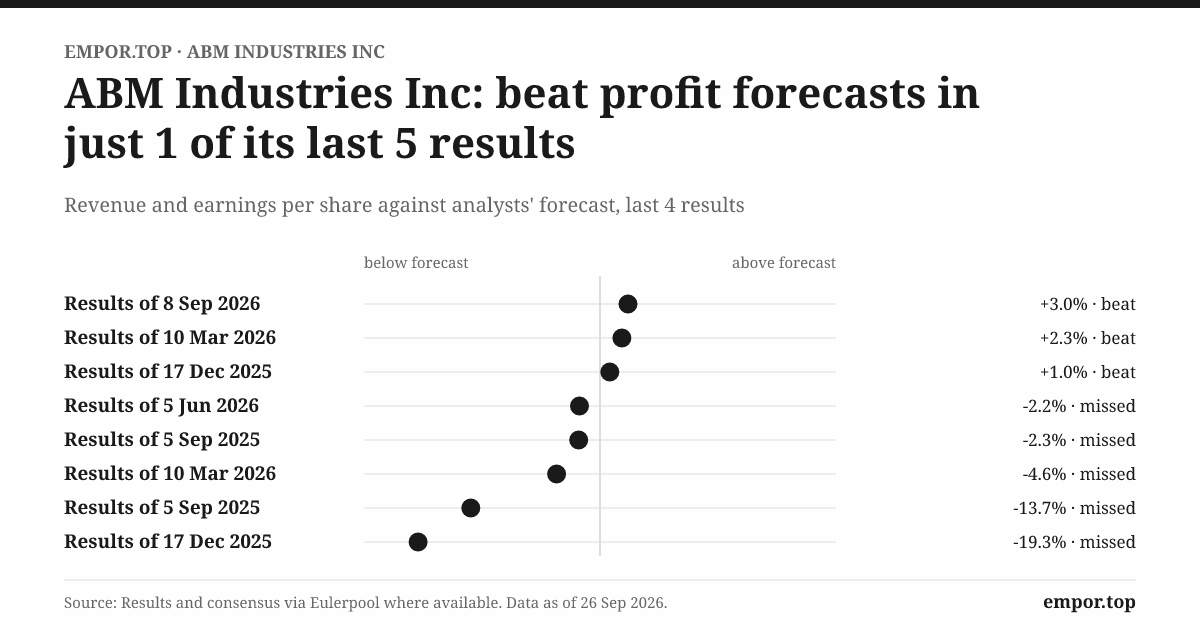
Where management fell short: Forward guidance has required repeated downward recalibrations. For fiscal 2025, ABM initially targeted an adjusted EBITDA margin of 6.3% to 6.5% alongside adjusted diluted earnings per share of $3.60 to $3.80.14 By September 2025, management lowered expectations to the bottom of both ranges.[^19] Full-year results ultimately missed the targets, with adjusted EPS settling at $3.44 and adjusted EBITDA margin finishing at 5.9%.2 A major driver of that shortfall was a $23.3 million negative adjustment to self-insurance reserves covering prior-year liability claims.2 Management contended that excluding this charge, underlying operations exceeded initial guidance.[^17] While mathematically accurate, self-insurance reserve adjustments represent an inherent, recurring cost of managing a 100,000-person frontline workforce rather than an isolated non-operating anomaly.
The margin outlook for fiscal 2026 underwent a similar series of reductions. Management initially introduced a segment operating margin target of 7.8% to 8.0%.2 By June 2026, leadership guided toward the lower end of that corridor,[^20] and by September trimmed the range to between 7.7% and 7.8%.[^1] Concurrently, the midpoint of full-year adjusted EPS guidance was raised to between $3.95 and $4.10.[^1] That divergence—diminishing segment operating profitability accompanied by rising per-share earnings—was engineered through reduced corporate tax rates, lower administrative overhead, and share repurchases, rather than operational margin expansion.[^1]
The self-insurance accounting overhaul. Following formal inquiries from the Securities and Exchange Commission staff in 2025, ABM revised its non-GAAP reporting framework to discontinue the practice of adding back prior-year self-insurance adjustments to adjusted EBITDA and adjusted EPS.[^12] The company recast prior historical periods to align with the revised standard. Orr characterized the adjustment to investors as a technical change in financial presentation.[^17] By June 2026, management indicated that operational refinements to its internal claims management allowed it to incorporate self-insurance volatility into forward guidance ranges.[^20] While adopting the standard enhanced reporting transparency, the accounting practice had been used to elevate headline non-GAAP earnings until regulatory intervention prompted the change.
Executive leadership transitions. Earl Ellis, who had served as chief financial officer since November 2020, departed the organization in June 2025 amid the cloud ERP billing remediation. The board appointed David Orr as his successor, a 24-year ABM finance veteran who had overseen financial planning and analysis since 2015.19 Orr's tenure coincided with the stabilization of working capital and free cash flow, accompanied by a more quantified, unvarnished communication style on quarterly earnings calls.
An Activist's Checklist
An institutional activist evaluating ABM's capital allocation and governance would center an engagement campaign on four unresolved challenges:
- Capital deployment versus structural returns: Over the past decade, management deployed billions of dollars into large-scale acquisitions—including GCA Services, Able Services, RavenVolt, and WGNSTAR—funded through debt and equity dilution and underwritten on projected operating synergies. Yet consolidated adjusted EBITDA margins remain pinned near 6%, while the balance sheet carries roughly $3 billion in capitalized goodwill and intangible assets. A skeptical shareholder would demand an unvarnished audit of cumulative return on invested capital across acquired entities.
- Non-GAAP earnings presentation: Management has repeatedly recast headline non-GAAP adjustments, culminating in the 2025 SEC inquiry regarding prior-year self-insurance claims. Investors require a standardized, long-term historical margin baseline calculated under consistent accounting standards to evaluate whether underlying earnings power is genuinely expanding.
- Severe customer concentration in high-margin verticals: ABM's primary growth drivers rely heavily on a narrow cluster of commercial counterparties. With single cornerstone clients generating roughly 30% of Manufacturing & Distribution revenue and over 20% of Technical Solutions revenue, project deferrals or client reallocations introduce acute earnings volatility.
- Repeated commercial office inflection targets: Executive leadership projected a cyclical inflection in commercial office properties three separate times over an eighteen-month span, only to defer the projected recovery horizon each time.
None of these vulnerabilities reflects corporate impropriety. Together, however, they illuminate why public markets assign ABM a valuation multiple typical of an hourly labor contractor, and they establish the empirical battleground separating the bullish transformation thesis from the bearish view of a commoditized janitorial vendor.
IX. Bull vs. Bear Case, Risks, & Key KPIs to Watch (165:00 – 185:00 / 20 min)
The Bear Case: A Commodity Business with a Good Story
Office contraction is slow but persistent. The skeptical case does not require a sudden collapse in commercial real estate, only the steady attrition of cleaning density across secondary and distressed markets. ABM's track record illustrates the dynamic: repeated executive forecasts of cyclical recovery followed by fresh client departures and contract concessions. With the cornerstone Business & Industry segment generating roughly 45% of total company sales, management's expectation that the division will return to organic growth only around the middle of fiscal 2027 carries little margin for error.[^1] If that inflection horizon slips further into late 2027 or 2028, the drag will continue to compress consolidated top-line growth and dilute portfolio margins.
Pricing concessions risk becoming institutionalized. The fall 2025 contract renegotiations traded operating margin for multi-year contract stability. While management maintains that profitability recovers over the tenure of those agreements—and recent margin stabilization in Business & Industry lends initial support to that argument—commercial property managers have observed that threatening an open competitive bid can successfully extract mid-term fee freezes and scope reductions. If enterprise buyers treat concessions as a recurring procurement tactic, those resets will become routine rather than episodic.
The digital transformation dividend remains elusive. The cloud ERP deployment consumed a year of cash collection disruptions and tens of millions in transformation outlays, yet two operating segments have yet to complete the migration. If consolidated operating margins fail to expand once the full platform is active, the ELEVATE program will prove to have been an expensive defensive necessity to maintain industry parity rather than a generator of structural operating leverage.
Technical growth is volatile, lump-sum contracting. Technical Solutions remains heavily reliant on a small cluster of enterprise accounts, where a single deferred project milestone can swing quarterly results. External policy and macroeconomic factors also cloud visibility: potential revisions to federal clean-energy tax credits, electrical supply chain bottlenecks, and tariffs on imported electrical switchgear and batteries could all erode project economics.[^12] Cyclical vulnerability extends to other operating units as well: the Aviation division regularly absorbs fee-reduction pressure whenever commercial carriers confront spikes in jet fuel expenses.[^1]
Self-insurance adjustments and legal liabilities remain constant tail risks. ABM self-insures a substantial portion of its workers' compensation, general liability, automobile, and employee healthcare obligations. Chief Financial Officer David Orr has characterized the underlying liability reserve pool at roughly $500 million,[^17] meaning an actuarial adjustment of just a few percentage points on prior-year claims can wipe out a full quarter of earnings expansion—as the fourth quarter of fiscal 2025 demonstrated. Separately, ABM carried $8.8 million in accrued litigation reserves as of July 31, 2026, alongside estimated reasonably possible additional losses of up to $14.9 million.4 While those litigation figures appear modest against an $8.7 billion revenue baseline, in an organization employing more than 100,000 hourly workers, wage-and-hour dispute settlements represent a persistent, unavoidable friction.
Centralized digital architecture creates a single point of failure. The cloud infrastructure that resolved decentralized billing discrepancies now concentrates enterprise operational risk. Administering weekly payroll for over 100,000 workers and generating invoices for thousands of customer facilities through a single cloud platform exposes the business to systemic cyber disruptions and operational outages that its historically fragmented branch network insulated against. As the remaining two operating divisions prepare for cutover, any operational disruption carries direct balance-sheet and working-capital ramifications.
Balance-sheet leverage and debt-service friction. Total outstanding debt stood at approximately $1.78 billion as of July 31, 2026, including borrowings under a $300 million accounts receivable securitization facility.4 Annual interest expense for fiscal 2026 is projected at roughly $110 million,[^1] rising from $96.4 million in fiscal 2025 and $85.0 million in fiscal 2024. While management achieved its leverage target of 2.9 times adjusted EBITDA ahead of plan, that debt service absorbs a meaningful share of operating income, and any further debt-financed acquisitions would quickly push leverage back above three times.
The Bull Case: A Cash Machine Moving Up the Value Chain
A secular flight to quality in commercial real estate. Institutional corporate tenants are concentrating occupancy in premier Class A and trophy towers, precisely where ABM maintains its deepest operational density. High-profile facility awards for major commercial and investment bank headquarters in New York demonstrate that premier landlords and blue-chip tenants still turn to established national providers with proven compliance and safety records.[^20]
The domestic manufacturing and semiconductor renaissance. Executive leadership highlights more than $645 billion in private semiconductor and advanced manufacturing investments announced across North America since 2020.[^20] Through the integration of WGNSTAR, ABM operates both across base-building utilities and directly inside cleanrooms servicing specialized photolithography and etch equipment. With semiconductor-related revenue expanding 65% organically across the first nine months of fiscal 2026,[^1] the segment provides a viable engine to lift Manufacturing & Distribution profitability as acquisition-related intangible amortization tapers.
Strong underlying cash flow yields and accelerating capital returns. For fiscal 2026, reported free cash flow is projected at roughly $210 million, or approximately $285 million on a normalized basis before transformation outlays, integration spending, restructuring charges, and the final RavenVolt earn-out installment.[^1] Against an equity valuation near $2.9 billion, that normalized performance translates into a double-digit free cash flow yield. As these transitional cash calls subside, management will command greater financial capacity to support share repurchases, expand the 58-year dividend streak, and pare down debt.
Portfolio mix shift driving multiple expansion. Specialized semiconductor, microgrid, and data center services already account for more than 11% of consolidated revenue while generating double-digit blended operating margins.[^1] If that technical footprint expands to represent 20% to 25% of enterprise sales, consolidated margins would lift mechanically. That portfolio evolution could prompt equity markets to revalue ABM as a mission-critical technical infrastructure partner rather than a low-margin janitorial vendor. Salmirs has emphasized that the data center project pipeline represents "a multiple of where it was at this time last year," with commercial conversion anticipated across fiscal 2027 and 2028.[^1]
Weighing the Two Cases
The empirical evidence supports a more measured version of the bullish narrative than executive communications suggest. The high-tech growth verticals are genuine and scaling rapidly, but they still represent a modest fraction of consolidated revenue, and their quarterly margins remain subject to project-timing swings. Meanwhile, the legacy janitorial core functions as an indispensable, cash-generative backbone, but one that continues to lack structural pricing leverage against corporate procurement desks. The most realistic operational trajectory points to a gradual, mix-driven margin improvement rather than a sudden corporate metamorphosis, explaining why public markets continue to value the enterprise near its historical nine-times EBITDA multiple.
The Three KPIs That Matter
1. Segment operating margin. Management established this metric in December 2025, reporting roughly 7.9% for fiscal 2025.[^17] For fiscal 2026, leadership has guided the corridor to between 7.7% and 7.8%.[^1] If the strategic pivot is translating into real operational leverage, this benchmark must expand across fiscal 2027 and 2028 as cloud ERP efficiencies materialize, corporate restructuring savings flow through, and higher-margin technical work represents a larger share of the business. If segment profitability remains pinned below 8%, the transformation thesis will have failed to show up in actual operations.
2. Organic growth split between commercial core and technical verticals. Investors must track Business & Industry's progress toward its mid-2027 organic growth milestone against the expansion rate of the semiconductor, microgrid, and data center verticals, which ABM now reports as an aggregate cluster. The decisive test is whether technical solutions can expand rapidly enough to drive consolidated earnings growth, or whether they merely offset ongoing volume attrition across commercial office towers.
3. Working-capital discipline and cash flow conversion. The billing friction of 2025 illustrated how swiftly administrative disruptions can exhaust working capital in an outsourced labor model. Key metrics to monitor include whether days sales outstanding remains disciplined as the final two reporting segments transition to the cloud ERP, and whether reported free cash flow steadily converges with normalized cash figures as one-time transformation outlays and acquisition integration charges conclude.
These three metrics will determine over the next twenty-four months whether ABM is genuinely evolving its century-old economic engine or simply redecorating a commoditized janitorial base—a distinction that frames the broader lessons of its corporate journey.
X. Epilogue & Playbook Lessons (185:00 – 195:00 / 10 min)
The Bucket and the Battery
Somewhere in a Georgia industrial park, an ABM crew is wiring switchgear into an on-site microgrid for a national big-box retailer. In a fabrication facility outside Phoenix or Portland, a WGNSTAR technician in a cleanroom suit is servicing a photolithography tool producing semiconductors worth far more than the building's annual cleaning contract. And in a downtown San Francisco office tower, not far from where Morris Rosenberg first washed storefront windows with a bucket and sponge, a janitor is vacuuming an office floor that is only half occupied. All three work for ABM. The company's long-term investment case depends on how the economic weight among those three jobs shifts over the remainder of the decade.
Lessons for Investors
Scale is not pricing power. Between fiscal 2017 and fiscal 2025, ABM expanded annual revenue by roughly 60% through debt- and equity-financed acquisitions, yet its adjusted EBITDA margin finished essentially where it began, near 6%. In business models where variable labor constitutes the vast majority of operating expense and corporate procurement departments routinely solicit competitive bids, operational scale defends commercial relevance and local route density; it rarely creates pricing leverage.
Workforce dynamics dictate client switching costs. In unionized commercial real estate, statutory worker-retention mandates and collective bargaining agreements dictate that a successor contractor must absorb the incumbent custodial crew. For a property manager, swapping service vendors replaces corporate supervision while leaving frontline cleaners and daily site routines largely untouched, reducing client switching friction to near zero. Genuine switching costs emerge only where a contractor's technical certifications, site-specific clearances, and specialized engineering protocols are difficult and costly to replace—the core economic logic motivating ABM's expansion into semiconductor cleanrooms and distributed power infrastructure.
Operational transformations require extended gestation. The "2020 Vision" reorganization required roughly six years to settle into its final segment architecture. The ELEVATE modernization program launched in late 2021, absorbed a year of billing friction and working-capital drag in fiscal 2025, and still awaits cutover across its final two operating divisions. In decentralized, labor-intensive enterprises, operational overhauls rarely follow tidy linear roadmaps, and the financial dividends from technical diversification are likely to arrive later and with greater quarterly volatility than early executive targets suggest.
Contingent earn-outs mitigate downside in growth acquisitions. Structuring the RavenVolt acquisition with substantial performance-contingent consideration shifted initial execution risk onto the selling founders, limiting ABM's upfront cash outlay and tying total consideration directly to realized EBITDA milestones. While fair-value mark-to-market adjustments introduced notable volatility into reported GAAP earnings, the mechanism prevented balance-sheet overextension before the business demonstrated sustained commercial adoption.
Multiple expansion requires structural margin evidence. Public markets value ABM near nine times adjusted EBITDA not because investors fail to understand the business, but because they understand its hourly labor economics all too well. Rerating from a commercial contractor multiple to a mission-critical technical infrastructure valuation cannot be achieved through strategic presentations or rebranding alone. It requires consecutive years of demonstrated organic growth, segment operating margins expanding beyond historical ceilings, and a permanent shift in underlying revenue mix.
Final Reflection
Morris Rosenberg's first afternoon in post-earthquake San Francisco yielded $3.50 in profit on a $4.50 outlay for a bucket, mop, and squeegee. Over the subsequent 117 years, the enterprise he founded survived the Great Depression, mobilized for a world war, navigated a global pandemic, and adapted to the structural realignment of American office work, all while building a 58-year record of consecutive annual dividend increases. What it has never managed to do is earn wide operating margins. The central question for investors is whether cleanrooms, microgrids, and data centers can finally alter that historical baseline, or whether ABM will remain what it has been across its century-long trajectory: an indispensable, cash-generative, low-margin operator whose primary strength lies in reliably executing the physical economy's most unglamorous work.
References
-
ABM Industries Form 10-K for Fiscal Year Ended October 31, 2024 — U.S. Securities and Exchange Commission, 2024-12-19 ↩↩↩↩↩↩↩
-
ABM Reports Fourth Quarter and Full Fiscal 2025 Results and Provides Fiscal 2026 Outlook (Form 8-K Exhibit 99.1) — U.S. Securities and Exchange Commission / ABM Industries, 2025-12-17 ↩↩↩↩↩↩↩↩↩↩↩↩↩
-
ABM Industries Form 10-Q for the Quarter Ended July 31, 2026 — U.S. Securities and Exchange Commission, 2026-09 ↩↩↩↩↩↩↩↩↩
-
History of ABM Industries Incorporated — FundingUniverse ↩↩↩↩↩↩↩
-
ABM History Timeline: Our Story Since 1909 — ABM Industries ↩↩↩↩↩↩↩↩↩
-
ABM Names Industry Veteran Scott Salmirs as Next CEO — ACHR News, 2015-01-28 ↩↩↩↩
-
ABM Industries Form 10-K for Fiscal Year Ended October 31, 2017 — U.S. Securities and Exchange Commission, 2017-12 ↩↩↩↩↩↩↩↩
-
ABM Announces "ELEVATE" Strategy for Value Creation and Growth at its 2021 Investor Day — ABM Industries via Yahoo Finance, 2021-12-15 ↩↩↩↩
-
ABM Industries Announces Fourth Quarter and Full Year 2020 Financial Results — GlobeNewswire, 2020-12-16 ↩↩↩↩
-
Facilities Giant ABM Buys Able Services for $830M — Buildings.com, 2021-08 ↩↩↩↩
-
ABM Industries Form 8-K Exhibit 99.1 (Able Services Transaction and Credit Facility) — U.S. Securities and Exchange Commission, 2021-09-08 ↩
-
ABM Reports Fourth Quarter and Full Year Fiscal 2023 Results and Provides Fiscal 2024 Outlook (Form 8-K Exhibit 99.1) — U.S. Securities and Exchange Commission / ABM Industries, 2023-12-13 ↩↩↩↩↩
-
ABM Reports Fourth Quarter and Full Fiscal 2024 Results and Provides Fiscal 2025 Outlook (Form 8-K Exhibit 99.1) — U.S. Securities and Exchange Commission / ABM Industries, 2024-12-18 ↩↩↩↩↩↩↩↩
-
ABM Offers EnhancedClean to Support COVID-19 Response Efforts — GlobeNewswire, 2020-04-07 ↩
-
ABM Broadens Its Technical Solutions Capabilities With Acquisition of Rapidly Expanding RavenVolt — Yahoo Finance / Business Wire, 2022-09 ↩↩↩↩
-
A Primer on the Displaced Janitor Opportunity Act and the Property Service Workers Protection Act — Leech Tishman, 2018-01-24 ↩
-
ABM Industries 2026 Proxy Statement (Schedule DEF 14A) — U.S. Securities and Exchange Commission, 2026-02-13 ↩
-
ABM Names David Orr as Chief Financial Officer — GlobeNewswire, 2025-06-10 ↩
 LinkedIn
 WhatsApp
 Reddit
 Hacker News
 Email
Email Kindle
 RSS Feed
 Spotify
 Apple Podcasts
 Amazon Music
 Audible
 YouTube