G-III Apparel Group, Ltd.: The Brands It Lost, the Brands It Bought
September 1: Marc Jacobs joins the portfolio
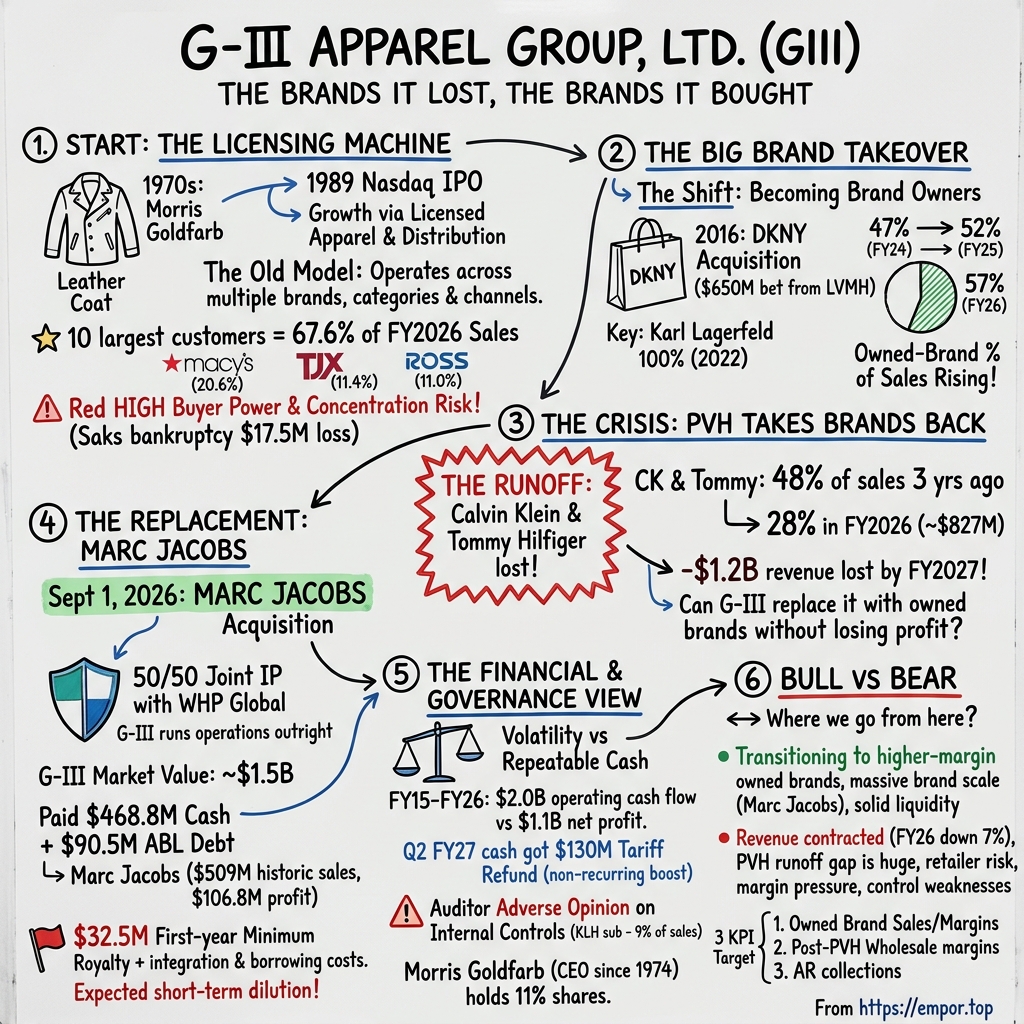
On September 1, 2026, a New York apparel company that most shoppers have never heard of took over one of the best-known names in American fashion. G-III Apparel Group closed its acquisition of Marc Jacobs from LVMH that day.1 The next morning, Morris Goldfarb, who has been at the heart of G-III since 1974, told analysts the deal was done, and in the same breath reported a quarter in which sales had fallen 10%.[^2]2 Both facts belong in the opening scene, because together they are the whole story.
The deal itself was unusual in shape. G-III did not buy Marc Jacobs the way a company normally buys a brand. It bought the operating business outright: the design studio, the inventory, the stores, the wholesale accounts, the people.1 The name, the logo and the rest of the intellectual property went somewhere else. They sit in a separate joint venture that G-III owns half of, alongside WHP Global, a New York firm whose business is buying brands and licensing them out.13
The joint venture then licensed the Marc Jacobs name back to G-III's operating company, under a license that runs to December 2041 and renews automatically for up to ten further five-year periods.1 Even the governance is split: the joint venture's board has two G-III managers and three from WHP, with major decisions requiring both partners.1
Think of it as buying a restaurant and half the building it sits in, then paying rent to the building's owners, one of whom is yourself. Goldfarb described the arrangement as "a hybrid where we're really paying essentially a half royalty."[^5] The rent is not small. In the first year, the operating business owes the joint venture a minimum royalty of $32.5 million.4 G-III gets half of whatever the joint venture earns back as its owner, but it pays the full royalty out of the operating business first. And management told investors from the outset that the acquisition would dilute earnings for its first twelve months before it began adding to them.3[^2]
The road to that morning had been short. On May 14, 2026, G-III announced a definitive agreement with WHP Global for the Marc Jacobs brand.3 The sequence was choreographed like a relay. WHP and G-III would form the joint venture; the joint venture would buy Marc Jacobs from LVMH; and G-III would then buy the operating business back out of the joint venture and sign the long-term license.31 G-III put its own investment at about $500 million, funded from cash on hand and its revolving credit line, with committed debt financing from Morgan Stanley in reserve.3
The license G-III signed covers stores, e-commerce and wholesale across apparel, handbags, footwear, swimwear, small leather goods, luggage and cold-weather accessories in the United States, Canada, Mexico and Western Europe.1 For the second time in a decade, LVMH was selling an American fashion house, and for the second time the buyer was G-III.
What G-III got is not, primarily, a clothing business. Goldfarb told analysts that about 90% of Marc Jacobs' sales come from handbags, small leather goods and accessories, and that about two-thirds are sold directly to consumers, through more than 100 stores, most of them outlets, and online.[^2] Ready-to-wear under G-III is still to launch.[^2] That mix is close to the inverse of G-III's own, which is dominated by apparel sold wholesale to department stores.
It is a reason the deal is strategically interesting, and a reason it carries execution risk: G-III is buying expertise in a channel it has run only at modest scale. Asked why it had not simply signed up as a licensee, Goldfarb was candid: "We could have sat by and been a licensee and paid a royalty."[^2] Instead G-III chose to be both owner and licensee at once.
Now look at the price. In its last full year under LVMH, Marc Jacobs produced about $509 million of revenue and about $107 million of operating profit, an operating margin of roughly 21%.5 To get it, G-III used about $469 million of its own cash and, on a pro forma basis, added about $90.5 million of borrowing under its asset-based credit line, at a disclosed rate of 7.25%.4 On those historical numbers, the price looks modest. Take the $107 million of operating profit, subtract the new $32.5 million minimum royalty, and what is left is about $74 million, a little under seven times the roughly half-billion dollars G-III said it was investing.543
That arithmetic is the bull case in miniature, and it comes with three caveats that matter more than the multiple. The first is that those profits were earned under a different owner, with LVMH's systems, LVMH's purchasing scale and LVMH's licensing deals, and part of what the old Marc Jacobs earned as licensing income now flows to the joint venture rather than to the business G-III runs. Goldfarb himself told analysts that the operating business expected roughly $360 million of global sales in the current year, excluding the joint venture's licensing revenue, which is a smaller number than the historical $509 million and is measured on a different basis.[^2]
The second is that the historical statements carry none of the new costs: the royalty, the interest, the integration work. The third is that a cheap price on a business is only cheap if the business keeps earning what it used to.
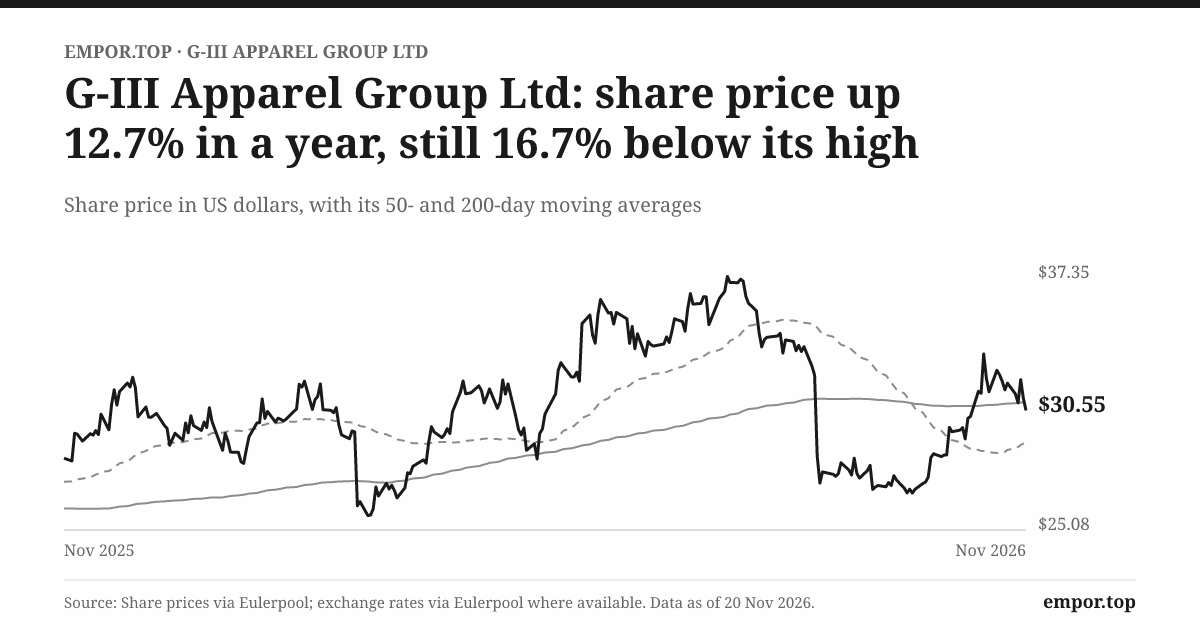
The stakes for G-III are large because of what was happening to the rest of the company at the same moment. G-III's stock market value was about $1.5 billion on November 20, 2026.[^8] Its revenue was about $3.0 billion in fiscal 2026, down 7%, and lower than it had been three years before.6 The cause was not mysterious. PVH, the owner of Calvin Klein and Tommy Hilfiger, was taking back the licenses under which G-III had spent two decades making and selling those brands' clothing to North American department stores. By the end of fiscal 2027, Goldfarb said, G-III would have lost nearly $1.2 billion of annual revenue from those two names.[^2]
Yet the headline totals understate how fast the company is changing underneath. Brands G-III owns outright rose from less than half of sales to 57% in just two years.6 Donna Karan, relaunched only in 2024, grew by more than 45% in the July quarter, according to management.[^2]7 The portfolio, not just the revenue line, is the thing in motion.
So the questions that run through this story are three. Can G-III, a company that built its fortune making clothes for other people's brands, turn acquired and licensed names into durable brand economics, with pricing power and repeat demand? Can it replace the PVH revenue without giving up the profit that came with it? And can a management team led by the same chief executive for more than half a century deliver that transition while its biggest customers are under financial strain and its auditor has flagged a weakness in its internal controls? To answer them, the story has to go back to a coat.
 Subscribe on LinkedIn
Morris Goldfarb’s licensing machine
The story starts in New York's Garment District in 1956, with a leather coat. That was the year Aron Goldfarb, a Holocaust survivor who had come to America to rebuild a life, set up the women's leather outerwear business that became G-III.7 It was the kind of company the district was full of in those decades: a cutting table, a few dependable buyers, a product that sold when the weather turned and sat in the warehouse when it did not.
In 1974 his son Morris joined the business.7 Half a century later he is still running it, as chairman and chief executive, a tenure that spans the company's entire life as a public company.8 What he built over those decades was not, at first, a brand. It was a capability. G-III's own account of the period says Morris Goldfarb began building a global sourcing and manufacturing organization, the unglamorous machinery that lets a New York apparel house design a coat, get it made in Asia at the right cost, and land it in a department store on the right week.7 The company listed on Nasdaq in 1989.7
The idea that turned that machinery into a growth engine was simple. If G-III could make a great coat, it could make a great coat with someone else's name on it. In 1990 it signed licenses with the NFL, NHL, NBA, Major League Baseball and the NCAA to make sports outerwear; through the 1990s it added outerwear licenses for Kenneth Cole, Nine West and Cole Haan.7 Each license was a bargain of a particular kind. The brand owner supplied the name and the consumer pull. G-III supplied the design team, the factories, the inventory risk and the relationships with store buyers. In return, G-III paid a royalty, usually a percentage of what it sold, often with a guaranteed minimum.
Then the pace quickened. In 2005 G-III bought Marvin Richards, which brought it Calvin Klein outerwear, and Winlit, which brought Guess.7 In 2008 it bought the Andrew Marc outerwear label, which came with Levi's and Dockers licenses, and Wilsons Leather, a mall retailer that pulled G-III into running its own stores and outlets.7 Vince Camuto came in 2011, the French swimwear house Vilebrequin in 2012, and G.H. Bass footwear in 2013.7
Calvin Klein grew from a coat license into a sprawling wholesale business across women's sportswear, dresses, suits, handbags and more, and in 2016 G-III added Tommy Hilfiger womenswear in the United States and Canada, a license that widened within the year to sportswear, suit separates, performance and denim.7 Morris Goldfarb later recalled that Calvin Klein alone "grew to be $1.2 billion in sales" inside G-III.9
That is the machine in one sentence: G-III became very good at turning other companies' names into racks of clothing in American department stores. It is worth being precise about how the money moves, because the rest of the story depends on it. Most of G-III's revenue is wholesale, and wholesale revenue follows three things: how many units retailers order, which products they choose, and what price actually sticks after markdown support and allowances.6 A smaller stream comes from G-III's own stores and websites. A third, small but strategically important, comes from royalties that G-III earns when it licenses its own brands to others; those royalties generally track the licensee's sales and may carry minimum guarantees.6
The business also lives on a calendar. Coats and the fall-holiday season dominate, so the third and fourth fiscal quarters, roughly August through January, produced about 59% to 61% of annual revenue in each of the past three years.6 That seasonality matters for an investor because it means G-III borrows and builds inventory in summer, ships in autumn, and collects in winter. A bad holiday season does not just dent one quarter; it decides the year.
G-III sells to roughly 1,500 customers.6 What it does not publish is just as telling. The company gives no portfolio-wide figure for how much of its revenue recurs under contract, and no single summary of when its licenses expire or how large the minimum guarantees are.6 For an outsider, that means the durability of the license book has to be inferred from events rather than read from a schedule. And, as PVH would later demonstrate, events can be abrupt.
So how did the machine perform over a full decade? From fiscal 2016 to fiscal 2026, G-III's revenue grew about 2.4% a year, from roughly $2.3 billion to $3.0 billion.106 Net profit went the other way, falling about 5.2% a year, from $114 million to $67 million.106 Part of that last figure reflects an unusually bad fiscal 2026, and the five-year comparison from the pandemic trough flatters the other direction. But the long view is clear enough. G-III's skill at operating across brands, categories and channels scaled the business. It did not compound its profits.
That is the central trade-off this story keeps returning to. A portfolio gives G-III more ways to fill a retailer's racks; if one name cools, another can take its floor space. But a licensed name is rented, not owned. Rights expire. Brand owners change their minds. And the retailers at the end of the chain, who can choose between G-III's coats and anyone else's, bargain hard. In 2016 Morris Goldfarb made the move that was meant to loosen that constraint: instead of renting a famous name, he bought one.
The $650 million bet on DKNY
On July 25, 2016, G-III and LVMH announced that the New York apparel house would buy Donna Karan International, owner of DKNY and Donna Karan, from the world's largest luxury group.11 The headline enterprise value was $650 million.11 For G-III it was a different kind of deal from anything it had done. It was not picking up a coat license or a mall chain. It was buying one of the defining American fashion names of the 1990s, from a seller that had decided it could not make the brand work.
LVMH's Toni Belloni said Donna Karan International had "a deep heritage, global recognition, and renewed energy."11 Morris Goldfarb called it "an iconic global fashion company."11 Both statements were generous, and neither explained the price. A luxury group does not sell a famous name because it is thriving inside its portfolio. G-III's bet was that a brand a luxury conglomerate no longer wanted could become a highly productive accessible-luxury brand in American department stores, made and distributed by a company that already knew those buyers better than almost anyone.
The financing told you how big the swing was for a company of G-III's size. Barclays and JPMorgan committed a $525 million asset-based revolving facility and a $450 million term loan, and LVMH agreed to take part of its payment in G-III paper: $75 million of newly issued G-III common stock and a seller note.11 By closing, on December 1, 2016, the purchase price had settled at about $670 million after adjustments, and the seller note had grown to $125 million.12[^16]
G-III, which had carried no borrowings at all a year earlier, ended fiscal 2017 with about $460 million of debt.12 The company also warned at the outset that the deal would dilute earnings in its first full fiscal year and become accretive thereafter.11 Keep that sentence in mind. A near-identical one would reappear a decade later.
The early consequences were visible in the numbers. G-III's operating margin fell from about 7.9% in fiscal 2016 to 4.7% in fiscal 2017, and net profit more than halved, as the company absorbed acquisition costs, new interest expense and the work of rebuilding a brand.12 DKNY was relaunched in 2017 and Donna Karan New York in 2024.7 The strategic logic was that brand ownership offered choices a licensee never gets. G-III could decide which categories to make itself and which to license out to others, which countries to enter through partners, and which stores deserved the name. A licensee works within someone else's plan. An owner writes the plan.
How did the bet turn out? DKNY generated about $650 million of reported net sales in fiscal 2026, with management citing more than $2.4 billion of global retail sales once licensees' products are counted.96 That makes the brand roughly the size of the enterprise value G-III paid for the whole company a decade earlier. It is tempting to treat that comparison as a verdict, but it is not one. The sales figure is a current revenue number, not a purchase-date multiple; it says nothing about how much profit DKNY earns after marketing and overhead, and nothing about what comparable fashion brands fetched in comparable deals.
It also comes with a wobble. DKNY's sales were about $590 million in fiscal 2024, rose to about $675 million in fiscal 2025, and eased back to about $650 million in fiscal 2026.6 Owning a brand did not make its growth automatic.
The next major portfolio move came from a stake G-III had been nursing for years. In 2015 it formed a joint venture for Karl Lagerfeld Paris in North America; in 2022 it acquired the remaining 81% of the Karl Lagerfeld global brand.7 By fiscal 2026 Karl Lagerfeld was about a $630 million business by reported net sales, growing high single digits, with high-teens growth in North America.9
The company also bought Sonia Rykiel in 2021, signed a 25-year master license for Halston with an option to buy the brand, and took long-term licenses for Nautica women's apparel, BCBG, Champion outerwear and Converse.7 Donna Karan, relaunched as a department-store brand, grew about 40% in fiscal 2026, according to management, although G-III declined to say how large it is.9
The owned brands also gave G-III something it never had with Calvin Klein: a royalty stream of its own, flowing in rather than out. The gap between DKNY's reported sales and its global retail sales is the licensing book at work, and in fiscal 2026 G-III signed new DKNY licensing deals covering Latin America, China and India.9 In the April 2026 quarter, DKNY's North American stores posted a double-digit comparable-sales gain, dkny.com grew more than 40%, and the brand opened a flagship in Shanghai.[^5]
Karl Lagerfeld, meanwhile, was being stretched well beyond clothing, into a café in Amsterdam and branded residences in Lisbon.[^2] Brand extensions of that kind are cheap for the owner, because the partner bears the capital, and they are exactly the optionality a licensee never captures. They are also, in revenue terms, small, and none of them is broken out in the filings.
The portfolio, in other words, was tilting. Owned brands accounted for about $1.6 billion of sales in fiscal 2026.6 But read it carefully, because part of the rise in the owned share is arithmetic: the denominator shrank as the PVH licenses ran off. Owned-brand dollars grew from about $1.36 billion to about $1.59 billion over those two years, which is real growth of roughly 8% a year, but not the transformation the share alone suggests.6
The bigger gap is in what G-III does not report. It discloses sales by brand group and segment, but not operating profit by brand.6 There is no line in the filings that shows DKNY's margin against Calvin Klein's, or Karl Lagerfeld's return on the capital G-III spent to buy it. Management says owned brands generally carry higher gross margins than licensed ones, which is plausible, because G-III no longer pays a royalty on them.9 But a brand owner also carries the brand's marketing, its flagship stores and its global licensing staff. Whether that trade nets out to superior returns is not something an outside investor can verify from the filings.
So the DKNY bet leaves a narrower claim than the one usually told. Buying Donna Karan International did give G-III a durable, substantial brand, and it gave Morris Goldfarb a playbook he has now run several times. What the record does not yet show is that the playbook creates brands with pricing power and repeat consumer demand, as opposed to names whose sales still depend on whether a department store buyer gives them space. That question takes the story out of the boardroom and onto the shop floor, where G-III's customers, not its consumers, make the first decision.
Macy’s, TJX, and the power of the buyer
Picture a G-III order on its way into the world. A design team in New York has built a fall line of DKNY coats and Karl Lagerfeld dresses. The samples travel to buyers' offices. The buyers are not consumers; they are professionals with a fixed budget for the floor, a spreadsheet of last season's sell-through, and a dozen other vendors waiting outside. The name on the label gets G-III into the room. It does not guarantee the order, the price, or the markdown money the retailer will ask for if the coats do not sell.
That room is where G-III's economics are decided, and the filings show who sits on the other side of the table. G-III's ten largest customers generated 67.6% of fiscal 2026 sales.6 The Macy's group alone accounted for 20.6%, TJX, owner of T.J. Maxx and Marshalls, for 11.4%, and Ross Stores for 11.0%.6 Put plainly, roughly 43 cents of every dollar G-III earned came from three retailers, and one of them was a department-store group while the other two are off-price chains that buy brand-name goods at a discount precisely because they can.
The value chain is straightforward. G-III designs, sources, distributes and sells apparel and accessories through wholesale accounts, its own stores and websites, and licensing partners.6 It owns almost no factories; the clothes are made by independent manufacturers, mostly in Asia. Its last three annual reports disclose no supplier concentration.6 That is a sign of flexibility on the supply side: if one factory raises prices or a country faces a new tariff, G-III can, with time and cost, move production. The pressure point is on the other end, where the customers are few and large.
To see how small G-III is in its own neighborhood, look at the company that was its largest partner. PVH, owner of Calvin Klein and Tommy Hilfiger, reported about $8.95 billion of revenue in its 2025 fiscal year, including about $4.77 billion for Tommy Hilfiger and $3.96 billion for Calvin Klein.13 G-III's entire company is about a third that size, and in fiscal 2026 the PVH-branded products G-III made under license still accounted for 28% of its revenue.6 One partner's two brands were each larger than G-III's whole business. That asymmetry is the backdrop for what PVH did next.
Run Porter's five forces through the evidence and the shape of the industry comes into focus. Buyer power is the dominant force, and it is documented, not assumed, in that concentration of sales among a handful of retailers. Substitution is high, because a shopper looking for a wool coat at Macy's can choose among dozens of brands, including the store's own private labels, and G-III's own product mix includes private-label work for retailers.
Supplier power looks modest, because the company reports no concentration in its factory base. Rivalry is intense, because fashion cycles reset every season and every apparel house is fighting for the same shrinking department-store floor. The threat of new entrants is real but bounded; anyone can design a dress, but few can reliably deliver millions of units on schedule to the country's largest retailers.
That last point is where G-III's edge, such as it is, lives. Its documented strength is execution across brands and channels: the sourcing network, the design teams, the logistics and, above all, the buyer relationships built over five decades. It can take a brand like Donna Karan and, according to management, add hundreds of department-store doors in a season.9 Those are real operating capabilities. What the filings do not show is anything that would make them a moat in the strict sense.
G-III does not report market share, customer retention rates, price realization or a cost advantage over rivals.6 Its gross margin fell in fiscal 2026, from about 40.8% to 39.4%, as tariffs and the loss of higher-volume licenses bit, which is not what a company with strong pricing power would expect to see.9
G-III has tried to loosen the buyers' grip by selling more directly. Its retail segment, the DKNY, Karl Lagerfeld and Vilebrequin stores and their websites, generated about $186 million in fiscal 2026, up about 12%, and earned a gross margin of about 50%, well above the roughly 37% earned in wholesale.9 The brand websites are growing faster still; donnakaran.com sales rose close to 170% in fiscal 2026 from a small base, by management's account.9 But the direct business remains a small fraction of a roughly $3 billion company. For the foreseeable future, G-III's fortunes will be decided in the wholesale buyer's office, and Marc Jacobs is in part a bet on changing that.
There is a second, less visible cost of concentration: credit. When three retailers account for 43% of your sales, they also account for a large share of the money you are owed. At the end of fiscal 2026, two customers made up 27.8% and 13.7% of G-III's receivables.6 And retailers fail. G-III stopped shipping to Saks Global, the owner of Saks Fifth Avenue, Neiman Marcus and Saks Off 5th, in December, before it filed for bankruptcy, and raised its allowance for doubtful accounts by $17.5 million, a charge management said cost about 30 cents a share in the fourth quarter.69
It also wrote off $8.4 million of receivables tied largely to bankrupt wholesale customers including Hudson's Bay, and fully impaired a $20 million investment it had made in Saks Global and Saks Off 5th.6 G-III, in other words, had not just sold to Saks on credit; it had invested in its customer. Both bets were lost.
At year-end, gross receivables stood at about $556 million against an allowance of about $19 million.6 G-III describes using customer credit criteria and specific reserves for known problems, but it does not publish an aging schedule showing how much of its receivables are current and how much are overdue.6 For an outside reader that is a real limitation, because the first sign of a customer in trouble is usually a slow payment, and G-III's disclosure does not let investors see it.
The honest verdict on G-III's competitive position is therefore a limited one. The company has a broad platform that is hard to replicate quickly, and it has proven, across fifty years, that it can turn names into product and product into orders. But there is little evidence of switching costs at the consumer level, and the retailers who buy from it have alternatives, scale and the willingness to use both. That leverage is not hypothetical. In G-III's own history the most powerful example came not from a retailer, but from a brand owner.
PVH takes its brands back
For most of two decades, the relationship between G-III and PVH looked like one of the great partnerships in American apparel. PVH owned Calvin Klein and Tommy Hilfiger, and was building them into global lifestyle brands. G-III, in exchange for royalties, made and sold enormous quantities of Calvin Klein and Tommy Hilfiger women's clothing, outerwear and accessories to American department stores. By Goldfarb's account, G-III grew those businesses into "a combined $1.5 billion platform at their peak."[^5] For G-III it was the single largest engine in the building.
Then the brand owner decided it wanted the engine back. PVH's strategy, laid out in its own filings, was to bring more of its brands' design and distribution under direct control, so that it, rather than a licensee, set the product, the price and the image in each market.13 For G-III, that turned a long-standing source of sales into a visible runoff schedule. Product categories came back to PVH one by one as licenses expired.
Calvin Klein and Tommy Hilfiger products, which had been about 48% of G-III's sales three years earlier, fell to 34% in fiscal 2025 and 28%, or about $827 million, in fiscal 2026.6 In its fiscal 2026 wholesale results alone, G-III attributed a $254 million decline to those two businesses, "due largely to the exited licenses."9
This is the moment the licensing machine reveals its hidden clause. A license teaches the licensee how to make a brand's products; it also, over time, teaches the brand owner how valuable those products are, which retailers buy them and what it would take to run the business itself. G-III had spent years building the playbook for Calvin Klein women's sportswear in department stores. PVH could now read the playbook and keep the proceeds.
The relationship did not end quietly. In June 2025, G-III sued PVH over the Calvin Klein and Tommy Hilfiger license relationship, and in July 2025 PVH filed counterclaims.6 G-III says it considers the counterclaims without merit and intends to defend itself.14 The dispute concerns the terms and economics of the license transition itself, which is why it matters: the outcome could affect what G-III collects or owes on a business that was, until recently, the largest in the company. Neither side has publicly quantified the stakes in a way an investor can model, and the filings describe the matter as unresolved.14
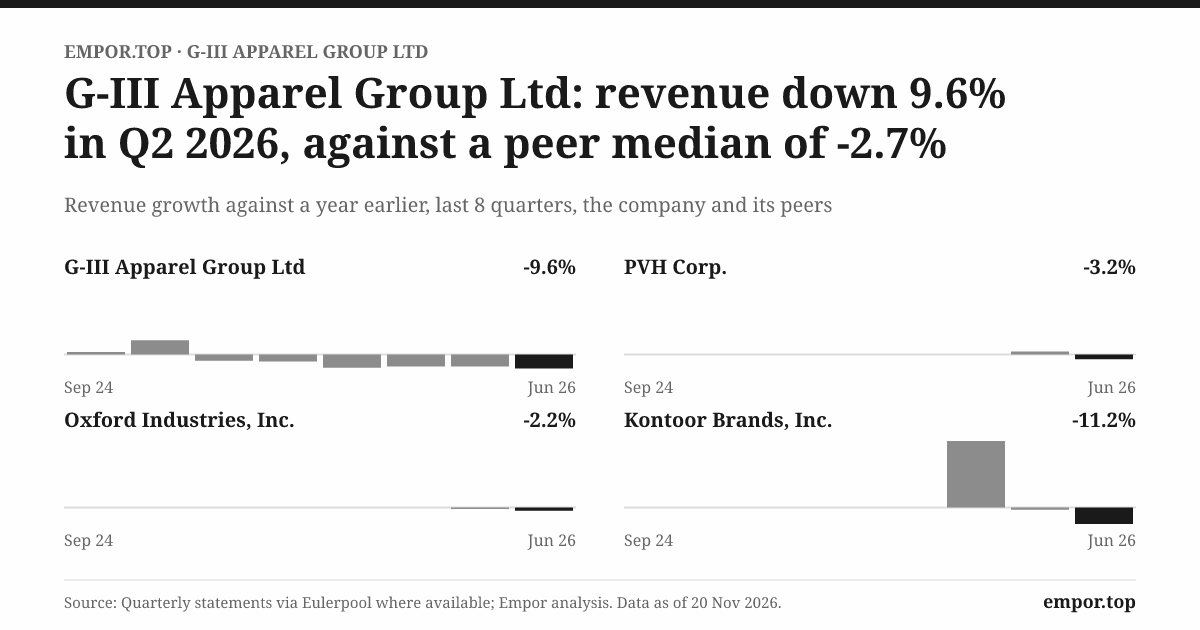
The runoff is now visible in every reported line. Revenue fell 7% in fiscal 2026 and was down about 10% in the July 2026 quarter, the sixth consecutive quarter of year-over-year decline.62 Operating profit fell by roughly half in fiscal 2026, to about $157 million, and the operating margin dropped from about 9.5% to 5.3%.6 Some of that came from tariffs and the Saks bad-debt charge; much of it, Goldfarb told analysts in March, came from the exits themselves. "The pressure on our company is really the exiting brands," he said, "and not only the scale of the exiting brands, but also the margin retrieval as you exit brands."9 When a license winds down, the fixed costs that supported it, from showrooms to sales staff to warehouse capacity, do not shrink as fast as the revenue.
The way management told this story across three earnings calls in 2026 is a useful test of narrative discipline, because the numbers kept moving in small, explicable steps. On the March call for fiscal 2026, G-III guided to fiscal 2027 sales of about $2.71 billion, down about 8%, absorbing about $470 million of lost Calvin Klein and Tommy Hilfiger sales, and guided to non-GAAP earnings of $2.00 to $2.10 a share, down from $2.61.9 Management said the PVH products had generated about $830 million in fiscal 2026 and would bring in about $360 million in fiscal 2027 before rolling off entirely in fiscal 2028.9 It expected gross margin to improve by as much as 300 basis points.9
In June, after the first quarter, sales guidance held at $2.71 billion, non-GAAP earnings guidance rose, and the gross-margin improvement target rose to about 400 basis points.[^5] By September, the lost PVH sales in the fiscal 2027 plan had been trimmed to about $460 million, the sales guidance was reiterated, and non-GAAP earnings guidance rose again, to $2.20 to $2.30.[^2]2 One figure moved the other way. Adjusted EBITDA guidance, raised in June, was lowered in September to $174 million to $178 million.2
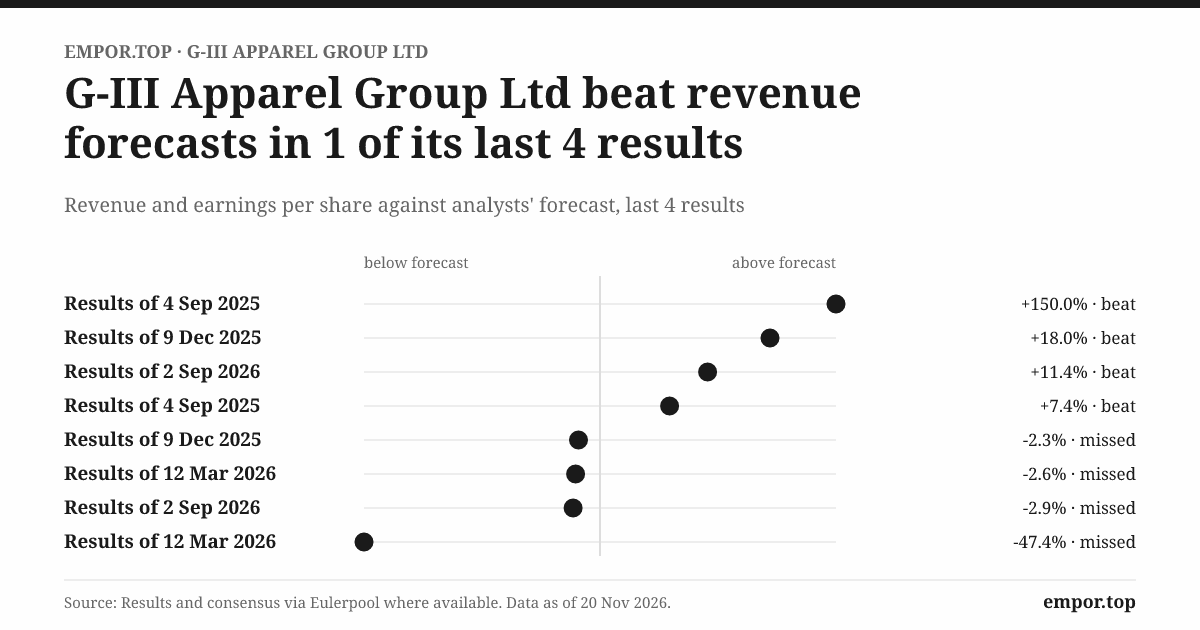
And the July quarter itself missed management's sales guidance of about $570 million, coming in at about $554 million, which Goldfarb attributed to shipment timing and weak traffic in Europe.[^2]2 The pattern is of a management team that kept its revenue promise steady, nudged profit guidance higher, and attributed misses to timing rather than demand. That may prove right. The third-quarter guide, for sales of about $870 million against about $989 million a year earlier, the largest PVH-related drop of the year, is where it will be tested.[^2]
Management's case for the future was crystallized in one sentence on the September call. G-III had lost "nearly $1.2 billion" of revenue from the PVH businesses by the end of the year, Goldfarb said, and "excluding any contribution from Marc Jacobs, we will have replaced $700 million of these sales with our go-forward portfolio growing at a high single-digit rate annually," at higher margin.[^2] Neal Nackman added that roughly $370 million of this year's Calvin Klein and Tommy Hilfiger sales would not recur in fiscal 2028.[^2] He pointed to wholesale sales of the go-forward portfolio in full-price channels rising more than 20% in the quarter.[^2]
Most of the replacement is coming from places other than the famous owned names. Team Sports, built on the Starter brand plus Converse from the second half of fiscal 2026, passed $130 million of net sales that year, and management described "a path to growth to $500 million over time."9 G-III launched BCBG in the fall of 2025, signed French Connection for North America in January 2026, and has Halston and Nautica women's apparel under long-term licenses.97
On the March call, Goldfarb said one brand would add at least 400 more points of sale in the coming season and another 300.9 There is an irony in this. A meaningful share of G-III's answer to losing a licensed business is to sign new licenses, which carry the same structural risk that PVH just demonstrated, only smaller and earlier in their life.
Set that claim beside the evidence and it narrows, but it does not collapse. The replacement is real in the sense that G-III's owned-brand sales grew by roughly $240 million between fiscal 2024 and fiscal 2026, and licensed businesses such as Team Sports, Converse, BCBG and Halston are adding revenue.69 But $700 million of replacement against $1.2 billion of loss still leaves a hole of about $500 million, which is roughly what the reported revenue line has lost. Owned brands as a whole grew only mid-single digits in fiscal 2026, by management's own account, and DKNY's sales slipped year over year.96 The high-single-digit growth rate management cites applies to a portfolio definition of its own choosing, the "go-forward" businesses, which no audited segment captures.
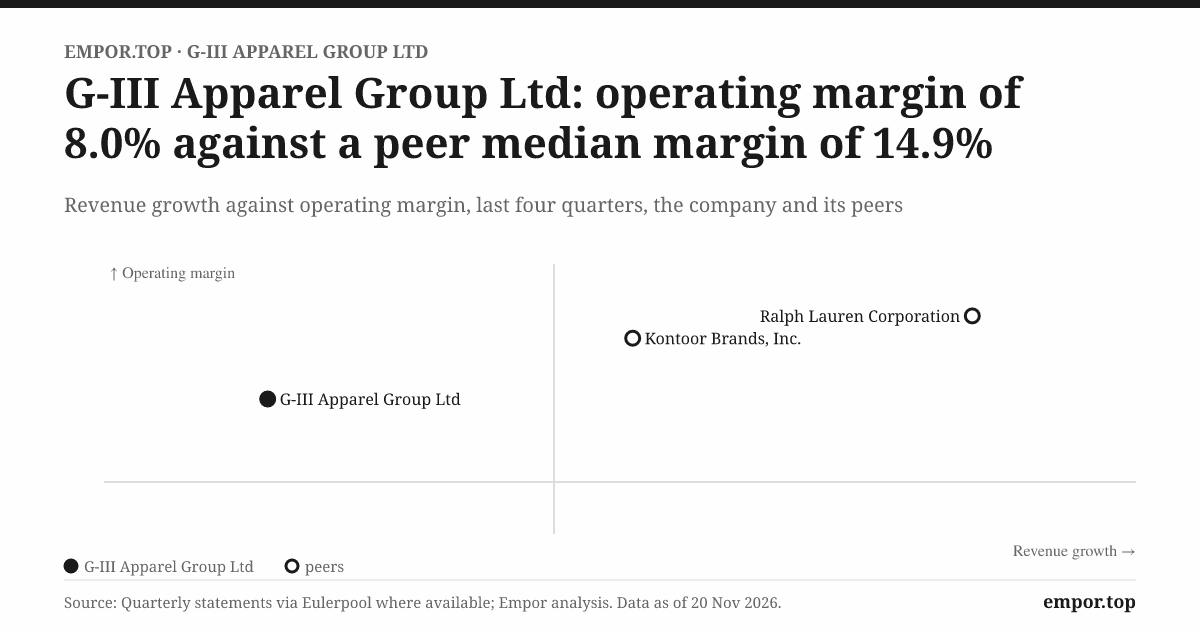
The margin claim deserves the same treatment. On the June call, Dana Telsey of Telsey Advisory Group asked about the combined margin potential of the business, and Nackman gave an unusually direct answer: licensed brands run at "low double-digit operating margins," owned brands at "mid-teens up to the upper teens."[^5] That is the strongest quantified support management has offered for the idea that the mix shift improves profitability. It is also a management estimate, not a disclosed figure. G-III's audited segments are wholesale and retail, not owned and licensed, and the company as a whole earned a 5.3% operating margin in fiscal 2026, which tells you that corporate costs, marketing and the drag of exiting licenses absorb most of what the brands earn before it reaches shareholders.6
Owning a brand removes the royalty; it adds the marketing, the brand stewardship and the inventory risk of building demand rather than renting it. Mix improvement is a hypothesis about returns until the reported margins follow.
The analyst questions on these calls reveal where the bridge is thinnest. In March, Mauricio Serna of UBS asked how large Donna Karan had become, and Goldfarb declined: "We don't disclose."9 Serna also asked how the high-single-digit growth was split between owned brands and licenses, and received a growth rate for owned brands but no dollar bridge.9 In September, Ashley Owens of KeyBanc asked how much of the $1 billion long-term Marc Jacobs target would come from existing categories versus new ones, and got no split.[^2]
Bob Drbul of BTIG pressed on the second-quarter miss and second-half confidence and received one hard number: an order book about 90% complete for the year.[^2] The pattern is consistent. Management answers with portfolio-wide growth claims and points of sale; it rarely gives the brand-by-brand sales and profit figures that would let investors verify the replacement themselves.
So the verdict on the PVH chapter is mixed in a precise way. G-III is replacing part of the lost volume, and its owned-brand mix is rising, which is what the strategy requires. But total revenue is still shrinking, the margin benefit is asserted rather than reported, and the company has not yet published the figures that would settle the question: owned-brand sales and their contribution, the wholesale segment's operating profit after the last PVH licenses expire, and total-company margins in fiscal 2028, the first year with no Calvin Klein or Tommy Hilfiger product at all. Until then, an investor is weighing management's bridge against an income statement that has not yet crossed it. And the most recent income statements carry something that makes them harder to read than usual.
The quarter's earnings include a tariff refund
In the July 2026 quarter, money arrived at G-III from an unusual source: the United States government. Earlier in the year, the Supreme Court had ruled on the tariffs imposed under the International Emergency Economic Powers Act, and importers that had paid those duties became entitled to claim them back.9[^5] G-III received about $130 million of tariff refunds during the quarter, plus about $4.2 million of statutory interest, and was still owed about $9.8 million.14 Cash on the balance sheet at the end of July stood at about $529 million, up from about $407 million in January.146 The company reported stronger earnings than guided and raised its profit outlook.2
It was not a windfall management had planned on. Management said tariffs had cost G-III about $65 million of unmitigated gross margin in fiscal 2026, and the fourth quarter took the heaviest hit.9 When it gave fiscal 2027 guidance in March, management said explicitly that it had assumed tariff rates in effect before the Supreme Court's ruling and had "not anticipated any changes to tariff policy or refunds" in its outlook.9 By September, it had changed its working assumption to current tariff rates.[^2] The refund, in other words, gave back money the previous year's earnings had already absorbed, which is why management treated most of it as belonging to a prior period.
The refund was a genuine windfall, and also a genuine puzzle for anyone trying to read G-III's earnings. The accounting began in the April quarter. G-III recorded a receivable of about $140 million for its tariff claim and reduced cost of goods sold by about $120 million, of which about $103 million related to tariffs it had expensed in fiscal 2026.[^5] That is why the April quarter shows an operating margin of almost 16% and earnings of $1.50 a share in what is normally G-III's weakest season.[^5] Strip out the prior-year refund, as management did in its non-GAAP figures, and the same quarter was a loss of about 21 cents a share.[^5]
The July quarter repeated the pattern on a smaller scale. G-III reported GAAP earnings of 46 cents a share and non-GAAP earnings of 26 cents.2 The difference came from the tariff recovery, interest income on the refund and the release of a tax valuation allowance, all of which management excluded from its adjusted figures.2 The tax rate in the quarter was negative, which is the kind of thing that happens when one-time items swamp a small profit base. The underlying business, in other words, earned roughly half what the headline said.
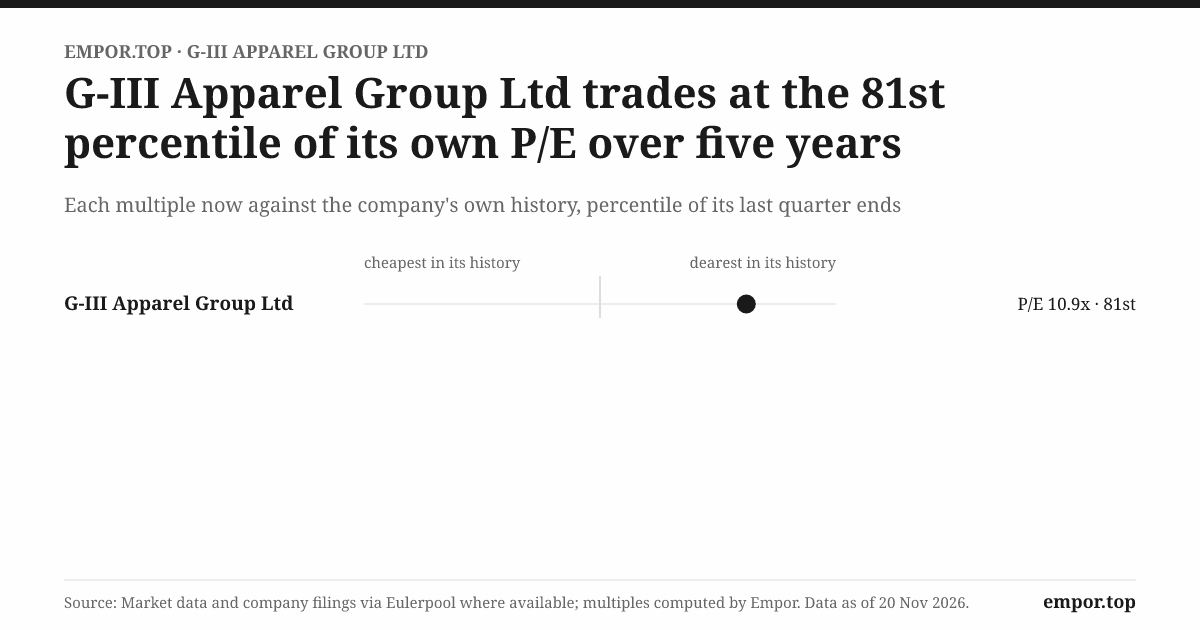
That matters for how the market prices G-III. On November 20, the stock traded at about 10.9 times trailing twelve-month earnings of about $3.14 a share, above its five-year median of about 7.2 times.[^8] But the trailing figure is a collage: a strong holiday quarter from 2025, a fourth quarter dragged into a loss by impairments and the Saks charge, and two quarters inflated by tariff refunds.62 On management's own non-GAAP guidance of $2.20 to $2.30 a share for fiscal 2027, the multiple is closer to 13 to 14 times.2
An independent research house, mwb research, put G-III at 14.0 times its 2026 earnings estimates in early November, against 7.7 times for PVH.15 By that measure, the market is paying more for G-III's earnings than for its former partner's, a sign it is pricing in a recovery that has not yet appeared in the reported numbers.
The cash record over a longer span is more reassuring, though not smooth. From fiscal 2015 through fiscal 2026, G-III generated about $2.0 billion of operating cash flow against about $1.1 billion of net profit, so cash ran well ahead of reported earnings.610 Part of that gap is depreciation, amortization and impairments, which reduce profit but not cash. But the annual pattern is jagged, because in an apparel wholesaler, working capital swings with the business.
Fiscal 2023 was negative, as inventory and receivables built. Fiscal 2024 was enormous, at about $587 million, because receivables and inventory fell. Fiscal 2025 benefited from another inventory release and higher payables, partly offset by rising receivables.6 A shrinking wholesale business releases cash as it shrinks, which flatters cash flow in exactly the years when the business is getting smaller. That is not an annuity. It is a balance sheet unwinding.
Free cash flow, operating cash less capital spending, summed to about $1.6 billion over those twelve years.6 Where did it go? Not mainly to dividends, which totaled only about $4.2 million because G-III began paying them only in December 2025.69 Cash and short-term investments rose by about $385 million over the period.6 Much of the rest went to acquisitions, most notably Donna Karan and Karl Lagerfeld, to repaying the debt those deals required, and, recently, to buybacks.
G-III repurchased about 2.2 million shares for $60 million in fiscal 2025 and a similar number for about $50 million in fiscal 2026.6 It redeemed its $400 million of senior notes in August 2024, which is why it ended fiscal 2026 with no borrowings under its credit line and only about $12 million of foreign debt, plus about $273 million of operating lease liabilities that should be kept separate from financial debt.6
On its face, the market's free-cash-flow yield of about 18.6% looks like an extraordinary bargain.[^8] Look underneath and the figure rests on the cash flows of a business in transition. Fiscal 2026 free cash flow of about $264 million included working-capital releases from a shrinking PVH business, and fiscal 2027 will include the tariff refund, which will not recur.614 The test of whether the yield is real is the first full year after both have washed through, when G-III's cash flow will reflect a smaller, owned-brand-heavy company with Marc Jacobs inside it.
And Marc Jacobs changes the balance sheet. The roughly $469 million of cash G-III used to close the deal consumed most of the July cash pile, including the tariff money, and the pro forma balance sheet shows about $90.5 million drawn on the credit line.4 G-III's debt has no agency credit rating, so the relevant evidence is the company's own: about $1 billion of liquidity before the deal, by management's account, and compliance with its credit agreement's covenants at the end of July.[^2]14 The credit line has a fixed-charge-coverage test that applies only if availability falls below a threshold.14
That is a comfortable position for a company of G-III's size, but not an idle one. The business borrows every summer to build inventory for autumn, and the next summer will be the first with Marc Jacobs' working capital on top. The tariff refund gave G-III a cushion at precisely the moment it chose to spend one. Whether the people who made that choice can also make it pay is the next question.
Morris Goldfarb’s long tenure meets a control weakness
There is a particular kind of company in which one person's judgment is the strategy. G-III is one of them. Morris Goldfarb joined his father's coat business in 1974 and has run it, by the company's own account, through every chapter since: the sports licenses, the Calvin Klein years, the Donna Karan purchase, the PVH runoff and now Marc Jacobs.78 He is chairman and chief executive. On the most recent earnings calls he is the one telling analysts how many new doors Donna Karan will open and why the exiting brands hurt margins as much as sales, in the plain-spoken idiom of a merchant who has spent fifty years in buyers' offices.9
Around him sits a team with deep tenure of its own. Neal Nackman, the chief financial officer and treasurer, had been with G-III for 22 years at the time of the 2026 proxy.8 Sammy Aaron, vice chairman and president, has led the Calvin Klein divisions, the very businesses now running off.8 Jeffrey Goldfarb, Morris's son, is an executive vice president and director, and Dana Perlman serves as chief growth and operations officer.8 Continuity is the obvious strength of that arrangement. The obvious question is what happens when the man who built the modern company steps back, and the 2026 proxy gives investors little public detail on that succession beyond the presence of the next generation in senior roles.8
Ownership is the first thing a skeptic checks, and here the alignment is real. Morris Goldfarb held about 11% of G-III's shares in the 2026 proxy, up from 9.9% in 2023, and directors and executive officers as a group held about 15%.816 He is a substantial owner, not a controlling one; BlackRock, at about 14%, held more than he did, followed by Vanguard at 11.3%, Dimensional at 7.7% and the Spanish value manager Cobas at 5.1%.8 The proxy reported an anti-pledging policy and no pledged shares by executives or directors.8 An executive with that much of his own wealth in the stock has every reason to care about the share price. Ownership, though, is evidence of incentive, not of execution.
Pay is the second test. Goldfarb's reported compensation fell from about $31.4 million in fiscal 2024 to $12.5 million in fiscal 2026.8 Net income over those years was about $175 million, $193 million and $67 million.86 The direction of the two lines is at least partly consistent: pay fell in the year profit collapsed. But the pattern is distorted by timing. Fiscal 2024's figure was swollen by a large performance-stock award, so the peak in pay came in a year when profit was lower than the following year's.8 Fiscal 2026 included retention grants for Jeffrey Goldfarb and Dana Perlman, awards designed to keep executives in their seats through the transition rather than to reward results already delivered.8
Shareholders noticed. At the June 2026 annual meeting, about 17% of the votes cast for or against the say-on-pay resolution opposed it, and director Victor Herrero received a substantial number of withheld votes.17 Seventeen percent is not a revolt. It does mean that roughly one in six voting shares, in a company where insiders control about 15%, declined to endorse the pay program, which implies the opposition among outside holders was proportionally larger.
Then there is the auditor's letter. In its fiscal 2026 annual report, G-III's management concluded that it had a material weakness in internal control over financial reporting, rooted in information-technology general controls at KLH, the Karl Lagerfeld holding subsidiary, which represented about 9% of the year's sales.6 IT general controls are the unglamorous rules that govern who can access a company's accounting systems, who can change them, and how those changes are checked.
When they fail, nobody has necessarily done anything wrong; the problem is that nobody can prove they have not. The distinction matters, and the auditor drew it precisely. Its opinion on the financial statements was unqualified, meaning it found them fairly presented. Its opinion on internal control over financial reporting was adverse.6 Management said it found no resulting material misstatement and described remediation work under way.6
The weakness sits in the very part of the company that is supposed to carry the future. Karl Lagerfeld is one of G-III's two largest owned brands, and it is the most international, with a European base and a global licensing network. Marc Jacobs, which G-III acquired in September 2026, is also a global business with its own systems. A company that has not yet demonstrated clean controls over one international owned-brand subsidiary is now integrating a second, larger one. That is not a reason to assume the next audit will go badly. It is a reason to treat the next internal-control opinion as one of the most important documents G-III will publish.
The related-party ledger is smaller than the headlines might suggest, and worth putting in proportion. G-III owns 18.7% of AWWG, a fashion group that acts as its agent for DKNY, Donna Karan and Karl Lagerfeld in Spain and Portugal and for Converse in selected markets.67 G-III paid AWWG about $6.9 million in fees and commissions in fiscal 2026, roughly a quarter of one percent of revenue, up from $1.7 million the year before.6
The filing identifies the relationship but does not characterize the pricing as arm's length.6 Separately, G-III bought about 209,000 shares from Sammy Aaron for about $4.1 million in June 2023, at the closing market price.6 Neither is large enough to change the investment case. Both are the kind of detail a careful board explains rather than merely lists.
The sharper governance question is capital allocation. Imagine the skeptical long-term holder, or an activist, reading the past three years. Revenue fell. Profit in fiscal 2026 dropped to roughly a third of the prior year's. Over those same two years, G-III spent about $110 million buying back shares, began paying a dividend, granted retention awards to senior executives, and committed close to half a billion dollars of cash to Marc Jacobs.64 Each decision can be defended on its own terms. Buybacks at a price below book value can create value per share; a brand acquisition can replace a dying license; retention grants can hold a team together.
But the combination asks shareholders to trust that the same management that did not foresee, or could not prevent, the loss of its largest partner's business has priced the replacement correctly. The way to earn that trust is not reassurance. It is quantified bridges: how much revenue was lost, how much was replaced, at what margin, and what the acquisition earned after its royalty. The record so far gives investors the first two numbers, in management's own words, and not yet the last two.
That leaves management's credibility as a matter to be measured over the coming year rather than assumed from its long tenure. The benchmarks are concrete: auditor confirmation that the KLH weakness is remediated, evidence of succession planning at the top, improving support in the next say-on-pay vote, and earnings explanations that reconcile to numbers. With the people and the controls in view, the story can turn to what it all teaches.
Business & Investing Lessons
Go back to the department-store buyer's office, where a G-III salesperson is presenting a rack of Calvin Klein coats. Every season for two decades, that meeting taught three parties something. The retailer learned what sold. G-III learned how to make it. And PVH, the owner of the name, learned exactly how large and profitable the business on that rack had become. The first lesson of G-III's story is that a license can build the machine, but it can also teach the brand owner how to take the machine back. G-III's skill turned Calvin Klein women's apparel into what Goldfarb called part of a $1.5 billion platform, and that success is precisely what made the business worth reclaiming.[^5]
For founders who build on someone else's brand, the wider point is uncomfortable: the better the licensee performs, the stronger the owner's case for doing it alone. A license is a lease on demand, and leases end on the landlord's schedule.
The second lesson comes from the June call, when management said its owned brands run at mid-teens to upper-teens operating margins while licensed brands earn low double digits.[^5] It is a compelling claim, and it sits beside a company-wide operating margin of 5.3% and a DKNY sales line that slipped in the latest full year.6 A higher-margin mix is a hypothesis until the profit follows. A brand owner keeps the royalty it used to pay, but it also takes on the marketing, the stores and the risk of building demand from scratch.
Investors in any company migrating from licensing to ownership should ask for one thing before applauding the mix shift: segment profit that proves it. G-III does not yet report owned and licensed brands as separate profit centers, so the claim remains management's to prove.6
The third lesson belongs to the night Marc Jacobs closed. On historical numbers, G-III paid well under ten times operating profit for a brand that had earned a margin of about 21%.54 Then come the adjustments the historical statements do not show: a $32.5 million minimum royalty in the first year, new borrowing at 7.25%, integration costs, and management's own warning of first-year dilution.4[^2] A bargain price can still be an expensive bet. The multiple measures what the business earned for LVMH; the return depends on what it earns for G-III after paying rent to a joint venture it only half owns.
A decade earlier, the Donna Karan deal came with an almost identical promise, dilutive first, accretive after, and the brand grew into a large business without ever showing investors a brand-level return on the money spent.116 The pattern is worth remembering when the next acquisition is described as cheap.
The fourth lesson comes from December 2025, when G-III stopped shipping to Saks Global, booked a $17.5 million bad-debt charge and wrote off the $20 million it had invested in its own customer.96 Retail distribution is both an asset and a dependency. G-III's ability to put a brand into hundreds of department-store doors in a season is the core of its value, and the same reach concentrates about two-thirds of sales on ten customers.6 Distribution is an asset only as long as the distributors stay solvent and the buyers stay willing. For investors, the right way to value a wholesale brand house is to price its customer list as both its moat and its largest unsecured creditor exposure.
There is a quieter lesson underneath all four. G-III's longest-lasting asset has never been any single brand. It has been the capacity to run brands, a set of skills in sourcing, design and selling that survived the loss of its biggest partners and could be pointed at new names. The company's next chapter is a test of whether operating skill can be converted into ownership value, and the evidence for that conversion will not come from the brands' names, but from their profit and loss.
Bull versus Bear: Can the portfolio outrun the runoff?
Lay the two stories side by side. In one, G-III is a company that has absorbed the loss of its largest business without falling apart: its owned-brand mix was rising, management said the go-forward portfolio was growing at a high-single-digit rate, and Marc Jacobs was added to the stable.6[^2]
In the other, the fiscal 2026 results and unfinished PVH runoff pointed to continued pressure.6 Both stories are told from the same filings. The question is which one the next two years will confirm.
The bull case begins with mix. If management's margin estimates are even roughly right, every dollar of licensed revenue that is replaced by owned-brand revenue lifts the profit G-III keeps, because the royalty no longer leaves the building. Donna Karan's growth, more than 40% in fiscal 2026 and more than 45% in the July quarter by management's account, suggests the relaunched brand has found a place in department stores, and DKNY and Donna Karan together generate about $2.7 billion of retail sales worldwide, according to Goldfarb, much of it through licensees who pay G-III royalties.9[^2]
Karl Lagerfeld is a business of more than $600 million with a growing North American base.9 Marc Jacobs, an accessories-led and largely direct-to-consumer business, adds a category and a channel where G-III has been comparatively light, and management has set a long-term ambition of $1 billion of annual revenue from it.[^2] Add $25 million of run-rate cost savings expected in fiscal 2028, and a market price below book value, and the bull can argue the stock prices in the runoff but not the rebuild.9[^8]
The bear case begins with the income statement. A transition is not a result. Revenue had fallen for six straight quarters, and the third-quarter guide implies another drop of roughly 12%.[^2] Net profit in fiscal 2026 was below its fiscal 2025 level by about two-thirds, and the most recent quarters' reported earnings are inflated by a tariff refund that will not come again.62 The Marc Jacobs target of $1 billion is a long-term ambition from a business that management expects to produce about $360 million of sales this year; that is almost a tripling, with ready-to-wear still to be launched.[^2] And the replacement economics that the bull case depends on, owned-brand margins, are not yet in any audited disclosure.6
The competitive analysis sharpens the disagreement. Run Hamilton Helmer's seven powers over G-III and most of them come up empty. G-III has no network effects; its customers do not become more valuable to each other as more join. It has no decisive scale economies; PVH, with revenue nearly three times G-III's, is larger in the very categories G-III is leaving.136 Switching costs are low, because a department-store buyer can replace one coat vendor with another in a season, and the concentration of G-III's sales among a handful of retailers documents who holds the bargaining power.6
Its licenses were never a cornered resource; PVH proved they could be taken back. Counter-positioning is at most a modest argument, in the sense that G-III is willing to be an operator-licensee hybrid, as in the Marc Jacobs joint venture, which a pure brand owner or pure licensing firm would not be.
Two powers are plausible. The first is process power, the accumulated know-how in design, sourcing and distribution that lets G-III launch a brand into hundreds of doors, and absorb the loss of its largest business, without collapsing. That is the most evidenced advantage the company has, but process power in apparel is a narrow moat; rivals can and do build the same capabilities. The second is branding, the power G-III is now trying to buy. DKNY, Karl Lagerfeld, Donna Karan and Marc Jacobs are recognized names with global licensing income, and if they command repeat demand at full price, they confer pricing power that a licensee never had.
The evidence so far is mixed: full-price wholesale growth for the go-forward portfolio and Donna Karan's surge on one side; DKNY's sales dip, falling gross margins and heavy dependence on off-price and department-store channels on the other.[^2]69 The verdict is that G-III's moat is intact but narrow, built on execution rather than structural advantage, and the brand power that would widen it is unproven rather than absent.
The bear also has a list of specific risks, each with a clear mechanism. Retailer demand and consolidation decide orders, so a weak holiday season at Macy's, TJX or Ross flows straight into G-III's revenue. Customer bankruptcies, of which Saks Global and Hudson's Bay are the recent examples, convert receivables into write-offs. About 23% of sales were international, the euro was the main currency exposure, and G-III does not hedge, so a weaker euro reduces reported profit from Karl Lagerfeld and Vilebrequin in Europe.6
Tariffs change the cost of nearly everything G-III sells, and management changed its tariff assumption in September to reflect current rates rather than the old regime.[^2] The material weakness at the Karl Lagerfeld subsidiary threatens the reliability of reporting precisely where the company is growing, and the PVH litigation remains unresolved over a business that was once G-III's largest.614
A skeptical activist would sharpen this into a question about capital allocation: why did G-III commit roughly half a billion dollars to a brand whose name it co-owns with a licensing firm before proving the replacement economics? The company has not yet given investors brand-level profit figures.64
Three numbers will decide which story wins. The first is owned-brand sales and their margin contribution: the mix was rising, but the profit contribution is not separately reported.6 The second is the wholesale operating margin after the PVH expirations; the wholesale gross margin fell from about 39.4% to 37.4% in fiscal 2026, and the first clean read will come in fiscal 2028.9 The third is the receivables trend: debtor days improved to about 66 from 72 the year before, against the previously noted allowance and receivables balance.6
The investment spine, stated neutrally, is this. G-III has a plausible route from license operator to brand owner, a capable operating platform and a balance sheet that gives it room to make the transition. The evidence has not yet shown that it can earn durable brand economics on the names it now owns. The next twelve months will start to show it.
Epilogue
Tonight, G-III is a company caught between two fiscal years. Its fiscal 2027 still contains about $370 million of Calvin Klein and Tommy Hilfiger sales that will not come back, and its fiscal 2028 will be the first in two decades without them.[^2] Marc Jacobs has been inside the company for less than three months. Management said it would fold the acquisition into its guidance with the third-quarter results in December.[^2]
That December report is the first of the moments that will decide the story. It will show the first quarter of Marc Jacobs under G-III ownership and the largest single-quarter PVH drop of the year. If the go-forward portfolio grows as management promised and the third-quarter sales land near the $870 million guide, the narrative of steady replacement gains a data point. If sales miss again, the explanation of shipment timing will become harder to sustain.
The next moment is the fiscal 2027 annual report, due in early 2027. It will contain the auditor's next opinion on internal control over financial reporting, which will say whether the KLH weakness has been remediated. It will also show the first full accounting of the Marc Jacobs acquisition: the purchase-price allocation, the royalty expense, the interest on the incremental borrowing and the brand's revenue contribution for its first five months.
The decisive moment, though, is the year after. Fiscal 2028 will strip away the last of the PVH business, the tariff refund and the working-capital releases that flattered recent cash flow. In that year, investors will finally be able to compare the replacement sales and operating profit against the roughly $460 million of PVH sales lost in fiscal 2027 and the further runoff in fiscal 2028, and measure Marc Jacobs after the $32.5 million minimum royalty and its financing costs.[^2]4
If G-III's operating margin recovers toward the 9% to 10% it earned in fiscal 2024 and fiscal 2025, on a smaller but more owned base, the transition will have created value.6 If revenue stabilizes but margins stay near 5%, G-III will have replaced the sales without replacing the profit.
Watch the receivables too. The Saks Global bankruptcy showed how quickly a large customer's distress becomes a charge on G-III's income statement, and the next annual report will show whether collections from the rest of the customer base held up.6
The story remains open, and the central tension is simple to state. G-III has proved it can survive losing brands it did not own. It has not yet proved that the brands it now owns can carry both the missing sales and the return investors expect.
Outro
Return to September 1, 2026. G-III, the Garment District coat business Morris Goldfarb joined in 1974, took control of Marc Jacobs' operating business while leaving the name in a joint venture it half owns.17 It is the perfect emblem of G-III: an operator so skilled at running other people's brands that the stock market values the result at about $1.5 billion, and so aware of the risks of that skill that it has spent heavily to own what it once rented.[^8]
G-III's defining talent has always been making brands work that it did not fully control. Its next chapter will be written in a single, unglamorous line of the income statement: how much is left from Marc Jacobs, DKNY and the rest after the royalty, the interest and the marketing are paid.4 The question now is whether it can make money owning them.
References
-
G-III Apparel Group, Ltd. reports second quarter fiscal 2027 results — G-III via SEC, 2026-09-02 ↩↩↩↩↩↩↩↩↩↩↩
-
G-III Apparel Group signs definitive agreement with WHP Global for Marc Jacobs brand — G-III via SEC, 2026-05-14 ↩↩↩↩↩↩
-
G-III pro forma financial information — SEC, 2026-11-18 ↩↩↩↩↩↩↩↩↩↩
-
Marc Jacobs historical financial statements — SEC, 2026-11-18 ↩↩↩
-
Form 10-K for fiscal year ended January 31, 2026 — SEC, 2026-03-24 ↩↩↩↩↩↩↩↩↩↩↩↩↩↩↩↩↩↩↩↩↩↩↩↩↩↩↩↩↩↩↩↩↩↩↩↩↩↩↩↩↩↩↩↩↩↩↩↩↩↩↩↩↩↩↩↩↩↩↩↩↩↩↩↩↩↩↩↩↩↩
-
G-III Apparel (GIII) Q4 2026 earnings call transcript — The Motley Fool, 2026-03-12 ↩↩↩↩↩↩↩↩↩↩↩↩↩↩↩↩↩↩↩↩↩↩↩↩↩↩↩↩↩↩↩↩↩↩
-
Form 10-K for fiscal year ended January 31, 2016 — SEC, 2016-03 ↩↩↩
-
G-III to acquire Donna Karan International from LVMH — LVMH, 2016-07-25 ↩↩↩↩↩↩↩
-
PVH Form 10-K for fiscal year ended February 1, 2026 — SEC, 2026-03-31 ↩↩↩
-
Form 10-Q for quarter ended July 31, 2026 — SEC, 2026-09-02 ↩↩↩↩↩↩↩↩
-
Apparel sector research, Q3 results — mwb research, 2026-11-03 ↩
 LinkedIn
 WhatsApp
 Reddit
 Hacker News
 Email
 Kindle
 RSS Feed
 Spotify
 Apple Podcasts
 Amazon Music
 Audible
 YouTube