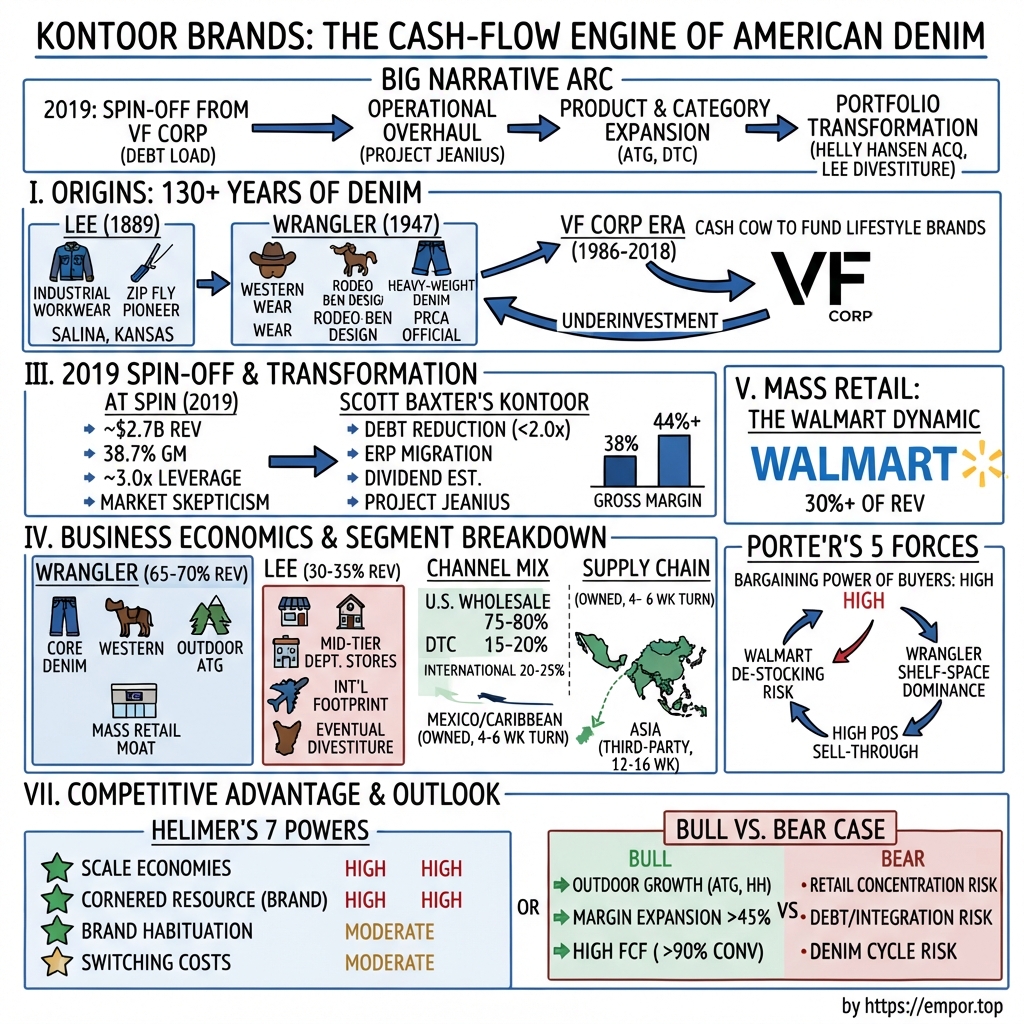
Kontoor Brands: The Cash-Flow Engine of American Denim
I. Introduction & Episode Roadmap (0:00 - 10:00)
On the morning of May 23, 2019, executive leadership stood on the New York Stock Exchange floor holding a placard with a corporate name unfamiliar to financial markets: Kontoor Brands. Invented by a branding agency and unveiled the previous December, the name served as a blank vessel for two heritage denim labels — Wrangler and Lee — carrying more than two centuries of combined history.1 The stock opened at $35.51, moved upward through the session, and closed at $38.60, establishing an initial enterprise valuation of approximately $2.19 billion.2
Wall Street's prevailing narrative at the time was skeptical. VF Corporation, the North Carolina-based conglomerate that had spent three decades constructing a prominent global apparel portfolio, had concluded its wholesale denim operations were low-growth assets. Mass-market denim sold through broadline retailers generated lower multiples than high-growth footwear and technical outerwear like Vans and The North Face. VF subsequently spun off its jeanswear division, encumbered the new entity with debt, and relocated corporate headquarters to Denver to realign with activewear trends.
By mid-August 2026, market valuations have shifted. Kontoor Brands trades around $84.90 per share with a market capitalization near $4.7 billion.3 The spin-off has raised full-year guidance, completed a nearly $1 billion acquisition of Norwegian technical outerwear brand Helly Hansen, and agreed to divest Lee to Authentic Brands Group for up to $1 billion.4 Conversely, former parent VF Corporation experienced multi-year revenue declines at Vans and divested Supreme for $600 million less than its original purchase price.56
This performance disparity raises a core analytical question: what operational efficiencies did Kontoor unlock within business units VF managed for thirty-three years, and is that performance durable or cyclical?
Three primary factors clarify this trajectory. First, the spin-off addressed historical operational slack, deploying systems investment and managerial focus to harvest dormant efficiencies. Second, Kontoor capitalized on a structural product cycle as Western fashion gained broader consumer traction, benefiting Wrangler's brand positioning. Third, financial data indicates a significant portion of recent earnings expansion derived from cost control initiatives and portfolio optimization rather than unit volume growth; Wrangler's global revenue grew 1% in the second quarter of 2026, while adjusted gross margin expanded 710 basis points.7 Cost-reduction programs eventually reach operational limits, whereas underlying consumer demand dictates long-term growth.
The scale of the enterprise. In fiscal 2025 — the final full year incorporating all three core brands — Kontoor reported $3.15 billion in revenue, an adjusted gross margin of 46.6%, adjusted earnings per share of $5.59, and $455.8 million in operating cash flow.8 Following the Lee transaction, management guidance projects continuing-operations revenue of $2.66 billion to $2.71 billion for fiscal 2026, alongside an adjusted gross margin of 49.8% to 50% and adjusted EPS of $5.25 to $5.35.9 While Kontoor does not disclose overall U.S. mass-market jeans market share, Circana point-of-sale data indicates the company expanded market share in men's and women's bottoms for a seventeenth consecutive quarter in Q2 2026.7 This analysis relies on these verified filing metrics rather than unbacked market estimates.
The narrative arc. Four key operational phases structure Kontoor's corporate evolution:
- The spin-off structure. VF's tax-free carve-out in May 2019, the $1.05 billion in debt assigned to Kontoor, and the initial deep-value valuation multiple assigned by equity markets.
- The operational overhaul. Executive leadership's multi-stage efficiency programs — "Horizon 1," "Horizon 2," and Project Jeanius — which expanded gross margin from the high-30% range toward 50%.
- Category expansion. The extension into Wrangler All Terrain Gear, womenswear, Western market momentum, and initial direct-to-consumer retail initiatives.
- Portfolio restructuring. The 2025 acquisition of Helly Hansen, the 2026 agreement to sell Lee, and the strategic shift toward outdoor and workwear categories funded by core denim cash flows.
Analytical progression. The story begins with the founding origins in Salina, Kansas, in 1889 and Greensboro, North Carolina, in 1947, before evaluating core value drivers: mass-market denim unit economics, customer concentration risks with key retail partners like Walmart, execution against stated management targets, sell-side analyst scrutiny, and core bull-bear investment arguments. Strategic frameworks, including Porter's Five Forces and Hamilton Helmer's 7 Powers, provide context for assessing whether Kontoor's competitive advantage represents a structural economic moat or enduring consumer buying patterns.
Assessing that durability requires examining those fundamental consumer habits.
 Subscribe on LinkedIn
II. The Origins: 130 Years of Denim Heritage (10:00 - 24:00)
In 1889, Salina, Kansas, was a grain hub on the Smoky Hill River, where Henry David Lee — a Vermont-born merchant who had moved west for health reasons — operated a wholesale grocery business. According to long-standing company lore, Lee grew frustrated with unreliable East Coast suppliers of work apparel and chose to produce his own. Whatever the initial catalyst, the H.D. Lee Mercantile Company began manufacturing overalls, jackets, and dungarees designed specifically for manual laborers.10
That focus led directly to Lee's foundational products. In 1913, the company introduced the Union-All, a one-piece work jumpsuit designed for mechanics to pull over street clothes.10 Built as a practical solution to protect everyday clothing from engine grease, the design proved effective enough that the U.S. military adopted a modified version. Roughly a decade later, Lee became one of the early garment manufacturers to incorporate zippers — then marketed as "hookless fasteners" — into work pants and coveralls, replacing the traditional button fly.10 Over the following half-century, Lee established a reputation as a functional innovator in denim, backed by design patents and key industry firsts.
Wrangler's origin followed a different, highly commercial trajectory. Blue Bell, an overall manufacturer based in Greensboro, North Carolina, acquired the Casey Jones Company in 1943, gaining access to the Wrangler brand name.11 Four years later, Blue Bell executed a targeted product design strategy. Rather than creating western jeans in a corporate design studio, the company hired Rodeo Ben — Bernard Lichtenstein, a Polish-born Philadelphia tailor who designed custom apparel for rodeo performers and Western film stars — and distributed prototype garments directly to working cowboys for field testing.12
The resulting feedback yielded specific functional requirements. Rivets were flattened so they would not scratch saddle leather. The watch pocket was deepened to prevent pocket watches from dislodging while riding. Seams were flat-felled and positioned to minimize chafing during long days in the saddle. Blue Bell added seven belt loops instead of five to support heavy work belts, and used heavyweight denim to prevent tearing. After thirteen design iterations, the company finalized the 13MWZ — standing for thirteenth prototype, men's western, zipper — endorsed by professional rodeo champions including Jim Shoulders, Bill Linderman, and Freckles Brown.12
This strategy established Wrangler's brand equity not through mass-market advertising, but through direct product validation from influential users within a targeted subculture.
Nearly eight decades later, Kontoor continues to sponsor the Wrangler National Finals Rodeo and sell the Cowboy Cut silhouette. When management stated in 2026 that Western apparel remains central to Wrangler's identity, the statement described a brand heritage developed decades prior.7 For investors, this distinction highlights that while management inherited a resilient asset, long-term performance remains tied to broader shifts in consumer culture.
The VF era: thirty-three years as a cash-generating division. VF Corporation acquired Blue Bell in 1986, combining Lee — which VF had purchased in 1969 — and Wrangler into the world's largest jeanswear manufacturer. Initially, denim formed the core of VF's business. Over time, VF managed the mature segment as a steady source of cash flow.
Throughout the 1990s and 2000s, VF deployed jeanswear's consistent cash flows to fund acquisitions in higher-growth categories, including The North Face, Vans, Timberland, Kipling, and Nautica. Regular replacement cycles for basic denim provided stable cash generation across economic cycles.
However, this capital allocation strategy limited investment in the denim division. By the mid-2010s, the segment operated on shared corporate systems with minimal direct-to-consumer infrastructure and limited standalone technology investments. Kontoor's management later characterized the inherited operational structure at the time of the spin-off as a "clone and go" setup designed for operational continuity rather than independent competitiveness.13
Evaluating the strategic value of heritage. This history yields two distinct operational advantages. First, decades of consumer purchasing habits created predictable demand defaults that reduce customer acquisition costs. Second, that consumer demand secures retail shelf space, as mass merchants allocate floor space based on inventory turnover. Both factors persisted through years of corporate underinvestment, providing empirical evidence of brand durability.
Yet brand durability does not automatically guarantee revenue expansion. While VF demonstrated that jeanswear generated steady cash flow, the segment struggled to deliver high top-line growth within a portfolio prioritizing rapid-growth brands like Vans. That structural divergence ultimately led to the 2019 corporate separation.
III. The 2019 Spin-Off: Rejection, Carve-Out, & Capital Structure (24:00 - 40:00)
On August 13, 2018, VF announced it would separate its jeans and outlet businesses into an independent public company.14 The rationale relied on sum-of-the-parts arithmetic: VF's high-growth outdoor and action-sports brands faced lower valuation multiples when bundled with a mature wholesale denim operation. Splitting the businesses allowed each to be valued independently. In December, the new entity received its corporate name, and in May 2019, the spin-off executed with a record date of May 10, distributing one Kontoor share for every seven VF shares before completing separation on May 22.115
The financial structure heavily influenced Kontoor's initial operating strategy. On May 17, 2019, days before separation, Kontoor incurred $1.05 billion of third-party debt, allocating the majority of the proceeds to fund a cash transfer to VF.16
By borrowing over $1 billion to fund its former parent's payout, Kontoor initiated public trading with leverage near three times EBITDA. The standalone enterprise inherited a wholesale-concentrated revenue base and lacked independent enterprise systems, requiring management to construct standalone infrastructure while servicing its initial debt burden.
The separation timeline unfolded across several key milestones:
- August 13, 2018 — VF announces the separation of its jeans and outlet businesses.14
- December 2018 — the new entity is named Kontoor Brands, Inc.15
- May 10, 2019 — record date set; VF holders to receive one Kontoor share per seven VF shares.1
- May 17, 2019 — Kontoor incurs $1.05 billion of debt, proceeds largely transferred to VF.16
- May 22–23, 2019 — separation completes; KTB begins trading, opening at $35.51 and closing at $38.60.12
Initial market skepticism. Equity markets initially priced Kontoor as a deep-value dividend security rather than a compounder. Skeptics pointed to structural vulnerabilities: roughly three-quarters of revenue originated from U.S. wholesale channels concentrated among a few powerful retailers, fast fashion compressed price points, athleisure trends pressured denim demand, e-commerce threatened traditional wholesale models, and the balance sheet carried substantial leverage.
In response to market positioning, Kontoor emphasized income returns. On July 23, 2019, the board declared its first regular quarterly dividend at $0.56 per share, providing an annualized dividend yield near 6% relative to its stock price in the high $30s.17 The high payout targeted income-oriented investors willing to hold high-yielding value stocks amidst challenging retail narratives.
The dividend suspension. Pandemic-driven retail closures in early 2020 disrupted that strategy. In May 2020, Kontoor suspended its dividend for the second and third quarters alongside a credit facility amendment, preserving approximately $32 million per quarter.18 Fiscal 2020 revenue fell to $2.10 billion from $2.55 billion, while net income declined to $67.9 million.19 While dividend preservation protected liquidity during severe macro disruption, the suspension altered Kontoor's initial investment case within twelve months of its market debut.
Management later reinstated and expanded the payout, raising the dividend to $0.53 per quarter alongside second-quarter 2026 financial results.7 Nevertheless, the distribution rate remains slightly below its 2019 inaugural level, illustrating that Kontoor operates primarily as a total-return model supported by cash flow. Capital allocation metrics in 2026 confirm this focus, with share repurchases and debt reduction accounting for the majority of capital returned to shareholders.7
Execution of the Horizon 1 strategy. CEO Scott Baxter prioritized three immediate objectives during Kontoor's initial operating phase: deleveraging the balance sheet, establishing standalone enterprise infrastructure, and stabilizing core brand revenue. Replacing VF's legacy IT systems required executing a complex global enterprise resource planning (ERP) migration without disrupting wholesale shipments to major retail partners. Management later reported that Horizon 1 achieved its objectives, completing the ERP transition, lowering leverage ratios, and stabilizing core market share.13
Comparative performance post-separation. Kontoor's operational stability contrasts sharply with VF Corporation's performance following the 2019 spin-off. VF acquired streetwear brand Supreme for $2.1 billion in 2020 before selling it to EssilorLuxottica for $1.5 billion in October 2024, realizing a $600 million decline in headline value.56 Concurrently, Vans, previously VF's primary growth driver, experienced prolonged revenue contractions.20
This divergence demonstrates that category growth rates alone do not dictate corporate performance. While denim remained a mature, slow-growth category — highlighted by Wrangler's 1% revenue growth in Q2 2026 — Kontoor generated substantial equity value through focused execution, operating discipline, and high cash conversion.7 Dedicated management focus and operational autonomy allowed a mature brand portfolio to outperform high-growth assets burdened by execution challenges within a broader conglomerate structure.
Evaluating Kontoor's financial trajectory requires analyzing the fundamental economics of mass-market denim manufacturing and supply chain management.
IV. Core Business Economics & Segment Breakdown (40:00 - 58:00)
A visit to a Walmart supercenter in Amarillo shows a wall of Wrangler denim in stacked sizes, priced from the twenties to low forties, maintaining identical fits in the same display locations year after year. There are no seasonal drops or capsule collaborations on that wall. The economics of Kontoor's core business rest on this predictable consistency.
The replenishment model. A basic five-pocket jean in a core fit functions as a replenishment item: it sells at a predictable rate, triggering automated reorders whenever retailer inventory drops below designated thresholds. By contrast, seasonal fashion items require upfront demand forecasting and carry substantial markdown risk if consumer preferences shift. Replenishment inventory provides three operational advantages: highly predictable demand that lowers inventory risk, minimal markdown pressure that keeps realized gross margins aligned with targets, and a streamlined stock-keeping unit (SKU) count that enables long manufacturing runs and lower unit production costs.
This structural advantage allows a mass-market denim manufacturer to sustain gross margins in the mid-to-high 40% range, often outperforming fashion apparel companies with significantly higher initial retail price points.
Segment reality, as of the current portfolio. In fiscal 2025, Wrangler generated $1.91 billion in revenue, representing 6% growth; Lee generated $750 million, a 5% decline; and Helly Hansen contributed $476 million during the June-to-December stub period following its acquisition.8 These segment results illustrate Kontoor's capital reallocation strategy: investing in the expanding Wrangler core, divesting the declining Lee business, and positioning Helly Hansen as a primary growth driver.
Wrangler's product mix extends beyond basic jeans. U.S. men's bottoms sold through mass-market retail represent the core economic engine of the business. Surrounding this core are three distinct growth vectors at varying stages of maturity:
- Western — expanding in the low double digits during the first half of 2026, supported by broader consumer interest in Western lifestyle and music trends.7
- Female — representing a large addressable market but a small starting base. Management disclosed that womenswear accounts for approximately 10% of Wrangler revenue despite women comprising over half the U.S. denim market, with segment sales rising 20% in the first half of 2026.7
- Outdoor — anchored by the All Terrain Gear platform introduced in November 2019, which reached approximately $200 million in revenue by 2023 after expanding by about $100 million over the preceding four years.2113
While these vectors demonstrate strong percentage growth, each remains modest in absolute dollar terms. Consequently, a 20% gain in a sub-category representing 10% of total sales moves Wrangler's blended growth rate by only two percentage points.
Lee's trajectory presented the opposite dynamic. Concentrated in U.S. mid-tier department stores and discretionary retail channels across China and the broader Asia-Pacific region, Lee faced structural headwinds in two underperforming distribution sectors. Despite operational discipline, the brand remained tied to contracting retail channels, motivating management's decision to divest the asset.
Channel and geography. Domestic revenue reached $2.29 billion in fiscal 2025, compared to international revenue of $865 million, which grew 66% primarily due to the Helly Hansen acquisition.8 This acquisition significantly reshaped Kontoor's geographic distribution.
Following the Helly Hansen integration and the Lee divestiture, Kontoor operates primarily through two geographic pillars: a U.S.-focused Wrangler business and a European and Nordic-focused Helly Hansen operation. In China, Helly Hansen operates through a joint venture with Youngor Group (雅戈尔), which is accounted for under the equity method and excluded from reported segment revenue.7 Consequently, China sales expansion — which management reported near 70% in the second quarter of 2026 — contributes to net income through equity earnings rather than consolidated top-line revenue.7
The supply chain, and why it is a genuine structural asset. Unlike many modern apparel peers that rely entirely on third-party sourcing, Kontoor maintains a hybrid manufacturing network:
- Nine manufacturing facilities — seven owned in Mexico, two leased in Nicaragua.22
- Roughly 185 contract manufacturing facilities across 18 countries.22
- Approximately one-third of units produced internally in 2023; two-thirds sourced externally.22
Near-shore production facilities provide operational flexibility for core, high-velocity products. Internal capacity enables replenishment cycles measured in weeks rather than the multi-month lead times required for Asian contract manufacturing, helping prevent stockouts at major retail partners when demand exceeds forecasts. On the second-quarter 2026 earnings call, executive management contrasted Wrangler's short-lead replenishment structure with Helly Hansen's order-book model, where technical outerwear is manufactured against committed wholesale orders rather than speculative demand.7
Additionally, Mexican manufacturing imported into the U.S. remains exempt from tariffs under the United States-Mexico-Canada Agreement (USMCA), insulating a substantial portion of Kontoor's core production costs from global trade duties.7 While this offers a cost advantage over competitors relying entirely on Asian production, the benefit remains subject to future trade policy revisions.
What the evidence supports and what it does not. The combination of automated replenishment and near-shore production provides a demonstrated operational advantage specifically within high-volume mass-market basics. However, this structure does not extend to fashion denim, premium apparel, or Helly Hansen's technical outerwear line, which operates on a traditional forward order book. As Helly Hansen represents a larger share of consolidated operations, the proportion of company revenue covered by near-shore replenishment benefits decreases.
Furthermore, Kontoor's core business model relies on a single dominant variable: customer concentration.
V. The Mass Retail Relationship: The Walmart Dynamic & Customer Concentration (58:00 - 1:12:00)
Every quarter, a retail buyer in Bentonville, Arkansas, determines how many linear feet of display space in a mass supercenter will be dedicated to Wrangler. Repeated across thousands of stores, those shelf-space allocations drive more of Kontoor's top-line revenue than any marketing campaign, product release, or executive hire.
The financial disclosures highlight this heavy reliance. Kontoor's largest customer accounted for 30% of total net revenues in fiscal 2025, down from 36% in both 2024 and 2023.23 Its second-largest customer represented 12% in 2025, compared with 11% in 2023.23 Combined, these top two accounts generate 42% of company revenue — down from nearly half of all sales in prior years. While regulatory filings do not name individual retail partners, the primary mass-market customer buying nearly one-third of America's leading Western denim line is clear.
Evaluating the concentration trend. While the reduction from 36% to 30% suggests progress in mitigating customer risk, the change primarily reflects a larger revenue denominator following the Helly Hansen acquisition, which carries virtually no U.S. mass-retail exposure. Overall customer concentration declined because Kontoor acquired an international outdoor business, not because wholesale volume with its top mass partner diminished. Furthermore, divesting Lee will remove revenue that also passed through that same retail channel, shifting the relative concentration math once again. Consequently, assessing long-term channel risk requires tracking customer concentration disclosures across future regulatory filings rather than assuming linear progress.
Analyzing buyer bargaining power. Under standard competitive analysis, a manufacturer with 30% customer concentration possesses limited pricing power. A single buyer's inventory adjustments directly shift Kontoor's quarterly revenue.
Executive leadership addressed this dynamic directly during recent investor calls. Point-of-sale data for Wrangler bottoms expanded at a low-to-mid single-digit rate in the second quarter of 2026 and 3% year to date through July, yet reported U.S. wholesale revenue remained flat because retailers "remain very cautious with respect to inventory management and their forward inventory commitments."7 Kontoor's chief financial officer noted that retail inventory levels were down high-single to low-double digits in certain segments, characterizing inventory at retail as "suboptimal."7
This divergence highlights the core risk of customer concentration: end-consumer demand for Kontoor's products is outpacing wholesale sell-in, creating a revenue gap governed entirely by retail partners' working-capital management.
The counterweight — and its limits. Proponents counter that mass retailers cannot easily substitute Wrangler, which functions as a destination brand for value-focused shoppers. Empirical evidence supports this defense. Seventeen consecutive quarters of Circana-measured market share gains in men's and women's bottoms indicate that Wrangler continues to defend its shelf presence.7 Products that consistently generate strong category turnover retain floor space during annual planogram resets, as retail financial metrics — sales per linear foot, low markdowns, and inventory velocity — incentivize merchants to keep core SKUs in stock.
However, this commercial leverage remains asymmetric. While losing Wrangler would disrupt category sales for a mass retailer operating at hundreds of billions in revenue, losing a 30% customer would represent a severe operational crisis for Kontoor. Mutual dependency does not establish equal bargaining power. Strong consumer sell-through provides Kontoor with pricing and shelf-space defense at the margin, enabling the company to protect terms without granting complete immunity from partner inventory shifts.
Shelf-space economics as an entry barrier. High customer concentration also establishes a significant barrier to entry for prospective competitors. Supplying mass retail on a national scale requires delivering consistent garment quality across dozens of size variants to thousands of store locations, integrating with complex electronic data interchange (EDI) replenishment networks, absorbing service chargebacks, and funding substantial working capital. Emerging direct-to-consumer denim brands generally lack the logistics infrastructure to meet these operational requirements, and the capital investment needed to build such scale rarely yields acceptable returns at mass-market price points.
Yet this moat protects access to a distribution channel rather than exclusivity over the consumer. Competing apparel brands capable of reaching mass-market shoppers through alternative retail or digital channels can bypass these wholesale barriers altogether.
Evaluating channel diversification. Given the risk posed by customer concentration, management has implemented several initiatives to broaden distribution beyond core mass retail. Direct-to-consumer channels are expanding, with Wrangler DTC revenue rising 12% globally and 9% in the U.S. during the second quarter of 2026, alongside a 27% increase in international DTC.7 The company is also adding new wholesale distribution, identifying home improvement retailer Lowe's as a key new retail partner for the second half of 2026.7 In addition, Kontoor has initiated pilot tests in owned full-price retail stores in Texas. However, direct-to-consumer sales still represent a minority of Wrangler's total business, and diversifying away from a 30% customer account remains a multi-year effort.
Assessing the long-term viability of this channel strategy ultimately depends on executive execution and leadership track record.
VI. Management & Strategy: The Scott Baxter Era & Transformation (1:12:00 - 1:28:00)
During Kontoor's fourth-quarter 2023 earnings call, Chief Executive Officer Scott Baxter offered a moment that revealed much about his leadership approach. Immediately after announcing Project Jeanius — the largest transformation program in the company's history — he acknowledged unprompted that Kontoor had fallen short of its prior commitments: "we have not achieved the targets we set out 3 years ago," referring to goals established at the 2021 Investor Day, before adding, "This is an important area of focus for us going forward."13
Chief executives rarely volunteer misses on the same call where they launch a new restructuring initiative. That statement provides a meaningful credibility data point, though it must be weighed alongside the reality that the original targets were missed in the first place.
Baxter's background and style. Baxter is a veteran VF executive who led the conglomerate's jeanswear and outdoor coalitions before being appointed CEO of the spin-off, and he serves as both Chairman and CEO.1 His public communication style is consistently optimistic and heavily team-focused, dedicating substantial portions of prepared remarks and earnings call Q&A to praising product designers and highlighting talent as a key operational differentiator. On the second-quarter 2026 call, he interrupted his chief financial officer's gross margin presentation to emphasize that he "would be remiss" if he did not credit the product and design teams.7
Investors can interpret that leadership style as substantive signal rather than routine rhetoric. From a positive perspective, maintaining institutional knowledge is critical in an inherited-brand enterprise, and Kontoor has preserved a remarkably stable executive team. From a skeptical view, this communicative approach can obscure operational specifics when analysts press for detailed figures. For instance, when an analyst inquired about what the upcoming Helly Hansen investor day would reveal, Baxter spoke enthusiastically about meeting the management team, reviewing product lines, and visiting an Oslo retail store — an energetic response, but one light on financial specifics.7 The concrete metrics were left to the chief financial officer.
The CFO becomes President. On August 12, 2026 — coinciding with the release of second-quarter financial results — Kontoor announced that Joseph A. Alkire had been appointed President and Chief Financial Officer, retaining his CFO role and global operations oversight while expanding his responsibilities to encompass both the Wrangler and Helly Hansen brands.24 Alkire joined Kontoor in 2023, received a promotion to Executive Vice President, CFO, and head of global operations in July 2025, and assumed global oversight of Helly Hansen in April 2026.24
Prior to joining Kontoor, Alkire spent eleven years at VF Corporation in senior finance and treasury roles, followed by nearly five years at the drinkware enterprise BrüMate.24 His updated executive compensation package includes a $900,000 base salary, a 120% target annual bonus, and a $2.6 million long-term incentive award.24
This promotion structure yields three key analytical insights. First, it represents clear succession planning; an executive managing both operating brands while overseeing finance and global operations functions as a CEO-in-waiting in all but formal title, though consolidating operational, financial, and brand leadership under one executive also creates potential governance concerns for disciplined investors. Second, securing three major promotions within thirteen months indicates that the board favors continuity in executing the corporate transformation over a strategic pivot. Third, Alkire now bears direct operational accountability for the long-term financial forecasts he previously constructed.
Execution against the stated phases.
Horizon 1 (2019–2021) focused on corporate separation, balance-sheet deleveraging, enterprise resource planning implementation, and dividend stabilization. On its primary operational targets, the phase largely succeeded, with the notable exception of the dividend, which management was forced to suspend during the 2020 economic disruption.
Horizon 2 (2021–2024) targeted category and channel expansion, establishing the 2021 Investor Day objectives — including a strategic goal to expand Lee's annual revenue from roughly $700 million toward $1 billion by 2023.25 Instead, Lee generated $750 million in fiscal 2025 amid declining revenue.8 Management publicly acknowledged missing the target, and ultimately chose to divest the brand altogether. That sequence offers an instructive case study: a major growth target established in 2021 became a full divestiture by 2026. While investors should discount management's multi-year top-line expansion targets, leadership deserves credit for taking decisive portfolio action once a strategic trajectory proved unviable.
Project Jeanius (2024–2026) was introduced on February 28, 2024, initially targeting $50 million to $100 million in cumulative gross margin expansion and SG&A cost savings over a three-year window.13 Baxter emphasized that the initiative was "not a cost-cutting exercise" but a structural transformation converting a "clone and go" spin-off into an integrated multi-brand platform.13 By the second quarter of 2026, management reported that the program was "firmly on track to exceed $100 million in gross savings."7 In this instance, execution is surpassing the upper boundary of original guidance.
Portfolio reshaping: the two decisions that redefine the company.
The acquisition of Helly Hansen was announced on February 19, 2025, with Kontoor agreeing to purchase the Norwegian technical outerwear and workwear brand from Canadian Tire Corporation for approximately $900 million — representing an enterprise multiple of roughly 11 times expected 2025 adjusted EBITDA excluding synergies, based on projected revenue exceeding $680 million and adjusted EBITDA of $80 million.26 The transaction closed on May 31, 2025, for cash consideration of 1.3 billion Canadian dollars, or approximately $960 million.27
The divestiture of Lee was announced on May 21, 2026, structured as $750 million in cash at closing plus a $250 million earnout contingent on Lee's performance over five years under Authentic Brands Group's ownership, with completion anticipated in the second half of 2026.4 On the August 2026 earnings call, management confirmed that the sale remains on schedule to close in the fourth quarter, with the majority of net proceeds allocated toward a new $400 million accelerated share repurchase program and the remainder dedicated to voluntary debt reduction.7
Evaluating these portfolio moves requires testing management's claims against disclosed empirical performance. For Helly Hansen, early performance data supports the strategic thesis: first-half 2026 operating margin expanded approximately 600 basis points to 7%, the brand generated positive operating profit of $1.9 million during its seasonally weakest quarter — a milestone the CFO noted was likely unprecedented for the business — and it delivered $100 million in operating cash flow in fiscal 2025.728 These figures demonstrate tangible financial momentum beyond strategic narrative.
Regarding the Lee transaction, the underlying math presents a more complex picture that management has transparently detailed. Lee currently contributes approximately $0.90 to annual operating earnings per share, and its exit leaves roughly $0.55 per share — or about $40 million — in stranded overhead costs previously allocated to the brand.7 Management outlined the following EPS bridge for analysts:7
- Start with 2026 baseline continuing-operations EPS of $5.25–$5.35.
- Add roughly $0.55 from eliminating stranded overhead costs over a 12-to-18-month period.
- Reach an intermediate baseline of approximately $5.80–$5.90.
- Offset the $0.90 in foregone Lee operating earnings through capital deployment, specifically the $400 million accelerated share repurchase and voluntary debt paydown.
- Arrive at a pro forma run-rate EPS of roughly $6.70–$6.80.
Analyzing that bridge highlights its underlying mechanics. Two of its primary pillars rely on internal cost elimination and share count reduction. Only the subsequent phase — in which management aims to "drive more accelerated growth in the Wrangler and the Helly brands" — represents organic revenue expansion.7 Critical observers could view this strategy as divesting a billion dollars in revenue and repurchasing stock simply to keep earnings per share stable — effectively financial engineering framed as corporate transformation. Conversely, a fair counter-argument holds that monetizing a mature asset at a full valuation to retire equity and pay down debt is a disciplined capital allocation strategy that leaves a higher-growth core behind. Both perspectives hold merit. The ultimate resolution over the next three years depends on whether Helly Hansen and Wrangler can generate genuine top-line acceleration.
Before judging that outcome, it is essential to examine the competitive landscape Kontoor faces.
VII. Competitive Landscape & Economic Moats (Helmer's 7 Powers) (1:28:00 - 1:44:00)
Evaluating Kontoor's competitive position requires mapping a denim industry divided into distinct price tiers and distribution channels. Kontoor operates primarily within one specific segment of that broader market.
The market structure. Four distinct price tiers define the competitive landscape:
- Private label (roughly $15–$25) — Retailer-owned brands such as Walmart's George and Target's Goodfellow & Co., where distribution and sourcing are controlled by the same parent organization.
- Mass branded basics (roughly $25–$50) — Wrangler's core operational domain, representing the primary segment where Kontoor's supply chain and brand equity advantages apply.
- Branded premium (roughly $50–$90 and above) — Premium department-store and specialty retail brands, led by Levi Strauss & Co.
- Fast fashion and marketplace commerce — High-velocity platforms such as Shein, Zara, and Amazon private brands, competing on fashion cycle speed and price rather than dedicated retail shelf placement.
Levi Strauss & Co. as an operational benchmark. In fiscal 2025, Levi Strauss & Co. reported net revenues of $6.3 billion — representing 4% reported growth and 7% organic expansion — with direct-to-consumer sales reaching 49% of total revenue, a gross margin of 61.7%, and adjusted EBIT of $719 million.29 Comparing these metrics to Kontoor — which operates at roughly half the revenue, a gross margin more than 1,000 basis points lower, and a significantly smaller direct-to-consumer footprint — illustrates two fundamentally different business models rather than a simple performance gap.
Levi's higher gross margin reflects its direct-to-consumer focus, which captures full retail markups but carries fixed retail occupancy costs, store labor expenses, and elevated markdown risks on fashion-driven inventory. Conversely, Kontoor's lower gross margin is offset by lower operating expense intensity, lower capital requirements, and minimal fashion risk. Gross margin reflects channel selection within the value chain; for equity investors, cash return on capital employed offers a clearer metric of performance, an area where Kontoor's wholesale-weighted model has historically demonstrated capital efficiency.
The private label threat. Retailer own-brands possess a direct distribution advantage through owned shelf space, accompanied by steady improvements in product quality. Kontoor's primary defense relies on fit consistency and brand heritage: consumers purchasing Wrangler's Cowboy Cut seek a specific, standardized fit associated with Western apparel tradition that private label brands have not replicated. However, this defense is strongest within core product lines with deep brand equity and weaker in generic denim basics.
Fast fashion dynamics. Fast-fashion retailers and digital marketplaces compete for total consumer spending rather than wholesale shelf space. While these competitors face structural limitations in heavyweight denim and durable workwear — where low-cost garments fail under physical stress — they capture fashion-driven, lower-frequency purchases. This represents the consumer segment Kontoor historically underserved and seeks to target through expanding its womenswear line.
Testing Helmer's 7 Powers framework.
Scale economies — real but bounded. Kontoor aggregates procurement volume across cotton, fabric, and freight, running extended production schedules on high-velocity core SKUs across a global logistics footprint. The integration of Helly Hansen provides empirical evidence of this advantage, as executive management attributed a significant portion of Helly's operating margin expansion to Kontoor's global "sourcing, logistics, planning, procurement" platform.7 Integrating a smaller brand into an established operational framework yielded structural profitability gains. However, this scale power remains bounded: Levi Strauss operates at larger scale, and major global apparel sourcing conglomerates maintain even greater volume advantages.
Branding — the primary competitive asset. Wrangler's Western authority represents a durable brand asset built through eight decades of rodeo sponsorships and practical product validation. The brand's seventeen consecutive quarters of point-of-sale market share expansion, alongside low-double-digit growth in Western lines, indicate expanding brand equity.7 Nevertheless, brand power tied to cultural trends carries cyclical exposure; current consumer interest in Western fashion provides a tailwind that may normalize over time, and management has not disaggregated how much recent growth stems from cyclical demand versus permanent market share gains.
Cornered resource — moderate. Kontoor does not control an exclusive raw material or proprietary technology. Its primary resource advantages consist of owned near-shore manufacturing facilities in Mexico and deeply embedded retail relationships, both of which competitors could theoretically replicate or challenge over time.
Counter-positioning — absent. Counter-positioning requires adopting an operating model that incumbents cannot copy without damaging their core business. Kontoor's wholesale-heavy, capital-light structure represents a strategic choice rather than an uncopyable model, as competitors like Levi's maintain wholesale divisions and could shift channel allocation if economically advantageous.
Switching costs — low for consumers, moderate for retail partners. While end consumers face zero switching costs between denim brands, wholesale retailers face meaningful operational friction when replacing a core supplier. Reallocating shelf planograms, reconfiguring electronic data interchange systems, verifying vendor delivery performance, and absorbing inventory risks for unproven replacement brands across thousands of doors create real operational barriers, though not absolute lock-in.
Network economies and process power — limited. Jeanswear manufacturing lacks network effects. Process power — organizational capability that competitors cannot replicate — remains an emerging objective under Project Jeanius and the multi-brand platform, though its long-term durability remains unproven.
Strategic synthesis. Kontoor maintains two verified economic powers — brand equity and supply chain scale — concentrated within mass wholesale distribution. This structure provides a defensible moat around core denim operations and enhances profitability for acquired brands integrated into the corporate platform. However, these advantages do not automatically transfer to Helly Hansen's technical outdoor market, where Kontoor competes against established outerwear brands like Arc'teryx, Patagonia, and The North Face, and where product innovation and brand momentum govern market outcomes.
VIII. Earnings Calls & Primary Evidence Breakdown (1:44:00 - 1:58:00)
Earnings calls serve as the primary venue where corporate strategy meets sell-side cross-examination. Kontoor’s quarterly calls follow a distinct cadence: CEO Scott Baxter frames the high-level brand narrative, President and CFO Joseph Alkire details the financial mechanics, and sell-side analysts — representing firms including JPMorgan, Wells Fargo, Baird, Barclays, UBS, Goldman Sachs, and BTIG — consistently return to four core operational pressure points.
Pressure point one: is the growth real, or is it margin expansion? In the second quarter of 2026, Kontoor reported a 19% revenue increase to $584 million, a 710-basis-point expansion in adjusted gross margin to 53.8%, and a 13% rise in adjusted EPS to $1.06.28 However, excluding the contribution from newly acquired Helly Hansen, Wrangler’s global revenue grew 1%, while U.S. wholesale revenue was flat.728 Management subsequently raised full-year adjusted gross margin guidance to between 49.8% and 50% (up from 48.3% to 48.5%) and adjusted EPS guidance to $5.25–$5.35, while leaving its full-year revenue outlook unchanged.7
This setup demonstrates that the guidance increase was driven entirely by gross margin expansion and favorable portfolio mix rather than underlying unit demand growth. Management acknowledged this dynamic, attributing the higher margin outlook primarily to Helly Hansen’s stronger margin profile and improved second-half supply chain visibility.7 Executive leadership also disclosed that it chose to reinvest approximately $25 million — equivalent to roughly $0.36 per share — of operational upside into incremental brand-building and marketing initiatives rather than allowing it to flow directly to net income.7 Reinvesting operational outperformance represents a deliberate capital allocation choice, though it also makes underlying organic earnings expansion more complex to evaluate.
Pressure point two: the 2027 earnings gap. The most direct exchange on the August 2026 earnings call involved Wells Fargo analyst Ike Boruchow, who highlighted a disconnect between management’s commentary and market consensus. When Kontoor announced the Lee divestiture, management suggested 2027 consensus EPS expectations — then sitting slightly above $7.00 — would remain intact. Yet consensus estimates subsequently fell to below $6.50, prompting analysts to request explicit clarification.7
Alkire addressed the question directly. While declining to provide formal 2027 guidance, he reiterated the pro forma EPS bridge, projecting a run-rate EPS of $6.70 to $6.80 and repeating management’s expectation that the Lee transaction will prove neutral to EPS within 12 to 18 months.7 This response provided a clear quantitative breakdown of management's model. However, because the bridge relies heavily on eliminating stranded corporate overhead and repurchasing shares rather than near-term top-line volume growth, analyst skepticism persists. The exchange quantified the mechanism behind management’s targets, even if it did not resolve the broader debate over organic revenue expansion.
Pressure point three: the wholesale destocking cycle. Evaluating management credibility requires comparing executive projections during operational stress against subsequent empirical results. In February 2024, as major U.S. retailers aggressively trimmed inventory, Baxter resisted promising an immediate demand rebound. Instead, he cautioned that retail headwinds would persist through the first half of 2024, noted that Circana point-of-sale data showed Wrangler and Lee outperforming the broader denim market by roughly 350 basis points for full-year 2023, and highlighted that Kontoor had reduced its own inventories by 16% year-over-year.13
Rather than discounting excess inventory into off-price channels to maintain shipment volume, Kontoor curtailed internal production to preserve pricing integrity. By the second quarter of 2026, the structural impact of that discipline became evident: total inventory stood at $526 million, down 3% year-over-year despite a 19% increase in consolidated revenue, with management rating inventory composition as strong.7 Apparel companies that maintain strict inventory controls during broad wholesale contractions typically realize superior margin recovery as demand stabilizes — a pattern consistent with Kontoor’s gross margin trajectory.
Management has maintained a cautious approach to macroeconomic forecasting across operating cycles. On both the 2024 and 2026 earnings calls, executive leadership explicitly excluded macro recovery assumptions from forward guidance. As Alkire stated in August 2026, management did not embed an overall environment improvement in its second-half projections, nor did it assume that point-of-sale volume or retail inventory levels would recover from current baselines.7 Constructing financial targets without relying on external channel acceleration establishes a conservative operational baseline that reduces downside guidance risk.
Pressure point four: portfolio execution and stranded-cost mitigation. Analysts also questioned the operational risks associated with integrating Helly Hansen while divesting Lee. Regarding stranded corporate overhead, Baxter pointed to institutional experience, citing the executive team's prior M&A executions.7 Alkire provided additional detail, specifying that restructuring plans and cost mitigation actions were initiated prior to the transaction announcement and establishing a 12-to-18-month execution window, while noting that final timelines depend partly on the transition support required by Authentic Brands Group.7
For investors, the execution of stranded-cost elimination represents a primary benchmark of management accountability. Quantified at approximately $40 million in annualized expense, this cost reduction carries a defined timeline and will be directly trackable within consolidated SG&A reporting.
Tariff accounting and legal adjustments. Recent financial reporting has also been impacted by tariff litigation adjustments. Following court rulings invalidating tariffs enacted under the International Emergency Economic Powers Act (IEEPA), Kontoor recognized a $54 million net receivable in the first quarter of 2026, of which $49 million was credited to cost of goods sold, and began receiving cash refunds in the third quarter, totaling approximately $23 million to date.307
Separately, judicial decisions invalidated Section 122 tariffs, which expired in July 2026; however, Kontoor has not recorded receivables for those duties pending further litigation.7 Management excludes the 2025-related IEEPA tariff recoveries from its adjusted 2026 operating outlook.7 While this treatment maintains consistency between adjusted and operational metrics, analysts evaluating GAAP results against adjusted figures across fiscal 2025 and 2026 must separate one-time legal recoveries from ongoing operational improvements.
This distinction between operational momentum and external accounting factors leads directly into an examination of Kontoor's primary downside risks.
IX. Material Risk Radar & Skeptical Investor Stress Test (1:58:00 - 2:10:00)
Every investment case relies on assumptions about what must go right. A more rigorous analytical exercise examines the inverse: the precise operational mechanisms that could undermine performance.
Risk one: customer concentration, with a twist. The primary concentration risk — one customer accounting for 30% of revenue and a second for 12% — is well documented.23 The immediate concern is more subtle. Point-of-sale data shows consumer demand for Kontoor's products growing in the low-to-mid single digits, yet reported wholesale revenue remains flat as retail partners deliberately maintain lean inventory levels.7
This dynamic yields two distinct scenarios. In the first, retail inventory levels eventually normalize, providing Kontoor with a temporary restocking surge on top of underlying consumer demand. In the second, lean retail inventory becomes a permanent operating model, capping wholesale revenue growth at point-of-sale expansion and preventing expected top-line acceleration. Current disclosures do not indicate which trajectory will prevail.
Risk two: input costs, tariffs, and trade policy. Apparel supply chains face ongoing volatility across cotton, fabric, freight, and duties. Kontoor's current positioning provides temporary insulation, with management projecting a relatively stable cost environment for 2026 as pricing adjustments and supply chain mitigation offset tariff and inflationary pressures, while Mexican production remains exempt under the United States-Mexico-Canada Agreement.7 However, forward projections incorporate a 15% reciprocal tariff rate for the second half of 2026, alongside updated Section 301 tariffs ranging from 10% to 12.5% enacted in July 2026 across major sourcing countries, with China and Vietnam positioned at the upper end of that range.7
The critical operational variable is pass-through pricing capacity. Because Kontoor's core price points target cost-conscious mass-market consumers, unabsorbed cost increases must either be passed to buyers — threatening unit sales volume — or absorbed through compressed gross margins.
Risk three: the denim cycle and casualization. Denim demand historically moves through multi-year demand cycles, oscillating between denim-heavy and athleisure-focused wardrobe preferences. Kontoor's diversification into outdoor and non-denim lines through All Terrain Gear and Helly Hansen offers partial mitigation. A specific sub-risk involves Wrangler's Western growth, which has benefited from broader consumer engagement with Western music and lifestyle trends. Should Western market momentum normalize while core mass-market demand remains flat, Wrangler's primary growth driver would narrow significantly.
Risk four: execution across two simultaneous transformations. Management is executing an acquisition integration and a brand divestiture concurrently while completing a major cost transformation program. Each initiative presents distinct execution risks: extending the Helly Hansen enterprise systems migration beyond the initial integration timeline, achieving the targeted $40 million in stranded-cost elimination, and finalizing transition services arrangements with Authentic Brands Group.7
Risk five: what a skeptical activist would actually attack. Examining Kontoor from the perspective of a short-side analyst or activist investor highlights several specific structural vulnerabilities:
The earnings-quality challenge. Kontoor's reported 2026 earnings-per-share expansion stems largely from gross margin gains generated by a cost reduction program in its final phase, acquisition-driven product mix shifts, and share buybacks. Underlying volume growth in the flagship brand remains flat. As Project Jeanius completes its implementation — with management noting that second-half margin expansion will moderate to approximately 140 basis points as prior-year gains are lapped — top-line momentum becomes critical.7 Management's transition to an ongoing cost-optimization model highlights the reality that relying on structural cost cuts to drive earnings expansion carries inherent operational limits.
The capital allocation challenge. Kontoor plans to deploy over $900 million in 2026 across share repurchases, dividends, and voluntary debt reduction, highlighted by a $400 million accelerated share repurchase funded through divestiture proceeds.7 Repurchasing shares at an average cost of $75 during a multi-year rally proved accretive, but executing a large-scale accelerated buyback at prevailing market prices near historical highs risks eroding capital efficiency if equity valuations contract.73 This capital allocation choice remains tied to transaction timing rather than market valuation.
The governance challenge. Executive authority is highly concentrated, with Scott Baxter serving as Chairman and Chief Executive Officer while Joseph Alkire holds the roles of President, Chief Financial Officer, head of global operations, and direct operational lead for both brand divisions. This concentration of decision-making authority narrows internal oversight.
The incentive-design challenge. Incentive compensation structures merit detailed examination. Kontoor's executive compensation plan is not anchored primarily to return on invested capital. Under disclosed executive compensation frameworks, annual cash incentives weigh gross margin percentage at 40%, operating income at 40%, and revenue at 20%, while long-term equity incentives weigh cumulative three-year adjusted earnings per share at 60% and revenue at 40%, modified by relative total shareholder return against peer benchmarks.31
This structure directly aligns executive compensation with gross margin expansion and adjusted earnings per share — metrics directly enhanced by divesting lower-margin units and repurchasing shares. While strategic repositioning carries valid operational logic, investors should recognize that executive compensation metrics match management's strategic emphasis on margin expansion and capital distribution rather than return on invested capital.
The bear thesis, stated at its strongest. Kontoor remains a mature wholesale apparel supplier whose flagship brand yields minimal top-line expansion, whose distribution is constrained by cautious retail partners, and whose earnings growth relies heavily on non-recurring cost initiatives and share reductions alongside a major divestiture. While Helly Hansen adds premium technical outerwear capabilities, it expands Kontoor into a highly competitive outdoor market where established incumbents hold strong positions. From this perspective, lower valuation multiples reflect modest organic volume expansion.
The bull counter, stated at its strongest. Kontoor demonstrates disciplined cash conversion, generating $455.8 million in fiscal 2025 operating cash flow while reducing net leverage below 1.5 times, funding steady dividend distributions and share buybacks. Point-of-sale data confirming seventeen consecutive quarters of mass-market share gains indicates sustained consumer demand despite wholesale channel caution. Furthermore, structural margin expansion, initial operating profit improvement at Helly Hansen, and portfolio rebalancing shift the business toward higher-margin international and outdoor categories.728
Both analytical perspectives rest on identical reported metrics; the core divergence lies in whether investors prioritize flat wholesale unit volume or resilient cash flow conversion.
X. Playbook & Business Lessons (2:10:00 - 2:20:00)
Stepping back from immediate stock performance reveals several transferable operational lessons, each accompanied by necessary qualifications.
1. The spin-off unlocking thesis, with an asterisk. Carving a cash-generative, mature asset out of a corporate conglomerate can unlock shareholder value, and Kontoor serves as a clear case study. However, the exact mechanism requires precise framing: outperformance did not stem from a sudden transformation in underlying demand, but from three operational shifts. Management compensation was tied directly to a single enterprise rather than a broader portfolio; capital allocation no longer competed against higher-growth divisions; and independent reporting forced long-deferred investments in standalone systems. The qualifying asterisk is that the separation saddled the new entity with $1.05 billion in debt, contributing to a dividend suspension within its first year. Corporate spin-offs do not unlock value without trade-offs; they exchange immediate balance-sheet leverage for managerial focus.
2. Core basics are a defensive asset, and defense is not the same as offense. A replenishment-driven product core insulates an enterprise from volatile fashion cycles, explaining why Kontoor maintained steady revenue while fashion-focused apparel peers experienced wider fluctuations. Yet that stability caps top-line velocity. An apparel maker cannot easily sustain double-digit growth selling basic items that consumers replace on predictable replacement cycles. High-volume basics grant an enterprise operational stability and cash flow to fund strategic initiatives, but they do not independently drive rapid expansion. Recognizing those boundaries, Kontoor allocated nearly $1 billion toward acquiring Helly Hansen to establish an outdoor growth pillar outside basic denim.
3. Structural margin comes from the operating model, not the price list. Project Jeanius provides an instructive operational case study. Gains stemmed from unwinding duplicated organizational structures inherited at the spin-off, implementing a single enterprise resource planning system, consolidating sourcing and logistics across brands, and optimizing SKU-level productivity — rather than raising prices.13 The integration of Helly Hansen serves as a practical test: Kontoor expanded the acquired brand's operating margin by plugging it into the company's centralized supply chain and planning system.7 The qualification is equally critical: cost-reduction programs are inherently finite. Management's description of "always-on cost excellence" implicitly acknowledges that initial restructuring benefits inevitably lap, requiring organic top-line growth to maintain momentum.
4. Category adjacency works when the permission is genuine. Wrangler All Terrain Gear extended a rural denim brand into outdoor performance apparel without diluting core brand equity, growing to roughly $200 million in revenue.13 The extension succeeded because the product adjacency was credible: consumers purchasing Wrangler for ranch work frequently buy technical gear for outdoor activities, giving the brand legitimate permission to enter the space. Conversely, category extensions into non-adjacent markets — such as heritage workwear attempting luxury fashion — often fail because consumers grant no such permission. Operational adjacency depends less on product categorization than on established consumer credibility.
5. Sell the loser at a good price, and say why. The agreement to divest Lee highlights notable portfolio discipline. Founding brands are frequently difficult to sell due to emotional and organizational inertia. After establishing a public growth target for Lee in 2021, Kontoor acknowledged missing the objective before taking the disciplined step of agreeing to sell the brand for up to $1 billion to Authentic Brands Group.413 The strategic lesson extends beyond shedding underperforming assets: publicly acknowledging missed targets creates internal permission to reallocate capital away from stagnant operations.
6. Concentration is a business model, not just a risk. Heavy customer concentration presents a structural risk while simultaneously serving as the foundation of Kontoor's operational model. High volume with key mass retailers generates scale economics, predictable replenishment demand, and distribution barriers that competitors cannot easily cross. Operational advantages and channel exposure are inextricably linked. For a concentrated supplier, the strategic question is not how to instantly eliminate primary retail relationships, but whether the business is accumulating sufficient independent demand — across brand equity, direct-to-consumer channels, and new retail partners — to keep commercial relationships balanced. Kontoor's diversification remains an ongoing process, and subsequent fiscal periods will demonstrate whether current progress is sufficient.
These lessons clarify the operational requirements necessary to sustain Kontoor's trajectory going forward.
XI. Strategic Outlook & Bull vs. Bear Case (2:20:00 - 2:30:00)
In early September 2026, Kontoor's management will host an investor day in Norway to outline multi-year growth and margin targets for Helly Hansen — a business leadership has framed as its next billion-dollar brand.327 The event marks the first time Kontoor will publicly set long-term financial expectations for an acquired asset rather than an inherited division. Given that management previously fell short of its 2021 top-line targets for Lee, institutional investors will evaluate the realism and operational specificity of these forward commitments closely.
The KPIs that actually matter. Beyond headline figures, three primary operating metrics define Kontoor's long-term investment case.
1. Wrangler point-of-sale growth and Circana-measured share. Point-of-sale data provides the clearest indicator of underlying consumer demand independent of retail channel inventory adjustments. Reported wholesale revenue reflects both end-consumer purchases and wholesale buyer order timing. In recent quarters, these figures have diverged: point-of-sale volume expanded while wholesale sell-in remained flat. Sustained point-of-sale growth alongside market share expansion would indicate that flat wholesale revenue reflects temporary inventory conservatism by mass merchants. Conversely, a sharp deceleration in point-of-sale trends would signal weakening consumer demand, undermining the core growth thesis regardless of gross margin expansion.
2. Adjusted gross margin, read against its drivers. Kontoor's gross margin trajectory — expanding from roughly 39% at the time of the 2019 spin-off to a guided 49.8% to 50% for fiscal 2026 — reflects significant operational efficiency gains.197 However, evaluating the durability of this expansion requires isolating its underlying components: structural gains from direct-to-consumer expansion, portfolio mix accretion from Helly Hansen (which management projects will add over 100 basis points in 2026), temporary cost reduction benefits under Project Jeanius, and volatile tariff or pricing adjustments.7 As structural restructuring programs reach completion, ongoing margin expansion will depend on favorable channel mix and organic pricing power rather than cost reduction.
3. Free cash flow and how it is deployed. Management projects approximately $450 million in operating cash flow for fiscal 2026 and plans to deploy over $900 million toward debt reduction, dividends, and share buybacks — bolstered by divestiture proceeds — while targeting net leverage below 1.5 times by year-end.7 In a cash-generative business, long-term returns depend primarily on capital allocation efficiency. Executing share repurchases at elevated market valuations or acquiring assets to offset flat organic growth risks diluting return on invested capital. The $400 million accelerated share repurchase scheduled upon closing the Lee transaction represents an immediate test of this capital allocation strategy.
The bull case, honestly constructed. The upside thesis does not require aggressive top-line acceleration across mass-market denim. It depends on three conditions:
- Wrangler's core mass-market business maintains stable demand, while faster-growing categories — including womenswear, direct-to-consumer sales, and Western apparel — gradually raise the overall revenue growth rate.
- Helly Hansen expands revenue at a high single-digit annual rate while achieving target operating margins in the mid-teens, providing Kontoor with higher-margin international and direct-to-consumer channels.
- Management deploys surplus cash flow to reduce total share count and maintain net leverage below 1.5 times, allowing modest operating income growth to yield double-digit earnings-per-share expansion.
Under this scenario, Kontoor transitions into a mid-single-digit compounder characterized by gross margins near 50%, high cash conversion, and disciplined capital return — a financial profile that typically commands a higher valuation multiple than a traditional wholesale apparel manufacturer.
The bear case, honestly constructed. The downside thesis does not rely on major demand destruction. It emerges if three operational headwinds materialize:
- Retailers permanently maintain lean inventory models, preventing wholesale sell-in from catching up to point-of-sale growth and limiting Wrangler's long-term top-line expansion to low single digits.
- Mitigating the $40 million in stranded corporate overhead from the Lee divestiture takes longer than 18 months, causing pro forma earnings per share to lag management's target bridge and fall closer to conservative consensus estimates.
- Helly Hansen requires higher marketing investment than anticipated to build brand recognition in North America — where aided awareness stands at approximately 30% by management's disclosure — compressing operating margins in its primary growth target.7
If unabsorbed tariff adjustments or rising raw material costs pressuring mass-market price points are added to these headwinds, recent earnings expansion could prove cyclical rather than structural.
Where the two cases actually meet. Both investment perspectives acknowledge Kontoor's operational discipline, strong core brand equity, efficient supply chain execution, and conservative balance-sheet management. The central analytical debate centers on a single question: does current earnings performance represent a structural baseline for future organic growth, or a peak driven by temporary cost savings, portfolio rebalancing, and share count reduction?
That question will be answered across specific upcoming operational milestones. The Helly Hansen investor day in September 2026 will establish measurable financial targets for Kontoor's expansion strategy. The scheduled fourth-quarter closing of the Lee sale will initiate the timeline for eliminating stranded corporate overhead. Meanwhile, subsequent quarterly point-of-sale results will demonstrate whether Wrangler's market share gains persist as broader Western fashion trends normalize.
What seven years of public trading have established is that Kontoor's inherited jeanswear business possessed significant dormant cash-generation capability. Through operational focus, supply chain discipline, and cost control, executive leadership demonstrated that legacy wholesale assets can deliver substantial shareholder returns. Whether Kontoor can transition from a cash-flow engine into a sustained top-line compounder remains the key test ahead — in retail buyer meetings in Bentonville, integration decisions in Oslo, and store sales across core Western markets.
References
-
VF Corporation Completes Separation of Kontoor Brands, Inc. — VF Corporation, 2019-05-23 ↩↩↩↩↩
-
Kontoor Brands to Begin Trading on NYSE May 23 as VF Sets Stock Plan — WWD / Sourcing Journal ↩↩
-
Kontoor Brands Stock Quote & Financial Overview — Reuters ↩↩
-
Kontoor Brands Enters Into Definitive Agreement to Sell Lee® Business to Authentic Brands Group — Kontoor Brands, Inc., 2026-05-21 ↩↩↩
-
VF Corporation Completes Acquisition of Supreme — VF Corporation, 2020-12-28 ↩↩
-
EssilorLuxottica to Acquire Supreme® from VF Corporation — VF Corporation, 2024-07-17 ↩↩
-
Kontoor Brands Second Quarter 2026 Earnings Conference Call Transcript — Seeking Alpha, 2026-08-12 ↩↩↩↩↩↩↩↩↩↩↩↩↩↩↩↩↩↩↩↩↩↩↩↩↩↩↩↩↩↩↩↩↩↩↩↩↩↩↩↩↩↩↩↩↩↩↩↩↩↩↩↩↩↩
-
Kontoor Brands Reports 2025 Fourth Quarter and Full Year Results; Provides Initial 2026 Outlook — Kontoor Brands, Inc., 2026-03-03 ↩↩↩↩
-
Kontoor Brands, Inc. — Form 10-K for fiscal 2025 (year ended January 3, 2026) — SEC EDGAR, 2026-03-04 ↩
-
Jeans: The Iconic American Style — Journal of Antiques & Collectibles ↩↩↩
-
From the C&I Archives: The Story of Wrangler — Cowboys & Indians, 2022-09 ↩↩
-
Kontoor Brands Reports 2023 Fourth Quarter and Full Year Results; Provides 2024 Outlook and Announces Project Jeanius Global Transformation — Kontoor Brands, Inc., 2024-02-28 ↩↩↩↩↩↩↩↩↩↩
-
VF Corp. to spin off its jeans business, including Wrangler and Lee — Fortune, 2018-08-13 ↩↩
-
V.F. Corp's Denim Spin-off to be Named Kontoor Brands — Nasdaq, 2018-12-10 ↩↩
-
Kontoor Brands, Inc. — Form 10 Registration Statement (Information Statement) — SEC EDGAR, 2019-05-13 ↩↩
-
Kontoor Brands, Inc. — Form 8-K, Declaration of First Regular Quarterly Dividend — SEC EDGAR, 2019-07-23 ↩
-
Kontoor Brands Reports First Quarter 2020 Results; Announces Actions to Further Strengthen Financial Flexibility — Kontoor Brands, Inc., 2020-05-07 ↩
-
Kontoor Brands, Inc. — Form 10-K for fiscal 2019 — SEC EDGAR, 2020-03-11 ↩↩
-
Wrangler Announces Major Expansion of Its Outdoor Apparel Line With Launch of ATG by Wrangler™ — Kontoor Brands, Inc., 2019-11-12 ↩
-
Kontoor Brands, Inc. — Form 10-K for fiscal 2023 — SEC EDGAR, 2024-02-28 ↩↩↩
-
Kontoor Brands, Inc. — Form 10-K for fiscal 2024, customer concentration disclosure — SEC EDGAR, 2025-02-25 ↩↩↩
-
Joseph A. Alkire Appointed President and Chief Financial Officer to Accelerate Next Phase of Growth — Business Wire, 2026-08-12 ↩↩↩↩
-
Kontoor Brands 2021 Virtual Investor Day Presentation — Kontoor Brands, Inc., 2021-05-24 ↩
-
Kontoor Brands Announces Definitive Agreement to Acquire Iconic Global Outdoor and Workwear Brand Helly Hansen® — Kontoor Brands, Inc., 2025-02-19 ↩
-
Kontoor Brands, Inc. — Form 10-Q, Helly Hansen acquisition accounting — Kontoor Brands, Inc., 2025-08-07 ↩
-
Kontoor Brands, Inc. — Form 8-K, Second Quarter 2026 Results and Raised Outlook — StockTitan, 2026-08-12 ↩↩↩↩
-
Levi Strauss & Co. Reports Fourth-Quarter and Full-Year 2025 Results — Levi Strauss & Co., 2026-01-28 ↩
-
Kontoor Brands Reports Stronger 2026 First Quarter Results and Raises Full Year Outlook; Announces Planned Divestiture of Lee and $750 Million Share Repurchase Program — Kontoor Brands, Inc., 2026-05-07 ↩
-
Kontoor Brands, Inc. — Form DEF 14A Proxy Statement — SEC EDGAR, 2025-03-06 ↩
-
Kontoor Brands to Host Helly Hansen Investor Day on September 2, 2026 — Business Wire, 2026-03-03 ↩
 LinkedIn
 WhatsApp
 Reddit
 Hacker News
 Email
Email Kindle
 RSS Feed
 Spotify
 Apple Podcasts
 Amazon Music
 Audible
 YouTube