Stock Yards Bancorp: The Local Bank That Kept Getting Bigger
I. The Bank That Reached $10 Billion
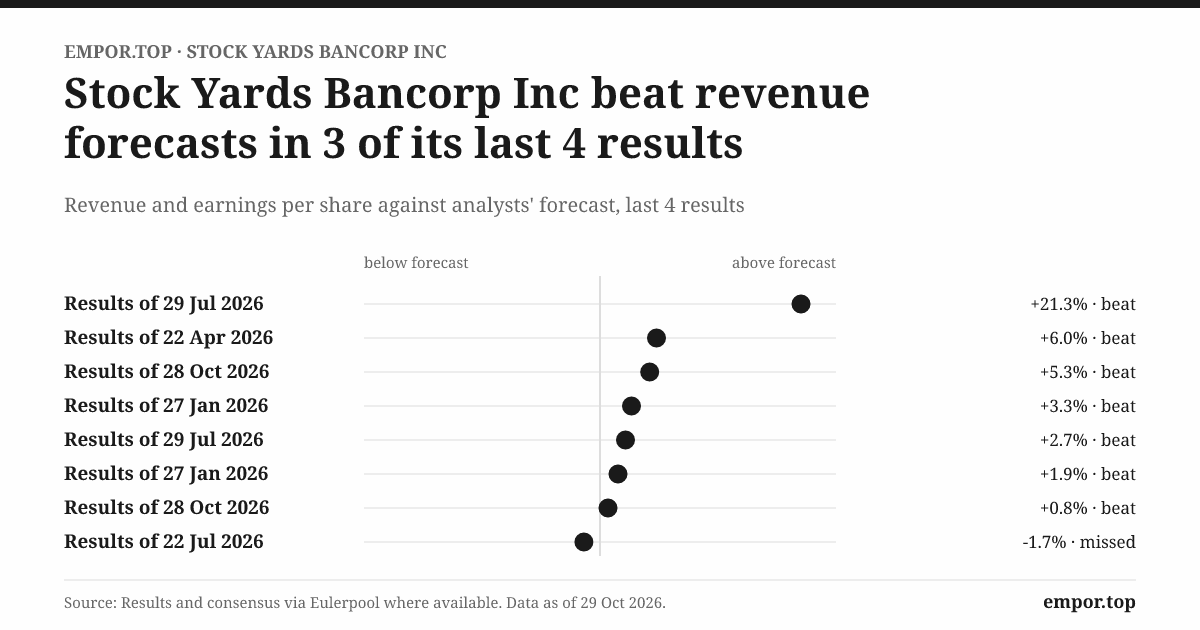
On the morning of October 28, 2026, a Louisville bank that most American investors could not place on a map reported the best quarter in its 122-year history. Stock Yards Bancorp earned $43.5 million in the three months to September, or $1.40 a share, up from $36.2 million and $1.23 a share a year earlier.1 Net income had risen about 21% in a year. The balance sheet had crossed a line that matters a great deal in American banking: total assets stood at $10.26 billion.1 And the bank had done all of this while still digesting a purchase it had closed only six months before, a six-branch lender from Henderson, in the far western corner of Kentucky, called Field & Main.2
That is the headline, and it is a good one. The harder question sits underneath it. When a bank gets bigger, there are three very different ways that can happen. It can win customers, one loan and one checking account at a time, from rivals who would rather keep them. It can buy another bank and add that bank's customers to its own ledger. Or it can simply be in the right place when interest rates move in its favour, so that the same customers produce more profit without anyone working harder. All three show up in the same line on the income statement. Only the first one says much about whether a bank has something special.
Stock Yards' record quarter contained all three. Loans grew 15% over the year, but that included about $606 million of loans that arrived with Field & Main. Strip those out and the legacy bank grew loans about 6%, which is solid but a much less dramatic number.1 Deposits looked even more stark. Total deposits were up about 10%, but almost the entire increase came with the acquired bank: excluding Field & Main, deposits grew by only about $15 million, less than 1%.1 Meanwhile net interest margin, the bank's spread between what it earns on loans and pays on deposits, had climbed to 3.88% from 3.56% a year earlier, because the bank had cut what it paid depositors as the Federal Reserve cut rates.1 A chunk of the record, in other words, was purchased and a chunk was weather.
That is the tension this story follows. Stock Yards has a genuine claim to being a local franchise that has compounded for decades. It also has a growing habit of buying its way into the next market. Investors paying for the first need to know how much of the growth is the second, and whether the latest purchase will add value per share once the cost of stitching two banks together has been paid.
First, the boundaries. Stock Yards Bancorp, Inc. is the listed holding company, traded on the NASDAQ under the ticker SYBT. It owns one bank, Stock Yards Bank & Trust Company, and the bank's results are the holding company's results.3 There is no outside parent, no private-equity sponsor and no controlling family. The largest holders at the end of 2025 were index giants BlackRock and Vanguard, each with about 6.5%, while directors and executives together owned about 3.1%.4 When Field & Main closed on May 1, 2026, its bank was merged into Stock Yards Bank & Trust and its shareholders received Stock Yards stock, so everything acquired in that deal now sits inside the listed company.25
Scale needs a little calibration, because "the largest bank headquartered in Kentucky" sounds grander than it is. At about $10 billion in assets, Stock Yards is a giant among Kentucky's community banks and a minnow among the institutions it competes with in Louisville, Lexington, Indianapolis and Cincinnati. JPMorgan Chase, PNC, Fifth Third and U.S. Bank all operate in its markets, and each of them is many times larger. Stock Yards' entire balance sheet is smaller than a rounding error at the biggest of them. Its job is not to out-muscle them. Its job is to be the bank a mid-sized business owner calls first, because the person who picks up knows the business and can say yes without sending the file to another state.
There is one more piece of calibration worth making early, because the numbers in circulation about this company do not all agree. Data services that build standardised statements for every listed company tend to struggle with banks. One widely used data set shows Stock Yards' 2025 revenue as about $564 million, while the company itself reported total revenue of $397.6 million, made up of net interest income and fees.3 The same data shows a negative book value per share, which is plainly wrong: the company reported book value of $36.49 a share at the end of 2025 and tangible book value of $32.08 a share at September 2026.31 Bank accounting simply does not fit the template built for factories and software companies. This story uses the bank's own reported figures and the measures bankers use to judge one another.
With those boundaries drawn, the question is clear. Is Stock Yards' latest growth the next chapter in a durable local franchise, or is it a business getting larger mainly through acquisitions and a favourable rate cycle? The honest answer, after weighing the record, is that it is both, and the proportions matter. The bank is growing and earning more. But the headline growth includes an acquisition and a margin tailwind, and the real test is whether the legacy franchise keeps producing organic loans, deposits and earnings once the integration noise fades. To see why that test matters, it helps to go back to how a 1904 Louisville bank learned to grow without becoming something else.
 Subscribe on LinkedIn
II. A Louisville Franchise Steps Beyond Its Home Market
The name is a clue to the origin. Stock Yards Bank opened in 1904 in Louisville's livestock district, a bank built to serve the cattle and hog trade that passed through the city's stockyards.3 For most of the twentieth century it stayed what that origin implied: a Louisville bank, lending to Louisville businesses and holding Louisville deposits. The holding company, Stock Yards Bancorp, was formed in 1988, which gave the bank access to public capital markets and a corporate structure capable of buying other institutions.3 The stockyards are long gone. The local-market model is not.
What makes that model worth studying is that it never really changed, even as the bank's footprint did. Stock Yards built its business around commercial relationships: owner-operated companies, real-estate developers, professional practices and the families behind them. It added a trust and wealth-management operation that became one of the largest bank-owned trust businesses in Kentucky.3 Over the 2000s and 2010s, it pushed into Indianapolis and Cincinnati, two metropolitan markets within a couple of hours' drive, building commercial and wealth teams in both cities.3 That organic expansion is part of why the company's long-run record looks the way it does. Diluted earnings per share rose from $1.65 in 2015 to $4.75 in 2025, close to tripling in a decade.3
Then, in late 2018, the bank made a modest move that turned out to be a template. On December 19, 2018, Stock Yards agreed to buy King Bancorp, the parent of King Southern Bank in Bardstown, the seat of Nelson County, about 40 miles south of Louisville.6 The price was about $28 million for a bank with roughly $192 million of assets and five branches.6 By the standards of what came later, it was tiny. But it showed the shape of the playbook. King was not a leap into a faraway market or a new line of business. It was the next county over, a place where Louisville customers already had relatives, suppliers and second homes, and where Stock Yards could plug a small bank's deposits and lending relationships into a much larger balance sheet.
The logic of adjacency is simple enough to explain at a kitchen table. A bank's most valuable raw material is a stable deposit from a customer who is not shopping around for the highest rate. Those deposits cluster where a bank has branches, bankers and a reputation. A small bank in the next county has exactly that kind of deposit base but lacks the scale to lend it out to bigger borrowers, offer sophisticated treasury services or run a trust department. A larger neighbour can do all of those things. When the two combine, the hope is that the acquired customers get more products, the acquirer gets cheap funding and a new market, and overlapping costs come out. In a state like Kentucky, where small banks dot almost every county seat, the supply of such targets is ample.
The footprint tells the story of how far that logic carried. Stock Yards had 43 banking locations in 2019. By the end of 2025 it had 75, and after Field & Main and a new branch in Bowling Green it had 82.31 The map now runs from Louisville through central Kentucky's horse country to Lexington, into eastern Kentucky, north to Cincinnati and Indianapolis, and west to Henderson and the Indiana side of the Ohio River.1 The sequence matters: King Southern in 2019, Kentucky Bancshares in 2021, Commonwealth Bancshares in 2022, then Field & Main in 2026.32 Each deal was larger than King, and each pushed the bank a little further from the Louisville core.
This is also the place to put the moat claim on trial, because the "local relationship bank" story is the one investors tend to accept on faith. The argument goes like this. Big national banks run commercial lending from regional hubs, use standardised credit models and rotate their relationship managers. A local bank keeps the same banker on the account for years, makes decisions in town, and can tailor a loan to a business it actually understands. Add a trust department that already manages the owner's family money and a treasury operation that handles the company's payments, and the customer has many reasons to stay and few to leave. That is a plausible mechanism, and Stock Yards' long record of loan growth and low losses is consistent with it.
But consistent is not the same as proven. Stock Yards does not publish a customer-retention rate, a record of competitive loan bids won or lost, or any evidence that it charges more for loans than peers or pays less for deposits because of its relationships.3 It does not disclose how many King, Kentucky Bank or Commonwealth customers remained with it after conversion. Without those numbers, the relationship advantage remains an inference from the bank's results, not a demonstrated fact. And the most recent evidence cuts the other way: in the year to September 2026, the legacy bank's deposits barely grew, which is not what a franchise with a strong pull on local funding usually looks like in a falling-rate environment.1
So the verdict on the first chapter of expansion is measured. The pattern is local infill: add nearby deposits, lending relationships and branches, then step into the next adjacent market. It has a long record and it has produced rising earnings. What the record does not establish is that acquired customers stay, or that branches bought this way earn better returns than branches built. King was a small enough bet that the question barely mattered. The next deal was large enough that it did.
III. The 2021 Deal That Changed the Map
The Kentucky Bancshares deal had already died once before it was announced. Talks between Stock Yards and the Paris, Kentucky, holding company had begun before the pandemic, and like so many negotiations in early 2020, they stalled as the economy locked down and nobody could value a loan book with any confidence. Late in 2020, with vaccines on the horizon and credit losses far smaller than feared, the two sides restarted.7 In January 2021 Stock Yards announced it would buy Kentucky Bancshares, the parent of Kentucky Bank, for about $190 million.78
This was a different animal from King. Kentucky Bancshares had about $1.2 billion of assets, roughly $767 million of loans and about $979 million of deposits, spread across 19 branches.78 Most important, it gave Stock Yards a real presence in and around Lexington, Kentucky's second-largest city and the centre of the Bluegrass horse and agricultural economy, plus a string of smaller central and eastern Kentucky towns.8 At a stroke, Stock Yards' footprint in the state roughly doubled in reach. The question for shareholders was whether the price made sense.
Bank deals are priced in two main ways, and both are worth understanding because they will recur. The first is the price-to-tangible-book multiple. Tangible book value is, roughly, what would be left for shareholders if the bank's loans and securities were collected at their recorded values, its deposits and debts were repaid, and intangible items such as goodwill were ignored. Paying 1.0 times tangible book means paying exactly for those net assets. Paying more means paying for the franchise: the deposits, the relationships, the earnings power. The second measure is the price-to-earnings multiple, which asks how many years of the target's profit the buyer is paying for.
Stock Yards paid about 1.65 times Kentucky Bancshares' tangible book value and about 16.2 times its 2020 earnings.8 Including the cost savings the company projected from combining the two banks, the effective earnings multiple fell to about 9.8 times.8 For context, the median U.S. bank deal in 2021 was priced at about 1.52 times tangible book nationally, and regional deals at about 1.61 times.9 Stock Yards paid a bit above both. That is not outrageous, but it means the buyer was paying for something beyond the median: market access, Lexington, and confidence that it could take cost out quickly.
Here is why the cost savings matter so much. The difference between 16 times earnings and 10 times earnings is the synergy promise. If Stock Yards could close overlapping branches, consolidate back-office systems, and cut duplicated management, the target's earnings to Stock Yards would be much higher than the target's earnings on its own. If it could not, Stock Yards had paid a full price for a mid-sized community bank. The deal was therefore not a bet on Kentucky Bancshares as it stood. It was a bet on Stock Yards' ability to integrate.
The buyer's case, expressed in bank terms, was sound. Branch density in central Kentucky meant a cheap, sticky deposit base. Stock Yards' larger balance sheet and broader product set meant it could lend those deposits to bigger borrowers and sell wealth, treasury and card services to customers who had never been offered them. A presence in Lexington, home to the University of Kentucky and a thick layer of professional and agricultural businesses, opened a market Stock Yards had never seriously served. If customers stayed, and if Stock Yards deployed the funding profitably, the deal could earn its premium.
The company also offered the forecasts that usually accompany such transactions: projected accretion to earnings per share and an estimated period over which the dilution to tangible book value would be earned back.8 Those are the numbers bank investors use to keep acquirers honest. "Earnback" is worth a moment of explanation. When a buyer pays above tangible book and issues stock to do it, its own tangible book per share usually falls on day one, because goodwill does not count. The earnback period is how long it takes for the extra earnings from the deal to rebuild tangible book per share to where it would have been without the deal. A short earnback, perhaps three years, is considered disciplined. A long one is a warning.
How did it turn out? The honest answer is that the record answers part of the question and leaves the rest open. The goodwill created by the Kentucky Bancshares deal remained on Stock Yards' books through 2025 with no reported impairment, which means the company's annual tests did not conclude the acquired business had lost value.3 Earnings per share also rose strongly after the deal, from $2.58 in 2020 to $4.75 in 2025.3 But goodwill that is not impaired is a low bar, not proof that projected returns were met. And earnings per share after 2021 reflect not only Kentucky Bancshares but also the Commonwealth deal, organic growth and the rate cycle. Stock Yards does not report the acquired Kentucky Bank franchise as a separate business, so outsiders cannot isolate how its deposits and loans behaved after conversion.3
There is one more complication carried forward from this deal, and it showed up in an unexpected place. Kentucky Bancshares had a captive insurance subsidiary, a structure some community banks used for tax and risk purposes. The IRS later proposed rules treating such arrangements as transactions of interest. Stock Yards dissolved the captive in 2023, but it remains subject to scrutiny for open tax years. The company recorded no reserve for an uncertain tax position, judging the final regulations did not require one.3 It is small, but it is a reminder that when a bank buys another bank, it buys its history too.
The verdict is that the price was above the broad deal median, so the bet depended on market access and integration savings, and the record so far neither condemns nor fully vindicates it. What the deal unmistakably did was change Stock Yards' sense of what was possible. Before the year was out, it had agreed to buy another bank, this time right at home in Louisville. Acquisition-led growth was becoming less an occasional opportunity and more a regular tool.
IV. Commonwealth: Buying More Than Branches
In the summer of 2021, with the Kentucky Bancshares integration barely finished, Stock Yards' management went shopping again, and this time the target was a crosstown rival. Commonwealth Bancshares, the parent of Commonwealth Bank & Trust, was a Louisville institution with branches across the metro area and, crucially, a significant wealth-management and trust business of its own.10 Stock Yards agreed to buy it for about $153 million.10 The Federal Reserve approved the acquisition in February 2022, and it closed shortly after.11
The Commonwealth deal was a different kind of chess move from Kentucky Bancshares. Lexington had been about new territory. Commonwealth was about density and diversification. Buying a bank in your own city lets you close overlapping branches and back offices, which is where the cleanest cost savings in banking come from. And buying a trust business lets you sell something whose revenue does not depend on interest rates. Management framed it as adding a second engine to the franchise.10
The price was richer than the Kentucky deal: about 1.78 times tangible book and 10.4 times trailing earnings, or 8.2 times estimated forward earnings once cost savings were fully phased in.10 As with the Kentucky deal, Stock Yards was again paying up.9 The forward earnings multiple looked cheap only because the synergies were expected to be large, which, in an in-market deal, is plausible. Still, the shape of the bet was familiar.
To understand why the trust business mattered, it helps to understand how Stock Yards actually makes money, because the two halves of the bank are not equal. In 2025, the Commercial Banking segment produced about $161 million of pretax income. Wealth Management & Trust produced about $17 million.3 The wealth segment generated $42.8 million of revenue that year, and the company says those fees are predominantly based on assets under management, with fee schedules customised at the account level; some estate and employee-benefit fees are one-time rather than recurring.3 In plain terms, the bank earns a percentage of the money it manages each year, so when markets rise and clients add assets, fees rise with them, regardless of what the Federal Reserve does with short-term rates.
That is the appeal of a fee stream. Deposit pricing and loan spreads move with interest rates and competition. Wealth fees move with asset values and client relationships. A bank with both has earnings that wobble less when one environment turns hostile. There is also a cross-selling story, which can make relationships harder to unwind. By the third quarter of 2026, wealth and trust fees had reached a record $12.9 million for the quarter, up about 20% from a year earlier, with $1.2 million of that coming from Field & Main's wealth clients.1
But the earnings mix keeps the claim in proportion. Wealth Management & Trust earned about one-tenth of what the commercial bank earned before tax in 2025.3 It diversifies Stock Yards' earnings; it does not transform them. If deposit costs surge or loan losses spike, a growing trust department will soften the blow, not absorb it. Anyone describing Stock Yards as a wealth-management franchise attached to a bank has the proportions backwards.
The Commonwealth deal also contains the clearest example in Stock Yards' recent history of a piece that did not fit. Along with the bank and trust company, Commonwealth brought a 60% stake in LFA, a small investment-advisory business. In 2022, the same year the deal closed, Stock Yards sold its interest in LFA, recorded a pretax loss of about $870,000 and wrote off about $8.5 million of goodwill tied to the Commonwealth acquisition.3 In the context of a $153 million transaction, the write-off was not catastrophic. It is still telling. It shows that part of what Stock Yards paid for did not survive its first year of ownership, and it shows management was willing to exit rather than nurse a mismatched business. Both readings are fair, and an investor should hold them together: decisiveness in cutting a loss, and evidence that the original price included something worth less than assumed.
So does the integration record support a repeatable playbook? The best that can be said is that it supports a partial one. Stock Yards has completed several bank integrations without large surprises in credit quality or visible blowups in its cost base, and its earnings per share have risen through each one.3 The central measures, though, are realised earnings against forecast and actual tangible-book earnback against the estimate, and the company does not publish a retrospective scorecard comparing what each deal promised with what it delivered. The LFA exit is the one public moment where a deal component clearly underperformed. The rest of the evidence is consistent with success, but it is the evidence of a rising tide, and rates did a lot of rising in those years.
That points to the engine that does most of the work at Stock Yards, the one beneath all the branches and all the deals: the spread between what a bank earns on money and what it pays for it.
V. The Engine Behind the Branches
Picture a Louisville manufacturer with $40 million of annual sales, a family name on the building, and a decision to make. The company needs a line of credit to carry inventory, a term loan for a new piece of equipment, an operating account through which every customer payment and payroll run flows, a corporate card programme, and a treasury system that can sweep idle cash overnight and catch fraudulent checks before they clear. Upstairs, the founder's family has a portfolio that someone needs to manage and an estate plan that needs a trustee. A national bank can provide all of it. So can Stock Yards. The question for the owner is which bank understands the business, answers the phone, and makes the whole bundle work without friction.
That bundle is what Stock Yards sells, and it is worth taking apart because its economics are not intuitive. At its core, a bank is a spread business. Customers deposit money, much of it in checking and savings accounts that pay little or nothing. The bank lends that money to businesses and households, and invests some in government securities. The difference between the interest it earns on loans and securities and the interest it pays on deposits and borrowings is net interest income. Divide that by the bank's interest-earning assets and you get the net interest margin, the single most important number in community banking. Then subtract credit losses, add fees, and deduct the cost of branches, people and technology. What remains is profit.
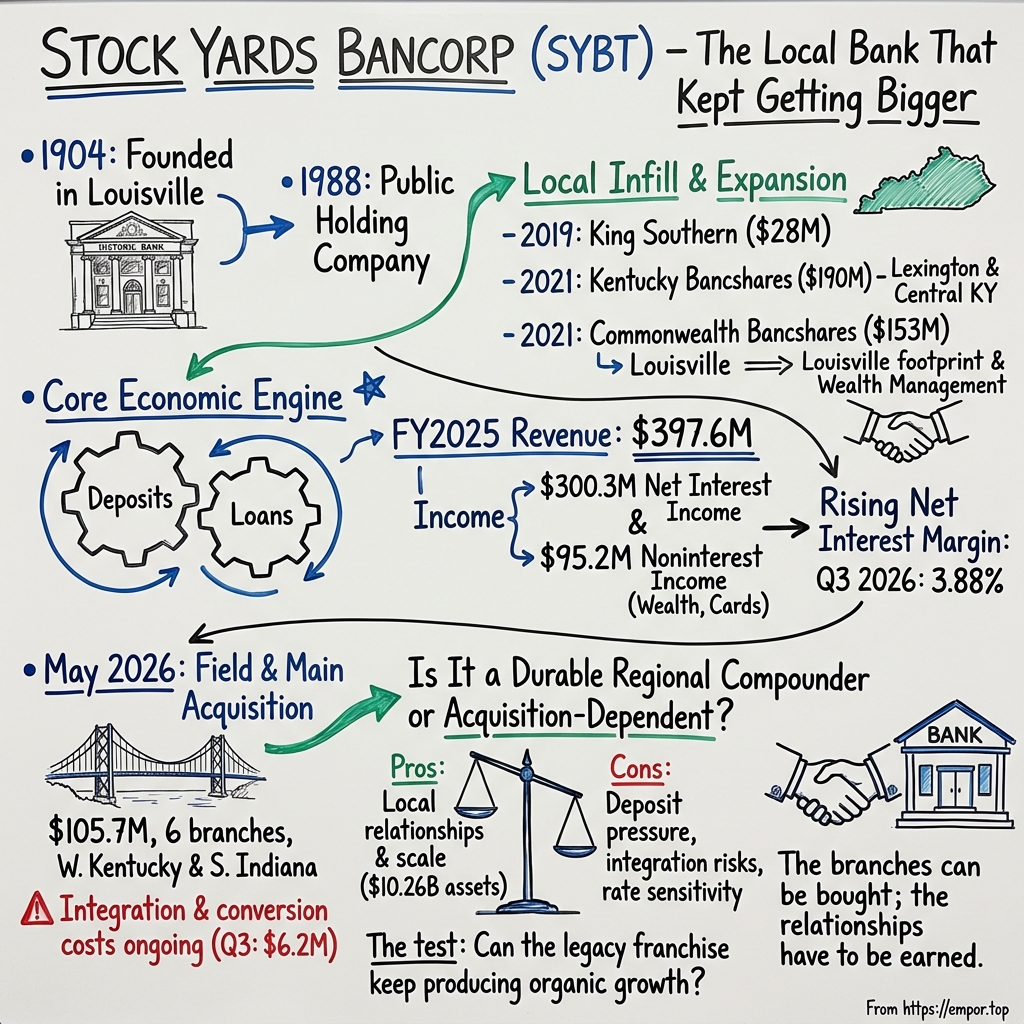
In 2025, Stock Yards' reported total revenue was $397.6 million. Net interest income was $300.3 million, about three-quarters of it, and noninterest income was $95.2 million.3 That ratio tells you what kind of business this is. For every dollar of revenue, roughly 75 cents comes from the lending spread. The rest comes from fees: wealth and trust, card services, treasury management, mortgage banking, brokerage and deposit-service charges. Cards generated about $19.9 million in 2025 and treasury-management fees about $11.7 million.3 Those lines matter because they keep commercial customers tied to the bank, but each one is a small fraction of net interest income.
The margin is where the recent story lives. Net interest margin rose from 3.31% in 2024 to 3.53% in 2025, and then to 3.88% in the third quarter of 2026.31 That might sound like a small move. It is not. On roughly $9 billion of interest-earning assets, every tenth of a percentage point of margin is worth about $9 million a year of pre-tax income. A move of more than half a point in under two years is the single largest reason earnings climbed as fast as they did.
Why did the margin widen? Over 2026, management's explanation evolved quarter by quarter, and following it closely is instructive. In the first quarter, the company said margin expansion was "driven primarily by lower interest-bearing deposit costs," as Stock Yards cut deposit rates in step with the Federal Reserve's reductions.12 In the second quarter, the explanation broadened to improved loan yields, lower deposit costs and a better funding mix, and the margin jumped 19 basis points in a single quarter.13 The bank's average rate on interest-bearing deposits fell to about 2.27%, down about a third of a percentage point from a year earlier.13 Then CEO Ja Hillebrand added a sentence that every investor should remember: "margin appears to be near a peak."13 In the third quarter, margin rose only another four basis points, and deposit costs essentially stopped falling, as higher costs on interest-bearing checking and money-market accounts offset the repricing of maturing certificates of deposit.1 The pattern is coherent and, to management's credit, candid. The easy part of the deposit-cost cut appears to be done.
This matters because of how Stock Yards is positioned for rates. At the end of 2025, the company's own model showed net interest income rising about 3.3% if rates jumped one percentage point immediately, and falling about 3.4% if they dropped one point.3 Bankers call this "asset sensitivity": the bank's loans reprice faster than its deposits. It is a gift when rates rise and a headwind when they fall. Stock Yards' recent margin gains came in a falling-rate environment, which means management succeeded in cutting deposit costs faster than its model assumed. That is a genuine accomplishment. It is also not something that can be repeated forever, because deposit rates cannot fall below zero and customers eventually notice.
Running the engine costs money, and the cost side deserves a moment because it is where scale either shows up or does not. Bankers measure it with the efficiency ratio: operating expenses as a share of revenue, so that a lower number is better. Stock Yards ran at about 53% in the third quarter of 2026, meaning it spent about 53 cents to produce each dollar of revenue, after about 56% in the second quarter, when the first Field & Main merger charges landed.113 That is respectable for a community bank with a large trust department, which is a people-heavy business, but it is not the kind of number that suggests a cost advantage over rivals. Scale has not yet turned into dramatically cheaper operations.
Technology sits inside that expense line too, and here the bank's exposure is the same as every other lender's. The quarterly report noted a single credit-card fraud loss of about $850,000 that inflated other expenses in the third quarter.1 It was small against quarterly profit of more than $43 million. But it is a reminder that a bank's relationship model now runs on payment rails, card networks and online banking, and that fraud, cyberattacks and the cost of keeping systems current fall harder, relative to size, on a $10 billion bank than on a national giant that spends billions a year on technology. Local decision-making is a selling point only as long as the digital experience does not drive customers away.
The deeper question is about funding, and here the record is less flattering. A relationship bank's real edge, if it has one, should show up in its ability to attract and keep cheap deposits. Over the year to September 2026, Stock Yards' organic deposits grew less than 1%, while Field & Main added $731 million, including $130 million of noninterest-bearing deposits.1 Legacy deposits actually fell about $61 million in the third quarter alone.1 Meanwhile organic loans grew about 6%.1 When loans grow faster than deposits, a bank has to fund the difference somehow, and Stock Yards did it partly by letting its securities portfolio run off: securities were down about 15% year over year, mainly because maturing Treasury bills were used to fund loan growth.1
That is a sensible use of liquidity, and Stock Yards has room. It had no brokered deposits at June 2026, core deposits made up about 84% of the total, and the bank had $1.49 billion of additional borrowing capacity at the Federal Home Loan Bank.14 But running off securities to fund loans is a one-time move. If the legacy bank cannot grow deposits, it will eventually have to pay more for funding, borrow more, or slow lending. Each of those squeezes the margin that has done so much of the work.
On loan growth, management's commentary in 2026 also shifted in a way worth noticing. In the first quarter, Hillebrand said "loan growth stood out in terms of both volume and credit quality."12 By the second quarter, organic loan growth for the quarter had shrunk to about $24 million, which he attributed to "a significant volume of payoffs as opposed to softening demand."13 In the third quarter, loan growth was "positive, but lighter than anticipated, as payoffs remained elevated," and he expected payoff activity "to remain a headwind in the near term."1 Payoffs are a real phenomenon when rates fall, because borrowers refinance or sell properties. But "lighter than anticipated" twice in a row is a pattern, and the explanation, while plausible, is hard for outsiders to verify because the bank does not break out payoff volumes against new originations.
So what does Stock Yards sell that makes customers choose it? The honest answer is a full-service commercial relationship, delivered locally, with a trust department that larger competitors often run from far away. That is a plausible advantage. The filings do not prove superior retention or pricing power, and the most recent deposit numbers suggest the funding edge, if it exists, is not strong enough to grow the legacy deposit base when rivals compete for every dollar. The core is a deposit-funded lending spread, the fees are supporting income, and recent earnings owe a good deal to a margin tailwind that management itself thinks is near its crest. Which is why the latest acquisition, and its bill, matters so much.
VI. The New Territory Comes With a Bill
Henderson, Kentucky, sits on a bend of the Ohio River, across the water from Evansville, Indiana. It is a river town with an economy built on farming, manufacturing and barge traffic, and it was home to a community bank called Field & Main. On January 27, 2026, Stock Yards announced it would buy Field & Main Bancorp in an all-stock deal valued at about $105.7 million.15 On May 1, the deal closed, and six branches serving Henderson and nearby markets in western Kentucky and southern Indiana became part of Stock Yards Bank & Trust.216
The strategic logic followed the familiar adjacency pattern, with one twist. Field & Main extended Stock Yards west, into territory between its Louisville core and the far corner of the state, and gave it a foothold across the river near Evansville.2 It was not a new business line or a distant market. But Henderson is farther from Louisville than any market Stock Yards had bought before, about two hours by road, and the river economy of western Kentucky is different from the Bluegrass. The adjacency was real, but it was stretching.
At closing, Field & Main brought about $839 million of assets and $626 million of net loans.2 At year-end 2025, it had held about $781 million of deposits and around $800 million of wealth-management assets.12 That last figure is the twist: Field & Main brought a meaningful trust business of its own, which fits Stock Yards' push to grow fee income. Its shareholders received 0.655 Stock Yards shares for each of their own, and the deal contemplated issuing up to about 1.55 million new shares.5 Former Field & Main owners were expected to hold about 4.9% of the combined company.5 Stock Yards' share count rose from about 29.5 million in March to about 31.1 million by June.13
Was the price sensible? At about 1.6 times Field & Main's tangible book value, measured at the midpoint of Stock Yards' initial offer range, it was in line with the premiums Stock Yards had paid before, and Field & Main's board described the final terms as favourable compared with similar 2025 bank deals.5 There is an important piece of financial engineering embedded here. Stock Yards paid in its own stock, and its stock trades at well above its own tangible book value. That means it can offer sellers a premium to their book while giving up less of its own tangible value per dollar than if its shares were cheap. A buyer trading at about two and a half times tangible book, buying a target at 1.6 times, is in effect swapping expensive paper for cheaper assets. That is a real advantage, and it is how highly valued banks often grow.
It is not free, though. Existing shareholders gave up nearly 5% of the company. Whether that is worth it depends on whether Field & Main's earnings, plus the savings from combining, exceed what those shares would otherwise have earned. Early signs are encouraging on the revenue side. In its first full quarter inside Stock Yards, Field & Main contributed about $7.8 million of net interest income and $2.0 million of fee income.1 Hillebrand said the acquisition was "already making a meaningful contribution to our results."1
The cost side is where the bill arrives. In the third quarter, Field & Main-related expenses were about $6.2 million: roughly $5.5 million of ongoing operating cost and $678,000 of one-time merger costs.1 In the second quarter, two months of ownership had brought $5.8 million of expenses, including about $2.3 million of one-time costs.13 The core systems conversion, when Field & Main's customers moved onto Stock Yards' technology, was completed in mid-October, and management said the remaining merger costs, primarily related to that conversion, will be recorded in the fourth quarter.1 The economics are only partially visible yet. Roughly $9.8 million of quarterly revenue against $5.5 million of operating cost suggests the acquired bank is profitable before integration charges. But the cost savings that would make it clearly accretive come after conversion, when duplicated systems are switched off and staffing is rationalised.
Management's explanation of the integration has been consistent across the year, which is a point in its favour. In the first quarter, Stock Yards signed the deal and set the closing date.12 In the second, it said the bulk of remaining merger expenses would fall in the second half, mostly tied to systems conversion.13 In the third, it reported the conversion complete and pointed to one final quarter of costs.1 No timetable slipped, and no new cost category appeared. What has been less concrete is the size of the expected savings. The quarterly releases do not quantify a cost-savings target for Field & Main, nor do they report progress against one, so outsiders will have to infer realised synergies from the expense line in 2027.
There is a second, subtler cost to Field & Main, and it involves the $10 billion line. Federal rules treat banks with $10 billion or more in assets differently. The most immediate effect is on debit-card interchange fees, the small charge a merchant pays every time a customer swipes: banks above $10 billion face a regulatory cap on those fees under the Durbin Amendment. They also come under the direct supervision of the Consumer Financial Protection Bureau. Stock Yards' assets reached $10.26 billion at September 30, and management said it plans to finish 2026 below $10 billion and cross the threshold in 2027.1 Because the test is applied at year-end, that timing defers the interchange hit by a year. But it is a reminder that card income sits partly on borrowed time, and that some of the bank's growth now carries a regulatory toll.3
The quality of what Stock Yards bought matters as much as the quantity. Of the $731 million of deposits Field & Main carried at September, about $130 million sat in noninterest-bearing accounts, the checking balances that cost a bank nothing and are the most prized funding in the business.1 That is roughly one dollar in six. It is a respectable mix for a community bank, and it helps explain why the acquired book added to net interest income from its first full quarter. But it also defines the risk of the conversion. Noninterest-bearing balances belong to operating businesses and households who use the account every day, and those are exactly the customers most likely to notice a new card, a new login or a new statement. If the acquired checking balances hold through the winter, Stock Yards will have bought the cheapest kind of funding there is. If they drift, the deal will have bought mostly loans, which the bank can originate on its own.
So will Field & Main create per-share value, or mainly add assets and complexity? The deal looks strategically adjacent and modest relative to Stock Yards' size. The premium and integration costs make execution the test. Tangible book per share has been rising, to $32.08 at September 2026 from about $28.30 a year earlier, which suggests the dilution from goodwill has been more than offset by retained earnings.1 But no verdict on accretion is warranted yet. The questions are which acquired customers stay after their accounts and cards change, whether the acquired loans perform, and whether the combined cost base shrinks the way an in-market acquirer's should. Those questions lead directly to the competitive arena, where Stock Yards' customers can always walk across the street.
VII. Why This Bank Might Win, and Where the Case Breaks
Walk down a commercial street in Lexington or Louisville and count the bank signs. Stock Yards, certainly. Republic Bank, the other big Louisville-headquartered lender. Community Trust, from Pikeville in eastern Kentucky. A credit union or two, offering higher deposit rates thanks to their tax exemption. And then the giants: Chase, PNC, Fifth Third, Truist, U.S. Bank, each with a mobile app, a national brand and an army of commercial bankers. A Kentucky business owner can bank with any of them, and many bank with several at once.
Stock Yards is the largest of the locals. At June 2026, Stock Yards Bank & Trust had about $10.4 billion of assets, against about $7.1 billion at Republic Bank and $6.9 billion at Community Trust.17 It held about 5.6% of the deposits at Kentucky branches.17 Those numbers say two things at once. Among Kentucky-based banks, Stock Yards has clear scale. Across the state's banking market, it is still a small share of a crowded field, because the national banks hold much of the rest.
This is the place to argue the moat in full, using the frameworks investors reach for. Start with Michael Porter's five forces. Rivalry in local banking is intense: dozens of banks compete in every city, and the product, money, is perfectly fungible. Buyer power is significant. Customers can multi-bank, move deposits with a few clicks, and play lenders off one another on large loans. Supplier power, in banking terms, is the power of depositors, who are the bank's suppliers of funding, and it has risen sharply in recent years as higher rates taught customers that cash has a price. The threat of substitutes is real: money-market funds, Treasury bills and fintech payment platforms all compete for deposits, and private-credit funds compete for commercial loans. The threat of new entrants is the one force that is weak, because bank charters are hard to obtain and capital requirements are high. Four of five forces push against the bank. That is the normal condition of community banking, not a problem unique to Stock Yards.
Hamilton Helmer's seven powers offer a sharper lens for asking whether Stock Yards has anything that persists. Scale economies exist in banking, but Stock Yards has them only relative to smaller Kentucky banks; against national competitors, it is at a disadvantage in technology spending and funding costs. Network effects are negligible. Counter-positioning, the idea of a business model incumbents cannot copy without hurting themselves, is arguably present in a mild form: national banks have centralised credit decisions to save costs, and reversing that to match Stock Yards' local decision-making would raise their expenses. Switching costs are the most promising power. A business with its operating accounts, payroll, treasury services, credit lines and family trust at one bank faces real friction in moving. Brand matters locally; Stock Yards has been a Louisville name for over a century. Cornered resources and process power are hard to identify.
So the plausible counterweight to all those adverse forces is a combination of switching costs and local counter-positioning: decision-making in town, full-service commercial relationships, and a large bank-owned trust business that deepens the bond. That is a coherent theory of advantage. The evidence limit, though, must be stated plainly. Stock Yards does not disclose customer-retention rates, its largest borrowers, competitive bid outcomes, or how its loan and deposit pricing compares with rivals.3 Switching costs are inferred, not measured. And the most direct test of a funding advantage, organic deposit growth, came in at less than 1% for the year to September 2026.1 The history therefore narrows the moat claim to a smaller version: Stock Yards has meaningful local scale and sticky commercial relationships, but no evidence establishes a protected position against larger banks or local rivals. The proving indicator is legacy deposit growth. If it recovers while rates fall, the switching-cost story strengthens. If it stays flat, the bank is renting its funding, not owning it.
Credit quality is the other half of the defence, because a relationship bank that lends carelessly loses more than it gains. Here the record is good, with a few items worth watching. At September 2026, nonperforming loans were about $21.9 million, or 0.27% of loans, and the bank reported net recoveries for the quarter rather than losses.1 Its allowance for credit losses covered about 1.35% of loans.1 Nonperforming loans had nearly doubled since the start of the year, however, from about 0.16% of loans in March, partly because Field & Main brought in its own problem credits.121 Loans 90 days or more past due but still accruing interest jumped to about $4.9 million in June, from less than half a million at the end of 2025, a rise the company attributed in part to the acquired portfolio and administrative issues.14 By September, that figure had fallen back to about $1.9 million, which suggests many of those loans cured.1 And the third quarter brought a small but unusual provision: $250,000 against the company's only corporate bond, acquired in an earlier deal, after an event of default that was still being resolved.1 None of this is alarming at these levels. All of it is the kind of noise that accompanies an acquisition, and all of it deserves follow-through.
The balance-sheet mechanics add a final layer. At June 2026, about 71% of the securities portfolio was pledged as collateral against public deposits and borrowings, leaving about $249 million unpledged.14 That is a modest cushion of immediately saleable securities for a $10 billion bank, though the Federal Home Loan Bank line provides more. Tangible common equity was about 10% of tangible assets at September, a comfortable level.1 One curious detail: some of Stock Yards' commercial customers require other banks to confirm its letters of credit, because the company has no rating from a national agency.3 For a bank of this size that is unusual, and it is a small, concrete sign that scale beyond Kentucky still has to be borrowed.
A skeptical investor would push on three points. First, compare organic deposits with acquired balances, and ask whether the bank's growth has quietly become dependent on buying funding. Second, watch whether credit metrics stay benign as commercial real estate and commercial-and-industrial lending expand into new markets where Stock Yards' bankers have less history. Third, ask whether the cost savings from Field & Main show up in the expense line. Those are fair tests, and they lead naturally to the question of what Stock Yards' long record teaches.
VIII. Playbook: Business & Investing Lessons
Lay the deals on a single timeline and a story emerges. In 2019, King Southern: $28 million, five branches, the next county over. In 2021, Kentucky Bancshares: about $190 million, Lexington, above the national deal median. In 2022, Commonwealth: about $153 million, a crosstown bank and a trust company, and a small business sold within the year at a goodwill write-off. In 2026, Field & Main: $105.7 million, a river town two hours west, an integration still costing money. Through all of it, earnings per share rose over the decade.3 The lessons are in how those two lines, the deals and the earnings, fit together.
The first lesson comes from Bardstown and Lexington: a nearby bank is valuable only if its customers and deposits stay nearby. King and Kentucky Bancshares were attractive because they brought local funding into a bigger lending machine. But the value of that funding depends on the customers not leaving once their bank's name changes. Stock Yards has never disclosed retention for acquired customers, and its legacy deposits barely grew in 2026. For founders and investors, the wider point is that in any acquisition of a relationship business, the purchase price buys access, not loyalty, and the only proof is what the customer base looks like two years after the sign comes down.
The second lesson belongs to the premiums paid for Kentucky Bancshares and Commonwealth: a premium is a promise you have to earn back. The company projected cost savings and earnback periods but never publicly scored them against reality.8109 The LFA write-off is the one place where the promise visibly failed in part. The rising earnings per share since suggest the deals did not destroy value. But the investor's discipline is to demand the scorecard, not to infer it from a rising tide.
The third lesson comes from the record quarter itself: a record quarter is not a through-cycle record. The margin rose sharply as Stock Yards cut deposit costs while rates fell, and management said in July that it appeared near a peak.313 The company's own model says net interest income falls when rates fall.3 A bank's best quarter often arrives at the top of a favourable cycle, and the true quality of the franchise shows up at the bottom of an unfavourable one.
Behind every deal sits a management team, and its incentives are part of the story. James "Ja" Hillebrand joined Stock Yards in 1996 to build its private-banking group, after starting his career at PNC in 1988. He became president in 2008, chief executive in October 2018, and chairman in January 2021, succeeding David Heintzman in a long, staged handover.18 That is unusual continuity: the person running the bank today has been in senior leadership through every acquisition in this story, and his background is the wealth and private-banking side of the house, which helps explain the emphasis on trust businesses in the Commonwealth and Field & Main deals. His reported compensation was about $3.38 million in 2025, up from about $2.53 million in 2024, and the increase included a $1.49 million incentive payment earned because diluted earnings per share of $4.75 exceeded the maximum payout threshold of $4.54.4 In other words, the bonus was tied to the very number the margin tailwind inflated. That is not improper; it is how most bank incentive plans work. But it means executives were paid at the top of the scale for a year in which rates did some of the lifting.
Ownership alignment is modest but real. Directors and executive officers together owned about 3.1% of the company at the end of 2025, and the company prohibits them from pledging their shares.4 Shareholders broadly endorsed the pay plan in 2026, with about 19.0 million votes for and roughly 745,000 against.19 The board has a substantial majority of independent directors and a lead independent director, though Hillebrand holds both the chair and chief executive roles.4
Assessing behaviour rather than biography, two moments stand out. The LFA exit showed management willing to admit quickly that a piece of an acquisition did not fit and take a loss. The Field & Main conversion, completed on schedule in mid-October with costs landing in the quarters management said they would, shows execution matching the stated plan.1 Against those sit the lack of any published comparison between deal forecasts and outcomes, and two straight quarters of slower loan growth.1
That leaves the unanswered credibility test. Stock Yards has compounded earnings for a decade while making acquisitions and keeping dividends modest; the payout ratio drifted down from the high 30s to about 27% of earnings by 2025, which left more capital to fund growth.3 The fourth lesson, then, is the one that belongs to Stock Yards and no other: the branches can be bought, but the relationships have to be earned. The record supports a long-tenured operator with material incentives. It does not yet settle how much of the growth was organic, or how well the deal forecasts were met. The market, however, has to put a price on it today.
IX. Analysis & Bear vs. Bull Case
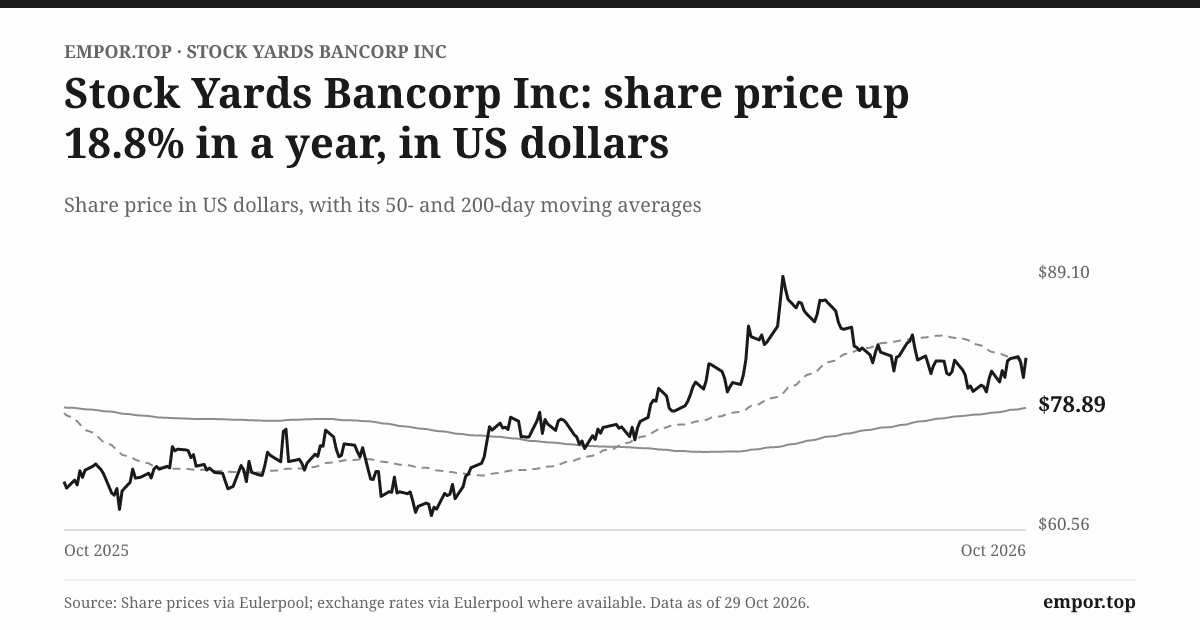
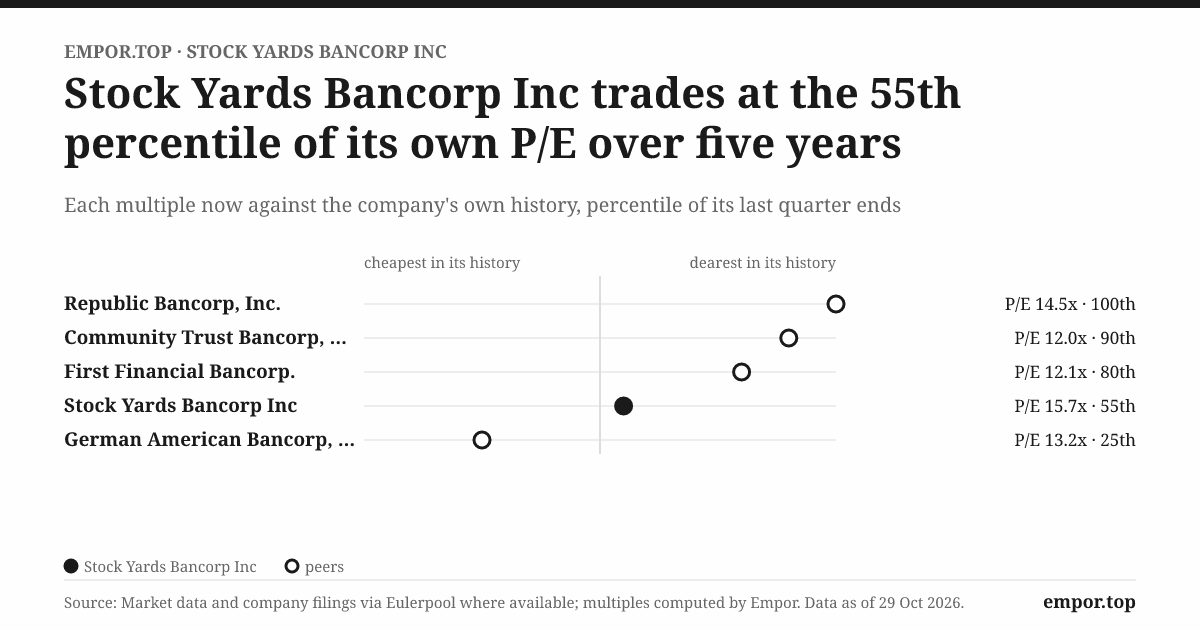
On October 29, 2026, the day after the record quarter, Stock Yards shares closed at about $78.89, roughly 10% below their 52-week high of $87.57 and well above the low of about $62. At that price, the company was worth about $2.3 billion. The shares traded at about 15.7 times the last twelve months of earnings of $5.15 a share, against a five-year median of about 15.4 times, which works out to an earnings yield of about 6.4%. In other words, investors are paying almost exactly what they have typically paid for a dollar of Stock Yards' earnings over the past five years.
The more revealing multiple for a bank is price to tangible book. With tangible book value per share at $32.08, the shares traded at roughly 2.5 times tangible book.1 That is a substantial premium. It says the market believes Stock Yards' franchise, its deposits, relationships and trust business, is worth far more than its net assets. That premium is what made the stock-funded Field & Main deal efficient. It is also what the bull case has to justify, because a bank priced at two and a half times its tangible value needs to keep earning high returns on that value to deserve it. Stock Yards' return on equity was about 13% in 2025, solid for a community bank but not spectacular.3 The market appears to be assuming that the bank can sustain those returns and keep growing.
The usual industrial-company yardsticks are misleading here and best set aside. Enterprise value against EBITDA, price against sales and free-cash-flow yield all treat deposits and loans as if they were working capital in a factory, which they are not. A bank's operating cash flow swings with mortgage loans held for sale and accounting adjustments, while its lending shows up as investing outflows and its deposits as financing inflows.3 Price to earnings, price to tangible book, return on equity and capital ratios are the right anchors.
The bull case runs like this. Stock Yards is the largest Kentucky-headquartered bank, with real local scale, an expanding regional footprint and an unusually large trust business for its size. Credit metrics are strong, with nonperforming loans around a quarter of a percent and net recoveries in the latest quarter.1 Fee income is growing at double digits, led by wealth management.1 Tangible book per share rose about 13% in a year despite an acquisition.1 Adjacent-market deals like Field & Main can keep compounding earnings, funded with highly valued stock, as long as organic deposits keep pace with loans. And a management team in place for decades has executed each integration on schedule.
The bear case is just as specific. Deposit growth is weak without acquisitions: the legacy bank added less than 1% in a year.1 Earnings are sensitive to rates, management has said margin is near a peak, and the company's own model shows net interest income falling as rates decline.133 Larger competitors can pressure funding costs whenever they choose to compete harder for deposits. Crossing $10 billion will cap debit interchange income and add regulatory cost.1 Loan growth has twice come in below management's expectations because of payoffs.1 And the integration could consume much of the expected accretion if the cost savings from Field & Main never materialise. At 2.5 times tangible book, a bank that stops growing organically is expensive.
Capital return is the quiet part of the bull case. Stock Yards raised its quarterly dividend to $0.33 a share, paid in October 2026, and the dividend yield at the current price is about 1.6%.1 The company did not buy back stock in any of the first three quarters of 2026, and its share count rose only because of the Field & Main issuance.113 That choice is consistent with a bank that sees better uses for capital in lending and acquisitions than in shrinking its share count. It also means shareholders are relying almost entirely on growth in earnings and tangible book, rather than on cash returned, for their returns. If organic growth slows, the absence of buybacks makes the next acquisition more, not less, likely, because retained capital will look for a use.
Weighing the two, the evidence leaves the bull case intact but narrower than it looks. Stock Yards is a well-run, well-capitalised regional bank whose earnings have genuinely compounded. But the part of its recent growth that would justify a premium multiple, organic, relationship-driven funding, is precisely the part that has stalled. The price embeds an assumption that the stall is temporary.
That makes the scorecard short. Three measures matter most. The first is organic deposit growth, excluding acquisitions, which most recently read less than 1% year over year and has been weakening.1 The second is net interest margin, at 3.88% in the third quarter, still rising but only barely, after management said it was near a peak.113 The third is the credit performance of acquired loans, where nonperforming loans have risen since the start of the year from a very low base, though late-payment balances have partly cured.1 Everything else, from wealth fees to the efficiency ratio, follows from those three.
Governance checks are, on the whole, clean. BDO, the auditor, issued an unqualified opinion on the 2025 financial statements and on internal controls, with no material weakness reported.3 Pending legal actions are not expected to have a material effect, according to the company and its counsel.3 The captive-insurance tax issue inherited from Kentucky Bancshares remains open for unexamined years but carries no reserve.3 Say-on-pay and auditor ratification both passed comfortably in 2026, with BDO's ratification drawing about 25.0 million votes for and about 363,000 against.19 Lending to directors, executives and their affiliates, about $104 million at the end of 2025, is the main related-party exposure, made on the same terms as comparable loans according to the company; it fell to about $71 million by June 2026 after a change in board composition.314 None of this changes the investment case. It removes some of the reasons for worry, which leaves the operating questions standing alone.
X. Epilogue
Tonight, Stock Yards sits in a peculiar moment. The core systems conversion for Field & Main went live in mid-October, which means that, for the first time, customers in Henderson and southern Indiana are logging into the same online banking, carrying the same debit cards and seeing the same statements as customers in Louisville.1 The deal is no longer an integration plan. It is just part of the bank. And the first full quarter after that conversion, the three months ending in March 2027, will be the cleanest early test of whether the acquired customers behave like Stock Yards customers.
Several moments will decide the story over the next year. The fourth-quarter results, due early in 2027, will carry the last of the conversion costs, and management has said those costs are primarily tied to the systems change.1 After that, the expense line should start to show whether the combination is saving money. If operating expenses attributable to Field & Main fall from the roughly $5.5 million a quarter seen in the third quarter, the deal moves toward accretion. If they do not, the premium paid becomes harder to earn back.1
The rate question will be answered by realised deposit costs and margin, not by last year's model. If the Federal Reserve keeps cutting, Stock Yards must keep lowering what it pays depositors without losing them. Management has already signalled that margin is near a peak, so a flat margin would be consistent with the plan; a falling one would mean the rate cycle has started to take back what it gave.13
Then there is credit. The September improvement in delinquencies and third-quarter net recoveries need to hold.1 Investors will want to see whether the remaining nonaccrual loans, many from the acquired book, resolve without charge-offs, and whether the corporate bond in default requires more than the $250,000 already reserved.1
And then the $10 billion line. Management intends to end 2026 just under it and cross in 2027.1 That milestone will reduce interchange income and bring new supervisory cost. Crossing it is the price of growing. How smoothly Stock Yards absorbs that cost, and whether it chooses to accelerate growth to dilute it, will show how management thinks about the next stage of scale.
The clearest confirmation of the thesis would be several quarters of organic loan and deposit growth together, stable credit metrics, and tangible book per share continuing to climb after the conversion costs fade. Deterioration in any one of those would narrow the thesis. Weak deposit growth would say the franchise is buying its funding. Rising problem loans would say the bank stretched for growth in unfamiliar markets. A stalled tangible book would say the deals cost more than they returned. Until those quarters arrive, the franchise looks capable, and the acquisition payoff remains unfinished.
XI. Outro
Go back to the business owner from earlier, weighing a credit line, a treasury system and a family trust. A decade ago, that owner would have been somewhere in Louisville. Today the same choice is being made by a farm-equipment dealer in Henderson, a horse-farm family outside Lexington and a contractor in suburban Indianapolis, all of them in markets Stock Yards now serves, many of them because Stock Yards bought the bank they already used. The map has grown one neighbouring market at a time, from the stockyards district to the bend of the Ohio River.
That is what makes Stock Yards unlike a bank that grows only by getting bigger. The test is whether the relationships came with the branches. The coming quarters will say whether they did.
References
-
Stock Yards Bancorp Reports Record Third Quarter Earnings, Form 8-K Exhibit 99.1 — Stock Yards Bancorp via SEC, 2026-10-28 ↩↩↩↩↩↩↩↩↩↩↩↩↩↩↩↩↩↩↩↩↩↩↩↩↩↩↩↩↩↩↩↩↩↩↩↩↩↩↩↩↩↩↩↩↩↩↩↩↩↩↩↩↩↩
-
Stock Yards Bancorp Completes Acquisition of Field & Main Bancorp, Form 8-K Exhibit 99.1 — SEC, 2026-05-01 ↩↩↩↩↩↩
-
2025 Form 10-K — Stock Yards Bancorp via SEC, 2026-02-26 ↩↩↩↩↩↩↩↩↩↩↩↩↩↩↩↩↩↩↩↩↩↩↩↩↩↩↩↩↩↩↩↩↩↩↩↩↩↩
-
2026 Proxy Statement — Stock Yards Bancorp via SEC, 2026-03-12 ↩↩↩↩
-
Form S-4 Merger Proxy Statement/Prospectus for Field & Main Bancorp — Stock Yards Bancorp via SEC, 2026-03-09 ↩↩↩↩
-
Stock Yards Bancorp to Acquire King Bancorp — Stock Yards Bancorp via SEC, 2018-12-19 ↩↩
-
Kentucky Bancshares Merger Proxy Statement/Prospectus — Stock Yards Bancorp via SEC, 2021 ↩↩↩
-
KBW Winter Financial Services Conference Presentation — Stock Yards Bancorp, 2021-02-10 ↩↩↩↩↩↩↩
-
Bank Strategy Briefing: 2021–2022 Bank M&A Round-Up and Predictions — Godfrey & Kahn ↩↩↩
-
Hovde Group Financial Services Conference Presentation — Stock Yards Bancorp, 2021-11-03 ↩↩↩↩↩
-
Federal Reserve Board Announces Approval of Application by Stock Yards Bancorp — Federal Reserve, 2022-02-17 ↩
-
Stock Yards Bancorp Reports First Quarter Earnings, Form 8-K Exhibit 99.1 — Stock Yards Bancorp via SEC, 2026-04-22 ↩↩↩↩↩
-
Stock Yards Bancorp Reports Record Second Quarter Earnings, Form 8-K Exhibit 99.1 — Stock Yards Bancorp via SEC, 2026-07-29 ↩↩↩↩↩↩↩↩↩↩↩↩↩
-
June 2026 Form 10-Q — Stock Yards Bancorp via SEC, 2026-08-04 ↩↩↩↩
-
Field & Main Merger Agreement, Form 8-K — Stock Yards Bancorp via SEC, 2026-01-27 ↩
-
Stock Yards Completes Field & Main Acquisition — Louisville Business First, 2026-05-07 ↩
-
Stock Yards Bancorp Elects Ja Hillebrand as Chairman of the Board — Stock Yards Bancorp, 2020 ↩
-
2026 Annual Meeting Voting Results, Form 8-K — Stock Yards Bancorp via Stock Titan, 2026-04-23 ↩↩
 LinkedIn
 WhatsApp
 Reddit
 Hacker News
 Email
 Kindle
 RSS Feed
 Spotify
 Apple Podcasts
 Amazon Music
 Audible
 YouTube