Establishment Labs: The Implant Maker That Finally Reached America
I. The First Positive Cash Quarter
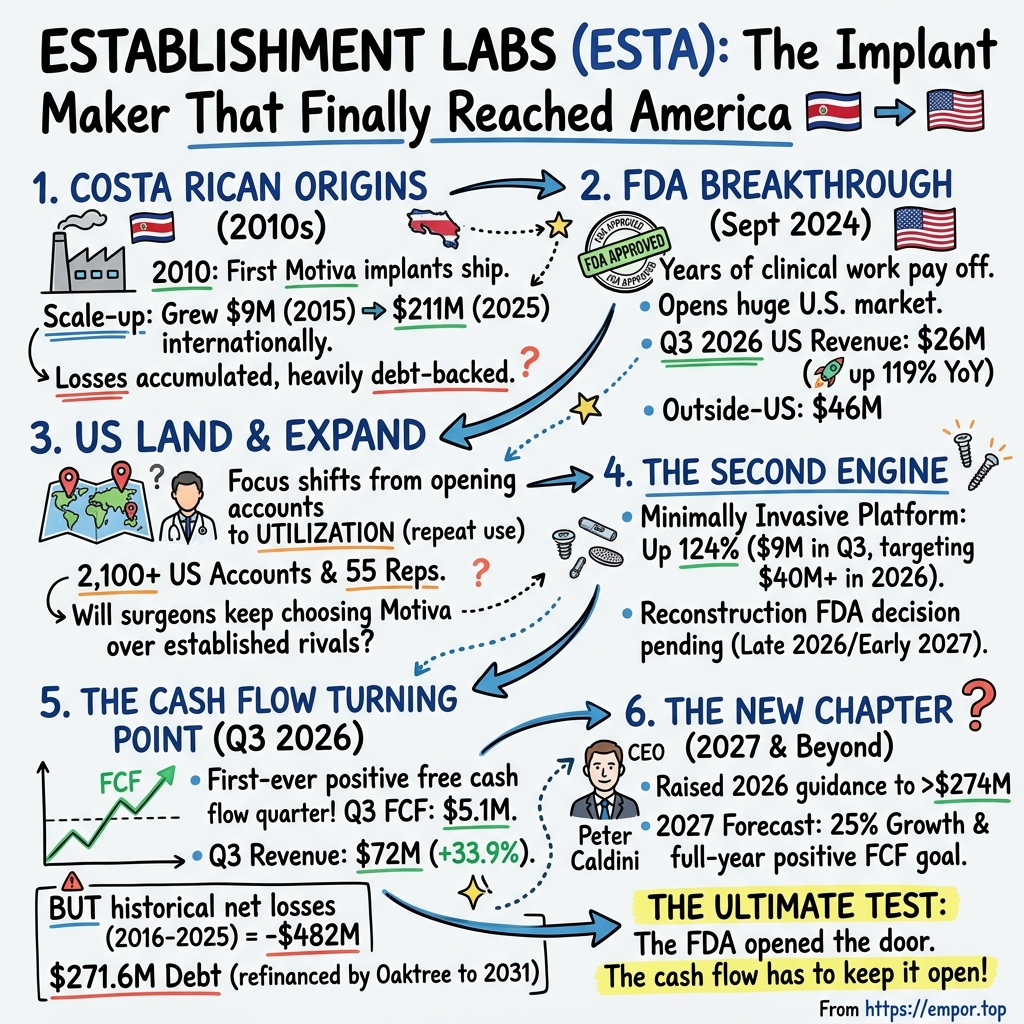
On October 29, 2026, Establishment Labs published its third-quarter results. Buried among the usual tables was a figure the company had never been able to report before. For the three months to September, the business had brought in more cash than it spent, even after paying for new equipment. Free cash flow was $5.1 million.1 In a large-cap medical-device company that would be a rounding error. For a Costa Rican breast-implant maker that had lost money in every year of its public life, management called it a milestone, and the word fits.2
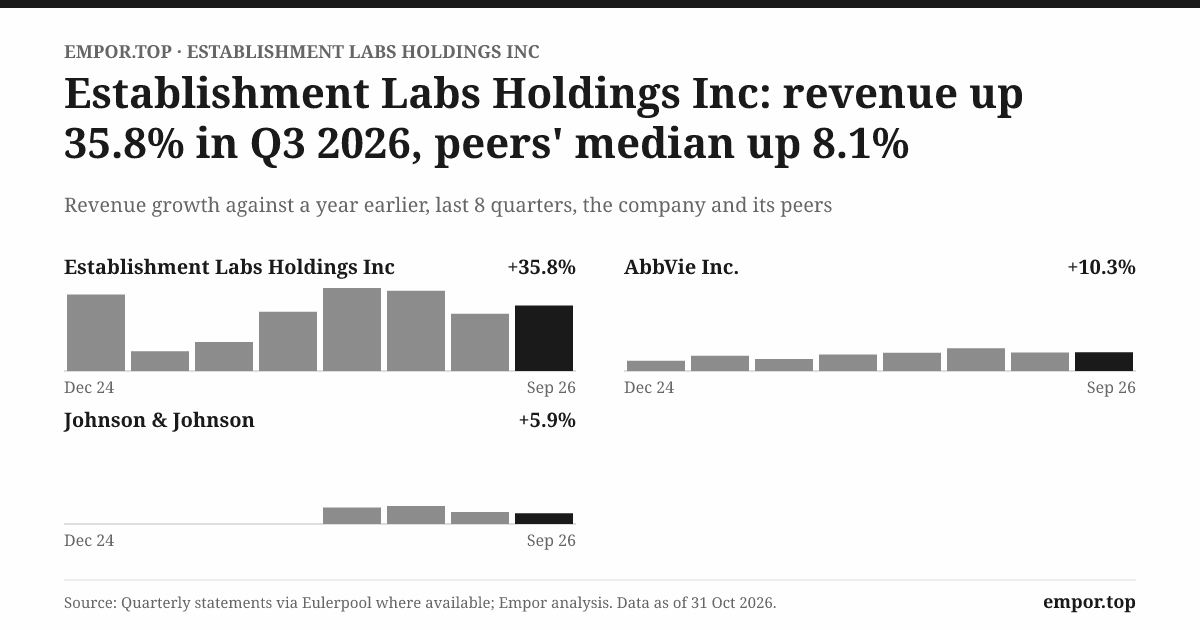
The rest of the quarter explained why the moment felt different. Revenue reached about $72 million, up 33.9% from a year earlier.1 Sales in the United States, a market the company had been allowed to enter only two years before, more than doubled.1 Management lifted its 2026 revenue forecast again, this time to more than $274 million.1 Six months earlier the company had refinanced its debt with Oaktree Capital, pushing its loan maturity out to 2031 and buying what every capital-hungry growth company wants most: time.3
That is the bright version of the story, and it is true. The darker version is also true, and it sits in the same filings. Establishment Labs still reported an operating loss in that very quarter.1 At the end of June it owed about $271.6 million to its lender, against roughly $71 million of cash in the bank.4 For most of the past decade, it funded itself by selling new shares and borrowing, not by earning. The fact that a single positive quarter counts as news tells you how long and expensive the climb has been.
So the question this story has to answer is simple to state and hard to settle. Has Establishment Labs reached an economic turning point, or has it produced one good quarter in a long, capital-hungry climb that is not yet over?
Three tensions run underneath that question, and they will follow the story through every chapter. The first is competitive. Breast implants are an old, concentrated market, dominated in the United States by Allergan Aesthetics, an AbbVie business, and by Mentor, owned by Johnson & Johnson.5 Establishment Labs is trying to take lasting share from those incumbents with a product called Motiva. Approval to sell in America let it into the room. It did not guarantee that surgeons would keep choosing Motiva once the novelty faded.
The second tension is about breadth. Motiva implants made up about 99% of the company's revenue in 2025.5 A newer line of minimally invasive products is growing fast, and a reconstruction indication for Motiva is waiting on a separate decision from the U.S. Food and Drug Administration.2 If those efforts work, the company becomes more than a one-product challenger. If they stall, it remains a single bet on augmentation surgery.
The third tension is the one the October quarter touched directly: cash. A company that makes physical products and sells them through distributors has to build inventory before it can sell it, and it has to wait for customers to pay. Establishment Labs has historically held large stocks of implants and waited a long time to collect.5 Fast growth makes that worse before it makes it better, because every new dollar of sales pulls more cash into the warehouse and the receivables ledger. The race is whether sales growth turns into cash before debt service and working capital consume the runway Oaktree provided.
Before going further, it helps to be precise about what the listed company actually is. Establishment Labs Holdings Inc. is incorporated in the British Virgin Islands and trades on Nasdaq.5 It consolidates a set of wholly owned subsidiaries: the Costa Rican manufacturing operations where Motiva implants are made, and the sales entities in the United States and other countries.5 There is no larger corporate parent whose economics need to be separated out, no private-equity sponsor sitting above the listed shares. What investors own is the factory, the brand and the sales network, plus the debt that funded them.
That clarity matters because the story is not about a subsidiary riding a parent's balance sheet. When Establishment Labs needed money, it went to public markets and private lenders on its own account. When it missed, nobody covered the gap. Every dollar of the decade-long investment showed up in its own books, and every dollar of future payoff will have to come from its own customers.
Think of the company as a long-distance runner who has just crossed a marker on a mountain road. The marker says "first positive cash quarter." It is a real marker, and the runner is moving faster than at any time in years. But the road keeps climbing, the runner is carrying a heavy pack of debt, and the summit, self-funded growth year after year, is still out of sight. To understand whether the runner will get there, the story has to go back to where the climb started: a small factory in Costa Rica, and a bet that a country better known for coffee and rainforests could build an implant to compete with the biggest names in medical devices.
 Subscribe on LinkedIn
II. A Costa Rican Factory Takes on a Global Market
Costa Rica is an unlikely starting point for a global implant brand, and also, on reflection, an obvious one. By the 2000s, multinational device makers had built a cluster of factories around San José, drawn by a free-trade-zone regime, an educated workforce and proximity to the United States. What the country lacked was a homegrown company that designed, owned and sold its own medical device under its own name. Juan José Chacón Quirós set out to build one.
Chacón Quirós founded Establishment Labs in 2004 and spent the next years assembling a product-development and manufacturing team in Costa Rica.6 The bet was audacious in a specific way. Breast implants are a Class III device, the riskiest category regulators recognize, because they are placed inside the body for years and their failures—ruptures, capsular contracture and a rare lymphoma linked to some textured surfaces—carry real consequences for patients.7 Entering that category meant building a factory that could meet European and other regulators' quality standards, financing clinical work, and then persuading surgeons to try an unfamiliar brand on patients who were paying out of their own pockets.
The first Motiva implants shipped in October 2010.5 Costa Rican business press later described the company as a local manufacturer that had made a global product out of a small country, an origin story Establishment Labs leaned on as its brand grew.8 The company's pitch to surgeons centered on design. Motiva implants used a proprietary surface the company called SmoothSilk, engineered to be very smooth at a microscopic level rather than heavily textured, and some versions carried a tiny radio-frequency identification chip so a surgeon or patient could verify the specific device implanted.6 Those features let the company tell a story about safety and traceability at a time when the industry was under scrutiny over textured implants.
The founder's style shaped the company's identity. Chacón Quirós positioned Establishment Labs less as a contract manufacturer and more as a brand-led medical-technology company, building the Motiva name with surgeons and patients rather than selling anonymous product to larger rivals.86 That was the harder road. A Costa Rican factory making implants for someone else's label would have needed far less capital. A Costa Rican company selling its own label had to fund clinical evidence, marketing, regulatory filings in dozens of countries and eventually a U.S. trial. The choice explains both the company's distinctiveness and its appetite for cash.
It is worth pausing on what exactly the company sells, because the economics of everything that follows flow from it. The unit of business is a physical implant. Establishment Labs sells it either to a medical distributor, who resells it in a country where the company has no direct presence, or directly to physicians, hospitals and clinics in markets where it runs its own sales force.5 Revenue is generally recognized when the product ships. When the company places stock on consignment at a clinic, revenue arrives only when the clinic reports that an implant has actually been used.5 Distributor contracts typically carry no rights of return or price protection.5
That structure has two important consequences. First, there is no subscription here. A surgeon who uses Motiva this month is under no contractual obligation to use it next month. Repeat business depends on procedures being booked, on surgeons being satisfied enough to keep reaching for the same brand, and on patients asking for it. Calling it "recurring" would be generous; it is repeat-purchase product revenue, exposed to surgical volumes, consumer confidence and competitive selling.5 Second, the company does not disclose contract lengths, minimum purchase commitments or what share of sales comes from repeat customers.5 An investor can see total sales, but not the loyalty underneath them.
With that model, the company grew by country. It sold through distributors across Latin America, Europe and Asia, and opened direct sales operations in selected large markets, with Brazil becoming an important one.5 It listed on Nasdaq in July 2018, raising money to fund that expansion and its U.S. clinical program.6 The growth that followed was genuinely remarkable for a company of its origins. Revenue went from about $9 million in 2015 to about $211 million in 2025.56 Put as an annual rate, that was roughly 37% a year compounded across a decade, the sort of number most device makers never see.
But a ten-year growth rate is a flattering summary, because it averages a fast early climb with a later stall. The company more than doubled in its early public years, dipped when the pandemic shut operating rooms in 2020, then rebounded hard in 2021 and 2022.95 Then the curve went flat. Revenue barely moved in 2023 and 2024, rising by only a few million dollars across two years.5 Over the three years to 2025, compound growth was under 10% a year.5
Why did it stall? Part of the answer was outside the United States, where the company's distributor-heavy markets proved lumpy. Distributors order in batches, carry inventory and cut back when demand softens or when they are holding too much stock. Part of the answer was that the company had saturated a lot of what it could reach without access to America. And part was self-inflicted pressure: the company was spending heavily to prepare for a U.S. launch it could not yet start. In 2023, research and development consumed about 16% of revenue and capital spending another 15%, as the company built out manufacturing capacity in Costa Rica.5 Property, plant and equipment on the balance sheet roughly quadrupled between 2021 and 2023.5
The losses deepened accordingly. In 2023 the company lost about $78 million; in 2024, about $84 million, on revenue that had stopped growing.5 The stall was not cosmetic. It showed that the international business, built over more than a decade, could not by itself carry the cost structure the company had assembled. The factory and the sales network had been built for a bigger market than the one Motiva was allowed to serve.
That is the right way to read the long record. Establishment Labs built a real export business and its own manufacturing base, which is more than most challengers in Class III devices ever manage. It also built an expense base that outran its commercial reach, and it funded the gap from outside. The founding team's technical milestones—a European-standard factory, a differentiated surface, a global distributor network—made sales possible. They did not prove that demand would grow on its own once the easy markets were covered.
The company itself seemed to know where the answer lay. America was the largest single market for breast augmentation, and the one market where the brand had been absent. Every year of flat international sales made the U.S. approval more important. So the company waited, spent and waited some more, for a regulator in Silver Spring, Maryland, to decide whether Motiva could cross the border.
III. The FDA Approval That Changed the Addressable Market
The U.S. clinical trial for Motiva began in 2018.7 By the standards of medical devices, that is not unusual; by the standards of a company burning cash every quarter, six years is an eternity. The trial had to follow women who received the implants over time, measuring complications such as rupture, capsular contracture and reoperation, because breast implants are judged on how they perform years after surgery, not on the day they go in.7
In September 2024, the FDA approved Motiva implants for breast augmentation.710 The agency's summary of safety and effectiveness data laid out what it had reviewed: clinical outcomes from the U.S. study, device testing and manufacturing information.7 Approved implants in America come with boxed warnings and patient decision checklists, a reminder that this is a category regulators treat with unusual caution.11 Trade press greeted the decision as the first new breast-implant approval in the U.S. in many years, which said as much about how hard the category is to enter as about Motiva itself.10
Two years later, the scale of what that approval unlocked was visible in the quarterly numbers. In the third quarter of 2026, U.S. revenue rose 119% from a year earlier, to about $26 million.1 Revenue outside the United States grew 9.7%, to about $46 million.1 In other words, the domestic business that did not exist before late 2024 was already more than a third of the company's sales, and it was growing more than ten times as fast as everything else.
That is the consensus version of the story: FDA approval as the moment Establishment Labs became a real company. It is mostly right. Approval was a genuine inflection point. It opened the largest national market in the company's sales mix, and the 2025 revenue jump of about 27%, after two flat years, coincided with the launch.5 Without it, the business would still be stuck where it was in 2023.
But a more careful reading separates two claims that tend to get blurred together. The first is that approval let Motiva compete in a larger market. The second is that approval created a durable competitive advantage. The record supports the first claim fully. It does not yet support the second.
Consider what the FDA actually decided. Approval means Motiva met the agency's standard of reasonable assurance of safety and effectiveness for its indication.7 It does not mean the FDA found Motiva superior to competing implants, and the agency did not run a head-to-head comparison. Approval is a license to compete, the way a driver's license is a license to drive. It says nothing about whether you will win the race.
And the field Motiva entered was not empty. Establishment Labs describes the U.S. market as concentrated around Allergan Aesthetics and Mentor, with Sientra as the third established player.5 Internationally, it competes with GC Aesthetics, Silimed, Sebbin, Polytech and others.5 The company says plainly that many competitors have greater resources, larger market share and longer relationships with providers.5 Neither Establishment Labs nor its large rivals disclose implant-only market shares in their filings, so nobody outside these companies can say with precision how much share Motiva has taken.
The competitive landscape did shift in ways that helped. Sientra, the smallest of the incumbent U.S. brands, filed for Chapter 11 in February 2024 and pursued a sale of its business.12 A weakened third player arguably made it easier for a newcomer to win surgeons who were open to switching. But it would be a stretch to call that a structural advantage; it was a gap in the field, and the two giants remained.
So where could a lasting edge come from? There are four candidates, and each deserves to be tested rather than assumed. The first is product design: the SmoothSilk surface and the company's argument that its implants deliver favorable safety outcomes. The second is clinical evidence, the long-term data generated through the U.S. trial and international experience. The third is brand, particularly with patients who research implants and ask for a specific name. The fourth is a direct commercial presence, a sales force calling on plastic surgeons rather than relying on distributors.
Each of those is plausible. None is proven in the way that would matter to a long-term investor. Proof would look like data showing surgeons who adopt Motiva keep using it, that the company can hold or raise prices as volumes grow, and that its share rises steadily against the incumbents. Establishment Labs does not disclose cohort retention, repeat-order rates by account, price realization or a market-share series.52 Without those, the advantage remains an argument, backed by rapid early growth that could also be explained by the simple novelty of a new brand entering a market that had not seen one in years.
There is also a legal question hanging over one of the asserted differentiators. In October 2025, Establishment Labs filed a patent infringement action against GC Aesthetics in Europe's Unified Patent Court, centered on implant-surface technology.4 GC Aesthetics counterclaimed, and also brought a revocation action in England challenging the patents.4 The June 2026 quarterly filing did not quantify any potential loss.4 For a company that emphasizes its surface as a point of difference, a dispute over whether that surface is protectable matters. A win would reinforce the story; a loss would not stop Motiva being sold, but it would weaken the claim that its design is uniquely the company's own.
Weighing it all, the history narrows the moat claim rather than rejecting it. The evidence supports a smaller, more defensible version: Motiva is a credible, approved alternative that surgeons are willing to try, and it is winning business quickly from a standing start. Whether that becomes a lasting position depends on a measurable question the company has not yet answered with disclosure: once surgeons try Motiva, do they keep using it at rising volumes?
That is the new test. After years of asking a regulator for permission to enter, Establishment Labs now has to ask thousands of surgeons, one operating schedule at a time, to choose it again.
IV. From Placing Accounts to Filling the Schedule
Every new device launch has two phases, and they feel very different from the inside. In the first, a sales force fans out to open doors. Reps visit practices, train surgeons, get a product onto the shelf and onto the approved list. The scoreboard is the number of accounts opened. In the second phase, the doors are open and the job becomes harder and quieter: getting each account to use the product more often, on more patients, by more surgeons in the same practice. The scoreboard becomes utilization.
On the third-quarter call in late October 2026, Establishment Labs told investors it was moving from the first phase to the second. Management said the company had more than 2,100 U.S. accounts and about 55 sales representatives, and that its focus was shifting from adding accounts to increasing utilization within the base it had already built.2 It was a sensible message for a launch entering its third year. It was also an admission that the easy part was ending.
Analysts pressed on exactly that point. If 2,100 accounts were already open, what would it take to get more out of them, and how much would it cost? Management's answer had three parts.2 The first was a larger sales force, because a rep covering too many practices cannot give each one enough attention to change habits. The second was targeted support for specific accounts, concentrating effort on practices with the most potential volume. The third was time. Surgeons, management said, need to build experience with a new implant before they make it a default, and that confidence accumulates case by case.
It is worth dwelling on that third point because it is both true and convenient. It is true because surgical habits are sticky. A plastic surgeon who has placed hundreds of Allergan or Mentor implants knows exactly how those devices feel, how they sit and what complications to expect. Switching brands for a patient who is paying thousands of dollars out of pocket is a reputational risk, and many surgeons will start with a few cases before committing. It is convenient because "it takes time" is an explanation that cannot easily be checked from the outside. The company described utilization as improving, but it did not disclose a time series of orders per account, the share of accounts reordering, or retention by cohort.2 Investors are being asked to take the trend on management's word, supported by aggregate revenue growth.
The aggregate growth is strong. U.S. revenue more than doubled in the third quarter, to about $26 million.1 Divide that across 2,100 accounts and the average account generated roughly $12,000 of Motiva sales in the quarter. That is a crude calculation, because accounts differ enormously and some were opened only recently, but it shows the scale of the opportunity management is describing: if the average account could be moved meaningfully higher, U.S. sales would rise without opening a single new door. It also shows the risk. An installed base full of accounts that tried Motiva once and went back to their old supplier would look exactly like this in the early numbers.
So the account count is a useful foothold, not proof of a protected customer relationship. It tells us surgeons were willing to try. It does not tell us how many kept trying.
The geographic split deserves its own moment, because it is easy to let the U.S. story crowd out the rest of the business. Outside the United States, sales grew about 10% in the third quarter, to about $46 million.1 That is still the larger share of revenue, and it includes direct markets and a wide web of distributors. The U.S. is the increasingly important driver, but the international business is not a footnote. Its slower growth sets the floor under the company's overall growth rate; if it stalls again, as it did in 2023 and 2024, U.S. gains will have to work harder to keep the total rising.
The distributor channel also explains a subtle point about the quality of growth. In the third quarter, distributors bought more than the company had expected. That added revenue and gross-profit dollars, but it lowered the reported gross-margin percentage relative to management's assumptions, because distributors pay less per implant than end customers do in direct markets.2 The distributor captures part of the margin in return for handling local sales and logistics.
Here is an everyday way to think about it. A bakery that sells a loaf directly to a customer for $5 keeps more per loaf than when it sells the same loaf to a grocery chain for $3.50. If the grocery chain suddenly orders double, the bakery takes in more money overall, but its average profit per loaf falls. Neither outcome is bad on its own. But an investor who sees revenue jump has to ask which kind of loaf drove it.
Management also said it was working with distributors to align their orders more closely with real end-market demand.2 That matters because distributor ordering has historically been lumpy, and a quarter in which distributors stock up can be followed by a quarter in which they draw down. Stronger-than-expected distributor buying in one quarter is therefore a mixed signal: good for the period, but not necessarily a sign of what patients are choosing.
Put the pieces together and the forward test becomes clear. Account count is no longer the right scoreboard. The questions that matter are whether U.S. revenue keeps growing as account additions slow, whether the company provides evidence that utilization inside existing accounts is rising, whether gross margin holds as the mix between direct and distributor sales shifts, and whether international distributors order in line with demand rather than in bursts. If U.S. growth continues at a high rate while account additions taper, that is real evidence that surgeons are adopting Motiva, not just sampling it. If growth slows sharply once the door-opening phase ends, the account base will turn out to have been wider than it was deep.
Implants are not the only product those reps carry into operating rooms, though. A second line, sold to many of the same surgeons, was growing even faster, and it raised the question of whether Establishment Labs could become something more than a one-product challenger.
V. The Second Product Starts to Matter
For most of its history, Motiva implants were essentially the whole business.5 A company with that much concentration is fragile in obvious ways. One adverse safety signal, one lost patent fight, one aggressive price war by a larger competitor, and there is no second business to absorb the blow.
By the third quarter of 2026, that picture had begun to change. Revenue from the company's minimally invasive products grew 124% from a year earlier, to about $9 million in the quarter.12 Year to date, the line accounted for roughly 15% of company revenue, and management said it expected more than $40 million of minimally invasive sales for the full year.2 Meanwhile, the company is waiting on the FDA to decide on a separate application to use Motiva implants in breast reconstruction, with management expecting a decision around the end of 2026 or in the first quarter of 2027.2
Those two developments are often discussed in the same breath, as "the pipeline." They should not be. One is a business with real current sales. The other is a regulatory decision that has not yet happened. Keeping that hierarchy clear is the most important discipline in assessing this chapter.
Start with what minimally invasive means here. Traditional augmentation surgery uses larger incisions and general anesthesia, and recovery can take weeks. The company's minimally invasive approach is designed around smaller implants and a less invasive procedure, aimed at patients who want a more modest change with a quicker recovery.5 In plain terms, it targets people who might never have considered conventional augmentation at all, which is why it could expand the market rather than simply carving up existing procedures.
Why could it matter commercially? Three reasons stood out in the company's own reporting. The line grew far faster than the company as a whole. It entered more U.S. accounts, meaning the same sales force that sells Motiva can carry it into practices it has already opened. And its product range expanded: the third-quarter release reported additional smaller implant sizes approved and larger minimally invasive sizes announced.1 A wider range of sizes lets surgeons offer the procedure to more patients, which is the kind of operational detail that tends to matter more than a press release headline.
Even so, approval is not adoption, and adoption is not profit. A new size approved is a permission. A surgeon trained on the procedure is a capability. Neither is recurring revenue. What would prove the minimally invasive platform is a second engine is sustained sales growth over several years, evidence that practices keep performing the procedure after their first cases, a gross margin at least comparable to the core implant business, and a visible contribution to operating profit. The company reports revenue for the line, but not its margin or profitability separately, so the last two tests cannot yet be applied from the outside.1
Reconstruction is a different kind of opportunity and deserves measured weight. Breast reconstruction, usually after mastectomy for cancer, happens in hospitals, often involves insurers and follows a different purchasing path from elective augmentation. On the third-quarter call, management said the FDA review was progressing, but cautioned that hospital value-analysis processes, the committees that decide which devices a hospital will stock, take longer than adoption in cosmetic practices.2 Management's 2027 growth outlook included portfolio opportunities, but it described reconstruction as a longer-term growth driver rather than a near-term contributor.2 That is an honest framing, and it is worth taking at face value. Reconstruction is optionality, not current revenue.
The company's own history offers a useful guide to how much weight to give such optionality. Consider Motiva Flora, a tissue expander used in reconstruction to stretch skin before a permanent implant is placed. It received U.S. clearance for tissue expansion in 2023, and by the third quarter of 2026 it was in more than 350 facilities.2 That is a real technical and regulatory accomplishment. Yet three years after clearance, the company does not disclose material revenue from it.51 Flora is a reminder that this company has converted a technical milestone into a meaningful new profit pool slowly, if at all. Access is the beginning of a commercial story, not its proof.
That record doesn't reject the reconstruction thesis. It narrows it. The realistic version is that an approval would give the company a second indication for its core implant and a path into hospitals, but that path will take time to translate into reported revenue, and Flora's experience suggests the timeline should be measured in years, not quarters.
So each line comes with its own test. For minimally invasive products, the test is happening now: does the company hit its more-than-$40-million 2026 expectation, and does the line keep growing at a high rate in 2027 as it laps easier comparisons? For reconstruction, the tests come in sequence: FDA approval, then hospital launches, then disclosed revenue. Investors should not collapse them into one.
All of which leads to an uncomfortable truth about growth businesses that make physical products. New lines, new indications and new accounts all demand inventory, sales reps and support before they produce cash. The faster Establishment Labs grows, the more money it ties up in the process. Whether that equation has finally tipped is the subject of the next chapter.
VI. The Sales Curve Meets the Cash Cycle
In its third-quarter release, Establishment Labs described its first positive free-cash-flow quarter as a milestone.1 Operating cash flow was about $7.7 million and free cash flow, after capital spending, about $5.1 million.1 To appreciate why that mattered, it helps to look backward over a full decade of the company's finances, because the history explains both the excitement and the caution.
Over the ten years from 2016 through 2025, Establishment Labs reported cumulative net losses of about $482 million.59 Cash used in operations over the same span was about $395 million.59 At first glance that looks like good news: the cash burn was smaller than the accounting loss. But the gap does not reflect a business quietly generating cash its income statement failed to show. It reflects non-cash charges.
A simple way to picture the difference is to think about a family's budget. If a family "spends" $1,000 a month on a car, but $300 of that is depreciation, the car slowly losing value, then only $700 actually leaves the bank account each month. The car's cost is real, but not all of it is cash out the door this month. Establishment Labs has several such items. Stock-based compensation pays employees in shares rather than cash, so it reduces reported profit without draining the bank. Depreciation spreads the cost of factory equipment over years. Debt-discount accretion, foreign-exchange remeasurement and various provisions also move profit without moving cash.5
In 2025, for example, the company lost about $51 million and used about $51 million of cash in operations, roughly the same figure.5 Underneath, the non-cash items helped: share-based compensation of about $11 million, depreciation and amortization of about $10 million, and increases in credit-loss and inventory-obsolescence provisions of several million more.5 But those benefits were almost entirely consumed by working capital, which absorbed about $13 million as receivables and inventory grew.5 The pattern is classic for a growing product company: the more you sell, the more cash you lock up before you see it again.
The full ten-year picture is starker when capital spending is included. Free cash flow, operating cash flow minus investment in plant and equipment, was negative by about $512 million over the decade.59 The company paid no dividends and did not buy back shares. There is no hidden return of capital in this record. The story is investment and operating burn, funded from outside: by equity offerings, by lenders and, at the very start, by private investors.
Two balance-sheet lines explain where much of that cash sits today, and they deserve attention because they will decide whether the October quarter becomes a trend.
The first is receivables. At the end of 2025, customers owed the company about $77.5 million, up from about $65 million a year earlier.5 That is a large figure for a business with roughly $211 million in annual sales. Expressed as days, customers took about 134 days on average to pay, down from a peak of about 143 days in 2024 but nearly twice the roughly 71 days of 2021.5 The company's allowance for credit losses, its estimate of receivables it may never collect, more than doubled during 2025, from about $3.1 million to about $6.8 million.5 Actual write-offs were small, about $0.4 million, which suggests the increase was a forward-looking judgment rather than a wave of defaults.5 And one customer accounted for about 14% of receivables at year-end, down from 17% a year before.5
Why does this matter? Because a sale only becomes cash when the customer pays. Long collection periods and a rising reserve for bad debts mean some of the company's reported revenue is, in effect, a loan to its customers, many of them distributors in markets with volatile currencies. The company does not publish a receivables aging table or name overdue customers.5 An investor can see the size of the receivables and the reserve, but not the quality underneath.
The second line is inventory. At the end of 2025, the company held about 482 days of inventory measured against its cost of goods sold.5 Put another way, the implants sitting in its warehouses, at distributors on consignment and in the pipeline represented well over a year's worth of production cost. Some of that is structural: an implant maker must stock many sizes, shapes and profiles so that a surgeon can choose the right device for each patient, and consignment stock sits in clinics before it is used. Some of it reflects the U.S. launch, which required building inventory ahead of demand. Combine slow collections, heavy inventory and the time the company takes to pay its own suppliers, and the cash conversion cycle came to about 374 days in 2025.5 Roughly speaking, money spent producing an implant took more than a year to come back as cash.
That number is the single best explanation for why a company growing at 30% can still struggle to generate cash. Every additional dollar of sales requires the company to fund another long cycle of inventory and receivables. Faster growth makes the problem bigger until the business either collects faster, carries less stock relative to sales, or earns enough margin to cover the extra working capital.
Currency adds another layer of noise between the income statement and the bank account. The company sells mainly in U.S. dollars, Brazilian reais and euros, and it does not hedge.5 In 2023 foreign-exchange remeasurement produced a gain of about $1.8 million; in 2024, a loss of about $8.8 million; in 2025, a gain of about $6.4 million.5 Those swings are large relative to the company's pre-tax losses, which ran between roughly $58 million and $85 million over the same three years.5 Other income, the line where they land, moved from an expense of about $13.8 million in 2024 to income of about $6.2 million in 2025, helped also by the absence of a one-off contract-termination charge.5 The lesson for anyone reading the bottom line is to look through it. A good year for the real and the euro can make the loss look smaller without a single extra implant being sold, and a bad one can do the reverse. The operating line, and ultimately cash, is the cleaner signal of progress.
Now reconcile that history with the October quarter. The company produced positive operating and free cash flow, yet still reported a GAAP operating loss of about $2.6 million.1 How can both be true? Because the same non-cash items that softened the burn in prior years were still at work, and because working capital likely moved favorably in the period, whether through collections, inventory discipline or the timing of payments. A quarter's cash flow can be helped by a good month of collections or a delay in paying suppliers; it is the most timing-sensitive number in the financial statements. That is why one quarter, however welcome, does not establish that the business funds itself.
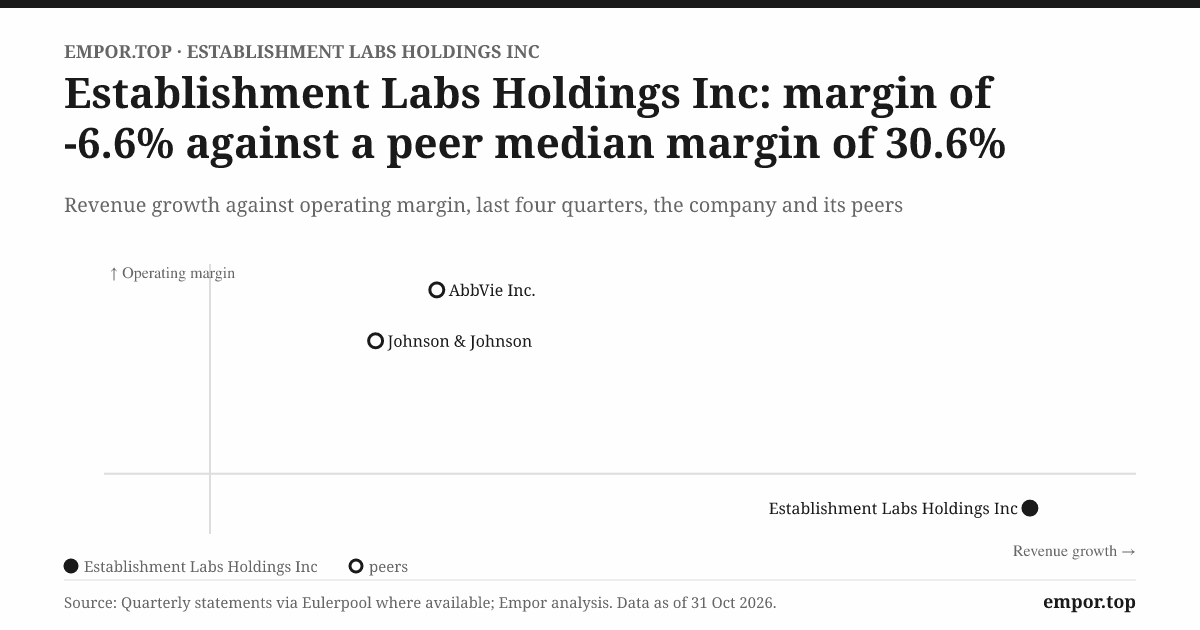
The company's own trajectory does point in the right direction. Operating losses narrowed from about $50 million in 2024 to about $39 million in 2025, and over the four quarters to September 2026 they shrank to about $17 million.51 Operating margin moved from deeply negative toward breakeven. Those are real improvements driven by revenue growth outpacing expenses. But a narrowing loss is not yet a profit, and the cash cycle means profits, when they come, will initially be absorbed by working capital.
What would settle the question? Full-year evidence. The decisive numbers will be operating cash flow and free cash flow for a whole year, reconciled with movements in receivables, inventory and credit-loss allowances, and measured after interest is paid in cash. Management has said it expects positive free cash flow for the full year 2027.2 If the company delivers that while continuing to grow, the October quarter will look like the first step of a new phase. If cash flow turns negative again as growth pulls more working capital, it will look like a well-timed quarter.
And that last phrase, after interest is paid in cash, points to the other half of the company's financial story. Because for now, Establishment Labs has not been paying its lender in cash at all.
VII. Oaktree Buys Time; Cash Must Buy Independence
At the end of April 2026, Establishment Labs announced that it had refinanced its credit facility with Oaktree Capital.3 On paper it was a routine piece of corporate finance. In practice it was the moment the company's runway was reset. The previous loan was due in April 2027, less than a year away, at a time when the company was still losing money.5 A company with a maturity that close is negotiating from weakness: lenders know it must refinance, and shareholders know a failure to do so could force a dilutive equity raise at a bad price. The new facility pushed final maturity out to April 2031.34
To understand why that mattered, and what it cost, it helps to think of Oaktree not as a bank but as a specialist lender to companies that banks won't touch. Oaktree is known for credit investing in situations where the borrower has real assets and real growth but not yet the cash flow that conventional lenders demand. It lends at higher rates, takes strong security and writes protections into the contract. For a borrower, that kind of money is expensive and reliable at the same time.
The new facility totaled $300 million. The company drew $265 million at closing, and another $35 million remained available subject to conditions.3 By the end of June, the amount outstanding had already grown to about $271.6 million, because accrued interest and an exit fee were being added to the principal.4 Against that, the company held about $71.2 million of cash.4 The lender holds a first-priority lien over substantially all of the company's assets.4 In plain language, if things went badly, Oaktree would be first in line for the factory, the inventory, the receivables and the intellectual property.
The cost of the money is the second part of the story. The stated rate was 8.75% fixed, subject to conditions, and the effective interest rate, which includes fees and the accretion of discounts, was about 9.7%.34 That is lower than the roughly 10.9% effective rate on the old facility, which is a modest improvement.5 But the more important feature is how the interest is paid. Through June 2026, the company elected to pay all of its interest "in kind," meaning instead of handing Oaktree cash, it added the interest to the loan balance, at the price of a half-point step-up in the rate.4
Payment-in-kind interest works like a credit card where you choose not to pay the monthly interest and let it roll onto the balance. It keeps cash in your pocket today. It also means the balance grows every month, and next month's interest is calculated on a larger number. For a company trying to reach cash-flow breakeven, PIK interest is a sensible bridge: it avoids draining cash precisely when the business needs it for inventory and sales reps. But it is a bridge with a toll. The longer the company relies on it, the bigger the debt it will eventually have to service or refinance.
That is also why the first positive free-cash-flow quarter needs to be read carefully. Free cash flow in the third quarter benefited from not paying interest in cash, to the extent the PIK election continued.41 A business that is free-cash-flow positive before cash interest has crossed one line; a business that is positive after cash interest has crossed a more important one. The October quarter showed the first. The second remains ahead.
The refinancing sits inside a longer pattern of external funding. Establishment Labs has repeatedly turned to the equity markets. In 2023 it issued about 1.3 million shares for net proceeds of about $84.5 million; in 2024, about 1.9 million shares for about $99.5 million.5 It also completed a registered direct offering in November 2024 that included common shares and pre-funded warrants, with additional shares and warrants issued in August 2025.5 The share count kept rising into 2026, from about 29.3 million at the end of 2025 to about 29.8 million in June 2026, partly through option exercises.413 Shareholders' equity on the balance sheet was only about $23.5 million at the end of 2025, after years of losses ate through the capital raised.5
It is fair to frame how that capital was deployed. This is not an acquisition story. Establishment Labs did not buy competitors or bolt on unrelated businesses. The money went into manufacturing capacity in Costa Rica, clinical trials, product development and building a commercial organization in the United States and other markets.5 Whether those investments earn a return is the open question, but the record does not show capital being sprayed across unrelated adventures. The hard part has been that the investment took years to produce revenue, and the losses had to be funded in the meantime.
Management describes the refinancing as giving the company financial flexibility.3 That claim deserves a test against the balance sheet. The extension is real: there is no maturity wall until 2031, which removes the most immediate risk. But the $35 million of undrawn capacity is not cash in the bank; it is a conditional promise from the lender. Debt of more than $270 million is large relative to cash of about $71 million, and relative to equity of about $24 million at the end of 2025.45 A company with that balance sheet has flexibility only as long as its operations keep improving. If growth slowed or cash flow turned negative again, the options would narrow quickly: draw the remaining capacity, sell more shares, or renegotiate.
One more piece of the company's economics depends on a government rather than a lender. Establishment Labs' Costa Rican operations benefit from a tax holiday that runs through December 2030, subject to continued compliance.5 The company estimates the arrangement reduced its tax expense by about $7.5 million in 2025 and about $18.4 million in 2024.5 While the business is loss-making, the benefit is modest in cash terms. It becomes more valuable precisely when the company starts to earn money, and its expiry date falls a few months before the Oaktree loan matures. A company that reaches sustained profitability before 2030 would capture the holiday's full benefit; one that gets there later would find its first profitable years taxed more heavily than today's guidance implies.
There is no public credit rating to offer a second opinion on any of this. The company has relied on privately negotiated Oaktree credit rather than rated bonds, so no agency has published a view on its creditworthiness.54 The closest thing to an independent judgment is the lender's own willingness to extend for five years at a fixed rate below the old facility's effective cost, which suggests Oaktree saw improving prospects. But a lender secured on substantially all of the company's assets can afford to be generous on maturity, because it is well protected if things go wrong.
An activist-minded skeptic would put the point bluntly. The company has borrowed at roughly 10% to fund a business that has never produced a full year of positive free cash flow, and it is letting the interest compound. That is rational only if the business will soon generate enough cash to service the debt comfortably. A believer would answer that this is exactly what the third quarter began to show, and that the long maturity gives the company four-plus years to prove it. Both sides are describing the same contract. The difference is a forecast.
The test that matters, then, is concrete. Establishment Labs needs sustained positive free cash flow after cash interest, without relying on another round of dilution or more borrowing. Oaktree has bought the company time. Only cash can buy it independence. And the person responsible for turning one into the other was a chief executive who had held the job for less than two years.
VIII. The New CEO Inherits the Proof Problem
When a founder steps back, a company's story usually changes tone. Founders sell visions; professional managers sell plans. Establishment Labs went through that transition in 2025. In March, Peter Caldini became interim chief executive, and in May he was named CEO.13 Juan José Chacón Quirós, who had founded the company two decades earlier and led it through the Motiva launch, the Nasdaq listing and the FDA process, retired from the role and remained a director until the 2026 annual meeting.13 The finance chief changed too: in March 2026, Sandra Harris succeeded Raj Denhoy as chief financial officer.13
Caldini was not an outsider parachuted in. He had been part of the company before taking the top job, with reported compensation of about $1.23 million in 2024.13 His mandate was different from his predecessor's. Chacón Quirós had built the product, the factory and the approval. Caldini inherited the commercial launch and the balance sheet, and with them the proof problem: turning a long product-development story into reported growth, margins and cash.
On the third-quarter call, he had good news to deliver. Management again raised its 2026 revenue guidance and offered an outlook of about 25% revenue growth in 2027.12 Analysts asked what was built into that 2027 figure. Management's answer pointed to continued Motiva growth, the minimally invasive business, rising U.S. utilization and broader portfolio opportunities, while treating reconstruction as a longer-term contributor.2 Management also repeated its expectation of positive free cash flow for the full year 2027.2
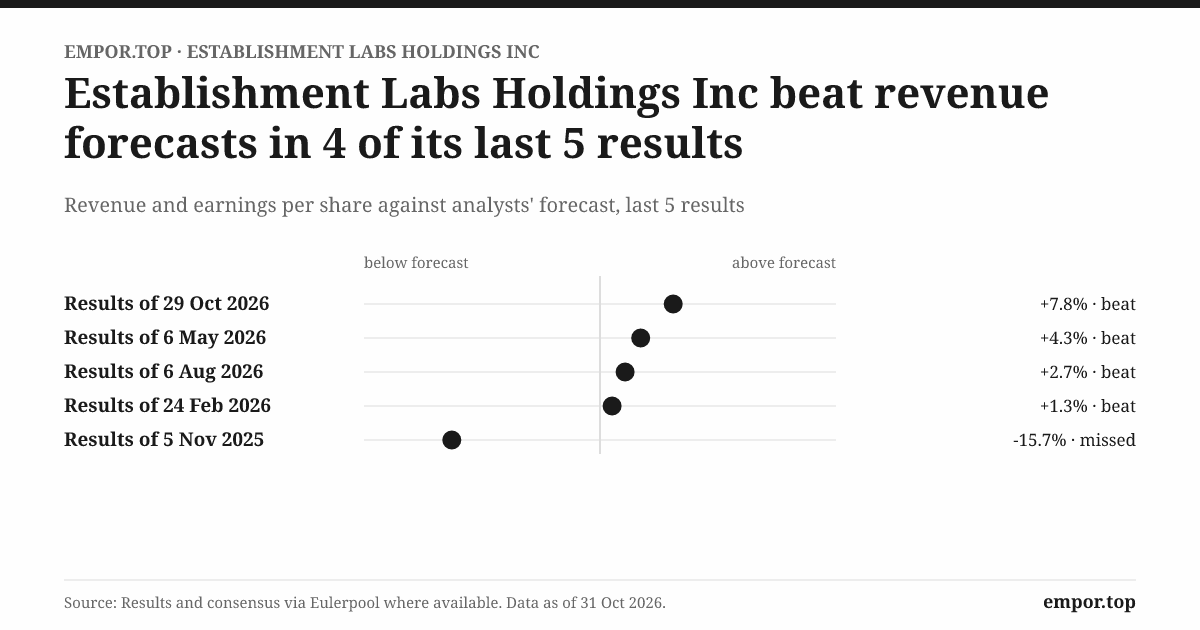
The best way to judge a management team is not by its targets but by what happens to them. Here the 2026 record is encouraging. Earlier in the year, at the first-quarter results, the company had pointed toward free cash flow turning positive in the second half of 2026.14 The third quarter delivered the first positive quarter, on schedule. Revenue guidance was raised more than once during the year, as quarterly results came in above earlier expectations.14151 That is the pattern of a team setting targets it can beat rather than targets it has to explain away.
There are limits to how much that proves. Guidance raised during a launch year, while the U.S. business is growing from a small base, is a lower bar than guidance kept through a slowdown. The 2027 forecast of 25% growth and full-year positive free cash flow remains a forecast, and the company's history includes the flat years of 2023 and 2024, when the growth story stalled. Management has shown it can call the quarter. It has not yet had to manage through a year where the market turned against it.
The same distinction applies to the substance of management's answers. On some questions, they were specific. On sales-force investment, they described adding reps and targeting accounts.2 On gross margin, they explained how distributor mix had moved the percentage.2 Those are concrete, checkable explanations. On utilization, the language was more general: improving, building, gaining experience.2 That is not evasive, but it is not yet evidence either, and investors should weigh it accordingly.
Then there is the question of incentives. Caldini's total compensation for 2025 was about $2.88 million, much of it in equity awards that vest over four years.13 That structure ties a meaningful part of his pay to the share price over a period long enough to cover the 2027 targets. The former CEO received about $1.65 million in 2025, including about $1.44 million in other compensation associated with the transition.13 For context, the company lost about $51 million that year.5 Executive pay at that level is not out of line for a Nasdaq-listed device company of this size, but it is worth noting that the pay was earned in a year of continued losses.
Ownership adds another layer. As of March 2026, directors and executive officers as a group beneficially owned about 9.99% of the company.13 That figure is for the whole group, not the CEO alone, and much of it sits with the former CEO, who held about 4.8%, and director Nicholas Lewin, at about 3.9%.13 The largest outside holders were JW Partners at about 10.4%, RTW Investments at about 9.6%, the Qatar Investment Authority at about 8.1% and Brown Advisory at about 6.9%.13 No single holder controls the company. The register is dominated by specialist and long-horizon investors, which tends to give management patience, but also means a small number of holders could move the share price sharply if they lost faith.
Shareholders were broadly supportive at the May 2026 annual meeting. Say-on-pay passed with about 20 million votes for and only about 31,000 against.16 Dissent on individual directors was higher, with roughly 1.7 million votes against Leslie Gillin and about 2.7 million against Lewin, not enough to threaten either but enough to register.16 Four of six director nominees were deemed independent; the CEO and the chair were not.13
The transition carries a continuing cost. The former CEO's consulting agreement pays $750,000 a year plus an annual equity award with a target value of another $750,000, and it can renew through May 2028.5 For a company working to reach breakeven, $1.5 million a year in consulting value is not trivial, though it is small next to revenue approaching $300 million.
There is also a related-party thread that deserves proportion rather than drama. The company sells to Herramientas Medicas, a distributor owned by a family member of the former CEO; sales were about $1.2 million in 2025, roughly 0.6% of revenue, with about $0.4 million still receivable at year-end.5 It also paid the former CEO's brother about $0.1 million in 2025 for physician training services, down from about $0.4 million in 2023.5 The audit committee reviews such transactions and assesses whether the terms are no less favorable than with unrelated parties.13 These amounts are too small to move the investment case. They are worth monitoring because the relationships persist after the founder's departure from the CEO role.
So is current management converting a long development story into disciplined execution? The 2026 record supports a qualified yes for the near term: guidance was repeatedly raised as quarterly results came in above earlier expectations, and the cash-flow milestone arrived roughly when promised. The longer-term credibility test is whether the 2027 outlook, 25% growth and a full year of positive free cash flow, becomes reported results. Compensation and ownership structures do not settle that. Results will. And the market, as of the end of October 2026, was pricing those results with a mix of hope and visible doubt.
IX. Analysis & Bear vs. Bull Case
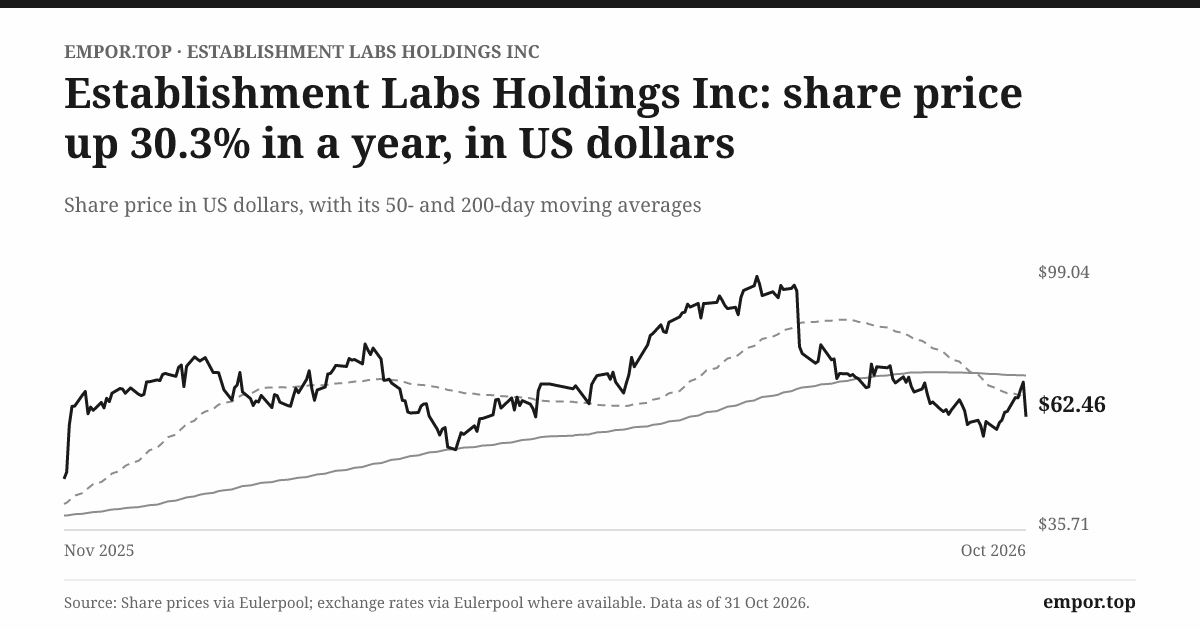
On October 31, 2026, Establishment Labs shares closed at about $62.46.17 That was about 35% below their 52-week high of roughly $95.65, and well above the low of about $47.80. The stock had fallen as much as 74% from a peak at one point in the past five years. In other words, investors who held it have lived through extreme swings, and the current price reflects a market that has already been both euphoric and despairing about this company within a short span.
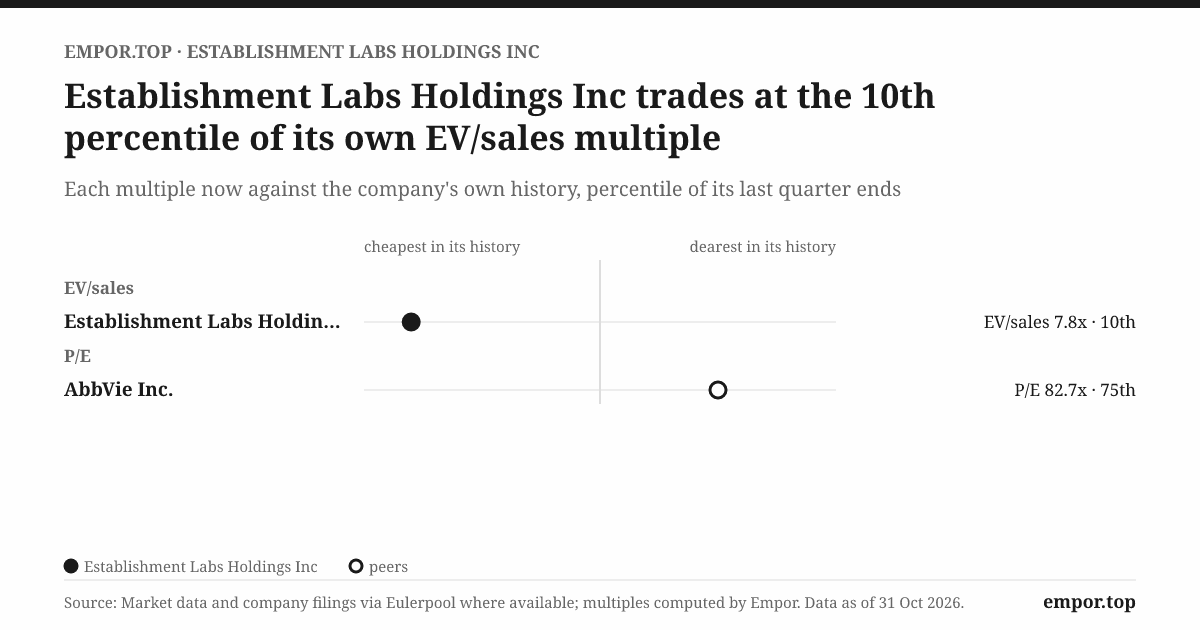
At that price, the company was worth about $2.1 billion in the market, and about $2.2 billion including debt net of cash. That is roughly 7.8 times the last twelve months of sales. The price-to-book ratio was about 122 times, but that figure says more about the tiny equity base, around $0.47 of book value per share, than about valuation; years of losses have shrunk book equity to almost nothing. With last-twelve-month earnings per share of about negative $1.27, a price-to-earnings ratio is meaningless.1517 There is no five-year median multiple or reliable peer comparison that would anchor the valuation cleanly, because the large implant makers sit inside diversified conglomerates such as AbbVie and Johnson & Johnson, whose multiples reflect pharmaceuticals and many other businesses.
So what is the market paying for? At nearly eight times sales for a company that is not yet profitable, it is paying for a future in which U.S. growth continues for years, margins expand substantially as the company scales, and cash generation becomes reliable. The valuation leaves little room for growth to disappoint. To judge whether that future is plausible, it helps to step back and look at the industry's structure.
The structure of the fight
Begin with Michael Porter's five forces. The threat of new entrants is low, and that is one of the few structural facts working in Establishment Labs' favor now that it is inside the U.S. market. Breast implants are Class III devices, and the U.S. trial that led to approval began in 2018 and ended with approval only in 2024.7 Few companies will spend six years and hundreds of millions of dollars to follow. The barrier that kept Motiva out for so long now helps protect it, along with the incumbents.
Buyer power is moderate. No single customer accounted for 10% or more of revenue in 2023, 2024 or 2025, so the company is not dependent on any one hospital system or distributor.5 But fragmented customers do not mean weak customers. Plastic surgeons can switch brands patient by patient, and distributors can and do adjust orders. The real buyer power lies in the surgeon's freedom to choose, case after case.
Supplier power is high, and this is the bear case's sharpest structural point. Avantor, formerly NuSil, supplies the medical-grade silicone used in Motiva implants. Purchases from that one supplier were about 56% of the company's total purchases in 2025, down from about 68% in 2023 but still dominant.5 Medical-grade silicone for long-term implants is a specialized material, and qualifying a new source requires extensive testing and regulatory work. A disruption at Avantor would constrain production directly. This is a vulnerability, not a source of advantage.
The threat of substitutes is real but slow-moving. Fat grafting, non-surgical body contouring and changing aesthetic preferences can all reduce demand for implants at the margin. Artificial intelligence is not a direct substitute for an implant, though it may change how patients choose surgeons and how clinical evidence is generated.5 The minimally invasive platform is partly a response to shifting preferences, which is a point in the company's favor.
Rivalry is intense and asymmetric. Allergan Aesthetics and Mentor have larger sales forces, deeper relationships and parent companies with vastly greater resources.5 They can match pricing, bundle products and sponsor surgeon education at a scale Establishment Labs cannot. Sientra's bankruptcy shows that even an established U.S. brand can fail in this market.12
Now apply Hamilton Helmer's seven powers, which ask what lasting advantage lets a company earn returns above its cost of capital. Scale economies favor the incumbents, not Establishment Labs. Network effects do not apply in any meaningful way. Counter-positioning, a business model incumbents cannot copy without harming themselves, is a weak fit; Allergan and Mentor could offer smoother implants or minimally invasive procedures without damaging their core business. Switching costs exist at the level of surgeon habit, which is precisely what currently works against Establishment Labs as a newcomer; it would become an advantage only once surgeons have built Motiva habits, and retention data to show that is not disclosed. Branding is the most plausible power: patients who research implants may ask for Motiva by name. But brand power in medical devices is fragile and hard to measure from the outside. A cornered resource could come from patents on the implant surface, but those patents are being contested by GC Aesthetics in Europe.4 Process power, a manufacturing capability rivals cannot replicate, might exist in the Costa Rican factory, but the company does not disclose cost comparisons that would prove it.
The honest verdict is that Establishment Labs has a differentiated product and a regulatory license that help it win surgeon consideration, but it has not yet demonstrated any of Helmer's powers in a durable way. The evidence supports a credible challenger with a possible brand advantage, not a moat.
Bull, bear and what to watch
The bull case has tangible evidence. FDA approval opened the U.S. market, and U.S. sales more than doubled in the latest quarter.1 The minimally invasive line is now material, at roughly 15% of year-to-date revenue and growing more than 100%.2 Operating losses have narrowed sharply, from about $50 million in 2024 to about $17 million over the last four quarters, and the first positive free-cash-flow quarter arrived when management said it would.5114 Debt maturity has been pushed to 2031.3 If U.S. utilization keeps rising and the company delivers 25% growth in 2027 with positive free cash flow, the business will have crossed from promise to proof.
The bear case has stronger evidence on several fronts. Nearly all 2025 revenue still came from Motiva implants.5 The two years before the U.S. launch were nearly flat, showing that growth can stall.5 The company used about $512 million of free cash flow over a decade, funded by dilution and debt.59 Debt of more than $270 million, accruing interest in kind, sits against cash of about $71 million.4 Inventory and receivables tie up cash for more than a year.5 And one supplier provides most of the critical raw material.5
The risks work through specific mechanisms. A supplier interruption at Avantor could halt production of the core product. Slower-than-expected surgeon utilization could flatten U.S. growth once account additions slow. PIK debt could compound if cash generation disappoints, forcing another equity raise. Currency swings matter too: the company does not hedge, and foreign-exchange movements swung reported results by millions of dollars in each of the last three years.5 And the GC Aesthetics litigation could unsettle a key product differentiator.4
For an investor who wants a short dashboard, three measures matter most. The first is U.S. revenue growth together with evidence of utilization inside existing accounts; the latest reading is 119% U.S. growth with more than 2,100 accounts, and the direction is up.12 The second is minimally invasive revenue, about $9 million in the third quarter and expected to exceed $40 million for 2026, also rising.2 The third is full-year free cash flow after cash interest and working capital; the latest annual reading, for 2025, was negative about $58 million, though the most recent quarter turned positive.51 If all three move in the right direction through 2027, the valuation will have been earned. If any one breaks, the price leaves little cushion.
X. Epilogue
Tonight, as October 2026 ends, Establishment Labs stands in a place it has never stood before. Its U.S. business is still doubling, and its newest product line is on track for more than $40 million this year.2 It has just reported a quarter in which it produced cash rather than consuming it.1 Its debt, still large at about $271.6 million as of June, does not come due until 2031.43
It is also a company that has not yet earned a full year of profit, that still owes its lender far more than it holds in cash, and whose growth until recently depended on a single product. The next eighteen months will decide which of those descriptions defines it.
The first checkpoint arrives early in 2027, when the company reports its full-year 2026 results. Management has guided to more than $274 million of revenue.1 Meeting or beating that number would extend the year's pattern of raised and delivered guidance. More revealing will be the fourth-quarter cash flow. If the company produces a second consecutive positive free-cash-flow quarter, the October result will begin to look like a trend rather than a timing event. If cash flow slips back, investors will ask how much of the third quarter came from collections and payment timing.
The second checkpoint is the FDA's reconstruction decision, which management expects around the end of 2026 or in the first quarter of 2027.2 An approval would be a meaningful regulatory win and would give Motiva a second U.S. indication. But it is worth remembering how this company's last American approval played out: it took years of trials before the 2024 augmentation approval, and then more than a year of selling before U.S. revenue became a dominant growth driver. Reconstruction will be slower still, because hospitals buy through value-analysis committees and insurers pay for the procedure.2 Approval would start a clock. It would not be the finish line. A rejection or delay would not break the core business, but it would remove a piece of the optionality the market is paying for.
The third checkpoint runs through all of 2027. Management has guided to about 25% revenue growth and to positive free cash flow for the full year.2 That pairing is the whole story in a sentence. Growth without cash would mean the business is still financing its expansion through working capital and debt. Cash without growth would mean the U.S. launch had peaked early. Only both together would show that the company has reached the self-funding phase its investors have waited a decade to see.
Underneath those headline numbers sits the quieter question that will actually determine them: utilization. The company has said its focus has moved from opening U.S. accounts to deepening them.2 If it begins to disclose evidence of that, such as reorder rates or revenue per account over time, investors will be able to judge whether the 2,100-account base is a foothold or a fortress in the making. If growth slows as account openings taper and the company still offers only qualitative reassurance, the market will draw its own conclusions.
Each checkpoint maps onto one of the central questions. U.S. growth and utilization test the commercial thesis: will surgeons keep choosing Motiva once the novelty wears off? Full-year cash generation tests the financing thesis: can the business outgrow its debt rather than refinance it again? Reconstruction and the minimally invasive line test the optionality thesis: can a company that turned Motiva Flora's clearance into little visible revenue do better with its next approvals?
The uncertainties are concrete, not abstract. Approval timing could slip. Surgeon utilization could plateau. Distributors could swing from stocking up to drawing down, pulling a quarter's revenue and margin with them. A disruption at the single silicone supplier could slow production just as demand peaks. And if the company returns to paying interest in cash, a meaningful share of whatever operating cash it generates will go to Oaktree rather than to growth. Any one of those could change the outcome. None of them has happened yet.
So the company exits 2026 with momentum, a longer runway and a story that has finally started to show up in the cash flow statement. What it does not have yet is the one thing a long-term investor most needs to see: a full year in which the business paid its own way.
XI. Outro
Go back to the beginning, to a factory in Costa Rica where, in 2010, a small team began shipping implants under a brand nobody in the United States had heard of.5 For fourteen years, those implants could be sold in Brazil, Europe and Asia, but not in the largest market in the world. The company built its manufacturing, its brand and its sales network around that absence, borrowing and issuing shares to keep going while it waited for a regulator's decision.
That patience was rewarded with a border crossing. In 2024 Motiva entered America, and within two years it had become one of the company's fastest-growing businesses. Very few challengers in Class III devices ever get that far, and almost none from a country without a domestic implant industry of its own. Establishment Labs did something genuinely unusual: it built a serious competitor to the world's largest medical-device companies from a manufacturing base in Central America.
But crossing one border only revealed the next one. The first border was regulatory, and crossing it came after a decade in which the company used more than half a billion dollars of free cash flow to fund investment and operations.59 The second border is financial: from revenue growth funded by others to growth funded by its own customers. The October quarter was the first step toward it. The full-year numbers will show whether the company keeps walking.
The FDA opened the door. The cash flow has to keep it open.
References
-
Q3 2026 Financial Results — Establishment Labs Holdings Inc., 2026-10-29 ↩↩↩↩↩↩↩↩↩↩↩↩↩↩↩↩↩↩↩↩↩↩↩↩↩↩↩
-
Q3 2026 Earnings Call Transcript — StockAnalysis/Quartr, 2026-10-29 ↩↩↩↩↩↩↩↩↩↩↩↩↩↩↩↩↩↩↩↩↩↩↩↩↩↩↩↩↩
-
Credit Facility Refinancing Announcement — Establishment Labs, 2026-04-30 ↩↩↩↩↩↩↩↩
-
Q2 2026 Form 10-Q — Establishment Labs Holdings Inc., 2026-08-07 ↩↩↩↩↩↩↩↩↩↩↩↩↩↩↩↩↩↩
-
2025 Form 10-K — Establishment Labs Holdings Inc., 2026-02-27 ↩↩↩↩↩↩↩↩↩↩↩↩↩↩↩↩↩↩↩↩↩↩↩↩↩↩↩↩↩↩↩↩↩↩↩↩↩↩↩↩↩↩↩↩↩↩↩↩↩↩↩↩↩↩↩↩↩↩↩↩↩↩↩↩↩↩↩↩↩↩↩↩↩↩↩↩
-
FDA Summary of Safety and Effectiveness Data for Motiva Implants — FDA, 2024-09-26 ↩↩↩↩↩↩↩
-
Establishment Labs and the Costa Rican Breast Implant Maker — El Financiero, 2015 ↩↩
-
Establishment Labs Wins FDA Approval for Motiva Breast Implants — MedTech Dive, 2024-09-30 ↩↩
-
Sientra Chapter 11 Announcement — Sientra Inc., 2024-02-13 ↩↩
-
2026 Proxy Statement — Establishment Labs Holdings Inc., 2026-04-10 ↩↩↩↩↩↩↩↩↩↩↩↩
-
Q1 2026 Financial Results — Establishment Labs, 2026-05-06 ↩↩↩
-
Q2 2026 Financial Results — Establishment Labs, 2026-08-06 ↩
-
2026 Annual Meeting Voting Results — Establishment Labs Holdings Inc., 2026-05-22 ↩↩
 LinkedIn
 WhatsApp
 Reddit
 Hacker News
 Email
 Kindle
 RSS Feed
 Spotify
 Apple Podcasts
 Amazon Music
 Audible
 YouTube