Edgewell Personal Care: The Brands That Had to Find Their Edge Again
I. A $1.37 Billion Deal That Never Closed
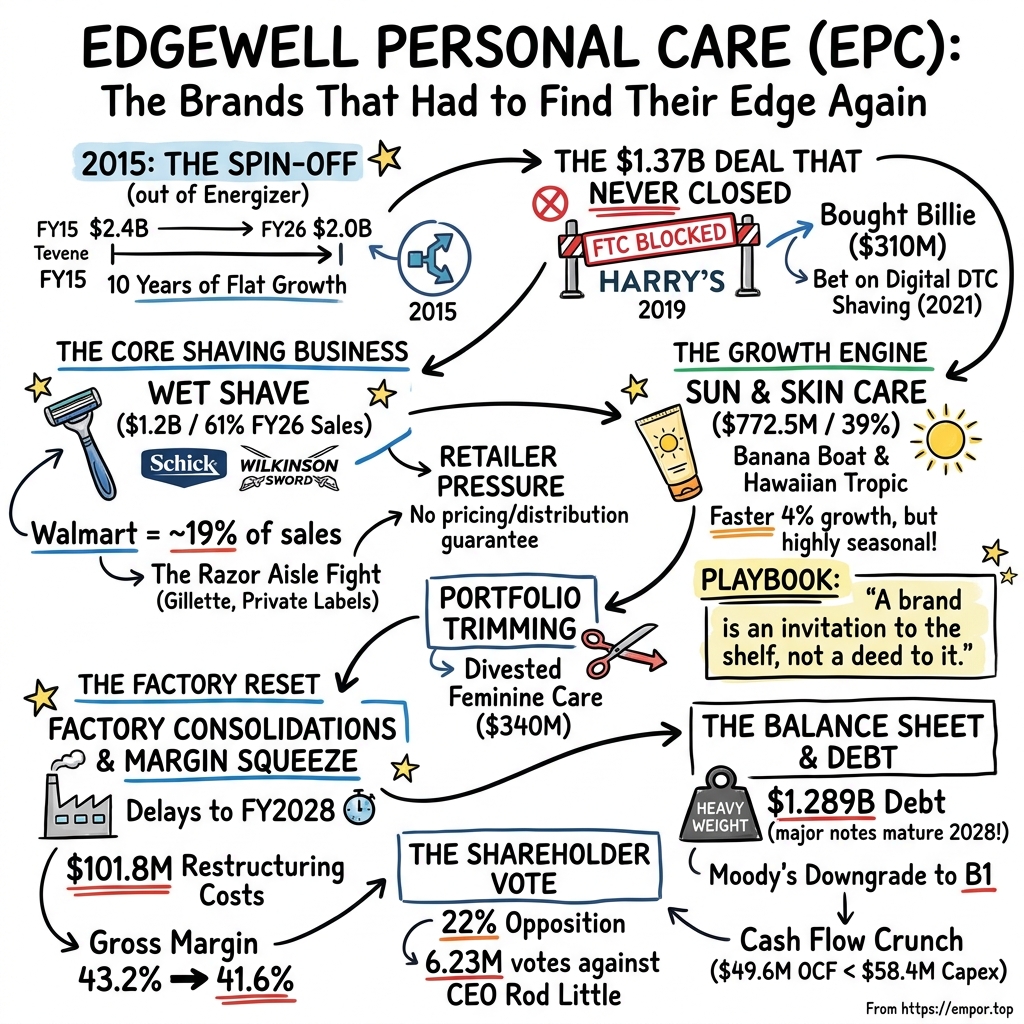
On February 3, 2020, the five commissioners of the Federal Trade Commission voted unanimously to go to court and stop a razor deal.1 The buyer was Edgewell Personal Care, owner of Schick and Wilkinson Sword, one of the oldest names in American shaving. The target was Harry's, a young company that had built a following by selling razors online, mailing cartridges to subscribers and then talking its way onto the shelves of big-box retailers. The price was $1.37 billion.1
The government's complaint read less like a merger review than a character study of an industry. Harry's, the FTC said, was a "uniquely disruptive competitor in the wet shave market," and buying it would "eliminate one of the most important competitive forces in the shaving industry."1 The agency described what the American razor market had looked like before the start-ups arrived: "a comfortable duopoly characterized by annual price increases that were not driven by changes in costs or demand."1 In that telling, Procter & Gamble's Gillette and Edgewell's Schick had been the two big chairs at the table, and Harry's was the guest who had started cutting the prices. Edgewell, the FTC added, was also the leading supplier of private-label razors in the United States, the store-brand blades that sit next to the national names.1
Edgewell did not stay for the fight. A week later, on February 10, 2020, it walked away from the deal before any trial could begin.2 The biggest bet in the company's short independent life had ended with nothing bought.
What happened next is the strange and revealing part. Edgewell did not give up on the idea that a digital-native challenger could teach an old razor house new tricks. It simply bought a smaller one. In November 2021 it agreed to acquire Billie, a direct-to-consumer women's shaving and body-care brand, for $310 million, roughly three and a half times the roughly $90 million in revenue Billie had booked the year before.3 Harry's would have been a merger with a rival. Billie was a purchase of a capability. The difference in scale tells you how the company's ambitions had been reshaped by a regulator.
Six years after the Harry's deal collapsed, Edgewell is a different company again. In fiscal 2026, the year that ended on September 30, its continuing business sold about $2.0 billion of goods.4 It is now concentrated in two segments: Wet Shave, home to Schick, Wilkinson Sword and Billie, and Sun and Skin Care, home to Banana Boat, Hawaiian Tropic and a set of men's grooming brands.4 The third leg it carried for a decade, Feminine Care, was sold early in 2026 and now sits in the accounts as a discontinued operation.4
That narrowing raises the questions this story will try to answer. Can a portfolio of familiar brands return to organic growth, the kind that comes from selling more or charging more rather than from currency moves and acquisitions? In fiscal 2026, organic sales grew just 0.3%.5 Can a cost-cutting program rebuild margins without starving the products, the factories and the retailer service levels that earn shelf space in the first place? And can a company carrying more than a billion dollars of borrowings reduce its debt while still paying a dividend and buying back stock?
One boundary needs to be set before the story starts. Edgewell did not exist as a standalone company until July 2015, when it was separated from Energizer.6 The $4.4 billion of revenue that appears for fiscal 2014 belongs to the predecessor, a company that also sold batteries and flashlights. Measuring Edgewell's growth from that figure would make it look as if half the business had evaporated, when in fact it was handed to another set of shareholders. The fair starting line is 2015, and the fair question is what the personal-care brands did once they had to stand on their own.
So the episode opens with a paradox. Edgewell's most consequential strategic move was a deal it was not allowed to make. The government's case against it rested on the claim that competition in shaving matters: that a nimble challenger can push prices down and force incumbents to innovate. If that is true, it cuts both ways for Edgewell's owners. It means the brands sit in a market where shoppers have real alternatives, where retailers and challengers can apply pressure, and where nothing about a famous name guarantees next year's sale. To see how Edgewell got here, the story has to go back to the day it was born.
 Subscribe on LinkedIn
II. The Spin-Off That Made Edgewell Its Own Company
On July 1, 2015, a single company in St. Louis became two.6 For years, Energizer Holdings had been an odd marriage of batteries and personal care: the pink bunny on one side, razors, sunscreen and tampons on the other. Management had concluded that the two businesses wanted different things from their owners: batteries were a mature, cash-generating category in slow decline, while personal care was a set of consumer brands that, in theory, could grow with marketing, innovation and acquisitions. So the household-products business left as a new Energizer, and the company that kept the personal-care brands took a new name, Edgewell.6
It is worth being precise about what the spin-off was. It did not create a new consumer-products business from scratch. It redrew the boundary of a listed company around brands that had been assembled over many years, many of them through acquisitions made by Energizer. Schick and Wilkinson Sword were the razor franchises. Banana Boat and Hawaiian Tropic were the sun-care franchises. Playtex, Stayfree, Carefree and o.b. made up the feminine-care business.7 The factories, the retailer relationships and the debt came along too.
The logic of independence was simple and appealing. A pure personal-care company could tell its own capital-allocation story. It could buy brands without competing for capital with batteries, it could set a dividend policy suited to its own cash flows, and its shareholders could judge management on one set of results rather than two. The early moves reflected that freedom. Edgewell added men's grooming brands such as Bulldog, Jack Black and CREMO over the following years; it tried to buy Harry's, and it bought Billie.4
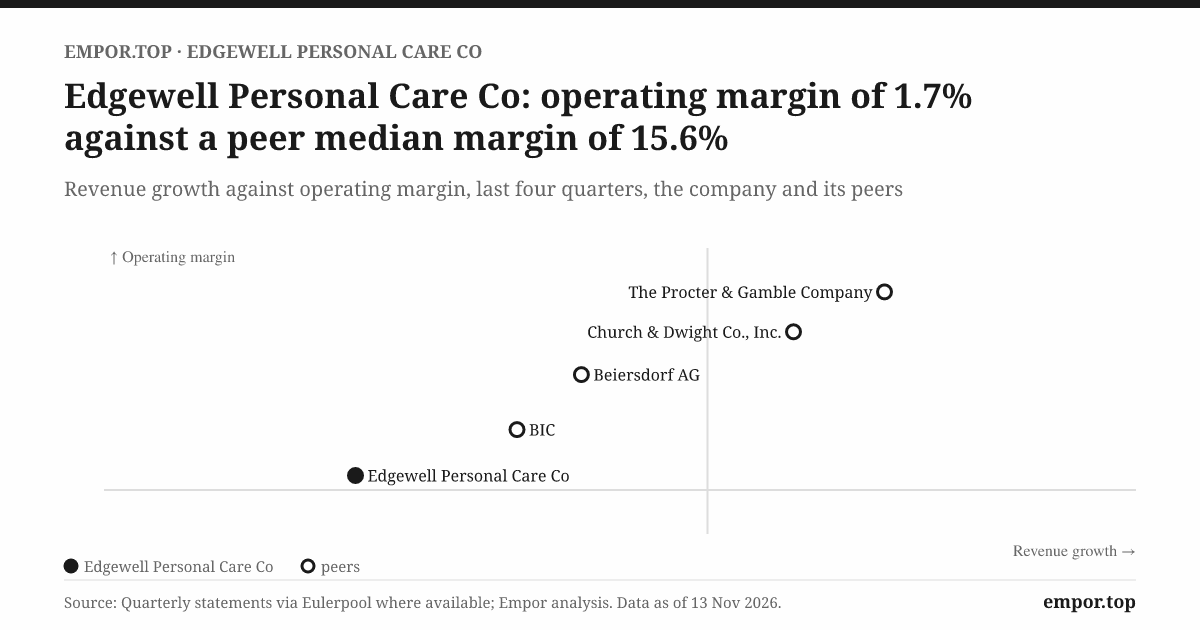
The decade that followed, however, is the most important check on any "steady compounder" story about this business. Edgewell's standalone revenue was about $2.4 billion in its first fiscal year and about $2.2 billion in fiscal 2025, which works out to a decline of a little under 1% a year across ten years.7 Revenue did not collapse. It drifted. Profit is where the drift became a slide. Operating profit, which peaked above $340 million in fiscal 2016 and 2017, fell below $100 million by fiscal 2025, and net profit shrank to about $25 million that year.7 For every $100 of sales, the company kept roughly $14 as operating profit in its best early years and about $4 in fiscal 2025.
Those numbers need a caveat, because Edgewell's portfolio did not stand still. The company bought brands, sold others, and in fiscal 2026 moved Feminine Care into discontinued operations, which means the most recent figures describe a smaller business than the one shareholders owned a year earlier.4 Some of the profit decline came from large impairment charges that show up as losses in years such as 2019, when the company wrote down the value of brands it carried on its balance sheet.7 But the direction is not an accounting illusion. Across ten years of independence, Edgewell's brands sold about the same amount of product and earned much less from it.
The obvious question is why. Part of the answer is the more competitive shaving market the FTC described. Part of it is that the company's largest customers gained bargaining power. And part of it is a set of internal decisions about factories, marketing and capital allocation that are still playing out. The spin-off made Edgewell the owner of its own fate. The record since then says that independence was a necessary condition for a better business, not a sufficient one.
So the right way to approach Edgewell today is not to ask whether its brands are famous. They are. The right question is where the money is made, who controls the terms on which it is made, and what the company has done with it. That starts in a supermarket aisle.
III. The Razor Aisle Is Where the Brands Meet the Buyer
Picture a shopper in a supermarket on a Saturday morning, standing in front of the razor shelf. At eye level are the bright blue and orange packs of Gillette. Nearby sits Schick, with its Hydro and Intuition lines. Lower down, BIC's disposables come in bags of ten. Somewhere in the mix is Harry's, the brand that once nearly became part of Edgewell, and Billie, the brand that did. And on the end, cheaper and plainer, is the store's own brand, a pack that may well have been made in an Edgewell plant.14 The shopper spends perhaps fifteen seconds here. Every one of those brands is fighting for those seconds, and the retailer decides how much shelf each one gets.
That scene is the whole business model in miniature. Edgewell makes razors, blades, sunscreen and grooming products under its own brands, and it also manufactures private-label products to retailers' specifications.4 It sells mostly through short-term purchase orders, often placed less than a month before shipment, and recognizes revenue when goods are delivered. Customers can generally reduce or cancel those orders.4 There is no subscription book here, no multi-year contract and no minimum purchase commitment that guarantees next quarter's revenue. Every month, the business has to be won again on the shelf and in the retailer's ordering system.
Wet Shave is where that fight matters most. In fiscal 2026, the segment sold about $1.2 billion of products, roughly 61% of the continuing business, and razors and blades on their own were more than 55% of sales.4 More importantly, Wet Shave is the profit engine. Its segment profit was $164.7 million in fiscal 2026, down from $190.3 million the year before, a drop of about 13.5%.5 When the biggest business loses an eighth of its profit in a year, the question is not whether the brands are recognized but whether they still command the economics.
Who holds the power on the shelf
Start with the buyer. Walmart alone accounted for 18.8% of Edgewell's consolidated sales in fiscal 2026, nearly one dollar in every five. No other customer exceeded 10%, and the company does not disclose how much its top five or top ten customers take together.4 That missing number matters, because the American personal-care market runs through a small number of giant retailers, drugstore chains, club stores and online platforms. When one customer controls nearly a fifth of revenue and can cut an order with a few weeks' notice, the supplier's room to raise prices is limited by the customer's willingness to accept them. Edgewell also says it does not require collateral from customers and that standard payment terms generally run after delivery.4 That is normal for the industry, but it underlines who has leverage.
Now the rivals. Procter & Gamble's Gillette is the largest named competitor, a brand with a marketing budget and a global footprint far beyond Edgewell's. BIC competes hard in disposables. Harry's and other digitally native brands compete on price and convenience, and private labels compete on price alone.4 Edgewell does not publish a comparable market-share measure, and any precise share figure would need a source it does not provide. What can be said is that Edgewell plays on several sides of this board at once: it is a branded challenger to Gillette and a private-label supplier, as the FTC has noted.1 That dual role is a hedge, since Edgewell earns something whether the shopper chooses a Schick or the store brand. It is also a constraint, because the retailer that buys its private-label razors is the same retailer deciding how much shelf to give Schick.
The supplier side is quieter. Edgewell buys steel for blades, plastics for handles, chemicals for sunscreen and packaging, often from multiple sources.4 Edgewell does not name suppliers or quantify their concentration, which suggests no single supplier dominates. The risk on this side is less about any one vendor than about the price of inputs, tariffs and the company's own ability to turn those inputs into finished goods on time, which became a central problem in 2026.
What about loyalty? Razors are a replenishment business. A shopper who likes a particular Schick handle keeps buying its cartridges, and that habit is a real asset. But the evidence for high switching costs is thin. A cartridge costs a few dollars, the next brand is a foot away on the same shelf, and promotions are designed precisely to make people switch. The FTC's own argument was that Harry's had pulled shoppers away from the incumbents by offering a cheaper, simpler product, which is another way of saying the incumbents' customers were willing to move.1 Repeat purchase is not the same as lock-in.
What went wrong in 2026
The live version of this story came out on the earnings calls. On the call in May 2026, management said North American Wet Shave sales had fallen about 6% in the quarter, even as Edgewell's branded share rose by about 40 basis points, led by Billie.8 That combination is a clue. If branded share was rising while the segment was shrinking, something other than consumer preference for Schick was going wrong. The answer was private label. Edgewell was in the middle of moving razor production between plants, and the transition was constraining supply to store-brand customers.8
By the November call, management put numbers on the damage. In fiscal 2026, private-label razor sales fell about 10% while branded sales grew about 2%, and management described the private-label business as "supply constrained."9 When analyst Chris Carey pressed on private label, he got the most concrete answer of the call: the consolidation project was about halfway done, the first quarter of fiscal 2027 would be the low point for private brands, and growth was planned to return in the second half of the year.9 Wet Shave organic sales still rose 1.6% in the fourth quarter, but that was a modest recovery after a year in which the segment's organic sales fell 1.2%.95
This matters for the moat question in a specific way. A retailer that cannot get its store-brand razors on time does not wait patiently. It may shift volume to another manufacturer or rethink the shelf. Management has given a recovery date, the second half of fiscal 2027, but it has not published a service-level metric that would let outsiders see whether fill rates have actually normalized. Until that recovery shows up in organic sales, the private-label setback is evidence that Edgewell's position depends as much on operational reliability as on brand.
So the verdict on the razor aisle is narrower than a brand story would suggest. Edgewell has real assets: recognized names, broad retail distribution, scale in a repeat-purchase category and a manufacturing base that serves both branded and store-brand customers. What the record does not show is a durable price or distribution advantage that protects profit when things go wrong. Wet Shave profit fell sharply in a year when the brands themselves gained a little share. The test is organic sales, pricing and segment profit, not familiarity. And that leaves an uncomfortable question for owners: if the brands keep Edgewell on the shelf, can the company protect that shelf when price and supply are not fully in its control? The second business, built around a single season of the year, offers a different answer.
IV. Sun Care's Summer Window, and the Cost of Keeping a Brand Relevant
Every year, the sunscreen business is decided before most consumers think about sunscreen. Production runs through the winter. Retailers place their seasonal orders in late winter and spring, and the bottles of Banana Boat and Hawaiian Tropic arrive in stores ahead of Memorial Day, stacked on endcaps and in beach-store bins. Then the weather decides. A hot, sunny June empties shelves. A cool, rainy one leaves retailers with inventory they do not want to reorder. The window to make and ship the season's products is short, and a supplier that misses it waits a year for another chance.
That is the rhythm of Edgewell's second business. Sun and Skin Care contributed $772.5 million in fiscal 2026, about 39% of continuing sales.5 Inside the segment are the two sun-care franchises, Banana Boat and Hawaiian Tropic, and a set of men's grooming and skin-care brands, Bulldog, Jack Black and CREMO, which Edgewell added after the spin-off as it tried to build a broader personal-care portfolio.4 Sun care alone was about 23% of company sales in fiscal 2026, making it the second-largest product group after razors and blades.4
On the surface, this was the bright spot of the year. Sun and Skin Care sales rose 4.0% on a reported basis, faster than Wet Shave.5 In the fourth quarter, segment organic sales rose 6.5%, and management said CREMO grew more than 50% in the quarter.9 With companywide organic growth nearly flat, a segment growing in the mid-single digits looks like a recovery engine.
The details call for more caution. Companywide reported sales rose 1.8%, but organic sales rose only 0.3%, which means currency movements did a good share of the lifting.5 Edgewell sells about half its products outside the United States, so a weaker dollar flatters reported growth when foreign sales are translated back.4 Some of the segment's reported growth carries that same currency tailwind. And seasonality creates another trap. Because retailers order ahead of summer, a shift in when they place those orders can move sales from one quarter to another without any change in how much sunscreen people actually buy. A strong sell-in quarter is a statement about retailer confidence, not proof of consumer demand. The proof comes later, when retailers decide how much to reorder.
A brand valued on a knife's edge
The most revealing number in this segment is not a sales figure. It sits in the notes to the accounts, where Edgewell tests whether the brands it carries on its balance sheet are still worth what it paid. The Banana Boat trade name was carried at $277.2 million at the end of fiscal 2026, and the company's estimate of its fair value exceeded that amount by only 2.4%.4 The auditor, PwC, flagged the valuation as a critical audit matter, which is the accounting profession's way of saying that the number depends heavily on management judgment.4
A 2.4% cushion is thin. It means that a modest cut to the assumed sales growth or profit margin for Banana Boat could push the fair value below the carrying amount and force a write-down. That is not proof the brand is impaired today. It is a sensitivity: the accounting value of one of Edgewell's most famous names depends on the brand delivering roughly the growth and margins management has projected. Investors who want to know whether the sun-care business is healthy can watch this cushion as closely as they watch sales.
Keeping a brand like Banana Boat relevant costs money. Edgewell spent $243.5 million on advertising and promotion in fiscal 2026, up from $211.3 million in fiscal 2024, and it spent $57.5 million on research and development, about 2.9% of sales.4 For fiscal 2027, management plans to push advertising to about 13% of sales, roughly 80 basis points higher than the prior year.9 Those are not the numbers of a company harvesting its brands for cash. They are the numbers of a company betting that marketing and product work will lift repeat demand and pricing.
The question is whether that bet is working. Advertising rose by about $32 million over two years while companywide organic growth slowed to almost nothing.45 In Sun and Skin Care, the fourth quarter's 6.5% organic growth is the strongest evidence that spending is translating into demand, but one quarter of a seasonal business is a small sample.9 The segment has not yet shown several years of organic growth with rising profit, and that is what would turn a hopeful story into a proven one.
So Sun and Skin Care is material, it grew faster than shaving in fiscal 2026, and some of its smaller brands are clearly gaining momentum. But one year of reported growth, partly flattered by currency, does not establish a durable growth engine, and the thin valuation cushion on Banana Boat shows how much rides on the next few summers. If this is the brighter growth pocket, can it carry more of the recovery while the larger shaving business is being reorganized? Part of the answer depends on whether Edgewell has learned to buy growth well, and that brings the story back to the deal it could not make.
V. Billie Was a Bet on Digital Brands; Harry's Was the Bet That Couldn't Happen
Harry's would have changed Edgewell's shape. The $1.37 billion deal would have given the company a fast-growing brand, a direct-to-consumer business with millions of customer relationships, and a management team that had built a challenger from nothing.1 It would also, the FTC argued, have taken the most disruptive competitor out of the market and let the incumbents return to their old habits of steady price increases.1 The commission scheduled an administrative trial for June 30, 2020.1 Edgewell terminated the deal in February, long before that date.2
The failed deal is more than a historical footnote. It is direct evidence, from a federal regulator that studied the industry's pricing and documents, that buyer choice and innovation matter in shaving. That is a warning about the moat as much as it is a story about a lost acquisition. If a start-up with a simple product could become, in the government's words, one of the most important competitive forces in the industry, then the incumbents' brands did not protect them from price competition as much as their market positions suggested.1 It also set a bar for Edgewell's later deals: every subsequent acquisition would be judged against the one that got away.
The smaller bet
Billie was the answer Edgewell found. Founded in 2017, the brand had built its identity around women's shaving, attacking the so-called "pink tax," the premium often charged for products marketed to women, and selling razors by subscription online before moving into retail.3 When Edgewell agreed to buy it in November 2021, the company paid $310 million, which management described as about 3.5 times Billie's prior-year revenue of roughly $90 million.3 The thesis was that Edgewell's retail distribution and marketing reach could take a digital-native brand into thousands more stores, while Billie's skills in online marketing and brand-building could rub off on the larger company. Edgewell said it expected the deal to add slightly to adjusted earnings per share in fiscal 2022.3
It is worth reading that multiple carefully. Three and a half times revenue is a revenue multiple, not a verdict on whether Edgewell overpaid. For a small, fast-growing consumer brand it was not unusual, and it was not cheap either: Edgewell's own whole company trades at well under one times sales today. The real question is what Billie has returned since, and here the public record runs out. Edgewell does not separately disclose Billie's current revenue, profit, customer retention or return on the acquisition price. The brand sits inside the Wet Shave segment, and the company's reports describe its momentum in qualitative terms.
There are clues. On the May 2026 call, management credited Billie with leading the 40-basis-point gain in Edgewell's branded share in North American shaving.8 That suggests the brand is growing faster than the category. But "leading a share gain" is not the same as earning a return on $310 million, and the slight earnings contribution expected in the first year has never been followed by a published accounting of what the deal has delivered. The honest verdict is that Billie appears to be a healthy brand inside Edgewell, and that whether it was a good use of capital remains unproven.
Selling the third leg
In November 2025, Edgewell turned seller. It agreed to sell its Feminine Care business, the Playtex, Stayfree, Carefree and o.b. brands, to the Swedish hygiene group Essity for $340 million.10 The deal closed in February 2026.8 The business being sold was shrinking in importance: in fiscal 2025, Feminine Care generated $261.5 million of sales and only $15.6 million of segment profit, a margin of about 6%.7 For a company trying to concentrate on its stronger franchises, a low-margin, declining segment was a natural candidate to go.
Essity described the price as about 12.1 times the business's pro forma EBITDA, or 8.3 times once its own estimated run-rate synergies were included.11 Those figures need careful handling. The synergy-adjusted multiple is what Essity expects the business to be worth inside Essity, combined with its own manufacturing and distribution; it is not the value of the business as Edgewell ran it. And Feminine Care's sale price cannot be compared directly with Billie's purchase price, because one is a divestiture valued on earnings and the other an acquisition valued on revenue.
The sale also had a cost that the headline price did not show. Edgewell told investors to expect stranded costs, the corporate overhead that had supported Feminine Care and would not disappear when the brands left, of $35 million to $45 million in annual adjusted EBITDA, or about $0.40 to $0.50 of adjusted earnings per share, net of income from transition services provided to Essity.10 In fiscal 2026, that transition-services income amounted to $21.5 million, a temporary cushion that expires.4 Management said on the November call that savings in selling and administrative costs in fiscal 2027 should "fully cover the residual stranded costs... and more."9 If that happens, the sale will have narrowed the company without leaving a hole in its cost base. If it does not, the company will have traded a low-margin business for an overhead problem.
Weighed together, the M&A record is mixed but not damning. Edgewell did not complete the deal that would have changed its scale. It bought a smaller digital brand at a full price, and that brand appears to be performing, though its return is not disclosed in a way that permits a clean verdict. It sold a weak business at a price that looks substantial relative to the business's reported segment profit, but the buyer's synergy-adjusted multiple is not Edgewell's proceeds multiple, and stranded costs offset part of the gain. That is a portfolio that has been pruned and patched more than reinvented.
What the deals reveal about the core business is more important. Edgewell spent money buying growth because its own brands were not producing enough of it. Selling Feminine Care left the company more concentrated in shaving and sun care, and that concentration means the remaining factories have to work. Which brings the story to the plan Edgewell is counting on to restore its margins, and to the plants where that plan is being tested.
VI. The Savings Plan Has to Survive the Factory Floor
In a manufacturing business, the most dangerous months are the ones when two factories are running at once. The old plant is still making product because customers need it. The new plant is being commissioned, its lines tuned and its workers trained. Equipment is being moved, quality has to be revalidated, and every retailer order has to be filled from somewhere. Costs are at their highest, because the company is paying for both sites, and reliability is at its lowest, because nothing is quite settled. That is where Edgewell has spent much of 2026.
The company is consolidating its razor manufacturing, moving four plants into one greenfield site, and on the November call management said the project was about half done: the first two sites had been consolidated, and the last two were in transfer.9 It is also redesigning its operating model, reducing overhead and headcount as part of the restructuring that followed the Feminine Care sale. Headcount fell from about 6,700 at the end of fiscal 2025 to about 6,500 a year later, though the sale itself accounts for part of that change.4
The financial case for all this is straightforward. Fewer, larger and more modern plants should make blades and handles more cheaply. In May, management said the consolidation should deliver about 2 points of gross-margin improvement across the company, with savings starting to show up in fiscal 2027 and reaching a full run rate in fiscal 2028.8 On a business with roughly $2 billion of sales, two points of gross margin is about $40 million a year, which would be a meaningful share of the company's operating profit.
Where the margin went
To understand why that matters, look at what happened to margins in fiscal 2026. Gross margin, the share of each sales dollar left after the cost of making the product, fell to 41.6% from 43.2%.5 That is about $1.60 less gross profit on every $100 of sales. Adjusted operating income, which excludes restructuring and other one-off charges, fell to $161.6 million from $173.3 million.5 On a reported basis the picture was worse, because the company booked $101.8 million of restructuring costs during the year.4
Management has offered several explanations, and they are not all the same kind. Some are external: input-cost inflation, tariffs and currency. On the November call, management described roughly 300 basis points of inflation offset by "well over 250 basis points" of productivity and volume absorption.9 That is a useful number, because it shows the company is not standing still against cost pressure. But it also shows that productivity has been running slightly behind inflation, rather than getting ahead of it. Other explanations are internal: the private-label supply constraints and the cost of running duplicate sites. In May, management said it was "running duplicate sites for longer than originally intended" to protect fill rates.8 That is a choice, and probably the right one, since losing a retailer's confidence would cost more than the extra overhead. But it means a meaningful part of the margin decline came from Edgewell's own execution, not only from the economy.
Six months later
The credibility test came in November. On the May call, management said the program was "still on track to achieve the service outcomes and savings we intended," with savings beginning in fiscal 2027.8 Six months later, the language had changed. "The consolidation schedule has shifted by roughly six months versus what we first planned," management said, and "we now anticipate the related savings starting in fiscal '28."9 The fiscal 2027 guidance, it added, "includes no savings from that program."9
That shift is a specific, measurable change in a promise, and investors should treat it as one. On the positive side, management disclosed it plainly, quantified the delay and removed the savings from guidance rather than leaving them in and hoping. That is better than the alternative. On the negative side, the delay came only six months after management described the program as on track, and the company had already lived through a year of private-label supply problems caused by the same transition. Analysts on the call pushed on private label and on the long-term margin target; asked by Peter Grom about long-term margins, management described three levers but declined to give a number, saying "We won't call out a long-term target."9 The specific answers were about the past and the near term; the long-term promise remained qualitative.
What makes this harder is that Edgewell is not cutting everywhere. Research and development held at about 2.9% of sales, and advertising and promotion reached $243.5 million, with plans to raise it further in fiscal 2027.49 The company is restructuring while still spending behind its brands, which is the right instinct for a consumer company that depends on shelf space. But it also means the savings have to be large enough to fund both margin recovery and continued brand investment.
The fair verdict is that cost savings are a plausible route to recovery, and that the record already shows execution risk. Factory consolidation can lower unit costs, and Edgewell has done the hard part of moving half its razor production. But it has pushed the savings out by half a year. The plan remains unproven until four things appear together: savings realized against the new schedule, gross margin recovering from 41.6%, a disclosed measure of retailer service showing stability, and organic growth in Wet Shave. Until then, the factories are a cost, and a cost has to be paid for. That leads to the balance sheet.
VII. Cash, Debt and the Shareholder Return Promise
When the Feminine Care sale closed in February 2026, $340 million arrived at a company that needed it.10 Edgewell ended fiscal 2026 with $375.6 million of cash, up from $225.7 million a year earlier, largely because of those proceeds.4 Against that cash stood $1.289 billion of borrowings.4 And over the full year, the business itself generated only $49.6 million of operating cash flow, less than the $58.4 million it spent on plants and equipment.4 For the first time in a long while, Edgewell's operations did not pay for their own upkeep.
That shortfall is striking because cash generation used to be this company's quiet strength. Across the twelve fiscal years from 2014 to 2025, Edgewell and its predecessor reported a cumulative net profit of about $515 million but generated about $2.8 billion of operating cash and about $2.0 billion of free cash flow after capital spending.7 The gap between profit and cash was not a mystery. Large non-cash charges, such as the amortization of acquired brands and the impairments that hit reported earnings in bad years, reduced profit without reducing cash. In fiscal 2026 alone, depreciation and amortization were $77.8 million, stock compensation $19.0 million and impairment charges $37.4 million.4 For most of its life, Edgewell looked much better through the cash-flow statement than through the income statement.
The recent year changes that interpretation. Operating cash flow of $49.6 million is a fraction of the more than $200 million a year the business generated in fiscal 2023 and 2024.7 Part of the decline came from working capital, the cash tied up in inventory and receivables minus what the company owes its suppliers. Other current assets consumed $26.3 million of cash, and lower payables used another $7.7 million, partly offset by a $57.3 million inflow from other current liabilities.4 Some of the drag came from restructuring cash costs and from cash items tied to the Feminine Care sale. Management's own adjusted free cash flow for fiscal 2026, which strips out those Feminine Care cash items, was about $86 million.9 The gap between that figure and the reported shortfall is itself a lesson: the adjusted number describes the business management wants investors to see, and the reported number describes the cash that actually moved.
Receivables that are sold before they are paid
Receivables add another layer. In fiscal 2026, Edgewell sold $1.183 billion of customer receivables to banks under factoring facilities, with $64.4 million of those sold invoices still outstanding at year-end; a year earlier, the figures were $1.178 billion sold and $94.7 million outstanding.4 Factoring works like this: instead of waiting thirty or sixty days for a retailer to pay, Edgewell sells the invoice to a bank at a small discount and gets its cash immediately. The cost of doing so was $4.2 million in fiscal 2026.4
There is nothing improper about factoring; it is common among suppliers to large retailers. But it makes cash flow harder to read. When the amount outstanding under factoring falls, as it did by about $30 million between the two year-ends, the company has effectively pulled less cash forward than before, and that shows up as weaker operating cash flow. When it rises, the opposite happens. So some of fiscal 2026's weakness may reflect less factoring rather than worse underlying cash generation, and some of earlier years' strength may have reflected more of it. Edgewell does not publish aging buckets for its receivables, so there is no evidence either way that customers are paying late. Net trade receivables were $132.4 million at year-end, with a small and shrinking allowance for bad debts.4 The issue is not credit quality. It is that the headline cash figure depends partly on a financing choice.
The debt that has to be refinanced
The borrowings themselves are mostly long-dated bonds. Edgewell has $750 million of fixed-rate notes due in 2028 and $500 million due in 2029, plus about $39 million of short-term borrowings.4 Leases, about $76.5 million, are reported separately and are a different kind of obligation.4 The company's $425 million revolving credit facility was undrawn at year-end, with $418.8 million available after letters of credit, and Edgewell reported compliance with its covenants, which cap leverage at 4.0 times and require interest coverage of at least 3.0 times.4 Borrowings fell by about $131 million over the year.4 On the May call, management said sale proceeds would go to paying down the revolver balance in that quarter.8
Subtract cash from borrowings, and net debt was a little over $900 million at the end of fiscal 2026. Management put its own adjusted net leverage at 3.4 times adjusted EBITDA.9 The rating agencies see something heavier. In October 2026, Moody's downgraded Edgewell to B1 from Ba3, a step deeper into speculative grade, and published coverage of the action cited adjusted leverage of 9.2 times, modest free cash flow, operating headwinds and restructuring needs.12 Moody's expected leverage to fall toward 6 times into 2027, helped by the sale, and described the company's dividends and buybacks as aggressive.12 S&P had already cut Edgewell to BB- in November 2025, citing a slower recovery, weaker sales and EBITDA, and higher-than-forecast leverage.13
The gulf between 3.4 times and 9.2 times is not a contradiction so much as a reminder that leverage depends on what you count. Management uses adjusted EBITDA that excludes restructuring and similar charges and measures debt net of cash; the agencies make their own adjustments and use their own earnings measure, which in a year of heavy restructuring looks far weaker. The prudent reading is the one a lender would take: when a bond comes due in 2028, the market will price the refinancing on the agencies' view as much as on the company's.
That brings the shareholder-return promise into focus. Edgewell pays a quarterly dividend of 15 cents a share.9 In fiscal 2025, the dividends it paid amounted to about 116% of net profit, against a long-run median payout of about 26%.7 At the November 2026 share price, the dividend yields about 2.2%. A yield, though, says nothing about affordability; it is just the dividend divided by a share price that has fallen. The question is whether cash flow covers it, and in fiscal 2026 operating cash flow did not even cover capital spending.
Edgewell also bought back about 0.7 million shares for $15.1 million in fiscal 2026 and had $85 million remaining under its authorization.4 Management said on the November call that buybacks would "primarily offset dilution" from stock compensation and reiterated its focus on lowering leverage.9 Those two statements are compatible in a narrow sense: offsetting dilution is a modest commitment. But a skeptical investor, or the credit analyst at Moody's, can fairly ask why a company with operating cash flow below capital spending, a speculative-grade rating and a $750 million bond due in under two years is spending any cash on its own shares.
For fiscal 2027, management has guided to adjusted free cash flow of $100 million to $120 million, including restructuring cash costs.9 If that happens, cash generation will cover the dividend and leave room for debt reduction. The concrete tests are net debt after sale proceeds and shareholder returns, cash flow after factoring and restructuring, and a credible plan for the 2028 notes. Those are financial tests. The people who will be judged by them are the management team, and shareholders have already begun to register their view of that team.
VIII. Rod Little's Recovery Plan Meets the Shareholders' Vote
The annual meeting is usually the quietest day on a public company's calendar. Proxy votes have been cast weeks earlier, the outcome is rarely in doubt, and the formal business takes minutes. Edgewell's meeting in February 2026 passed every proposal. But the tallies, filed with the SEC a few days later, carried a message. About 22% of the votes cast for or against the company's executive pay opposed it.14 Rod Little, the chief executive, received about 6.23 million votes against his re-election as a director.14 Director Carla Hendra received about 2.2 million.14 None of those numbers threatened anyone's job. All of them were higher than a comfortable board would like.
Rod Little has led Edgewell since 2019.15 A finance executive by background, he took over a company that was still digesting the impairments and portfolio questions of its first years, and he has owned nearly every major decision in this story: the attempt to buy Harry's, the purchase of Billie, the expansion into men's grooming, the decision to sell Feminine Care and the plan to consolidate razor factories. His chief financial officer, Francesca Weissman, joined in that role in December 2024, which means she has been the finance lead through the sale, the restructuring and the delayed savings timeline.15 Day-to-day leadership also includes Jessica Spence, who runs North America, and Daniel Sullivan, the chief operating officer, who oversees Europe and Latin America.4
Compensation is where shareholder unease usually shows up first, and the numbers explain why. Little's reported total compensation was about $10.2 million in fiscal 2023, $10.1 million in fiscal 2024 and $9.8 million in fiscal 2025.15 Over the same three years, Edgewell's net profit fell from about $114 million to $98 million to $25 million.7 Pay dipped by about 4%; profit fell by almost 80%. That comparison needs one important qualification. Most of Little's fiscal 2025 compensation, about $7.6 million, was stock awards valued at the grant date.15 Grant-date value is what the board intended to give, not what the executive actually receives, and stock awards tied to performance or share price can end up worth much less if the company underperforms. Reported pay is not cash pay. But the disconnect between the reported pay trend and the profit trend is exactly what a say-on-pay vote exists to register.
The same meeting approved an amendment to the company's stock plan authorizing 2.1 million additional shares for employee awards.14 Against roughly 46 million shares outstanding, that is about 4.5% of the company in potential future dilution, spread over the life of the plan.4 Management's statement that buybacks will mostly offset dilution should be read beside that number: the company is committing to buy back shares largely to keep its own equity awards from shrinking existing holders' stakes.
Who owns the company
Edgewell has no controlling shareholder. Its 2025 proxy listed BlackRock at 14.9%, Vanguard at 12.6%, Brandes at 10.9%, American Century at 8.5% and Dimensional at 7.1%.15 Later filings showed Brandes, a value-oriented investment firm, at 14.39%, or about 6.7 million shares, as of March 2026.16 Vanguard's later filings split its holdings between two reporting units, Vanguard Portfolio Management at 6.56% and Vanguard Capital Management at 5.09%, and each filing excludes shares attributed to other affiliates, so those figures should not simply be added or compared with the proxy's single Vanguard line.1718 The rise in Brandes' stake is the notable move: a value manager increased its position while the share price and profits were falling, a bet that the recovery is underpriced. The register is otherwise dominated by index funds and diversified institutions, which tends to make governance pressure slower and quieter.
For the chief executive, as the pay figures show, alignment with these owners runs largely through equity awards whose eventual value depends on the share price, which is why the recovery's timing matters to him as directly as to them.
Judging the plan by behavior
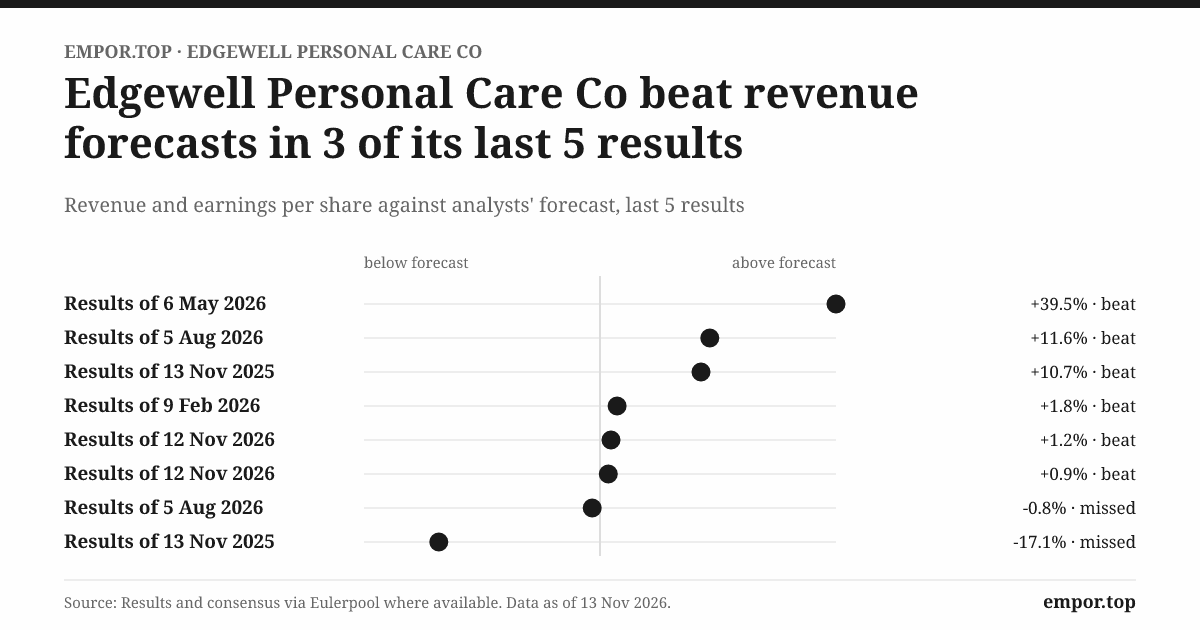
The useful way to judge management is not by the size of the vote but by behavior over time. On guidance, the record of the past year is reasonably good. In May 2026, management guided to adjusted earnings per share of $1.70 to $2.10, adjusted EBITDA of $245 million to $265 million and adjusted net leverage of 3.3 to 3.5 times at year-end.8 The actual results, $1.93, $254.5 million and 3.4 times, landed within those ranges.9 On operations, the record is weaker: the factory consolidation was described as on track in May and was six months late by November.89 On disclosure, management handled the delay directly, which is the behavior of a team that knows it is being watched. On long-term targets, it declined to give one.9
The analysts on the November call pressed where they should. Nik Modi asked about the consumer and fiscal 2027 guidance, and received a fairly concrete answer: categories growing roughly in line with the previous six to twelve months, a guidance midpoint that assumes Edgewell holds share, and advertising at about 13% of sales.9 Chris Carey asked about private label and got numbers. Peter Grom got no long-term target.9 That pattern leaves investors without a yardstick for the restructuring's ultimate payoff.
So the shareholder dissent and the earnings decline make credibility a live issue. They do not settle the strategy. Management will earn confidence by hitting the revised savings schedule, by showing organic growth in both segments, and by aligning capital returns with debt reduction. Those are tests that can be checked against the next few years of results. Before looking ahead, though, it is worth stepping back to ask what Edgewell's story teaches.
IX. Playbook: Business & Investing Lessons
Go back to the razor shelf one more time. Everything Edgewell has learned since 2015 is visible from there: the brands that have been on that shelf for decades, the challenger the company tried to buy, the store-brand pack that came from its own factory, and the retailer who decides how much of the shelf each one gets. Four lessons follow from that view, and each belongs to this company in particular.
The first is that a brand is an invitation to the shelf, not a deed to it. Schick’s long history has not stopped shoppers from switching to cheaper challengers, or Walmart from accounting for nearly a fifth of Edgewell’s sales.14 Brand recognition gets a product considered. It does not guarantee the next order, the next promotion slot or the next price increase. For investors, the lesson is to stop asking whether a consumer brand is famous and start asking whether it can raise prices without losing volume, and whether the retailers that sell it need it more than it needs them.
The second lesson is that the price of growth is only the start of the return. Billie appears to be helping Edgewell gain share, but the company has not disclosed the brand’s return against its acquisition cost.3 An acquisition price is a promise of future cash, and the only way to know whether the promise was kept is to see the cash. Founders who sell and acquirers who buy should both remember that the headline multiple is the beginning of the story, not its verdict.
The third lesson is that factory savings count only when the product still arrives. Edgewell’s consolidation is supposed to lower costs by about two points of gross margin, and it may well do so.8 The company says private-label razor sales fell about 10% amid supply constraints, and the savings timeline slipped by six months.9 In a business where shelf space is won order by order, a cost program that disrupts service can lose more in sales than it saves in overhead. The time to judge a restructuring is not when it is announced but when the trucks are on schedule again.
The fourth lesson is that cash from a sale buys time; it does not make the core grow. The Feminine Care sale improved Edgewell’s liquidity and allowed it to reduce borrowings.104 It did not add a single sale to Wet Shave or Sun and Skin Care. A divestiture can clean up a portfolio and buy a company room to fix its remaining businesses, but the clock starts running the moment the proceeds arrive. If organic growth does not follow, the company will simply be a smaller version of the same problem.
Taken together, these lessons describe what it actually takes to own consumer brands in a market controlled by retailers. Edgewell’s story is not that brands endure. It is that a company has to keep earning distribution, fund the marketing that keeps a brand relevant, run factories that deliver on time and convert all of that effort into cash. Those are the questions the bull and the bear argue about.
X. Analysis & Bear vs. Bull Case
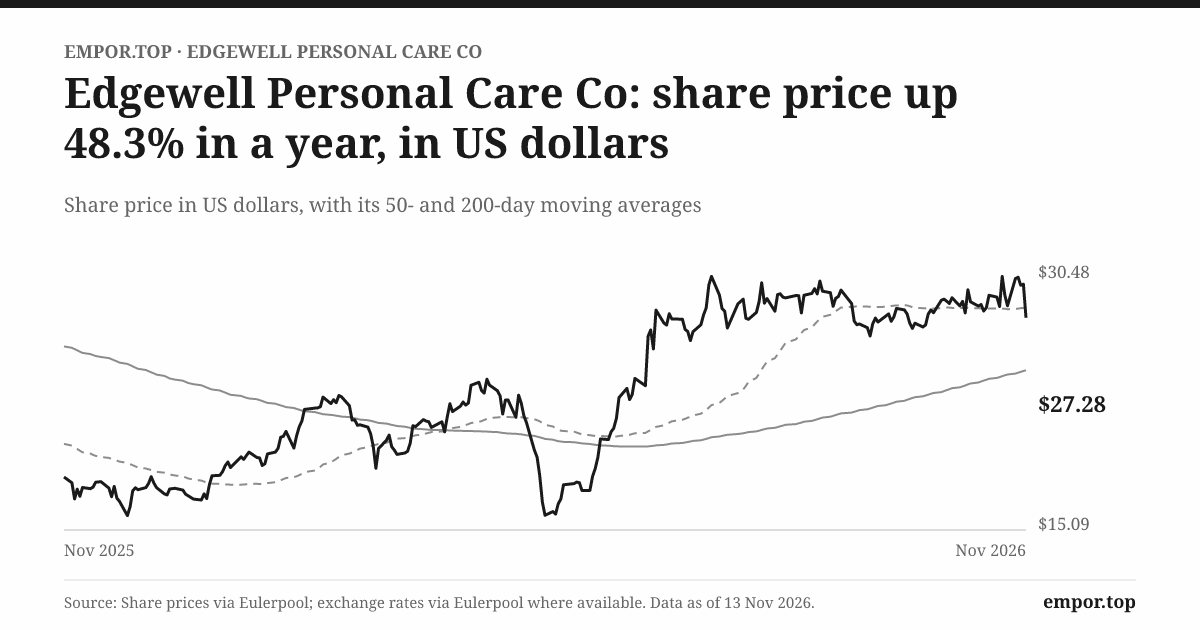
In November 2026, Edgewell reported its full-year results, and two different stories came out of the same release. On an adjusted basis, earnings per share rose to $1.93 from $1.81, an improvement of about 6.6%.5 On a reported basis, the continuing business lost 5 cents a share.5 Organic sales grew 0.3%.5 Two days later, the stock closed at $27.28, near the top of its 52-week range and well above the low of about $16, and it traded at about 37 times trailing earnings, more than double its own five-year median of about 17.5 times. To understand why the market is paying up for a business with flat organic sales and falling profit, it helps to lay out what each side believes.
The thesis spine is simple. The case for why Edgewell can win from here rests on established brands, broad retail distribution, replenishment demand and the potential for factory and operating-model savings to rebuild margins. The case for why it may not rests on retailer leverage, private-label alternatives, limited evidence of pricing power, weak organic growth and execution problems that have already delayed the savings. The rest of the analysis is a test of which side the evidence supports.
The forces around the shelf
Consider the market forces first, not as a checklist but as a story about who captures the profit. Buyer power is the most important force, and it is high. Walmart's 18.8% share of sales and the industry's reliance on a handful of national retailers mean the customer can dictate shelf space, promotion terms and, in practice, the speed at which price increases pass through.4 Rivalry is intense. Procter & Gamble's Gillette leads the category with greater scale, BIC competes in disposables, Harry's and other challengers compete on price and convenience, and private labels compete on price alone.4 The FTC's description of a "comfortable duopoly" that disruptors broke open suggests rivalry has become more intense, not less, over the past decade.1 The threat of substitutes is modest, since there is no real substitute for a razor or sunscreen, but switching between brands is easy and cheap. New entrants have been a real threat, as Harry's and Billie both proved, though the cost of national distribution now makes new entry harder than in the mid-2010s, when buying online was new. Supplier power is moderate: inputs such as steel, plastics and chemicals come from multiple sources, but tariffs and inflation have proved hard to fully offset.49
Put those forces together and the profit pool looks like a contested one. The retailer and the largest brand capture much of it; the rest of the industry fights over what is left.
Hamilton Helmer's framework asks a sharper question: what lasting advantage lets a company earn more than its cost of capital? Of his seven powers, Edgewell can credibly claim parts of two. Branding is real but limited. Schick, Banana Boat and Hawaiian Tropic are recognized names, and that recognition earns consideration, but the company's long-term profit decline and the private-label share in its own business suggest shoppers do not pay a large, durable premium for them. Scale economies exist in manufacturing, since razor blades are a high-precision product with high fixed costs, and the consolidation is an attempt to sharpen that advantage. But Gillette's scale is larger, and Edgewell's scale has not translated into superior margins.
The other powers are mostly absent. There are no network effects in razors. Switching costs are low, as the replenishment discussion showed. There is no counter-positioning advantage, since Edgewell is the incumbent being counter-positioned against, which is precisely what the FTC case documented. No cornered resource, such as a patent wall or exclusive input, is disclosed. Process power, the kind that comes from an organization doing something better than rivals over years, would show up as rising margins and reliable service; 2026 showed the opposite.
So the moat claim should be kept narrow. Brand recognition and distribution are real assets, but the record does not demonstrate durable share gains, low price sensitivity, high retention or superior unit economics. Ten years of standalone results, with roughly flat revenue and sharply lower profit, are the strongest evidence against a wide moat, and they come from the same brands and largely the same management regime. The history does not reject the idea that Edgewell has an advantage; it narrows it to a defensive one, an ability to stay on the shelf rather than to dictate terms there.
The bullish evidence is real and recent. Fourth-quarter organic sales rose 3.1%, with both North America and international markets growing about 3%.9 Sun and Skin Care grew organically by 6.5% in the quarter, and CREMO grew more than 50%.9 Adjusted earnings per share rose about 6.6% for the year.5 Selling Feminine Care removed a low-margin segment, reduced complexity and helped lower borrowings.104 Billie appears to be gaining share.8
Management's fiscal 2027 outlook adds to the bull case. It calls for organic sales growth of 1% to 3%, adjusted earnings per share of $1.85 to $2.15 and adjusted EBITDA of $250 million to $270 million, with gross margin up about 60 basis points and operating profit up roughly 10%.9 Crucially, the guidance includes none of the factory-consolidation savings.9 If the company delivers that guidance and the savings then arrive in fiscal 2028, the bull would argue, earnings could step up meaningfully over the next two years, and today's high trailing multiple would turn out to have been measured on a trough.
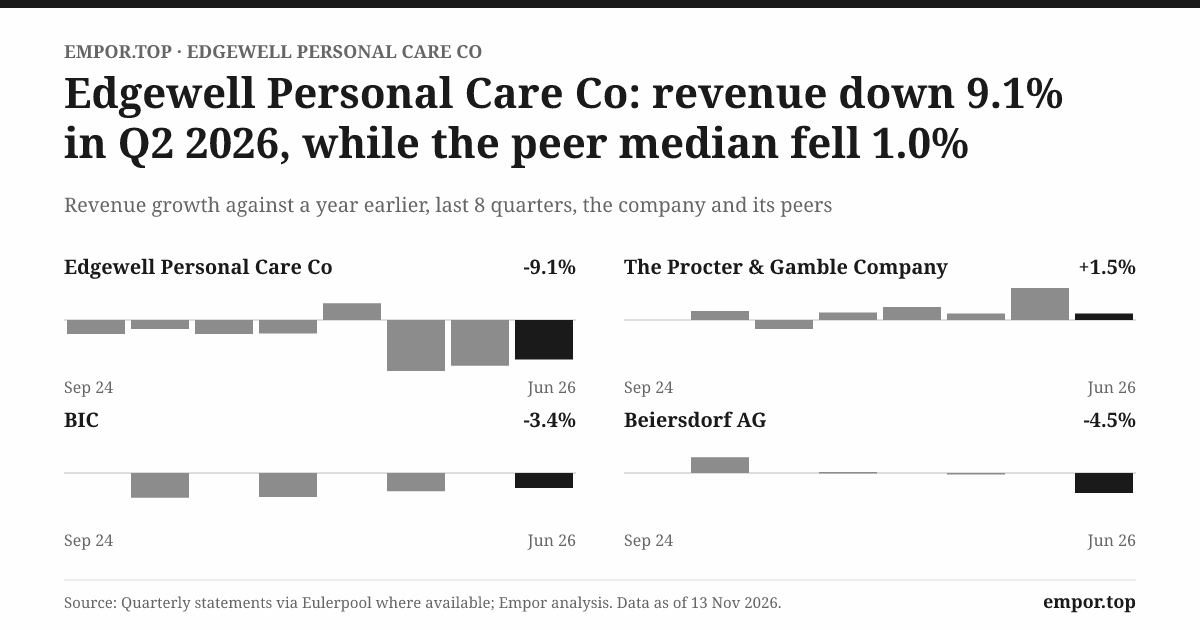
The bearish evidence is just as specific. Full-year organic growth was 0.3%, well below the company's five-year revenue growth rate of about 2.7% a year.57 Wet Shave segment profit fell by 13.5%.5 Continuing operations lost money on a reported basis. Operating cash flow fell short of capital spending.4 The savings timeline slipped by six months.9 Both Moody's and S&P downgraded the company within a year.1213 And the fiscal 2027 guidance itself carries risks: management expects the first quarter's organic sales to be flat to down about 1%, earnings to be lower than a year earlier in the first quarter, and about 80% of adjusted earnings per share to fall in the second half.9 A plan that loads most of the year's earnings into the final two quarters leaves little room for another delay. The expiration of transition-services income from Essity and a higher tax rate will together cost about 20 cents of earnings per share.9
The adjusted and reported numbers need to stay side by side. Adjusted earnings exclude restructuring costs, impairments and other charges that, in Edgewell's case, have recurred in most years since the spin-off. A company that restructures repeatedly is, in a sense, paying a regular cost of doing business, even if each charge is labeled one-off. Fiscal 2027 alone is expected to carry about $55 million of restructuring and related charges.9 The adjusted earnings improvement is real, but it does not erase those costs.
What the price assumes
That brings the story to valuation. At $27.28, the 37-times trailing P/E and an EV/EBITDA of about 34 times reflect depressed trailing earnings, so neither is a clean measure of value. The trailing earnings yield is about 2.7%, and the free-cash-flow yield is about 3.7%, against a year when operating cash flow did not cover capital spending. On forward estimates the picture changes: one peer-data service showed Edgewell at about 15 times next-year earnings, against a peer median near 25 times, and about 9 times forward EBITDA, against a peer median near 16 times.19 Those are estimate-based figures over a different period and a broad consumer-brand peer set, so they are not directly comparable with the trailing numbers. Taken together, they say the market is pricing Edgewell as a recovery: cheap if fiscal 2027 and 2028 earnings arrive as management describes, expensive if they do not.
Three measures will decide which side is right. The first is organic sales growth by segment, which was 0.3% for the company in fiscal 2026, with Wet Shave down 1.2% and Sun and Skin Care growing, and which turned up to 3.1% in the fourth quarter.59 The second is gross margin, which fell from 43.2% to 41.6% in fiscal 2026, together with the restructuring savings the company actually realizes against its revised schedule.5 The third is free cash flow after capital spending, factoring and restructuring cash costs, which was negative on a reported basis in fiscal 2026 against management's fiscal 2027 target of $100 million to $120 million on an adjusted basis.49
Beneath those three sits a risk radar specific to this business. Retailer pressure and consumer trade-down threaten branded pricing. Sun care's dependence on one season exposes it to weather and to the timing of retailer orders. Input costs and tariffs have already outrun productivity once. About 51% of sales come from outside the United States, so a stronger dollar would reverse the currency help of fiscal 2026.4 The factory consolidation has to finish without another supply disruption. And the $750 million maturity in 2028 will test both leverage and the market's view of the recovery.4 Edgewell also notes that AI shopping assistants may increasingly influence how consumers discover and choose products, a possible change in how brands win attention rather than a substitute for razors or sunscreen.4
A skeptical investor or activist would focus on one question above all: why continue buybacks and dividends while leverage is high and cash generation is weak? Management's answer is that buybacks mostly offset dilution and that leverage is the near-term focus.9 That answer should be judged against actual debt reduction and free cash flow, not against capital-allocation language. On the evidence, Edgewell has a credible recovery possibility, not a proven moat or a normalized earnings base. The next two years will show which.
XI. Epilogue
Tonight, Edgewell enters fiscal 2027 as a smaller, simpler company than it was a year ago. It has two businesses instead of three, about $376 million of cash in the bank, an undrawn credit line and a plan.4 It also has a $750 million bond coming due in 2028, factory savings that have been pushed into that same year, and a guidance range that depends on the second half doing most of the work.49 The cushion is real. So is the clock.
The first moment to watch comes early. Management has said the first quarter of fiscal 2027 will be the trough, with organic sales flat to down about 1% and private-label razors still recovering.9 If that is all that goes wrong, and the second half shows the organic growth the guidance needs, the fourth quarter's 3.1% will look like the start of something rather than a single good quarter. If the first quarter is worse than guided, the burden on the rest of the year becomes heavier, and the market will ask whether the 1% to 3% range was ever realistic.
The second moment is on the factory floor. Edgewell has two of four razor plants consolidated and two in transfer.9 As the last moves finish, the evidence that matters is whether private-label customers get their orders on time and whether that business returns to growth in the second half, as management has promised. Another slip in the consolidation schedule would be more than a delay. It would be the second revision of the same promise in a year, and investors would be right to treat it as evidence against the team's execution.
The third moment is the balance sheet. Each quarterly report will show net debt, cash flow after capital spending and the amount of receivables sold. The question that the Feminine Care proceeds left open, how much of the money strengthens the balance sheet and how much flows out in dividends, buybacks and investment, will be answered in those reports. By the time the 2028 notes approach, the company will need either enough cash and earnings to refinance on reasonable terms or a credible plan to reduce what it owes. The rating agencies' view will shape that price as much as management's.
And the last moment is the one the whole story has been building toward: fiscal 2028, when the savings are now supposed to begin. If they arrive on the revised schedule while organic growth holds and service is stable, Edgewell's reset will have worked, and the depressed trailing earnings that make today's valuation look stretched will have been a trough. If they slip again, or arrive only by cutting the brand investment that keeps the products on the shelf, the company will face its refinancing with less to show for its restructuring than it promised.
Until then, the sale and the cost plan create room to recover, but they are not proof that the recovery has arrived. Edgewell has bought itself time. Whether it uses that time well will be decided not in a press release but in the next four to eight quarters of organic growth, gross margin and cash.
XII. Outro
Go back one last time to the shopper at the razor shelf. There is Schick, a name that has been in American bathrooms for generations. There is Billie, the online brand Edgewell bought when it could not buy something bigger. There, a few feet along, is Harry's, the challenger Edgewell once agreed to pay $1.37 billion to own, still competing against it on the same shelf.1 And at the end is the store's own pack, possibly made in an Edgewell plant, priced to win the shopper who does not care about any of the names.
That failed deal still defines Edgewell's competitive problem. It has had to win the old-fashioned way, one order, one season and one shopper at a time, with brands it already owned and factories it is still rebuilding.
Edgewell owns enduring names. But endurance is not the same as an edge. Every season, the familiar package sits on the shelf and faces the same question it faced the day the deal collapsed: will the shopper choose it again?
References
-
FTC Files Suit to Block Edgewell Personal Care Company's Acquisition of Harry's, Inc. — Federal Trade Commission, 2020-02-03 ↩↩↩↩↩↩↩↩↩↩↩↩↩↩↩
-
Edgewell Personal Care Company and Harry's, Inc., In the Matter of — Federal Trade Commission ↩↩
-
Edgewell Announces Acquisition of Billie — Edgewell Personal Care, 2021-11-29 ↩↩↩↩↩
-
FY2026 Form 10-K — Edgewell Personal Care Company, 2026-11-13 ↩↩↩↩↩↩↩↩↩↩↩↩↩↩↩↩↩↩↩↩↩↩↩↩↩↩↩↩↩↩↩↩↩↩↩↩↩↩↩↩↩↩↩↩↩↩↩↩↩↩↩↩
-
Edgewell Reports Fourth Quarter and Fiscal Year 2026 Results — Edgewell Personal Care, 2026-11-12 ↩↩↩↩↩↩↩↩↩↩↩↩↩↩↩↩↩
-
Separation of Energizer Holdings Completed; Edgewell Personal Care Begins Trading — Edgewell Personal Care, 2015-07-01 ↩↩↩
-
FY2025 Form 10-K — Edgewell Personal Care Company, 2025-11-14 ↩↩↩↩↩↩↩↩↩↩
-
Q2 FY2026 Earnings Call Transcript — Edgewell Personal Care Company, 2026-05-06 ↩↩↩↩↩↩↩↩↩↩↩↩
-
Q4 FY2026 Earnings Call Transcript — Edgewell Personal Care Company, 2026-11-12 ↩↩↩↩↩↩↩↩↩↩↩↩↩↩↩↩↩↩↩↩↩↩↩↩↩↩↩↩↩↩↩↩↩↩↩↩↩↩↩
-
Edgewell Announces Sale of Feminine Care Business to Essity for $340 Million — Edgewell Personal Care, 2025-11-12 ↩↩↩↩↩
-
Essity Acquires Edgewell's Feminine Care Business in North America — Essity ↩
-
Moody's Downgrades Edgewell to B1 as Leverage Stays High; Outlook Stable — Investing.com, 2026-10-02 ↩↩↩
-
Edgewell Personal Care Downgraded to BB- by S&P on Slower Recovery — Investing.com, 2025-11-25 ↩↩
-
Annual Meeting Results, Form 8-K — Edgewell Personal Care Company, 2026-02-05 ↩↩↩↩
-
Brandes Investment Partners Schedule 13G — U.S. Securities and Exchange Commission, 2026 ↩
-
Vanguard Portfolio Management Schedule 13G — U.S. Securities and Exchange Commission, 2026 ↩
-
Vanguard Capital Management Schedule 13G — U.S. Securities and Exchange Commission, 2026 ↩
 LinkedIn
 WhatsApp
 Reddit
 Hacker News
 Email
 Kindle
 RSS Feed
 Spotify
 Apple Podcasts
 Amazon Music
 Audible
 YouTube