Enovis Corporation: The Business Inside the Impairment
I. The $1.7 Billion Question
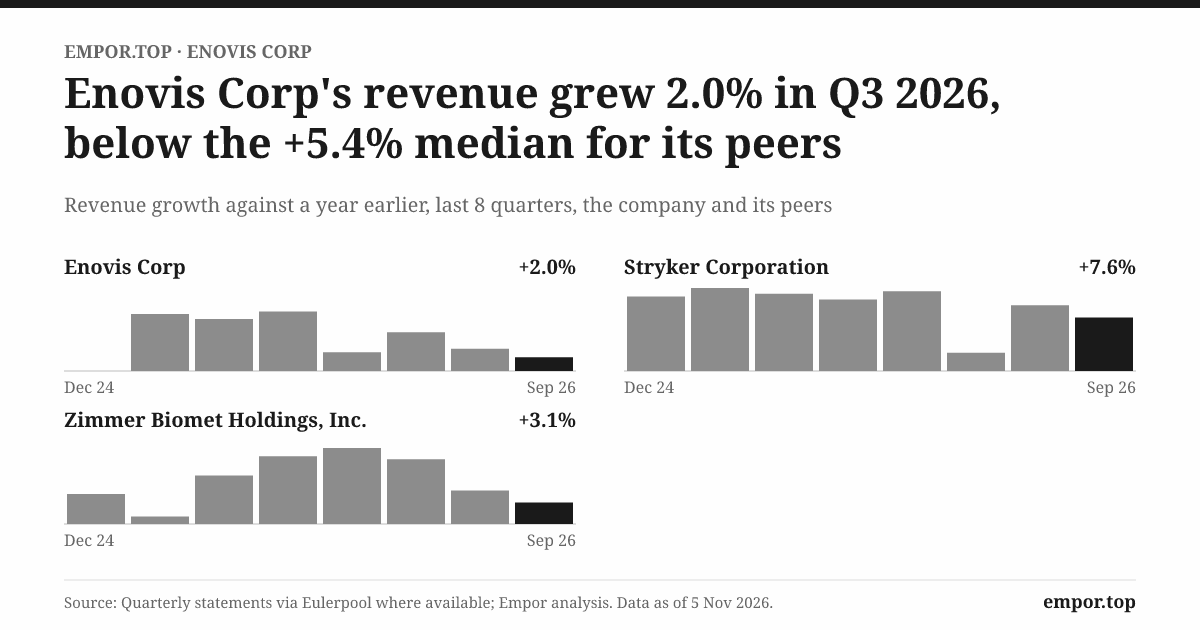
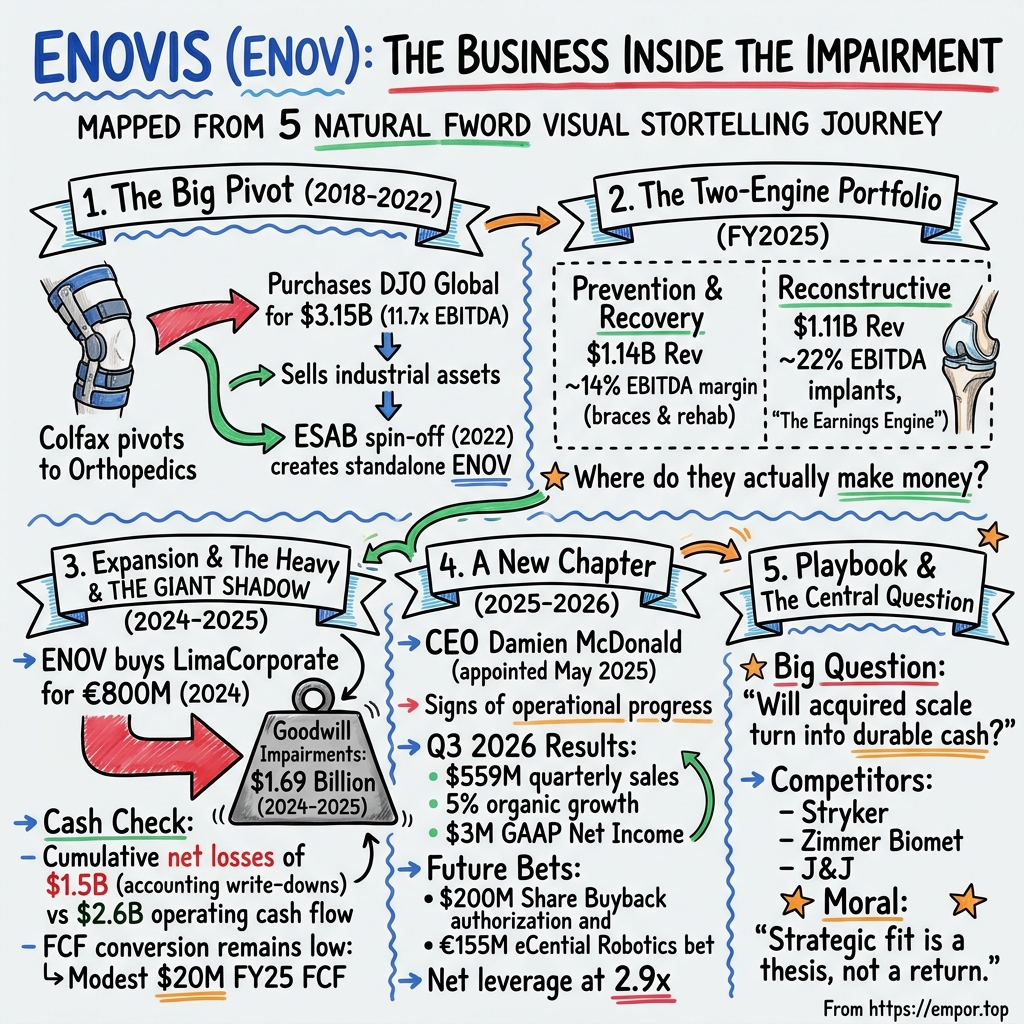
On the morning of November 5, 2026, Enovis did something it had not done in a long time. It told investors it had made money. Third-quarter sales came in at about $559 million, up 2% as reported and 5% on an organic basis, which strips out currency and the businesses the company had sold.[^1]1 And at the bottom of the income statement, after interest, after amortization, after taxes, sat a profit of about $3 million.2
Three million dollars is not a number that usually moves anyone. For a company with more than $2 billion in annual sales, it is a rounding error, roughly half a cent of profit for every dollar of product shipped. But context is everything, and the context here is brutal. Over the previous two fiscal years, Enovis had written down about $1.69 billion of goodwill: roughly $645 million in 2024 and about $1.05 billion in 2025.34 Goodwill is the accounting residue of acquisitions, the part of a purchase price that cannot be pinned to a factory, a patent or a pile of inventory. It is, in effect, the premium a buyer pays for the future. When a company writes it down, it is admitting in public that the future it paid for is worth less than it thought.
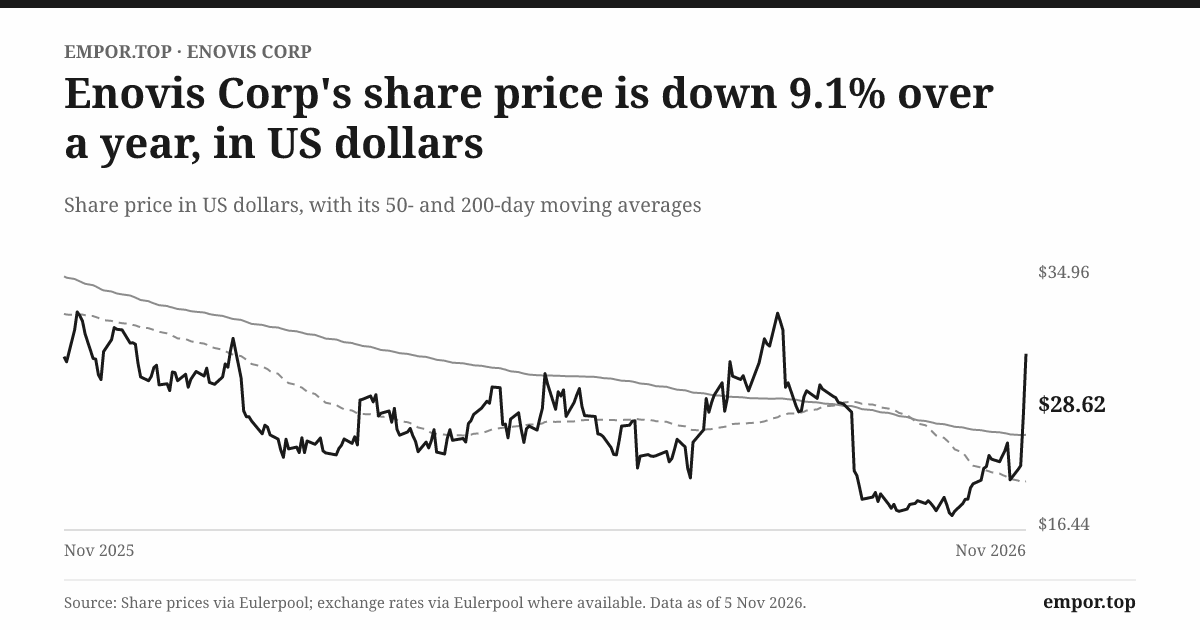
So the small profit sits next to an enormous confession. Put the two numbers side by side and the ratio is almost comic: the impairments of 2024 and 2025 were more than five hundred times the size of the quarter's net income. In the four quarters to October 2026, Enovis still lost about $9.28 a share, because the last big write-down landed in the final quarter of 2025.4 The market has drawn its own conclusions. At the close on November 5, the shares traded at about $28.62, which valued the equity at roughly $1.6 billion and the whole enterprise, debt included, at about $2.9 billion. That is about 0.7 times annual sales for the equity and about 1.3 times sales for the enterprise. Within the last five years, the stock fell at one point about 81% from its peak.
The tension in this story is easy to state and hard to resolve. Is the third quarter the first chapter of a recovery, the moment a reshaped orthopedics company finally started turning sales into profit? Or is the market right to price Enovis as a business whose acquisitions have not yet earned their cost, and may never fully do so?
Three questions will carry the story. The first is whether the product business can grow on its own, without a fresh acquisition to flatter the top line. The second is whether that growth turns into cash, because a company carrying about $1.3 billion of debt and only a sliver of cash cannot live on adjusted earnings.4 The third, and the hardest, is whether the acquisitions that built Enovis can earn returns that justify the prices paid for them.
To answer them, the listener needs to know that Enovis is really two businesses under one roof. The first, Prevention & Recovery, sells braces, supports, rehabilitation equipment and pain-management devices: the products a patient meets after a sprained knee, a sports injury or a surgery, many of them sold under brand names that physical therapists and orthopedic clinics have known for decades. The second, Reconstructive, sells implants: artificial shoulders, hips, knees and the instruments and technologies that surgeons use to put them in. In 2025 the two were almost exactly the same size, each with a little over $1.1 billion of sales.4 But they were not the same business. Reconstructive grew faster and kept more of each dollar as adjusted earnings, and it was the side of the company that the biggest acquisitions were designed to build.
That difference is the hinge of the story. Enovis's management talks about a medtech growth company. Its income statement, until very recently, described a company that bought growth and then spent years absorbing the bill. The third-quarter profit is the first piece of evidence that the two descriptions might converge. A single quarter cannot settle the question, because one quarter of $3 million can be undone by one bad tariff ruling, one quarterly charge or one weak month of surgical volumes. What it can do is tell investors what to watch.
The adjusted figures make the operational progress clearer. Management reported an adjusted EBITDA margin of about 18.5% for the quarter, up more than a point from a year earlier, and adjusted earnings per share of $0.88, up 17%.1 The company reported net leverage, the ratio of debt minus cash to a year of adjusted EBITDA, at 2.9 times, below the goal management had set for the year.1 Those are the numbers of a company that is tightening its operations. They are also the numbers of a company that defines its own scorecard, and the gap between adjusted earnings of almost a dollar a share and GAAP earnings of about six cents is a reminder of how much of the cost of Enovis's history still runs through the real accounts every quarter: amortization of acquired intangibles, integration costs, restructuring, interest.
To understand why that gap exists, and why an industrial company's family tree is buried inside an orthopedics business, the story has to go back to a very different company, one that made welding torches and industrial fans, and to a decision in 2018 that changed what it was.
 Subscribe on LinkedIn
II. The Industrial Company That Chose Orthopedics
Before it sold knee braces, this company sold the machinery of heavy industry. Enovis began life as Colfax Corporation in 1995, founded by Steven and Mitchell Rales, the brothers who had earlier built Danaher into one of the most admired acquisition machines in American business.5 The Rales playbook was famous: buy businesses with durable positions, run them with a relentless operating discipline, and redeploy their cash into the next acquisition. Colfax was a smaller sibling built on the same idea, starting in pumps and fluid-handling equipment.
The company's big leap came at the start of 2012, when Colfax acquired Charter International, a British group that brought with it ESAB, a welding and cutting business, and Howden, which made industrial fans, compressors and air-handling equipment.5 Overnight Colfax became a diversified industrial company with a global footprint. It was also a company tied to the industrial cycle: when mining, oil and gas, and power generation slowed, so did orders for fans and compressors. That is visible in the long-run figures. Colfax's revenue was about $4.6 billion in 2014 and sank steadily over the following years as industrial markets softened and portfolio changes took hold.4
By 2018 the company had decided that cyclicality was a disease and not a feature. Its leadership, under chief executive Matt Trerotola, chose an unusual cure. On November 19, 2018, Colfax agreed to buy DJO Global from Blackstone for $3.15 billion in cash.6
DJO was not a small or obscure target. It was one of the larger names in orthopedic bracing, rehabilitation and recovery products, with brands that sat in clinics and sports-medicine rooms around the world, plus a growing business in joint replacement implants. In 2018 it generated about $1.2 billion of revenue and about $269 million of adjusted EBITDA.[^8] Colfax presented the price as 11.7 times that adjusted EBITDA, and it worked out at about 2.6 times sales.[^8] For a business generating a little over a fifth of its sales as adjusted earnings, that was a full but not outrageous price for medtech, a sector where investors routinely paid more for growth than they did in industrials.
The strategic case was explicit. Colfax told investors that DJO would bring a business with higher growth, higher margins and less cyclicality than its industrial portfolio, a platform on which it could apply its own operating system and make further acquisitions.6[^8] Patients do not stop tearing ligaments when the price of copper falls. Surgeons do not delay a hip replacement because a mining company cancelled a capital project. The idea was to swap the boom and bust of heavy industry for the steadier rhythm of an aging, active population.
Then came the clean-up. Colfax divested the more cyclical parts of its portfolio, including the fluid-handling and Howden businesses, the latter sold in 2019.5 The proceeds helped pay for the pivot. What remained was an odd couple: ESAB, the welding business, and DJO, the orthopedics business, sitting side by side in one listed company. Investors who liked welding did not necessarily want braces, and vice versa, so in 2022 Colfax separated ESAB into its own listed company and renamed what was left Enovis Corporation.5
The separation gave Enovis a clean identity. It did not give it a clean history. The new company inherited the goodwill and acquired intangible assets from DJO and from the medtech acquisitions that followed it, the amortization charges that come with them, and the habit of growing by buying. The balance sheet showed the transformation starkly: total assets fell from about $8.5 billion at the end of 2021 to about $4.3 billion a year later, as ESAB left, while borrowings dropped from about $2.2 billion to about $335 million.4 For a moment, Enovis was a lightly indebted medtech company with a fresh ticker.
That moment is worth dwelling on, because it was the cleanest decision point the company ever had. A newly independent medtech business with modest debt could have chosen to grow through better products and tighter integration of what it already owned. Or it could follow the Rales-family instinct and buy another platform. The answer arrived within eighteen months, and it would define the next chapter. The two halves of Enovis earn money in very different ways.
III. Two Kinds of Orthopedics, One Sales Force
Imagine a forty-five-year-old weekend tennis player who feels something give in her knee. The first Enovis product she is likely to meet is not an implant. It is a brace, fitted at an orthopedic clinic, perhaps followed by a cold-therapy device to manage swelling and an electrical stimulation unit her physical therapist uses during rehabilitation. If she is lucky, that is the end of her story with the company. If the damage is degenerative and the years roll on, she may meet Enovis again in an operating room, as the maker of the artificial joint a surgeon chooses to replace the one that wore out.
That patient journey is the logic of Enovis's portfolio, and it is the source of both its appeal and its complexity.
Prevention & Recovery is the older half, the core of what DJO brought in. It sells braces, supports, rehabilitation equipment, regenerative and pain-management products, and related products to clinics, hospitals, physical therapists, athletic trainers and, increasingly, directly to patients.4 The products reach customers through a mix of direct sales representatives, third-party distributors and direct-to-patient channels.4 In 2025 this segment generated about $1.14 billion of sales and about $163 million of adjusted EBITDA, an adjusted margin of roughly 14%.4 It is a large and established business, but it grows slowly, and parts of it are exposed to reimbursement rules and to competition from many other makers of soft goods and rehabilitation devices.
Reconstructive is the implant business. It sells shoulder, hip, knee and extremity implants, plus the instrumentation and enabling technologies used to plan and perform those surgeries.4 Its growth is shaped by forces that are very different from those driving braces: the number of joint replacement procedures performed, the preferences of individual surgeons, the availability of implant sets in hospitals and surgery centers, the size and quality of the sales force, and the pace of new product launches.4 In 2025 Reconstructive generated about $1.11 billion of sales and about $240 million of adjusted EBITDA, an adjusted margin of roughly 22%.4
Put the two side by side and the arithmetic is striking. The segments were almost the same size in sales, but Reconstructive produced roughly half again as much adjusted EBITDA. For every $100 of product sold, Prevention & Recovery kept about $14 of adjusted earnings and Reconstructive kept about $22. That is why the story keeps returning to the implant side. A dollar of Reconstructive growth has recently carried more earnings weight than a dollar of Prevention & Recovery growth, and the acquisitions that shaped modern Enovis were aimed squarely at it. It is also why the slower bracing business matters more than its growth rate suggests: it is half the sales, and its margins set the floor for the whole company.
There is a common assumption about medical-device companies that deserves testing here: that they enjoy something like recurring revenue, because hospitals buy implants again and again and clinics restock braces every month. In a loose sense that is true, since demand repeats. In the contractual sense it is not. Enovis says that substantially all of its revenue is recognized at a point in time, typically when control of the product transfers to the customer, and that billing usually happens at the same time.4 There is no subscription. The company does not disclose what share of its revenue comes under multi-year contracts, whether any customers commit to minimum purchases, or how long its agreements typically run.42 Each quarter's sales are, in effect, the sum of thousands of individual orders, each of which a surgeon, a therapist or a hospital buyer could in principle place with someone else.
That matters for how an investor should think about the business. A company with contracted recurring revenue can tell you how much of next year is already sold. Enovis cannot, and it does not try to. Its next year depends on procedure volumes, on whether surgeons keep choosing its implants, on whether its distributors and direct representatives keep winning shelf space, and on whether its products stay competitive, all risks the company itself names in its annual report.4
The customer base raises a similar question. Enovis describes its medical customer base as highly diversified.2 That is reassuring as far as it goes: no single hospital chain seems to hold the company's fate in its hands. But the company does not publish customer concentration percentages, a top-ten customer share, or any customer above 10% of revenue.42 In orthopedics, where large hospital systems negotiate through group purchasing organizations and where distributors can control access to entire regions, the practical limit is clear. Diversification is asserted. Exposure to a handful of large distributors or hospital buyers cannot be measured from the outside.
Geography adds a final layer. About 42% of Enovis's 2025 sales came from outside the United States.4 That makes the company more international than many American orthopedic peers of its size, a legacy of DJO's European operations and, above all, of the acquisition that came next. It also means that the dollar's moves can add or subtract several points of reported growth in any given year. In 2025, a weaker dollar added about $30 million to reported sales.4 The workforce tells the same story: of roughly 7,800 employees at the end of 2025, only about 2,100 worked in the United States, while about 5,700 worked elsewhere.4 Enovis is an American-listed company whose people, factories and a large share of its customers sit abroad, which shapes everything from its cost base to the way it hedges. It uses forward currency contracts and cross-currency swaps, some designated as hedges of its foreign investments, and those swaps have at times produced meaningful interest income that flows through the financing lines rather than the operating ones.4 That makes reported earnings noisier than the underlying business, and it is one more reason the adjusted and GAAP numbers diverge.
Two businesses, then, with different growth rates, different margins and different competitive dynamics, sharing a balance sheet and a corporate strategy. A newly independent Enovis faced a choice about which side to build. In 2023 it answered decisively, with a bet on an Italian implant company that would double the size of Reconstructive.
IV. When the Buyout Became the Growth Plan
San Daniele del Friuli is a hill town in northeastern Italy best known for its prosciutto. It is also, improbably, home to one of Europe's more interesting orthopedic companies. LimaCorporate was founded there in 1945 by the Lualdi family, and over the decades it grew into a global implant maker with a particular expertise in additive manufacturing: printing implants in metal, layer by layer, using a proprietary porous structure it calls Trabecular Titanium, designed to mimic the spongy architecture of real bone so that the patient's bone can grow into it.7 By the early 2020s Lima operated directly in more than 20 countries and sold large-joint revision and primary implants alongside a complete line of extremity products, including shoulders.7 Its owner was EQT, the Swedish private-equity firm.
On September 25, 2023, EQT announced that it would sell Lima to Enovis.7 Lima had generated about €249 million of revenue in 2022.7 The deal had an enterprise value of about €800 million, paid with roughly €700 million in cash, including the repayment of Lima's debt, and Enovis shares valued at about €100 million.3 Matt Trerotola, still Enovis's chief executive, called it a strategic combination that "expands and strengthens our geographic reach and orthopedic leadership around the world."7 The deal closed in January 2024.3 EQT's announcement made a point of promising that San Daniele would remain the fulcrum of production, with new investment to finish a production building at the headquarters.7 That detail matters more than it seems. Lima's value lay partly in a manufacturing capability that is hard to copy, and keeping it intact in Friuli was part of the bargain, which also meant that Enovis was buying a factory footprint and a capital-spending commitment alongside the brand.
The strategic pitch had three parts. Lima's products were complementary to Enovis's, especially in shoulders and extremities, where Enovis already had a strong American position and Lima had a strong international one. Lima's European and international footprint would give Enovis reach outside the United States. And Lima's manufacturing technology, particularly its 3D-printing know-how, would deepen the company's capabilities in implants.7 The combination was meant to turn Enovis from a mid-sized player in reconstruction into one with genuine global scale in the faster-growing, higher-margin half of its business.
The price is the first place to test the idea. About €800 million for €249 million of 2022 revenue works out to roughly 3.2 times sales. Was that expensive? The honest answer is that the available comparisons cannot say. A dated snapshot of medical-device trading multiples at the end of 2025 showed Enovis itself at about 1.3 times enterprise value to revenue, CONMED and Envista at about 1.5 times, and Globus Medical at about 4.1 times.8 Lima's multiple sits inside that range. But a trading multiple is what investors pay for a small slice of a listed company on one day; an acquisition multiple includes a control premium, is struck at a different moment in the cycle, and reflects a buyer's private view of synergies. Those peer figures are also two years removed from the deal and from very different business mixes. They are context, not proof. They cannot establish whether Lima was cheap or dear. Only the cash Lima produces under Enovis's ownership can do that.
So follow what came next. In 2024, its first year inside Enovis, Lima contributed about $322.5 million of sales and a net loss of about $17 million.3 That loss is not as alarming as it sounds, because acquisition accounting front-loads costs: the inventory acquired at fair value flows through cost of sales at a higher price, intangible assets are amortized, and integration costs pile up. But it is a reminder that the first year of an acquisition is rarely a showcase.
The segment numbers tell the bigger story. Reconstructive sales rose from about $630 million in 2023 to about $1.11 billion in 2025, and the segment's adjusted EBITDA roughly doubled, from about $117 million to about $240 million.43 That is a transformation in scale. The adjusted margin rose too, from roughly 19% to roughly 22%, which suggests the enlarged business is not simply larger but more profitable per dollar of sales on management's preferred measure.
The question an investor has to ask is how much of that growth is acquired and how much is earned. Most of the jump from 2023 to 2024 was Lima itself. The growth from 2024 to 2025 is more informative, because Lima was in both years, and there the company attributed its growth to volume in the existing business and to a weaker dollar rather than to new purchases.4 By the third quarter of 2026, Reconstructive organic growth was about 6%.1 That is a respectable rate for orthopedic implants, a market that industry trackers estimate grows in the mid-single digits.9 It is not yet evidence that the combination is growing much faster than the market. Management argues that integration and cross-selling are still building; on the third-quarter call, the chief financial officer described 2026 as "the last big meaningful year of investments in integration on Lima."1 That is a claim about the future, and it should be marked as one.
Now place the impairments beside the thesis. In 2024, the year Lima closed, Enovis impaired goodwill in both of its reporting units, including about $330 million in Reconstructive.3 The Reconstructive charge is the uncomfortable one. Goodwill impairment tests compare the estimated fair value of a reporting unit with its carrying value on the books. When the fair value falls short, the difference is written off. A Reconstructive charge in the very year the company paid a large premium for a reconstructive business means the combined unit was judged to be worth less than its carrying value, which included the new goodwill from Lima. That is not proof that Lima was overpaid for. Impairment tests are sensitive to discount rates, which rose sharply in 2023 and 2024, and to the company's own share price, which had fallen. But it is a clear signal that the value expectations embedded in the purchase did not survive the first year intact.
Then, in 2025, Enovis recorded further goodwill impairment charges across the business.4 The charges landed mainly in the third and fourth quarters of 2025, when the company reported net losses of about $571 million and $520 million.4 The auditor's report on the 2025 accounts treated the goodwill valuation as a critical audit matter, which means it required especially challenging judgment, but the report was unmodified and identified no material weakness.4 The accounts are clean. The verdict they record is harsh.
Here the story has to be precise about what is known. Lima clearly added revenue, and a great deal of it. The enlarged Reconstructive business clearly generates more adjusted EBITDA than the old one did. What is not established is whether those added earnings, after integration costs, interest on the debt that funded the deal and the capital needed to keep the business growing, will produce a return on the roughly $900 million Enovis committed. The impairments say the estimated value of the combined business fell. The question going forward is not whether Lima added revenue. It is whether the enlarged business can earn enough cash on its enlarged capital base to make the price look sensible in hindsight.
That depends on something no balance sheet can show: whether surgeons, one operating room at a time, keep choosing Enovis's implants over those of companies many times its size.
V. The Products Have to Win in the Operating Room
Picture the decision from the surgeon's side of the table. A shoulder surgeon at a busy hospital or an ambulatory surgery center has done hundreds of replacements with one implant system. She knows its instruments by feel, knows how its components fit, knows the representative who shows up at 6:30 in the morning with the right sizes in the tray. Now someone wants her to try something different. The new system has to be better enough, or easier enough, or supported well enough, to justify the risk of changing a routine that works. That is the battlefield on which Enovis's Reconstructive business is won or lost: not in a procurement office, but in the habits of individual surgeons.
The competitive map is daunting. Worldwide joint replacement sales were almost $24 billion in 2025, the largest segment of a roughly $65 billion orthopedic market, and that segment was still growing at a mid-single-digit rate.109 The market is dominated by a small group of giants. Enovis names Stryker, Zimmer Biomet and Johnson & Johnson's DePuy Synthes among its competitors and acknowledges that many rivals have substantially greater scale and resources.4 Each of those three sells many times more in implants than Enovis's entire Reconstructive segment, and each has spent heavily on surgical robots that tie hospitals to their implant portfolios. Globus Medical and a range of more focused orthopedic companies compete in overlapping categories.4 Against that field, Reconstructive's roughly $1.1 billion of sales makes Enovis a meaningful but distinctly second-tier player in global joint replacement.
Where it is not second tier is shoulders. On the third-quarter call, the chief financial officer described Enovis as "the global No. 3 player in shoulder, No. 2 internationally."1 Shoulder replacement is a smaller market than hips and knees, but it has been growing faster, and it is technically demanding, which rewards companies with specialized implants and instrumentation. Lima's strength in international shoulders is a large part of why that ranking exists. That claim is management's own characterization of its position, not an independently audited market share, but it is consistent with the logic of the Lima deal and with the fact that extremities led Reconstructive growth in the quarter.
What actually drives wins and losses in this business? Five mechanisms matter. The first is procedure growth: as populations age and stay active, more people need joints replaced, and every company in the market rides that tide. The second is surgeon preference, which is sticky and slow to shift. The third is product availability, because an implant system only sells if the right sizes and instruments are physically in the hospital when the surgery is scheduled, which is why orthopedic companies carry so much inventory. The fourth is commercial coverage: the number and quality of representatives who can support surgeons in the operating room. The fifth is innovation, which gives representatives a reason to ask for a surgeon's time.
Enovis's third-quarter results offer some evidence on each. Reconstructive grew about 6% organically, with extremities up about 8% and hips and knees up about 5%.1 The chief executive said the company believes it is continuing to take share in knees, and the chief financial officer said the same about shoulders.1 Those are claims, and the evidence offered behind them is more interesting than the claims themselves. The most concrete data point concerned a hip stem called Nebula: management said that more than 80% of new instrument sets placed for it went to surgeons who had been using competitors' products, and that it had become the company's top-selling stem.1 That is the kind of evidence that matters, because it describes actual conversion of surgeons. But it is a ratio of instrument sets placed, not a measure of revenue or share, and the company does not publish how many surgeons that represents or how many of them stay.
The analysts on the call pushed on exactly this point. One asked why American hips and knees were softer than extremities and international markets. Another, from Baird, listed a series of competitive pressures in U.S. hip and knee and asked whether growth there was slowing; the chief executive acknowledged that "we are seeing all of that," and the chief financial officer noted that the company does "not guide for anatomy level."1 A fair reading is that Enovis is gaining ground in certain products and anatomies, especially shoulders and specific hip and knee systems, while the core U.S. hip and knee market remains intensely contested. "Taking share" is therefore a claim with real but partial support: plausible in shoulders and in specific product lines, unproven as a description of the whole Reconstructive franchise.
A further shift is happening in where surgery takes place. More joint replacements are moving from hospitals to ambulatory surgery centers, which are cheaper and faster but more cost-conscious and more sensitive to the logistics of instrument sets. Management said that a little over a quarter of its primary knees and about a fifth of its hips are now done in such centers.1 Whether that channel favors a nimble mid-sized supplier or the giants with full robotic ecosystems is an open question, and one Enovis has a direct stake in.
Technology is where the claims require the most care. Enovis has invested in computer-assisted surgery, including ARVIS, an augmented-reality system that projects surgical guidance into a headset the surgeon wears, rather than relying on a large robot parked beside the operating table.4 The appeal is easy to grasp: a surgeon gets real-time navigation without the hospital having to buy and house an expensive machine. In October 2026, management said, the first ARVIS shoulder cases were performed in Europe.1 That is a genuine technical milestone. It is not yet evidence of adoption or of profitable revenue. A first case tells an investor that the system works in a surgeon's hands; it does not tell them how many surgeons will use it, whether it pulls implant sales with it, or whether it earns its development cost. The history of orthopedic technology is full of navigation systems that were technically impressive and commercially marginal. The fair conclusion is that Enovis's enabling technology may support its implant business, but the company has not yet published adoption figures that would prove it.
Behind all of this sits the research budget. Enovis spent about $120 million on research and development in 2025, about 5.4% of revenue, up from about 4.3% the year before.4 Management said it would add another $4 million of investment in enabling-technology R&D talent in the fourth quarter of 2026.1 Rising spending is a necessary condition for staying competitive against larger rivals. It is not a sufficient one, and the giants spend far more in absolute terms.
Prevention & Recovery needs to be judged on its own terms. Its growth and margins have lagged Reconstructive. In the third quarter of 2026 it grew about 3% organically, with global bracing up about 3% and regenerative products growing at double digits as a new product launched.1 The company also trimmed the segment, selling its Dr. Comfort footcare business to Promus Equity Partners in October 2025 for up to $60 million, a move management framed as sharpening its focus and supporting margin expansion and faster debt reduction.11 That sale shrank reported growth by about two and a half points in the third quarter, which explains much of the gap between 2% reported and 5% organic growth for the company.1 Bracing and rehabilitation are competitive markets with many suppliers and powerful payers. What it has is scale, brand familiarity among clinicians and the breadth of its channels.
The strongest version of the case for Enovis, then, is not that it has an unassailable product edge. It is that it has a credible reconstructive franchise with a genuine international shoulder position, a stream of new products that is winning some surgeons from competitors, and a technology program that could keep it relevant as surgery becomes more digital. The weaker version is that its evidence for pricing power and switching costs is thin, its share gains are claimed more often than they are quantified, and it competes in hips and knees against companies that can outspend it many times over. Products win in the operating room. Companies win on the cash flow statement. That is where the next chapter goes.
VI. The Cash That Didn't Follow the Profit
Every annual report contains a page that is more honest than the rest: the cash flow statement. It starts with net income, the number built from accounting judgments, and then walks, line by line, to the cash that actually came in. For Enovis, that walk has become a long one. In 2025, the company reported a net loss of about $1.2 billion and yet generated about $217 million of cash from operations.4 How can a company lose more than a billion dollars and still bring in cash?
The answer is that the loss was almost entirely made of things that did not consume cash in that year. The roughly $1.05 billion goodwill impairment was a write-down of value paid for long ago. On top of it sat about $121 million of depreciation and amortization and about $174 million of amortization of acquired intangible assets, the slow expensing of the brands, technologies and customer relationships that came with acquisitions.4 None of those charges required Enovis to write a check in 2025. All of them recorded, in different ways, the cost of past decisions.
Stretch the lens across a longer period and the pattern becomes clearer. From 2014 through 2025, the company that became Enovis reported cumulative net losses of about $1.5 billion. Over the same twelve years it generated about $2.6 billion of operating cash flow and about $1.3 billion of free cash flow, the cash left after capital spending.4 It paid no dividends.4 And yet its cash and short-term investments fell by about $275 million over the period, to about $36 million at the end of 2025.4 More than a decade of positive free cash flow did not build up a cash pile. That cash went somewhere.
It went, mainly, into acquisitions and into the reshaping of the portfolio. In 2019 alone, investing outflows were about $1.6 billion as DJO was bought; in 2024, acquisition and investment outflows were about $770 million as Lima closed.43 Those purchases were funded by a mix of internally generated cash, asset sales and borrowing. The consequence is that the cumulative operating cash of the past decade is not sitting on the balance sheet as a cushion. It is embedded in the acquired businesses, whose estimated value has since been marked down by about $1.69 billion.
The write-downs did not consume cash when booked; the cash left when Enovis made the acquisitions. But they were not meaningless. Under audit, Enovis recorded that the future cash flows it expected from those businesses, discounted at the rates investors then demanded, were worth less than the books said. The charges tell investors that the cash already spent was less productive than planned.
The reinvestment picture has a more constructive side. In 2025 Enovis spent about $120 million on research and development and about $197 million on property, equipment and intangible assets, together close to 14% of revenue.4 In orthopedics, a large part of capital spending goes into instrument sets, the trays of tools and trial implants that companies place in hospitals so that surgeons can use their systems. Those sets are an investment in future sales: without them, no surgeon can switch. They are also expensive and slow to pay back, and they are one reason free cash flow in 2025 came to only about $20 million, the difference between $217 million of operating cash and the capital spending that followed.4 Twenty million dollars of free cash flow against about $1.3 billion of debt is a thin margin of safety.
The lenders, at least, have been accommodating. At the end of 2025, Enovis's roughly $1.3 billion of borrowings consisted of a term loan of about $690 million, convertible notes of about $450 million and about $160 million drawn on its revolving facility and other debt.4 In December 2025 it amended its credit agreement, pushing the term loan's maturity out to December 2030, and it ended the year with about $943 million of undrawn revolver capacity and in compliance with its covenants, which cap senior secured leverage at 3.5 times and require interest coverage of at least 3 times.4 So the company is not short of liquidity in the sense of being unable to pay its bills; its cash balance is small because it relies on the revolver as its reserve. What it is short of is slack. Each acquisition draws on the same facility that would cushion a bad year, and by October 2026 the company held only about $13 million of cash on its balance sheet.2
Working capital explains another part of the gap. Implant companies carry enormous inventories, because every procedure requires a range of sizes to be on hand even though only one will be used. Enovis's inventory equaled about 236 days of cost of sales at the end of 2025, and its cash conversion cycle, the time between paying for inventory and collecting from customers, was about 232 days.4 Those are long cycles even by orthopedic standards, and they have lengthened over the decade as the portfolio shifted toward implants. In 2025, working capital absorbed about $42 million of operating cash, largely because of growth in international Reconstructive sales.4 Growth in this business consumes cash before it produces it.
Receivables look steadier. Debtor days, the number of days of revenue sitting in unpaid invoices, were about 72 at the end of 2025, well below a peak of about 107 in 2017.4 Trade receivables were about $443 million at the end of 2025 and about $428 million by October 2026, with an allowance for credit losses that barely moved, at about $26 million.42 Write-offs were modest in both periods. The company does not disclose the ageing of its receivables, or how much is overdue, so rising sales alone cannot settle the quality of collections, but nothing in the reported figures suggests a deterioration.
The more encouraging news is in 2026. In the first nine months of the year, operating cash flow was about $171 million, up from about $129 million a year earlier.2 Free cash flow in the third quarter was about $35 million, and year-to-date free cash flow was about $37 million, up about $50 million from the prior year.1 Management's target for 2026 is free cash flow conversion, meaning free cash flow as a share of adjusted net income, of more than 25%, and it has pointed to a framework of at least 50% conversion and about $100 million of cash generation in 2027.1
Read those targets carefully. A 25% conversion target means management expects to turn only about a quarter of its adjusted profit into free cash this year. That is low, and it reflects how much of the adjusted earnings figure is consumed by interest, integration costs, restructuring, capital spending and working capital. Doubling it next year would be a real improvement. It has not happened yet. Until full-year free cash flow and actual debt reduction confirm the trend, the 2026 improvement is a direction, not a destination.
This is the setting in which a new chief executive arrived, inherited the impairment years, and then had to decide what to do with the cash the business was starting to generate.
VII. A New CEO, a Buyback and Another Robotics Bet
Damien McDonald walked into Enovis in May 2025 carrying a résumé that read like a tour of the medtech industry. He had run LivaNova, a London-headquartered, Nasdaq-listed maker of cardiovascular and neuromodulation devices, as chief executive from early 2017 until April 2023, after a brief stint as its chief operating officer.412 Before that he had been a group executive at Danaher, leading its professional consumables businesses, had led Zimmer's spine division, and had run global marketing for Johnson & Johnson's Ethicon surgical business.12 The Danaher thread is not incidental. It links him to the operating culture that the Rales brothers built into Colfax at the very beginning.
His LivaNova record was mixed. Trade press described his departure as following disappointments in the company's pipeline, and analysts gave his tenure a varied verdict.13 That history matters because it is the closest available evidence of how he runs a public medtech company under pressure. It does not settle anything at Enovis, and the impairment charges predated him. Enovis's board announced his appointment on April 2, 2025, effective May 12, and he succeeded Matt Trerotola, who had planned to retire and stayed on as an executive advisor for a year.1214
Pay is one window into accountability. In 2025, McDonald's reported compensation was about $9.24 million; Trerotola's was about $9.42 million; and chief financial officer Phillip Berry's was about $5.14 million, up from about $3.43 million in 2024.14 Those are substantial sums for executives of a company that reported consecutive GAAP losses, even if the losses were largely impairment-driven. Shareholders did not object. At the May 2026 annual meeting, the say-on-pay vote passed with about 49.5 million votes for and about 2.2 million against, roughly 96% support among votes cast.15 Shareholders also approved an additional 3.65 million shares for the company's incentive plan, equal to roughly 6% of the shares outstanding, which creates potential future dilution.1514 The largest disclosed holder is BlackRock, with about 16% of the shares; there is no controlling shareholder.16 Alignment, in other words, comes from equity awards and an institutional register, not from founders or large insider stakes.
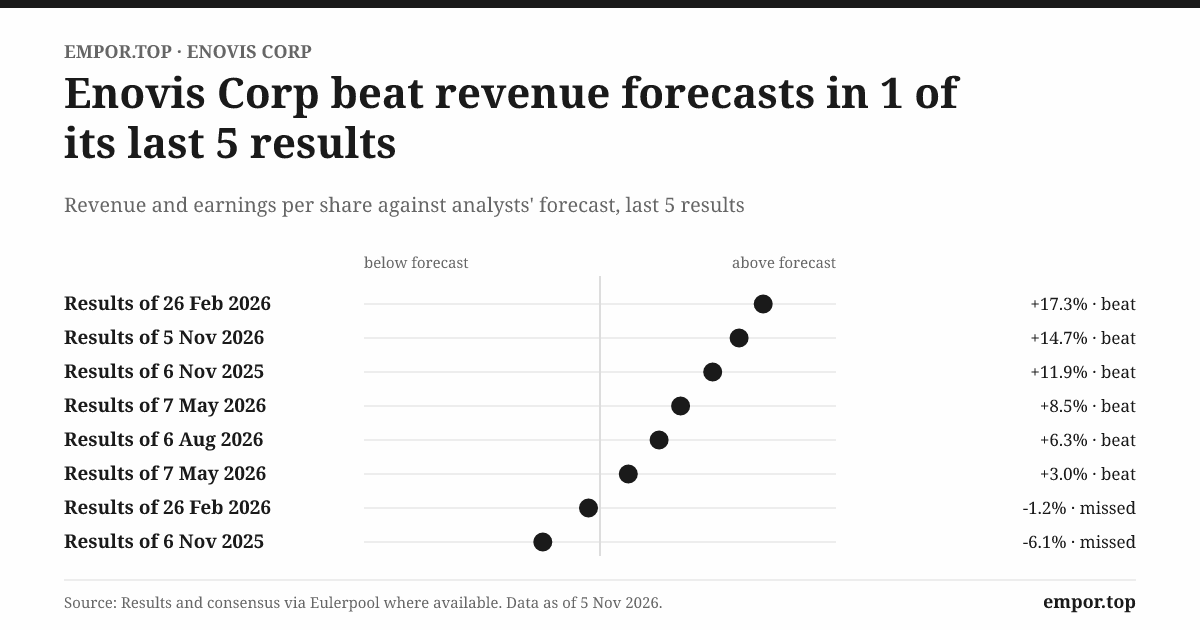
Guidance is the second window, and here the record of McDonald's team is short but reasonably consistent. In August 2026, reporting second-quarter sales of about $583 million and 5% organic growth, management reaffirmed its 2026 outlook of 4% to 6% organic growth and adjusted EBITDA of $425 million to $435 million, while warning that it anticipated "a more dynamic macroeconomic environment in the second half."17 In November, it narrowed organic growth to about 5%, narrowed revenue guidance to $2.32 billion to $2.35 billion, and raised adjusted EBITDA to $428 million to $438 million and adjusted earnings per share to $3.58 to $3.79.1 When an analyst asked why guidance rose by less than the quarter's beat, the chief financial officer pointed to the extra $4 million of R&D spending and about $1 million of currency headwind.1 That is a specific, numerical explanation, which is more than many companies offer. A team that warned of a tougher half and then delivered within its range is building credibility. One year is not a track record.
The third window is capital allocation, and here two decisions arrived about nine weeks apart. On November 2, 2026, the board authorized a new share repurchase program of up to $200 million, replacing the previous authorization.[^1]1 Berry said the company would use it opportunistically and stay within a leverage range of 2.5 to 3.5 times, and he described the shares as "dislocated."1 For context, Enovis bought back only about $3.5 million of stock in 2025.4 An authorization is permission, not action. A $200 million program is about an eighth of the company's market value, and roughly ten times the free cash flow it generated in 2025. It can only be executed at scale if cash conversion improves sharply or if the company borrows to buy.
The second decision pulls in the opposite direction. On September 1, 2026, Enovis announced a binding offer to acquire eCential Robotics, a French developer of surgical navigation and robotics, at an enterprise value of about €155 million, with up to €35 million more in milestone payments.18 eCential's Op.n platform combines real-time spine navigation, robotic guidance and 3D imaging in the operating room.18 Enovis plans to fund the purchase with cash and its revolving credit facility, and management said the deal would raise leverage by about half a turn when it closes, which it expects by the end of 2026.181 French law required a consultation with eCential's works council before a definitive agreement, which management said had been completed.1
The rationale McDonald offered was strategic. He described the combination as an ecosystem of planning, navigation and robotic assistance that would let Enovis "compete head to head" for hospital contracts that require such technology, and he said the robot should come to market within two years, with a shoulder application to follow.1 That is the heart of the bet. In joint replacement, robots have become a way for the largest companies to lock hospitals into their implant portfolios: a hospital that has bought one company's robot tends to buy that company's implants. Enovis, without a robot, risks being shut out of those contracts. eCential is its answer.
It is also, plainly, another acquisition, and one whose payoff depends on a product that is not yet on the market for joints. Optionality is not the same as a profit pool. The milestones that would show commercialization are concrete: closing on schedule, regulatory clearance for joint applications, a launch within the two-year window management described, and, ultimately, evidence that hospitals buy more Enovis implants because of the system. Until then, eCential is a cost and a capability, not a revenue stream.
Put the pieces together and the capital allocation picture is one of competing claims on limited cash. Net leverage was 2.9 times at the end of the third quarter. eCential would push it toward roughly 3.4 times on management's own estimate, close to the top of the stated range and not far from the 3.5 times senior secured leverage ceiling in the credit agreement, although the two measures are defined differently.14 A buyback would push in the same direction unless cash flow rises quickly. The current team has shown improved operating results and raised guidance. The impairment years, which it did not create but now owns, weigh against any broad claim that the company has proven its acquisition discipline. This management will be judged on whether it can do three things at once: invest in robotics, buy back stock and still bring leverage down. That is a demanding combination, and it frames the case for and against Enovis.
VIII. What Would Make the Case Work—or Break It
Imagine two scorecards laid out side by side on the desk of a long-term investor. The first is built from what Enovis is doing right: organic growth of about 5% in the third quarter, adjusted margins rising, a reconstructive business that now earns more than the bracing business, a stream of new products and a first step toward its own robot. The second is built from what the company has not yet proved: two years of goodwill write-downs, a thin cash balance, leverage near the top of its range, and a long history of buying growth rather than generating it. Both scorecards are true. The work is deciding which one the next few years will confirm.
The case for Enovis starts with organic growth. A company that can grow about 5% a year without acquisitions, in a joint replacement market growing at a mid-single-digit rate, is at least holding its own against larger competitors.19 If that growth is concentrated in the higher-margin Reconstructive segment, it lifts profitability as well as sales, because, as the segment comparison showed, each Reconstructive dollar carries more adjusted earnings. R&D spending has risen as a share of revenue, the shoulder franchise has real international standing, and products like the Nebula hip stem show that the company can win surgeons from rivals. Add eCential and ARVIS, and Enovis has a route into the technology-driven contracts that would otherwise be closed to it. On that view, growth without another big acquisition is plausible, and the impairments belong to an earlier strategy.
The case against starts with the long record. Over the five years to 2025, reported revenue fell by about 6% a year, and over ten years by about 5.5% a year.4 Much of that reflects the shedding of industrial businesses rather than weakness in orthopedics, so it is not a fair test of the medtech franchise. But the more recent growth is not clean either: the three-year growth rate of about 13% a year from 2022 to 2025 is inflated by Lima and shaped by divestitures.4 The company has impaired about $1.69 billion of goodwill. And the evidence on the things that make a moat, product-level share, surgeon retention and price realization, is limited to management's characterizations and a few ratios.
The industry structure helps explain why the moat question is so hard. Buyers have real power. Hospitals and surgery centers buy through purchasing groups, can choose among several established implant vendors, and in many markets push hard on price. Enovis's description of a diversified customer base suggests no single buyer dominates its revenue, but the company publishes no concentration or retention data, so the strength of that defense cannot be tested.2 Rivalry is intense: the three largest competitors have more scale, more capital and robot ecosystems. Substitutes are limited for a patient who needs a new joint, but within bracing and rehabilitation there are many suppliers and payers who treat products as interchangeable. New entrants face steep barriers in implants, because of regulation, clinical evidence and the cost of instrument sets, and modest ones in soft goods. Suppliers matter mostly through raw materials, freight and manufacturing costs; the third quarter showed both sides of that, with about $8 million of tariff refunds offset partly by about $3 million of inflation tied to the conflict in the Middle East.1
Measured against Hamilton Helmer's seven sources of lasting advantage, Enovis's position is best described as partial. It has some switching costs, because a surgeon trained on a system and a hospital stocked with its instrument sets face real friction in changing. But the company does not disclose retention rates, and the Nebula figures show that the same friction can be overcome when a competitor offers something better, which is exactly how Enovis wins surgeons and how it could lose them. It has some scale benefits in distribution, but far less than its largest rivals. Its brands are recognized among clinicians, especially in bracing, but brand power in medical devices rarely translates into large price premiums. It has process know-how in additive manufacturing through Lima, which may be a modest cornered resource. It has no evident network effects and no counter-positioning against incumbents. The fair verdict is that Enovis has competitive capability but not an established moat: it can win, but it has to keep winning, one surgeon and one contract at a time.
Now the stress test that a skeptical activist would run. Line up the two big purchases with what followed. DJO was bought at about 11.7 times adjusted EBITDA on the promise of higher growth, higher margins and less cyclicality. The company did become a medical-device business with steadier demand, but its reported operating margins have mostly been negative since 2020, and its returns on invested capital have stayed in the low single digits at best, about 2.4% in the twelve months to October 2026.4 Lima was bought at about 3.2 times sales, a multiple that looks broadly within a dated peer trading range, but the company impaired Reconstructive goodwill in the year it closed. The verdict from the company's own record is that the acquisition strategy narrowed rather than delivered its promise: it built scale and a better business mix, but it has not yet produced returns that justify the capital. An activist would ask why, with that record, the company is buying again before proving the last purchase.
The risks that matter are specific. Procedure volumes and reimbursement drive demand: fewer surgeries, or tighter reimbursement for braces and rehabilitation devices, would hit sales directly. Larger competitors can pressure adoption and pricing, especially in U.S. hips and knees, where analysts on the third-quarter call were already probing for signs of slowing.1 About 42% of sales come from outside the U.S., so currency can swing reported results by several points, and management described Western Europe as challenging for several quarters.41 Inflation, tariffs and supply-chain disruption can squeeze costs, as the Middle East conflict showed. And the debt, about $1.3 billion including about $450 million of convertible notes, plus the cost of eCential, constrains everything else.4
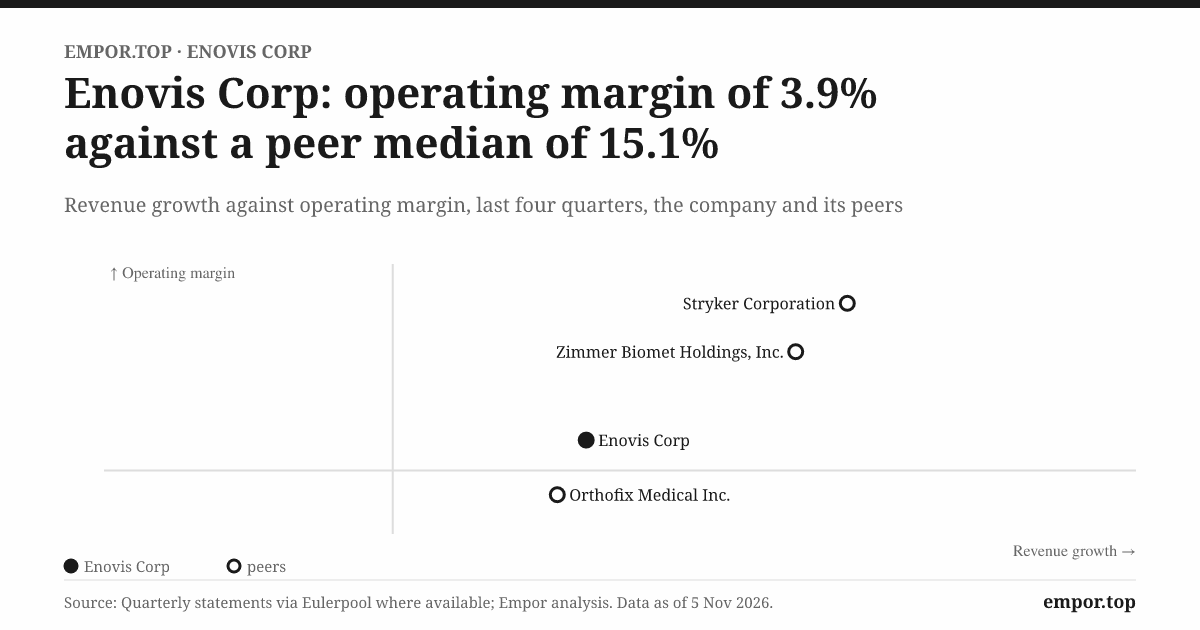
Three measures will tell the story better than any other. The first is organic sales growth by segment, latest reading about 6% in Reconstructive and about 3% in Prevention & Recovery, with the company at about 5%, recently steady.1 The second is segment adjusted EBITDA margin read alongside GAAP operating profit: in 2025, the segments earned about 14% and 22% on an adjusted basis, while the company's GAAP operating margin was slightly negative, a gap that should narrow if the recovery is real.4 The third is free cash flow conversion and net leverage, latest readings about 2.9 times leverage and a 2026 conversion target of more than 25%, both moving in the right direction but from weak levels.1
Valuation sets the frame but not the answer. At about 0.7 times sales for the equity and 1.3 times for the enterprise, and about 1.0 times book value, the market is pricing Enovis well below the levels it paid for its own acquisitions, and at the lower end of the peer range the 2025 snapshot showed.8 The P/E is meaningless with GAAP losses, and Enovis's own multiples over time are not a useful guide given how much the business has changed. A low sales multiple says that the market doubts Enovis will convert sales into durable profit. It does not, by itself, say that the doubt is misplaced. The price appears to assume that the company will keep growing but will struggle to earn much on its capital. Proving otherwise is the company's job, and the lessons of how it got here are worth drawing out.
IX. Playbook: Business & Investing Lessons
Go back to the slide deck of November 2018. Colfax's pitch for DJO was clean and persuasive: leave the boom and bust of industrial markets, buy into orthopedics, enjoy faster growth, fatter margins and steadier demand.[^8] Every element of that pitch was reasonable. Orthopedic demand really is steadier than demand for industrial fans. Medtech margins really are, on average, higher than industrial margins. The company really did become a medical-device business. And seven years later it wrote off about $1.69 billion of goodwill in two years. The lessons of Enovis live in the space between a pitch that was right about the industry and a result that has so far been wrong about the returns.
The first lesson is that a strategic fit is a thesis, not a return. Lima was a near-perfect fit on paper: complementary shoulders, an international footprint where Enovis was thin, a distinctive manufacturing technology, a family-founded Italian company with a history of innovation.7 Reconstructive did double in size, and its adjusted earnings did roughly double. Yet the Reconstructive reporting unit was impaired in the year the deal closed.3 Fit explains why the combined business is bigger and arguably better. It does not explain whether the roughly $900 million price will come back as cash. For founders and investors, the wider point is that the word "strategic" in an acquisition announcement describes the buyer's intentions. The return is a separate question, answered years later by the cash flow statement, and the best acquirers are the ones who keep those two questions apart.
The second lesson is that a non-cash loss can still be a real warning. It is common to hear goodwill impairments dismissed as accounting noise, since no money leaves the company when they are booked. Enovis's record shows why that is too easy. The cash left when DJO and Lima were bought; the impairments are the moment the company admitted, under audit, that the future it bought was worth less than it paid. Twelve years of positive operating cash did not build a cash cushion, because the cash went into acquisitions whose value was later marked down. The investor's habit should be to treat a large impairment as a delayed verdict on a capital allocation decision. It is not a reason to panic, and it is not a reason to ignore it. It is a reason to ask what return the remaining assets must earn to justify their carrying value.
The third lesson belongs to medical devices in particular: a product has to reach the surgeon before it reaches the income statement. Enovis has invested heavily in implants, instrument sets, augmented-reality navigation and now robotics. The investments that matter are the ones that change what happens at 7 a.m. in an operating room, when a surgeon decides which system to open. That is why the Nebula conversion figure is more useful than any number of product launches, and why the company's lack of disclosed adoption, utilization or retention measures is so frustrating. In a business built on surgeon habits, the most valuable disclosure is not how many systems were launched but how many surgeons changed their minds and stayed changed.
The fourth lesson is about leverage and patience. Enovis emerged from the ESAB separation with modest debt and a chance to prove itself as a standalone medtech company. Within two years it had borrowed again to buy Lima, and its debt-to-equity ratio rose from about 0.1 to about 0.9 as impairments shrank equity and borrowings rose.4 The broader point for any company rebuilding itself through acquisitions is that each deal shortens the runway for the next one. A business that buys before the previous purchase has proved itself can end up with neither the cash to invest nor the credibility to borrow. Enovis is not there; its lenders have given it ample headroom. But the eCential bet, the buyback and debt reduction now have to share the same pool of cash, and that pool is still small.
X. Epilogue
Tonight, Enovis stands at an interesting point. It has just reported a quarter with its first GAAP profit in a long time, organic growth that matched its guidance, adjusted margins that were rising and leverage below its own target.12 Its shares had recovered from a 52-week low of about $17.43 to about $28.62, though they remained below their recent high. And it is working to close another acquisition, has authorized a share repurchase program and has just raised its full-year guidance. The next few months will decide whether this is the beginning of a better chapter or another false dawn.
The first moment that matters is the fourth-quarter report, expected early in 2027, which will close out the 2026 guidance. Management has guided to about 5% organic growth for the full year, with revenue of $2.32 billion to $2.35 billion and adjusted EBITDA of $428 million to $438 million, and expects the fourth quarter to accelerate on shoulder sales, ARVIS, Nebula conversions and new Prevention & Recovery products, helped by an extra selling day.1 Hitting that range would add a third consecutive quarter of meeting or beating guidance under the new team. Missing it would revive the question that analysts were already asking about U.S. hips and knees. Investors will be able to compare the explanation for the full year against what management said in August, when it warned of a more dynamic second half, and in November, when it raised its outlook.171
The second moment is the free cash flow number. The 2026 target of more than 25% conversion is modest, and the step toward at least 50% conversion and roughly $100 million of cash generation in 2027 that management has sketched would be a meaningful change.1 If the company gets there, it will be able to fund eCential, buy back stock and still reduce debt. If it does not, those three claims on cash will collide, and the buyback is likely to be the first to give way.
The third moment is eCential's closing and what follows. Management expects to complete the deal by the end of 2026, adding about half a turn of leverage.1 After that, the relevant milestones are regulatory progress for joint applications, a market launch within the two-year window McDonald described, and, much later, any sign that hospitals are buying Enovis implants because of the system. A robot that ships on time and pulls implant sales would make the acquisition look prescient. A robot that slips, or that ships without moving implant share, would make it one more acquisition whose strategic fit ran ahead of its return.
Beneath those moments run the two segment questions. Can Reconstructive keep growing at about 6% organically while lifting its margin, now that the heaviest Lima integration spending is supposedly behind it? And can Prevention & Recovery stabilize at low single-digit growth, with better margins after the Dr. Comfort sale, without needing another acquisition to look healthy?111 The cleanest evidence will be segment growth with acquisition and currency effects separated, followed by post-close leverage and a full year of cash returns.
The story remains unsettled. Enovis has shown that it can grow. It has not yet shown that it can earn a return on what it bought. That tension, between an operating recovery that looks real and a capital record that still looks costly, is where the company will spend 2027.
XI. Outro
There is a quiet scene that captures Enovis better than any chart. In an operating room somewhere, a surgeon holds two implant systems in mind: the familiar one from a giant competitor, and a newer one from Enovis that promises a better fit or a smoother workflow. She has to decide whether the difference is worth the risk of change. A few miles away, in a conference room, a management team holds two other options in mind: another investment in technology, or another dollar paid down on its debt. Both decisions are about the same thing. They are about whether a new commitment will pay off.
Enovis began this story with a $3 million quarterly profit sitting beside $1.69 billion of goodwill impairments, a tiny gain next to a giant confession. The distance between those numbers is the company's whole history: a family of industrial businesses that chose orthopedics, an Italian implant maker bought for its fit, a new chief executive inheriting the bill and placing a fresh bet on robots. Enovis does not need to prove that it can buy growth. It has done that, twice, at scale. What it needs to prove, one surgeon and one quarter at a time, is that it can earn a return on it.
References
-
Enovis Q3 2026 Earnings Call Transcript — Webull, 2026-11-05 ↩↩↩↩↩↩↩↩↩↩↩↩↩↩↩↩↩↩↩↩↩↩↩↩↩↩↩↩↩↩↩↩↩↩↩↩↩
-
2026 Q3 Form 10-Q — Enovis Corporation, 2026-11-05 ↩↩↩↩↩↩↩↩↩
-
2025 Form 10-K — Enovis Corporation, 2026-02-26 ↩↩↩↩↩↩↩↩↩↩↩↩↩↩↩↩↩↩↩↩↩↩↩↩↩↩↩↩↩↩↩↩↩↩↩↩↩↩↩↩↩↩↩↩↩↩↩↩↩↩↩↩↩
-
Colfax to Acquire DJO Global for $3.15 Billion — Colfax, 2018-11-19 ↩↩
-
EQT Private Equity to Sell LimaCorporate to Enovis — EQT / LimaCorporate, 2023-09-25 ↩↩↩↩↩↩↩↩
-
Q4 2025 Medical Device Public Comps — Mirus Capital Advisors, 2026-02-25 ↩↩
-
Enovis Completes Sale of its Dr. Comfort Footcare Solutions Business for Proceeds of up to $60 Million — Enovis, 2025-10-08 ↩↩
-
Enovis names former LivaNova CEO Damien McDonald as chief executive — MedTech Dive, 2025-04 ↩↩↩
-
Former LivaNova CEO takes the corner office at Enovis — MassDevice, 2025-04 ↩
-
Annual Meeting Voting Results — Enovis Corporation, 2026-05-19 ↩↩
-
Enovis Announces Second Quarter 2026 Results — Enovis, 2026-08-06 ↩↩
-
Enovis to Boost Robotic-assisted Surgery Portfolio with eCential Acquisition — Medical Design & Development, 2026-09 ↩↩↩
 LinkedIn
 WhatsApp
 Reddit
 Hacker News
 Email
 Kindle
 RSS Feed
 Spotify
 Apple Podcasts
 Amazon Music
 Audible
 YouTube