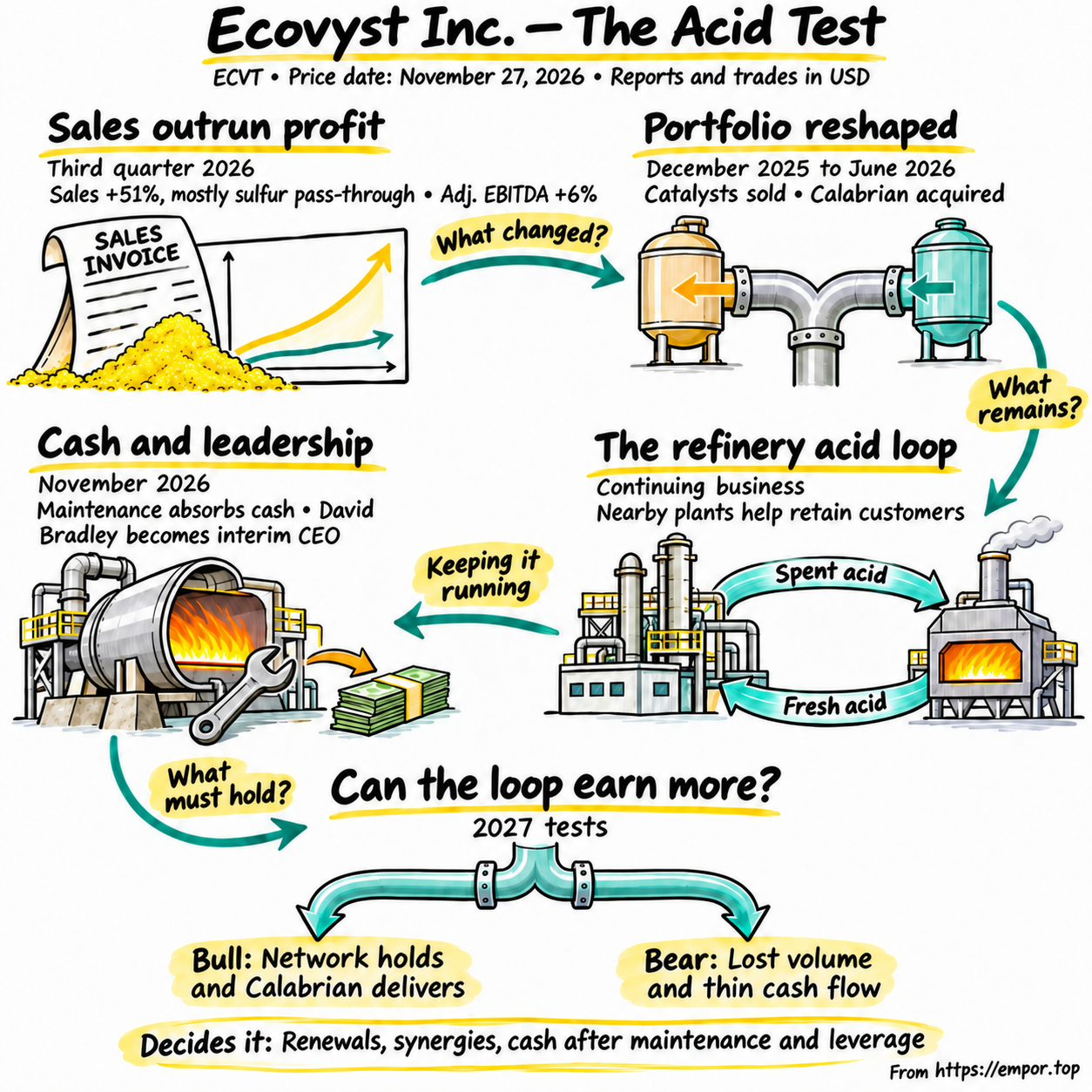
Ecovyst Inc.: The Acid Test
I. The Quarter When Sales Jumped 51%
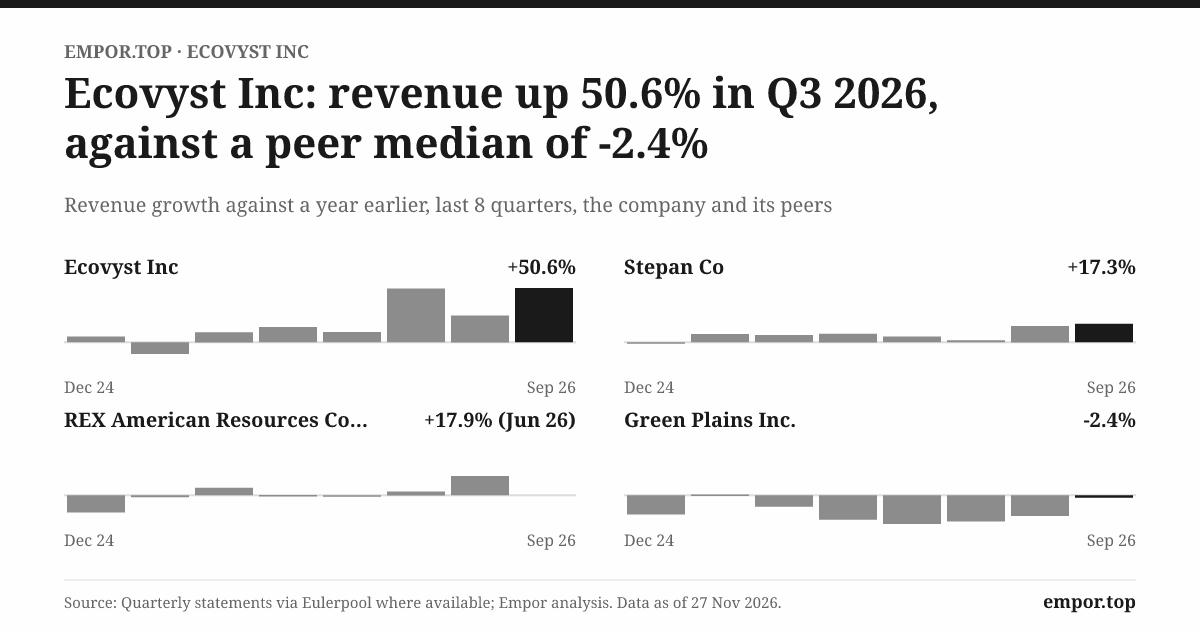
At five in the morning Eastern time on November 5, 2026, Ecovyst put out a number that looked like a growth stock's. Sales for the third quarter had jumped 51%, to $308.6 million, an increase of $103.7 million over the same quarter a year earlier.1 For a company that regenerates sulfuric acid for oil refineries and makes fresh acid for mines and factories, a 51% jump in a single year is not normal. Mature industrial networks do not usually grow like software companies.
Two lines further down the release, the story changed. Adjusted EBITDA, the operating profit measure management steers by, had risen by $3.7 million, or about 6%, to $61.2 million.1 Sales had grown more than eight times faster than profit. The gap between those two numbers is where this story starts. A thirteen-day leadership drama followed it, and the open question it leaves is what this smaller, rebuilt company can actually earn.
Most of the gap has one explanation, and it is yellow. Sulfur is the raw material Ecovyst burns to make virgin sulfuric acid, and in 2026 sulfur prices climbed hard. Ecovyst's contracts let it pass the higher cost on to customers, so the extra cost shows up as extra sales.
In the third quarter that pass-through added roughly $67 million to revenue.1 Think of a caterer who bills a client for groceries at cost. If grocery prices double, the caterer's invoices balloon, but the caterer is no better off. The money passes through its hands and leaves again.
Because pass-through dollars carry almost no profit, they also make the margin look worse. Adjusted EBITDA as a share of sales fell to 19.8% from 28.1% a year earlier.2 Management argued that the drop was mostly arithmetic. Strip out the $67 million of sulfur pass-through, the company said, and the margin would have been about 550 basis points higher.2
That is a fair correction, but it does not settle the question. Even on management's own adjusted basis, the margin was around 25%, still below the prior year's 28%. The sulfur effect explains most of the decline, not all of it.
The rest of the sales bridge is more revealing. Ecovyst split the $103.7 million increase into three lines: sulfur pass-through of $67 million, higher volume of about $31 million, and price excluding sulfur of about $5.6 million, or 2.7 points of growth.2 Then there is Calabrian, the sulfur dioxide business Ecovyst bought at the end of June. It contributed $29.1 million of sales in the quarter.3
The bridge has only three lines and they add up to the whole increase, so Calabrian's sales have to sit inside one of them, almost certainly volume. If so, the acid business Ecovyst owned a year ago grew its volume by only a couple of million dollars. Its real organic gain came from modest price increases. Regenerated acid volumes did rise on strong refinery demand, but virgin acid volume fell slightly against a strong prior-year quarter, so the two largely cancelled out.2
Profit tells a similar story. In August, management guided that Calabrian would add $10 million to $12 million of adjusted EBITDA in the second half of 2026.4 By November it expected $5 million to $6 million of that in the fourth quarter.1 Together those numbers imply that Calabrian contributed something like $5 million in the third quarter.
That is about the size of the whole year-over-year EBITDA gain. Management said the legacy business absorbed heavier turnaround costs than a year earlier, plus inflation and higher manufacturing and transport costs.5 So the underlying acid network held its profit roughly flat while doing more maintenance. That is a respectable result. It is not a 51% growth company.
Then, thirteen days later, the chief executive was gone. On November 18, the board said Kurt Bitting had ceased to serve as president and CEO effective the previous day, and that director David Bradley would serve as interim CEO while the board searched for a permanent successor.6
The company described the exit as a termination without cause under Bitting's severance agreement, and said his resignation from the board was not the result of any disagreement.7 The board reaffirmed the guidance it had raised two weeks earlier.6 That was meant to reassure investors. It also showed that the board was not blaming the numbers.
The timing makes the questions in this story sharper. Ecovyst is selling a promise that long contracts and a plant network built around refinery hubs can protect its returns through the cycles of oil refining and commodity prices. It is asking investors to believe that Calabrian will earn back what it cost. And it now needs a new leadership team to make a smaller company worth more than the larger one it used to be.
A boundary has to be set before any of that can be judged. On December 31, 2025, Ecovyst sold its Advanced Materials & Catalysts business, including its share of the Zeolyst catalyst joint venture.8 On June 30, 2026, it bought Calabrian.9 The company that reported that third quarter is a different company from the one whose financial history runs back a decade.
A long record of revenue, profit and cash flow exists, but it belongs to a broader chemicals group that no longer exists in that form. Reading it as a baseline for today's business is like judging a restaurant's new menu by its old one. To see what shareholders own now, the story has to go back to how this collection of businesses came together and how it came apart.
 Subscribe on LinkedIn
II. Two Businesses Become One Portfolio—and Then One Leaves
The acid business is older than almost anything else in this story. Ecovyst traces its regeneration know-how to Stauffer Chemical, which helped pioneer modern sulfuric acid regeneration in the 1940s.10 For decades the business moved between chemical conglomerates. By the 2010s it was a business unit inside Solvay's American arm, called Eco Services. It was useful but not central to a Belgian giant whose interests lay elsewhere.
On December 1, 2014, an entity backed by funds affiliated with the private-equity firm CCMP bought substantially all of the Eco Services assets from Solvay.11 This is a familiar private-equity move. A corporate parent sells a steady, unglamorous industrial unit to buyers who think focused ownership and leverage can do more with it. The plan, though, was not to keep Eco Services on its own. CCMP also held a large stake in PQ, a maker of silicas and catalysts, alongside INEOS, the chemicals empire controlled by Jim Ratcliffe.11
On May 4, 2016, the two businesses were combined under a new holding company, PQ Group Holdings.11 One accounting detail turned out to be prophetic. The combination treated legacy Eco as the acquirer and the predecessor company for accounting purposes, even though PQ was the larger and more glamorous business.11 On paper, the acid regenerator swallowed the catalyst maker. A decade later, the acid business would be almost all that remained.
PQ Group Holdings filed to go public in 2017 and planned to list on the New York Stock Exchange under the symbol PQG.11 Before the offering, funds affiliated with CCMP held about 58% of the voting power, INEOS about 31%, and management, directors and other investors the remaining 11%.11 The prospectus warned plainly that the two sponsors would continue to have significant influence over the company.11 For several years, the listed company was a classic sponsor-built roll-up. It had a broad portfolio, heavy debt, and an equity story about diversification and specialty chemistry.
Then the portfolio began to come apart, one piece at a time. In December 2020 the company sold its Performance Materials business to an affiliate of The Jordan Company for $650 million.12 That same month it paid a special dividend of $1.80 a share, about $244 million.12
It also recorded a $260 million goodwill impairment on its Performance Chemicals segment.12 In August 2021 it sold Performance Chemicals for $1.1 billion, used part of the money to repay debt, and declared another special dividend of $3.20 a share.13 By the time it filed its 2021 annual report, the company had taken the name Ecovyst.13
This history matters because it explains two features of the long-run financial record that otherwise look strange. From fiscal 2014 through 2025, the group generated about $1.9 billion of operating cash flow while reporting cumulative net losses of about $246 million. Much of that gap is depreciation, amortization and impairments, which are charges that cost no cash in the year they are booked.
The two largest loss years, 2020 and 2021, were dominated by write-downs and disposals of businesses Ecovyst no longer owns.1213 So a simple "losses but lots of cash" reading misses the point. The losses were mostly about exiting businesses, not running the acid network.
The same caution applies to dividends. Over those twelve years, the group generated about $851 million of free cash flow and paid about $678 million of dividends. It is tempting to read that as a company handing back four-fifths of its free cash.
But the dividends were the two special payouts of 2020 and 2021, and they were funded by asset-sale proceeds, not by operating cash.1213 Ecovyst said it did not intend to pay regular dividends.13 The historical ratio says nothing about the current company's capacity to pay shareholders. It mainly records what the sponsors did with the money from selling businesses.
The final big piece left in 2025. In September of that year, Ecovyst agreed to sell Advanced Materials & Catalysts to Technip Energies for $556 million, which it described as 9.8 times the segment's adjusted 2024 EBITDA after adjusting for standalone costs.14
Bitting's explanation was unusually blunt for a corporate press release: the board had concluded that the market undervalued the segment, and selling it was the way to realize that value for stockholders.14 The deal closed on December 31, 2025. At closing, Ecovyst used $465 million of the proceeds to pay down its term loan.8 Net cash proceeds, after adjustments for debt, cash and working capital, came to about $568 million.10
The logic was easy to follow. Shareholders gave up a broader chemicals group, including a catalyst joint venture with real technology and growth prospects. In return they got a balance sheet with much less debt and a company built almost entirely around sulfur. The continuing business had 2025 sales of about $724 million, adjusted EBITDA of about $172 million, nine manufacturing plants and roughly 617 employees.15 Gross borrowings, which had stood near $900 million a year earlier, fell to about $397 million by the end of 2025.10
Whether the trade was a good one depends on what the market pays for the rest of the company over time, and the record before the sale is not encouraging. According to the company's own proxy disclosure, $100 invested in Ecovyst stock at the end of 2020 was worth about $84 at the end of 2025, while the same amount in the company's peer group had grown to about $103.16
Selling a well-regarded catalyst business at 9.8 times EBITDA because the market would not give it credit inside the group is a defensible decision. It is also an admission that the old structure had not been creating value for public shareholders.
So the question about the 2016 combination and the 2025 divestiture is really a question about what was left. The answer is a regional, capital-heavy business that takes spent acid out of refineries and sends fresh acid back, plus a virgin acid business that sells into mines and factories. To judge whether that business deserves a premium, the story needs to follow a single tank of acid around its loop.
III. The Acid That Has to Come Back Around
Picture an alkylation unit at a refinery on the Texas or Louisiana coast. Inside, light hydrocarbon molecules left over from the refining process are combined into alkylate, a clean, high-octane blending component that lets refiners make gasoline that meets strict specifications for octane and vapor pressure.10
The reaction needs a catalyst, and in many units that catalyst is concentrated sulfuric acid. The acid does its job, but it does not stay pure. As it works, it becomes contaminated and diluted. Eventually the refinery is left with tanks of "spent" acid it cannot use and does not want to store.
That is where Ecovyst comes in. Most refiners no longer consider acid regeneration a core skill, storage space for fresh and spent acid is usually limited, and an interruption to an alkylation unit is very expensive.10 So refiners want someone to take the spent acid away and bring fresh acid back, reliably and continuously. Ecovyst collects the spent acid by pipeline, barge, rail or truck.
At its plants, a furnace breaks the spent acid down at high temperature into a clean gas stream, which is then converted back into strong, fresh sulfuric acid.10 The fresh acid travels back to the refinery and the loop starts again. It is less like selling a product and more like running a laundry service for one of the refinery's most important tools.
Geography is the first source of advantage. Ecovyst's plants are concentrated on the Gulf Coast and in California, regions that hold about 64% of US refining capacity.10 Some of those plants are connected to refinery customers by captive pipelines.10 Acid is heavy, corrosive and hazardous, and moving it long distances is expensive and risky, so the business is mostly regional.10 A competitor cannot simply undercut Ecovyst from a plant 800 miles away. The refinery's choice of regenerator is limited to the operators who are physically nearby.
The second leg of the business works differently. Virgin sulfuric acid is made by burning sulfur, or sulfur-rich materials, in a furnace.10 It goes to copper and borate mining, nylon production, water treatment and a range of industrial uses.5 Demand here follows mining activity, factory output and the price of sulfur rather than refinery runs.
The two legs use similar plants and logistics, which gives Ecovyst some flexibility. When unplanned refinery outages cut regeneration volume in late 2025, the company redirected capacity to profitable spot sales of virgin acid.5 That flexibility helps. It also shows that volume in one leg can disappear quickly.
The calendar matters too. Gasoline demand peaks in summer, so regeneration volume and working capital needs usually rise in the second and third quarters and ease in winter, with customer turnarounds adding their own swings.10 Location also gives Ecovyst a raw-material edge. On the August call, Bitting pointed out that sulfur bought in the United States was cheaper than sulfur on international markets, and that the Gulf Coast, where Ecovyst's network is concentrated, is where most North American sulfur is produced.17
The Waggaman plant also gave the company the ability to export acid when international prices make that worthwhile.17 None of this changes the basic economics. It does mean that a Gulf Coast acid producer has advantages in sourcing sulfur that a distant rival lacks.
The contracts are the third leg of the claimed advantage. Regeneration contracts typically run five to ten years and virgin acid contracts one to five years.10 About 90% of 2025 sales came under contracts with some form of raw-material pass-through. Many contracts include minimum volume protection or quarterly price adjustments tied to labor costs, natural gas prices and a chemical-plant construction cost index.10 On the third-quarter call, Bitting described the mechanism as almost automatic: as inflation indices rise, the company can "mechanically pass those costs through" to customers.5
Read the fine print, though, and the protection looks thinner. Excluding contracts with automatic evergreen renewals, only about 40% of Ecovyst's sulfuric acid volume in 2025 was under contracts expiring at the end of 2026 or later.10 Put the other way round, most of the volume was either on rolling evergreen terms or due for renewal before then.
More importantly, regeneration contracts with major refinery customers typically let the customer terminate with one to two years' notice.10 A ten-year contract that can be ended with two years' notice is really a relationship with a long notice period. The contract gives visibility. It does not guarantee volume.
Customer concentration sharpens the point. In 2025, Ecovyst's ten largest customers accounted for about 61% of sales, and the largest one alone represented 12%, or about $89 million.10 The company does not name these customers. It does say that its relationships with its top ten average more than 50 years.10 That is a striking figure, and a fair piece of evidence that refiners do not switch regenerators casually. But concentration cuts both ways. A buyer that accounts for 12% of sales knows exactly how much it matters when the contract comes up for renewal.
Ecovyst is not alone. It names Chemtrade and Nexpera, the former sulfuric acid business of Veolia, as competitors in North American refinery services.10 It estimates that its regenerated acid supply share is "substantially larger" than its closest competitor's, but it does not quantify that share or its rivals' scale.10
The company competes, in its own words, on price, reliability and responsiveness, and those depend on scale, proximity and operating expertise.10 That is an honest description of an oligopoly, not a monopoly. Where a refinery has two credible regenerators within reach, the threat of switching is real even if it is rarely carried out.
There is also a slower kind of competition. Sulfuric acid is not the only catalyst that can run an alkylation unit, and a refiner that rebuilds or replaces a unit over a twenty- or thirty-year horizon can choose a different process. That is not a threat that shows up in any quarter. But it is the reason the length of Ecovyst's customer relationships matters less than the remaining life of the units those customers run. The moat protects today's alkylation units. It does not guarantee that tomorrow's units will need the same service.
The barriers to new competition are real, and they come from steel, permits and pipe rather than patents. Ecovyst argues that the industry favors incumbents because expanding an existing plant costs far less, and faces far fewer regulatory hurdles, than building a new one.10 Environmental permitting for a plant that handles sulfur dioxide and acid mist is slow and uncertain.
The company is still subject to a 2007 Clean Air Act consent decree covering six locations, a reminder of how closely regulators watch these plants.10 A newcomer would have to find a site near refineries, win permits, build furnaces, assemble a fleet of rail cars and barges, and then persuade a refinery to risk its alkylation unit on an unproven supplier. That is a high bar. But Chemtrade and Nexpera have already cleared it, and they keep prices honest.
The claim worth testing hardest is the one management makes most confidently: that the network makes profits stable. On the third-quarter call, Bitting said that as refining margins moved up and down over the past four or five years, the regeneration business and its margins "continued to expand" regardless.5 The record is more modest.
The continuing business's adjusted EBITDA was about $177 million in 2023, $173 million in 2024 and $172 million in 2025.15 That is resilience, not expansion. Over the same years, sulfur prices and pass-through swung the sales line around, and 2025 brought what the company called unplanned and extended customer downtime plus heavier maintenance turnarounds of its own.10 The network held its ground through a bad refinery year. It did not grow through it.
The broader group's record is even more volatile, with net losses of roughly $278 million in 2020 and $139 million in 2021.1213 Those losses, tied mostly to businesses Ecovyst later sold, do not prove that the acid network is fragile. But they do show something else: the company's earnings have depended heavily on what it owned at any given time, and the listed company's record since 2017 has been anything but stable.
The fair verdict is that Ecovyst's advantage is narrower than the marketing and sturdier than the skeptics might assume. Proximity, logistics, permits and decades-long refinery relationships are real defenses, and the evidence that refiners rarely leave is reasonably strong. What the record does not show is pricing power strong enough to grow profit through a downturn, or contract terms strong enough to lock in volume.
The test is renewal economics. If the contracts expiring through 2026 and 2027 renew at higher real prices without lost volume, the moat is doing its job. If they renew flat, or a top-ten customer starts dual-sourcing, the moat is smaller than claimed. Management, meanwhile, had decided the network was strong enough to build on. In the spring of 2026 it went shopping.
IV. The $190 Million Bet on Calabrian
On June 30, 2026, the last day of the first half, Ecovyst completed the purchase of the Calabrian sulfur dioxide and sulfur derivatives business from INEOS Enterprises.18 Six months after selling its catalyst business, the company had used part of the freed-up balance sheet to buy something new. The symbolism was deliberate. Ecovyst was not shrinking into a pure acid regenerator. It wanted to become a broader sulfur chemistry platform.
What it bought is a business that turns sulfur into a different family of molecules. From plants in Port Neches, Texas, and Timmins, Ontario, Calabrian makes sulfur dioxide and related derivatives: sodium bisulfite, sodium thiosulfate and sodium metabisulfite.19 These are workhorse chemicals.
Sulfur dioxide is used in gold mining, sodium bisulfite in water treatment, and the derivatives in specialty uses that management says include food processing and pharmaceuticals.18 Ecovyst already made sodium bisulfite, and Bitting argued that Calabrian shared "meaningful end-use, customer, and sulfur-chemistry overlap" with the existing business.19
The industrial logic is easy to see. Calabrian starts with the same raw material Ecovyst already buys in bulk, sells to some of the same kinds of customers, and runs plants that share safety and handling practices with acid plants. If Ecovyst can buy sulfur more cheaply at scale, share logistics, and sell more products to the mining and water-treatment customers it already serves, the combination should be worth more than the two parts alone.
That is the theory behind the synergy figures. Theories like this are common in chemical deals, and the gap between promised and delivered cross-selling is usually wider than the gap on cost savings.
The price was $190 million, subject to the usual adjustments for cash and working capital.9 At the announcement, the then-CFO Michael Feehan gave the key figures. Calabrian had trailing twelve-month adjusted EBITDA of about $23.7 million, so the purchase price was about 8.0 times that figure.
Ecovyst expected the multiple to fall below 7.0 times once identified synergies were fully realized over the three years after closing.19 On the second-quarter call, Bitting put the expected cost and revenue synergies at $3 million to $4 million.17 The arithmetic checks out. Add $3.5 million to $23.7 million and the $190 million price works out to just under seven times.
Is eight times expensive? There is no clean comparison. Ecovyst's own enterprise value was about 9.9 times its trailing EBITDA in late November 2026. On that comparison the company bought earnings more cheaply than the market values its own. But those two numbers have different dates, perimeters and adjustments, and a small single-product business deserves a different multiple from a larger, diversified network.
A cleaner comparison sits inside Ecovyst's own record. It sold Advanced Materials & Catalysts at 9.8 times adjusted EBITDA14 and, six months later, bought Calabrian at about 8 times. Selling at nearly ten and buying at eight looks good on a slide. Whether it creates value depends on whether Calabrian's earnings hold up as well as the catalyst business's would have.
What can be said is that the price does not look reckless. It is also not proof of a bargain. The deal will be judged by things that have not happened yet: whether Calabrian's EBITDA holds at or above $23.7 million, whether the synergies arrive, and how much the integration costs. The first data points are mixed. Calabrian contributed $29.1 million of sales in its first quarter under Ecovyst ownership.3
Acquisition and integration costs reached about $11.2 million for the first nine months of 2026.3 Once added up, those one-time costs equal roughly half a year of Calabrian's EBITDA. Purchase accounting also tells investors how much of the price was paid for things other than hard assets. Ecovyst recorded about $72.8 million of goodwill from the deal, roughly two-fifths of the price.3
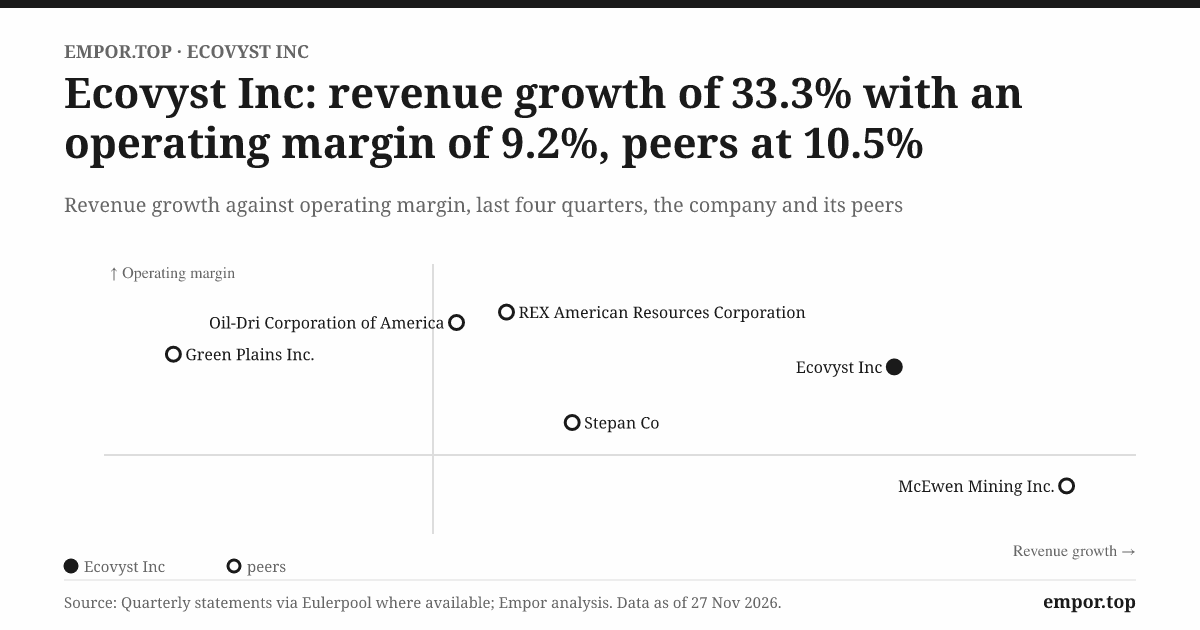
The acquisition also lets investors redo the growth calculation on a like-for-like basis. In its quarterly filing, Ecovyst published pro forma figures showing what sales would have been had Calabrian been part of the company since the start of 2025. On that basis, third-quarter 2025 sales would have been about $229.6 million, against the $308.6 million actually reported in 2026.3
That is growth of about 34% rather than 51%. With roughly $67 million of sulfur pass-through inside that increase, the underlying growth of the combined business, before sulfur, works out to about 5%. Calabrian did not change the growth rate. It added a new stream of revenue.
The deal is also not small relative to the company. Feehan said on the August call that Calabrian represents roughly 10% of the overall business, that it has a slightly higher EBITDA margin than the legacy acid business, and that it needs less capital.17
If that holds, it matters, because capital intensity is the biggest drag on Ecovyst's free cash flow, as the next part of this story shows. A business that turns more of its EBITDA into cash would improve the mix. But Ecovyst has not yet reported a full year of Calabrian earnings under its own ownership, so the claim about higher cash conversion is still a forecast.
The funding came from the balance sheet the divestiture had just repaired. Ecovyst borrowed an extra $100 million under its existing term loan, at the same floating rate of SOFR plus 2.00%, and paid the rest from cash on hand.9 The company's preferred leverage measure, net debt divided by trailing adjusted EBITDA, rose from 1.2 times at the end of 2025 to 2.1 times by September 2026.1
Management pointed out, fairly, that the trailing figure included only one quarter of Calabrian's earnings, so the ratio overstated leverage.1 It also described a target range of 2 to 2.5 times.17 In other words, the balance sheet that the catalyst sale cleaned up has already been put back to work. Liquidity of about $167 million at the end of September gives Ecovyst room to manoeuvre, but not unlimited room.1
Bitting presented Calabrian as the third step in a repeatable playbook. The first was the Chem32 catalyst-activation business in 2021. The second was the Waggaman, Louisiana sulfuric acid plant bought in May 2025. The approach, he said, was to "identify essential sulfur chemistries adjacent to what we already do best, acquire them at capital-efficient valuations" and fold them into the network.17
Waggaman provides a small piece of supporting evidence. Ecovyst paid $35 million plus about $6 million of working capital for it,15 and management said in August that it had contributed to double-digit growth in virgin acid volume and delivered the network savings they expected.17 One small plant performing as promised is encouraging. It is not a track record for a $190 million acquisition.
On the third-quarter call, Bitting said Calabrian's performance was "consistent with our investment thesis," that integration was on track and in some areas ahead of schedule, and that synergy delivery remained on plan.15 He also highlighted Calabrian's exposure to gold mining in Canada, where mines were running at high rates.5
Those statements describe the first four months of ownership. A business that sells sulfur dioxide into gold mines may look very different at a lower gold price or after a key customer contract renewal. And the executive who made the case for the deal is no longer running the company.
There is one more piece of context. INEOS was a founding sponsor of the listed company. On June 30, 2025, it sold its remaining 9.04 million Ecovyst shares to a broker-dealer at $7.60 each and ceased to hold any stake.20 Ten months later, on May 1, 2026, Ecovyst agreed to buy Calabrian from INEOS Enterprises.19 The filings describing the purchase do not characterize it as a related-party transaction, and by then INEOS was no longer a shareholder.
Ecovyst hired Lazard as its financial adviser.19 Nothing in the record suggests the terms were anything other than arm's length. Still, investors deserve to know the history: the seller was the company's former co-owner, which had walked away from its shares at $7.60 and then sold Ecovyst a business. INEOS's own chairman described Calabrian as a strong business that was simply "not a core fit" for INEOS.19 Whether it fits better at Ecovyst is the question the next two years will answer.
The deal was paid for, and now the company has to keep its plants running, pay its debt and decide how much to return to shareholders. That is where the arithmetic of a capital-heavy business takes over.
V. The Cash Must Compete With the Plants
A sulfuric acid plant is, at bottom, a furnace, a reactor, a set of heat exchangers and a lot of corrosion-resistant pipe, running hot and continuously for years at a time. Every so often it has to stop. Crews take it apart, inspect it, replace what the acid has eaten, and put it back together. The industry calls this a turnaround. Ecovyst expects six of them at its sulfuric acid plants in 2027.5 Turnarounds are not optional and they are not cheap, and they are where the investment case meets the plants.
Maintenance spending is the price of the moat. In 2025, Ecovyst spent $61.5 million on maintenance capital, up from $47.9 million in 2024 because of extended turnarounds, and only $6.8 million on growth projects.10 Put simply, about nine of every ten dollars of capital spending went to keeping existing plants safe, compliant and running, not to building anything new. That is not a criticism. Reliability is what refiners pay for, and the consent decree is a reminder of the regulatory cost of falling short.
But it means a large share of operating cash is committed before shareholders see any of it. The people who run the plants are a fixed cost too. Its 617 employees at the end of 2025 were all in the United States, and about 37% were represented by a union.10 A small, skilled, partly unionized workforce running hazardous plants is not a cost line that can be cut quickly when volumes fall.
The pressure on capital is rising in 2026. Management raised its capital expenditure guidance to $90 million to $95 million, partly because Calabrian came with plants to maintain.1 About $20 million of the 2026 budget goes to expanding Ecovyst's Gulf Coast storage and logistics network to serve growing virgin acid demand, according to management.17
That is the first sizeable growth project in years, and it will take time to show results. Depreciation and amortization, the accounting charge for wearing out plants and writing down acquired intangibles, is expected to be $84 million to $88 million this year.1 When capital spending roughly equals depreciation, a business is mostly standing still in physical terms.
What is left for shareholders? Ecovyst guides to adjusted free cash flow of $50 million to $60 million for 2026, up from an earlier $45 million to $55 million.1 For the first nine months, adjusted free cash flow was $32.4 million, down from $42.4 million in the same period of 2025.1 Two things account for the decline: higher capital spending and the working capital tied up by expensive sulfur. Continuing operations generated $80.7 million of operating cash over those nine months.1
But receivables absorbed about $22 million and inventory another $9.4 million.3 Expensive sulfur means bigger invoices and pricier stockpiles, and both tie up cash until customers pay. If sulfur prices fall, as management expects, some of that cash should come back. The credit-loss allowance was a modest $1.2 million at both the end of 2024 and 2025.10 Ecovyst does not publish an aging schedule for its receivables, so investors cannot see whether any particular balance is overdue.
The balance sheet at the end of September looked manageable but no longer spacious. Gross debt was about $497 million and cash about $71 million. Ecovyst had about $96 million available under its asset-based credit line and had not drawn on its revolver.1 The company said it remained in compliance with its debt covenants.3
Its term loan does not mature until June 2031,10 so the risk is not an imminent refinancing. It is that Ecovyst carries floating-rate debt of roughly half a billion dollars into a period of integration, heavy maintenance and leadership change. Interest expense for 2026 is guided at $19 million to $21 million.1 That is lower than before the divestiture, but large compared with the free cash flow left for shareholders.
Then there are the share buybacks. In the first nine months of 2026, Ecovyst repurchased about 3.5 million shares at an average price of $11.01, spending about $38.4 million.3 Almost all of that came in the first quarter, before the Calabrian deal. The stock closed at $10.06 on November 27, 2026, so the shares bought this year are currently worth about 9% less than the company paid.
Management plans to keep going. It intends to spend up to $20 million on buybacks in the second half of 2026, having spent only $2.7 million in the third quarter.1 That implies a much larger fourth quarter, at a time when the company is also integrating an acquisition and has just changed chief executives.
Management has framed this as balance. On the second-quarter call, Feehan pointed out that over the previous fifteen months Ecovyst had bought back about $83 million of stock, reduced debt by about $472 million, and made two bolt-on acquisitions totaling about $224 million, and still ended the period at the bottom of its target leverage range.17 That is a fair summary of 2025 and the first half of 2026. It is also a description of a company doing everything at once. A skeptic would ask a simple question.
With leverage at 2.1 times, free cash flow guided at $50 million to $60 million and $497 million of debt, why spend more than a third of this year's free cash flow on stock that has fallen since the purchases? Paying down debt at SOFR plus 2% is not exciting, but its return is certain.
The buyback is a bet that the stock is undervalued. The company has made that bet before. In 2025 it repurchased about $47 million of stock,15 much of it cheaply. Shares bought in the first nine months of 2025 cost an average of $7.74,3 well below today's price. So the record is mixed rather than poor: buying well in 2025 and less well in 2026.
The longer history adds a sobering note. Those payouts came from asset sales. The stock still underperformed its peers. That does not prove current management is allocating capital badly. It does mean that adjusted EBITDA and buyback announcements are weak evidence of value creation. Per-share free cash flow after maintenance, and the strength of the balance sheet, are better evidence.
That brings the story back to the question the board answered so abruptly in November. Plants, debt and buybacks need someone accountable for them. Two weeks after raising guidance, Ecovyst no longer had the person who had made those promises.
VI. A New CEO in the Middle of the Integration
The announcement came on a Wednesday, November 18, 2026, two weeks after Kurt Bitting had told analysts that Ecovyst was raising its guidance for the second time in three months. By then he had already ceased to be chief executive, effective the day before.6 The board had named David Bradley interim CEO,6 and Bitting's departure left it with seven members.7
Chairman Kevin Fogarty's statement was warm but carefully worded. He thanked Bitting for his "many contributions" and said the board believed Bradley would "further accelerate the execution of our strategic objectives."6 The word "accelerate" carried a quiet message. Boards do not usually replace a CEO who has just beaten guidance unless they want something to go faster, or differently.
The company gave no reason beyond the termination without cause and its no-disagreement statement.7 Investors are left to infer the rest.
Bitting was an insider's insider. He joined the Eco Services business as a business director in 2016, ran what became Ecoservices from 2019, and took over as CEO in April 2022. Before that he worked at Kinder Morgan, Sprint and Solvay USA.16 He knew the acid network as well as anyone.
He also led the company through its most important strategic change: the sale of the catalyst business, the Waggaman and Calabrian purchases, and the turn toward a pure sulfur platform. His departure means the strategy he designed will now be carried out by someone else.
Bitting's exit was not the first abrupt change at the top. His predecessor, Belgacem Chariag, was also terminated without cause by the board, on April 25, 2022.16 Two CEOs removed without cause in four and a half years is a pattern worth noting. It suggests a board willing to act. It also suggests a company that has struggled to find leadership the board trusts for long.
Bitting will receive the severance his 2022 agreement provides for a termination without cause. That means two years of base salary and target bonus, a pro-rated bonus for 2026 based on actual performance, subsidized health coverage, and continued vesting of a pro-rated portion of his performance-based stock units.7 He will also stay on as a consultant until February 5, 2027, and his time-based stock units will keep vesting while he does.7
One more detail is worth mentioning. On October 22, 2026, less than four weeks before Bitting's departure, the board's compensation committee amended the company's executive severance plan, setting CEO severance at 104 weeks of salary plus target bonus.21 Bitting's own payout comes from his earlier individual agreement, and the filing does not link the two events. But the timing will interest anyone who studies how boards prepare for leadership changes.
The new man arrived with an operator's résumé. Bradley, 55, had been an Ecovyst director since 2022.6 He ran SI Group as president and CEO from March 2019 until October 2026. Before that he led Nexeo Solutions from 2011 to 2019, and spent seven years at Kraton, where his roles included chief operating officer and vice president of business transformation.6
He has run larger and more complex chemical businesses than Ecovyst, through ownership changes and integrations. His interim package, an annual salary of $1.1 million and restricted stock worth $2 million that vests when a permanent CEO starts or after a year,7 is generous for a temporary role. It also gives him a clear reason to keep the seat warm rather than reshape it.
The finance chair had already changed. On August 24, 2026, Laurie Bergman replaced Michael Feehan as CFO.22 Feehan was a company veteran who had been corporate controller from 2008 and CFO from 2021.16 Bergman, 49, came from outside: she had been CFO of Legacy Food Group and Liquid Environmental Solutions, and chief accounting officer of the utility UGI.22
On her first earnings call she emphasized "disciplined execution, cash generation and long-term value creation."5 So within three months, both of the executives who negotiated the Calabrian deal and made the 2026 promises had left. The people who will deliver the results did not make the forecasts.
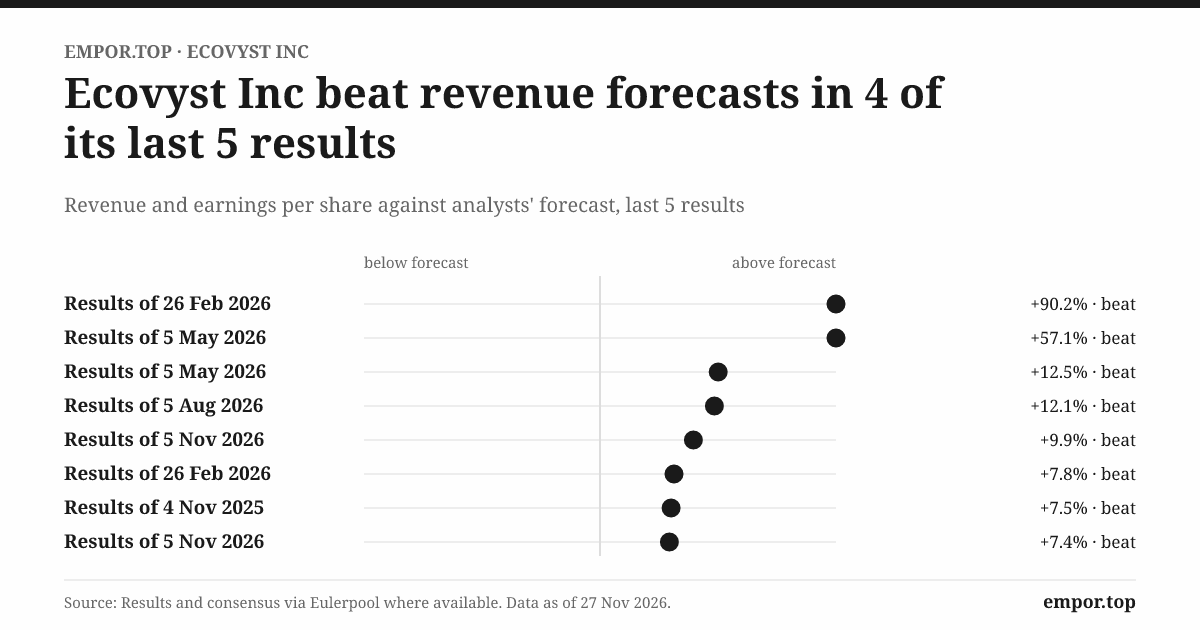
What did those promises look like, and did the company keep them? On this question, Ecovyst's 2026 record is solid. Before Calabrian arrived, the full-year guidance for adjusted EBITDA stood at $180 million to $195 million. In August, management raised it to $195 million to $207 million, now including Calabrian.4 In August, it guided third-quarter adjusted EBITDA to $54 million to $59 million.17 The actual figure was $61.2 million, above the top of the range.1
In November it raised the full-year range again, to $208 million to $212 million.1 Bitting was candid about the source of part of that raise. About $3 million came from one customer asking to move a turnaround from the fourth quarter into early 2027, which shifts cost rather than removing it.5 Even without that, he said, the midpoint rose about 3%.5 That is a management team that set conservative targets and beat them, and it explained a timing benefit rather than hiding it.
The fourth quarter tells the same story. In August, management guided fourth-quarter adjusted EBITDA to $48 million to $55 million.17 By November that range had risen to $54 million to $58 million.5 The language was also consistent from call to call. Calabrian was "accretive from day 1" in August,17 and in November it was "consistent with our investment thesis."1
The demand outlook stayed the same: high refinery utilization, healthy mining demand, flat nylon and caution about sulfur-driven destocking.175 There was no sudden change of story, no missed quarter to explain away, and no new excuse. That makes the board's decision harder to read from the outside, not easier.
The analyst questions on those calls show where the debate lies. In August, Citi asked how quickly Calabrian synergies would arrive. Bitting answered with the $3 million to $4 million figure and the step-down from eight times to around seven.17 In November, analysts pressed on refinery utilization if oil prices fall, on cost inflation, and on pricing for contracts rolling off at year-end.5
Bitting's answers were confident and general. He talked about "good pricing power as contracts roll off" and said renegotiated virgin acid contracts had produced "positive outcomes," but he did not quantify them.5 Nobody on the November call asked about leadership. Two weeks later, that was the only question that mattered.
Pay and ownership tell a partial story. Bitting's reported 2025 compensation was about $4.99 million, up from $4.09 million in 2024. About $3.35 million of the 2025 total was stock awards.16 At the end of 2025 he owned stock worth about 7.8 times his base salary, above the five-times requirement.16 That is meaningful alignment: a CEO holding that much stock in a company whose shares had underperformed had felt the pain alongside shareholders. Shareholders, for their part, have become much happier with pay.
Support for the say-on-pay vote rose from about 66% in 2022 to about 99% at the May 2026 meeting.2324251626 The board is also declassifying, so all directors will stand for election each year from 2027.16 These are improvements in governance. But a nearly unanimous pay vote in May tells investors little about why the board removed the CEO in November.
The longer record calls for humility in judging any strategy. The 2020 and 2021 losses and the five years of share-price underperformance before 2026 happened on the watch of more than one CEO, more than one portfolio, and sponsors who have since left. They should not be pinned on Bitting. Equally, they are a reminder that portfolio reshaping does not create value by itself. The catalyst sale and the Calabrian purchase are decisions. Their value will show up only in results.
The leadership change is therefore an execution risk, not a verdict that the strategy has failed. The board reaffirmed guidance, and the operating team below the CEO is unchanged. But credibility now depends on three things: a permanent CEO appointment, clear targets for Calabrian and leverage, and a first full-year report under new management that matches what the old management promised. Until then, investors are underwriting the plan without the people who wrote it. That makes it worth laying out, as plainly as possible, what could go right and what could go wrong.
VII. The Case for a Better Business—and the Case Against It
Imagine a refinery planning manager on the Gulf Coast sometime in 2027. The regeneration contract with Ecovyst is up for renewal. The manager's alkylation unit cannot run without a reliable supply of fresh acid and a reliable way to get rid of spent acid.
Ecovyst's plant is close, perhaps connected by pipe, and the relationship goes back decades. But Chemtrade or Nexpera might also be within reach, and the refinery's procurement team has been told to cut costs. Across town, Ecovyst's new CEO is studying the first full year of Calabrian results. Both of them are, in effect, deciding the investment case.
The bull case starts with the loop. Ecovyst's regional plant and logistics network is expensive and slow to copy.10 Its customer relationships are long-standing, and its contracts pass through most raw-material costs and adjust for inflation.10 Alkylate is essential to meeting gasoline specifications, and exports were up about 5% year over year, Bitting noted.5
The bull case continues into mining. Copper demand tied to electrification, and gold mining in Canada through Calabrian, give Ecovyst growth markets that do not depend on gasoline.5 Bitting also argued that little new acid supply is coming to market.5 If Calabrian delivers higher margins and lower capital needs, as Feehan said it would,17 the mix improves.
And if leverage falls back toward the bottom of the target range as Calabrian's earnings fill the trailing twelve months, Ecovyst will have flexibility for more bolt-ons or buybacks. On that view, investors get a hard-to-copy industrial network, a growing mining exposure and a management bench that has beaten its numbers.
The bear case starts with the same loop. Refinery utilization drives regeneration volume, as 2025 showed.10 Bitting himself warned that refiners deferring maintenance to capture strong margins could increase the risk of unplanned outages later.5
Sulfur volatility can distort revenue and demand.1 Customer concentration means a single lost or repriced contract could matter a great deal. The capital needs are relentless, leaving a thin layer of free cash flow for shareholders.
Michael Porter's five forces help sort the evidence. Buyer power is the most serious force, given customer concentration and termination rights.10 Rivalry is real but restrained, as geography limits credible options.10 The threat of new entry is low, because capital costs, environmental permitting, plant locations and captive pipelines all favor incumbents.10
Supplier power is limited mainly because contracts pass sulfur costs through. The risk is less that suppliers squeeze margins and more that volatile sulfur prices distort working capital and demand. The threat of substitution is slow but real. Refineries can change alkylation technology over time, and the long-term demand for gasoline in North America is not guaranteed. None of this describes a monopoly. It describes a strong regional position in an oligopoly with powerful customers.
Hamilton Helmer's 7 Powers framework asks a sharper question: which advantage lets Ecovyst earn more than its cost of capital for a long time? Scale economies exist in the network sense. A denser set of plants and logistics lets Ecovyst serve refiners more reliably and cover outages with spare capacity elsewhere in the system.
Switching costs are real, because a refinery that changes regenerator risks its alkylation unit and has to rebuild logistics, and the long-standing customer relationships are the best evidence that refiners rarely switch.10 Process know-how stretching back to the Stauffer era may amount to a modest form of what Helmer calls process power. Cornered resources, in the form of permitted sites and captive pipelines, may also apply.
But the 7 Powers test is about outcomes, and here the evidence is thinner. Adjusted EBITDA for the continuing business was flat over 2023 to 2025.15 Price growth excluding sulfur remained modest in the third quarter of 2026.2
Management's supply-share claim remains unquantified, and termination rights limit what contract length proves.10 The honest conclusion is that Ecovyst has credible switching costs and network advantages that defend its position. It has not yet shown that those advantages produce rising returns. The moat appears to keep competitors out more than it lets Ecovyst push prices up.
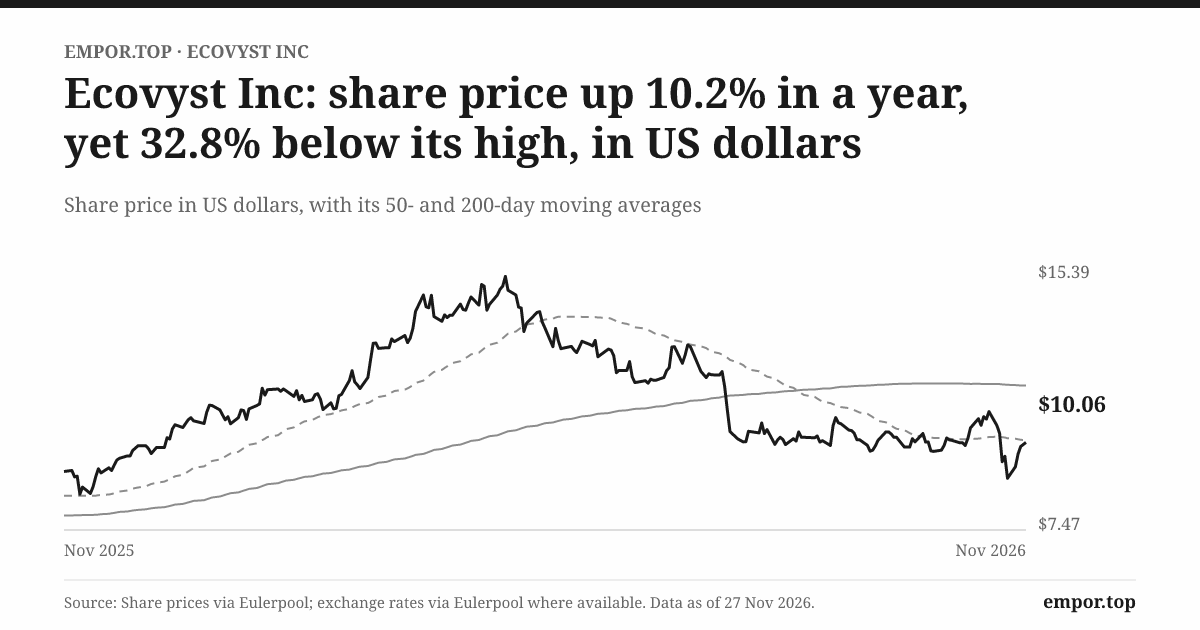
The market's verdict sits in the share price, and it is ambivalent. At $10.06 on November 27, 2026, Ecovyst traded about 33% below its 52-week high of $14.97 and not far above its low of $8.53. Its market value was about $1.1 billion and its enterprise value, including debt, about $1.6 billion.
On trailing measures, the stock looks expensive. It trades at about 32 times last twelve months' earnings per share of $0.33, against a five-year median of 17. Enterprise value is about 9.9 times trailing EBITDA, and the trailing free cash flow yield is only about 2.3%.
Those trailing numbers are distorted, which is the whole problem with valuing Ecovyst. The earnings come from a period that includes a disposal, an acquisition, integration costs, purchase-accounting amortization and interest on debt that has since been partly repaid and then partly re-borrowed. The five-year median P/E belongs to a different portfolio in a different cycle. On management's own forward measures, the picture looks very different.
Divide the enterprise value by the midpoint of 2026 adjusted EBITDA guidance, about $210 million,1 and the multiple falls to roughly 7.5 times. The share price is about 14 times the midpoint of guided adjusted earnings per share of $0.63 to $0.77.1 Guided adjusted free cash flow of $50 million to $60 million1 implies a yield of about 5% on the market value.
The truth lies between the two views. Adjusted figures exclude real costs: integration expenses, acquisition charges and, in the free cash flow case, items management deems non-recurring. Trailing figures penalize the company for one-off events. What the market seems to be saying is this: it will pay a moderate multiple for adjusted earnings it does not fully trust, from a business whose ownership, leadership and portfolio have all changed within a year. The price assumes neither collapse nor compounding. It assumes Ecovyst still has something to prove.
A skeptical activist looking at Ecovyst would probably not attack the plants. The challenges would be about capital allocation and governance. The first would be the buyback, which is already underwater. The second would be the acquisition strategy. Chem32, Waggaman and Calabrian are each small and sensible on their own, but a string of bolt-ons can turn a focused network into a collection of adjacent businesses, each with its own plants to maintain. The third would be disclosure. Ecovyst does not publish contract renewal rates or separate margins for regeneration and virgin acid, so investors have to take much of the moat on trust.
The fourth would be leadership continuity. Recent executive changes and the new severance plan raise questions about how the board plans succession. None of these points proves that something is wrong. Together they explain why the market is reluctant to pay a full multiple for adjusted earnings.
Three numbers will show whether Ecovyst can supply that proof. The first is growth excluding sulfur pass-through, split into volume and price. In the third quarter, price growth remained modest and most volume growth came from Calabrian.23 The second is adjusted EBITDA margin excluding pass-through, with turnaround effects identified. It remained below the year-earlier level in the third quarter.2
The third is free cash flow after maintenance capital, alongside net leverage. Adjusted free cash flow fell in the first nine months while leverage rose.1 On all three measures, the latest reading is either flat or moving the wrong way, for explainable reasons.
The decision rule follows. The case strengthens if organic volume and price grow without help from sulfur or acquisitions, if margin excluding pass-through recovers toward its earlier level, if Calabrian delivers its EBITDA and synergies, and if leverage falls while free cash flow rises. It weakens if integration milestones slip, if contract renewals come in flat or with lost volume, if a large refinery customer dual-sources, or if free cash flow stays thin while buybacks continue. None of that requires a forecast. It requires watching.
VIII. Playbook: Business & Investing Lessons
Go back to the tank of spent acid leaving the alkylation unit. It travels through pipe or rail car to a furnace that has to run hot and safe for years, then comes back as fresh acid. Every link in that loop is a piece of Ecovyst's advantage, and every link wears out. The same steel that keeps competitors away has to be inspected, repaired and replaced. That is the first and most important thing this company teaches.
The first lesson: a network earns its moat one renewal and one reliable delivery at a time. Ecovyst's nearby plants and pipelines give it a powerful starting point.10 But the refinery's decision to stay is renewed every contract cycle, and customer concentration gives buyers leverage.10 The moat is not the pipe. It is the refinery's decision that switching is not worth the risk. For investors, this means the right evidence is renewal economics and lost-volume data, not the length of a contract or the size of a market share estimate. For founders building physical networks, it means the advantage has to be re-earned through reliability, because customers with leverage will test it.
The second lesson: a sale can fix the balance sheet and still leave the new business to prove itself. Ecovyst sold Advanced Materials & Catalysts and used much of the proceeds to repay debt.148 It did what activists often demand: sold what the market undervalued and cut its leverage.
But the sale also removed a business with real growth prospects and left investors with a smaller company that had to show it could grow alone. Within six months the cleaner balance sheet had been partly used up by the Calabrian deal and the buybacks. The wider point is that a divestiture is a starting gun, not a finish line. The value of a "focused" company appears only when the focus produces results.
The third lesson: adjusted earnings are the beginning of the return, not the return itself. Calabrian's purchase multiple and expected synergies are deal metrics, not shareholder returns.19 What remains after integration costs,3 interest on new debt, maintenance capital and tax is what matters. A multiple measures the price. Free cash flow per share measures the outcome.
The fourth lesson: when sales outpace profit, follow the sulfur. Ecovyst's third-quarter numbers showed how pass-through can obscure underlying performance.1 For businesses that pass through commodity costs, revenue is a poor signal and can even mislead, because it rises when inputs get more expensive and falls when they get cheaper, regardless of how well the business is doing.
The best measures for such companies are volume, price excluding pass-through, and profit per unit. Investors who looked only at the headline in November saw a growth story. Those who looked at the bridge saw a stable network with a modest price increase and an acquisition.
There is a fifth lesson, about boards. Ecovyst's second CEO removal, shortly after a beat-and-raise quarter,167 shows how board confidence can shift. The earlier pay vote did not answer that question.26 Pay votes measure whether the incentive plan looks reasonable. They say nothing about whether the board has confidence in the person it is paying. In companies going through a strategic transformation, the board's patience may matter more than the strategy.
Put together, the lessons describe a particular kind of company: one whose advantages are physical, local and old, and whose challenges are financial, managerial and new. The acid network was built over eighty years. The portfolio around it was rebuilt in eighteen months.
Investors are being asked to trust the first while the second is still settling. The wider rule for anyone studying an industrial company in transition is to judge it by the slow-moving evidence, such as renewals, reliability and cash after maintenance, rather than the fast-moving evidence of deals, guidance raises and leadership announcements.
IX. Epilogue
Tonight, at the end of November 2026, Ecovyst is a company in between. It has a business it has owned for decades, a business it has owned for five months, an interim chief executive who became CEO ten days ago after serving as a director, and a finance chief who arrived in August. The company says its plants are running hard because refiners are running hard. Its guidance for the year is $208 million to $212 million of adjusted EBITDA, after being raised twice.1 Its fourth-quarter outlook is $54 million to $58 million, including $5 million to $6 million from Calabrian.15
The first test arrives with the full-year results in early 2027. The number to watch is not whether Ecovyst hits its guidance. The deferral of a $3 million turnaround already makes that easier.5 What matters is how much of the improvement came from underlying operations rather than timing. That turnaround now sits in 2027, a year in which management expects six turnarounds at its sulfuric acid plants.5 A heavier maintenance year will test whether margins can hold while the plants are offline more often.
The second test is Calabrian's first full year under Ecovyst. Investors will want to see whether sales, EBITDA and synergies match what was promised: roughly $23.7 million of EBITDA at purchase and $3 million to $4 million of synergies over three years.1917 They will want to see whether integration costs stop, and whether the business keeps its customers through a change of ownership. The company said the Canadian gold mines that buy its sulfur dioxide were running near capacity.5 If gold prices fall, or a large contract reprices, Calabrian's thesis will face its first real stress.
The third test is the loop itself. Ecovyst will renew contracts through 2027, and it has said it expects "positive pricing outcomes" as virgin acid contracts roll over.5 Sulfur prices have started to fall. The Tampa benchmark dropped $90 to $615 a ton for the fourth quarter, and management has warned that falling sulfur could cause customers to cut inventories.5
When pass-through shrinks, reported sales will fall. That will make the headline look worse even if the business is healthy. Investors who separated pass-through from price and volume on the way up will need to do the same on the way down.
The fourth test is accountability. A permanent CEO will define who owns the Calabrian targets, the leverage path and the capital budget. The new leader will also inherit a buyback program that management planned to accelerate in the fourth quarter, a debt load near $500 million, and free cash flow that has been squeezed by sulfur and capital spending.
Whether the new CEO keeps buying stock, pays down debt or looks for the next bolt-on will reveal more about Ecovyst's priorities than any presentation. A new leader may also want to set expectations lower, a familiar move for incoming chief executives. If the 2027 outlook arrives below what the market expects, investors will need to judge whether the business has weakened or whether the new CEO is simply resetting the bar.
Each of these outcomes points to a different company. If renewals hold, Calabrian performs and leverage falls, Ecovyst becomes what Bitting described: a compounding network of essential sulfur chemistries. If renewals slip, Calabrian disappoints or leadership turns over again, it becomes another sponsor-built chemicals company that sold its best growth asset and bought a smaller one. The evidence so far supports neither story fully. The operating record has held up, but returns have not yet arrived.
X. Outro
Somewhere on the Gulf Coast tonight, a rail car of spent acid is rolling toward a furnace. In a few days it will roll back as fresh acid, and the refinery will barely notice, which is exactly the point. Ecovyst's whole business is to be the part of the refinery nobody thinks about, because it is built to work reliably. That invisibility is what makes it hard to replace. It is also why the company has to spend so heavily simply to stay where it is.
The 51% sales jump that opened this story was, in the end, mostly sulfur moving through the company's books. Behind it was a business holding its profit steady, an acquisition still proving itself, and a board that changed its chief executive two weeks later. Ecovyst's bargain with investors is simple to state and hard to deliver.
The loop has to keep running, the customers have to keep renewing, and someone has to turn all that steel and acid into more cash per share. The acid always comes back around. The open question is whether the value will come back with it.
References
-
Ecovyst Reports Third Quarter 2026 Results and Raises 2026 Outlook — Ecovyst Inc., 2026-11-05 ↩↩↩↩↩↩↩↩↩↩↩↩↩↩↩↩↩↩↩↩↩↩↩↩↩↩↩
-
Third Quarter 2026 Earnings Presentation — Ecovyst Inc., 2026-11-05 ↩↩↩↩↩↩↩
-
Form 10-Q for the quarter ended September 30, 2026 — Ecovyst Inc., 2026-11-05 ↩↩↩↩↩↩↩↩↩↩↩
-
Ecovyst Reports Second Quarter 2026 Results and Raises 2026 Outlook — Ecovyst Inc., 2026-08-05 ↩↩
-
Third Quarter 2026 Earnings Call and Webcast — Ecovyst Inc., 2026-11-05 ↩↩↩↩↩↩↩↩↩↩↩↩↩↩↩↩↩↩↩↩↩↩↩↩↩
-
Ecovyst Announces Chief Executive Officer Transition and Reaffirms Full-Year 2026 Guidance (Exhibit 99.1) — Ecovyst Inc., 2026-11-18 ↩↩↩↩↩↩↩
-
Form 8-K, Chief Executive Officer Transition — Ecovyst Inc., 2026-11-18 ↩↩↩↩↩↩↩
-
Ecovyst Completes Sale of Advanced Materials & Catalysts Segment to Technip Energies — Ecovyst Inc., 2026-01-02 ↩↩↩
-
Form 8-K, Completion of Calabrian Acquisition and Incremental Term Loan — Ecovyst Inc., 2026-06-30 ↩↩↩
-
Form 10-K for the fiscal year ended December 31, 2025 — Ecovyst Inc., 2026-02-27 ↩↩↩↩↩↩↩↩↩↩↩↩↩↩↩↩↩↩↩↩↩↩↩↩↩↩↩↩↩↩↩↩↩↩↩↩↩
-
Form S-1/A Registration Statement — PQ Group Holdings Inc., 2017-09-25 ↩↩↩↩↩↩↩
-
Form 10-K for the fiscal year ended December 31, 2020 — PQ Group Holdings Inc., 2021-03-17 ↩↩↩↩↩↩
-
Form 10-K for the fiscal year ended December 31, 2021 — Ecovyst Inc., 2022-03-01 ↩↩↩↩↩↩
-
Ecovyst Announces Agreement to Sell its Advanced Materials & Catalysts Segment to Technip Energies — Ecovyst Inc., 2025-09-11 ↩↩↩↩
-
2026 Proxy Statement (DEF 14A) — Ecovyst Inc., 2026-04-15 ↩↩↩↩↩↩↩↩↩
-
Q2 2026 Earnings Call Transcript — Ecovyst Inc., 2026-08-05 ↩↩↩↩↩↩↩↩↩↩↩↩↩↩↩↩
-
Ecovyst Completes Acquisition of Calabrian — Ecovyst Inc., 2026-06-30 ↩↩
-
Ecovyst Announces Agreement to Acquire Calabrian Sulfur Dioxide and Related Derivatives Business — Ecovyst Inc., 2026-05-01 ↩↩↩↩↩↩↩↩
-
Schedule 13D/A (Amendment No. 7) — INEOS Limited, 2025-07-02 ↩
-
Form 8-K, Amended and Restated Severance Plan — Ecovyst Inc., 2026-10-28 ↩
-
Ecovyst Announces Chief Financial Officer Transition — Ecovyst Inc., 2026-08-24 ↩↩
-
Form 8-K, 2022 Annual Meeting Voting Results — Ecovyst Inc., 2022-05-31 ↩
-
Form 8-K, 2023 Annual Meeting Voting Results — Ecovyst Inc., 2023-05-11 ↩
-
Form 8-K, 2024 Annual Meeting Voting Results — Ecovyst Inc., 2024-05-09 ↩
-
Form 8-K, 2026 Annual Meeting Voting Results — Ecovyst Inc., 2026-05-21 ↩↩
 LinkedIn
 WhatsApp
 Reddit
 Hacker News
 Email
 Kindle
 RSS Feed
 Spotify
 Apple Podcasts
 Amazon Music
 Audible
 YouTube