DXP Enterprises: The Pump Shop That Became a Roll-Up
I. The Quarter the Numbers Hit a New High
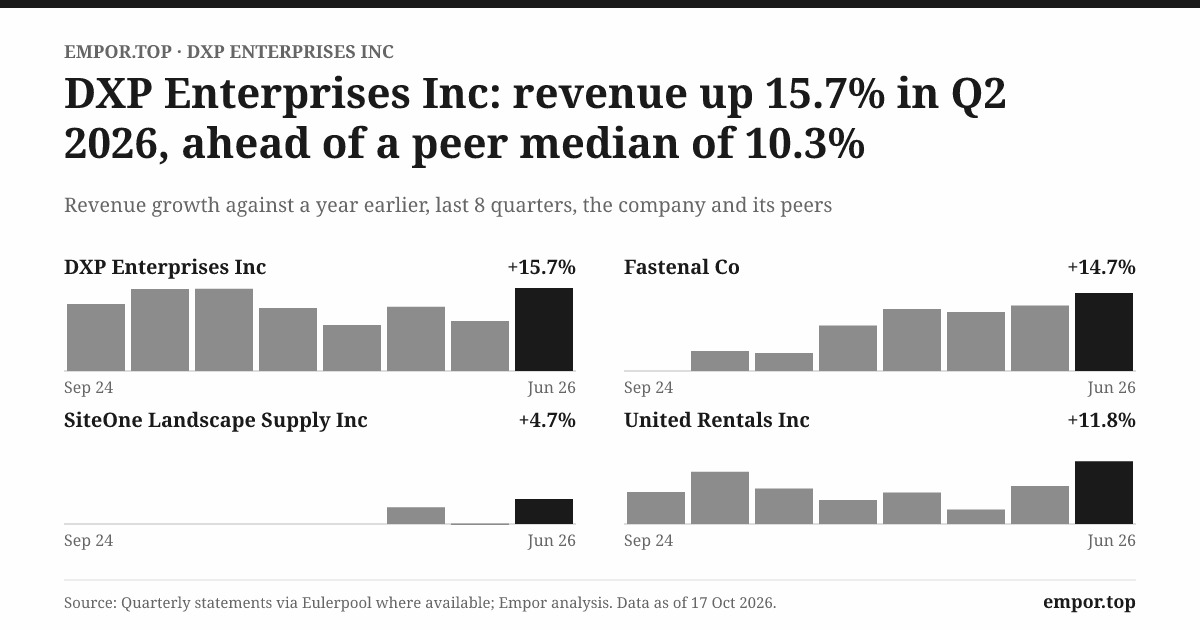
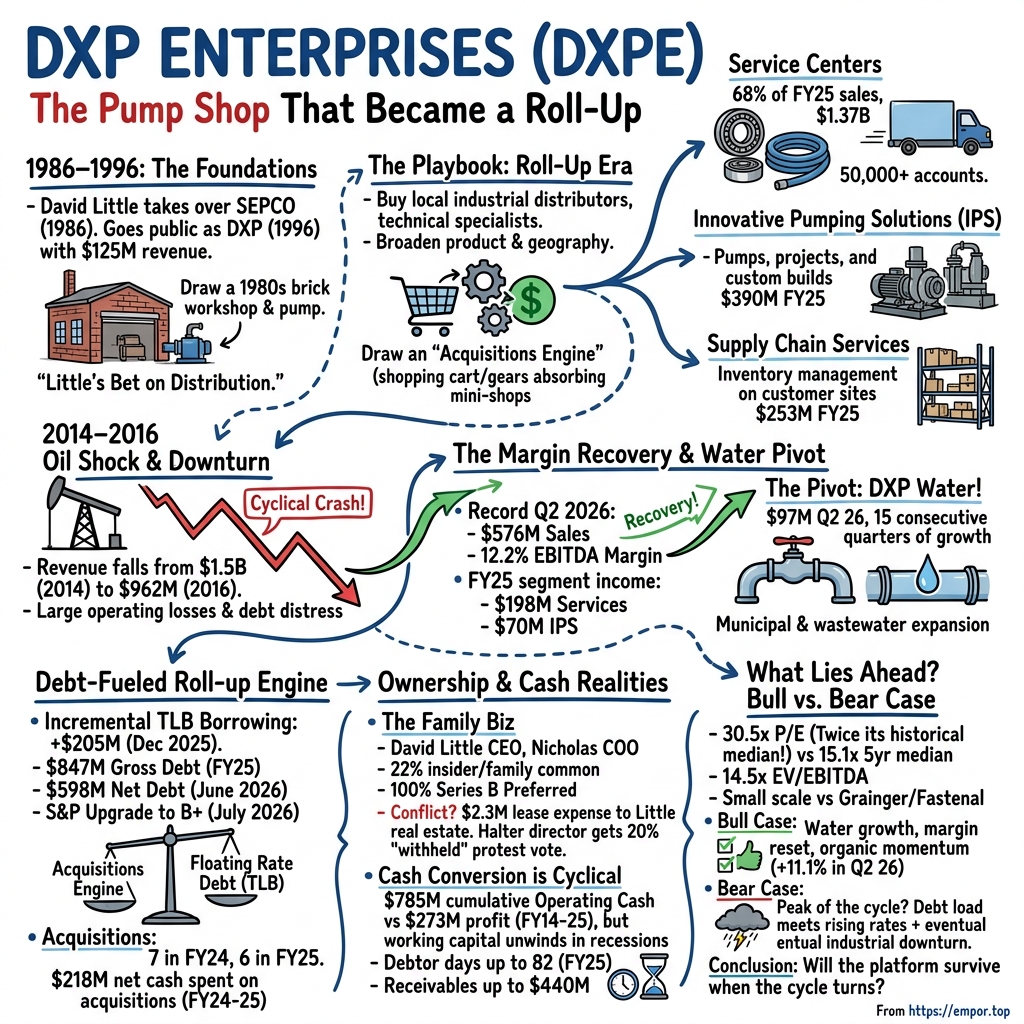
In early August 2026, DXP Enterprises reported its second quarter, and nearly every number was a record. The Houston industrial distributor posted $576 million of sales, about 16% more than a year earlier, and an adjusted EBITDA margin of 12.2%, the highest in its history.1 On the earnings call, the line management seemed most eager to repeat had nothing to do with bearings or hoses. It was about water. DXP Water, a business that barely existed as a separate idea a few years earlier, brought in about $97 million in the quarter.12
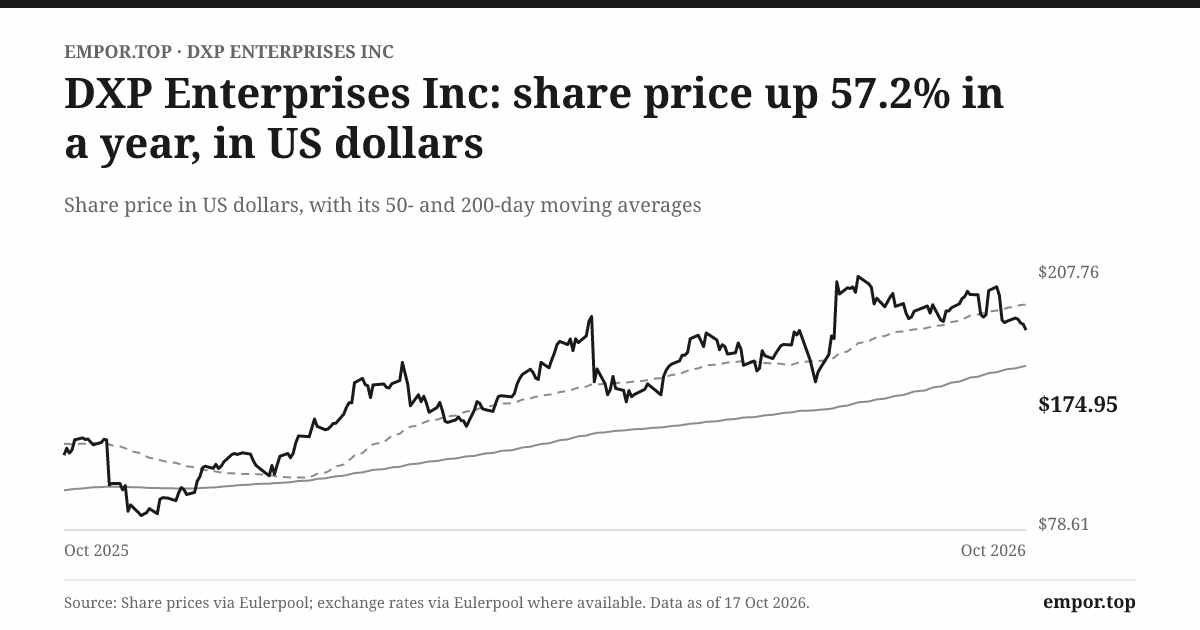
Mention a company that sells bearings, belts, hoses and pump parts and most investors picture a quiet business. DXP is not quiet. Over the twelve months to June 2026 it sold about $2.1 billion of goods and services.4 It ended 2025 with 3,286 employees.3 On October 17, 2026 the stock market valued it at about $2.7 billion, and the share price was close to double its level of a year before, when the 52-week low was about $86 against roughly $175 today.22 For a family-run distributor that lost money as recently as 2020, that is quite a change in standing.
The mix of the business explains why investors care. The Service Centers segment, the branch network that sells maintenance, repair and operating supplies to plants, is still the largest piece by a wide margin.3 But two other things now shape the story. The first is engineered pumping, where DXP designs, assembles and rebuilds pump systems and earns margins no ordinary distributor gets. The second is water, which has grown from a sideline inside the pump business into something management talks about as a growth platform of its own.
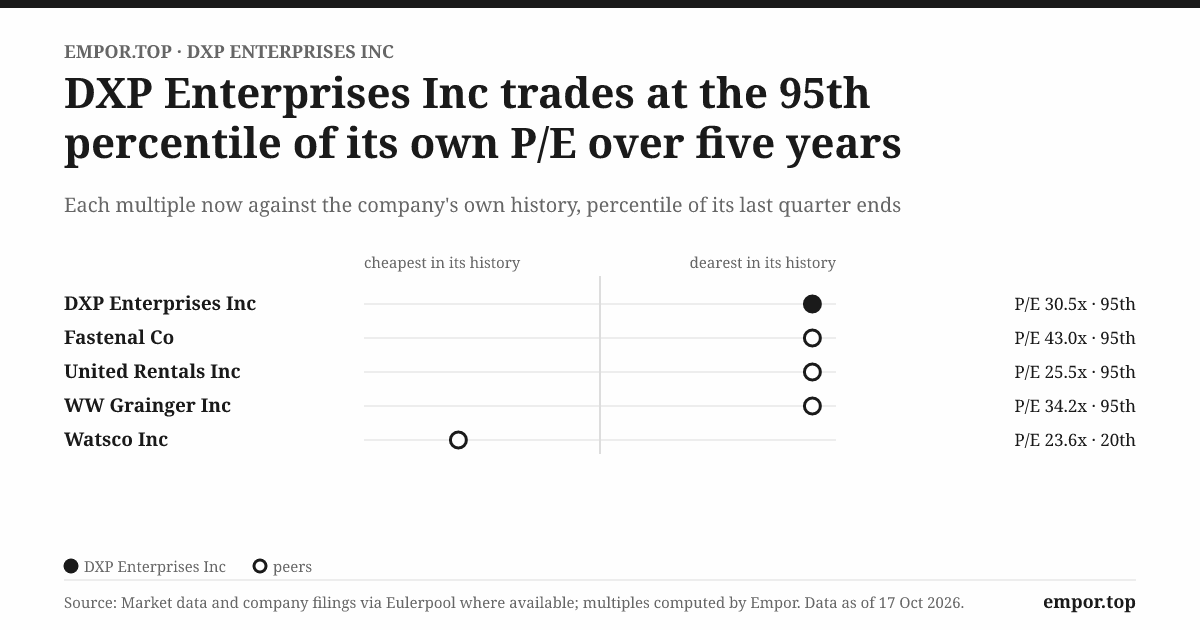
Behind the record quarter sit four questions, and this story is built around them. The first is whether the margins are a lasting change in the business or the top of a kind industrial cycle. DXP has been here before, with record years followed by losses when oil prices fell. The second is whether its acquisition engine creates value or only revenue, because the company buys businesses every year, often without saying what it paid. The third is whether family control protects minority shareholders through long-term alignment, or exposes them through pay, preferred stock and property leases that flow to the controlling family. The fourth is whether the share price already assumes all of the good answers. At about 30 times trailing earnings, the market is paying roughly twice what it typically paid for DXP over the past five years.22
There is an unusual tension here. DXP's industrial lineage reaches back to 1908.5 Its current chief executive has run it since 1986.5 It is reporting the best numbers in its history. And in December 2025 it borrowed another $205 million to buy its next chapter.3 A century-old supplier of parts is betting that debt-funded growth will make it into something more valuable than a supplier of parts.
To judge that bet, it helps to see how the company got here. That starts with one man who bought an old Houston supply house and decided that distribution, done at scale, could be a growth business.
 Subscribe on LinkedIn
II. David Little's Bet on Distribution
The business David Little took over in 1986 was already old. SEPCO Industries traced its roots to 1908, back when Houston's industrial economy was a scattering of mills, rail yards and the first oil-patch suppliers.5 Little took control at an unpromising moment. The mid-1980s oil bust had hit Houston hard, and companies that sold to the energy industry were fighting to survive rather than planning to expand. He bet that a distributor could do more than hand over parts across a counter. It could build a network, add product lines and become the supplier a plant called first.
Ten years later that bet had a public vehicle. DXP Enterprises, incorporated in Texas in 1996, succeeded SEPCO as a public company with about $125 million of revenue.35 That continuity still matters today. The same chief executive who took control of SEPCO in the Reagan years runs the company now, and his family still holds a large block of its shares. Few listed American companies of this size have been under one leader for nearly four decades.
The growth playbook was simple to describe and hard to carry out. Industrial distribution in America is fragmented. In many regions the dominant bearing house, pump shop or hose specialist is a local firm, often owned by a founder getting close to retirement. DXP's approach was to buy those firms and keep their people and customer relationships, then sell those customers a wider basket of products and services: the bearing customer could also buy pump repair, the pump customer could buy safety supplies.15 A 2013 Houston Chronicle profile ranked DXP among the area's top public companies, which by then had been built through exactly this kind of serial buying.21 The pitch to customers was one supplier for more of what keeps the plant running. The pitch to investors was a steady compounder that grew by acquisition and earned more as its scale increased.
Then oil collapsed, and the compounder story got its first serious test. DXP's revenue peaked at about $1.5 billion in 2014, and by 2016 it had fallen to about $962 million, a drop of more than a third in two years.6 The losses went beyond lost volume. DXP posted operating losses in both 2014 and 2015, and recorded impairment charges on goodwill and intangibles from businesses bought at the top of the energy cycle.6 Those write-downs are the most direct public evidence of how acquisitions turn out when conditions change. They amount to the company admitting that some of the businesses it had bought were worth less than it had paid.
The balance sheet needed help too. In October 2016 DXP sold 2.8 million new shares at $19 each, using the money to pay down bank borrowings.7 By the standards of that era, this was a modest dilution and a sensible decision. It also showed something about how the model was financed. Earlier expansion had depended on outside capital, and when the cycle turned, existing shareholders shared the cost of repairing the balance sheet.
The 2014 to 2016 period taught a lesson that runs through the rest of this story. DXP had many customers in many places, and in that narrow sense it was diversified. But a refinery maintenance buyer, an oilfield pump customer and a petrochemical plant all answer to the same energy cycle. A long customer list did not protect the company from a shared downturn, and 2020 would later show the same thing.
What, then, does DXP actually sell that customers keep buying, in good years and bad? The answer starts at a branch counter.
III. The Branch That Keeps a Plant Running
Imagine a chemical plant on the Gulf Coast at two in the afternoon. A pump that circulates cooling water starts to vibrate, and the maintenance supervisor knows the bearing is failing. The plant could keep running for hours or for days, nobody knows, and every hour of unplanned downtime costs far more than the part. The supervisor does not need the cheapest bearing in America. They need the right one, today, from someone who can confirm the size and maybe send a technician. That situation, repeated across thousands of plants, is DXP's business.
The Service Centers segment is built for it. In 2025 it generated about $1.37 billion of sales, roughly 68% of the company total, through 168 facilities selling bearings, power transmission parts, hose, fluid power components and other maintenance supplies.3 Pricing is mostly transactional: a catalogue price, a negotiated spot quote or a line on a blanket purchase order that a customer draws against all year.3 DXP's value lies less in the part itself, which a customer can usually get somewhere else, than in having it in stock nearby, knowing which part fits and delivering it fast.
The second engine does a different job. Innovative Pumping Solutions, usually called IPS, designs and assembles pump packages and remanufactures pumps. A pump "skid" is a pump mounted on a steel frame with its motor, piping, valves and controls, built so a customer can drop it into place as a working system. IPS generated about $390 million of sales in 2025 from 36 facilities.3 It sells these systems under fixed-price project contracts that can run anywhere from three months to more than a year and a half, and it recognizes revenue as the work progresses rather than at delivery.3 That makes it the closest thing DXP has to a manufacturer, and also its most cyclical piece, because pump packages are capital purchases that customers can postpone.
The third engine sits inside the customer's own fence. Supply Chain Services runs storerooms and purchasing for customers at 89 sites, under a program DXP calls SmartSource, which is a form of vendor-managed inventory.3 Instead of a plant employing its own storeroom clerks, DXP staff stock the shelves, reorder parts and manage suppliers. This segment brought in about $253 million in 2025, mostly under multi-year contracts that typically run three to five years and combine product sales passed through at cost-plus with management fees.3
The recurring element is real, though it is important to state it accurately. More than 80% of Service Centers and Supply Chain Services sales relate to customers' ongoing operations and maintenance rather than new construction.3 Plants that run keep wearing out bearings. IPS is different: its revenue depends on capital projects, and its customers have no long-term purchase commitments.3 So about four-fifths of the company tracks how busy American industry is, and the remaining fifth tracks whether that industry is willing to spend on new equipment.
Customer concentration is low. DXP serves more than 50,000 customer accounts, and no single customer reached 10% of sales in 2023, 2024 or 2025.3 The company does not disclose the share of its top five or top ten customers. On the supply side, DXP buys from thousands of manufacturers under distributor agreements that either party can cancel at little or no notice.3 That works in both directions. No single supplier can squeeze DXP, but no supplier is locked into DXP either. A manufacturer that wants a different distributor in Houston can switch.
The competitive field is where the story gets uncomfortable for a bull. DXP is a roughly $2 billion business in a market whose leaders are several times its size. W.W. Grainger, Fastenal and Applied Industrial Technologies are not perfect comparisons. Grainger is a broad-line giant, Fastenal grew up selling fasteners and runs vending machines on customer sites, and Applied Industrial is the closest match in bearings and power transmission. Their scale gives them purchasing power and logistics systems that DXP cannot match, and they set the price that DXP's branch counter has to meet. DXP describes itself as a leader in rotating equipment such as pumps, compressors and bearings.3 In a fragmented market that is a fair claim for particular regions and product lines. As national dominance it is unproven, and the company publishes no market-share data to back it up.
The forces acting on DXP point in different directions. Buyers are fragmented, which limits any one customer's leverage, but each can source from several suppliers, and large accounts often do. Suppliers are numerous and replaceable. Physical service is hard to copy: no website can send a technician to diagnose a failing pump, and e-commerce mainly threatens commodity items where price is easy to compare. What the company does not publish is the evidence that would prove a strong moat: customer retention rates, renewal rates on Supply Chain Services contracts, or proof that DXP sustains a price premium over Grainger or Applied. Until it does, the honest verdict is that DXP is useful to customers in practical, local ways, and that a durable competitive advantage remains a claim rather than a fact.
That leaves the economic question the rest of this story has to answer. Distribution margins are thin and cyclical. Can custom engineering and a broader mix lift DXP's margins enough to change what kind of company it is? For a while, the numbers have suggested they can.
IV. When the Margin Stopped Looking Like Distribution
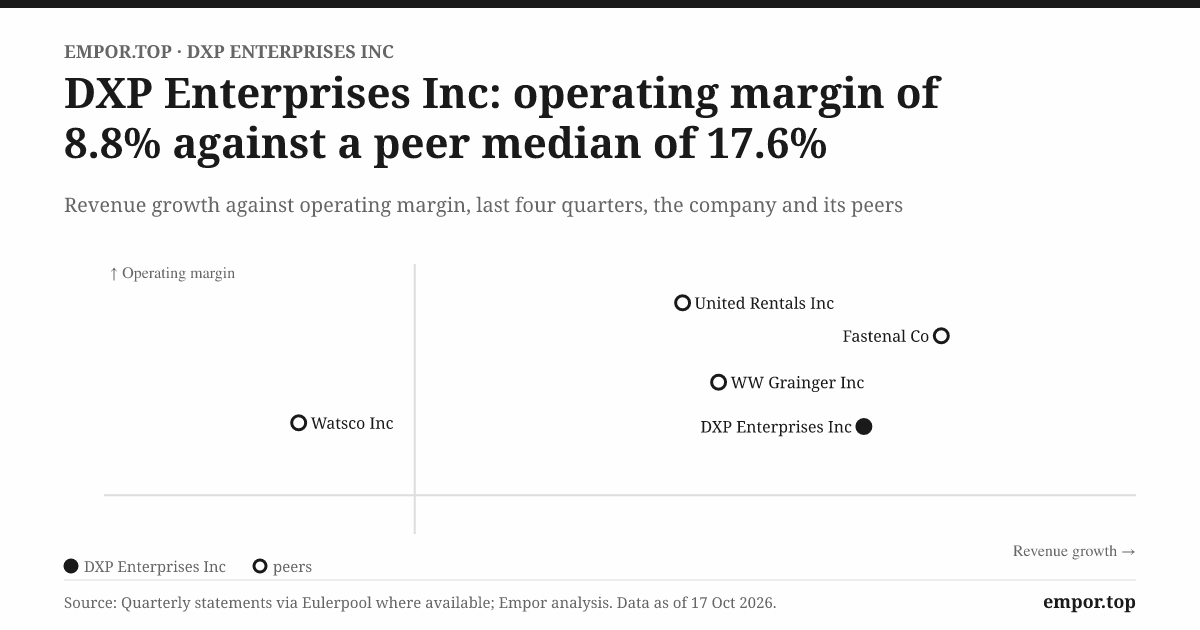
Look at DXP's operating margin over a decade and you see two different companies. In 2016, after the oil collapse, the business kept about two cents of operating profit from each dollar of sales.6 In 2020, when the pandemic shut down demand, it lost money at the operating level.8 By 2025 it was keeping almost nine cents per dollar, and in the second quarter of 2026 it reached 9.6%.34 For a distributor, a margin like that starts to resemble a premium peer rather than a regional parts house.
The increase was gradual, which is partly why it is believable. Operating margin climbed from about 2% in 2016 to roughly 8.3% in 2023, held in that range through 2024, and reached 8.8% in 2025.316 Sales climbed fast over the same period, from about $1.1 billion in 2021 to about $2 billion in 2025.3 When a business with fixed branch costs grows that much, more of each extra dollar falls to profit. That effect, operating leverage, accounts for much of the improvement.
The segments show where the money comes from. In 2025 Service Centers produced about $198 million of segment operating income, by far the largest pool of profit.3 IPS produced about $70 million on much smaller sales, a segment margin of roughly 18%.3 That is a striking figure for a business that packages pumps. It reflects engineering content, custom design and remanufacturing work that customers cannot get from a catalogue. One caveat: segment numbers exclude corporate costs such as headquarters, IT and executive pay, so the consolidated margin is always well below what the segments add up to.3
Management and the filings name the drivers: higher activity across the segments, contributions from acquired businesses and a richer mix with more IPS and more water.32 A popular claim among bulls goes further and says pricing reset during the post-pandemic inflation, so that DXP now earns permanently higher prices. The company does not publish a figure that separates price increases from volume or mix. It is reasonable to assume inflation helped, because distributors that pass on price increases with a markup earn more dollars on the same volume. But the evidence cannot show that price alone explains the improvement, or that it will last.
The strongest argument against calling the margin structural comes from DXP's own record. The company had operating losses in 2014, 2015 and 2020, and recorded substantial impairment charges in the earlier downturns.68 In each case, operating leverage that had worked so well on the way up turned against it: the branches, staff and leases stayed while sales fell away. The industrial exposure that produced a record margin in 2026 is the same exposure that produced losses six years earlier. Nothing in the business model has removed it.
So the verdict is in between. The improvement is real, it has lasted several years rather than a single quarter, and it has more than one source: organic growth, acquisitions and a shift toward higher-margin engineering. It is not yet proven to hold through a cycle. The test is specific. If oil and gas activity weakens for several quarters while municipal water demand stays firm, does the Service Centers margin hold, and does IPS stay well into double digits? A business that keeps a 7% or 8% margin through a real contraction will have changed. One that drops back to 3% will have had a strong upcycle.
That test leads straight to the business management hopes will carry the company through the next downturn: water.
V. The Water Business Outgrows Its Original Role
For most of its history, DXP's pump business was an energy business. Its pump packages moved crude through pipelines, injected water into oil wells and circulated fluids in refineries. When rig counts fell, the order book fell with them. That dependence is what made the 2015 and 2020 downturns so painful.
By 2025 the picture inside IPS had changed. Water and wastewater accounted for about 55% of IPS sales.3 Municipal water does not follow the price of oil. Cities replace aging lift stations and treatment plant pumps on schedules set by regulation, population growth and the condition of old pipes. In the second quarter of 2026, management reported about $97 million of DXP Water sales and said the business had grown sequentially for 15 straight quarters.12 To put that in proportion: a single quarter of water sales now equals roughly a quarter of what the entire IPS segment sold in all of 2025.3
The water business was built largely through acquisitions. DXP has bought manufacturers' representatives that sell specified pump brands into municipal projects, packagers that build pump stations, and tank specialists.1513 In 2026 it added Mid Atlantic Storage Systems, a water storage tank business, and Ambiente H2O, a Rocky Mountain manufacturer's representative.313 Earlier deals such as the 2024 purchase of Hartwell Environmental added further environmental and process capabilities.14 The aim is a single offering in which DXP can specify the pump, build the package, supply the tank and service the installation, rather than selling one piece of a city's project.
Some care is needed in separating a real business from an attractive pitch. The $97 million quarter makes water material today, and that is a fact, not a projection. It does not prove a durable moat, and it does not establish a standalone return on capital. DXP does not report water as a separate segment, so investors cannot see its margins, its organic growth separate from acquisitions, or the purchase prices that built it.4 "Fifteen consecutive quarters of growth" sounds like organic momentum, but in a business assembled through acquisitions, part of that growth was bought.
Management's message across calls has been consistent in emphasis. On the fourth-quarter 2024 call, the company presented water as a diversification away from energy and as part of its acquisition strategy.17 By the first and second quarters of 2026, the framing had grown more confident. Management pointed to sequential growth, backlog and municipal demand, and on the Q2 call CEO David Little and CFO Kent Yee put forward the 11.1% organic growth figure as evidence that the core was growing as well as the acquired pieces.218 Analysts in Q&A pressed on how much of the water figure was acquired and on IPS backlog. The answers pointed to healthy bookings rather than giving water-only margins.2 Management has given the tone of a growth engine without the disclosure that would let outsiders confirm it.
The test is clear enough. Once the acquired water businesses are fully in the comparison base, so that year-over-year growth can no longer come from simply owning more companies, does water keep growing, and does IPS keep its high-teens margin? If yes, DXP will have built a real second engine with less exposure to oil. If growth slows sharply once the acquisitions stop counting, water will have been a larger project business with a new name.
Either way, the water platform was paid for, and paying for it changed DXP's balance sheet.
VI. The Acquisition Engine Takes on Debt
On December 16, 2025, DXP amended its Term Loan B and borrowed an extra $205 million, taking outstanding term debt to about $848 million.3 There was no crisis behind it and no single transformative deal. It was the financing for a habit. DXP buys companies every year, and in late 2025 it decided to arrange the money in advance.
The pace of buying has been steady. DXP completed seven acquisitions in 2024 and six in 2025, and four more in the first half of 2026.34 Net cash paid for acquisitions came to about $157 million in 2024 and $62 million in 2025, roughly $218 million over two years.3 Spending on ordinary capital expenditure was much smaller, about $40 million in 2025, and a large part of that went to corporate facilities, fleet and IT rather than the operating segments.3 For DXP, reinvestment mostly means buying other companies, not building branches or factories.
The targets fall into two groups. One reinforces the core in rotating equipment: Arroyo Process Equipment, a Florida process-pump distributor, and Moores Pump, a Louisiana pump and service business bought in mid-2025, extend DXP's footprint in pumps and repair work in regions where it wanted more presence.1512 The other broadens the project offering and the end markets, the water businesses among them. In January 2026, DXP announced two acquisitions together, saying the pair had combined annual sales of about $94 million and adjusted EBITDA of about $21 million.11
Those figures need to be read carefully. On a plain reading, $21 million of EBITDA on $94 million of sales is a margin above 20%, well above DXP's own, which would make the deals immediately accretive to margins. But DXP did not disclose what it paid.11 Without a price there is no multiple, and without a multiple no one outside the company can say whether DXP bought cheaply or overpaid. That is true of most of its deals, which lack disclosed prices or post-deal returns.3 Investors are asked to trust the strategy and to judge it by the consolidated results. The consolidated results have been good, but they cannot show which deals worked and which did not.
The debt also needs accurate reading, because the headline figure misleads. The often-quoted balance-sheet borrowings figure of about $982 million at the end of 2025 combines funded bank debt with lease liabilities and contingent acquisition payments.3 The funded debt itself was about $847 million gross at year-end 2025, almost all of it under the Term Loan B due 2030.3 By June 30, 2026, the carrying value of funded debt was about $825 million, against about $227 million of cash, so net funded debt was close to $598 million.4 Separately, DXP had about $74 million of lease liabilities, a real obligation but a different kind of claim.4
The structure of the debt matters as much as the amount. The Term Loan B pays a floating rate: the SOFR benchmark plus 3.25 percentage points, with an effective rate of about 7.2% at the end of 2025.3 DXP had no interest-rate hedges in place.3 Interest expense was about $60 million in 2025, roughly a third of the year's operating income.3 When rates fall, DXP benefits immediately. When they rise, or when a downturn shrinks the income that pays the interest, nothing cushions it. Alongside the term loan sits an asset-based revolving credit facility. In July 2026 DXP expanded it to $225 million and extended the maturity to 2031.41 That adds liquidity for a bad year, but it is also another source of floating-rate borrowing if drawn.
Covenants are not the problem today. The main test is a secured leverage ratio, capped at 5.75 times EBITDA at the end of 2025 and stepping down to 4.75 times by 2028. DXP's actual ratio was about 2.25 times.3 That is plenty of headroom. In July 2026, S&P Global Ratings upgraded DXP's issuer rating and its first-lien term loan to B+ from B, with a stable outlook, citing its record of keeping leverage manageable across cycles and its diversification into water, while flagging energy exposure, debt-funded acquisitions and floating rates as constraints.19 An upgrade is good news. B+ is still well into speculative grade, several notches below investment grade, and a credit agency's comfort that lenders will be repaid is a different matter from whether equity holders will earn a good return on the deals.
That leaves the question of credibility on capital allocation. In its favor, DXP has made acquisitions for decades, its recent deals have coincided with rising margins, and it has never needed emergency financing during this upcycle. Against it, the earlier downturns produced large goodwill impairments, which means acquisitions made at cyclical highs disappointed when conditions changed.68 DXP is buying now, in another strong period, with more debt than it has ever carried. The record does not show that the roll-up destroys value. It shows that its value depends heavily on when the next downturn arrives and how severe it is, and that the company's own disclosure does not let outsiders judge individual deals in advance.
Debt is serviced with cash, not earnings. So the next question is how much of DXP's reported profit actually turns up as cash, and when.
VII. The Cash Conversion That Changes With the Cycle
In 2020 DXP lost money, about $29 million at the net level.8 It also generated about $109 million of cash from operations, one of the best cash years in its history.8 Those two facts look contradictory, but they are the key to understanding how this business converts profit into cash.
Over the twelve years from 2014 to 2025, DXP reported about $273 million of cumulative net profit and generated about $785 million of operating cash flow, nearly three times as much.368 Read at face value, that would make DXP an extraordinary cash generator. The real explanation has two parts. First, a large share of the charges that reduced reported profit used no cash. Amortization of acquired customer relationships and trade names reduces earnings every year, and the big impairment write-downs of 2014, 2015 and 2020, including about $60 million in 2020, cut profit without a single dollar leaving the bank.83 Second, DXP's working capital moves against the cycle. When activity falls, customers pay their old invoices and the company stops buying inventory, so receivables and stock turn back into cash. When activity rises, the reverse happens.
Picture a distributor as a reservoir. In good years, cash flows into the reservoir in the form of receivables and inventory. In bad years, the reservoir drains, and that cash shows up on the cash flow statement. The 2020 cash figure was the reservoir draining, not the business performing well. It is a real cushion that has protected DXP in downturns. But it means the twelve-year ratio overstates steady-state cash generation.
The upcycle shows the other side. Receivables reached about $440 million by June 2026.4 Debtor days, the average time it takes customers to pay, rose to about 82 in 2025, the longest in more than a decade of data, compared with the low 60s in 2014.3 Free cash flow in 2025 was about $54 million, the lowest since 2022, even though operating profit was a record.3 Part of that is reasonable, since a faster-growing business ties up more receivables. Part of it is a mix effect, because IPS project work is billed on milestones. But a distributor whose customers are taking longer to pay while sales are booming needs watching.
The project accounting adds another layer. IPS recognizes revenue as work progresses, so DXP books sales before it can bill for them. At June 2026, those unbilled amounts, contract assets, stood at about $59 million, or about $37 million after deducting customer prepayments.4 Not large relative to the company, but an area where accounting judgment drives reported numbers.
The evidence on credit losses is reassuring as far as it goes. The allowance for doubtful accounts was about 1% of gross receivables at the end of 2025, and write-offs in 2025 came to about $1.3 million, trivial against roughly $400 million of receivables.3 What the company does not publish is a breakdown of receivables by age, so investors cannot see whether the extra days are concentrated in a few slow-paying accounts or spread evenly.
Where did the cash go? Not to dividends, which DXP did not pay during this period.3 Between 2023 and 2025 it spent about $100.5 million buying back roughly 2.5 million shares.3 The price paid rose sharply over that time, from about $32 a share in 2023 to about $93 in 2025.3 The early purchases look excellent with hindsight, and the later ones smaller and at prices closer to today's. It bought no shares in the first half of 2026, as cash went to acquisitions.4 The balance of cash went into deals, and DXP ended 2025 with about $304 million of cash, much of it borrowed in December and then partly spent in 2026.34
Two less prominent filing details deserve mention because they bear on how much to trust the reported numbers. DXP's auditor, PricewaterhouseCoopers, issued a clean opinion, but singled out one critical audit matter: the percentage-of-completion revenue on custom pump contracts, where about $373 million of 2025 revenue depended on management's estimates of the cost to finish open jobs.3 If those estimates prove too optimistic, profit already reported has to be reversed later. DXP also carried about $6.6 million of unrecognized tax benefits, including a $6.1 million reserve against research and development tax credits it had claimed for custom pump design.3 Litigation was described as routine and not expected to be material.3 None of these are alarms. They show where judgment sits in the accounts.
Currency is a minor issue. About 96% of 2025 sales came from the United States, most of the rest from Canada, and DXP uses no foreign-exchange hedges.3 There is no meaningful exposure to a weaker dollar, and no international business to offset a downturn in American industry.
Cash, debt and acquisitions all come back to the people who make the decisions. At DXP, that means one family.
VIII. The Company Still Runs Through One Family
At the June 2026 annual meeting, DXP's shareholders gave executive pay a resounding approval of about 97.6%.10 On the same ballot, about 20.5% of the votes cast for independent director Timothy Halter were withheld.10 It was not a one-off. Halter drew withheld votes of about 17% in 2025 and about 19% in 2024.1020 Shareholders are content with what management is paid, but a substantial minority keeps registering doubt about one of the directors meant to oversee it.
The family is at the center of the company. David Little has been chairman and chief executive since 1986.9 His son Nicholas Little is chief operating officer.9 Two sons-in-law hold senior roles: Paz Maestas as chief marketing and technology officer, and Matt Gentle as president of the metalworking and air compressor business.9 Kent Yee, the chief financial officer since 2011, is the most visible non-family executive.9 A family that runs the business day to day, owns a large share of it and has been in charge for close to forty years is aligned with long-term value in one sense. It is also hard for outside shareholders to hold accountable.
Pay at DXP is tied to profit. Named executives earn quarterly bonuses based on pre-tax income targets.9 David Little received about $4.6 million in total compensation in 2025, down from about $5.3 million in 2024.9 Including the son and sons-in-law, family pay was about $8.1 million, roughly 4.6% of the year's $177 million of operating income.93 Whether that is fair is a matter of judgment. It is clearly material for a company this size. The pre-tax income target also creates a particular incentive: an acquisition financed with debt raises pre-tax income as long as the acquired profit exceeds the interest, whether or not the deal earns a good return on the price paid. Pay based on returns on capital would test the roll-up more directly.
Then there are the leases. DXP paid about $2.3 million in 2025 to rent branch properties from real estate entities owned and controlled by the Little family, up from about $1.8 million in 2023.3 To be precise, this is rent, not a share of company revenue, and it is small relative to DXP's size. The Audit Committee reviews these leases each year under a policy requiring terms comparable to those with unrelated landlords.3 That is a reasonable safeguard, but not independent proof of fair pricing, since no appraisal is published. It also means the family earns from DXP as landlords, in a way other shareholders do not.
Ownership supplies the alignment. Insiders and executives owned about 22% of the common shares in April 2026, with David Little holding about 7.9% directly and Nicholas Little about 5.2%.9 Family insiders also own all of the Series B preferred stock, which pays a small dividend and converts into 840,000 common shares.39 Across the shareholder register, institutions have been adding. Fidelity's parent FMR raised its stake from about 5.8% to about 10.3% between April 2025 and April 2026, and Wellington went from about 5.2% to 7.1%, alongside BlackRock's roughly 12%.923 Large, sophisticated holders have been buying, not exiting.
So how should the votes be read? Strong say-on-pay support says institutions accept the pay structure. A persistent one-in-five withheld vote against Halter over three years is a governance signal, likely linked to his tenure or his committee roles and to questions about board independence when the chief executive also chairs the board. It is not evidence of an activist campaign, and no such campaign has emerged. It is the kind of signal that would grow louder if results disappointed.
Management's descriptions of its own record are worth comparing with the filings. On recent calls, Little and Yee have described acquisitions as disciplined and accretive, emphasized organic growth and called leverage comfortable.218 The filings support the last of these: covenant headroom is wide. They partly support the second, through reported organic growth figures. They cannot support the first, because DXP does not disclose deal prices or post-deal returns. Management's claims are not contradicted, but they are only partly verifiable.
Which brings the story to the question every shareholder ultimately faces: given all of this, what is the market paying for, and what has to go right?
IX. Analysis & Bear vs. Bull Case
On October 17, 2026, DXP shares closed at about $175, which put them at roughly 30.5 times trailing earnings.22 Over the past five years the median multiple has been about 15 times.22 The market is paying twice its usual price for each dollar of DXP's profit. That re-rating is the most important number in the investment case, because it shows how much success the price already assumes.
The bull case has real evidence behind it. Margins have improved for several years, not one quarter. Organic growth was about 11% in the second quarter of 2026, which means the core grew even before counting acquired sales.12 The end-market mix is more balanced than it was in 2015, with water now a material share of the pump business. IPS earns engineering-level margins. The debt is manageable against covenants and S&P has just upgraded the credit. Major institutions have been adding to their positions. On this reading, DXP is changing from an oil-linked distributor into a diversified industrial service platform, and its multiple is catching up with that change.
The bear case uses the same evidence. Most of the company's revenue is still distribution, about two-thirds through the branch network. IPS depends on project timing. DXP's ten-year revenue growth rate is only about 5% a year, because the strong recent years follow the collapse of 2015 and 2016.3 The record includes two oil downturns and a pandemic loss. And the current upswing coincides with the largest debt load in company history, at floating rates without hedges. On this reading, the market is giving a cyclical distributor a premium multiple at a cyclical high, which is exactly when cyclical distributors are most expensive.
The moat assessment determines which reading is closer to the truth. Using Michael Porter's five forces: buyer power is moderate, because customers are spread out but can multi-source. Supplier power is low, though distributor agreements can be cancelled. The threat of substitutes is limited for field service and engineered packages, and greater for commodity parts sold online. Barriers to entry are modest locally but higher nationally, where scale matters. Rivalry is intense, with Grainger, Fastenal, Applied Industrial and DNOW all competing for the same plant budgets. Using Hamilton Helmer's seven powers: DXP has some scale economies locally, though less than its larger rivals; some switching costs in Supply Chain Services, where moving a storeroom to a new provider is disruptive; and something like cornered know-how in custom pump engineering. It shows no network effects, no counter-positioning and no brand strong enough to command a premium. The verdict is that DXP has real but local advantages, most clearly in IPS and in on-site supply chain contracts. Its largest business, Service Centers, competes mainly on service and availability against bigger rivals. That is enough for good returns in a strong market. It is not enough to protect margins against a severe downturn.
Valuation comparisons need care. At about 14.5 times EV to EBITDA, DXP is cheaper than Applied Industrial at roughly 19 to 20 times and Fastenal at 22 to 24 times, and in line with DNOW at about 15 times.22 On that measure it looks reasonably priced against peers. On trailing P/E, though, it is about level with Applied Industrial and only a little below Fastenal, and twice its own history. The two measures differ because DXP has much more debt than its peers: debt is part of enterprise value but not of the share price, so leverage makes EV/EBITDA look cheaper. Its free cash flow yield of about 4.3% is moderate.22 Neither comparison settles fair value. What the price clearly assumes is that recent margins hold and that acquired growth keeps compounding.
A skeptical investor would ask a simple question. If organic growth slows below 8%, can DXP's free cash flow, after paying interest, still reduce funded debt without another share sale or drawing on its credit line? In 2025, after paying about $60 million of interest, DXP was left with free cash flow of about $54 million, roughly 6% of its funded debt.3 At that pace, meaningful debt reduction depends heavily on working capital. In a moderate slowdown, cash from receivables would help. In a period of slow but positive growth, receivables keep absorbing cash while margins come under pressure. That middle scenario, not a crash, is the one the balance sheet is least designed for.
Three numbers will show which case is winning. The first is organic sales growth by segment, last reported at about 11% for the company in the second quarter of 2026 and rising.1 The second is IPS margin and DXP Water growth, with IPS at about 18% for 2025 and water at about $97 million in the second quarter, still growing sequentially.31 The third is free cash flow after interest, read together with debtor days and net funded debt. Debtor days have been lengthening, to about 82, and net funded debt was about $598 million in June 2026.34
One question the filings cannot yet answer is whether the recent acquisitions earn attractive returns on their purchase prices. Until DXP discloses more, that question remains open, and it sits at the center of the bull case.
X. Lessons From the Pump Room
Go back to that Gulf Coast plant. A maintenance supervisor orders a bearing from a branch twenty minutes away and has it by evening. Across town, in a DXP fabrication shop, a custom pump skid for a municipal lift station is half built, its revenue already partly booked on an engineer's estimate of the work remaining. Both are DXP. They are different kinds of business, and the lessons of this company come from the gap between them.
The first lesson is that a part is only valuable when the customer needs it. DXP has no proprietary product catalog; the bearings it sells are made by others and available elsewhere. What DXP sells is the moment: the part on the shelf, the person who knows which one fits, the truck that leaves within the hour. That is a real business, built over decades and hard to replicate with a website. But it is an advantage of presence, not of product, and presence has to be paid for every year in branches, staff and leases, whether customers are buying or not. For founders, it is a reminder that service businesses earn their margins daily. For investors, it means the 68% of DXP that is distribution should be valued as excellent execution, not as a fortress.
The second lesson is that engineering can change the margin, but the customer's budget still sets the clock. IPS shows what happens when a distributor adds real expertise: segment margins near 18%, revenue from complex projects and customers who need a design, not just a part. Yet every one of those projects starts with a customer approving capital spending, and capital spending is the first thing a plant manager cuts when times get hard. DXP's engineering is genuine. Its timing is set by someone else. A company can raise its margins by moving up the value chain without escaping the cycle that runs through it.
The third lesson is that an acquisition is a claim on future cash, not a growth statistic. DXP spent roughly $218 million on acquisitions in 2024 and 2025, announced deals with attractive sales and EBITDA figures, and reported strong consolidated growth.311 None of that shows whether the money was well spent, because the prices are mostly undisclosed. The impairments after 2014 showed what happens to deals bought at the top. The current roll-up will be judged by the same standard: whether the acquired businesses keep their margins and generate the cash to retire the debt that bought them. For any investor watching a serial acquirer, the deal count is noise. What matters is the cash returned per dollar spent, and when the company will not show it, the evidence has to come from what the business does in a downturn.
XI. The Next Downturn Will Tell the Story
As of mid-October 2026, DXP's third-quarter results have not yet been reported. When they are, investors will be looking past the headline to the line that separates organic from acquired sales. The second quarter's organic growth of about 11% was the strongest evidence for the bull case.1 Each new quarter makes the comparison harder, as the acquired businesses of 2025 move into the base and stop adding to growth automatically.
The first thing to watch is whether organic growth holds in both Service Centers and IPS. If the branch network slows while IPS keeps growing, the mix story is working. If both slow together, the cycle has arrived and the multiple will be tested against the business's real earning power, not its record quarter.
The second is water through a project slowdown. Municipal spending is steadier than oilfield spending, but it is still project work, subject to budget cycles, permitting and the timing of federal and state funding. Water is meaningful now. Until it is reported separately, with its own margins and organic growth, investors are judging it through management's commentary and a single quarterly sales number.
The third is cash conversion alongside debtor days. Strong operating cash flow in a downturn is reassuring only if it reflects normal working-capital release rather than a stretched receivables book. If debtor days keep rising past 82 while sales grow, the reservoir is filling with slower-paying accounts, and it may drain less cleanly when the cycle turns.
The fourth is the balance of funded debt, interest expense and acquisition spending against free cash flow. The July 2026 expansion of the credit line added liquidity.4 It did not change the fact that nearly all of DXP's debt floats with short-term rates, with no hedges. A year in which DXP pays down debt from free cash flow while still acquiring would strengthen the case considerably. A year in which it borrows more while organic growth slows would weaken it.
The last is the one rarely discussed on earnings calls: succession. David Little has led the company for close to forty years.9 At some point that will change, and when it does, the questions this story has raised about governance will become practical ones. Will the next chief executive come from the family? What happens to the family-owned properties DXP rents? Will the board's independent directors, one of whom has drawn persistent dissent, play a bigger role? Each of those answers will tell outside shareholders how much of DXP's culture was the system and how much was the founder-operator.
None of these tests depends on the next acquisition announcement. They depend on how the business performs when industrial America slows down, which it eventually will.
XII. Outro
Somewhere tonight a pump is running in a plant because a DXP branch had the right bearing in stock. It is a small, unglamorous transaction, the kind the company has completed millions of times since an old Houston supply house changed hands in 1986. Behind that bearing now stands something much larger: a $2 billion platform, a fabrication shop booking revenue on engineering estimates, a water business assembled deal by deal, and nearly $850 million of floating-rate debt paying for all of it.
That contrast is DXP. A humble replacement part, bought because a plant cannot afford to stop, financing a leveraged bet on becoming a national engineered-solutions company. The market, at around 30 times earnings, has decided the bet is working. The company's own history says the verdict comes later, in the year when the plants slow down and the cycle that funded the roll-up turns. DXP sells uptime one part and one pump at a time, then bets its future on buying more ways to deliver it.
References
-
Q2 2026 Earnings Call Transcript — The Motley Fool, 2026-08-12 ↩↩↩↩↩↩↩
-
Form 10-K for FY2025 — SEC, 2026-02-26 ↩↩↩↩↩↩↩↩↩↩↩↩↩↩↩↩↩↩↩↩↩↩↩↩↩↩↩↩↩↩↩↩↩↩↩↩↩↩↩↩↩↩↩↩↩↩↩↩↩↩↩↩↩↩↩↩↩↩
-
2026 Annual Meeting Voting Results, Form 8-K — SEC, 2026-06-17 ↩↩↩
-
Two Strategic Acquisitions — DXP Enterprises, 2026-01-05 ↩↩↩
-
DXP Acquires Moores Pump — Modern Distribution Management, 2025-07-08 ↩
-
DXP Acquires Ambiente H2O — Modern Distribution Management, 2026 ↩↩
-
Acquisition of Hartwell Environmental — DXP Enterprises, 2024-09-04 ↩
-
Q4 2024 Conference Call Presentation — DXP Enterprises, 2025-03-06 ↩
-
DXP Enterprises Earnings Call Transcripts — Stock Analysis ↩↩
-
S&P Global Ratings Rating Action Summary — S&P Global, 2026-07 ↩
-
2024 Annual Meeting Voting Results, Form 8-K — SEC, 2024-06-18 ↩
-
DXP Enterprises Public Company Profile — Houston Chronicle, 2013-06-24 ↩
 LinkedIn
 WhatsApp
 Reddit
 Hacker News
 Email
 Kindle
 RSS Feed
 Spotify
 Apple Podcasts
 Amazon Music
 Audible
 YouTube