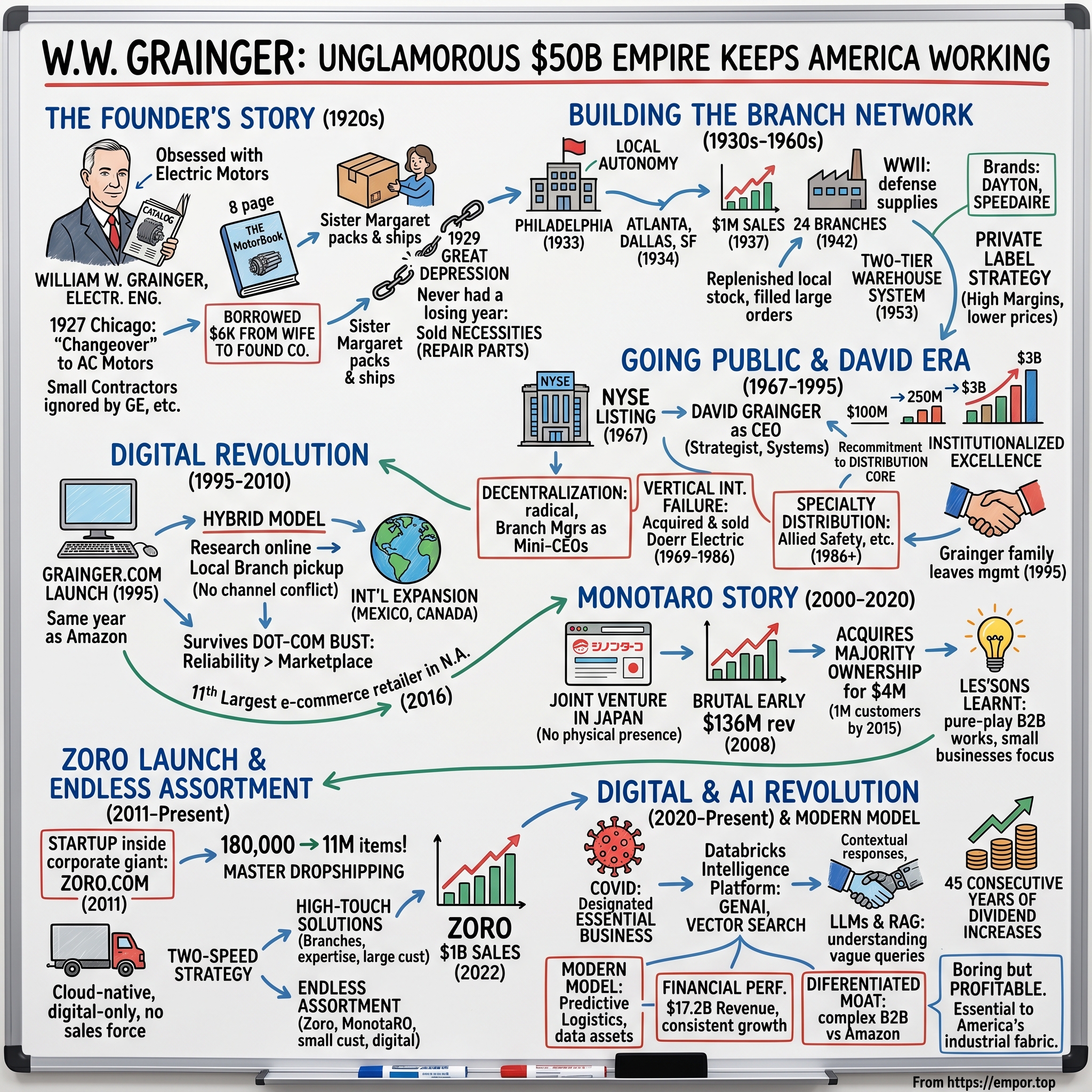
W.W. Grainger: The Invisible Machine Behind the Industrial World
I. Introduction & Episode Roadmap
A Utility Disguised as a Wholesaler
It is 2:40 a.m. at a food-processing plant somewhere in the Ohio Valley. A conveyor motor seizes, a production line goes silent, and a maintenance technician with a flashlight inspects the motor nameplate: horsepower, frame size, voltage, and shaft diameter. At that moment, nobody on the plant floor is evaluating price-to-earnings multiples or returns on capital. Everyone is focused on a single question: Can the replacement part arrive before the morning shift begins?
That question, asked millions of times each year across manufacturing plants, hospitals, data centers, correctional facilities, universities, and military installations, forms the foundation of W.W. Grainger, Inc. (NYSE: GWW). Over nearly a century, Grainger has built an operating network capable of delivering that answer—and generating financial returns rarely associated with distributing safety gloves and circuit breakers. In 2024, Grainger reported sales of $17.2 billion, an operating margin of 15.4% (15.5% on an adjusted basis), and diluted earnings per share of $38.71.1 Its adjusted return on invested capital (ROIC) that year was 41.6%.2 In 2025, revenue rose to $17.9 billion and adjusted ROIC was 39.1%.34
To put those numbers into perspective, an enterprise generating roughly 40 cents of after-tax operating profit annually for every dollar invested in distribution centers, inventory, and receivables functions more like a regulated toll road than an ordinary wholesale distributor. Most industrial distributors generate returns on capital in the low-to-mid teens. The central question of the Grainger story is how the company established that economic engine and whether its competitive moat can endure.
What Grainger Actually Sells
Grainger does not supply the raw steel forged into an automobile chassis or the resin molded into a plastic bottle. Those materials are classified as direct production inputs, typically procured in bulk volumes through multi-year contracts. Instead, Grainger provides maintenance, repair, and operating (MRO) supplies: safety eyewear, commercial pumps, fasteners, industrial adhesives, facility lighting, HVAC replacement components, and hand tools required to keep facilities and assembly lines operational. Its 2025 annual report described more than 4.6 million customers and more than 5,000 primary suppliers, with no single supplier accounting for more than 5% of purchases.54
The MRO category exhibits an unusual economic asymmetry. Individual orders are relatively small, and the products themselves are largely standardized commodities. However, the operational cost of not having the required component immediately available—measured in idle labor, missed production deadlines, and stranded factory capacity—can be severe. Grainger captures its economic surplus precisely within that spread between the acquisition cost of an inexpensive part and the catastrophic cost of facility downtime. The company's strategic history centers on expanding that value spread, alongside the operational challenges encountered whenever management misjudged customer friction.
The Spine of the Story
Three strategic tensions define Grainger's modern evolution:
First, Grainger operates two distinct business models. The High-Touch Solutions North America segment (consisting of Grainger U.S., Canada, and Mexico) generated approximately $14.0 billion in 2025 revenue at a 16.8% adjusted operating margin. Meanwhile, the Endless Assortment segment, comprising Zoro in the United States and MonotaRO in Japan, produced $3.6 billion at a 9.8% adjusted operating margin.4 The high-touch model relies on enterprise sales representatives, custom contracts, and embedded, on-site inventory systems. The endless-assortment model operates through digital search acquisition, upfront price transparency, and self-service digital checkout.
Second, the company endured a disruptive pricing reset. In 2016 and 2017, Grainger determined that its traditional practice of publishing inflated catalog list prices while granting negotiated discounts behind closed doors could not survive digital search transparency. Eliminating artificial list prices compressed gross margins and temporarily shook investor confidence before volume elasticity restored operating momentum.
Third, Grainger's capital allocation record is uneven. The most lucrative transaction in company history began as an early venture in Japan that grew into a controlling stake in MonotaRO. Conversely, several bolt-on acquisitions in the United Kingdom and continental Europe resulted in restructuring charges, asset write-downs, and eventual market exits.
The Roadmap
This examination traces the enterprise from Bill Grainger's Chicago electric motor catalog in 1927, through the postwar expansion of local branches and private-label brands, to early digital investments in the 1990s and 2000s. It analyzes the mid-2010s pricing reset and the strategic retreat from Europe, dissects the mechanics of today's two core segments, and evaluates the firm's competitive positioning and capital discipline. The analysis concludes by stress-testing the investment thesis against Grainger's historical performance, assessing whether its operating advantages are as portable and durable as its balance sheet indicates.
That narrative starts with a modest motor bulletin and an electrical engineer who recognized that regional power grids were modernizing far faster than the fragmented supply chains servicing them.
 Subscribe on LinkedIn
II. The Origin: Bill Grainger, Alternating Current, and the MotorBook (1927–1939)
An Engineer Reads the Grid
Chicago in the late 1920s was loud with mechanical power. Many factories still operated on a single large central engine that turned overhead line shafts, with leather belts dropping down to drive individual machines. A snapped belt could halt an entire plant floor. The emerging alternative was unit drive—giving each machine its own small electric motor—a transition that accelerated as municipal utilities standardized on alternating current.
William Wallace "Bill" Grainger, a motor designer, salesman, and electrical engineer by training, recognized a structural gap in that industrial shift.6 Major motor manufacturers were structured to supply original equipment manufacturers buying in bulk. By contrast, an independent repair shop, electrical contractor, or small manufacturing facility needing a single replacement motor had few reliable options. In 1927, Grainger established a wholesale electric-motor business in Chicago, incorporating it as W.W. Grainger, Inc. the following year.7
The Eight-Page Catalog
The young enterprise's primary offering was a publication rather than hardware. The MotorBook was an eight-page catalog listing available motors alongside their technical specifications, quickly becoming the cornerstone of the company's brand recognition.6 In the early days, Bill Grainger, his sister Margaret, and two employees packaged and shipped orders themselves.6
The catalog enabled a single modest office to reach commercial buyers across the country without a traveling field sales force. A plant maintenance supervisor reading the MotorBook could match a nameplate to a catalog listing, submit an order, and receive the correct component. That core premise has anchored every distribution channel Grainger subsequently built—from the printed catalog to digital storefronts and modern search platforms: streamline complex procurement for buyers who cannot afford to install the wrong part.
Surviving the Depression
The timing appeared precarious. Grainger was barely two years old when the Great Depression struck. Yet industrial repair distribution possesses an inherent counter-cyclical hedge: factories unable to finance new capital equipment must keep aging machinery running. Although Grainger's sales fell to $163,000 in 1932, that downturn marked one of only four years in the company's early history in which sales did not expand.76
Pure mail-order distribution, however, had clear operational limits. A plant facing a burned-out motor could rarely afford to wait days for a parcel delivery. Grainger's solution was forward positioning—placing inventory directly inside major industrial centers. The company opened its first regional branch in Philadelphia in 1933, followed by branches in Atlanta, Dallas, and San Francisco in 1934.7 By 1937, Grainger operated 16 branches and generated more than $1 million in annual sales.76
Why the Origin Still Matters
Grainger's early operational architecture established the principles that still govern the modern enterprise. Distributing through a catalog forced the company to master structured product data and technical categorization long before digital databases existed. Building out a branch footprint prioritized immediate local availability over lean, centralized logistics. Finally, focusing on urgent replacement demand generated pricing power grounded in fulfillment speed rather than product uniqueness. Each of those design choices resurfaced as a durable competitive advantage in subsequent decades—even as several later created structural friction.
The next phase moved Grainger from a regional network of stocked storefronts into an integrated national logistics system.
III. Building the Industrial Moat: Warehousing, Private Label, & Public Markets (1940–1995)
War Demand and the Regional Warehouse
World War II transformed Grainger from a regional motor distributor into a nationwide supplier. Supplying electric motors for wartime production and government facilities expanded sales from $2.6 million in 1941 to $7.8 million in 1948.6
A more fundamental operational shift took place in 1953, when Grainger introduced a regional warehousing system.7 Until that point, each local branch had operated largely as an isolated inventory island. Establishing regional warehouses converted the footprint into a hub-and-spoke network: centralized facilities maintained deep stock and replenished branches, enabling local storefronts to operate with leaner inventory while ensuring customers maintained immediate access to the full product catalog.
In logistical terms, the company had begun pooling its inventory. A single central warehouse supporting twenty branches requires significantly less aggregate safety stock than twenty standalone locations independently trying to forecast local demand. Pooling inventory delivered superior fulfillment reliability with lower capital intensity—the basic economic mechanism supporting Grainger's high return on invested capital today. The automated distribution centers examined later in this study represent the modern evolution of that 1953 architecture.
Private Label: Owning the Margin
The second postwar strategic lever was proprietary branding. Distributing third-party brand-name motors left Grainger operating on narrow wholesale spreads and exposed to supplier pricing power. In response, the company developed its own private-label lines. Grainger registered the Dayton trademark in 1937, and by 1975 proprietary labels—including Dayton, Teel, Demco, Dem-Kote, and Speedaire—represented roughly 65% of company sales.7
That historical peak provides a telling contrast with modern operations. In its 2025 annual report, Grainger disclosed that private-label products accounted for approximately 19% of U.S. stocked product sales within the High-Touch Solutions segment.5 The private-label share has receded because the company's catalog expanded from a focused motor catalog into an expansive industrial portfolio carrying millions of SKUs, the majority sourced under national brand names. While private-label goods remain a valuable gross margin lever, they no longer anchor the commercial proposition—and they present distinct supply chain risks. On its second-quarter 2026 earnings call, management cited margin compression from certain private-label lines, many of which are manufactured overseas and remain exposed to import tariffs.89
The Public Company and a Cautionary Detour
Grainger completed its initial public offering in 1967.7 Sales had expanded to $80.2 million in 1966, up from $43.5 million in 1962.7 Bill Grainger's son, David W. Grainger, steered the business through this era of commercial scaling, serving as chief executive officer until 1995, when Richard Keyser succeeded him and David Grainger assumed the role of board chair.6
The most instructive corporate experiment of this era was a brief excursion into manufacturing. In 1969, Grainger acquired electric motor manufacturer Doerr Electric Corporation. In 1986, it divested Doerr to Emerson Electric for $24.3 million.7 Although detailed transaction economics were never fully disclosed, the strategic takeaway was plain. Operating a manufacturing facility tied up capital in an asset-heavy, cyclical business with an entirely different cost structure, while creating channel conflicts with the equipment manufacturers whose products stocked Grainger's catalogs. The experience reinforced a principle that would govern subsequent capital allocation: Grainger generates superior returns by aggregating and distributing products, rarely by producing them.
Building Out Categories
Through the late 1980s and early 1990s, Grainger steadily extended its reach beyond electrical and mechanical equipment into adjacent facility categories. It purchased Allied Safety, Inc. in 1990 and Lab Safety Supply in 1992, establishing an anchor position in industrial safety and personal protective equipment (PPE).7 PPE subsequently grew into one of the company's foundational product lines—a position that proved commercially pivotal during the 2020 pandemic. Total sales climbed from $1.3 billion in 1987 to $4.1 billion in 1997.6 In 1996, Grainger initiated its international expansion by acquiring a division of Acklands Ltd. in Canada, launching a cross-border operation that would encounter prolonged operational headwinds.76
What This Era Built
By the mid-1990s, Grainger possessed three durable competitive assets: a hub-and-spoke inventory network that pooled capital efficiently, a distribution brand synonymous with reliable industrial availability, and an unmatched repository of structured product data. That third advantage proved decisive. As the commercial internet took shape, a company that had spent decades standardizing and categorizing technical specifications for hundreds of thousands of industrial parts possessed a substantial head start over competitors struggling to catalog their inventory online.
IV. The Digital Genesis & The Japanese Equity Miracle (1995–2010)
The Catalog Goes Online
For decades, Grainger's printed catalog had been a ubiquitous fixture in North American maintenance shops. By 1991, that bound volume—the direct descendant of Bill Grainger's original eight-page MotorBook—listed more than 35,000 items.6 In the mid-1990s, the company launched grainger.com to bring that catalog to the web, and by 1999 it was operating three separate internet properties: Grainger.com, OrderZone.com, and FindMRO.com.6
That early digital experimentation was not without missteps. OrderZone, a multi-supplier purchasing portal launched during the dot-com expansion, struggled to gain commercial traction and was merged into Works.com in 2000 after disappointing adoption.6 That stumble provides a useful counterweight to retrospective narratives framing Grainger as an infallible digital pioneer. The open-marketplace concept faltered. What endured, however, was the disciplined, unglamorous taxonomy of structured product data: classifying dimensions, electrical voltages, thread pitches, and materials so that facility managers could filter directly to an exact replacement component. That technical infrastructure later enabled seamless enterprise e-procurement integrations and, ultimately, machine-learning-driven search.
Japan: A Small Joint Venture With a Big Idea
In 2000, Grainger and Japanese trading house Sumitomo Corporation formed a joint venture in Osaka.10 That venture became MonotaRO Co., Ltd., a direct marketer of MRO supplies to Japanese businesses.10
The concept was uniquely tailored to Japan's commercial landscape. Industrial procurement had long moved through multi-tiered networks of regional wholesalers and relationship-driven distribution rooted in the keiretsu tradition—an arrangement that imposed high transaction costs and prolonged delivery times on smaller enterprises. MonotaRO introduced a radical departure. Dispensing entirely with a physical branch footprint and field sales representatives, it published transparent catalog pricing, targeted small and mid-sized enterprises, and relied on direct marketing and, increasingly, web-based ordering.
The 2009 Deal
By 2009, MonotaRO had established a viable, profitable operational model. In 2008, the company generated $136 million in revenue and $11 million in operating earnings, serving over 320,000 customers with a catalog of more than 110,000 products.11 At that juncture, Grainger held a 38% minority stake in the business.10 In June 2009, amid the dislocation of the global financial crisis, Grainger’s then-chief executive Jim Ryan announced a plan to acquire majority control, citing an estimated $50 billion total addressable MRO market in Japan.10
Through the subsequent tender offer, Grainger purchased 380,000 shares at ¥1,010 each—approximately $11.11 per share—raising its ownership stake to 53%.11 The incremental cash outlay was roughly $4 million. While market commentators occasionally cite that $4 million sum as the total purchase price of MonotaRO, it represented only the incremental cost required to secure majority control, building upon the equity capital Grainger had committed since the venture's founding nine years earlier.
The Outcome
The operational trajectory of that investment proved extraordinary. In fiscal 2025, MonotaRO reported consolidated net sales of ¥333.9 billion—a 15.9% year-over-year increase—and operating income of ¥46.2 billion (up 24.6%), generating an operating margin of approximately 13.8%.12 Its digital catalog expanded to more than 28.8 million SKUs.12 For fiscal 2026, the company projected net sales of ¥381.4 billion and operating income of ¥53.1 billion.12 Grainger’s equity stake stood at 50.34% as of March 2025, down slightly from its 2009 level, and MonotaRO has maintained a governance commitment to operational independence, with Grainger personnel occupying fewer than half of its board seats.13
MonotaRO's customer mix has also evolved in ways the original investment thesis did not anticipate. Although the platform was initially engineered for small and medium-sized commercial buyers, its Enterprise Business—which integrates directly with larger corporate procurement systems—grew 23.5% in 2025, outpacing the core self-service web storefront.12 Investor disclosures highlight ongoing strategic initiatives to consolidate indirect procurement for enterprise accounts and deepen relationship management for institutional clients.12 In effect, the digital-native upstart has steadily built out the high-touch corporate capabilities that define Grainger's core North American franchise. Rather than remaining permanently distinct, the two operating models appear to be converging from opposite starting points.
For Grainger, the broader strategic takeaway carries a degree of humility. The most financially lucrative international transaction in company history succeeded precisely because Grainger did not impose its domestic playbook. MonotaRO flourished as a domestically engineered, digital-first business built around the specific purchasing habits of Japanese industrial buyers, and Grainger's leadership exercised the discipline to grant it operational autonomy. That outcome stands in stark contrast to the challenges Grainger encountered when attempting to export its capital-intensive, high-touch branch model into Western Europe.
The decade that followed tested both distribution philosophies in parallel.
V. The Strategic Crisis: Pricing Transparency, International Value Destruction, and the 2017 Reset (2011–2019)
The Problem With List Prices
Consider two buyers purchasing the exact same box of nitrile gloves in 2015. The first is a procurement manager at a Fortune 500 manufacturing facility operating under an enterprise contract that provides a steep discount off Grainger's catalog list price. The second is the proprietor of a twelve-person machine shop who types "nitrile gloves" into a web search engine. The corporate manager secures a competitive wholesale price. The independent shop owner, lacking a negotiated corporate contract, confronts Grainger's full list price—while alternative digital marketplaces offering comparable safety supplies at a sharp discount sit just a click away.
That disparity exposed the central vulnerability in Grainger's commercial pricing model. Historically, the company had relied on an opaque arrangement: high published catalog list prices paired with custom, contractually negotiated discounts granted to large accounts behind closed doors. That framework functioned reliably when cross-shopping required paging through heavy print catalogs or placing phone inquiries across regional supply counters. It proved far less resilient once digital commerce and online search made price discovery instantaneous. Mid-sized and smaller commercial customers—the buyers paying closest to full list price—were the quickest to defect, despite being among the company's most profitable accounts.
Enter D.G. Macpherson
The executive who confronted that structural challenge did not fit the mold of a conventional distribution lifer. D.G. Macpherson held an undergraduate degree from Stanford University and an MBA from Northwestern University's Kellogg School of Management. He began his career as an operations test engineer with the U.S. Air Force and served as an operations manager at Rain Bird before spending six years, from 2002 to 2008, as a partner and managing director at the Boston Consulting Group, where he concentrated on industrial goods, production systems, and continuous improvement.14 Macpherson joined Grainger in 2008, oversaw the global supply chain, served as chief operating officer from 2015 to 2016, and became chief executive officer in October 2016 and board chairman in October 2017.14
That background informed his strategic response. An industrial engineer and former management consultant was naturally inclined to treat legacy pricing architecture as an operational system requiring fundamental redesign rather than a historical commercial privilege to be protected.
The Reset and the Market's Verdict
Grainger first outlined its U.S. pricing overhaul in late 2016 and implemented the primary adjustments across January and February 2017, introducing lower web prices and a more competitive rate structure for non-contracted buyers. The immediate market response was severe. On April 18, 2017, Grainger reported first-quarter sales of approximately $2.54 billion—up just 1%—alongside diluted earnings per share of $2.93, with both figures trailing consensus estimates. Management lowered its full-year EPS guidance from a range of $11.30–$12.40 down to $10.00–$11.30, announcing that it would accelerate additional price reductions originally planned for 2018 into the third quarter of 2017. Grainger's shares dropped 11.4% that day to close at $197.57.15
The direct financial cost was evident on the income statement. Gross margin fell from 40.6% in 2016 to 39.3% in 2017, while operating margin compressed from 11.0% to 10.1%.16 In year-end communications, management reported that removing "the pricing barrier" had prompted a positive customer response, noting that expanding order volume was beginning to offset unit price deflation.16
Did It Work?
Financial results for 2018 provided the first conclusive verdict. Total revenue rose 8% to $11.2 billion, U.S. shipment volumes expanded 8%, and adjusted operating margin recovered to 12.0%—a threshold Macpherson stated the company had attained "a year earlier than anticipated."17 Gross profit margin, however, slipped further to 38.7%.17
A balanced assessment indicates that the reset succeeded not by reviving Grainger's historical profit spreads, but by establishing a new operating equilibrium. Grainger accepted structural gross-margin dilution in exchange for customer retention, volume growth, and operating leverage across a largely fixed logistics infrastructure. Equity markets eventually validated the maneuver: shares that closed at $197.57 following the 2017 guidance cut were repurchased by the company at average prices ranging between roughly $944 and $1,004 per share in late 2025.155 The shift was also commercially necessary; the legacy pricing structure had triggered a chronic customer defection that digital price transparency would have compounded over time.
Crucially, the reset did not prove that Grainger commanded unrestricted pricing power. Instead, it demonstrated that the enterprise could trade gross margin for higher order volume and still expand total operating profit because its distribution centers possessed the unutilized capacity to handle incremental volume without a proportionate rise in operating costs. That operational leverage depended on existing slack across the fulfillment network—an advantage that would not function similarly in a business already running at capacity constraints.
Zoro: Serving the Buyer the Sales Force Could Not Afford To
While the pricing reset resolved customer friction within the core branch network, Grainger created a separate channel to tackle a different operational challenge: the prohibitive overhead of servicing smaller accounts. In May 2011, the company launched Zoro.com with an initial roster of twenty employees and 180,000 catalog items.18 By 2016, Zoro's digital catalog expanded past one million unique products.18 Macpherson had directly overseen the platform's initial rollout.14 Adapting MonotaRO's operating model, Zoro functioned without field sales representatives, offered transparent upfront pricing, carried an expansive digital assortment, and leveraged Grainger's existing distribution network for customer fulfillment.5
The underlying economic principle was straightforward. Deploying an enterprise account executive and negotiating bespoke contract terms represented uneconomic tools for a customer purchasing $300 in annual maintenance supplies. Serving that customer through an automated, low-cost digital storefront enabled Grainger to capture fragmented small-business spend without undermining the unit economics of its high-touch enterprise sales organization.
Historical Falsification Case #1: The International Expansion Record
The overarching strategic thesis Grainger tested during this era was that its high-touch, relationship-driven branch model could be exported internationally through cross-border acquisitions. The resulting track record largely refuted that premise.
Fabory (Continental Europe). In August 2011, Grainger agreed to acquire Fabory, a Dutch distributor of industrial fasteners headquartered in Tilburg with approximately $300 million in 2010 sales, for $344 million (€242 million). Then-CEO Jim Ryan characterized the transaction as "a unique opportunity" to establish a platform within one of the world's largest regional MRO markets.19 The acquisition closed on August 31, 2011, accompanied by plans to accelerate Fabory's branch footprint and product portfolio.20 Nine years later, in the first quarter of 2020, Grainger recorded a $177 million impairment charge against Fabory's goodwill, intangible assets, and long-lived assets, citing decelerating sales, gross margin contraction, and stagnant operating performance.21 Grainger agreed to divest the business to Dutch private equity firm Torqx Capital Partners in June 2020 on undisclosed terms, booking an additional $109 million pretax loss on the sale.2223 Relative to the original purchase price, those write-downs erased the majority of Grainger's invested capital.
Cromwell (United Kingdom). In July 2015, Grainger agreed to purchase Cromwell, the largest independent MRO distributor in the United Kingdom, for £310 million (approximately $482 million). Management framed the acquisition around a digital transformation thesis: Cromwell generated less than 5% of its sales online, and Grainger intended to replicate its success with MonotaRO and Zoro by projecting Cromwell's EBITDA margins would expand from 10% to 15% over a five-year horizon.24 By the third quarter of 2018, Grainger had written off the entirety of Cromwell's $105 million in goodwill alongside $34 million of trade-name value, citing deteriorating operational results and macroeconomic uncertainty surrounding Brexit.25 In September 2025, Grainger initiated the proposed closure of Zoro U.K. On October 17, 2025, the company announced the sale of Cromwell to private equity firm AURELIUS, indicating that it anticipated a non-cash after-tax loss between $190 million and $205 million, with Macpherson stating: "we've altered our assumptions about our future potential in this region."26 That divestiture closed on December 17, 2025.5
Acklands-Grainger (Canada). The Canadian franchise, originally acquired in 1996, underwent years of structural reorganizations. In 2018, Grainger incurred $47 million in restructuring charges across its Canadian operations.17 In the first quarter of 2019, Canadian daily sales dropped 24% as management aggressively rationalized branches to downsize the physical network, narrowing the unit's net loss from $20 million to $5 million.27 Grainger achieved a profitable fourth quarter in Canada in 2018 following years of operating losses.17 Nonetheless, the $119 million in goodwill remaining on the Canadian balance sheet was designated by Grainger's independent auditor as a critical audit matter in the 2025 audit because the valuation assumptions required significant subjective judgment.5
The conclusion. This historical record does not indicate that Grainger's broader distribution competencies cannot function outside the United States. Rather, it reveals a much narrower and more consequential reality: the high-touch, branch-and-rep distribution model does not travel effectively through cross-border acquisitions. That model's economics rely on local delivery route density, favorable supplier terms, institutional brand equity, and entrenched customer relationships cultivated across decades in a specific geography. Purchasing an established overseas distributor provides none of those structural advantages on day one. Furthermore, the Cromwell experience demonstrates that layering a digital storefront onto an underperforming foreign distributor cannot compensate for a deficit in those core logistical fundamentals. Tellingly, Grainger's sole overseas success—MonotaRO—was locally engineered, digital-native, and managed with operational independence. Any future international acquisition proposals must be evaluated against this empirical track record rather than executive optimism.
The retreat from European operations cleared the way for the two-segment enterprise that exists today.
VI. Modern Architecture: High-Touch Solutions vs. Endless Assortment (2020–Present)
A Tale of Two Buyers
Consider two customers served by the same enterprise on the same Tuesday. At a Midwestern hospital system, a facilities director never visits Grainger's website. Replenishment orders flow automatically through enterprise procurement software, a Grainger-managed vending machine dispenses gloves and diagnostic batteries to maintenance personnel, and an on-site Grainger representative inspects the facility storeroom weekly. Meanwhile, at an independent HVAC contractor in Arizona, the owner types a component part number into Zoro.com at 10:00 p.m., checks prices, and checks out with a credit card.
Both are Grainger customers, but they are serviced by two fundamentally different distribution machines.
The Pandemic as a Live-Fire Exercise
The current two-segment structure was tested almost immediately. In the first quarter of 2020, as the COVID-19 pandemic spread, Grainger suspended full-year financial guidance and paused share repurchases while classifying its operations as an essential business. Despite severe macroeconomic dislocations, first-quarter sales rose 7.2% to $3.0 billion.21 That period revealed the dual dynamics of the operating model: surging demand for pandemic-related supplies like safety masks, protective gloves, and sanitizer partially offset sharp declines in baseline industrial volume. (Section IX evaluates what that quarter demonstrated regarding the franchise's structural defensiveness.) The immediate operational takeaway was that a national fulfillment footprint anchored by deep inventory in safety categories—the legacy of the Allied Safety and Lab Safety acquisitions decades earlier—could pivot rapidly when commercial demand transformed overnight.
Segment 1: High-Touch Solutions North America
This segment serves large and mid-sized commercial accounts managing complex operations, including manufacturers, government agencies, healthcare networks, and commercial real estate operators.5 In 2025, High-Touch generated $13.99 billion in sales, an increase of 2%, and produced operating earnings of $2.35 billion on a 41.7% gross margin.5 Adjusted operating margin compressed from 17.5% in 2024 to 16.8% in 2025.24 That margin pressure reflected key cost sensitivities: management attributed the contraction to tariff-driven price-cost timing mismatches, LIFO inventory accounting adjustments, and elevated operating overhead, including higher healthcare expenses.3
Three operational mechanisms underpin customer retention in this segment:
Procurement integration. Enterprise customers rarely browse digital storefronts. Instead, they transact via electronic data interchange (EDI) and integrated e-procurement software, which link customer purchasing platforms directly into Grainger's catalog, inventory feeds, and negotiated contract pricing. Management noted in early 2026 that EDI and e-procurement constituted the company's largest order channel at roughly 40% of order volume, with the vast majority of contracted accounts utilizing both e-procurement workflows and KeepStock.28 In practical terms, this integration functions much like corporate travel software pre-configured for a preferred carrier: while an employee could technically book elsewhere, doing so requires manual workarounds and invites administrative scrutiny.
KeepStock. Grainger's vendor-managed inventory program places physical storage hardware, automated dispensing units, and dedicated personnel directly inside customer facilities, encompassing on-site vending machines, organized storerooms, and proactive replenishment managed by Grainger staff.5 Customer adoption of KeepStock expanded in 2025 as industrial employers navigated labor constraints and facility cost pressures, prompting Grainger to schedule the rollout of upgraded customer-facing data tools in 2026.28 One analytical limitation is that Grainger does not routinely disclose the aggregate number of active KeepStock installations or discrete KeepStock revenue in its annual filings, constraining external attempts to quantify this operational advantage.5
Sales coverage and product range. Grainger expanded its commercial field force by 110 sales representatives in 2025, bringing cumulative additions since 2022 to more than 300 sellers—an expansion of roughly 10% across the U.S. sales organization. Concurrently, the company introduced more than 85,000 net new SKUs, marking its largest single-year catalog expansion in nearly a decade.29
Supporting this commercial front is an extensive physical logistics footprint. At year-end 2025, Grainger operated 21 U.S. distribution centers—some scaling up to 1.5 million square feet—complemented by 245 local branches, 75 on-site customer locations, and four will-call express depots. In international markets, the segment maintained 32 branches and five distribution centers across Canada, alongside 15 branches and two distribution centers in Mexico.5
Segment 2: Endless Assortment
Endless Assortment expanded sales by 15.7% to $3.63 billion in 2025, while operating earnings surged 33% to $345 million, propelled by strong customer reorder rates and enterprise account expansion at MonotaRO.5 The segment generated a 29.9% gross margin—roughly twelve percentage points below High-Touch—illustrating the structural spread between a self-service, upfront price-transparent model and a full-service, contract-driven branch network.5
Zoro maintains a digital catalog of approximately 13 million SKUs and fulfills orders by drawing upon Grainger's centralized fulfillment network as well as third-party drop-ship supplier arrangements.5 Zoro U.S. expanded sales approximately 16% in 2025, with management highlighting encouraging early reorder rates across newly introduced private-label product lines.29
MonotaRO, the Japanese direct marketer detailed in Section IV, posted an 18.4% local-currency revenue increase in 2025, although management acknowledged that top-line performance benefited partly from a cyber outage at a primary competitor.29 MonotaRO's corporate disclosures confirmed a sharp fourth-quarter surge in office-supply orders directly linked to that competitor's downtime.12 MonotaRO's logistics backbone incorporates the Kasama and Inagawa distribution centers and the Ibaraki Chuo fulfillment center, with a new facility in Mito under construction; to support this multi-hub infrastructure expansion, the company secured ¥13 billion in bank term loans during 2025.125
Operating momentum carried into 2026. During the second quarter, Endless Assortment sales advanced 20.6% on a daily, organic constant-currency basis, as Zoro U.S. grew 18.4% and MonotaRO expanded 24% in local currency. That surge was aided by an estimated $45 million in customer forward-buying of petroleum-derived consumables—primarily protective gloves and safety gear—prompted by geopolitical instability in the Middle East, a windfall management cautioned was unpredictable and likely transitory.9 Updated corporate guidance projected a 2026 Endless Assortment operating margin of 10.4% to 10.8%, compared with 17.2% to 17.6% for High-Touch Solutions.8
The broader portfolio implication is that while Endless Assortment operating margins are expanding, they remain structurally lower than High-Touch returns. Because Endless Assortment is compounding at a faster pace, its increasing weight within the sales mix exerts downward pressure on consolidated gross margin—an unfavorable mix shift management highlighted in the fourth quarter of 2025.3 For investors, strong Endless Assortment performance accelerates top-line growth while moderating consolidated headline margins.
The Logistics Build-Out
Grainger is executing its most ambitious logistics expansion in years. In February 2024, the company announced plans for a 1.2-million-square-foot distribution center in Hockley, Texas, near Houston, scheduled to open in 2026 with roughly 400 workers. That facility anchors a broader capital plan adding 3.5 million square feet—a 35% increase in total warehouse capacity—alongside a 525,000-square-foot bulk inventory facility in Pineville, North Carolina, and a new regional distribution hub in Gresham, Oregon.30 The Northwest Distribution Center in Gresham initiated customer fulfillment in July 2026 and hosted its formal opening on August 19, 2026, with industry publications describing a 550,000-square-foot facility stocking over 135,000 unique products.931 Cash capital expenditures totaled $684 million in 2025, with management guiding 2026 capital spending between $575 million and $650 million.38
The commercial rationale extends the inventory-pooling thesis pioneered in 1953 to a continental scale. Positioned strategically, modern distribution hubs place deeper safety stock closer to regional customer clusters, increase the proportion of orders delivered complete on a next-day basis, and reduce dependence on smaller, costly local branches. The operational risk lies in capital absorption. Adding automated square footage introduces substantial fixed depreciation and carrying overhead before facilities reach optimal throughput; should broader industrial demand soften, unabsorbed warehouse capacity will temporarily weigh on returns on invested capital.
AI and the Product-Data Advantage
Industrial catalog search presents technical challenges fundamentally different from consumer e-commerce. A facility engineer might query "3/8 zinc hex bolt," "0.375 hex cap screw," or an obscure manufacturer part number, all pointing to an interchangeable component. To resolve that semantic friction, Grainger collaborated with Databricks to construct a retrieval-augmented generation (RAG) search architecture utilizing Databricks Mosaic AI and Vector Search across a catalog of approximately 2.5 million SKUs subject to more than 400,000 daily catalog modifications.32 In contrast to unconstrained language models, a RAG system retrieves verified catalog records prior to generating a response, ensuring recommendations remain anchored in actual technical specifications and inventory availability. The system was deployed primarily to assist internal customer-service specialists and sales teams, alongside direct website search enhancements.32 Grainger has similarly integrated artificial intelligence capabilities into its SellerInsights sales-enablement platform and its digital marketing optimization engines.28
Two analytical qualifications are warranted. While these applications are operationally substantive, Grainger has not disclosed empirical metrics—such as measurable conversion-rate uplifts or quantified cost reductions—demonstrating their incremental contribution to operating profit. Furthermore, the underlying algorithmic tooling is accessible across the software industry. Grainger's true competitive barrier resides not in proprietary code, but in nearly a century of clean, standardized technical taxonomies and customer transaction records. Whether that data moat remains unassailable as general AI models grow more adept at structuring unstructured vendor catalogs represents a pivotal strategic question—and frames the broader competitive landscape.
VII. Competitive Landscape & 7 Powers Analysis
The War Room
Consider a procurement director at a regional healthcare system mapping its annual MRO expenditures. One major category is locked under enterprise contract with Grainger. A specialized band of cutting tools and structural fasteners flows to niche distributors. A growing volume of routine, uncontracted spend—batteries, breakroom supplies, and utility storage bins—has migrated to a corporate Amazon Business account. The remainder is fragmented across dozens of local supply houses. That ledger represents the modern competitive battlefield. Grainger's ongoing growth depends on consolidating spend away from regional jobbers while preventing digital generalists from encroaching on its technical, mission-critical core.
A Fragmented Market
The North American MRO market remains vast and highly fragmented, with Grainger standing as its largest broad-line distributor. Neither the company's 2025 Form 10-K nor its annual report discloses an explicit total addressable market size or official market-share percentage.5 Third-party industry estimates should therefore be treated with caution. What Grainger does disclose is its revenue growth relative to estimated market expansion—a metric that offers a clearer operational signal, evaluated in Section IX.
The Competitors
Fastenal (NASDAQ: FAST) represents Grainger's most profitable peer. For 2025, Fastenal reported net sales of $8.2 billion, an increase of 8.7%, and operating income of $1.7 billion, translating to an operating margin of roughly 20.7%.33 Originally established as a fastener specialist, Fastenal built its business model around dedicated onsite locations inside customer facilities backed by an expansive base of automated dispensing devices, signing 25,892 new FASTBin and FASTVend installations in 2025.33 Fastenal provides the clearest evidence that Grainger's embedded-inventory model is not an uncontested monopoly. It competes directly against KeepStock for plant storerooms and factory floors, generating superior operating margins on a narrower, more fastener-centric product portfolio.
MSC Industrial Direct (NYSE: MSM) represents the cautionary peer. For fiscal 2025, MSC reported sales of $3.77 billion, down 1.3% year-over-year, alongside an operating margin of 8.0% (8.4% on an adjusted basis), trailing management's stated target of mid-teens adjusted margins.34 MSC's historical stronghold in metalworking and cutting-tool applications has failed to generate Grainger-like returns on capital, underscoring that broad-line distribution scale, comprehensive product taxonomy, and sophisticated digital e-procurement integrations matter far more than deep specialist positioning alone.
Amazon Business represents the primary structural threat. The platform reported approximately $35 billion in annualized gross sales in 2023,35 and by July 2026 disclosed that annualized gross sales had reached $60 billion.36 While those totals encompass all commercial procurement—spanning enterprise IT hardware, office consumables, and breakroom provisions—and are not directly comparable to Grainger's industrial MRO volume, the expansion velocity is the salient metric. Amazon's structural limitations in industrial MRO remain genuine: it lacks technical field engineers, provides limited on-site vendor-managed inventory services, and maintains less regulatory and logistical depth across hazardous materials and heavy machinery components. Nevertheless, its commercial procurement footprint is compounding far faster than the broader distribution sector.
Hamilton Helmer's 7 Powers
Helmer's framework asks which structural advantages let a company earn high returns that competitors cannot compete away.
Scale economies (strong). Grainger's nationwide distribution center network, negotiated freight volumes, and purchasing relationships spanning more than 5,000 primary suppliers spread fixed logistical overhead across a revenue base regional distributors cannot match.5 The empirical proof is the persistent ROIC spread between Grainger, smaller regional jobbers, and mid-tier peers like MSC. However, this scale barrier remains strictly continental; as demonstrated in Section V, purchasing power and logistics density did not transfer to European acquisitions.
Switching costs (strong in High-Touch, weak in Endless Assortment). Deep ERP integrations, customized e-procurement workflows, on-site KeepStock installations, and negotiated enterprise pricing create substantial operational friction for corporate accounts considering a transition away from Grainger. By contrast, Endless Assortment buyers can defect with a single mouse click. Their retention depends almost entirely on continuous search relevance, catalog breadth, and competitive price discovery.
Process power (moderate). Nearly a century spent refining technical product taxonomies, hazardous materials routing, regulated supply-chain workflows, and complete next-day fulfillment creates an operational machine that cannot be replicated quickly. Yet process power is rarely permanent; its defensive margin erodes as well-capitalized competitors, including Amazon, systematically invest in identical fulfillment and logistics capabilities.
Counter-positioning (moderate, fading). Zoro and MonotaRO were designed around a self-service, low-overhead model that legacy, commission-heavy distributors could not replicate without cannibalizing their existing field sales forces. While highly effective against traditional regional wholesalers, that counter-positioning offers no structural defense against Amazon, which entered enterprise commerce entirely unencumbered by physical branch infrastructure or commissioned sales representatives.
Brand (moderate). To plant maintenance supervisors and facility engineers, the Grainger name remains a shorthand for fulfillment reliability, supporting premium pricing on emergency orders. Yet in business-to-business commerce, brand equity has definite boundaries. When corporate procurement committees audit recurring tail spend, cost-optimization algorithms routinely override a technician's historical brand affinity on non-urgent commodities.
Network effects (weak). Catalog expansion across Zoro and MonotaRO produces a mild two-sided dynamic: a broader SKU assortment attracts incremental commercial traffic, which in turn encourages additional drop-ship vendors to list inventory. However, this dynamic remains far weaker than a genuine platform network effect, as Grainger continues to bear inventory, curation, and fulfillment responsibilities rather than operating an open, frictionless software exchange.
Cornered resource (weak). The vast majority of Grainger's catalog consists of standardized industrial commodities produced by third-party manufacturers. Proprietary private-label merchandise, which represents approximately 19% of U.S. stocked product sales, functions as an incremental gross-margin lever rather than an exclusive, unreplicable asset.5
The overarching conclusion of this analysis is that Grainger's competitive moat rests primarily on two structural pillars: scale economies and enterprise switching costs. Critically, both advantages reside almost exclusively within High-Touch Solutions in North America. That concentration explains why Grainger sustains exceptional returns on capital—and precisely where its business model remains vulnerable, a dynamic explored in the financial analysis that follows.
VIII. Financial Engine, Capital Allocation, & Governance
How a Distributor Earns 40% on Capital
Grainger's financial model functions much like an industrial conveyor belt. Inventory arrives from suppliers, moves rapidly through high-throughput distribution centers, and ships out to creditworthy corporate and institutional clients who pay reliably. Because inventory turns quickly and fixed assets are utilized intensively, each dollar of invested capital cycles through the system multiple times per year at operating margins in the mid-teens. That operating velocity generates the company's outsized returns on capital: an adjusted ROIC of 41.6% in 2024 and 39.1% in 2025.24
The year-over-year compression between 2024 and 2025 reflects margin pressures in High-Touch Solutions alongside substantial upfront capital outlays for new distribution facilities that have yet to reach full throughput efficiency.3 The executive compensation framework demonstrates how normalized such performance has become within the boardroom. For 2025, incentive payout thresholds for adjusted ROIC spanned from 37.5% at the minimum threshold to 43.1% for maximum payout.37 For Grainger's directors, earning roughly 40 cents of after-tax operating profit per dollar of capital employed is treated not as a cyclical peak, but as the baseline expectation.
Cash Flow and Where It Goes
In 2025, Grainger generated $2.0 billion in operating cash flow, directed $684 million toward capital expenditures, and produced $1.3 billion in free cash flow.3 Total cash returned to shareholders reached $1.5 billion, comprising $1.045 billion in share repurchases and $467 million in cash dividends.53 Grainger's 2025 annual report highlighted 54 consecutive years of annual dividend increases.4 Dividends represented 27.4% of 2025 net earnings, leaving ample room for reinvestment.4 For 2026, management projected full-year share repurchases between $975 million and $1.05 billion.8
From an investor's perspective, however, Grainger returned more cash to shareholders than it generated in free cash flow during 2025, reducing cash and cash equivalents from $1,036 million to $585 million.3 While a temporary balance-sheet drawdown is easily manageable for an enterprise with Grainger's recurring cash generation, it meant that share repurchases executed near $1,000 per share were partially funded by drawing down cash reserves. Corporate filings show late-2025 buybacks executed at average prices ranging from roughly $944 to $1,004 per share.5 Share repurchases compound per-share value only when shares are acquired below intrinsic worth; repurchasing stock at those levels requires investors to believe that Grainger's premium distribution multiple remains sustainable.
The Capital Allocation Scorecard
Grainger's capital allocation track record is more nuanced than simple management discipline. It divides sharply across three distinct categories:
- Organic reinvestment: Funding automated distribution centers, digital search architectures, and sales-force expansions has consistently generated superior returns, as evidenced by the enterprise's sustained ~40% ROIC.
- Cross-border acquisitions: Overseas acquisitions outside North America systematically impaired shareholder value. Cumulative write-downs and divestiture losses on Fabory and Cromwell erased hundreds of millions of dollars against initial purchase prices of $344 million and approximately $482 million, respectively.192122242526
- MonotaRO: The singular international triumph stands as the exception that proves the rule—an early, incremental joint-venture investment in an autonomous, locally engineered digital platform.
Under Macpherson's leadership as CEO, Grainger has avoided large-scale acquisitions while systematically divesting Fabory and Cromwell. That restraint reflects capital discipline, but it also reflects an organization chastened by costly strategic missteps—including Cromwell, which Grainger acquired in 2015 while Macpherson was serving as a senior executive overseeing global supply chain and international operations.1424
The MonotaRO Accounting Wrinkle
A critical structural nuance in Grainger's consolidated financial statements is easily overlooked. Although Grainger owns approximately 50.3% of MonotaRO, it consolidates 100% of MonotaRO's revenues and operating earnings into the Endless Assortment segment.313 The economic share belonging to external public shareholders appears only near the bottom of the income statement under noncontrolling interest, which absorbed $102 million of consolidated net earnings in 2025—an increase of 27.5% over the previous year.5 Furthermore, MonotaRO's results are consolidated one month in arrears and translated from Japanese GAAP to U.S. GAAP, meaning reported figures will diverge slightly from MonotaRO's standalone disclosures.3
This accounting treatment is crucial when evaluating segment performance. While Endless Assortment's reported top-line expansion flows entirely into Grainger's consolidated revenue, roughly half of MonotaRO's net profit belongs to outside equity holders. Because MonotaRO is compounding faster than Grainger's core North American operations, the spread between consolidated operating profit and net earnings attributable to Grainger will naturally widen over time. For equity analysts, net earnings attributable to Grainger and diluted earnings per share provide the true economic gauge of shareholder value.
Management and Governance
Macpherson has led Grainger as chief executive since 2016. In mid-2026, the executive ranks experienced a significant transition. On August 3, 2026, Grainger announced that Chief Financial Officer Deidra Merriwether would step down effective September 4, 2026, to pursue another opportunity, noting that her departure did not stem from any disagreement regarding operations, financial reporting, or internal controls. Laurie Thomson, vice president and controller, assumed the role of interim CFO on September 5, 2026, while the board initiated a search for a permanent successor.389 Although the transition was orderly, the departure of a CFO precisely as the company integrates multi-million-square-foot automated distribution centers introduces operational execution risk, alongside natural succession considerations accompanying Macpherson's decade-long tenure.
Incentives: Aligned, but Watch the Yardstick
Grainger's 2026 proxy statement outlines an executive compensation structure tightly coupled to operational efficiency and capital productivity. The annual incentive program is weighted entirely across two core metrics: daily organic constant-currency sales growth and adjusted ROIC. In 2025, the annual plan paid out at 93% of target, reflecting 4.0% sales growth and a 39.1% adjusted ROIC; the board also eliminated an environmental, social, and governance modifier from the plan in 2025.37 Stock ownership guidelines require Macpherson to hold shares valued at six times his base salary, while corporate governance policies strictly prohibit the hedging or pledging of company equity.37
The long-term incentive program presents a more intricate governance picture. Performance share units (PSUs) for the 2023–2025 cycle vested at 90% of target, driven partly by three-year average U.S. market share gains of 284 basis points—comprising annual outgrowth of 518 basis points in 2023, 97 basis points in 2024, and 235 basis points in 2025. Notably, the proxy discloses that in 2025, the compensation committee modified the methodology for calculating U.S. market outgrowth, shifting from a third-party estimate incorporating both price and volume to an internal, volume-only "multi-factor" model developed by Grainger.37 The committee stated that the adjustment better captured structural shifts in the domestic MRO landscape and aligned with external reporting methodologies.37 Nonetheless, altering the performance yardstick mid-cycle using a proprietary internal model warrants ongoing scrutiny from institutional shareholders, requiring disciplined tracking across future reporting periods.
Those executive incentive metrics represent the exact operational benchmarks that must be tested against Grainger's historical performance to evaluate the durability of the broader investment thesis.
IX. Historical Falsification Layer & The Skeptical Investor Stress Test
The Evidence Room
This analysis functions much like a courtroom trial. For each core thesis advanced by bullish investors, the critical question is what empirical evidence from Grainger's own operational record would disprove it—and whether that disconfirming evidence exists.
Test #1: "Grainger Has Durable Pricing Power"
The claim: Maintenance, repair, and operating supplies represent a minor fraction of a customer's total operating expenses and are frequently purchased under emergency conditions, rendering buyers insensitive to price.
The disconfirming evidence: The 2016–2017 pricing reset demonstrated that pricing power has clear structural boundaries. When digital price discovery became frictionless, uncontracted customers defected rapidly, forcing Grainger to surrender more than a full percentage point of gross margin as gross profit margin fell from 40.6% in 2016 to 38.7% in 2018.1617 More recently, import tariffs in 2025 produced price-cost timing mismatches and LIFO accounting headwinds that compressed High-Touch operating margins.3 On the second-quarter 2026 earnings call, management articulated its core pricing principle as maintaining market-relevant pricing and achieving price-cost neutrality over time—a defensive stance rather than an aggressive assertion of pricing leverage.9
The verdict: The claim is narrowed rather than rejected. Grainger commands pricing power over service—immediate inventory availability, complete next-day fulfillment, and integrated procurement convenience—rather than over the underlying manufactured product. Its capacity to pass through input inflation has largely held up: management reported passing through essentially all known tariffs in 2025,29 and achieved price-cost neutrality in the second quarter of 2026.9 The key operational metric to monitor is High-Touch gross margin across the tariff cycle: a persistent decline below its historical 41% to 42% range would indicate that Grainger's service premium is eroding.
Test #2: "Grainger Consistently Takes Share at 400–500 bps a Year"
The claim: At its September 2022 Investor Day, Grainger elevated its target for annual U.S. market outgrowth in High-Touch to 400 to 500 basis points and projected 2025 sales between $19 billion and $20 billion.39
The disconfirming evidence: Actual market outgrowth came in at 518 basis points in 2023, 97 basis points in 2024 (roughly 325 basis points on a volume basis), and approximately 250 basis points on a volume basis in 2025.2437 Net sales in 2025 reached $17.9 billion, falling short of the Investor Day projection.3 Management attributed the shortfall partly to softer procurement in government accounts, the pacing of sales representative additions, and a prolonged contraction in broader industrial volume.29 On the other hand, Grainger's 2025 adjusted operating margin of 15.0% surpassed the Investor Day target of approximately 14.5%.339
The verdict: The market-share thesis is intact but unproven at management's targeted velocity. While Grainger continues to outgrow the broader MRO market, it lagged its stated target in two of the last three years—and, as noted in Section VIII, the underlying measurement methodology was revised internally in 2025. The critical benchmark to watch is High-Touch U.S. volume outgrowth measured against consistent historical metrics. The growth acceleration in 2026—with High-Touch delivering 11.7% daily constant-currency sales growth in the second quarter—serves as a pivotal test, although management acknowledged that this expansion was bolstered by large project orders and price inflation.89
Test #3: "The Two Models Reinforce Each Other"
The claim: Zoro and High-Touch share logistics infrastructure and supplier networks, creating a complementary flywheel that blankets every commercial customer tier.
The disconfirming evidence: Operational infrastructure sharing is genuine: Zoro fulfills customer orders directly through Grainger's centralized distribution network.5 However, international execution revealed strict limits to this synergy: Zoro U.K. was closed in 2025 alongside the divestiture of Cromwell, demonstrating that the digital template falters without an established domestic logistics moat.26 A commercial channel conflict also lingers. A contracted enterprise customer discovering lower spot prices on Zoro introduces pricing friction for Grainger's account representatives, and Grainger does not disclose customer overlap between the two platforms.
The verdict: Narrowed. Segment synergies are concentrated almost entirely in back-end operations—shared freight scale, consolidated supplier purchasing, and unified product taxonomies—rather than a commercial, customer-facing flywheel. The two models function successfully as distinct operating units anchored by common logistics, and exclusively in regions where Grainger already commands distribution density or, as with MonotaRO, authentic domestic roots.
Test #4: "Amazon Cannot Compete in Industrial MRO"
The claim: Amazon lacks technical field support, vendor-managed inventory services, and industrial regulatory expertise, preventing it from competing effectively in MRO distribution.
The disconfirming evidence: Amazon Business expanded from roughly $35 billion in annualized gross sales in 2023 to $60 billion by mid-2026.3536 Grainger's own 2017 pricing reset was forced by the rapid digital price discovery pioneered by online marketplaces. Furthermore, the categories most susceptible to digital commoditization—uncontracted, routine maintenance purchases and tail spend—represent the very transactions where Grainger historically captured its highest gross margins.
The verdict: Narrowed. Amazon Business is unlikely to displace Grainger from complex, on-site vendor-managed inventory installations, enterprise e-procurement contracts, or specialized, hazardous product categories in the near term. However, it is steadily capturing the uncontracted, routine tail spend that once flowed to Grainger at full catalog list prices. The clearest proof of Grainger's defensive moat will be sustained volume growth in High-Touch alongside resilient gross margins. Conversely, the early indicator of competitive erosion would be decelerating growth among mid-sized commercial accounts—a sensitive customer cohort that Grainger does not break out separately in its reporting.
Test #5: "Grainger Is a Defensive Business"
The claim: Essential maintenance and repair spending persists through recessions, insulating Grainger from cyclical economic downturns.
The disconfirming evidence: During the severe downturn of the second quarter of 2020, Grainger estimated that the broader U.S. MRO market contracted between 14% and 15%. Although Grainger expanded market share, its gross margin compressed by 290 basis points as lower-margin pandemic supplies displaced higher-margin industrial goods.22 More recently, entering 2026, management modeled baseline U.S. MRO market demand as flat to down 1.5%.29
The verdict: Partially true. Grainger exhibits substantially greater resilience than cyclical capital equipment manufacturers, as demonstrated by its operating continuity during the Great Depression. However, the business is not recession-proof. Total shipment volume remains tightly tethered to industrial capacity utilization, and its highly automated, fixed-cost fulfillment network inevitably amplifies earnings volatility whenever warehouse throughput declines.
Myth vs. Reality
Myth: Grainger acquired MonotaRO for $4 million. Reality: That $4 million outlay covered only the incremental equity stake that elevated Grainger's ownership from 38% to 53% in 2009, capitalizing on nine years of prior joint-venture investment.1011
Myth: Grainger's international strategy was an unqualified failure. Reality: Cross-border acquisitions of high-touch branch distributors failed. By contrast, the domestically engineered, digital-first platform in Japan generated extraordinary returns. The operational lesson centers on which distribution model travels across borders, rather than international expansion in the abstract.
Myth: The 2017 pricing reset impaired Grainger's long-term unit economics. Reality: The reset permanently reset gross margins at a lower baseline, but it halted customer defection, restored volume elasticity, and propelled adjusted operating margin back to roughly 15% by 2024 and 2025.1317
Those stress tests establish the operational foundation for weighing the competing bull and bear cases for the enterprise.
X. Bull vs. Bear Case & Material Risk Radar
Two Analysts, One Set of Numbers
Put two analysts in a room with Grainger's August 2026 guidance—projecting net sales of $19.4 billion to $19.7 billion, an operating margin between 15.8% and 16.2%, and diluted earnings per share of $45.50 to $47.25, all raised from February's initial outlook.83 One sees an industrial recovery cycle taking hold across an increasingly automated, cost-efficient distribution network. The other sees a flattering quarterly snapshot propelled by non-recurring tariff refunds, temporary customer pre-buying, and cost inflation, recorded precisely as the chief financial officer prepared to depart.
Both readings are consistent with the reported facts. Grainger's second-quarter operating margin of 16.1% included $43 million in International Emergency Economic Powers Act (IEEPA) tariff refunds, contributing approximately 90 basis points to gross margin, which management acknowledged would largely not recur.89 Reported results also reflected an operational lift from completing the divestiture of its unprofitable operations in the United Kingdom.8
The Bull Case
- Demand is recovering. Management reported that underlying MRO market demand had shifted from "several years of negative performance" into positive low- to mid-single-digit growth.9 Grainger enters that cyclical upturn with an expanded sales force, over 85,000 net new SKUs, and substantial new distribution center capacity, positioning the enterprise to generate considerable operating leverage as volume accelerates.29
- Share gains compound at scale. Even at an annual volume pace of roughly 250 basis points, compounding steady market-share gains across a fragmented multi-billion-dollar sector generates significant incremental revenue. Deepening penetration across automated e-procurement workflows and KeepStock vendor-managed inventory installations reinforces customer retention and sustains that outgrowth.28
- Exceptional capital productivity. Generating an adjusted return on invested capital near 40% during a multi-year period of elevated capital spending demonstrates extraordinary cash efficiency, providing ample liquidity to fund both logistics expansions and substantial share repurchases.4
- Expanding digital profitability. Endless Assortment operating margin guidance was raised to a range of 10.4% to 10.8% for 2026, while MonotaRO targeted approximately 14% top-line growth, demonstrating that Grainger's digital-first platforms can harvest operating leverage alongside double-digit revenue expansion.812
The Bear Case
- Underlying margin quality. A material share of the 2026 margin expansion reflects temporary tailwinds, including one-time tariff refunds, an estimated $45 million in customer forward-buying of protective equipment amid geopolitical tensions, and structural adjustments from the U.K. divestiture.9 Concurrently, unfavorable mix shifts toward large project orders, elevated import costs on private-label lines, and outbound freight inflation exerted downward pressure on core margins.9
- Commitment shortfalls. Grainger missed its 2022 Investor Day revenue target of $19 billion to $20 billion, trailed its annual outgrowth target of 400 to 500 basis points in two of three years, and subsequently revised its market-outgrowth methodology for executive compensation to a proprietary internal model.3937
- Structural gross margin dilution. Endless Assortment generates a gross margin roughly twelve percentage points below High-Touch Solutions.5 Because the digital segment compounds at a significantly faster rate, commercial success there structurally dilutes consolidated gross margin over time.
- The Amazon threat. Amazon Business's rapid scaling to $60 billion in annualized gross sales confirms that the transparent, digital procurement channel is expanding far faster than legacy industrial distribution, systematically capturing uncontracted corporate tail spend.36
- Demanding valuation. Share repurchases executed in late 2025 at prices between $944 and $1,004 per share implied an earnings multiple of 24 to 25 times 2025 adjusted earnings per share of $39.48.53 For an industrial distributor whose cyclical volume remains tied to broader factory utilization, that valuation leaves little margin for error, exposing shareholders to potential multiple compression if growth falters.
The Activist's Memo
A skeptical institutional investor analyzing Grainger would not contest the quality of the underlying domestic franchise. Instead, the critique focuses on execution discipline, governance transparency, and capital allocation:
- Guidance credibility. Why did 2025 performance fall short of the 2022 Investor Day targets for net sales and annual market outgrowth, and what concrete operational safeguards ensure that future multi-year targets are more reliable?393
- Measurement changes. What was the strategic rationale for shifting the market-outgrowth benchmark to an internal, volume-only multi-factor model in the exact year performance lagged historical targets?37
- Capital discipline. Does returning cash in excess of annual free cash flow to repurchase shares at 24 to 25 times earnings represent optimal capital allocation, particularly during an intensive logistics expansion requiring hundreds of millions in capital expenditures?3
- MonotaRO's valuation gap. Grainger holds a controlling 50.3% stake in a publicly traded Japanese e-commerce leader whose autonomous growth outpaces the parent company. Can management unlock greater shareholder value from that holding, or does MonotaRO's governance commitment to operational independence restrict Grainger's strategic flexibility?13 To date, management has indicated no intention to alter the structure, and MonotaRO's board arrangements limit Grainger's day-to-day control.13
- Executive succession. With D.G. Macpherson marking a decade as chief executive and an interim chief financial officer in place following Deidra Merriwether's exit, how deep is the executive succession pipeline?38
These inquiries do not suggest operational distress. Rather, they represent the governance stress tests an institutional board must satisfy when equity shares trade near historical valuation peaks.
Porter's Five Forces
Rivalry (moderate to high). The North American MRO market remains highly fragmented. While Fastenal competes aggressively for on-site vending installations and MSC Industrial Direct defends specialist metalworking accounts, thousands of regional supply houses defend local accounts through entrenched personal relationships. Price competition is intense during formal enterprise contract tenders, but diminishes substantially when fulfillment speed is urgent.
Buyer power (moderate, rising). Large institutional customers command significant bargaining leverage through competitive bidding, multi-vendor sourcing mandates, and automated e-procurement platforms that simplify price audits. While small commercial accounts lack individual pricing power, universal digital search transparency grants them collective leverage—as Grainger learned during the 2017 pricing reset.
Supplier power (low). With more than 5,000 primary suppliers and no single vendor representing more than 5% of total purchases, Grainger faces minimal concentration risk.5 The primary supplier challenge comes from manufacturers attempting to bypass intermediaries and sell directly to commercial end-users, a dynamic explicitly identified in Grainger's annual filings as an ongoing source of competition.5
Threat of substitutes (moderate). The primary substitutes include direct-from-manufacturer purchasing programs and broad-line digital marketplaces such as Amazon Business. Over a longer horizon, widespread adoption of IoT sensors and predictive maintenance technology that prevents unplanned equipment failure could reduce high-margin emergency orders, shifting commercial volume toward pre-scheduled replenishment.
Threat of new entrants (low for High-Touch, high for digital). Constructing a continental distribution network capable of complete next-day fulfillment requires billions in capital, millions of square feet, and decades of operational refinement. Conversely, the barrier to entry for digital storefronts is modest, though matching Zoro's catalog depth and Grainger's underlying fulfillment economics remains formidable.
Risk Radar
- Tariffs and trade policy. Operating results in 2025 demonstrated that abrupt tariff increases trigger price-cost timing mismatches and LIFO inventory charges before commercial pricing adjustments catch up.3 Overseas-sourced private-label lines carry heightened exposure to trade policy volatility.8
- Execution in the logistics build-out. Integrating 3.5 million square feet of automated warehouse capacity—including the 1.2-million-square-foot facility in Hockley, Texas, and the newly operational distribution center in Gresham, Oregon—requires scaling throughput efficiently without service disruptions or unabsorbed overhead.3031
- Leadership transition. The departure of CFO Deidra Merriwether leaves financial oversight under interim leadership while the board conducts an external and internal executive search.38
- Cybersecurity and operational resilience. MonotaRO's 2025 market-share gains following an extended cyber outage at a Japanese competitor illustrate how catastrophic system downtime can be for digital distributors, highlighting an identical operational risk for Grainger's integrated IT network.2912
- Accounting subjectivity. Consolidated adjusted earnings exclude substantial non-cash losses from the U.K. divestiture, while the evaluation of $119 million in Canadian goodwill remains a critical audit matter involving subjective cash-flow projections.53
The Three KPIs That Matter
- High-Touch U.S. volume outgrowth versus the MRO market. This benchmark measures whether the core market-share expansion thesis remains valid. Investors should monitor it on a consistent volume-only basis, accounting for the internal methodology adjustment introduced in 2025.
- Total company adjusted ROIC. This metric reveals whether the multi-hub logistics expansion and commercial sales-force additions are generating acceptable returns on capital. A persistent contraction below the high-30% range would signal that capital deployment is outrunning operational absorption.
- High-Touch gross margin. Gross margin provides the cleanest barometer of pricing power against digital transparency, import tariffs, and e-commerce competitors. Because Grainger does not disclose discrete KeepStock revenues or installation counts, the combination of stable gross margins and positive volume outgrowth serves as the definitive indicator of enterprise switching costs.
These three operational indicators synthesize the strategic lessons of Grainger's first century—principles that define the concluding investment framework.
XI. Business & Investing Playbook
Lesson 1: Reliability Beats the Product
The replacement motor that halts an assembly line was the central lesson of Grainger's founding decade, and it remains the core economic engine of the business today. Commercial buyers do not pay Grainger a premium for the physical component; they pay for the certainty that the correct part will arrive before downtime compounds. Every capital investment across the company's history—from the 1953 regional inventory-pooling warehouses to the modern automated distribution centers in Texas and Oregon—represents an investment in that operational certainty. Enterprises distributing standardized commodities can sustain outsized returns on capital, provided they remain the most reliable solution when speed is paramount.
Lesson 2: Cannibalize Before Someone Else Does
The 2017 pricing overhaul triggered an immediate market sell-off, reduced full-year guidance, and permanently compressed gross profit margins.1516 Yet it also arrested customer defection and preserved the core commercial accounts. The strategic takeaway is not that price reductions are inherently beneficial. Rather, when structural shifts like digital price discovery render an opaque pricing model unsustainable, moving proactively on management's own terms is far less value-destructive than being forced into reactive retreat by competitors later.
Lesson 3: Physical Advantages Do Not Travel Well
The write-downs and eventual exits from Fabory and Cromwell demonstrated that local route density, supplier leverage, and institutional commercial relationships cannot be acquired overnight in a foreign market through a bolt-on transaction.212526 MonotaRO proved the viable alternative: back an autonomous, domestically engineered, digital-first business and grant local leadership operational independence. For investors, the takeaway is to evaluate future cross-border expansion proposals against this empirical operational record rather than executive deal rationale.
Lesson 4: Run Two Models in Separate Structures
Grainger's operational bifurcation between High-Touch Solutions and Endless Assortment reflects a disciplined recognition: an enterprise sales organization carrying heavy field overhead should not be deployed to service small, transactional buyers. Establishing distinct commercial brands, cost architectures, and margin profiles allows each distribution model to be managed and evaluated on its own economic terms. However, running parallel structures also introduces real portfolio frictions, including consolidated gross-margin mix drag and lingering channel conflict. The structural benefits are substantial, but they are not costless.
Lesson 5: Watch the Measurement, Not Just the Result
When corporate leadership alters how it benchmarks a primary performance metric—such as Grainger's 2025 shift to an internal, volume-only model for calculating market outgrowth—the revision may carry sound operational logic, but it still demands institutional scrutiny. Maintaining consistent, transparent yardsticks over time is an investor's most effective defense against a corporate narrative that quietly shifts to fit reported outcomes.
The final question is what the next decade of the business looks like.
XII. Epilogue & The Next Century
The Warehouse of 2030
The Northwest Distribution Center in Gresham, Oregon, is a long way from the Chicago office where Bill Grainger and his sister packed fractional-horsepower motors by hand. Its automated storage systems, high-speed conveyors, and routing software are engineered to fulfill more than 135,000 products across the Pacific Northwest with greater speed and fewer touches.31 The planned 1.2-million-square-foot facility in Hockley, Texas, operates on an even larger footprint.30 Trade publications describe the overarching logistical objective as next-day ground delivery to roughly 99% of the U.S. market—extending the 1953 inventory-pooling concept across an entire continent.31
Looking toward 2030, two structural forces could reshape the economics of MRO distribution. The first is advanced automation. Upgraded robotics and automated storage and retrieval systems should systematically lower the operating cost per order line—a decisive efficiency metric in a business where average order sizes are modest and handling expenses accumulate quickly. The second is predictive maintenance. As industrial machinery increasingly incorporates connected sensors and more commercial facilities run on real-time KeepStock consumption data, replacement components can be dispatched before mechanical failures occur rather than after an assembly line halts.28 That transition would shift Grainger's value proposition from emergency rescue to scheduled prevention. Yet it also introduces a subtle commercial risk: planned replenishment diminishes the panic-driven willingness to pay that has historically supported premium pricing on emergency orders. Grainger's primary strategic opportunity is to control the data architecture connecting the plant-floor sensor directly to the replenishment bin.
Neither trajectory is guaranteed. Advanced artificial intelligence could reinforce Grainger's catalog advantage by interpreting non-standard customer inquiries, or it could commoditize product taxonomy across the industry and erode one of the company's oldest structural moats. Amazon Business may continue absorbing uncontracted corporate tail spend, or its logistical constraints in technical field support, vendor-managed inventory, and hazardous materials could confine it to commercial consumables. What the operational record demonstrates is an enterprise that has adapted across successive commercial eras—from mail-order bulletins to local supply counters, from regional warehouses to integrated digital storefronts, and from opaque catalog list pricing to transparent e-procurement. It also underscores an organization that absorbed costly lessons whenever management assumed its physical distribution advantages could be exported through foreign acquisitions.
Closing Reflection
The central lesson of Grainger's first century is that an unglamorous enterprise can earn extraordinary returns on capital if it becomes the most dependable answer to an urgent, recurring operational problem. Its second century will test whether that economic moat endures when the answer is accessible to anyone with an internet connection and a corporate credit card. Bill Grainger's eight-page MotorBook resolved a friction of technical information and physical distance in 1927. Grainger's challenge today is to prove that owning the physical distribution network, the embedded customer workflows, and the cleanest industrial data still commands a premium in an era when information is no longer scarce.
References
-
Grainger Reports Results for the Fourth Quarter and Full Year 2024 (Form 8-K Exhibit 99.1) — U.S. Securities and Exchange Commission, 2025-01-31 ↩↩
-
W.W. Grainger, Inc. 2024 Annual Report (Form ARS) — U.S. Securities and Exchange Commission, 2025 ↩↩↩↩
-
Grainger Reports Results for the Fourth Quarter and Full Year 2025 — Grainger Investor Relations, 2026-02-03 ↩↩↩↩↩↩↩↩↩↩↩↩↩↩↩↩↩↩↩↩
-
W.W. Grainger, Inc. 2025 Annual Report (Form ARS) — U.S. Securities and Exchange Commission, 2026 ↩↩↩↩↩↩↩↩↩
-
W.W. Grainger, Inc. Annual Report on Form 10-K for fiscal year 2025 — U.S. Securities and Exchange Commission, 2026 ↩↩↩↩↩↩↩↩↩↩↩↩↩↩↩↩↩↩↩↩↩↩↩↩↩↩↩
-
History of W.W. Grainger, Inc. — FundingUniverse ↩↩↩↩↩↩↩↩↩↩↩↩
-
W.W. Grainger Inc. — Encyclopedia.com (International Directory of Company Histories) ↩↩↩↩↩↩↩↩↩↩↩
-
Grainger Reports Results for the Second Quarter 2026 (Form 8-K Exhibit 99.1) — U.S. Securities and Exchange Commission, 2026-08-04 ↩↩↩↩↩↩↩↩↩↩
-
Grainger (GWW) Q2 2026 Earnings Call Transcript — The Motley Fool, 2026-08-11 ↩↩↩↩↩↩↩↩↩↩↩
-
Grainger to Acquire Majority Ownership in MonotaRO Co., Ltd. — Grainger Investor Relations, 2009-06-19 ↩↩↩↩↩
-
Grainger Completes Tender Offer Bid; Achieves 53% Stake in MonotaRO Co., Ltd. — Grainger Investor Relations, 2009-09-14 ↩↩↩
-
MonotaRO FY2025 (Jan.–Dec. 2025) Financial Results and 2026 Business Plan — MonotaRO Co., Ltd., 2026 ↩↩↩↩↩↩↩↩↩
-
MonotaRO Co. Affirms Independence Amid Grainger's Controlling Stake — TipRanks, 2025-03-27 ↩↩↩↩
-
DG Macpherson — Board of Directors Biography — Grainger Investor Relations ↩↩↩↩
-
Why W.W. Grainger Stock Tumbled 11% on Tuesday — The Motley Fool, 2017-04-18 ↩↩↩
-
Grainger Reports Results for the 2017 Fourth Quarter and Full Year (Form 8-K Exhibit 99.1) — U.S. Securities and Exchange Commission, 2018-01 ↩↩↩↩
-
Grainger Reports Results for the 2018 Fourth Quarter and Full Year (Form 8-K Exhibit 99.1) — U.S. Securities and Exchange Commission, 2019-01-24 ↩↩↩↩↩↩
-
Zoro.com Celebrates 10 Years of eCommerce Success — Grainger Pressroom, 2021-05-13 ↩↩
-
Grainger Intends to Acquire Fabory Group — PR Newswire, 2011-08-15 ↩↩
-
Grainger Completes Acquisition of Fabory Group — Grainger Investor Relations, 2011-08-31 ↩
-
Grainger Reports Results for the 2020 First Quarter (Form 8-K Exhibit 99.1) — U.S. Securities and Exchange Commission, 2020 ↩↩↩↩
-
Grainger Reports Results for the 2020 Second Quarter (Form 8-K Exhibit 99.1) — U.S. Securities and Exchange Commission, 2020 ↩↩↩
-
Grainger Announces Agreement to Divest Fabory — Grainger Pressroom, 2020-06-02 ↩
-
Grainger to Acquire Cromwell Group (Form 8-K Exhibit 99.1) — U.S. Securities and Exchange Commission, 2015-07-30 ↩↩↩
-
W.W. Grainger Form 10-Q for the quarter ended September 30, 2018 — U.S. Securities and Exchange Commission, 2018-11-01 ↩↩↩
-
Grainger Announces Agreement to Divest Cromwell — Grainger Pressroom, 2025-10-17 ↩↩↩↩
-
A Choppy Demand Environment Dents W.W. Grainger's Sales — The Motley Fool, 2019-04-23 ↩
-
Grainger Expands AI in Sales, Marketing, and KeepStock Tools — Digital Commerce 360, 2026-02-04 ↩↩↩↩↩
-
Grainger (GWW) Q4 2025 Earnings Call Transcript — The Motley Fool, 2026-02-03 ↩↩↩↩↩↩↩↩
-
Grainger Announces Plans for New Distribution Center Near Houston — Grainger Investor Relations, 2024-02-01 ↩↩↩
-
Grainger Opens 550,000-Square-Foot Oregon Distribution Center — Distribution Strategy Group, 2026-08 ↩↩↩↩
-
Grainger Customer Story: RAG-Powered Product Search with Mosaic AI — Databricks ↩↩
-
Fastenal Company Reports 2025 Annual and Fourth Quarter Earnings — TradingView News, 2026-01 ↩↩
-
MSC Industrial Supply Co. Reports Fiscal 2025 Results — The Globe and Mail, 2025-10-24 ↩
-
Amazon Business Touts $35 Billion in Annualized Gross Sales — Digital Commerce 360, 2023-04-13 ↩↩
-
Amazon Business Hits $60 Billion in Annualized Gross Sales — Digital Commerce 360, 2026 ↩↩↩
-
W.W. Grainger, Inc. 2026 Proxy Statement (Schedule 14A) — U.S. Securities and Exchange Commission, 2026 ↩↩↩↩↩↩↩↩
-
Deidra C. Merriwether to Resign as Grainger CFO; Laurie R. Thomson Named Interim CFO — TradingView News, 2026-08-03 ↩↩↩
-
Grainger Provides Strategic Update and Multi-Year Financial Outlook at Investor Day — Grainger Investor Relations, 2022-09-21 ↩↩↩↩
 LinkedIn
 WhatsApp
 Reddit
 Hacker News
 Email
Email Kindle
 RSS Feed
 Spotify
 Apple Podcasts
 Amazon Music
 Audible
 YouTube