Capri Holdings: The Brands It Bought, the Debt It Kept
I. The $1.4 Billion Exit
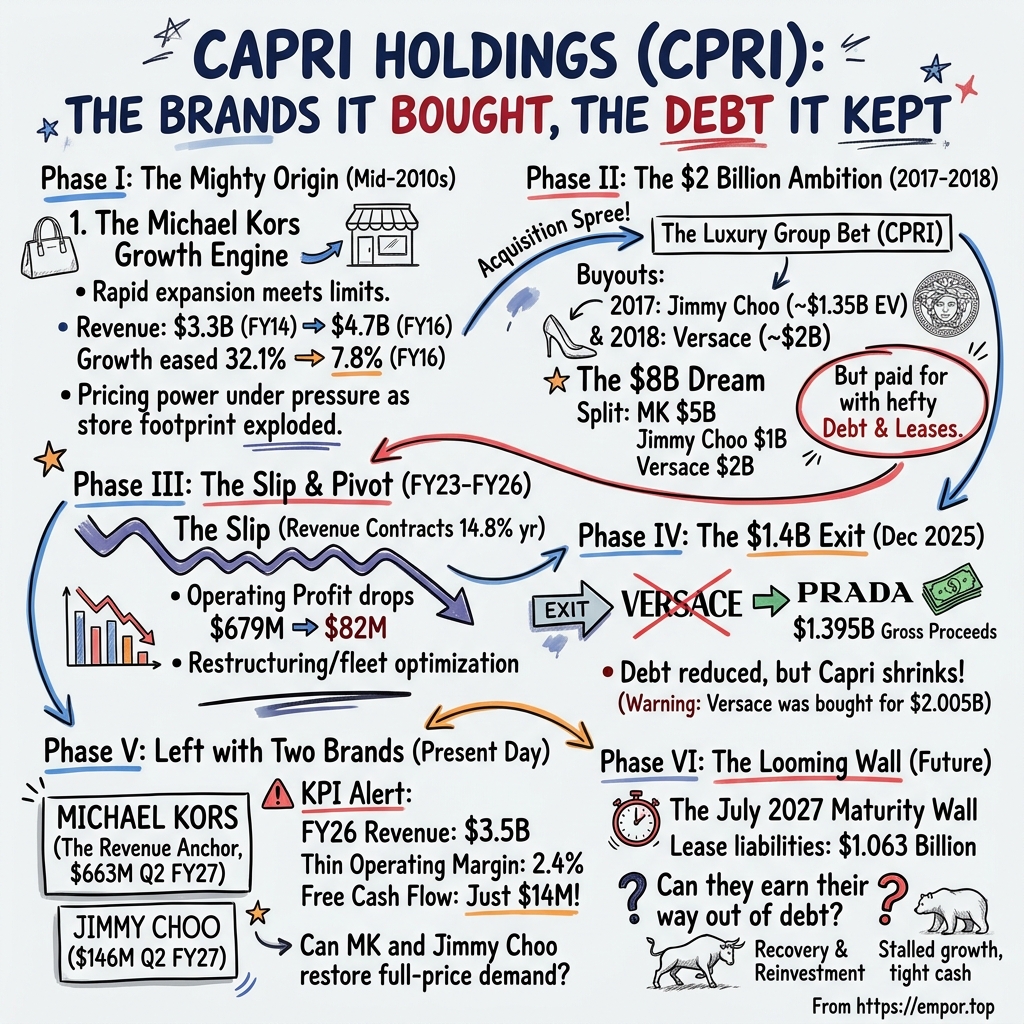
On December 2, 2025, a short filing landed on the SEC's servers. Capri Holdings had finished selling Versace to Prada.1 There was no gala in Milan and no fireworks in New York. One sentence ended a seven-year experiment in building an American-run luxury empire, and a cash figure followed it.
Capri received gross cash proceeds of about $1.395 billion.2 Seven years earlier the same company had recorded about $2.005 billion of purchase consideration to buy Versace.3 Those two figures do not measure the same thing. One is a purchase price recorded under acquisition accounting. The other is sale cash after adjustments for debt, working capital and expenses. Treat the gap as a warning about how the bet turned out, not as a precise loss.
The deal had been sold with a grander number attached. When Michael Kors Holdings agreed to buy Versace in September 2018, it renamed itself Capri Holdings and said the new group could reach $8 billion of revenue over the long term.4 Versace alone was supposed to grow past $2 billion.4 By the time Prada collected the keys, the Medusa head had become a way to pay down borrowings.
Why sell at all? Because the alternatives had run out. A plan to be acquired by Tapestry, the owner of Coach, had been blocked by regulators in late 2024. Then fiscal 2025 delivered a net loss of about $1.18 billion, driven by impairments and a large tax charge.5 Borrowings stood near $1.5 billion against a business whose profits were shrinking.6
Prada agreed to pay €1.25 billion for Versace in April 2025, and Capri's management said the proceeds would let it substantially reduce debt and eventually restart share repurchases.75 Selling the crown jewel was not a victory lap. It was the price of keeping the rest of the company on a stable footing.
Capri now consists of the two brands it kept. Michael Kors, the American label the company was built around, brought in about $2.87 billion of revenue in the year to March 2026, roughly 83% of the total.8 Jimmy Choo, the London shoe house bought in 2017, brought in about $600 million.8 Together they make a business of about $3.5 billion a year, and that business is shrinking.
The profit line is the hardest part to read. In fiscal 2026 Capri earned $23 million of reported operating income on continuing operations, a margin under 1%. Even after stripping out impairments and one-off costs, adjusted operating income was only $118 million, about 3.4% of sales.8 A decade earlier the Michael Kors business on its own kept close to a quarter of every sales dollar as operating profit.9 That gap is the story.
Cash tells a similar tale, with a wrinkle. The continuing business generated about $197 million from operations and spent $63 million on stores and systems, which left about $134 million of free cash flow.8 Add back Versace's last months as a discontinued operation and total operating cash flow shrank to about $77 million, leaving roughly $14 million after capital spending.6 Either way, the cash pile was small next to the company's obligations.
Those obligations come in two forms. At the end of March 2026 Capri owed $357 million of borrowings, down from about $1.5 billion a year earlier because the Versace money went to lenders.6 It also carried $1.063 billion of operating lease liabilities, the long-term rent on its shops.6 Leases rarely make headlines, yet here they were three times the size of the debt. A retailer can refinance a loan. It cannot easily walk away from a lease on a flagship.
At year-end the borrowings also came with a clock. Capri's secured credit facilities were due on July 1, 2027.6 In June 2026 the company amended its revolving facility, cut commitments from $1.5 billion to $1.0 billion and pushed the maturity out to June 2031.2 By September Capri reported only that revolver and about $21 million of other debt.2 The deadline had moved. The test of whether the two brands can carry the balance sheet had not.
So the questions this episode asks are simple to state and hard to answer. Did a decade of acquisitions create value, or only complexity and debt? Can Michael Kors and Jimmy Choo regain the pull that once let them sell at full price? And will management spend the cash a smaller company produces in ways that show discipline rather than ambition?
To answer them, the story has to go back to a time when Capri did not need to buy anyone, when one designer's name on a handbag was enough to make a company grow faster than almost anything else in fashion.
 Subscribe on LinkedIn
II. When Michael Kors Could Do No Wrong
In the early 2010s, a certain kind of handbag seemed to be everywhere at once. It sat on airport lounge chairs and in office lobbies, swung from the arms of college students and their mothers, and carried a small metal monogram that announced its maker. The shape was polished, the price was within reach, and the name belonged to a designer who had launched his label in 1981.9
The company behind the bag was not run by the designer alone. Michael Kors supplied the taste and the public face; the company described him as a "renowned, award-winning designer" who provided design leadership from the start.9 The machine was built by John Idol. He became chief executive in December 2003 after running Donna Karan International and Kasper ASL and serving as a group president at Ralph Lauren.10 He knew how licensing, department stores and outlet malls worked, and he knew how fast a brand could be pushed.
The same year Idol arrived, Sportswear Holdings, a vehicle tied to the investors Silas Chou and Lawrence Stroll, bought a majority stake in the company.11 They were patient backers of a business that was about to stop being small. In fiscal 2010 the company had revenue of about $508 million. A year later it had about $803 million, up 58%.11
That growth carried the company to the New York Stock Exchange under the ticker KORS in December 2011.10 The listing was unusual in one respect: all 41.7 million shares in the base offering came from selling shareholders, so the company itself raised nothing.11 It did not need the money. It was producing cash, and the early owners wanted to realize some of the value they had built.
The company was still close to its roots. In October 2011 it ran 169 retail stores and concessions in North America and only 34 abroad.11 Its retail segment produced about $344 million of revenue, and net income had jumped about 85% in a year to roughly $73 million.11 The international map was mostly blank. That blank map was the opportunity investors were buying.
What happened next looked like a fashion business that had found a cheat code. By fiscal 2014 revenue was about $3.3 billion. In fiscal 2015 it grew another 32% to roughly $4.4 billion, and in fiscal 2016 it reached about $4.7 billion.9 In five years the company had grown almost sixfold.
The engine had several cylinders. Owned stores sold handbags, shoes, watches and clothes directly to shoppers. Department stores and specialty shops bought wholesale and resold the goods. Licensees made fragrance, eyewear and watches under the Kors name and paid royalties. By the end of fiscal 2016 the company ran 668 of its own stores and concessions across the Americas, Europe and Asia.9 It also sold through more than 3,800 department-store and specialty doors worldwide.9
The positioning had a name: accessible luxury. The idea was to sit one rung below the European fashion houses on price while borrowing their vocabulary of runway shows, glossy campaigns and flagship stores. A shopper who could not stretch to a $3,000 Italian bag could buy a $300 Michael Kors tote and feel part of the same world.
Outlet stores extended the ladder further down, selling product at lower prices to shoppers who might never walk into a full-price store. Each rung widened the funnel. Each rung also risked teaching customers that the brand was available for less if they knew where to look.
In fiscal 2016 alone it added 142 net new stores, more than one opening every three days.9 It was also building digital flagship sites so that a shopper in Germany or Japan could buy the same tote as one in New Jersey. The company was not waiting for demand to find it. It was putting the bag in front of as many people as possible, as quickly as it could.
The profit numbers explained why everyone loved this model. In fiscal 2015 the company kept close to 29 cents of operating profit from every dollar of sales, and the return on invested capital was around 70%.9 Those are figures that software companies envy. Handbags were made by contract manufacturers, sold at strong markups, and needed little capital beyond store fit-outs and inventory.
Then the speedometer started to fall. Revenue growth dropped from about 32% in fiscal 2015 to under 8% in fiscal 2016.9 Comparable store sales, the measure of whether existing shops are selling more, fell 4.2% after rising 10.3% the year before.9 Growth was now coming from new stores rather than from more shoppers in the old ones. That is a sign every retail investor learns to watch.
The wholesale side showed the same strain. Wholesale revenue rose 3.8% to about $2.1 billion, despite what the company called a "challenging wholesale environment."9 Macy's alone accounted for 12.7% of revenue that year.9 When a single department store chain buys one dollar in eight of your goods, its inventory decisions, its promotions and its traffic problems become yours.
The company also acknowledged that the wider accessible luxury industry had been challenged by lower consumer traffic.9 Fewer people were walking through malls, and those who did were finding more bags on promotion. A business model built on placing product everywhere was colliding with a customer who was beginning to shop less often and more selectively.
Here the story needs a distinction that runs through everything that follows. A recognizable brand is an asset. It gets you a meeting with a department store and a glance from a shopper. What proves that a brand still earns its place is repeat full-price sell-through: customers buying the bag at the price on the tag, season after season, without waiting for the sale rack.
Michael Kors had the first in abundance. The second was slipping. When a brand is everywhere, it stops feeling special; when it stops feeling special, shoppers wait for a discount; and when they wait, department stores mark it down, which teaches them to wait some more. Fashion history is full of labels that lost their glow this way, and the revenue line is usually the last place the damage shows.
What did management do? It did not shrink the brand back to scarcity. It reached for a different answer: if one label was maturing, buy other labels with more prestige and turn the company into a group.
III. The $2 Billion Bet on a Luxury Group
On July 25, 2017, Michael Kors Holdings announced it would buy Jimmy Choo for 230 pence per share in cash.12 The enterprise value was about $1.35 billion.12 Jimmy Choo was a London name with a red-carpet pedigree, a creative director in Sandra Choi, and roughly 150 company-run stores plus hundreds of multi-brand doors.12
Idol said Jimmy Choo was "poised for meaningful growth," and the company said it saw an opportunity to grow the brand to $1 billion of sales.12 The logic was easy to sketch on a whiteboard. Michael Kors was strong in handbags and weaker in fashion footwear. Jimmy Choo was strong in shoes and wanted to sell more bags. A larger parent could open more stores, share back-office systems and push the brand into Asia.
The deal moved quickly. Holders of about 69% of Jimmy Choo's shares had already given irrevocable undertakings to accept, and JPMorgan and Goldman Sachs committed bridge financing so the offer did not depend on raising money later.12 Pierre Denis stayed as chief executive and Sandra Choi as creative director.12 The message to the London fashion world was that the American buyer would leave the creative house alone and supply capital and reach.
Fourteen months later came the bigger move. On September 25, 2018, the company agreed to buy Versace for an enterprise value of €1.83 billion, about $2.12 billion.4 The cash came from cash on hand, the revolving credit facility and new bank term loans; the Versace family took €150 million of the price in shares of the new parent.4 Donatella Versace stayed on to lead the creative vision.4
The new name was meant to signal a new identity. "Capri" referred to the Italian island long associated with glamour; its three famous rock formations stood for the three founder-led houses.4 The press release painted a picture of a group that would rebalance away from American malls toward Europe and Asia. The Americas would fall from 66% to 57% of revenue, and Asia would rise from 11% to 19%.4
The plan was bold in its numbers. Versace would grow to more than $2 billion of revenue.4 Its store network would expand from about 200 to 300.4 Accessories and footwear would rise from 35% to 60% of Versace's sales, which meant Capri planned to apply the Michael Kors handbag playbook to a Milanese couture house.4 Group revenue would reach $8 billion.4 Take away the $2 billion Versace goal and the earlier $1 billion Jimmy Choo goal, and the plan implied roughly $5 billion from Michael Kors itself, a brand that had already stopped growing.
Look at what that meant for Versace. Capri paid about $2 billion and promised that the brand would generate about $2 billion of sales a year. A price of roughly one times targeted revenue can look modest for a luxury house, but only if the revenue arrives and carries luxury-level margins. Neither promise was a fact on the day the check cleared. Both were forecasts made by the buyer.
The financing turned a growth story into a balance-sheet story. In fiscal 2016 the company had almost no borrowings.9 By March 2019, after both deals, borrowings were about $2.6 billion, and they climbed higher still when the pandemic arrived a year later.3 The 2019 annual report recorded the Versace purchase consideration of about $2.005 billion and the goodwill and brand intangibles that came with it.3 From then on, the brands had to earn not only a return on their price but also enough to service the debt used to pay for them.
It is tempting to say Capri "overpaid," or, in the other direction, that it bought trophy brands "cheaply." Neither label helps. A famous name is not proof of value, and a revenue target is not a forecast you can bank. The only fair test is what happened afterward: did each brand grow, earn a healthy margin and generate cash under Capri's ownership?
For Jimmy Choo, eight years on, the answer is sobering. It generated about $600 million of revenue in fiscal 2026, well short of the $1 billion target, and its operating margin was negative, at about minus 3.7%.8 That is a meaningful luxury footwear house, and in the current quarter it is the one growing. But it remains about a fifth the size of Michael Kors and has yet to show it can make money consistently on its own.
For Versace, the verdict came from the market. In April 2025 Capri agreed to sell it to Prada for €1.25 billion, about $1.375 billion in cash before adjustments.7 The brand never reached the $2 billion revenue target before it left. The sale below the purchase consideration does not, by itself, calculate Capri's return, since it ignores the years of cash Versace generated or consumed. It is strong evidence, though, that the deal did not deliver the value the 2018 plan promised.
There was one more twist. In August 2023 Tapestry, owner of Coach and Kate Spade, agreed to buy all of Capri in a deal valued at about $8.5 billion.1314 For a moment it looked as if the empire would be absorbed into a bigger one.
Then, in April 2024, the Federal Trade Commission sued to block it, arguing the combination would dominate what it called the "accessible luxury" handbag market.14 A federal court granted a preliminary injunction in October 2024, and the companies terminated the merger in November.13 Capri received about $45 million from Tapestry to reimburse merger costs.5
The FTC had voted 5-0 to bring the case.14 Its announcement noted that Tapestry itself had coined the phrase "accessible luxury," the very market the agency said the combined company would dominate.14 For Capri, eighteen months of waiting had passed with management attention split between running the brands and preparing for a sale. The deal's collapse also left a residue: shareholder litigation over the terminated merger, which a court dismissed without prejudice in March 2026 before plaintiffs filed an amended complaint in April.6 That case remained pending at the last annual report.
The FTC's case contained an uncomfortable compliment. Regulators treated Michael Kors and Coach as head-to-head rivals in a distinct market.14 That meant Michael Kors still mattered competitively. It also meant Capri's escape hatch had closed. There would be no buyer at a premium to rescue shareholders. The group would have to revive its largest brand on its own while integrating three very different houses, and then decide what to do with the one that was not working.
IV. The Recovery That Kept Slipping
Picture a Michael Kors outlet on a weekday afternoon in 2024. The racks are full, the signs promise extra percentages off, and the bags look a lot like the bags from three seasons ago. That image, repeated across hundreds of stores, is the problem Capri spent the next two years trying to undo.
Start with the company boundary, because it changed in the middle of the story. Versace is gone, and its results now sit in discontinued operations. The live question is the two brands that remain. Michael Kors is the economic center of gravity, with roughly five of every six dollars of revenue.8 Jimmy Choo is the smaller, faster-moving piece.
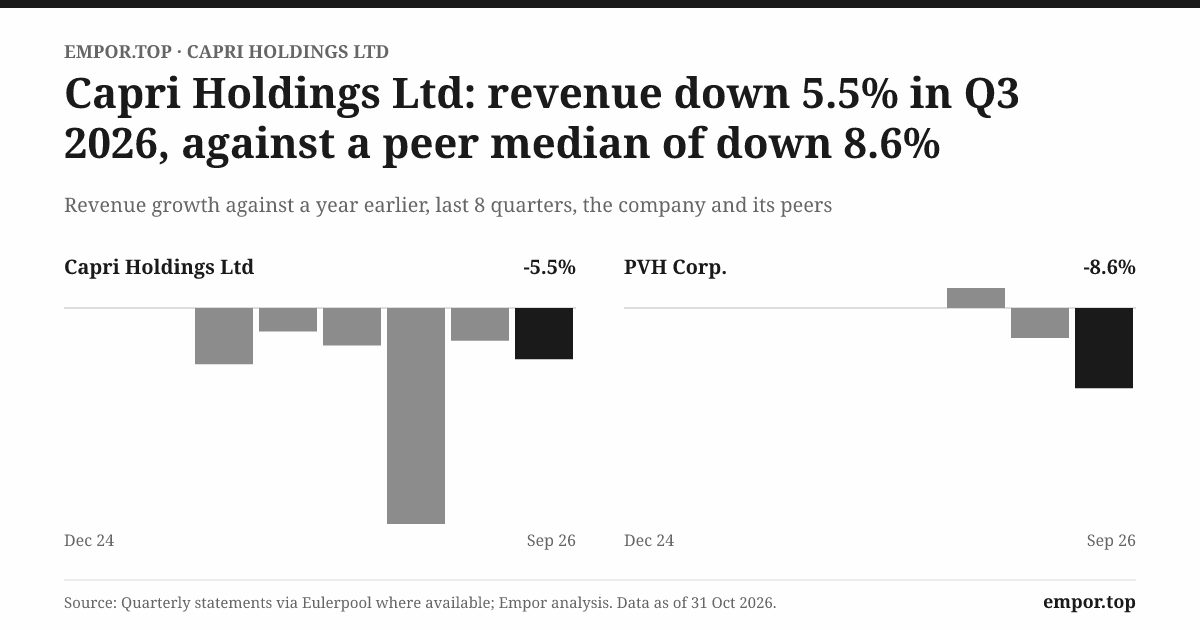
The long-run picture is unflattering, and it is worth reading carefully. Reported group revenue fell about 15% a year from fiscal 2023 to fiscal 2026, and operating profit collapsed from about $679 million to a few tens of millions.65 Part of that fall is accounting: Versace was inside the earlier years and outside the later ones. Strip the portfolio change away and the organic picture is still poor. On continuing operations, revenue fell about 4% in fiscal 2026 alone, or about 6% in constant currency.8
The cleaner comparison is the brand against its own past. In fiscal 2016, when the company was essentially just Michael Kors, it generated about $4.7 billion of revenue.9 A decade later the Michael Kors segment generated about $2.87 billion.8 The brand that built the company is roughly 40% smaller than it was ten years ago, and its operating margin has fallen from the mid-20s to about 11%.98
Fiscal 2025 was the low point. Capri recorded a net loss of about $1.18 billion, driven by roughly $797 million of asset impairments and a $545 million non-cash tax charge.5 Impairments are the accounting confession that an asset will not earn what you once thought. When a company writes down brand values and store assets on that scale, it is admitting that past forecasts were too optimistic.
The repair plan had four parts. The first was to stop discounting so much. The second was to refresh the product so customers had a reason to pay full price. The third was to renovate stores and close weak ones. The fourth was to spend on marketing to bring a younger customer back to the brand.
It helps to know what Capri actually sells and where. Accessories, mostly handbags and small leather goods, made up about 56% of fiscal 2026 revenue, footwear about 25% and apparel about 13%, with licensing and other income making up the rest.6 The Americas generated about $2.0 billion, Europe, the Middle East and Africa about $1.0 billion, and Asia about $440 million.6 Online sales accounted for roughly a fifth of revenue.6 So the recovery is, above all, a question of whether American women will pay full price for a Michael Kors handbag again.
The first lever is now visible in the numbers. On the October 2026 call, Idol said markdown inventory was down about 40% and promotional days were down about 50%, adding: "I want to reemphasize that again, 50%."15 The gross margin, the share of each sales dollar left after paying for the product, rose to 63.3% in the September quarter from 61.0% a year earlier.2
The discipline went beyond store promotions. On the August call management described cutting back on sales to third parties and off-price retailers, the discount chains that buy excess inventory and sell it at a fraction of the original price.16 Every bag that ends up on an off-price rack teaches a shopper that the brand can be had cheaply.
Idol also said the group had reset its strategic pricing about two years earlier, raised outlet prices, and taken "some minor price increases" at full-price Michael Kors stores.15 Pricing up while promoting less is the right sequence for a brand trying to restore its standing. It is also the sequence most likely to cost volume in the short run, which is exactly what the revenue line shows.
That is real progress on the quality of each sale. It is not yet progress on the quantity. Michael Kors revenue in the quarter was $663 million, down 8.6%.2 In the Americas, its biggest market, revenue fell about 11%.15 Management said roughly $50 million of product arrived late and that about $15 million of wholesale shipments were pulled forward from the next quarter.15 Shifting shipments between quarters flatters one period at the expense of the next, so the underlying decline is the more useful figure.
The first quarter had shown the same pattern. Michael Kors revenue fell about 7% to $590 million, with the Americas down about 10% and Asia the only region growing.16 Gross margin at the brand rose almost three percentage points, yet its operating margin slipped.16 Two quarters in a row, the brand sold its product more profitably and sold less of it.
Jimmy Choo told a different story. Its revenue rose 11.5% to $146 million, with the Americas up about 24% and Europe up about 13%.215 Gross margin reached about 71%, yet its operating margin was just 1.4%.15 The house is growing, but it still turns almost none of that growth into profit. Management expects it to return to profitability for fiscal 2027.15
The pattern held from the first quarter, when Jimmy Choo revenue rose about 10% to $179 million, driven by accessories such as the Bon and Cinch bags and casual footwear.16 On the October call, while answering an analyst's question about pricing, Idol addressed a question many investors had been asking since the Versace sale: would the faster-growing brand be the next asset to go?
His reply was blunt: "Jimmy Choo is not for sale in the company."15 He framed it as a business that could reach $800 million of revenue at a low double-digit operating margin.15 It is a long way from today's near-zero margin to that target, and the house has already missed one long-term goal under Capri's ownership.
On the product side, management pointed to specific styles. Idol said the Hamilton Soft bag had "quickly become one of the brand's best-selling styles," and that the company was "actively chasing inventory."15 Footwear was finally working, he said, with loafers and flexible flats rather than the sneakers that once made up 30% to 40% of the shoe business.15 A TikTok effort, he told analysts, was doing almost four times the business originally planned.15
Those are encouraging signals. They are also the kind of anecdote fashion executives always reach for. A single hit bag does not make a recovery. What matters is whether full-price sales grow across the assortment, quarter after quarter, without a return to heavy promotion. On that measure, management was candid. Full-price sales declined in the September quarter, and the next quarter's guidance assumed that Michael Kors full-price would "return to positive during the quarter."15 The recovery is still a forecast.
The cost side carried much of the weight. Store counts and headcount both fell sharply. Michael Kors full-price stores, including concessions, dropped from 461 to 342 over two years, and Jimmy Choo stores from 177 to 155.6 Total employees fell from about 14,200 to 11,200 in a single year, partly because of the Versace sale.6 Closing weak shops lifts average productivity and margins. It does not, on its own, prove that a single additional customer wants the brand.
How does Michael Kors stack up against its closest rival? Coach, the main brand inside Tapestry, generated about $5.6 billion of net sales in Tapestry's year to June 2025, up nearly 10%.13 A decade ago Michael Kors was the larger, faster-growing business.
Today Coach is roughly twice its size and growing, while Michael Kors is shrinking. Capri does not publish market share, so that comparison is the cleanest available evidence of who has been winning the accessible-luxury contest. Prada and the larger European groups sit higher up the price ladder and compete more directly with Jimmy Choo.
The industry adds its own pressures. Shoppers can switch handbag brands with no cost at all. Fashion cycles move quickly, so last year's hero style can become this year's clearance item. Wholesale partners can cut orders or fail outright; in fiscal 2026 a wholesale customer filed for Chapter 11, and Capri booked an extra $11 million allowance against that account.6
No customer reached 10% of revenue, a long way from the days when Macy's alone took one dollar in eight.6 But Capri does not disclose its top-five customer concentration, so investors cannot fully gauge how exposed it remains to department-store health.
So the evidence narrows the recovery claim rather than rejecting it. Capri has proven it can sell fewer bags at better margins. It has not yet proven it can sell more bags at full price. The KPI that will decide the story is constant-currency revenue growth at Michael Kors, read alongside its gross margin. If both rise together, the brand is regaining pull. If margin rises while revenue keeps falling, the company is managing decline more profitably.
And the earnings improvement leans on more than product. A good share of it depends on lower costs and, increasingly, on a line of income that has nothing to do with selling handbags at all.
V. What Actually Pays the Bills?
Here is a puzzle that would make any accountant reach for a second coffee. In the September 2026 quarter, Capri's reported operating income was $10 million. Its pre-tax income was $44 million.2 The difference came mostly from a single line: $31 million of net interest income.2
A company that still owes money to its banks is earning more in interest than it is paying. Management attributed the jump mainly to lower average borrowings after the Versace sale.2 The 10-K also shows large cross-currency swaps used to hedge Capri's foreign investments, and swaps that pay a low-rate currency while receiving dollars tend to produce interest income.6 Whatever the mix, the effect is clear. In that quarter, interest income was about three times reported operating income.
That matters because the guidance leans on it. For fiscal 2027 management now expects about $100 million of net interest and other income.15 It expects adjusted operating income of about $175 million.15 Put those together and more than a third of expected pre-tax profit will come from financial income rather than from selling bags and shoes.
The long record seems, at first glance, to tell a reassuring story about cash. Across fiscal 2015 to 2026, the company produced about $8.6 billion of operating cash flow against about $3.2 billion of net profit.96 On that view, every dollar of reported profit came with nearly three dollars of cash.
That ratio is real, but it belongs to a different company. It covers the boom years of the Michael Kors expansion, two acquisitions, a pandemic, large non-cash impairments that crushed reported profit without touching cash, and Versace's own cash flows. Impairments are the main reason profit looks so small beside cash in the later years. The ratio says the business historically produced more cash than its accounting profit suggested. It does not say the business produces much cash today.
The recent run-rate is far smaller. Continuing operating cash flow was about $356 million in fiscal 2024, $154 million in fiscal 2025 and $197 million in fiscal 2026.6 Fiscal 2026 free cash flow was about $134 million from continuing operations, or roughly $14 million including Versace.86 Compare that with the $850 million or more of free cash flow the Michael Kors machine produced in its peak years.9
Currency adds another layer of noise. Capri sells in euros, pounds and yen while reporting in dollars, and it hedges with forward contracts and cross-currency swaps.6 At the end of fiscal 2026 a 10% move in the dollar would have shifted the value of its net-investment hedges by about $385 million.6 That is mostly a translation effect that runs through shareholders' equity rather than a cash loss. It does explain why currency assumptions appeared among the reasons for the August revenue cut, and why reported revenue and constant-currency revenue can tell slightly different stories.16
Inventory and receivables offer clues to the quality of that cash. Inventory days, the number of days of goods sitting on shelves and in warehouses, fell to about 149 in fiscal 2026 from close to 200 in the prior years.6 Leaner inventory means fewer bags that will need to be discounted later, and it ties directly to the markdown story. In September 2026 inventory stood at $712 million, about 7% lower than a year earlier.15
Receivables moved the other way. Debtor days rose to about 32, the highest in more than a decade, and the Chapter 11 wholesale customer forced the extra allowance.6 The company does not name that customer in its annual report or publish an ageing schedule of overdue balances.6 The sums are modest, but they are a reminder that in wholesale the brand often waits to be paid by a retailer under its own strain.
The size of that exposure is knowable. At the fiscal year-end, gross receivables were about $257 million, of which only about $67 million of trade receivables were insured.6 Credit losses were small, around $7 million in each of the last two years.6
But management has told analysts it expects Michael Kors wholesale to return to "very healthy growth" next year, with about 100 shop-in-shops under construction, and it sees wholesale settling at roughly 20% to 25% of the business.15 Growing wholesale again means extending more credit to department stores at a time when at least one has already failed.
Now follow the money out. In fiscal 2026 Capri bought back about 4 million shares for $79 million under a new three-year, $1 billion authorization.6 In the first half of fiscal 2027 it bought another $204 million, including $150 million in the September quarter alone, retiring about 10.3 million shares at an average of roughly $14.50.2 With the shares now near $18.70, that last tranche was well timed.
What paid for it? Over the same six months, continuing operations generated about $124 million of operating cash flow and spent about $40 million on capital projects.2 That left roughly $84 million of free cash against $204 million of buybacks. The gap was filled by borrowing. Total debt rose from $357 million in March to $461 million in September, and net debt climbed from about $222 million to $336 million.815 Put plainly, Capri borrowed to buy back its own stock.
Management plans more of it. The October guidance lifted the fiscal 2027 buyback target to $300 million, up $100 million from the prior plan.15 Shares outstanding have already fallen from about 115 million in May to about 103 million in late October.62 Fewer shares will lift earnings per share even if total profit does not move.
Capital spending is the other claim on cash. Management plans about $125 million in fiscal 2027, roughly double the prior year, mostly for store renovations and digital systems.8 About 50 stores have been renovated toward a goal of 300, and Idol said the company plans to open between 50 and 75 new stores next year.15
After two years of shrinking the fleet, that is a meaningful turn back toward expansion. Whether those dollars earn a return will show up in store productivity and full-price sales, neither of which Capri yet reports in a way that settles the question.
The leases remain the obligation investors most often skip. Those $1.063 billion of lease liabilities represent years of contractual rent on stores, offices and warehouses.6
A store that sells less still owes the landlord in full. That is why fleet closures came first in the restructuring, and why every new store opened next year will add to a fixed cost base that only rising sales can carry. Add the leases to the borrowings and the company's real obligations are several times larger than its headline debt suggests.
The Versace cash and the revolver extension bought time and room. They did not settle whether the business can fund its reinvestment, its leases and its buybacks from operations alone. That question leads straight to the people making those choices.
VI. The CEO's Scorecard
On July 29, 2026, Capri's shareholders cast their votes at the annual meeting. The proposals all passed. But about 19.9 million votes, roughly 22% of those cast, went against the executive pay plan.17 A year earlier, 91.3% had voted in favor.10 In one year support fell by about fourteen points.
The man at the center of that vote has run the company for almost 23 years and been chairman since around the 2011 listing.10 He built the Michael Kors machine, led both acquisitions, negotiated the Tapestry deal, and then sold Versace. Few executives in fashion have stayed so long through so many strategic turns. That continuity cuts both ways: it brings deep knowledge of the brand, and it means the same leader who designed the group strategy is now designing its reversal.
His pay in fiscal 2026 was about $11.9 million.10 That included a $1.35 million salary, about $5 million in stock awards and a $5.4 million cash bonus.10 For context, his total pay was about $9.1 million in fiscal 2025, the year of the $1.18 billion loss, and about $10.5 million in fiscal 2024.105
The bonus deserves a closer look, because the details are revealing. The annual plan had three parts. Free cash flow carried 20% of the weight, SG&A cost control carried 50%, and individual strategic goals carried 30%.10 Free cash flow came in at $134 million against a $74 million target and a $100 million maximum. SG&A came in about $38 million below target.10 Both financial measures paid at the maximum, contributing 140 points; the strategic component added 60 more, for a total payout of 200% of target.10
Two choices stand out. The first is what the plan rewarded: cutting costs and generating cash, not growing revenue or operating profit. In a year when continuing revenue fell and reported operating margin was below 1%, the plan paid double. The second is that the compensation committee waived a relative shareholder-return governor that would otherwise have capped the payout at target.10 A governor exists to stop a bonus from paying out generously when shareholders have suffered; waiving it is a decision investors are entitled to question.
Fiscal 2026 also mixed in the effects of the Versace sale and discontinued operations. Capri-attributable net income was about $137 million, while continuing pre-tax income was about $107 million.6 Compensation tied to reported totals in such a year can reflect portfolio moves rather than operating improvement. The 22% vote against pay does not prove investors objected to any single item. It does signal that a meaningful minority found the overall design out of line with results. About 8.9 million votes also opposed Idol's re-election as a director.17
Idol does have skin in the game. He was reported to own about 2.2% of the company, including shares and awards he may be deemed to own.10 At the late-October share price that stake is worth roughly $48 million, enough to align him with long-term shareholders in a meaningful way, though still dwarfed by institutions such as FMR, which held about 9%.10
Beside him on the earnings calls sits Tyler Reddien, chief financial officer and chief operating officer, who took the role after Thomas Edwards left in June 2025.176 Reddien carries the debt, cash and guidance portfolio. On the October call he walked analysts through the gross-margin outlook, warning that higher tariff rates and the anniversary of a tariff refund would trim second-half gains.15 That kind of specific caveat is more useful than a generic promise.
There are other governance markers worth noting, none of them alarming on its own. The auditor, Ernst & Young, issued a clean opinion and found internal controls effective; it flagged the valuation of indefinite-lived intangible assets, chiefly the brand names, as a critical audit matter.6
That is the judgment area behind the large impairments of recent years, and it remains the place where future write-downs would appear if the recovery disappoints. The proxy also discloses an aircraft time-sharing arrangement with the chief executive, reviewed under the company's related-person policy, which is small relative to the business.10
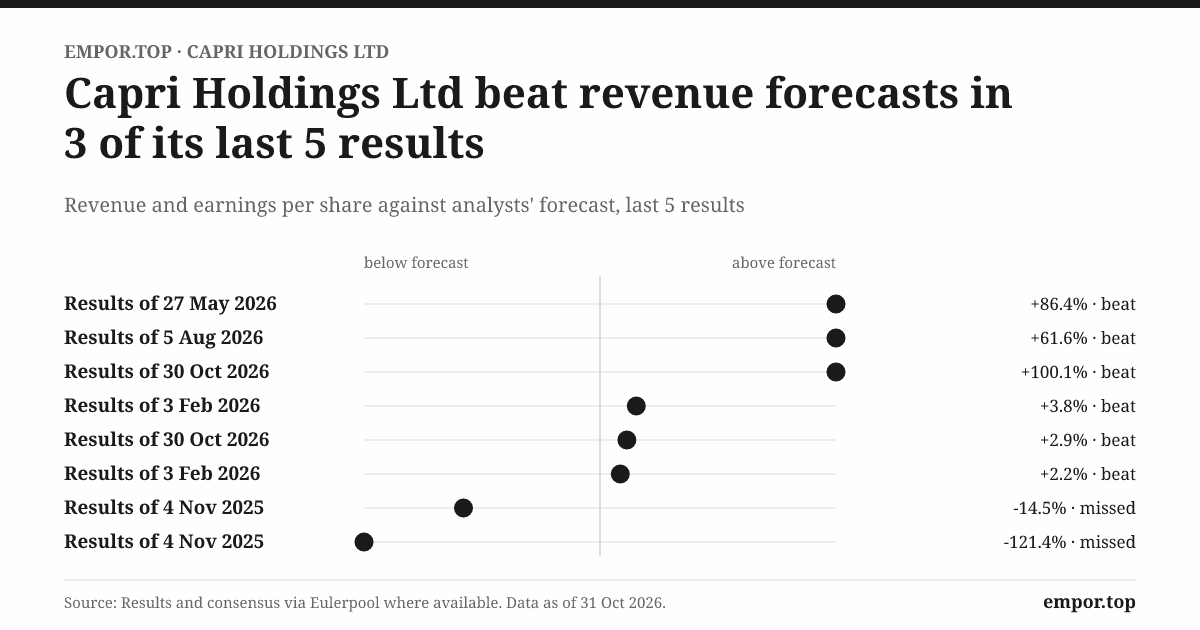
The real test of credibility is guidance over time, so follow it across three calls. In May 2026 management guided to about $3.525 billion of fiscal 2027 revenue, about $190 million of adjusted operating income and about $2.15 of adjusted earnings per share.8 In August it cut revenue to about $3.4 billion, citing late Michael Kors inventory, softer trends in Europe linked to conflict in the Middle East and lower tourist traffic, and currency.16 It held earnings per share at $2.15 by cutting planned spending by $70 million.16
In October it nudged revenue up to about $3.42 billion and raised earnings per share to about $2.20.15 But look beneath. Adjusted operating income was now guided at about $175 million, $15 million below May.15 Net interest and other income rose from $85 to $90 million to about $100 million, and the expected diluted share count fell from about 112 million to about 108 million.815 Operating profit expectations went down; per-share earnings went up. The improvement came from interest and buybacks, not from the brands.
To management's credit, the August revenue cut came with specific, quantified reasons, and the October call gave numbers for shipment timing rather than vague references to macro softness. Idol also explained why the sneaker mix was shrinking and how far the business could shift toward dressier styles.15 That is more transparency than many fashion companies offer. The October call also revealed what analysts did not press. Questions focused on outlet trends, wholesale sizing, product cohorts and pricing; no analyst asked about the buyback, the borrowing that funded it, or leverage.15
Seen from an activist's chair, the challenge almost writes itself. Why borrow for buybacks while the core brand is still shrinking? Why pay a 200% bonus on cost cuts in a year of declining sales? And why should investors trust long-term targets, $4 billion of Michael Kors revenue at low-20s margins and $800 million at Jimmy Choo, from a team whose last set of long-term targets ended with Versace sold for less than its purchase price?154
The fair answer is that the plan deserves to be judged by results, not by the targets themselves. Organic revenue, operating profit and free cash flow over the next full year will tell investors more than any adjusted EPS figure. That leads to the deepest question of all: is there anything about these two brands that lets them win consistently against rivals who are bigger and, right now, growing?
VII. The Two-Brand Moat Test
On October 30, 2026, Idol described a customer who had come back. She was buying the new Michael Kors bags and the loafers, discovering the brand on TikTok, and paying closer to full price than she had in years.15 In the same breath, the numbers showed the brand's revenue down more than 8% from a year earlier.2 Both things were true. The question is which one tells you more about the future.
A moat, in investor shorthand, is whatever stops competitors from eating your profits. For a fashion company the candidates are familiar: a brand heritage that makes customers prefer you, design talent that keeps the product relevant, marketing that keeps the name in the conversation, a network of stores and websites that puts the product in reach, and access to department-store shelf space. Michael Kors and Jimmy Choo have all five to some degree. The real question is whether any of them is strong enough to protect profits when demand turns.
Hamilton Helmer's framework of seven powers offers a useful checklist, because it asks for a specific mechanism behind each advantage. Brand is the obvious one. A brand is a power when customers will pay more for the same functional product purely because of the name. Michael Kors clearly had that power at its peak. Jimmy Choo has a version of it today, with gross margins above 70%.15 The test of whether brand power survives is whether the company can hold price without losing volume.
Scale is the second candidate. A $3.5 billion group can buy leather, freight and advertising more cheaply than a small label, and it can spread technology and logistics costs over more units. That is a real cost advantage, but it is a modest one in fashion, because the biggest rivals, Tapestry and the European groups, are larger still. Capri's scale was meant to be its edge as a three-brand group. Now that the group is two brands, the scale argument is weaker than it was in 2018.
The comparison with Tapestry is instructive here. Coach remains roughly twice Michael Kors' size.13 If scale were decisive in accessible luxury, the larger player would be pulling ahead, and that is exactly what the numbers show. Capri's scale advantage relative to small labels is real; relative to its most direct rival, it is a disadvantage.
The other powers are mostly absent. Handbags have no switching costs; a customer can buy Coach tomorrow without losing anything. There are no network effects; one woman's bag does not make another's more valuable. There is no protected resource, no patent or licence that keeps rivals out.
Counter-positioning, the advantage a newcomer enjoys when the incumbent cannot copy its model without hurting itself, does not apply to a company that is itself the incumbent. Process power, a hard-to-copy way of operating, is not evident in the record. That leaves Capri's moat resting almost entirely on brand, with a small assist from scale.
Michael Porter's five forces explain why brand alone is a fragile defence. Buyer power is high at the level of the shopper, who can switch brands at no cost and is bombarded with choices. Buyer power is also meaningful at the wholesale level, where department stores have consolidated and some have failed, which concentrates orders in fewer hands. Supplier power is moderate: contract manufacturers are plentiful, though tariffs and freight costs can squeeze margins quickly, as Reddien's warning about second-half tariff rates showed.15
Rivalry is intense. Coach and Kate Spade compete head-on with Michael Kors at similar prices; the FTC itself identified that rivalry as direct.14 Jimmy Choo competes with Prada, and with the shoe and accessory lines inside LVMH and Kering, houses with far deeper pockets. The threat of new entrants is real too. Social media lets a small label build demand without stores or wholesale partners, and the threat of substitutes, from resale platforms to cheaper look-alikes, is ever-present.
There is an irony in that list. Prada, now the owner of Versace, is both a former counterparty and a competitor to Jimmy Choo at the upper end of the market. Capri sold a brand to a rival that is better capitalized and more focused on high-end fashion, and it now competes against that rival for the same customers in luxury footwear and accessories.
It is important to separate what Capri shows from what an observer must infer. Capri does not publish a market-share series, a customer-retention rate or top-customer concentration. The claims about customers returning come from management's prepared remarks and answers to analysts. The hard numbers available are revenue, margins and inventory, and those are what a moat claim must survive.
So run the falsification test. If Michael Kors had durable pricing power, it would not have needed to cut promotional days by half from an elevated base, because it would not have been running so many promotions in the first place.
If it had durable customer loyalty, its decade-long shrinkage against its closest rival's growth would be harder to explain.9813 The record rejects the unqualified claim that Michael Kors has a strong moat. It narrows the claim to something smaller: the brand retains recognition and enough desirability to sell at better margins when supply is disciplined.
Jimmy Choo's case is different but no stronger. Its gross margins suggest real pricing power at the product level. Yet it was loss-making at the operating level in fiscal 2026, which meant the cost of running its stores and marketing consumed all of that margin and more.8 A brand that customers pay up for but that cannot cover its own overhead does not yet have a moat that matters to shareholders.
What would it take for either brand to win from here? Customers would need to choose the product at full price, not on promotion. Store productivity would need to rise as renovated shops pull in more shoppers per square foot. And operating margins would need to rise with revenue, proving that growth creates profit rather than consuming it. Management's own targets assume all three.
What could break the case? The product recovery could stall after a few hit styles. Competitors, especially Coach, could keep capturing the fashion conversation among younger shoppers. And group scale might not offset weak brand-level economics, leaving a company that is too small to have real cost advantages and too large to feel exclusive.
The evidence leaves Capri's moat intact only in its narrowest form: recognizable brands with renewed margin discipline. It is unproven as a source of durable, growing profits. That brings us to the price the market is putting on this uncertain recovery.
VIII. Analysis & Bear vs. Bull Case
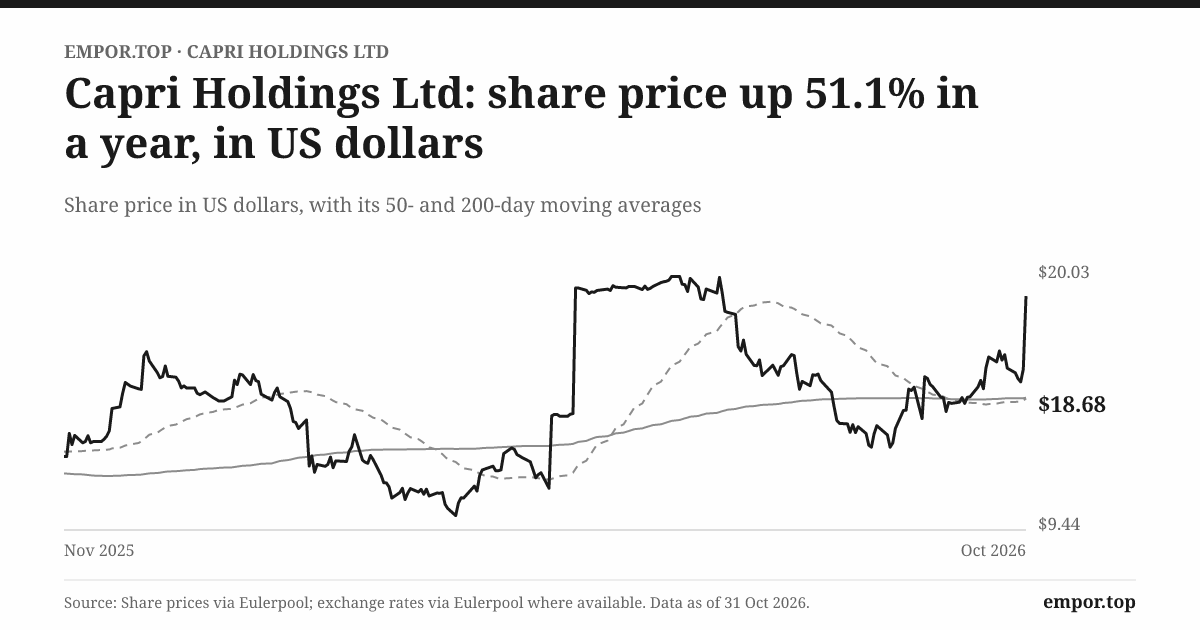
On October 31, 2026, Capri's shares closed at about $18.68, just 4% below their 52-week high and nearly double the 52-week low of about $10.18 For a company whose core brand is still shrinking, that is a remarkable run. Investors who bought in the spring have been rewarded. The question for anyone looking now is what the price already assumes.
The headline multiples point in opposite directions. The company's market value is about $2 billion, depending on whether one uses the shares outstanding before or after the recent buybacks.2 Against trailing reported earnings of about 79 cents a share, the stock trades at about 24 times earnings.6 Against enterprise value, which adds net debt, the multiple of operating profit is about 44 times.6 Yet the price-to-sales ratio is only about 0.6.6
The share price has been a wild ride. Its one-year volatility is around 60%, and at its worst point in the past five years it had fallen about two-thirds from its peak.18 Those swings reflect a company whose outlook has shifted between takeover target, blocked deal, deep losses, asset sale and turnaround in the space of three years. A stock that moves like that is priced on sentiment about the recovery as much as on current earnings.
The contradiction in those multiples is the whole debate in miniature. A low sales multiple says investors are paying little for each dollar of revenue. A high earnings multiple says they are paying a lot for each dollar of profit. Both are true because profit margins are depressed. If margins recover toward management's targets, today's price will look cheap on earnings. If they do not, the low sales multiple will turn out to be fair for a business that earns little on its sales.
Management's guidance offers another lens. Against the guided fiscal 2027 adjusted earnings of about $2.20 a share, the stock trades at roughly 8.5 times.15 That is a far lower multiple than the trailing reported figure. But adjusted earnings exclude impairments and restructuring costs that have recurred for years, and they include the interest income discussed earlier. An investor who accepts the adjusted figure is betting that those costs are truly behind the company. Capri's own history of repeated impairments argues for caution.
Data to compare against history and peers is limited. There is no five-year median P/E available for Capri on a consistent basis, partly because its earnings swung between large profits and large losses. Peer multiples are not the subject of Capri's own filings either. So the honest conclusion is that the market is pricing a recovery, but whether the stock is cheap or expensive versus its own past or its competitors cannot be settled from the available evidence.
The bull case, in its strongest form, runs as follows. Product momentum at Michael Kors is real, as the Hamilton Soft bag and footwear suggest, and the brand returns to full-price growth this winter. Jimmy Choo keeps growing at double digits and finally turns its 70% gross margins into operating profit.
The renovated stores and new openings lift productivity. The Versace proceeds and the revolver extension give management room to invest, and the buybacks executed at $14 to $19 a share look smart in hindsight. On that path, adjusted operating income could rise from its depressed base, and the per-share math would be powerful.
The bear case deserves equal weight. Michael Kors has been in decline for years, and every recovery has so far depended on fewer promotions rather than more customers. The latest margin base is thin. Free cash flow is weak, and recent buybacks have been debt-funded.
Interest income could shrink as debt rises again. Wholesale partners remain fragile, as the Chapter 11 filing showed. On that path, operating profit stays thin, the share count falls but enterprise value does not, and leverage creeps up under a 4.0 times net leverage covenant.2
The credit lens adds historical context. In February 2025 S&P cut Capri to BB from BBB-minus with a negative outlook, citing weak operating performance, lost market share and expectations of continued sales declines.19 That action predates the Versace sale and the debt reduction that followed, so it is not a current verdict on the post-sale company. It is, however, a reminder that credit analysts had already concluded Capri's problems were about brand demand, not just the balance sheet.
Three measures will tell investors whether the bull or bear case is winning. The first is constant-currency revenue growth by brand, especially Michael Kors, which fell about 8% in the September quarter.15 The second is operating margin by brand, which stood around 10% at Michael Kors and barely above zero at Jimmy Choo.15 The third is free cash flow after capital spending, which was about $134 million for the continuing business in fiscal 2026 and must now absorb roughly $125 million of planned capex.8
Two events matter as well. The first is how management handles the balance sheet now that the revolver runs to 2031: whether it lets borrowings climb to fund buybacks or keeps leverage low while the recovery is unproven. The second is whether buybacks continue at the raised pace if revenue disappoints again.
Management's guidance itself is a stress test. For fiscal 2027 it calls for about $3.42 billion of revenue and $175 million of adjusted operating income.15 The third-quarter outlook assumes Michael Kors full-price sales turn positive.15 If that happens, the guidance looks achievable. If it does not, the company will have missed its own plan twice in one year, after already cutting revenue expectations once.
The tradeoff, in the end, is simple to state. A low sales multiple can coexist with expensive earnings multiples when profit is depressed. Investors are not paying for what Capri earns today. They are paying for what the two brands might earn if the recovery holds. The lessons from how Capri got here suggest why that bet deserves careful scrutiny.
IX. Playbook: Business & Investing Lessons
Go back to September 2018, to the press release that renamed the company after an island and promised an $8 billion group.4 Then fast-forward to December 2025, when the brand at the heart of that promise left for about $1.4 billion in cash.2 Between those two moments lies a set of lessons that belong to Capri and to no one else.
The first lesson is that a famous label is a starting asset, not a forecast. Versace was one of the most recognizable names in fashion. Capri priced its purchase partly on the idea that the name could carry the brand past $2 billion of revenue. It never got there under Capri's ownership.
The name was real; the revenue was a projection; and the sale price eventually measured the gap. For founders and investors, the lesson is to separate what a brand is worth today from what an acquirer hopes it will become, and to ask who pays if the hope does not arrive.
The second lesson is that store growth can rent demand from the future. In fiscal 2016 Michael Kors opened 142 net new stores while comparable sales fell.9 The new doors kept total revenue climbing even as each existing store sold less. A decade later the company was closing stores by the hundred and spending to renovate the ones that remained.
Expansion pulled sales forward and spread the brand thin. Now, having shrunk the fleet, management plans to open 50 to 75 new stores next year.15 Investors who lived through the first cycle will want to see full-price demand before they cheer the second.
The wider lesson for anyone building a consumer brand is that distribution and desire are different things. Distribution can be bought with capital, leases and wholesale terms. Desire has to be earned, and it is far easier to lose than to rebuild. Michael Kors bought distribution brilliantly in the 2010s and has spent the 2020s paying to rebuild desire.
The third lesson is that cash conversion belongs to a time and a portfolio. Twelve years of operating cash nearly three times net profit is an impressive record, and it was earned. But it was earned largely by a fast-growing Michael Kors with high margins, then muddied by impairments, acquisitions and Versace's cash. The current two-brand business produced about $134 million of free cash flow last year. A historical average is a fact about the past; it is not a promise about the next year.
The same trap catches investors in many industries. A long record of cash generation gets quoted as proof of quality long after the business that produced it has changed. Before trusting a decade-long average, check whether the company that earned it still exists in the same form. In Capri's case, a large part of it was sold to Prada.
The fourth lesson is that a cheaper share count is not the same as a stronger company. Capri has retired about a tenth of its shares in a matter of months, partly with borrowed money.2 That will lift earnings per share. It will not make a single extra customer buy a bag. Buybacks create value when the business is undervalued and the balance sheet can afford them. They destroy value when they substitute for fixing the business or leave a company less able to weather the next downturn.
Capri's recent repurchases look well-timed on price, since much of the stock was bought below where it trades today. Yet timing is not the whole test. The money spent on shares could instead have stayed on the balance sheet as a cushion against a failed recovery, or gone into the stores and product that must carry the turnaround. The company chose to do all three, which works only if the recovery arrives on schedule.
The fifth lesson is that a strategy earns credibility one forecast at a time. Capri's leadership has issued many long-term targets over the years: $1 billion at Jimmy Choo, $2 billion at Versace, $8 billion for the group, and now $4 billion at Michael Kors and $800 million at Jimmy Choo. Investors cannot evaluate targets by their ambition. They can only evaluate them by the next year's brand-level revenue, margin and cash.
If there is one sentence that captures Capri's journey, it is this: a portfolio of famous names is not automatically a portfolio of compounding businesses. Brand health, purchase price and financing determine whether a group creates value, and Capri learned that lesson at the cost of one of fashion's great houses.
X. Epilogue
The next call will arrive in early 2027, with the holiday season behind the company and its first test of full-price growth on the scoreboard. Michael Kors will either have returned to positive full-price sales, as the guidance assumes, or it will not. Everything else in the story follows from that answer.
Over the next two to four quarters, investors will be watching a short list of signals. The first is whether Michael Kors returns to revenue growth and whether that growth comes with the lower promotional activity management has promised. The second is whether Jimmy Choo's growth finally converts into operating profit, as management expects for fiscal 2027.15 The third is whether the gross margin gains, already visible at 63% to 65% across the first half, translate into operating margin and cash.216
The calls themselves will matter. Prepared remarks have been specific and confident. The analyst questions have focused on product, outlets and wholesale. If revenue misses again, investors will want to hear whether management explains the miss with the same detail it offered in August, or whether the reasons grow vaguer.
The balance sheet will be the quieter drama. With the revolver extended to 2031, the immediate refinancing question that hung over the year-end balance sheet has been answered.2 The new questions are subtler. How high will borrowings climb to fund buybacks, and how much covenant headroom will remain if earnings stall?2 And how will lease liabilities evolve as the company renovates and opens new stores?6
Picture the scene in the boardroom if the holiday quarter comes in light. The revolver is long-dated and the covenant is still comfortable, so there is no crisis. But the buyback target looks harder to defend, the interest income starts to shrink as borrowings rise, and the analysts who did not ask about leverage in October start asking in February. Turnarounds rarely fail in a single dramatic moment. They fail by a series of small misses that slowly use up the room management bought with an asset sale.
Each outcome would answer one of the questions this story has carried. If Michael Kors grows at full price, the moat claim graduates from narrow to plausible, and the acquisition era becomes a costly detour rather than a lasting wound. If cash covers the buybacks, the capital allocation critique softens. If neither happens, the long-term targets join the earlier ones in the archive of promises that did not arrive.
A good outcome would look like this: Michael Kors full-price sales turning positive for several quarters in a row, Jimmy Choo posting consistent operating profit, operating margins rising with revenue, and free cash flow covering both capex and buybacks without extra borrowing. A bad outcome would look like another revenue cut, operating profit that depends on interest income, and buybacks that keep running ahead of free cash flow while debt rises.
The central question remains the one this story began with. Can two brands restore growth before the costs of the strategy—the leases, borrowings and buybacks—remove the company's room to maneuver? Tonight, the answer is still in the evidence yet to come.
XI. Outro
Return to that December 2025 filing. The brand that was meant to complete a luxury empire left the company as a check, and the check bought time.
What makes Capri’s story distinctive is the shape of its arc: after an ambitious detour into global luxury, it is rebuilding around the original engine.
The names are still on the shop windows: Michael Kors, Jimmy Choo. The customers have not vanished. Behind the glass, though, there is a clock. The next collection has to sell at full price, and the cash has to arrive.
References
-
Versace Sale Closing, Form 8-K — Capri Holdings, 2025-12-02 ↩
-
Q2 FY2027 Form 10-Q — Capri Holdings, 2026-10-30 ↩↩↩↩↩↩↩↩↩↩↩↩↩↩↩↩↩↩↩↩
-
Michael Kors Holdings to Acquire Versace and Be Renamed Capri Holdings — Capri Holdings, 2018-09-25 ↩↩↩↩↩↩↩↩↩↩↩↩↩
-
Fourth Quarter and Full Year Fiscal 2025 Results, Exhibit 99.1 — Capri Holdings, 2025-05-28 ↩↩↩↩↩↩
-
2026 Form 10-K — Capri Holdings, 2026-05-27 ↩↩↩↩↩↩↩↩↩↩↩↩↩↩↩↩↩↩↩↩↩↩↩↩↩↩↩↩↩↩↩↩↩↩↩
-
Prada Group Agreement to Acquire Versace — Prada Group, 2025-04-10 ↩↩
-
Capri Holdings Announces Fourth Quarter and Full Year Fiscal 2026 Results — Capri Holdings, 2026-05-27 ↩↩↩↩↩↩↩↩↩↩↩↩↩↩↩↩↩
-
Fiscal 2016 Form 10-K — Michael Kors Holdings, 2016 ↩↩↩↩↩↩↩↩↩↩↩↩↩↩↩↩↩↩↩↩
-
2026 Proxy Statement — Capri Holdings, 2026-06-16 ↩↩↩↩↩↩↩↩↩↩↩↩↩↩
-
Form F-1 Registration Statement — Michael Kors Holdings, 2011-12-02 ↩↩↩↩↩
-
Michael Kors Holdings to Acquire Jimmy Choo PLC for 230 Pence Per Share in Cash — Capri Holdings, 2017-07-25 ↩↩↩↩↩↩
-
Tapestry, Inc./Capri Holdings Limited, In the Matter of — Federal Trade Commission, 2024 ↩↩↩↩↩↩
-
Q2 FY2027 Earnings Call Transcript — Stock Analysis, 2026-10-30 ↩↩↩↩↩↩↩↩↩↩↩↩↩↩↩↩↩↩↩↩↩↩↩↩↩↩↩↩↩↩↩↩↩↩↩↩↩
-
Q1 FY2027 Earnings Call Transcript — The Motley Fool, 2026-08-12 ↩↩↩↩↩↩↩↩
-
2026 Annual Meeting Vote Results, Form 8-K — Capri Holdings, 2026-07-30 ↩↩↩
-
Capri Holdings Investor Relations and Stock Information — Capri Holdings, 2026-10-31 ↩↩
-
Capri Holdings Rating Lowered to BB, Outlook Negative — S&P Global Ratings, 2025-02-20 ↩
 LinkedIn
 WhatsApp
 Reddit
 Hacker News
 Email
 Kindle
 RSS Feed
 Spotify
 Apple Podcasts
 Amazon Music
 Audible
 YouTube