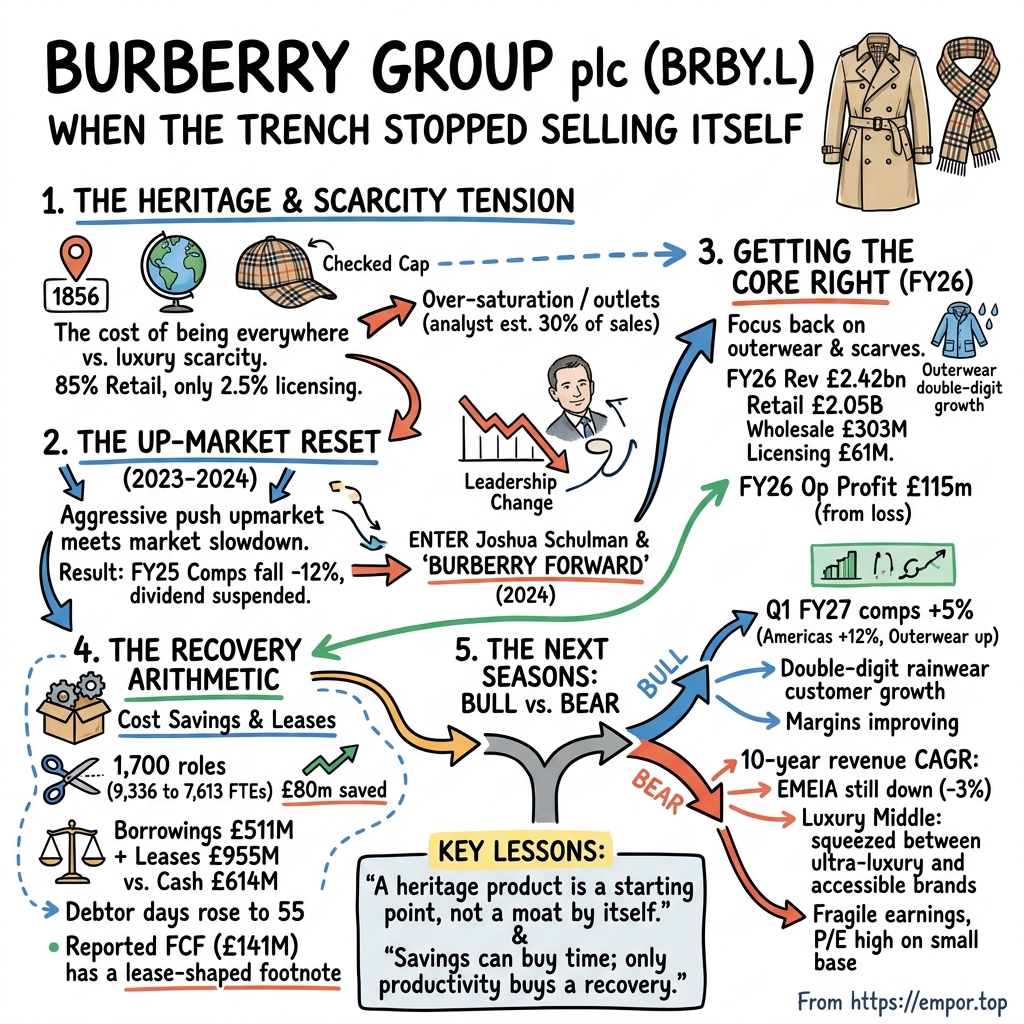
Burberry Group plc: When the Trench Stopped Selling Itself
I. The Coat That Had to Find Its Way Back
On 17 July 2026, Burberry told the market something it had not been able to say with much conviction for years: customers were coming back. Comparable retail sales for the first quarter of the 2027 financial year rose 5%, the fourth quarter in a row in which the number had been positive.1 Outerwear grew at a double-digit rate. Scarves, the cheapest way into the house and the most recognisable piece of check in any airport duty-free hall, kept selling. The number of new customers buying rainwear rose 19%, and handbags, the category that had embarrassed the company through its previous strategy, returned to growth.1
Read only that paragraph and the story sounds finished. It is not. On the same morning, the same release showed the region Burberry calls EMEIA (Europe, the Middle East, India and Africa, the region that includes its London home) shrinking: comparable sales there fell 3%.1 The Americas grew 12%, Greater China grew, and the tourist flows that have always shaped luxury shopping in Paris, Milan and Bond Street pulled the other way. Management also had to concede the obvious arithmetic of a turnaround. The easy comparisons, quarters measured against the wreckage of 2024 and early 2025, were running out.4
That split screen is the best possible place to begin, because it is the exact question Burberry's shareholders are being asked to answer. Is Burberry Forward, the plan Joshua Schulman launched in November 2024, building a recovery that lasts? Or is it simply lifting results off a floor so low that almost any competent management would have produced a rebound?2
The scale of the floor matters. For the 52 weeks ended 28 March 2026, Burberry reported revenue of £2.42bn, flat at constant currency, and comparable retail sales up 2% for the year.2 That is a business that has not grown in a decade. In sterling terms, revenue compounded at roughly minus half a percent a year from the 2016 financial year to the 2026 one, and over the last three years it shrank by almost 8% a year.3 Reported operating profit recovered to £115m, after a £3m loss the year before.2 Two years earlier, in a single good year, Burberry had earned several times that amount. The recovery so far is real, but it is a recovery to a level that the company used to regard as a disappointment.
It helps to be precise about what kind of business this is. Burberry Group plc is a London-listed luxury house, and nearly everything it earns comes from selling things to people today. In the 2026 financial year, its own stores and websites brought in about £2.06bn, or 85% of revenue; wholesale partners such as department stores contributed about £300m; licensing, mostly royalties on fragrance and eyewear made by partners, was about £60m, or 2.5%.3 There is no subscription, no long-term contract and no royalty annuity to cushion a bad season. The company describes itself as having "little contracted income."3 Every year, the trench has to be sold again.
That makes three questions unavoidable, and they run through everything that follows. First, can Burberry turn heritage into pricing power, the ability to charge more without losing the customer, which is what separates a luxury house from a fashion brand with a famous logo? Second, can it grow without repeated rounds of cost cutting, which flatter margins once but cannot be repeated forever? And third, does today's thin earnings base support a share price that, on trailing profit, looks extraordinarily expensive and, on cash flow, looks almost ordinary?
The test ahead is not complicated to state. Product demand has improved, store sales have improved, and full-price selling appears to have improved. The question is whether those three can keep improving as the comparisons toughen, and whether the improvement shows up not only in comparable sales, a measure flattered by a weak base, but in reported revenue, reported margin and cash. One strong year proves that the decline stopped. It does not yet prove that growth has started.
To understand why that distinction matters so much at Burberry, it helps to go back to the moment when the company's most famous symbol became too famous for its own good.
 Subscribe on LinkedIn
II. A British Icon Learns the Cost of Being Everywhere
In the early 2000s, the Burberry check stopped belonging to Burberry. The camel, black, red and white pattern that the company had used for decades as a coat lining turned up on baseball caps, bikinis, pushchairs and dog collars, some of them genuine, many not. In Britain, the check became a shorthand for a particular kind of brash, aspirational street style, and the tabloids took notice. For a luxury house, it was a strange kind of success. Everyone recognised the product. Fewer of the customers the brand most wanted wished to be recognised wearing it.
The story of how Burberry got there begins far earlier and far more practically. Thomas Burberry opened his outfitting business in Basingstoke in 1856.3 His breakthrough was a fabric, gabardine, woven tightly enough to keep out rain while still letting the wearer breathe, and from it came the garment that would carry the name around the world: the trench coat, worn by officers in the First World War and later by film stars, detectives and anyone who wanted to look as if they had somewhere important to be in the rain. The heritage is not a marketing invention. Burberry still makes trench coats at its own factory in Castleford, in Yorkshire, and that factory is now being renovated as part of the current plan.3
What that history gave the company was authority in a specific category. Burberry is believable when it sells a raincoat in a way that few fashion houses are, and the brand's recognition across Asia, the Middle East and the Americas is the product of more than a century of that association. What history did not give it was scarcity. A pattern travels more easily than a price point. Licensees in different countries made Burberry-branded goods for local markets, wholesale accounts discounted, and counterfeiters copied the check freely, so the symbol spread much faster than the luxury positioning behind it.
The recovery that followed was, in hindsight, the template for every Burberry turnaround since. From the late 1990s and through the 2000s, successive leaders pulled the brand back from broad exposure toward a more controlled house: fewer licences, less of the check, more investment in its own stores, and a creative identity built around the trench rather than the pattern. Christopher Bailey, who rose from designer to chief creative officer and then to chief executive in 2014, became the public face of that era, when Burberry pitched itself as a digitally fluent luxury brand with a British soul.7
Licensing is the clearest example of control being bought back. For decades, the Japanese market had been served largely through a licence with a local partner. When that arrangement ended in 2015, Burberry gave up a high-margin royalty stream in exchange for selling directly under its own name, with all the cost, inventory and risk that came with it.7 In the years that followed, the company kept reshaping the remaining licences, bringing some brand activity closer to its own control and letting others lapse or narrow, until royalties became a small sideline rather than a pillar of profit.6 These moves were about who controlled the brand, not about buying growth. Burberry has never been an acquisition machine, and nothing in the current equity story depends on a deal.
That tighter grip is visible in today's revenue mix.3 It is the end state of thirty years of tightening the grip on the brand.
It is also the source of the tension that runs through the rest of the story. A company that sells through licensees collects royalties and lets someone else worry about unsold stock. A company that sells through its own stores captures the whole margin on every full-price sale, but it also owns the leases, the staff, the inventory and the obligation to clear what does not sell. Tighter control protects the brand. It also puts the full weight of merchandising, pricing and clearance on Burberry's own shoulders, and that weight shows up the moment demand weakens.
Heritage, in other words, is a real asset. It gives Burberry recognition that a new brand could not buy, and authority in outerwear that few rivals can claim. But the checked-cap era proved that recognition and desirability are different things, and that a symbol can be famous and devalued at the same time. The question for an investor is not whether Burberry has heritage. It is how much of that heritage can be converted, each season, into sales at the price on the tag.
III. A £2,420 Million Business Built on Today's Customer
Picture a shopper walking into a Burberry store on Regent Street, or in Shanghai, or at a mall in Texas, for a scarf. A cashmere check scarf is the classic entry ticket: recognisable, giftable, a few hundred pounds rather than a few thousand. For the shopper, the visit is a purchase. For Burberry, it is an opportunity and a test. Can the sales associate, the window display and the product on the rail turn that visit into a full-price coat, a bag, or a reason to come back next season? That one interaction contains almost the entire economic engine of the company.
In the 2026 financial year, retail remained Burberry’s dominant source of revenue, with smaller contributions from wholesale and licensing.3 Retail and wholesale revenue is recognised when the goods change hands; royalties accrue as licensees produce or sell. Burberry earns its revenue one transaction at a time, with exposure to global consumer demand, the risk the company itself lists first.3
The causal chain from brand to profit runs in a straight line, and it is worth walking through slowly because every later debate about Burberry is a debate about one of its links. Brand and product choices decide whether people walk in: that is traffic. Merchandising, staff and the product itself decide whether they buy: that is conversion. The mix between scarves and coats, and between full-price and outlet, decides the average selling price. How much stock was bought against how much sold decides markdowns. And all of that, spread across a fixed base of stores and staff, decides store productivity, the sales each location generates against what it costs to run. Burberry wins when every link strengthens at once. It loses badly when two or three weaken together, because the store costs do not fall when the customer stays away.
That is why analysts watch comparable retail sales so closely. The comparable figure strips out the effect of opening and closing stores and of currency, and asks a simple question: are the stores Burberry already had selling more than they did a year ago? It is the best quick read on momentum in existing locations. It is not the same as Group revenue, which also reflects store closures, wholesale orders, licensing and the translation of foreign sales into sterling, and it certainly is not profit. In FY26, comparable sales rose 2% while reported revenue was flat at constant currency and lower in sterling, a gap that is the whole reason this distinction matters.2
Owning the shop floor carries obligations that a licence business never sees. Burberry's stores come with leases, and at the end of FY26 the lease liabilities on its balance sheet were close to £1bn.3 Its people, inventory and fixed costs do not flex quickly with demand. Wholesale partners add a different exposure: they are customers who are given credit, and some of them pay slowly. Burberry does not disclose its largest wholesale customers or the share of revenue they represent, nor does it disclose concentration among its suppliers.3 Its retail scale makes it unlikely that any single account dominates, but the company does not give investors the numbers to confirm that.
Digital is part of the same engine rather than a separate one. E-commerce sales rose at a high-teens rate in FY26 and at a mid-teens rate in the first quarter of FY27, faster than the stores.21 It is tempting to treat online growth as a story in its own right, as Burberry itself did a decade ago, when it styled itself one of the most digitally advanced luxury brands. The more useful question is narrower. Does digital bring in profitable, full-price demand, or does it simply move existing customers from one channel to another and add delivery and return costs along the way? The company reports the growth rate. It does not separately report the profitability of the channel.
Geography adds another layer of cyclicality that the store network cannot escape. Luxury spending moves with tourists as much as with residents: a Chinese family shopping in Paris, an American couple buying in London, a Gulf visitor in Milan. When currencies, visa rules or travel patterns shift, sales move from one region's stores to another's, and a company with fixed leases in every major city feels the drop in one place before it sees the gain in another. That is part of why the first quarter of FY27 showed 12% growth in the Americas alongside a decline in EMEIA.1 Burberry's regional comparable figures are therefore not just a scorecard of local brand health. They are also a map of where its customers happened to be standing when they decided to buy, which makes a single quarter's regional pattern a weak guide to the brand's underlying appeal and a multi-quarter pattern a much stronger one.
What the structure reveals is a business with high gross margins and heavy fixed costs. In FY26, gross margin reached 67.9%: for every £100 of goods sold, about £68 was left after the cost of the product.2 Yet reported operating margin was under 5%, because stores, staff, marketing and central costs consumed almost all of the gap.2 That spread is the key to understanding Burberry's operating leverage. A few points of extra revenue, sold at full price through stores that are already paid for, can move profit sharply. A few points of lost revenue can wipe it out, which is exactly what happened in FY25.
And so the section ends on the question that matters most. If customers are buying the trench and the scarf again, is that a durable preference for Burberry, the kind of loyalty that lets a house raise prices and still sell, or is it the success of a well-chosen campaign and a favourable moment in the outerwear cycle? A business with almost no contracted revenue cannot answer that question in advance. It can only answer it season after season, and the competition it faces is what makes each season hard.
IV. The Luxury Middle Is a Difficult Place to Stand
There is a long-running argument among analysts who follow Burberry, and it is not really about Burberry's profits. It is about what Burberry is. Some treat it as a true luxury house, a peer of the great French and Italian names with a British accent. Others treat it as a premium fashion brand, closer to Coach or Michael Kors than to Louis Vuitton, priced and valued accordingly. The distinction is not academic. A luxury house can raise prices every year, keep inventory scarce and earn margins well above 30%. A premium brand competes on design, newness and value, and its margins rise and fall with the fashion cycle. Burberry has, at different points in the last decade, tried to be both. That uncertainty is the competitive problem.
Scale frames the war game. In 2025, LVMH's Fashion and Leather Goods division, home to Louis Vuitton, Dior and a stable of other houses, generated about €37.8bn of revenue.9 Gucci alone, a single brand inside Kering, generated roughly €6bn, even after a painful two-year slump.10 Burberry's entire Group revenue in FY26 was £2.42bn.2 These comparisons need care. LVMH is a diversified group whose brands share property, media buying and talent, and Gucci is one house inside a larger portfolio. Neither is a perfect one-brand comparison. But the gap illustrates something real: Burberry is a mid-sized independent house competing for the same windows on the same streets, the same magazine covers and the same wealthy customers as companies many times its size, which can spread advertising and store costs across far larger revenue bases.
Run the industry forces through that reality and the picture is mixed. Rivalry is intense: Burberry fights for attention and spending against Gucci, Saint Laurent, Moncler in outerwear, Coach in accessible leather goods and the full LVMH portfolio. Buyer power sits with millions of individual consumers rather than with a few large customers; no single disclosed customer dominates revenue, but a shopper can switch from one brand to another without friction and can simply defer a purchase when confidence wobbles.3 Wholesale partners add a second layer of buyer influence over how and where the brand is shown. Substitutes are everywhere, because another coat, bag or scarf competes on design, status, quality and price, and heritage alone does not stop a customer from choosing Moncler for a winter jacket. Supplier power is harder to read, because the company does not disclose a material supplier concentration figure, though craftsmanship and sourcing do constrain how quickly the supply of fine leather goods or cashmere can flex.3 Entry barriers are real but slow-moving: building global recognition and a store network takes decades, yet Burberry's filings point to no protected resource or high switching cost that locks customers in.
In Hamilton Helmer's language of durable advantage, the only one of his seven powers that could plausibly apply is branding, the ability to charge more for an objectively similar product because of what the name means to the buyer. Burberry does not enjoy scale economies relative to its giant peers; it has no network effects, no switching costs and no proprietary technology of consequence. Its counter-positioning, if it has any, is the authenticity of a British outerwear specialist in a market of Italian and French generalists. So the investment case rests on one power, and the question is whether that power is as strong as a luxury multiple would imply.
Two other powers deserve a brief hearing, because bulls sometimes invoke them. The first is a cornered resource: the trademark, the check and the Castleford factory are assets no rival can copy legally. That is true, but owning a symbol is not the same as owning demand for it, as the counterfeit-heavy 2000s proved. The second is process power, the kind of accumulated operating know-how that lets a company do something better than rivals even when they can see how it is done. Burberry's craft in outerwear arguably qualifies within that one category. It does not extend to leather goods, where the company has spent years trying, and largely failing, to build the handbag franchise that powers the profits of its French and Italian peers. Branding remains the only power with a plausible claim across the whole business, and branding is precisely the power that depends on consistency, which Burberry's record has lacked.
The record says the brand power is real but conditional. Its break mechanism is easy to describe, because Burberry has demonstrated each element of it. Shift creative direction too often and the customer stops recognising what the brand stands for. Raise prices faster than the customer's willingness to pay and full-price sell-through drops. Clear the resulting excess stock through outlets and the scarcity that justified the price erodes further. Each step makes the next more likely.
Outlets are the uncomfortable part of that picture. In November 2024, Reuters reported analysts' estimates that outlets accounted for close to 30% of Burberry's sales and as much as 50% of its profitability at that time.11 Those were analyst estimates, not company disclosures, and Burberry does not report the outlet channel separately. But even as a rough guide, they captured the bind facing the new chief executive: a significant part of the business depended on selling Burberry at a discount, which supported profit in the short term while undercutting the case that Burberry deserved luxury pricing.11 A true luxury house rarely relies on outlets on that scale.
None of that means the brand is broken. The affirmative evidence from 2026 deserves its full weight: outerwear, rainwear and handbags all improved.1 Those are exactly the signals one would want to see if the brand's core appeal was reasserting itself. They are also, so far, a few quarters of evidence against a decade of uneven performance, and many came at prices Burberry had deliberately reset to be more approachable. That is useful proof that customers still want the trench. It is not yet proof that they will pay ever-higher prices for it.
The verdict, then, is that Burberry has a moat, but a narrow and leaky one. Heritage and category authority are genuine. They have not reliably translated into peer-like growth or margins, and the company's own history shows how quickly they can be diluted. The forward test is concrete: full-price mix, comparable growth broken down by region and category, and margins that hold up when the comparisons get harder. If those move together, the brand power is stronger than the past decade suggested. If outerwear grows while margins stall, the moat is smaller than the trench's fame implies.
The most recent proof of how quickly the moat can leak was the strategy that came just before the present one.
V. The 2023 Push Upmarket, and the Reset That Followed
On 15 July 2024, Burberry's board did three things in one announcement. It warned that the first half would produce an operating loss. It suspended the dividend. And it said that Jonathan Akeroyd, chief executive for little more than two years, was leaving with immediate effect, replaced by Joshua Schulman, a former chief executive of Michael Kors and former president of Coach.13 The shares fell 16% that day and hit their lowest level in more than a decade.13 Retail revenue for the quarter had dropped by about a fifth from a year earlier.13 Seven weeks later, FTSE Russell announced that Burberry would leave the FTSE 100 after 15 years in the index, its market value having fallen by about 70% in a year.14 For a company that had long been one of the London market's flagship consumer brands, it was a public humiliation.
To understand how Burberry arrived there, it helps to trace the transitions that matter to investors, rather than parade every executive. After 2014, under Christopher Bailey, Burberry tried to elevate a brand that had grown through accessible products and digital marketing.7 His successor as chief executive, Marco Gobbetti, came from Céline with a mandate to push Burberry firmly into the higher luxury tier: fewer cheap products, more leather goods, a sharper fashion edge and the closure of stores and wholesale accounts that did not fit.8 When Akeroyd arrived from Versace in 2022 and appointed Daniel Lee, the young British designer who had made Bottega Veneta fashionable again, as chief creative officer, the reset began once more: a new logo, a new knight emblem, a blue-tinged visual identity and an explicit ambition to raise prices and lift Burberry's position among the luxury elite.8
The Lee era was meant to signal seriousness. The new identity leaned on the knight emblem from Burberry's archive, a bolder use of the check in fresh colours, and runway collections that tried to make Burberry feel like a fashion insider's brand again.8 Fashion critics were often kind. Customers were more hesitant, particularly where prices rose in leather goods, a category in which Burberry had never established the authority of its rivals. The house was asking shoppers to pay a premium for a version of Burberry they had not yet learned to want.
Each of these shifts had its logic. Taken together, they made it hard for a customer to know what Burberry was. The brand that sold the reliable trench and check scarf changed its design language roughly every four or five years and its price ambition with it. When the people paying the price cannot see a coherent house, they hesitate, and hesitation in a business with no contracted revenue goes straight to the income statement.
The financial record shows how it ended. The upmarket push collided with a sharp slowdown in luxury spending, particularly in China, and with Burberry's own decision to lift prices in categories where its authority was weakest. In January 2024, the company issued its first profit warning, citing a slowdown in December trading.12 The second came with the July 2024 management change. For the 2025 financial year as a whole, comparable retail sales fell 12%, and reported operating profit collapsed to a £3m loss.15 Management at the time blamed, in part, a difficult luxury market. That explanation was true but incomplete. Peers suffered in 2024 too, but Burberry's declines were deeper and earlier than most, which points to choices the company controlled: pricing too far ahead of its customer, and a product range that moved away from what customers came to Burberry to buy.
Schulman's answer, presented in November 2024 as Burberry Forward, was to go back to the brand's centre of gravity.2 He came with a reputation built at Coach and Michael Kors, businesses that live or die on the accessible end of luxury, and that background shaped the plan. In practice, it meant leading with outerwear and scarves, the categories where Burberry's authority is clearest; refining a good-better-best price structure so that customers could find a Burberry coat at several price points rather than only at the top; improving the visual merchandising in stores and the clienteling, the personal relationships between sales staff and repeat customers; and only then extending demand into bags, shoes and other categories.16 It was not a glamorous vision. It was a merchant's vision.
The early evidence is better than many skeptics expected. Alongside the FY26 recovery, adjusted operating profit, which excludes restructuring and other one-off items, was £160m.2 The momentum continued into the first quarter of FY27.1 On a simple question, whether Burberry Forward stopped the decline, the answer is yes.
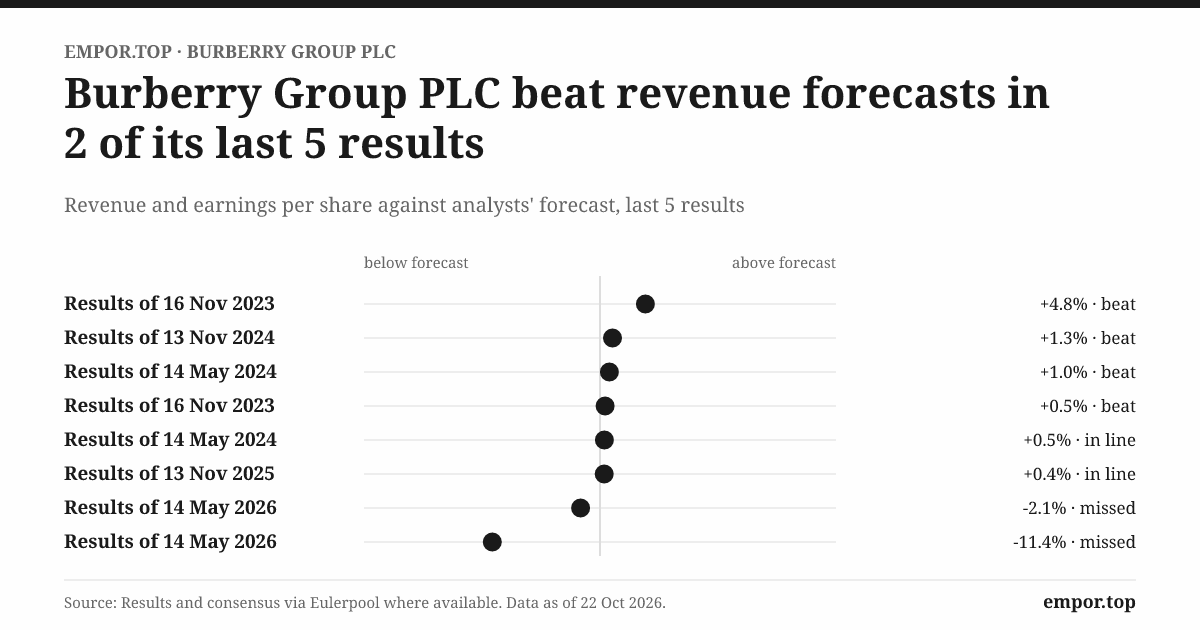
The calls tell a more textured story than the headline numbers. In the prepared remarks at the FY26 results in May 2026, management leaned heavily on brand language: desirability, momentum, the reconnection of Burberry with its heritage.5 Analysts in the Q&A pressed on harder points: how much of the improvement came from full-price sales rather than outlets, how quickly the cost savings would be reinvested, and whether the pace of growth could hold as the base got tougher. On the Q1 call in July, the questions shifted to regional divergence, particularly Europe's softness and the role of tourist spending, and to whether FY27's expectations for profit improvement depended more on growth or on savings.4 Management gave measures where it could, such as category growth rates, new-customer counts and channel growth, but tended to answer the full-price and outlet questions with confidence rather than numbers, because the company does not break out outlet sales.
That gap matters for judging credibility. Burberry's recent leaders each arrived with a clear story and a promise to restore the brand's luxury standing. Each story was told well at the time. The outcomes diverged sharply from the promises, and in Akeroyd's case the gap was exposed within two years. Schulman's plan differs in an important way: it promises less. It aims to sell more of what customers already want, rather than to change what Burberry is. That is a lower-risk strategy, and the early results support it. But it also caps the prize. A Burberry that sells good coats at good prices to a wider base is a healthy business. It is not automatically a luxury house earning luxury margins.
The falsifier for this plan is explicit. Sustained growth in reported revenue, accompanied by margin expansion, would mean the reset has worked. Comparable sales alone, or another first-year rebound followed by a stall, would mean Burberry has simply moved from one reset to the next. And because the margin recovery so far has leaned heavily on cost savings, the real test runs through the arithmetic of how those savings were achieved.
VI. The Recovery's Arithmetic: Savings, Stores and Investment
When Burberry presented its FY26 results, one figure did a lot of work: £80m of cost savings delivered during the year, with annualised savings expected to reach £100m in FY27.2 Beside it sat another, less trumpeted: the company planned to raise capital spending again after two years of cuts. The juxtaposition captures the central question of the recovery. Is Burberry restoring profit by selling better, or by being smaller?
The size of the adjustment is striking. Average full-time-equivalent employees fell from 9,336 in FY24 to 7,613 in FY26, a reduction of about 18% in two years, and the company said the changes affected around 1,700 roles.3 That is not a trim. It is a substantial reshaping of the organisation, touching head-office functions, regional teams and store operations. Some of it was clearly necessary: a business whose revenue had fallen sharply could not keep the cost base of a company that had expected to grow. But headcount reductions of that scale also carry risk in a business that sells through personal service. Clienteling, the relationship between a trusted sales associate and a regular customer, is one of the levers of Burberry Forward, and it is hard to deepen with fewer people.
Capital expenditure tells the same story from a different angle. It fell from £208m in FY24 to £151m in FY25 and £113m in FY26, from about 7% of revenue to under 5%.3 For FY27, management guided capex of around £120m, including renovation work at the Castleford trench factory.2 The direction has turned, but modestly. A luxury retailer's stores are its stage; when spending on them stays low for several years, the stage begins to look tired. The question is whether the planned increase is the start of reinvestment or simply a return from an unusually low level.
Management says the savings are funding growth initiatives, including marketing.5 That is the right story to tell, and it may be true. But it is also the story every restructuring management tells, and the evidence will come later, in sales per employee and sales per store. If Burberry has removed costs that did not touch the customer and reinvested in the ones that do, revenue should rise faster than the cost base and productivity should climb. If the savings mainly flatter the margin while the reinvestment lags, the improvement will fade once the cuts are absorbed. Burberry does not report sales per square foot or sales per store, which leaves investors working from total revenue, comparable growth and headcount.
The reported numbers also need to be read with care. FY26's reported operating margin was about 4.8%; on an adjusted basis, which removes restructuring charges, impairments and other items the company treats as non-recurring, it was about 6.6%.2 Restructuring charges alone were about £45m in FY26.3 Investors should keep the two measures distinct, because a company in the middle of a reset tends to have adjusting items every year, and a margin that is "adjusted" every year is not fully a cleaner picture of underlying performance. The gap between the two is the price of the reset, and it belongs in the record.
Incentives are where this arithmetic meets governance. Joshua Schulman's total remuneration for FY26 was about £4.0m, including a bonus of about £2.3m; chief financial officer Kate Ferry received about £2.5m, including a £1.3m bonus and a vesting share award.3 Those bonuses were paid in a year when adjusted operating profit improved sharply from a very low base, but when reported operating margin was still under 5%. Shareholders noticed. At the July 2026 annual general meeting, the new remuneration policy passed with only about 65% support, and amendments to the share-plan rules with 63%.17 In UK governance, a vote against of more than 20% is a significant signal; the board said it would continue to engage with shareholders and report back within six months.17 The vote is not a crisis, but it is a clear message: a meaningful minority of owners is not yet convinced that the pay structure rewards durable outcomes rather than the rebound itself.
Ownership alignment is a separate question from incentives, and it cannot be inferred from a bonus plan. Burberry's remuneration report sets shareholding requirements for executive directors, and the chief executive's and chief financial officer's personal holdings against those requirements are the measure that matters, rather than the size of the awards they might one day receive.3 Both executives are relatively recent arrivals, so their holdings are still being built largely through the company's own share plans, which means their exposure to the share price depends more on future vesting than on stock they have bought with their own money. There is no founder, family or controlling shareholder; MFS, with about 5.1%, and Norges Bank, with about 3.9%, were the largest disclosed holders at the year-end.3 More recently, Frasers Group, the Mike Ashley-founded retailer, disclosed an economic interest of about 6% held through sold put options, which carries no voting rights.21 It is a financial position, not a bid for control.
The related-party question, often a source of trouble in other markets, has a simple answer here. In FY26, Burberry disclosed £2m of donations to The Burberry Foundation, its charity, and no other material related-party transactions; key management compensation totalled about £7m.3 Transactions between subsidiaries are eliminated on consolidation. There is no parent company extracting fees, no royalty to a controlling family and no loans to insiders.
The board itself is in transition. A change of chair was scheduled for November 2026, which means that the people who will judge whether the remuneration dissent has been answered, and whether the next stage of Burberry Forward deserves more capital, will include a new presiding voice.3 The company reported a majority of independent non-executive directors and a board that was 56% women.3 Those facts do not settle any argument about strategy. They do mean that the governance machinery exists to hold management to its promises, and the AGM vote showed that shareholders expect it to be used.
The arithmetic, then, is clear in direction and uncertain in quality. Burberry has rebuilt margin partly by being smaller: fewer people, less capex, lower costs. That bought time and stabilised the business. Only productivity, more revenue from each store and each employee, can turn that stabilisation into a recovery, and the cash flow statement shows how much room the company has to fund it.
VII. The Cash That Earnings Do Not Explain
Over the twelve financial years from FY15 to FY26, Burberry reported about £3.2bn of net profit in total. Over the same period, its operating activities generated about £6.4bn of cash, almost exactly twice as much.3 At first glance, that looks like the profile of a superb cash machine, a business whose accounts understate its true earning power. The reality is more interesting, and it explains why investors who stop at that ratio can draw the wrong conclusion.
Part of the gap is ordinary for a business with physical assets. Depreciation and amortisation are deducted from profit but involve no cash leaving the business in that year, so they are added back in the cash flow statement. The larger reason is an accounting change. Since 2019, under the IFRS 16 standard, Burberry has recorded most of its store leases as assets on its balance sheet and depreciated them, with the matching lease payments split into interest and principal repayments. The principal part does not appear in operating cash flow at all; it shows up in financing. So the rent Burberry pays for its stores, which is unmistakably an operating cost for a retailer, has partly moved out of the operating cash flow line. The result is that operating cash flow looks much larger than it would have under the old accounting, even though no extra cash reached the company.
FY26 illustrates the bridge clearly. Operating cash flow was about £582m.3 The cash flow statement added back about £375m of depreciation and amortisation, a large share of which related to stores' right-of-use assets.3 Working capital helped too, contributing a £41m inflow as payables rose and inventory fell.3 Strip out the lease-related depreciation and the working-capital boost, and the underlying cash profit of the business looks much closer to its modest reported earnings.
That is why there are two very different free cash flow figures in circulation. A simple definition, operating cash flow minus capital expenditure, gives a figure for FY26 of roughly £470m, implying a free cash flow yield of around 10% on the current market value. Burberry's own definition is stricter: it also subtracts lease principal payments and related cash flows, interest and tax. On that basis, the company reported FY26 free cash flow of £141m.2 Both are internally consistent. They answer different questions. The first asks how much cash the business generates before it pays for its stores; the second asks how much is left for shareholders after it does. For a business whose stores are its core operating asset, the second number is the more honest guide to what owners can receive.
The long-run uses of cash tell the same story. On the simple definition, Burberry generated about £4.8bn of free cash flow over the twelve years, and paid out about £1.8bn in dividends, around 37% of it.3 Over the same period, the company also reduced its share count materially, from about 445m shares in issue in 2015 to about 364m in 2026, through buybacks.3 Yet cash and short-term investments rose by only about £126m across the whole period.3 The difference was absorbed by lease payments, buybacks and, more recently, the cost of weak trading, which turned a once-fortress balance sheet into one with net debt.
The share-count reduction deserves its own footnote. Most of the shares Burberry holds in treasury came from a buyback completed in the 2022 financial year, when the share price was far higher than it is today.3 During FY26, there was no buyback, no equity raise and no rights issue; instead, about 1.8m treasury shares were transferred to employee share trusts to satisfy awards.3 In hindsight, the 2022 repurchase was capital returned at a high price just before the business entered its worst stretch in a generation. That is not proof of poor judgment, because few predicted the depth of the luxury slowdown. It is evidence that Burberry's buybacks have tended to happen when cash was plentiful, which is also when shares were expensive.
The dividend's history shows how cyclical the payout has been. Over the period, the median payout was about half of net profit, but the range ran from zero in FY21, when the pandemic forced a suspension, to around 145% in FY20, when the dividend was maintained through a profit collapse.3 Since the July 2024 suspension, nothing has been paid.13 The dividend is therefore not a reliable signal of normal earnings; it has been suspended twice in five years, and its return will depend on sustained reported profit rather than a single good year.
Debt deserves a careful look, because the leases complicate it. At the end of FY26, Burberry's borrowings were about £511m, lease liabilities about £955m and cash, net of overdrafts, about £614m.3 On borrowings alone, the company had more cash than debt. Including leases, it had substantial net obligations. The main instrument is a £450m sterling bond carrying a 5.75% coupon and due in 2030; a £300m revolving credit facility, maturing in November 2027, was undrawn.18 Burberry repaid a £300m bond in September 2025, which reduced gross debt.3 The auditor found no material uncertainty over going concern, and management said its going-concern assessment did not depend on drawing the revolving facility.3 The 2027 refinancing of that facility is worth watching, but it is not an immediate pressure point.
There is a quieter detail in the FY26 income statement that shows how thin the profit cushion had become. Finance income, mainly interest and gains on cash held in money-market funds, was about £23m, against profit before tax of only about £49m.3 In a normal year, interest on cash is a footnote. In FY26, it accounted for roughly half of the pre-tax profit, because the operating business earned so little and interest and lease costs consumed most of it. The tax charge then took a large bite: the effective rate was close to 60%, as some costs were not deductible and some losses could not be used.3 The chain from £115m of operating profit to a small net profit is therefore a story of fixed financing costs and tax friction pressing on a thin base, and it is exactly the chain that would reverse quickly if operating profit rose.
Rating agencies offer a useful but bounded view. In December 2025, Moody's affirmed Burberry's Baa3 rating, the lowest rung of investment grade, and revised the outlook from negative to stable, citing debt reduction and improving metrics, while noting that revenue had declined and that operating performance needed to keep improving.19 Burberry subsequently reported net debt to adjusted EBITDA of 1.6 times at the FY26 year-end, down from 2.3 times.2 That is a credit view, focused on whether lenders get paid. It says the balance sheet has stabilised. It says little about whether shareholders will earn an attractive return.
Capital deployment is easy to summarise because Burberry has done so little dealmaking. No transformational acquisition drives the story, and no purchase price needs to be justified. The record is the control of the brand, capital spending, dividends, buybacks and debt repayment. On that record, the company returned a lot of cash to shareholders in its good years and then found itself with too little cushion when trading turned, which is why it suspended the dividend and why its credit rating briefly carried a negative outlook. The lesson is not that the buybacks were reckless. It is that a business with no contracted revenue and heavy fixed lease costs needs a bigger balance-sheet margin of safety than its cash flow ratios suggest.
And one corner of the balance sheet suggests the cash conversion may face more pressure than the headline numbers imply.
VIII. Debtor Days Reach 55
At the close of the 2026 financial year, the customers who owed Burberry money had, on average, taken longer to pay than at any point in the previous dozen years. Debtor days, the number of days of revenue sitting in receivables, reached 55, up from 35 in FY15.3 In a business where 85% of sales come through the company's own tills, where the customer pays on the spot, that is an unusually high figure, and it points squarely at the wholesale channel.
The detail is more reassuring than the headline, but not entirely. At 28 March 2026, gross trade receivables were about £151m, against which Burberry held an £18m allowance for expected credit losses, leaving net receivables of about £133m.3 Separately, accrued income, money earned but not yet invoiced, was about £15m.3 Of the gross trade receivables, about £115m was current, meaning not yet due.3 The concern sits in the oldest bucket: about £15m was more than three months overdue, and Burberry held an £11m allowance against it, implying the company expects to recover only a fraction of those old balances.3 The total allowance rose from £11m in FY25 to £18m in FY26.3
So who is late? Burberry does not disclose its customer concentration or name any dominant debtor, but the structure of the business points to wholesale partners: department stores, multi-brand retailers and distributors who buy on credit terms.3 Multi-brand luxury retail has been under pressure through the industry's slowdown, and the increase in the overdue balance is consistent with a partner or partners under stress. The amounts are small relative to Burberry's revenue, so this is not a balance-sheet threat. It is a monitoring point: a business that has relied on working capital for part of its cash conversion cannot afford for receivables to keep lengthening.
The settling measure is simple. If the more-than-three-months-overdue balance and the loss allowance fall during FY27, as cash generation improves, the FY26 figures will look like a one-off clean-up. If they keep rising while inventory and payables stop providing an inflow, cash conversion will weaken just as the company tries to fund reinvestment.
Two other exposures belong in the same ledger. The first is tax. Burberry held a provision of about £76m for uncertain tax positions at the FY26 year-end, down from £107m a year earlier, largely related to transactions between group companies in different countries and discussions with tax authorities.3 That is the kind of judgment that can move in either direction as audits conclude. The second is currency. Burberry sells in many currencies and buys in several, and it hedges 70% to 90% of its anticipated exposure where it is significant.3 It estimated that a 10% move in sterling would change post-tax operating profit by only about £3m at the year-end, which suggests the hedging programme limits the short-term impact, though translation of foreign earnings still moves reported sterling revenue.3
The auditor's view was clean. EY's opinion on the FY26 accounts was unqualified, and its key audit matters were inventory provisioning, impairment of store assets and uncertain tax positions, the three areas where management's judgment most directly shapes reported profit.3 EY reported no material uncertainty over going concern through September 2027.3 Those key audit matters are a useful map in themselves: they mark the places where a weak season would show up first, in stock that has to be written down and stores whose value has to be cut.
The receivables do not break the investment case. They narrow it. Burberry's cash generation remains healthy on most measures, but one of its smaller cogs is moving the wrong way, and that is exactly where a skeptical investor should be looking as the market prices the recovery.
IX. Analysis & Bear vs. Bull Case
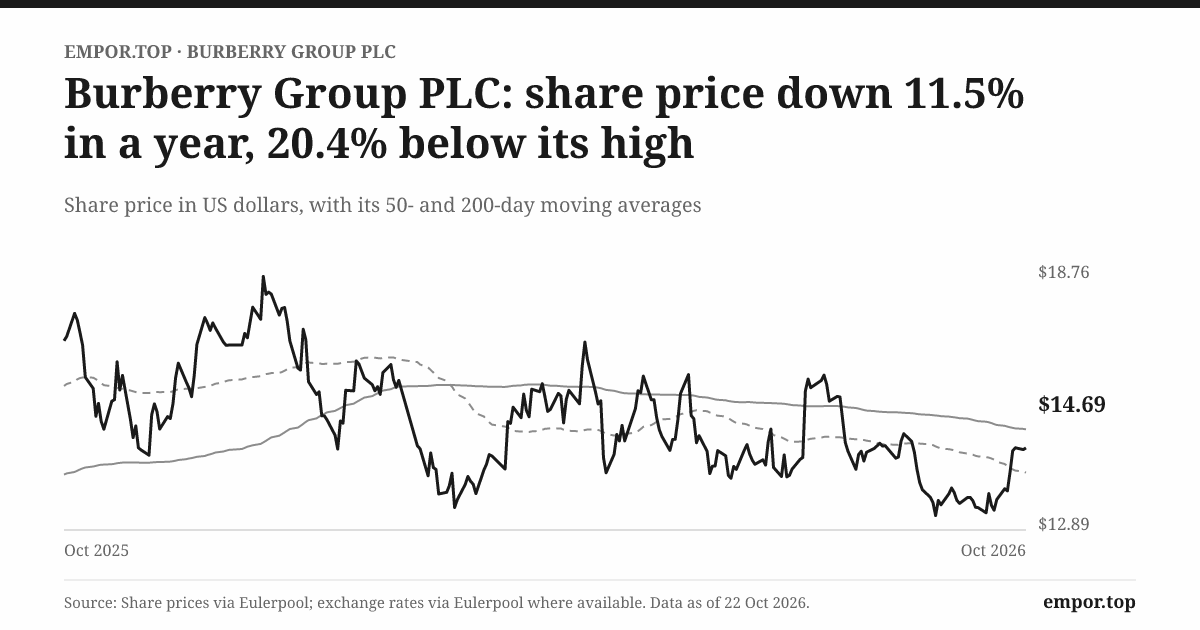
On 22 October 2026, Burberry's shares closed at about £10.98, nearly a fifth below their 52-week high and leaving the company with a market value of roughly £3.9bn.3 On the trailing earnings, that price is about 187 times net profit per share. On enterprise value against operating profit, it is about 31 times. On enterprise value against EBITDA, it is about nine times. Three multiples, three entirely different stories. The disagreement among them is the clearest sign of how unstable the earnings base still is.
Begin with the bull case, told without borrowing management's adjectives. Customers are responding to the products where Burberry has the most authority: outerwear grew at a double-digit rate and new rainwear customers rose 19% in the first quarter of FY27.1 Comparable sales have returned to growth for four consecutive quarters. Online sales are growing faster than the stores. Gross margin improved to 67.9% in FY26, reflecting less discounting and better pricing discipline.2 Leverage has fallen to 1.6 times adjusted EBITDA, and Moody's moved its outlook to stable.219 Consensus, as compiled by the company in July 2026, expected FY27 revenue of about £2.54bn and adjusted operating profit of about £246m, a margin close to 10%.20 If that happens, profit would rise by about half from FY26 on revenue growth of around 5%, and the P/E that looks absurd today would compress sharply. Operating leverage, the same force that wiped out profit in FY25, would work in shareholders' favour.
The bear case is built from the same record. Revenue has shrunk at about minus 0.4% a year over a decade and at about minus 8% a year over the last three.3 Net profit has fallen dramatically: FY26 net profit was a fraction of FY23's.3 The company has been through four creative and strategic resets in a decade, two profit warnings in a single financial year and two dividend suspensions in five years.1213 Reported operating margin is under 5%. A significant share of profit may still depend on outlets, though the company does not disclose it.11 And the margin improvement so far leans on £80m of savings, not on proven pricing power.2 On that reading, Burberry is a mid-sized fashion house that has repeatedly failed to turn its heritage into sustained growth, and FY26 is the first year of a rebound rather than the start of a new era.
The peer comparison should be used honestly. LVMH and Kering demonstrate what scale and portfolio breadth can do for a luxury group, spreading costs and sharing talent across many brands.910 They do not prove Burberry can achieve their margins. Kering's own recent struggles at Gucci show that even large houses can lose their way when creative direction shifts and prices outrun customers.10 Burberry's positioning, somewhere between accessible luxury and the higher tier, remains a live execution problem rather than a solved one. The Schulman plan has deliberately leaned toward accessibility in price architecture, which supports volume but tests whether Burberry can ever return to the high margins it earned in its best years.
The multiples need careful reading. With trailing earnings per share of only about 6p, a modest change in profit would move the P/E enormously: if FY27 earnings doubled, the multiple would roughly halve, without the share price moving at all.3 The same is true, less dramatically, of enterprise value to operating profit. EBITDA, by contrast, includes the large depreciation of store leases, which inflates the denominator and makes nine times look cheap, even though much of that EBITDA is spent on rent. None of these figures is a standalone signal of value. Each needs its definition stated before it is quoted.
There is also a data tie-out problem worth flagging. Third-party data providers calculate Burberry's operating profit differently from the company's own statutory figure: the enterprise-value multiple implies an operating profit of around £150m, between Burberry's reported £115m and its adjusted £160m.2 Readers comparing multiples across sources should reconcile those definitions first. For the narrative, Burberry's own sterling figures, reported and adjusted, are the anchors.
It helps to walk through the consensus arithmetic step by step. Start with expected FY27 revenue of about £2.54bn, roughly 5% above FY26.20 Then take expected adjusted operating profit of about £246m, which is a margin of just under 10%.20 Compared with FY26's adjusted £160m, that is an increase of about £86m on extra revenue of about £120m.2 In other words, analysts expect about seven of every ten extra pounds of sales to fall through to profit, plus the full-year benefit of the savings programme. That is ambitious, but not absurd, for a business with gross margins near 68% and a cost base that has already been cut. It also shows how much depends on the revenue line: if growth came in at 2% rather than 5%, most of the expected profit increase would disappear, and the savings alone would carry the year.
What does the current price appear to assume? At roughly £4.8bn of enterprise value, the market is paying for something like the consensus recovery: sustained growth and a return toward a high-single-digit or low-double-digit operating margin.20 It is not pricing in a return to the 20% margins of FY23, nor a relapse into losses. In other words, it is pricing a partial recovery, which means the share price will be highly sensitive to whether the next few results confirm or undermine the consensus trajectory.
A skeptical activist would focus on three things. First, the outlet question: how much of Burberry's profit depends on discounted sales, and what is the plan to reduce that dependence without losing the profit it provides? Second, the cost of the stores: with lease liabilities close to £1bn and a fixed cost base that leaves little margin at modest growth, is the network the right size and shape? Third, pay: the 2026 remuneration vote showed that a meaningful minority of shareholders wanted executive rewards tied more closely to durable reported outcomes.17 None of these has yet become an activist campaign. Frasers Group's derivative position is an economic exposure rather than a governance agenda.21 But they are the pressure points an engaged owner would push.
Three measures will matter most as the story unfolds. The first is comparable retail sales by region, which reached 5% in the first quarter of FY27 but with Europe still shrinking.1 The second is reported operating margin alongside gross margin: the former was about 4.8% in FY26, the latter 67.9%, and the gap between them is where the cost base and the savings live.2 The third is free cash flow after lease payments, on the company's own definition, which was £141m in FY26.2 If all three improve together over the next several reports, the recovery is real. If comps rise but reported margin stalls, or if cash after leases fails to grow, the market is paying for a turnaround that has not yet earned its multiple.
What would change the view is also clear. Sustained reported growth, with full-price demand rising and store productivity improving, would strengthen the case that Burberry Forward has rebuilt the brand's commercial engine. Renewed discounting, weaker comparable sales or margin gains driven mainly by further cost cuts would weaken it. The evidence so far supports a recovery in demand. It does not yet support a durable shift in pricing power, and the history of the last decade explains why investors should hold that distinction firmly.
X. Lessons from the House of the Trench
There is a moment in every Burberry turnaround when someone walks past a window and sees the trench coat again. It happened in the long clean-up of the 2000s, when the coat came back to the centre of the brand after the check-cap era. It happened again under Schulman, when outerwear became the lead category and the number of new rainwear customers began to rise. The trench is both the brand's strongest proof of authenticity and its most persistent reminder that a famous product is not a business model on its own. Five lessons from Burberry's own record make that tension concrete.
The first is that a heritage product is a starting point, not a moat by itself. Outerwear's recent growth is real evidence of brand strength.1 But the trench was there through a decade in which revenue went nowhere.3 The coat did not stop the company from losing its way; it only gave the company a place to come back to. For founders and investors, the lesson is that heritage works like a reservoir, not a river. It holds value, but someone has to keep drawing from it with good merchandising, sharp pricing and a coherent identity, or the water stays still.
The second lesson is about price and patience. When a brand changes its price before its customer changes with it, the spreadsheet catches up later. Burberry's upmarket push and the reset that followed showed how quickly customers can withdraw their permission to pay.121315 Pricing power is not a decision a company makes. It is a permission customers grant, and Burberry learned that the permission can be withdrawn faster than it is earned.
The third lesson is that savings can buy time, but only productivity buys a recovery. The recent cuts stabilised the business and lifted the margin.3 They cannot be repeated indefinitely. The test now is whether each store and each employee generates more revenue than before, because a recovery that comes only from a smaller cost base is a recovery with a ceiling.
The fourth lesson belongs to the accountants as much as to the merchants: cash-flow ratios need a lease-shaped footnote. Burberry's operating cash flow can look much stronger than its net profit because store depreciation is added back, while rent still has to be paid.3 Its own free cash flow after lease payments was £141m in FY26.2 Any investor valuing a store-heavy business should ask which number is being quoted, and why.
The fifth lesson is the plainest. Burberry has no founder or family to provide patient capital, and royalties remain a small share of revenue.3 Nearly every pound has to be earned in a store or online, from a customer who could have bought something else. That is a hard way to run a business. It also means that when Burberry gets its product and distribution right, the rewards flow directly to shareholders, without the dilution of a larger group's priorities. The house of the trench succeeds or fails on its own merchandise.
XI. Epilogue
Tonight, Burberry stands somewhere between rebound and recovery. The first quarter of FY27 produced 5% comparable growth, though performance remained uneven by region.1 Consensus expected a substantial rise in adjusted operating profit this year.20 Meeting that expectation would represent the first year of genuine profit growth in a long time. Missing it would reopen every question this story has asked.
The next test arrives quickly. On 12 November 2026, Burberry will report its interim results for the first half of FY27. The headline comparable sales figure will matter, but the more revealing moments will come in the Q&A. Will management give evidence on full-price sales, or answer with brand sentiment? Will it explain how Europe's softness and the flow of tourists across regions are affecting demand? Will wholesale orders, which reflect the confidence of department stores and partners in the next season, point up or down? And will reported operating margin, not just the adjusted figure, show measurable progress?
Beyond November, the decisive question is whether revenue growth and margin expansion arrive together. If revenue grows while margin expands because of better full-price selling and store productivity, the case for a durable recovery strengthens materially. If margin expands only because costs keep falling while revenue stagnates, the recovery will look like another round of restructuring. And if revenue grows only through promotions and outlets while margin stalls, the brand will be buying volume with the scarcity that justifies its price.
The working-capital signals deserve attention too. If debtor days and overdue receivables continue to rise while inventory and payables stop helping cash flow, the cash conversion that has supported the balance sheet will weaken just as the company tries to raise capital spending. Those are small numbers next to the brand debate, but they are where operational stress tends to show first.
Imagine the three ways the next year could go. In the first, Burberry grows reported revenue in line with expectations, Europe stabilises as the Americas and China keep improving, and margin rises toward 10% with savings and full-price sales both contributing. That outcome would make FY26 look like the bottom of a cycle and would put the dividend back on the agenda. In the second, comparable sales keep growing at low single digits, but toughening comparisons and Europe's softness keep reported revenue flat, so margin improves only through the savings already banked. That would be a holding pattern: healthier than 2024, but not yet a growth company. In the third, the outerwear cycle cools, outlets and promotions fill the gap, and the company finds itself once more explaining a miss. The market price sits much closer to the first scenario than to the third, which is why each results day carries more weight than usual.
The central uncertainty remains intact. Stronger sales are evidence that Burberry Forward has reconnected the brand with customers who want what Burberry is best at making. Sustained pricing power, and attractive returns on reinvestment, are still to be demonstrated. The next two or three results will tell whether the company has built something durable, or whether the market is once again paying for a promise.
XII. Outro
A trench coat exists for one purpose: to keep its wearer dry when the weather turns. That practical origin is why the coat has outlasted wars, fashions and a remarkable number of Burberry strategies. Every creative director has redesigned it, every chief executive has put it in the window, and every turnaround has eventually returned to it.
What makes Burberry unlike any other luxury house is that its most authentic product is also its most ordinary one. Anyone can understand a raincoat. The hard part is making that raincoat feel desirable at today's price, season after season, in a world full of other coats. The coat is working again, as recent results suggest.21 The company still has to prove that it can keep it working when the weather turns.
References
-
Q1 FY27 Trading Update — Burberry Group plc, 2026-07-17 ↩↩↩↩↩↩↩↩↩↩↩↩
-
Preliminary Results for 52 Weeks Ended 28 March 2026 — Burberry Group plc, 2026-05-14 ↩↩↩↩↩↩↩↩↩↩↩↩↩↩↩↩↩↩↩↩↩↩↩↩
-
Annual Report 2025/26 — Burberry Group plc ↩↩↩↩↩↩↩↩↩↩↩↩↩↩↩↩↩↩↩↩↩↩↩↩↩↩↩↩↩↩↩↩↩↩↩↩↩↩↩↩↩↩↩↩↩↩↩↩↩↩↩↩↩↩↩↩
-
Q1 FY27 Trading Update Transcript — Burberry Group plc, 2026-07-17 ↩↩
-
Preliminary Results Transcript — Burberry Group plc, 2026-05-14 ↩↩
-
Burberry's New CEO Faces Outlet Store and Pricing Dilemmas — Reuters via Investing.com, 2024-11-05 ↩↩↩
-
Burberry's Share Price Hit as Luxury Brand Warns About Lower Trading — Associated Press, 2024-01-12 ↩↩↩
-
Burberry Suspends Dividends and Announces New CEO — Hargreaves Lansdown, 2024-07-15 ↩↩↩↩↩↩
-
Burberry Gets Booted off FTSE 100 after 15 Years — Fortune, 2024-09-05 ↩
-
How to Reconnect and Innovate Burberry Forward — TD Cowen Insights with Joshua Schulman, 2025-06-25 ↩
-
Result of AGM 2026 — Burberry Group plc via Investegate, 2026-07-15 ↩↩↩
-
Moody's Revises Burberry's Outlook to Stable on Debt Reduction — Investing.com, 2025-12-08 ↩↩
-
Analyst Consensus — Burberry Group plc, updated 2026-07-10 ↩↩↩↩↩
-
Holding(s) in Company — London Stock Exchange, 2026-10-19 ↩↩
 LinkedIn
 WhatsApp
 Reddit
 Hacker News
 Email
 Kindle
 RSS Feed
 Spotify
 Apple Podcasts
 Amazon Music
 Audible
 YouTube