Central Garden & Pet: The Shelf, the Seed, and the $1 Billion Question
I. The Sales Line Went Down. The Business Got Better.
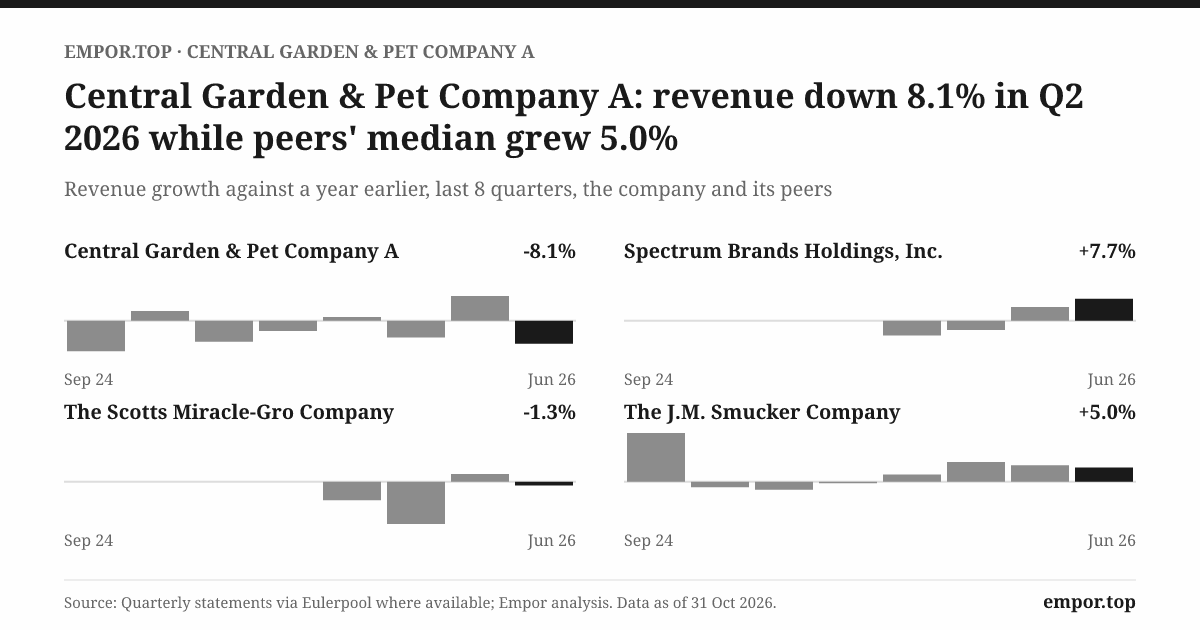
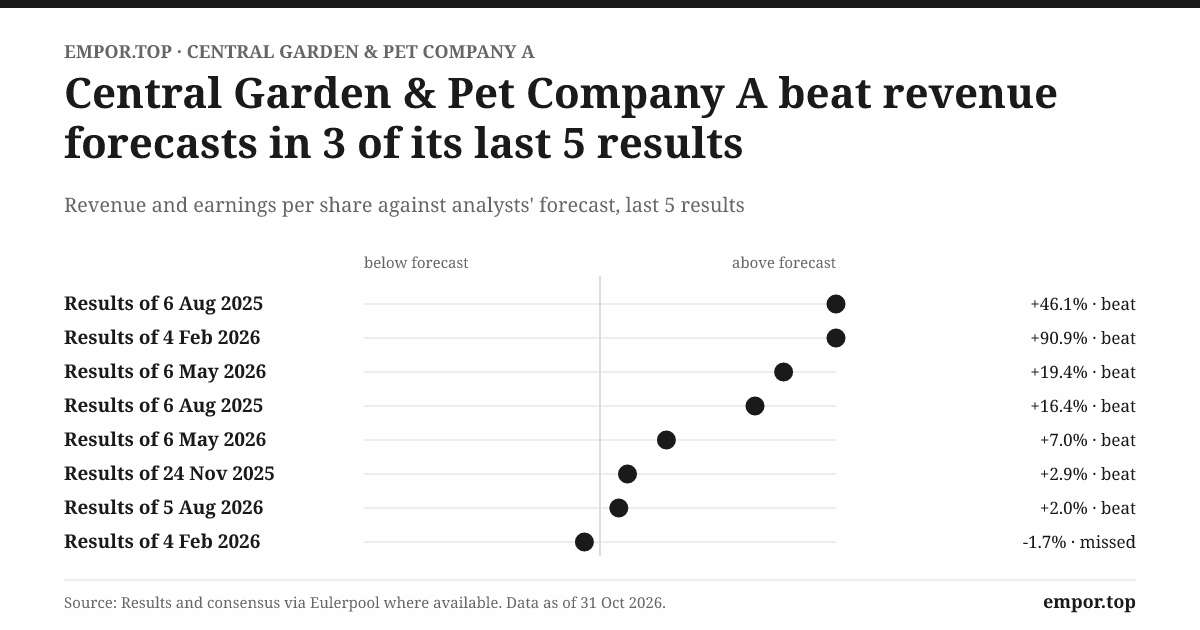
On August 5, 2026, Central Garden & Pet published a quarterly result that looked, at first glance, like bad news. Sales for the three months to late June had fallen about 8%, from roughly $961 million a year earlier to about $882 million.1 A company that sells dog chews, bird seed, aquarium gear and grass seed to the biggest retailers in America had just shrunk, in the season that matters most for its garden business.
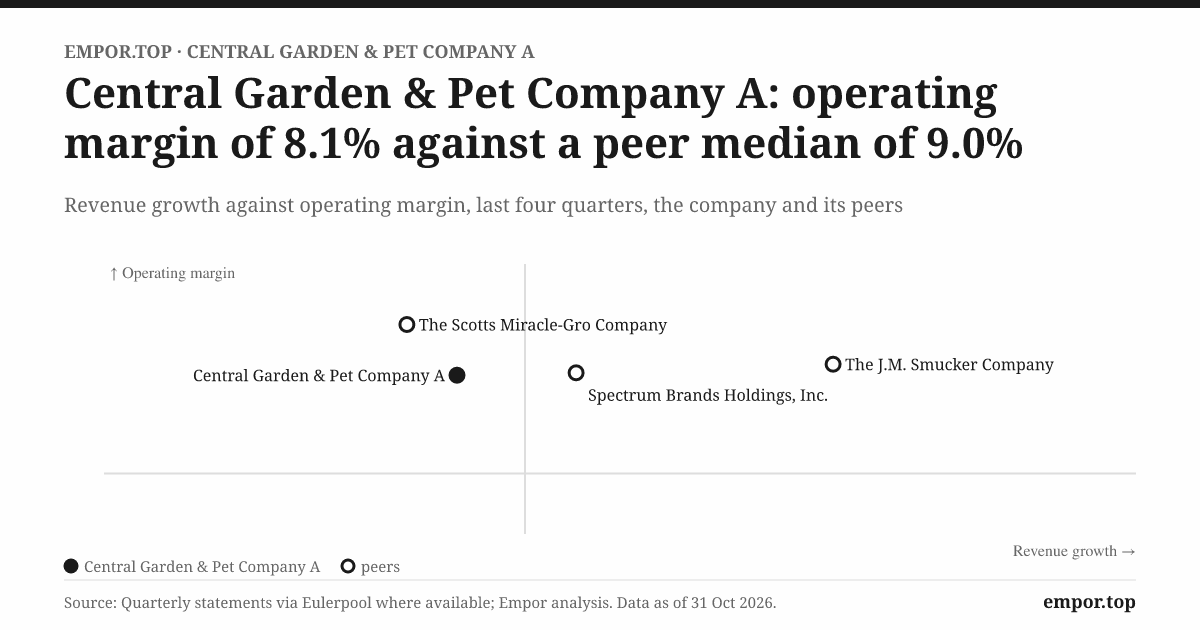
Then came the second line of the release. Strip out the business Central had just handed to someone else, and organic sales had risen about 2%, from roughly $842 million to $862 million.1 Operating margin, the share of each sales dollar left after running the business, had edged up from 14.1% to 14.3%.1 Gross margin had climbed even faster, to almost 36%.1 Smaller company. Better company. Or at least, a company with a better-looking income statement.
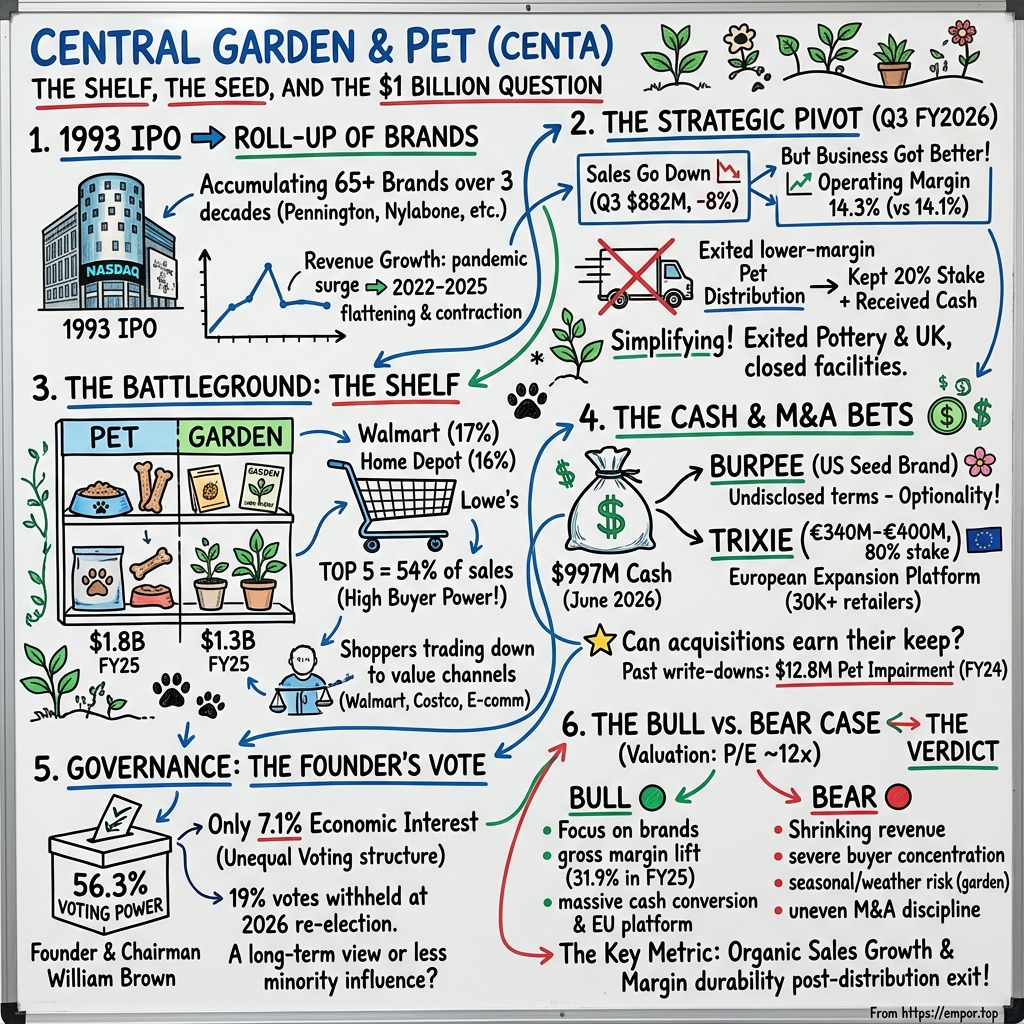
That tension is the whole story. Central was not shrinking because its customers had walked away. It was shrinking because it had chosen to stop doing something: running a pet distribution business that moved other manufacturers' products to independent pet stores. In the spring of 2026 it had folded that operation into a partnership with Phillips Pet Food & Supplies and kept a 20% stake.2 The headline sales decline was the sound of that door closing.
So the question investors face tonight is not whether Central got smaller. It did, on purpose. The question is what kind of business remains. A simpler portfolio of branded products with higher margins can be a stronger compounding engine. It can also be the same slow-growing business wearing a better outfit, with the margin gain coming from what was removed rather than from anything that grew.
Four questions hang over the company, and this story will keep returning to them. Can the continuing business actually grow, once the comparison with the old distribution operation rolls off? Are the margin gains durable, or are they the arithmetic of subtraction plus a cost program that eventually runs out of facilities to close? Can a company sitting on roughly $1 billion of cash buy businesses at prices that earn a decent return? And what does it mean for outside shareholders that the founder, now in his eighties, still controls a majority of the votes?
Start with what Central is today. It is a Delaware-incorporated, U.S.-centered maker and marketer of pet and garden products, organized into two segments, Pet and Garden.3 Its brands are the kind most shoppers have handled without ever noticing the parent company: Nylabone and Kaytee in the pet aisle, Pennington grass seed and Amdro insect control in the garden center, Aqueon in aquariums, Farnam in horse care, Ferry-Morse in seed packets.4 In fiscal 2025, which ended in late September of that year, it sold about $3.1 billion of products.3
About four of every five of those sales dollars came from products Central makes or brands itself. The rest, roughly 21%, came from products made by other manufacturers that Central distributed.3 That second slice is the part the company has been shrinking, most dramatically with the Phillips transaction. The perimeter of the company is moving while investors are trying to measure it.
And the perimeter is moving in both directions. In late July 2026, Central agreed to buy about 80% of TRIXIE, a German pet-supplies maker, for roughly €340 million in cash at closing plus up to €60 million more depending on 2026 performance.5 On September 30, 2026, it closed the purchase of W. Atlee Burpee, the 150-year-old American seed company, and announced the deal three weeks later without disclosing the price.6
Put those moves side by side and a pattern appears. Central is selling down the low-margin middleman role, closing plants, and then spending its cash on brands. That is a coherent strategy on paper. It is also exactly the strategy a company would describe if it needed a new growth story because the old one had stalled.
The cash pile makes the stakes concrete. At the end of June 2026, Central held about $997 million of cash against about $1.2 billion of debt, with its $600 million asset-based credit line undrawn.7 By early September its chief financial officer was telling a Barclays conference the cash balance was "over $1.1 billion."8 That is roughly half the market value of the company's shares. Whatever management does with that money will matter more to long-term owners than another quarter of margin expansion.
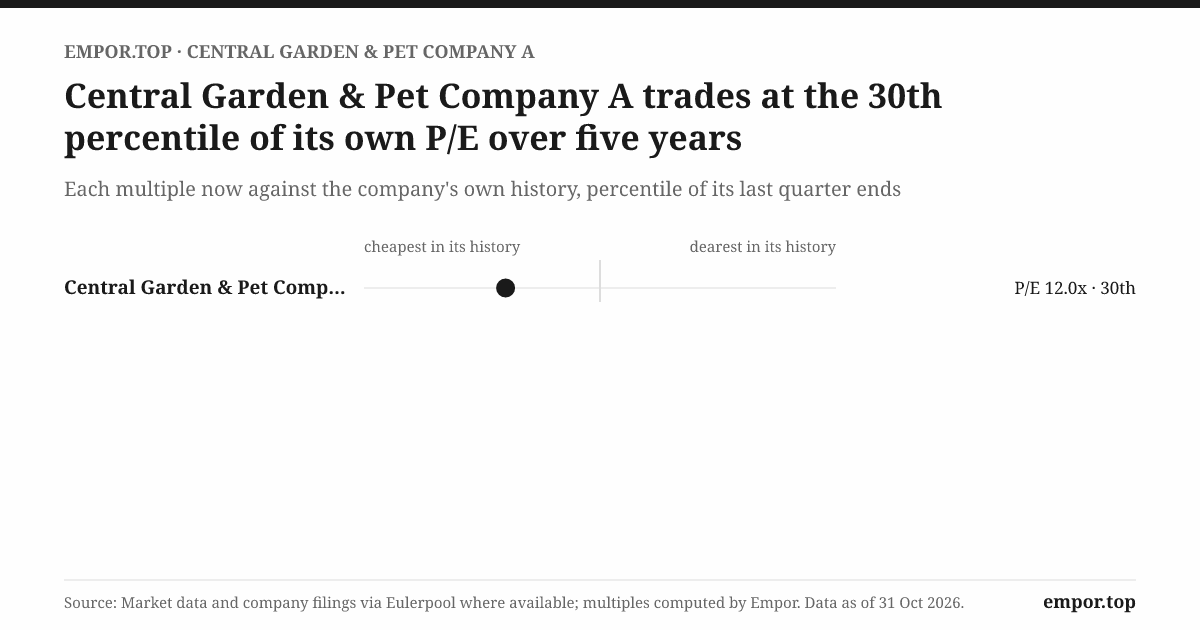
The market's current verdict is cautious. At the end of October 2026, the Class A shares traded at about 12 times trailing earnings, below their own five-year median of about 13.6 times, and at roughly 6.9 times enterprise value to EBITDA.7 That is the price of a business investors are not yet convinced will grow.
Which brings the story to its central question. Can Central turn a smaller, simpler business into durable growth, and will the next acquisitions earn their place? To answer that, it helps to understand how this collection of brands came together in the first place, because Central has been buying its way into categories for more than three decades, and the record of those purchases is the best evidence available about what the next ones might be worth.
 Subscribe on LinkedIn
II. A 1993 IPO Becomes a Portfolio of Brands
In 1980, Bill Brown founded Central Garden Supply.4 He was not a gardener by training. He was a finance and operations executive, with a decade at McCormick, five years at McKesson, and three years running finance, operations and research at Vivitar, the camera company, before he struck out on his own.9 That background shows in everything Central later became. This was never a company built around one beloved product. It was built around the logic of a portfolio.
Central Garden Supply merged into a newly incorporated Central Garden & Pet in 1992, and in 1993 the company went public on Nasdaq.4 The listing was modest. The initial offering sold about 2.03 million shares at $10 apiece, a roughly $20 million raise that would barely register beside the company's later acquisitions.10 The SEC's daily digest from late July 1993 recorded the registration among dozens of other filings that week.11 Nobody on Wall Street was treating it as a landmark.
But the listing opened a chapter. Public shares gave Central a currency and a cost of capital, and Brown used both. In 1997 the company bought Four Paws, TFH Publications, Nylabone and Kaytee, and formed Central Life Sciences around the Wellmark insect-control business.4 In 1998 it bought Pennington Seed.4 Within five years of its IPO, Central had turned itself from a garden-supply company into something closer to a holding company for everyday pet and garden brands.
The logic of that roll-up is worth stating plainly, because it still drives the company. Pet and garden aisles are full of small categories: bird seed, rawhide chews, flea collars, grass seed, ant bait, aquarium filters. Each one is too small to interest a giant like Procter & Gamble, and many are dominated by family-owned firms. A company that owns brands across dozens of these categories can offer a retailer one sales team, one logistics network, one negotiation. It can spread the cost of marketing, manufacturing and data across many products. And it can keep buying the next small leader.
The buying never really stopped. Farnam came in 2006, IMS dog chews and the Cadet brand in 2015, Bell Nursery in 2018, Arden Companies in 2019.4 In 2021 alone, Central bought Green Garden, Hopewell Nursery, DoMyOwn and D&D, and in 2023 it bought TDBBS, a dog-chew and treat business.4 Not every acquisition was large, but the cumulative effect was a company with brands in an unusual number of shopping aisles.
Did the strategy work? Over the decade that public records allow a clean comparison, the answer is a qualified yes. From fiscal 2015 to fiscal 2025, revenue grew about 6.6% a year, roughly doubling from about $1.6 billion to about $3.1 billion.3 Operating profit grew faster, from roughly $91 million to $265 million, as margins rose.3 Over the same stretch, the cash on the balance sheet went from almost nothing to the hoard that now defines the strategic debate.
The qualification is in the timing. Break that decade into pieces and the growth story starts to look like a story about one extraordinary period. From fiscal 2020 to fiscal 2025, revenue grew only about 3% a year. From fiscal 2022 to fiscal 2025, it shrank about 2% a year.3 The trend line did not bend upward as Central got bigger. It bent down.
The reason is a phenomenon every pet and garden company knows well. When the pandemic sent people home in 2020, Americans adopted pets, planted vegetable gardens, fixed up their lawns and filled bird feeders. Central's sales rose about 13% in fiscal 2020 and almost 23% in fiscal 2021, helped by the wave of 2021 acquisitions.3 It was the best demand environment the company had ever seen.
And then it ended. Sales were roughly flat in fiscal 2022, slipped slightly in 2023, and fell about 3% in 2024 and 2% in 2025.3 New pet adoptions slowed, households that had bought aquariums and hamster cages did not buy second ones, and inflation pushed consumers toward cheaper options. The company that had grown by buying categories now had to prove that its categories could grow on their own.
One small accounting entry captures the stakes. In fiscal 2024, Central recorded a $12.8 million impairment on intangible assets in its Pet segment, tied to weaker demand for durable pet products and to international competition.12 Intangible assets are the accounting value assigned to brands and customer relationships when a company buys another business. An impairment is the company admitting that some of what it paid for is worth less than it thought.
Twelve point eight million dollars is not a large number for a company with $3 billion of sales. But the reason behind it matters. Durable pet products, the cages, tanks, bowls and toys that a household buys once and keeps, are exactly the kind of category where a brand offers the least protection. When demand softens, retailers turn to cheaper imports and private labels, and owning the brand does not stop the slide. Buying a brand, in other words, does not guarantee the position the brand held when it was bought.
That is the right lens for everything that follows. The public record shows a company that built scale through acquisition, rode an exceptional demand wave, and then watched growth disappear when the wave receded. It does not show that the acquisition engine, on its own, produces durable growth. That remains to be proven. And the place where it will be proven or disproven is not in the boardroom or the deal room. It is on a retailer's shelf.
III. The Walmart Shelf Is the Real Battleground
Picture a Walmart supercenter on a Saturday morning in April. In the pet aisle, a shopper weighs a bag of bully sticks against the store's own brand. Two aisles over, in the garden center, another shopper reaches for a bag of grass seed, a box of ant bait and a sack of wild bird food. Several of those products may come from the same company, though almost nobody in the store would know it. What they all have in common is that Walmart decided they deserved the space.
That decision is where Central's business really lives. Walmart was Central's largest customer in fiscal 2025, accounting for about 17% of total sales. Home Depot was second, at about 16%.3 Together with Costco, Lowe's and Amazon, Central's five biggest customers produced about 54% of its sales.3 More than half of the company's revenue, in other words, depends on the purchasing decisions of five buyers.
To see what those buyers are choosing among, walk the shelf through the two segments. Pet is the bigger one. In fiscal 2025 it produced about $1.8 billion of sales and about $216 million of segment operating profit.3 It spans consumables that households buy again and again, such as dog chews, bird and small-animal food, and flea and tick treatments, and durables that households buy rarely, such as aquariums and cages. It also includes animal health and equine products, and the live aquarium fish business through Segrest, which Central describes as the largest supplier of aquarium fish in the United States.3
Garden is smaller but far from minor. It produced about $1.3 billion of sales and about $142 million of segment operating profit in fiscal 2025.3 Its shelf includes grass seed, fertilizer, insect and weed controls, wild bird food, packet seeds, and live plants grown in Central's own nurseries. That last category is a reminder that Central is not just a brand owner. It runs greenhouses, mixes fertilizer, packages seed and ships perishable plants into stores on tight seasonal schedules.
The two segments make money in different ways, and the difference matters for anyone trying to value the whole. Pet earns about 12 cents of operating profit on every sales dollar; Garden earned under 11 cents in fiscal 2025, and that was a good year after a weak one.3 Pet is the core value driver because it is bigger, steadier and dominated by repeat purchases. Garden is a substantial second profit pool, but its results move with the weather, with the timing of spring, and with how much inventory retailers decide to hold.
Garden's earnings swing shows how much. Its operating profit rose about 74% in fiscal 2025, to about $142 million.3 A business that can grow profit by three-quarters in one year can also give much of that back when spring is cold and wet. The seasonal pattern is visible in the quarterly numbers too: Central routinely reports operating losses or near-zero profit in its September quarter, when the garden season ends, and most of its annual profit in the March and June quarters.7
Garden is also where retailer concentration is most visible. In fiscal 2025, Home Depot accounted for about 37% of Garden segment sales, Walmart about 29% and Lowe's about 14%.3 Four of every five dollars of Garden sales, roughly, ran through three retailers. A shift in how one of those chains merchandises its spring garden center, or a decision to give more space to its own label, moves Central's Garden numbers directly.
Who is Central fighting for that space? There is no single competitor and no single market share, because Central competes category by category. In pet, it runs into Mars, the private giant behind a vast portfolio of pet food and care brands, J.M. Smucker in pet snacks, and Spectrum Brands in aquatics and companion animal products.3 In garden, its most visible rival is Scotts Miracle-Gro, along with Spectrum's home and garden brands and S.C. Johnson in insect control.3 Behind all of them sits the competitor that never appears in a list of companies: the retailer's own private label.
Scale gives some perspective. Scotts Miracle-Gro's fiscal 2025 sales were somewhat larger than Central's total, but almost entirely in lawn and garden, where it is the dominant branded player.13 Central's $3.1 billion is spread across many more categories. So in any single garden category, Central may be smaller than Scotts, while across the store it may be a more important supplier to a retailer's pet and garden departments combined. These are overlapping competitors, not like-for-like peers, and any claim about Central's "share" needs to name the category.
So what actually wins the shelf? The honest answer, from Central's own disclosures, is a combination of things that matter but do not lock anything in. Brand recognition matters, because a shopper buying grass seed for a lawn that cost thousands of dollars to install will often pay up for a name. Product range matters, because a retailer would rather manage fewer suppliers. Sales relationships and logistics matter, because a garden center that runs out of fertilizer in a sunny April weekend loses sales it will never recover.
Here is where the moat claim needs testing, once and carefully. A durable competitive advantage would show up as switching costs, as evidence that retailers keep giving Central space even when cheaper options appear, and as an ability to raise prices without losing volume. Central's filings do not provide a customer-retention series, a category-share series, or a disclosure of price realization over time.3 Most of its customer arrangements, including incentives, run for a year or less.3 There are no long-term contracts that guarantee a retailer will keep buying.
And the forces working against a moat are concrete. Retailers multi-source, which means they can and do buy similar products from several suppliers. Private label is growing in some categories; management itself said in August 2026 that "eCommerce and, in certain categories, private label remain important areas of growth."14 E-commerce lets small brands reach shoppers without winning a physical shelf at all. The impairment on durable pet products showed what happens when those forces bite.
The live consumer data reinforce the point. On the August 2026 call, Chief Executive Niko Lahanas described consumers who "continue to seek value and performance," and acknowledged "some trade-down going on," while arguing that the real task was "finding that value equation that resonates with the consumer."14 His examples were products like Rebel grass seed and Bully Hide chews, designed to deliver performance at a lower price point.14 John Hanson, who runs Pet, said Central's branded products outperformed private label in the quarter, but also that super-premium products saw more trade-down.14
Those are useful signals of execution. A company that can design a cheaper product its retailer wants to stock is doing something right. But they are not proof that Central is gaining share across its portfolio. They are management's chosen examples, and the filings provide no category-level share data to check them against. The safer reading is that Central is responding competently to a value-seeking consumer, not that the consumer has proven loyal to Central's brands.
The channel picture adds another layer. Chief Financial Officer Brad Smith described a shift toward club stores and Walmart, naming Costco, and Hanson said pet e-commerce sales rose about 10% in the quarter, while garden e-commerce rose more than 40%.14 At the Barclays conference a month later, Smith said the strongest channels were club, particularly Costco and Walmart, and e-commerce through Amazon, Chewy and Walmart, while independent pet specialty and independent garden stores were "under pressure."8
That shift matters because it concentrates power further. The channels growing fastest are the ones with the most bargaining leverage, and the channel shrinking fastest, independent pet stores, is the one Central's old distribution business served. The consumer's move to value and to giant retailers is not a neutral backdrop. It pushes Central toward its most powerful customers.
The supply side looks very different. Central's five largest suppliers accounted for only about 6% of its cost of goods sold in fiscal 2025.3 No single grain merchant, packaging firm or chemical supplier can hold the company hostage. That is a genuine advantage: Central can shop for inputs, switch vendors and absorb a supplier's problem without disrupting the shelf.
So the asymmetry is stark. On one side of Central sits a fragmented base of suppliers that have little power over it. On the other sit five retailers that buy more than half its output, and the largest of them alone takes about a sixth. A buyer's shelf reset, an annual decision about which products get space next spring, can move the whole company's numbers. Central's breadth of brands is real. So is the leverage of the stores that sell them.
The receivables tell the same story in money. At the end of fiscal 2025, Central's largest customer accounted for about 19% of receivables and its five largest for about 56%.3 There is no sign in the filings of a major customer loss, bankruptcy or unusual credit terms.3 But the exposure is a structural fact of the business model, and it frames everything management does to improve margins. Which is where the story turns next, because the margin recovery of the past two years came not from winning more shelf, but from changing what sits behind it.
IV. The Margin Turn Came with Closures and Exits
Fiscal 2025 produced a result that looked contradictory. Sales fell about 2%, to roughly $3.1 billion.3 Yet operating profit jumped from about $185 million to about $265 million, and operating margin rose from 5.8% to 8.5%.3 A business that sold less made much more. Somewhere between the shelf and the income statement, something important had changed.
The best place to see it is the gross margin, the share of sales left after paying to make and ship the products. It rose from about 28.6% in fiscal 2023 to about 31.9% in fiscal 2025.3 Gross profit rose by about $54 million in fiscal 2025 even as sales fell, and selling, general and administrative costs fell by about $11 million.3 Put simply, Central was keeping more of each sales dollar at the factory and spending less to run the company.
To understand why, go back to the downturn. After the pandemic boom, Central was left with a supply chain built for a world that no longer existed. Inventory ballooned: inventory days, a measure of how long goods sit before they sell, rose from about 107 in fiscal 2021 to about 146 in fiscal 2022.3 Operating cash flow turned negative in fiscal 2022 as cash poured into stock.3 Operating profit then fell in fiscal 2023 and again in fiscal 2024, while the margin slid from about 7.8% to 5.8%.3
The company's leadership was also in flux. Mary Beth Springer, a director, served as interim chief executive from October 2023 until September 2024.9 A year without a permanent CEO, in the middle of a downturn, is not a detail. It is the backdrop against which the restructuring began.
What followed was a long list of closures and exits. Central closed facilities, consolidated its distribution network, exited its pottery business, wound down operations in the United Kingdom, and pulled out of distributing some product lines in Garden.3 Under an internal banner management called "Cost and Simplicity," the company pursued lower-cost operations across its network.3 On the August 2026 call, management said that since 2022 Central had closed 13 facilities and opened two, moving to what it calls the Central Logistics Network, a unified national system with four main nodes.14
Think of it like a delivery company that used to run a dozen regional depots, each with its own trucks, staff and inventory, and replaced them with four large hubs. Fewer buildings means less rent, fewer duplicated managers and less inventory sitting in multiple places. It also means each hub has to work. Management said the program was about 95% complete and that every project had come in under budget, though it has not quantified the savings publicly.148
That absence of a number matters. Investors are being asked to believe the margin improvement is durable partly because of a cost program whose savings management declines to measure in public. Smith told the Barclays audience that "we have definitely seen cost savings" from the work, but "we do not quantify it publicly."8 The gross-margin climb is evidence that something worked. The size of the cost program's contribution, as opposed to mix and exits, is not disclosed.
This is where the accounting adjustments deserve a careful look, because they can make a turnaround look cleaner than it was. In fiscal 2024, Central recorded about $20.3 million of closure and exit costs in Garden, about $7.5 million of facility closure costs in Pet, the $12.8 million Pet intangible impairment, and a $7.5 million impairment of investments in private companies.12 Add those together and they come to roughly $48 million, about a quarter of that year's reported operating profit.
Management, like most companies, presents "adjusted" results that exclude such items, on the logic that they are one-time costs that do not reflect ongoing performance. That logic is reasonable once. It becomes harder to accept when the one-time costs keep arriving. In the June 2026 quarter, Central recorded another $13.8 million of facility closure and exit charges, about $13 million of it in Pet.1 The company's adjusted operating margin for that quarter was 15.4%, more than a percentage point above the reported 14.3%.1
A turnaround that repeatedly depends on excluding restructuring charges deserves scrutiny, not because the charges are fake, but because closing plants is part of how this company is choosing to compete. If closures are the strategy, their costs are part of the business. Investors comparing adjusted and reported figures should treat the gap as the price of the restructuring, and ask when it will stop.
The quarter's adjusted results also carried other moving parts. Central booked about $3.6 million of tariff refund income in Pet and a $2.5 million gain on a divestiture.1 Neither is large, but both flatter a comparison that management already describes as distorted by the distribution exit.
So how much of the recent margin gain is genuine productivity? Management gave a surprisingly direct answer. At the Barclays conference in September 2026, Smith said: "Most of the operating margin gain in Q3 was definitely related to the distribution exit."8 On the August call, he attributed Pet's margin rise "primarily" to the exit, partly offset by higher materials and freight costs.14 Pet's adjusted operating profit actually fell about 2% in the quarter, even as its adjusted margin rose from about 15.8% to 19.0%.1
That one detail is the reveal. Pet made fewer dollars of adjusted operating profit than a year earlier. Its margin rose because the denominator shrank: Central removed a large block of low-margin sales. The margin went up because of what left, not because what stayed got dramatically more profitable.
There are genuine signs of underlying improvement too. Garden's adjusted operating profit rose about 7% in the June quarter, on sales up about 3%, driven by wild bird, fertilizer and controls, and grass seed.1 Smith told analysts that every business in Garden and Pet was up or at least flat versus the prior year, except the vendor-partner business and Dog and Cat.14 The fiscal 2026 earnings outlook was raised to $2.85 or better of adjusted earnings per share, from $2.70 or better.1
Mix can also be a durable tailwind. If Central's continuing portfolio leans toward higher-margin consumables, such as treats, chews and controls, rather than low-margin distributed goods and durables, its margin can stay higher even without further cost cuts. The quarterly data support that possibility, while also showing how much of the improvement came from removing one business.
The verdict on this chapter is therefore narrower than the headline. The margin recovery is real: gross margin has risen for two straight years and the network is leaner. But a material share of the most recent improvement came from portfolio mix and business exits, and the repeated closure charges and impairments narrow any claim that Central is now a fully repaired, steadily growing business. A cleaner network is a better platform. It is not yet proof of a better growth engine.
The next proof point is simple to state and slow to arrive. Investors need several quarters of continuing-business organic sales growth and segment margins after the distribution comparison has rolled off. Only then will the numbers show what this company earns when nothing has just been removed. And the biggest thing removed, the distribution business itself, deserves its own examination, because Central did not just close it. It traded it.
V. Central Handed Off the Trucks and Kept a 20% Stake
Shortly after the March 2026 quarter closed, Central announced that it had entered a strategic partnership with Phillips Pet Food & Supplies to create a new pet distribution business.2 Central would contribute its own pet distribution operations and keep a 20% stake. Phillips and its existing investors would hold the other 80%, and the combined business would operate as an independent company under the Phillips name.2
For a company built on accumulating things, this was an unusual move. Central was giving up control of a business it had run for decades, one that had once been central to its identity. The company that began as Central Garden Supply, a supplier to stores, was handing the trucks to someone else.
Why would it do that? Because distribution and branded products are different businesses wearing the same logo. A distributor buys products from many manufacturers, stores them in warehouses, and delivers them to stores, usually independent pet shops that are too small to buy directly from every brand. It earns a thin markup on enormous volume. It needs warehouses, trucks, drivers and large amounts of working capital, the cash tied up in inventory and in bills customers have not yet paid.
A branded-products company works the other way. It earns a larger margin on each item because it owns the brand and the product design. Its working capital needs are lighter per dollar of profit. When Central ran both, the distribution business swelled its sales line while diluting its margin and adding complexity, and it tied Central's fortunes to the independent pet-specialty channel that management now describes as under pressure.8
The size of the trade is visible in the June 2026 quarter. Pet segment sales fell about 19%, to about $401 million.1 Strip out the transferred business and organic Pet sales rose about 2%.1 At the Barclays conference, Smith said the exit would take Pet revenue down roughly 20%, or about 10% for the total company, while producing "structurally meaningfully higher operating margin" and having "very little impact on operating income dollars."8
That last phrase is the heart of the decision. Central removed roughly a tenth of its revenue and, by management's account, almost none of its operating profit. If that is right, the business it gave away was close to a break-even pass-through: lots of revenue, lots of work, little reward. In May, Lahanas said the company expected "a minimal impact on earnings per share."2
What did Central receive in return? It kept 20% of a larger distribution business, which now combines its old operations with those of Phillips. It shed the inventory, warehouses and staff that came with running distribution directly. Central's announcement did not put a value on the transfer or disclose the venture's revenue, profit or governance arrangements.2 The company also has not said whether the venture pays distributions to its owners or what rights Central has to sell its stake.
That is the gap in the story. The retained stake is described in the company's own disclosures as a minority interest in an independent entity. There is no public evidence yet that it produces meaningful income, or that it is a growth engine. Until the company discloses how the venture performs and what its stake earns, the 20% interest is best treated as a residual asset of uncertain value, not as a source of future profit.
Give management's rationale a fair test. The case for the exit is that Central becomes a simpler company, focused on brands, with higher margins and less working capital. The evidence so far supports that case on margins: Pet's adjusted margin rose sharply in the June quarter.1 It also simplified the company's message to investors, who no longer have to untangle a pass-through business from the brands.
The case against is subtler. Central's branded products still need to reach the independent pet shops the distribution business served. Those products will now reach many of those stores through Phillips, a partner Central partly owns but does not control. Central has traded a channel it ran for a channel it relies on. If the new venture struggles, or prioritizes other suppliers' brands, Central's own products in that channel could suffer. And the independent channel itself is shrinking, which is part of why the exit made sense.
There is also the matter of the easy comparison. For the next several quarters, Central's reported sales will look weak against prior periods that included distribution, and its margins will look strong for the same reason. That works in management's favor on margins and against it on revenue, and both effects are mechanical. The organic Pet figure, which excludes the transferred business, is the one that matters, and a 2% organic gain in a single quarter is a start, not a trend.
What would confirm the decision? Three things. First, the venture's disclosed performance: whether Central eventually reports income from its stake, and whether the stake holds its value. Second, the behavior of Central's own branded Pet sales through independent stores after the transition. Third, and most important, whether organic Pet growth continues after the transferred business drops out of the comparison entirely, which will happen during fiscal 2027.
Taken together, the exit fits the strategy and seems to have cost little in operating profit, which is the most important thing it had to prove. What it does not prove is that the remaining business will grow. It removed a drag. It did not add an engine. And that is why the more consequential decision of 2026 was not what Central gave away, but what it chose to buy with the money it had been piling up.
VI. The Cash Became a Test of What to Buy Next
On July 27, 2026, Central announced the largest strategic move of the new management team's tenure. It had signed an agreement to acquire roughly 80% of TRIXIE Heimtierbedarf, a German pet-supplies company, along with related entities.5 The price was about €340 million in cash at closing, plus an earn-out of up to €60 million based on TRIXIE's 2026 performance, for total consideration of up to €400 million.5
TRIXIE is not a household name in America. In Europe it is a fixture of pet-shop shelves. It was founded in 1974 by Bonnik Hansen and is based in Tarp, a small town in Schleswig-Holstein near the Danish border.15 It employs close to 600 people, sells more than 6,000 products for dogs, cats, birds, reptiles and small animals, and introduces around 500 new products a year from an in-house design team.15 It serves more than 30,000 pet retail stores internationally, and about 90% of its sales come from its own brands.15
The structure of the deal tells you how the sellers think about the future. Hansen and other shareholders sold most of the company, but continuing shareholders kept roughly 20%.5 Over at least three years, those continuing shareholders will have the right to require Central to buy their shares; if they do not exercise that right after three years, Central will have the right to buy them.5 Two TRIXIE executives, Dirk Jessen and Volker Haak, remained as minority shareholders, and members of the existing management team stayed on.15
That put-and-call arrangement is common in deals with founder-led companies, and it has a logic. It keeps the sellers invested in TRIXIE's performance after the sale. But it also means Central has not agreed to pay for 100% of TRIXIE. It has agreed to pay up to €400 million for 80%, with a future obligation to buy the rest at a price determined later. At the Barclays conference, Smith said plainly: "We do not know if and when we are going to acquire the additional 20%."8
To understand why management wanted TRIXIE, start with the people making the bet. Niko Lahanas became chief executive in September 2024, after a long climb inside Central.9 He joined in 2006 as a finance manager in the Garden segment, rose through business-performance and planning roles, served as chief financial officer of the Pet segment, and then as the company's CFO from May 2017 until he became CEO.9 Before Central, he had worked in private equity and investment banking.9 He is, in other words, a finance executive who knows both segments from the inside, and who understands deals.
His CFO, Brad Smith, took the job at the same time.9 Smith joined Central in 2017 as CFO of the Pet segment, after 12 years at Delhaize Group, including as CFO of its European operations, and 11 years at Arthur Andersen.3 That European experience is not incidental to the TRIXIE deal. Smith has become the public voice of Central's capital-allocation strategy, and he has not been shy about it.
On the August call, Smith called TRIXIE "the most exciting opportunity in pet supplies I've seen during my nine years at Central," and said the deal gave access to more than 100 million pet-owning households across Europe.14 At Barclays, he described TRIXIE as "the largest European pet supplies and snacks company, by far," and said cat products, a category Central wants more of, made up about 20% to 25% of its business.8 TRIXIE estimated the European pet supplies and snacks market at roughly €10 billion of annual sales.15
The fit, as management describes it, has three parts. TRIXIE is mostly own-brand, so it looks like the kind of branded business Central wants more of, not like the distribution business it just shed. It gives Central a meaningful presence outside the United States; management said about 10% of combined net sales would come from outside the U.S.15 And it offers a possible platform in a fragmented European specialty market, where Central could later bolt on further businesses. Smith said the most meaningful synergies would be commercial, selling Central products into Europe and some TRIXIE products into the U.S., with supply-chain automation second.8 He also said he would not expect synergies in the first year.14
Now the uncomfortable part. Central has not disclosed TRIXIE's revenue, its EBITDA, its net debt or the full valuation basis of the deal.5 Without those numbers, there is no way to know whether €400 million for 80% is a cheap price, a fair price or an expensive one. Investors are being asked to evaluate the most important capital-allocation decision in years without the denominator.
The industry context offers a range, not an answer. One investment bank's review of pet-industry deals found that transactions involving pet products companies averaged about 8.8 times EBITDA.16 Smith said at Barclays that European multiples were "slightly lower than what we're seeing in the U.S."8 If TRIXIE was bought near those levels, it would be in line with the market. But that is a conditional sentence, and no one outside the deal can complete it. The benchmark tells you what similar businesses fetched. It cannot tell you what TRIXIE earns.
The deal was still pending at the end of October 2026. Central expects it to close in the first half of fiscal 2027, subject to regulatory approval and other customary conditions.5 So the company has made a commitment but has not yet taken ownership.
Then, three weeks after the TRIXIE announcement became old news, Central disclosed a second deal. On October 19, 2026, it announced that it had acquired W. Atlee Burpee Company, in a transaction that had closed on September 30.6 Burpee was founded in 1876 and describes itself as the premier brand in packet seeds and young plants.6 It sells through mass merchants, grocery and club stores, e-commerce and catalog, home improvement and farm stores, and it will operate as a separate entity under its chief executive, Jamie Mattikow.6 George Ball, its former owner and executive chair, said his goal had been "to find it a home that would be a strong steward of that legacy."6
Burpee fits Garden in an obvious way. Central already owns Ferry-Morse and other seed brands, and adding America's best-known seed catalog name strengthens its position in a category where consumers, especially home vegetable gardeners, recognize brands. Burpee's catalog and online heritage could also strengthen Garden's digital sales, which were growing fast.14
But Central did not disclose what it paid for Burpee, nor how much revenue or profit it adds.6 The company said it would provide more details on its fiscal fourth-quarter call.6 Until then, Burpee is optionality: a recognized brand that could strengthen Garden, not yet a material growth engine. It is impossible to say whether the price was disciplined, because the price is not public.
This is where history has to sit beside the new thesis. Central has made dozens of acquisitions over three decades, and not all of them held their value. In fiscal 2016, Central recorded a $16.6 million impairment on two joint-venture investments.17 In fiscal 2024 came the $12.8 million impairment on Pet intangibles and the $7.5 million impairment on private-company investments.12 Those charges are small relative to the company, but they are evidence that some past deployments of capital did not earn what was expected. The roll-up has produced scale; it has not produced a perfect record.
The longer cash record offers its own lesson. Over fiscal 2014 to fiscal 2025, Central generated about $2.4 billion of operating cash flow, against about $1.2 billion of reported net profit.3 Depreciation, amortization of acquired intangibles and stock compensation explain much of that gap, along with swings in working capital. Free cash flow, after capital spending, totaled about $1.8 billion.3 That is a business that turns profit into cash reliably, and that has funded its acquisitions largely from its own operations.
Where did that cash go? Not to dividends. Central has never paid a cash dividend on its common stock or its Class A shares and has said it does not intend to.3 Instead, cash went to acquisitions, to share buybacks and to the balance sheet. Cash and short-term investments rose from about $33 million at the end of fiscal 2013 to about $882 million at the end of fiscal 2025.3
Buybacks have been the other lever. Central spent about $148 million repurchasing shares in fiscal 2025, and about $22.7 million in the first nine months of fiscal 2026, with about $128 million left under its authorization at June 2026.7 The slowdown in buybacks during fiscal 2026 coincided with the build-up to TRIXIE, which suggests management was conserving cash for deals.
That priority is explicit. At Barclays, Smith said M&A was "clearly the biggest gap in priority we have," and that "we are aggressively on the hunt for deals."8 He said the company preferred "high margin, fast-moving consumable businesses, brands with a clear right to win," and preferred larger deals, naming cat, pet supplements and insect control as white spaces.8 That is a candid statement of intent, and it raises the stakes on discipline. A management team that says it is aggressively hunting for deals is a management team that will be tempted to pay up.
How is that team paid? Lahanas's reported compensation for fiscal 2025 was about $1.9 million before the later bonus determination.9 His target annual bonus equals 100% of his base salary, and he is eligible for a target annual equity grant of $1 million.9 His subsequently disclosed fiscal 2025 incentive bonus was about $1.13 million, and Smith's was about $350,000.9 The proxy says performance is measured using net sales, organic sales, non-GAAP gross margin, EBIT and strategic goals.9
Those incentives reward growth and margins, which is reasonable. They do not explicitly reward return on acquired capital, which is the metric that will decide whether TRIXIE and Burpee create value. A bonus that pays for higher net sales and EBIT can be earned by buying revenue and profit, regardless of the price paid. That is not evidence of bad intent. It is a reason for shareholders to watch acquired returns themselves.
Financing is the last piece. Smith said at Barclays that Central was "very comfortable using existing cash on hand to pay for the transaction," and expected to stay below 1.5 times net leverage, and below 3 times gross leverage, even after the payment.8 Net leverage, debt minus cash divided by a year's EBITDA, was about 0.5 times at the end of June 2026.1 Central's debt consists of $300 million of 5.125% notes due 2028, $500 million of 4.125% notes due 2030 and $400 million of 4.125% notes due 2031.7 The rating agencies rate it in the double-B range, below investment grade but stable.18
So the balance sheet can absorb TRIXIE comfortably. The question is what happens next. Smith also said that if a significant deal came along, Central "would be willing to lever up more than we are right now and then take it down relatively quickly."8 The eventual close of TRIXIE, the earn-out, the future purchase of the remaining 20% and Burpee's price will determine the actual post-deal balance sheet. And whoever decides how much more to spend, and at what price, answers in the end to one person.
VII. The Founder Still Has the Deciding Vote
William Brown is 84 years old. He has been a director of the company since 1980, served as its chief executive for most of the period from 1980 to 2013, and has been chairman again since 2019.9 He owns about 7.1% of Central's economic interest. He controls about 56.3% of the votes.9
That gap is the product of Central's share structure. The company has three classes of stock: ordinary common shares, Class A common shares with limited voting rights, and Class B shares held by Brown that carry outsized voting power.9 The Class A shares, which trade under the CENTA ticker, carry only limited voting rights, so the company can issue them for acquisitions and compensation without diluting the founder's control. Economic ownership and voting power, in other words, are not the same thing at Central. Owning 14.5% of the economic interest, as BlackRock does, buys about 7.9% of the vote.9
Brown's voting power has actually crept up. It rose from about 55.5% in the prior proxy to about 56.3% in the most recent one, without a material change in his Class B holdings.9 That is a side effect of buybacks: as Central repurchases shares from other holders, Brown's share of the remaining votes grows. Buybacks that shrink the share count also, quietly, entrench control.
Shareholders have noticed. At the 2026 annual meeting, about 3.18 million votes were withheld from Brown's reelection as a director, roughly 19% of votes cast on that item.19 For a founder who controls the majority of votes himself, that means a substantial share of the independent votes went against him. Say-on-pay opposition, by contrast, was small.19 Outside shareholders appear comfortable with how management is paid, and less comfortable with the governance structure itself.
The board is majority independent, which is a real safeguard.9 Independent directors set pay, review related-party dealings and oversee the audit. The disclosed related-party transactions are tiny: about $1.3 million of purchases from a company owned by an executive's son-in-law, and a few hundred thousand dollars of reimbursed royalties in a joint venture, together a sliver of a percent of sales.3 There is no sign of the kind of self-dealing that super-voting structures sometimes enable.
But independence of the board is not the same as accountability to minority holders. A board that can be replaced only with the founder's consent is a board that answers, in the end, to the founder. Proxy fights, shareholder proposals and activist campaigns, the tools outside investors use to challenge management at most companies, have little practical force when one holder controls a majority of the vote.
Is that bad? It depends on the founder and the plan. Founder control can let a company take a long view, ignore quarterly noise and make bold decisions without fear of activists. Brown has been involved with Central for more than four decades and has seen it through multiple cycles. His continued control is a durable feature, not a passing market position.
The current management team operates inside that structure. Lahanas, a Central lifer, has led the company for a little over two years. The record of that period shows real margin improvement, a successful network consolidation and a cleaner portfolio. It does not yet show sustained organic growth or returns on acquisitions, because the acquisitions have not closed or have only just closed.
Picture the questions a skeptical shareholder would put to the board. What return has Central earned on the businesses it has bought over the past decade, and how does management plan to measure TRIXIE's? Why have buybacks, which raise the founder's voting share, been prioritized over other uses at some points and slowed at others? What does Central expect to earn from its 20% stake in the Phillips venture, and when will it disclose that? And how will the company decide the price of the remaining 20% of TRIXIE?
Those are reasonable questions, and there is no sign of an activist asking them. But the more important point is what happens if the answers are unsatisfying. At most companies, a shareholder who disagrees with capital allocation can vote against directors, and if enough agree, change the board. At Central, the 19% of votes withheld from Brown's reelection is about as loud as that disagreement can get. That governance bargain matters more now, because the company is about to spend a substantial portion of its cash on international acquisitions, and outside shareholders will have limited power to influence what comes next. Whether the market is pricing that bargain correctly is the question the valuation has to answer.
VIII. Analysis & Bear vs. Bull Case
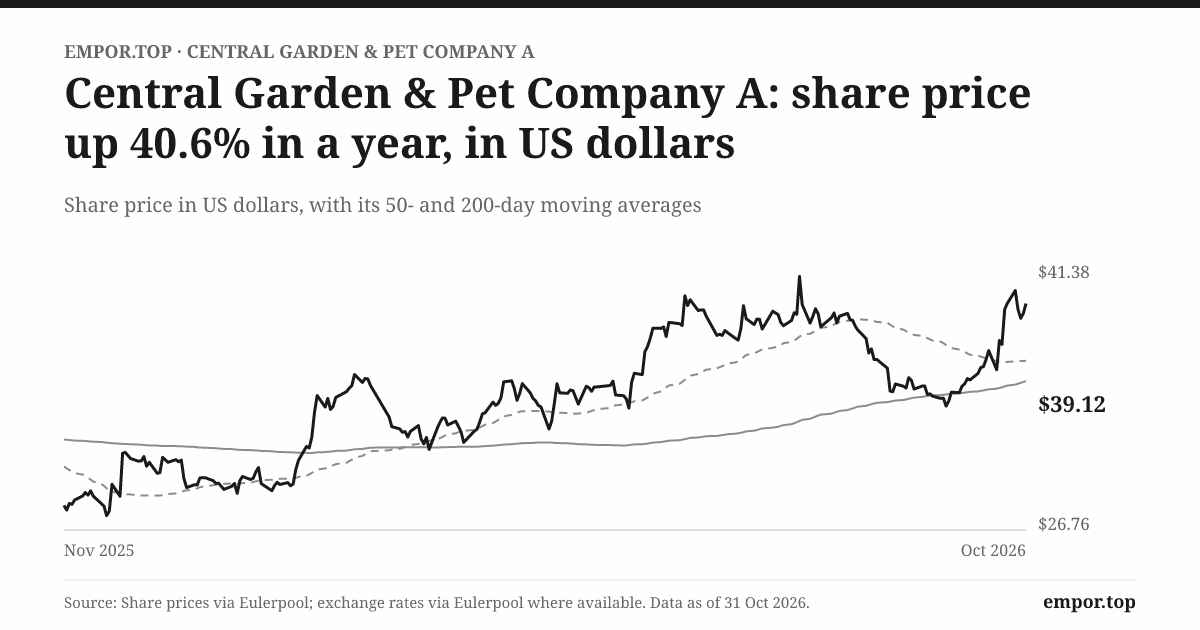
At the end of October 2026, Central's Class A shares closed at about $39.12, just below a 52-week high of $40.60 and well above the 52-week low of $27.55.7 The stock had risen nearly half from its low in a year, as margins expanded and the company raised its earnings outlook. Yet the company's reported sales remained below their fiscal 2022 peak.3 The market was rewarding a better business while still pricing it like a mature one.
The numbers say so. At about 12 times trailing earnings, Central trades below its own five-year median of roughly 13.6 times.7 Its enterprise value, the market value of its shares plus debt minus cash, is about 6.9 times EBITDA.7 Its free-cash-flow yield, the cash it generates after capital spending as a share of its market value, is about 17.5%.7 For comparison, Scotts Miracle-Gro traded at roughly 50 times trailing earnings at the end of October 2026, and Spectrum Brands at about 25 times.2021 Neither is a clean peer, and a trailing multiple can be inflated by a single weak year of earnings. But the contrast shows that the market is not paying a premium for Central's brands.
What does that price appear to assume? Roughly, that Central's current earnings are durable but that growth will be slow, and that the cash on the balance sheet will be spent at returns no better than average. The discount to its own history may also reflect the governance structure, which limits what outside shareholders can do if capital allocation disappoints. A low multiple is a clue, not a verdict. It does not settle whether the earnings are durable.
The bull case starts with focus. After the distribution exit and two years of network consolidation, Central is a simpler company built around brands in categories where consumers buy repeatedly: treats, chews, bird seed, grass seed, fertilizer, insect control. Recent margin gains and cash generation support that case. It owns recognizable brands across resilient pet and garden categories, and it now has the cash, and the stated intent, to build a European platform through TRIXIE and to deepen Garden through Burpee. If organic growth reaches the low single digits management targets, with margins holding, the current valuation would look modest for a business with this cash generation.
Management's own growth targets are worth stating precisely, because they define the bull case. On the August call, Lahanas said he thought Pet could grow anywhere from 1% to 4% and Garden somewhat lower, maybe 1% to 2%.14 At Barclays, Smith described the goal as growing organic sales at or above the category rate, which he called low single digits, and said "we are finally turning the corner on that this year organically."8 Those are modest targets, and that is to management's credit. They are also an admission that Central is not a high-growth company, and that any faster growth will have to come from acquisitions.
The bear case starts with the revenue line. Over the three years to fiscal 2025, sales contracted about 2% a year. Five customers produce more than half of sales, and the fastest-growing channels are the most powerful retailers. Consumers are trading toward value, and private label is growing in some categories. Garden demand is hostage to weather. Pet demand depends on pet ownership trends that management itself says have not fully stabilized: at Barclays, Smith said cat ownership continued to grow and several smaller categories had "finally" stabilized, but large dog and small animals such as guinea pigs had not, and pet owners were "holding off on getting new pets."8 And the record of impairments cautions against assuming that every acquisition will earn its keep.
To weigh these two cases, it helps to look at the forces that shape the industry's profitability, in the spirit of Michael Porter's five forces. Buyer power is high. Five retailers buy more than half of Central's output, and they control the shelf space every supplier needs. Rivalry is intense, with large branded competitors like Mars, Scotts and Spectrum, and with private-label alternatives that retailers can promote at will. Supplier power is low, because Central's top five suppliers represent only about 6% of its costs. The threat of substitutes is meaningful: a shopper can choose a store-brand chew, a different grass seed or nothing at all, and retailers can multi-source the same category from several suppliers. Entry is relatively easy in fragmented product niches, where a small brand can launch on Amazon, but hard in the business of winning shelf space and running national logistics.
The net picture is an industry where Central's scale and breadth give it real advantages against small competitors, but where the most powerful players are not its rivals but its customers.
Hamilton Helmer's 7 Powers framework asks a sharper question: what, specifically, lets a company earn returns above its cost of capital over long periods? Central may have scale economies in selected categories, where its national logistics network and manufacturing let it produce and deliver at lower cost than smaller competitors. It may have branding power in some categories, such as grass seed and wild bird food, where consumers recognize the name and may pay a little more. Both are plausible, and both are partial.
What Central lacks is evidence of the stronger powers. There are no meaningful switching costs: a retailer can drop a product at the next shelf reset, and a consumer can buy a different brand next week. There are no network effects. There is no counter-positioning, no cornered resource and no process power that competitors cannot imitate. Central's return on invested capital, about 9% over the twelve months to June 2026, is respectable but not the return of a company with a deep moat.7
So keep the claims proportional. Central does claim leadership in parts of the U.S. lawn and garden consumables market.3 But it does not publish a complete category-share series that would prove a company-wide moat. The fairest summary is that Central has competitive advantages in selected categories, rooted in brand and scale, and a business model that depends heavily on the goodwill of a few retailers. The moat is real but narrow, and it protects margins in good categories rather than the portfolio as a whole.
That brings the analysis down to a handful of numbers that will decide which case wins. The first is organic sales growth by segment. In the June 2026 quarter, total organic sales grew about 2%, with Pet organic up about 2% and Garden up about 3%.1 That is in line with management's targets and an improvement from the declines of the previous three years. The second is segment operating margin, excluding the effect of the distribution exit and identifiable one-off charges. Pet's adjusted margin reached about 19% in the June quarter and Garden's about 19%, both higher than a year earlier.1 The third is cash conversion after seasonal working capital: operating cash flow for the nine months to June 2026 was about $327 million, which management called a record.14
If organic growth holds at low single digits, margins hold after the distribution comparison rolls off, and cash conversion stays strong, the bull case will have its evidence. If organic growth slips back toward zero once the easy comparisons end, or if margins fall back as the cost program finishes, the bear case will look right. And if TRIXIE and Burpee add revenue but earn returns below Central's cost of capital, the cash that now underpins the valuation will have been spent on growth that does not pay.
Only after weighing the operating case does the valuation come back into focus. The market's below-history multiple may reflect a sensible discount for slow growth, retailer concentration and founder control. Or it may reflect skepticism that will fade if the next year delivers. The price is a question, not an answer. Which makes it worth asking what this company's choices teach, whatever the answer turns out to be.
IX. Playbook: Business & Investing Lessons
A company exited distribution, closed facilities, and then committed its cash to a German pet-supplies maker and a 150-year-old American seed brand. That sequence, played out in a single year, contains most of what Central's story has to teach.
The first lesson comes from the margin lift that followed the Phillips deal. Pet's margin rose as Central handed off distribution, even though its operating profit dollars fell. That is the oldest trick in portfolio management: remove a low-margin business and the average rises. It is not a trick in the deceptive sense; it is a legitimate improvement in focus. But it is a one-time effect. A simpler portfolio is only better if the earnings stay when the easy comparison disappears. Founders and investors should always ask whether a margin gain came from doing something better or from doing less of something worse.
The second lesson comes from TRIXIE and Burpee: both are plausible fits, but the price paid decides whether a brand is an investment. Central has not disclosed enough to judge either deal against earnings. A famous brand is an asset; the price paid decides whether it is an investment. A company can buy the best brand in a category and still destroy value if it overpays, and the history of consumer-products roll-ups is full of beloved brands bought at prices their buyers could never earn back.
The third lesson comes from Central's long cash record: cash generation funded acquisitions, buybacks and a billion-dollar cushion, but does not prove acquisitions worked. Past impairments and the post-pandemic sales decline show that some purchases lost value and the portfolio did not grow on its own. Cash conversion can fund a roll-up, but it cannot prove the roll-up worked. Only returns on the capital deployed can do that.
The fourth lesson belongs to the shelf itself: Central's brand breadth gives it some leverage, but its dependence on a few giant retailers limits its pricing power. Breadth is leverage until the buyer is bigger than you. For any consumer-products company selling through a handful of giant retailers, the moat is not just the brand. It is whatever makes the retailer need you more than you need the retailer.
X. Epilogue
Tonight, at the end of October 2026, Central stands at the threshold of a new fiscal year with a different shape than the one it had a year ago. Its distribution business is gone, replaced by a 20% stake in a partner's company. Burpee, acquired on the last day of September, sits inside its Garden segment as a separate entity. TRIXIE remains a signed agreement awaiting regulatory approval, with a close expected in the first half of fiscal 2027.5 The cash pile that defined the strategic debate has begun to shrink as Central pays for those deals.
The first moment of truth is close. Central will report its fiscal fourth-quarter and full-year results in the coming weeks, and it has promised more details on Burpee then.6 That call will be the first chance to learn what Burpee cost and what it earns, and the first chance to hear management's outlook for fiscal 2027, a year in which the distribution comparison will finally roll off.
After that, three measures will decide the story. The first is organic sales by segment, with the former distribution business excluded consistently. If the segments meet management's growth targets, the continuing business will have shown it can grow on its own. If organic growth fades toward zero once the comparisons normalize, the margin recovery will look like a one-time reset.
The second is segment margins after the distribution comparison has rolled off. Management will need to show a bridge between portfolio mix, continuing productivity and temporary items like tariff refunds and closure charges. If margins hold at current levels without further closures, the cost program will have earned its claims. If they slip, investors will know how much of the recent gain came from subtraction.
The third is post-close net leverage and the returns on acquired capital. When TRIXIE closes, Central will owe its sellers about €340 million, with up to €60 million more depending on 2026 performance, and it will eventually face the question of whether to buy the remaining 20%. Burpee's price will become public. Investors will be able to see how much of the cash was spent, whether net leverage stays below the 1.5 times Smith promised, and, over the following year or two, whether TRIXIE's sales and profit justify what was paid.
There is also a test of candor. On the August call and at the Barclays conference, management answered some questions directly, such as how much of the margin gain came from the distribution exit, and deflected others, such as the size of the cost savings and the impact of a facility fire in Latin America, which Lahanas said had not been quantified.14 The coming year will reveal whether management discloses TRIXIE's economics, the Phillips venture's results and Burpee's contribution, or continues to ask investors to trust the strategy without the numbers.
The tension that remains is the one this story began with. Central has made itself smaller and better, and it has the cash to make itself bigger again. The next year will show whether it has built a stronger compounder or simply completed a successful cost-and-mix reset with no durable growth engine underneath.
XI. Outro
Go back to that Walmart supercenter on a Saturday morning. A bag of Pennington grass seed sits in the garden center. A Nylabone chew hangs in the pet aisle. Soon, a packet of Burpee tomato seeds might sit on a rack near the registers, and a TRIXIE cat toy might hang in a pet shop in Hamburg or Copenhagen. The products are different. The parent could soon be the same. And between that parent and every household that buys its products stands the retailer that decides what goes on the shelf.
Central's distinctive bet is that a fragmented collection of everyday brands can become a simpler, more profitable platform, one that earns more by owning less of the supply chain and more of the brands. It has made that bet with real cash, under a founder who still holds the deciding vote and a management team that promised to be aggressive. Now the shelf, and the next acquisition, have to prove that the whole is worth more than the parts.
References
-
Q3 FY2026 earnings release and segment results — Central Garden & Pet, 2026-08-05 ↩↩↩↩↩↩↩↩↩↩↩↩↩↩↩↩
-
Central Garden & Pet Announces Record Q2 Fiscal 2026 Results — Central Garden & Pet, 2026-05-06 ↩↩↩↩↩
-
Form 10-K for fiscal 2025 — Central Garden & Pet, 2025-11-26 ↩↩↩↩↩↩↩↩↩↩↩↩↩↩↩↩↩↩↩↩↩↩↩↩↩↩↩↩↩↩↩↩↩↩↩↩↩↩↩↩
-
Form 8-K, TRIXIE sale and purchase agreement — Central Garden & Pet, 2026-07-27 ↩↩↩↩↩↩↩↩
-
Central Garden & Pet Acquires Burpee, an Iconic Brand in Gardening — Central Garden & Pet, 2026-10-19 ↩↩↩↩↩↩↩↩
-
Form 10-Q for Q3 fiscal 2026 — Central Garden & Pet, 2026-08-06 ↩↩↩↩↩↩↩↩↩↩
-
Barclays 19th Annual Global Consumer Conference transcript — Central Garden & Pet, 2026-09-10 ↩↩↩↩↩↩↩↩↩↩↩↩↩↩↩↩↩
-
Definitive Proxy Statement for the 2026 Annual Meeting — Central Garden & Pet, 2025-12-22 ↩↩↩↩↩↩↩↩↩↩↩↩↩↩↩↩
-
SEC News Digest — U.S. Securities and Exchange Commission, 1993-07-26 ↩
-
Fiscal 2025 Annual Report — The Scotts Miracle-Gro Company, 2025 ↩
-
Q3 FY2026 earnings call transcript — Central Garden & Pet, 2026-08-05 ↩↩↩↩↩↩↩↩↩↩↩↩↩↩↩
-
Central Garden & Pet to Acquire Majority Interest in TRIXIE (Exhibit 99.1) — Central Garden & Pet, 2026-07-27 ↩↩↩↩↩↩
-
Form 10-K for fiscal 2018 — Central Garden & Pet, 2018-11-28 ↩
-
2026 Annual Meeting voting results — Central Garden & Pet, 2026 ↩↩
-
Scotts Miracle-Gro (SMG) stock overview — Stock Analysis, 2026-10-30 ↩
-
Spectrum Brands (SPB) stock overview — Stock Analysis, 2026-10-30 ↩
 LinkedIn
 WhatsApp
 Reddit
 Hacker News
 Email
 Kindle
 RSS Feed
 Spotify
 Apple Podcasts
 Amazon Music
 Audible
 YouTube