BlackLine, Inc.: The Month-End Close Goes to War with AI
I. The quarter the story changed
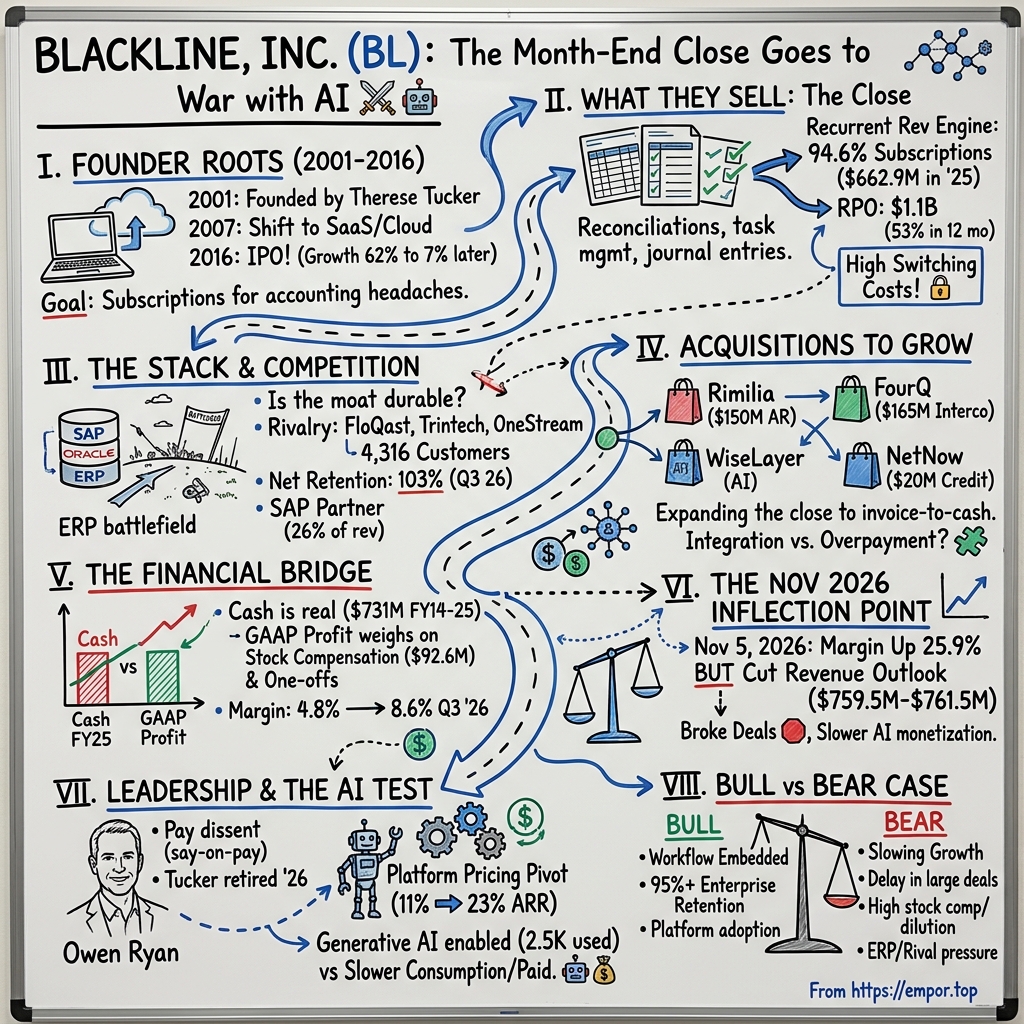
On the afternoon of November 5, 2026, BlackLine put out a set of numbers that looked, at first glance, like the report of a company finally getting its house in order. Profitability had climbed to a level the business had rarely touched. On the company's preferred non-GAAP measure, which strips out stock compensation and acquisition amortization, operating margin reached 25.9% for the third quarter.[^1] Cash kept flowing in. Contracted future revenue kept growing. And then, a few lines further down, came the sentence that set the tone for the conference call: BlackLine was lowering its full-year revenue outlook to a range of $759.5 million to $761.5 million.[^1]
The reason, management said, was not a collapse. It was a delay. Several large deals that management had expected to sign in the quarter did not close on schedule, professional-services revenue grew more slowly than planned, and the consumption revenue BlackLine had hoped to earn from its new AI agents came in below expectations.1 For a company that sells software to the people who close the books, the irony was hard to miss. BlackLine's customers had, in effect, pushed their own decisions into a later period.
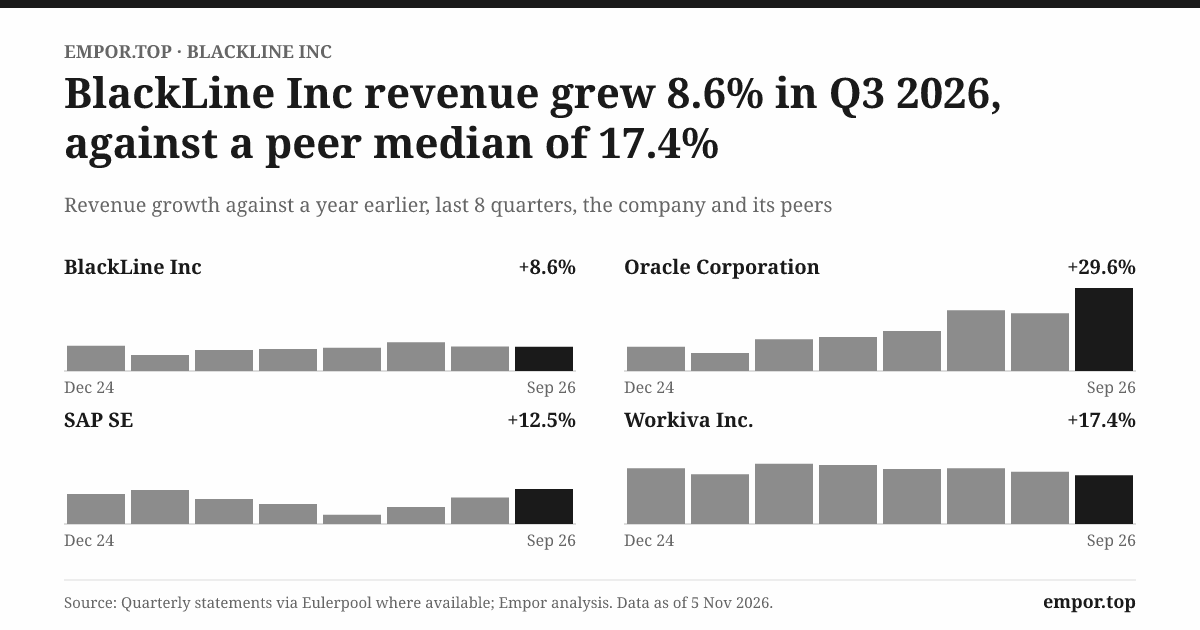
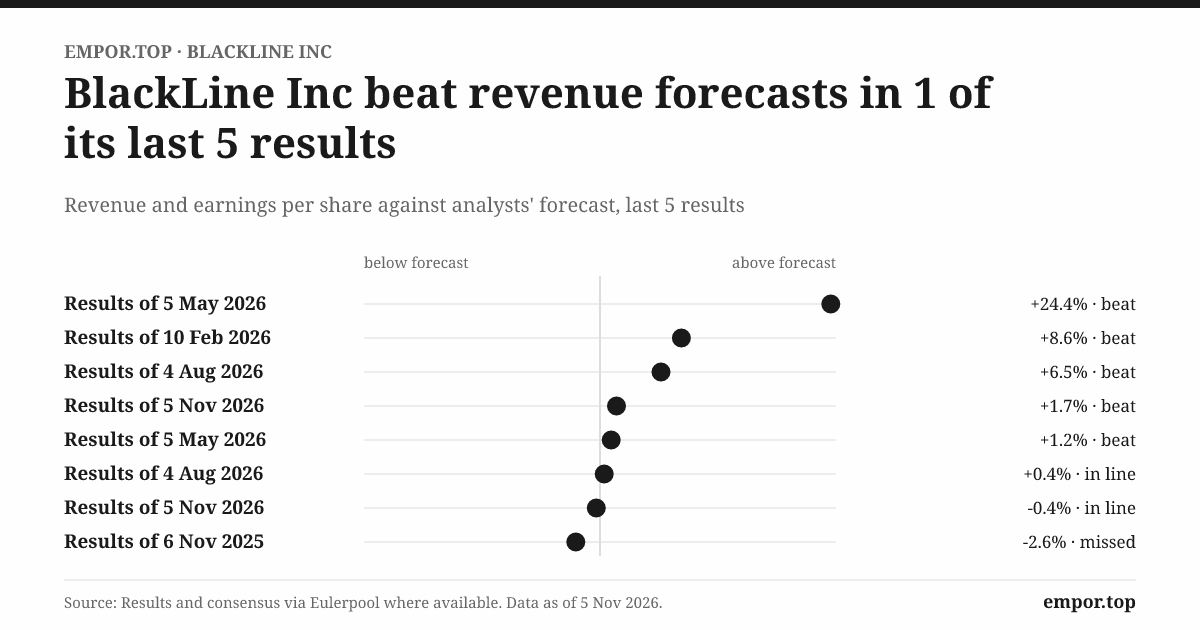
The headline numbers captured the tension in miniature. Revenue grew roughly 8.5% from a year earlier, to about $193 million for the quarter.[^1] Remaining performance obligations, the accounting term for revenue customers have contractually committed to but that BlackLine has not yet recognized, grew 14.3% to $1.1 billion.2 One number says customers are signing longer and larger commitments. The other says that, so far, those commitments are arriving in the income statement at a single-digit pace. If the contracted backlog is growing nearly twice as fast as revenue, why isn't revenue speeding up?
There are two possible answers, and the rest of this story is an attempt to tell them apart. The generous reading is that BlackLine is in the middle of a product and pricing transition, that customers are signing multi-year deals on a new platform while they test the AI features, and that the revenue will catch up as those contracts ramp. The harsher reading is that the company's core market, the financial close for mid-sized and large enterprises, has matured, and that the next growth engine, the AI and platform story management has been selling for two years, is not ready to carry the business.
What made the November call uncomfortable was the contrast with August. Three months earlier, on the second-quarter call, chief executive Owen Ryan had framed the first half of 2026 as possibly the most consequential period in the company's history, and management described AI adoption as accelerating and beginning to monetize.3 Second-quarter revenue had come in at about $187 million, up nearly 9% from a year earlier.[^5] Nothing in that call prepared investors for a quarter in which the AI revenue would be described as below plan and large customers as waiting.
So the quarter poses three questions that will run through this episode. The first is about growth: can BlackLine grow faster by selling more of its platform to customers it already has, rather than relying on a shrinking pool of new logos? The second is about position: can a specialist in month-end close software hold its ground against the giant enterprise suites from SAP and Oracle on one side and nimbler specialists on the other? The third is about value: does BlackLine's stronger cash generation translate into durable value for each share, or does stock compensation quietly hand much of it back to employees?
None of those questions will be settled by a press release. They will be settled by a few numbers that tell the truth about customer behavior: how fast subscription revenue grows, how much existing customers expand what they spend, whether the new platform pricing actually raises the price customers pay, and whether BlackLine can keep producing GAAP profit, the kind that counts every cost, rather than only the adjusted kind. To understand why those particular measures matter, it helps to go back to the problem BlackLine was founded to solve, and to the founder who decided that the most tedious week in corporate finance could be a business.
 Subscribe on LinkedIn
II. The founder made month-end work software
Every public company has a ritual that outsiders rarely see. In the days after a month or quarter ends, an accounting team works through a long checklist before anyone is allowed to say what the company earned. Every bank account has to be matched to the ledger. Every balance-sheet account has to be reconciled, which means someone proves that the number in the system is supported by an invoice, a statement, a contract or a calculation. Differences have to be explained. Journal entries have to be prepared, reviewed and approved. For most of the history of modern corporate accounting, a great deal of that work lived in spreadsheets, binders and email chains.
Therese Tucker knew that world from the technology side. She studied computer science and mathematics at the University of Illinois and spent years as a programmer and then chief technology officer at SunGard, working in treasury systems software, before she struck out on her own.[^6] In 2001 she founded BlackLine, and she has said she funded the early company by cashing out her retirement savings.4 The bet was unglamorous by Silicon Valley standards. She was not building a social network or a search engine. She was building software for reconciliations, the closest thing corporate finance has to washing dishes.
That choice turned out to be the company's defining insight. The financial close is repetitive, which makes it ripe for automation. It is also control-sensitive, which means mistakes are expensive: a reconciliation that is wrong can turn into a misstatement, an audit finding or, for a public company, a disclosure problem. Work that is both repetitive and risky is exactly the kind a finance chief will pay to make reliable. BlackLine did not need to replace the general ledger, the core accounting system run by SAP, Oracle or others. It sat next to it, pulling in balances and transactions and organizing the human work of proving they were right.
The second decisive move came in 2007, when BlackLine shifted toward delivering its software through the cloud as a subscription, rather than as software a customer installed on its own servers.5 In 2007 that was not yet the obvious choice for finance software. Many controllers were uneasy about putting sensitive accounting data on someone else's servers. But the subscription model changed the economics of the business. Instead of a large up-front licence followed by maintenance fees, BlackLine would collect recurring payments, typically billed a year in advance, for as long as the customer kept using it. That is a slower way to make money at first and a much more durable one later.
The business grew for years without much outside capital. The ownership changed in 2013, when Silver Lake Sumeru and ICONIQ Capital invested and took a large stake in the company, giving it the resources to expand its sales force and product.5 That history matters mainly for how the company reached the public markets; it does not describe today's economics. BlackLine is not controlled by a private-equity sponsor now, and its largest holders are index-scale asset managers and a handful of concentrated investors, a subject the story will return to when it reaches the boardroom.
BlackLine went public on the Nasdaq in October 2016, with its registration statement declared effective on October 27.5 The timing was good. Investors were hungry for cloud software companies with recurring revenue, and BlackLine had a clean pitch: a large, underpenetrated market of finance teams still working in spreadsheets, and a product that solved a problem every one of them had.
The growth that followed was real, and so was its slowing. Revenue rose from about $83 million in 2015 to about $700 million in 2025, a compound growth rate of nearly 24% a year across the decade.6 But the shape of that curve matters more than its endpoints. Growth was above 60% in 2015, still above 20% as late as 2022, then fell from roughly 13% in 2023 to 7% in 2025.6 Over the three years to 2025, revenue compounded at about 10% a year. That is a respectable rate for a mature software company. It is not the rate investors paid for at the IPO.
There is a fair explanation for part of the deceleration. Any company growing from a small base will slow as it gets bigger, and BlackLine's early customers were the easiest to win: the finance teams most frustrated with spreadsheets. But a quarter-century of operating history also supports a more interesting claim. Companies do not keep paying for software for twenty years unless it does a job they cannot easily do without it. The longevity of BlackLine's customer relationships is the strongest evidence that the close is a real, embedded workflow. What that history does not prove is that the workflow can be stretched much further, into adjacent processes and into AI-driven automation, without the company losing the focus that made it valuable.
That became the question of BlackLine's second decade. A company that owned one painful week of the accounting calendar now wanted to own more of the finance department's year. Before judging whether it can, it is worth looking closely at what it actually sells today, and why finance teams keep paying for it.
III. A product that earns its keep at the close
Picture a controller at a multinational with forty legal entities, three different general ledgers left over from past acquisitions and a few hundred bank accounts spread across a dozen currencies. It is the third working day after quarter-end. The chief financial officer wants preliminary numbers by the end of the week, and the auditors will want evidence for every material balance a few weeks after that. Somewhere in the organization, an analyst is downloading a bank statement into a spreadsheet, matching it line by line against the ledger and highlighting the items that do not tie. Another is chasing a colleague in a subsidiary for support for an intercompany balance that does not match on both sides. A third is emailing a manager for sign-off on a journal entry that has been sitting in an inbox for two days.
That is the scene BlackLine is built for. Its core products automate account reconciliations, so that balances that match their support are certified automatically and only exceptions reach a human. Its transaction-matching engine compares large volumes of bank, card and ledger transactions and flags the ones that do not pair up. Its journal-entry tools route entries for preparation and approval with an audit trail. Its close-task management turns the checklist into a tracked workflow, so a controller can see which steps are late. And its intercompany tools help multi-entity companies agree on what their subsidiaries owe one another, one of the messiest problems in group accounting.6
The simplest analogy is air-traffic control for the close. BlackLine does not fly the planes; the general ledger still records the transactions. What it provides is the system that tells everyone which flight is on time, which is delayed and who signed off on clearing it to land. For an auditor, that record is the point. A reconciliation that lives in a governed system with timestamps and approvals is far easier to test than one that lives in a spreadsheet on someone's laptop.
The business model follows from that role. In 2025, subscription and support revenue was about $663 million, roughly 95% of total revenue, while professional services, mostly implementation work, brought in about $38 million.6 Subscription contracts typically run for one to three years, and customers are generally invoiced annually at the start of each contract year.6 For most of its history BlackLine priced by the solutions a customer bought and the number of users who touched them. In 2025 it introduced a newer model that also takes account of product mix, the size of the organization and volume measures such as transactions or entities.6 The shift sounds technical, but it is the heart of the company's growth argument, and the story will come back to it when it reaches the AI test.
Why do these mechanics produce attractive economics? Because the customer pays first. A company that signs a one-year subscription in January sends cash for the whole year up front, while BlackLine recognizes the revenue month by month. That timing gap means the company collects money before it has to report it as earned, and it shows up as deferred revenue on the balance sheet. When a subscription business is growing, the effect is a steady tailwind to cash flow. It is also why BlackLine's cash generation looks so much better than its reported profits, a puzzle that deserves its own chapter.
Annual billing has a less flattering side. Customers do not always pay promptly, and large enterprises in particular can stretch their payment terms. One way to measure that is debtor days, the number of days of revenue sitting in receivables. For BlackLine it improved to about 100 days in 2024 and then rose to about 114 in 2025, as receivables consumed about $38 million of operating cash during the year.6 Some of that is seasonal, because invoices cluster around renewals, and the company's peak was higher, at about 130 days in 2019. But a rise of two weeks in collection time is a reminder that a prepaid business still has to collect. The allowance for credit losses is small, about $3.3 million against net receivables of roughly $174 million at the end of September 2026, and BlackLine does not publish an aging table or a write-off history.2 On the third-quarter call, management mentioned a settlement with an unnamed financially distressed customer, which it said reduced the renewal rate by more than a percentage point.1 It is one customer, not a pattern. But it is the kind of event that shows where the soft spots in a receivables book tend to be.
The auditor, for its part, gave an unqualified opinion on BlackLine's 2025 financial statements and its internal controls, and flagged subscription revenue recognition as a critical audit matter, which means it required especially careful testing of how subscriptions are initiated, billed and recorded.6 That is a routine designation for a subscription business rather than a warning, but it identifies where the judgment in BlackLine's accounts lies.
That brings the story back to the $1.1 billion backlog. About 53% of the September 2026 balance was expected to be recognized over the following twelve months.2 The figure is useful, but it is easy to over-read. It rises when customers sign longer contracts, when they renew early or when contracts are larger, and it does not by itself measure how much new demand arrived in a given quarter. A customer that signs a three-year renewal at the same price adds to RPO without adding a dollar of growth. RPO growing faster than revenue is encouraging only if the extra commitments are bigger, not merely longer.
The deeper point is the hinge of the whole business. The more deeply BlackLine embeds itself in a company's financial controls, the harder it is to rip out, because switching means rebuilding reconciliation rules, retraining staff, re-documenting controls for the auditors and taking the risk of a messy close in the middle. That is the case for durability. But embedding is not the same as expansion. A customer can keep BlackLine for a decade and buy no more of it, or buy less as automation reduces the number of people who need a licence. The only way to know which is happening is to watch whether the existing base keeps spending more each year, and whether rivals are winning business at the edges. That contest begins in the place where BlackLine's software meets the systems of the giants it depends on.
IV. The system beside SAP and Oracle
Imagine the steering committee of a multinational that is midway through a move to a new version of its enterprise resource planning system, the giant software backbone that runs its ledgers, purchasing and payroll. The finance transformation lead lays out three options for the close. The first is to rely on the close and reconciliation tools that come bundled with the new ERP, which the company is already paying for. The second is to keep or buy a specialist close platform that sits across all of the company's ledgers, old and new. The third is to split the work: the ERP's tools for the simplest entities, a specialist for the complex ones, perhaps a cheaper niche vendor for a single process. Every one of those options is reasonable. Only one of them pays BlackLine in full.
That meeting, in one form or another, is where BlackLine's moat is tested. The company ended 2025 with 4,394 customers, down from 4,443 a year earlier, and by September 2026 the count had fallen further, to 4,316.61 Dollar-based net revenue retention, which measures how much the existing customer base spends this year compared with last year after expansion, downgrades and churn, rose from 102% in 2024 to 105% in 2025, then slipped to about 103% in the third quarter of 2026.61 In plain terms, the average group of customers spends a little more each year than it did the year before, but not much more, and the number of customers is shrinking.
To understand who is in the room with BlackLine, it helps to be precise about the categories, because they are not identical. SAP and Oracle sell broad enterprise suites, and both can bundle close, reconciliation and consolidation capabilities into deals that span the whole finance stack. OneStream competes on financial consolidation, planning and close, often for the same large enterprises. FloQast, Trintech and a growing set of newer vendors target parts of the close and reconciliation workflow, often with simpler products and lower prices aimed at mid-market accounting teams. Each of these rivals overlaps with BlackLine somewhere. None overlaps everywhere.
Independent product assessments offer one view of where BlackLine stands. In its 2025 Financial Close Buyers Guide, ISG Research classified BlackLine among the leaders, alongside OneStream and Oracle, and also recognized FloQast and Trintech.7 That is real evidence that BlackLine's product is competitive. It is not evidence of market share or pricing power. ISG's guide scores products and customer experience; it does not measure revenue, unit volumes or win rates. No reliable public series measures share in the financial close market, so a claim that BlackLine dominates the category cannot be supported. What can be said is that it is a leading specialist in a field where the largest suites are also rated leaders.
Why might BlackLine win that steering-committee meeting? The strongest argument is complexity. A company with dozens of entities, multiple ERPs and heavy intercompany activity needs a layer that works across all of them, and a suite vendor's native tools tend to be strongest inside its own ledger. BlackLine's integrations across ERP systems, its audit trails and the simple fact that a finance team has spent years building its close process inside the software all raise the cost of switching. A controller who changes close platforms is betting a quarter's reporting on a migration. Few want to be the person who made that bet and lost it.
The company's own renewal data shows where that protection is strongest. On the third-quarter call, management cited a revenue renewal rate of about 90.5%, with renewal above 95% in enterprise accounts and churn concentrated in lower-mid-market customers.1 That pattern fits the switching-cost story. The customers with the most complex closes, the most entities and the most at stake in an audit are the ones that stay. The customers with simpler needs are the ones most likely to leave, because a cheaper specialist or a bundled tool can do enough of the job for them.
Now the case against. The same evidence narrows the moat claim in three ways. First, retention of around 103% is modest for a company whose argument rests on expansion: it means the installed base is growing its spending at a low single-digit rate, which leaves most of any acceleration to new customers, and new customers are not arriving fast enough to grow the count. Second, the falling customer number says that BlackLine's protection in the lower mid-market is weak. Third, BlackLine's relationship with SAP is both an asset and an exposure. SAP-related products accounted for about 26% of revenue, and on the third-quarter call management said some SAP customers had paused decisions while they assessed how SAP's own AI capabilities and BlackLine's Verity agents would work together.1 When a quarter of your revenue flows through a partner that is also building adjacent automation, every product announcement from that partner is a reason for a customer to wait.
A further risk is quieter. BlackLine's older pricing was tied in part to users. If automation, BlackLine's own included, reduces the number of accountants needed to close the books, customers can trim licences without leaving. That is one reason the company is shifting toward pricing based on scale and volume. Whether the shift protects revenue or merely repackages it is the question the AI section will test.
Customer concentration is not the issue. No single customer exceeded 10% of revenue in 2023, 2024 or 2025, although BlackLine does not disclose the share of revenue from its five or ten largest customers.6 The bargaining power in this market is not held by one dominant buyer. It is held by many large buyers, each of whom has alternatives, a procurement team and, increasingly, a reason to delay.
Seen through Michael Porter's lens, the contest has a clear shape. Buyer power is high in large enterprise deals, because those customers have suites, specialists and in-house options to play against one another. The threat of substitutes is credible, both from ERP bundling and from automation that reduces the amount of close work to be done. Rivalry among specialists is active at the simpler end of the market. Against those forces stands one real source of protection, the switching cost of a control-sensitive workflow, whose strength shows up in enterprise renewal rates and whose limits show up in customer counts.
It is tempting, in a world of AI marketing, to treat certifications, product announcements and talk of BlackLine as the "trust layer" for finance as evidence of a moat. They are not. A moat shows up in customer behavior: in whether customers pay more, renew at higher prices and choose BlackLine over a bundled alternative they already own. On that test, the record narrows the claim rather than rejecting it. BlackLine has a defensible position in complex, multi-entity enterprise close. It has not shown that the position confers pricing power, and it has not stopped the leakage at the smaller end. The KPI that would confirm a wider moat is net revenue retention moving back above its 2025 level while the customer count stabilizes. A drop toward 100% would say the opposite.
BlackLine's management has long understood that the close alone might not be enough. Its answer, for most of the past six years, was to buy its way into the processes that sit on either side of it.
V. The acquisitions that widened the promise
In October 2020, in the middle of a pandemic that had forced finance teams around the world to close their books from kitchen tables, BlackLine announced that it was buying Rimilia, a British company that used machine learning to automate accounts-receivable work, for up to $150 million.8 The logic was easy to grasp. Rimilia's software helped companies match incoming customer payments to the invoices they were meant to settle, a problem that looked a lot like the transaction matching BlackLine already did for the close. If BlackLine could own that step, it could reach further upstream, into the cash a company collects before the accountants ever reconcile it.
The size of the deal was the real statement. At its maximum price, Rimilia cost about 43% of BlackLine's 2020 revenue of roughly $351 million.86 That was not a tuck-in. It was a commitment to the idea that BlackLine could become a broader platform for what the industry calls invoice-to-cash, the chain of work that runs from billing a customer to applying the payment.
Fifteen months later came a second, larger bet. In January 2022, BlackLine announced the acquisition of FourQ, a specialist in intercompany accounting, for $165 million up front plus up to $75 million in earnouts tied to future performance.[^12] Intercompany accounting, the bookkeeping of transactions between subsidiaries of the same group, is notoriously painful for multinationals, because both sides of every transaction have to agree, and they rarely do on the first try. BlackLine already had intercompany tools; FourQ was meant to give it a fuller system for managing those transactions from the moment they are created. At its maximum, FourQ's consideration was about 56% of BlackLine's 2021 revenue of roughly $425 million.[^12]6
Those two deals defined the strategy of BlackLine's middle years: widen the promise from the close to the processes that feed it. The later purchases were smaller and aimed at a different target. BlackLine bought WiseLayer, a developer of AI agents for accounting work, for total consideration of about $23.7 million, and NetNow, which provides customer onboarding and credit-risk tools that fit into invoice-to-cash, for about $20 million.6 Against a revenue base now near $750 million a year, those are modest outlays, closer to buying a team and a technology than buying a business.
Did BlackLine overpay? The honest answer is that the record does not allow a verdict. BlackLine did not disclose Rimilia's or FourQ's revenue, margins or growth at the time of purchase, and there is no consistent set of comparable transaction multiples to measure them against. The ratios above show how material the deals were to BlackLine, not whether the targets were cheap or expensive. What can be judged is what the acquisitions have contributed since, and here too the disclosure is thin. BlackLine reports its revenue as subscription and services, not by product line, so investors cannot see how much invoice-to-cash or intercompany revenue the deals brought in, or whether those products grow faster than the core.
The indirect evidence is mixed. The acquisitions coincided with BlackLine's growth staying above 20% through 2022, and then with growth halving over the following three years.6 Integration work, a broader sales motion and new products to support all added cost during years when operating losses were widening. None of that proves the deals failed. It does mean that the burden of proof sits with adoption: whether customers buy the wider suite and whether it shows up in retention. A product roadmap that integrates Rimilia's matching into the BlackLine platform is a technical achievement. It is not, by itself, a commercial one.
The acquisitions sit beside a second form of capital allocation that has grown more important as the business matured: returning cash to shareholders by buying back stock. BlackLine repurchased $235.5 million of its shares in 2025 and roughly $124 million more through the first nine months of 2026, including about 1.3 million shares for $39.1 million in the third quarter.6[^1] In the November release, the board added $100 million to the buyback program.[^1]
Those repurchases were financed against a balance sheet that still carries meaningful debt. BlackLine has used convertible notes, bonds that can turn into shares, to fund itself for years. In 2024 it bought back part of its 2026 notes at a discount and issued $500 million of 1.00% convertible notes due in 2029; additional notes issued under the same terms brought the outstanding principal to $675 million.62 It repaid the remaining 2026 notes in March 2026.2 At the end of September 2026, BlackLine held about $532 million of cash and marketable securities against that $675 million of principal, which means it has moved from a net cash position to a modest net debt position on its convertibles.2
That is not a balance sheet under strain. The notes carry a low coupon, there is no near-term maturity and the company generates cash. But it does mean every dollar spent on buybacks is a dollar not held against a debt that must be settled, in cash or shares, in 2029. An activist would ask a simple question: were the earlier acquisitions a better use of capital than the buybacks that followed them, and is the company now buying back stock because it believes its shares are cheap, or because it has fewer places to invest? The answer depends on whether the wider platform those deals built starts to earn its keep. And to judge that, investors have to understand why BlackLine's cash and its earnings have told such different stories for so long.
VI. Cash arrived before clean earnings did
BlackLine's 2024 income statement contains one of those numbers that makes a casual reader sit up. Net income attributable to the company was $161.2 million, on revenue of about $653 million, a net margin of nearly 25% for a company that had reported losses in every year from its IPO through 2022.6 It looked like the moment a software company finally became a profit machine.
It wasn't. Two items did most of the work. BlackLine recognized a $65.1 million gain on extinguishing debt when it repurchased part of its 2026 convertible notes at less than face value, and it booked a $43.1 million tax benefit.6 Strip those out, and the 2024 picture looks much more like the years around it. Operating income, the profit from running the business before interest, investment income and taxes, was only about $18.5 million in 2024.6 The following year, with no such gains, net income fell to $24.5 million.6 Anyone who extrapolated from 2024 learned quickly that a one-off gain is not a trend.
The more interesting puzzle runs the other way. From 2014 through 2025, BlackLine reported cumulative net losses of about $129 million. Over the same twelve years, it generated about $731 million of cash from operations.6 How can a company lose money on paper for a decade and still bring in hundreds of millions of dollars of cash?
The answer lies in three accounting bridges. The first is stock-based compensation. BlackLine pays a large part of its employees' compensation in shares, which accountants count as an expense but which does not require cash to leave the company. In 2025, stock compensation was $92.6 million, nearly four times net income.6 The second is amortization. When BlackLine capitalizes software development or buys a company, the cost is spread over future years as a non-cash charge, which depressed reported profit long after the cash had gone out the door; depreciation and amortization were about $46.5 million in 2025.6 The third is the cash-flow tailwind from customer prepayments.
Each of those bridges is legitimate, and each has a cost the cash figure hides. Stock compensation is a real expense to existing shareholders, because every new share issued to an employee dilutes the ownership of everyone else. Amortization reflects real money spent on software and acquisitions. And prepayments are a promise to deliver a service, not a profit already earned. A business that looks wonderful on cash flow and mediocre on earnings is not necessarily hiding something. But it is asking its owners to trust that the gap reflects timing and accounting rather than real costs that never go away.
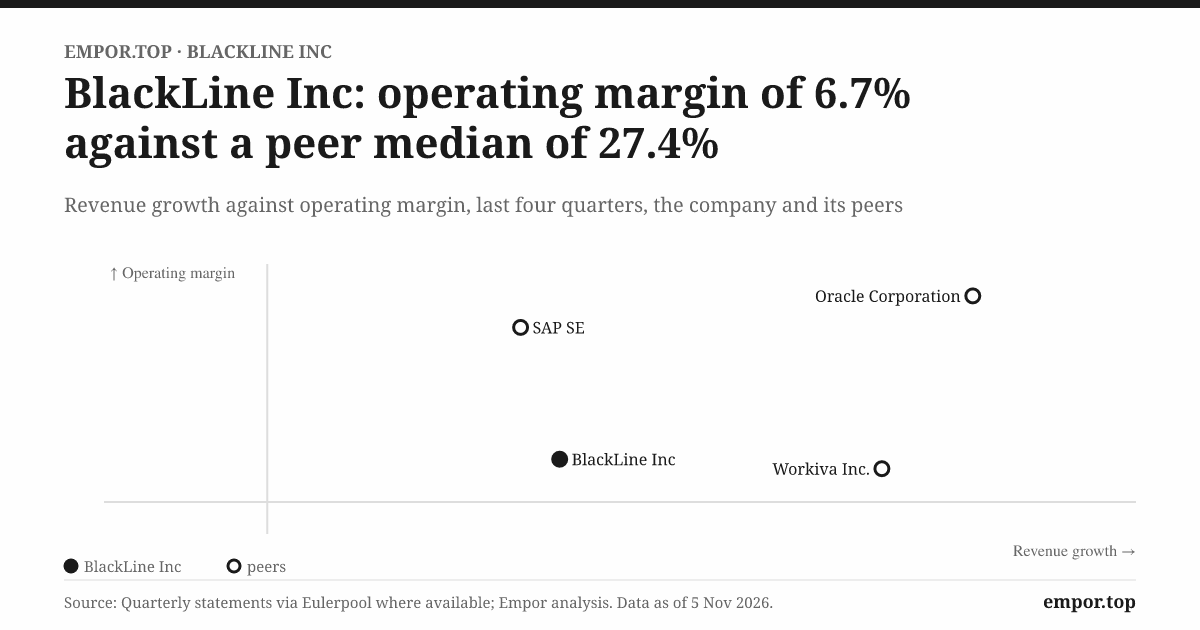
So what does the operating business actually earn? Using the reported GAAP figures, BlackLine's 2025 revenue was about $700 million and operating income about $33 million, a margin of roughly 4.8%.6 Some summaries of the year have cited a lower margin, but the filing's own income statement supports the 4.8% figure. The trajectory is the encouraging part. BlackLine reported operating losses every year through 2022, when the loss reached about $56 million, and then turned to modest operating profits of about $14 million in 2023, $18 million in 2024 and $33 million in 2025.6 In the third quarter of 2026, the GAAP operating margin reached 8.6%, roughly double the 4.3% of a year earlier, and operating income over the trailing twelve months reached about $50 million.[^1]2
That improvement did not come from a sudden burst of revenue. It came mostly from cost discipline. BlackLine announced a workforce plan in 2025 that initially affected about 130 positions, roughly 7% of staff, and later added further reductions of 25 and 75 positions; it reported about 1,850 employees worldwide at the end of the year.6 Research and development spending, net of capitalized software, stayed at about 15.6% of revenue, almost exactly where it had been in 2024.6 In other words, BlackLine has kept investing in its product while trimming elsewhere. That combination is what a maturing software company is supposed to do. It is also a reminder that the margin gains so far are about spending less, not selling more.
The cash-flow statement also shows why the 2025 cash figure fell even as operating profit rose. Receivables absorbed about $38 million of cash as invoices went uncollected for longer, and a deferred tax charge of about $15 million reduced reported earnings without leaving the building.6 In other words, the year's slight dip in cash generation was a working-capital story rather than a deterioration in the underlying economics. That matters for interpretation: if collections normalize, cash generation should rebound; if the longer collection times reflect customers under pressure, the dip is an early warning rather than noise.
There is one more layer to the earnings. In 2025, interest income of about $33 million and other income added meaningfully to profit before tax, which was about $48 million, more than the operating income.6 That interest came from the cash pile, which is shrinking as BlackLine repays debt and buys back stock. As it shrinks, so does the investment income that has flattered the bottom line.
Free cash flow, the cash from operations left after capital spending, tells the most investor-friendly part of the story. It was about $135 million in 2025, down from about $164 million in 2024, as receivables absorbed cash.6 In the third quarter of 2026, free cash flow was $57.5 million.[^1] That is real money, and it is what pays for the buybacks. But the uses tell the whole story. In 2025, BlackLine generated about $135 million of free cash, spent $235.5 million buying back stock, and recorded about $93 million of stock compensation expense for awards to employees. The buybacks exceeded free cash flow and were funded partly from the balance sheet, and part of their effect simply offset the new shares that flow to staff.
That leaves the question that matters most to a long-term owner. A buyback is only as good as its effect on the share count, and earnings only matter per share. BlackLine's diluted earnings per share were $0.34 in 2025 and about $0.67 over the twelve months to September 2026.62 If the business can keep growing GAAP operating income while buybacks actually reduce the number of shares outstanding, the cash story and the earnings story will finally converge. If buybacks merely mop up stock awards, shareholders are paying twice for the same employees. Whether that convergence happens depends heavily on the people who set the pay and the plan, and that means the leadership that inherited the founder's company.
VII. Owen Ryan inherits the founder's company
On October 1, 2025, the arrangement that had run BlackLine for two and a half years came to an end. Therese Tucker stepped down from the co-CEO role she had shared with Owen Ryan, leaving him as sole chief executive.9 Eight months later, effective June 2, 2026, she retired from the executive team altogether, though she kept her seat on the board and a stake of about 8.1% of the company.9 The founder who had turned reconciliations into a public company was, for the first time in a quarter-century, no longer running it day to day.
The handover had been a long time coming, and it was not the first attempt. In March 2023, BlackLine's board announced that Marc Huffman, who had been chief executive, would step aside, and that Tucker and Ryan would become co-CEOs effective March 6, 2023.10 Co-CEO structures are rare in public companies for a reason: they can blur accountability. In BlackLine's case it read as a transition device. Tucker brought the product history and the founder's credibility with long-time customers. Ryan brought something different.
Ryan is, by training and career, a creature of the profession BlackLine sells to. He is a certified public accountant who spent more than three decades at Deloitte, from 1985 to 2016, and from 2008 served as chief executive and managing partner of Deloitte Advisory, the firm's risk and advisory business.10 He then ran AEGIS Insurance, a mutual insurer, for two years before joining BlackLine's board in August 2018; he became chair in January 2023, shortly before taking the co-CEO role.10 That background fits the company's ambitions. A former Deloitte leader speaks the language of audit committees, controllers and chief financial officers, and BlackLine's pitch increasingly depends on persuading them that AI can be trusted inside the controls they answer for.
Today the investor story belongs mainly to Ryan and to Patrick Villanova, who became chief financial officer in March 2025 after his predecessor, Mark Partin, left the company.9 Ryan is both chief executive and chair of the board, with a lead independent director providing the counterweight.9 Combining the two roles is common in American companies, but it concentrates authority, and it raises the bar for the board to show it holds management to account when results disappoint.
Pay and ownership tell a revealing story when read together. In 2025, Ryan's reported total compensation was about $11.6 million, and Tucker's about $9.6 million, each driven mostly by equity awards with a target value of $7.5 million.9 Their cash bonuses were modest, roughly $473,000 for Ryan and $421,000 for Tucker.9 Ryan's beneficial ownership, as measured for the March 2026 proxy, was 116,821 shares, a stake worth roughly $4 million at November's share price.9 Tucker, by contrast, held 8.1% of the company, and all directors and executive officers together held about 9.1%.9 In other words, almost all of the insider ownership in BlackLine still belongs to the founder who no longer runs it. The chief executive's alignment with shareholders comes mainly through future equity grants, which tie his pay to performance but also add to the dilution that the buybacks are working to offset.
Shareholders noticed. At the 2024 annual meeting, roughly 94% of votes supported the advisory resolution on executive pay; in 2025, support fell to about 76%.9 At the May 2026 meeting, about 30.3 million votes were cast in favor and about 18.3 million against, which means close to four in ten votes cast on the question opposed the company's pay practices.11 A say-on-pay vote is advisory and does not force any change. But a decline of that size over two years is a clear signal from institutional holders that they do not see pay and performance moving together.
The shareholder register adds to the pressure. Funds affiliated with BlackRock held about 13.2% and Vanguard about 11.3%, but two concentrated holders stand out: Clearlake Capital, the private-equity firm, at about 9.6%, and Fivespan Partners at about 5.1%.9 Fivespan's March 2026 Schedule 13D, the filing an investor makes when it may seek to influence a company, said it bought the shares because it believed they were undervalued and reserved the right to engage with management.12 A board facing falling pay support, a founder with a large stake and a board seat, and two concentrated holders with private-market instincts is a board that will be asked hard questions if growth does not return.
The leadership test became especially visible across 2026. The August call's upbeat framing of AI adoption invited investors to expect a near-term inflection that November's results did not deliver.31 Neither statement is necessarily wrong. Adoption can accelerate while monetization lags, and enterprise deals do slip.
To its credit, management did explain the miss, naming specific causes.1 What the third-quarter call did not offer was a set of measurable milestones by which investors could judge whether the delays were resolving. The test for the coming quarters is whether management separates what it controls, such as product readiness, pricing and sales execution, from what it does not, such as a customer's procurement timetable, and whether it revises its plan when the evidence changes rather than simply pushing the expected inflection one more quarter out. The single most important thing Ryan has promised is that the platform and AI will reignite growth. That promise now has to survive contact with customers.
VIII. Platform pricing meets the AI adoption test
On the second-quarter call in August 2026, the tone was expansive. Ryan described the first half of the year as perhaps the most consequential in the company's history, as BlackLine rolled out its next-generation platform and its Verity AI agents to customers.3 By the November call, the language had changed. AI consumption was below plan, and some customers, particularly those running SAP, were waiting to see how BlackLine's tools would work alongside SAP's own AI before committing.1 Between those two calls lies the most important question about BlackLine's future: can it turn platform adoption and AI features into paid expansion without slowing the core business that pays the bills?
Part of the hesitation has a name. Management said on the third-quarter call that some customers were waiting for BlackLine 3.0, the next generation of the platform, before making larger commitments.1 Any software company that announces a major new version faces the same trap: the better the new product sounds, the more reasonable it becomes for a customer to delay buying the old one. For BlackLine, the trap is sharper because the buyers are finance teams, who are paid to be careful and who rarely want to migrate a working close process twice in quick succession. A product transition can therefore depress near-term bookings precisely because customers believe in it.
Start with the pricing shift, because it is the less glamorous but more measurable half of the story. For most of its life, BlackLine sold individual solutions, such as reconciliations or transaction matching, and priced them largely by the number of users. The newer platform model, introduced in 2025, packages the products into bundles priced on the customer's product mix, organization size and volumes such as transactions or entities.6 The intuition is straightforward. If a customer automates more of its close and processes more transactions through BlackLine, the bill should grow with the work being done, rather than shrink because fewer accountants are logging in. It is the difference between charging a restaurant by the number of waiters and charging it by the number of meals served.
BlackLine tracks this conversion with a specific metric: the share of eligible annual recurring revenue that has moved to platform pricing. That share rose from about 11% at the end of 2025 to about 23% at the end of the third quarter of 2026.131 Doubling in three quarters is real progress. But it is important to be precise about what the metric measures. It tracks how much of the existing revenue base has been converted to the new model, not how many incremental dollars the conversion produced. A customer that moves to platform pricing at exactly its old price counts toward the 23% just as much as one that pays 20% more. BlackLine does not disclose the average uplift on converted contracts, so investors cannot yet tell whether platform pricing is a growth engine or mainly a new way of packaging the same spending.
The AI story needs even more careful separation, between technical reach and commercial result. By the third quarter, about 3,400 customers had BlackLine's embedded generative AI features enabled, and roughly 2,500 of its 4,316 customers used them during the quarter.1 That is a striking level of usage for features that did not exist a few years ago. It is also, for the most part, usage of features included in what customers already pay. The paid product is the agentic AI, software agents that carry out tasks such as preparing reconciliations or investigating exceptions, which BlackLine sells partly on a consumption basis. On that line, management said revenue was below expectations.1 Enabled is not paying. Using is not expanding.
Why would finance teams hesitate? Management's explanation on the third-quarter call was that customers wanted to test the new platform and set up governance before letting AI touch their financial workflows.1 That is entirely plausible. A controller who lets an AI agent post journal entries is accountable for every one of them when the auditors arrive, and the instinct to pilot slowly is the same instinct that made BlackLine's controls software valuable in the first place. But the explanation cuts both ways. If the barrier to paid AI is the caution of the buyer, that caution will not disappear in a quarter, and the revenue curve for AI agents may be much flatter than the marketing implied.
The SAP complication sharpens the point. SAP-related products account for about a quarter of BlackLine's revenue, and BlackLine has long sold alongside SAP to its customers.1 As SAP builds its own AI into its finance applications, some joint customers are pausing to understand where SAP's capabilities end and BlackLine's begin.1 That is a classic platform risk. The partner that brings you customers can also decide that some of your functionality belongs inside its suite. It does not mean SAP will displace BlackLine; complex multi-ERP customers still need a neutral layer. It does mean that for a meaningful share of the base, BlackLine's next sale depends partly on another company's product roadmap.
The calls themselves show how analysts have probed these issues. Across the second and third quarters, the Q&A sessions returned again and again to timing: when the delayed deals would close, how much AI usage was paid, what platform conversions were doing to price, and what had changed between August's optimism and November's caution.31 Management's answers tended to describe pipeline strength and customer engagement in broad terms rather than offering hard milestones such as a target for paid AI revenue or a disclosed uplift on platform conversions.1 That gap between the specificity of the questions and the generality of the answers is itself a piece of evidence. When a company has a number it likes, it usually shares it.
The strategic direction had been signposted well before 2026. At its 2024 Investor Day, BlackLine laid out a strategy centered on moving customers to a broader platform and expanding its role in finance and accounting operations.[^18] Two years later, the conversion is visibly under way, but the financial payoff it was meant to deliver has yet to appear in the growth rate.
Keep the operating backdrop in view, because it frames everything else. In the third quarter, annual recurring revenue grew about 7% and subscription revenue about 9%, while RPO grew about 14%.1 The customer count fell to 4,316. Large-enterprise renewal stayed above 95%, with churn concentrated in the lower mid-market.1 Read together, those numbers describe a company whose biggest customers are staying and signing longer commitments, whose smallest customers are leaving and whose total recurring revenue is growing at a single-digit pace. The platform and AI strategy is meant to change that last number. So far it has not.
The record narrows the AI claim rather than rejecting it. BlackLine has real distribution, thousands of customers using AI features inside a workflow they trust, and a pricing model designed to capture value as automation grows. What it does not have yet is evidence that AI is a separate profit pool. The claim that survives is smaller: AI is a plausible future growth vector that must prove itself in paid adoption. Three measures will tell investors whether it does. The first is subscription ARR growth, which stood at about 7% in the third quarter. The second is dollar-based net retention, at about 103% and down from 105% in 2025. The third is paid AI and platform expansion showing up as revenue rather than as enablement statistics. If ARR growth climbs toward double digits and retention moves back above its 2025 level, the AI strategy is working. If they stay flat while platform conversion keeps rising, the new model is mostly a repackaging. Those are the facts the market is weighing when it sets a price on the stock.
IX. Analysis & Bear vs. Bull Case
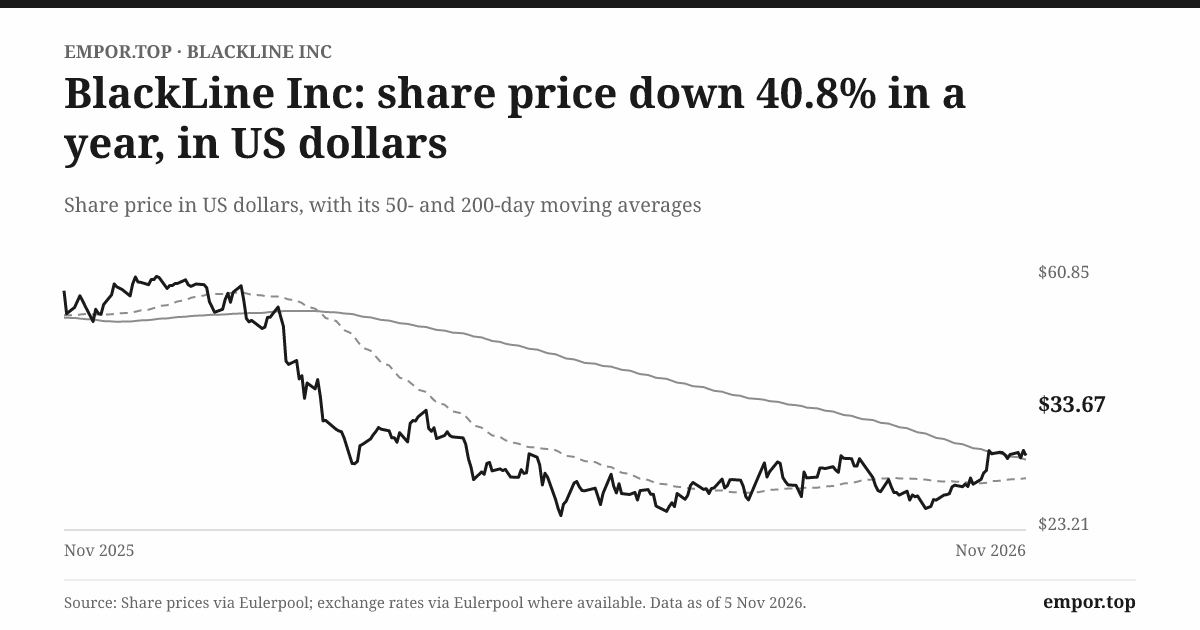
On November 5, 2026, BlackLine's shares closed at $33.67, giving the company a market value of about $2.2 billion.[^19] That price was about 43% below the stock's 52-week high of $58.83, and the shares had swung within a range whose low was $25.23.[^19] Over five years, the stock's largest fall from peak to trough was about 81%,[^19] a reminder of how far sentiment toward mid-sized software companies has travelled since the 2021 boom. The question for any investor is not whether BlackLine is a good product. It is whether, at this price, the market is paying for a recovery that the business has yet to deliver.
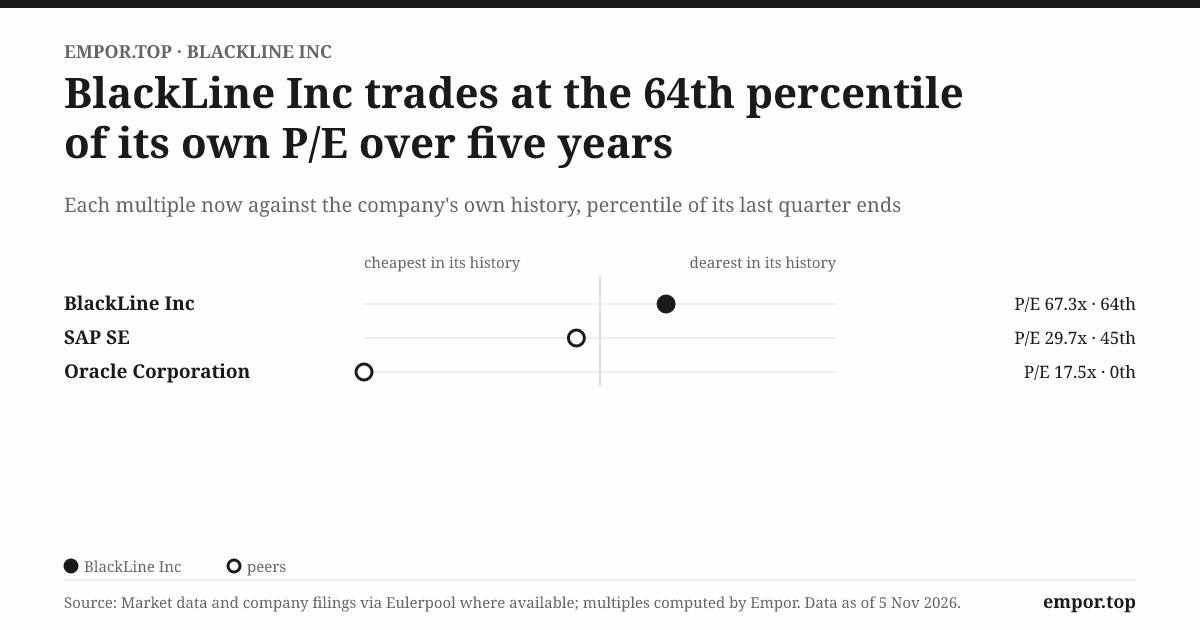
The headline multiples point in different directions. On trailing earnings, the stock traded at about 67 times, above its own five-year median of about 51 times.62 On sales, it traded at about 3 times, and on free cash flow it offered a yield of about 7.7%. Return on invested capital, a measure of how much operating profit the business earns on the capital tied up in it, was about 6.4% over the twelve months to September. Those numbers describe two different companies. On cash, BlackLine looks inexpensive for a subscription software business. On GAAP earnings and returns, it looks expensive, because the earnings are still small and the returns are below what most investors would consider the cost of capital.
Part of the price-to-earnings gap reflects distortion rather than euphoria. Earnings are recovering from a low base after the 2024 gains washed out, and a multiple on depressed earnings always looks high. But the comparison with history still matters: the market is valuing BlackLine's current earnings above where it valued them on average over the past five years, during which growth was higher. For context only, an index of software-as-a-service valuations at the end of September 2026 put BlackLine's forward enterprise value at about 2.3 times expected sales, against about 2.8 times for Workday and 3.3 times for Salesforce.14 Those are broader enterprise-software businesses, not close operating comparables, but they show that BlackLine is not priced at a premium to the largest application vendors on sales. What the price appears to assume is that margins will keep expanding and that growth will at least hold, so that today's modest earnings grow quickly into the multiple.
The bull case begins with the product. BlackLine's enterprise customers renew at rates above 95%,1 and platform pricing has doubled its reach in three quarters.1 RPO is growing faster than revenue, while GAAP margins and cash flow improved in the third quarter.[^1]2 On this view, the delayed deals and slow AI consumption are timing problems, and a company generating this much cash at a single-digit growth rate will look cheap if growth reaccelerates even modestly.
The bear case has the stronger numbers on its side for now. Revenue growth has slowed to single digits, and the customer count is falling.6 AI consumption has lagged management's expectations.31 Stock compensation exceeded 2025 net income several times over, so the cash-flow yield overstates what is truly left for shareholders.6 Return on invested capital is in the mid-single digits. And a quarter of revenue is tied to SAP's ecosystem at the moment SAP is building competing AI.1
The same competitive forces evident in BlackLine's customer losses and delayed deals shape the investment case. ERP bundling and AI create substitution risk; large enterprises have the power to delay and negotiate; and specialists such as FloQast and Trintech compete for simpler workflows, where price matters more than depth.7 Against those pressures stands the switching cost of BlackLine's enterprise accounts, which is weaker at the lower end.
Hamilton Helmer's seven powers offer a sharper lens on what kind of advantage BlackLine actually has. It has no meaningful network effects: one customer's use of BlackLine does not make the product more valuable to another. It has limited scale economies relative to SAP and Oracle. It has no cornered resource; its technology can be replicated. Its brand among controllers and auditors is genuine but does not command a visible price premium. A second, process power, the accumulated know-how of running close processes across complex multi-ERP environments, is plausible but harder to prove. That is the profile of a durable niche, not of a wide moat. A wide moat would show up as pricing power and rising retention, and BlackLine's retention has drifted down.
Some risks deserve naming because they are specific to this business rather than generic. Longer enterprise buying cycles, of the kind the third quarter revealed, can persist if economic uncertainty or AI evaluation stretch decisions out. ERP or AI substitution could hollow out the simpler end of the product line. BlackLine handles sensitive financial data for thousands of companies, so a security breach or control failure would strike at the core of its value proposition. Expansion into public-sector and international markets brings execution costs, and the $675 million of 2029 convertible notes will need to be settled in cash or shares, which bears directly on per-share value.2 There is also a modest tax overhang: gross unrecognized tax benefits rose to about $22 million at the end of 2025 from about $7 million two years earlier, although the company did not expect material changes within twelve months.6 Currency exposure is real but small; a 10% move in the dollar would have shifted year-end 2025 cash by only about $6 million.6
The growth question resolves only conditionally. Platform pricing and the growing backlog support a credible path to recovery, but neither settles whether the delayed deals will close or AI will add meaningful revenue. The record supports a clear but bounded conclusion: BlackLine has evidence of a durable niche in complex enterprise close, but it has not proved a wide moat or a scaled AI profit pool. Whether the price is fair depends on which of those futures arrives, and the market has not yet been shown which one it is buying.
X. Lessons from the close
Go back to the controller on the third working day after quarter-end. Twenty-five years after Therese Tucker decided that moment could be a business, it is still the moment that matters. Every lesson in BlackLine's story starts there.
The first lesson comes from the 2007 decision to move the close into the cloud. BlackLine chose work customers could not skip. That durability still shows up in enterprise renewals, even in a quarter of disappointing growth. The wider point for founders is that durability is chosen at the start, in the choice of problem, long before it shows up in a retention chart. A durable software business starts by owning work customers cannot skip.
The second lesson comes from the subscription engine: recurring revenue can look dependable even as customer counts and collections weaken. A subscription is a renewable promise, and every year the customer gets to decide whether to renew it, shrink it or walk away. Recurring revenue still has to be renewed, expanded and collected.
The third lesson comes from Rimilia and FourQ, whose strategic fit has yet to show up clearly in disclosed results. The test of an acquisition is not whether it fits on a strategy slide but whether customers buy what it added. A broader product suite is only worth its price when customers use it.
The fourth lesson comes from the ninety days between August and November 2026, when AI went from accelerating to below plan. Paid adoption has yet to match enabled usage. For investors in any company selling AI to risk-averse buyers, the distinction is the whole game. A feature that is enabled is not yet a product customers will pay for.
The fifth lesson comes from the gap between BlackLine's earnings and cash flow. Stock-based pay was paid in ownership, and the buybacks of 2025 and 2026 have spent much of their force absorbing it. Cash can arrive before earnings look good, but stock compensation still has a cost.
XI. Epilogue
Tonight, BlackLine stands in an unusual position for a software company of its age. It has reached a stronger financial footing, but its next growth engine remains unproven. Its founder has left the executive suite; its chief executive has had to explain why the optimism of August did not survive to November.
The next earnings call will open with the question the third quarter left unresolved: did the large deals merely slip, or did customers change their minds? Several seven-figure deals moved out of the third quarter, according to management.1 If they close in the fourth quarter or early 2027, the delay will look like what management said it was, an enterprise buying cycle stretched by AI evaluation and SAP's roadmap. If they slip again, or close at smaller sizes, the market will draw a harsher conclusion about demand. Alongside them sits the backlog, whose conversion into revenue will be visible quarter by quarter.
The second thread is platform pricing. Conversion to the new model will almost certainly keep rising, because BlackLine controls the pace at which it offers renewals on platform terms. The more telling number will be whether ARR growth and net retention move with it. If converted customers are paying more, retention should climb back above its 2025 level. If retention stays near current levels while conversion rises toward a majority of eligible ARR, the new pricing will have changed the packaging more than the economics.
The third thread is paid AI. The usage figures will keep growing, and management will keep citing them. What matters is whether customers move from evaluation to governed deployment, with agents that do real work under audit, and whether BlackLine starts disclosing the revenue those agents produce. A company that wants to be the trusted control layer for AI-driven finance will eventually need to show investors a number for it.
The final thread runs through the share count. Over the coming year, GAAP operating profit and diluted earnings per share will show whether margin gains continue as cost cuts annualize, and whether buybacks reduce the number of shares outstanding. The 2029 convertible remains in the background.
BlackLine may be exactly what its management says it is: the system finance teams trust to govern their books as AI starts to do more of the work. Or it may be settling into a slower, more profitable niche, valuable and durable but no longer a growth story. The evidence for the first is real and incomplete. The evidence for the second is in the growth rate. The next few quarters will not be decided by the company's AI vocabulary but by its customers' behavior: deals signed, usage paid for, contracts renewed and earnings per share that finally grow alongside the cash.
XII. Outro
Every company wants a faster close. Chief financial officers talk about real-time finance, continuous accounting and AI agents that never sleep. But behind every earnings release there is still a team of accountants proving that the numbers are right, because the cost of getting them wrong is measured in restatements, audit findings and lost credibility. That is the moment BlackLine was built for, and it is a moment no amount of marketing can wish away.
The company that digitized the quiet, repetitive work behind corporate earnings now wants its software to do some of that work on its own. Customers have already trusted it with the checklist. The next chapter depends on whether they will trust it with the work itself, and pay for the privilege.
References
-
BlackLine Q3 2026 Earnings Call Transcript — Benzinga, 2026-11-05 ↩↩↩↩↩↩↩↩↩↩↩↩↩↩↩↩↩↩↩↩↩↩↩↩↩
-
BlackLine, Inc. Q3 2026 Form 10-Q — SEC, 2026-11-06 ↩↩↩↩↩↩↩↩↩↩↩
-
BlackLine (BL) Q2 2026 Earnings Call Transcript — The Motley Fool, 2026-08-05 ↩↩↩↩↩
-
Building BlackLine: Interview With CEO Therese Tucker — Dun & Bradstreet ↩
-
BlackLine, Inc. Registration Statement on Form S-1 — SEC, 2016-09-30 ↩↩↩
-
BlackLine, Inc. 2025 Form 10-K — SEC, 2026-02-26 ↩↩↩↩↩↩↩↩↩↩↩↩↩↩↩↩↩↩↩↩↩↩↩↩↩↩↩↩↩↩↩↩↩↩↩↩↩↩
-
BlackLine, Inc. 2026 Proxy Statement — SEC, 2026-03-25 ↩↩↩↩↩↩↩↩↩↩
-
BlackLine Announces Leadership Succession (Form 8-K, Exhibit 99.1) — SEC, 2023 ↩↩↩
-
BlackLine, Inc. 2026 Annual Meeting Vote Results (Form 8-K) — SEC, 2026-05-08 ↩
-
BlackLine (BL) Q4 2025 Earnings Call Transcript — The Motley Fool, 2026-02-10 ↩
 LinkedIn
 WhatsApp
 Reddit
 Hacker News
 Email
 Kindle
 RSS Feed
 Spotify
 Apple Podcasts
 Amazon Music
 Audible
 YouTube