Burke & Herbert: The 174-Year-Old Bank That Started Buying Its Future
I. The Bank That Went Public Without an IPO
Most banks that arrive on Nasdaq come with a roadshow, an underwriting syndicate and a prospectus full of promises about the money they are raising. Burke & Herbert arrived with none of that. In the spring of 2023, a bank that had been taking deposits in Alexandria, Virginia, since 1852 filed a registration statement with the Securities and Exchange Commission, applied to list the shares its owners already held, and walked onto the public market without selling a single new share.1 There was no cash raise to celebrate and no new owner to introduce. The bank simply let the outside world see what had been quietly trading for years in a corner of the over-the-counter market.
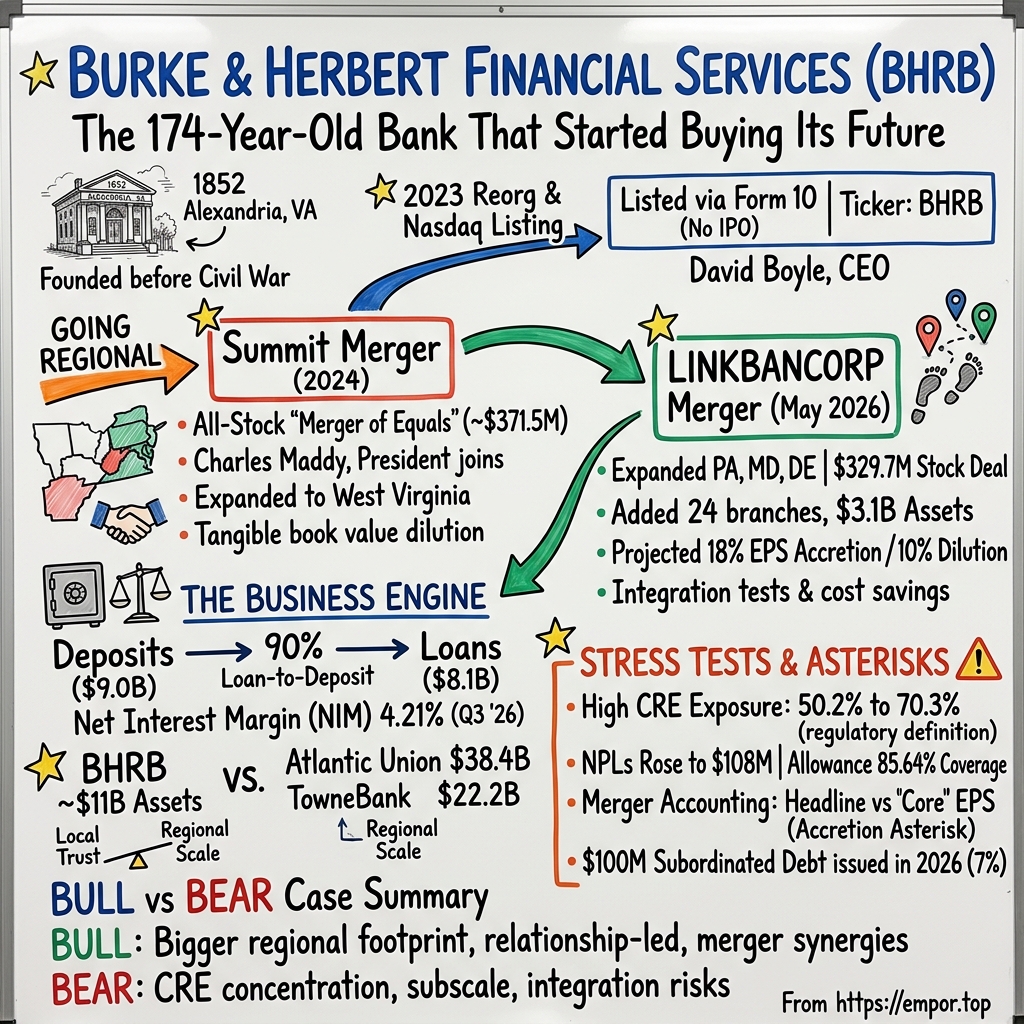
That quiet entrance is the right place to start, because almost everything that happened next was loud. Within months of its listing, the bank announced an all-stock merger with Summit Financial Group, a lender headquartered across the mountains in West Virginia.2 The deal closed in May 2024.[^3] Then, in December 2025, it agreed to buy LINKBANCORP, a Pennsylvania bank holding company, again paying in stock, and that deal closed on May 1, 2026.3 In roughly three years, a bank that had spent most of its life inside the orbit of Northern Virginia became a regional lender with something like $11 billion in assets, 105 full-service branches and customers spread across six states.4
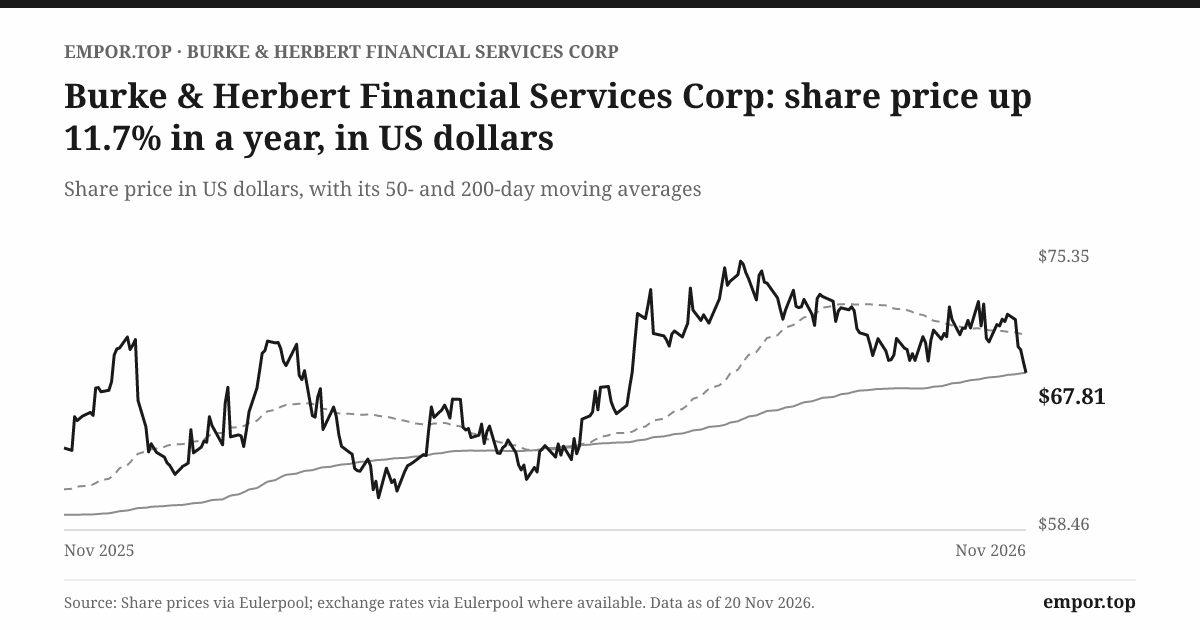
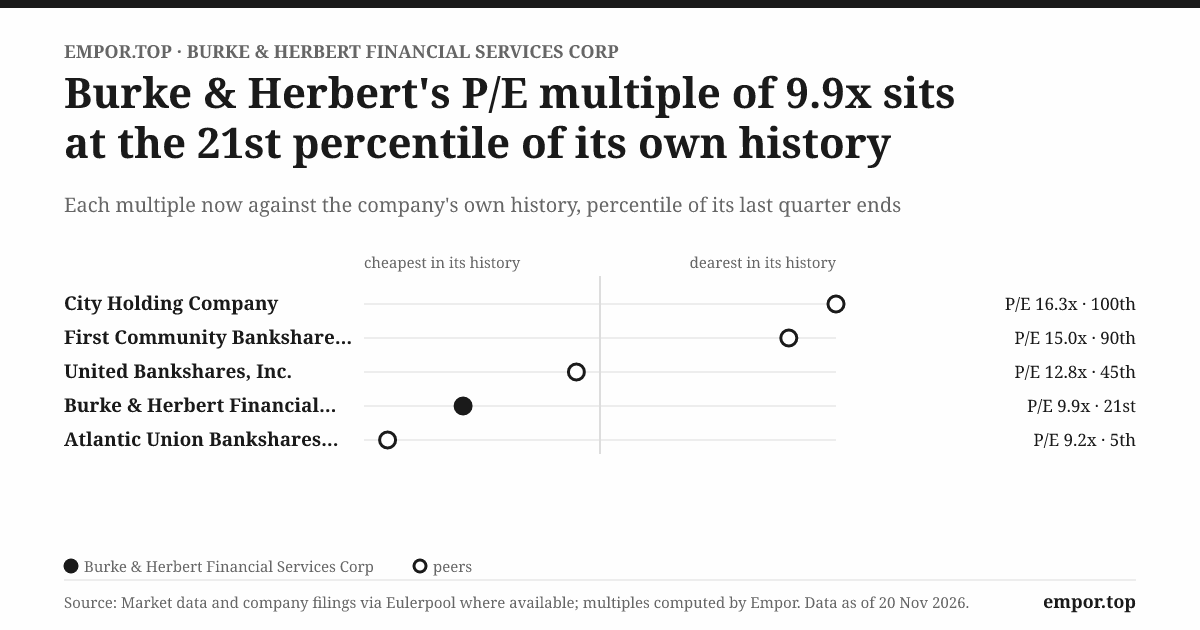
The market, at least for now, is unimpressed. On November 20, 2026, the shares closed at $67.81, about 9.9 times the last twelve months of earnings.[^6] Over the previous five years the stock's median earnings multiple was 22.5 times. On the surface, that is a striking discount. A bank that has more than doubled in size is being priced at less than half the multiple investors once accepted for the smaller, sleepier version of itself, and at about 0.9 times the book value of its equity.[^6]
There are two ways to read that gap, and this story is an attempt to decide between them. In the first reading, the market is still pricing Burke & Herbert as a messy merger story, cluttered with integration charges and accounting adjustments, and has not yet noticed that a larger, more profitable franchise is emerging from the noise. In the second, the market has noticed exactly what is happening: a community bank has bought a much bigger loan book, heavy with commercial real estate, at a moment when that asset class is under strain, and the earnings it reports are flattered by the arithmetic of acquisition accounting. Cheap, in that reading, is just the price of risk.
Before weighing those readings, it helps to be precise about what is being bought. The listed company, Burke & Herbert Financial Services Corp., is a holding company. Its main asset is Burke & Herbert Bank & Trust, the operating bank that makes the loans and takes the deposits. The holding company began operating on October 1, 2022, in an internal reorganization that placed a corporate parent above the existing bank.1 That reshuffle changed the legal plumbing, not the business. The two mergers that followed did change the business. They brought in new branches, new borrowers, new depositors, new employees, new executives and new risks, which means any growth figure measured across 2024 or 2026 is partly a measure of what was bought rather than what was grown.
That distinction sets up three questions that will run through every section that follows. The first is whether regional scale actually makes this bank more competitive, or merely larger. The second is whether the bank can loosen its dependence on commercial real estate lending without loosening its credit standards. The third is whether the earnings investors now see are durable banking income or, at least in part, the temporary product of how acquired loans are booked.
The scorecard for answering them is simple to state and slow to fill in. A good acquisition, for a bank, shows up in organic loan and deposit growth once the purchased balances are stripped out, in returns that hold up after the merger costs are paid, and in credit losses that stay low as the inherited loans age. None of those can be read off a closing announcement. They are written quarter by quarter, and the story so far contains only a handful of those quarters.
The paradox, then, is built into the bank's own history. The institution is very old, and the public company is very young. To understand how a bank with 174 years behind it ended up in a hurry, the story has to go back to the town where it started.
 Subscribe on LinkedIn
II. A Local Bank Becomes a Regional One
Picture the corner of King and Fairfax Streets in Old Town Alexandria, a few blocks from the Potomac, where the bank has long kept its headquarters. When the bank opened its doors in 1852, Alexandria was a port town, Virginia was a slave state, and the Civil War was still nine years away.1 The bank outlasted that war, the Panic of 1873, the Depression, the savings-and-loan crisis and the 2008 crash, and through most of those decades it did roughly the same thing: it took the savings of people who lived nearby and lent them to other people and businesses who lived nearby. The name over the door still carries the surnames of its founding partners.
For a very long time, that was the whole strategy. Burke & Herbert built a reputation as a conservative, family-shaped institution in one of the wealthiest regions in America, gathering deposits from Northern Virginia households and businesses and lending against the region's property. When it registered with the SEC in 2023, it described itself as a Virginia-chartered commercial bank with more than 20 branches in Northern Virginia and about $3.6 billion in consolidated assets at the end of 2022.1 That was a respectable community bank, with deep local roots, a strong deposit franchise and very little reach beyond the Beltway.
Its shares had a peculiar history too. Before the Nasdaq listing, the stock traded thinly on the OTC Pink market under the ticker BHRB, and for years each share carried a four-figure price that kept many ordinary investors away.1 In November 2022 the board approved a forty-for-one stock split, turning one expensive share into forty more ordinary ones.1 The split and the holding-company reorganization were the stage-setting. The Form 10 filing and the listing on the Nasdaq Capital Market were the curtain going up.
The listing gave the bank visibility and a public reporting obligation.1 For investors, the practical consequence was that a bank known mostly to its customers and a narrow circle of local shareholders now had to publish quarterly reports, hold earnings calls and explain its strategy in public. That obligation turned out to be timely, because the strategy was about to change dramatically.
The man who would lead that change had not grown up inside the institution. David Boyle came to Burke & Herbert in June 2019 as President and Chief Operating Officer and became Chief Executive Officer on January 1, 2020.5 His career had been spent in the machinery of larger banks and bank deals. He had been Chief Financial Officer of Orrstown Financial Services, a Pennsylvania bank holding company, from 2012 until he moved to Virginia in 2019; before that he worked at PNC as a chief performance officer, served as a regional president for National City, and had run Wayne Bancorp as its chair, president and chief executive.5 That background matters. Boyle is a finance executive who had lived through consolidation from the buyer's side, the seller's side and the integration side. When he looked at a 167-year-old Alexandria bank, he did not only see a heritage brand. He saw a strong deposit base sitting inside a market that had grown far beyond the bank's footprint.
That combination of continuity and change defines the modern company. The deposit-led, relationship-driven model that made Burke & Herbert durable is still the model the company sells to investors and customers. But the people running it are increasingly drawn from the wider regional banking industry, and the footprint is increasingly made up of places where the bank's 174 years of local history mean very little. A business owner in Harrisburg or on the Delmarva Peninsula has no particular memory of what the bank did in Alexandria during the Depression.
That is the tension a heritage bank faces when it expands. Relationship banking works because a loan officer knows the borrower, the borrower knows the branch, and both know the local economy. Those advantages are real, but they are also local by construction. They can be acquired along with another bank's staff, but they cannot simply be shipped from Northern Virginia to Pennsylvania. Whether the trust travels depends on whether the people who hold it stay, and whether the customers who give it are treated as they were before the sign changed.
The scale of the change is visible in the bank's own staffing figures. At the end of September 2025, before the LINKBANCORP deal closed, the company had 75 branches and 829 full-time-equivalent employees. A year later it had 105 branches and 1,030 employees, an expansion the company attributes primarily to the LINKBANCORP merger.4 Those numbers describe a different organization from the one that filed its Form 10 with "over 20 branches" in 2023.1 They also describe an organization with a still-short public record. Burke & Herbert has reported as a listed company for barely three and a half years, and for most of that time its results have been shaped by one merger or the other.
So the question that began the first deal is the same question that begins every bank consolidation. If the board wanted a larger footprint, it could have opened branches one at a time, hiring lenders and waiting years for deposits to follow. Or it could buy a bank that already had them. Burke & Herbert chose to buy, and its first purchase arrived only months after the listing.
III. Summit Turns a Virginia Bank Into a Merger-of-Equals Franchise
Summit was the first of those deals, announced in August 2023.2 On one side stood the Alexandria institution with its 1852 founding date and its Northern Virginia deposit base. On the other stood Summit Financial Group, a West Virginia bank holding company that had grown from the Potomac Highlands into Virginia, Maryland and nearby markets. The announcement used a phrase that bankers deploy when they want to reassure both sides at once: a merger of equals.
The structure explained the phrase. Summit shareholders would receive 0.5043 Burke & Herbert shares for each Summit share they owned, with no cash involved.2 At announcement the deal was valued at about $371.5 million, and the exchange ratio implied a premium of about 6.3% over Summit's share price the day before.6 By the time the definitive proxy went to shareholders, a later reference price for Burke & Herbert stock put the value at about $345 million.2 That slippage is the nature of stock deals. Because the buyer pays in its own shares, the headline price moves every day the buyer's stock moves, and the seller's shareholders end up owning a slice of the combined company rather than a fixed check.
A 6.3% premium is modest by bank-merger standards, and that was the point. In a true acquisition, the buyer pays a substantial premium for control. In a merger of equals, the premium is small because both sets of shareholders are meant to share the upside together. Board seats were split between the two legacy companies, and the leadership arrangement reflected the bargain.2 David Boyle remained Chair and Chief Executive Officer. Summit's long-time chief executive, H. Charles Maddy III, became President of the combined company.5 Maddy had served as Summit's President and CEO since 1994 and had sat on its board since 1993, which meant the combined bank brought in someone who had spent three decades building a lender in rural and small-city markets that Burke & Herbert barely knew.5
Was the price sensible? The merger proxy gives one useful yardstick. In the fairness analyses that bankers prepare for boards, the Summit consideration implied about 1.15 times Summit's tangible book value, a multiple in the neighborhood of the range those advisers found for comparable bank transactions.2 Tangible book value is the bank's equity minus goodwill and other intangible assets, the closest thing a bank has to a liquidation value. Paying a little more than one times that figure is not lavish for a profitable lender with an established deposit franchise.
But a multiple in line with peers does not settle whether the deal created value for Burke & Herbert's own shareholders. The more telling number is what the deal did to their tangible book value per share. Here management was candid: the transaction was expected to dilute tangible book value per share, meaning each existing Burke & Herbert share would represent less tangible equity immediately after closing than before.6 That is common in bank deals. The buyer issues shares, records goodwill and fair-value marks, and then has to earn its way back through higher earnings. The period required to rebuild the lost tangible book is called the earnback, and it is the closest thing a bank acquirer has to a payback period. A deal that looks fair on a multiple can still be expensive if the earnback stretches for years.
The closing itself was jarring. When Summit joined on May 3, 2024, the combined company reported a loss of about $16.9 million for the quarter, as merger expenses and the accounting entries required to bring an acquired loan book onto the balance sheet landed in the same period, and full-year 2024 profit came to only about $35 million.7 Investors who had bought a steady Alexandria dividend payer suddenly owned a bank that had lost money in a quarter. That loss was largely mechanical, but it showed how much noise a large merger introduces into reported results.
What happened next is the more important evidence. Shareholders' equity rose from about $315 million at the end of 2023 to about $730 million at the end of 2024, because the bank had issued stock to Summit's owners, and total assets roughly doubled from about $3.6 billion to $7.8 billion.7 The company's tangible common equity ratio and its tangible book value per share then recovered after closing, while regulatory capital ratios strengthened through 2024.7 KBRA, the rating agency that covers the bank's debt, later described the capital rebuilding after Summit as conservative.8
Then came 2025, the first full year with Summit inside the perimeter, and the year that comes closest to a clean test of the first merger. Net profit was about $117 million, compared with $44 million in 2022 for Burke & Herbert alone.17 Diluted earnings per share were $7.81, up from $6.42 in 2022, even though the share count had roughly doubled to accommodate Summit's holders.17 Return on equity reached 13.7% and return on assets about 1.5%, both far above the bank's pre-merger levels.7 Put simply, each Burke & Herbert share owned more profit in 2025 than it had before the Summit deal, after the dilution was absorbed.
That looks like a merger that worked, and on the evidence of 2025 the strategic rationale has largely been borne out. But there is an important asterisk, which a later section will examine in detail. Part of the 2025 profit came from the accretion of fair-value discounts on acquired Summit loans, a non-cash accounting effect that will fade as those loans mature or pay off. KBRA's 2025 rating rationale drew attention to accretion's contribution to earnings.8 So the clean test is not quite clean. Summit produced a larger bank with higher reported returns per share; the share of those returns that will survive once purchase accounting runs off is not yet known.
The presentation that accompanied the Summit announcement also projected cost savings and earnings accretion.6 Those were targets, and the honest way to evaluate them is through outcomes rather than through the targets themselves. The outcome that matters most, the bank's operating profit margin, moved from about 10% in the merger year of 2024 to about 30% in 2025.7 That jump reflects the absence of one-off charges as much as any underlying efficiency, but it does show that the combined bank, once the integration costs had passed, earned a much higher profit on each dollar of revenue than either the merger year or Burke & Herbert's 2023 results suggested.
The verdict on Summit is therefore a narrow one. The deal materially widened the franchise, brought in a seasoned operator in Maddy, and was followed by a strong year of reported earnings. It did not prove that Burke & Herbert bought cheaply, because tangible-book dilution was part of the price and some of the post-deal earnings came from accounting accretion. It did, however, give management a larger platform and some evidence that it could absorb a big merger without breaking the bank's capital position. That confidence was soon put to work again, this time to the north.
IV. LINKBANCORP Adds Pennsylvania—and Another Integration Test
In December 2025, with Summit barely eighteen months behind it, Burke & Herbert announced a second big deal. It agreed to acquire LINKBANCORP, the holding company of LINKBANK, a Pennsylvania lender based in the Harrisburg region that had itself grown by combination.9 LINKBANCORP's footprint ran through Pennsylvania, Maryland, Delaware and Virginia, with 24 full-service branches and four loan-production offices.9 For Burke & Herbert, the purchase pushed the map north into the commercial markets of central and southeastern Pennsylvania and east onto the Delmarva Peninsula, filling in the space between Northern Virginia and the Summit franchise to the west.
The seller was a meaningful business in its own right. At the end of September 2025, LINKBANCORP had about $3.1 billion in assets, $2.7 billion in deposits and $2.5 billion in loans.9 It earned a net interest margin of about 3.8% and a return on assets of about 1%, and it carried a loan-loss allowance equal to about 1% of loans.9 Those are respectable community-bank economics, though not exceptional ones, and they tell a buyer something useful. A 1% return on assets means the acquired bank was already profitable before any cost savings, so the deal was not a turnaround bet. A 3.8% margin, below the margin Burke & Herbert would report after the deal, meant the buyer was paying partly for the chance to run LINKBANCORP's balance sheet more efficiently.
Once again the currency was stock. Each LINKBANCORP share converted into 0.1350 Burke & Herbert shares.4 The fully diluted transaction value came to roughly $329.7 million, and Burke & Herbert issued about 5.1 million new shares to complete it.34 The deal closed on May 1, 2026, less than five months after announcement.3
Paying in shares had an obvious advantage. Burke & Herbert did not have to drain its capital or borrow money to buy LINKBANCORP, and LINKBANCORP's shareholders became partners in the combined bank. It also had an obvious cost. Common shares outstanding rose from about 15 million at the end of 2025 to about 20 million at the end of September 2026, an increase of roughly one-third.4 Every existing shareholder now owns a smaller slice of a larger pie. Whether the slice is worth more depends on whether LINKBANCORP adds more to earnings than it adds to the share count.
How expensive was the pie? The cleanest simple benchmark is LINKBANCORP's own book equity, which was about $306.4 million at the merger date.4 Against that, the $329.7 million value works out to about 1.08 times book. That is not a tangible-book multiple, because LINKBANCORP's equity included its own goodwill and intangibles from earlier deals, so the tangible multiple would be somewhat higher. Even so, paying a little more than book value for a bank earning about 1% on its assets does not look obviously excessive. It is the sort of price that implies Burke & Herbert expected to make its money through integration rather than through having found a bargain.
Management laid out exactly how it expected to make that money. The investor presentation projected about 18% accretion to earnings per share in 2027, the first full year after closing, with tangible book value per share diluted by about 10% at closing and an earnback period of roughly 3.2 years.9 Translated into plain English, management told shareholders that each of their shares would lose about a tenth of its tangible equity on day one, that the larger bank would earn substantially more per share once costs were cut, and that the extra earnings would rebuild the lost tangible book in a little over three years.
Those are not unusual numbers for a regional bank deal, and that is precisely why they need testing rather than applause. An 18% accretion forecast depends on assumed cost savings, assumed margins, assumed funding costs and assumed credit performance on the acquired book. A 3.2-year earnback assumes the accretion arrives on schedule. If integration costs run higher, if depositors leave, or if a few of the acquired loans turn sour, the earnback stretches and the accretion shrinks. The first quarter with LINKBANCORP fully inside the bank, the September 2026 quarter, offered an early reading on several of those assumptions, and the reading was mixed.
The encouraging part was the margin. The combined bank reported a net interest margin of about 4.2% in the third quarter of 2026, comfortably above what LINKBANCORP earned on its own.4[^12] The less comfortable part was that a portion of that margin came from accretion on acquired loans, about $9.3 million in the quarter.[^12] As with Summit, that accretion temporarily boosted reported margins and earnings, rather than reflecting a recurring benefit of a better franchise.
The deal also brought credit baggage that had to be absorbed. At the end of September 2026, non-performing assets had risen to about $110.9 million from $76.9 million at the end of 2025, and the company attributed much of the increase to LINKBANCORP and to a handful of specific credits.4 That does not mean the acquired portfolio was poorly underwritten; it means the buyer inherited the seller's problem loans along with its good ones, and the bank's own disclosures show that inheritance immediately.
That asymmetry is the central risk of buying a bigger book. Branches, deposits and loan balances become visible on the day the deal closes. Their quality, meaning whether the depositors stay and whether the borrowers repay, becomes visible only over years. LINKBANCORP added 24 branches and $2.5 billion of loans in a single day. Proving that those branches grow and that those loans perform will take much longer. To see why that proof matters so much for a bank like this one, it helps to step back and look at what a relationship bank actually sells.
V. What a Relationship Bank Sells Between the Loan and the Deposit
Imagine a commercial lender in one of Burke & Herbert's branches, sitting across from the owner of a small manufacturing company or a family that owns three apartment buildings. The borrower wants a loan. The lender has to decide two prices at once, even though the borrower sees only one of them. There is the rate the bank will charge on the loan, and there is the rate the bank will have to pay on deposits to fund it. The bank's profit lives in the gap between those two numbers.
That gap is the whole business, and it is worth describing in plain terms. Deposits are a bank's raw material. Customers lend their money to the bank, in checking accounts, savings accounts and certificates of deposit, and the bank pays them interest, sometimes very little. The bank then lends that money to borrowers at a higher rate or invests it in securities. The difference between what the bank earns on its assets and what it pays for its funding is called net interest income, and when it is expressed as a percentage of the bank's earning assets it is called the net interest margin. Everything else, the branches, the loan officers, the fees, the technology, either supports that spread or adds a smaller stream on the side.
At Burke & Herbert the spread dominates. In 2025, net interest income was about $295.9 million, while non-interest income, the fees and other revenue not tied directly to lending, was about $46.1 million.7 Put differently, roughly six of every seven dollars of the bank's core revenue came from the spread. The fee stream is not trivial. It includes about $12.3 million of card revenue, $10.5 million of fiduciary and wealth fees, $8.2 million of service charges on accounts and $8.1 million from company-owned life insurance, along with other income.7 Non-interest income rose about 31% in 2025, mainly because of Summit.7 But none of these lines is large enough to replace the spread if lending margins compress or credit losses rise.
The latest balance sheet shows how big the spread engine has become. At the end of September 2026, gross loans were about $8.1 billion and deposits about $9.0 billion, which means the bank had lent out roughly 90 cents of every dollar it had gathered.4 A loan-to-deposit ratio around 90% sits in a sensible middle range for a commercial bank: high enough to put most deposits to work earning loan yields, low enough that the bank is not forced to rely heavily on more expensive wholesale borrowing. Brokered deposits, the kind that come through intermediaries and tend to leave as soon as someone else pays more, were only about 1.4% of the total.[^12] And the third-quarter net interest margin of about 4.2% was healthy by the standards of community and regional banks.[^12]
Why might a bank like this earn that kind of margin? Management's answer, repeated in its presentations, is relationships. Burke & Herbert describes itself as a relationship-based commercial lender, and in the third quarter of 2026 it reported about $406.9 million of new relationship-based loan commitments.[^12] The idea is familiar across community banking. If a bank knows its business customers well, it can win their operating accounts as well as their loans, gather low-cost deposits that larger banks struggle to attract, and price loans on the strength of service and speed rather than purely on rate. A business owner who has had the same banker for fifteen years and can get a credit decision in days rather than weeks may not shop every renewal to the cheapest bidder.
That is a coherent theory of advantage. The question is how much of it the evidence supports. The bank's filings do not disclose customer retention rates, the share of deposits held by long-standing relationships, deposit betas, meaning how quickly the bank had to raise deposit rates when market rates rose, or any comparison of its loan pricing against competitors. KBRA, an outside observer with access to management, did describe the bank's deposit base as solid with low funding costs in its 2025 rationale.8 That is meaningful support. But it falls short of a measured, durable cost advantage, and it predates the LINKBANCORP merger, which brought in a different set of depositors.
A more skeptical lens is useful here, starting with the bank's customers. Depositors can and do move money. In 2023, when interest rates rose sharply, depositors across the American banking system shifted cash from checking accounts into higher-yielding alternatives, and banks had to pay up to keep them. Borrowers, especially larger commercial real estate borrowers, can compare offers from several banks and from non-bank lenders. Some of Burke & Herbert's deposits are also less sticky than others: estimated uninsured deposits, the balances above the federal insurance limit that are most likely to flee in a scare, were about $3.3 billion, or roughly 36.5% of the total.[^12] That is not an alarming level for a commercial bank, but it means a sizable portion of the funding base belongs to customers with good reasons to watch the bank's health closely.
Then there are the competitors. Atlantic Union Bankshares, the largest bank headquartered in Virginia, reported about $38.4 billion in assets at the end of September 2026, more than three times Burke & Herbert's size.10 TowneBank, based in Hampton Roads, reported about $22.2 billion.11 Above them sit the national and super-regional banks such as Truist, with branch networks, marketing budgets and technology spending that a bank of Burke & Herbert's size cannot match. In that company, Burke & Herbert is not a scale player. It is a mid-sized regional lender that must win in particular towns and with particular customer types rather than across the whole market.
None of this means the relationship model is a myth. It means the model's power is local and conditional. Branch presence and long-standing relationships plausibly create switching costs for small and mid-sized businesses whose treasury services, payroll accounts and credit lines are tangled together at one bank. Local underwriting knowledge plausibly lets a community lender make sound loans that a distant national bank would decline or misprice. Regulatory capital and a 174-year reputation plausibly make customers more comfortable. But none of those is a cornered resource, something a rival cannot replicate. Other community banks have local knowledge too. Larger banks can hire away relationship managers and, with them, the relationships.
What management is doing about that limitation is visible in its strategy. The company says it is pushing into adjacent Mid-Atlantic markets where its expanded footprint gives it density, keeping its emphasis on relationship-based commercial lending, and adding capacity in wealth management and fee businesses that diversify income away from pure spread lending.[^12] Those are sensible moves for a bank of this size. They are also moves that almost every regional bank of this size claims to be making.
The fair conclusion is that the case for why Burke & Herbert wins rests on local execution and stable funding relationships, and that those advantages are plausible but not yet demonstrated in the kind of data that would prove them. A healthy margin and a low share of brokered deposits are consistent with the claim. The proof would be several years of organic deposit growth at low cost, customer retention through the integrations, and lending margins that hold up as purchase-accounting benefits fade. Those are the data points to watch. And the most important of them concerns what sits on the other side of the spread: the loans themselves.
VI. The Loan Book Is the Franchise—and the Stress Test
The September 2026 quarter was supposed to be the first clean look at the enlarged bank. It was clean in one sense: for the first time, LINKBANCORP was inside the company for a full three months. But the quarter's credit tables carried a less comfortable message: non-performing assets were higher than at year-end.4 In the language of bank analysts, the loan book had started to show its age, or at least the age of some of the loans that had just been bought.
To understand why that matters, start with what the bank lends against. Burke & Herbert is, above all, a commercial real estate lender. At the end of September 2026, loans secured by non-owner-occupied commercial property, the narrower definition that excludes buildings used by the borrower's own business and excludes construction and land-development loans, totaled about $4.0 billion, or about 50.2% of gross loans.4 Using the broader definition that bank regulators and rating agencies often prefer, which adds owner-occupied property and construction loans, total commercial real estate exposure was about $5.7 billion, or roughly 70.3% of loans.4 Those are two definitions of the same concentration, not two separate exposures, but either way the conclusion is the same. Most of this bank's lending is tied, directly or indirectly, to the value and cash flow of commercial property.
Within that broader commercial real estate book, office and condominium collateral accounted for about 17% of exposure.4 Office is the property type that has caused American lenders the most anxiety since the pandemic, because hybrid work cut demand for space, lowered rents in many buildings and made refinancing harder for owners whose loans came due. Geography adds another layer of concentration. Virginia accounted for about 39.9% of the broader commercial real estate portfolio, with the remainder spread across the other states the bank serves.4 That is more diversified than the pre-merger bank, whose lending was concentrated in Northern Virginia, but the mergers have increased the absolute amount of commercial property the bank holds as well as spreading it out.
Now look at the credit indicators together, because each tells part of the story. Non-performing loans, meaning loans on which the bank had stopped accruing interest or which were at least 90 days past due, totaled about $108 million at the end of the third quarter.4 Of that, about $85.2 million was non-accrual and about $22.8 million was past due but still accruing. Against those troubled loans, the bank held an allowance for credit losses of about $92.5 million, equal to about 1.15% of total loans.4 So the reserve covered about 85.6% of non-performing loans, meaning less than one dollar of reserve for each dollar of problem loans.
Coverage below one-for-one sounds worse than it necessarily is. A non-performing loan does not usually become a total loss. Many are secured by property worth a substantial share of the loan balance, and some are restructured or paid off. That is why actual losses, measured by net charge-offs, are the third critical indicator. In the third quarter, annualized net charge-offs were just 0.04% of loans, a very low figure.[^12] The bank has not, so far, been writing off much money.
Management's explanation for the rise in problem loans was specific. It said the increase was concentrated in isolated credits rather than reflecting broad-based deterioration, attributed much of it to LINKBANCORP, and said it did not expect material charge-offs from the identified loans.4[^12] That is a falsifiable claim, which is its virtue. If those loans are resolved without significant losses over the next few quarters, management's judgment will have been vindicated. If charge-offs rise or provisions must be increased to cover the same credits, the claim will have been wrong.
How much weight should an outside investor give to that explanation? The bank's own history offers some support. KBRA's 2025 rating rationale described historically low credit losses as one of the bank's strengths.8 Burke & Herbert built that record over many years as a conservative Northern Virginia lender. The difficulty is that much of the new non-performing balance belongs to a portfolio Burke & Herbert did not underwrite. A legacy of careful lending in Alexandria is evidence about the legacy bank's credit culture. It is weaker evidence about loans made by LINKBANCORP's lenders before the merger was even contemplated.
The rating agency's view captures that balance. In September 2026, KBRA affirmed the company's ratings, including a BBB senior unsecured rating at the holding company and BBB+ deposit and senior ratings at the bank, and changed the long-term outlook to Positive from Stable.12 A positive outlook signals that an upgrade is more likely than a downgrade over the agency's horizon. But the agency's detailed 2025 rationale also named the constraints plainly: commercial real estate concentration and elevated non-performing assets.8 KBRA said the path to higher ratings ran through diversifying away from commercial real estate and growing fee income, and that materially higher credit losses would push the other way.8 So the outlook improved while the central concern remained in place.
It helps to be concrete about how a concentrated commercial property book turns into trouble, because the mechanism is slower than a bank run and easier to underestimate. It usually starts with a building whose tenants leave or whose rents fall. The owner's cash flow shrinks, and the loan's debt-service coverage, the ratio of rental income to loan payments, slips toward or below one. When the loan matures, a new lender looks at a lower appraisal and higher interest rates and offers a smaller loan, leaving a refinancing gap the owner cannot fill. The loan becomes non-performing. The bank must estimate what it will recover from the collateral, increase its loan-loss provision, and possibly charge off part of the loan. Each step eats into earnings first and capital second. A bank with half its loans in commercial real estate does not need a crisis to feel this; it needs a handful of buildings in the wrong submarkets to go wrong at the same time.
There is one more balance-sheet sensitivity worth noting in the same breath. The bank's securities portfolio, which includes about $1.09 billion of state and municipal bonds, carried about $136.5 million of unrealized losses in accumulated other comprehensive income at the end of September 2026.4 Those losses exist because bonds bought when rates were lower are worth less now. They do not hit the income statement unless the bank sells the bonds, but they do reduce reported equity and tangible book value, and they constrain flexibility. The legacy bank felt this sharply in 2022, when its shareholders' equity fell from about $390 million to $273 million even though it earned about $44 million that year, a gap that only the rising-rate mark on its securities can explain.1 Interest-rate risk and credit risk are separate, but they can compound each other when a bank needs capital most.
The forward test is therefore clear. The indicators to watch are the commercial real estate share of loans and especially the office share, criticized and classified loans, delinquencies, non-performing loans and allowance coverage, and, above all, net charge-offs, with particular attention to the acquired LINKBANCORP credits. Today, charge-offs are low, coverage is below one-for-one, and the concentration is material. That is not a crisis. It is a portfolio that has not yet been tested through a full post-merger cycle. And it raises the next question naturally, because if credit costs are still low, investors have to ask what exactly the bank's earnings are made of.
VII. The Earnings Come With an Asterisk
On July 23, 2026, Burke & Herbert published its results for the second quarter, the quarter in which LINKBANCORP joined the company. Two numbers sat near the top of the release, and they could hardly have been further apart. Net income applicable to common shareholders, measured under generally accepted accounting principles, was about $9.3 million. Adjusted operating net income, the company's own measure that strips out merger-related costs and certain other items, was about $37.5 million.13 One figure described a bank that had barely earned its dividend. The other described a bank having a solid quarter. Both were describing the same three months.
The gap was not a mystery. Closing a bank merger is expensive. There are investment-banking and legal fees, severance and retention payments, contract terminations, systems conversions and, under current accounting rules, an initial loan-loss provision that the buyer must record for acquired loans that are not already credit-impaired. That last item can feel especially strange to outsiders: the buyer marks the acquired loans down to fair value and then also books a fresh reserve against many of them, so the same expected losses appear to be counted twice at the moment of closing. Many of these charges land in the quarter a deal closes. The adjusted figure tries to show what the bank would have earned without them.1314
Then the third quarter arrived, and reported earnings rebounded. GAAP net income applicable to common shareholders was about $36.2 million, and adjusted operating net income was about $43.4 million.[^12] On a per-share basis, diluted GAAP earnings were $1.78 and adjusted earnings $2.14.[^12] The temptation is to read that rebound as a sign that the business had suddenly grown stronger. It is more accurate to say the bank had a full quarter with LINKBANCORP inside it and a smaller pile of one-off charges. The rebound was the merger arriving in the income statement, not organic momentum.
The more subtle asterisk is accretion, and it deserves careful explanation because it sits inside the number most investors focus on. When Burke & Herbert bought LINKBANCORP and, before that, Summit, it recorded the acquired loans at fair value. Loans made at low rates in earlier years, or loans with some credit doubt attached, were marked below their face value. The borrowers still owe the full face value, though. As they repay, the bank collects more than it recorded, and accounting rules spread that difference over the life of the loans as additional interest income. Think of it as buying a bond at a discount and gradually writing it up to par: real cash eventually arrives, but the extra income exists because of the purchase price, not because the bank is lending more profitably.
In the third quarter, acquired-loan accretion contributed about $9.3 million.[^12] That is a pre-tax figure, and at the bank's recent tax rate of a little under 20%, it is worth roughly $7.5 million after tax, or about a fifth of the quarter's GAAP net income. Over the first nine months of 2026, accretion reduced the reconciliation from net income to operating cash flow by about $25.4 million, underlining that this income is an accounting recognition rather than new cash generated by the period's lending.4 Accretion is not fake income; the loans really are being repaid at face value. But it is finite, it shrinks as acquired loans mature or prepay, and it would have existed even if the bank had done nothing to improve the businesses it bought.
That has a direct consequence for the 4.2% margin that looked so encouraging. Some of that margin is accretion. The bank's underlying spread, the one that will remain once purchase accounting has run its course, is lower by an amount that depends on how quickly the acquired loans run off. Management does present adjusted figures that remove merger costs. A consistent, quarter-by-quarter presentation of earnings per share and net interest margin excluding both merger costs and purchase-accounting accretion would let investors see the underlying engine directly, and that is the most useful question an analyst could put to management on the next earnings call.
The rest of the revenue picture grew with the footprint. Net interest income rose in the third quarter on the enlarged balance sheet, and service charges, card income and other fee lines also increased as the merger added customers.[^12] That is what a bigger bank should produce. It is not yet evidence that the combined company is winning customers faster than its parts did separately, because the comparison periods do not include LINKBANCORP.
A final point about cash belongs here, because it trips up investors trained on industrial companies. For a manufacturer, comparing operating cash flow to net income is a powerful test of earnings quality. For a bank, it is a much weaker one. In the first nine months of 2026, net income was about $73.2 million and operating cash flow about $69.1 million.4 The closeness of those numbers says little, because the bank's real operating activity, taking deposits, making loans and buying securities, flows through the financing and investing sections of the cash-flow statement. A bank's equivalent of cash conversion is whether earnings turn into retained capital that can absorb future loan losses and support growth. On that test, the relevant numbers are capital ratios and tangible book value, and they belong to the next part of the story: the people deciding how that capital is used.
VIII. The People and the Price of Another Deal
Every spring, the company's proxy statement lays out how its executives were paid and why. The 2026 edition contained an interesting detail. David Boyle's total compensation for 2025 was about $3.01 million, up from about $2.87 million in 2024 and about $1.57 million in 2023.5 His 2025 package included about $1.06 million of non-equity incentive pay and about $807,000 of stock awards.5 And the formula behind the annual incentive payout used two kinds of targets: earnings per share and merger cost savings.5
That design is double-edged, and it is worth stating both edges plainly. On one side, tying pay to merger cost savings is exactly what a shareholder might want during integration. It rewards the executive for realizing the efficiencies that justified the deal, rather than for simply closing it. On the other side, cost-savings targets are usually measured against the company's own baseline and its own definitions, and earnings-per-share targets can be hit with help from accretion that would arrive regardless of management's effort. A pay plan that rewards savings and EPS during a period when purchase accounting is lifting EPS deserves scrutiny of how targets are set and whether adjusted measures drive the payouts.
The leadership bench has also changed since the Summit era began. Charles Maddy, who arrived from Summit as President, did not stand for re-election to the board in 2026 and retired from the company effective June 30, 2026, according to the proxy.5 That departure matters more than a routine retirement, because Maddy was the living link to the Summit franchise and its West Virginia customer relationships, and he left in the same months that LINKBANCORP was being integrated. Roy Halyama, the Chief Financial Officer who joined in 2021 after a stint as a finance chief at a PNC affiliate in Pittsburgh, earned about $1.43 million in 2025.5 Both Boyle and Halyama signed amended employment agreements in October 2025, shortly before the LINKBANCORP deal was announced.7
Ownership offers a partial counterweight to pay. At the proxy's record date, Boyle owned 47,736 shares and Maddy 83,333.5 At the November 2026 share price, Boyle's stake is worth a little over $3 million, roughly one year of his total pay. That is meaningful alignment for an individual, but it is not control. No insider group owns a controlling block, and the largest disclosed holders are index managers: BlackRock with about 6.1% and Vanguard with about 5.1% as of April 2026.5 Shareholders in Burke & Herbert, in other words, depend on the board rather than a founding family or a dominant owner to hold management accountable.
That is why one governance episode from 2026 is worth dwelling on. At the annual meeting, shareholders were asked how often they wanted an advisory vote on executive pay: every year, every two years or every three years. The board recommended every three years, describing that as the most appropriate choice for the company.5 A plurality of shareholders voted for every year instead.15 The board nonetheless decided to hold the vote every three years, with the next one expected at the 2029 annual meeting.15 Boards are legally entitled to make that choice, because the frequency vote is advisory. But it means that during the three years in which the LINKBANCORP integration will be tested, and in which pay is partly linked to merger outcomes, shareholders will have no routine annual vote to register approval or dissent. That is a real tension. It is not evidence of misconduct, and it does not prove that pay is misaligned. It does show a board willing to set aside its shareholders' stated preference on a question about its own accountability.
Capital decisions tell a related story. Both big deals were paid for in stock, so the share count expanded each time rather than leverage rising. That preserved the bank's capital ratios but put the cost of each deal on existing shareholders through dilution. Then, on September 30, 2026, the company sold $100 million of 7.00% fixed-to-floating subordinated notes due 2036, which pay a fixed 7% until 2031 and float thereafter.16 The company said the proceeds would provide capital flexibility and support repayment of existing subordinated debt.16 Subordinated debt counts toward a bank's total regulatory capital, and the reported total risk-based capital ratio was about 15.45% at the end of the third quarter.[^12] A 7% coupon is not cheap money, which suggests the market wanted to be paid for lending to a mid-sized bank with a large commercial property book. But deposits remain the bank's principal funding by far; at the end of September, short-term borrowings were about $525 million and subordinated debentures and trust-preferred obligations about $251 million, against roughly $9 billion of deposits.4 There are also about 207,560 warrants outstanding with a $74.07 strike price, a small potential source of further dilution.4
A routine governance check also belongs in the picture, sized to its importance. At the end of 2025, loans to directors, principal officers, their families and affiliated companies totaled about $163 million, and related-party deposits were about $132.3 million.7 None of those loans were past due, on non-accrual or classified, and the company says they were made in the ordinary course on substantially the same terms as loans to unrelated parties.75 For a bank whose directors are often local business owners, insider lending is normal, and at that scale it is a monitoring item rather than an earnings driver. The auditor, Crowe, issued an unqualified opinion on both the 2025 financial statements and internal controls.7
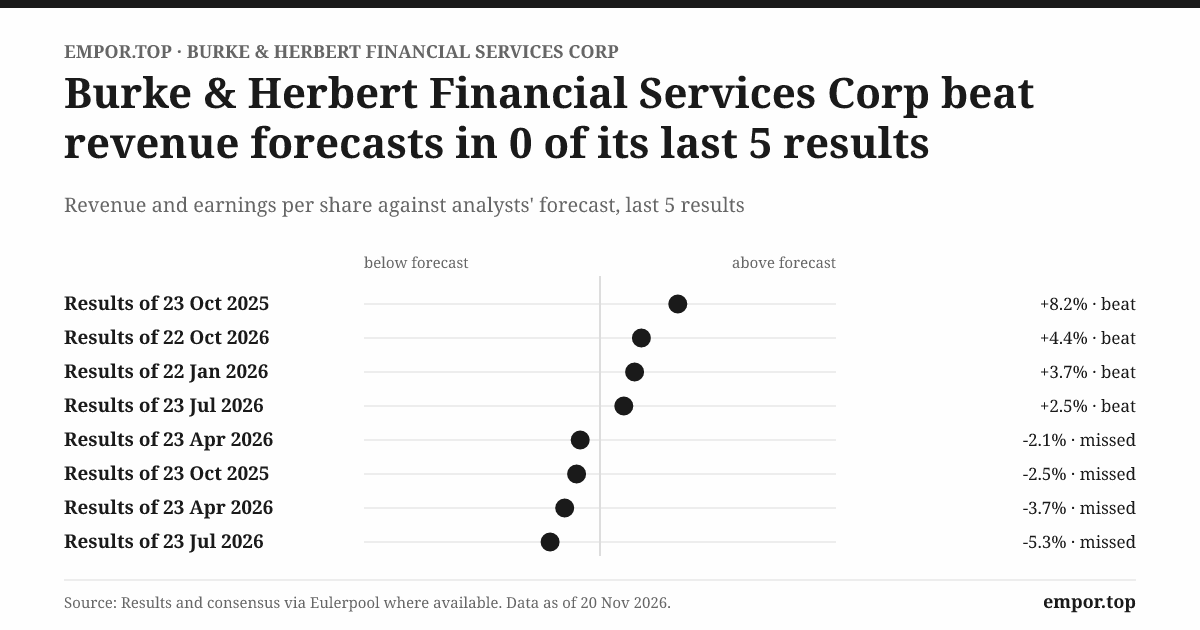
How should one judge this management team's credibility? The fair answer is that the record is short. Boyle's team announced Summit, absorbed a loss-making closing quarter, and then delivered a strong 2025 with higher earnings per share than before the deal. That is a real accomplishment. It then announced LINKBANCORP with specific targets for accretion, dilution and earnback, and closed it quickly. Whether those targets are met cannot be known until 2027 and beyond. The listed company simply has not existed long enough to establish a long history of setting and hitting forecasts. An activist reading the proxy would ask a pointed question: if the integration plan is working, why should shareholders accept a share price below book value and a pay vote once every three years? The answer will not come from the labels "merger of equals" or "relationship bank." It will come from realized returns, and those are what the bull and bear cases ultimately argue about.
IX. Analysis & Bear vs. Bull Case
Here is the scene that frames the debate. On November 20, 2026, a bank that had just reported its first full quarter after its second big merger, with a 4.2% net interest margin and a positive rating outlook, traded at about 9.9 times trailing earnings and about 0.9 times book value.[^6] Its five-year median multiple had been 22.5 times. Its return on equity over the last twelve months was about 9.0%.[^6] Either the market is missing something, or it is seeing something the company's own presentations play down.
Start with the bull case, stated as strongly as the evidence allows. Burke & Herbert now has a contiguous Mid-Atlantic footprint, running from West Virginia through Northern Virginia and Maryland into Delaware and Pennsylvania, assembled at prices that were not obviously rich: around 1.15 times tangible book for Summit, around 1.08 times reported book for LINKBANCORP.24 It has a funding base with little reliance on brokered money and a margin well above LINKBANCORP's stand-alone level.9[^12] The Summit deal, measured by 2025 earnings per share, left shareholders with more profit per share than before.7 If the LINKBANCORP savings arrive as projected, management's own projection of roughly 18% earnings-per-share accretion in 2027 would mean the current multiple is being applied to an earnings base that has not yet fully shown up.9 In that telling, the low multiple reflects merger noise, and noise fades.
Now test that case against the proof required. The adjusted earnings that make the bank look cheap exclude merger costs, which is reasonable, but they include purchase-accounting accretion, which is temporary. The 2025 earnings that validated Summit also contained accretion, as KBRA noted.8 The franchise premium that relationship banking is supposed to create has no filing-level support in the form of retention rates, deposit-pricing comparisons or customer-level economics. So the bull case is plausible, but its central premise, that this is a bank with a durable local edge now earning on a bigger base, rests more on management's description than on measured outcomes.
The bear case is concrete. Commercial real estate is about half of loans on the narrow measure and about 70% on the broad one.4 Allowance coverage of non-performing loans is below 100%, and problem loans rose after the latest merger.4 The share count has grown by about a third in 2026 alone, and tangible book was diluted at closing.49 The integration burden is heavy and arrived immediately after the President who embodied the first merger retired.5 And the bank competes against much larger regional rivals: Atlantic Union, at about $38.4 billion of assets, and TowneBank, at about $22.2 billion, can outspend Burke & Herbert on technology, marketing and talent.1011
A structured look at the industry clarifies which of these concerns are structural. Buyer power is significant on both sides of the balance sheet: depositors can move money with a phone app, and commercial borrowers can solicit bids from banks, credit unions and private lenders. The threat of substitutes is real, especially in commercial real estate, where insurance companies, debt funds and securitization markets all compete for the best loans, and in deposits, where money-market funds and Treasury bills offer higher yields to rate-sensitive savers. Rivalry among existing banks is intense in the Mid-Atlantic, one of the most competitive banking regions in the country. Supplier power, in banking, is mostly about the cost of funds and talent; experienced relationship lenders are scarce and mobile. The barrier that does protect incumbents is regulation: bank charters, capital requirements and supervisory scrutiny make it hard for new entrants to start a deposit-taking bank from scratch. That barrier protects Burke & Herbert from new entrants but not from existing banks.
Through Hamilton Helmer's lens of durable advantages, the picture is similar. Scale economies favor the larger competitors, not Burke & Herbert, because technology, compliance and marketing costs are largely fixed and spread better over a bigger asset base; the mergers narrow that gap but do not close it. Network effects are weak in community banking. Switching costs are the most credible power: small and mid-sized businesses with operating accounts, payroll, treasury management and credit lines bundled together at one bank face genuine friction in leaving. Branding, in the sense of a reputation that lets a company charge more, is plausible in Alexandria, where 174 years of history mean something, and much weaker in markets where the name arrived last spring. Counter-positioning, process power and cornered resources are hard to identify; the bank's local underwriting knowledge is valuable but not unique. The honest summary is that Burke & Herbert has a modest switching-cost advantage with its core commercial clients and a regional, not national, brand, and that neither is yet proven to deliver above-peer returns over a full cycle.
Valuation should be read with those limits in mind. The 9.9 times multiple uses trailing earnings that include a merger-depressed second quarter; annualizing the third quarter's GAAP earnings gives a multiple closer to 9.5 times, and annualizing the adjusted figure gives a little under 8 times.[^12] On the other hand, both of those run-rate figures contain accretion. And the 0.9 times price-to-book figure is measured against total book value of about $76 per share, which includes goodwill and other intangibles from two acquisitions; the price relative to tangible book is meaningfully higher.[^6] The comparison with the bank's own five-year median multiple is also slippery, because the five-year history spans a small pre-merger bank, a loss-making merger quarter and a much larger post-merger bank. Taken together, the market appears to be pricing Burke & Herbert as a bank whose earnings it does not yet fully trust, rather than as one whose growth it has missed.
Three measures will settle the debate more than any narrative. The first is organic growth: loan and deposit balances growing from customer activity once acquired balances are excluded, the only clean evidence that the relationship model travels. The bank reported about $406.9 million of new relationship loan commitments in the third quarter, a start but not yet a trend.[^12] The second is underlying profitability: net interest margin and earnings per share excluding accretion and merger charges, the figures that will show what the bank earns once accounting gifts expire. The third is credit: delinquencies, non-performing loans, provisions and net charge-offs on the commercial property book, with net charge-offs at 0.04% annualized today and non-performing assets rising.4[^12]
The risk radar around those measures is specific rather than generic. Interest-rate sensitivity shows up in the $136.5 million of unrealized securities losses and in the cost of deposits.4 Commercial real estate stress is the dominant credit risk. Technology and cybersecurity investment is a fixed-cost burden that weighs more on a mid-sized bank than on a giant, and the company's own filings flag technology and artificial intelligence as risk areas without estimating their earnings impact.4 Merger execution, meaning systems conversions, customer retention and staff retention, is the near-term operating risk. And uninsured deposits of about 36.5% of the total are the funding vulnerability to watch in any period of stress.[^12] Foreign-exchange risk, by contrast, is not material to a bank that operates and reports entirely in U.S. dollars. The case, in the end, is not that Burke & Herbert is broken or brilliant. It is that the bank has bought itself a chance to prove a claim, and the price reflects how much of that claim is still unproven.
X. Business & Investing Lessons
Go back to the 2023 presentation that introduced the Summit deal. It promised cost savings and earnings accretion.6 Three years later, a similar document introduced LINKBANCORP, with its own promises.9 Between those two decks lies the whole lesson of this story, which is that in banking a merger is not an event. It is a process that begins at closing and ends years later, if it ends well at all.
A bigger map is not yet a better bank. The branch count went from 75 to 105 in a year, and the employee count crossed a thousand.4 Those are numbers anyone can buy with enough stock. What cannot be bought is the organic growth that proves customers in Harrisburg and on the Delmarva Peninsula prefer Burke & Herbert to the bank they had before. For founders and investors in any roll-up, the lesson is to measure the acquirer on what the acquired businesses do after the deal, never on the size of the map on closing day.
In banking, trust is an asset only when the deposits stay. Burke & Herbert's long history in Alexandria is a story about people trusting one bank with their savings. Investors should watch funding costs, deposit mix and the loan-to-deposit ratio to see whether that trust survives the sign change.
Accretion is a forecast; credit losses are the audit. The roughly $9.3 million of acquired-loan accretion in a single quarter here[^12] arrives first. Credit losses on the same acquired book arrive later and are rarely clean. The lesson extends far beyond this bank: when a buyer's earnings rise after an acquisition, separate the part that comes from booking the purchase from the part that comes from running the business better, because only one of them repeats.
The cheapest deal can still be expensive if capital takes years to earn back. Both deals looked reasonable on headline book multiples.24 But the latest deal diluted tangible book value per share and expanded the share count by roughly a third.49 A fair price on a multiple is only half the bargain. The other half is how long the buyer's own owners wait to be made whole, and whether they are made whole at all.
Local history opens the door; current execution keeps it open. Burke & Herbert's name carries history in Alexandria; in a new market, it is a stranger's name. The broader lesson for heritage businesses that expand by acquisition is that legacy lowers the cost of the first conversation, but it does not win the hundredth. The young public company now has to earn, in each new town, the reputation the old bank took generations to build at home.
XI. Epilogue
As of November 20, 2026, Burke & Herbert is a bank of about $11 billion in assets, 105 branches and roughly 20 million shares, trading a little below its book value.4[^6] It has a positive outlook from its rating agency, a fresh $100 million of subordinated debt, a margin above 4%, and a rising pile of non-performing loans it says are isolated.4[^12]1216 It is, in other words, a bank on the eve of its most important year as a public company, the first full year after LINKBANCORP.
The next moments are already on the calendar. The fourth-quarter results, due early in 2027, will be the second full quarter with LINKBANCORP and the first to show the bank across a year-end, with its seasonal deposit flows and annual credit review. Then come the quarterly reports of 2027, the year in which management projected about 18% earnings-per-share accretion from the deal.9 Those reports will reveal the most important answers in a sequence: first whether merger costs fade from the income statement, then whether the promised savings appear as lower operating expenses, then whether the earnback toward the 3.2-year target is on schedule.
If loan and deposit balances grow from new customers rather than acquired ones, the relationship thesis will have its first real proof. If they shrink as acquired customers drift away, the bank will have bought a footprint it cannot hold. If the problem loans that rose in 2026 are resolved without material charge-offs, as management predicted, its credit judgment will gain credibility; if charge-offs climb, the half of the loan book tied to commercial property becomes the dominant story. If tangible book value per share and capital ratios recover while the dividend and the new subordinated coupon remain comfortably covered, the stock-funded growth strategy will look prudent. If not, the dilution will have been the price of size rather than the price of strength.
The rating agency will be watching the same things. KBRA's move to a positive outlook in September 2026 is a starting point for surveillance, not a conclusion, and the agency has said what would move it: diversification away from commercial real estate and more fee income on the upside, materially higher credit losses on the downside.812 That makes the bank's central question unusually clear. Over the next four quarters, investors will learn whether scale is producing more resilient earnings or simply adding more exposure and more accounting complexity. The answer will arrive one earnings release at a time.
XII. Outro
Return, one last time, to the corner of King and Fairfax in Alexandria, where the bank opened in 1852. Its promise was personal, a relationship that carried it through the decades.
Today the same name stands over branch doors in six states, attached to a balance sheet about three times the size it was when the company first listed its shares, assembled through two mergers in two years.14 Burke & Herbert is trying to do something few banks manage: to keep the intimacy of a local bank while acquiring the reach of a regional one. The branch door is now opening in towns that never heard of Alexandria. The real test is not whether the door opens. It is whether the customers, the deposits and the sound loans walk through it, and stay.
References
-
Burke & Herbert Financial Services Corp. Form 10 Registration Statement (Amendment) — SEC, 2023-04-20 ↩↩↩↩↩↩↩↩↩↩↩↩
-
Burke & Herbert and Summit Financial Group Joint Proxy Statement/Prospectus — SEC, 2023-10-16 ↩↩↩↩↩↩↩↩
-
Burke & Herbert Financial Services Corp. Form 10-Q for the quarter ended September 30, 2026 — SEC, 2026-11-06 ↩↩↩↩↩↩↩↩↩↩↩↩↩↩↩↩↩↩↩↩↩↩↩↩↩↩↩↩↩↩↩↩↩↩↩
-
Burke & Herbert Financial Services Corp. 2026 Proxy Statement — SEC, 2026-04-30 ↩↩↩↩↩↩↩↩↩↩↩↩↩↩
-
Burke & Herbert and Summit Merger Investor Presentation — SEC, 2023 ↩↩↩↩
-
Burke & Herbert Financial Services Corp. 2025 Form 10-K — SEC, 2026-02-27 ↩↩↩↩↩↩↩↩↩↩↩↩↩↩↩
-
KBRA Affirms Ratings for Burke & Herbert Financial Services Corp. — KBRA, 2025-09-23 ↩↩↩↩↩↩↩↩
-
LINKBANCORP Merger Agreement Investor Presentation — Burke & Herbert, 2025-12-18 ↩↩↩↩↩↩↩↩↩↩↩
-
Atlantic Union Bankshares Form 10-Q for the quarter ended September 30, 2026 — Atlantic Union Bankshares, 2026-11-03 ↩↩
-
TowneBank Reports Third Quarter 2026 Earnings — TowneBank, 2026 ↩↩
-
KBRA Releases Surveillance Report for Burke & Herbert Financial Services Corp. — KBRA, 2026-09-28 ↩↩↩
-
Burke & Herbert Second Quarter 2026 Earnings Release — SEC, 2026-07-23 ↩↩
-
Burke & Herbert Second Quarter 2026 Investor Presentation — SEC, 2026-07-23 ↩
-
Burke & Herbert Form 8-K/A on Say-on-Pay Vote Frequency — SEC, 2026-06-18 ↩↩
-
Burke & Herbert 7.00% Fixed-to-Floating Subordinated Notes Prospectus Supplement — SEC, 2026-09-30 ↩↩↩
 LinkedIn
 WhatsApp
 Reddit
 Hacker News
 Email
 Kindle
 RSS Feed
 Spotify
 Apple Podcasts
 Amazon Music
 Audible
 YouTube