Atlantic Union Bankshares Corporation: The Mid-Atlantic Banking Playbook
I. Introduction & Episode Roadmap
On the evening of July 21, 2026, a bank that began life in a Virginia farm town of roughly a thousand people reported a quarter in which it earned $158.0 million for its common shareholders — $1.11 per share — on a balance sheet of $38.1 billion.1 Fifteen months earlier, the same company had reported a quarter in which it earned twelve cents a share.2 Nothing about the underlying business had changed in the interim. What changed was accounting, and what accounting was obscuring was the arrival of a genuinely different institution.
That whipsaw — from twelve cents to a dollar-eleven — is the entire Atlantic Union Bankshares story compressed into five quarters. It is a story about what happens when a mid-sized bank decides that the only way to survive the regulatory and technological cost curve of modern banking is to buy its way to scale, absorbs two acquisitions in thirteen months, eats an enormous non-cash charge to do it, sells $2 billion of the acquired loans to Blackstone within ninety days of closing, and then asks investors to believe the earnings power on the other side is real.
The strategic problem Atlantic Union set out to solve is one every regional bank in America recognizes. Call it the squeezed middle. Above sit JPMorgan Chase, Bank of America, and Wells Fargo — institutions that spend more on technology annually than Atlantic Union earns in a decade, and that have used that spending to build mobile applications and payment rails a $10 billion bank simply cannot replicate. Below sit hundreds of community banks with one advantage the megabanks cannot buy: the loan officer knows the borrower's name, the credit committee meets down the hall, and a decision takes days rather than weeks. In between sits a cohort of banks large enough to carry full regulatory infrastructure but too small to amortize it — the worst of both worlds.
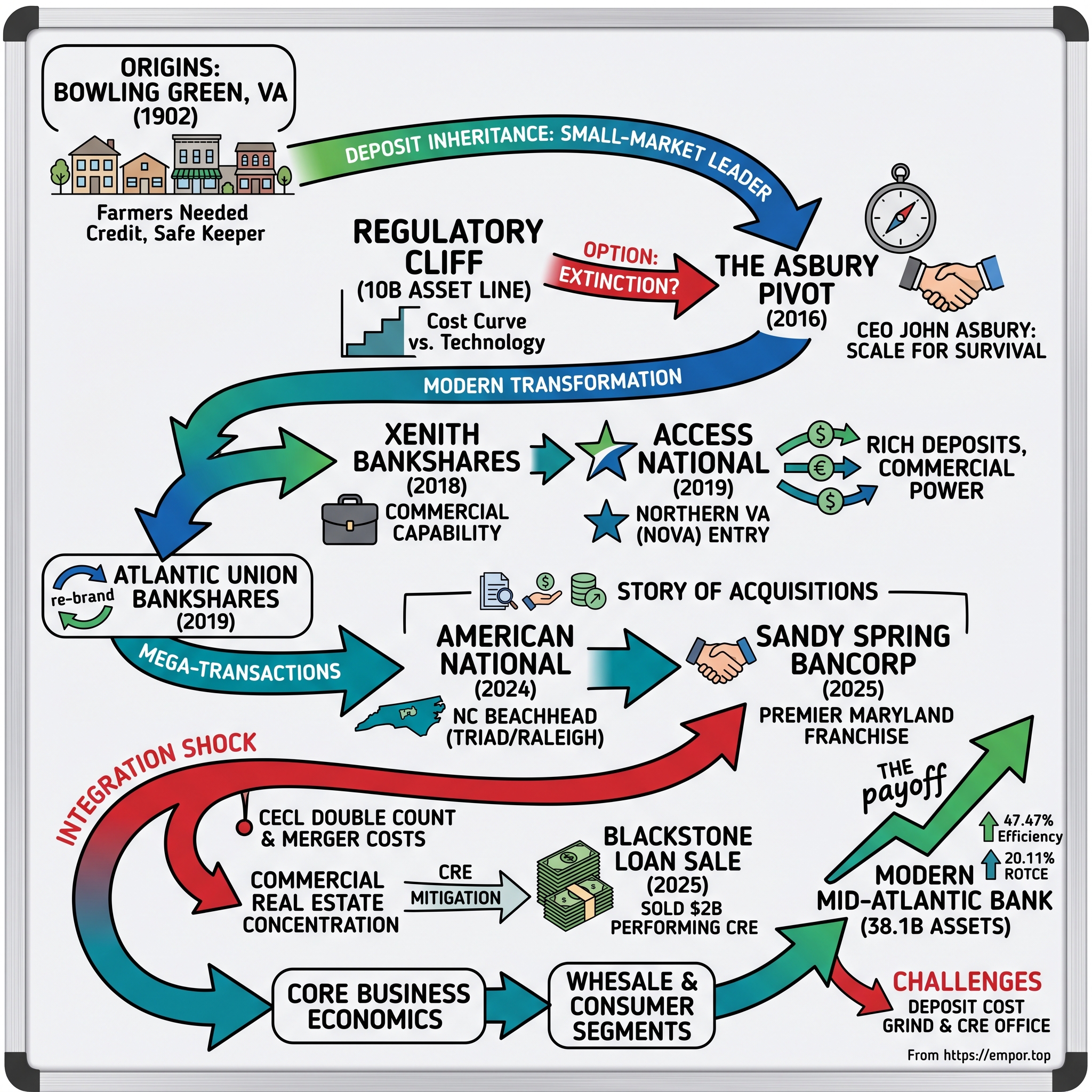
Atlantic Union's answer, articulated by CEO John Asbury from the moment he arrived in 2016, was blunt: get big enough that the fixed costs stop hurting, and stay close enough to the customer that the relationship still matters. Asbury told his own board that crossing the $10 billion asset threshold left the company two options — become a $13 to $15 billion institution, or face extinction.3 It is now roughly three times that size.
Whether that answer has actually worked is the question this piece tries to answer honestly. The evidence is genuinely mixed in an interesting way. On one side: an adjusted operating efficiency ratio of 47.47% and adjusted operating return on tangible common equity of 20.11% in the most recent quarter — numbers that, if durable, put the franchise in the upper tier of American regional banking.1 On the other: those numbers rest on purchase accounting accretion that mechanically fades, a loan book where nearly a third came from an acquired institution whose credit culture is only two years inside the tent, and a deposit franchise where non-interest-bearing balances have drifted to roughly 22% of the total as customers learn to sweep every idle dollar into something that pays.4
Here is the road we will travel. First, the long Virginia foundation — kept brief, because 1902 matters mostly as an explanation of why this bank still owns deposit share in towns most investors have never heard of. Second, the Asbury era, when a federation of Virginia community banks was reassembled into a commercial bank with a single brand and a single core system. Third, the mega-transactions — American National in 2024 and Sandy Spring in 2025 — which we will examine as deal math, not press release. Fourth, the economics of the business as it actually operates today. Then competition, management, strategic frameworks, and the bull and bear cases, with an explicit stress test of what would have to go wrong for the current story to break.
The recurring theme is the tension between two things that are both true: consolidation is genuinely the correct strategic response to the economics of mid-sized banking, and consolidation is also the single most reliable way for bank management teams to destroy shareholder capital. Atlantic Union has bet the franchise that it belongs in the first category. The proof is still being assembled.
 Subscribe on LinkedIn
II. Roots & Evolution: Building the Virginia Foundation (1902–2015)
Bowling Green, Virginia, sits in Caroline County about halfway between Richmond and Fredericksburg, in country that in 1902 was tobacco, timber, and not much else. The Union Bank and Trust Company opened there that year for the most ordinary of reasons: farmers needed credit between planting and harvest, merchants needed somewhere to keep the till overnight, and the nearest alternative was a day's travel.5 There is no origin myth here, no visionary founder sketching a future franchise. There is a ledger, a safe, and a town.
That is precisely why the early history matters, and why we will not linger in it. What Union built over its first century was not a strategy but an inheritance: physical presence in dozens of small Virginia markets where, decades later, it would still hold the number one or number two deposit position because no one else ever bothered to show up. Deposit share in a rural county is not glamorous. It is also nearly impossible to attack, and it is the cheapest funding in American banking. Every subsequent chapter of this story is, in some sense, an attempt to convert that inherited low-cost funding into higher-return commercial assets somewhere else.
The consolidation instinct arrived early. Through the 1990s and 2000s, Union Bankshares assembled itself as a holding company for a set of affiliate banks across Central Virginia and the Shenandoah Valley — separate charters, separate boards, separate brands, loosely federated. This was a common structure for its era and a genuinely defensible one at the time: local boards made local credit decisions and local names carried local trust. It was also, as the industry would learn, a structure that multiplied cost. Every affiliate needed its own compliance function, its own audit, its own systems.
The pivot came in 2010. Union merged with First Market Bank, a Richmond institution founded in 1997 as a joint venture with Ukrop's Super Markets — the beloved Richmond grocery chain that had put bank branches inside its stores. The combined company took the name Union First Market Bankshares, and in the same year moved to consolidate its remaining affiliate banks into a single charter.6 Two things happened at once, and both mattered more than the headline. Union acquired real density in Richmond, the state's second-largest metropolitan economy and the seat of its corporate and legal establishment. And it began dismantling the federated structure that had made it a collection of banks rather than a bank.
The Ukrop's connection deserves a moment, because it explains something about the deposit base that persists to this day. In-store branches gather retail deposits from ordinary households doing ordinary shopping. These are small balances, they are almost entirely FDIC-insured, and they are extraordinarily sticky — a household does not move its checking account because a competitor offers twenty-five extra basis points. The granularity that would later prove decisive in 2023 was, in part, a legacy of grocery-store banking.
The 2008 crisis is the other piece of inherited advantage worth naming. Virginia's real estate market went through the crisis badly but not catastrophically. It had nothing resembling the speculative construction booms of Florida, Nevada, or the Inland Empire, and Virginia banks broadly had not loaded up on the exotic mortgage products that killed institutions elsewhere. Union came through with capital intact. The lesson institutionalized inside the company was not "we are brilliant underwriters" — it was closer to "we did not do the stupid thing, and the survivors get to buy." That distinction matters analytically. A conservative credit culture inherited from geography is not the same as a conservative credit culture built by design, and investors should be careful about which one they are underwriting.
There is a second, quieter inheritance from this era that shaped everything after: the regulatory clock. The Dodd-Frank framework that emerged from the crisis attached escalating supervisory expectations to asset thresholds, most consequentially at $10 billion, where a bank picks up direct Consumer Financial Protection Bureau examination, interchange fee limits under the Durbin Amendment, and stress testing obligations. For a bank approaching that line, the arithmetic is brutal and entirely predictable: costs step up in a discontinuous jump while revenue grows continuously. A bank that crosses $10 billion and stops there has bought the expense without the scale to carry it. That structural fact — not ambition, not empire-building — is the honest explanation for why nearly every American bank in the $8 to $12 billion range spent the following decade either buying or being bought.
By 2015, then, the picture was this: a roughly $7 billion Virginia bank with excellent small-market deposit share, a growing Richmond presence, a newly unified charter, a clean balance sheet, and no particular commercial banking capability to speak of. It was, in the language of the industry, a good thrift-like franchise attached to a mediocre commercial bank. That gap — great funding, unremarkable asset generation — was the specific problem the next chapter would attack, and it required someone from outside Virginia to see it clearly.
III. The Modern Transformation: The Asbury Era & Northern Expansion (2016–2023)
John Asbury describes himself as "just a guy from Radford."3 The self-deprecation is real but it conceals a career built almost entirely inside institutions far larger than the one he came to run. He graduated summa cum laude from Virginia Tech's Pamplin College in 1987, started in the management training program at Wachovia in Winston-Salem, and then spent seventeen years at Bank of America, leaving as the Pacific Northwest Region Executive for Business Banking. He joined Regions Bank in 2008 and rose to Senior Executive Vice President heading the Business Services Group. He ran First National Bank of Santa Fe as President and CEO from early 2015 until the summer of 2016.7 Then he came home to Virginia.
He had wanted to be a pilot. At eighteen, attending the Air Force Academy, his eyesight changed and the ambition ended; he later trained as a civilian pilot and gave that up too when bank leadership discouraged it.3 It is a small biographical detail that says something about the man's tolerance for constraint. Asbury has spent a career operating inside institutions where the rules were written elsewhere, and he arrived at Union in October 2016 succeeding a CEO who had held the job for twenty-six years.7
What he saw was a bank whose funding was better than its lending. The strategic vision he set out was not subtle and has been remarkably consistent ever since: convert a Virginia community banking federation into a genuine Mid-Atlantic commercial bank, with the product set, the credit infrastructure, and the geographic reach to bank companies rather than just households. Everything that followed was in service of that sentence.
Buying the capability the bank did not have
The first move came fast. Union agreed to acquire Xenith Bankshares in an all-stock transaction valued at approximately $701.2 million, closing January 1, 2018.89 Xenith was not a deposit-gathering franchise in the Union mold — it was a commercial lender concentrated in Hampton Roads and Greater Richmond, with the commercial real estate and middle-market capability Union lacked. The company described the combination as creating the first Virginia-headquartered regional bank in nearly two decades.9 Strategically, the point was straightforward: Union had cheap money and no one to lend it to profitably; Xenith had lenders.
Thirteen months later came the more consequential deal. Union completed its acquisition of Reston-based Access National Corporation on February 1, 2019, in an all-stock transaction announced at approximately $610 million.1011 Access brought Northern Virginia — the Reston and Tysons Corner corridor, the wealthiest concentration of business banking opportunity in the state — along with a wealth management business and relationships in the government contractor ecosystem that surrounds the federal procurement complex. Northern Virginia is where the money is in Virginia. Union had been effectively absent.
The same announcement carried the rebrand: Union Bank & Trust would become Atlantic Union Bank, with the holding company following as Atlantic Union Bankshares in 2019.10 Renaming a bank is usually a vanity exercise. This one was substantive for two reasons. First, the geographic claim was deliberate — "Union" was a Virginia name, "Atlantic Union" was a regional ambition stated out loud, and management was signaling to investors and to acquisition targets what it intended to become. Second, and more importantly, the rebrand was paired with the operational work of collapsing legacy operating systems onto a single core platform. A bank running multiple cores cannot deliver a consistent product, cannot report cleanly, and cannot integrate the next acquisition quickly. The unglamorous decision to standardize the technology stack in 2018 and 2019 is what made the 2024 and 2025 transactions executable at all.
Investors should hold that observation loosely, though. Management teams routinely claim integration competence; the honest test is what happens under load, and that test would not come for another five years.
The pandemic, and what a crisis reveals
In the spring of 2020, the Paycheck Protection Program landed on American banks as an operational shock. Atlantic Union processed roughly 11,000 PPP loans totaling about $1.7 billion, including for businesses that were not customers — Asbury personally fielded calls from home in the evenings.3 The megabanks, constrained by their own onboarding and compliance architecture, were notably slower to serve non-customers.
The financial return on PPP was modest. The strategic return was not. A commercial operating relationship — the account through which a company runs payroll, receivables, and treasury — is the single stickiest product in banking, and PPP handed regional banks a once-in-a-generation opportunity to acquire thousands of them from institutions that fumbled the moment. This is the clearest available evidence that Atlantic Union's "big enough to compete, small enough to care" positioning is more than a slogan: under a genuine stress test with a hard deadline, the bank's decision speed was an advantage. It is worth noting that this evidence is now six years old, and that the relevant comparison — a $38 billion bank against a $3 trillion one — is different from the comparison that applied in 2020.
March 2023, and the value of boring deposits
When Silicon Valley Bank failed in March 2023, followed within weeks by Signature Bank and First Republic, the market did not stop to distinguish between regional banks. It sold all of them. The specific mechanism that killed those institutions was a lethal pairing: enormous concentrations of uninsured deposits held by a small number of sophisticated, digitally networked customers, funding long-duration securities carried at amortized cost with unrecognized losses underneath. When the depositors moved, the securities had to be sold, and the losses became real.
Atlantic Union had close to none of that. Its deposit base was granular, heavily insured, spread across households and small businesses in Virginia towns, with no venture capital concentration and no crypto exposure. The bank did not experience a run.
That said, the balance sheet was not costless. Atlantic Union had already begun repositioning: across January, February, and March 2023 it sold available-for-sale securities with a total book value of $505.7 million at a pre-tax loss of $13.4 million, using the proceeds to pay down high-cost Federal Home Loan Bank borrowings and improve liquidity.12 The company earned $35.7 million in the first quarter of 2023, or $0.44 per share.13 These are the actions of a management team managing a real, if survivable, problem — taking a certain loss to remove an uncertain one.
The deeper lesson from 2023 was about competitive positioning, and Asbury clearly drew it. The crisis did not merely spare well-funded regionals; it accelerated the consolidation of everyone else. Banks with damaged securities portfolios, unhappy boards, and no path to scale became sellers. Atlantic Union, with capital intact and a unified operating platform, was about to become a very active buyer.
IV. The Mega-Transactions: American National & Sandy Spring Bancorp (2024–2025)
Danville, Virginia, is a former tobacco and textile town on the North Carolina line that lost most of its industrial base and has spent two decades trying to find a second act. It is not where you would expect a growth story to begin. But American National Bankshares, headquartered there since 1909, had something Atlantic Union wanted more than Danville: a franchise that reached across the state line into the Piedmont Triad and Raleigh.
American National: the small deal that was really about North Carolina
Atlantic Union completed its acquisition of American National on April 1, 2024. Shareholders received 1.35 Atlantic Union shares for each American National share, producing an aggregate transaction value of approximately $507 million based on Atlantic Union's closing price of $35.31 on March 28, 2024. The deal added 26 branches and, on a pro forma basis as of December 31, 2023 and before merger adjustments, produced a company with $24.3 billion in total assets, $19.4 billion in deposits, and $17.9 billion in loans held for investment.14
Read the map rather than the multiple and the logic is clear. Central, Western, and Southern Virginia were fill-in — more of what Atlantic Union already did well, at incrementally better density. The Piedmont Triad and Raleigh were something else entirely: the first real beachhead in a state whose demographics run considerably ahead of Virginia's. Danville was the price of admission to Raleigh.
The all-stock structure is worth pausing on. Bank acquirers use stock when they want to share integration risk with the seller and preserve capital, and cash when they are confident and want to keep the accretion. Atlantic Union has used stock in every large transaction of the Asbury era. That is defensible discipline. It is also dilutive by construction, and it means the acquirer's own currency does a lot of the work — a deal announced when your stock is expensive is a very different transaction from the same deal announced when it is cheap.
Sandy Spring: the deal that redefined the company
On October 21, 2024, Atlantic Union announced an agreement to acquire Sandy Spring Bancorp in an all-stock transaction valued at approximately $1.6 billion, with Sandy Spring holders receiving 0.900 Atlantic Union shares apiece — about $34.93 per share at the time.15 Sandy Spring was the premier independent bank in Maryland, rooted in Montgomery and Howard Counties with reach into Baltimore and the D.C. suburbs, and it brought roughly $14.4 billion in assets, $11.7 billion in deposits, $11.5 billion in loans, and 53 branches.15 It was the third-largest announced bank acquisition of 2024.15
The strategic case was the strongest Asbury had ever put in front of investors. The combination would create the largest regional banking franchise headquartered in the lower Mid-Atlantic, marrying the leading independent bank in Virginia to the leading independent bank in Maryland across a contiguous, wealthy, government-anchored corridor.16 Pro forma figures based on September 30, 2024 data pointed to roughly $39.2 billion in assets, $32.0 billion in deposits, and $29.8 billion in gross loans.15 The wealth business would roughly double, adding more than $6.5 billion in assets under management.15
The deal math, as presented, was aggressive. Management guided to cost savings of approximately 27% of Sandy Spring's expense base, EPS accretion of roughly 28% in 2026, and a tangible book value earnback of about two years on a crossover basis. Atlantic Union also raised $336 million by selling 9.9 million shares at $35.50 to pre-fund the capital impact.15
Those are attractive headline numbers, and investors should treat each with a different level of skepticism. Cost savings of 27% on an in-market target with overlapping geography are achievable — this is the most reliably delivered item in bank M&A, because the costs being removed are duplicate systems, duplicate back offices, and duplicate executives, all of which are identifiable before signing. EPS accretion of 28% is a fully-phased-in figure that assumes those savings are realized and that revenue attrition is minimal, which is a considerably heavier assumption. A two-year TBV earnback on a crossover method is genuinely fast by industry standards, but the crossover method is the more flattering of the two conventions in common use, and comparisons across deals should be handled carefully.
The commercial real estate problem, solved with a phone call to Blackstone
The most interesting thing about the Sandy Spring transaction was disclosed at announcement rather than discovered afterward. Sandy Spring carried a heavy commercial real estate book. Combined, the two banks would have sat uncomfortably close to the 300% of total risk-based capital threshold that triggers heightened regulatory scrutiny under interagency CRE concentration guidance. Atlantic Union's answer was to announce, up front, its intention to sell up to $2 billion of Sandy Spring commercial real estate loans — a move projected to bring the pro forma concentration ratio to roughly 285%, safely under the line, and to pull the loan-to-deposit ratio below 90%.15
The execution followed within months of closing. In June 2025, Atlantic Union sold approximately $2 billion of performing commercial real estate loans by unpaid principal balance to Blackstone Real Estate Debt Strategies, at a price in the low 90s as a percentage of par, retaining customer-facing servicing.1718 The loans carried at roughly $1.8 billion and the transaction produced a modest pre-tax gain of $10.9 million. Asbury framed the sale as delivering on post-merger goals: reducing CRE concentration and creating capacity for future growth.17
This is a genuinely revealing episode, and it cuts in two directions at once. Positively, it demonstrates that management identified a structural problem before signing, disclosed it publicly, priced it into the deal, and executed the fix in under ninety days — a sequence that is rarer in bank M&A than it should be. Less comfortably, it is an admission that the acquired institution's loan book was not something Atlantic Union wanted to own at that size, which raises a fair question about what else came with it. Selling performing loans at low 90s of par is not a distressed outcome, but it is not free either; the discount is the cost of the concentration.
The quarter that looked like a disaster
Then came the accounting. For the second quarter of 2025 — the first with Sandy Spring inside the tent — Atlantic Union reported net income available to common shareholders of $16.8 million, or $0.12 per share. Adjusted operating earnings for the same quarter were $135.1 million, or $0.95 per share.2
The gap of roughly $118 million was almost entirely two items: $78.9 million of merger-related costs, and $100.9 million of CECL Day 1 provision expense, consisting of an $89.5 million reserve on purchased non-credit-deteriorated loans plus $11.4 million for unfunded commitments.2
That second item deserves a plain-English explanation, because it is the single most misunderstood number in bank M&A. Under current expected credit loss accounting, when an acquirer buys a loan portfolio, it first marks those loans down to fair value — a mark that already embeds expected credit losses. Then, for loans not classified as credit-deteriorated, accounting requires the acquirer to establish a fresh allowance for those same expected losses, funded through the income statement. The bank charges itself twice for one set of losses. The industry calls this the CECL "double count," and it is a bookkeeping artifact, not an economic event. The offsetting credit mark flows back into earnings over subsequent years as accretion income.
Which sets up the central analytical tension of everything that follows. The $100.9 million charge made 2025 earnings look far worse than reality. The accretion income now flowing through the margin makes 2026 earnings look somewhat better than the underlying franchise. In the second quarter of 2026, reported net interest margin was 3.94% on a tax-equivalent basis, while core net interest margin — stripping purchase accounting — was 3.46%.4 That 48 basis point gap is the accounting tailwind, and it will fade. Any investor evaluating this company needs to watch the core number, not the headline.
What management said, and how they said it
The Sandy Spring core systems conversion completed on October 14, 2025, roughly six months after legal closing and on the timeline management had signaled at announcement.19 Maria Tedesco, President and Chief Operating Officer, attributed the outcome to a detailed merger integration playbook developed from the moment of announcement.19 Tedesco has separately described it as the smoothest conversion in a career spanning some thirty banks, and Asbury and Tedesco asked employees across the company to staff customer phone lines through the conversion weekend.3 Conversion weekends are where bank mergers die; this one did not.
On the calls themselves, the pattern in Asbury's answers has been consistency rather than eloquence. Through the merger sequence, management repeatedly returned to the same three commitments — cost savings, CRE reduction, and profitability targets — and analysts have been able to check them off in order. By the second quarter of 2026, CFO Alex Dodd told analysts the company remained "confident that we will achieve all three of these targets over the medium term, which we define as this year and next," and disclosed that the return on assets and return on tangible common equity targets had already been reached.4
Two things are notable about the tone. First, management has been willing to give specific, falsifiable numbers — guidance ranges, target ratios, earnback periods — rather than directional language. That is a credibility-positive habit, because it creates a scoreboard. Second, when analysts have pressed on uncomfortable items, the answers have been quantitative rather than evasive: on deposit costs, Dodd conceded a "cost of funding that is going up higher than we expected" and gave the specific figure of a two basis point increase in June; on buybacks, he put the earn-back at about four years rather than deflecting.4 Conceding a negative with a number attached is a better signal than most bank management teams provide.
The skeptic's counterpoint is that it is easy to be transparent while beating your targets. The real test of a management team's disclosure culture arrives during the quarter something breaks, and Atlantic Union has not yet had that quarter under the enlarged balance sheet.
V. Core Business Economics & Segment Breakdown
Strip away the deal history and what remains is a machine with a simple job: gather deposits cheaply in places where competition is thin, and lend them at a spread in places where the economy is growing. Atlantic Union's franchise is unusual because the two halves of that sentence increasingly refer to different geographies.
The map is the strategy
The operating footprint now runs across Virginia, Maryland, Washington D.C., and North Carolina, with the company describing itself as the largest regional banking franchise headquartered in the lower Mid-Atlantic.16 Within that footprint, three distinct economies are doing three different jobs.
The Northern Virginia and Washington corridor is the profit engine — some of the highest median household incomes in the United States, an enormous federal contracting ecosystem, professional services, and data center construction. This is where commercial loan demand is richest and where the competition is fiercest. Maryland, added through Sandy Spring, extends the same demographic into Montgomery and Howard Counties and toward Baltimore. Richmond, Fredericksburg, Hampton Roads, and the small Virginia markets provide the funding: granular, insured, sticky retail deposits gathered where the alternatives are limited. In several of those markets Atlantic Union holds a leading deposit position — the kind of share that exists only where an institution has been present for generations and no national competitor ever found the market worth attacking.
North Carolina is the third leg, and it is being built rather than bought. The company has been executing a densification strategy focused on Raleigh and Wilmington, with ten new branches planned; three Raleigh branches opened during 2026 with Wilmington to follow, and management reported double-digit loan balance growth in the state driven by new wholesale banking hires.4 This is an important tell about strategic direction. Building branches organically in a new state is slower and less accretive than buying a bank there, and management has chosen it deliberately.
An honest caveat: the Washington corridor's exceptional demographics are underwritten by federal spending, and the composition of that spending has been unusually volatile in recent years. A regional bank whose best market is the federal contracting complex carries a policy exposure that does not show up anywhere in its credit metrics until it does.
Wholesale banking: where the money is made
Atlantic Union reports in two segments — Wholesale Banking and Consumer Banking.20 Wholesale is the value driver.
The commercial and industrial book spans middle-market lines of credit, government contractor financing, and equipment finance conducted through Atlantic Union Equipment Finance, a non-bank affiliate that lends against marine equipment, tractors, trailers, buses, and construction machinery.20 Equipment finance is an instructive addition: it is a specialty business with yields above conventional C&I lending, it can be originated outside the branch footprint, and it carries collateral that is genuinely repossessable. It is also a business that historically deteriorates early in a downturn, which makes it a useful leading indicator.
Commercial real estate remains the larger exposure and the more scrutinized one. Even after the Blackstone sale brought the concentration ratio back under the 300% supervisory threshold — consistent with the roughly 285% pro forma level management had targeted at announcement15 — CRE is the portfolio that determines whether this credit cycle is kind to Atlantic Union. The relevant sub-segments behave very differently: owner-occupied CRE is effectively C&I lending with a building attached and behaves like the operating business; multifamily and industrial have held up through the cycle; suburban office is the structurally impaired category, and Northern Virginia and suburban Maryland office is among the more challenged office markets in the country given the persistence of hybrid work in a federal and professional-services labor force.
What the reported numbers currently show is calm. In the second quarter of 2026, nonperforming assets stood at 0.39% of loans held for investment, annualized net charge-offs were 3 basis points, and the allowance for credit losses was $331.0 million, or 1.15% of loans.1 Management was confident enough to lower full-year net charge-off guidance to a range of 5 to 10 basis points.4
Three basis points of charge-offs is an extraordinarily low number by any historical standard, and investors should be careful about what it means. It is evidence that nothing is currently breaking. It is not evidence of underwriting skill, because credit losses are a lagging indicator that reveal themselves at the end of a cycle rather than the middle. A portfolio one-third of which was acquired two years ago and marked to fair value at acquisition will naturally show suppressed charge-offs, because losses that would otherwise flow through the income statement were absorbed in the purchase accounting mark. The honest reading is that credit is fine and the data cannot yet tell you more than that.
Consumer banking and the deposit franchise
The consumer bank exists primarily to fund the commercial bank. This is not a criticism — it is the economic logic of nearly every successful regional bank in America. What matters is the quality of that funding, and the trend is where the pressure is showing.
In the second quarter of 2026, total deposits stood at $30.5 billion at a cost of 1.93%, with non-interest-bearing balances at roughly 22% of the total.14 Management attributed continued migration into interest-bearing accounts to commercial clients actively optimizing working capital through sweep accounts and treasury management products, and guided to a cost of new interest-bearing deposits between 3% and 3.5%.4
That deserves translation. A non-interest-bearing deposit is free money — a business checking account that pays nothing while the bank earns a yield on it. For decades, banks assumed a stable base of these balances. Since 2022, corporate treasurers have systematically hunted down every idle dollar, and the tools banks themselves sold them — sweeps, treasury workstations — made it easy. The result is a structural, industry-wide shrinkage in free funding that does not reverse when rates fall, because the behavior has been learned. Twenty-two percent is a respectable figure for a commercially-oriented bank. The direction of travel is the concern, and it is the single most important slow-moving headwind facing the franchise.
Branch strategy sits at the intersection. Atlantic Union continues to invest in physical locations in core markets while the industry closes them, on the theory that branch density drives deposit gathering and small business relationships in a way digital channels do not. The North Carolina buildout is that theory being spent against. It is a reasonable bet and an unproven one; the counterargument is that new branches in a market where you have no brand take years to gather profitable deposits, and the cost lands immediately.
Wealth management: the underappreciated leg
Wealth management and trust — delivered through Atlantic Union's wealth platform and expanded materially by Sandy Spring's business — provides fee income that does not depend on the shape of the yield curve.20 The Sandy Spring transaction was expected to roughly double the wealth business by adding more than $6.5 billion in assets under management.15
The strategic case for fee income in a bank is straightforward: it diversifies earnings away from net interest margin, it carries high incremental margins because the infrastructure is largely fixed, and it deepens client relationships in ways that make the underlying deposits stickier. Sandy Spring also brought capital markets capability that has produced measurable results — in the second quarter of 2026, teams from the legacy Sandy Spring franchise originated 27% of interest rate swap transactions and 32% of foreign exchange revenue.4
That last statistic is the most concrete evidence available that the Sandy Spring acquisition delivered capability rather than just balance sheet. Cost synergies are subtraction; revenue synergies are the hard part, and most bank acquirers promise them and quietly stop discussing them. Atlantic Union has produced specific, attributable numbers. The caution is scale: fee income remains a modest contributor relative to net interest income, so the wealth and capital markets story is optionality rather than thesis.
How the margin actually works
Net interest income is the whole game, and its mechanics deserve to be stated plainly. The bank earns a yield on loans and securities and pays a cost on deposits and borrowings; the difference, expressed against earning assets, is the net interest margin.
In the second quarter of 2026, the tax-equivalent margin was 3.94%, up 9 basis points from the prior quarter on higher earning-asset yields, higher loan yields, and increased loan accretion income.14 Management tightened full-year margin guidance to 3.90%–3.95% and guided to full-year tax-equivalent net interest income of $1.32 to $1.33 billion inclusive of accretion.4 New loan production was being written at spreads of roughly 200 basis points for both variable and fixed-rate credits.4
Two forces are pulling in opposite directions. Accretion income from the acquisitions is currently additive and will decline as acquired loans pay down. Deposit costs are grinding higher as the mix shifts. The core margin of 3.46% is the number that reveals which force wins.4 If core margin holds or expands as accretion fades, the franchise economics are genuinely strong. If core margin drifts down while accretion disappears, reported margin falls twice as fast as it looks like it should. This is the mechanical heart of the investment question, and it is knowable from quarterly disclosure.
That mechanical question, though, is contested in a market where every competitor is running the same playbook.
VI. Competition & Industry Landscape
Picture the pitch meeting. A $60 million-revenue government services contractor in Tysons Corner needs a $15 million revolving credit facility, treasury management, and someone to handle its foreign exchange exposure. Four institutions want the business, and each is playing a fundamentally different game.
The megabanks
Bank of America, Wells Fargo, and Truist bring capabilities Atlantic Union cannot match at any price: global payments infrastructure, capital markets underwriting, mobile applications refined by billions in annual technology spending, and legal lending limits large enough that no client ever outgrows them. In Richmond, the concentration is stark — Bank of America came to control roughly half of all local deposits in recent FDIC market share data.21
What the megabanks give up is decision architecture. Credit approval for a $15 million middle-market facility at a trillion-dollar institution runs through a centralized process with standardized parameters; the local relationship manager is a conduit, not a decision-maker. Atlantic Union competes on the opposite basis — local credit decisioning, direct access to the people who say yes, and a relationship manager who does not rotate to another region every eighteen months.
The honest assessment is that this advantage is real but narrowing. Megabank technology has improved dramatically, and the gap in digital experience is the one place where a $38 billion bank structurally cannot catch up. Atlantic Union's counter is that the customers who care most about relationship depth — closely held commercial businesses, professional practices, family wealth — are also the most profitable customers in banking.
The direct peers
The genuine competitive war is with institutions of similar size and similar strategy: United Bankshares, TowneBank in the Hampton Roads and Virginia markets, Fulton Financial across the mid-Atlantic, and Pinnacle Financial as the standard-setter for the high-performing Southeastern regional model. These banks compete for the same middle-market borrowers, the same deposits, and — most consequentially — the same commercial lenders.
Talent is the underrated battlefield. A commercial banker with a fifteen-year book of relationships is a portable asset; when one moves, loans and deposits move with them. Atlantic Union has been on the winning side of this recently, with management crediting new wholesale banking hires for the double-digit commercial growth in North Carolina.4 The same mechanism runs in reverse, and a bank that has just completed two integrations is exactly the kind of target competitors' recruiters call.
On the numbers that matter for this competition, Atlantic Union currently screens well. An adjusted operating efficiency ratio of 47.47% and adjusted operating return on tangible common equity of 20.11% in the most recent quarter place it in the upper cohort of mid-cap regional banks, and management has stated its ambition to rank in the top quartile of its proxy peer group.14 Those figures come with the accretion caveat already discussed.
The community banks
Below Atlantic Union sit hundreds of banks under $5 billion in assets. They compete effectively for small business relationships and local deposits, and they are frequently better liked. What they cannot do is fund a $20 million credit, deliver institutional-grade treasury management, absorb the compliance cost of the post-2010 regulatory framework, or spend meaningfully on cybersecurity.
This is the structural force that has driven American bank consolidation for four decades, and it has not exhausted itself. It is also the source of Atlantic Union's own strategic patience: the supply of willing sellers in the Mid-Atlantic is not going away, which is why management's current stance on M&A — discussed below — is a choice rather than a constraint.
The competitor that does not take deposits
The most important new entrant in middle-market lending over the past decade does not hold a charter, does not fund itself with deposits, and does not appear in any FDIC market share table. Private credit funds — Blackstone, Ares, Blue Owl, and dozens of smaller managers — raised enormous pools of capital in the low-rate era and have been deploying it into exactly the corporate loans regional banks consider their core franchise. Their advantages are speed, structural flexibility, and a willingness to write covenants a bank credit committee would reject. Their disadvantage is price: they cost the borrower more, because they fund at market rates rather than with 1.93% deposits.
That cost gap is Atlantic Union's defense, and it is a real one. A bank funded with insured retail deposits will always be the cheapest lender to a creditworthy borrower, which is why private credit has taken share primarily at the leveraged and sponsor-backed end of the market rather than in ordinary middle-market commercial lending. But the boundary moves, and it moves fastest when banks retrench. The Blackstone transaction illustrated the dynamic with unusual clarity: a private credit manager was simultaneously the competitor for the asset class and the buyer of the book that a bank needed to shed for regulatory reasons.17 When your competitor is also your liquidity provider, the relationship is more complicated than a market share table suggests.
Where this leaves the franchise
Atlantic Union's competitive position is best described as strong locally and unremarkable nationally. It holds top-tier deposit positions in Richmond, Fredericksburg, Roanoke, and a set of smaller Virginia markets that generate genuinely cheap funding, and it is a credible challenger rather than a leader in Northern Virginia, suburban Maryland, and North Carolina. That asymmetry is the franchise: harvest funding where you dominate, deploy it where you are hungry.
The risk embedded in that asymmetry is that the harvest markets are demographically slow and the deployment markets are the ones where everyone else also wants to be. Growth requires winning share in the hardest markets in the footprint, against better-capitalized incumbents, using deposits gathered somewhere else. That is a viable strategy. It is not a moat, and the difference matters when assessing what the people running it are actually being paid to do.
VII. Current Management & Governance
There is a moment in every acquisitive company's life when the accumulated promises come due, and the people who made them either deliver or explain. Atlantic Union reached that moment in 2026, and the composition of the room had changed.
John Asbury
Asbury has now run this company for nearly a decade, and his operating signature is consistency of message. The strategic thesis he articulated on arrival — build a Mid-Atlantic commercial bank of sufficient scale — has not been revised, rebranded, or quietly abandoned, which distinguishes him from a meaningful share of bank CEOs who have discovered new strategies after old ones stopped working. He was named Virginia Business Person of the Year for 2025, and has served as Chairman of the American Bankers Association.37
His COO, Maria Tedesco, describes him as "the most humble guy I have ever met," and points to transparency with staff and an insistence on stated company values.3 The relevant question for investors is not whether he is likable but whether the humility translates into discipline about deal pricing, and the record on that is genuinely good so far: every large transaction has been all-stock, each was announced with specific financial hurdles, and management has been willing to disclose problems — the CRE concentration — at announcement rather than after closing.
The counter-case an activist would put is worth stating. Asbury has grown the balance sheet roughly fivefold through acquisition. Serial acquirers are structurally difficult to analyze because purchase accounting, merger charges, and adjusted metrics obscure organic performance for years at a stretch, and the company's own reporting now leans heavily on "adjusted operating" figures that differ materially from GAAP — an adjusted operating efficiency ratio of 49.86% against a reported 57.14% in the first quarter of 2026 is a wide gap.22 Investors are entitled to ask when the reported and adjusted numbers converge, and the answer should be soon, given the conversion is complete.
The CFO transition
The more consequential governance event of 2026 was a change in the finance seat. On February 24, 2026, Atlantic Union named Alexander D. Dodd Chief Financial Officer effective April 13, 2026, succeeding Robert M. Gorman, who retired after nearly fourteen years. Gorman remains with the company through September 30, 2026 as an executive advisor, and will then provide consulting services as a non-employee through September 30, 2027.23
Dodd arrived with more than twenty years of enterprise finance leadership across U.S. and Canadian banking, most recently as Deputy Chief Financial Officer at TD Bank Group and previously as Interim CFO for TD's U.S. operations, an institution of roughly $375 billion in assets.23
Two observations. First, the transition was handled well from a governance standpoint — announced with a defined effective date, an extended advisory period, and a consulting tail, which is the structure you use when you actually want continuity rather than a clean break. Gorman had been the CFO who guided the market through the entire acquisition sequence, and losing that voice abruptly during the accretion runoff would have been genuinely destabilizing.
Second, the hire is a signal about ambition. A Deputy CFO from a $375 billion institution taking the CFO role at a $38 billion bank is a step down in balance sheet and a step up in scope. It also brings large-bank financial infrastructure discipline — regulatory reporting, capital planning, liquidity frameworks — into an organization that has been growing toward thresholds where that discipline becomes mandatory rather than optional. Investors watching for the next phase of the strategy should note that you do not hire this profile if you intend to stay small.
Dodd's early performance on the calls has been quantitative and specific. On the second quarter 2026 call he provided precise figures under analyst pressure on new loan production spreads, monthly deposit cost movement, securities portfolio trajectory, and buyback earn-back economics.4 That is the correct default for a new CFO establishing credibility.
Board and alignment
The board has followed the pattern typical of acquisitive banks, expanding to accommodate acquired institutions and then contracting. It comprised sixteen directors following the retirement of Patrick Corbin, with three directors added from Sandy Spring in 2025 — Mona Abutaleb Stephenson, Mark C. Micklem, and Daniel J. Schrider, Sandy Spring's former CEO.24 Non-employee directors are required to hold common stock worth at least five times the annual cash retainer.24
Adding the acquired company's CEO to the acquirer's board is standard in bank M&A and serves a real purpose — retention of relationships and cultural bridge-building — while also creating a director whose primary reference point is the value of a company that no longer exists independently. It is a governance trade-off, not a problem.
Detailed metric weightings for the executive incentive plans were not fully disclosed in the sections of the 2026 proxy reviewed here, and management's public framing emphasizes adjusted operating return on assets, return on tangible common equity, and the efficiency ratio as the scorecard against which it expects to be judged.424
Capital allocation, stated and revealed
The stated hierarchy is conventional: fund organic loan growth first, maintain and grow the dividend, pursue M&A that clears financial hurdles, and repurchase shares opportunistically.
The revealed behavior in 2026 was a genuine shift. Asbury told investors there were "no additional acquisitions currently planned during this phase of our strategic plan," redirecting attention toward organic growth and shareholder returns.4 The company paid a quarterly dividend of $0.37 per share and repurchased approximately 265,000 shares for $10.0 million at an average price of $37.76 during the second quarter, against a $250 million authorization running through May 2027 with roughly $240 million remaining.14 Management indicated it plans to complete the full program, with pace dictated by share price, and disclosed a buyback earn-back of about four years while targeting a common equity tier 1 ratio between 10% and 10.5%.4 CET1 stood at 10.41%.1
The pause on M&A is the most analytically interesting decision the company has made in two years. A serial acquirer that stops acquiring is either being disciplined or is out of capacity. The evidence points toward discipline — capital ratios are comfortably inside the target range and the company is buying back stock, which is not what a capital-constrained bank does. But investors should hold this lightly. "Currently planned" is not a commitment, the buyback pace is modest at $10 million a quarter against a $250 million authorization, and the strategic logic that drove five acquisitions has not changed. A four-year buyback earn-back is a mediocre return by the standards of the deals this team has done, which is precisely why a return to M&A would not be surprising.
VIII. Strategic Frameworks: Helmer’s 7 Powers & Porter’s 5 Forces
Frameworks applied to banks tend to flatter them, because banking has genuine structural barriers — a charter, deposit insurance, capital requirements — that look like moats from a distance. The useful exercise is to separate the barriers that protect the industry from the advantages that protect this particular company against the others inside it.
Hamilton Helmer's 7 Powers
Scale Economies — medium, and improving. This is the strongest of Atlantic Union's powers and the explicit rationale for the entire acquisition sequence. Regulatory compliance, cybersecurity, core banking technology, and risk management infrastructure are largely fixed costs that must be borne whether a bank has $10 billion or $40 billion in assets. Spreading them across a $38.1 billion balance sheet rather than a $20 billion one is the mechanism behind an adjusted operating efficiency ratio in the high forties.1 The qualification is that scale economies in banking exhaust well below megabank size and above roughly $50 billion begin reversing as enhanced prudential standards add cost. Atlantic Union sits near the efficient point of the curve, which is a good place to be and not a defensible one — competitors can and do reach it.
Switching Costs — high, and genuine. A commercial treasury management relationship is the closest thing in banking to enterprise software lock-in. Once a company's payroll, receivables, payables, lockbox, and fraud controls are configured against a bank's platform, moving means re-implementing operational plumbing that the finance team cannot afford to break. This is why commercial deposits are stickier than the rate on them would suggest, and why the PPP relationships won in 2020 have persisted. The limit is that switching costs protect the relationship, not the price — the corporate treasurer who will not move the account will absolutely demand a better rate on the balance, which is exactly what has been happening to non-interest-bearing balances.
Counter-Positioning — low. Atlantic Union's model is not one the megabanks cannot copy; it is one they choose not to prioritize because the economics of high-touch middle-market relationship banking do not scale to their cost structure. That is a real gap, but it is a business-model preference rather than a trap. Truist and Wells Fargo could compete harder for a Tysons Corner contractor if they wanted to, and periodically do.
Cornered Resource — low to medium. The nearest candidate is the physical deposit franchise in markets like Fredericksburg, where a century of presence produced share that cannot be replicated by anyone starting today. It is a genuine asset. It is also confined to markets with limited growth.
Process Power — unproven but suggestive. The integration playbook is the candidate. Completing the Sandy Spring conversion on schedule roughly six months after closing, with an internally reported outcome as the smoothest in a thirty-bank career, suggests institutional capability rather than luck.193 Two data points do not establish process power, and if the company genuinely stops acquiring, the capability depreciates rather than compounds.
Network Economies — absent. Banking of this type has none worth speaking of.
Branding — low to medium. Local brand equity in Virginia is real; the Atlantic Union name is six years old in Maryland and essentially new in North Carolina, which is precisely why the branch buildout costs what it does.
Porter's Five Forces
Threat of New Entrants — very low. De novo bank formation in the United States collapsed after 2010 and has never recovered. Chartering, capital requirements, and compliance cost make organic entry impractical. The nuance is that the threat has migrated: new competition arrives not as new banks but as non-bank lenders and fintech deposit products that sidestep the charter entirely.
Bargaining Power of Borrowers — high. A creditworthy middle-market company in Northern Virginia can choose among four regional banks, two megabanks, and an increasingly aggressive private credit market. Loan pricing at roughly 200 basis points of spread reflects a competitive rather than a captive market.4
Bargaining Power of Depositors — high and rising. This is the force that has genuinely shifted since 2022. Depositors — retail and corporate alike — learned that idle cash has an opportunity cost, and the tools to act on it are now one tap away. Structural mix shift toward interest-bearing accounts is the direct expression of that power.4
Threat of Substitutes — moderate to high. Money market funds compete directly for deposits. Private credit funds compete directly for commercial loans, increasingly at the middle-market sizes regional banks consider core. The Blackstone transaction is a neat illustration of both sides of this force: private capital was simultaneously a competitor for the assets and the buyer of them.
Rivalry — high. Overlapping footprints, undifferentiated products, and competition conducted primarily on price and lender talent.
What the frameworks actually say
Netted out, Atlantic Union possesses one strong power (commercial switching costs), one improving power (scale), one plausible but unproven power (integration process), and a set of structural industry protections that it shares with every competitor. That is a solid regional bank, not a fortress. The investment case therefore cannot rest on moat; it has to rest on execution — on whether this management team compounds tangible book value faster than peers over a cycle. Which is exactly the argument the bull and bear cases have to litigate.
IX. Investment Case: Bull vs. Bear & Key KPIs
Myth versus reality
Before the cases, three consensus beliefs deserve testing.
Myth: the earnings power on display in 2026 is the new baseline. Reality: a meaningful portion is purchase accounting accretion. The 48 basis point gap between reported tax-equivalent margin of 3.94% and core margin of 3.46% in the second quarter of 2026 is a fading asset.4 The franchise may well earn its way through the runoff — that is the bull case — but the current headline is flattered.
Myth: pristine credit metrics prove conservative underwriting. Reality: three basis points of annualized net charge-offs on a book where roughly one-third was fair-valued at acquisition two years ago tells you the cycle has not turned, not that the underwriting is superior.14 Credit quality claims in banking should be evaluated at the end of an expansion, not the middle.
Myth: management has stopped acquiring. Reality: management said no acquisitions are planned "during this phase of our strategic plan."4 That is a phase-specific statement from a team that has completed five transactions, made by a company hiring a CFO from a $375 billion institution. Treat the pause as real for now and revisit it every quarter.
The bull case
The core argument is that Atlantic Union has assembled, at a defensible price, the last independent banking franchise of consequence in one of America's wealthiest and most economically defensive corridors, and is now in the harvest phase.
Start with the returns. Adjusted operating return on tangible common equity reached 20.11% in the second quarter of 2026, with reported return on assets of 1.73% and an adjusted operating efficiency ratio of 47.47%.1 Management stated that the return on assets and ROTCE targets set at the time of the Sandy Spring transaction had already been achieved, and expects full-year tangible book value per share growth of approximately 12%, positioning returns in the top quartile of the proxy peer group.4 Tangible book value per share rose to $20.77 at June 30, 2026 from $19.93 three months earlier.122
Tangible book value per share growth is the honest scoreboard for a bank, and it is worth explaining why. Banks earn on equity; the compounding of tangible book value plus dividends is the total return an owner receives over time, and unlike earnings per share it cannot easily be manufactured through buybacks or accounting adjustments. Roughly 12% growth in a year that included a full share count from a large stock-funded acquisition is a genuinely strong outcome, and it is the single strongest piece of evidence in the bull case.
The second pillar is delivery against stated commitments. Management said it would take out roughly 27% of Sandy Spring's cost base, reduce CRE concentration below the regulatory threshold, and convert systems on schedule.15 The cost structure now runs at a high-forties adjusted efficiency ratio; the commercial real estate concentration was pulled back under the supervisory threshold within a quarter of closing through the Blackstone sale;17 the conversion completed October 14, 2025.19 Three specific promises, three verifiable outcomes. In an industry where the gap between merger presentations and realized results is notoriously wide, that record is meaningful.
The third pillar is the runway. Loan growth reached 10.4% annualized on a period-end basis in the second quarter of 2026, with management guiding full-year growth toward the higher end of a mid-single-digit range; commercial lending in the Washington and Maryland markets grew double digits year-to-date, and North Carolina showed double-digit loan growth alongside the branch buildout.4 If the acquired markets are genuinely producing organic growth rather than merely contributing static balances, the franchise has a self-funding path that does not require another deal.
The bear case
The bear case does not require anything dramatic. It requires the three tailwinds to reverse simultaneously, which is more plausible than it sounds because they are correlated.
Accretion runoff meets deposit competition. Purchase accounting income declines mechanically. Deposit costs are grinding higher — management conceded funding costs rising faster than expected and guided new interest-bearing deposits to 3%–3.5%, against a total deposit cost of 1.93%.14 Every maturing or repriced balance moves toward that higher marginal rate. Non-interest-bearing deposits at roughly 22% represent an eroding subsidy. Reported margin can fall from both ends at once, and the company's full-year guidance of 3.90%–3.95% is for this year, not the next one.4
Commercial real estate, and specifically Northern Virginia and suburban D.C. office. Even after selling $2 billion to Blackstone, CRE remains the dominant risk concentration. Office in the D.C. suburbs faces a structural, not cyclical, problem: hybrid work has permanently reduced square footage per employee in exactly the professional-services and federal-adjacent tenant base that occupies those buildings. Loans underwritten in 2019 at 65% loan-to-value against appraisals that assumed full occupancy are being refinanced against materially lower valuations. The reported nonperforming ratio of 0.39% does not yet reflect this because commercial real estate credit deteriorates at maturity, not continuously.1 The clock on the 2020–2021 vintage is still running.
Integration risk that has not fully expired. The systems conversion succeeded, which was the acute risk. The chronic risk is different: an institution that grew from roughly $20 billion to $38 billion in thirteen months has absorbed thousands of employees, two credit cultures, and two customer bases. Attrition in acquired markets shows up slowly and is easy to obscure inside consolidated growth. Competitors actively recruit from recently-merged banks. And a credit culture that took a decade to build in Virginia has had two years to propagate through a Maryland loan book that was originated under different standards.
The federal exposure. Northern Virginia's economy is anchored to federal spending and federal contracting. That is a source of stability across most of history and a source of concentrated, correlated risk in periods of fiscal contraction or procurement disruption. A regional bank whose best commercial market, best deposit market, and most valuable CRE collateral all sit inside the same policy exposure has less diversification than the four-state footprint implies.
The activist stress test
What would a skeptical investor press management on?
First, on the adjusted-versus-reported gap. The first quarter of 2026 showed a reported efficiency ratio of 57.14% against an adjusted operating figure of 49.86%.22 By the second quarter the gap narrowed sharply, with reported at 47.94% and adjusted at 47.47% — but the second quarter also included a $32.3 million pre-tax gain from the sale of an equity interest in Bearing Insurance, which is precisely the kind of non-recurring item that flatters reported results in the opposite direction.1 The demand would be for a clean quarter with no adjustments in either direction.
Second, on the buyback. Repurchasing $10 million of stock in a quarter against a $250 million authorization, at a disclosed earn-back of roughly four years, is a modest commitment.4 An activist would argue that if management genuinely believes the shares are undervalued and genuinely has no acquisitions planned, the pace should be far more aggressive — and that the slow pace reveals either a lack of conviction on valuation or an intention to preserve capital for a deal not yet announced.
Third, on serial acquisition and analytical opacity. Five transactions in eight years means investors have almost never seen a clean organic year. The reasonable demand is a defined period — two years, say — of un-adjusted results before the next transaction, so the market can actually price the underlying franchise.
Fourth, on the CRE loan sale itself. Selling performing loans at low 90s of par to solve a concentration problem created by an acquisition is a rational fix, but it also means shareholders paid a spread to unwind a position management chose to acquire. An activist would ask whether the deal price adequately reflected that cost at signing.
The KPIs that matter
Three metrics, and only three, tell an investor whether this thesis is working.
1. Core net interest margin, excluding purchase accounting accretion — read alongside the cost of deposits and the non-interest-bearing mix. This is the single most important number. Reported margin will be distorted by accretion for years; core margin is the truth about the franchise's earning power. Read it together with deposit cost and the non-interest-bearing percentage, because those two determine which direction core margin travels. If core margin holds while accretion fades, the bull case is proven. If it drifts, the reported margin will fall faster than headline guidance implies.
2. Adjusted operating efficiency ratio, and its convergence with the reported ratio. With the conversion complete and merger charges behind the company, these two numbers should be converging toward the mid-to-high forties. Sustained separation between them, absent a clearly identified one-time item, is a signal that "adjusted" has become a permanent presentation choice rather than a temporary accommodation for merger accounting.
3. Nonperforming assets and net charge-offs, watched specifically within commercial real estate and office. Three basis points of charge-offs is unsustainably low and will normalize. The question is where it normalizes — toward the 5 to 10 basis points management guided to, or toward something materially higher as the acquired CRE book seasons past its purchase accounting marks and the 2020–2021 office vintages reach maturity.4 This is the metric most likely to break the case, and it is also the metric that gives the least advance warning.
X. Epilogue & Playbook Lessons
The bank that opened in Bowling Green in 1902 to lend against tobacco crops now operates across four jurisdictions with $38.1 billion in assets, and the through-line between those two facts is not vision but arithmetic. At every point in its history, Atlantic Union's answer to the question "why do we need to be bigger?" has been the same: because the cost of being a bank keeps rising, and the cost is fixed.
Regional scale is a real but bounded advantage. The economics of banking punish institutions caught between community-bank agility and megabank infrastructure, and the only exits are to get larger or be acquired. Atlantic Union chose the first, and the improvement in its cost structure is genuine evidence that the logic works. But the benefit plateaus — the curve that rewards a $20 billion bank for reaching $38 billion begins to punish a $50 billion bank for the regulatory burden that comes next. Scale in banking is a threshold to cross, not a slope to climb forever, and the companies that forget this are the ones that acquire past the point of return.
Deal discipline is visible in the disclosures, not the presentations. The most telling thing Atlantic Union did in the Sandy Spring transaction was announce the commercial real estate problem at the same moment it announced the deal, and commit to a specific remedy with a specific target ratio.15 Acquirers who describe the flaw up front and execute the fix on schedule behave differently from acquirers who discover the flaw in the second year. That is a pattern worth watching in any serial acquirer: does the bad news arrive with the announcement or after the closing?
Balance sheet integrity is insurance you buy before you need it. The reason Atlantic Union was a buyer in 2024 and 2025 rather than a seller is the reason it survived March 2023 without drama — granular insured deposits, a securities portfolio it repositioned at a modest loss before the crisis rather than after, and capital ratios that were never in question. None of that generated a headline in the good years. All of it determined what the company was permitted to do when the environment changed. The banks that failed in 2023 were not, by and large, badly managed on the asset side; they were badly funded, and funding quality is invisible until the day it is the only thing that matters.
And the unresolved question. Atlantic Union has proven it can buy banks and integrate them. What it has not yet proven, in a clean and un-adjusted way, is that the resulting institution compounds tangible book value at a superior rate through a full credit cycle without another transaction to reset the narrative. Management has effectively volunteered for that test by declaring the acquisition phase paused. The next eight quarters — as accretion fades, as the acquired commercial real estate book seasons, and as the company either buys back its stock aggressively or does not — will produce the evidence. Until then, the story is a well-executed consolidation with a genuinely attractive franchise attached, and an earnings base that deserves to be read carefully rather than at face value.
References
-
Atlantic Union Bankshares Reports Second Quarter Financial Results — Business Wire, 2026-07-21 ↩↩↩↩↩↩↩↩↩↩↩↩↩↩↩
-
Atlantic Union Bankshares Reports Second Quarter Financial Results — Atlantic Union Bankshares Investor Relations, 2025-07-24 ↩↩↩
-
2025 Virginia Business Person of the Year: John Asbury — Virginia Business, 2025 ↩↩↩↩↩↩↩↩
-
Full Transcript: Atlantic Union Bankshares Q2 2026 Earnings Call — Benzinga, 2026-07-21 ↩↩↩↩↩↩↩↩↩↩↩↩↩↩↩↩↩↩↩↩↩↩↩↩↩↩↩↩↩↩↩
-
Union First Market Bankshares Corporation to Consolidate Affiliate Banks — PR Newswire, 2010 ↩
-
Union Bankshares to buy Xenith Bankshares for $701.2m — Retail Banker International, 2017-05-22 ↩
-
Union Bankshares Corporation Completes Acquisition of Xenith Bankshares, Inc. — GlobeNewswire, 2018-01-01 ↩↩
-
Union Bankshares Corporation Completes Acquisition of Access National Corporation; Intends to Rebrand its bank from Union Bank & Trust to Atlantic Union Bank — GlobeNewswire, 2019-02-01 ↩↩
-
Union Bankshares Corp. to acquire Access National Corporation in transaction valued at $610 million — The Free Lance–Star (Fredericksburg.com), 2018-10-05 ↩
-
Atlantic Union Bankshares Corporation Form 10-Q for the quarter ended March 31, 2023 — SEC EDGAR, 2023 ↩
-
Atlantic Union: Q1 Earnings Snapshot — The Washington Post, 2023-04-25 ↩
-
Atlantic Union Bankshares Corporation Completes Acquisition of American National Bankshares Inc. — Atlantic Union Bankshares Investor Relations, 2024-04-01 ↩
-
Atlantic Union Bank to buy Sandy Spring in $1.6B deal — Banking Dive, 2024-10-21 ↩↩↩↩↩↩↩↩↩↩↩
-
Atlantic Union Bankshares Corporation Completes Acquisition of Sandy Spring Bancorp, Inc. — Atlantic Union Bankshares Investor Relations, 2025-04-01 ↩↩
-
Blackstone acquires $2 billion in CRE loans from Atlantic Union — Alternatives Watch, 2025-06-27 ↩↩↩↩
-
Atlantic Union sells $2bn of CRE loans to Blackstone following Sandy Spring acquisition — FinTech Futures, 2025 ↩
-
Atlantic Union Bank Completes Integration of Sandy Spring Bank — Atlantic Union Bankshares Investor Relations, 2025-10-14 ↩↩↩↩
-
Atlantic Union Bankshares Corporation Form 10-K for the year ended December 31, 2025 — SEC EDGAR, 2026 ↩↩↩
-
Bank of America now controls half of all local deposits in latest FDIC rankings — Richmond BizSense, 2025-10-30 ↩
-
Atlantic Union Bankshares Reports First Quarter Financial Results — Atlantic Union Bankshares Investor Relations, 2026-04-21 ↩↩↩
-
Atlantic Union Bankshares Corporation Names Alexander D. Dodd Chief Financial Officer and Updates Transition Plan — Atlantic Union Bankshares Investor Relations, 2026-02-24 ↩↩
-
Atlantic Union Bankshares Corporation Preliminary Proxy Statement (PRE 14A) — Atlantic Union Bankshares Investor Relations, 2026-05-05 ↩↩↩
 LinkedIn
 WhatsApp
 Reddit
 Hacker News
 Email
Email Kindle
 RSS Feed
 Spotify
 Apple Podcasts
 Amazon Music
 Audible
 YouTube