City Holding Company: The Bank That Grew One Market at a Time
I. A Record Quarter, and a More Expensive Stock
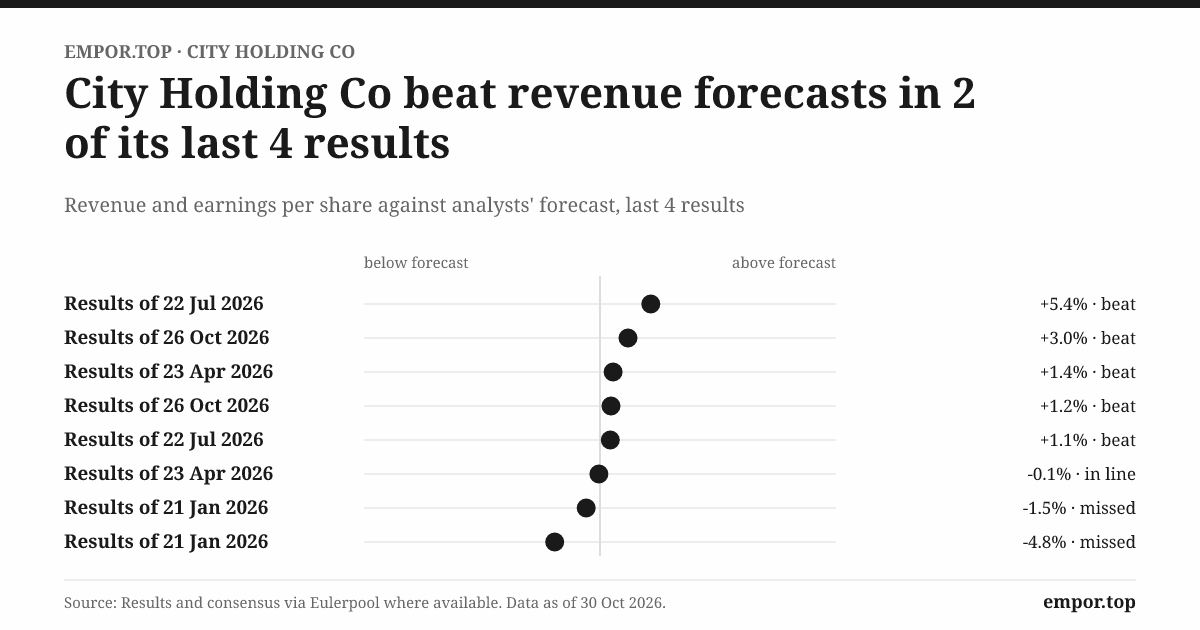
On October 26, 2026, a bank in Charleston, West Virginia, put the word "record" in a headline. City Holding Company had earned $2.43 of diluted earnings per share in the third quarter, the most it had ever earned in a single three-month stretch.1 For a company that rarely raises its voice, this was close to a shout. The quarter had a clean story attached to it as well: loan and investment yields were rising, the net interest margin was widening, and problem loans were scarce.1
Read one line further down, though, and the record gets more complicated. Net income for the quarter was $34.6 million, which was 1.6% less than City had earned a year earlier.1 How does a company post record per-share earnings while earning fewer dollars? It owns fewer of its own shares in other people's hands. City had spent years buying back stock, so each remaining share claimed a slightly larger slice of a slightly smaller pie. Earnings per share rose by two cents from the year-earlier quarter while net income fell. For the first nine months of 2026 the picture was flatter still: $99.6 million of net income, against $98.9 million in the same nine months of 2025.1 The engine was running. It was not accelerating.
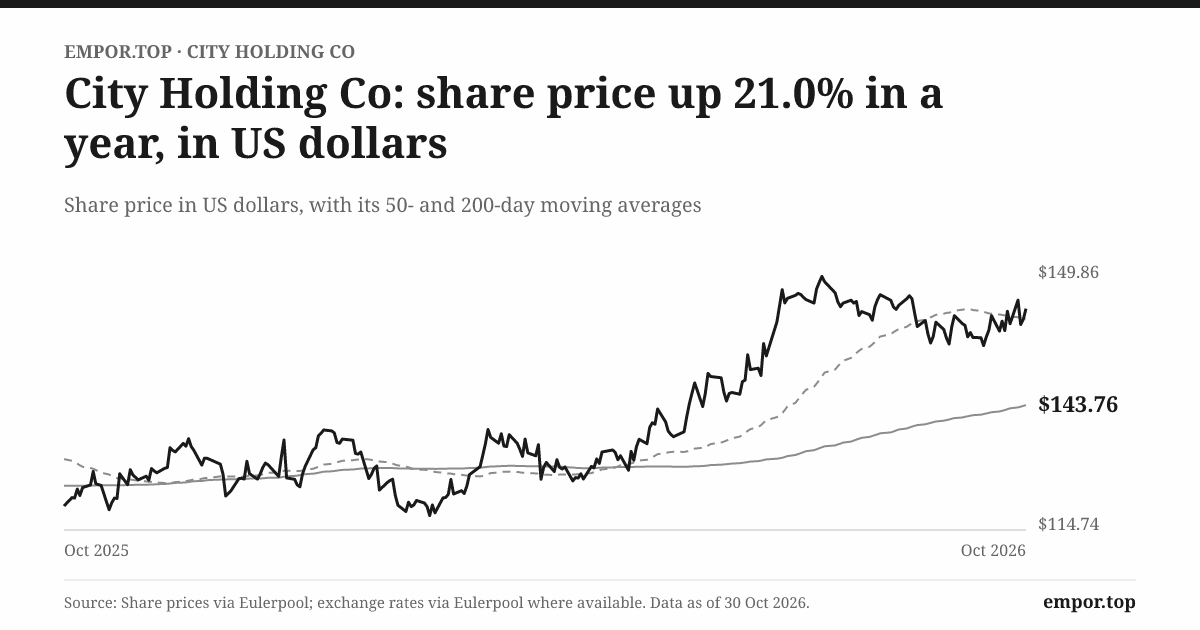
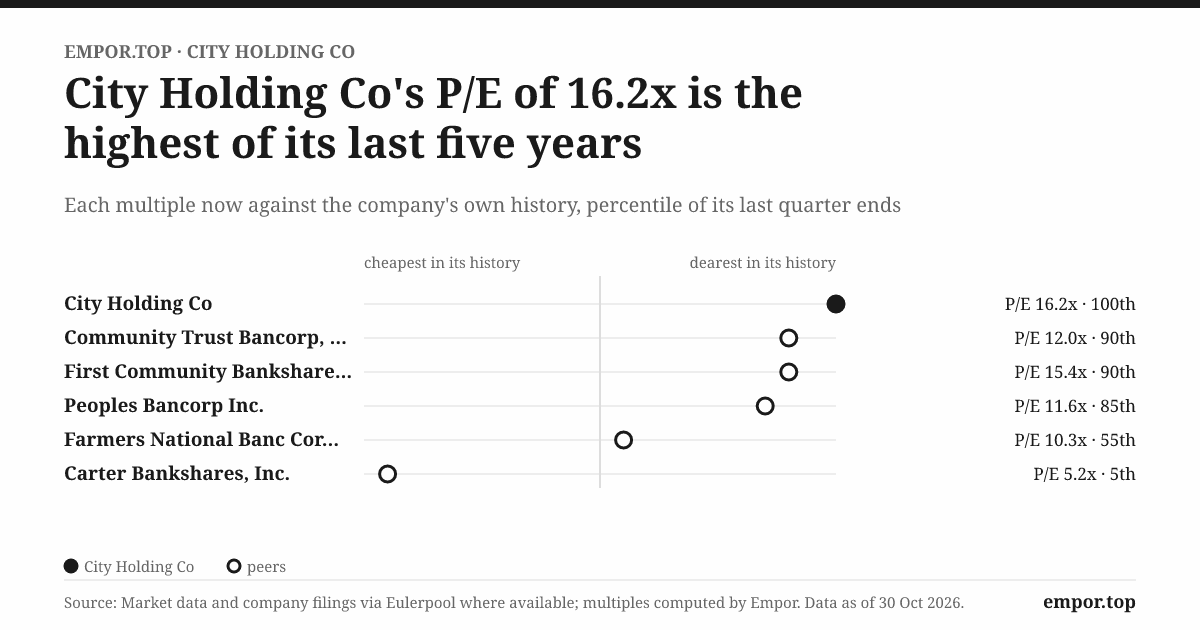
That would be an unremarkable observation about most regional banks, except for the price the market now puts on this one. At the close on October 30, 2026, City's shares traded at about $144, roughly 16 times the last twelve months of earnings and about 2.6 times book value, for a market value of around $2.1 billion.12 Over the previous five years, investors had typically paid about 13.6 times earnings for the same company. The stock sat within 3% of its 52-week high. Put simply, investors in late 2026 were paying roughly a fifth more for each dollar of City's earnings than they had been willing to pay, on average, over half a decade, at precisely the moment those earnings had stopped growing quickly.
That is the tension this story is built around. A premium valuation is a bet on durability. It says that this particular bank's returns will hold up better than the industry's through a full turn of the interest-rate and credit cycle, and that whatever earns City its unusually high profitability today is hard for a rival to copy. So three questions will follow City through its history. What, if anything, makes a regional lender in Appalachia hard to displace? Did its long string of small acquisitions create value, or merely create size? And are today's returns strong enough, and steady enough, to justify the price?
Start with what City actually is, because the name hides it. City Holding Company is a bank holding company with roughly $6.8 billion of assets, and essentially all of its economic life runs through one subsidiary, City National Bank of West Virginia.31 It reports a single business segment, community banking.3 There is no fintech arm, no insurance conglomerate, no investment bank bolted on the side. City ended 2025 with 96 branches and 934 full-time-equivalent employees spread across West Virginia, Kentucky, Virginia and southeastern Ohio, and it has trimmed that network to about 95 since.31 It gathers checking and savings balances from people and businesses in those towns, lends the money back out as mortgages, home-equity lines, commercial real-estate loans and business loans, invests the rest in bonds, and earns the difference.
It does that unusually well. In 2025, City earned about $1.90 for every $100 of assets on its balance sheet.3 That figure deserves a beat of context. A typical American bank is pleased to earn around one dollar per hundred. City has been earning nearly double that for years, and its return on equity, close to 17% over the past twelve months, sits comfortably above what most banks of its size manage.31 Its capital ratios are high, its bad-loan ratios are low, and it has raised its dividend steadily.
Yet nothing about the business is exotic, and that is both its charm and its risk. City is profitable and well capitalized, but its future still depends on the same three things every community bank depends on: whether local customers keep their deposits there without being paid a fortune to stay, whether borrowers in a slow-growing region keep paying their loans, and whether management deploys the surplus capital wisely. The record quarter answered none of those questions definitively. To see why investors are willing to pay up anyway, and whether they should be, the story has to go back twenty-five years, to a moment when City National looked less like a premium franchise and more like a candidate for a regulator's rescue.
 Subscribe on LinkedIn
II. The Turnaround Team Builds a Regional Bank
In early 2001, City Holding was in the kind of trouble that ends careers. Over 2000 and 2001 combined, the company lost $54.4 million, or $3.81 a share.4 Its stock, which had once traded around $45, had fallen to about $5.4 The common dividend was gone. Dividends on its trust-preferred securities had been deferred. And City National was operating under a formal agreement with the Office of the Comptroller of the Currency, signed in June 2000, while the holding company answered to the Federal Reserve under a memorandum of understanding.5 In regulator language, a formal agreement is a polite way of saying that the bank no longer gets to run itself without supervision. Many observers thought it might not survive.
How had a Charleston community bank ended up there? The roots go back to the 1980s. City Holding was formed in 1984 as West Virginia loosened its old restrictions on bank ownership, letting holding companies assemble local banks that had previously been forced to stand alone, and over time it folded those banks under the City National name.2 In the late 1990s, management reached well beyond plain community banking. City built a mortgage operation called City Mortgage Services, packaged high-rate loans into securitizations and kept slices of the risk, bought two banks in California, and collected a grab bag of side businesses, from a printing and direct-mail company to an internet service provider and a Dallas loan-collection shop.5 When the riskier loans soured, the retained securitization interests were written down, and the whole structure buckled. The chief executive resigned in June 2000.5
The rescue arrived from Indiana. In January 2001, Gerald "Jerry" Francis became chief executive, a banker with three decades behind him at institutions including National City, Bank One and Peoples Bank of Indianapolis.4 He brought four colleagues, and the five of them shared an unusual résumé line: every one had worked at Peoples Bank of Indianapolis.4 There was John Loeber, the senior credit officer with 36 years of experience; Bill Butcher, who ran retail banking and operations; Craig Stilwell, who handled marketing and human resources; and a 14-year banking veteran with a doctorate named Charles "Skip" Hageboeck, who became chief financial officer and chief information officer.4 Hageboeck had come up through Indiana National and NBD before Peoples Bank.4 He was, in other words, the numbers person on a team of credit and operations people, the one who would have to explain to regulators, auditors and shareholders exactly where the losses lay and how fast they could be cleaned up.
What the team did next reads like a surgeon's checklist, and its speed is the point. By April 1, 2001, City had exited mortgage servicing and written down $30 million of retained interests in securitized loans.4 By the end of June it had collapsed its operations from four facilities into one, sold its non-bank subsidiaries and cut staff by 27%, saving about $7 million a year.4 By the end of September it had reviewed every commercial loan in the book, scored all 66,000 of its retail loans and hired a seven-person workout team.4 The California banks were sold, out-of-state loan production offices closed, indirect auto lending abandoned.5 By December 2001, the bank was profitable again on an operating basis.4
And then the bank did something more surprising than survive: it became a bank whose returns most of its peers would envy. In May 2002, the OCC terminated its formal agreement and the Federal Reserve ended its memorandum of understanding.5 Nonperforming assets had fallen by 44% in a single quarter.5 The stock had more than doubled in a year.5 By 2003, City earned $43.7 million, a return of 2.18% on assets and 24.5% on equity, with an efficiency ratio of about 52%, meaning it spent only 52 cents to generate each dollar of revenue.4 Those are numbers that belong to a bank that has shed every distraction and is left with nothing but a cheap, sticky deposit base in small towns and a lending book it understands.
That is the origin myth worth holding onto, because it explains the culture that followed. The people who ran City after 2001 learned their trade cleaning up the consequences of reaching too far. They saw what happened when a West Virginia bank pretended to be a national mortgage securitizer. The lesson they drew, and that the company still repeats, was to stay close to home, keep credit simple and keep a fat capital cushion. In 2005, Hageboeck, the turnaround CFO, was named president and chief executive, and he joined the board the same year.6 He still holds the job in 2026, more than two decades later.
The bank he inherited had a clear next problem. Having stopped shrinking, how should it grow? West Virginia is not a growth market. Its population has been flat to declining for decades, and its economy leans on industries, from coal to chemicals, that have rarely been engines of new household formation. A bank that wanted to grow faster than its home state could either take market share from entrenched competitors, which is expensive, or step carefully across the state line. City chose the second path, and it chose a very particular version of it: move into the places that touch the places you already serve.
Over the next two decades, the map filled in along the edges of the existing footprint. City pushed into the northern Shenandoah Valley of Virginia, next door to West Virginia's Eastern Panhandle, then deeper into Kentucky, first along the Ohio River near Huntington and Ashland and later into the Lexington area.78 Each step extended a market City already knew rather than leaping into a new one. That is the quiet logic of the company: not a land grab, but a set of adjacent squares on a board.
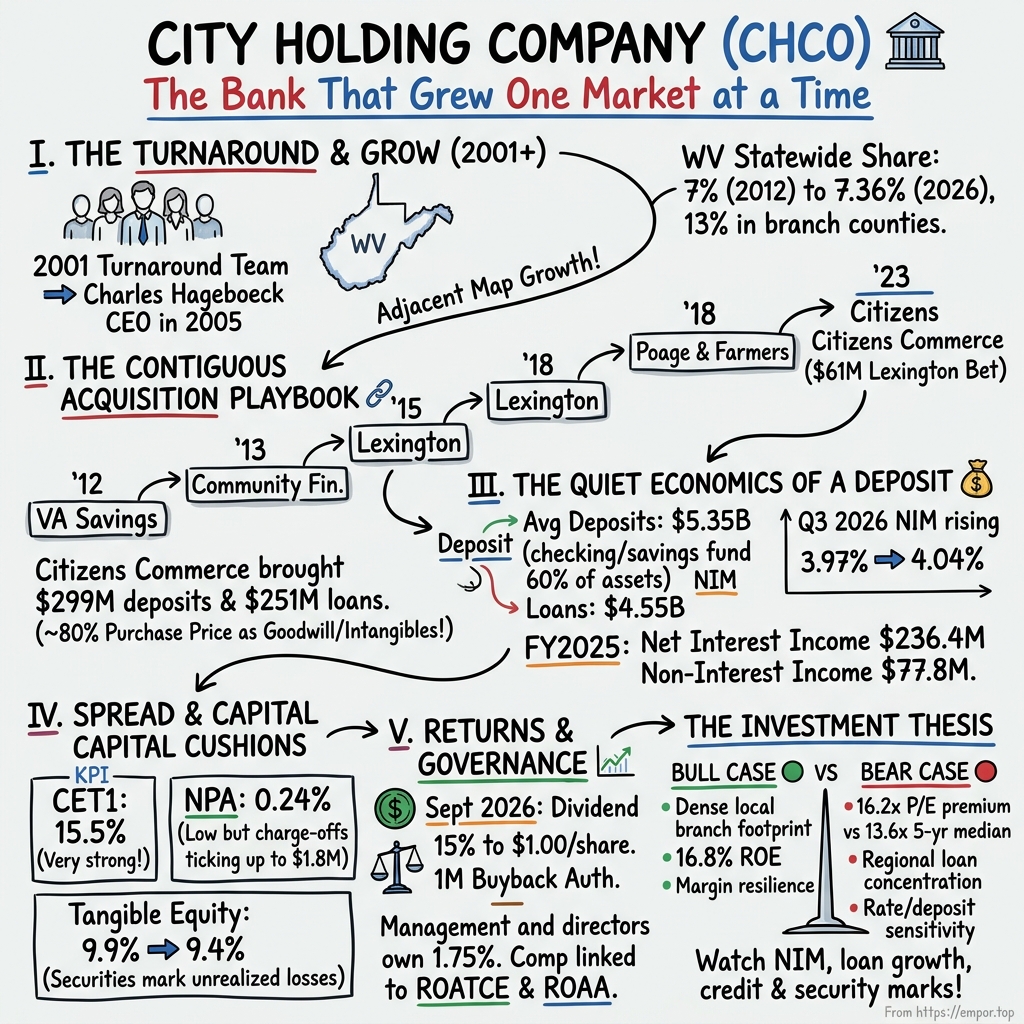
How strong has that position become? Here the record calls for a sharper answer than the company's own rhetoric might suggest. According to the FDIC's June 2026 Summary of Deposits, City National held about 7.4% of all deposits in West Virginia.9 That is a respectable number, and in the counties where City actually has branches, its share is roughly 13%.910 But City is not the biggest bank in its own home state. United Bank, the subsidiary of United Bankshares, held about 14.5% of statewide deposits; Truist held about 12.5%; and WesBanco about 8.75%.9 City ranks fourth.
That fact is central to understanding City's position. City's advantage, if it has one, is not dominance of a state. It is density in particular counties and towns, the Kanawha Valley around Charleston, the Huntington and Ashland corridor, pockets of Kentucky and Virginia, where it may be the bank people grew up with. That structure reinforces the point. Wealth management, mortgage lending and commercial banking are all products sold through one community-banking franchise rather than separate engines with their own economics.3 The strategic consistency since 2005 is real and unusually long-lived. Whether it has built a moat, or simply a well-run regional bank, depends on what City paid to extend that map, and the clearest test of that came in Lexington.
III. The $61 Million Lexington Bet
In October 2022, as the Federal Reserve was raising interest rates at the fastest pace in four decades and bank stocks were sliding, City Holding announced that it would buy a small Kentucky bank called Citizens Commerce Bancshares, based in Versailles, a horse-country town just west of Lexington.11 When the deal closed on March 10, 2023, City paid entirely in its own stock, exchanging 0.1666 of a City share for each Citizens share, in a deal worth about $62 million at the time.11 The timing was striking. That same week, Silicon Valley Bank collapsed, and the question on every bank investor's mind was whether deposits were about to flee small lenders. City was spending its stock to buy more of them.
What did it get? Citizens brought about $299 million of deposits and $251 million of loans.3 It also brought something the accountants had to put a price on, and that is where the deal gets interesting. When one bank buys another, it marks the target's assets and liabilities to fair value. Anything paid above those fair values becomes goodwill, and a separate intangible asset called the "core deposit intangible" captures the estimated value of having a pool of cheap, stable checking and savings deposits. City recorded $40.8 million of goodwill and $8.3 million of core-deposit intangible on the Citizens deal.3 Together, those intangible assets equaled about 80% of what City paid.
Turn that around and it becomes vivid. Of every $100 in City stock handed to Citizens shareholders, only about $20 bought something you could touch, net of the fair-value marks: loans, bonds, buildings, cash, less the deposits and other liabilities that came with them. The other $80 bought relationships, a Lexington presence and the expectation that Citizens' customers would keep their money at City. There is an important nuance here. In early 2023, rising rates had pushed down the fair value of nearly every bank's bonds and fixed-rate loans, so marking Citizens' balance sheet to market shrank its net assets and inflated the goodwill line. Some of that 80% reflects the rate environment of the moment, not a reckless price. Measured against the deposits acquired, City paid about 21 cents for each dollar of Citizens' deposits, a figure that is easier to compare across deals.
The map, one square at a time
To judge whether Lexington was a sensible bet, it helps to see it as the latest move in a sequence that stretches back more than a decade. In June 2012, City completed the purchase of Virginia Savings Bancorp, a small thrift with about $133 million of assets and $120 million of deposits operating five offices in northwestern Virginia, around Front Royal and Winchester, just across the line from West Virginia's Eastern Panhandle.7 That took City to roughly $2.9 billion of assets and 73 banking offices.7 The next year it bought Community Financial, extending its presence in Virginia's Shenandoah Valley.12 In 2015, City bought branches in Lexington, its first real foothold in Kentucky's second city.12
The biggest step came in July 2018, when City announced two deals on the same day.8 It agreed to buy Poage Bankshares, the parent of Town Square Bank in Ashland, Kentucky, a savings institution founded in 1889, with about $450 million of assets, $375 million of deposits and nine branches across northeastern Kentucky.8 City paid in stock, valued at about $93.5 million.8 Separately, it agreed to buy Farmers Deposit Bancorp, a Cynthiana, Kentucky bank founded in 1866, with $122 million of assets and three branches around the Lexington market, for $24.9 million in cash.8 Hageboeck framed both as "strategic next steps for enhancing our market presence throughout Kentucky."8 Poage's own merger proxy put the implied transaction price at about 153% of Poage's book value.13
The pattern across these deals is consistent, and it is the clearest evidence of strategic discipline in City's record. None of the targets was large. None took City into a market it had no connection to. Ashland sits across the Ohio River from Huntington, where City was already established. Cynthiana and Versailles both sit in the orbit of Lexington, where City had planted branches in 2015. Winchester and Front Royal border the eastern edge of West Virginia. The deals bought deposits, branches and local lenders in places that could be connected to the existing network, which meant City could fold them into its systems, its credit culture and its product set without building a second company.
The prices were also strikingly similar when measured against deposits. Poage cost about 25 cents per dollar of deposits. Farmers Deposit cost about the same. Citizens, five years later and in a far more nervous market, cost about 21 cents. That consistency suggests a buyer with a mental price list, not one chasing a deal at any cost.
What the record can and cannot prove
Management has long described City as a disciplined acquirer. In its November 2019 investor presentation, City said it needed willing sellers, and that it favored deals that were accretive to earnings and culturally compatible.12 Those are sensible principles. Every bank acquirer in America says something similar. The useful question is whether the evidence lets an outsider confirm them.
Some of it does. Its credit metrics stayed clean through each integration, and its return on assets, about 1.3% in 2017, was about 1.9% by 2025, after the Kentucky push.3 Its share count tells a revealing story, too. City issued stock to pay for both Poage and Citizens, yet it had fewer shares outstanding at the end of 2025 than it had a decade earlier, because buybacks more than offset the issuance.3 Shareholders who stayed through the decade ended up owning a larger slice of a much bigger bank.
But there are limits to what the record proves. City does not publish the returns on any individual acquisition after it closes. It does not disclose how many of Citizens' deposits stayed, what cost savings were realized against plan, or what each acquired branch earns today. Once a target is merged into City National, its numbers disappear into the single segment. So the claim that each deal earned an adequate long-run return is plausible rather than demonstrated, and an investor has to infer it from the consolidated results.
Those results temper the story. Reported revenue grew much faster over the three years through 2025 than over the decade, but that window includes the Citizens acquisition, so part of that growth was bought rather than built.3 Net profit grew about 8.4% a year over those three years, slightly below the 9.2% a year City compounded over the full decade from 2015 to 2025.3 Loans grew about 5.4% in 2025, a healthy organic number, but just 1.1% in the third quarter of 2026.31 The honest verdict is that the acquisition engine has extended City's map and has not visibly damaged the economics, but it has not obviously accelerated them either. Lexington looks like a sound geographic move bought at a full price, not an inspired bargain.
That leaves the forward question, which City's own 2019 presentation answered candidly: acquisitions require willing sellers.12 The pool of small banks in contiguous markets is finite, and the best of them know what their deposits are worth. If City cannot find the next Poage at the next 25-cents-a-dollar price, growth will have to come from its existing branches. And that means understanding, more carefully than any acquisition press release does, what those branches actually earn on a dollar of deposits.
IV. The Quiet Economics of a Dollar on Deposit
Picture a small business owner in Charleston walking into a City National branch with a check for $10,000 and depositing it into the company's operating account. Nothing about the moment is dramatic. Yet that deposit is the raw material of everything City does. The bank does not let the money sit idle. It might use it, along with thousands of other balances, to fund a 30-year mortgage on a house in Huntington, a line of credit for a contractor in Lexington, or a loan on a strip mall in Winchester. Whatever is left over goes into bonds, mostly municipal securities and mortgage-backed securities guaranteed by government agencies.3
The bank earns interest on the loans and bonds. It pays interest on the deposit, often very little on a checking account and considerably more on a certificate of deposit. It pays the tellers, the loan officers, the technology and the rent. What remains, plus the fees it collects along the way, is profit. That spread between what a bank earns on its assets and what it pays for its funding is the beating heart of the business, and the industry measures it as the net interest margin.
In 2025, City earned about $321 million of interest income and paid about $85 million of interest expense, which left $236.4 million of net interest income.3 In plain terms, of every dollar of interest City collected from borrowers and bond issuers, it paid only about 26 cents out to depositors and lenders. On top of that, it collected $77.8 million of non-interest income: service charges on accounts, debit and credit card fees, wealth-management and trust fees, and returns on bank-owned life insurance.3 Add the two together and roughly three-quarters of City's revenue came from the spread and one-quarter from fees, a mix that held in the third quarter of 2026.1
That fee quarter deserves a moment, because it is easy to misread. In some banks, fee income signals a separate, faster-growing business, such as a large asset manager or a payments processor. At City, it does not. The fees are overwhelmingly tied to the same customers who hold deposits and take loans: an overdraft charge, a card swipe, an advisory fee on a retiree's trust account. They make the franchise stickier and less dependent on interest rates, but they rise and fall with the same customer base. The company reports them inside its one community-banking segment for a reason.3
Why the latest quarter mattered
The third quarter of 2026 showed the spread mechanism working in City's favor. The net interest margin rose from 3.97% in the second quarter to 4.04%.1 Management attributed the gain to higher yields and larger average balances on both loans and investment securities.1 Average deposits were about $5.35 billion.1
A four-percent margin is high for a bank of City's size. Many regional lenders operate in the low-to-mid threes. The reason City can earn more lies on the liability side of the balance sheet. A large share of its funding comes from ordinary checking and savings accounts, which pay little or nothing, rather than from expensive certificates of deposit or wholesale borrowings. Checking and savings balances funded about 60% of City's assets.1 That is the economic engine in one sentence: City borrows cheaply from small-town customers and lends to them at market rates.
The engine has a sensitivity, though, and the third quarter showed only one side of it. When interest rates rise, City's loans and bonds reprice upward over time, and if its depositors are slow to demand higher rates, the margin widens. When rates fall, or when competitors start paying up for deposits, the engine can run in reverse. City had $1.218 billion of time deposits scheduled to mature during 2026, a slab of funding that had to be rolled over at whatever rate the market demanded.3 Its loans and deposits come in many shapes, from overnight checking balances to 30-year mortgages, and the company does not publish a single portfolio-wide contract length or a recurring-revenue percentage.3 What it does disclose is that its primary market risk is interest-rate risk, and that it has essentially no foreign-exchange exposure.3 Unlike many companies whose earnings swing with the dollar, City's swing with the yield curve.
The franchise question
City sells a broad range of products: commercial loans and treasury services for businesses, commercial real-estate financing, residential mortgages and home-equity lines for households, consumer loans, and trust and investment management for wealthier clients.3 All of it is delivered through the same branch network and sold under the City National brand. The breadth matters because it raises the cost of leaving. A family that has its checking account, mortgage, home-equity line and parents' trust account at City has more paperwork to unwind than a family with a single savings account.
But how strong is that position, really? The deposit-share numbers from West Virginia offer the cleanest outside measure. City's 7.4% statewide share places it fourth in its home state, behind United's 14.5%, Truist's 12.5% and WesBanco's 8.75%.9 Each of those rivals is either larger or comparable in scale, and each competes for the same depositors, often in the same towns. Beyond them sit credit unions, which in many Appalachian communities are a serious alternative for consumer lending and savings, national banks with powerful digital apps, and online banks and fintechs that will pay higher savings rates without a single branch.
That competitive landscape lets the analysis of City's moat take shape through the five forces a strategist would use. Customers, on the buyer-power side, have meaningful choice. A depositor can compare rates on a phone in thirty seconds and move money in a day, and a commercial borrower can solicit term sheets from three lenders. City's filings say that no single depositor could materially harm its liquidity or performance, and that no industry concentration in its loan book exceeded internal limits at the end of 2025.3 That means City is not hostage to any one customer, but it also means each customer is individually free to walk. The threat of substitutes, from money-market funds to Treasury bills to online savings accounts, rises every time short-term rates do. New entry into branch banking is slow and expensive, which helps incumbents, but digital entry costs very little. Rivalry among existing banks is intense, especially for deposits after 2022. And supplier power, in a bank's case, is mostly the power of depositors themselves, since they are the bank's suppliers of funding.
Against those forces, City's defenses are local: a dense network of branches in specific counties, relationships that sometimes stretch across generations, and a reputation for service. The bank has won outside recognition for customer satisfaction, and in many of its core counties it holds a share well above its statewide average.149 Those are real proof points. But they stop short of proof. City does not publish customer retention rates, deposit attrition after acquisitions, account-opening costs or how its deposit pricing compares with peers'. The four-percent margin and the high share of checking and savings funding are consistent with a loyal, low-cost deposit base. They are also consistent with a bank that happens to operate in less competitive rural markets during a favorable rate period. The filings cannot fully separate the two explanations.
That is the crux of the franchise question, and it explains why the next part of the story is about the balance sheet rather than the branch. A good deposit franchise is only valuable if the bank lends those deposits out carefully, and holds enough capital to survive the moments when it doesn't. A four-percent spread is worth very little if credit losses or bond-market losses eat it.
V. The Spread Holds; the Securities Mark Remains
At the end of September 2026, City's balance sheet told two stories at once. One was the story of a bank operating near the top of its game. Loans had reached $4.55 billion, up 1.1% in the quarter.1 Nonperforming assets, the loans on which borrowers had stopped paying plus repossessed real estate, were just 0.24% of loans and other real estate owned.1 City National's common equity tier 1 ratio, the regulators' core measure of loss-absorbing capital, stood at 15.5%, more than double the 7% level at which banks begin to face restrictions under current rules.1 The margin had widened to 4.04%.
The other story was in a single line about tangible equity. City's ratio of tangible equity to tangible assets had fallen to 9.4% from 9.9% at the end of 2025, and the company attributed the decline primarily to unrealized losses on its securities portfolio.1 A record-earning bank had less tangible equity, relative to its size, than it had nine months earlier. Both stories were true. Understanding why requires a short detour into how bank balance sheets work.
First, a word on the measures investors usually reach for. For an industrial company, a natural question is how much of reported profit turns into cash. For a bank, that question breaks down. City's operating cash flow was about $131 million in 2025, close to its net income of $130.5 million.3 But that figure says little about distributable cash. When City makes a new loan, the cash goes out as an investing activity. When a customer deposits money, it comes in as a financing activity. Loans, bonds and deposits are not leftovers after production; they are the production. The right question for a bank is not whether profit converts to cash, but whether the assets it holds are worth what the books say, and whether the capital behind them is sufficient.
The loan book
City's loans divide almost evenly into two halves. About 47% are residential mortgages and home-equity loans, the bread and butter of a community bank, usually secured by a family's house.3 About 52% are commercial: commercial-and-industrial loans to businesses and commercial real-estate loans secured by offices, retail centers, apartments and other property.3 That mix matters, because the two halves fail in different ways. Residential loans tend to suffer when local unemployment rises and home prices fall. Commercial real-estate loans tend to suffer when tenants leave, rents fall, or refinancing rates jump, which is exactly what made commercial property the source of anxiety for banks across the United States after 2022.
So far, City's credit history through this cycle has been mild. Nonperforming loans fell to $10.7 million at the end of September 2026, down from $13.9 million at year-end.1 Loans more than 30 days past due were only about 0.18% of the book.1 But net charge-offs, the losses actually written off, had risen to $1.8 million for the first nine months of 2026, compared with $0.8 million in the same period of 2025.1 Among them was an $856,000 commercial real-estate charge-off in the first quarter.1
Neither number tells the full story alone. Low nonperforming assets mean few loans are in trouble right now. Rising charge-offs mean some of the loans that were in trouble have now been confirmed as losses. Measured against a $4.55 billion book, $1.8 million of charge-offs over nine months is tiny, an annualized loss rate of about five hundredths of one percent. It doubled from a very low base, which is worth watching but not alarming in itself.
The allowance for credit losses was about $19.8 million at the end of September, or roughly 0.44% of loans.1 That is lean. It covers nonperforming loans almost twice over, but it is a far thinner reserve, relative to the whole book, than City carried after its turnaround, when the allowance stood at about 1.66% of loans.4 The current accounting rules require banks to reserve for losses expected over a loan's life, and City's small reserve reflects a decade of minimal losses. If the region's economy turned, the bank would need to rebuild that reserve through the income statement, and quickly.
The bond portfolio and the hidden mark
The securities problem is a different animal. At the end of 2025, City held about $1.01 billion of available-for-sale securities at fair value, carrying $107.9 million of unrealized losses, most of them on bonds that had been underwater for more than a year.3 These were mainly municipal bonds and agency mortgage-backed securities, assets with little risk of default.3 The losses arose because City had bought them when interest rates were lower, and when rates rise, the market value of an existing fixed-rate bond falls.
Think of it like owning a house bought with a 3% mortgage in a world of 7% mortgages: the house is still sound, but its market value relative to what was paid has changed. Accounting rules for available-for-sale securities require those paper losses to flow directly into shareholders' equity, through a line called accumulated other comprehensive income, without touching the income statement. That is why City's tangible equity fell during 2026 even as its earnings set a record.1
Here, a crucial distinction applies. Under the rules that govern banks of City's size, those unrealized losses on available-for-sale securities do not reduce regulatory capital. That is why City National's CET1 ratio could sit at 15.5% while the tangible-equity ratio fell.1 If City holds the bonds to maturity, the losses will unwind as the bonds pay back at face value. The losses become real only if City is forced to sell, which is precisely what happened to Silicon Valley Bank in March 2023. City's defense against that scenario is liquidity. It reported about $1.8 billion of additional borrowing capacity at the end of September 2026.1 That is a large cushion against a run on deposits.
Even so, the mark matters to shareholders. The $107.9 million of year-end losses equaled about 13% of City's shareholders' equity at that date.3 Those losses reduce tangible book value, a figure investors often use to value banks, and they limit flexibility: a bank sitting on underwater bonds is reluctant to sell them to fund loans or acquisitions, because doing so would crystallize the loss.
Where the risks actually live
The material risks for City can be traced to specific mechanisms. A downturn in the regional economy, whether from weakness in energy, chemicals, healthcare or property, would hit borrowers' ability to pay and the value of the collateral behind their loans, and with almost all lending concentrated in four contiguous states, there is little geographic diversification to offset it.3 A renewed fight for deposits, whether from a rival bank, an online savings product or a sudden drop in rates that compresses asset yields faster than funding costs, would squeeze the spread that the third quarter just widened. And a cybersecurity breach or technology failure could interrupt service, damage the trust that local banking depends on and invite regulatory penalties. City's filings name technology competition and operational risk as real threats, but they do not quantify any specific threat from artificial intelligence, so there is no evidence on which to model it.3
City's filings also contain no material litigation reserve and no specific material legal case. The company does carry about $1.0 million of accrued tax interest and penalties tied to open federal and state tax years.3 Those are routine. The live questions are the ones every community bank faces.
The balance-sheet verdict, then, is that current credit metrics and regulatory capital are genuinely strong, and that strength is what separates City from the banks that failed in 2023. But strength today does not erase exposure. The test for the next several quarters is simple to state: can loans and core deposits grow while charge-offs stay low and the securities mark shrinks? That test leads directly to how management spends the capital it has accumulated.
VI. Dividends, Buybacks and the Price of Patience
On September 30, 2026, City's board did something it had done many times before, only bigger. It raised the quarterly dividend 15%, to $1.00 a share.15 Six months earlier, on March 25, it had authorized the company to buy back up to one million of its own shares, roughly 7% of those outstanding, replacing an authorization from January 2024.16 For a bank whose earnings had stalled in 2026, these were confident gestures. A dividend increase is a promise that management expects to keep paying. A buyback is a statement that the stock is a good use of the company's money.
Are they the right gestures? That depends on a question that sounds simple and isn't: how much of City's capital is truly surplus?
Start with what City has actually done. Over 2023, 2024 and 2025, it paid $40.0 million, $43.5 million and $47.3 million in cash dividends, a steady climb.3 Its repurchases were anything but steady: $60.1 million in 2023, $17.9 million in 2024 and $45.8 million in 2025.3 Add the two together and, over three years, City returned about $255 million to shareholders against about $362 million of net income, roughly 70 cents of every dollar earned. The rest, about $107 million, stayed inside to support loan growth and the Citizens acquisition, and to rebuild capital eroded by the bond-market losses.
The dividend payout ratio, dividends as a share of profit, was about 36% in 2025.3 Over the dozen years from 2014 through 2025, it ranged from a low of about 34% to a high of about 50%, with a median around 41%.3 In other words, City's dividend has grown more slowly than its earnings for much of the past decade, and the payout ratio has drifted down from the high forties into the mid thirties. The September increase reverses some of that drift. At $4 a year, the new dividend would absorb roughly 44% of the last twelve months' earnings per share, back near the long-run median and still comfortably covered.
What the buybacks bought
Buybacks are harder to judge than dividends, because their value depends entirely on the price paid. When a company buys its own stock below what it is worth, the remaining shareholders gain. When it buys above, they lose. City's repurchases have been lumpy, and the lumpiness hints at opportunism. The heaviest year, 2023, came as bank stocks across the country sold off after the spring failures, when City's shares were cheaper relative to its earnings. The lighter year, 2024, coincided with a rally. That pattern is consistent with a management team that leans in when the stock is cheap, which is exactly what shareholders should want. City does not publish the average price it paid each year against a measure of intrinsic value, so an outsider cannot fully confirm the judgment, but the timing points in the right direction.
The 2026 picture is more cautious. City bought only about 74,000 shares in the second quarter, a small fraction of the one-million-share authorization.16 With the stock trading near its 52-week high and at roughly 16 times earnings, a slower pace of buybacks is arguably the disciplined choice. A bank that spends heavily on its own shares at a premium valuation is transferring value from remaining shareholders to departing ones.
Capital is not cash
The deeper constraint is that a bank's capital is not a pile of spare money. It is the equity cushion that absorbs losses before depositors are hurt, and regulators require a minimum amount of it relative to the bank's risk-weighted assets. Every new loan City makes consumes some capital. Every acquisition consumes more, because goodwill and intangibles are deducted from regulatory capital. So the 15.5% CET1 ratio at City National is not a measure of excess cash. It is a measure of how much room the bank has to lend, absorb losses or buy another bank before it bumps into the regulators' comfort levels.1
By that standard, City holds a great deal of room. Its ratio is more than double the 7% level at which banks begin to face restrictions. A skeptical investor, the kind who writes letters to boards, might push on exactly that point. If the capital is far above what the bank needs, why not return more of it? Holding excess capital lowers return on equity, because the same profits are spread over a larger equity base. City's reply, implicit in its behavior, is that the cushion is what lets it buy a Citizens in the middle of a banking panic, ride out a recession without cutting the dividend, and avoid the forced bond sales that sank other banks. Both arguments have merit. What the capital costs is visible; what it buys is invisible until a crisis arrives.
The funding side of the balance sheet also deserves a precise reading. A debt-to-equity ratio of about 0.64 would look modest in an industrial company and is almost meaningless for a bank, because it does not include the $5 billion-plus of customer deposits that actually fund the business. City's true wholesale debt is small. At the end of 2025, it had $150 million of long-term Federal Home Loan Bank advances at a weighted rate of about 4.14%, maturing in three $50 million tranches in 2027, 2028 and 2029.3 Customer repurchase agreements, which mature daily and function much like deposits for commercial clients, made up much of the rest of what screening databases call borrowings.3 There is no publicly rated bond program, no covenant breach and no visible refinancing wall.3
The management record so far
So how should shareholders grade the capital allocators? Over the decade from 2015 to 2025, net profit compounded at about 9.2% a year while shareholders' equity grew at about 6.8%.3 That gap is the signature of a bank that grew its earnings faster than its capital base, which is another way of saying its returns on equity improved, from about 13% to about 16%.3 Earnings per share grew even faster, from about $3.56 to $9.08, helped by the shrinking share count.3 That is a good record, achieved through a mix of organic growth, acquisitions and buybacks.
The caution is recency. Three-year profit growth is slightly below the ten-year rate, the third quarter of 2026 showed a year-on-year decline in net income, and 2026 as a whole is tracking near flat.13 Part of the 2025 strength came from a favorable rate environment and a credit-loss recovery of about $1.4 million that reduced costs.3 A rising dividend is a sign of confidence, not proof of value creation. The real test is whether future buybacks are made at sensible prices and whether the next acquisition earns more than lending the same capital to existing customers would. That test falls to a management team whose leader has been in charge for more than two decades.
VII. A Long-Tenured CEO, and the Oversight Test
The March 2026 proxy confirms Hageboeck's long tenure as president and chief executive.6 He had spent the previous four years as chief financial officer, helping drag the bank back from a regulatory agreement. Few chief executives of public banks can claim a tenure that long while being able to say they inherited a company only a few years removed from crisis and handed shareholders one that earns nearly two dollars per hundred of assets.
Hageboeck's style, as it comes through in two decades of filings and deal announcements, is quiet and numerical. The man who arrived in 2001 as CFO and chief information officer, with a doctorate and a résumé built in Indianapolis, has run City with an analyst's caution rather than a dealmaker's appetite.4 His public comments on acquisitions tend to emphasize fit and continuity. On the Citizens deal he stressed that "Citizens customers… will continue to see the same people who have been serving them."11 He also appears regularly before investors, including at the Janney CEO Forum in February 2026, where bank executives typically field questions on deposit pricing, credit and capital.17 The most useful way to read those appearances is against what followed. In early 2026, management presented a franchise with strong capital and clean credit, and the third-quarter results broadly bore that out. The places where words and outcomes can drift apart in the coming year are loan growth, which slowed in 2026, and the pace of buybacks, which remained modest against the authorization.
How the pay plan works
City pays its chief executive in three layers: salary, an annual cash bonus and long-term stock awards. Hageboeck's total 2025 compensation was about $1.92 million, including a cash incentive of about $797,000.6 The annual bonus is tied to return on average tangible common equity, a measure that strips out goodwill and asks how much profit City earns on the hard capital its shareholders have put at risk.6 The long-term stock awards are tied to return on average assets and to City's total shareholder return relative to other banks.6
That design is well chosen for a bank. Return on tangible equity rewards profitability without rewarding acquisitions that inflate equity through goodwill, and return on assets discourages loading up the balance sheet with low-yielding assets just to grow. Relative shareholder return measures whether City beat its peers, not merely whether the tide lifted all banks. The actual record matches the incentive design reasonably well: City's return on assets has run near double the level most banks target, and its net income grew from about $114 million in 2023 to $130.5 million in 2025.3
Against a company with about $130 million of annual profit and a $2.1 billion market value, $1.92 million of total pay is not extravagant. It is roughly 1.5% of a year's net income.
The ownership picture
Alignment is not only about pay. It is also about how much of the company the people running it actually own. Hageboeck owned 58,705 shares as of the 2026 proxy, worth about $8.4 million at late-October prices and representing roughly 0.4% of the company.6 Directors and executive officers as a group owned about 1.75%.6 Those are meaningful personal stakes, several years of salary in Hageboeck's case, but they are modest relative to the company. Nobody inside City controls it.
The largest disclosed owners are index and asset-management giants. As of the proxy's record date in March 2026, BlackRock was listed with about 2.16 million shares, or about 14.5%, and Vanguard with about 1.79 million, or about 12%.6 Those figures, however, rest on Schedule 13G filings from December 2023, which means they are stale snapshots rather than a current ownership map.6 What they show is that City's register is dominated by passive capital, which tends to vote with management on routine matters and rarely pushes for strategic change. That increases the importance of independent directors. City says its independent directors met nine times in executive session in 2025, and that its committee members met Nasdaq independence standards.6
The voting record, and a filing blemish
Shareholders have consistently backed the pay plan. The 2025 say-on-pay vote received about 94.8% support.6 At the April 2026 annual meeting, the say-on-pay resolution received about 9.46 million votes in favor and about 284,000 against, roughly 97% support among votes cast.18
There was one small wrinkle. City's initial report of the 2026 meeting results omitted the vote counts, and on May 1, 2026, the company filed an amended report supplying them.18 In proportion, this is a process error, not a governance scandal. The corrected tally shows strong support, and there is no evidence of shareholder dissent being hidden. But it is a reminder that small-company reporting depends on internal controls, and controls are worth watching precisely because they usually work.
On that front, City's auditor gave unqualified opinions on both the 2025 financial statements and the company's internal control over financial reporting, with no material weakness identified.3 That is bounded evidence, a clean bill of health for one year rather than a guarantee for the next, but it is the right kind of evidence.
The verdict on governance is therefore mostly favorable, with two questions left open. The first is the one every long tenure raises: City's culture and acquisition discipline have been shaped by one leader for two decades, and shareholders have an interest in how that continuity will be preserved when leadership eventually changes. The board signaled something in May 2026, when CFO David Bumgarner was promoted to senior executive vice president, though the company has not described that as a succession step.16 The second is ownership: with insiders holding under 2% and the largest holders passive, the board is the main check on capital allocation. So far, it has been a credible one. Whether the market is paying too much for that credibility is the question the bull and bear cases have to settle.
VIII. Analysis & Bear vs. Bull Case
Set two numbers side by side. City's shares trade at about 16.2 times earnings. Over the past five years, they have typically traded at about 13.6 times.2 The closest large neighbor, United Bankshares, the bank with the biggest deposit share in West Virginia, closed on October 29, 2026, at about 12.9 times earnings and about 1.2 times book value.19 City, by contrast, trades at about 2.6 times book.2 Investors are paying more than twice as much for each dollar of City's equity as they are for United's.
What are they paying for? The quick answer is returns. City earned about 16.8% on its equity over the past twelve months, and about 1.9% on its assets in 2025.23 A bank that earns 17% on its equity deserves a higher multiple of book value than one earning 9% or 10%, because each dollar of book generates more profit. The price-to-book premium is largely the market's way of capitalizing that return gap. The price-to-earnings premium is harder to justify on returns alone, because it asks for growth or durability on top of profitability. With net profit growth of about 8.4% a year over three years and a price-earnings-to-growth ratio of about 1.7, the market is paying for confidence more than for acceleration.32
It is worth noting which yardsticks do not apply. Enterprise-value multiples, including an EV-to-EBITDA ratio around five, are close to meaningless for a bank, because deposits and other liabilities are part of the operating business rather than financing to be subtracted.2 For a lender, price-to-earnings and price-to-tangible-book, measured against the bank's own history and a consistent peer set, are the right lenses.
The case for City
The bull case begins with the deposit franchise. City funds itself largely with checking and savings balances from small-town customers, and that cheap funding supports a net interest margin above 4%, high for a bank of its size.1 Its branches are dense in particular counties, where its share runs well above its statewide figure.9 It has kept credit tight: nonperforming assets are about a quarter of a percent of loans, and losses are tiny.1 It holds far more capital than regulators require, has ample liquidity and has no meaningful wholesale debt.13 Its management has been in place for two decades, with a consistent strategy of small, adjacent acquisitions at disciplined prices, and its pay plan rewards returns on tangible equity rather than size.6 And the third quarter of 2026 showed the margin moving the right way.1
In Hamilton Helmer's framework of seven powers, the sources of durable advantage, the bull can point to two. The first is a form of switching cost: for a family or small business with several products at City, moving banks is a hassle, and inertia keeps deposits in place even when a competitor pays a little more. The second is cornered or local scale: in a county where City holds a large share of deposits, it can spread its branch, compliance and technology costs across more customers than a smaller rival, and its brand recognition is earned rather than bought. A third power, process advantage, might be argued from City's consistently low losses and high efficiency over twenty years, which suggest an underwriting and operating culture that is hard to replicate.
The case against
The bear case starts with the same data, read differently. City is fourth in West Virginia, behind United, Truist and WesBanco.9 Its advantage is regional and uneven, strong in some counties and modest in others, and it is not a dominant franchise in the way that would justify a premium indefinitely. Customers can move deposits, and in a world of online banks and instant transfers, the switching costs that protected rural deposits are weaker than they were a decade ago. City's lending is concentrated in four contiguous states with slow population growth and economies tied to a few industries.3 Nearly half its loans are residential mortgages and home equity, and most of the rest are commercial real estate and business loans in the same region.3
The securities portfolio still carries unrealized losses that reduce tangible equity even while regulatory capital looks fine.31 Growth has slowed: loans grew only about 1% in the third quarter of 2026, and net income declined year on year.1 And the valuation premium itself is a risk. At 16 times earnings, City is priced as though nothing will go wrong. If the margin narrows when rates fall, or if credit costs rise from their unusually low base, earnings could fall and the multiple could compress at the same time, a double hit that premium bank stocks know well.
Against Helmer's framework, the bear would argue that City has no network effect, no counter-positioning against a disruptive model and no proprietary technology. Its power is local scale and switching costs, both real but both erodible. Porter's five forces point in the same direction. Buyer power is meaningful because depositors and borrowers have alternatives. Substitutes, from money-market funds to online savings, intensify whenever short-term rates rise. Rivalry is high, especially for deposits. The barrier that protects City is the slow, expensive work of building branches and relationships, and that barrier protects every incumbent in the region, not only City.
Weighing it
Which story does the record support? The fairest reading is that City's moat is real but narrower than its valuation implies. The evidence for durable advantage, two decades of high returns on assets, low credit losses and a cheap deposit base, is substantial and, crucially, spans more than one interest-rate cycle, including the near-zero rates of 2020 and 2021 and the sharp rise that followed. Yet the advantage is geographic, uneven and dependent on deposit behavior that City does not fully disclose. It is a well-run regional bank in favorable local markets, not a fortress.
A comparison with United Bankshares sharpens the point while showing its limits. United is larger and spread across more states. Its price of about 1.2 times book against about 12.9 times earnings implies a return on equity in the high single digits, well below City's.19 Some of City's premium is earned by its returns. But a single-company comparison is not a peer set, and differences in size, credit mix, geography and acquisition history make it a reference point rather than a verdict.
Three measures will decide whether the premium holds, and investors can watch each one every quarter. The first is the net interest margin, read together with deposit mix: it stood at 4.04% in the third quarter of 2026, up from 3.97%, and if it holds while checking and savings balances keep funding a large share of assets, the franchise thesis survives.1 The second is loan growth alongside nonperforming assets and charge-offs: loans grew about 1.1% in the quarter, nonperforming assets were 0.24%, and nine-month charge-offs had roughly doubled from a tiny base.1 The third is tangible book value after securities marks, which fell during 2026 as the bond losses widened.1
The case has clear tests of falsification. Two or more consecutive quarters of margin compression accompanied by weak deposit growth would show that City's deposit advantage is weaker than its premium assumes. Rising commercial real-estate delinquencies or a sustained increase in charge-offs would undermine the credit thesis. And sustained returns on equity and organic growth above a consistent regional-bank peer set would strengthen the case that the premium is earned.
IX. Playbook: Business & Investing Lessons
Go back to the spring of 2001. Five bankers from Indianapolis walk into a company with $130 million of problem loans, a formal agreement with its regulator and a stock price that had fallen by nearly 90%.4 They do not try to be clever. They shut the businesses that do not fit, review every loan, cut the staff, and within eighteen months the bank is earning close to 1.5% on its assets and nearly 20% on its equity.4 Then one of them, the finance chief, runs the company for the next two decades, and spends most of that time adding small banks in the next county over. From five-person turnaround team to a $6.8 billion bank, with six notable acquisitions since 2005 and still only one reportable business, City's story contains lessons that belong to it alone.13
The first lesson is that a branch is only an advantage when it gathers deposits at a price that still leaves a spread. City's 95 branches are not its moat. The moat, to the extent it exists, is what those branches do: collect checking and savings balances cheaply enough that a 4% margin is possible in a region where loan growth is slow. Founders and investors in any physical-distribution business, from retail to healthcare, can borrow the point. Footprint is a cost. It becomes an asset only when the economics of each location prove it.
The second lesson is that a small acquisition can change the map, but only the next decade of returns tells you whether it changed the economics. The Lexington bet bought $299 million of deposits in a market City wanted, and 80% of its price went into goodwill and intangibles.3 Whether it was a good deal will not be known from the press release or the closing date. It will be known from whether those customers stay, whether those deposits remain cheap and whether City's returns on tangible equity hold up. Acquirers of any kind, in banking or software or consumer brands, are tempted to celebrate the deal. The disciplined ones keep score long after.
The third lesson is that a bank's capital is both its safety net and its growth budget, and returning it well is a test of judgment. City returned about 70% of its earnings to shareholders over three years while keeping a CET1 ratio around 15%.31 It bought back heavily when bank stocks were cheap in 2023 and lightly when they were expensive in 2026.316 That is the kind of behavior that compounds wealth quietly. But the cushion it keeps, far above what regulators require, also lowers its return on equity, and every dollar held in reserve is a dollar that must one day justify itself.
The fourth lesson belongs to the turnaround itself: the people who clean up a crisis tend to build institutions that avoid the next one. City's leaders learned banking by watching a West Virginia lender pretend to be a national mortgage securitizer and nearly fail. Twenty-five years later, the company still has one segment, simple credit and a fat capital cushion. That is not an accident of temperament. It is institutional memory, and it is perhaps the hardest asset in the company to value.
Yet the final lesson is a limit. Good execution does not prove an unassailable moat or justify any price. City's discipline is real, but a well-run regional bank can still disappoint investors if its valuation outruns its growth. Discipline in the boardroom has to be matched by discipline in the price paid for the stock.
X. Epilogue
City enters the final months of 2026 with record quarterly earnings per share, a 4.04% margin, a CET1 ratio of 15.5% at its bank and a tangible-equity ratio below where it began the year.1 Each of those numbers is a promise and a question.
The first answer will come in the fourth-quarter results, expected early in 2027, and in the full-year 2026 annual report. Investors will look at the margin and the deposit mix together. If the margin holds near 4% and checking and savings balances keep growing, City's claim to a cheap, sticky deposit base gets stronger. If the margin slips while City pays up to hold deposits, especially as more than $1 billion of time deposits reprice, the premium thesis narrows.3 Neither number tells the story alone; a stable margin bought by shrinking the balance sheet would be a hollow victory.
The second test is credit. The commercial real-estate charge-off in the first quarter of 2026 was small, but it was a reminder that losses arrive one loan at a time.1 The numbers to watch are delinquencies and nonaccrual loans in the commercial real-estate book, net charge-offs against the allowance, and whether the allowance, about 0.44% of loans, needs to be rebuilt.1 If losses stay low while loans grow, City's underwriting culture continues to earn its reputation. If they rise, the thin reserve will need to be thickened through earnings.
The third test is capital. With a one-million-share buyback authorization in hand and a newly raised dividend, City has committed to returning capital. The question is whether repurchases and any new acquisition earn more than lending the same money would, and whether they lift per-share book value and earnings without eroding capital ratios.1615 A deal announcement would be the most revealing moment of all, because the price per dollar of deposits would show whether City's discipline has survived a richer stock price.
And then there is the valuation itself. At about 16 times earnings, the market has already priced in the good outcomes. A high-quality regional bank can still disappoint shareholders if its premium outruns its growth. The questions are answerable, quarter by quarter, in City's own filings. Until they are, the record quarter is a strong opening chapter rather than the end of the argument.
XI. Outro
Return to that Charleston branch, and the small business owner with the $10,000 check. That deposit is the raw material of City's spread, and of the dividend, buyback and next acquisition it helps fund.
That branch is the whole story in miniature. It is where City's customers meet the bank, and where the bank's familiarity and service either earn their keep or quietly become a cost. City's wager, made by five bankers from Indianapolis and kept for a quarter of a century, is that a regional bank can compound value without trying to become a national one: by knowing its towns, lending carefully and growing one adjacent market at a time. The record says the wager has paid. The stock price says investors expect it to keep paying. Only the next deposit, and the next loan, can say whether they are right.
References
-
Q3 2026 Results — City Holding Company, 2026-10-26 ↩↩↩↩↩↩↩↩↩↩↩↩↩↩↩↩↩↩↩↩↩↩↩↩↩↩↩↩↩↩↩↩↩↩↩↩↩↩↩↩↩↩
-
2025 Form 10-K — City Holding Company, 2026-02-25 ↩↩↩↩↩↩↩↩↩↩↩↩↩↩↩↩↩↩↩↩↩↩↩↩↩↩↩↩↩↩↩↩↩↩↩↩↩↩↩↩↩↩↩↩↩↩↩↩↩↩↩↩↩↩↩↩
-
Investor Presentation, Exhibit 99.1 to Form 8-K — City Holding Company, 2004-03 ↩↩↩↩↩↩↩↩↩↩↩↩↩↩↩
-
City Holding Company Announces Termination of Formal Agreements with the OCC and the Federal Reserve — City Holding Company, 2002-05-16 ↩↩↩↩↩↩↩
-
2026 Proxy Statement — City Holding Company, 2026-03-27 ↩↩↩↩↩↩↩↩↩↩↩↩
-
City Holding Company Completes Acquisition of Virginia Savings Bancorp — City Holding Company, 2012-06-01 ↩↩↩
-
Poage and Farmers Deposit Merger Announcement — City Holding Company, 2018-07-11 ↩↩↩↩↩↩
-
FDIC Summary of Deposits — Market Share Reports — Federal Deposit Insurance Corporation ↩↩↩↩↩↩↩
-
West Virginia Deposit Market Structure — FDIC Summary of Deposits data ↩
-
Citizens Commerce Acquisition Filing, Form 8-K — City Holding Company, 2023-03-10 ↩↩↩
-
September 2026 Dividend Announcement, Form 8-K — City Holding Company, 2026-09-30 ↩↩
-
2026 Annual Meeting Vote Results, Form 8-K/A — City Holding Company, 2026-05-01 ↩↩
-
United Bankshares market data — YatırımMasası, 2026-10-29 ↩↩
 LinkedIn
 WhatsApp
 Reddit
 Hacker News
 Email
 Kindle
 RSS Feed
 Spotify
 Apple Podcasts
 Amazon Music
 Audible
 YouTube