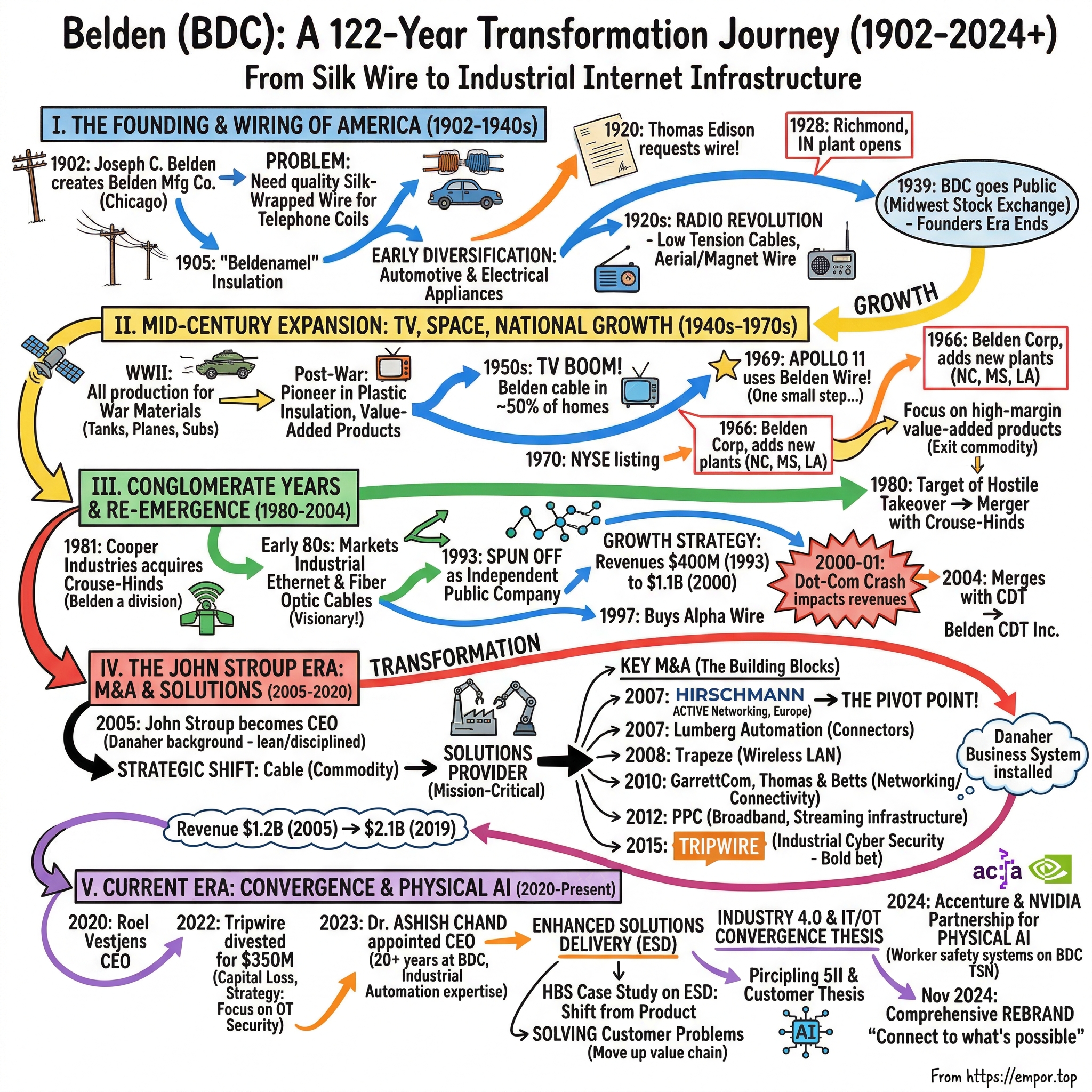
Belden Inc.: The 122-Year Transformation from Silk Wire to Industrial Internet Infrastructure
I. Introduction: Wiring the World's Most Critical Systems
Picture a modern automobile factory floor in 2025: robotic arms pivot with millimeter precision, autonomous vehicles shuttle components between stations, and thousands of sensors stream real-time data to edge computing systems. Every microsecond counts. A single network failure doesn't just slow production—it can endanger lives.
Now consider this: the company responsible for much of the critical networking infrastructure enabling this ballet of automation was founded in 1902 by a 26-year-old purchasing agent who couldn't find enough quality silk-wrapped wire for telephone coils.
Belden Inc. is an American, multinational, publicly traded company specializing in the design, manufacture, and distribution of end-to-end networking, security and connectivity products. The company serves the Industrial Automation Solutions, Smart Buildings and Broadband & 5G markets.
This is the story of Belden—a 122-year-old company that has survived every major technological disruption of the past century and emerged as a leader in the Industrial Internet of Things (IIoT). It's a story of strategic reinvention, disciplined M&A, and a bet on a future where the convergence of operational technology (OT) and information technology (IT) represents one of the most significant industrial transformations since the assembly line.
Belden Inc. delivers a comprehensive product portfolio designed to meet the mission-critical network infrastructure needs of industrial and enterprise markets. With innovative solutions targeted at reliable and secure transmission of rapidly growing amounts of data, audio and video needed for today's applications, Belden is at the center of the global transformation to a connected world.
The central question this analysis explores: How did a 1902 wire manufacturer navigate through the radio era, television boom, computer revolution, internet explosion, and mobile disruption to position itself at the forefront of Industry 4.0? And what does this remarkable journey tell investors about its future?
The answer lies in three transformative eras: the founding decades that established a culture of quality and innovation; the Cooper Industries years that preserved the brand through corporate restructuring; and the John Stroup era (2005-2020) that fundamentally reimagined what Belden could become. Today, under the leadership of Dr. Ashish Chand, the company is executing a solutions-driven strategy that aims to make Belden not just a supplier of products, but an indispensable partner in the digital transformation of the world's critical infrastructure.
 Subscribe on LinkedIn
II. The Founding & Wiring of America (1902–1940s)
A Problem Worth Solving
In the early 1900s, Chicago was the beating heart of American telecommunications. Bell System exchanges connected the nation's rapidly expanding network of telephone users, and at companies like Kellogg Switchboard & Supply, purchasing agents scrambled to source the specialized components that made it all possible.
Belden was founded by Joseph C. Belden in Chicago in 1902. Belden had been working as a purchasing agent for Kellogg Switchboard & Supply Company of Chicago but was finding it difficult to locate the high-quality, silk-wrapped magnetic wire needed for telephone coils. Recognizing the need for this product, Belden, then 26, decided to go into business for himself, selling shares in the company, called Belden Manufacturing Company, to 11 investors for $25,000 in start-up capital.
Joseph Belden was always an innovator—even at the start of his career as a purchasing agent for a telephone equipment manufacturer. In the early 1900s, silk-insulated magnet wire was incredibly difficult to source, making his job nearly impossible. After months of struggling to find what he needed, Joe wondered: Could he create more wire to meet demand? A 26-year-old graduate of Yale University who studied calculus, physics, chemistry, mathematics and civil engineering, Joe was prepared to solve practical problems—but not to make wire. With his skillfulness and resolve, however, he was determined to find a way.
This origin story matters because it established a pattern that would define Belden for over a century: identifying gaps in critical infrastructure markets, then filling them with products that customers could depend on.
Building the Foundation
Belden served as the company's president until 1939. Under his leadership, the company established several enduring characteristics.
The first major technical breakthrough came in 1905 with the development of "Beldenamel" insulation. The first major breakthrough for Belden occurred in 1905 when, after much experimental work, "Beldenamel" insulation was created. This flexible enamel insulation would become the basis of Belden's early success.
The wiring of America was just getting underway, and Belden quickly found a market for his product. However, in order to protect itself from fluctuations in demand, the company began to expand its product line. An initial foray into supply silk-wound wire frames for ladies' hats proved less successful given caprices of fashion, and Belden quickly found two new markets—the nascent automotive and electrical appliance industries—for the company's wire products.
This early diversification—and the quick pivot away from the millinery business—demonstrated a strategic pragmatism that would serve the company well through multiple technological cycles.
From Edison's Letter to the Radio Revolution
The validation of Belden's quality-first approach came from the most prestigious source possible. In 1920, Joseph Belden received a letter from his hero, Thomas Edison, requesting enameled wire and pledging "I will not forget the favor."
When commercial radio broadcasting emerged in the 1920s, Belden was ready. The company's low tension cables, aerial wire, and magnet wire found strong demand among radio manufacturers. The company also began selling parts to jobbers in the radio industry, establishing a distribution arm that would become increasingly important.
In 1928, a new plant, designed especially for manufacturing electrical wire, opened its doors in Richmond, Indiana. This facility would later become the site of the company's Electronic Division—and remains a Belden manufacturing center to this day.
Going Public and the Pre-War Era
In January 1939, Belden became publicly traded for the first time when listed on the Midwest Stock Exchange. By that year, the company had reached sales of $4.9 million with net income of $378,000—respectable figures for a specialized manufacturer during the tail end of the Great Depression.
Joseph Belden's decision to take the company public and step aside from day-to-day leadership after 37 years marked the end of the founder era. But the culture he established—quality obsession, customer focus, and strategic adaptability—had been deeply embedded.
For investors, the founding era establishes a crucial truth about Belden: the company's DNA has always been about serving critical infrastructure applications where failure is not an option. From telephone coils to radio to automotive wiring, Belden built its reputation by making products that customers could stake their systems on.
III. Mid-Century Growth: Television, Space, and National Expansion (1940s–1970s)
War and Its Aftermath
World War II accelerated Belden's growth and solidified its role as a mission-critical supplier. By 1942, Belden had shifted manufacturing strictly to war materials. Its products were used in tanks, airplanes, mobile radios, submarines, ships, jeeps and a variety of other military machinery.
Belden wire was instrumental in WWII to transmit electrical energy to equipment and ensure the safe operation of aircraft. This wartime experience—producing for applications where lives literally depended on product quality—reinforced the company's engineering-first culture.
After the war, Belden began to clearly establish its leadership in wire and cable technology through research, engineering, and product development. The company was one of the first wire producers to apply plastic insulations to wire and cable. Belden sought market niches that required sophisticated and high quality products where value was added in insulation, cabling, shielding and jacketing.
The Television Boom
The post-war era brought one of the greatest consumer technology revolutions in history: television. Belden positioned itself perfectly.
The 1950s brought a boom in home TVs. By mid-decade, almost half of American homes had a TV outfitted with Belden cable.
Consider the implications: at the peak of the television adoption curve, Belden was the connectivity provider for roughly half of American households. This wasn't commodity wire—it was the engineered solution that brought Walter Cronkite into living rooms and connected families to the outside world.
Belden began its shift toward the television and data processing markets as these industries began their commercial growth in the 1950s. Belden's sales continued to grow steadily, and it continued to add capacity to its Chicago and Richmond plants. By 1965, the company's sales had grown to $53 million.
The Space Race and Beyond
Perhaps no single image better captures Belden's role in American technological achievement than Apollo 11. Neil Armstrong's "one small step" might not have been possible without Belden wire, which was used aboard Apollo 11.
This wasn't marketing hyperbole—aerospace applications represented the extreme edge of Belden's quality capability. When NASA engineers selected Belden products for the mission that would put humans on the moon, they were making a statement about reliability under the most unforgiving conditions imaginable.
Expansion and the First Crisis
The 1960s and 1970s saw aggressive expansion under Robert W. Hawkinson, who became president in 1965. Hawkinson, who joined Belden in 1945 as an engineer after serving as a fighter-bomber captain in the Army Air Forces during the Second World War, would lead Belden through its next growth phase. That era began in 1966, when Belden changed its name to Belden Corporation and built a plant in Franklin, North Carolina—its first new plant since 1938. Over the next three years, the company constructed two more plants, one in Pontotoc, Mississippi, and a 170,000-square-foot site in Jena, Louisiana.
By 1970, sales had topped $100 million, and the company began listing on the New York Stock Exchange.
Helping to fuel this growth was a stepping up of its activity in the automotive aftermarket, which itself was growing rapidly with the steady increases in car sales of the period. During the 1970s, the company continued to expand its production capacity, adding a 75,000-square-foot automotive aftermarket facility to its Jena plant, while adding new plants in Dumas, Arkansas, and Monticello, Kentucky. The company also moved to improve its profits by exiting the low-margin commodity market, discontinuing production of heavy wire and closing its original Chicago plant.
This strategic decision to exit commodity markets in favor of value-added products would prove prescient. By 1978, the company's sales had grown to $240 million, earning profits of $8.8 million. Belden's stock price, however, had not kept pace with its revenue growth. By 1980, the company had become the target of a hostile takeover, and Belden found refuge in a merger with Crouse-Hinds Co.
For investors, the mid-century era demonstrates both Belden's remarkable ability to ride technological waves—radio, television, data processing, aerospace—and its vulnerability as an independent public company. The 1980 merger would begin a 13-year period as part of a larger conglomerate.
IV. The Cooper Industries Years & Re-emergence (1980–2004)
Into the Conglomerate
The 1980 merger with Crouse-Hinds marked the end of Belden's first era as a standalone public company. But the absorption didn't stop there.
It was acquired by Crouse-Hinds Company in 1980; Crouse-Hinds was acquired by Cooper Industries in 1981 and spun off Belden as an independent company in 1993.
In September, Belden and Crouse-Hinds Company, a highly regarded manufacturer of electrical products located in Syracuse, New York, entered into a merger. In April, Cooper Industries, with corporate headquarters in Houston, Texas, acquired the combined entity of Belden and Crouse-Hinds.
Under Cooper Industries, Belden operated as an unincorporated division for 12 years. While this structure limited independence, it also provided certain advantages: access to capital, protection from market volatility, and the ability to focus on operational excellence without the distractions of quarterly earnings pressure.
The company used this period to establish technology leadership in emerging categories. In the early 1980s, Belden became one of the first in the industry to market Ethernet and fiber optic cables for industrial use—prescient moves that would pay dividends decades later.
The company also built enduring media partnerships, establishing long-term relationships with NBC and CBS and supplying cable for the Olympics for over 20 years.
The 1993 Spin-Off
In October, Belden once again became an independent public held entity with corporate offices located in St. Louis, Missouri.
The spin-off came at an interesting moment in industrial history. The early 1990s saw the first wave of enterprise networking—Local Area Networks were becoming standard in corporate environments, and data transmission was emerging as a critical infrastructure need beyond traditional broadcast and telecommunications.
Belden pursued a growth strategy. Through acquisitions and organic growth, Belden's revenues grew from under $400 million in 1993 to more than $1.1 Billion in 2000.
The company, led by C. Baker Cunningham, who previously led Cooper's tool, hardware, and automotive division, posted sales of $667 million and net income of $55 million in 1996. Founded in 1902, Belden was operated as an unincorporated division of Cooper Industries between 1981 and 1993 but has been public again since 1993.
The Dot-Com Boom and CDT Merger
The late 1990s internet boom created surging demand for networking cable and connectivity products. Belden rode this wave, expanding production capacity and broadening its product portfolio.
In early 1997, Belden purchased Alpha Wire. Alpha Wire provides an extensive selection of cable, wire, heat-shrink tubing, accessories, and wire management services to customers worldwide in the Industrial Automation, Medical, Semiconductor, Aerospace & Defense, Consumer Electronics, and Energy markets.
The dot-com crash of 2000-2001 hit networking-adjacent companies hard. Belden's revenues, which had reached $1.1 billion in 2000, fell significantly as enterprise IT spending collapsed.
The strategic response came in 2004. In 2004 the company merged with Cable Design Technologies forming Belden CDT Inc. (now Belden Inc.) and since then the company has been headquartered in St. Louis.
Belden CDT, Inc., formed in July 2004 through the merger of Belden Inc. and Cable Design Technologies Corp., is one of the largest U.S.-based manufacturers of high-speed electronic cables and focuses on products for the specialty electronics and data networking markets, including connectivity. Belden CDT Inc. operates as one of the largest manufacturers of high-speed electronic cables in the United States.
The merger brought together complementary capabilities and established a stronger platform for growth. But the real transformation was about to begin.
V. The John Stroup Era: Transformation Through M&A (2005–2020)
A New Kind of Leader
In 2005 John Stroup became CEO.
John Stroup arrived at Belden with a pedigree that signaled where he wanted to take the company. Prior to joining Belden, Mr. Stroup held various positions of increasing responsibility at Danaher Corporation, Scientific Technologies, and Rockwell Automation. Mr. Stroup began his career at Parker Hannifin Corporation in various roles including engineering, sales, and marketing.
The Danaher experience is particularly significant. Danaher is renowned for its rigorous operating system—the Danaher Business System—which emphasizes continuous improvement, lean manufacturing, and disciplined capital allocation. Stroup would bring this playbook to Belden.
Mr. Stroup joined Belden, a global leader in signal transmission and security systems solutions for mission-critical applications in enterprise and industrial markets, as President and Chief Executive Officer in 2005 and became Chairman and Chief Executive Officer in 2016. Under Mr. Stroup's leadership, Belden grew revenue from $1.2 billion in 2005 to $2.1 billion in 2019. During this period, Mr. Stroup drove Belden's transformation from a provider of high-quality cable products to a leading manufacturer of end-to-end networking and connectivity solutions.
The revenue numbers tell only part of the story. The more fundamental change was strategic: Stroup recognized that cable was becoming a commodity and that Belden's future lay in becoming a solutions provider for mission-critical applications.
The Hirschmann Acquisition: The Pivot Point
The Stroup era's defining strategic move came early. In January 2007, Belden announced the acquisition that would fundamentally reshape its identity.
"The acquisition of Hirschmann is a major achievement in our pursuit to expand our business in desirable end-markets, beyond cable, to signal transmission solutions," said John Stroup, president and chief executive officer of Belden.
Belden expanded in the 21st century through a number of corporate acquisitions: In early 2007, Belden purchased Hirschmann Automation and Control, an industrial marketing company focused on industrial automation and networking systems, for $260 million.
Hirschmann, founded in 1924, had sales last year worth around $250m. It employs some 750 people and has two production sites in Germany, as well as three manufacturing joint ventures in China.
According to a fact sheet posted on the Belden Web site, Hirschmann has the leading global market share in rail-mounted Industrial Ethernet devices, as well as a strong position in industrial connectivity within the European market.
"Industrial Ethernet is an open system that allows the integration of a wide variety of equipment and provides for an interface between the industrial network and the enterprise network. The adoption of Industrial Ethernet among our customers is in the early stages but is increasing rapidly because of these compelling advantages."
The Hirschmann deal matters for several reasons. First, it gave Belden a foothold in industrial Ethernet—the networking protocol that would underpin the Industry 4.0 revolution. Second, it expanded Belden's reach beyond cables into active networking equipment. Third, it established Belden's presence in Europe, particularly Germany, the world's manufacturing heartland.
The acquisition will expand Belden's activities beyond cabling into signal transmission equipment.
Building the M&A Engine
Following Hirschmann, Stroup accelerated the acquisition pace, systematically building capabilities across Belden's target markets.
In the summer of 2007, Belden acquired Lumberg Automation, which manufactures connectors used in industrial automation, for an undisclosed price. In June 2008, Belden purchased wireless LAN vendor Trapeze for $113 million. In December 2009, Belden purchased Telecast Fiber Systems, a manufacturer of fiber-optic systems for television broadcast production, for an undisclosed price. In late 2010, Belden acquired GarrettCom, an industrial networking products manufacturer, for $52 million. In late 2010, Belden purchased Thomas & Betts Corporation, a coax connectivity and communications products company, $78 million.
Belden expands its presence in South America with the acquisition of Poliron, a leading Brazilian cable company. Belden acquires SCADA, a security solutions provider, and Byres Security, makers of the Tofino brand industrial security solutions.
The 2011 security acquisitions—SCADA and Byres Security—signaled Belden's recognition of cybersecurity as a critical adjacency. As industrial systems became networked, they became vulnerable. Belden was positioning to address both sides of that equation.
The Big Three: Miranda, PPC, and Tripwire
Between 2012 and 2015, Belden executed three large acquisitions that dramatically expanded its capabilities and market reach.
Belden acquires Miranda Technologies, a worldwide provider of hardware and software solutions for the broadcast television, cable, satellite and IPTV industries. PPC, a leading developer and manufacturer of connectivity solutions for the broadband service provider market, joins the Belden family.
The PPC acquisition, completed in December 2012 for $515.7 million, was particularly significant for the broadband market. PPC brought patented connector technologies that served cable and telecommunications service providers—positioning Belden in the infrastructure buildout supporting America's streaming revolution.
Then came Tripwire—the boldest bet of the Stroup era.
Belden Inc. (NYSE: BDC), a global leader in signal transmission solutions for mission-critical applications, today announced it has signed a definitive agreement to acquire Tripwire for $710 million in cash. Tripwire, a leading global provider of advanced threat, security and compliance solutions...
Together, the companies will work to deliver the next generation of cybersecurity solutions that can be deployed across enterprise, industrial, and broadcast markets. "As a leading supplier of signal transmission solutions for mission-critical networking applications, this acquisition is an important and natural extension of Belden's capabilities," said John Stroup, President and CEO of Belden.
With its proposed acquisition of Tripwire, which has been owned by private equity firm Thoma Bravo LLC since 2011, the St. Louis-based Belden will be picking up a highly profitable cybersecurity solutions provider that generates approximately $165 million in annual revenue, has more than 400 employees, serves more than 9,000 customers, including half of the Fortune 500 companies, and comes in No. 2 in terms of market share in the so-called vulnerability management sector.
In December 2014, Belden announced plans to buy Tripwire for $710 million. The acquisition was completed on January 2, 2015.
The Strategic Logic
By 2015, Belden had transformed itself from a cable manufacturer into what Stroup envisioned as a comprehensive provider of signal transmission solutions. The acquisitions followed a clear pattern:
- Industrial Automation: Hirschmann, Lumberg Automation, GarrettCom
- Broadcast: Miranda, Telecast Fiber Systems
- Broadband: PPC
- Cybersecurity: Byres Security, Tripwire
The insight underlying this strategy was that Belden's customers increasingly needed integrated solutions, not just components. A factory automation system required cables (Belden's legacy), networking equipment (Hirschmann), connectors (Lumberg), and increasingly, cybersecurity (Tripwire). By assembling these capabilities, Belden could provide complete solutions and capture more value per customer relationship.
"We made great progress in transforming the Company, installing a disciplined business system and Lean enterprise culture, and building a solid foundation for future success. Our journey will now continue under Roel's leadership."
Stroup's Legacy and Transition
Mr. Stroup served as Belden's Chief Executive Officer from October 2005 until May 2020, when he was appointed Executive Chairman and Roel Vestjens succeeded him as President and CEO. Mr. Stroup was elected Chairman of the Board in November 2016.
"On behalf of our Board of Directors, I want to congratulate John on his highly distinguished career and offer our most sincere appreciation for his extraordinary leadership over the years as CEO and Chairman."
The numbers speak to Stroup's impact: revenue nearly doubled from $1.2 billion to $2.1 billion, and more importantly, the business model fundamentally evolved. When Stroup arrived, Belden was a cable company. When he left, it was a signal transmission solutions provider positioned at the convergence of IT and OT.
VI. Leadership Transitions: From Vestjens to Ashish Chand (2020–Present)
The Vestjens Interlude
Roel Vestjens assumed the CEO role in May 2020, having previously served as Executive Vice President and Chief Operating Officer. His tenure, while brief, navigated the company through COVID-19 disruptions and completed a significant portfolio rationalization.
The most notable move was the Tripwire divestiture. Belden Inc. (NYSE: BDC), a leading global supplier of specialty networking solutions, today announced the completion of the previously announced divestiture of the Companys Tripwire cybersecurity business (Tripwire) to HelpSystems, a cybersecurity and automation software company, for $350 million in cash.
The Company today also announced that it has signed a definitive agreement to divest Tripwire for $350 million in cash. The transaction is expected to close in the first quarter 2022. Under the terms of the agreement, Belden will act as an exclusive reseller of Tripwire's industrial cybersecurity solutions. Tripwire's full year 2021 revenues were $107 million with an EPS contribution of $0.03 excluding asset impairments and amortization of intangibles.
The Tripwire sale represented a notable capital loss—Belden had paid $710 million and sold for $350 million. However, management's rationale was strategic: Tripwire's enterprise cybersecurity business had diverged from Belden's core industrial focus. The sale allowed Belden to sharpen its focus on OT security while retaining reseller rights for industrial applications.
"We are pleased to announce the completion of this important transaction, which further strengthens our balance sheet and provides significant financial flexibility as we execute our strategic growth plans. Our portfolio of businesses is aligned around the favorable secular trends in industrial automation, broadband & 5G, and smart buildings, and we are excited about our initiatives to drive profitable growth."
The Rise of Ashish Chand
In 2023, leadership transitioned again when Vestjens resigned for personal reasons. His successor had spent over two decades building Belden's industrial automation business.
Belden Inc. (NYSE: BDC) (the Company), a leading global supplier of network infrastructure solutions, today announced that Ashish Chand, EVP of Industrial Automation Solutions and Managing Director of APAC, has been appointed President and Chief Executive Officer. In connection with his appointment, Dr. Chand has been appointed to Beldens Board of Directors. The appointments are effective immediately.
Dr. Chand joined Belden in 2002, and most recently served as the Company's Executive Vice President of Industrial Automation Solutions since July 2019, and Managing Director of Belden Asia Pacific from August 2017. Over the course of his tenure with Belden, he has held roles across several functions, including sales and marketing and operations in both Asia and North America. Dr. Chand has played a pivotal role in developing and executing Belden's long-term growth agenda, solutions and product strategy, and go-to-market efforts. He made key contributions towards establishing and growing Belden throughout the Asia Pacific region, including setting up manufacturing in China and India. Dr. Chand holds a BA in Economics from Loyola College, Chennai, India, an MBA from XLRI Jamshedpur, India, and a Doctorate of Business Administration from the City University of Hong Kong.
"For over two decades, Ashish has played integral roles in creating and building the Industrial Automation Solutions business as well as developing our broader solutions-driven strategy. With his unrelenting focus on market innovation, operational excellence and customer satisfaction the Board is confident that Ashish is the right choice to further build on Belden's success."
The Harvard Business School Case: Enhanced Solutions Delivery
Perhaps the best way to understand Dr. Chand's approach is through the Harvard Business School case study written about his work.
This case concerns the industrial automation division at Belden, a hardware manufacturer. While Belden historically sold products such as cables, wires, and other networking devices, EVP of Industrial Automation Ashish Chand recognized that IT vendors were entering the market via new digital technologies. Chand initiated Enhanced Solutions Delivery (ESD), which pivoted Belden from selling products to selling solutions to optimize customers' networks.
ESD required Belden to change its sales cycle, its approach to hiring, pricing model, and compensation structure. The case explores how Belden's leadership team implemented these changes, and how Belden navigated its changing relationship with channel partners and distribution partners.
The learning objectives discussed in this teaching note include: a) to understand the impact on an organization of changing buying criteria and competition due to digital technology; b) to examine what does and does not change when a company shifts its focus from product sales to marketing "solutions"; and c) to illustrate how sales and channel partners can be conduits and barriers to managing change.
The ESD transformation is significant because it addresses a fundamental strategic challenge: how does a hardware company create sustainable competitive advantage when products become commoditized? Chand's answer was to move up the value chain—not just selling products, but solving customer problems.
Recent Acquisitions: Doubling Down on the Thesis
Under Chand's leadership, Belden has continued strategic M&A, though with a more focused approach than the Stroup era's broad diversification.
In early 2021, Belden acquired OTN Systems, a Belgium based manufacturer of critical telecommunication equipment, for $71 million.
In August 2023, Belden acquired CloudRail, a company based in Mannheim, Germany, specialized in connectivity solutions for the Industrial Internet of Things.
The most significant recent deal was the Precision Optical Technologies acquisition.
On April 30, 2024, Belden entered into a definitive agreement to acquire Precision Optical Technologies, Inc. ("Precision Optical Technologies") for approximately $290 million in cash. Precision Optical Technologies is a leading supplier of value-added optical transceivers with proprietary software, firmware configurations, and related components. The company's products are core elements in fiber infrastructure deployments, expansions, and network upgrades, benefiting from multiple secular tailwinds. Precision Optical Technologies' products are highly complementary to Belden's existing Enterprise Solutions products and will enhance our solutions offerings in key markets.
During the year, Belden completed the acquisition of Precision Optical Technologies and Voleatech GmbH, expanding its product portfolio in fiber infrastructure and firewall products.
The Brand Evolution
In November 2024, Belden undertook a comprehensive rebrand to reflect its transformation.
"The award recognizes Belden's comprehensive rebrand that reflects a fundamental business transformation. The company's evolution took place following years of strategic acquisitions and expanded capabilities, shifting it from a connectivity products supplier to a provider of converged IT/OT solutions."
Nearly 500 participants globally—Belden employees, partners and customers—helped shape the company's new brand platform: "Connect to what's possible." While looking to the future of the business, the rebrand also honored Belden's legacy. "We didn't want to let go of who we were," Spiegel explained. "Connection was what it was all about in the past—very literally. But now we've connecting things in a more figurative sense. We connect people through rural Wi-Fi. We connect factory systems that need to work together. We bring data into alignment so customers can make better decisions."
VII. Business Model Deep Dive: How Belden Makes Money Today
The Current Structure
Belden operates through two primary segments that reflect its strategic positioning at the intersection of smart buildings and industrial automation.
It operates through two segments, Smart Infrastructure Solutions and Automation Solutions. The Smart Infrastructure Solutions segment offers copper cable and connectivity solutions, fiber cable and connectivity solutions, interconnect panels, racks and enclosures, and signal extension and matrix switching systems for use in local area networks, data centers, access control, 5G, fiber to the home, and building automation applications. It also provides power, cooling, and airflow management products for mission-critical data center operations; and end-to-end fiber and copper network systems. This segment serves commercial real estate, education, financial, stadiums and venues, military installations, and broadband and wireless service providers, as well as data centers, government, healthcare, and hospitality sectors.
Belden's Smart Infrastructure Solutions segment reported revenues of $1,143,790,000, while the Automation Solutions segment reported $1,317,189,000 in revenues.
The segment split tells an important story: Industrial Automation (now called Automation Solutions) accounts for approximately 54% of revenue, with Smart Infrastructure at 46%. This balance provides diversification across end markets while maintaining focus on mission-critical applications.
Financial Performance
Belden Inc revenue for the twelve months ending June 30, 2025 was $2.618B, a 12.93% increase year-over-year. Belden Inc annual revenue for 2024 was $2.461B, a 2.03% decline from 2023. Belden Inc annual revenue for 2023 was $2.512B, a 3.62% decline from 2022.
The 2023-2024 revenue declines reflected industry-wide inventory destocking as customers worked through pandemic-era orders. The trailing twelve-month recovery to $2.618B suggests the destocking cycle has largely run its course.
Fourth Quarter 2024 Highlights: Revenues of $666 million, up 21% y/y and up 14% y/y organically. GAAP EPS of $1.42, up 56% y/y. Adjusted EPS of $1.92, up 32% y/y. Repurchased 0.5 million shares for $55 million during the quarter.
Free cash flow for the year reached $223 million...
Future Outlook: Belden aims to achieve mid-single-digit annual revenue growth, deliver incremental Adjusted EBITDA margins between 25% to 30%, and generate a free cash flow margin approaching...
Capital Allocation Philosophy
Management has articulated a disciplined approach to capital allocation prioritizing organic growth, strategic acquisitions, and shareholder returns.
Under Chand's guidance, the Board approved an expanded $415 million share‑buyback plan and $300 million in repurchase authorization, refocused capital deployment toward acquisitions and shareholder value.
Belden's board of directors increased the authorizations under its share repurchase program by $300 million, with $340 million remaining authorized for future repurchases as of year-end.
The balance sheet position supports this flexibility. The company reported a total of $1,130,101,000 in long-term debt, with no borrowings outstanding on its revolving credit agreement as of December 31, 2024.
Geographic Footprint
Approximately 43% of Belden's sales in 2024 were to customers outside the U.S., with significant operations in Canada, China, India, Mexico, Tunisia, and various European countries. The company uses both distributors and direct sales to reach international markets.
Founded in 1902, the company is headquartered in St. Louis and has manufacturing capabilities in North and South America, Europe and Asia.
VIII. The Industry 4.0 & IT/OT Convergence Thesis
Understanding the Opportunity
Belden's strategic positioning makes most sense when viewed against the backdrop of Industry 4.0—the fourth industrial revolution characterized by the integration of digital technologies into manufacturing.
A series of acquisitions and a growing need for network solutions placed Belden at the center of the Industry 4.0 revolution.
Belden's President & CEO, Dr. Ashish Chand, has outlined the company's leadership in Industry 4.0, IT/OT convergence, and smart manufacturing during a recent interview with CNBC-18 in India. Dr. Chand emphasized Belden's strategic position in incorporating advanced technologies to enhance industrial operations. This initiative supports their commitment to modernize the manufacturing industry by leveraging connectivity and data analytics.
The IT/OT convergence trend is particularly significant. Information technology (IT) and operational technology (OT) have long existed in their separate spheres. Each had its own network, objectives and requirements. Until relatively recently, this separation was perfectly fine. More and more organizations are embracing Industrial IoT technologies. The rise of these new technologies has created a need for organizations to optimize how machines, applications and infrastructure collect, transmit and process data. When done correctly, convergence gives businesses the ability to fix critical issues faster, make informed business decisions, and scale processes across both physical and virtual systems.
IT/OT convergence will not only bring IT and OT networks together, but also serve as the backbone of everything set to come in the industrial world: edge computing, analytics, remote commissioning, cobots, etc.
Market Size and Growth
The Industrial IoT market represents a substantial and growing opportunity.
The global Industrial IoT Market Market was valued at USD 119.4 billion in 2024 and is projected to grow from USD 198.2 billion in 2025 to USD 286.3 billion by 2029, at a CAGR of 8.1% during the forecast period.
The Industrial IoT market worldwide is forecasted to witness a significant growth in revenue, with projections indicating a staggering figure of US$275.70bn by 2025. This market market is expected to exhibit a strong annual growth rate (CAGR 2025-2030) of 12.54%, culminating in a market volume of US$497.81bn by 2030.
The global industrial internet of things market size is estimated to reach USD 1,693.44 billion by 2030, registering a CAGR of 23.3% from 2025 to 2030, according to a new report by Grand View Research, Inc.
The Accenture Partnership: Physical AI
Belden's most recent strategic initiative demonstrates its evolution from infrastructure provider to solutions partner.
(NYSE: BDC), a leading global provider of complete connection solutions, has collaborated with Accenture to help develop and deploy physical AI systems for worker safety in factories and warehouses. The systems demonstrate how time-sensitive network infrastructure enables advanced AI applications that enhance worker safety, improve quality control and modernize existing factory operations as modern manufacturing increasingly integrates autonomous systems alongside human operators.
Accenture's Physical AI Orchestrator, powered by NVIDIA technologies and integrated with Belden's Time-Sensitive Network, enables real-time industrial solutions at the edge. Following the pilot project completed in September, the virtual safety fence solution is now expected to be commercially deployed at an automotive manufacturer for pedestrian safety in warehouse environments later this year. "The physical AI safety systems we are building represent our evolution from connectivity products to comprehensive industrial solutions," said German Fernandez, VP of Ecosystem Partner Programs at Belden.
The technical breakthrough centers on Belden's Time Sensitive Networking (TSN) capabilities, which enable microsecond-precise synchronization of video streams from multiple cameras across factory floors.
IX. Competitive Analysis: Porter's Five Forces & Hamilton Helmer's 7 Powers
Porter's Five Forces Analysis
1. Threat of New Entrants: LOW-MODERATE
Belden's 122-year brand reputation for quality creates significant trust barriers in mission-critical applications. The deep technical expertise required in industrial networking, combined with significant capital requirements for manufacturing at scale, limits new entrant threats. Established relationships with major industrial customers—built over decades—are difficult to replicate.
However, software-focused startups could potentially nibble at the higher-margin solutions business by offering cloud-native alternatives.
2. Bargaining Power of Suppliers: MODERATE
Belden has developed a diversified supplier base across multiple geographies. We are headquartered in St. Louis and have manufacturing capabilities in North America, Europe, Asia and Africa. Raw material commoditization (copper, fiber, plastics) generally reduces supplier power. Vertical integration in some areas provides additional insulation.
3. Bargaining Power of Buyers: MODERATE-HIGH
Large industrial customers like major automotive and energy companies have significant negotiating leverage. However, the mission-critical nature of Belden's products reduces price sensitivity—when network failure means production shutdown or safety risk, the cost of components becomes less important than reliability.
The strategic shift toward solutions further reduces buyer power. As Belden embeds deeper into customer operations through integrated solutions, switching costs increase substantially.
4. Threat of Substitutes: LOW-MODERATE
Wireless technology represents a partial substitute for wired networking, but industrial environments typically require the deterministic performance that only wired solutions provide. Time-Sensitive Networking (TSN) capabilities—where Belden has invested heavily—are specifically designed for applications where microsecond precision matters.
The more significant substitution threat comes from vertically integrated competitors who might offer complete systems rather than components. However, the fragmented nature of industrial environments often favors Belden's interoperability approach.
5. Competitive Rivalry: HIGH
The major rivals include TE Connectivity, Molex (Koch Industries), Aptiv (Delphi), Foxconn Interconnect (FIT), Luxshare Precision, Phoenix Contact, Corning (fiber systems), Belden (cables), and various Asian/European connector specialists (JAE, JST, Sumitomo, Yazaki, Rosenberger, LEMO, etc.).
Hirschmann Automation and Control, a subsidiary of Belden Inc., competes with Amphenol in areas related to network connectivity, particularly in industrial and automotive applications. The focus for Hirschmann has been on creating rugged components designed for harsh environments, which directly...
The competitive landscape is intense, with well-capitalized global players. However, Belden's focus on mission-critical industrial applications—rather than consumer electronics or general enterprise—provides some differentiation.
Hamilton Helmer's 7 Powers Assessment
1. Scale Economies: MODERATE Belden benefits from manufacturing scale, but faces larger competitors in adjacent markets.
2. Network Economies: LOW Direct network effects are limited in infrastructure products.
3. Counter-Positioning: MODERATE-HIGH Belden's solutions-focused transformation positions it differently from traditional cable companies. Competitors focused on component sales face an "innovator's dilemma" in transitioning to solutions.
4. Switching Costs: MODERATE-HIGH As Belden embeds into customer operations through solutions and services, switching costs increase. Customers who rely on Belden for complete network design and support face significant friction in transitioning to alternatives.
5. Branding: HIGH In mission-critical applications, the Belden brand carries significant weight. The 122-year heritage, combined with associations with reliability in aerospace, broadcast, and industrial applications, creates real competitive advantage.
6. Cornered Resource: MODERATE Hirschmann's leading position in industrial Ethernet switches and Belden's TSN capabilities represent specialized expertise that competitors cannot easily replicate.
7. Process Power: MODERATE The Lean enterprise culture and disciplined operating system installed under John Stroup provide operational advantages that compound over time.
X. Bull and Bear Cases
The Bull Case
1. Industry 4.0 is Still Early Innings
Despite years of discussion, most manufacturing facilities have barely scratched the surface of digitalization. However, during the last decade, a major paradigm shift has taken place. Modern OT systems, which were traditionally "air-gapped" and which used proprietary communication protocols, are increasingly manufactured and delivered with IT capabilities. The convergence of these two technologies has led to the creation of the IoT, using standard Internet protocols, and facilitating performance and speed at previously unachievable levels.
As manufacturing facilities modernize, they need the complete connectivity infrastructure that Belden provides—from cables to switches to edge computing platforms.
2. Reshoring and Reindustrialization Tailwinds
Global supply chain disruptions during COVID-19, combined with geopolitical tensions, have accelerated manufacturing investment in North America and Europe—Belden's primary markets. Every new factory built represents a greenfield opportunity for Belden's solutions.
3. Solutions Transformation Driving Margin Expansion
Future Outlook: Belden aims to achieve mid-single-digit annual revenue growth, deliver incremental Adjusted EBITDA margins between 25% to 30%...
The shift from product sales to solutions sales should drive margin expansion as Belden captures more value per customer relationship. The Harvard Business School case study on Enhanced Solutions Delivery documents this transformation's strategic logic.
4. Physical AI as Growth Catalyst
"The physical AI safety systems we are building represent our evolution from connectivity products to comprehensive industrial solutions," said German Fernandez, VP of Ecosystem Partner Programs at Belden. "By providing the full stack of technology from sensor to edge, we're enabling manufacturers to implement advanced AI safety systems using existing factory infrastructure."
The Accenture/NVIDIA partnership positions Belden at the leading edge of AI-enabled manufacturing—a market opportunity that barely existed five years ago.
5. Valuation Relative to Growth
According to 3 analysts, the average rating for BDC stock is "Strong Buy." The 12-month stock price target is $136.67, which is an increase of 19.47% from the latest price.
Market Cap 4.738B · P/E (TTM) 21.41 · Fwd P/E (NTM) 15.80
The Bear Case
1. Cyclical Exposure
Belden serves industrial and construction markets that are inherently cyclical. Economic downturns reduce capital expenditure budgets, directly impacting demand for networking infrastructure. The 2023-2024 revenue decline demonstrates this sensitivity.
2. Commodity Price Exposure
Inflation: Rising costs of raw materials and labor due to inflation could erode profitability if not offset by timely price increases.
Copper prices significantly impact Belden's cost structure. While the company uses pass-through pricing mechanisms, volatile commodity markets create margin unpredictability.
3. Technology Disruption Risk
While wireless technology has not yet replaced wired industrial networking, advancing wireless capabilities—including 5G private networks—could eventually erode Belden's addressable market. Additionally, cloud computing and edge computing architectures are evolving rapidly; Belden must continue adapting its portfolio to remain relevant.
4. Intense Competition
CMR found that emerging players in the electronic connector market, such as 3M, Nexans, Belden Inc., Eaton, and Ametek Inc., are positioning themselves as significant competitors to the industry's established leaders.
Larger competitors like TE Connectivity and Amphenol have significantly greater scale and resources. Asian competitors continue gaining share through cost advantages.
5. Tariff and Trade Policy Uncertainty
Volatility in Global Trade Policies: Increased tariffs on imports from countries like Canada, China, and Mexico could lead to reciprocal tariffs on U.S. exports, increasing supply chain costs and potentially reducing margins and demand.
With manufacturing operations across multiple countries and approximately 43% of sales outside the U.S., Belden faces meaningful trade policy risk.
XI. Key Metrics to Watch
For investors tracking Belden's ongoing performance, three metrics deserve particular attention:
1. Organic Revenue Growth Rate
This metric strips out the effects of acquisitions and currency fluctuations to reveal underlying demand trends. As business conditions continue to improve, I am pleased to report that our revenues grew organically in the fourth quarter by 14% with strength in both segments.
Management targets mid-single-digit organic growth. Consistent achievement of this target would indicate the solutions transformation is gaining traction with customers.
2. Adjusted EBITDA Margin
Belden aims to deliver incremental Adjusted EBITDA margins between 25% to 30%...
EBITDA margin expansion demonstrates whether the shift toward higher-value solutions is translating into improved profitability. Current margins around 17% have room for expansion if management executes successfully.
3. Solutions Revenue as Percentage of Total
While not separately disclosed, monitoring the growth of software, services, and integrated solutions relative to component sales would indicate progress on the strategic transformation. Management commentary on solutions adoption provides qualitative insight into this trajectory.
XII. Conclusion: What Joe Belden Built
In 1902, a 26-year-old purchasing agent founded a company to solve a simple problem: there wasn't enough quality wire available for telephone coils. From that modest beginning, Belden has navigated 122 years of technological change—radio, television, computers, mobile phones, and now the Industrial Internet of Things.
The company's survival and adaptation raise a fascinating question: What endures across such dramatic change?
The answer seems to be this: Belden's core competency isn't making any particular product—it's enabling the transmission of signals that matter. In the telephone era, that meant magnet wire. In the television era, coaxial cable. Today, it means integrated connectivity solutions for factories, data centers, and smart buildings.
In 1902, Joe Belden founded the company that, to this day, bears his name. In his years of leadership that followed, he made a point to instill the practice of constantly searching for what's next into the fabric of the company.
Under John Stroup, Belden transformed from a cable company into a signal transmission solutions provider. Under Ashish Chand, the company is pushing further—from selling products to solving customer problems, from component supplier to strategic partner.
Belden Inc. delivers complete connection solutions that unlock untold possibilities for our customers, their customers and the world. We advance ideas and technologies that enable a safer, smarter and more prosperous future. Throughout our 120+ year history we have evolved as a company, but our purpose remains – making connections. By connecting people, information and ideas, we make it possible.
The bet investors make on Belden is a bet on the continued digitalization of the physical world—that factories will become smarter, buildings more connected, and infrastructure more data-intensive. If that thesis proves correct, a company uniquely positioned at the convergence of IT and OT, with 122 years of experience in mission-critical applications, may be exactly where investors want to be.
As Joseph Belden might say: the problem is clear, and someone needs to solve it. The question is whether his company remains the one to do so.
The views expressed in this article are for informational purposes only and do not constitute investment advice. Past performance does not guarantee future results. Investors should conduct their own due diligence before making investment decisions.
 LinkedIn
 WhatsApp
 Reddit
 Hacker News
 Email
Email Kindle
 RSS Feed
 Spotify
 Apple Podcasts
 Amazon Music
 Audible
 YouTube