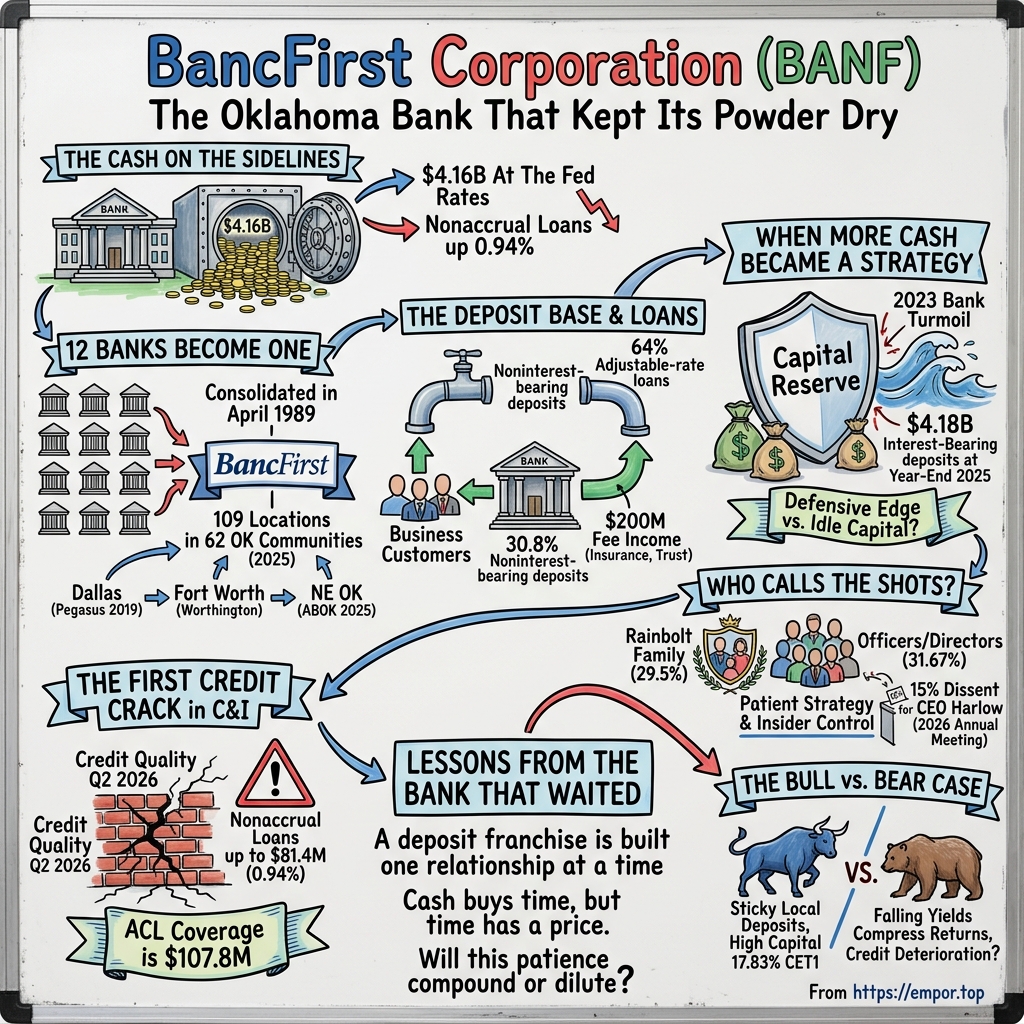
BancFirst Corporation: The Oklahoma Bank That Kept Its Powder Dry
I. The Cash on the Sidelines
At the end of June 2026, BancFirst had more than four billion dollars sitting at the Federal Reserve. It had not lent the money, and it had not put it into long-term bonds. The balance sat in interest-bearing deposits with other banks, mostly the Fed, and came to roughly $4.16 billion, while total deposits were about $12.8 billion.2 Few bank balance sheets of this size look like that. Most regional banks put every spare dollar to work in loans or securities because idle cash earns less than either. BancFirst left more than a quarter of its assets in what is, in effect, the safest checking account in America.
In the same quarter the company reported a record. Net interest income grew about 10% from a year earlier to roughly $133.5 million, the net interest margin rose to 3.84%, and quarterly net income came to about $66 million, or $1.96 a diluted share.3 Anyone reading only the headline would have seen a bank at its peak.
The footnotes told a less settled story. Loans the bank no longer expected to collect interest on, called nonaccrual loans, rose from about $61 million at the end of 2025 to $81.4 million by June. That took them from 0.72% of the loan book to 0.94%.2 Most of the increase came from commercial and industrial borrowers, meaning companies whose loans are secured by business assets and not by property. Repossessed property, which banks call other real estate owned or OREO, also grew.2 Neither number is alarming for a bank that holds this much capital. Both show that the borrowers' cycle has started to turn.
Those two facts frame the question this story follows. BancFirst has spent years building the deepest liquidity and capital cushion of any comparable regional bank in its part of the country. That cushion paid off when interest rates were high, because cash at the Fed earned more than 5% and needed no credit judgment. Now rates are falling, and that cash will earn less each time the Fed cuts. Borrowers are also starting to show strain. So the question is whether a bank that kept its powder dry can keep earning a premium return when the rewards for waiting shrink and the costs of lending rise.
Before going further, it helps to be clear about what the company is. The listed company, BancFirst Corporation, is a bank holding company in Oklahoma City. Almost all of its business runs through BancFirst, a state-chartered bank with 109 locations in 62 Oklahoma communities. That bank holds about four-fifths of the group's loans.1 Two smaller banks extend the franchise into Texas: Pegasus Bank in Dallas and Worthington Bank in the Fort Worth area. The group also owns BancFirst Insurance Services, an independent insurance agency. American Bank of Oklahoma, known as ABOK, was bought in 2025 and merged into BancFirst in February 2026.1
One accounting quirk is worth clearing up early. Standard data screens show BancFirst's "cash and short-term investments" dropping from almost $4 billion in 2024 to about $227 million in 2025, which would seem to mean the cash pile disappeared. It did not. The company's own year-end balance sheet still showed about $4.18 billion of interest-bearing deposits with banks.1 The difference comes from how data vendors classify a bank's line items. For this company, the number that matters is the cash at the Fed, and it stayed above $4 billion.
That leaves three tests. Can the bank protect its returns as yields on that cash fall? Is the rise in commercial nonaccruals a single borrower problem being worked out, or the start of something broader? And will management put its surplus capital to work without diluting returns? To answer them, the story starts in 1989, when a dozen Oklahoma banks agreed to become one.
 Subscribe on LinkedIn
II. Twelve Banks Become One Oklahoma Franchise
The Oklahoma of the late 1980s was a hard place to run a bank. The oil bust earlier in the decade had wrecked the state's energy economy, and the most famous failure, Penn Square Bank in Oklahoma City, had become a byword for reckless energy lending. Small-town banks across the state were capital-starved and had nobody local to sell to. In that setting a holding company first incorporated in 1984 as United Community Corporation, and renamed BancFirst Corporation in 1988, did something unusual. On April 1, 1989 it merged twelve banks into a single institution.1
The underlying bet was simple, and it still runs through the company. Community banking works because local bankers know local borrowers: the rancher's cattle cycle, which car dealer pays on time, whether the school district's payroll account is likely to stay put. Community banking struggles because small banks cannot afford modern technology, compliance staff, treasury services or the capital to make larger loans. BancFirst tried to keep the local relationship and share the plumbing. Back-office functions, technology and capital would be centralized. The customer would keep dealing with a banker who lived down the street.
The company kept repeating that formula for three decades. It has made more than 40 community-bank acquisitions over its history, most of them small, most of them in Oklahoma towns where the selling bank had good relationships and no good succession plan.1 By the end of 2025 the outcome was the 109 locations in 62 communities.1 In many small towns the BancFirst branch is one of very few banks, and sometimes the only one. Dense coverage in places larger banks overlook is the core of the franchise.
For most of that period the company was associated with one family and one executive. David Rainbolt, whose father was a founder, became chief executive in 1992 and ran the company for twenty-five years.1 In May 2017 the structure changed. Rainbolt became Executive Chairman, David Harlow became chief executive of the holding company, and Darryl Schmidt became chief executive of the main bank.1 That split still governs the company. Harlow oversees the group and its capital. Schmidt runs the Oklahoma bank where most of the profit is made. Rainbolt remains the largest shareholder and the center of gravity.
The team that took over in 2017 inherited a sound but narrow franchise. It was profitable, very well capitalized and confined almost entirely to Oklahoma, a state whose economy still moves with energy prices and whose population grows slowly. The new team's first major decision was to look south. In 2019 BancFirst agreed to buy Pegasus Bank in Dallas, its first real step into one of the fastest-growing metropolitan economies in the country.4 In 2022 it bought Worthington Bank in the Fort Worth–Arlington area.1 In 2025, it returned home to Oklahoma with ABOK in Collinsville, near Tulsa.6
That sequence shows the strategy. The company has not made a transformative merger. It has expanded the map gradually, one bank at a time, with a clear preference for staying in territory it understands. The approach looks disciplined, and it has produced results. Net income rose from about $66 million in 2015 to about $240 million in 2025, which is roughly 14% compounded a year.1 Total assets more than doubled over the same decade.1
The structure also creates a tension. Local autonomy protects relationships and underwriting judgment, because a banker who knows the borrower usually lends better than a scoring model in another state. But autonomy is hard to standardize and harder to measure from outside. The company does not publish branch-level profitability, customer retention or deposit share by town, so investors cannot easily separate a network that compounds from one that simply accumulates. The test is in the economics: what each relationship actually earns, and whether that has held up.
III. The Deposit Base That Pays for the Loans
Picture a small manufacturer in Norman or Enid that needs a $2 million line of credit to buy steel ahead of a large order. The owner goes to the local BancFirst branch, where the lender has known the family for years. The loan is approved and priced at a floating rate. The customer then moves its operating account into the bank too, along with payroll, cash-management services, merchant payments and possibly the company's insurance policies. The loan is the first step. Most of the long-term value comes from what the customer brings along with it.
That scene captures BancFirst's economics. Banks make money mainly on the spread between what they earn on assets and what they pay for funding. In 2025, BancFirst earned about 5.79% on its earning assets and paid about 2.05% on its funding overall, leaving a spread of around 2.5%.1 The more important detail is the next one. Because a large share of its funding cost nothing at all, the bank's effective margin was much higher than the simple spread. Net interest income of about $490 million on roughly $13.1 billion of average earning assets produced a net interest margin of 3.74%.1 Interest-free funds contributed about 1.2 percentage points of that margin.1
Those interest-free funds are the business accounts in that scene. At the end of 2025, about 30.8% of BancFirst's deposits, roughly $3.9 billion, were noninterest-bearing demand deposits.1 They are the payroll and operating balances that companies and households keep at the bank because it is convenient and because the bank provides the services around them. A bank that funds almost a third of its balance sheet at zero cost has a structural head start over a lender that has to pay market rates for every dollar. That is the most important competitive fact about BancFirst, and the footnoted evidence for it is strong.
The asset side complements it. About 64% of BancFirst's loans have adjustable or floating rates.1 When rates rose in 2022 and 2023, those loans repriced upward quickly while a large part of the funding stayed free, which is why margins improved. The same mechanism works in reverse. As rates fall, floating loans earn less, and the free deposits stop adding as much value because the alternative cost of funding falls too.
Fees are the second leg. In 2025 noninterest income was about $200 million, roughly 29% of net revenue.1 Service charges on deposits brought in about $71 million, cash-management fees about $41 million, insurance commissions about $35 million and trust fees about $23 million.1 These lines are recurring and mostly tied to the same customer relationships that provide the deposits. BancFirst Insurance Services is real diversification, but it should be kept in proportion. It is a meaningful agency business inside a bank, not a second pillar of comparable scale.
The cash that reprices first
Then there is the cash. In 2025 the interest-bearing deposits at the Fed and other banks earned about $167.6 million, up from $119 million in 2023.1 That came to more than a fifth of total interest income.1 This is the part of the balance sheet that changes fastest when rates change. The rate the Fed pays on reserves moves with its policy rate almost immediately. A quarter-point cut on $4 billion takes about $10 million a year out of interest income before the bank has adjusted anything on the deposit side.
The bull case says BancFirst can absorb that. Interest-bearing deposits cost about 3.12% in 2025, which leaves room to cut those rates as the Fed eases.1 The bank's margin of 3.84% in the second quarter of 2026 suggests that, so far, it has been repricing its deposits at least as fast as its assets.3 The bear case says a single quarter's margin does not establish a trend, and that deposit pricing depends on competition, not only on the bank's intentions. If a competitor in Tulsa or Dallas keeps paying higher rates to win commercial balances, BancFirst either has to match them or lose deposits.
The competitors are well known. In Oklahoma the largest local rival is BOK Financial, the Tulsa-based bank that is several times BancFirst's size. In Texas there is Prosperity Bancshares, plus Cullen/Frost and a long list of strong community banks. National banks such as JPMorgan Chase and Bank of America compete for the larger commercial accounts, and online banks compete for consumer savings with high-yield accounts. Precise market shares require FDIC deposit data from a common date, and BancFirst does not publish its own deposit share. What can be said is that the company's footprint is unusually dense in smaller Oklahoma communities, where national banks are thin on the ground, and much less dense in the Texas metros, where it is a small participant.
How durable is the advantage? The evidence supports a narrower claim than "immune to rate cuts." A large stock of noninterest-bearing deposits and a mostly floating-rate loan book give the bank a lower cost of funds than most peers and protect the margin in rising-rate periods. They also make earnings more sensitive to falling rates, because the cash and the floating loans reprice first. The company does not disclose customer retention, deposit attrition by vintage or relationship pricing data, so whether the moat would survive a sustained price war is untested. The noninterest-bearing share of deposits is the best public proxy for the strength of those relationships. It held near a third even after two years of high rates, when customers had every reason to move cash into interest-bearing accounts. That is a good sign. The company would need to show the same stability through a full easing cycle to make the stronger claim.
IV. The Growth That Came One Small Bank at a Time
In 2019 BancFirst agreed to pay $123.5 million in cash for Pegasus Bank, a Dallas lender with about $651 million in assets and $604 million in deposits.4 Measured against the acquirer it was small: Pegasus added less than a tenth to BancFirst's assets. Strategically it mattered a great deal. For thirty years the company had grown inside Oklahoma. With Pegasus it bought into the Dallas economy, which was growing faster than almost any other large American metro, and into a commercial lending market where a relationship banker with a strong balance sheet behind them could compete for larger customers.
The structure of the deal shows the bet. The price was well above the target's tangible book value, so a large part of it was booked as goodwill and intangible assets.4 Goodwill is the premium a buyer pays over the fair value of what it can count, and it is effectively a wager that future earnings will justify it. BancFirst paid in cash and not in shares, which avoided diluting existing owners but meant the company was using its own capital cushion to buy entry into Texas. Pegasus has continued to operate under its own name, with three branches in Dallas.1
Worthington Bank, bought in 2022, followed the same logic in Fort Worth and Arlington, again keeping its local brand.1 Together the Texas banks and ABOK hold about a fifth of the group's loans.1 That is a substantial share. The Texas strategy is no longer an experiment, but it is also not the core. Oklahoma still produces most of the earnings.
The other deals are smaller still. In 2020 the company bought a small Oklahoma community bank, Citizens, which only filled in its existing map.5 In 2023 it bought a branch in Stroud.1 In 2025 it bought ABOK, a Collinsville bank with about $414 million in assets, for total consideration of about $33 million in cash and stock.6 BancFirst issued about 204,000 shares, worth roughly $23 million, as part of that payment.1 These are bolt-on deals. They extend coverage into nearby towns and bring deposits and borrowers into a platform that already exists.
Reading the price tags
It is tempting to compare those prices with the acquired assets and call the deals cheap. Pegasus cost about a fifth of its assets and ABOK about 8% of its assets. But price to assets is not how bank deals are valued. Bankers compare price with tangible book value, with core deposits, with earnings, and with the fair-value marks taken on the acquired loans. A small bank with thin capital may look cheap on assets and still be fully priced on book. BancFirst's filings give enough to show the deals were modest relative to its own balance sheet. They do not give enough to calculate a deal-by-deal return on invested capital, and the company has not disclosed a material pro forma earnings contribution from ABOK.1 So the fair verdict is limited. These acquisitions fit the strategy and were affordable. Whether they earned more than their cost of capital is unproven in the public record, and calling them bargains would go beyond what the evidence supports.
There is one real stress test in the record, and it is 2020. Net income fell about 26% that year, from roughly $134 million to about $99 million, as the bank set aside reserves for pandemic losses and rates collapsed.5 That was the first year Pegasus was fully consolidated, which is why some observers connected the two. The more likely explanation is the cycle. Loss provisions jumped across the industry, and a bank with this much floating-rate lending and cash was bound to suffer when the Fed cut to zero. Earnings recovered strongly in 2021 and set new records afterward.1 The lesson of 2020 is not that the acquisition strategy failed. It is that BancFirst's earnings are cyclical. The company stayed profitable, but compounding at this bank is not a straight line.
Looking ahead, Oklahoma community-bank consolidation will continue because the economics of small banks keep getting harder. BancFirst, with a large capital surplus and a proven integration process, is an obvious buyer. The open question is whether small, local deals can absorb enough of that surplus to matter. A $33 million acquisition is a rounding error for a company with almost $2 billion of equity. If deals stay this small, most of the capital will keep sitting where it already sits, at the Fed.
V. When More Cash Became a Strategy
In March 2023 Silicon Valley Bank failed in less than two days. Its depositors were concentrated and largely uninsured, and the bank had put their money into long-term bonds whose values fell as rates rose. When depositors ran, the bank had to sell those bonds at a loss, and the loss wiped out its capital. Signature Bank and First Republic followed. For several weeks every regional bank in America was judged on two questions: how many uninsured deposits do you have, and how much of your bond book is underwater?
BancFirst got through that period without visible strain, because its balance sheet had been built for it. Its loan book was smaller than its deposits, so it did not need wholesale funding. Its securities book was short and mostly Treasuries. Its excess liquidity sat in cash, which cannot lose market value. By the end of 2025 the company still carried about $4.18 billion of interest-bearing deposits with banks, and it had another $923 million of untapped borrowing capacity at the Federal Home Loan Bank of Topeka.1
The securities choice explains most of it. Many banks bought long-dated mortgage bonds and placed them in the held-to-maturity category so that price swings would not hit reported capital. BancFirst's held-to-maturity holdings were negligible, about half a million dollars.1 Its available-for-sale portfolio of roughly $924 million was about 95% U.S. Treasuries, and the unrealized loss on it at the end of 2025 was only about $11 million before tax.1 At many peers the corresponding figure ran into the hundreds of millions. That choice removed one of the most dangerous sources of rate risk. It also meant earnings depended more on overnight cash rates, which is the vulnerability now visible as rates fall.
The deposit-flight arithmetic
How safe is the funding? Uninsured deposits, meaning balances above the FDIC's $250,000 per-account limit, were about $4.3 billion at the end of 2025, roughly a third of deposits.1 Cash at the Fed covered almost all of that. On paper, the bank could have repaid nearly every uninsured depositor in a day without selling a security. That is a strong position, but it does not make the bank immune to deposit flight. A sudden run would still be painful. The cash would leave, earnings would fall, and the bank might have to pay up to keep the remaining balances. Liquidity reduces the vulnerability. It does not remove the cost of keeping deposits loyal when competitors offer more.
Capital tells the same story. At the end of 2025, BancFirst's common equity tier 1 ratio, the main measure of loss-absorbing capital relative to risk-weighted assets, was 17.83%.1 The regulatory minimum including the buffer is 7%. That puts the company among the most heavily capitalized commercial bank groups of its size in the United States. Its leverage ratio, which measures capital against total assets without risk weighting, was about 11.6%.1 Regulators would be satisfied with a much thinner cushion.
Bank capital grows differently from cash at an industrial company. A manufacturer's free cash flow is the money left after it pays for its factories. A bank's operating cash flow mixes in loan disbursements and deposit flows, so it says little about what shareholders actually earned. The cleaner measure is how net income becomes equity. In 2025 BancFirst earned about $241 million and paid about $63 million in common dividends, keeping roughly $177 million.1 Shareholders' equity rose from about $1.62 billion to about $1.85 billion, and to about $1.96 billion by June 2026.12 Nearly every retained dollar became loss-absorbing capital, and the company did not need to issue new shares to get there.
The price of safety
This is also where an activist would start asking questions. The dividend payout has been around a quarter of earnings for years, about 26% in 2025.1 The board raised the quarterly dividend to $0.49 in May 2026.8 But BancFirst bought back no shares in 2024, 2025 or the first half of 2026, and only about 20,000 in 2023.1 The capital ratio has kept rising. A bank with a 17.8% CET1 ratio and earnings that keep adding to it has far more capital than it needs, and that capital earns the cash rate, not a lending rate. That drag is why return on equity has fallen from about 15% in 2022 to about 12.7% over the last twelve months, even as profits reached records.1
The skeptic's case is not that the bank is unsafe. It is that BancFirst may be optimized for continuity and safety, which suits a controlling family, more than for per-share returns, which suit minority owners. The defense is that this cushion is exactly what lets the bank buy a competitor at the bottom of a cycle, or lend while others retreat. Both are plausible. What the record shows so far is that the capital accumulated faster than it was deployed.
The measures to watch follow from this: the margin, average cash balances, the loan-to-deposit ratio (about two-thirds at the end of 2025), tangible book value growth and return on equity as rates come down.1 If cash falls and loans rise without a jump in credit costs, the patience will have paid off. If cash stays high and returns keep slipping, the market will treat the liquidity as idle capital. The other variable is credit, which is the real test of whether lending more would be wise.
VI. The First Credit Crack Is in C&I
For most of the past several years, BancFirst's credit record was nearly uneventful. Net charge-offs, the loans written off as losses after recoveries, were about 0.08% of average loans in 2023 and 2024 and 0.10% in 2025.1 For comparison, a typical U.S. commercial bank's long-run average is several times that. Nonaccrual loans were about 0.72% of loans at the end of both 2024 and 2025.1 The book looked steady.
Then, in the first half of 2026, one category moved. Nonaccruals among commercial borrowers not secured by real estate rose from about $12 million at year-end to about $42 million by June.2 That roughly $30 million jump accounted for most of the increase in total nonaccruals to $81.4 million.2 When a bank's problem loans move that much in one category within six months, the usual explanation is one or two large borrowers rather than hundreds of small ones. The company does not name the borrowers or their industries in its filing. The scale suggests a concentrated workout, and Oklahoma's economy, with its energy, agriculture and manufacturing exposure, does produce lumpy commercial credit events.
The counterevidence belongs right next to it. The allowance for credit losses, the reserve set aside for expected losses, rose to about $107.8 million, or 1.25% of loans, by June.2 That is more than the full balance of nonaccrual loans. Net charge-offs in the first half of 2026 were about $7.4 million, still modest.2 Nonaccrual does not mean lost. It means the bank has stopped booking interest until it is satisfied it will be repaid, and many such loans are eventually recovered through collateral or restructuring.
Coverage is not a forecast, though. Reserve coverage of nonaccrual loans fell from about 170% at year-end to roughly 132% in June, because the problem loans grew faster than the reserve.12 If the commercial borrowers in question are worth less than the bank thinks, charge-offs will rise and the reserve will need replenishing through provisions that reduce earnings. Reserves can tell you how bad the bank thinks things are. They cannot tell you the outcome.
The real estate question
Commercial real estate is the other area to watch. At the end of 2025, non-owner-occupied commercial real estate (office, retail, multifamily and industrial property held by investors and not by the businesses using it) was about $1.8 billion, roughly 21% of loans and almost equal to the holding company's equity.1 Construction loans added about $657 million.1 Those are significant concentrations relative to capital. They are not unusual for a community bank, and BancFirst's capital ratio is high enough to absorb a large loss. But a claim that the real estate book is "conservative" depends on property type, geography, loan-to-value and maturity. The company gives only partial detail on those, so the honest verdict is that the concentration is moderate and has not yet caused losses.
Repossessed real estate, OREO, rose from about $48 million at the end of 2025 to about $60 million by June 2026.12 For a bank this size that is a noticeable amount, and a large part of it sits in a small number of legacy holdings, including real estate entities the company carries as subsidiaries.1 The increase looks more like a few individual workouts than a broad property downturn, but resolution timing and sale prices will decide that.
The auditor has highlighted the same area. Forvis Mazars issued an unqualified opinion on the 2025 financial statements and on internal controls.1 It identified the allowance for credit losses as the critical audit matter, specifically the loss-modeling assumptions and the qualitative adjustments management makes on top of the models.1 A critical audit matter is not a qualification or a warning. It marks the area of the accounts that requires the most judgment. At BancFirst, that area is the reserve against loan losses, which is now being tested.
The next filings will show which way this goes. The third-quarter 2026 report and the 2026 annual report should show whether the commercial nonaccruals were resolved with limited loss, or whether criticized loans, charge-offs and OREO kept rising. Until then, the fair conclusion is that the increase is real, concentrated and well reserved. It has not yet become a credit cycle. When a cycle does arrive, the question will be who decides how the bank responds.
VII. Who Gets to Call the Shots?
At BancFirst's annual meeting on May 28, 2026, every director nominee was re-elected, as usually happens. One result stood out. Chief executive David Harlow received about 24.8 million votes for and about 4.4 million against, roughly 15% dissent.8 The other directors received less than 2% opposition.8 Say-on-pay passed with about 98.4% support.8 Shareholders approved the pay plan Harlow ran under and voted for every other nominee, but a meaningful minority voted against him in particular.
The context matters, because outside shareholders have limited power at this bank. As of March 2026, David Rainbolt beneficially owned about 14.9% of the shares, mostly through a family partnership, and the SEC treats him as a statutory "parent" of the company.7 His sister, Dr. Leslie Rainbolt, held another 14.6% through her own partnership.7 Together the family controlled about 29.5% of the votes, and directors and officers as a group owned about 31.7%.7 The largest outside holders, BlackRock, Kayne Anderson Rudnick and Vanguard, each held between about 7% and 8.5%.7 An activist would struggle to win a proxy fight without the family's support.
The leadership is stable and has been for a long time. Rainbolt, the former chief executive, is Executive Chairman and the family's representative. Harlow, a long-time BancFirst executive, has led the holding company since 2017. Schmidt runs the Oklahoma bank. Hannah Andrus, who came from Ernst & Young, became chief financial officer in 2024.7 The board has 17 directors, a majority independent under Nasdaq rules, with separate audit, compensation and nominating committees.7
Pay, family and related parties
Executive pay at BancFirst is low by the standards of public banks. In 2025, Harlow received about $1.0 million in total, consisting of a $725,000 salary, an incentive of about $181,000 and retirement and other benefits.7 Schmidt received almost exactly the same.7 The incentive formula is tied to budgeted net income and credit measures rather than large stock grants.7 Calling it "modest" requires a peer set, and many bank chief executives at companies of similar market value earn several times more. On the evidence available, pay is restrained and tied to profit and safety. The incentive is also small relative to the salary, which suggests the board is not paying heavily for performance either.
Related-party dealings are disclosed plainly and should be described plainly. Loans to directors, executives and their affiliated businesses, which Regulation O governs, came to about $145.9 million at the end of 2025, up from about $84 million two years earlier.1 None were nonaccrual, past due or restructured, and the company says they were made on ordinary market terms.1 Insider lending is normal at a community bank whose directors are local business owners. The growth in those balances is still worth tracking. Separately, a son of the Executive Chairman works as an executive and licensed agent at BancFirst Insurance Services and earned about $595,000 in 2025, including commissions.7 The controls are formal. So is the family connection.
What explains Harlow's vote? The proxy statement and the vote filing give no reason, and no investor publicly announced a campaign.78 Proxy advisers sometimes recommend against a CEO who also sits on a board with limited independence, or over committee or attendance issues, but there is no evidence to say which applied here. The dissent is a signal worth watching through next year's proxy. It is not proof of a governance crisis.
Management credibility is better judged by results. The team that took over in 2017 grew earnings strongly through 2019, saw them fall sharply in 2020, recovered fully in 2021 and handled the rate shock of 2022–2023 better than most regional banks. It is now dealing with the first meaningful credit deterioration of its tenure. The company's earnings releases describe results in a sober, factual way, without the ambitious targets some peers publish.3 There is no record of missed guidance because there is very little guidance. That limits overpromising, but it also leaves shareholders with less to hold management to.
The company disclosed no material litigation, regulatory enforcement or tax dispute.1 Off-balance-sheet commitments of about $2.4 billion in unused loan lines and about $88 million in standby letters of credit are part of ordinary banking.1 They are a call on liquidity when customers draw them, but they are not debt the bank already owes. With $4 billion at the Fed, the bank can cover them. In the end, the family's patience sets the strategy.
VIII. Lessons from a Bank That Waited
Go back to the manufacturer in Norman: one loan, one operating account, one cash-management contract, perhaps an insurance policy. The bank collected a spread, a fee and an interest-free deposit from a single relationship, and then put a large share of what it gathered into the safest asset available. Multiply that across 62 communities and three decades and the result is the BancFirst story. Revenue grew about 10% a year over the past decade, net income about 14%, and the company paid out roughly a quarter of its earnings as dividends.1 Several lessons from that record apply specifically to this bank.
The first is that a deposit franchise is built one relationship at a time and lost the same way. BancFirst's advantage is not its brand and not its technology. It is roughly $4 billion of operating balances that customers keep there without being paid to. That advantage appears in the deposit mix and the margin. It has not been tested in a long period of falling rates and aggressive competition. For investors in any relationship bank, the lesson is that the noninterest-bearing share of deposits is the moat expressed as a number. When it starts to fall, the moat is getting narrower.
The second is that a good acquisition extends the map before it changes the balance sheet. Pegasus brought BancFirst into Dallas without betting the company, and ABOK filled a gap near Tulsa for the cost of a few months of earnings. Neither deal could have hurt the company badly. But small acquisitions also cannot prove much. Twelve years of disciplined deal-making has not produced a single public, deal-level return calculation. Modest prices make good stories, but returns are the proof, and here that proof is still owed.
The third is that cash buys time, and time has a price. Billions at the Fed meant BancFirst never had to sell bonds at a loss, never had to scramble for funding in 2023, and could earn more than 5% while waiting. That was clearly the right position in a high-rate world. In a falling-rate world it becomes a question. Return on equity has slipped from the mid-teens toward the low teens while profit reached records, because the capital has grown faster than the earnings it supports.1 Waiting is a strategy only if there is an end to the waiting.
The fourth is that conservatism is a policy, not a guarantee. The 2020 profit drop showed that earnings at even a cautious bank fall when rates and credit turn together. The 2026 commercial nonaccruals show that local underwriting knowledge is not proof against loss. And concentrated family ownership, which has kept the strategy consistent for decades, also means minority owners cannot easily change it if it stops working. Investors who admire BancFirst's patience should also accept that they have little say over when it ends.
IX. Analysis & Bear vs. Bull Case
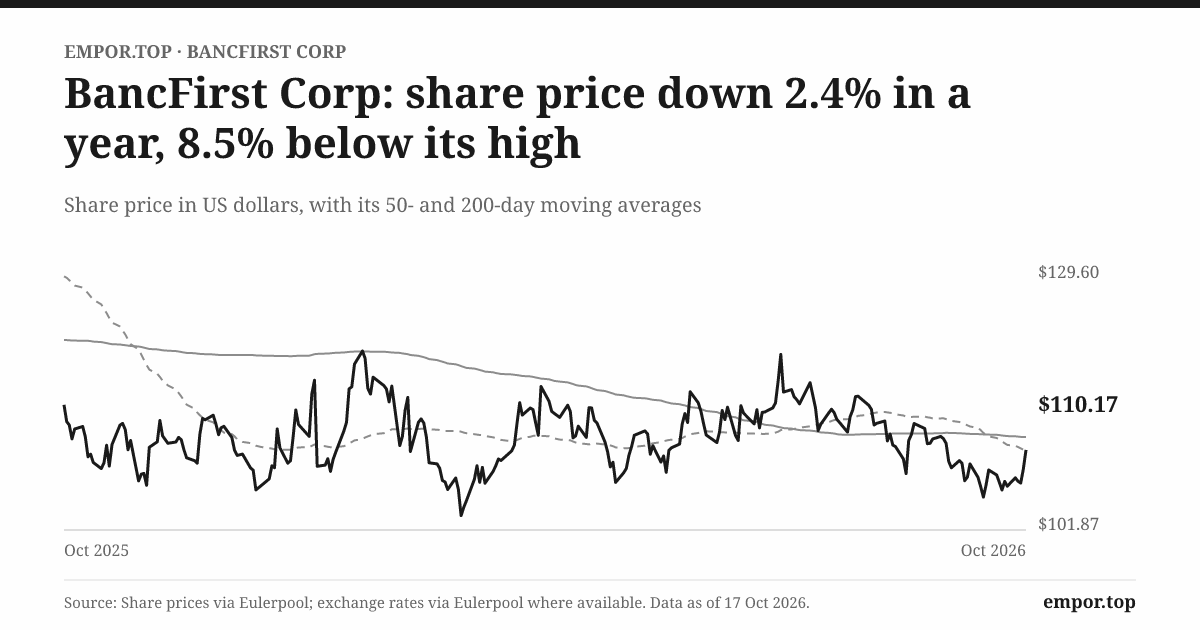
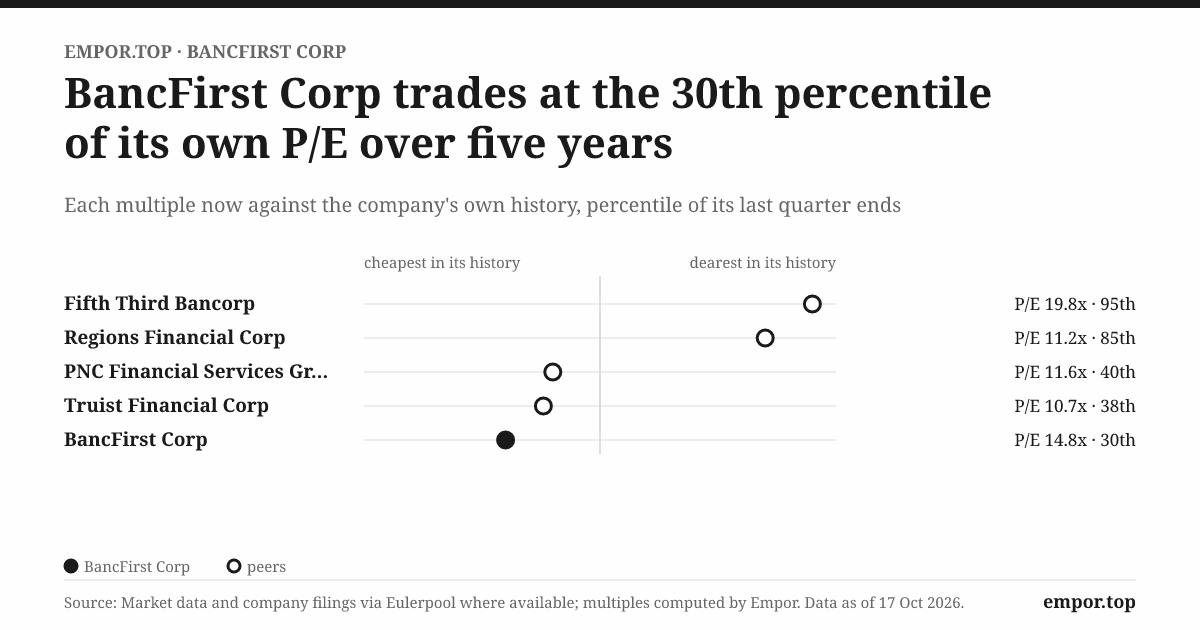
On October 17, 2026, BancFirst shares closed at about $110.17, which put the market value at about $3.7 billion.9 That was about 14.8 times trailing earnings, close to the five-year median of around 15.2 times, and about 1.9 times book value.12 The stock was about 8.5% below its 52-week high. The market is paying close to the bank's normal earnings multiple, but a higher multiple of book than most regional banks. The question is whether that premium on book reflects a stronger franchise or simply safety that will not compound.
The bull case starts with funding. Almost a third of deposits cost nothing, interest-bearing deposit costs have room to fall, and a mostly floating loan book means earnings move with rates instead of being locked into a low-yield bond portfolio. It adds roughly $200 million of recurring fee income, credit losses that have stayed around 10 basis points or less, capital far above regulatory minimums, almost no financial debt and a liquidity pool that could fund substantial loan growth or an acquisition without raising outside capital.1 On this view, the bank earns a high return on assets, about 1.6% in 2025 in a sector where 1% is respectable, and is underlevered.1 Any sensible deployment of the surplus would raise returns.
The bear case starts with the same balance sheet. More than a quarter of assets are in cash whose yield falls with every rate cut. A margin of 3.84% will be harder to defend as that cash and the floating loans reprice. Commercial nonaccruals have risen, and the reserve cover has thinned. Commercial real estate is concentrated relative to equity. Return on equity is lower than its peak despite record profits, and the obvious solution, using the surplus capital, has not happened. A controlling family that prefers safety may continue to prefer it. On this view, the market is paying a premium on book for a bank whose return on that book is falling.
The moat, tested
Porter's five forces give the structure. Rivalry is strong: BOK Financial, Prosperity, Cullen/Frost and national banks compete for commercial clients in the larger cities, and online banks compete for consumer deposits. Customer bargaining power is moderate. Individual depositors have little power, but large commercial customers can move balances, and no single depositor accounts for 10% of deposits, so concentration is low.1 Suppliers to a bank are essentially its depositors and its technology vendors. Depositors have gained power as moving money has become easy. The threat of substitutes comes from fintech payment platforms and private credit lenders, which have taken some commercial lending from banks nationally. Barriers to entry are high for a new chartered bank but much lower for a digital deposit-gatherer.
Hamilton Helmer's seven powers narrow the advantage further. The most plausible is switching costs. Operating accounts integrated with payroll, cash management and lending are troublesome to move, and the stable noninterest-bearing deposit share is evidence that customers stay. A second is a form of scale or density. In small Oklahoma towns, BancFirst's branch coverage and local knowledge are hard for a larger competitor to justify replicating, and that functions somewhat like a cornered distribution network. Counter-positioning, network effects, brand and process power are weak or unproven. The bank's process is good, but nothing in the record shows that competitors could not copy it. So the honest verdict on the moat is real but local. It is strongest in rural Oklahoma, weaker in Texas, and the company publishes no retention, pricing or market-share data that would let an outsider measure it directly.
Against peers, BancFirst's premium on book looks partly earned. As of recent snapshots, BOK Financial traded around 1.4 times book, Prosperity around 1.1 times and Simmons First under 1 times. Cullen/Frost, the other Texas bank known for strong deposits, traded around 2 times.1 Those multiples move daily and should be refreshed before any decision. The pattern is still informative. The market pays the most for banks with large, cheap deposit bases and high capital, and BancFirst sits in that top group with Cullen/Frost. What it gets paid for is the funding. What it has to prove is the return.
Three indicators matter most. The first is the net interest margin together with deposit costs, which last read 3.84% in the second quarter of 2026, up from a year earlier.3 The second is credit migration in commercial lending: nonaccruals at 0.94% of loans and rising, net charge-offs around 0.10% of average loans.12 The third is return on equity with capital deployment, now about 12.7% and lower than three years ago.1 The free-cash-flow yield of roughly 6.6% that standard screens show is not a meaningful valuation measure for a bank. Earnings, book value, credit costs and capital returns are the measures that count. On those measures the price assumes the bank can keep returns near current levels through the easing cycle. That is plausible, but it is not guaranteed, and the outcome depends on the next few quarters.
X. Epilogue
The next earnings release, for the third quarter of 2026, will be the first full report since the June credit increase, and the first since rate cuts began to bite.3 Each outcome on the three questions would point in a different direction.
Start with the margin. The level to watch is around 3.5%. If the margin holds near or above that as cash yields fall, it would mean deposit costs are coming down roughly as fast as asset yields. That would show the funding advantage holds in both directions of the rate cycle. If the margin falls toward or below that level while cash balances stay above $4 billion, it would mean the bank waited too long to put its liquidity to work, and the cash that protected it in 2023 would be dragging on it in 2027. A single quarter is not a trend. The direction across several quarters, together with the mix of loans and cash, will be the evidence.
Then the commercial credits. The best outcome would be that the large commercial nonaccruals are resolved through collateral sales or restructuring with limited charge-offs, that criticized loans level off and that OREO starts to shrink. That would confirm the contained-workout view, and the reserve would have been sufficient. The worse outcome would be the same loans moving into charge-offs while new problem loans appear in other categories. That would be the start of a credit cycle, and the bank's high capital would be needed for its original purpose.
Then the capital. Every quarter that passes without a buyback, larger acquisition or significant loan growth pushes the CET1 ratio higher and return on equity lower. A larger Texas acquisition, an authorized repurchase program or a deliberate expansion of lending would show the surplus being put to work. In each case the investor's question is whether the new dollar earns more than shareholders could earn elsewhere. Continued accumulation would show that safety remains the main priority.
Management's own communications will also be a test. If prepared remarks and analyst answers are specific about deposit betas, the commercial credits and plans for the cash, and consistent with what the company said six and twelve months ago, credibility will rise. If they are vague, the 15% vote against the chief executive will start to look less like an anomaly and more like a warning.
XI. Outro
Go back to the opening image: more than four billion dollars sitting at the Federal Reserve, beside a network of branches in Oklahoma towns where BancFirst is often the bank customers know best.12 In 2023 that cash was protection, against bond losses, deposit runs and the panic that brought down larger banks. In 2026 it is still protection. It is also the clearest open question about the company: what will management do with the next dollar?
BancFirst's defining bet is that local relationships and time are worth more than forcing every dollar to work today. For thirty-seven years that bet produced a profitable, overcapitalized bank. Now rates are falling and some borrowers are weakening, so the cost of waiting is going up. The coming quarters will show whether that patience is still earning a return, or whether it has become a reluctance to deploy capital.
References
-
BancFirst Corporation Form 10-K for the fiscal year ended December 31, 2025 — SEC EDGAR, 2026-02-26 ↩↩↩↩↩↩↩↩↩↩↩↩↩↩↩↩↩↩↩↩↩↩↩↩↩↩↩↩↩↩↩↩↩↩↩↩↩↩↩↩↩↩↩↩↩↩↩↩↩↩↩↩↩↩↩↩↩↩↩↩↩↩↩
-
BancFirst Corporation Form 10-Q for the quarter ended June 30, 2026 — SEC EDGAR, 2026-08-07 ↩↩↩↩↩↩↩↩↩↩↩↩↩
-
BancFirst Corporation Q2 2026 Earnings Release — SEC EDGAR, 2026-07-23 ↩↩↩↩↩
-
BancFirst Corporation Form 10-K for the fiscal year ended December 31, 2019 — SEC EDGAR, 2020-02-28 ↩↩↩
-
BancFirst Corporation Form 10-K for the fiscal year ended December 31, 2020 — SEC EDGAR, 2021-02-26 ↩↩
-
BancFirst Corporation Form 8-K, ABOK acquisition announcement — SEC EDGAR, 2025-05-21 ↩↩
-
BancFirst Corporation 2026 Proxy Statement, Form DEF 14A — SEC EDGAR, 2026-04-03 ↩↩↩↩↩↩↩↩↩↩↩
-
BancFirst Corporation Form 8-K, Annual Meeting Voting Results — SEC EDGAR, 2026-05-28 ↩↩↩↩↩
 LinkedIn
 WhatsApp
 Reddit
 Hacker News
 Email
 Kindle
 RSS Feed
 Spotify
 Apple Podcasts
 Amazon Music
 Audible
 YouTube