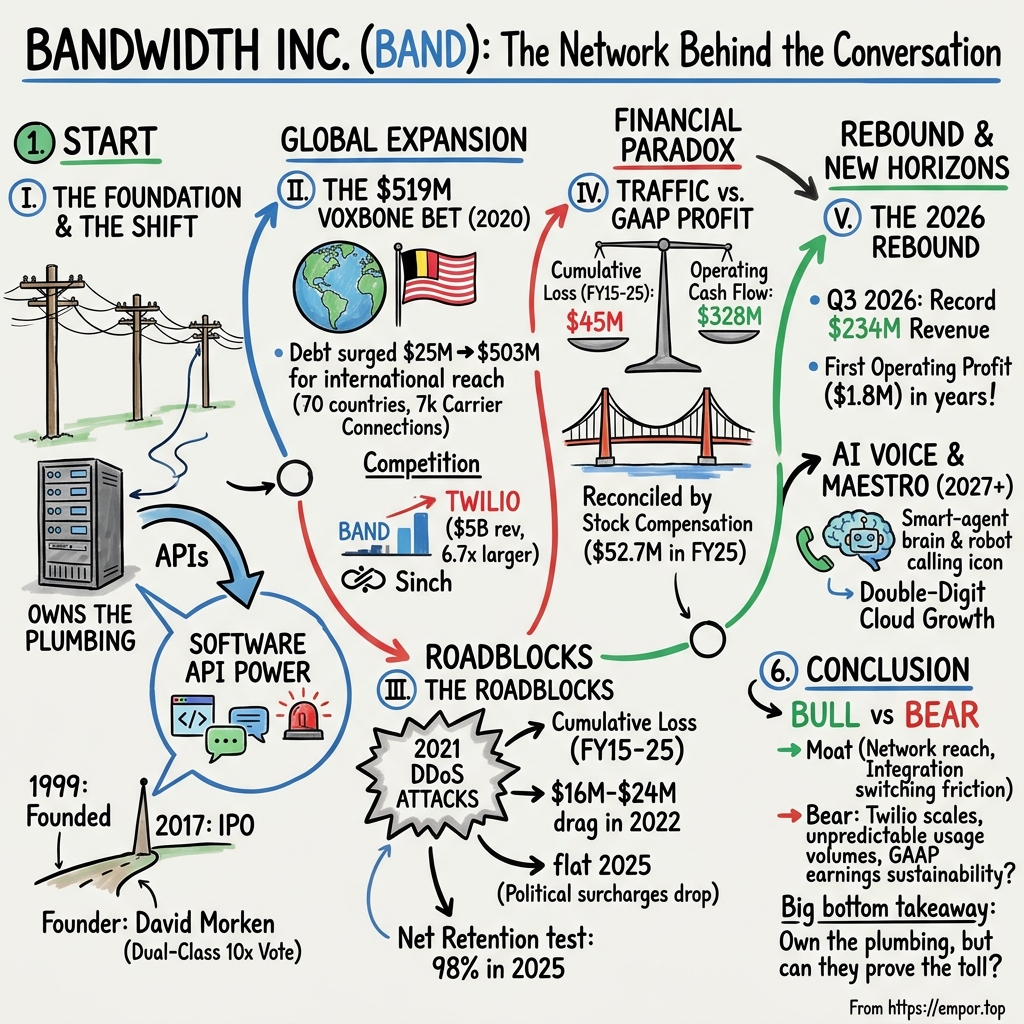
Bandwidth Inc.: The Network Behind the Conversation
I. The Call That Has to Pay Off
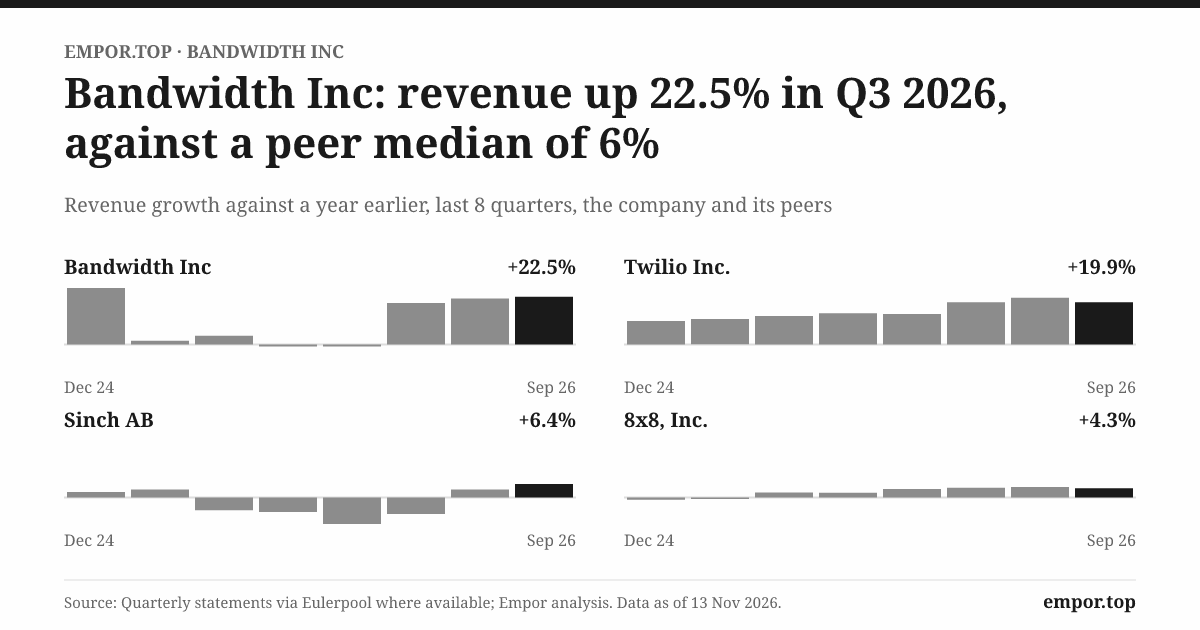
On the morning of October 29, 2026, David Morken opened Bandwidth's third-quarter call the way he often does, by thanking customers, thanking the people he calls "bandmates," and thanking God. Then he got to the number. Revenue for the quarter was a record $234 million, up about 22% on a year earlier.1
For a company whose reported sales had gone essentially nowhere in 2025, that was a jolt. Morken went further and told analysts that Bandwidth had growing confidence in double-digit growth in its core cloud communications revenue in 2027.[^2]
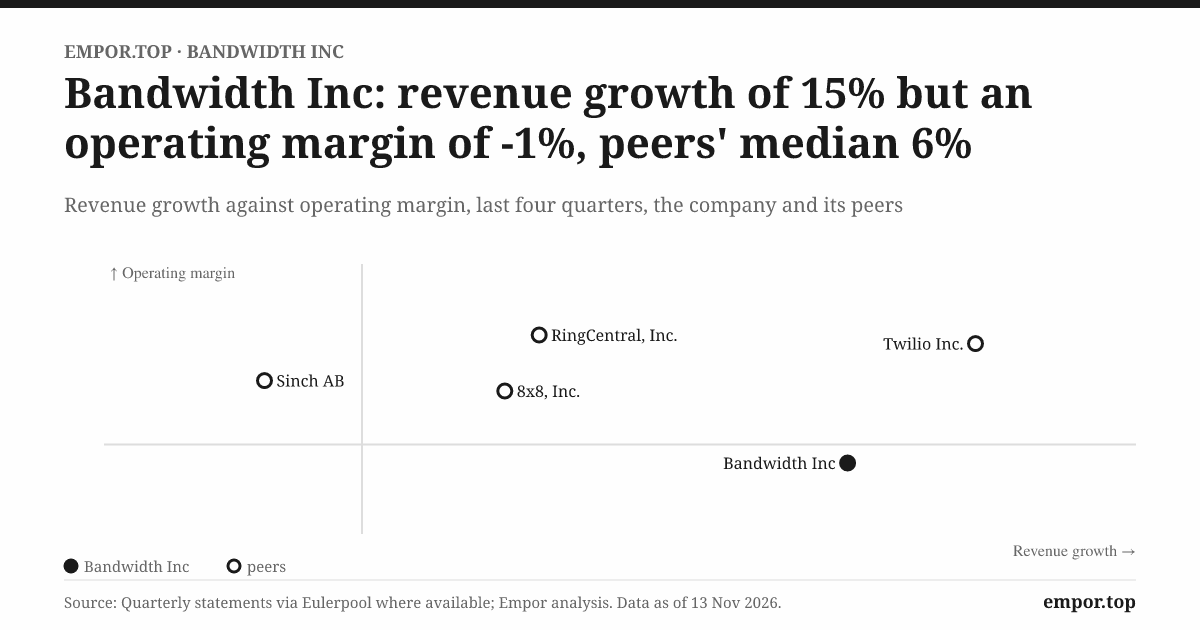
Buried a few lines lower in the release was the figure that mattered even more. Bandwidth earned an operating profit of $1.8 million in the quarter.1 That is a rounding error for a company with nearly a billion dollars of annual sales.
It was also the first time in years that the company had covered all of its costs, including the stock it pays its people with, from running the business. Every quarter from the autumn of 2023 through the summer of 2026 had closed with an operating loss, and the company had not reported a full-year operating profit since 2018.2
That is the paradox at the heart of this story. Bandwidth carries a staggering amount of the world's business conversation. When an app texts a two-factor code, when a contact center routes a customer to an agent, when a software platform needs a phone number that can reach 911, there is a good chance Bandwidth's network is somewhere underneath. The traffic keeps rising. Yet for most of its public life, the company carrying that traffic has struggled to turn it into accounting profit.
The quarter's headline flattered the core a little, too. Strip out the carrier surcharges Bandwidth collects on text messages and passes through to mobile operators, and the cloud communications business grew about 12%, to $158 million.[^2] That is respectable, and it is faster than the business grew through most of 2025.
But it is roughly half the headline rate, because carrier price increases and a midterm election swelled pass-through revenue that Bandwidth does not get to keep. The company's own adjusted gross margin, which excludes those surcharges and other items, rose to about 61%, while its reported gross margin slipped to 36%.[^2] Same quarter, two very different pictures, depending on whether you count the toll the carriers charge.
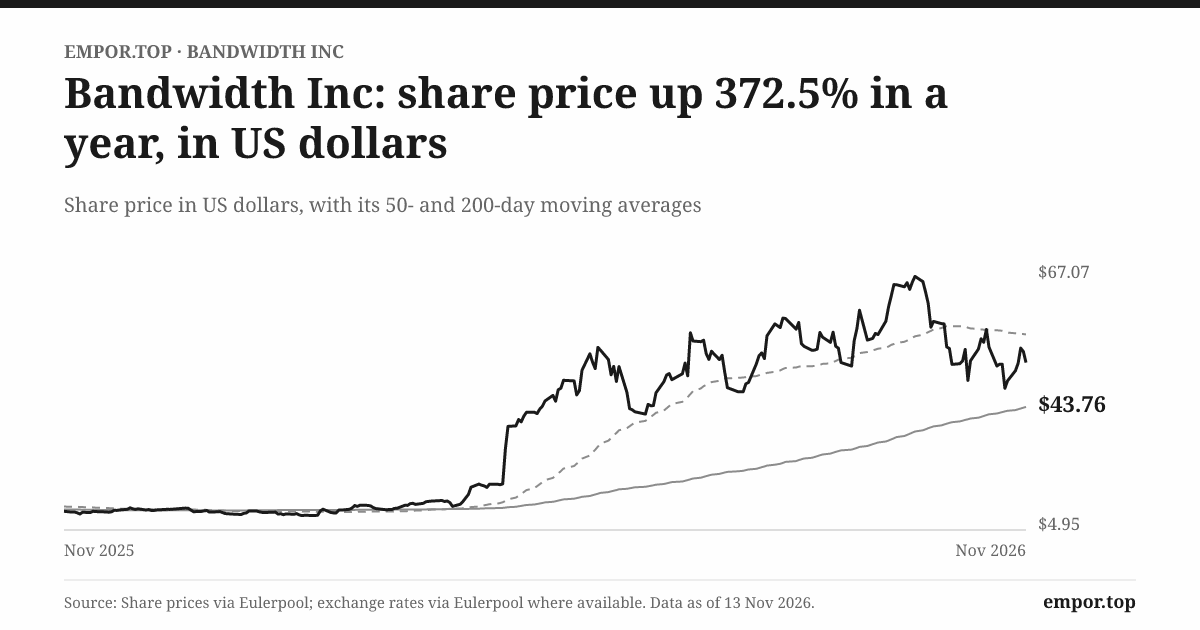
The stock market had already placed its bet. On November 13, 2026, Bandwidth's shares closed at about $44, giving the company a market value of roughly $1.3 billion and an enterprise value, after adding debt and subtracting cash, of about $1.7 billion.[^4] On the trailing twelve months of reported earnings, that price works out to more than 650 times earnings.
The multiple is absurd in the literal sense, because the earnings beneath it are tiny and, as this story will show, inflated by a gain on buying back debt and a tax benefit.3 A more useful lens is enterprise value against cash earnings before depreciation and other charges, which sits near 27 times. Either way, investors are paying for what Bandwidth might become, not for what it has reported.
So the questions for this story are sharp. Can growth persist once the election cycle and carrier surcharges are stripped away? Does owning a network give Bandwidth a real edge against much larger rivals, or is it a costly way to sell a service others rent? Was the $519 million Bandwidth paid for Voxbone in 2020 worth it? Can the company's genuine cash generation become durable profit under standard accounting? And does the 2026 recovery justify what the market already expects?
The scale helps frame the stakes. Bandwidth reported about $754 million of revenue in 2025 and runs as a single reported business segment, which means it publishes no separate profit figures for voice, messaging or international operations.2 It is a mid-sized company in a field where its best-known competitor, Twilio, is almost seven times larger.4
It owns its network in a world where most software buyers assume such things are interchangeable. Whether that ownership is a moat or a millstone has been the question underneath Bandwidth from the very beginning, and the beginning was a spare-room business that wanted to sell internet access.
 Subscribe on LinkedIn
II. A Carrier's Problem Becomes a Software Company
Bandwidth started in 1999, at the top of the dot-com boom, as the kind of company that boom produced by the thousands: a reseller of connectivity with an aspirational domain name.5 Its founder, David Morken, came to business from the Marine Corps, where he had served as a judge advocate, a military lawyer, before deciding he would rather build something than litigate it.6
Henry Kaestner joined him as co-founder, and a quarter-century later the two men still control a large block of the company's high-vote shares.6 The company grew up in Raleigh, North Carolina, where its headquarters campus stands today.2
Faith is part of the founding story. Morken is openly devout, and his habit of thanking God on earnings calls is not a public-relations flourish but a thread that runs through how the company describes itself, its people and its purpose.[^2]
He has run the company as chief executive since 2001 and chairs its board, an unusually long tenure for a founder in a public technology company.6 What matters for investors is the decision-making temperament that tenure has revealed: patient, stubborn and willing to build expensive things that pay off slowly.
The first decade was a scramble. Reselling other people's lines is a thin business, because the reseller owns nothing the supplier cannot take back or reprice. Bandwidth's defining move was to stop renting and start owning. Over the 2000s it built a nationwide IP voice network in the United States and became a licensed competitive carrier, which meant it could hold phone numbers, interconnect directly with other carriers and route calls itself rather than leasing those capabilities from AT&T or Verizon.5
Owning the pipes was only half of the idea. The other half was to make them programmable. Traditional telephone service was sold by the line and the circuit, provisioned by engineers, and changed through paperwork. Bandwidth exposed its network through application programming interfaces, the software hooks that let one program instruct another.
A developer could write a few lines of code to buy a phone number, send a text or place a call, and Bandwidth's network would do the rest.5 In effect, it turned a telephone company into something that looked, from the customer's side, like a cloud software service.
An analogy helps. Most communications platforms of that era were like travel agents: they took a customer's booking and passed it to an airline, keeping a fee for the convenience. Bandwidth wanted to be the travel agent and the airline at once, with its own planes and landing rights. That meant higher fixed costs and slower expansion, because every new route needed equipment and permission.
But it also meant that once a route existed, every extra passenger cost very little, and nobody upstream could raise the fare on Bandwidth without warning. That trade-off between heavy fixed investment and cheap incremental traffic is the economic DNA of the company, and nearly every later chapter of this story is a variation on it.
That combination found its first great customers among technology companies that needed communications at enormous scale. Bandwidth powered calling and messaging for large internet platforms and also incubated its own consumer phone service, Republic Wireless, which it separated from the core business in 2016 ahead of going public.5
The spin-off left behind a cleaner company focused on selling network services to other businesses, and it also left a thread that still runs through Bandwidth's filings: certain Bandwidth directors hold equity in Relay, the later venture from that family tree, which rents office space from Bandwidth today.2
The initial public offering came in November 2017, after Bandwidth filed its registration statement that October.5 The pitch to public investors was crisp. Bandwidth was the only major communications platform that owned a nationwide network rather than reselling someone else's, so it could offer software-style convenience with carrier-style economics. Public money and a listed share would let it widen that network and eventually take it abroad.
The long-run numbers show both why investors bought the pitch and why the ride has been bumpy. Revenue grew from about $137 million in 2015 to about $754 million in 2025, a compound rate of almost 19% a year.2 But the average hides two very different decades.
Growth surged during the pandemic, when remote work and video calling multiplied traffic, then slowed sharply, then surged again in 2024 before going flat in 2025. Over the three years to 2025, the compound rate was under 10%.2
The entity boundary is simple, which is a relief in this business. Bandwidth Inc. is the listed parent and the consolidated operator, with no controlling outside owner. Its figures include Voxbone, the Belgian international network it bought in 2020, and everything described here belongs to the same consolidated company.2 When this story speaks of Bandwidth's network, its customers or its debts, it means the listed company itself.
The defining strategic choice, then, was to own the infrastructure and sell access to it through software. It explains Bandwidth's appeal to customers who need reliability, and it explains the heavier capital burden that has kept accounting profit elusive. To understand which side of that trade-off wins, the next step is to look at what a customer actually pays for.
III. What the Customer Actually Buys
Picture a software company that sells a contact-center product to banks. Its engineers do not want to negotiate with dozens of phone carriers, register for emergency-calling rules in every state or buy blocks of phone numbers one region at a time. So they write code against Bandwidth's interfaces.
When a bank's customer dials in, the call lands on a Bandwidth number, travels over Bandwidth's network and is handed to the software company's application. Each minute of that call creates a small charge. Each number the bank keeps active creates a monthly fee. Multiply that by millions of calls and texts, and a business emerges.
Bandwidth's revenue model has two main pieces, and they behave differently. The first is usage: per-minute charges for voice calls and per-message charges for texts. The second is recurring monthly fees for phone numbers, 911-enabled numbers, messaging services and related software.2 In 2025, usage-based fees were about $415 million and the steadier monthly fees were about $147 million, together forming what the company calls cloud communications revenue of about $561 million.2
Then there is the third piece, which is not really Bandwidth's money at all. Mobile carriers charge surcharges on business text messages, and Bandwidth collects them from customers and passes them on. These messaging surcharges came to about $192 million in 2025, roughly a quarter of total revenue.2 They inflate the top line without adding much profit, and they swing with carrier pricing decisions and message volumes, including the floods of political texts that arrive in election years.
That swing explains 2025's strange arithmetic. Total revenue grew less than 1%, which looked like stagnation.2 Yet surcharge revenue fell by $16 million, or about 8%, as political campaign messaging faded after the 2024 presidential election, while cloud communications revenue rose.2
Management argued that, excluding political messaging, total revenue grew about 10% organically in 2025.[^9] The truth sits between the bleak headline and the management-adjusted figure. The core business grew, but not quickly enough on a reported basis to hide the end of an election cycle.
Inside cloud communications, the business divides again, and the pieces grow at very different speeds. In the third quarter of 2026, voice revenue was about $125 million, up 9%, while programmable messaging was about $33 million, up 26%, including roughly $3 million of political campaign texts.[^2] Within voice, enterprise voice, sold directly to large companies and their contact centers, grew 15%, while Global Voice Plans, the long-standing business of selling calling, numbers and emergency services to software platforms, grew 8%.[^2]
Raiford described the base-level connectivity markets behind Global Voice Plans as growing at about 3% to 8% a year, and said Bandwidth held the number-two share of the U.S. market in emergency-calling services, a management claim the company does not quantify further.[^2] The message is that Bandwidth is really two businesses wearing one name: a mature, sticky utility for platforms and a faster-growing enterprise operation that depends on winning big migrations.
Is this sticky software or variable traffic? It is both, and that is why the business is hard to value. The services recur, in the sense that a customer who embeds Bandwidth in its product rarely rips it out next month. But the revenue from that customer depends on how many calls and messages its own customers generate. A retailer's messaging spikes at Black Friday. A political platform's volume collapses after November. An airline's call volume swells during storms.
Bandwidth does not disclose a recurring-revenue percentage in the way a subscription software company would, nor does it disclose a typical contract length or minimum commitment across its customer base.2 Its 10-K describes multi-year master service agreements with many customers, but not how much of their spending those agreements guarantee.2
Customer concentration, at least, is limited at the line where companies must disclose it. No customer accounted for 10% or more of 2025 revenue.2 Average annual revenue per customer was about $232,000 at the end of 2025 and reached a record $273,000 by the third quarter of 2026, a sign that Bandwidth is landing bigger enterprise accounts.[^9][^2] The company does not publish its top-five or top-ten customer shares, so investors cannot tell how much revenue sits just below the 10% line.
That sets up the most important test in the whole business, and it is a test about loyalty. Bandwidth says more than 99% of its customers stay from one year to the next.[^2] That is a statement about names on contracts. The harder question is whether those customers spend more each year.
A customer can stay loyal while its traffic shrinks, or while it quietly moves half its volume to a second provider. The difference between keeping customers and growing with them is where Bandwidth's claims of a moat either hold or crack, and it is the subject of the network itself.
IV. The Network Is the Product—and the Test
Imagine an all-digital bank racing to grow. It wants an artificial-intelligence agent to answer the phone, a human to take over when the conversation turns complicated, a contact-center platform from Genesys stitched in, and toll-free numbers that never go dark even when one route fails.
In the third quarter of 2026, a bank with almost exactly those requirements signed a deal worth more than $1 million a year with Bandwidth.[^2] According to Morken, Bandwidth displaced a major rival communications platform by offering a low-latency owned network, toll-free service with five layers of redundancy, deep Genesys integration and expert support.[^2]
That is the moat as Bandwidth tells it. To test it, it helps to understand what an enterprise is buying when it buys a phone call. A call has to find a route across carriers, arrive quickly enough that two parties are not talking over each other, carry an identity the receiving end will trust, comply with emergency-calling and number-portability rules, and keep working when something upstream breaks. Most of that work is invisible until it fails.
Bandwidth says its network improves those economics. The company says its network spans nearly 70 countries, with roughly 7,000 direct connections to other carriers.7
Morken pressed the point vividly on the February 2026 call, describing a moat "a mile wide, filled with oil and lit on fire," hard to cross because rivals would have to do it "at the speed of government across 80-plus countries."[^9] The flourish was memorable, and the country counts in the company's own materials did not quite agree: nearly 70 countries in the investor deck, 80-plus on the call. Investors can take the spirit of the claim without leaning too hard on the number.
There is real substance underneath. Becoming a licensed carrier in a country means regulatory filings, local entities, number-allocation rights, emergency-services obligations and interconnection agreements with incumbents who are not always eager to help a newcomer. Bandwidth has built that footprint over decades, and Voxbone gave it a large international chunk in a single purchase.
Ownership also changes cost. A platform that resells another carrier's capacity pays a toll on every minute. An owner pays mostly fixed costs for the network and keeps more of each incremental dollar. Management says its incremental gross profit yield, the share of each added dollar of cloud communications revenue that becomes gross profit, was about 82% in 2025 and about 86% in the third quarter of 2026.[^9][^2]
The competitive field is crowded, though, and much bigger. Twilio reported about $5.07 billion of revenue in 2025.4 Twilio does not own a comparable carrier network in the same way, but it has more developers, more products and a deeper sales machine. Sinch, the Swedish group, competes in messaging and became a major American voice carrier when it bought Inteliquent.
Telnyx and other specialists sell programmable networks to developers, and the old incumbents, AT&T, Verizon and Lumen, still hold the enterprise phone lines Bandwidth is trying to win. Bandwidth does not disclose its market share in any of these businesses, and no reliable public figure settles it.
Asked on the February call whether Twilio was getting more aggressive in voice, Bandwidth's management said the deals it had just described were won from Verizon, AT&T and a smaller carrier, and that none involved Twilio.[^9] That answer is revealing in two ways.
It suggests Bandwidth's enterprise growth comes largely from displacing old carriers rather than from fighting software platforms head to head. It also suggests the competition with those platforms is less a battle for the same deal than a battle for the customer's architecture.
Seen through Michael Porter's lens, the structure is mixed. Barriers to entry at the network layer are real, because licenses, interconnections and number inventories take years to assemble. Supplier power is meaningful, because the mobile carriers set the surcharges Bandwidth passes through and can change the economics of business messaging with a single price notice.
Buyer power is meaningful too. Large software platforms can and do split traffic across several providers, and they have engineers whose job is to route volume to whoever is cheapest or most reliable that week. Substitutes are evolving: chat apps, agent-to-agent protocols and in-app messaging all compete with the phone call and the text.
Seen through Hamilton Helmer's seven powers, Bandwidth has a credible claim to two. The first is a cornered-resource argument in its regulatory access and carrier interconnections, which are slow and expensive to replicate. The second is switching costs: once a contact center is integrated with Bandwidth's numbers, emergency-calling setup and orchestration software, moving is a project rather than a toggle.
A third, scale economies, is plausible at the network level but unproven against Twilio's vastly larger customer base. What Bandwidth does not obviously have is pricing power, because the same multi-vendor sourcing that lets customers stay also lets them shift volume at the margin.
The loyalty statistics put that limit in plain view. Bandwidth's net retention, a measure of how much last year's customers spend this year compared with last year, was 101% in 2023, 122% in 2024 and 98% in 2025.2 In plain English, the same group of customers spent slightly more in 2023, a great deal more in the election year of 2024, and slightly less in 2025.
Management prefers to emphasize customer-name retention above 99% and an organic net retention rate of 107% that strips out political messaging.[^9] Both are fair adjustments, but the reported figures show the uncomfortable truth: almost nobody leaves Bandwidth, yet the spending of those who stay can contract in a given year.
The network also carries its own counter-evidence. Reliability is the product, and reliability has failed at least once in a way that cost money. In late 2021, distributed denial-of-service attacks, floods of junk traffic designed to knock services offline, disrupted Bandwidth's network and its customers' service. When the company set its 2022 outlook, it estimated a revenue impact of $16 million to $24 million from the fallout, as some customers shifted traffic elsewhere.[^11] An owned network concentrates both the advantage and the target.
By the third quarter of 2026, the numbers had swung back in Bandwidth's favor. Reported net retention was 113%, and Morken said the company's enterprise wins were frequently taken from incumbents such as AT&T, Lumen and Verizon as enterprises reconsidered their voice infrastructure for AI.[^2] That is encouraging evidence for the moat. It is not yet proof. Retention above 100% in a recovering, election-boosted year says less than retention above 100% in a quiet one.
The verdict on the moat is a narrower one than management's. Owned infrastructure, regulatory access and embedded integrations are real advantages, and the steady wins against old carriers suggest buyers value them. But the record rejects the strong version of the claim, that the network itself guarantees customer expansion or pricing power.
Customers stay; they do not always grow. The KPI that would confirm the stronger claim is reported net retention holding above 100% through a year without election traffic, and 2027 will provide exactly that test. The international part of this network did not grow organically from Raleigh, though. Bandwidth bought it, at a price that still shapes the balance sheet.
V. The $519 Million Bet on Voxbone
October 2020 was a strange moment to be a communications company. Offices were empty, classrooms had moved onto screens, and doctors were seeing patients over video. Every one of those conversations needed a network, and Bandwidth's revenue was growing at its fastest pace in years.
Its share price had risen with it, giving management a valuable currency and an appetite to use it. On October 12, Bandwidth announced that it would buy Voxbone, a Belgian company that had spent years assembling exactly the international footprint Bandwidth lacked.[^12]
The strategic logic was easy to state. Bandwidth was strong in the United States and Canada, but its large software customers were global, and they wanted one provider that could give them local phone numbers, emergency-calling compliance and call routing across dozens of countries. Building that country by country would take years of licensing work and carrier negotiations. Voxbone had already done it, with a footprint covering more than 60 countries representing about 93% of world GDP.8 Buying it meant buying time.
Voxbone was not a garage project. It had been built as a wholesale provider of local numbers and inbound calling for communications companies, the same kind of developer-oriented carrier customer Bandwidth served at home. That made the cultural and product fit tighter than a typical cross-border deal. It also meant Bandwidth was buying more of the same kind of customer, one that tends to multi-source and to negotiate hard on price, rather than a new category of buyer.
The price reflected the hot market of that autumn. Bandwidth paid an enterprise value of €446 million, about $519 million at the time.8 Roughly $413 million came in cash and the rest in about 663,000 new Bandwidth shares worth about $106 million.8 At announcement, the company presented the price as about six times Voxbone's anticipated 2020 revenue.[^12] The deal closed on November 2, 2020, Voxbone began operating under the Bandwidth brand, and Voxbone's Amaya Lantero became general manager of Bandwidth's international operations.8
Was six times sales a lot? A rough comparison arrived only four months later. In February 2021, Sinch agreed to buy Inteliquent, a large American voice carrier, for $1.14 billion.9 Inteliquent had reported about $533 million of 2020 revenue and $135 million of EBITDA, and Sinch presented the price as 8.4 times EBITDA, or about 10.2 times after adjusting for temporarily elevated pandemic earnings.9 Divide price by revenue and Sinch paid roughly two times sales, about a third of Bandwidth's multiple.
That comparison is tempting and imperfect. Inteliquent was a larger, more mature business, much of it wholesale voice traffic with thinner margins on each dollar of revenue. Voxbone offered international licenses, numbers in dozens of countries and a developer-friendly product that slotted into Bandwidth's platform. Buyers rationally pay more for faster-growing, harder-to-replicate assets. The honest conclusion is that Bandwidth paid a full price at a frothy moment, but the evidence is not strong enough to declare that it overpaid.
The financing consequences were clearer. Bandwidth funded the cash portion largely with convertible notes, bonds that can turn into shares if the stock rises enough. Its borrowings climbed from about $25 million at the end of 2019 to about $503 million two years later as it raised more.2
In one year, Bandwidth went from a company with almost no debt to one whose borrowings exceeded its shareholders' equity. That leverage would shape the next five years of capital decisions, including the debt buybacks that produced the 2026 accounting gain.
So what did the $519 million buy? Bandwidth does not report Voxbone's standalone revenue or profit, and the international business has long since been folded into the single consolidated platform. The closest public clue is geographic. About 13% of Bandwidth's 2025 revenue came from outside North America, which on about $754 million of revenue is roughly $98 million.2
If Voxbone was expected to bring in something like $86 million in 2020, implied by the six-times-revenue multiple, international revenue appears to have grown only modestly in the five years since. The comparison is crude, because customer geography and acquired operations are not the same thing, but it does not suggest a business that compounded rapidly after the deal.
A second clue is the company's return on invested capital, which measures how much operating profit, after tax, a company earns on the debt and equity tied up in it. Bandwidth's has been negative in every year since 2019.2 That does not prove Voxbone failed; the losses reflect stock compensation, depreciation and the whole company's investment. But it does mean the combined business has yet to earn a positive accounting return on the capital the acquisition helped enlarge.
The strategic evidence is more encouraging. In 2026, Salesforce named Bandwidth the first certified carrier to support the global rollout of its native contact center, extending to more than 25 countries across Europe, the United Kingdom, Australia and New Zealand.[^2] A third-quarter 2026 win from a communications provider serving resellers and governments rested explicitly on Bandwidth's ability to route calls to destinations its previous provider could not reach.[^2] Those deals rest on international reach that Voxbone accelerated.
The verdict is therefore unresolved rather than negative. Voxbone bought time and footprint, and the footprint is now winning deals Bandwidth could not have won alone. The purchase price has not yet been earned back in measurable returns.
The KPIs that would settle it are international revenue growth, consolidated return on invested capital turning positive and the absence of any goodwill write-down. A big acquisition buys time, not returns, and the first test of what that bigger network was worth arrived barely a year later, in the form of an attack.
VI. The Attack That Interrupted the Growth Story
In the autumn of 2021, a stream of junk traffic began hammering Bandwidth's network. A distributed denial-of-service attack works like a crowd blocking a shop door: the attackers do not need to break in, only to send so many fake visitors that real customers cannot get through.
For a company whose product is the promise that calls connect, the timing could hardly have been worse. Bandwidth had just finished doubling its scale, and it was asking the world's biggest software companies to trust its network with their most important conversations.
The company later quantified the attacks' impact in its 2022 outlook.[^11] Wider claims about lost reputation are speculation.
The attack also exposed the risk of owning the infrastructure. Bandwidth's 2025 annual report still lists cybersecurity attacks and network failures among the risks that could cause customers to reduce usage or leave.2
What followed was an uneven recovery. Revenue growth slowed from almost 48% in 2020 to about 5% in 2023.2 Some of that slowdown reflected the pandemic surge fading, some reflected the attacks, and some reflected a tougher market for business messaging.
Then 2024 brought growth of about 25%, helped by a presidential election that flooded the network with political texts and by higher carrier surcharges.10 And 2025, without an election and with surcharges falling, grew less than 1%.2
That jagged line matters for anyone trying to judge whether 2026 is a recovery or just another swing. The pattern since 2021 shows that Bandwidth's reported growth has been heavily shaped by things outside its core control: a pandemic, an attack, election calendars and carrier pricing. Cloud communications revenue, the part Bandwidth earns from its own services, has been steadier than the total. Management's insistence on separating the two is not just spin. It reflects how the business actually works.
Management's credibility can be tested across that cycle. In early 2023, when Bandwidth reported its 2022 results, it set ambitious four-year goals through 2026: compound revenue growth of 15% to 20% a year, adjusted gross margin of 60%, an adjusted EBITDA margin of 20%, a free cash flow margin of 15% and $125 million of cumulative free cash flow.[^9]
By February 2026, Morken acknowledged that market dynamics, particularly in messaging, would almost certainly leave Bandwidth short of the revenue target, while saying the company was on track for the margin and cash goals and had already passed $125 million of cumulative free cash flow.[^9]
Judged against its own guidance for 2026 of about $905 million to $910 million of revenue, Bandwidth's compound growth from 2022 will be roughly 12% a year, below the bottom of the target range.[^2] Management hit its profitability targets on the adjusted measures it chose, which is a real accomplishment for a company that had been losing money on almost every measure.
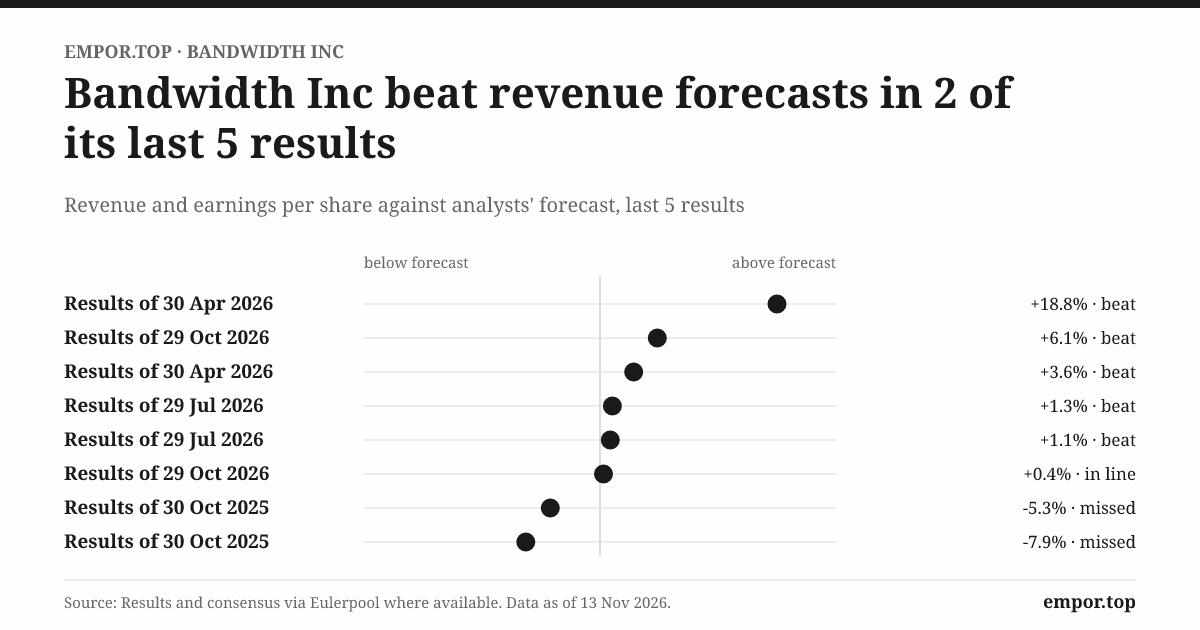
But it missed the growth target that the whole plan was meant to deliver. On the third-quarter 2026 call, Morken told analysts that Bandwidth had met or exceeded its quarterly guidance for 36 straight quarters.[^2] Both statements are true. Short-term guidance has been reliable; long-term growth ambition has not.
The analysts on that call were not shy about probing the gaps. Morgan Stanley's Elizabeth Porter noted that cloud communications growth excluding campaign revenue had slowed slightly in the third quarter and asked how the 2027 growth would arrive.[^2]
Piper Sandler's James Fish pointed out that the roughly $19 million of annual contract value from the year's eleven large deals left a sizeable gap to fill if cloud communications revenue were to grow by double digits in 2027.[^2] Chief financial officer Daryl Raiford answered that the 2027 outlook did not rely solely on enterprise voice and cited retention, commercial messaging growth and smaller wins.[^2] The answer was reasonable; it was also less specific than the question.
The verdict on reliability is that the attack was consequential, and the recovery was real but slow. Network ownership did not guarantee reliability or customer expansion, though Bandwidth's later wins in banking, insurance and financial services suggest enterprise buyers have regained confidence in its resilience.
The claim that ownership makes Bandwidth more reliable than rivals is narrowed to a smaller, unproven version, one that will be confirmed only by years without another major outage. The record also showed something else: through the slowdown, cash kept coming in, even while accounting losses continued. That gap between profit and cash is the next puzzle.
VII. From Traffic to Profit—and the Cost of Getting There
Here is the puzzle in one sentence. Over the eleven years from 2015 to 2025, Bandwidth reported a cumulative net loss of about $45 million, yet it generated about $328 million of cash from its operations.2 How does a company lose money and make money at the same time?
The answer lies in three bridges between accounting profit and cash. The first and largest is stock-based compensation. When Bandwidth pays employees in shares, the income statement records an expense, but no cash leaves the building. In 2025, stock compensation was about $53 million.2 The second bridge is depreciation and amortization, the accounting charge that spreads the cost of network equipment, software and acquired assets over their useful lives.
In 2025, the gap between Bandwidth's EBITDA of about $39 million and its operating loss of about $14 million implies more than $50 million of such charges.2 The third is capitalized software development, where some engineering costs are recorded as an asset and expensed later, which delays their hit to the income statement.
Each bridge is legitimate accounting, but each has a cost. Depreciation reflects real money spent on servers, switches and data centers in earlier years. Capitalized software is real engineering salary. And stock compensation is a real transfer of ownership from existing shareholders to employees.
Put the 2025 figures side by side and the point lands hard: free cash flow was about $57 million, and stock compensation was about $53 million.2 Nearly every dollar of free cash flow that year was matched by a dollar of shareholder value paid out in stock.
This is not a scandal. Most American technology companies pay heavily in equity, and Bandwidth's cash generation has improved dramatically. Free cash flow was negative in every year from 2019 through 2022 and has been solidly positive since 2023.2
But it changes how to read the company's cash story. Free cash flow measures what is left for shareholders before counting the stock already handed to employees. An investor who looks only at free cash flow will overstate how much the business truly earns for its owners.
The reinvestment record shows a company that is not in harvest mode. Research and development spending rose from about $104 million in 2023 to about $133 million in 2025, roughly 17% to 18% of revenue.2 In the first nine months of 2026, it rose another 18% to about $112 million, which the company attributed to more research and development staff.3
Capital spending fell over the same nine months, to about $19 million from about $25 million.3 Management is betting its next leg of growth on software and AI capabilities, while spending less on physical network expansion.
The 2026 cash story carried a subtle new wrinkle in working capital. In the first nine months of the year, accounts receivable rose by about $27 million, mostly because September was a heavy month for customer usage and much of it had not yet been billed.3 By the end of the quarter, unbilled receivables, revenue earned but not yet invoiced, had reached about $71 million, or 60% of net receivables.3 That is up from about $57 million at the end of 2025.3
Should that worry investors? Proportionately, not much yet. Usage-based companies bill in arrears, so a strong final month naturally leaves a large unbilled balance, and management says those amounts are billed in the next cycle.3 The allowance for expected credit losses was only about $0.7 million, and no single customer accounted for more than 10% of net receivables.3
But Bandwidth does not publish an aging schedule showing how long invoices remain unpaid, nor a history of write-offs. The auditor identified revenue recognition as a critical audit matter because huge volumes of usage and recurring charges flow through multiple systems, though it reported no material weakness.2 The real test is simple: those September balances should turn into cash in the fourth quarter.
There is one structural tailwind in Bandwidth's working capital that deserves credit. The company typically collects from customers within about six weeks, while carrier surcharges and other pass-through costs give it a matching pool of money owed to suppliers. In 2025, its current liabilities outside debt exceeded its current assets outside cash by the equivalent of about three weeks of revenue.2
In plain terms, the business runs partly on other people's money: carriers and suppliers fund part of its operations by waiting to be paid. That helps cash flow when the company grows, but it reverses if growth stalls or if carriers tighten their terms, which is another reason surcharge-heavy revenue deserves careful reading.
The most important caution concerns 2026's reported profit. Bandwidth reported net income of about $11.8 million for the first nine months of the year.3 That looks like a turnaround until the components are examined.
The company recorded a $13.2 million gain on extinguishing debt, because it repurchased older convertible notes for less than their face value, and it booked a $6.2 million income-tax benefit.3 Without those two items, the period would have shown a loss. On an operating basis, before interest and taxes, the nine months still produced a loss of about $7.4 million.3
There is a certain irony in that debt gain. The old notes traded below par because, in earlier years, investors doubted Bandwidth's prospects. In 2026, the company bought them back cheaply and booked the market's former pessimism as profit. It was a smart transaction, but it is not a repeatable source of earnings.
Bandwidth also had about $39 million of stock compensation in the first nine months of 2026, on pace to remain close to 2025's level.3 So the conversion question is still open. Cash generation is meaningful and improving. GAAP profitability arrived for one quarter, by a narrow margin.
The claim that Bandwidth has become a profitable business is not rejected, but it is unproven, and it needs several more quarters of positive operating income, with net income that does not depend on gains or tax benefits. The company's bet on how to get there has a name, and in 2026 the name was AI.
VIII. The AI Call Is Not Yet the AI Business
On the third-quarter 2026 call, Morken introduced a new term. AI, he said, was now "super intelligence," or "SI," to use what he called the new official terminology.[^2] Then he made his case in three parts: Bandwidth owns the network an AI agent needs, gets paid by interaction rather than by seat, and supplies every agent with the phone number, trusted identity and path to a human that it cannot do without.[^2]
The economic logic is easy to follow. An AI voice agent that answers customer-service calls needs a real phone number, a fast connection and a way to pass the call to a human when it gets stuck. Every one of those calls runs over a network. If AI makes it cheap for businesses to handle calls they once ignored, or to place outbound calls that were never worth a human's time, the number of calls could rise.
Morken argued that a single AI conversation also creates more legs of traffic, as transcription, translation, fraud checks and customer-record lookups run alongside the conversation.[^2] He also noted that Bandwidth bears no inference cost, so cheaper AI models expand its volume without hitting its margins.[^2]
The product at the center of this pitch is Maestro, Bandwidth's orchestration software. Think of it as a switchboard for AI: it lets an enterprise plug one or several AI engines, contact-center platforms and routing rules into its phone traffic without writing custom connecting code.
Morken said all of the enterprises newly choosing Bandwidth had adopted Maestro, and that its integrations and fraud defenses were a significant factor in the all-digital bank win.[^2] In February, the company highlighted a household-name U.S. insurer that chose Bandwidth to integrate Google's conversational AI into a complex Cisco contact-center environment.[^9]
The measurable revenue is still small. Software services revenue, which includes Maestro and related tools, was about $7 million in the third quarter, up 68%, and exited the quarter at an annual run rate above $30 million.[^2] That is about double the roughly $15 million run rate at the end of 2025.[^9]
It is also only about 5% of cloud communications revenue, as Raiford himself noted.[^2] Bandwidth does not disclose how much of its voice or messaging revenue comes from AI use cases, and in February it said a fast-growing cohort of third-party AI developers on its platform did not yet contribute materially to revenue.[^9]
The analysts' questions on the third-quarter call tested the story at its weakest points. Bank of America's Koji Ikeda asked how much of the 2027 growth was already secured by signed customers. Morken said "the vast majority" came from customers already in hand, including the large deals signed since the start of 2025.[^2]
Ikeda then asked whether Salesforce, which Bandwidth has said could become its largest customer by the end of 2028, might simply buy a competitor and take the service in-house. Morken called the risk "tantamount to zero," describing the combination of network and platform as "rare-earth rare."[^2]
That answer deserves scrutiny. Salesforce is precisely the kind of customer whose buying power is a moat question. Morken said that for Salesforce to become the largest customer, it would need to reach roughly a $20 million annual run rate by the end of 2028.[^2]
That would make Bandwidth more dependent on one platform's strategy than it has been, in a year when no customer accounted for even 10% of revenue. A partner of that scale can multi-source, renegotiate or build. The claim of near-zero risk is management's opinion, not a contractual fact.
William Blair's Arjun Bhatia asked a sharper strategic question: if AI agents increasingly talk to other AI agents through dedicated protocols, why would those conversations need a phone call at all?[^2] Morken answered that agent-to-agent channels would rightly absorb lower-value interactions while the highest-value exchanges, between AI and people, would still run over voice.
Chief product officer John Bell added that such protocols would mostly replace websites and apps rather than phone calls.[^2] It is a plausible answer, and it is also a reminder that AI could substitute for parts of Bandwidth's traffic as well as add to it.
Consumer voice agents, the personal AI assistants that might one day phone a business on someone's behalf, came up too. Morken called the third quarter "day one" for that market.[^2] It is an intriguing frontier, but for now it is a passing point, with no measurable revenue behind it.
The company is also trying to make itself the default supplier for software agents that act on their own. Morken described Bandwidth Build and a Model Context Protocol server, a standard way for AI models to use outside tools, that let an agent provision its own phone numbers and configure services in plain language.[^2]
One analyst on the call described his own AI assistant obtaining a persistent number through exactly that route.[^2] Bandwidth then used its Reverb customer event in Raleigh on November 10, 2026, to showcase enterprise AI deployments.[^2] These are sensible moves to be present wherever AI agents need a phone line. They are distribution bets, and the company has not said what they earn.
Bandwidth's own history offers a guide to how quickly technical milestones become revenue. Its rise in the pandemic converted demand into revenue almost instantly, because customers' traffic was already flowing.
Its AI pitch, by contrast, has been running for more than two years: in February 2026, Morken said the company had identified AI voice as "the next frontier" over two years earlier.[^9] In that time, software services have grown quickly from a small base, and enterprise voice growth has improved. But the company still cannot point to a disclosed AI revenue line.
So the verdict on AI is that it is a plausible future driver, not yet a proven business. Voice agents could increase usage and make reliability, routing and compliance more valuable, which would play to Bandwidth's network. But announcements, pilots and wins are not revenue, and the network's economics remain largely those of a usage business.
The KPI to watch is software services revenue as a share of cloud communications revenue, alongside enterprise voice growth. Whether AI turns into durable per-share value also depends on the people who decide how the company spends its cash, and on how much power they hold.
IX. Founders, Forecasts and the Capital Choices
Twenty-seven years after the company began, its founder still runs it. David Morken also chairs the board, so the person who sets strategy is also the person who leads the body meant to oversee it.6 That continuity has advantages. Few public-company chief executives understand their network, their customers and their regulators as deeply as a founder who built all three. It also concentrates power in a way outside shareholders cannot easily check.
The mechanism is Bandwidth's dual-class share structure. Ordinary Class A shares carry one vote each. Class B shares, held mainly by the founders, carry ten.6 As of March 15, 2026, Morken owned about 3.6% of the company's economic value but controlled about 23.2% of the total vote.
Co-founder Henry Kaestner controlled about 17.3%. Together, the two men held roughly 40.5% of the voting power.6 They do not have outright control, but they hold a blocking position on most contested questions and enormous weight in any board election.
The trend in Morken's own stake is worth a sentence. His economic ownership fell from about 4.5% in the 2024 proxy to about 3.6% in 2026, and his voting power slipped from about 26.0% to about 23.2%.116 That is still a large personal stake in absolute terms, but it means his share of the company's economics is shrinking faster than his share of its decision-making.
Pay tells a similar story. Morken's reported compensation was about $2.0 million in 2023 and about $2.1 million in 2024, then jumped to about $7.6 million in 2025.6 Nearly all of the increase, about $7.0 million, came as stock awards rather than salary or cash bonus.6 Chief financial officer Daryl Raiford received about $3.8 million.6 The compensation committee is composed entirely of independent directors, according to the proxy.6
Context matters here. In 2025, Bandwidth's operating loss narrowed from about $20 million to about $14 million, and adjusted measures such as EBITDA and free cash flow improved.2 But the company still reported a net loss of about $12.9 million, and reported revenue was nearly flat.6 Shareholders were asked to approve a near-quadrupling of the chief executive's reported pay in a year when the measure most investors see first, revenue, did not grow.
Many did not approve. At the annual meeting in May 2026, about 30.9 million votes supported the advisory say-on-pay resolution and about 10.0 million opposed it.12 Roughly one in four votes cast went against.
Class B shares carry ten votes each, so if the founders' shares sat in the supporting column, as founder votes usually do, the opposition among outside shareholders was proportionately heavier than the headline split suggests. That is a real governance signal. Whether the board responds in its next compensation design or disclosure will say something about how much the outside shareholders' voice counts.
Capital allocation has also changed shape. Bandwidth pays no dividend and paid none in any year from 2015 through 2025.2 In February 2026, alongside its fourth-quarter results, it announced its first share-repurchase authorization, of up to $80 million.[^9] Through September, it had bought back about $30 million of stock at an average price of about $37 per share, leaving about $50 million authorized.[^2] With shares near $44 in mid-November, those purchases look well-timed so far.[^4]
But buybacks must be weighed against what flows the other way. In the first nine months of 2026, stock compensation of about $39 million exceeded the $30 million spent on repurchases.3 So the buyback has partly offset dilution rather than meaningfully shrinking the share count. The company also refinanced its debt heavily in 2026, issuing about $316 million of new convertible notes and using the proceeds to repurchase or retire older ones.3
At the end of September, it had about $323 million of convertible-note principal outstanding and no borrowings under its revolving credit line, which it later enlarged to $200 million and extended to October 2031.3 Management said net leverage, debt minus cash relative to adjusted EBITDA, had fallen to about 1.3 times.[^2]
Leases are a further fixed commitment that rarely appears in management's leverage figure. Bandwidth carried about $223 million of operating lease liabilities at the end of September, most of them long-term and much of that tied to its Raleigh headquarters campus.3 Those payments do not show up as debt, but they will be paid for years whether traffic grows or not.
The headquarters carries another piece of history. Years earlier, the State of North Carolina had offered Bandwidth a job-creation incentive tied to expanding locally and hiring roughly 1,200 people.
In January 2024, the company exited the agreement after creating 87 of the planned jobs, and it received no grant money.13 It is a small episode financially, but it is a useful marker of how far the company's growth plans of the late 2010s outran reality, and of management's willingness to step back when the plan changed.
The related-party relationship is small. Relay, a company in which certain Bandwidth directors hold equity, paid Bandwidth about $1 million in rent in 2025, roughly 0.13% of revenue.2 The 2026 quarterly filing noted that the sublease had expanded at previously agreed rates, with about $10.9 million of future rent due.3 The company does not publish an analysis of whether the terms match market rates, but the scale is modest.
One more governance development arrived in October. Morken welcomed Chip Schroeder, who had spent more than a decade at Silver Lake advising technology companies on go-to-market strategy and capital allocation, to the board.[^2] An investor with private-equity discipline is a welcome addition to a founder-led board, though one director does not change who holds the votes.
The verdict on management is mixed but not damning. Founder leadership has given the company continuity and real technical depth, its guidance record remains strong, and 2026's buybacks and refinancing were well-executed.
But the dual-class structure limits outsiders' leverage, the multiyear revenue goal was missed, and a quarter of the votes on pay went against management. The test is whether per-share value, not just total revenue, grows from here. That brings the story to the question every investor ultimately has to answer: what has to go right, and what could go wrong?
X. Analysis & Bear vs. Bull Case
The move from a 2025 operating loss to a third-quarter 2026 operating profit captures the investment debate.21
On November 13, 2026, the stock closed about 31% below its 52-week high, after a year in which its shares swung with an annualized volatility of about 91%.[^4] Over the past five years, it suffered a peak-to-trough fall of about 88%.[^4] The market has already priced in a recovery, and then priced some of it back out.
The bull case begins with demand. Enterprise voice, the segment selling to large companies directly, grew 21% in 2025 and 15% in the third quarter of 2026, with management guiding to more than 20% in the fourth quarter.[^9][^2]
Bandwidth signed eleven deals worth more than $1 million a year in annual contract value in the first nine months of 2026, close to $19 million in total, and Raiford said very little of that value had yet reached reported revenue.[^2] If those deals ramp as planned through 2027, they provide a visible floor under growth.
The bull case continues with economics. Because Bandwidth owns its network, each additional dollar of cloud communications revenue has carried a high incremental gross margin, which management put above 80%.[^9] Adjusted EBITDA margin reached a record 22% in the third quarter.[^2]
If revenue keeps growing faster than costs, operating leverage should eventually turn the adjusted profit into GAAP profit. The AI narrative, if it delivers, adds both volume and higher-margin software revenue through Maestro and related services. And the Salesforce relationship, if it grows as management hopes, could add a major platform partner on top.
The bear case begins with volatility. Bandwidth's reported growth has swung from double digits to nearly zero and back within three years, driven by elections, carrier surcharges and the lingering effects of the 2021 attacks. Reported net retention of 98% in 2025 showed that existing customers can spend less in a quiet year.2
Twilio, at more than six times Bandwidth's revenue, can outspend it on product and sales.4 Bandwidth's market share remains undisclosed.
The bear case continues with earnings quality: GAAP profitability remains unproven, as the nine-month result included one-off debt and tax benefits.3 The trailing price-to-earnings ratio is effectively meaningless as a valuation anchor because earnings are so small and flattered by one-off items.
The third-quarter evidence—a bank won from a major software platform and enterprises taken from old carriers—strengthens the switching-cost argument. It does not yet show that Bandwidth can raise prices.
An activist-minded investor would focus on four questions. First, why should two founders with under 8% of the economics between them keep roughly 40% of the votes? Second, why does stock compensation consume most of free cash flow, and what is the plan to reduce it?
Third, what return has the company earned on the $519 million Voxbone purchase? Fourth, why should shareholders trust adjusted EBITDA targets when the multiyear revenue target was missed? None of these questions implies wrongdoing. Each is the kind of pressure that would sharpen management's accountability.
Valuation needs careful framing. At about $1.7 billion of enterprise value, Bandwidth trades at roughly 1.9 times trailing revenue.[^4] Measured against management's adjusted EBITDA guidance of about $125 million for 2026, the enterprise value is closer to 14 times.[^2] Its trailing free cash flow yield is about 5.5%.[^4]
A September 2026 broker report from Pareto Securities, prepared for its coverage of Sinch, estimated 2026 enterprise value to EBITDA at about 16.6 times for Bandwidth, 33.5 times for Twilio and 10.7 times for Sinch.14 Those are forecast-based figures on different definitions, so they are not directly comparable with the trailing multiples. What they suggest is that the market values Bandwidth between Sinch and Twilio: more than a carrier, less than a software platform.
What does that price appear to assume? At roughly 14 times adjusted EBITDA, investors are betting that Bandwidth's 2026 recovery continues, that adjusted margins keep expanding and that a meaningful share of that adjusted profit eventually becomes GAAP profit. If growth falls back toward the low single digits, as it did in 2023 and 2025, the multiple has little cushion.
The path of the 2026 forecast is part of what investors are pricing. In February, management guided to total revenue growth of about 16% and cloud communications growth of about 10%, and expected political messaging to contribute about 2.5% of cloud communications revenue.[^9] By October, after three consecutive increases to the cloud communications outlook, the full-year guide stood at $905 million to $910 million of total revenue, about 20% growth, and roughly 11% growth in cloud communications.[^2]
Political revenue was trimmed to about $10 million for the year, while commercial expectations rose.[^2] Upward revisions driven by commercial demand rather than election traffic are the healthiest kind, and they are the strongest piece of evidence that the 2026 recovery is more than a cyclical bounce.
Two secondary risks are worth noting in proportion. Bandwidth is contesting a $3.8 million San Francisco access-line tax assessment, which it paid under protest in July 2025 before filing a refund complaint, and it faces an Illinois lawsuit over 911 taxes and surcharges.2
The company says its accruals for pending matters are not material.2 Currency exposure is modest, because most revenue and costs are in dollars, but a 10% adverse move would have cut 2025 net income by about $4 million, a sum that matters when net income itself is in single-digit millions.2
Three KPIs will decide the case. The first is cloud communications revenue growth excluding political messaging, which ran at about 12% in the third quarter and which management says will be double digits in 2027.[^2]
The second is GAAP operating margin, viewed alongside stock compensation, which turned slightly positive in the third quarter for the first time in years.1 The third is reported net retention, which recovered to 113% in the third quarter, together with the collection of the roughly $71 million of unbilled receivables.[^2]3
If all three move in the right direction through 2027, the bull case strengthens materially. If retention falls back below 100% without an election, the moat claim weakens sharply. The record so far points to a credible infrastructure-and-integration business with recovering growth, but one whose moat durability, AI monetization and GAAP profitability remain unproven, and whose valuation leaves little room for the rebound to reverse.
XI. Playbook: Business & Investing Lessons
Go back to the simplest thing Bandwidth sells: an API call that asks for a phone number and gets one. Behind that one line of code sit regulatory filings, number inventories, carrier interconnections and a network that has to stay up when attackers try to knock it down. Bandwidth's story is a lesson in what it means to own the layer beneath someone else's software.
The first lesson is to own the plumbing, but prove the toll. Bandwidth's decision to own a network gave it a durable reason to exist, and its enterprise wins show buyers value that ownership.
But a network earns its keep only if customers stay, expand and pay enough to cover the investment. The company says more than 99% of its customers stay from one year to the next, yet in 2025 the group of existing customers spent less than the year before. Ownership earns the right to compete; it does not guarantee the toll.
The second lesson is that a big acquisition buys time, not returns. Voxbone gave Bandwidth an international footprint that helped it win global partners such as Salesforce in 2026, but the combined company has not yet earned a positive return on its invested capital. An acquisition can compress a decade of licensing work into a closing date. It cannot compress the decade it takes to earn the money back.
The third lesson is that cash conversion has a cost. Bandwidth's cash generation is real, but stock compensation and capitalized development work affect how much of it truly belongs to shareholders. Investors who read only free cash flow at Bandwidth are reading half the ledger.
The fourth lesson is that a founder's horizon can outlast the public market's patience. Morken's quarter-century at the helm gave Bandwidth the stubbornness to build a network when renting one was easier, and the patience to keep investing through attacks and slowdowns. The dual-class structure that protected that long horizon also shields management from outside pressure on pay and capital allocation. A founder's conviction can be an asset for decades and a governance problem in the same year.
For founders, the wider lesson is that infrastructure gives software a floor, not a ceiling. For investors, it is that the hardest thing to value in a usage business is the difference between traffic and profit, and Bandwidth has spent a quarter-century showing how wide that gap can be.
XII. Epilogue
By mid-November 2026, Bandwidth stood at its most promising point since the pandemic, having reported a quarter of operating profit. Management says momentum will build through 2027.[^2] Its full-year outlook implies a fourth quarter of roughly $245 million of revenue.[^2]
The next decisive moment is the fourth-quarter results in early 2027, when the company will publish full-year 2026 numbers and its first formal outlook for 2027. The first thing to watch is whether the promised double-digit cloud communications growth shows up in guidance, and whether management continues to show the political messaging and surcharge revenue separately. If the guidance is double digits on that clean basis, the recovery has momentum. If it relies on surcharge increases or one-off political traffic, the growth story weakens.
The second thing to watch is profit. Bandwidth's 2026 Form 10-K will show the full-year GAAP operating result. Positive operating income in the fourth quarter, without debt gains or tax benefits, would make the third quarter look like the start of a trend rather than a blip. Another operating loss would push the profitability question further out.
The third is cash. The roughly $71 million of unbilled receivables sitting on the September balance sheet should turn into invoices and then into cash.3 If fourth-quarter operating cash flow is strong, it confirms that the usage behind the receivables was real and collectable. If receivables keep rising faster than revenue, it will raise questions that the company's limited disclosure on aging cannot answer.
The fourth is retention. The next annual report will disclose full-year 2026 net retention, which should look strong given the election boost. The more revealing reading will come a year later, in a non-election 2027. If retention stays above 100% in that quiet year, the moat claim strengthens; if it falls back below, the record of 2025 repeats.
And then there is AI. The gap between announcements, deployments and reported revenue is still wide. Management will need to show how much of the 2027 growth comes from AI-driven traffic and software services, and how much from ordinary enterprise migration from old carriers. Either answer can support growth, but only one supports the premium narrative.
The tension that remains is the one that has followed Bandwidth from its first spare-room days. The network is real, the traffic is real and the cash is real. Whether all of that adds up to durable profit for the owners of the business is still the open question.
XIII. Outro
Somewhere tonight, an AI voice agent is placing a call. It sounds human, it knows the customer's name, and it is fast enough that the person on the other end does not notice the pause. Behind that voice sits the infrastructure Bandwidth has spent a quarter-century building. Most of the time, nobody thinks about any of it.
That invisibility is Bandwidth's opportunity and its burden. The network works; durable returns for shareholders remain unproven. The calls keep coming. The question is whether, at last, they will pay.
References
-
Q3 2026 Earnings Release, Form 8-K Exhibit 99.1 — Bandwidth Inc., 2026-10-29 ↩↩↩↩
-
2025 Form 10-K — Bandwidth Inc., 2026-02-19 ↩↩↩↩↩↩↩↩↩↩↩↩↩↩↩↩↩↩↩↩↩↩↩↩↩↩↩↩↩↩↩↩↩↩↩↩↩↩
-
Q3 2026 Form 10-Q — Bandwidth Inc., 2026-10-29 ↩↩↩↩↩↩↩↩↩↩↩↩↩↩↩↩↩↩↩↩
-
Twilio Q4 and Full Year 2025 Results — Twilio, 2026-02-12 ↩↩↩
-
Form S-1 registration statement filing index — U.S. Securities and Exchange Commission, 2017-10-13 ↩↩↩↩↩
-
2026 Proxy Statement — Bandwidth Inc., 2026-04-14 ↩↩↩↩↩↩↩↩↩↩↩↩
-
Bandwidth Completes Acquisition of International Cloud Communications Leader Voxbone — Bandwidth Inc., 2020-11-02 ↩↩↩↩
-
Sinch establishes leadership in US voice communications through acquisition of Inteliquent — Sinch, 2021-02-17 ↩↩
-
Bandwidth Announces Fourth Quarter and Full Year 2024 Financial Results — Bandwidth Inc., 2025-02-19 ↩
-
2026 Annual Meeting Results, Form 8-K — Bandwidth Inc., 2026-05-29 ↩
-
North Carolina technology company Bandwidth leaves incentive agreement with the state — Associated Press, 2024-01-23 ↩
-
Sinch: Initiating Coverage — Pareto Securities, 2026-09-29 ↩
 LinkedIn
 WhatsApp
 Reddit
 Hacker News
 Email
 Kindle
 RSS Feed
 Spotify
 Apple Podcasts
 Amazon Music
 Audible
 YouTube