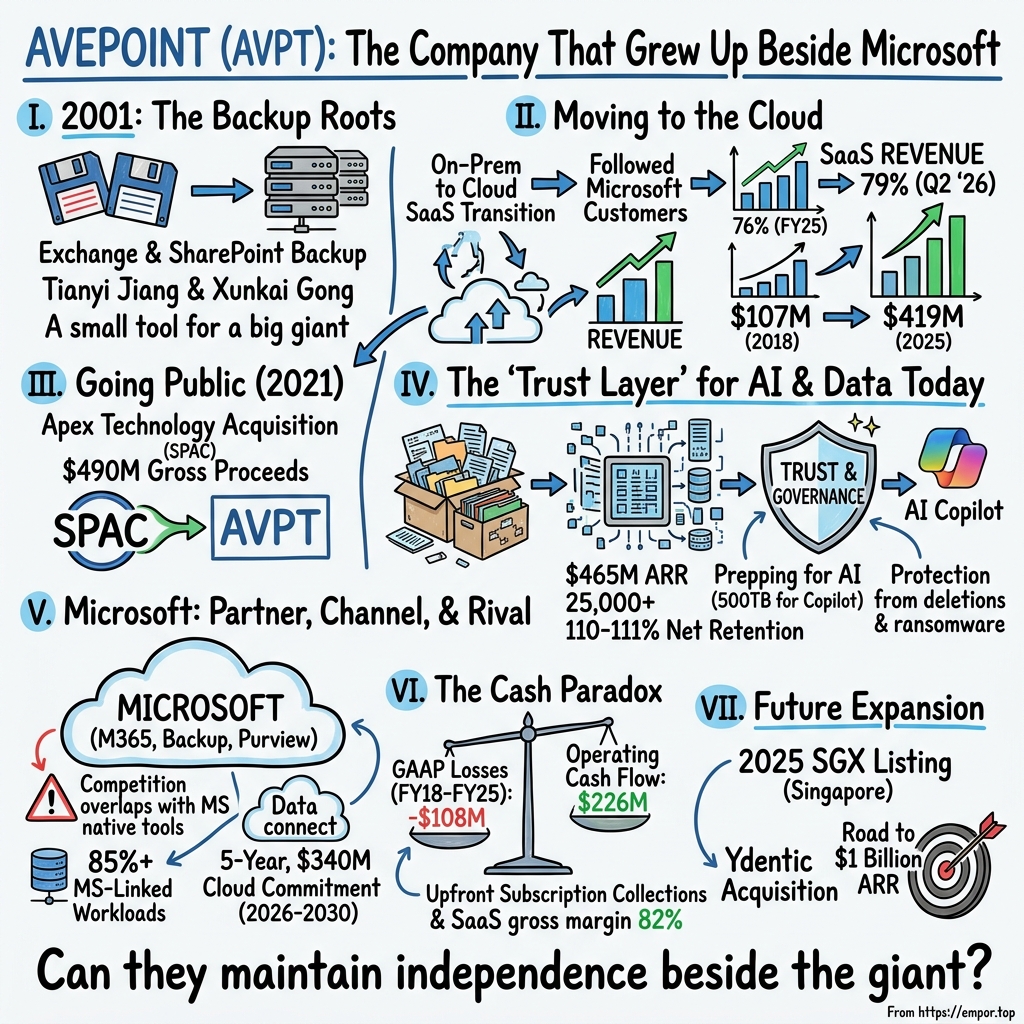
AvePoint, Inc. (AVPT): The Company That Grew Up Beside Microsoft
I. The Backup Company That Wants to Be AI's Trust Layer
Picture a large enterprise in 2026 getting ready to switch on an AI assistant for every employee. The licences are bought and the training sessions are booked. Then someone in IT asks an awkward question: what will the assistant be able to see? Twenty years of shared drives, collaboration sites, chat logs and email archives sit behind it. Much of that data was never properly labelled. Some of it was shared with "everyone in the company" by people who left a decade ago. An AI that answers any question from any document will happily surface the salary spreadsheet, the draft merger memo and the HR complaint, because nobody ever told the system those files were private.
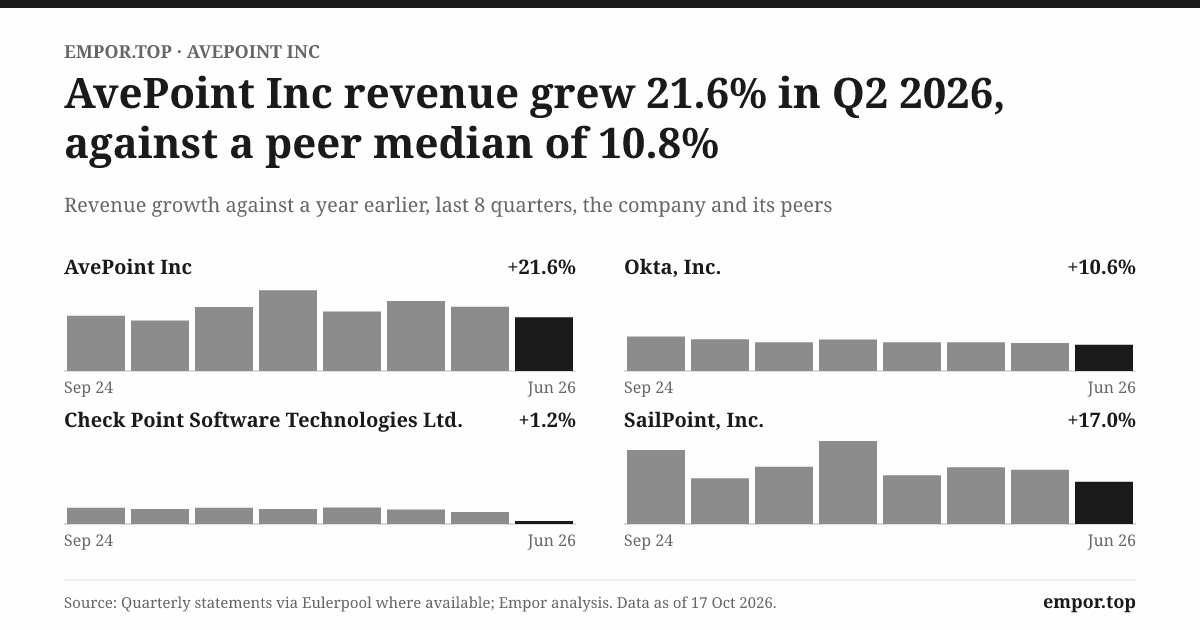
That awkward question is where AvePoint, Inc. now makes its money. The company began in 2001 by backing up Microsoft's email and collaboration servers.1 Today it describes itself as a trust layer for AI agents that work across enterprise data: the software that classifies information, locks down permissions, recovers what gets deleted or encrypted by ransomware, and moves workloads between clouds without breaking the rules attached to them.1 Twenty-five years after its founding, it reported $465 million of annual recurring revenue at the end of June 2026, and second-quarter revenue grew about 22% from a year earlier.2
The paradox at the heart of the business is that one company sits on every side of it. Microsoft built the ecosystem that made AvePoint possible: Exchange, SharePoint, and later Microsoft 365, Teams and Copilot. Microsoft runs the Azure cloud on which much of AvePoint's software operates. Microsoft's partner programmes and distributors are a route to AvePoint's customers. And Microsoft keeps adding its own backup and governance tools, which overlap with parts of what AvePoint sells.19 Few software companies have their landlord, their sales channel and their most important rival in the same building.
That arrangement raises four questions, and this story will keep returning to them. The first is whether AvePoint can keep its pricing power as Microsoft expands native backup and governance. The second is whether the pitch around AI governance is turning into durable revenue, or just a fashionable label on an old product. The third is whether operating margins, which turned positive only recently, will keep improving as the company grows. The fourth is whether management's use of capital, including buybacks, a small acquisition and a large cloud commitment, can justify the premium the market pays for the shares.
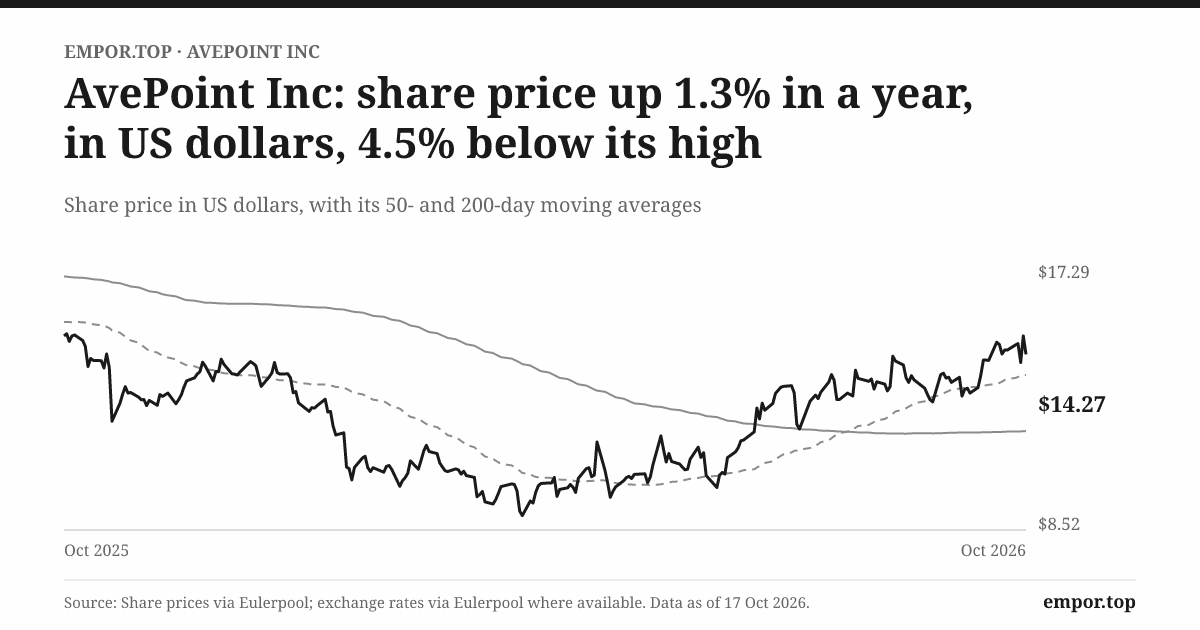
The scale today is no longer that of a niche utility. AvePoint generated about $464 million of revenue in the twelve months to June 2026,2 and on October 17, 2026 the market valued the company at about $3.1 billion, with the shares at $14.27, a little below their 52-week high.17 More than 25,000 organizations use its software, and no single one accounts for as much as a tenth of revenue.1
Those numbers prove that customers buy and keep buying, and that the business has scale. What they do not prove is the harder thing. A company can grow quickly inside a platform for years because the platform itself is growing. The question that decides AvePoint's long-term worth is whether it owns a durable layer of value between enterprise data and Microsoft's cloud, one that customers would pay for even if Microsoft's own tools became good enough for most of them.
To see why that question is open, and why it is not hopeless, it helps to go back to the company's first problem: a file server that nobody could afford to lose.
 Subscribe on LinkedIn
II. From SharePoint Backup to a Public Cloud Company
In 2001, Dr. Tianyi Jiang and Xunkai Gong started a software company with a modest ambition: back up Microsoft Exchange, the email server that ran inside most large companies.3 It was an unglamorous corner of enterprise IT, the kind of product nobody notices until the day a server fails. Then Microsoft released SharePoint, a platform for shared documents and intranet sites, and the founders saw a bigger version of the same problem.3 SharePoint changed fast, customised easily and spread through organizations like ivy. Companies poured their working documents into it, and its built-in protection was thin. A tool that could back it up, restore a single deleted site, or move content from one version to the next was worth paying for.
That early choice set the pattern for everything that followed. AvePoint did not try to build its own platform. It attached itself to the platform Microsoft's customers were already adopting and solved the problems Microsoft left behind. When customers upgraded SharePoint, they needed migration. When the sites multiplied, they needed management and governance: who owns this site, who can see it, what must be kept for seven years for regulators. Each new problem became a product line, and each product line deepened the relationship with the same IT departments.3
The founders gave the company an unusual stability. Jiang became chief executive and Gong executive chairman, and the two have run AvePoint together for a quarter century.14 That continuity is rare among software companies that reach this size; most cycle through founders, professional CEOs and private-equity owners. AvePoint did take private capital along the way, and growth-equity investors such as Summit Partners and Sixth Street became large holders before the public listing.14 But the operating vision stayed with the two people who started with Exchange backup.
The decisive transition came when Microsoft moved its customers to the cloud. Office 365, later renamed Microsoft 365, shifted email, SharePoint and the new Teams workloads from customers' own servers to Microsoft's data centres. For a company that sold software installed on those servers, this could have been the end. Instead, AvePoint followed the customer once again. It rebuilt its products as cloud services, priced them as subscriptions and sold them alongside Microsoft's own cloud transition.1
The numbers trace the arc. Revenue was about $107 million in 2018 and about $191 million in 2021.14 By 2025 it had reached about $419 million, compounding at a little over 21% a year for seven years.1 Growth slowed to about 17% in 2023, a reminder that the curve was never smooth, and then re-accelerated to 27% in 2025.1 The interesting part is not the speed but what changed underneath it. In 2025, software-as-a-service revenue made up about 76% of the total, and by the second quarter of 2026 it was about 79%, with SaaS revenue of $98.5 million in that quarter alone.12 A company that once sold licences that customers bought once and maintained now earns most of its money as rent that renews every year.
That shift matters for an investor because it changes what the company is. Licence revenue arrives in lumps and has to be resold every cycle. Subscription revenue is earned every month the customer stays, which makes it more predictable and, if customers stay long enough, more valuable per dollar. The price is a transition period when reported revenue and profit look worse, because money that would once have been booked upfront is spread over the life of a contract. AvePoint went through that period in public, and its loss-making years partly reflect it.
The public listing came in the middle of that transition. On July 1, 2021, AvePoint completed its business combination with Apex Technology Acquisition Corp., a special purpose acquisition company.4 The deal had been announced in November 2020,5 at the height of the SPAC boom, and it included a $140 million private placement at $10 a share.4 Total gross proceeds were about $490 million.4 For the founders, the listing provided a large cash cushion and a public currency for paying employees and, eventually, making acquisitions.
SPAC deals of that era often came with heroic forecasts, and many companies that went public that way have since fallen far short of them. AvePoint's merger materials laid out projections for rapid growth, and the most useful test is the revenue record that followed.418 The company did not hit the steepest versions of the boom-era optimism on schedule: 2022 and 2023 brought slower growth and continued losses, and the shares fell sharply from their post-listing levels, part of a peak-to-trough decline of about 62% over the past five years.17 But the revenue base has roughly doubled since the listing year, and the business turned profitable. Measured against its SPAC peers, which as a group destroyed much of the capital they raised, AvePoint looks like one of the survivors that kept compounding. Measured against its own pitch, it arrived later than promised.
The honest verdict is that the SPAC supplied capital and visibility, while the operating shift did the heavier work. The move from backup to migration and governance, and then from installed software to cloud subscriptions, is what built a business worth $3 billion. Yet every step of that journey began inside a platform somebody else controls. AvePoint has outgrown the backup label. It has not outgrown the hyperscaler, and to understand why customers keep paying it, the place to start is the bill itself.
III. A Subscription That Starts With a Seat, a Byte or a Migration
Go back to the company preparing for AI. Its IT team has bought Microsoft Copilot licences and now discovers that its shared drives and collaboration sites hold years of poorly classified, over-permissioned data. The obvious fix, asking every employee to review every file they ever shared, is impossible. What the team needs is software that scans the estate, figures out what is sensitive, finds out who can see it, and tightens access automatically. That is the most recent version of AvePoint's sales pitch, and on the first-quarter 2026 call, management offered a concrete example: a pharmacy benefits manager that bought AvePoint's governance tools to prepare roughly 500 terabytes of unclassified data before rolling out Copilot.6
A pharmacy benefits manager is a telling customer. It handles patient prescription data under strict health-privacy rules, so an AI assistant that leaked the wrong record would be a regulatory disaster rather than an embarrassment. Five hundred terabytes is also a lot of mess, enough documents to fill many millions of filing cabinets. The example captures the logic of the pitch: AI adoption turns old data hygiene problems into urgent risks, and urgent risks get budget. It does not prove how often such deals happen. Management has described Copilot readiness as a driver of demand across calls,67 but it does not break out how much ARR comes from AI-related governance purchases, so a listener should treat the pharmacy deal as an illustration rather than a measurement.
What is AvePoint actually paid for? The bill is built from three units. Some products are priced per user or seat, much like the Microsoft licences they protect. Some are priced by the volume of data under protection, measured in gigabytes or terabytes. And the company increasingly bundles modules into platform tiers, so a customer can buy protection, governance and migration as a package.1 Contracts commonly run one to three years and are often billed annually in advance.1 That last detail sounds like accounting trivia, but it matters a great deal later: customers pay before AvePoint has delivered the service, so cash arrives ahead of revenue.
In 2025, about $319 million of AvePoint's $419 million of revenue came from SaaS.1 Term licences and support, sold mostly to customers who still run software on their own servers or in their own private clouds, contributed about $41 million. Services, which means helping customers migrate and implement, added about $54 million. Old-style maintenance had dwindled to about $5 million.1 The services line is not the economic engine; it is the on-ramp. A big migration project often leads to a protection and governance subscription that keeps billing long after the consultants leave. The subscription is where the margin lives.
The customer promise comes down to four jobs. Classify and govern data, so the organization knows what it holds and what rules apply. Control access, so the right people see the right things and AI assistants inherit those boundaries. Recover from mistakes and attacks, whether an employee deletes a project site or ransomware encrypts a mailbox. And migrate workloads, from an old server to Microsoft 365, or from one tenant to another after a merger, while preserving the permissions and policies attached to every file.1 An analogy helps: if Microsoft 365 is a giant office building, AvePoint sells the filing system, the key-card access, the insurance policy and the moving company, all of which come with instructions that only make sense for that building.
How sticky is that bundle? Retention is the best evidence. AvePoint's net retention rate, which measures how much this year's revenue from last year's customers grew after upgrades, downgrades and cancellations, has held around 110% to 111%.12 In plain terms, a group of customers paying $100 a year ago pays about $110 today. Expansion outweighs contraction. But the gross retention rate, which ignores upgrades and simply asks how much revenue survives, has sat around 87% to 89%.12 So roughly one dollar in nine walks out the door each year. For a product that markets itself as essential infrastructure, that is respectable rather than exceptional. Best-in-class enterprise software vendors often report gross retention in the mid-90s. AvePoint's figure reflects a broad base that includes small and mid-sized businesses reached through partners, where churn is naturally higher, but it also means that customers do leave, and some of them presumably leave for cheaper or native alternatives.
The demand engine is broad. More than 25,000 organizations use the software, and no customer exceeds 10% of revenue.1 At the end of 2025, AvePoint had about $508 million of remaining performance obligations, the contracted revenue it has yet to recognise.1 That figure is more than a year of revenue already signed, which gives the business unusual visibility. It also means that a sudden collapse in demand would show up slowly, which cuts both ways for an investor watching for early warnings.
The competitive field needs to be kept in proportion. The structural rival is Microsoft itself, whose native protection and compliance tools improve every year. Beyond that, AvePoint competes in overlapping areas with backup specialists such as Veeam, Commvault and Rubrik, and with data-security vendors such as Varonis. Several of those are larger. Commvault reported about $1.18 billion of revenue in its fiscal 2026,10 Varonis about $624 million in 2025,11 and Rubrik about $1.3 billion in its fiscal 2026.12 None is an exact substitute for AvePoint's full set of products: Commvault and Rubrik are built around protecting infrastructure across many data sources, Varonis around detecting threats and over-exposure in data, and AvePoint around the governance and lifecycle of collaboration data. Reported revenue is not market share. But the comparison shows that AvePoint is a mid-sized player in a crowded neighbourhood, not a monopolist.
Where, then, is the moat, if there is one? The most plausible source is switching cost. A large customer that has spent years encoding retention rules, access policies, archiving schedules and operational workflows inside AvePoint has effectively written its governance policy in AvePoint's language. Pulling that out means re-creating the rules elsewhere and convincing auditors the new system is equivalent, which is expensive and risky. Partner distribution through Microsoft resellers and managed service providers widens the funnel, and support for clouds beyond Microsoft, including Salesforce and Google Workspace, could make AvePoint more valuable to customers who use several platforms.1
The evidence for that moat is real but partial. Net retention above 110% and a growing customer count are consistent with switching costs. Yet AvePoint discloses no market share, no price realization on renewals, and no split of ARR between Microsoft and non-Microsoft workloads. Gross retention below 90% says that a meaningful slice of customers do switch. The fairest reading is that AvePoint has demonstrated a credible land-and-expand model, in which customers start small and buy more, without yet proving that customers cannot substitute Microsoft's own tools or a rival's. That uncertainty has a name, and it sits in Redmond.
IV. Microsoft Is the Landlord, the Channel and the Rival
In December 2025, AvePoint signed a contract that put a number on its relationship with the cloud. It committed to consume $340 million of eligible cloud services over five years, through November 2030, with a minimum of $50 million in the first year.1 The filing describes the counterparty as a cloud vendor rather than naming it in the commitments note, but AvePoint builds its SaaS architecture on Microsoft Azure.1 At roughly the same time, Microsoft was steadily expanding Microsoft 365 Backup and its Purview compliance suite, tools that do some of the same jobs AvePoint sells.9 So in one season, AvePoint promised a vast sum to its infrastructure landlord while the same landlord kept building a competing product on the floor below.
Start with the bargain, because it is genuinely attractive. Microsoft 365 has hundreds of millions of commercial users, and every one of them generates data that someone must protect, govern and eventually migrate. Microsoft prefers to build broad platforms and leave specialised depth to partners, which is why it runs a large independent software vendor programme and co-sells partner products. AvePoint has spent two decades as one of those partners, and Microsoft resellers and global distributors such as TD SYNNEX, Ingram Micro and Arrow are part of its route to market.1 For a company with a few thousand employees, borrowing that distribution is worth more than any sales force it could build alone.
Then comes the conflict. Microsoft 365 Backup, which Microsoft made generally available in 2024 and has extended since, lets customers back up and restore SharePoint, OneDrive and Exchange data natively, inside the Microsoft boundary.9 Microsoft also opened backup storage interfaces that third parties can build on, which is a sign it wants partners in the ecosystem and also a sign it wants the underlying storage revenue.9 Purview covers classification, data-loss prevention and retention policies. A "better together" partnership can coexist with direct substitution. A customer that already pays Microsoft for its top-tier licence may ask why it should buy a separate tool for the basic version of those jobs.
How exposed is AvePoint? By the best available estimate, more than 85% of its workloads are tied to Microsoft. AvePoint does not report that figure, and it does not disclose ARR by cloud ecosystem, so the estimate should be treated as a hypothesis to test rather than a fact. Management talks about Salesforce, Google Workspace and other clouds as growth areas,78 but as long as the split stays undisclosed, investors cannot measure how much of the business would survive a world in which Microsoft's native tools became good enough for the majority of customers.
The cloud commitment turns this from a strategic question into an operating one. The schedule is heavily back-loaded: of about $354 million of total purchase commitments outstanding at the end of 2025, about $51 million falls due in 2026 and roughly $290 million in 2030.1 Read naively, that looks like a cliff. Read more carefully, it reflects how such contracts often work: a minimum total spend over the period, with any shortfall against the cumulative commitment due at the end. AvePoint's filings do not fully describe which service categories count toward the commitment, how the schedule escalates year by year in practice, or what flexibility exists if growth slows. Those details matter, because a minimum-consumption deal is benign if the company would have spent the money anyway, and onerous if it has to buy capacity it does not need.
There is a reasonable case for benign. AvePoint's SaaS gross margin was about 82% in 2025, on roughly $319 million of SaaS revenue against about $57 million of SaaS cost of revenue.1 Hosting is a large part of that cost, and a first-year minimum of $50 million is close to what the business was already spending. Committing to a large volume typically earns better pricing, which can protect gross margin as the business scales. If ARR keeps compounding near its recent rate, the later-year commitments may simply track what the company needed to consume.
The case for caution is also real. A five-year promise fixes a cost that used to flex. If ARR growth slows into the low teens, the back-end of the schedule could force either margin compression, as the company pays for unused capacity, or a cash payment for the shortfall. It also binds AvePoint more tightly to one infrastructure provider just as the company argues that its value lies in being independent of any one platform. The right posture is neither alarm nor dismissal. The things to watch in future filings are actual cloud consumption against the contractual minimums, hosting costs per dollar of SaaS revenue, and the SaaS gross margin as the commitment ramps.
The earnings calls show how management frames the tension. On the second-quarter 2026 call, the emphasis was on demand created by Copilot and AI agents, on ARR growth and on the partner channel.7 Management's consistent line across recent calls has been that native Microsoft tools raise awareness of data protection and governance, which expands the market, while large customers still need independent, cross-cloud capabilities and multi-tenant management.78 That is a coherent argument, and it is also exactly what a company in AvePoint's position would say regardless of the facts. Analysts have pressed on competition and on the economics of the cloud agreement; the answers have tended to stress the partnership and the pricing benefits of committing volume rather than quantifying non-Microsoft revenue.7 The prepared remarks tell the opportunity; the Q&A shows how much of the risk remains unmeasured.
There is also a governance thread that runs straight into this question. Jeff Teper, a Microsoft veteran who joined the company in 1992, is widely known as the father of SharePoint and leads Microsoft 365 collaborative apps and platforms. He serves as AvePoint's lead independent director, sitting on the audit and compensation committees and chairing the nominating and governance committee.14 AvePoint disclosed no material related-party revenue or expenses with him or Microsoft for 2023 through 2025.14 The arrangement gives the board unusual insight into Microsoft's thinking, and it also means that a senior executive of the company's most important partner and rival holds a central oversight role. Reasonable investors can read that either as alignment or as a potential conflict. It is unusual enough to deserve noting.
So what would settle the Microsoft question? Four pieces of evidence: disclosed non-Microsoft ARR and its growth rate; retention broken out by product ecosystem; any data on competitive wins and losses against native tools; and the SaaS gross margin as the cloud commitment ramps toward 2030. Until AvePoint publishes the first two, the claim of platform independence remains a claim. What the company can already show, though, is that its customers pay it in a way that produced cash long before it produced profit.
V. The Cash Arrived Before the Profits Did
Here is a puzzle that would trouble a first-time reader of AvePoint's accounts. Add up its reported net results from 2018 through 2025, and the company lost about $108 million.113 Add up its cash from operations over the same eight years, and it generated about $226 million.113 A business that loses money on paper and gains it in the bank is either doing something clever with its accounts or running a model in which the paper and the bank simply measure different things. In AvePoint's case it is mostly the second, with one caveat that matters a great deal.
Three forces explain the gap. The first is the timing of subscription billing. Because customers often pay a year in advance, AvePoint collects cash before it earns revenue. The unearned portion sits on the balance sheet as deferred revenue, and as the business grows, that pile of prepayments grows too. In 2025, the increase in deferred revenue added about $40 million to operating cash flow.1 It is a little like a gym that sells annual memberships in January: the cash arrives at once, the revenue drips in over the year, and a growing gym always has more cash than its income statement suggests.
The second force is stock-based compensation. AvePoint pays a meaningful share of its employees in shares rather than cash, and it recorded about $39 million of such expense in 2025.1 That cost reduces reported profit but uses no cash, so it is added back in the cash-flow statement. The third force is a quirk of the SPAC structure. In 2023 and 2024, AvePoint had to mark earn-out shares and private warrants to market, and as its share price rose, those liabilities became more expensive, producing non-cash losses of about $11.5 million and $37.3 million.113 Those charges made the company look worse than its operations were, and they have now disappeared because the earn-outs vested and the warrants were exercised or redeemed.1
The cleanest year to examine is 2025. AvePoint reported net income of about $35 million and operating cash flow of about $85 million.1 Deferred revenue explained about $40 million of the gap and stock compensation another $39 million. Against that, rising receivables consumed about $31 million, because customers owed the company more at year-end than a year earlier.1 Free cash flow, after a small amount of capital spending, was about $82 million.1 The business generates real cash, and much of the reason is structural: customers prepay.
But here is the caveat, and it should stay visible. Stock compensation is not free just because it uses no cash. Each share granted to an employee is a share that existing owners no longer own. A company that pays $39 million in stock each year and reports $85 million of operating cash flow is, in an economic sense, spending a large share of that cash flow on its staff, merely in a different currency. Investors who value AvePoint on free cash flow without subtracting stock compensation are flattering it. The honest framing is that recurring billing gives AvePoint a genuinely stronger cash engine than its GAAP history suggests, and that roughly half of the gap between cash and profit is employee pay in disguise.
Receivables deserve a closer look rather than a headline. AvePoint's debtor days, the number of days of revenue sitting in unpaid invoices, were about 108 in 2025.1 That is below the peak of about 126 days in 2019, but above about 97 days in 2024.113 For a subscription business, more than three months of revenue in receivables looks high at first glance. Part of the explanation is the channel: distributors and resellers often pay on longer terms than direct customers. Part is accounting: under revenue rules, the licence component of term-licence deals is recognised upfront even though billing may be spread out, which creates receivables that are earned but not yet invoiced.1
The year's movement is worth a sentence of attention. Gross trade receivables rose about 44% in 2025 to about $98 million, much faster than revenue.1 Unbilled receivables, amounts earned but not yet invoiced, reached about $27 million in current assets plus about $11 million classified as long-term, roughly $38 million in all.1 The allowance for credit losses on trade receivables was only about $740,000, which reflects a long history of customers paying.1 None of that signals distress. But unbilled receivables are the part of the balance sheet where judgment lives, because they rest on management's estimates of how revenue should be allocated within bundled contracts, and their growth deserves watching as bundles get larger.
One loss in 2025 did not come from customers at all. AvePoint recorded a credit-loss provision of about $4 million on notes receivable from an unrelated growth-equity venture when it exited that investment.1 It is small in the context of the company, but it is a reminder that a software company with a large cash pile can make investments outside its core, and that not all of them work. It is the kind of side bet a skeptical shareholder would ask about, precisely because it had nothing to do with protecting anyone's data.
Where did the cash go? From 2018 through 2025, free cash flow added up to about $209 million, and AvePoint paid no dividends.1 Instead, it accumulated cash and, more recently, bought back shares. At the end of 2025, cash and short-term investments stood at about $481 million; by June 2026, after a large buyback, they stood at about $417 million.12 A small data note is worth clarifying: the roughly $17 million sometimes labelled as borrowings at the end of 2025 is operating lease liabilities on offices, not debt.1 AvePoint has no funded financial debt and has never drawn on its $30 million HSBC credit facility.12
So the losses were not a sign of weak economics. They were a mixture of subscription timing, non-cash SPAC accounting and real employee costs paid in stock. The cash engine is strong. The question that follows is whether the profits, now that they have finally arrived, are as solid as the cash.
VI. The Margin Turn Has to Survive More Than One Tailwind
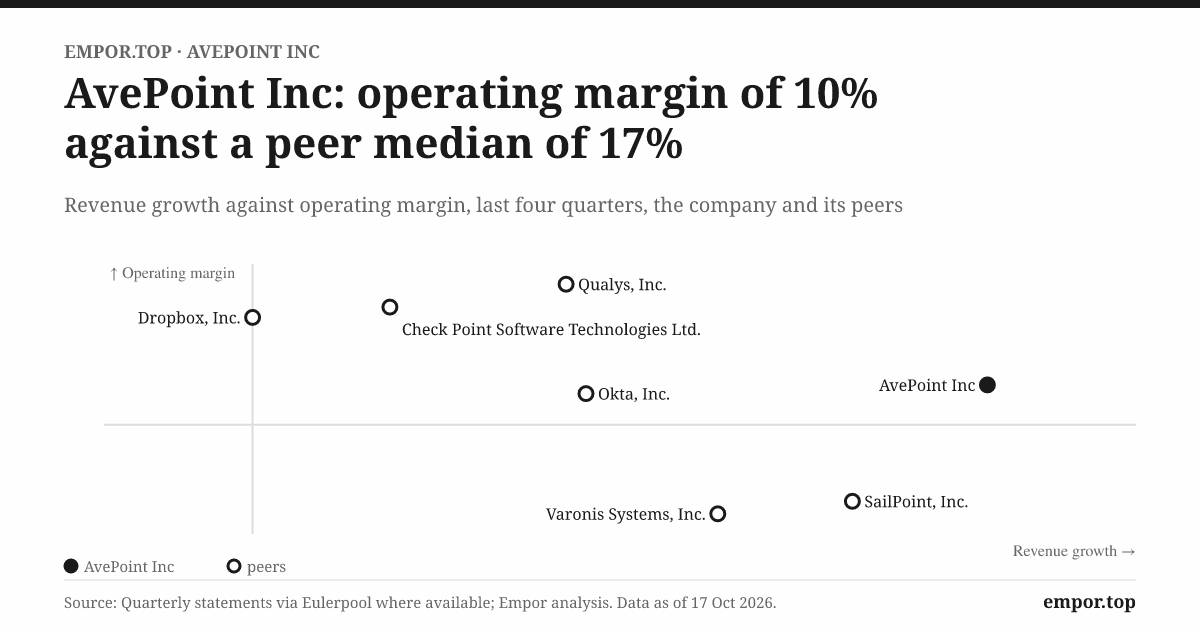
For most of its public life, AvePoint lost money at the operating line. In 2021, the year it listed, the operating loss was about $54 million, or 28% of revenue.14 In 2022 the margin was about negative 17%.1 Then the losses narrowed, the company crossed into operating profit in 2024, and in 2025 it posted a GAAP operating margin of about 7.9%.1 Over the twelve months to June 2026 it reached about 9.8%.2 For a company that spent its first public years explaining why profits were coming later, that is a genuine milestone. The question is how much of it is structural.
The operating turn itself is clean in one important sense. It shows up in GAAP operating profit, which is before interest income, tax benefits and other items that can flatter the bottom line. AvePoint has now reported more than two years of consecutive quarters of GAAP operating profit, with operating profit of about $33 million in 2025 and about $46 million over the twelve months to June 2026.12 The mechanism is the familiar one for software. As SaaS revenue grew past $300 million, the costs of selling, building and running the business grew more slowly than revenue, so each new dollar of revenue carried more profit.
That leverage did not come from starving the product. Research and development spending was about $53 million in 2025, roughly 12.5% of revenue, and stayed at about that share in the first half of 2026.12 Headcount rose about 17% in 2025 to 3,443 employees.1 Capital spending remained tiny, about 1.3% of revenue, because a cloud software business rents its computers rather than buying them.1 That is what an asset-light model looks like: the main investment is people, and the infrastructure shows up as an operating expense, including the cloud commitment examined earlier.
Look more closely at the R&D ratio, though, and a distinctive cost structure appears. About 12.5% of revenue is a low R&D share for a growing software company; many peers spend 20% or more. Part of the explanation is where AvePoint's engineers sit. A large share of its technical staff and office footprint is in China, Singapore and Vietnam, and about 85% of its leased office space is outside the United States.1 AvePoint's median employee earned about $35,310 in 2025,14 a figure that would be startling for a U.S.-centred software firm. That geography is a real cost advantage: the company gets more engineering hours per dollar than a Silicon Valley rival. It also carries risks that a Silicon Valley rival does not, including wage inflation in Asian technology hubs and geopolitical or regulatory friction that could complicate development in China for a company selling security software to Western enterprises and governments. The advantage is real; whether it is durable depends on factors outside management's control.
Below the operating line, other income adds noise. In 2025, interest income and gains on Treasury bills contributed about $13 million, roughly a third of pre-tax profit.1 That income depends on interest rates and on the size of the cash pile, both of which can shrink. Foreign exchange worked the other way, with net losses of about $6 million.1 Currency is a bigger structural issue than that single number suggests. About 64% of AvePoint's 2025 revenue was denominated outside U.S. dollars, in euros, Singapore dollars, yen, Australian dollars and sterling, while only about half its expenses were.1 The company does not hedge.1 By its own estimate, a 10% across-the-board rise in the dollar would cut annual operating income by about $7 million, a meaningful slice of a business earning in the tens of millions.1 Reported margins therefore move with the dollar as well as with execution.
The most recent quarter shows why net income should be read with care. In the second quarter of 2026, AvePoint reported net profit of about $27 million on revenue of about $124 million, a margin that looks spectacular.2 Much of that came from a tax benefit: having become consistently profitable, AvePoint released about $19.9 million of a valuation allowance on deferred tax assets, which produced a net tax benefit of about $15.6 million for the quarter.2 That is a legitimate accounting step, recognising that past losses will now shelter future profits. It is also a one-time event. Strip it out and the quarter's net income looks far more like the steady operating improvement visible in the margin line, and in future periods the company will report normal positive tax charges.
The auditor offers one more place to look. Deloitte gave AvePoint an unqualified opinion for 2025, with no material weaknesses.1 It flagged a single critical audit matter: the estimation of standalone selling prices in contracts that bundle several products.1 When a customer buys a licence, a subscription and services together, management must decide how much of the price belongs to each, and that choice affects how quickly revenue is recognised. It is a common judgment area in software, not a red flag. But as AvePoint sells larger platform bundles, the estimate matters more, and it connects directly to the growth in unbilled receivables.
So how durable is the margin turn? The evidence supports a real operating improvement, driven by SaaS scale. It narrows the claim, though, in two ways. Net income in 2026 is flattered by a tax release and by treasury income that depends on rates. And the operating margin rests partly on a low-cost global workforce whose cost advantage is exposed to geopolitics, and partly on a currency mix the company does not hedge. Management has spoken of a long-term ambition of 15% to 20% GAAP operating margins.8 The test is the next four to six quarters: whether GAAP operating margin keeps rising while R&D stays at a healthy share of revenue and stock compensation shrinks relative to operating cash flow. A company that hits its margin targets only by spending less on product, or only because the dollar weakened, would be winning on paper rather than in substance.
Which raises the question of what management has done with the cash the business now produces, and with the cash its warrants handed it.
VII. The Buybacks, the Warrant Cash and the Singapore Sale
In September 2025, AvePoint did something unusual for a Nasdaq-listed software company. It listed its shares on the Singapore Exchange by introduction, and alongside that listing, existing holders sold about 13.3 million shares at $15.75 each.15 AvePoint itself raised nothing.15 Among the sellers were both founders, who each sold about 2.1 million shares, and early investor Zhijian Lu, who sold about 7 million.15 The buyers included 65 Equity Partners, part of the Temasek ecosystem, alongside abrdn, Eastspring and Lion Global.15 Meanwhile, the company itself kept buying back stock. The juxtaposition invites a cynical reading: insiders selling at one end while the company buys at the other. The fuller record is more nuanced.
Start with the warrants, because they explain where much of the buyback money came from. Like most SPAC companies, AvePoint carried warrants that allowed holders to buy shares at a fixed price. When the share price rose well above that price in 2025, holders exercised, paying AvePoint about $168 million in cash.1 The remaining public warrants were redeemed in July 2025.1 That was a windfall in cash terms, and it was also dilution: the new shares went to warrant holders. AvePoint then used part of its cash to buy back shares, about $50 million in 2025 and another $50 million in the second quarter of 2026 alone.12 Repurchases since 2023 add up to more than $170 million.1
The share count shows the net effect. Shares outstanding rose from about 194 million at the end of 2024 to about 215 million at the end of 2025, as warrant exercises and stock compensation outran buybacks.1 By June 2026 the count had fallen to about 211 million after the big second-quarter repurchase.2 So the buybacks have offset part of the dilution, not reversed it. That is not necessarily bad. Exercising warrants converted a liability that could only dilute into cash in the bank, and buying back shares later partly undid the dilution at prices that were, at the time, in the low-to-mid teens. Whether those repurchases were good value depends on the long-run worth of the shares, which is exactly the question the market is still debating.
The one meaningful acquisition of this period was small. In January 2025, AvePoint announced it was buying Ydentic, a Dutch company that helps managed service providers administer many Microsoft 365 customers from one console.16 AvePoint paid about $20.4 million for 80% of the business.1 The strategic logic is coherent: managed service providers, the IT firms that run technology for small and mid-sized businesses, are a growing channel for AvePoint, and multi-tenant management is the tool they need. Ydentic's standalone revenue and profit are not disclosed, so the price cannot be benchmarked reliably against other software deals. It is a tuck-in, not a second business, and it complicates only one thing: the clean measurement of organic growth, which management has not separated out in detail.
Earlier, the company had also bought out minority partners in MaivenPoint, a Singapore-based education-technology subsidiary, for about $6 million in 2024 and $12 million in 2025.1 That was a cleanup of a side venture rather than a growth bet. Taken with the $4 million loss on the growth-equity notes, the pattern is clear enough: AvePoint's peripheral investments have been small, but they have not all been successful, and a skeptical shareholder would want them kept small.
The long-range targets set the bar for all of this capital. Management has framed a goal of $1 billion of ARR by 2029.48 From a base of about $465 million, that requires ARR to more than double in a little over three years, an annual growth rate in the low-to-mid twenties, slightly above the 24% FX-adjusted growth AvePoint reported in mid-2026.2 It is ambitious but not fantastical, given the recent record. The relevant comparison is with the original merger projections, which proved too optimistic on timing during the 2022–2023 slowdown.4 Management has since delivered faster growth than in those lean years, which earns some credibility. It has not yet earned the right to have its 2029 target treated as a forecast.
Now the founders. The Singapore sale gave each of them roughly $33 million of liquidity at $15.75.15 After it, each still held about 9% of the company, and directors and officers together owned about 22.7% as of March 2026.14 After twenty-four years of building a company, selling a sliver of a large stake is an ordinary liquidity event, not proof of lost confidence. The sale also brought in Asian long-only institutions, and 65 Equity Partners became the largest outside holder with about 9.2%.14 AvePoint generates almost 30% of its revenue in Asia-Pacific,1 so a Singapore shareholder base has some strategic logic. But the offering was entirely secondary. It broadened the register; it did not fund the business. The pre-IPO private-equity sponsors had already exited, and future Form 4 filings will show whether the founders keep selling.
Incentives are reasonably aligned with the metrics investors care about. Executive pay combines salary, annual bonuses tied to ARR and non-GAAP operating margin targets, and equity awards.14 CEO Tianyi Jiang's total compensation was about $2.96 million in 2025, and Executive Chairman Xunkai Gong's about $3.56 million.14 Those are modest numbers for founders of a $3 billion company, especially next to the scale of their shareholdings, which is where most of their wealth sits. The ratio of CEO pay to the median employee was about 84 to 1, low by U.S. standards because the median employee is in a lower-cost market.14 Shareholders approved the pay programme in 2025 with about 89% support, solid but not unanimous.14 One caveat on the bonus metric: non-GAAP operating margin excludes stock compensation, so the bonus formula does not penalise executives for paying staff in shares.
The SPAC also left a legal tail, now resolved. A Delaware class action alleged that the 2021 merger proxy was misleading; it settled for $14.4 million, of which AvePoint paid about $1.4 million and insurance covered the rest.1 That overhang is gone.
So the capital-allocation record is mixed but defensible. AvePoint converted its SPAC warrants into cash, kept a large net-cash balance, bought back stock, made one small strategic acquisition and wound up a side venture. It has not done anything reckless. It also has not shown the kind of returns-driven discipline that would justify calling it exceptional, and the founders' sales, while ordinary, are a reminder that insiders took some money off the table at prices above today's. The market, meanwhile, is pricing the company as if the best is ahead.
VIII. Analysis & Bear vs. Bull Case
On October 17, 2026, AvePoint's shares closed at $14.27, about 4.5% below their 52-week high and more than 50% above their low.17 At that price, the market valued the equity at about $3.1 billion and the enterprise, net of cash, at about $2.7 billion.17 The headline trailing price-to-earnings ratio is about 44 times, but that figure includes the one-time tax benefit from the second quarter, so the underlying multiple of normal earnings is higher.2 On sales, the enterprise trades at about 5.6 times; on free cash flow, the shares yield about 3.3%.17 These numbers do not price in a slow, steady utility. They price in a company that keeps growing above 20% and keeps widening its margins for years.
How does that compare? AvePoint has no long, stable record of profits against which to compare a historical P/E; for most of its public life it lost money, so a five-year median earnings multiple is not meaningful. Against peers, the picture is a middle position. Faster-growing data-security names such as Rubrik and Varonis have typically traded at higher multiples of sales with weaker GAAP profitability, while mature backup vendors such as Commvault have traded at lower sales multiples with stronger margins.101112 AvePoint sits between them: a growth rate closer to the premium group, a margin profile closer to the improving middle. Product mix and profitability differ enough that none of these comparisons is precise, and reported revenue is not market share.
The bull case starts with demand. Enterprises deploying AI assistants and agents must confront their data governance problem, and that problem is getting worse, not better, as data volumes grow and regulations tighten. AvePoint has ARR and SaaS revenue growing above 20%,2 retention above 110%,1 and a product set that follows customers across Microsoft, Salesforce and Google Workspace. Its multi-cloud tools, if they gain traction, would let it follow customers across platforms rather than depend on one.
The bear case is not simply "Microsoft competes." It is more specific. Microsoft controls the ecosystem, decides what features are bundled into its premium licences, and can price native tools at zero at the margin. Customers can multi-source, using Microsoft's tools for basic protection and a specialist only for the hard cases. Gross retention below 90% shows that some customers already leave.1 And AvePoint does not disclose the non-Microsoft ARR that would establish its independence. In that world, AI demand may raise AvePoint's revenue for a while without giving it lasting pricing power.
The financial bull case is that operating leverage is now visible in GAAP results, not just in adjusted metrics, and that $417 million of cash with no funded debt gives management room to invest through a downturn.2 The financial bear case is that the quality of reported margins is weaker than the headline: stock compensation is large, currency is unhedged, the offshore cost advantage is exposed to geopolitics, receivables are growing faster than revenue, and the cloud commitment fixes a cost that used to flex.
The structure of the industry helps weigh those cases. Buyer power is moderate: no customer exceeds 10% of revenue, which limits any single buyer's leverage, but large enterprises negotiate hard and can bundle with Microsoft.1 Supplier power is high and concentrated in one company, Microsoft, which provides the platform, the infrastructure and much of the channel. The threat of substitutes is the most important force: native Microsoft tools are improving every year and are bundled into licences customers already pay for.9 The threat of new entrants is moderate; building governance across many workloads takes years, but well-funded backup vendors are already moving into adjacent areas. Rivalry is intense, with larger players such as Commvault, Rubrik and Varonis competing for overlapping budgets.101112 That is a tough neighbourhood for a mid-sized company whose biggest supplier is also its biggest competitor.
Hamilton Helmer's 7 Powers framework sharpens the moat question. Switching costs are AvePoint's most credible power: policies, permissions and workflows embedded across large data estates are painful to rebuild, and net retention above 110% is consistent with that. Counter-positioning is a possible second power: Microsoft has reasons not to build the best tools for protecting data on Google Workspace or Salesforce, or for moving it out of Microsoft's cloud, which leaves room for a neutral specialist. But that power works only if multi-cloud demand grows into a large share of AvePoint's revenue, which is not yet disclosed. Scale economies are limited; AvePoint is smaller than several rivals. There are no meaningful network effects, no cornered resource, and the brand is respected but not decisive. Process power, in the form of a low-cost global engineering organization, is real but contestable. The honest verdict is that AvePoint has one demonstrated power, switching costs, and one plausible but unproven power, counter-positioning against Microsoft. That is enough to explain the growth so far. It is not enough, on current disclosure, to say the advantage is durable.
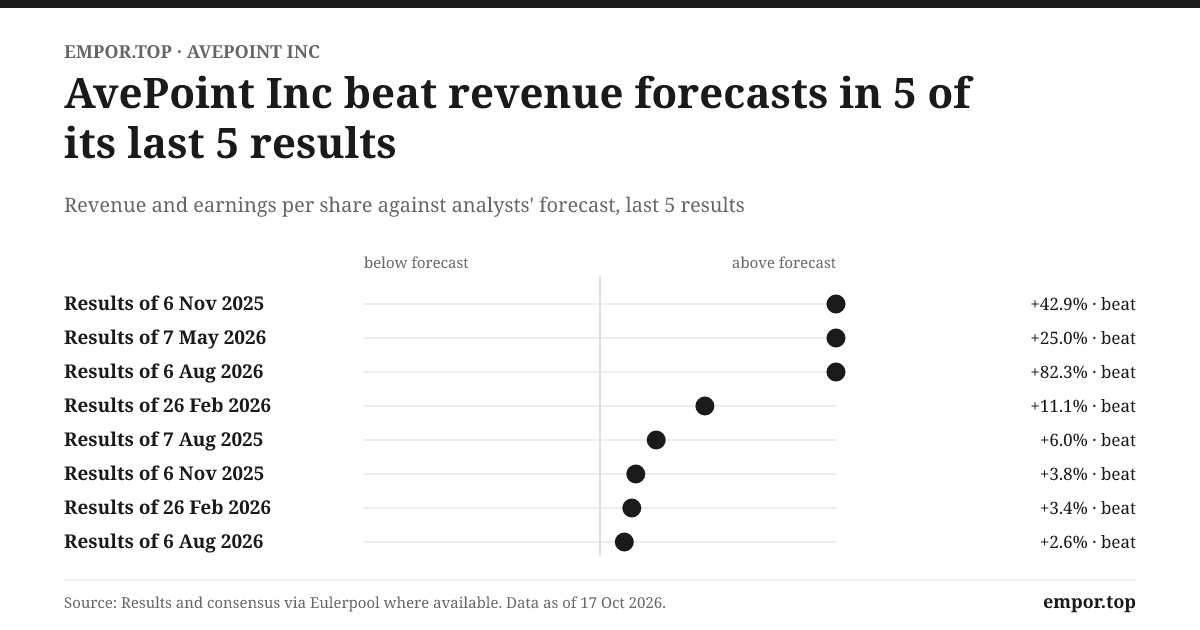
Management's credibility is best judged by behaviour. Across the fourth-quarter 2025, first-quarter 2026 and second-quarter 2026 calls, management has kept its narrative consistent: AI-driven demand, channel growth, steady retention, and expanding margins.678 It has generally met or raised its own guidance during this period, which counts for more than the rhetoric. The places to probe are the ones where answers have been less concrete: the path to $1 billion of ARR, the FX assumptions built into guidance, organic growth excluding Ydentic, and the economics of the cloud commitment. A management team that consistently hits its numbers earns patience; a team that explains away misses with currency or timing earns scepticism. So far AvePoint's recent record falls in the first category, while its SPAC-era record falls closer to the second.
Three measures matter more than the rest. The first is organic ARR growth, ideally broken out by cloud ecosystem; the latest reading is about 24% FX-adjusted ARR growth, and the ecosystem split is not disclosed.2 The second is the pair of SaaS gross margin and GAAP operating margin; SaaS gross margin was about 82% in 2025, and GAAP operating margin was about 9.8% over the last twelve months, rising.12 The third is unbilled receivables relative to revenue, which grew faster than revenue in 2025.1 If all three move the right way, the bull case strengthens. If ARR growth slows while unbilled receivables keep rising, the market's assumptions start to look stretched.
IX. Playbook: Business & Investing Lessons
Every company that builds on someone else's platform tells itself a story about why the platform owner will never eat its lunch. AvePoint's story has held for twenty-five years, which makes it more interesting than most. It offers lessons that are specific to this company and also travel.
The first lesson is about following customers. AvePoint started as a tool for backing up Microsoft servers, then followed customers to SharePoint, then followed them into the cloud. Each migration was a moment when an incumbent specialist could have died, and each time AvePoint chose to move with the customer rather than defend its old product. That decision built a recurring business that now generates three quarters of its revenue from subscriptions.1 But following the customer to Microsoft's cloud also deepened the dependence on Microsoft. The line to remember is this: follow the customer's migration, but never confuse the destination with a moat.
The second lesson is about cash. For years, AvePoint reported losses while its bank balance grew, because customers paid in advance and employees took part of their pay in stock. The prepayments were a real strength; they meant the business funded itself through its loss-making years. The stock compensation was a real cost; it meant owners' share of that cash kept shrinking. Investors who look only at GAAP losses miss the first point, and investors who look only at free cash flow miss the second. For AvePoint, a prepayment is a promise of future work, and a stock grant is a bill paid in someone else's equity.
The third lesson is about what the word "platform" has to earn. AvePoint now sells an impressive catalogue: backup, governance, migration, multi-tenant management, AI readiness. A catalogue is not a platform. A platform is something customers would struggle to leave, and the evidence for that comes one renewal at a time. Net retention around 110% says customers buy more.1 Gross retention below 90% says some still walk away.1 Until the company shows that its revenue outside Microsoft's ecosystem is growing into a meaningful share, the platform claim stays a claim. A platform story earns its name one renewal at a time, never in a press release.
The fourth lesson is for anyone weighing a business that lives inside a giant's ecosystem. The giant's growth can look like your growth for a very long time. The test is not whether you grow when the platform grows. It is whether customers would still pay you if the platform owner offered something good enough for free. AvePoint has spent a quarter century proving that Microsoft's tools are not enough for many customers. The next decade will show whether that remains true when the tool being bundled is not a backup button but an AI governance suite.
X. Epilogue
Tonight, AvePoint stands roughly halfway to the $1 billion ARR ambition management has set for 2029, with about $465 million of ARR,2 a growing pile of contracted revenue, no debt and a GAAP operating margin a little under 10%.2 It also stands at the start of a five-year, $340 million commitment to its cloud provider, with the heaviest obligations at the end.1 Its shares trade near their highs, at a valuation that assumes the next few years look like the last two.
The next decisive moment is the third-quarter 2026 earnings report. What to listen for is not the headline beat or miss, but the details the company has so far kept vague. Any disclosed progress on non-Microsoft ARR would be the single most important new fact, because it would begin to answer whether AvePoint is a multi-cloud platform or a Microsoft specialist. Customer expansion and the managed-service-provider channel, where the Ydentic deal was meant to help, will show whether the base is broadening beyond large enterprises.
The cloud commitment will reveal itself more slowly. Each annual report will show how actual consumption compares with the contractual minimums, and how SaaS gross margin moves as the obligation rises. If margins hold near 80% while consumption tracks the schedule, the deal was a sensible bulk purchase. If the company starts buying capacity it does not need, the back-loaded schedule will become the bear case's favourite exhibit.
Margins are the third test. Management's long-term ambition of 15% to 20% GAAP operating margin will be measured against a world in which the one-time tax release has passed, treasury income may shrink if interest rates fall, and the dollar may or may not cooperate.8 A steady climb toward that range, achieved while R&D stays above 12% of revenue, would show that the margin turn is structural. A stall, or gains that come only from a weaker dollar, would show that it depended on tailwinds.
The founders are the quiet fourth test. After the Singapore secondary, both still own about 9% of the company.14 If they continue to hold, and if public guidance remains consistent with the strategy they have described, their alignment with outside shareholders remains a strength. If future filings show steady selling at a time when management describes the opportunity as larger than ever, investors will draw their own conclusions.
Each of these outcomes points back to the same tension. AvePoint has proved it can grow inside Microsoft's world. It has not yet proved it can stand on its own feet if that world changes the rules.
XI. Outro
Go back to that company preparing to switch on its AI assistant, staring at twenty years of over-shared files. It needs someone to make that data safe enough to trust. Microsoft would like to be that someone. So would AvePoint, which has spent a quarter century learning exactly where Microsoft's tools fall short.
That is what makes AvePoint unlike any other software company of its size. Its greatest opportunity and its greatest dependency come from the same place. It has spent twenty-five years protecting what companies put in the cloud. Now it has to prove it can protect its place in the cloud.
References
-
Annual Report 2025 / Form 10-K — AvePoint, 2026-02-26 ↩↩↩↩↩↩↩↩↩↩↩↩↩↩↩↩↩↩↩↩↩↩↩↩↩↩↩↩↩↩↩↩↩↩↩↩↩↩↩↩↩↩↩↩↩↩↩↩↩↩↩↩↩↩↩↩↩↩↩↩↩↩↩↩↩↩↩↩↩↩↩↩↩↩↩↩↩
-
Form 10-Q for quarter ended June 30, 2026 — AvePoint, 2026-08-06 ↩↩↩↩↩↩↩↩↩↩↩↩↩↩↩↩↩↩↩↩↩↩
-
Merger Proxy / Prospectus — Apex Technology Acquisition Corp. and AvePoint, 2021-06-02 ↩↩↩↩↩↩↩↩
-
AvePoint SPAC merger announcement — SEC filing, 2020-11-23 ↩
-
Q2 2026 Earnings Call Transcript — AvePoint, 2026-08-06 ↩↩↩↩↩↩
-
Form 10-K for the Fiscal Year Ended December 31, 2024 — AvePoint, 2025-02-28 ↩↩↩↩
-
Definitive Proxy Statement — AvePoint, 2026-03-13 ↩↩↩↩↩↩↩↩↩↩↩↩
-
Secondary Offering Prospectus Supplement — AvePoint, 2025-09-16 ↩↩↩↩↩
 LinkedIn
 WhatsApp
 Reddit
 Hacker News
 Email
 Kindle
 RSS Feed
 Spotify
 Apple Podcasts
 Amazon Music
 Audible
 YouTube