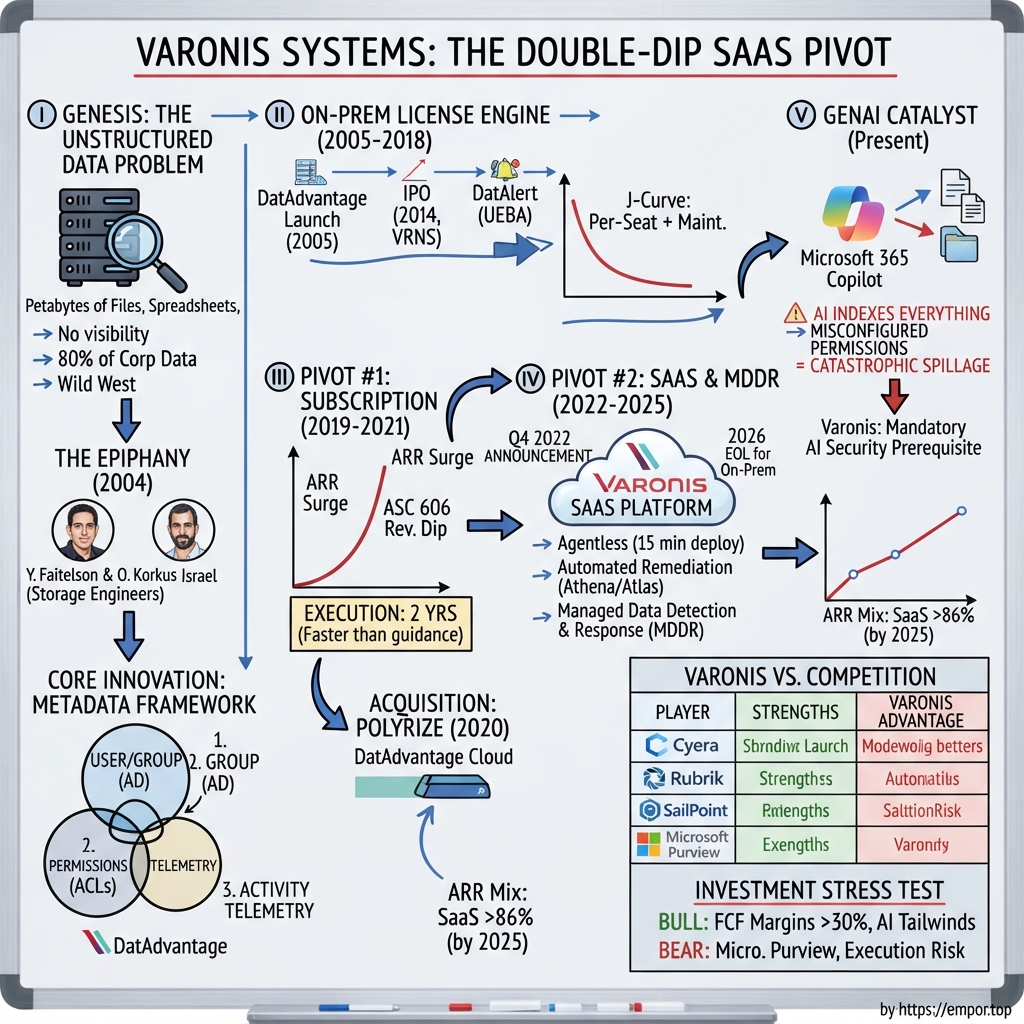
Varonis Systems: The Battle for Enterprise Unstructured Data and the Double-Dip SaaS Pivot
I. Introduction & Episode Roadmap
On the morning of October 29, 2025, traders watching NASDAQ opened their screens to a valuation drop that looked like a typo. Varonis Systems, a twenty-year-old data security company that sell-side analysts had long viewed as one of the most reliable compounders in enterprise software, dropped roughly 48% in a single trading session, erasing nearly $3.8 billion of market value.1
The catalyst was neither a data breach nor a competitive disruption, but a single sentence regarding customer renewals. On the third-quarter earnings call the prior afternoon, co-founder and CEO Yaki Faitelson informed investors that the company "experienced weaker-than-expected renewals in our federal business in our non-federal on-prem subscription business" — and noted that most of the shortfall had materialized in the final two weeks of the quarter.2 Management lowered fourth-quarter revenue and full-year recurring-revenue guidance, announced a 5% workforce reduction, and authorized a $150 million share repurchase program.23
Within weeks, securities class action lawsuits were filed, alleging that Varonis had assured investors its retention and renewal rates were "all very strong" while quietly struggling to migrate on-premises customers to its cloud platform.4 Eight months later, on June 23, 2026, Bloomberg reported that the company had retained advisers and was fielding preliminary takeover interest from Blackstone, Thoma Bravo, and Vista Equity Partners. The stock rose 12% on the news.5
That two-act sequence — a sharp sell-off triggered by the friction of a business-model migration, followed by private-equity takeover interest driven by the cash flows that same transition yields — defines Varonis in 2026. Understanding this dynamic requires examining an event from the company's origins: a deleted folder of seismic images on an oil company's file server.
The core hook. Varonis was founded on a simple yet critical security oversight: enterprises had spent decades fortifying network perimeters while leaving internal assets — file shares, mailboxes, SharePoint repositories, and unmonitored spreadsheets — largely unsupervised. Two Israeli storage engineers recognized that few organizations could answer a fundamental question: who has access to what, and who is actually using it?
The strategic double-dip. Varonis has deliberately disrupted its own income statement twice. In the first quarter of 2019, it abandoned perpetual licenses in favor of term subscriptions.6 In late 2022, it launched a second migration from customer-hosted software to a Varonis-managed cloud service, subsequently setting a firm end-of-life date for the self-hosted business of December 31, 2026.1 While both transitions traded short-term reported revenue for long-term recurring visibility, the second also introduced volatility into the predictability of its renewal base.
The generative AI catalyst. Varonis contends that AI copilots and autonomous agents inherit the access privileges of the users who prompt them. In its fiscal year 2025 annual report, the company noted that these systems "rely on existing access controls to determine what data can be surfaced," cautioning that overly permissive controls allow AI to "unintentionally amplify risk by scaling access faster than organizations can manage manually."1 While this risk rationale is compelling, whether Varonis can translate it into sustained market share gains against hyperscaler security bundles and well-capitalized private competitors remains an open question.
Why the addressable problem keeps growing regardless of who wins. A fundamental structural driver underpins the market. Citing IDC's Global DataSphere forecast in its annual report, Varonis notes that enterprise data is projected to grow at a compound annual rate of 25.4% over five years, exceeding 527 zettabytes by 2029.1 Consequently, the security challenge Varonis addresses expands continuously as data volume compounds and the number of autonomous systems accessing that data multiplies. The key strategic question is not overall market size, but which vendor captures that growth and at what operating margin.
As of early August 2026, Varonis traded near $43.50 per share with a market capitalization of approximately $5.0 billion, sitting within a 52-week range of $19.70 to $63.90 — reflecting significant market debate over the company's intrinsic valuation.7
Here is the roadmap: the metadata epiphany and founding; the perpetual-license machine and the 2014 IPO; the first pivot and the Polyrize tuck-in; the SaaS double-dip and the renewal shock; the AI security land grab and the 2025–26 acquisition spree; the competitive map; management credibility under stress; the strategic-power frameworks; and finally the bull and bear cases with the specific metrics that will settle the argument.
 Subscribe on LinkedIn
II. The Genesis: NetApp, Oceanographic Files, and the "Metadata Epiphany" (2004–2005)
In the early 2000s, a systems integration engineer in Israel fielded a call from a major energy company facing a critical problem: high-resolution images of the ocean floor—seismic survey data gathered at immense expense to guide multi-million-dollar offshore drilling decisions—had vanished from a network file share.
The immediate question was who had deleted them. The network file server provided no answer; it simply did not record such activity in an accessible format. Reconstructing the incident required a tedious digital forensic effort. The eventual finding proved more troubling than the missing data itself: dozens of administrators and employees possessed the technical permissions to view, move, or delete those files, even though almost none required access to perform their jobs.
That incident marked a turning point. Yaki Faitelson, who had managed professional services and systems integration teams at NetVision and NetApp, and Ohad Korkus, an architecture leader at the same firms, concluded that enterprise security was addressing the wrong vulnerability. Traditional firewalls secured the network perimeter, and antivirus tools monitored endpoints, but no system tracked activity inside internal file repositories.
Why the problem was structurally hard. This operational gap persisted due to fundamental technical constraints rather than oversight. Unlike structured databases—which organize information in labeled rows, columns, and query logs—unstructured data encompasses documents, spreadsheets, presentations, emails, and video. Varonis would later coin the term "human-generated data" for this material.8 Two properties made this category resistant to standard security tools.
First, event volume. An enterprise file server can generate millions of file-access events daily, including open, read, write, and delete actions. Enabling native operating-system auditing to capture these events severely degraded storage performance. Consequently, storage administrators routinely disabled auditing to protect system speed, leaving security teams without activity logs.
Second, permission complexity. File system access rights are rarely structured as flat access lists. Instead, they exist as complex, nested trees involving inherited rights, overlapping Active Directory groups, and layered exceptions. Determining who possessed permission to access a specific folder required evaluating intricate access graphs, while predicting the operational impact of removing a user group required complex permission simulations. System administrators could not resolve either question through manual inspection.
The architectural bet. Faitelson and Korkus elected to bypass file contents entirely, choosing instead to collect and correlate system metadata—the structural information describing the data. Their framework targeted three continuous data streams: identity hierarchies (users and groups), permission configurations (access control lists and inheritance rules), and telemetry logs (every file interaction). By normalizing and aggregating these streams, the software answered who owned access and who used it. More importantly, it enabled IT teams to determine appropriate access levels based on actual usage patterns and to simulate permission revocations before applying them.
An analogy for what they built. Consider a commercial building with 50,000 rooms and no central reception desk. Over two decades, key copies proliferate: former contractors retain working keys, employees hold credentials for rooms visited once years earlier, and master keys remain assigned to obsolete maintenance teams. Traditional security focused on fortifying external doors and placing cameras in the lobby.
Varonis introduced internal sensors for every doorway to log entry times and cross-reference access attempts against key registries. The platform then generated reports identifying thousands of unused keys that could be revoked without disrupting operations. By auditing entryways and access rights rather than reading the contents inside each room, the Metadata Framework scaled across enterprise environments where content-scanning solutions failed.
Varonis Systems, Inc. was incorporated in Delaware on November 3, 2004 and commenced operations on January 1, 2005, with its engineering center in Israel and its commercial headquarters eventually in New York.8 Faitelson, who held no formal university degree and acquired his expertise through practical integration work, assumed the executive role, while Korkus led product engineering. Together, they secured foundational patents covering permission visualization, access simulation, and telemetry analysis.
The resulting enterprise software functioned primarily as a data-engineering platform designed for security and IT governance buyers—a structural distinction that gained renewed relevance two decades later during the enterprise deployment of AI agents. This dual capability also shaped Varonis' evolving market positioning. Over subsequent years, its core category description shifted from data governance to data access governance, data security platform, data security posture management, and ultimately data and AI security, even as its underlying architecture remained focused on metadata ingestion.
For investors, this founding architecture established the core of Varonis' competitive moat. The primary technical hurdle was not constructing user dashboards, but processing billions of telemetry events continuously without impairing enterprise storage performance—a deep engineering challenge that required years of optimization.
III. Building DatAdvantage & The On-Prem License Machine (2005–2014)
Varonis launched its first commercial product, DatAdvantage, in 2006. By modern user-interface standards, the layout was sparse—a dense directory tree of folders and user groups color-coded by risk level. Functionally, however, it performed a previously elusive task: capturing and normalizing every file-access event across Windows and UNIX/Linux servers, storage devices, email systems, and intranet environments without requiring native operating-system auditing or degrading storage performance.8
The platform's key operational innovation was permission simulation rather than simple visibility. Systems administrators could select an over-permissioned user group, model its removal against months of historical access logs, identify precisely which users would lose access they routinely exercised, and execute the remediation with confidence. Varonis transformed what had historically been a high-risk administrative action into a predictable, evidence-based workflow.
Modular expansion, one license at a time. The company expanded its platform by adding specialized modules anchored to its core metadata architecture:
- DataPrivilege, also introduced in 2006, decentralized access governance. Through a self-service portal, business line leads and department managers—who understood the context of their team's data—could evaluate, approve, or revoke access requests directly, relieving central IT of routine entitlement decisions.8
- The IDU Classification Framework, launched in 2009, scanned file repositories to identify and tag sensitive material, such as personally identifiable information, financial data, and intellectual property. Crucially, it mapped those tags against access permissions to generate a prioritized index of folders that were both highly sensitive and broadly accessible.8
- Behavioral analytics followed, introducing automated anomaly detection to the activity stream. If a user credential that typically accessed dozens of files daily suddenly enumerated tens of thousands, the platform flagged the anomaly—capturing potential insider exfiltration as well as early-stage ransomware execution.
The economics of the license era. During this period, Varonis operated on a traditional on-premises software model: large upfront perpetual license fees bundled with recurring annual maintenance contracts. This model generated strong immediate cash flows and sustained an annual maintenance renewal rate above 90% leading up to the company's initial public offering.8 The land-and-expand sales engine proved effective: customer count grew from more than 1,700 at year-end 2012 to approximately 2,400 a year later, driven by 728 new customer additions in 2013 compared to 473 additions in 2012.8
However, the perpetual model harbored structural vulnerabilities common to legacy software vendors. Revenue recognized in any given quarter depended heavily on closing large enterprise transactions in the final days of the reporting period, creating quarterly lumpiness. That late-quarter execution risk would re-emerge more than a decade later under far more challenging circumstances.
Furthermore, high maintenance renewal rates provided a deceptive signal of customer engagement. Because maintenance fees represented a fraction of the original perpetual license cost, clients frequently renewed support contracts simply to preserve software updates and technical support, regardless of active adoption. This structure padded retention metrics while obscuring whether software was actively deployed across client environments—a distinction that became critical when Varonis eventually required customers to re-commit under subscription pricing.
The ransomware tailwind. During the late 2010s, Varonis benefited from an unexpected application of its core technology. Although its behavioral analytics engine was originally designed to detect insider threats, such as departing employees downloading proprietary files, ransomware attacks exhibited identical telemetry patterns: a single account rapidly opening, modifying, and rewriting thousands of files per minute. By identifying these mass modification patterns within the metadata stream, Varonis could detect ongoing encryption before endpoint security tools flagged the underlying malicious executable. This capability provided the company with an urgent secondary sales narrative during the peak of global ransomware outbreaks.
Distribution. To distribute its software, Varonis established a direct sales force to negotiate enterprise deals while partnering with channel resellers and systems integrators for contract fulfillment. Over time, channel partners became the primary route to market; by 2024 and 2025, third-party partners fulfilled substantially all of the company's sales.1 While this model allowed Varonis to scale sales coverage efficiently, it also inserted an intermediary layer between management and real-time signals of end-user satisfaction.
By 2013, Varonis possessed a differentiated product portfolio, a proven enterprise sales motion, a growing customer base, and a market segment it had largely defined. To support its next phase of expansion, the company sought access to public capital markets—leading to its initial public offering in early 2014.
IV. Wall Street Debut & The Unstructured Data Gold Rush (2014–2018)
Varonis priced its initial public offering at $22.00 per share and began trading on the NASDAQ Global Select Market under the ticker VRNS in early 2014—the year's first technology IPO.8 Public trading brought immediate price volatility. Within twelve months, the stock traded between $17.50 and $56.80, closing at $30.40 on February 18, 2015—a range management explicitly highlighted in its debut annual report as evidence that its shares "have been and will likely continue to be volatile."8 Subsequent market cycles thoroughly validated that disclosure.
Selling a category that did not exist. In its early years as a public company, Varonis faced a structural go-to-market challenge: corporate chief information security officers maintained dedicated budget lines for firewalls and endpoint protection, but lacked an established category for data access governance. Generating sales required demonstrating operational vulnerabilities prospects did not realize existed.
To drive adoption, Varonis deployed a standardized sales mechanism: the free Data Risk Assessment. The company installed its software on a prospect's live network for a limited period to audit internal file repositories. The findings were consistently alarming: tens of thousands of folders accessible to all employees, sensitive files sitting un-inventoried, active credentials assigned to dormant accounts, and service accounts with unrestricted administrative permissions.
The assessment inverted standard enterprise sales dynamics. Rather than debating feature comparisons against competitors, Varonis exposed immediate, empirical risks within the prospect's own infrastructure. The audit itself served as proof of value, creating a natural expansion pathway: once a customer remediated vulnerabilities across core file servers, Varonis applied the same access monitoring to email systems, SharePoint environments, and cloud repositories.
The macro tailwinds. External catalysts reinforced this sales narrative. High-profile corporate breaches throughout the mid-2010s shifted board-level discussions beyond perimeter defense toward limiting blast radiuses once networks were compromised—aligning directly with Varonis' core proposition. Regulatory mandates accelerated this shift. The enforcement of Europe's General Data Protection Regulation in May 2018, followed by California's consumer privacy legislation, transformed unmonitored personal data from an IT embarrassment into a quantifiable legal liability. Varonis capitalized on these mandates by positioning its classification and access-request modules as essential compliance infrastructure for managing data subject access requests and enforcing privacy policies.9
Multi-product attach as the real engine. Internally, management prioritized module expansion per client. While a single-module deployment functions as an isolated utility, a multi-module footprint reflects deep platform integration. This expansion motion scaled steadily: by year-end 2020, 63% of Varonis customers with 500 or more employees had licensed four or more modules—up from 54% the prior year—while 30% had adopted six or more, up from 20%.9
This adoption pattern established the foundation of Varonis' switching costs. Integrating four or more modules embedded the software into multiple operational workflows, making vendor replacement costly and disruptive compared to swapping out an isolated single-module scanner.
The competitive vacuum, and why it did not last. During this expansion phase, Varonis operated in a largely uncontested market. In its first annual report, management noted that while competitors addressed specific features or tactical use cases, the company did not believe it competed "with a company that offers the same breadth of function."8 That initial category lock afforded Varonis several years of strong growth when the primary sales hurdle was educating buyers on the underlying risk. Over the subsequent decade, however, as data security posture management matured into an established market, enterprise buyers began evaluating Varonis against a broader field of point solutions and platform suites.
A structural operational detail from this era remains relevant to the company's long-term profile. Varonis has consistently conducted core research and development in Israel while managing commercial operations from the United States, with financial disclosures audited by Kost Forer Gabbay & Kasierer, the Israeli member firm of EY Global.1 While this structure delivered R&D cost efficiencies, it concentrated product development within a single geographic region.
The IPO-era business model generated steady cash flow, but it carried an architectural dependency that would shape its next strategic shift: every dollar of revenue depended on customers self-hosting Varonis infrastructure—deploying dedicated SQL databases, managing collectors, and maintaining internal servers to run the platform.
V. Transition #1: The Subscription Pivot & Polyrize Acquisition (2019–2021)
In the first quarter of 2019, Varonis announced a strategic shift to a subscription-based business model.9 On paper, this was a straightforward shift—selling the same software for a set term rather than a perpetual license. In practice, it deliberately reshaped the company's near-term reported financials.
The accounting mechanics, in plain English. Under a perpetual license model, a customer pays a large upfront fee, allowing the vendor to recognize most of that revenue immediately. Under an on-premises term subscription, the customer pays annually. Revenue-recognition rules require the vendor to recognize the license portion upfront for the contracted term, while spreading maintenance over time. Switching to subscriptions causes reported short-term revenue to decline even if contract activity is growing, replacing a large one-time revenue spike with smaller, multi-year streams.
The result is a trajectory known as a J-curve: GAAP revenue growth slows or turns negative while annual recurring revenue—the annualized value of active subscription contracts—continues to rise. Management urged investors to focus on recurring revenue metrics rather than top-line GAAP revenue during the transition.
Why do it at all? The transition served two strategic objectives. First, recurring revenue streams typically command higher valuation multiples than volatile perpetual license sales. Second, term subscriptions restructured pricing dynamics: customers could license more modules within the same annual budget because they no longer paid steep upfront license fees. Varonis effectively traded upfront price-per-license for higher module attach rates, betting that clients using six modules would be stickier and generate greater long-term value than those running two.
The model transition progressed rapidly. For the year ended December 31, 2020, subscriptions generated 99% of license revenues, and 97% of total revenues were recurring in nature.9 Module adoption corroborated management's thesis: as detailed previously, the proportion of enterprise clients licensing four or more modules rose to 63% by late 2020, confirming that customers expanded their platform footprint under subscription pricing.
What the J-curve does to a shareholder register. Intentionally depressing reported short-term revenue alters a company's investor base. Traditional growth investors screening on GAAP revenue often sell, replaced by institutional investors willing to value the business on annual recurring revenue. Over the transition cycle, the shareholder base shifts toward investors who prioritize non-GAAP recurring revenue metrics over near-term reported earnings.
This investor alignment supports management during a smooth transition, but increases vulnerability if operational friction emerges. Investors accustomed to evaluating non-GAAP figures have fewer traditional valuation anchors if recurring revenue growth stumbles. Because Varonis initiated two major business transitions within five years, its investor base became heavily anchored to recurring revenue progress—amplifying the market reaction during the October 2025 slowdown.
Polyrize: the first acquisition, and a template. On October 29, 2020, Varonis completed its first acquisition, purchasing Israeli security startup Polyrize Security Ltd. The transaction totaled $39.4 million, consisting of $29.6 million in purchase consideration—$24.7 million in cash, $4.2 million in stock, and $0.7 million in replacement equity awards—along with $9.8 million in conditional retention payments to founders over three years, accounted for as compensation expense.9
Polyrize developed software that mapped user-to-data relationships across cloud applications and correlated disparate user accounts for individual employees.10 CEO Yaki Faitelson noted that the technology allowed Varonis to expand its core permissions mapping—originally designed for on-premises infrastructure and Microsoft 365—across a broader ecosystem of cloud platforms.10
What the deal revealed about capital allocation. The transaction highlighted three core elements of Varonis' M&A strategy. First, disciplined sizing: at under $40 million for a team of fewer than twenty employees, the deal represented a targeted technology acquisition rather than a revenue-buying expansion. Second, structured incentives: nearly a quarter of total deal value depended on post-acquisition retention milestones for the founding team. Third, strategic alignment: Polyrize was acquired not to add immediate revenue, but to extend Varonis' core metadata graph—its identity-and-access permission mapping—into third-party cloud applications where Varonis lacked native telemetry.
Financially, Polyrize provided a multi-cloud permissions framework for approximately two quarters of free cash flow with minimal equity dilution. The transaction also set a template that Varonis would repeat five times over the subsequent five years at increasing transaction sizes.
By the end of 2021, Varonis had successfully transitioned from perpetual licenses to a term-subscription model with expanded cloud coverage and expanding module attach rates. However, rather than maintaining that operating structure, management announced in late 2022 that it would initiate a second major business-model shift.
VI. Transition #2: The Double-Dip Shift to 100% Cloud SaaS & MDDR (2022–2025)
On the fourth-quarter 2022 earnings call on February 6, 2023, Faitelson described the SaaS platform Varonis had introduced roughly one hundred days earlier in terms that left no ambiguity about how he viewed it: "as big a milestone for us as the first version of DatAdvantage, the birth of our company."11
For investors who had only just finished digesting the initial subscription shift, this announcement signaled an unwelcome sequel. The financial logic was familiar and painful: under a true SaaS model, revenue is recognized ratably over the service period—eliminating the upfront license revenue recognition that on-premises term subscriptions still allowed. Varonis was effectively volunteering for a second J-curve while still standing in the shadow of the first. Management quantified the immediate top-line drag on that call as roughly a two-percentage-point revenue headwind resulting from the shift in product mix.11
The three-part rationale. Management's case rested on three core operational arguments.
Deployment friction. Self-hosted Varonis software required enterprise clients to maintain substantial internal database and collector infrastructure. Hours spent managing hardware and database servers distracted from core security operations, while prospective clients lacking dedicated IT bandwidth represented lost sales opportunities. Delivering the platform via SaaS eliminated that infrastructure prerequisite entirely.
Automation. Beyond eliminating hardware overhead, the cloud architecture altered the platform's execution model. While Varonis previously offered automated remediation capabilities, SaaS enabled continuous execution and centralized scale. Instead of requiring clients to schedule maintenance windows and manually apply software patches, the vendor-managed cloud service could execute permission reductions continuously across a customer's environment and tune detection models centrally. As Varonis noted in its annual filings, the SaaS platform "can automatically take action to contain" threats—such as restricting access and locking down compromised accounts—rather than merely generating alerts for human analysts to triage.1
Managed Data Detection and Response. MDDR bundled Varonis' internal security analysts directly into the subscription, providing around-the-clock alert monitoring and threat response on behalf of clients.12 Commercially, this offering served two functions: it expanded average revenue per user and provided a direct incentive for cloud adoption. As Varonis stated in its annual disclosures, MDDR and other advanced capabilities were made "only available through our SaaS platform."1 The migration was thus driven not only by customer persuasion, but by architectural gatekeeping; the company's newest capabilities were withheld from the legacy on-premises software.
Management also instructed investors to expect a 25% to 30% pricing uplift for SaaS relative to on-premises term subscriptions, arguing the increase was justified by total-cost-of-ownership savings on infrastructure.11 When Morgan Stanley analyst Hamza Fodderwala questioned on the call whether Varonis might instead be forced to offer discounts to drive customer adoption, Faitelson pointed to the company's internal cost calculators rather than directly addressing the potential pricing friction—foreshadowing a recurring theme on subsequent earnings calls.11
The migration ran faster than planned — and that was the problem. By the third quarter of 2025, SaaS represented 76% of total recurring revenue, prompting management to raise its year-end mix target to 83% and announce a firm end-of-life deadline for self-hosted products of December 31, 2026.2 Full-year 2025 results exceeded those projections: SaaS annual recurring revenue reached $638.5 million, accounting for 86% of total ARR of $745.4 million.13 Reported SaaS revenue for 2025 reached $462.6 million—more than double the $208.8 million recognized in 2024. Conversely, legacy term-license revenue fell 56.9% to $109.6 million, while maintenance and services revenue dropped 41.7% to $51.3 million.1
Viewing these revenue streams together illustrates the mechanics of the transition: as cloud revenues more than doubled, legacy streams contracted sharply, resulting in total revenue growth of 13.2% to $623.5 million for 2025.1
The crossover year, and the conversion mechanic that confused everyone. The financial pivot occurred in 2024. SaaS accounted for 37.9% of total revenue that year, compared to 46.1% from term licenses; by 2025, those proportions inverted to 74.2% for SaaS and 17.6% for term licenses.1 Inverting a corporate revenue mix within twelve months introduced operational and disclosure complexities that became central to subsequent investor lawsuits and metric debates.
When an existing on-premises customer converted mid-contract, accounting rules required prospective handling: remaining term-license revenue recognition ceased immediately, and contract value was spread ratably over the new SaaS term.1 This mechanics produced two distinct effects. First, reported GAAP revenue experienced an immediate short-term drop unrelated to underlying customer demand. Second, the client's recurring contract value migrated from the legacy on-premises category into SaaS ARR. As a result, SaaS ARR expanded rapidly even when total ARR remained flat, meaning headline SaaS growth largely reflected an internal balance-sheet transfer rather than net-new customer expansion.
Varonis subsequently adjusted its reporting by disclosing SaaS ARR growth excluding conversion activity. However, because this enhanced disclosure arrived alongside contract weakness in the legacy customer base rather than ahead of it, the sequence drew scrutiny from institutional investors and securities class action plaintiffs. Varonis maintained that its reporting disclosures evolved appropriately alongside its business model transition.14
What broke. The strategic challenge management underestimated was how a forced migration alters the customer renewal cycle. While routine on-premises maintenance renewals typically pass through standard procurement, establishing a hard end-of-life date forced enterprise clients to re-evaluate, re-budget, and re-authorize their software deployments. During the third quarter of 2025, a subset of clients chose to downsize or depart. On the earnings call, Chief Financial Officer Guy Melamed cited multiple contributing factors: account teams had struggled to demonstrate sufficient value to single-use-case customers, corporate budget scrutiny had intensified late in the quarter, and federal government contracts—representing roughly 5% of total ARR—had underperformed expectations, leading management to conclude there was "not one common theme."2
While management framed the shortfall as a combination of isolated external headwinds, analysts noted that a diffuse set of renewal friction points suggested underlying retention vulnerabilities across the legacy customer base—a key premise in subsequent shareholder litigation.4
The cost of the transition, in margin. The shift to a vendor-managed cloud service also compressed operating margins. GAAP gross margin declined from 85.6% in 2023 to 83.0% in 2024 and 78.8% in 2025, reflecting hosting and infrastructure expenses previously borne by self-hosted clients.1 Management framed this margin contraction as a temporary condition resulting from supporting dual delivery infrastructures during the transition, predicting gross margins would recover once legacy architectures are fully retired.14 However, through mid-2026, margin trends have yet to demonstrate a sustained rebound.
And in operating losses. Profitability metrics reflected similar pressure. Varonis' GAAP operating loss widened from $117.2 million in 2023 to $117.7 million in 2024 and $146.5 million in 2025, even as total operating expenses as a percentage of revenue edged down slightly from 104.4% to 102.3%.1 This minor efficiency gain stemmed primarily from a reduction in sales and marketing expenses, which fell from 55.7% of revenue in 2023 to 48.3% in 2025, while research and development spending expanded.1 This resource re-allocation shifted capital from customer acquisition toward platform engineering during the migration cycle.
An accounting detail further complicates year-over-year expense comparisons. Conditional consideration tied to retention milestones for acquired startup founders is recognized as compensation expense within research and development rather than capitalized as purchase price.1 Consequently, a portion of the recorded R&D expansion reflects transaction structuring and retention payouts rather than core organic engineering investment.
VII. The Copilot & GenAI Paradigm Shift: Securing the AI Layer (2023–Present)
Consider a scenario that illustrates Varonis' enterprise sales narrative in 2026:
An enterprise deploys an AI assistant across its workforce. The assistant functions effectively because it indexes every file the requesting user has permission to view. An analyst in accounts payable enters a prompt asking for details regarding an upcoming corporate reorganization. The assistant searches internal repositories, discovers a spreadsheet in a SharePoint site shared broadly across the company in 2019, and generates a structured summary of planned headcount reductions.
No systems were breached, and no security controls failed. The assistant operated as designed. The underlying permissions had simply remained misconfigured and unnoticed for seven years. The deployment of generative AI transformed what previously required searching for a specific file into a simple natural-language query.
Why this is structurally different from previous security waves. Varonis articulates the mechanism in its annual report through a concept it calls "blast radius" — the set of data a given identity, human or machine, can reach. Copilots and agents "typically rely on existing access controls to determine what data can be surfaced, summarized or acted upon," so over-permissioning becomes what the company calls a "risk multiplier," and reducing blast radius consistently at scale "isn't possible through manual processes, making automation essential."1
Underneath the industry terminology, the core premise is straightforward: artificial intelligence does not generate new authorization levels; rather, it automates the discovery and retrieval of improperly secured data. This dynamic underpins Varonis' strategic positioning in 2026, as remediation requires the permission mapping and automated governance infrastructure the company developed over two decades.
A second-order security risk stems from unmonitored AI integration. Employees and business units routinely connect unauthorized AI tools to corporate environments. An analyst connects a departmental assistant to an internal database; a third-party software vendor embeds an AI indexing feature into enterprise file workflows; or a developer grants an autonomous agent elevated service account privileges. The result is a network of AI entities operating without central security oversight. Unlike human employees, automated agents process data continuously and execute tasks at machine speed. On the second-quarter 2026 earnings call, Chief Executive Officer Yaki Faitelson framed a misconfigured agent as representing "a breach from hell," highlighting the systemic risk of autonomous data access.16
Turning the argument into product. Varonis expanded its platform to address generative AI risks across 2025 and 2026:
- Athena AI, a generative layer integrated into the platform that combines large language models with Varonis' data and identity metadata to assist security teams with natural-language threat investigation and reporting.1 Athena functions primarily as an operational productivity feature for security analysts rather than a structural moat.
- Atlas, launched on March 17, 2026, represents a more significant architectural expansion. Positioned as a dedicated AI security platform, Atlas discovers active AI deployments—including unapproved shadow tools—assesses security posture, performs adversarial testing, enforces runtime guardrails on prompts and responses, and integrates with existing security operations tools.15 At launch, Faitelson asserted that "AI completely disrupts the enterprise security model… agents are accessing data directly — placing data and AI security front and center."15
Atlas originated from the acquisition of AllTrue.ai, announced on February 3, 2026, and closed on February 6. Varonis agreed to acquire the firm for approximately $126 million in cash, with subsequent second-quarter financial filings disclosing $114.5 million in net consideration transferred at closing, up to $40 million in conditional performance payouts, and an additional $25.8 million tied primarily to continuing employee service.114 The transaction brought specialized domain expertise: AllTrue co-founder Ron Bennatan, who joined Varonis as Vice President of AI and Data Security Strategy, previously co-founded Guardium (acquired by IBM) and jSonar (acquired by Imperva).15
The early evidence. On the second-quarter 2026 earnings call, management cited a healthcare customer with over 40,000 employees that purchased Varonis' top-tier subscription tier specifically to monitor Microsoft Copilot, Anthropic's Claude, and custom internal language models, adding that Atlas was featured in "almost every conversation" with enterprise clients.16 While qualitative customer engagement and single-account deal wins indicate early interest, enterprise sales conversations do not guarantee durable revenue expansion. The definitive measure of market traction remains net-new SaaS annual recurring revenue excluding account conversions, which has not yet shown a material upward inflection attributable to Atlas.
The co-opetition problem, stated plainly. Varonis' AI growth strategy relies heavily on its relationship with Microsoft. The primary repository of over-exposed enterprise data resides within Microsoft 365 environments—including SharePoint, OneDrive, and Teams—where Microsoft Copilot is most widely deployed. Varonis has published extensive research detailing Copilot data exposure vectors and developed dedicated monitoring modules to provide security teams with visibility into accessible sensitive files and employee prompt activity.22
This creates an inherent strategic tension. Varonis' value proposition assumes that Microsoft's native governance suite, Microsoft Purview, leaves persistent security gaps that require third-party remediation. While commercially viable, this thesis depends on Microsoft continuing to leave functional gaps within its enterprise bundle. Varonis counters this risk by emphasizing cross-platform coverage, arguing that enterprises operating across hybrid environments—combining Microsoft 365, Amazon Web Services, Salesforce, Google Workspace, and on-premises infrastructure—require a unified data security control plane rather than fragmented vendor-native tools. This multi-cloud positioning remains valid if Microsoft enhances Purview, but faces pressure if enterprise buyers decide native controls are sufficient for their primary data repositories.
The honest counter-case. Security vendors across the software landscape have reframed their product roadmaps around AI governance, while Microsoft promotes native security controls directly within its enterprise suite. Varonis' distinct advantage is that its solution to AI data exposure relies on an automated remediation engine backed by two decades of permission auditing, rather than a recently assembled monitoring dashboard. However, this technical headstart is neither permanent nor exclusive. Unlike prior compliance mandates that allowed for extended implementation cycles, unauthorized AI data access presents immediate operational risk. Whether Varonis can convert this structural positioning into sustained, high-margin ARR expansion remains the central question for its next several reporting quarters.
VIII. Core Business Architecture, Segment Economics & Competitive Landscape
Strip away two decades of product names and Varonis today sells one thing: a control plane that sits across an enterprise's data stores, identity systems, cloud applications, databases, email, and now AI systems, and continuously answers what is sensitive, who and what can reach it, what they are doing with it, and how to shrink that exposure automatically.23 Everything in the revenue line is a licensing wrapper around that single capability.
Varonis in mid-2026 is close to being a single-line business, which is the whole point of the transition. In the second quarter ended June 30, 2026 — reported on July 28 — SaaS revenue was $171.7 million of $180.0 million in total revenue. Term license subscriptions contributed $4.2 million, down from $32.4 million a year earlier; maintenance and services contributed $4.1 million, down from $13.9 million.14 The legacy business is not declining. It is essentially gone.
Total SaaS ARR reached $726.0 million, up 52% year over year — but the number management wants investors to use is SaaS ARR excluding conversions, which strips out ARR that simply migrated from the self-hosted book, and which grew 25% to $598.1 million.17 The gap between 52% and 25% is the entire measurement problem of the last three years compressed into one line, and it is why the company also began disclosing a SaaS renewal rate, which it reported as above 90% for the first half of 2026.14
The KPI disclosure question. It is worth being direct about something commonly assumed and not actually supported by the filings: Varonis does not disclose a net revenue retention figure. It has replaced its historical renewal-rate disclosure with a SaaS renewal rate, and it has said that once the self-hosted end-of-life completes, total ARR and SaaS ARR "will be materially consistent" — at which point the conversions adjustment disappears and comparisons get cleaner.14 Investors should treat the current metric set as transitional and somewhat self-selected. Melamed's response on the second-quarter call to a question about updating conversion figures each quarter — that doing so would "generate more confusion" — is a defensible operating position and also, for a company facing disclosure litigation about exactly this transition, an awkward one.16
Where the money comes from geographically. Roughly 72% of first-half 2026 revenue came from the United States, 20% from EMEA, and 8% from the rest of the world.14 That concentration is a growth opportunity and a risk: Varonis is heavily levered to US enterprise IT budgets, and its federal exposure — the segment that blew up in late 2025 — was deliberately downsized, with Faitelson noting the company held only FedRAMP moderate certification and lacked "empirical evidence" justifying continued investment at prior levels.2 Management has since told investors it assumes no near-term upside from federal.16
The competitive map. Four distinct threats, each attacking a different flank.
Cloud-native data security posture startups. Cyera is the one that matters. Its trajectory is extraordinary: a $400 million Series F at a $9 billion valuation in January 2026, followed by reports in June 2026 that it was finalizing a round of at least $300 million at a $12 billion valuation, having surpassed $150 million in ARR — roughly 80 times revenue — while spending faster than it earns and adding 500 employees in a single half-year.18 Set that against Varonis: roughly $5 billion of market value on $726 million of SaaS ARR.717 Private capital is paying about sixteen times more per dollar of recurring revenue for the challenger than public markets pay for the incumbent. Some of that is growth-rate arithmetic. Some of it is a genuine judgment that agentless cloud-first architecture wins the next decade. Varonis investors should not dismiss the signal, but they should also note the reverse reading: an incumbent with three times the challenger's revenue at less than half the valuation is precisely the profile private equity buys, which is what June 2026 suggested.
Backup and data resilience vendors. Rubrik and Cohesity approach data from recovery rather than access. They compete for adjacent budget and for the CISO's attention, not usually head-to-head on permissions. The distinction that matters commercially is that backup vendors sell insurance against the bad day, while Varonis sells reduction in the probability and severity of the bad day. Both get funded; they rarely displace each other. The competitive risk is subtler — as backup vendors add classification and posture features to their copies of enterprise data, they can credibly argue they already know where the sensitive files are, which chips at Varonis' discovery value even if it never touches its remediation value.
Identity and access governance. SailPoint, CyberArk, and Okta manage identities and entitlements at the account level. The clean distinction: identity tooling governs whether you have a key; Varonis governs which rooms the key opens and watches what you do inside. In practice these coexist, and Varonis benefits from the identity vendors normalizing the "least privilege" concept it has sold since 2006.
The convergence risk runs in both directions, though. As machine identities and AI agents proliferate, "who is this actor and what may it do" and "what data did it touch" start to look like one problem rather than two. Whichever side of that boundary builds the more complete picture first inherits the other's budget. Varonis starts from the data side with better telemetry; the identity vendors start from the provisioning side with better placement in the procurement process.
Microsoft. The most serious structural threat, because Purview ships inside licensing bundles enterprises already buy. Varonis' counter-arguments are cross-platform coverage — AWS, Salesforce, Google Workspace, network-attached storage, databases — and automated remediation depth rather than manual labeling. Both are real today. Neither is defensible by decree. The relevant historical evidence is that Varonis grew alongside a decade of Microsoft security bundling; the relevant caution is that Microsoft's data-governance investment has intensified sharply in the AI era.
New adjacency: databases and email. Varonis is now buying its way into neighboring telemetry. Cyral, acquired March 17, 2025 for $25.5 million in cash plus $2.4 million conditional, brought agentless database activity monitoring — on the second-quarter 2026 call management said it was helping displace Imperva and IBM Guardium.116 SlashNext, completed August 28, 2025 and announced in early September for $106.0 million cash plus $4.7 million conditional — reported as up to $150 million including retention awards — brought AI-native email and collaboration security from a team founded in 2017 by Atif Mushtaq, an architect of FireEye's malware sandbox.119 That technology shipped as Varonis Interceptor on October 8, 2025, covering email plus Teams, Slack, and WhatsApp with automated message removal and link neutralization.20
The strategic logic — connect email, identity, and data so the managed service can trace an attack from the inbox to the file — is coherent. The financial logic is less settled: three acquisitions in twelve months totaling roughly $260 million of upfront cash is a meaningful change in behavior for a company whose prior deal history was one $39 million tuck-in.
A note on the backlog, because it looks worse than it is. Remaining performance obligations — contracted revenue not yet recognized — stood at $1,084.5 million at June 30, 2026, slightly below the $1,096.7 million reported at the end of 2025, with roughly 57% expected to convert to revenue within twelve months.141 A flat-to-declining backlog alongside 52% SaaS ARR growth looks alarming until you understand the billing mechanic behind it. Multi-year on-premises subscriptions were frequently contracted and invoiced for the full term upfront, which stuffed the backlog with years of committed revenue. SaaS contracts are generally billed annually.14 The company is trading a large contracted backlog for a smaller but genuinely recurring one. That is a structurally better business and a worse-looking metric, and it is also the direct cause of the cash-flow pressure discussed later. Investors who anchor on RPO growth as a health signal will misread this company for at least another year.
What the managed service does to the model. MDDR deserves a specific economic note because it is the least software-like part of Varonis. Bundling human analysts into a subscription raises revenue per customer and deepens the operational entanglement that produces switching costs — a customer whose security operations center has outsourced data-threat triage to Varonis is not casually replacing it. But analysts cost money that scales with customers rather than with code, and the company itself flags that it expects customer success, support, and MDDR costs to keep rising in absolute dollars.14 That is one plausible explanation for why gross margin has not yet begun recovering. If MDDR attach continues to rise, some portion of the margin compression management describes as transitional may prove to be structural mix shift instead. This is a testable proposition, and the test is whether gross margin recovers meaningfully in 2027.
IX. Management Credibility, Capital Allocation & Skeptical Investor Stress Test
Yaki Faitelson has led Varonis since co-founding the company, holding the roles of Chief Executive Officer, President, and Chairman simultaneously. Having advanced through practical systems integration roles at NetVision and NetApp rather than executive corporate tracks, his leadership style remains deeply connected to the platform's technical origins. The company's annual report explicitly lists key-person reliance as a specific risk factor, citing a "dependency on the continued services and performance of our co-founder, Chief Executive Officer and President."1 Guy Melamed has served as Chief Financial Officer throughout both corporate transitions and now carries the Chief Operating Officer title as well, while co-founder Ohad Korkus served as Chief Technology Officer from 2007 until February 2018 and remains on the board.
Combining the CEO and Chairman roles alongside a CFO who also serves as COO creates an executive configuration with unusual operational latitude. That concentration of authority enabled management to execute two aggressive, long-term strategic model shifts. However, it also coincided with communication gaps around renewal health that triggered shareholder litigation. A complete evaluation of management's track record must account for both outcomes.
What the track record actually shows. Varonis has maintained notable narrative consistency over the past decade. From 2019 through 2026, every major strategic initiative aligned with a single core thesis: consolidate enterprise data stores onto one platform, expand module attach rates per client, and automate threat remediation. Management set an ambitious subscription target in early 2019 and largely completed the transition by 2020.9 When leadership initiated the SaaS pivot in late 2022, cloud adoption progressed rapidly, reaching 86% of annual recurring revenue by year-end 2025—ahead of its original multi-year schedule.1113
Where it breaks down. While the speed of the model shifts was disciplined, communication surrounding the stability of the underlying customer base proved far less transparent. On earnings calls through the second quarter of 2025, management consistently characterized retention as strong. Yet by October 28, 2025, rapid deterioration in the legacy on-premises renewal book forced a guidance reduction and triggered a single-session share price collapse of nearly 48%. A securities class action covering the period from February 4 through October 28, 2025, cited this discrepancy between executive commentary and underlying contract trends.4 Although the litigation remains unresolved and its claims unproven, the operational reality is clear: renewal weakness surfaced abruptly for public markets rather than being communicated incrementally.
A secondary credibility friction involves management's tendency to reframe critical questions during market stress. When asked on the early 2023 call whether accelerating SaaS adoption would require pricing discounts, executive responses pivoted to total-cost-of-ownership calculators.11 When pressed on the second-quarter 2026 call about whether a major industry AI security incident had accelerated client deal flow, management reframed the discussion toward general "customer maturity."16 Similarly, when questioned on the same call about providing quarterly conversion updates, management stated that updating the figure would generate more confusion.16 While each answer served an immediate corporate communication purpose, the broader pattern provides investors with limited falsifiable detail during executive Q&A sessions.
Capital allocation. Varonis' capital deployment reveals a more complex picture than a simple founder-led discipline narrative suggests.
R&D. Research and development spending reached $237.8 million in 2025, accounting for 38.1% of revenue, up from 35.8% in 2024.1 This elevated reinvestment rate reflects the platform engineering demands of dual delivery architectures and aligns with management's stated preference for building capabilities internally over large-scale external M&A.
Stock-based compensation. Equity compensation totaled $130.2 million in 2025, representing roughly 21% of revenue.1 This expense creates the primary divergence between GAAP financial results and non-GAAP performance metrics, explaining how Varonis generated $131.9 million of free cash flow while simultaneously reporting a $129.3 million net loss.113 While cash generation remains solid, ongoing share dilution represents a real economic cost to equity holders.
Buybacks. The board authorized a $150 million repurchase program in October 2025—announced alongside the workforce reduction and the guidance cut.12 Management executed aggressively during stock weakness, repurchasing 5.4 million shares for $132.1 million at an average of $24.67 in the first quarter of 2026 and $135.0 million in total across the first half.2114 Deploying operating cash to buy back depressed shares represents defensible capital allocation, though initiating the buyback alongside a guidance reset also served to stabilize market sentiment.
Balance sheet. Cash and investments stood at $911.5 million at June 30, 2026 against $460.0 million of 1.00% convertible senior notes due 2029, issued in September 2024.171 This balance sheet position provides comfortable liquidity and debt service flexibility during the cloud transition.
Varonis' debt history demonstrates deliberate capital timing. The company issued $253.0 million of 1.25% convertible notes in May 2020 and refinanced with the larger 2029 issue in September 2024, purchasing capped calls alongside both transactions to limit dilution—allocating $55.5 million of the 2024 proceeds to that purpose.1 Securing low-cost debt while maintaining nearly a billion dollars in liquidity represents prudent treasury management. Furthermore, the use of capped calls highlights a structured effort to limit dilution from financing, contrasting sharply with the continuous share dilution resulting from annual equity compensation.
The cost discipline that arrived late. The 5% workforce reduction in October 2025 marked the company's first material headcount action, which management framed as reallocating resources toward higher-return initiatives, with the underperforming federal team specifically named.2 However, coming simultaneously with a guidance cut, the market viewed the action as a reactive response to late-quarter sales friction rather than proactive optimization. Total headcount still ended 2025 at 2,658 across all functions.1
The activist stress test. If an activist investor or private equity suitor mounted a case for operational or governance change, the core arguments would focus on five vulnerable areas:
"You changed the metric when the old one got ugly." Varonis retired total-ARR and blended renewal-rate disclosure in favor of SaaS ARR, SaaS ARR excluding conversions, and a SaaS renewal rate—during the exact period when the legacy book was deteriorating and while defending disclosure litigation. The company's explanation is that the metrics now match the business model.14 While that structural rationale is defensible, the timing of the transition invites scrutiny from institutional shareholders.
"Free cash flow is going backwards." First-half 2026 free cash flow was $69.1 million, down from $82.7 million a year earlier, even as revenue grew 22%.1417 The mechanical driver is billing structure: multi-year on-premises deals collected cash upfront, whereas SaaS collects annually. Management calls this transitional. Full-year guidance of $105–110 million against $131.9 million delivered in 2025 means Varonis has guided to a decline in free cash flow in the year it completes its transformation.1713 Generating lower free cash flow during the final stage of a major business model transition remains a primary point of financial pressure.
"Margins are going the wrong way." Second-quarter gross margin of roughly 75% and a 290-basis-point year-over-year compression drew direct analyst challenge; management attributed it to planned transition investment rather than pricing pressure or acquisition drag.1416 Nonetheless, persistent margin compression challenges the thesis that cloud delivery immediately unlocks operating leverage.
"The acquisitions are getting bigger and less related." Email security and database monitoring are adjacent, not core. While the platform-consolidation rationale is sound in principle, the execution risk of integrating three teams in twelve months while retiring an entire product architecture is non-trivial.
"Governance." Combined CEO/Chairman roles, founder-led governance, the absence of a dividend, and prolonged stock underperformance present a clear activist target. On an indexed basis from December 31, 2020, Varonis stood at $60.14 at the end of 2025 against $100 invested, while the NASDAQ Composite stood at $108.33 and the NASDAQ Computer Index at $258.44.1 Five years of strategic boldness produced a 40% loss for shareholders while the sector index more than doubled. That number, more than any other, explains why private equity came knocking.
X. The Playbook & Hamilton Helmer 7 Powers / Porter's 5 Forces Analysis
Stripping away narrative positioning leaves the fundamental question facing long-term investors: does Varonis possess a structural advantage capable of enduring competition from Microsoft and heavily capitalized venture-backed challengers?
Switching costs — real, and measurable. Switching costs represent Varonis' strongest strategic power. A mature deployment ingests years of access history, assigns data owners across thousands of repositories, establishes automated remediation policies tailored to operational risk tolerances, and embeds managed threat-detection analysts directly into client security workflows. Replacing the platform requires re-mapping permissions from scratch while accepting a window of unmonitored exposure.
However, empirical evidence from 2025 demonstrates that switching costs are not uniform across the customer base. Clients running only one or two modules experienced lower friction when choosing to churn during the cloud migration.2 Consequently, high switching costs exist as a function of deep platform integration rather than brand selection alone—making module attach rates the primary determinant of moat durability.
Cornered resource — partly. Two decades of proprietary engineering in ingesting and normalizing identity, permission, and activity telemetry at enterprise scale without degrading storage performance cannot be easily replicated by competitors. Yet this resource is structurally asymmetric. In legacy hybrid environments—comprising file servers, network-attached storage, on-premises Active Directory, and relational databases—the technical barrier remains steep. Conversely, in cloud-native environments, agentless scanning presents a significantly lower entry barrier, placing challengers on equal footing. As a result, Varonis' technical advantage is strongest in the slower-growing segments of the market.
Process power — plausible, unproven. The managed detection and response service model, alongside remediation playbooks refined across thousands of enterprise tenants, represents organizational know-how that is difficult to mirror quickly. However, process power can only be verified through operational metrics such as response efficacy, retention consistency, and net expansion—disclosures that management provides only in limited detail.
Scale economies — modest. While spreading cloud hosting infrastructure and threat-detection models across a multi-tenant platform yields theoretical cost efficiencies, GAAP gross margin compressed for three consecutive years through 2025, reflecting dual-infrastructure costs and managed-service delivery overhead.1 Management's assertion that gross margins will rebound post-migration remains a forward projection rather than demonstrated operating leverage.
Counter-positioning — against Varonis, not for it. In strategic terms, cloud-native entrants benefit from counter-positioning against Varonis' legacy architecture. While Varonis maintains hybrid infrastructure coverage as a key market differentiator and primary revenue source, supporting that footprint imposes engineering overhead and system complexity that pure-play SaaS competitors avoid.
Network economies and branding: essentially absent. Platform utility does not inherently increase with tenant scale beyond centralized threat intelligence feeds, and brand loyalty in enterprise cybersecurity remains low.
The Varonis playbook, extracted. Beneath these analytical frameworks sits a consistent operating pattern that has directed executive strategy for two decades:
One asset, many products. Every operational module draws upon the same core metadata graph. This unified data layer allows Varonis to expand into adjacent domains—such as database monitoring, collaboration security, and AI governance—more rapidly than generalist security providers. It also explains why recent acquisitions align strategically: the company is purchasing new telemetry feeds to integrate into its existing analytical engine.
Show, don't argue. The Data Risk Assessment sales mechanism has survived multiple business-model transitions because it addresses the primary hurdle in security sales—proving exposure—by auditing the prospect's live infrastructure rather than presenting generic marketing material.
Disrupt the model before the market forces it. Executive leadership has twice accepted near-term financial deceleration to pursue recurring business models. While this willingness to absorb short-term volatility reflects strategic conviction, the 2025 renewal contraction underscored an inherent risk: forcing a model transition converts passive maintenance renewals into active purchasing decisions, prompting a subset of customers to evaluate alternative vendors.
Automate, then monetize the automation. Varonis operates on the premise that enterprise data growth exceeds manual administrative capacity. Consequently, product value shifts from identifying vulnerabilities to automated remediation—first through software controls and subsequently via managed analyst services. While this progression elevates average revenue per customer, it also increases service delivery costs, making margin expansion dependent on software leverage outstripping service overhead.
The Five Forces read.
Rivalry: high and intensifying. Market competition is expanding across multiple vectors, including well-capitalized cloud-native startups, data backup vendors extending into posture management, identity governance platforms broadening entitlement tracking, and Microsoft bundling native controls within enterprise software suites.
Threat of new entrants: moderate, and bifurcated. Launching a cloud-only visibility product requires modest capital and development time. Conversely, engineering real-time hybrid metadata ingestion with automated remediation presents high technical barriers, restricting entry primarily at the cloud-native layer.
Buyer power: moderate to high. Chief Information Security Officers face budget consolidation pressure and increasingly favor unified platform suites over point solutions. As evidenced in late 2025, enterprise buyers exercise procurement power when forced to re-evaluate legacy commitments. The Data Risk Assessment serves as a counterweight by converting abstract budget negotiations into documented vulnerability reports.
Supplier power: low. Cloud infrastructure represents a commoditized input. The primary supply-side constraint is specialized engineering talent, concentrated in Israel, where 916 of the company's 2,658 employees were based at year-end 2025—a geographic concentration that presents ongoing operational and geopolitical risk.1
Substitutes: moderate and rising. Microsoft Purview represents the primary market substitute. The continuous improvement of native security features within Microsoft 365 remains the key variable influencing Varonis' long-term pricing power.
The synthesis. Varonis retains one clear strategic power (switching costs within deeply integrated deployments), one asymmetric advantage (proprietary hybrid telemetry processing), and limited scale or network efficiencies. While this infrastructure supports a viable enterprise business, it does not guarantee permanent pricing power. Sustaining market share requires driving multi-module adoption and establishing leadership in AI data security before platform competitors narrow the functional gap.
XI. Strategic Position, Material Risks & Bull vs. Bear Case
The three numbers that will settle the argument.
First: SaaS ARR excluding conversions. This metric serves as the cleanest proxy for whether Varonis is capturing new business rather than merely converting existing accounts. In the second quarter of 2026, organic SaaS annual recurring revenue grew 25% year over year to $598.1 million, prompting management to raise full-year guidance to 20% to 21% growth—an outlook above the second-quarter beat.17 However, because full-year guidance sits below the second-quarter rate, management is effectively projecting second-half deceleration. Whether that reflects operational conservatism or genuine demand friction remains a key variable. Once self-hosted software is fully retired at year-end 2026, this metric and total ARR will converge, eliminating conversion ambiguity.
Second: free cash flow margin. Full-year 2026 free cash flow guidance of $105 million to $110 million on revenue of $735 million to $739 million implies a cash flow margin of approximately 14%, down from 21% in 2025.1713 The bullish thesis requires this margin to rebound sharply in 2027 as annual billing schedules normalize and dual-infrastructure operational costs vanish. If margin expansion fails to materialize, the SaaS platform thesis breaks down financially regardless of headline ARR expansion.
Third: module attach and the SaaS renewal rate. Because Varonis does not disclose net revenue retention, investors must rely on the SaaS renewal rate—reported above 90% for the first half of 2026—and executive updates on multi-module adoption to evaluate whether client accounts are expanding or stabilizing.14 Given that the late-2025 contraction originated among shallow single-module accounts, any operational recovery will surface first in these attachment metrics.
Material risk radar.
End-of-life execution. The self-hosted platform reaches its end of life on December 31, 2026, requiring all legacy clients to select a migration path. Management projected $50 million to $75 million in full-year conversions, having achieved roughly half in the first six months, and expects conversion velocity to accelerate as contract renewals expire.16 As demonstrated in late 2025, forced migration deadlines often expose latent client dissatisfaction. This represents the primary operational risk over the next two quarters.
Litigation and disclosure overhang. Securities class actions stemming from the October 2025 disclosure reset remain pending, following a March 9, 2026 lead plaintiff deadline.4 Beyond direct legal expenses, the litigation reinforces management conservatism regarding forward-looking commentary on retention, potentially limiting valuation multiple expansion.
Microsoft co-opetition. This presents a gradual margin risk rather than an immediate disruption. Incremental enhancements to Microsoft Purview narrow the segment of enterprise buyers for whom Varonis is indispensable, shifting pricing leverage during contract renewals.
The M&A pace. Varonis executed three acquisitions in twelve months totaling approximately $260 million in upfront cash while simultaneously retiring its legacy architecture, with retention payments recorded as research and development expenses that obscure organic margin trends.114 Any integration friction would likely manifest as decelerating module adoption and sustained operating expense pressure.
The sale process itself. Unconfirmed reports of private equity buyout interest introduce sales friction. On the second-quarter call, Faitelson acknowledged that takeover speculation had delayed enterprise sign-offs late in the period, though he noted several transactions subsequently closed in July, including a seven-figure deal.16 Enterprise procurement teams frequently delay multi-year commitments during ownership uncertainty. If no transaction materializes, that procurement hesitation represents net operational drag.
Concentration. The business maintains significant structural exposure, generating approximately 72% of revenue from the United States, relying almost entirely on channel partners for contract fulfillment, and concentrating platform research and development in Israel.141
Demand and budget compression. In its financial disclosures, Varonis acknowledged shifts in corporate purchasing behavior, including tighter budget enforcement and elevated procurement scrutiny.14 Data security posture projects remain vulnerable to deferral during broad IT spending reductions when lacking immediate regulatory compliance mandates.
The disruption risk pointed at Varonis itself. While market commentary frequently treats artificial intelligence as an unmixed catalyst, advances in large language models present structural risks. If frontier models achieve low-cost content classification, Varonis' legacy discovery features risk commoditization, lowering entry barriers for cloud-native entrants. Management contends that content classification is secondary to permission mapping and automated remediation. While technically valid, this defense mirrors traditional incumbent arguments when facing architectural shifts.
Myth versus reality.
Myth: Varonis executed two flawless transitions. Reality: Varonis executed two rapid transitions, but with vastly different outcomes. The subscription shift in 2019 was orderly. In contrast, the cloud SaaS migration achieved its ARR mix targets ahead of schedule while masking underlying renewal degradation that eventually erased 48% of the company's equity value in a single trading session and prompted shareholder litigation.14 Migration speed does not guarantee customer health.
Myth: the SaaS model has already improved the financial profile. Reality: GAAP gross margins compressed for three consecutive years through 2025, free cash flow guidance projects a full-year decline for 2026, and the GAAP operating loss expanded to $146.5 million in 2025.117 Structural financial improvement remains a projection rather than a demonstrated outcome.
Myth: AI adoption automatically pulls Varonis through. Reality: while the security rationale is compelling and qualitative customer commentary is positive, empirical validation requires accelerating organic SaaS ARR growth. That rate stood at 25% in the second quarter of 2026, with full-year guidance anticipating deceleration.17 Generative AI demand represents a genuine tailwind, but has not yet converted into accelerating top-line expansion.
The bull case. Under the bullish scenario, Varonis completes 2026 as a cloud-native provider free of legacy software overhead, supported by a customer base that survived a forced migration, and offering a telemetry suite spanning files, identities, databases, email, and AI agents. As dual-hosting costs recede, gross margins recover toward historical levels, billing cycles normalize, and free cash flow expands significantly in 2027. Accelerating corporate AI deployments transform permission remediation into an operational mandate, positioning Varonis as the primary provider capable of automating remediation across complex hybrid environments. Multi-module adoption expands as Atlas, Interceptor, and database monitoring integrate into core tiers, while managed threat detection raises average revenue per user and reinforces switching costs. At a market capitalization of approximately $5 billion against $726 million in SaaS ARR, Varonis appears valued as an incumbent finishing a painful business model transition.717 Reported private equity interest at these levels offers structural validation rather than mere market rumor.
The bear case. Under the bearish scenario, Varonis' competitive moat proves less resilient than management contends. The contract losses in late 2025 demonstrated that single-module accounts churn readily, while deeply integrated accounts remain concentrated in contracting on-premises environments. Cloud-native startups—highlighted by Cyera's reported $12 billion valuation on $150 million in ARR and rapid hiring velocity—capture the greenfield cloud market.18 Simultaneously, Microsoft Purview narrows the functional gap, leading cost-sensitive security leaders to rely on existing license packages. Operating gross margins remain capped below historical levels due to the structural expense of vendor-managed cloud hosting, free cash flow expansion stays constrained, equity compensation continues to absorb one-fifth of revenue, and GAAP profitability remains elusive. Consequently, a private equity acquisition at a modest premium represents the most probable outcome, capping shareholder upside.
What would falsify each. These competing arguments can be evaluated against specific financial thresholds over the coming six quarters.
The bull case is invalidated if organic SaaS ARR growth decelerates below the high teens once legacy conversions complete in 2027, or if gross margin fails to rebound after dual-infrastructure expenses are eliminated. Either result would indicate that vendor-managed cloud delivery is structurally less profitable than legacy software distribution.
Conversely, the bear case is invalidated if free cash flow margins return toward the low-twenties percentage range in 2027 while organic ARR growth remains in the mid-twenties. Such performance would confirm that margin compression resulted entirely from transitional dual-hosting costs rather than fundamental business deterioration.
Both scenarios depend on identical financial reporting metrics over the next eighteen months. This clear resolution framework explains why Varonis shares traded across a three-to-one valuation range over a single twelve-month period: public markets are not disputing current operational facts, but weighing two competing interpretations of the company's long-term business model.7
Ultimately, both cases share the same baseline data and diverge on a single structural question: whether the high switching costs securing legacy on-premises deployments can be established across cloud-first and AI-native environments. Financial disclosures through mid-2026 have yet to resolve that question.
XII. Epilogue & What to Watch
Twenty-two years after two storage engineers could not tell an oil company who had deleted its seismic imagery, the question they built a company to answer has become a central question of enterprise artificial intelligence. That trajectory reflects a combination of strategic foresight and structural alignment: management chose to tackle the hardest engineering problem in unstructured data security, and complex access governance challenges have remained consistently relevant as enterprise IT architecture evolved.
Four lessons emerge from this story for founders, corporate leaders, and institutional investors:
Model transitions are measured on two clocks, and most companies monitor only one. Varonis shifted its recurring revenue mix faster than nearly any enterprise software peer through two consecutive business-model transformations. However, leadership learned through significant market volatility that the speed of an architectural transition reveals little about the underlying health of the renewing customer base. The key operational signal—the depth of multi-module adoption within the renewing cohort—was available internally, but received insufficient external focus during the expansion phase.
Choosing an unglamorous engineering problem creates compounding technical moats. Varonis spent its initial decade addressing a complex infrastructure challenge: capturing and normalizing billions of continuous file-access events without impairing customer storage performance. That foundation provides the company's technical credibility when Chief Information Security Officers evaluate which data enterprise AI agents can access. While newer competitors can construct modern management dashboards relatively quickly, building a two-decade graph of permissions and identity metadata presents a far higher technical barrier.
Regulatory mandates and technology waves provide distribution mechanisms, not core strategy. Compliance frameworks like the General Data Protection Regulation did not alter Varonis' fundamental value proposition; they made an existing governance platform easier to sell. Generative AI tools like Microsoft Copilot function similarly. Capitalizing on external catalysts is effective only when the underlying product is independently differentiated; otherwise, rising market waves lift all industry vendors temporarily without establishing durable competitive advantage.
Metric selection is a strategic decision with compounding reputational consequences. The most severe valuation drop in Varonis' public history resulted not from a security failure or product obsolescence, but from a single reporting period in which the divergence between published metrics and underlying contract retention became fully visible. Having voluntarily disclosed a blended renewal rate during stable operating periods, management faced significant market backlash when explaining that historical metrics did not capture legacy customer churn. The durable lesson extends beyond enterprise software: the performance disclosures a company highlights during expansion define the standards by which public markets evaluate its execution during periods of stress.
What to watch over the next four quarters, in order of information value:
The end-of-life execution, reported in early 2027 with fourth-quarter 2026 results. Whether the remaining cohort of self-hosted customers successfully converts to SaaS, reduces contract scope, or churns entirely represents the single most critical operational milestone in the cloud transition—and the final window for legacy renewal friction to surface.
The 2027 free cash flow outlook. Management's core thesis—that dual-infrastructure hosting expenses and transition friction temporarily depressed profitability—will face empirical testing in the 2027 financial guidance. A sharp inflection in free cash flow margins would validate the SaaS business model, whereas soft forward guidance would suggest cloud delivery margins are structurally lower than legacy on-premises distribution.
Organic SaaS ARR growth after conversion adjustments expire. Beginning in 2027, annual recurring revenue disclosures will become straightforward as legacy conversion adjustments end. Accelerated organic growth would demonstrate sustained commercial traction for AI security modules, while growth persisting in the low-twenties percentage range would indicate a mature, steady-state software provider rather than a re-accelerating platform.
The resolution of the strategic review process. A take-private acquisition, a formal conclusion of discussions, or prolonged silence each provides distinct signals regarding how private equity suitors and strategic buyers evaluate Varonis' intrinsic asset value after conducting full due diligence.
Attach rates for Atlas and Interceptor. Whether recent acquisitions in AI security and email protection convert into material ARR drivers or remain peripheral product features will manifest in multi-module customer adoption commentary well before impacting reported financial segments.
The overarching takeaway is that Varonis is neither the structurally broken enterprise implied by its October 2025 sell-off nor the unassailable AI security leader portrayed in executive presentation decks. It remains a differentiated software provider with a real but narrowing technical moat, concluding a multi-year self-inflicted business transformation that cost five years of equity outperformance and tested market credibility. As the company enters late 2026, the central investment debate shifts away from transitional accounting mechanics toward an operational test: whether Varonis can expand its platform footprint across cloud and AI environments faster than venture-backed challengers and hyperscaler security bundles capture market share. The coming four quarters will deliver that evidence.
References
-
Varonis Systems, Inc. Form 10-K for the fiscal year ended December 31, 2025 — U.S. Securities and Exchange Commission, 2026-02 ↩↩↩↩↩↩↩↩↩↩↩↩↩↩↩↩↩↩↩↩↩↩↩↩↩↩↩↩↩↩↩↩↩↩↩↩↩
-
Varonis (VRNS) Q3 2025 Earnings Call Transcript — The Motley Fool, 2025-10-29 ↩↩↩↩↩↩↩↩
-
Varonis Systems, Inc. Investor Relations — Varonis Systems, Inc. ↩
-
Varonis Systems, Inc. (VRNS) Hit with Securities Class Action Amid Renewal and ARR Concerns That Drove Shares Down 48% — Hagens Berman via PR Newswire, 2026 ↩↩↩↩↩
-
Varonis Systems stock jumps on potential sale reports — Investing.com, 2026-06-23 ↩
-
Varonis Systems, Inc. SEC EDGAR Filings (CIK 0001361113) — U.S. Securities and Exchange Commission ↩
-
Varonis Systems, Inc. Form 10-K for the fiscal year ended December 31, 2014 — U.S. Securities and Exchange Commission, 2015-02 ↩↩↩↩↩↩↩↩↩↩
-
Varonis Systems, Inc. Form 10-K for the fiscal year ended December 31, 2020 — U.S. Securities and Exchange Commission, 2021-02 ↩↩↩↩↩↩
-
Varonis Systems (VRNS) Q4 2022 Earnings Call Transcript — The Motley Fool, 2023-02-06 ↩↩↩↩↩↩
-
Varonis Managed Data Detection and Response (MDDR) — Varonis Systems, Inc. ↩
-
Varonis Announces Fourth Quarter 2025 and Full-Year 2025 Financial Results — GlobeNewswire, 2026-02-03 ↩↩↩↩↩
-
Varonis Systems, Inc. Form 10-Q for the quarterly period ended June 30, 2026 — U.S. Securities and Exchange Commission, 2026-07 ↩↩↩↩↩↩↩↩↩↩↩↩↩↩↩↩↩↩
-
Varonis Launches Atlas to Secure AI and the Data That Powers It — GlobeNewswire, 2026-03-17 ↩↩↩
-
Earnings call transcript: Varonis tops Q2 2026 estimates but shares fall — Investing.com, 2026-07-28 ↩↩↩↩↩↩↩↩↩↩
-
Varonis Announces Second Quarter 2026 Financial Results — StockTitan, 2026-07-28 ↩↩↩↩↩↩↩↩↩↩
-
Cyera eyes $12B valuation at 80x ARR multiple despite operating losses — TechCrunch, 2026-06-02 ↩↩
-
Varonis Acquires Email Security Firm SlashNext — SecurityWeek, 2025-09-02 ↩
-
Varonis Launches Interceptor: AI-Native Email Security to Stop Data Breaches Before They Start — GlobeNewswire, 2025-10-08 ↩
-
Varonis Announces First Quarter 2026 Financial Results — GlobeNewswire, 2026-04-28 ↩
-
Microsoft 365 Copilot Data Security Risks and Mitigation Analysis — Varonis Systems, Inc. ↩
-
Varonis Data Security Platform Product Overview — Varonis Systems, Inc. ↩
 LinkedIn
 WhatsApp
 Reddit
 Hacker News
 Email
Email Kindle
 RSS Feed
 Spotify
 Apple Podcasts
 Amazon Music
 Audible
 YouTube