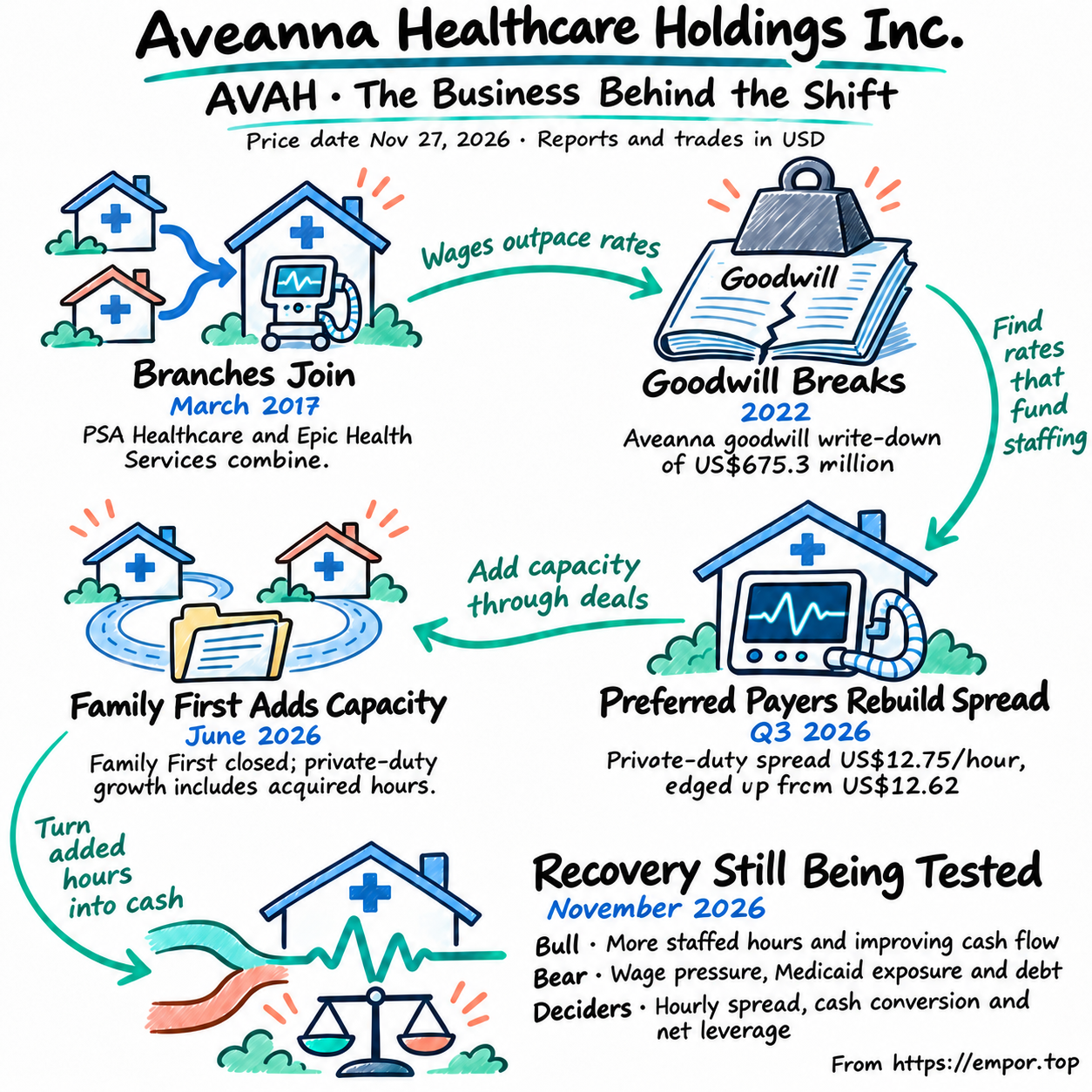
Aveanna Healthcare Holdings Inc.: The Business Behind the Shift
A $12.75 spread, and four questions
Somewhere in Florida or Texas or Pennsylvania tonight, a nurse is sitting beside a child who breathes through a tracheostomy tube. The ventilator hums. The nurse checks the settings, suctions the airway, logs the feeding and watches the monitor through the hours when the parents finally sleep. That shift is the whole of Aveanna Healthcare in miniature. In the third quarter of 2026, for each hour of private-duty care like this one, Aveanna collected an average of $44.09 from whoever paid for the child's care, and spent $31.34 on the caregiver and other direct costs of delivering it.1 The difference, $12.75 an hour, is what was left to pay for the branch office, the recruiters, the billing staff, the software, the interest on the company's debt, the taxes, and finally anything for shareholders.1
Three parties have to line up for that hour to exist at all. A family, usually referred by a children's hospital, needs care. A payer, most often a state Medicaid program or a managed-care plan acting for one, has to authorise the hours and set a rate. And a nurse has to be willing to drive to that house at that wage instead of working at the hospital down the road. If any one of the three is missing, the hour is never delivered and the revenue never exists. Aveanna's growth, its margins and its ability to pay down debt all come down to how many of those hours it can line up, and at what spread.
The company that does the lining up is big. Management raised its 2026 guidance in November to more than $2.695 billion of revenue and more than $374 million of adjusted EBITDA, the profit measure it prefers, which excludes interest, tax, depreciation and a list of items management treats as unusual.2 It also carries about $1.52 billion of borrowings.1 Those two numbers, a few dollars of spread per hour multiplied across roughly 50 million care hours a year,3 and a debt load more than half the size of the company's stock-market value, explain why Aveanna has been both a dramatic recovery story and a frightening one.
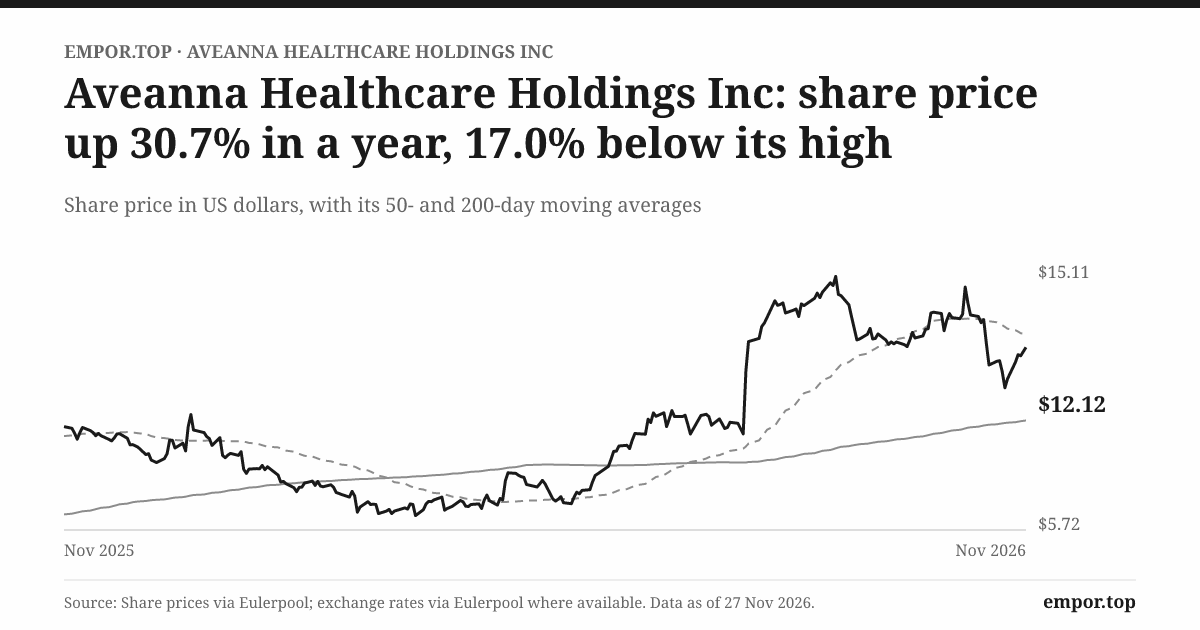
How frightening? Employees buying stock through the company's purchase plan in the first nine months of 2025 paid an average of about $2.80 a share.1 On November 27, 2026, the stock closed at $12.12, valuing the equity at roughly $2.6 billion.4
The question this story sets out to answer is simple to state. Is Aveanna building a durable home-care platform, or is its growth still hostage to staffing, payer rates and acquisitions? Four smaller questions sit inside it. How much of today's growth is organic, and how much was bought? Can the margin gains of 2025 survive wage pressure and Medicaid budgets? Is cash arriving reliably, or does it depend on collections timing and accounting estimates? And does the debt, refinanced and upgraded but still large, leave room for a mistake?
It helps to be precise about what is being analysed. The company on the Nasdaq Global Select Market is Aveanna Healthcare Holdings Inc., a Delaware holding company based in Atlanta.5 It does not employ nurses directly in the sense that matters to the patient; its wholly owned operating subsidiaries, such as Pediatric Services of America, LLC, hold the licences, sign the payer contracts and employ about 32,000 people.51 When this story says "Aveanna", it means that consolidated group. The private-equity firms that built it, Bain Capital and J.H. Whitney, were shareholders, not a parent company with its own operations, and their role has been shrinking.6
The short answer, set out at the start so the rest of the story can test it, is that the recovery is real. Revenue, profit and cash flow have all turned up, and the Q3 spread was higher than a year earlier. But the recovery depends on keeping caregivers staffed at rates payers will cover, and on the operating improvement turning into lasting cash and lower leverage. The company was assembled through deals and then badly damaged by them, so it is worth seeing how that happened first.
 Subscribe on LinkedIn
The roll-up that became Aveanna
The founding document of Aveanna is a merger, not a garage. In March 2017, a vehicle owned by Bain Capital and J.H. Whitney combined Pediatric Services of America, known as PSA Healthcare, with Epic Health Services, two providers of private-duty nursing for medically complex children.57 The new company took the name Aveanna in May 2017.5 Whitney had a long history in the business: it was already an investor in PSA, and it brought healthcare experience alongside Bain's balance sheet and buyout machinery.7
The people running the combination had done this before. The 2021 IPO prospectus introduced a management team led by Executive Chairman Rodney Windley and Chief Executive Tony Strange, with Jeff Shaner as chief operating officer, and pointed back to a long arc in home health.7 Windley's Healthfield Group, founded in 1986, merged with Gentiva Health Services in 2006, and that team helped build what the prospectus called the largest home care company in the United States before Kindred Healthcare acquired Gentiva in 2015.7 Aveanna was, in effect, the second act of a group of operators who believed that home care rewarded whoever could assemble the most branches, payers and back-office muscle under one roof.
They assembled quickly. By the company's own count, it grew from 17 states and about $325 million of revenue in 2016 to 30 states and $1.5 billion of revenue in 2020, a roughly fivefold expansion in four years.7 Much of that came through acquisitions. Premier, a California private-duty business bought in 2018, alone contributed about $234 million of revenue in 2019.7 An even larger private-duty deal agreed in December 2018 collapsed before closing, after the company had already started spending to integrate it.7 That terminated transaction later resurfaced in an unexpected place: a federal antitrust investigation.
In 2020 Aveanna moved beyond its pediatric base into adult home health and hospice, the Medicare-funded business of caring for older patients after a hospital stay or at the end of life. It paid about $64 million for Five Points Healthcare, a home health and hospice provider in seven states, and $61 million for Recover Health, a home health company in six states.7 In 2021 it kept going: Doctor's Choice in Florida for $115 million, Accredited Nursing Services in California, and in December, Comfort Care, a home health and hospice operator in Alabama and Tennessee.78 Those three 2021 businesses together had generated about $291 million of revenue that year, counting the months before Aveanna owned them.8 Alongside them sat a medical products business supplying enteral nutrition, which became the Medical Solutions segment.
The 2021 initial public offering was as much a balance-sheet event as a listing. Shares began trading on Nasdaq on April 29, 2021, and the offering closed on May 3.58 The company sold about 42 million new shares and received about $478 million of net proceeds.8 Before the deal, its filing had used an assumed price of $17 a share, the midpoint of its range; the net proceeds work out to a little over $11 a share, a sign that public investors priced the company well below where the sellers had hoped.78 Most of the cash went straight to lenders. Aveanna used $307 million to repay its entire second-lien loan, the most expensive layer of its debt, and paid down another $100 million of first-lien borrowings.8 The listing, in other words, was partly a refinancing with a ticker attached.
The pitch to IPO investors was explicit about why scale mattered. Aveanna described itself as the largest of just three national private-duty nursing providers in a market where local and regional agencies held about three-quarters of the business.7 It listed among its strengths an "acquirer of choice with proven ability to integrate acquisitions and realize synergies" and claimed that "scale advantages result in a network effect, accelerating growth."7 Those claims are worth holding on to, because the next three years tested them hard.
What followed was a sequence that defines how the company should be read today. First came acquisitions and the listing. Then came the impairment shock of 2022, when the company wrote down hundreds of millions of dollars of the goodwill it had paid for. Then came a change of strategy and leadership: a preferred-payer approach that steered nurses toward the payers willing to pay more, and in 2023 a new chief executive. Finally came the 2025 to 2026 return to growth, including Thrive Skilled Pediatric Care in June 2025 and Family First Homecare in June 2026.51
The steward of that recovery is Jeff Shaner, chief executive since 2023. He is not a founder figure but an operator's operator. Before Aveanna, he ran operations at Gentiva Health Services as a senior vice president and president of operations, and earlier led Gentiva's hospice division; he then became chief operating officer of PSA Healthcare and, after the merger, of Aveanna, where the company credits him with a central role in forming the combined business.3
His chief financial officer, Matt Buckhalter, also became CFO in 2023, after joining PSA's finance team in 2015.3 That continuity is a strength in a business where relationships with state Medicaid officials and managed-care plans take years to build. It also means the people in charge today were senior leaders during the deal spree and the write-downs that followed. Whether that history is a liability or a lesson is a question the story will keep returning to.
By 2025 the scale was undeniable: revenue reached about $2.4 billion, roughly double the $1.25 billion of 2018.57 But revenue that is bought is not the same as revenue that grows on its own, and a platform built by acquisition has to prove that the pieces work better together than apart. The place to start that test is the work itself, the hour of care that every one of those acquired branches was supposed to multiply.
The business runs on an hour Aveanna can staff
Picture the discharge planner at a children's hospital. A baby has spent months in the neonatal intensive care unit and is finally stable enough to go home, but only with a ventilator, a feeding tube and a nurse in the house for up to 24 hours a day. The hospital wants the bed. The family wants their child home. The Medicaid managed-care plan wants the child out of an intensive-care unit that can cost several thousand dollars a day.
Everyone agrees on the plan. What none of them can produce is the nurse. Aveanna's management has framed the economics bluntly: a day in a neonatal unit can cost $6,000 or $7,000, while care at home costs a fraction of that.9 That gap is the reason home care exists as an industry, and the reason payers want more of it. It does not, by itself, put a nurse in the house.
This is the heart of Private Duty Services, which produced about $1.66 billion of Aveanna's $2.01 billion of revenue in the first nine months of 2026, or 83%.1 Its core is private-duty nursing for medically complex children and young adults with conditions such as chronic respiratory failure, cerebral palsy and congenital anomalies.5 Children's hospitals are the most important referral source. Care usually runs between four and 24 hours a day, and patients often stay for years; about 30% of the company's private-duty nursing patients are over 18, having aged into adulthood on the service.5
Aveanna describes itself as the largest provider of this care in the United States.5 The segment also includes pediatric therapy and some non-medical personal care. It is paid mostly by the hour, which is why the company reports volume in hours and profit in spread per hour.
The other two businesses work differently. Home Health and Hospice, about $208 million of nine-month revenue, serves mostly elderly Medicare patients through visits rather than continuous shifts: a nurse or therapist after a hospital stay, or end-of-life care in hospice.1 Medicare pays home health largely by 30-day episode, with a national base rate of about $2,057 per episode in 2025.5 Medical Solutions, about $142 million, ships enteral nutrition formula, pumps and supplies periodically or as needed to patients who cannot eat normally, and is paid mostly by Medicaid.1 Its natural link to the core is that many tube-fed children receiving private-duty nursing also need the formula.
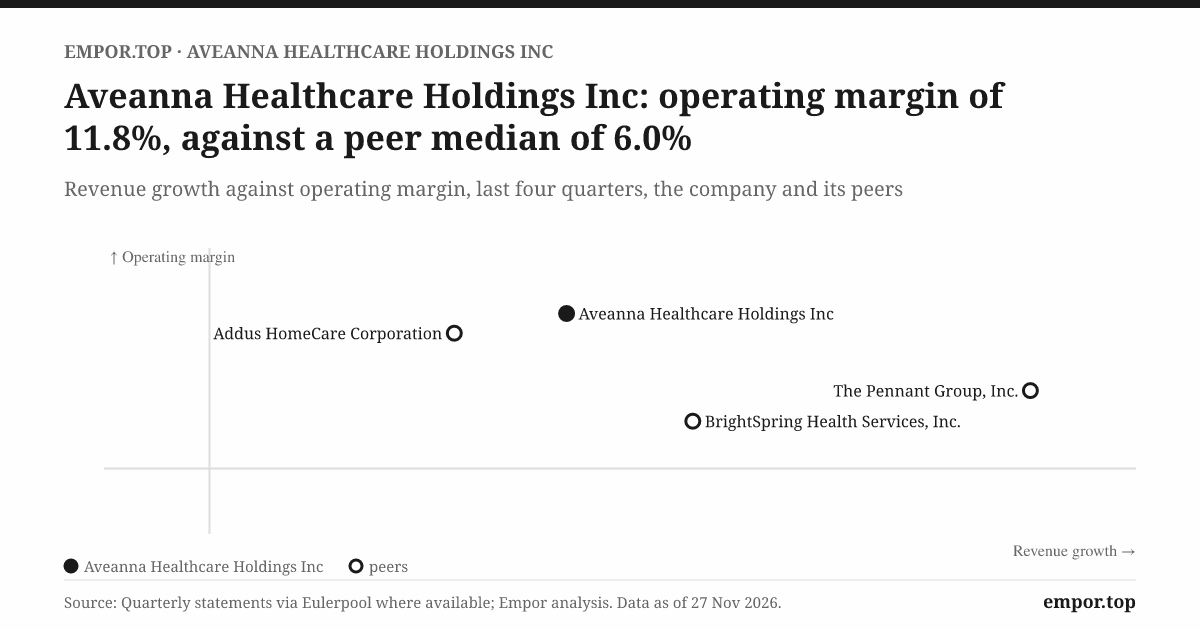
The margins differ just as much. In the third quarter, Home Health and Hospice kept 53.3% of its revenue after direct care costs, Medical Solutions 45.2%, and Private Duty Services 28.9%.1 Those are gross margins, before the branch, regional and corporate costs the company does not allocate to segments, so they cannot be read as segment operating profit. Still, they show something important. The business with the thinnest gross margin is the one that produces more than four of every five revenue dollars. Aveanna is, at bottom, a staffing-intensive pediatric nursing company with two smaller, richer businesses attached.
Who pays makes the economics even clearer. The company bills more than 1,500 distinct payers, including managed-care organisations, state Medicaid programs, Medicare, Medicare Advantage plans and commercial insurers, across 38 states.5 Management says no single payer contributes more than 9% of revenue.3 That breadth means no one contract can sink the company. But the breadth is mostly an illusion of variety. Medicaid and Medicaid managed-care plans together paid for 82.8% of third-quarter revenue.1 The managed-care plans negotiate their own rates, but they are themselves funded by state Medicaid budgets, so the ultimate price-setter for most of Aveanna's hours is a state legislature. The company does not publish a top-customer table, and it does not need to for the point to land: the real concentration is not in a name, it is in a funding source.
The competitive map looks like this. Aveanna describes its markets as fragmented, with local and regional agencies, hospital-based providers, nonprofits, visiting nurse associations and a handful of national operators.5 In home health alone there were more than 12,000 Medicare-certified agencies in the United States in 2025.5 In private-duty nursing, the company estimated at its IPO that local and regional providers held about 75% of the market.7 The nearest listed comparison is Addus HomeCare, which reported about $1.42 billion of revenue in 2025 against Aveanna's $2.4 billion, though Addus leans toward personal care for older adults rather than pediatric skilled nursing.105 Neither figure is market share, and Aveanna does not publish its share of any market.
Run the competitive forces through that map and the pressures are easy to see. Starting a small home care agency requires licences and nurses but little capital, so in many markets entry is easy and rivalry is local and constant. Buyers are powerful: Medicaid sets rates by statute or budget, and managed-care plans have consolidated. Suppliers, which here means nurses, are scarce and courted by hospitals, schools and other healthcare employers who can often pay more. The patient's family rarely chooses on price, and referral relationships with children's hospitals matter, but no hospital is contractually obliged to send its next patient to Aveanna.
So what is the edge? Management's answer has several parts: nurse recruiting and training at national scale, clinical quality, a broad set of services, data systems and, above all, preferred relationships with payers.511 Some of this has real evidence behind it. The company reports an average of less than one patient-safety-related injury per two million hours of service since 2017, a striking figure for a business delivering ventilator and tracheostomy care in private homes.5 It runs a national onboarding team that orients nurses around the clock, every day of the week. Shaner used Family First as the example: the acquired company was good at recruiting nurses but could not onboard them seven days a week, and Aveanna could.9 That is a plausible scale advantage, because a nurse who waits a week to start often takes another job.
What the company does not publish is the evidence that would turn plausibility into proof. There is no disclosed case-fill rate, meaning the share of authorised hours actually staffed, compared with peers. There is no disclosed nurse retention rate over time, and no peer-level comparison of clinical outcomes. The IPO prospectus claimed that scale produced a "network effect"; a network effect would mean each new patient or nurse makes the service more valuable to every other, and nothing in the record shows that happening in a business where each nurse serves one patient in one home.7
The more defensible version of the claim is narrower: scale lowers the cost of recruiting, onboarding, billing and negotiating, and gives the company a seat at the table with state officials and large managed-care plans. That is an advantage in cost and access, not a moat that keeps rivals out.
Artificial intelligence belongs in this picture, but in proportion. Management lists AI and automation among its five strategic priorities, aimed at administrative efficiency.11 The clearest result so far is in revenue-cycle management, the unglamorous work of billing and collecting: Buckhalter said automation had helped reduce days sales outstanding and freed staff to chase old receivables once thought uncollectible.12 That matters for cash. It does not replace the nurse at the bedside. No software suctions a tracheostomy at 3 a.m., and the binding constraint on Aveanna's growth remains how many caregivers it can hire and keep.
That constraint is the key to everything that follows. If care availability is the scarce input, then the company's value depends on whether it can pay nurses enough to staff cases while payers pay enough to leave a spread. When those two prices moved in opposite directions in 2022, the result was a write-down that erased much of what Aveanna had paid for its growth.
The $675 million warning in the middle of the growth story
In the summer of 2022, Aveanna's finance team ran a test that public companies run whenever there is reason to doubt the value of what they have bought. Goodwill is the accounting residue of acquisitions: the part of a purchase price that exceeds the value of the identifiable assets, a bet that the business will earn more than its parts. Once a year, or sooner if something changes, a company must ask whether each of its reporting units is still worth what the books say.
As of July 2, 2022, Aveanna's answer was no for five of its six reporting units, across all three segments.8 It wrote down $470.2 million of goodwill in that quarter. At year-end it ran the annual test again, got the same answer for five of six units, and wrote down another $205.1 million.8 The total for 2022 was $675.3 million.
The strange part is that the revenue line barely flinched. Revenue grew 6.5% in 2022, to about $1.8 billion.8 Patients still needed care, hospitals still discharged children on ventilators, and Medicare still paid for home health episodes. Yet the company reported an operating loss of about $642 million.8 How can a business grow and collapse in value at the same time?
The answer is the spread. The company's explanation for the impairments was that inflation and rising operating costs had constrained patient-volume growth relative to costs.8 In plain terms, nurses' wages jumped in the post-pandemic labour market, while Medicaid rates, set in state budgets that move once a year at best, did not keep pace. Aveanna faced an ugly choice on every case. It could pay the market wage and lose money on the hour, or keep wages where the rate allowed and fail to staff the case. Either way, the future cash flows that justified the prices paid for acquired agencies shrank. A goodwill test is, at heart, a discounted-cash-flow model, and when the expected spread falls and interest rates rise, the value of a leveraged, low-margin roll-up falls fast.
It is tempting to dismiss the write-down as "non-cash", and in a narrow sense it was. No money left the bank account in 2022 because of the impairment; the money had left years earlier, when the acquisitions were paid for. That is exactly why it matters. An impairment is the accounting system's admission that capital already spent will not come back at the expected rate. It was also not a one-off. The company had already written off about $118 million of goodwill, net of tax, on four private-duty reporting units at the end of 2021, the year of the IPO.8 It wrote down another $105.1 million in 2023.5 Across three years, close to $900 million of the value attached to past deals was erased.
Set that record against the IPO prospectus, which, barely a year before the big write-down, presented Aveanna as an "acquirer of choice with proven ability to integrate acquisitions and realize synergies."7 The impairments do not prove that every deal was bad. Some write-downs reflect a market-wide revaluation that hit every leveraged healthcare services company in 2022. But they do reject the broad version of the claim, that acquisition-led scale automatically creates value. What survives is a narrower claim: acquisition-led scale creates value only when the acquired hours can be staffed at a spread that covers the price paid.
The losses kept coming after the write-downs ended. Aveanna lost about $662 million in 2022, $134 million in 2023 and $10 million in 2024 before reporting $225 million of net income in 2025.85 Equity on the balance sheet turned negative, and borrowings drifted up toward $1.5 billion.5 For a stretch, the stock market priced the company as if the debt might win. That was the low point from which the current management team, with Shaner in the chief executive's chair from 2023, had to rebuild.
The lesson the company drew, judging by what it did next, was not to stop buying businesses. It was to stop accepting hours that could not pay. That idea, sorting payers by whether they would fund wages, became the preferred-payer strategy. It is the reason the 2025 numbers look so different, and it is the strategy every later acquisition must now be judged against. The deals that followed, including the one closed in June 2026, have to show integration, cash returns and progress on leverage, or the 2022 pattern stands as the base rate.
The preferred-payer strategy puts a price on growth
On earnings calls since 2025, Shaner has returned to the same plain idea: the industry does not have a demand problem.11 Payers, states and families want more home care than providers can staff. The constraint is labour, and labour follows wages. So Aveanna stopped treating every payer the same. It began sorting them into those willing to raise reimbursement and work with it on recruiting, and those that were not, and it steered its scarce nurses toward the first group.11 The company calls these partners preferred payers. A managed-care plan that agrees to a better rate gets more of Aveanna's recruiting effort and faster staffing of its members' cases; a plan that will not move gets whatever capacity is left over.
The idea is simple, and its logic is sound. If there are more cases than nurses, a provider should staff the cases that pay best, and use the better rate to lift wages so it can hire more nurses for those payers. Each preferred agreement is, in effect, a payer buying a larger share of a scarce resource. It also aligns interests. A managed-care plan whose members sit in hospital beds waiting for home nurses pays far more for the delay than it would for a higher hourly rate.
The scoreboard has moved. Aveanna had 22 private-duty preferred payers entering 2025 and 30 by the end of that year.13 It set a 2026 goal of 38, reached it by the third quarter, and expected to finish the year close to 40.11 The share of its private-duty managed-care volume under those agreements rose from 57% at the end of 2025 to 65% in the third quarter of 2026.11 Alongside the private contracts runs a government-affairs campaign aimed at state rates. The company won 10 state rate enhancements in 2025 and eight more by the third quarter of 2026.1311
The most vivid evidence that the strategy worked is the fourth quarter of 2025. Private-duty care hours rose 17.9% from a year earlier, revenue per hour rose 10.2% to $43.74, and cost per hour rose 11.1% to $31.62, leaving a spread of $12.12.13 Two caveats belong next to those numbers. The quarter contained an extra week because of how the company's fiscal calendar fell, which flattered the year-on-year growth in hours and revenue.11 And the hours growth included the Thrive acquisition, closed in June 2025.5 Even so, the direction was unmistakable. Rates went up, wages went up with them, and nurses came back.
By the third quarter of 2026, the picture had changed character. Hours still grew 10.2%, but revenue per hour rose only 1.4%, to $44.09, while cost per hour rose 1.6%, to $31.34.1 In percentage terms, wages outran rates. In dollars, the spread still edged up, from $12.62 to $12.75, because the base rate was higher than the base cost.1 The private-duty gross margin slipped from 29.0% to 28.9%.1 Translated, the big catch-up in state rates is mostly over. Management itself said at the start of 2026 that after three years of meaningful rate movement, it expected future state actions to be more like cost-of-living adjustments.13 Growth now has to come mostly from volume, and volume has to be bought with wages that rise at least as fast as rates.
California shows how fragile that balance can be. On the fourth-quarter 2025 call, Shaner said there was no private-duty nursing rate increase in California's budget as it then stood.13 By August, the state had legislated an increase effective January 1, 2027, and Shaner called California the final state in the company's multi-year effort to lift rates and caregiver wages; the company said it planned to raise California nurse wages that fall, ahead of the new rate.9
By November, the story had become more complicated. The state's Medi-Cal department confirmed roughly $60 million of combined state and federal funding for private-duty nursing for January through June 2027, but planned to pay it as a supplemental payment rather than a permanent increase in the base rate.11 Aveanna said it disagreed, and Buckhalter said the company could not invest meaningfully in base nurse wages in California until the higher rate was permanent, offering temporary retention payments instead.11
That sequence is a fair test of how to read management's prepared remarks. The August plan to raise wages "this fall" became, by November, a decision to wait. The reason is defensible: a company that raises base wages on a six-month payment risks being stuck with the cost when the money stops. But it shows that the preferred-payer and government-affairs strategies do not put Aveanna in control of its price. The state still decides what kind of money it is offering, and the company still decides whether it is safe to pass that money through to nurses.
The other two segments offer a different kind of signal. In Home Health and Hospice, the preferred-payer idea took the form of episodic contracts, where private payers such as managed-care plans agree to pay per episode of care, as traditional Medicare does, rather than per visit at lower rates. About 80% of third-quarter home health admissions were episodic, up from about 77% a year earlier.1
Admissions rose 19.6% and episodes 24%, and the gross margin held at 53.3%.1 Asked whether that growth was organic, Shaner said it was, and added candidly that he did not think 20% to 25% organic growth was sustainable forever.11 Medical Solutions, with $49.2 million of quarterly revenue, grew 9.1% after a modernisation programme that management said was complete; Shaner expected high-single-digit growth to continue.111 Both are encouraging. Neither is large enough to carry the company if private duty falters.
The analysts on the November call pressed on 2027, and the answers were revealing in their asymmetry. Shaner said the company felt very confident in how it was finishing 2026 and described a "beat and raise mentality."11 Buckhalter said the company was still working through its 2027 budget and that it was too early to get into specifics.11 That is normal for November. It also means the strongest statement management has made about the future concerns the six weeks left in a year almost finished.
Judged on its record, the preferred-payer strategy has operating proof. Volume is growing in all three businesses, more payers have signed on, and the 2025 margin recovery was real. The verdict, though, has to stay bounded. The strategy turned a broken spread into a working one by persuading payers to raise rates; it has not yet shown that it can widen the spread once rate catch-up slows. The number that will confirm or falsify it is the private-duty spread per hour over the next several quarters, read alongside wage growth. If the spread holds while hours grow, the strategy is a durable operating system. If wages keep outrunning rates, it was a successful one-time repricing.
Management's answer to that slower rate environment has been to add volume another way. In June 2026, it bought it.
Family First: $174 million for more pediatric capacity
On June 1, 2026, Aveanna's subsidiary Pediatric Services of America closed the purchase of Family First Homecare, paying about $173.7 million in cash after adjustments.1 The deal had been signed in March at a headline price of $175.5 million.1 Family First was a pediatric home care business, mostly skilled private-duty nursing, with 27 locations across seven states: Florida, Illinois, Iowa, North Carolina, Pennsylvania, South Dakota and Texas.14 Aveanna paid with cash on hand, not new borrowing or new shares.15 For a company that only three years earlier had been writing off acquisition goodwill, it was a statement of confidence.
The strategic fit is easy to see. Family First added density in states where Aveanna already operated, most notably Florida and Texas, which are among the largest pediatric Medicaid markets in the country. More cases in the same territory mean more nurses within driving distance of more homes, more leverage in negotiating with the same managed-care plans, and more fixed branch costs spread across more hours. Shaner said Family First had helped fuel the preferred-payer strategy in core states like Florida, as Thrive had before it.11
The price is where investors need to slow down. When the deal closed, Aveanna raised its 2026 guidance by exactly the contribution it expected from Family First: $70 million of revenue and $10 million of adjusted EBITDA.14 Those figures cover only the seven months Aveanna would own the business in 2026. A simple annualisation, which assumes the business runs at the same pace all year, implies about $120 million of revenue and about $17 million of adjusted EBITDA. On that basis, Aveanna paid roughly 1.5 times revenue and about 10 times adjusted EBITDA. Management, on its fourth-quarter call, described the price as about 7.5 times EBITDA after expected synergies.13 The gap between those two figures, roughly 10 times today against 7.5 times after the savings management expects, is the integration work.
Is 10 times expensive? Aveanna's own enterprise value is about 11 to 12 times its trailing EBITDA, and Addus was recently around 13 times.416 On that crude comparison, the price looks reasonable. But a public-company multiple is not a private-deal benchmark, and adjusted EBITDA is not GAAP operating profit, so the comparison is a sanity check, not proof of value.
The accounting tells the more important story. Of the purchase price, about $156.8 million was recorded as preliminary goodwill, or roughly 90% of what Aveanna paid.1 Almost none of the price is backed by assets a creditor could sell. It is a bet on future cash flows, exactly the kind of asset that disappeared in 2022. That does not make the deal a mistake; service businesses rarely own much. It does mean the whole value of the purchase rests on the integration and the expected synergies.
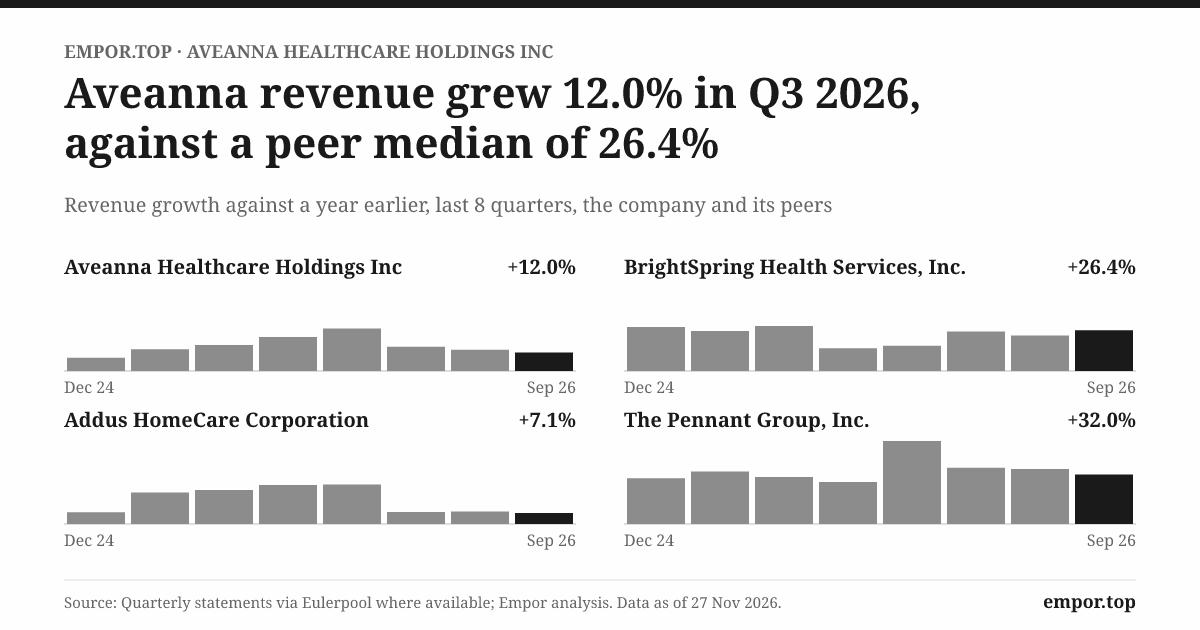
Family First also matters for how to read Aveanna's growth. Revenue rose 13.7% in the first nine months of 2026, and private-duty revenue rose about 14%.1 The Q3 press release attributed the quarter's results to "strong organic growth across all three business segments."2 For Home Health and Hospice and Medical Solutions, that description fits. For private duty, it needs care. Family First is inside the private-duty numbers, and Thrive was too until it passed the anniversary of its acquisition in June 2026.15
If Family First ran at about the monthly pace implied by management's guidance, it contributed something like $30 million of revenue in the third quarter, which would be about half of the roughly $60 million increase in private-duty revenue. That is an estimate, not a disclosure, because the company does not publish an organic bridge by segment. But it suggests that organic private-duty growth was closer to the mid-single digits than to 11.6%, consistent with the 5% to 6% long-term organic rate management itself now targets for the segment.93
That is not a scandal. Management has been open that its long-term plan combines 5% to 7% organic growth with 3% to 4% from acquisitions.3 But investors should not confuse the total with the organic part, and the company could make the distinction easier by publishing it.
Integration was on schedule by the company's account. In November, Shaner said essentially all back-office functions had been completed in the third quarter, with in-market and electronic medical record integration continuing, and the majority expected to be finished by the end of the fourth quarter.11 He also said he looked forward to "more Family First type acquisitions in 2027."11
That last sentence is the one to weigh against history. The company that described itself as an acquirer of choice in 2021 went on to write off hundreds of millions of dollars of acquired goodwill in 2022. The current team is more disciplined in what it says: deals funded with cash, a target of net leverage below three times in 2027, and acquisitions sized to fit the preferred-payer model.11 Family First is a reasonable deal on its stated terms. The forward test is whether its revenue becomes cash, whether that cash pays down debt, and whether its goodwill survives the next downturn in rates or wages without another write-down. That brings the story from the income statement to the bank account.
Profit returned; cash has to do more than arrive
On October 3, 2026, Aveanna's balance sheet carried $333.7 million of patient receivables, money owed for care already delivered.1 That figure was already net of $96.6 million of estimated contractual adjustments and implicit price concessions, the company's estimate of how much less than the billed amount it will actually collect.1 In other words, for every dollar of receivables on the books, management had already shaved off about 22 cents gross before calling the rest an asset. That estimate is not a sign of trouble; every healthcare provider makes one. But it is a judgement, and the size of the judgement is a reminder that in this business, revenue is an estimate until the cash arrives.
Start with the long view, because it looks alarming. From 2018 through 2025, Aveanna reported cumulative net losses of about $878 million, against about $247 million of cash from operations.58 Taken at face value, that looks like a company whose accounting profits and cash have never been on speaking terms. Taken apart, it looks different. The losses were dominated by the goodwill write-downs of 2021 to 2023, which reduced reported profit without taking any cash out in those years.
Even the recent profit flatters: Aveanna's $225 million of net income in 2025 included a $118.1 million deferred-tax benefit, an accounting gain from recognising tax assets the company now expects to use, not cash collected from patients.5 Strip both distortions out and the cumulative mismatch is far less dramatic. It is not a clean test of recurring cash conversion in either direction.
The more useful test is recent and simple. In 2025, operating cash flow was $125.9 million and free cash flow, after capital spending, about $118 million.5 In the first nine months of 2026, operating cash flow was $157.5 million and free cash flow $141.2 million, about $55 million better than a year earlier.23 Capital spending is tiny, around 0.3% of revenue, because the assets of a home care company are mostly people and software.5 That is an attractive feature. Nearly every dollar of operating cash flow is available for debt reduction or acquisitions.
The timing inside a year, though, swings widely, and the mechanism is worth understanding. Revenue is recorded when care is delivered, at the amount the company expects to collect. Cash arrives later, after claims are submitted, authorisations are matched and payers process them. Home health is billed in 30-day increments, so it collects more slowly than private duty.5 Payroll, by contrast, is paid every week or two. So anything that slows billing, such as a new billing system, the integration of an acquired company's records, or a backlog at a state Medicaid office, delays cash without changing reported revenue. The first quarter of 2026 showed the pattern: operating cash flow was just $4.3 million, which management described as a seasonal low driven partly by payroll taxes.12
Collections can also flatter results in the other direction. On the first-quarter 2026 call, Buckhalter said the company had collected about $6 million of receivables it had previously reserved against, and that this boosted both revenue and adjusted EBITDA in the quarter; he credited automation in revenue-cycle management for allowing staff to chase old balances once thought uncollectible.12 A quarter earlier, a $2.5 million to $3 million reserve release had temporarily lifted Medical Solutions' gross margin.13 Each item was disclosed, and each was small relative to the company. Together they show that reserve estimates move reported profit, and that the 2026 guidance raises partly rested on collecting money from earlier periods.
The auditor's view gives this its proper weight. In its report on the 2025 financial statements, Ernst & Young identified the estimate of contractual adjustments and price concessions, about $106.5 million at the time, as a critical audit matter, the label auditors use for areas requiring especially challenging judgement.5 EY tested the company's controls, its historical collection analysis and its cash receipts, and issued unqualified opinions on both the financial statements and internal control over financial reporting.5 That is a clean bill of health, with a spotlight on the most judgemental number.
What the company does not publish limits how far outsiders can go. Aveanna discloses the reserve against receivables but not an ageing table showing how long balances have been outstanding, nor an unbilled-revenue balance.1 Days sales outstanding, which measures how many days of revenue sit in receivables, was 46.3 days at the start of 2026.5 It recorded no bad-debt expense in the first nine months of 2026, because expected shortfalls are built into revenue as price concessions rather than booked separately.1
So the verdict on cash is a qualified yes. The business now generates real cash, and the long-run mismatch is mostly an accounting artefact of impairments and taxes. But the reserve estimate is large, collections have been helping results, and the integration of Family First's records is exactly the kind of event that can slow billing. The tests to watch are DSO, the size of price concessions relative to revenue, and whether cash flow keeps tracking adjusted EBITDA once the easy collections of old balances are done. Cash matters so much here because of what sits on the other side of the balance sheet.
The listed company has more owners; the debt remains
On August 20, 2026, RBC Capital Markets priced an offering of 15 million Aveanna shares at $11.75 each.6 None of the money went to Aveanna. The sellers were affiliates of the original sponsors, and they collected $11.50 a share after the underwriting discount, about $172.5 million for the base deal.6 Whitney-affiliated sellers had also given the underwriter an option to buy another 2.25 million shares, which was exercised in full, bringing the total to 17.25 million.6 The prospectus carried one sentence of real governance consequence: after the offering, Aveanna would no longer be a "controlled company" under Nasdaq rules, meaning its sponsors no longer controlled a majority of the vote.6
It is worth being clear about what this was and was not. A secondary sale moves existing shares from one owner to another. It does not reduce the company's debt, add to its cash, or dilute existing holders. It did widen the public float, which can improve trading liquidity, and it marked the beginning of the end of private-equity control nine years after the 2017 merger. But the sponsors did not vanish. The prospectus warned that Bain Capital and Whitney would continue to be able to strongly influence the company, and that it could rely on certain governance exemptions during a one-year transition.6
Before the sale, the April 2026 proxy had listed Bain-affiliated entities at 37.5% and Whitney at 18.4%, though it noted that Bain's underlying filing dated from 2021.[^17] After the sale, one Whitney fund reported holding under half a percent, and noted that a stockholders' agreement could cause it to be treated as part of a group with Bain affiliates.[^18] The exact voting alignment of the former sponsors should be read from their latest filings rather than inferred.
The debt is the larger story. At October 3, 2026, borrowings were $1.521 billion: about $1.315 billion of first-lien term loans priced at the SOFR benchmark rate plus 3.00%, and $206 million drawn on a receivables securitisation facility at SOFR plus 2.50%.3 The term loans mature in 2032, the revolving credit line in 2030 and the securitisation in 2028.1 The revolver was undrawn, the company met its financial covenants, and total liquidity was about $492 million.13
The cost of that debt has fallen sharply. A refinancing in the third quarter of 2025 retired the expensive second-lien loan entirely.1 A repricing in the second quarter of 2026 cut the term-loan rate by 75 basis points, which management said would save about $10 million a year, and the lending agreement cut the margin by another quarter-point in May after a credit-rating improvement.91 Together with lower benchmark rates, those steps took the weighted-average interest rate from 7.8% a year earlier to 6.8%, and third-quarter interest expense fell about 22%.1
That rating improvement came from Moody's, which upgraded the corporate family rating of the operating borrower, Aveanna Healthcare LLC, to B2 from B3 in May 2026, with a stable outlook.17 The agency credited improving operating performance and declining leverage. It also named the constraints it still saw: high leverage, concentration in California, Texas and Pennsylvania, and exposure to government reimbursement cuts, especially in Medicaid.17 B2 is still well inside speculative-grade territory. The upgrade means lenders see less risk than before, not little risk.
There is one more detail in the hedging that investors should not miss. Almost all of Aveanna's debt is floating-rate, and the company has protected itself with interest-rate caps, contracts that pay out if benchmark rates rise above a set level. Today, $880 million of debt is capped at 3%, a cap that expires in February 2027. Its replacement, signed after the quarter, caps the same amount at 5.25% through December 2029.113 If short-term rates stay above 3% when the old cap expires, Aveanna's effective interest cost on that slice will rise in 2027, even with no change in its borrowing. The new cap protects against disaster, not against the ordinary loss of a very favourable old hedge.
How leveraged is the company, really? Net of its $198 million of cash, debt was about $1.32 billion at the end of the third quarter.3 Against management's 2026 adjusted EBITDA guidance of more than $374 million, that is roughly 3.5 times, and management has said its goal is to get below three times in 2027.11 Moody's, which makes its own adjustments, including for leases, expected leverage in the mid-to-high four times range over the following 12 to 18 months.17 The truth for an equity investor lies somewhere between, and either way it leaves less room for a bad year than the stock's recovery might suggest.
One link between ownership and the capital structure deserves a sentence. One of Aveanna's significant stockholders also held 6.6% of its 2026 term loans as of October 2026.1 The filings report no related-party revenue, management fees or affiliate services, so there is no sign of value leaking out through side arrangements.15 But an owner who is also a lender can, in a stressed scenario, have interests that differ from those of ordinary shareholders.
So the balance sheet is clearly safer than it was in 2023: cheaper debt, longer maturities, a better rating, ample liquidity. It is not yet a conservative one. The share sale changed who owns Aveanna; it did not change what Aveanna owes. Net leverage, interest expense and cash left after acquisitions are the tests. Whether those numbers keep improving depends on the people making the next capital-allocation decisions.
A recovery with a management test attached
When Shaner opened the third-quarter call on November 12, 2026, he had good news to deliver. Revenue was up 11.8% to $695.5 million, adjusted EBITDA up 25% to $100.1 million, and guidance was going up again.2 He described the quarter as evidence of the company's "strong organic growth across all three business segments."2 It was the fourth upward revision of the year, counting the June addition of Family First.
That record of raises deserves credit, and it can be measured. In March, management guided to 2026 revenue of $2.54 billion to $2.56 billion and adjusted EBITDA of $318 million to $322 million, excluding Family First.13 In May it raised both, to $2.56 billion to $2.58 billion and $328 million to $332 million.12 In June it added Family First's expected $70 million of revenue and $10 million of adjusted EBITDA, and nothing else.14
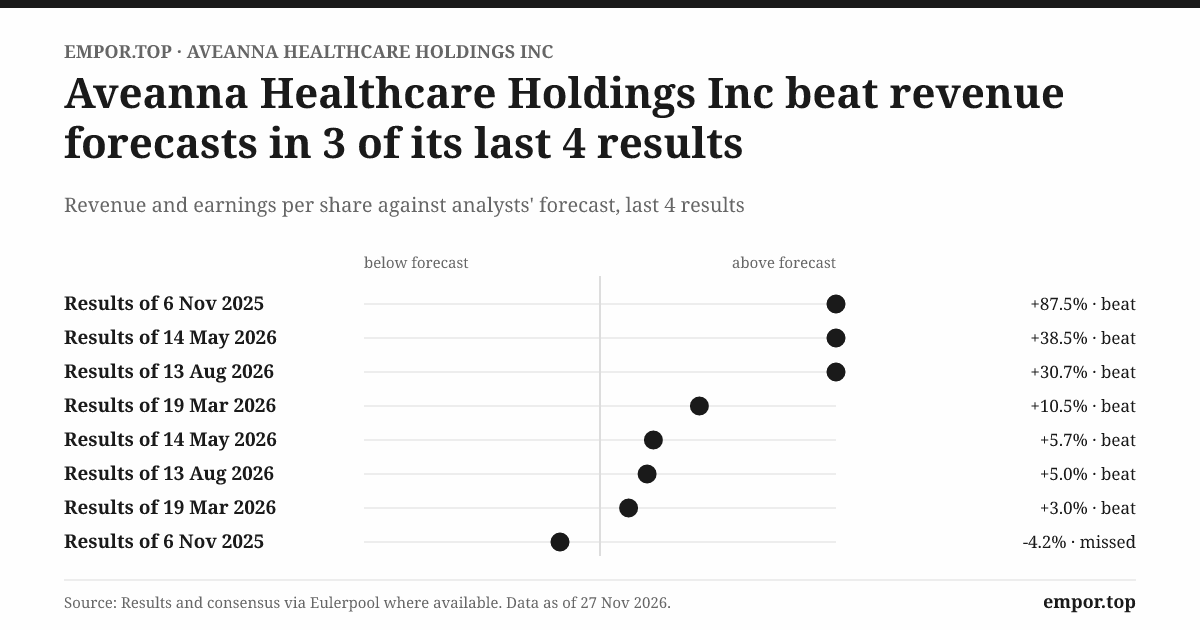
By November, guidance was above $2.695 billion and $374 million.2 Take out Family First and the organic EBITDA outlook rose from about $320 million to about $364 million over eight months, an increase of more than 13%. Some of it came from collecting old receivables; management attributes most of the improvement to rates, volumes and operating efficiencies.11 On guidance discipline, this management team has under-promised and over-delivered in 2026.
The people delivering it have their own money on the line. The April 2026 proxy reported that Shaner beneficially owned about 3.62 million shares, or 1.6% of the company, while Buckhalter owned less than 1%.[^17] Those figures predate the August secondary sale and should be read as of their date. Shaner's total reported compensation rose from $2.9 million in 2023 to $4.9 million in 2025; the 2025 figure included $1.5 million of incentive pay and $2.6 million of stock awards.[^20][^17] Buckhalter's rose from $1.5 million to $1.9 million over the same years.[^17]
Pay rose with the recovery, which is how incentive plans are supposed to work. A sceptic would add two observations. First, 2025 GAAP net income included the deferred-tax benefit already noted, so headline profit overstated the underlying improvement.5 Second, the proxy disclosed that modified awards added about $291,000 of incremental stock-award value for Shaner in 2025, a reminder that equity terms can be adjusted after the fact.[^20]
Shareholders noticed. At the May 29, 2026 annual meeting, about 19.5 million votes were cast against the say-on-pay resolution, against about 160.1 million in favour, roughly 11% opposition.18 Chairman Rodney Windley received about 29.6 million withheld votes, about 16% of those cast on his re-election.18 Both proposals passed comfortably, and at a company still heavily owned by its sponsors at the time of the vote, the dissent among unaffiliated holders was proportionally larger than the headline percentages suggest. It is a signal of scrutiny, not a rejection.
The fair test of management credibility is consistency over time, and here the record is mixed in a specific way. On operations, the team has done what it said: it set preferred-payer targets and hit them, raised guidance repeatedly, refinanced the debt and closed Family First on schedule. On narrative, there are places where the story moved. California's rate and wage plans changed over the year.13911 The press release's language about organic growth glides over the acquired revenue in private duty. Neither is a broken promise. Both are reasons to read the prepared remarks alongside the segment data.
The deeper question is history. Shaner was chief operating officer through the acquisition spree and the 2021 to 2023 impairments, and became chief executive in 2023, the year of the last large write-down.35 His record as CEO is the recovery; his record before that includes the period when the spread broke and the goodwill went with it. That history does not prove the team will repeat its mistakes. It does raise the bar for the next round of acquisitions, which Shaner has explicitly promised for 2027. The test of the management team is no longer whether it can restore growth. It is whether it can buy growth without recreating the balance sheet of 2022. And beyond management's control sits another kind of risk entirely: the law.
Where the care model meets the law
On November 9, 2026, Jeff Shaner signed a letter from the Antitrust Division of the U.S. Department of Justice on behalf of an Aveanna subsidiary called Aveanna Healthcare AS, LLC.19 The letter was a non-prosecution agreement. It concerned a conspiracy to fix the wages of registered nurses and licensed practical nurses providing home healthcare in Las Vegas, Nevada, from March 2016 through May 2019, and it covered predecessor entities including Epic Health Services.19 The company admitted the facts set out in the agreement, agreed to pay $3,857,470 in restitution to affected nurses and a $112,000 penalty, and committed to continue strengthening its antitrust compliance programme, with its board to certify compliance at the end of a six-month term.19
The investigation had hung over the company for seven years. Grand jury subpoenas began arriving on October 30, 2019, seeking documents on nurse wages, reimbursement rates and hiring in a few local markets.1 The company linked the matter to the terminated 2019 acquisition, and spent $4.9 million on compliance costs in 2025 and another $2.8 million in the first nine months of 2026.51 By October 2026 it had reached a resolution in principle; the November agreement made it formal.119
The most revealing paragraph in the agreement is not about money. In explaining why it chose not to prosecute, the Antitrust Division noted that a conviction, including a guilty plea, could have led to Aveanna's exclusion from federal healthcare programmes for at least five years and to the revocation of its enrollment in state Medicaid programmes, with substantial harm to patients and employees.19 For a company that gets more than four-fifths of its revenue from Medicaid-linked payers, that is the definition of an existential risk. The government chose not to pull that lever. Its existence is the point.
There is also an irony worth noting without overstating. The story of Aveanna's recovery is about paying nurses enough to staff more cases. The wage-fixing case concerned conduct, years before the current strategy and partly at a predecessor, that held nurses' wages down. The restitution is small. The reputational lesson for a company that competes for nurses is not.
The other legal matter is not resolved and is distinct in kind. On July 19, 2023, the U.S. Attorney's Office for the Middle District of Alabama issued a civil investigative demand concerning Comfort Care Hospice, LLC, an indirect subsidiary.1 The inquiry concerns two issues: claims to Medicare and other federal programmes for hospice patients who were allegedly ineligible or not properly certified, and alleged improper payments tied to patient referrals.1 Comfort Care came into Aveanna through the December 2021 acquisition of the Alabama and Tennessee home health and hospice business.8 The company says it is cooperating, believes a loss is not probable and cannot estimate a range of possible loss.1 The antitrust agreement does nothing to resolve it; the agreement says explicitly that it offers no protection for unrelated conduct.19
This is why the legal risk belongs inside the economic story rather than in a footnote. Hospice eligibility and referral rules sit at the centre of federal healthcare enforcement, and allegations of that kind can lead to repayments, penalties and, in severe cases, restrictions on program participation. The Alabama matter involves one acquired subsidiary in a segment that produced about 10% of revenue, so its scale should not be exaggerated. But it is another reminder that acquisitions bring liabilities as well as revenue.
Routine litigation and professional-liability reserves are a normal cost of delivering care in homes, and the company carries them.5 They are not the story. The wage agreement and the Alabama inquiry are, because they test the trust Aveanna needs from the three parties it cannot do without: the nurses it recruits, the government programmes that pay it, and the regulators who decide whether it may keep billing them. With that in view, the investment case can finally be tested whole.
Analysis & Bear vs. Bull Case
At $12.12 a share on November 27, 2026, the market valued Aveanna's equity at about $2.6 billion and its enterprise value, equity plus net debt, at roughly $3.9 billion to $4.0 billion.4 That is about 11 to 12 times trailing EBITDA, depending on the measure, and about 10.5 times management's 2026 adjusted EBITDA guidance.42 Over the past five years, the company's EV/EBITDA multiple has averaged an estimated 12.5 times, but within an extraordinarily wide range of about 8.6 to 55.1 times, because the EBITDA itself swung from losses to healthy profits.20 Addus HomeCare was recently valued at about 12.9 times.16 The reported price-to-earnings ratio of about 9 times is close to meaningless, distorted by the 2025 tax benefit and years of losses before it.
What does the price assume? Roughly, that Aveanna is a reasonably healthy, somewhat more leveraged version of its nearest peer, priced at a modest discount. It does not assume a collapse, and it does not assume a compounding machine. The bull and bear cases are arguments about which way that middle-of-the-road pricing will break.
The bull case starts with the operating evidence. Private-duty hours grew 10.2% in the third quarter, and all three segments grew revenue.1 Guidance has gone up three times in 2026 before counting the Family First addition.212 Preferred agreements covered about two-thirds of private-duty managed-care volume in the third quarter, up from 57% less than a year earlier.11 Free cash flow was above $140 million in the first nine months, interest costs are falling, and net leverage is heading down.3 Demand is structural: payers save money every time a child goes home from an intensive-care unit, and states have been raising rates to make that possible. On this reading, Aveanna is the largest player in a fragmented market, with the recruiting machine, payer relationships and lobbying presence to keep consolidating it, and the market has not yet fully priced the recovery.
The bear case reads the same numbers in a different light. Private-duty rate growth slowed to 1.4% in the third quarter, below the 1.6% growth in cost per hour.1 Consolidated gross margin for the first nine months fell to 32.3% from 33.7%.1 Medicaid and Medicaid plans paid for 82.8% of revenue, and state budgets can tighten quickly in a recession.1 California's planned increase is temporary.11 The interest-rate cap that has kept borrowing costs low expires in early 2027. Debt of $1.5 billion leaves little room for an operating setback. And the company's own history shows that when wages outrun rates, the damage does not stay in the income statement; it shows up as write-downs of the acquisitions it bought to grow.
Porter's five forces reinforce the earlier picture: local rivalry and low entry barriers, powerful Medicaid buyers and scarce nurses, with hospital care as an expensive substitute. Licensing and the 36-month rule on Medicare home health ownership changes add some friction.5 That is a structure in which the provider's best hope is to be the most efficient and most trusted intermediary between two powerful parties, not to dictate terms to either.
Hamilton Helmer's seven powers framework sharpens the point. Network effects, claimed in the IPO prospectus, are absent.7 Aveanna has no cornered resource; nurses are not exclusive and can move to a rival agency or hospital. Brand matters at the margin, among referring hospitals and families, but does not command a price premium in a market where the state sets the price. Switching costs exist in a soft form: families often keep the same nurse for years, and moving a ventilator-dependent child to a new agency is disruptive.
Scale economies are the strongest candidate, in recruiting, onboarding, billing and government affairs, and the round-the-clock onboarding team is a concrete example. Process power, the hard-to-copy routines of matching nurses to payers, could become real if the preferred-payer system keeps delivering above-peer staffing results. The evidence that would upgrade that verdict, such as published case-fill rates, nurse retention or market share gains against peers, is not disclosed.
An activist looking at Aveanna would not need to look far for questions. Why not publish an organic growth bridge for private duty so investors can separate Family First from the base business? Why not disclose fill rates and nurse turnover, the numbers that would prove the staffing edge? Should free cash flow go to more acquisitions in 2027, or to faster debt reduction until leverage is comfortably below three times? Each is a reasonable question that management could answer with more disclosure.
Three measures will tell most of the story. The first is the private-duty spread per hour, together with hours growth: $12.75 in the third quarter, up slightly from a year earlier, with hours growing about 10% including acquisitions.1 The second is cash conversion, measured through DSO and operating cash flow relative to adjusted EBITDA: DSO stood at 46 days at the start of 2026, and nine-month operating cash flow was $157.5 million.52 The third is net leverage and interest expense: about 3.5 times on management's measure, with a goal of below three times in 2027.11 If all three move the right way, the bull case is being earned. If the spread narrows while debt climbs to fund another deal, the bear case has its opening.
The fair overall verdict is that Aveanna's recovery is a labour-and-payer execution story with real evidence behind it, operating in an industry where the buyers hold most of the pricing power and the workforce holds the rest. The market price is not a clean bargain signal, because the earnings it is based on have been so volatile. What it reflects is a reasonable, unproven bet that the operating repair will last. The lessons of the story so far are clearer than its ending.
Playbook: Business & Investing Lessons
The first lesson comes from the 2022 impairment year. Five of Aveanna's six reporting units failed their value tests despite the company's scale.8 Size did not protect it, because size was never the scarce thing. Nurses were. The line to remember is this: a network of branches is not a moat until it fills the shifts. For founders building service roll-ups, the lesson is to count capacity, not locations. For investors, it is to ask for fill rates before believing in scale.
The second comes from the third quarter of 2026, when revenue per private-duty hour rose more slowly than cost per hour.1 The spread still edged up in dollars, but the direction of the race had turned. A higher rate is not a margin gain if caregiver costs rise faster. In labour businesses priced by governments, rate increases tend to be passed through to wages because they were won by arguing that wages were too low. Investors should credit rate wins only to the extent the spread widens afterward.
The third comes from Family First, whose purchase added $70 million to revenue guidance.114 Revenue was the easy part. The hard part is still ahead: integrating the medical records, keeping the nurses, and turning that business into cash that pays down debt. An acquisition earns its price when it becomes cash, not when it becomes a larger revenue line. The 2022 write-downs were the bill for the earlier version of that lesson.
The fourth comes from the Justice Department's decision not to prosecute, which reflected the stakes of exclusion from federal healthcare programmes and loss of Medicaid enrollment.19 For a company whose payers are mostly public, trust is not a soft asset. It is the licence to bill. The wider lesson for anyone investing in government-funded services is that compliance failures carry a consequence far larger than the fine.
Each of these lessons comes back to the same point. In home care, the advantages of scale have to be earned one shift and one contract at a time, and they can be lost the same way.
Epilogue
As 2026 nears its close, Aveanna stands in a stronger position than at any point since its listing. It expects more than $2.695 billion of revenue and more than $374 million of adjusted EBITDA for the year, it has generated $157.5 million of operating cash in the first nine months, and its debt is cheaper and its rating better than a year ago.2 It has also arrived at a series of moments that will decide whether the recovery is durable or merely well-timed.
The first comes on January 1, 2027, when California's supplemental private-duty payment begins. If the state turns it into a permanent rate in its next budget, Aveanna has said it will pass meaningful wage increases through to nurses, which should help it staff more cases in one of its largest states.11 If the money stays temporary, California will remain the state where the spread is hardest to fix.
The second is the fourth-quarter and full-year report in early 2027. It will show whether Family First's integration finished as promised, whether Q4 margins held through the holiday weeks without last year's extra week, and what management's 2027 guidance assumes for rates, wages and acquisitions.11 Investors should listen for whether the company separates organic from acquired growth in private duty, and whether the private-duty spread per hour holds as wage increases continue.
The third is in February 2027, when the 3% interest-rate cap on $880 million of debt expires and the 5.25% cap takes over.3 Whether interest expense keeps falling after that, and whether net leverage reaches management's goal of below three times, will show how much of the deleveraging story rests on operations and how much on a favourable hedge.
Beyond those dates sit outcomes management cannot schedule. The Alabama hospice investigation remains open, with no estimate of loss.1 State Medicaid budgets will be written in 2027 legislative sessions, and federal Medicaid policy remains a live political question. Shaner has said he does not expect the 2025 federal budget legislation to affect private-duty nursing materially, but that is a judgement, not a guarantee.11
The central questions of this story will be answered in those results. If hours keep growing at a stable or widening spread, the preferred-payer strategy will have proven itself as an operating system rather than a one-time repricing. If Family First generates cash and leverage falls below three times even after the next acquisition, the company will have shown that it has learned the lesson of 2022. If wages outrun rates while debt funds another round of deals, the history will begin to rhyme. Tonight, the evidence leans toward the first outcome. It does not yet rule out the second.
Outro
Go back to the house where the ventilator hums. The nurse in that room does not think about spreads, preferred payers or interest-rate caps. The nurse's mind is on the child's oxygen levels and the next feeding. But the only reason that nurse is in the room at all is that a payer agreed to fund the hour, and Aveanna found a way to leave a narrow difference to cover everything else.1
That is the whole wager. Aveanna has rebuilt the spread. It now has to prove it can keep it.
References
-
Form 10-Q for the quarter ended October 3, 2026 — Aveanna Healthcare Holdings Inc., 2026-11-12 ↩↩↩↩↩↩↩↩↩↩↩↩↩↩↩↩↩↩↩↩↩↩↩↩↩↩↩↩↩↩↩↩↩↩↩↩↩↩↩↩↩↩↩↩↩↩↩↩
-
Aveanna Announces Third Quarter Financial Results and Revised 2026 Guidance, Exhibit 99.1 to Form 8-K — Aveanna Healthcare Holdings Inc., 2026-11-12 ↩↩↩↩↩↩↩↩↩↩
-
Investor Presentation, November 2026, Exhibit 99.1 to Form 8-K — Aveanna Healthcare Holdings Inc., 2026-11-13 ↩↩↩↩↩↩↩↩↩↩↩↩↩↩
-
AVAH Statistics and Valuation — Stock Analysis, 2026-11-27 ↩↩↩↩
-
2025 Form 10-K — Aveanna Healthcare Holdings Inc., 2026-03-19 ↩↩↩↩↩↩↩↩↩↩↩↩↩↩↩↩↩↩↩↩↩↩↩↩↩↩↩↩↩↩↩↩↩↩↩↩↩
-
August 2026 Secondary Offering Prospectus Supplement (424B4) — Aveanna Healthcare Holdings Inc., 2026-08-24 ↩↩↩↩↩↩
-
Form S-1/A — Aveanna Healthcare Holdings Inc., 2021-04-20 ↩↩↩↩↩↩↩↩↩↩↩↩↩↩↩↩↩
-
2022 Form 10-K — Aveanna Healthcare Holdings Inc., 2023-03-16 ↩↩↩↩↩↩↩↩↩↩↩↩↩↩↩↩
-
Q2 2026 Earnings Call Transcript — The Motley Fool, 2026-08-20 ↩↩↩↩↩↩
-
Q3 2026 Earnings Call Transcript — The Motley Fool, 2026-11-12 ↩↩↩↩↩↩↩↩↩↩↩↩↩↩↩↩↩↩↩↩↩↩↩↩↩↩↩↩
-
Q1 2026 Earnings Call Transcript — The Motley Fool, 2026-05-14 ↩↩↩↩↩
-
Q4 2025 Earnings Call Transcript — The Motley Fool, 2026-03-19 ↩↩↩↩↩↩↩↩↩
-
Aveanna Completes Acquisition of Family First Homecare and Updates Full Year 2026 Guidance, Exhibit 99.1 to Form 8-K — Aveanna Healthcare Holdings Inc., 2026-06-02 ↩↩↩↩
-
Family First Homecare Acquisition Completion, Form 8-K — Aveanna Healthcare Holdings Inc., 2026-06-02 ↩
-
Addus HomeCare Financial Ratios — Stock Analysis, 2026-11-27 ↩↩
-
Moody's Upgrades Aveanna Healthcare Rating on Lower Leverage — Investing.com, 2026-05-28 ↩↩↩
-
2026 Annual Meeting Voting Results, Form 8-K — Aveanna Healthcare Holdings Inc., 2026-05-29 ↩↩
-
Non-Prosecution Agreement with Aveanna Healthcare AS, LLC — U.S. Department of Justice, Antitrust Division, 2026-11-09 ↩↩↩↩↩↩↩
 LinkedIn
 WhatsApp
 Reddit
 Hacker News
 Email
 Kindle
 RSS Feed
 Spotify
 Apple Podcasts
 Amazon Music
 Audible
 YouTube