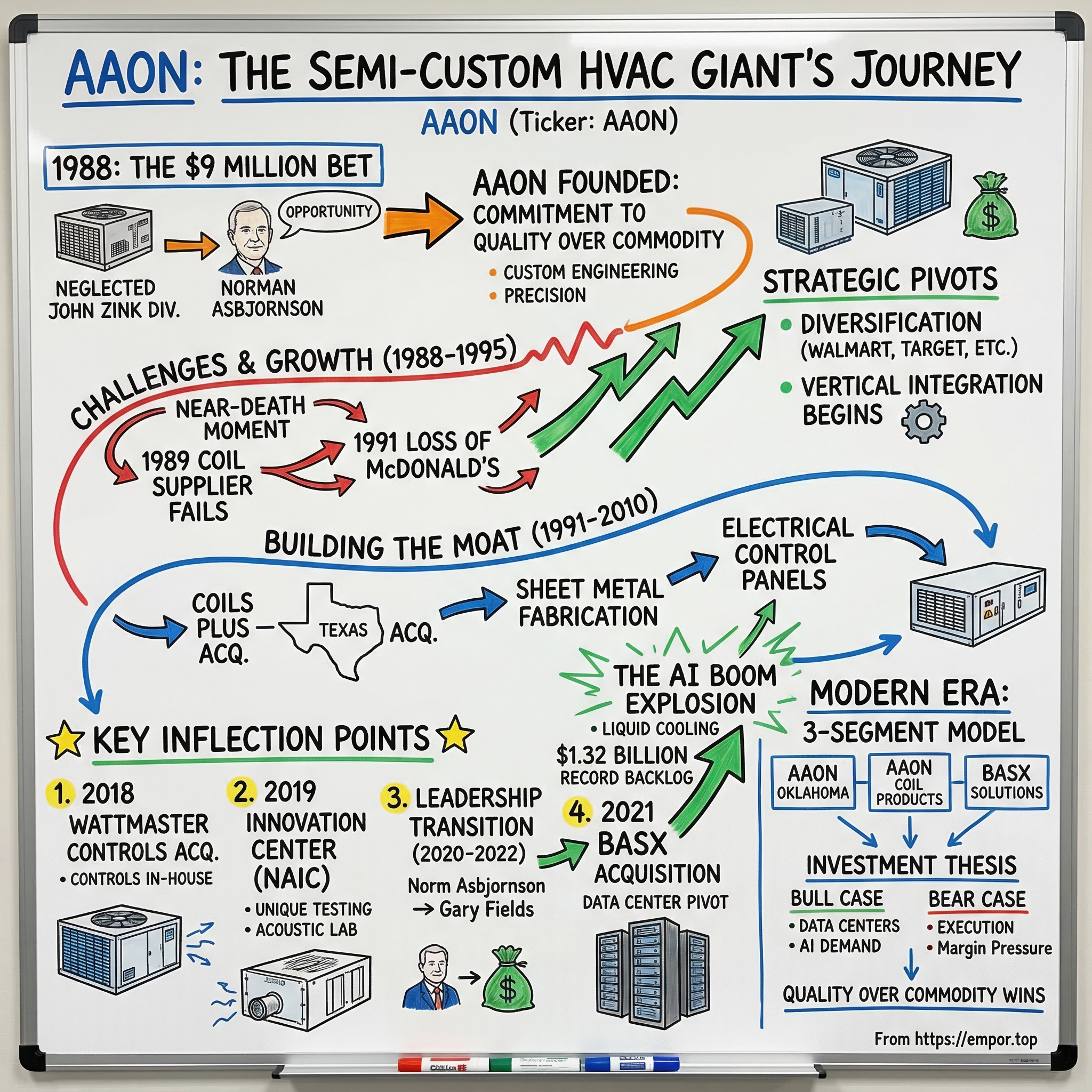
AAON: The Semi-Custom HVAC Giant That Bet on Quality Over Commodity
Introduction: The $9 Million Bet That Became an $8 Billion Company
In the summer of 1988, in the midst of Oklahoma's oil bust, a veteran HVAC engineer named Norman Asbjornson stood before a group of Tulsa investors with an audacious proposition: spend $9 million to buy a neglected air conditioning division that larger corporations had deemed too small to bother with, and build it into something different—a commercial HVAC company that would compete not on price, but on precision engineering and customization.
Today, AAON commands a market capitalization of nearly $8.32 billion in the Heating, Ventilation, and Air Conditioning (HVAC) sector. The company's annual revenue for 2024 was $1.201 billion, a 2.75% increase from 2023. What makes this story particularly compelling is not just the growth trajectory, but the strategic philosophy that enabled it.
AAON controls nearly 100% of its manufacturing chain, including custom sheet metal fabrication and electrical control panel production. The semi-custom manufacturing approach allows the company to meet the exact, often complex, specifications of commercial and industrial clients, which larger, more standardized HVAC manufacturers struggle to do.
The thesis is straightforward: while giants like Carrier, Trane, and Lennox battled for dominance in the commodity end of commercial HVAC, AAON carved out a premium niche by building equipment specifically configured to each customer's requirements. As one plant president described it, this is "mass customization," a reference to the Harvard Business School concept—mass production, but with personalization.
Three strategic themes define the AAON story: First, the relentless pursuit of vertical integration as a competitive moat. Second, a founder-led culture that prioritized engineering excellence and long-term thinking over quarterly earnings. Third, the company's prescient pivot into data center cooling—a market now exploding with AI-driven demand.
As of Q3 2025, total backlog reached a record $1.32 billion, up 103.8% year-over-year and 18.1% sequentially, with particularly solid momentum in data center applications. BASX sales (the data center cooling segment) jumped 95.8% to $124.8 million, driven by data center liquid cooling.
The question for investors isn't whether AAON has built something valuable—it clearly has. The question is whether the same playbook that transformed a $9 million buyout into a multi-billion-dollar enterprise can navigate the next decade of technological disruption, AI-fueled data center growth, and increasing regulatory complexity around refrigerants and energy efficiency.
 Subscribe on LinkedIn
Pre-History: The John Zink Roots (1928-1987)
Every great company has an origin myth, and AAON's begins not in 1988, but six decades earlier in the oil-boom swagger of 1920s Tulsa. AAON's roots can be traced to 1928 when the John Zink Company (JZC) was started in Tulsa, Oklahoma to produce equipment for the oil industry.
Tulsa in the late 1920s was one of America's wealthiest cities per capita—the "Oil Capital of the World." Petroleum barons built ostentatious mansions on the city's south side, and those mansions needed climate control. John Zink decided to diversify his firm's operations by making, installing, and servicing heating and, especially, air conditioning equipment for the mansions of Tulsa's wealthy oil men.
This was no small matter in pre-war Oklahoma. Air conditioning was still a luxury technology, barely two decades removed from Willis Carrier's first commercial installations. Zink's ability to design custom cooling systems for complex residential applications created a foundation of engineering expertise that would prove crucial decades later.
Then in 1968 JZC's HVAC division began producing rooftop heating and air conditioning equipment for commercial customers. The transition from residential to commercial marked a strategic pivot—suddenly Zink's engineers weren't just cooling mansions but solving climate problems for retailers, restaurants, and office buildings.
In 1970 McDonald's Restaurants became the first main customer for the rooftop units. Wal-Mart followed in 1971. These weren't small accounts. McDonald's was in the midst of Ray Kroc's aggressive expansion across America, and every new restaurant needed reliable rooftop HVAC. Wal-Mart, still a regional discount retailer based in Arkansas, was beginning its own march toward retail dominance. John Zink's HVAC division found itself supplying the infrastructure for two of the 20th century's most successful franchise and retail stories.
But then came the corporate ownership musical chairs that would eventually set the stage for AAON's creation. After founder John Zink died, his son negotiated the acquisition of JZC in 1972 by the Sunbeam Corporation. In 1981 the Sunbeam Corporation in turn was purchased by Allegheny International, Inc. Then in June 1987 Lone Star Technologies, Inc. purchased JZC, but its leaders decided to get out of the HVAC industry, for that division was doing only about $16 million in annual sales.
Here was the crux: a $16 million HVAC division attached to a company doing $100 million elsewhere. To Lone Star's executives, the air conditioning business was a distraction—too small to move the needle, too different from their core operations to manage effectively. They wanted out.
What looks like corporate neglect from a conglomerate perspective often looks like opportunity from the ground level. The division had loyal customers in McDonald's and Wal-Mart. It had experienced engineers who understood commercial HVAC. It had manufacturing infrastructure in Tulsa. All it needed was leadership willing to bet on building something independent.
Norman Asbjornson: The Founder's Journey
To understand AAON, you have to understand Norman Asbjornson—the engineer who saw opportunity where others saw a cast-off corporate asset.
Norman H. Asbjornson, a professional engineer educated at Montana State University and the University of Nebraska, was the firm's president, treasurer, and director. He had worked for American Standard's Commercial Air-Conditioning Division from 1960 to 1972, Singer Corporation's Climate Control Division from 1972 to 1977, Nortek (a heating/air conditioner maker) from 1977 to 1987, and then the John Zink Company's HVAC Division until it was acquired by AAON.
This isn't a biography of an entrepreneur who stumbled into HVAC—it's the resume of a man who spent 27 years becoming an expert before he struck out on his own. Asbjornson had seen commercial HVAC from inside three different major corporations. He understood the engineering, the manufacturing, the sales channels, and the competitive dynamics.
Asbjornson grew up in Winifred, Mont., and attended MSU, then called Montana State College, from 1953 to 1960, interrupted by a tour of duty with the U.S. Army in Korea. The seven-year college timeline tells its own story—this was a working-class kid from rural Montana who served his country and worked his way through engineering school.
He was the key person who alerted others that the HVAC division was up for sale. When Lone Star decided to divest, Asbjornson wasn't just a passive observer. He recognized the opportunity and began assembling the investors and financing needed to execute a management buyout.
Asbjornson led the group that acquired the heating and air conditioning division of the John Zink Company. Asbjornson's initial move was to name the company AAON to ensure it was listed first in phone directories—a simple, effective marketing hack of the time.
The name "AAON" has no intrinsic meaning—it was pure positioning. In an era before internet search engines, being listed alphabetically first in business directories provided a genuine competitive advantage. It was a small but revealing decision: Asbjornson thought about details, about how customers would find him, about every marginal edge he could secure.
"Norm has inspired us and humbled us with not only his generosity, but with the depth of his character and his sense of responsibility for future generations," said MSU President Waded Cruzado years later. Asbjornson made the largest private donation in the history of Montana—$50 million to Montana State University.
The philanthropic success came much later, of course. In 1988, Asbjornson was simply a 55-year-old engineer betting his career savings and professional reputation on a division that its corporate parent had deemed insufficiently important to keep.
"It has been an extraordinary privilege to be an employee of this remarkable company for nearly 34 years and an even greater privilege to serve alongside all of the dedicated team members who have elevated AAON to its current position as an industry leader," Asbjornson said in 2022 when announcing his retirement from the executive chairman role.
The cultural DNA Asbjornson embedded in AAON—engineering excellence, vertical integration, long-term thinking—would prove remarkably durable. But before AAON could become an industry leader, it first had to survive.
The Founding & Early Years (1988-1995)
In August 1988 AAON, Inc. was incorporated in Oklahoma for the purpose of acquiring the heating and air conditioning division of the John Zink Company, which took place the following month. AAON paid $9,219,000 for that acquisition, including $7,035,000 cash and the assumption of liabilities worth $2,184,000.
Nine million dollars. That was the price tag for what would become a multi-billion dollar enterprise. The deal structure tells you something about the environment: $7 million in cash, with additional liabilities assumed. This wasn't a venture-backed startup flush with Silicon Valley capital—it was a bootstrap operation in the heart of Oklahoma.
Tulsa residents were willing to invest in the new company in part because the oil industry in Oklahoma was hurting. The timing was both opportunistic and challenging. Oil prices had collapsed in 1986, devastating the Oklahoma economy. But that same downturn meant local capital was looking for diversified investments, and talented engineers were available for hire.
AAON bought its Tulsa manufacturing plant and offices in late 1988 for $650,000. After extensive changes costing almost $1.9 million, the company began using the refurbished facilities in early 1989. The heavy industrial manufacturing and warehouse spaces totaled 172,000 square feet, and the offices were situated in an additional 12,000 square feet. The plant, located on 12 acres at 2425 South Yukon, featured two main assembly lines.
Then came the creative path to public markets. Two months later, on August 18, 1987, a shell company called Diamond Head Resources, Inc. was incorporated in Nevada by its founders. These individuals and other investors raised money through Diamond Head stock offerings during 1987 and early 1988. This money was raised for a potential business opportunity to be selected later; thus it was described as a blind pool or blank check offering.
In June 1989 Diamond Head Resources acquired AAON, Inc. of Oklahoma, which became a wholly owned subsidiary. This deal was described as a "reverse acquisition," as if AAON had acquired Diamond Head. The ownership of Diamond Head's stockholders was reduced in this transaction to 20 percent, and AAON's stockholders became the owners of 80 percent of Diamond Head, which changed its name to AAON, Inc., a Nevada corporation. AAON became a publicly traded company at this time.
This was essentially a reverse merger—a faster, cheaper path to public markets than a traditional IPO. The structure gave AAON access to public capital markets while avoiding the expense and regulatory complexity of a full initial public offering.
The First Near-Death Experience
In its early years AAON manufactured rooftop units for two main customers, both retained from the John Zink Company era. In 1989 sales to Wal-Mart were $16 million, up from $5 million in both 1987 and 1988. McDonald's bought $12 million worth of products in 1989 as well as in 1988. About 89 percent of AAON's 1989 annual sales of $31.3 million were made to McDonald's and Wal-Mart.
That concentration—89% of revenue from two customers—represented an enormous risk. And AAON was about to learn just how fragile that position could be.
In its first year of operations, AAON faced a major challenge. The firm that supplied its coils failed, leaving many machines half finished at the Tulsa plant. AAON was able to survive with the help of the Bank of Oklahoma, which increased its loan to the struggling new company from $5 million to $9 million. Because the Bank of Oklahoma believed in AAON during this crisis, AAON remained a loyal customer of the bank.
Picture it: a new company, barely operational, suddenly unable to complete orders because its critical component supplier has collapsed. Half-finished air conditioning units sitting on the factory floor. Customers waiting. Cash burning. The entire enterprise balanced on a knife's edge.
The Bank of Oklahoma's decision to nearly double AAON's credit line during this crisis was a leap of faith—and Asbjornson never forgot it. That relationship would become characteristic of how AAON operated: loyalty to partners who demonstrated loyalty in return.
Losing McDonald's
In 1991 AAON lost one of its main customers. McDonald's canceled orders for any new rooftop units but continued to buy replacement parts.
When you're doing 89% of your business with two customers and one of them walks away from new orders, you have an existential problem. The loss of McDonald's represented approximately $10 million in annual revenue—a massive blow to a company that size.
But the crisis also forced diversification. AAON began aggressively pursuing new customer segments: shopping malls, schools, retail chains beyond its original anchor accounts. In 1993 AAON's American customers included Wal-Mart, Kmart, Target, Mervyn's, Shopko, Discovery Zone, Meijer, Home Depot, Boston Chicken, Braum's, QuikTrip, Mazzio's, and Leaps and Bounds.
The diversification wasn't just geographic or by customer type—AAON also began international expansion. The company also initiated overseas sales in 1993. It began delivering equipment to Cifra, Mexico's largest retailer.
Every near-death experience teaches a lesson. For AAON, the coil supplier failure and the McDonald's cancellation reinforced a central insight: dependency on external suppliers and concentrated customer bases created unacceptable risk. The company would spend the next three decades systematically eliminating those vulnerabilities.
Building the Vertical Integration Strategy (1991-2010)
The coil crisis had nearly killed AAON. Asbjornson's response was characteristically thorough: never again would critical components come from suppliers AAON couldn't control.
In December 1991 AAON, Inc. of Nevada created a new subsidiary called CP/AAON, a Texas corporation, to acquire most of the assets of Coils Plus, Inc. of Longview, Texas. Coils Plus had been founded in 1984 to design and make new and replacement coils for the HVAC industry.
In 1991, AAON acquired Coils Plus in Longview, TX, initially only committed to manufacturing HVAC coils. The acquisition served multiple purposes: it eliminated supplier risk for a critical component, provided manufacturing capacity independent of the Tulsa plant, and created optionality for future product expansion.
AAON acquired this Texas company to make coils instead of upgrading its Tulsa plant because of inadequate sewage services in Tulsa. The rationale was pragmatic rather than romantic—Longview simply had the infrastructure to support the chemical processes involved in coil manufacturing.
AAON expanded significantly in 1993. First, in January, its subsidiary CP/AAON purchased a 110,000-square-foot facility near its former plant in Longview, Texas, and moved into the newly renovated plant a couple months later.
AAON, a world leader in the manufacture of premium HVAC equipment, first located in Longview in 1991. In 2000, AAON began to manufacture equipment in Longview. The Texas operation evolved from a pure coil supplier into a complete manufacturing facility, producing finished HVAC units alongside the parent plant in Tulsa.
Scaling Through the 1990s and 2000s
The numbers tell the story of disciplined growth. AAON yearly shipments exceeded $100 million. The company crossed this milestone by the late 1990s, roughly a decade after the founding.
Because we produce semi-custom units, we have to produce semi-custom coils that go along with that. So when we talk about coil manufacturing and the automation process that go into that, there are a lot of things that can be automated, but there's also a lot of things that cannot be automated. So it is very heavily manual labor process on some aspects of that.
This is the essence of AAON's manufacturing philosophy. Semi-custom production requires flexibility that pure automation can't provide. Each unit is configured to customer specifications, which means production workers must understand the engineering and be capable of adapting processes on the fly.
And in those decades-long relationships uniquely positioned BASX as the reshoring of semiconductor manufacturing occurs... We also focused very heavily on vertically integrating our products. And as we talked through supply chain disruption over the last two and a half, three years, that vertical integration has been one of the areas that has allowed us to excel in the midst of one of the most chaotic supply chain markets we've ever experienced. We are one of the few manufacturers in the HVAC market that manufacture our own fans.
The vertical integration strategy—coils, controls, sheet metal fabrication, electrical panels, even fans—wasn't just about cost control. It was about quality control and supply chain resilience. When COVID-19 disrupted global supply chains in 2020-2021, AAON's manufacturing independence became a significant competitive advantage.
"We build everything to order," the Longview plant president said during a facility tour. He calls it "mass customization," a reference to "Mass Customization: The New Frontier in Business Competition," published in 1992 by the Harvard Business School Press. It's mass production, but with personalization.
The intellectual framework wasn't accidental. AAON's leadership explicitly modeled their production philosophy on academic research into flexible manufacturing systems.
Key Inflection Point #1: WattMaster Controls Acquisition (2018)
By 2018, AAON had built an impressive vertically integrated operation—but one critical component remained outside its control: the electronic controls that govern how HVAC systems operate.
AAON closed on the purchase of substantially all of the assets of WattMaster Controls, Inc. ("WCI") on February 28, 2018. The assets acquired consist primarily of intellectual property, receivables, inventory and fixed assets.
AAON, Inc. acquired substantially all of the assets of Wattmaster Controls Inc for $6.4 million on February 28, 2018. The deal value consists of $6 million cash paid at closing and $0.4 million cash paid in May 2018 towards working capital settlement.
WattMaster Controls, Inc. is a manufacturer of building automation controls and systems that develops HVAC, lighting and fire detection products. WattMaster Controls, Inc. was established in 1977 and is based in Parkville, Missouri.
At $6.4 million, this was a small acquisition by public company standards—but strategically transformative. WattMaster had been supplying controls to AAON for years. The acquisition brought that expertise in-house.
"This acquisition allows us to quickly bring in-house the expertise and knowledge needed to accelerate the development of our own controls, which we believe to be an integral part of our continued efforts to improve our products and increase our customer satisfaction."
AAON, Inc. hired all of the Wattmaster employees. In 2018, AAON acquired Missouri-based WattMaster Controls (WCI) and entered a lease of the facility previously occupied by WCI.
The significance of controls integration cannot be overstated. Modern commercial HVAC systems are increasingly complex, with variable-speed compressors, sophisticated air handling logic, and integration with building management systems. The software and electronics that govern these operations are as important as the mechanical components.
WattMaster was a long-time supplier primarily of controls to AAON. This acquisition facilitated the acceleration of AAON's internal development of its own line of controls used in AAON products.
By owning the controls, AAON could optimize the entire system—hardware and software designed together, tested together, and warranted together. Competitors buying controls from third parties faced integration challenges AAON could avoid.
Key Inflection Point #2: Norman Asbjornson Innovation Center (2019-2020)
AAON, Inc., a leading manufacturer of heating and cooling products, officially opened the Norman Asbjornson Innovation Center (NAIC) Research and Development Laboratory. The Lieutenant Governor of Oklahoma, Matt Pinnell, the President and CEO of the Tulsa Regional Chamber, Mike Neal, and other local dignitaries attended the ribbon cutting ceremony. The 65-foot tall 134,000 square foot facility features ten test chambers that continue to solidify AAON as the technological leader in high performance HVAC equipment.
The NAIC wasn't just a research lab—it was a statement of ambition. The Norman Asbjornson Innovation Center, a $35 million, 134,000-square-foot facility, opened in Tulsa in 2019.
The NAIC is the only laboratory in the world able to measure supply, return, and ambient sound under actual load conditions, for an air conditioning system up 300 tons and a chiller system up to 540 tons. Environmental application testing capabilities include -20°F to 140°F testing conditions, up to 8 inches per hour rain testing, up to 2 inches per hour snow testing, and up to 50 mph wind testing.
Consider what that capability means: AAON can test equipment under conditions no competitor can replicate. A customer specifying a rooftop unit for a Minnesota installation can see their exact unit tested at -20°F with driving snow—before it ships. A data center operator in Arizona can verify performance at 140°F ambient conditions.
Among these chambers is the largest psychrometric reverberation sound chamber in the world. The NAIC is the only HVAC lab in the world capable of testing thermal and acoustic performance under full environmental load from -20°F to 130°F for HVAC equipment up to 540 tons.
"The NAIC is a major reason I decided to come and lead the AAON team. The value this facility brings to the company is enormous; we are able to show our customers firsthand why AAON is the leader in the HVAC industry. Its capabilities have already resulted in multiple large AAON equipment orders, where the customer required testing that was not possible anywhere else," said Gary Fields, President of AAON.
The commercial impact was immediate. Customers with demanding specifications—data centers, pharmaceutical facilities, hospitals—could now verify performance claims empirically. The NAIC became both an R&D engine and a sales tool.
The Norman Asbjornson Innovation Center (NAIC) in Tulsa, Oklahoma, drives product development, leading to over 150 proprietary technological innovations and 192 active patents as of 2023.
"We knew many years ago that we were quickly outgrowing our facilities," Asbjornson said at the grand opening. The NAIC was the culmination of more than 25 years of planning—testament to the long-term thinking that characterized Asbjornson's leadership.
Key Inflection Point #3: Leadership Transition (2020-2022)
AAON announced today that Norman H. Asbjornson, Chief Executive Officer and Founder of AAON, Inc., will transition to the role of Executive Chairman, effective May 12, 2020. The Company also announced today that Gary D. Fields, President, will assume the role of Chief Executive Officer (in addition to his current position of President), also to be effective May 12, 2020.
Since November 2016, Mr. Fields has served as President of AAON and was elected as a member of the Board of Directors in 2015. Mr. Fields has over 35 years of experience in the HVAC industry. Before joining the Company, Mr. Fields was an HVAC equipment sales representative at (and from 2002 to 2012, a member of the ownership group of) Texas AirSystems, the largest independent HVAC equipment...
Fields represented a different profile from Asbjornson—not an engineer by training, but a sales and operations leader who had built deep customer relationships throughout his career. The transition was deliberate and gradual.
"The leadership changes which have been taking place at AAON over the past few years are now essentially complete for the present time, with transitions occurring at many management positions across various levels of the Company. These leadership transitions have occurred through elevating individuals from within our existing ranks, which has allowed these individuals to bring several years of experience at AAON to their current roles, while simultaneously significantly lowering the average age of the Company's management team. The experience and tireless efforts of this talented group of managers has already provided tangible results."
Norm Asbjornson, founder of Tulsa-based AAON, retired as executive chairman after more than three decades with the company, effective May 12, 2022. Asbjornson, 86, continued to serve as a member of the firm's board of directors and assist it in a consulting/advisory role until May 2024.
Since Gary became president in 2016, sales of AAON have more than tripled and market capitalization of the Company has grown over 500%. The succession proved remarkably successful by financial metrics.
The Second Leadership Transition: Matt Tobolski
AAON announced that its Board of Directors has appointed Matt J. Tobolski, PhD, as Chief Executive Officer effective as of the Company's Annual Shareholders' meeting on May 13, 2025. Dr. Tobolski will succeed Gary Fields, who will remain a member of the Board of Directors and serve as a special advisor to the Board to help ensure a smooth transition.
Since January 2024, Matt has served as president and chief operating officer for AAON. He has been integral in the Company's transformational reorganization and positioning both brands, AAON and BASX, for sustainable long-term growth. Since 2022, Matt was president of AAON's BASX segment, a business that AAON acquired in 2021 and Matt co-founded in 2013.
The Tobolski appointment represents a strategic inflection. The new CEO co-founded BasX—the data center cooling company AAON acquired in 2021. His elevation signals the board's belief that data center cooling represents AAON's most significant growth opportunity. The founder of the acquired company now leads the entire enterprise.
Key Inflection Point #4: BasX Acquisition & Data Center Pivot (2021-Present)
AAON Inc., a manufacturer of HVAC products for nonresidential buildings, completed the acquisition of BasX, LLC, dba BasX Solutions on Dec. 10, 2021. The company previously announced on Nov. 18, 2021, that it had entered into a membership interest purchase agreement to acquire 100% of the equity interests of BasX, LLC. The transaction was funded through a combination of cash, borrowings under its revolving credit facility, and equity. The terms required an upfront payment of $100 million of which almost all was funded via cash-on-hand. Additional payments, all of which would be in the form of equity, valued at up to an additional $80 million, are subject to earn-out milestones that extend through 2023.
As a condition of closing, AAON will also enter into a real estate purchase agreement with BasX Properties, LLC, an affiliate of BasX, to acquire the real estate and improvements used by BasX for an additional $22 million, subject to customary closing conditions and adjustments. AAON plans to fund the transactions through a combination of cash, loans under its revolving line of credit and equity.
At up to $202 million total (including real estate), this was by far AAON's largest acquisition. But the strategic logic was compelling.
"Upon closing this acquisition, we will continue to advance our long-term strategy of focusing on innovative, semi-custom and custom, energy efficient HVAC solutions for nonresidential applications," said Gary Fields, AAON's President and CEO. "BasX will provide AAON with an immediate presence in the high-growth data center and cleanroom markets, both of which the company has historically had minimal exposure. The growth and profitability fundamentals of these new markets are very compelling for AAON."
There are high barriers to entry. The sophistication of the equipment, the high cost of failure if the equipment fails and the strong customer relationships with a concentrated group of blue chip companies all act as a moat to this business.
Customers include top operators in the data center industry: Brocade, Cologix, eBay, Equinix, Facebook, NetApp, Oracle, Ross, Terremark, and Vantage.
BasX has experienced a five-year sales CAGR of 45% and has a robust backlog that supports future growth. This wasn't a turnaround situation—BasX was growing explosively when AAON acquired it.
BasX Solutions was founded in 2013. At BasX LLC, all 260 employees working out of the 200,000 square-foot Redmond facility remained with the new company, as did the manufacturing operations. BasX was founded in 2012 but operations ramped up in 2014.
The AI and Data Center Boom
The timing proved extraordinarily fortuitous. AAON acquired BasX in late 2021—right before the AI-driven explosion in data center construction.
AAON was recently awarded orders from one data center customer that approximately totaled $174.5 million. Under these orders, AAON will provide a custom-designed thermal management system supporting a liquid cooling deployment for the customer's data centers. The equipment will be manufactured under our BASX brand in our existing and newly constructed facilities at our Longview, Texas location and is expected to mostly be produced and delivered in the first half of 2025.
A single order for $174.5 million—larger than AAON's entire annual revenue in its early years—demonstrated the scale of opportunity in data center cooling.
"These significant orders highlight AAON's superior engineering and manufacturing capabilities, advanced technology, and expertise in the data center cooling market," said Matt Tobolski, AAON President and COO. "Since BASX joined AAON in 2021, we have strengthened our collective position as leaders in this rapidly growing market."
Applied Digital selected BasX to design and manufacture a customized free cooling chiller system for Applied Digital's AI factory in Ellendale, North Dakota, known as Polaris Forge 1. The system is purpose-built to meet the performance demands of AI infrastructure in a cold climate, while maximizing energy efficiency and sustainability.
"AI factories like Polaris Forge 1 require 15 to 30 times the power density of traditional data centers, making conventional power and cooling strategies insufficient."
This is the core of the investment thesis: AI compute requires dramatically more cooling than traditional server workloads, and that cooling must be highly customized to each deployment's specific characteristics. The same semi-custom, engineering-intensive approach that differentiated AAON in commercial HVAC is now differentiating BasX in data center cooling.
The BASX-branded backlog reached $896.82 million, representing a 119.5% increase year-over-year and a 43.9% jump from the previous quarter. The company highlighted strong demand for both air-side and liquid cooling products, with the Memphis facility expansion set to triple production capabilities. Full-scale production at this facility is expected by year-end, positioning AAON to capitalize on the robust data center market.
Modern Era: Three-Segment Business Model (2022-Present)
The company operates through three segments: AAON Oklahoma, AAON Coil Products, and BASX. It offers rooftop units, data center cooling solutions, cleanroom systems, chillers, packaged outdoor mechanical rooms, air handling units, makeup air units, energy recovery units, condensing units, geothermal/water-source heat pumps, coils, and controls. The company markets and sells its products to retail, manufacturing, educational, lodging, supermarket, data centers, medical and pharmaceutical, and other commercial industries.
Operations are split into AAON Oklahoma (semi-custom HVAC), AAON Coil Products (coils for internal use and external sales), and BASX (specialized data center and cleanroom solutions).
2024-2025 Performance
Gary Fields, CEO, stated, "As we anticipated early in the year, 2024 had its share of triumphs and obstacles for AAON. The BASX brand made a significant impact on the data center market with the industry's first large-scale development and sale of a custom-designed liquid cooling solution. Along with strong demand for BASX's air-side data center cooling equipment, this drove the Company's total backlog to finish the year up 70.0% from the end of 2023. To meet a strengthening pipeline of demand beyond the backlog, we also successfully increased production capacity in 2024 with the completion of our 245,000 square foot addition at our Longview, Texas location and the purchase of our new 787,000 square foot building in Memphis, Tennessee.
Total backlog reached a record $1.32 billion, up 103.8% year-over-year and 18.1% sequentially, with particularly solid momentum in data center applications. National account bookings increased 96% in the quarter and 92% year-to-date, reflecting continued market share gains despite softness in the broader nonresidential construction market.
The ERP Implementation Challenge
AAON's expansion of the Memphis facility represents a significant strategic investment to address the growing demand for data center cooling solutions. Additionally, the company's ERP implementation, while creating short-term challenges, is expected to enhance operational efficiency and improve margin trajectory over time. The company's balanced approach to managing both the high-growth BASX brand and the recovering AAON brand demonstrates a strategic focus on both immediate growth opportunities and long-term operational stability.
Revenue: $384.2 million vs analyst estimates of $337.5 million (17.4% year-on-year growth, 13.8% beat). Adjusted EPS: $0.37 vs analyst estimates of $0.32 (14.9% beat). Operating Margin: 11.4%, down from 20% in the same quarter last year. Backlog: $1.32 billion at quarter end, up 104% year on year.
The margin compression is a near-term concern. Gross margin contracted to 27.8% from 34.9% year-over-year. Management attributes this to ERP implementation costs, Memphis facility ramp-up expenses, and operational inefficiencies at Longview.
Margins will remain under pressure early in the year as we endure less-than-optimal volumes at the AAON Oklahoma segment and absorb pre-production start-up costs at the new Memphis facility. However, this will be temporary, and we expect margins to significantly improve throughout the year as volume growth accelerates and we right-size capacity and production efficiencies across the four main manufacturing locations. Over the next two years, we anticipate gross margins returning to levels we realized in the second half of 2023.
Playbook: The AAON Business Model Deep Dive
Semi-Custom vs. Commodity
Our business strategy involves combining the low unit costs of mass production processes with the flexibility of individual customization using flexible computer-aided manufacturing systems to produce standard, semi-custom, and custom equipment. Through a collaborative effort with our network of independent sales representative organizations, we engineer and manufacture products and systems that best serve the buyer's unique needs and applications.
So, there's two core platforms that this company was founded on. Semi-customization being primary to that. The way that we went about utilizing computerization to assist this, and then the overall manufacturing strategy lends itself very well to this semi-customization. I look at, say, the automotive industry for instance, you can have a plain white pickup truck with rubber floor mats all the way through a luxury truck with a moon roof, and power windows, and door locks, and that's the semi-customization that the automotive did in there. Yet, that truck will only do the one thing. It pulls trailers or hauls loads. Ours, we're able to do many things with it, with many different strategies for end use.
Vertical Integration Philosophy
The company's value creation is built on a segmented, vertically integrated manufacturing model that prioritizes customization and quality over mass production. The goal is to provide a premier ownership experience.
More than 4 million square feet of space in five strategically located facilities across the United States. AAON is positioned to deliver exceptional HVAC solutions efficiently no matter where our customers are located.
Capital Allocation
Capital expenditures have increased substantially, with the company spending $213.2 million in 2024, up from $109.5 million in 2023. AAON expects approximately $220 million in capital expenditures for 2025, primarily related to preparing its new Memphis facility for production later this year.
This level of capital investment—roughly 18% of revenue—is aggressive for a manufacturing business. AAON is essentially building capacity ahead of demand, betting that the data center boom will sustain itself through 2026 and beyond.
Rebecca Thompson, AAON CFO and Treasurer, commented, "This gives us flexibility to continue to focus on our investment in growth for the future with capital expenditure plans of $180.0 million in 2025."
Replacement Revenue Strategy
AAON's focus on the replacement and retrofit market—as opposed to new construction—provides counter-cyclical ballast. When new commercial construction slows, existing buildings still need HVAC maintenance, repairs, and upgrades. The company has deliberately cultivated this revenue stream to reduce earnings volatility.
Competitive Analysis: Porter's Five Forces & Strategic Position
1. Threat of New Entrants: LOW
There are high barriers to entry. The sophistication of the equipment, the high cost of failure if the equipment fails and the strong customer relationships with a concentrated group of blue chip companies all act as a moat to this business.
Building capabilities like the Norman Asbjornson Innovation Center requires tens of millions of dollars and years of institutional knowledge. Vertical integration across coils, controls, sheet metal, and final assembly creates a cost and quality advantage difficult to replicate.
2. Bargaining Power of Suppliers: LOW
AAON controls nearly 100% of its manufacturing chain, including custom sheet metal fabrication and electrical control panel production. This gives them greater control over quality and supply chain management.
The entire vertical integration strategy was designed to minimize supplier dependence. AAON's early crisis with the failed coil supplier became foundational to its strategic philosophy.
3. Bargaining Power of Buyers: MODERATE
AAON serves large, sophisticated customers—national retail chains, data center operators, hospital systems—who have significant purchasing power. However, switching costs are substantial once systems are specified into building designs, and AAON's customization capabilities create differentiation that commodity competitors cannot match.
4. Threat of Substitutes: LOW-MODERATE
Commercial buildings require climate control—there's no substitute for that fundamental need. However, technology evolution (geothermal, advanced heat pumps, AI-optimized building management) could shift the competitive landscape. AAON has invested heavily in heat pump technology and controls to stay ahead of these trends.
5. Competitive Rivalry: HIGH
AAON made these changes realizing that their competitors in the HVAC industry were much larger companies. For example, Carrier Corporation, a subsidiary of United Technologies Corporation, in 1991 had sales of $3.8 billion, 37 percent of the HVAC industry, and employed almost 30,000 persons. Other major players in this industry included the Trane Company, a subsidiary of American Standard, Inc.; Lennox Industries, Inc.; and York International Corporation.
AAON operates in the highly competitive commercial and industrial HVAC equipment market. The company's primary competitors include large diversified HVAC manufacturers such as Carrier Global Corporation, Trane Technologies, Johnson Controls International, Daikin Industries, and Lennox International. These competitors generally offer broader product portfolios and have significantly larger global footprints than AAON. In the rooftop unit segment, which represents AAON's largest product category, the company competes primarily with Carrier, Trane, Johnson Controls' York brand, and Lennox.
Hamilton Helmer's 7 Powers Framework
From the 7 Powers perspective, AAON demonstrates several durable competitive advantages:
-
Process Power: The combination of vertical integration, semi-custom manufacturing, and the NAIC testing capabilities creates process advantages competitors cannot easily replicate.
-
Cornered Resource: The Norman Asbjornson Innovation Center represents a unique testing capability—the only facility in the world with certain acoustic and thermal testing combinations.
-
Counter-Positioning: AAON's semi-custom model represents a positioning that larger competitors find difficult to adopt. Carrier and Trane have optimized for high-volume, standardized production; shifting to customization would cannibalize their existing operations.
-
Scale Economies: While AAON doesn't have absolute scale advantages over larger competitors, it has achieved efficient scale within its niche—enough volume to justify vertical integration while maintaining customization flexibility.
Investment Thesis: The Bull and Bear Cases
The Bull Case
The data center cooling opportunity is genuinely transformational. AI compute demand is growing exponentially, and every AI cluster requires sophisticated thermal management. The BASX-branded backlog reached $896.82 million, representing a 119.5% increase year-over-year and a 43.9% jump from the previous quarter.
AAON's engineering capabilities, testing infrastructure, and vertical integration position it ideally for this high-margin, high-growth market. The company has multi-year visibility through its record backlog, and capacity investments in Memphis should unlock additional growth.
The traditional commercial HVAC business provides stable cash flow while data center cooling drives the growth story. If execution improves and margins recover to historical levels, earnings growth could significantly outpace revenue growth over the next two years.
The Bear Case
Execution risk is real. Gross margin contracted to 27.8% from 34.9% year-over-year. ERP implementations are notoriously challenging, and AAON is attempting complex manufacturing expansions simultaneously with systems upgrades.
Customer concentration in data center cooling is a concern. Large orders from hyperscale customers provide visibility but also create dependency. If a major customer delays orders or shifts to alternative solutions, backlog conversion could disappoint.
The premium valuation leaves little room for error. AAON trades at a significant multiple to earnings, pricing in successful execution of the data center strategy. Any hiccups—margin compression, order cancellations, manufacturing delays—could trigger meaningful multiple compression.
Finally, the refrigerant transition represents regulatory risk. The industry-wide shift away from certain refrigerants requires ongoing R&D investment and could create warranty issues with older product lines.
Key Metrics to Monitor
For long-term fundamental investors, three KPIs deserve particular attention:
-
Backlog Conversion Rate: The $1.32 billion backlog provides visibility, but what matters is conversion to revenue. Monitor the gap between backlog growth and revenue growth—widening gaps could indicate execution challenges.
-
Gross Margin Trajectory: Management has guided to margin recovery over the next two years. Quarterly gross margin progression (or lack thereof) will signal whether operational improvements are tracking to plan.
-
BASX Segment Growth & Margin: The data center cooling segment drives the growth thesis. Track both revenue growth and segment profitability—strong revenue growth with margin compression would suggest pricing pressure or execution issues.
Conclusion: Quality Over Commodity
From a $9 million management buyout of a neglected HVAC division to an $8+ billion market cap manufacturer commanding premium pricing in the era of AI, AAON's story validates a deceptively simple thesis: build better products than anyone else, control your supply chain, invest relentlessly in engineering capabilities, and trust that customers will pay for quality.
"The third quarter marked a decisive inflection point in our operational recovery and capacity expansion," said CEO Matt Tobolski. "We saw substantial improvement in production throughput at both the Tulsa and Longview facilities, which drove meaningful sequential sales growth, while continued strength in bookings contributed to further backlog growth. While margins in the quarter continued to be impacted by operational inefficiencies in Longview and the early ramp-up of the new Memphis facility, we continue to make steady progress."
Norman Asbjornson's founding insight—that commercial customers would pay premium prices for equipment precisely configured to their specifications—proved durable across four decades and multiple technology cycles. The question now is whether Matt Tobolski can extend that insight into the AI-driven data center market, where the same principles of customization, quality, and engineering excellence appear equally relevant.
"By leveraging the innovative spirit and highly talented engineering resources of both AAON and BASX, we are well-positioned to grow the Company's prominence in the industry. As we enter this evolutionary phase, I look forward to strengthening relationships and continuing to deliver industry-leading solutions."
The pieces are in place: world-class testing infrastructure, vertical integration across critical components, deep engineering expertise, and massive demand from the data center market. Execution will determine whether AAON can translate these advantages into the next chapter of compounding returns.
 LinkedIn
 WhatsApp
 Reddit
 Hacker News
 Email
Email Kindle
 RSS Feed
 Spotify
 Apple Podcasts
 Amazon Music
 Audible
 YouTube