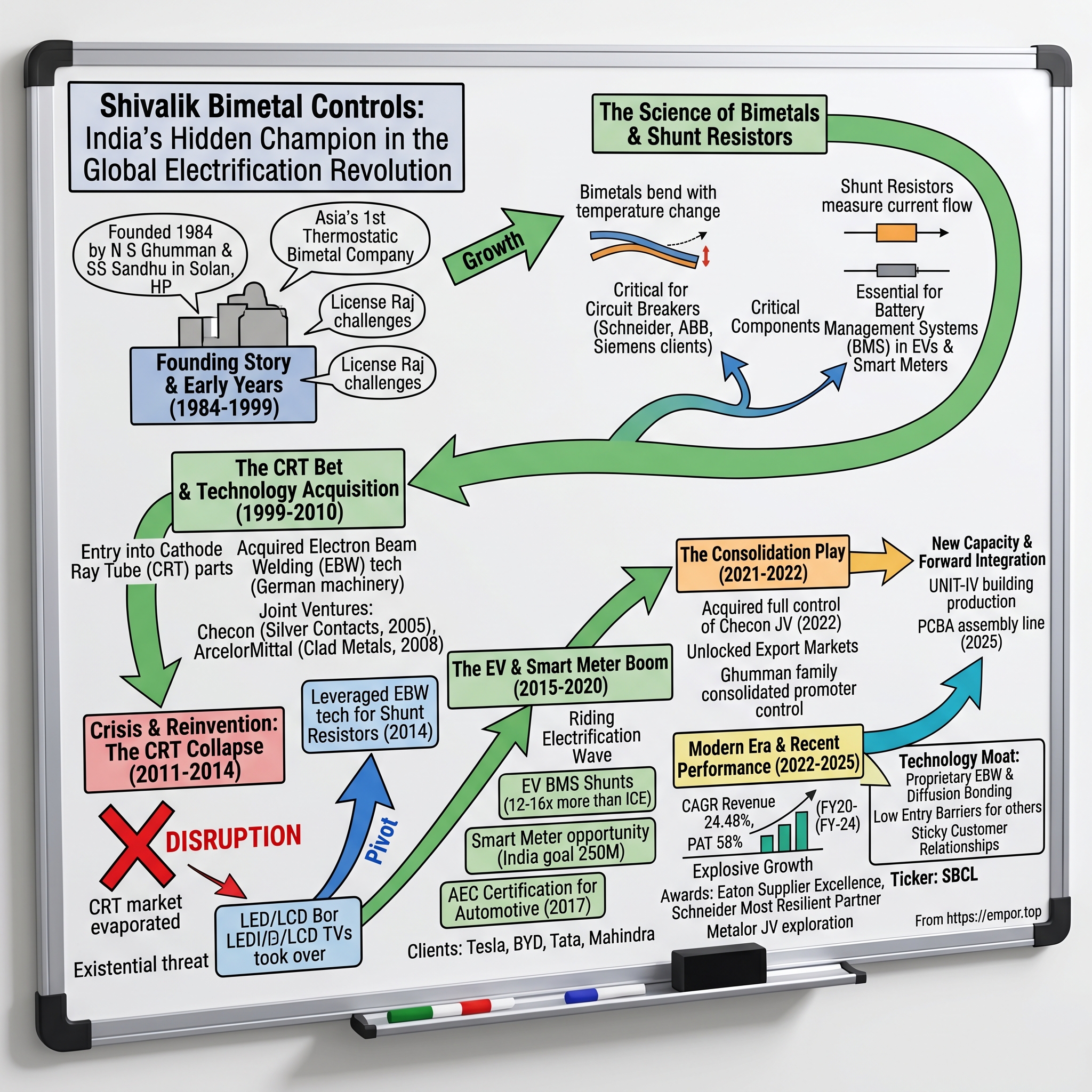
Shivalik Bimetal Controls: India's Hidden Champion in the Global Electrification Revolution
I. Introduction & Episode Roadmap
Picture this scene: A monsoon afternoon in the Shivalik foothills of Himachal Pradesh, where the mist-covered hills give way to a nondescript industrial complex in Solan. Inside, workers operate machines that fire electrons at two-thirds the speed of light—a process so precise that the beam must be focused on a diameter thinner than a human hair. This isn't a government research lab or a semiconductor fabrication plant. This is Shivalik Bimetal Controls, a company that, against all odds, has become one of the world's very few manufacturers of components that go into every EV battery management system, every smart meter, and every circuit breaker on the planet.
Shivalik Bimetal Controls Limited was incorporated on June 18, 1984 at New Delhi, with commercial production commencing in October 1986, promoted by Manjit Kaur and Narinder Singh Ghumman. What began as a specialized manufacturer of thermostatic bimetals—strips of metal that bend when heated—has transformed into a global niche leader whose products form the invisible backbone of the electrification revolution sweeping the planet.
The company manufactures thermostatic bimetal/trimetal strips, components, shunt resistors and clad metals—products that sound arcane but are absolutely critical. It specializes in joining metals using niche technology such as electron beam welding, hot diffusion bonding, resistance welding, and continuous brazing. These are critical components used in switchgear, automobiles (including EVs), and in Energy Meters.
The current market capitalization of Shivalik Bimetal Controls is approximately $342M (around ₹2,900 Crore), with trailing twelve month revenue of approximately $60 million. These numbers might seem modest compared to the mega-cap tech darlings that dominate financial news. But consider this: Shivalik holds an impressive market share of approximately 85-90% in the domestic thermostatic bimetal segment. Shivalik boasts the world's largest capacity and production of Electron Beam (EB) welded shunts.
This is the story of how a small Indian company, founded during the License Raj era when industrial entrepreneurship in India faced bureaucratic hurdles at every turn, became a global niche leader. It's a story of reinvention—surviving the complete collapse of one business line and pivoting to capture opportunities in electrification. It's a story of strategic joint ventures that transferred technology from the West to India, and then acquisitions that consolidated control. And it's a story about riding mega-trends—EVs, smart meters, and the digitization of the power grid—that are just getting started.
The central question we'll explore: How did Shivalik navigate multiple technology cycles, survive an existential crisis, and position itself to benefit from the most powerful secular trends of our time?
 Subscribe on LinkedIn
II. The Science of Bimetals: What Are We Actually Talking About?
Before we dive into the corporate history, we need to understand what Shivalik actually makes—because these products, while invisible to consumers, are essential to modern life.
Understanding Thermostatic Bimetals
Imagine you have two different kinds of metal. One metal stretches out when it gets hot, and the other one doesn't stretch as much. If you stick these two metals together side by side, you get what's called a bimetal. Shivalik makes this special metal, and it's really useful because when it gets warm or cool, it bends a little because one side is stretching more than the other.
This elegant principle—the differential thermal expansion of bonded metals causing predictable bending—underlies the operation of countless safety devices. Thermostatic Bimetals are a combination of two or more alloys with different thermal coefficients which bend when heated and so are used to trigger Circuit breakers for Switchgear, Electrical appliances etc. Some of their customers are Schneider, ABB, Siemens etc.
Every time a circuit breaker trips to protect your house from an electrical fire, every time an industrial overload relay prevents a motor from burning out, every time a heating element in an appliance shuts off before reaching dangerous temperatures—there's likely a thermostatic bimetal at work. These critical components are majorly used in overload protection devices. According to the management, a significant 65% of the revenue from the bimetals segment is generated from switchgear and circuit breakers, while 15-20% comes from appliances, and 8% is attributed to smart meters.
Understanding Shunt Resistors
Metal strip shunts/resistors are components that play an essential role in providing precise electrical resistance in circuits. They are widely used in various electrical and electronic applications that require accurate current measurement, current sensing, and voltage drop measurement. By connecting the shunt in series with the load, a small voltage drop is generated across the shunt that is proportional to the current flowing through it. This voltage drop can be measured and used to accurately determine the current flowing in the circuit.
Think of shunt resistors as the bathroom scales of electrical systems—they measure exactly how much current is flowing at any given moment. The role of batteries in EVs cannot be overstated. Battery management systems (BMS) rely on metal strip shunts/resistors to monitor the current flowing in and out of batteries. This allows for accurate tracking of battery charging and discharging.
Even though shunt resistors might seem just a small component, but they are a very important part of a battery management system. In BMS, a shunt resistor plays a key role because if the detection of current is not accurate, the current could harm the battery. So, making this product on a large scale has become the company's special advantage. Only a few other companies are able to make such specialized shunts.
Consider the implications: An EV battery pack contains thousands of lithium-ion cells, each storing enough energy to cause catastrophic damage if mismanaged. The BMS must know precisely how much current is flowing in and out of each cell, in real-time, under extreme temperature conditions, for the entire lifespan of the vehicle. The shunt resistor that enables this measurement must maintain micro-ohm precision through years of thermal cycling, vibration, and electrical stress. This is not a commodity product—it's a precision-engineered component that takes years to qualify for automotive use.
The Technology Moat
Shivalik is one of the very few companies in the world which has the manufacturing ability to produce Hot Atomic diffusion Bonding and Electron Beam Welding of different materials and components thereof under one-roof.
Shivalik is a high-precision welding company that primarily specializes in joining metals mainly through Electron Beam Welding (EBW) & Diffusion Bonding. Electron Beam Welding for Shunt Resistors is a high-precision welding process that uses a focused beam of high-velocity electrons (2/3rd speed of light) to join materials. Diffusion bonding for Bimetals is a joining process where two or more alloys are fused together at elevated temperatures.
The electron beam welding process deserves special attention. In a vacuum chamber, a beam of high-energy electrons—traveling at approximately 200,000 kilometers per second—is focused onto a spot just 0.1 millimeters in diameter. EBW Shunts are used for very precise measurement of current flow and must work in tough operating conditions for its entire life cycle (Consider even extreme situations like a car being driven uphill in negative temperature weather which results in large power drawn from the battery) and so require high-precision welding with the Electron beam focussed on a very narrow diameter of 0.1mm to ensure metallurgical properties of alloys welded aren't impacted.
This precision is what separates Shivalik from would-be competitors. In 2011, Shivalik acquired Sandvik's Bimetal bonding equipment at an attractive price. Today Shivalik has the largest Electron Beam welding and Bonding capacity globally.
The combination of specialized technology, proprietary process knowledge, customer qualification requirements, and multi-year relationship building creates significant barriers to entry—and positions Shivalik at the heart of multiple secular growth trends.
III. Founding Story & Early Years (1984-1999)
The Founders
Shivalik was set up by Mr N S Ghumman and Mr SS Sandhu in 1984 as Asia's first Thermostatic Bimetal company. This was no small ambition. At a time when India's industrial policy was still heavily regulated under the License Raj, two entrepreneurs set out to build manufacturing capability for a specialized product that barely existed on the subcontinent.
N. S. Ghumman is the Chairman & Whole Time Director of the Company, a visionary leader with over five decades of distinguished experience in engineering and manufacturing. He holds a Bachelor of Technology (Hons) degree in Mechanical Engineering, graduating with first division from the prestigious Birla Institute of Technology & Science (B.I.T.S.), Pilani. Mr. Ghumman began his professional journey as Chief Engineer with Tradax Gestion SA in Geneva, Switzerland.
The Swiss connection is significant. Before returning to India, N.S. Ghumman had exposure to European precision engineering standards—an experience that would shape Shivalik's approach to quality and technology for decades to come. This wasn't someone learning metallurgy from textbooks; this was an engineer who had worked with some of the world's most demanding industrial customers.
As a highly qualified and widely experienced technocrat, Mr. Ghumman possesses over 51 years of expertise in engineering, manufacturing operations, research & development, and product development. Under his dynamic leadership, the Company has undertaken numerous challenging initiatives, successfully implemented critical expansion programs, and significantly enhanced its manufacturing capabilities and capacities.
Building India's First Bimetal Capability
Shivalik Bimetal Controls Ltd., incorporated in the year 1984 commenced commercial production w.e.f. 15th Oct. 1986 in the state of Himachal Pradesh, is a company specialized in the joining of materials through various methods such as diffusion bonding/Cladding, Electron Beam Welding, Solder Reflow and Resistance Welding.
Choosing Himachal Pradesh for the manufacturing plant was strategically astute. The state offered tax incentives for industrial development, abundant hydroelectric power, a climate suitable for precision manufacturing, and—perhaps most importantly—distance from the industrial congestion of the major metros. Today, the Company operates 4 manufacturing facilities in Solan, H.P., operated by a team of 1000 vastly skilled people.
Shivalik has been a single vendor to many prestigious OEMs since 1986 and have successfully met the most stringent of demands set by multiple large global organizations. This claim—"single vendor to many prestigious OEMs since 1986"—is remarkable. OEMs don't grant single-source status lightly; it represents the ultimate endorsement of quality, reliability, and criticality.
The 1990s Expansion
By the mid-1990s, with a decade of successful operation behind it, Shivalik was ready to diversify. The company embarked upon an expansion into manufacturing components for color picture tubes—the cathode ray tubes (CRTs) that powered television sets globally.
The company has Imported Edge Welding Machinery from Germany for manufacturing of Trimetals through EBT Technology and the machinery has been installed successfully and started its production in the early 2001. This investment in German precision equipment, and specifically in electron beam technology, would prove to be one of the most consequential decisions in the company's history—though not in the way anyone anticipated at the time.
The company also developed its own R&D capabilities. Shivalik Bimetal Controls Ltd. has a recognized IN HOUSE R&D UNIT. The recognition has been awarded by Department of Scientific and Industrial Research, Ministry of Science and Technology, Government of India. Over the years Shivalik has been instrumental in saving millions of dollars for its customers by innovative solutions and optimization of materials.
By the end of the 1990s, Shivalik had established itself as India's dominant player in thermostatic bimetals, had developed relationships with global OEMs, and had made significant investments in electron beam welding technology. The stage was set for a bold expansion—and for an unforeseen crisis.
IV. The CRT Bet & Technology Acquisition (1999-2010)
Strategic Entry into CRT Components
The late 1990s and early 2000s were the golden age of cathode ray tube televisions. India's middle class was booming, and every household aspired to own a color TV. The global CRT market was massive, and manufacturers were racing to build capacity.
Shivalik later forayed into the Cathode Ray Tube parts to cater to the growing TV demand in India which gave it access to the EBW technology in 2000. This wasn't just a diversification—it was a technology acquisition strategy disguised as a business expansion.
The key insight: Electron beam welding technology, required to manufacture certain CRT components, was the same technology needed for high-precision shunt resistors. The company has Imported Edge Welding Machinery from Germany for manufacturing of Trimetals through EBT Technology and the machinery has been installed successfully and started its production in the early 2001. The company has expanded the installed capacity of Electron Guns and Bimetal Strips during the financial year 2003-04 by 3 crores (Nos) and 500 Tonnes respectively.
Why CRT Mattered—Acquiring Electron Beam Welding Capability
Even if CRT televisions didn't last—and in hindsight, they didn't—the technology platform would prove invaluable. This is a classic example of what strategy theorists call "options value": making an investment that pays off under multiple future scenarios.
Shivalik can edge weld various combinations of alloys using the latest Electron Beam Welding Technology. Presently Shivalik has three Electron Beam Welding lines at its Solan facility.
The electron beam welding process, once mastered, could be applied to any application requiring precision joining of dissimilar metals. Battery management systems for EVs didn't exist as a commercial market in 2001. Smart meters were a niche technology. But Shivalik's investment in EBW capability meant it would be ready when these markets emerged.
Joint Venture Strategy Begins—Checon Corporation (2005)
In the year 2005, the Company entered into a Joint Venture Agreement with Checon Corporation of Massachusetts, USA to have manufacturing facilities for Electrical Silver Contacts.
This JV's main motive was to combine, the expertise of Shivalik Bimetal Controls Ltd. with that of Checon Corporation, USA to make high quality Silver and Silver Alloy based electrical contact materials and assemblies, using world class equipment and professional manpower clubbed with decades of manufacturing experience. CHECON and SHIVALIK own 50: 50 Ownership Rights (Shareholding) in the JV Company and also equally represent the Board of JV Company on 50: 50 basis.
This JV structure accomplished several objectives: it brought American know-how to Indian manufacturing, created a channel for potential exports, and expanded Shivalik's product portfolio into electrical contacts—another critical component in switchgear and industrial applications.
Shivalik Engineered Products (SEPL) is a wholly owned subsidiary of Shivalik Bimetal Controls Ltd. SEPL was originally formed as a joint venture with Checon Corporation in 2006 and was known as Checon Shivalik Contact Solutions until 2021. SEPL benefits from the combination of Checon's expertise in the field of making various types of electrical contact assemblies and materials and Shivalik Bimetal's specialisation in joining dissimilar metals.
Second JV—ArcelorMittal/Aperam (2008)
The Company got into a Joint Venture with ArcelorMittal, France and DNick, UK for the establishment of a manufacturing facility at SEZ, Pithampur, Indore (India) for the manufacturing of Clad Metals. In addition to this, a new joint venture company named Innovative Clad Solutions Pvt. Ltd., (ICS) was incorporated and land around 21,673 sq. meters was allotted to the company at SEZ, Pithampur, Indore (India).
The shareholding in the JV Company is presently held by Shivalik & Aperam with Aperam constituting as a majority shareholder and Shivalik as a minority shareholder.
This partnership with ArcelorMittal (later Aperam) for clad metals manufacturing demonstrated Shivalik's ability to attract world-class JV partners. For European multinationals, Shivalik offered access to low-cost Indian manufacturing with acceptable quality standards—a rare combination at the time.
By 2010, Shivalik had assembled an impressive portfolio: dominant domestic market share in bimetals, a growing CRT components business, a JV with a leading American electrical contacts specialist, and a JV with a European steel giant for clad metals. The future looked promising. And then the world changed.
V. Crisis & Reinvention: The CRT Collapse (2011-2014)
The Disruption Hits
The transition from CRT to flat-panel displays happened faster than almost anyone predicted. LCD and LED televisions, once expensive niche products, plummeted in price and surged in adoption. By 2010, CRT television sales were in freefall globally. By 2014, the technology was effectively dead.
The business was previously engaged in the manufacturing of cathode ray tubes (CRTs) but experienced major setbacks during FY11-14 as LED and LCD televisions rose to the occasion. This led them to rediscover themselves as a global player whose primary interest lies in manufacturing thermostatic bimetals and shunt resistors.
For Shivalik, this was an existential threat. The company had invested heavily in CRT component manufacturing—equipment, facilities, workforce—and now that entire business line was evaporating. Revenue declined. Margins compressed. Investors questioned whether the company could survive.
However, with the global shift from traditional CRT TVs to LED TVs, Shivalik experienced a significant decline in sales. Nonetheless, the growth in the bimetals business helped offset this decline, contributing to the overall company growth.
The Pivot That Saved the Company
What happened next separates great companies from good ones. Rather than retreating, Shivalik's management recognized that their electron beam welding capability—acquired for CRT manufacturing—could be repurposed for a completely different market: shunt resistors for automotive and industrial applications.
Later on in 2014, by leveraging the electron beam welding (EBW) technology, the company diversified into manufacturing Shunt Resistors. This turned to be a significant growth driver for the company, as shunts founded applications in electric vehicles (EVs), smart meters, and various electronic devices. Shunts Resistors now form around 45% of the company's business.
While the CRT parts business got disrupted due to the rise of LED/LCD screens, promoters showed foresight by successfully diversifying into Shunt Resistors in 2015 by leveraging its EBW tech know-how.
This pivot exemplifies a crucial lesson in business strategy: technology platforms can outlive individual product applications. The electron beam welding capability that Shivalik acquired for CRT manufacturing became the foundation for its shunt resistor business—a business that barely existed in 2010 but would drive most of the company's growth over the following decade.
Lessons: How Existing Technology Platforms Enable New Opportunities
The CRT collapse and shunt resistor pivot illustrate what Clayton Christensen called "the innovator's dilemma" in reverse. Usually, established companies are disrupted when they fail to recognize that their core technology has become obsolete. Shivalik succeeded because it recognized that its core technology—precision welding of dissimilar metals—remained valuable even as one application (CRTs) disappeared.
The key was that Shivalik owned a process capability, not just a product capability. Anyone can make CRT components if they buy the right equipment. But the accumulated know-how in electron beam welding—the tacit knowledge about alloy combinations, beam parameters, process control, quality inspection—took years to develop. That knowledge was directly applicable to shunt resistors.
For investors, this episode highlights the importance of understanding what a company actually does at the process level. Shivalik's competitive advantage wasn't in CRT components or shunt resistors per se—it was in precision joining of dissimilar metals. That capability transfers across applications.
VI. The EV & Smart Meter Boom: Riding the Electrification Wave (2015-2020)
Shunt Resistors in Battery Management Systems—The Perfect Timing
Shivalik's pivot to shunt resistors around 2014-2015 coincided with the early stages of two megatrends that would reshape the global economy: the electrification of transportation and the digitization of the power grid.
Shivalik has created shunt resistors, which are utilized in the battery management system (BMS) of electric vehicles. At present, there is constrained rivalry for the shunt resistor utilized in BMS as hardly any players make it. The organization has a built-in relationship with one of the huge semiconductor organizations based out of the United States.
The EV opportunity was particularly attractive. Electric Vehicles require 8-16x more shunts than ICE vehicles. Every electric vehicle needs to monitor current flow in the battery pack, the drive motors, the power electronics, and various subsystems. A conventional internal combustion engine vehicle might use a handful of shunt resistors; an EV uses dozens.
In its bimetals business, Shivalik has solid partnerships with industry giants like Schneider, LeGrand, and Siemens. In the case of shunts, Shivalik primarily collaborates with Tier-1 OEM players such as Vishay and TT Electronics, which further supply their products to top-tier OEMs like TESLA and BYD. In the domestic market, Shivalik's shunts are utilized by leading players like Tata and Mahindra. Key factors behind their strong client relationships are Shivalik's ability to provide customized products tailored to each client's specific needs and the lowest lead time to meet its customer demands.
Smart Meter Opportunity
As of 2024, over 8.6 million smart meters have been installed across the country under the Smart Meter National Program (SMNP), working towards the government's ambitious goal of installing 250 million smart meters nationwide by 2025.
The India Smart Meter Market is projected to reach USD 3,179.5 million by 2032, growing at a CAGR of 34.57% from 2024-2032.
In India, Smart Meters are key to reducing losses of discoms and is expected to grow rapidly over the next decade as only ~1.25 Cr out of 25 Cr target has been installed till now. Shivalik is a dominant player in India with 80%+ share and has scope to gain market share globally (~15% global market share) due to its strong track record on quality and cost advantage from its end-to-end India manufacturing setup.
The smart meter opportunity is particularly attractive because it represents recurring demand over many years. The Indian government has sanctioned over 200 million smart meters, but deployment has been gradual. This creates visibility for component suppliers like Shivalik—they know the demand is coming, even if the timing is uncertain.
Building Global Presence
Shivalik exports shunt resistors all around the globe. Export contribution has increased from c.76% in FY18 to c.83% in FY23 (for shunts specifically). This growth was due to increased acceptance of Shivalik's shunt resistor segment in the global market due to relatively more power carrying ratio to size (low ohmic).
Business has become more diversified across Segments (Shunts, Bimetals & Contacts), customers, geographies (~60% Export FY24) and end industries (Automotive, Switchgear, Appliances, Smart Meters etc). Share of Sales from their largest customer is now at manageable levels of < 20% and we expect this to further reduce as new customers ramp up over time. Economics has improved over time due to a better mix (Higher share of Shunt Resistors, exports, and forward integration).
AEC Certification Milestone
The AEC (Automotive Electronics Council) compliant test facility was commissioned in 2017. Construction of the Building and equipment installation on the adjoining land was completed and commercial production commenced in 2021-22.
The AEC certification is crucial for automotive supply chains. OEMs will not qualify a component supplier without documented compliance with AEC standards, which specify rigorous quality and reliability requirements. By commissioning an AEC-compliant test facility in 2017, Shivalik signaled to global automotive customers that it was serious about meeting their requirements—and created a barrier against competitors who lacked similar certification.
VII. The Consolidation Play: Taking Full Control (2021-2022)
Acquisition of Checon Stake
The year 2022 marked a strategic inflection point. After years as a 50-50 joint venture, Shivalik moved to acquire full control of its electrical contacts business.
Through a Share Purchase Agreement, the Company in Apr' 22 acquired the entire equity stake of Checon Corporation, USA (50%) held in Shivalik Engineered Products Private Limited (SEPPL) (Formerly known as Checon Shivalik Contact Solutions Private Limited) and resultant on completion of said acquisition, SEPPL ceased to be a Joint Venture of the Company and became its Wholly-Owned Subsidiary effective on April 12, 2022. Similarly, the Company acquired entire stake held by Ultra Portfolio Management Private Limited and O D Finance and Investment Private Limited (55%) held in Shivalik Bimetal Engineers Private Limited (SBEPL) and SBEPL ceased to be associate of the Company and became its wholly-owned subsidiary w.e.f. April 12, 2022.
In 2006, Shivalik entered a JV with Checon Corporation (USA), aiming to leverage its expertise in crafting high-quality silver and silver alloy-based electrical contacts. By FY23, Shivalik acquired the remaining stake from Checon Corporation, making it into a wholly-owned subsidiary.
Why This Matters—Unlocking Export Markets
The export market remains largely unexploited given erstwhile restrictions due to JV with Checon corp USA. We expect this segment to grow strongly given Shivalik now fully controls this entity and can leverage existing relationships with global customers (C&S Electric, Anchor, Legrand etc).
Joint ventures often come with territorial restrictions. Checon Corporation, as the American partner, may have retained rights to certain markets or customer relationships. By acquiring full ownership, Shivalik unlocked the ability to pursue export opportunities without restriction—particularly valuable as global OEMs increasingly seek to diversify supply chains away from China.
Promoter Consolidation
The Ghumman family now has full control over the company with larger shareholding having recently bought stake from the other promoter group at 610 per share. The Ghumman family bought a portion of the Sandhu family stake in Sept 2024 to increase their shareholding from ~26% to ~33% at 610 per share.
A single promoter group can drive more decisive decision making and we are already seeing more investments behind Sales and R&D. Full control with one business family can mean more decisive decision making. The Ghumman family are increasing investments in the business for growth (Capex, Sales/marketing team, R&D for new technologies/products, hiring professionals across various functions etc).
The consolidation of promoter control is a significant governance development. With a single family now in operational control, decision-making can be faster and more decisive. The company can pursue long-term strategies without the need for consensus among multiple stakeholder groups.
New Capacity and Commercial Production
The Company started commercial production of UNIT-IV Building, situated at Kather District Solan, Himachal Pradesh effective on August 1, 2023. The pilot Printed Circuit Board Assemblies (PCBA) assembly line has commenced operations in 2025.
The PCBA assembly line represents forward integration—moving up the value chain from components to assemblies. This is a strategic evolution from selling shunt resistors as components to selling integrated modules, potentially capturing more value per unit sold.
VIII. Modern Era & Recent Performance (2022-2025)
Explosive Growth Phase
The years from FY2020 to FY2024 represented a remarkable transformation in Shivalik's financial performance.
Over the past five years, the Company has exhibited robust financial growth, with revenue from operations rising from ₹187 crore in 2020 to ₹449 crore in 2024, reflecting a CAGR of 24.48%. This revenue growth is a testament to our effective sales strategies and strong market presence. The Company's Profit Before Tax (PBT) has grown substantially, with a CAGR of 61.19%, increasing from ₹16 crore in 2020 to ₹108 crore in 2024. Profit After Tax (PAT) has grown at a robust CAGR of 58.00%, rising from ₹13 crore in 2020 to ₹81 crore in 2024. Furthermore, the Earnings Per Share (EPS) has increased at a CAGR of 43.98%, demonstrating the Company's commitment to delivering substantial value to our shareholders.
Company revenue and net profit have grown at a CAGR of 24% and 37% respectively in the last 5 years. Revenue growth was 45% in FY23 and 39% in Q4FY23 on a YoY basis after strong growth in FY22. EBITDA margin expanded from 11% in FY20 to 23% in FY23 and Q4FY23. ROCE and ROE were 38% and 34% respectively in FY23—the return ratio has steadily improved after FY20.
These are exceptional numbers. A company that more than doubles revenue while nearly quadrupling profitability demonstrates operating leverage and margin expansion—signs that fixed-cost investments are paying off as volume scales.
Customer Recognition
Shivalik's commitment to industry excellence was further highlighted as the management team recently attended EATON Corporation's 'EATON 2023 SCM Conference', USA to receive the award for 'One Eaton Supplier 2023- Excellence Award Winner.' Shivalik stands amongst a select set of 12 global suppliers shortlisted from EATON's global supplier base to be granted the Supplier Excellence award. In addition, Shivalik also received the prestigious 'Most Resilient Partner, 2023' accolade at Schneider Electric's Global Supplier Day, Hongkong.
Being recognized by EATON and Schneider Electric—two of the world's largest electrical equipment companies—validates Shivalik's quality and reliability at the highest level. These awards aren't given to commodity suppliers; they recognize partners who consistently exceed expectations.
FY25—Navigating Headwinds
In FY25, Shivalik Bimetal Controls Limited navigated a complex macroeconomic environment shaped by inventory realignment and uneven demand conditions. Despite a modest 2.72 percent decline in standalone revenue, the Company preserved its profitability, reflecting the strength of its operating framework and consistent financial stewardship.
Revenue rose 3.68% YoY in Q4, with volumes up 6.16%. India led with a 31.31% increase (₹67.04 Cr from ₹51.06 Cr), while Europe and Asia (ex-India) grew 20.74% and 22.69%, respectively. Shivalik Bimetal posts ₹23.12 Cr PBT in Q4 FY25, up 31.48% YoY. Board proposes ₹1.50 per share final dividend; FY25 total dividend at ₹2.70 per share.
For the six months ending September 2025, sales was INR 2,739.99 million compared to INR 2,526.31 million a year ago. Revenue was INR 2,797.62 million compared to INR 2,585.86 million a year ago. Net income was INR 476.34 million compared to INR 377.64 million a year ago. Basic earnings per share from continuing operations was INR 8.23 compared to INR 6.51 a year ago.
The H1 FY26 results show the company returning to growth, with revenue up 8.5% and net income up 26% YoY—suggesting that the FY25 headwinds were temporary.
New Ventures—Metalor JV Exploration
Shivalik Bimetal Controls Ltd. announced the signing of a Memorandum of Understanding (MoU) with Metalor Technologies International SA (Metalor) to explore the feasibility of setting up a Joint Venture in India to produce electrical contacts. This strategic collaboration aims to enhance Shivalik's manufacturing capability for producing electrical contacts by partnering with a renowned global leader. Metalor Technologies International SA, headquartered in Switzerland is a member of the Tanaka group of Japan and a global leader in Precious Metals.
Managing Director of Shivalik Engineered Products Pvt Ltd., Mr. Sumer Ghumman, commented on the MoU: "This has a potential for us to strengthen our manufacturing capabilities using the best technologies in the field of electrical contacts. We look forward to working with Metalor in India and expanding our portfolio of products in the silver contacts segment."
A JV with Metalor (Tanaka Group) would bring world-class silver metallurgy expertise to Shivalik, potentially accelerating the electrical contacts business into a larger growth driver.
IX. Business Deep Dive: Products, Markets & Customers
Three Business Segments
Shivalik mainly caters to three broad segments – Shunt Resistors (~40% of Sales FY25e), Thermostatic Bimetals (~45%) and Electrical Contacts (~15%).
Bimetals Segment
Dominating the Indian market, Shivalik holds an impressive market share of approximately 85-90% in the thermostatic bimetal segment. On the global stage, their market share is around 16%, with expectations to rise to about 22%.
Some of their customers are Schneider, ABB, Siemens etc. and they compete with global players like EMS and Aperam.
The bimetal business is mature but stable. With 85-90% domestic market share, significant growth requires either expanding into exports (where Shivalik has room to grow) or benefiting from overall market growth driven by infrastructure development and electrification.
Shunts Segment
Shivalik boasts the world's largest capacity and production of Electron Beam (EB) welded shunts.
EBW Shunt Resistors are used to detect and measure the flow of electrical current in a circuit in applications such as Energy Meters, Automotives, Battery Management Systems etc. Some of their customers are Vishay, Hella, Continental etc (Tier 1 suppliers to OEMs) and they compete with global players like Isabelenhuette.
The shunt business is the primary growth driver. With EV adoption accelerating globally and smart meter deployment ramping up in India, demand for precision shunt resistors is poised for sustained growth.
Customer Base
Shivalik has existing relationships with MNC customers (Schneider, Siemens, ABB etc) and can gain global wallet share as it offers high quality with cost benefits and supply chain reliability as global competitors such as EMS and Aperam are large $ Bn businesses for whom Bimetal is a smaller, non-strategic segment.
Reputed and diversified client base - Schneider Electric (India) Private Limited, Havells India Limited, Larsen & Toubro.
Shivalik faces the challenge of high customer concentration, with its top 5 customers accounting for 40% of its shunt business revenue and 30% of its bimetals business revenue. While this concentration has significantly reduced from ~90% three to four years ago, it remains a potential risk. The loss of any major customer could significantly impact Shivalik's revenues. To address this, the company has implemented a policy to limit individual customers to no more than 10% of total revenues.
Capacity Utilization
Currently, both the bimetals and shunts businesses are operating at 38-39% capacity utilization, showing significant room for growth. The electrical contacts business is operating at 100% capacity, with the construction of a new plant expected to be completed by Q2 FY25.
The management is confident that these expansion efforts will pave the way for a significant revenue increase, potentially quadrupling it to around Rs 1600 Cr in the future.
At 38-39% capacity utilization, Shivalik has substantial headroom for growth without significant capital expenditure. This operating leverage is attractive—incremental revenue should flow through to profits at higher margins.
X. Porter's Five Forces Analysis
1. Threat of New Entrants: LOW
With its unique business model based on proprietary bimetal technologies and niche solutions that OEMs demand, Shivalik thrives in an industry with high entry barriers.
Shivalik operates in a highly favourable industry structure (4-5 players globally ex China) and enjoys a strong position with 80-90%+ market share in Shunts and Bimetals in India. There is strong domain expertise and sticky customer relationships with marquee global names (Vishay, Schneider, Siemens etc) with whom trust is well established. The products are low cost (Shunt/Bimetal is ~5-10% of Bill of Materials), but highly critical to end product performance.
Entry barriers include: - Process Technology: EBW and diffusion bonding require specialized equipment and years to master - Customer Qualification: OEMs require extensive testing before qualifying new suppliers (often 2-3 years) - Capital Investment: Equipment is expensive and specialized - Tacit Knowledge: Know-how accumulated over decades is not easily replicated
2. Supplier Power: MODERATE
Raw materials (various specialty alloys) are procured globally, and Shivalik has limited ability to backward integrate into alloy production. However, the company maintains relationships with multiple suppliers, limiting any single supplier's power.
3. Buyer Power: MODERATE
Shivalik's customers are large OEMs (Schneider, Siemens, etc.) with significant purchasing power. However, the switching costs for customers are high (new supplier qualification takes years), and the component cost is a small fraction of the end product value.
4. Threat of Substitutes: LOW
While shunt resistors are cost-effective and reliable, they may not always provide the same level of precision as other technologies, such as Hall effect sensors, which can detect both AC and DC current without a direct electrical connection. As industries continue to demand higher accuracy and broader functionality in current sensing, the market for shunt resistors may face increased competition from these emerging technologies. The limitations of shunt resistors in terms of accuracy and sensitivity could hinder their adoption in certain high-precision applications.
Hall effect sensors represent an alternative technology, but shunt resistors remain preferred for cost-effectiveness and simplicity in high-current applications.
5. Competitive Rivalry: MODERATE
The leading Players in the global shunt resistor market are Rohm Semiconductor, Yageo, Murata, Vishay, Delta Electronics (Cyntec), Isabellenhütte, Walsin, Viking Tech, KOA Corporation, Cbeureka, Ohmite, TT Electronics, MEGATRON Elektronik, Token Electronics, Bourns.
While there are several global competitors, Shivalik's cost advantage (India manufacturing) and existing customer relationships provide differentiation.
Hamilton Helmer's 7 Powers Framework
- Scale Economies: Moderate—fixed costs in EBW equipment spread over larger volumes
- Network Effects: None
- Counter-Positioning: Strong—global competitors are larger companies for whom bimetals/shunts are non-core segments; they may be reluctant to invest aggressively
- Switching Costs: High—OEM qualification requirements create lock-in
- Branding: Limited in B2B context
- Cornered Resource: Moderate—proprietary process knowledge and EBW capacity
- Process Power: Strong—decades of accumulated know-how in precision metal joining
XI. Bull and Bear Cases
Bull Case
- EV Adoption Acceleration: As global EV penetration increases, demand for BMS shunt resistors grows 8-16x per vehicle compared to ICE vehicles
- Smart Meter Deployment: India's 250+ million smart meter target represents a decade-long growth runway
- Export Market Share Gains: With capacity in place and Checon restrictions removed, export growth could accelerate
- Operating Leverage: At 38% capacity utilization, incremental revenues drive outsized profit growth
- Technology Leadership: Largest EBW capacity globally creates sustainable competitive advantage
Bear Case
- Customer Concentration: Loss of a major customer could significantly impact results
- Technology Disruption: Hall effect sensors or other sensing technologies could displace shunt resistors
- Chinese Competition: Low-cost Chinese manufacturers could erode pricing power
- Raw Material Volatility: Specialty alloy prices can fluctuate significantly
- Working Capital Intensity: Working Capital Days at 217—the business requires substantial working capital
Myth vs. Reality
| Consensus View | Reality |
|---|---|
| "Shivalik is a bimetal company" | Shunt resistors now contribute ~40% of revenue and growing faster |
| "Indian markets drive growth" | Export contribution is 60%+ and increasing |
| "Technology is easily replicable" | EBW process knowledge takes years to develop; Shivalik acquired Sandvik's equipment and has the largest global capacity |
| "CRT collapse was a failure" | The CRT bet was actually a strategic success—it transferred EBW technology that enabled shunt resistor business |
XII. Key Performance Indicators for Investors
Based on the analysis, the following KPIs are most important to track:
1. Shunt Revenue as % of Total Revenue
This metric indicates the company's transition toward higher-growth segments. Shunts benefit from EV and smart meter tailwinds, while bimetals are more mature. A rising shunt contribution signals successful execution of the growth strategy.
2. Capacity Utilization Rate
At 38-39% utilization, there's significant operating leverage. As utilization increases toward 60-70%, expect margin expansion as fixed costs are spread over larger volumes. Watch for announcements about new capacity additions—this signals management's confidence in demand.
3. Customer Concentration (Top 5 Customers as % of Revenue)
Currently ~40% for shunts and ~30% for bimetals. Management has stated a policy to limit any single customer to <10% of revenue. Decreasing concentration reduces risk and indicates successful diversification.
XIII. Conclusion: A Hidden Champion at the Heart of Electrification
Shivalik Bimetal Controls represents a compelling case study in industrial entrepreneurship: a company that built specialized manufacturing capability in India, survived the complete disruption of a major business line, and repositioned itself to ride multiple secular growth trends.
Shivalik Bimetal Controls Ltd. (SBCL) has consistently demonstrated its ability to thrive amidst global economic fluctuations. The company's strategic positioning and adaptability have allowed it to seize growth opportunities in both developed and emerging markets. In India, SBCL is poised to capitalize on high-growth opportunities in the smart meter, switchgear, and electric vehicle (EV) sectors, supported by government grants and Production Linked Incentive (PLI) schemes.
The company's core competitive advantages—proprietary EBW technology, world's largest EBW capacity, strong OEM relationships, and cost-competitive India manufacturing—are durable. These advantages were built over decades and cannot be easily replicated.
At the same time, risks exist. Customer concentration, technology substitution threats, Chinese competition, and working capital intensity all warrant monitoring. The company's success depends on continued execution, particularly in converting capacity into revenue as EV and smart meter deployments accelerate.
For those interested in the electrification of transportation and power grids, Shivalik offers exposure to these themes through a specialized, under-followed company with strong market positions and significant growth potential. Whether the market eventually recognizes this hidden champion remains to be seen—but the thesis is compelling for those willing to look beyond the obvious names in India's industrialization story.
The board declared a final dividend of Rs 1.5 per share in the last quarter, bringing the total for FY25 to Rs 2.7. Looking ahead, Shivalik has guided for double-digit growth in FY26, with room for acceleration as its newer products hit commercialization stages.
The story of Shivalik Bimetal Controls is far from over. In fact, for a company positioned at the intersection of EVs, smart grids, and industrial electrification, the most exciting chapters may still lie ahead.
 LinkedIn
 WhatsApp
 Reddit
 Hacker News
 Email
Email Kindle
 RSS Feed
 Spotify
 Apple Podcasts
 Amazon Music
 Audible
 YouTube