NHPC: The Dam That Took Twenty Years
I. Four Turbines, Twenty Years Late
On the border between Assam and Arunachal Pradesh, the Subansiri River comes down out of the Himalayan foothills and runs into a wall of concrete 116 metres high. For most of the last two decades, that wall was the most expensive unfinished sentence in Indian power. Then, at midnight on October 23, 2026, NHPC declared commercial operation of the fifth 250-megawatt unit at the Subansiri Lower Hydroelectric Project, taking the station to 1,250 megawatts out of a planned 2,000.1
The first of those turbines had entered commercial service only the previous December, inaugurated virtually by the Union Power Minister, Manohar Lal.2 By the spring of 2026, four were turning. The fifth arrived last week. Three remain.
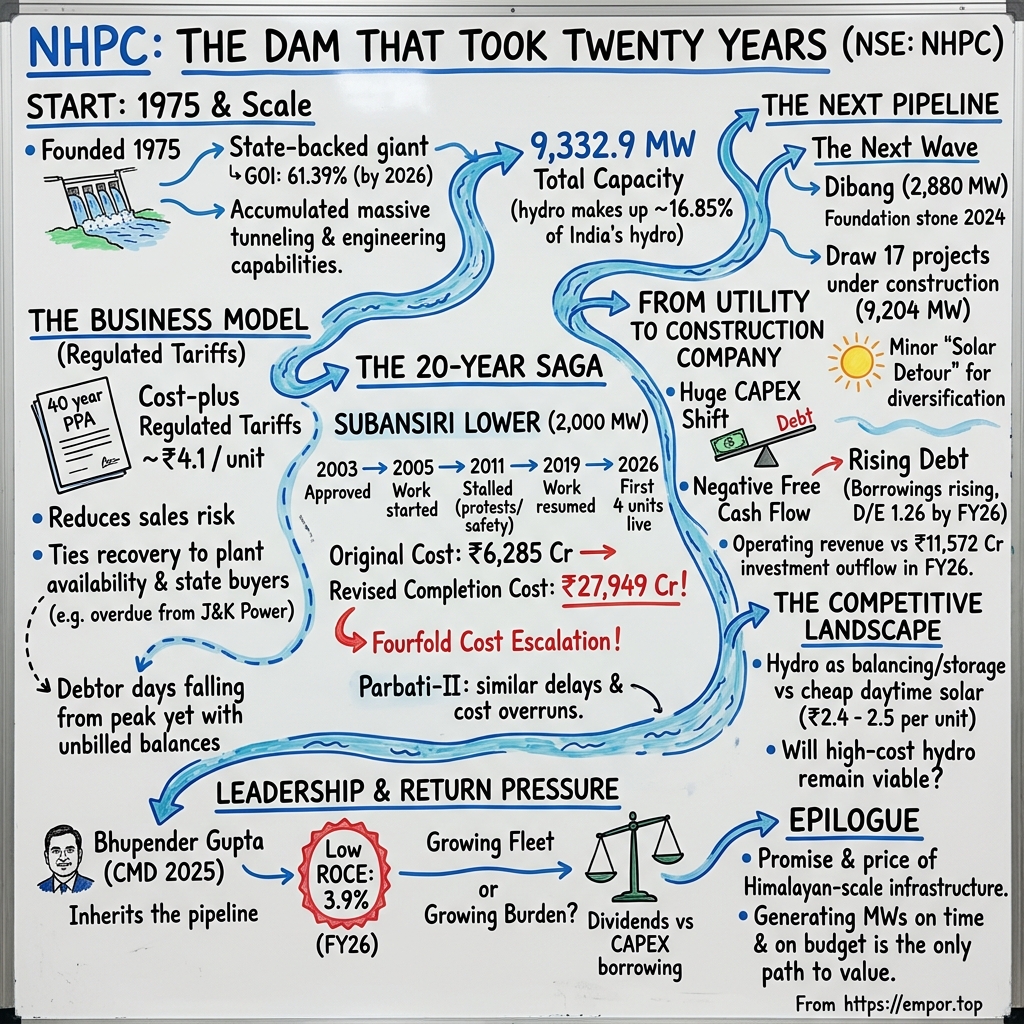
To feel the weight of that moment, hold two dates in your head. The project was approved in 2003, and construction began in 2005. The original approved cost was ₹6,285 crore.3 The water now spinning those turbines arrived roughly two decades and several governments later, and the bill arrived with it. In February 2025, the government told Parliament that the revised estimate had reached about ₹26,076 crore, including nearly ₹19,800 crore of escalation.3 A Ministry of Power tabulation of NHPC's cost revisions put the completion cost at ₹27,949 crore.4
By May 2026, management was describing an anticipated cost of ₹30,072 crore, of which ₹26,092 crore had already been spent.5 The number has not stopped moving. It now sits close to five times the figure on which the dam was first sanctioned.
That is the gap this story is about: the distance between a project announcement and electricity reaching the grid, and the distance between electricity reaching the grid and money reaching shareholders. NHPC is very good at the first kind of patience. Whether it can earn a return on the second is the question an investor is really being asked.
There is a temptation to read Subansiri's turbines as a happy ending. In one sense they are. NHPC's power stations generated 29,619 million units of electricity in the year to March 2026, about 16% more than the year before, largely because Parbati-II, another long-delayed Himalayan project, had finally started running and Subansiri had begun to contribute.5 More water through more turbines is what a hydro company is for.
But the same year carried a warning. The plant availability factor, the share of the time a station is ready to generate when called upon, fell to 74.75% from 78.87%.5 Availability is how a regulated hydro company gets paid its fixed charges, so a slide in that figure is not a footnote. It is the first sign that building a fleet and running one are separate tests.
Here is where NHPC stands on the eve of this story's telling. It owns or controls 9,332.9 megawatts of installed capacity, including about 1,682 megawatts held through joint ventures, and of that, 8,771 megawatts is hydro spread across 24 stations.6 That hydro fleet is roughly 16.85% of everything India has built in hydropower.6 It is, by installed hydro capacity, the country's largest hydropower developer. And it is building almost as much again: 17 projects totalling 9,204 megawatts are under construction across the company, its subsidiaries and its joint ventures.6
So the episode has three questions. First, can NHPC turn that enormous and difficult pipeline into lasting profit growth, or will delays keep consuming the returns? Second, do regulated tariffs and the backing of the Government of India actually compensate shareholders for construction risk, or do they merely make it survivable? Third, can the current investment programme pay its own way, when the company spent more on projects last year than it earned in operating revenue?
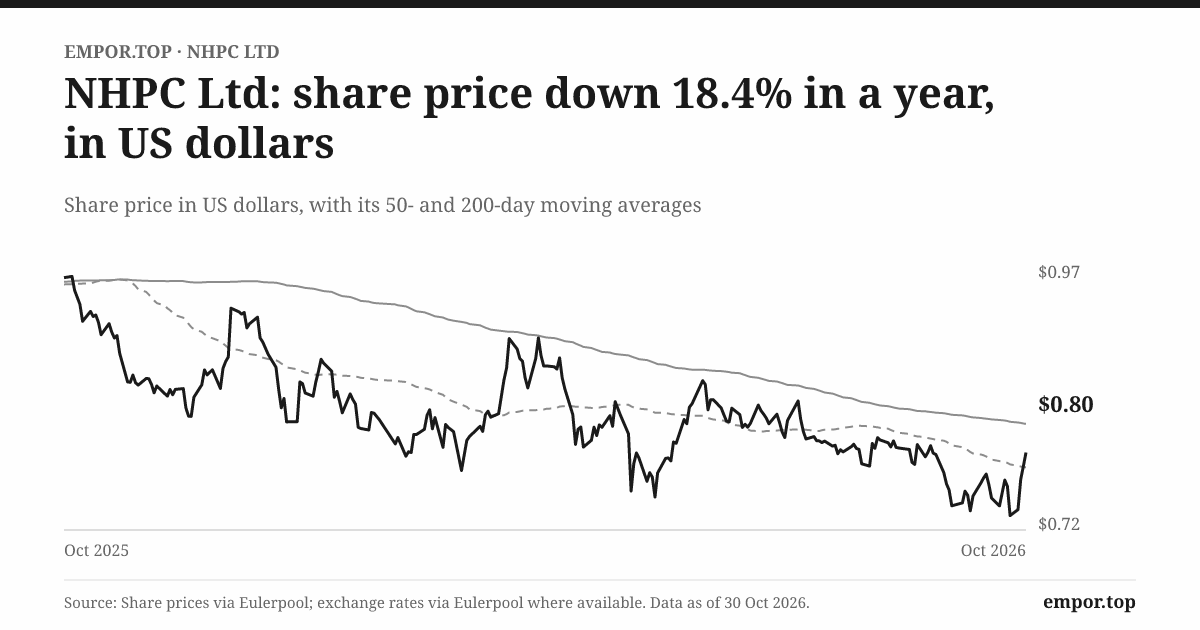
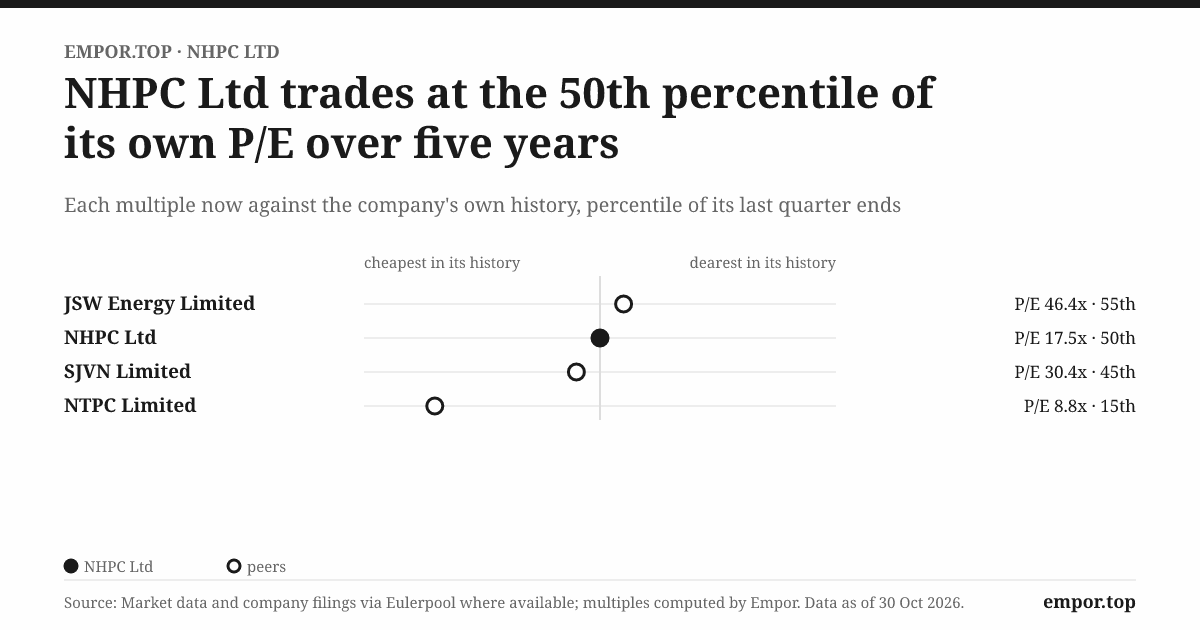
The market has given its own provisional answer. At a share price of about ₹75.71 on October 30, 2026, NHPC is valued at roughly ₹76,000 crore, or about 17.5 times trailing earnings, almost exactly its own five-year median multiple of 17.3. Investors are paying an ordinary price for an extraordinary bet. Underneath that ordinary multiple sit some uncomfortable trends: return on capital employed fell to 3.9% in the year to March 2026, debt reached 1.26 times shareholders' equity, and free cash flow was deeply negative as construction spending swamped what the operating stations brought in.7
None of this is a verdict on whether Subansiri was worth building. It almost certainly was worth building for India. A dam that can generate more than 7,400 million units of clean electricity in an average year and hold back monsoon floods is a national asset.2 The harder question is whether a national asset built at five times its first budget, over two decades, can also be a good asset for a minority shareholder. The new units prove that NHPC can complete what it starts. They do not yet prove that completion pays. To understand why the company keeps taking this bet anyway, you have to go back to why it was created in the first place.
 Subscribe on LinkedIn
II. The Company Built to Make Rivers Useful
India in the mid-1970s had rivers in abundance and electricity in short supply. The Himalayas sent enormous volumes of snowmelt and monsoon water down the Indus, Ganga and Brahmaputra systems every year, and almost all of it ran to the sea without turning a single turbine. The states that owned the best sites were often the least able to finance them, and the projects themselves sprawled across state lines, through forests, past border regions and into territory where roads did not yet exist. A hydro dam in the Himalayas was not a private-sector proposition. It was a nation-building problem.
The Government of India's answer was to create a dedicated central developer. On November 7, 1975, National Hydroelectric Power Corporation Private Limited was incorporated.6 It did not start with a blank sheet. The new company took over three projects that had been run by the Central Hydroelectric Projects Control Board: Salal Stage-I in Jammu and Kashmir, Bairasiul in Himachal Pradesh and Loktak in Manipur.8
Those three names tell you the shape of the mandate from day one: a mountain station in the far north, a hill station in Himachal and a lake-fed scheme in the north-east, each in a place where the logistics alone were a feat. The corporation became a public limited company in April 1986, and decades later earned the Mini-ratna and then Navratna status that the government grants to its most capable state enterprises, the latter in August 2024.6
What did those early decades actually build? Not just power stations. They built a capability that is genuinely rare: the ability to survey a gorge for years before anyone pours concrete, to bore tunnels through rock whose behaviour cannot be fully known until the drill hits it, to design dams for earthquake zones, and to coordinate an absurd number of stakeholders.
A typical NHPC project needs the central government for investment approval, the state government for land and free power, environment and forest ministries for clearances, local communities for consent, the Central Electricity Authority for technical vetting and, eventually, the Central Electricity Regulatory Commission for a tariff. A private developer would have to build all of that relationship capital from scratch. NHPC was born with it. Tellingly, that capability lives in people and project experience rather than in laboratories: NHPC spent about ₹21.74 crore on research and development in FY2026, roughly 0.2% of revenue, and had 4,634 employees on its rolls.7
That state-backed coordination is the company's original advantage, and it is real. It explains why NHPC, not some private challenger, ended up owning the largest hydro fleet in the country. It also explains why the company could take on projects that sat idle for years without being forced into a distress sale. A privately financed developer whose dam stopped for eight years would have been restructured, sold or bankrupted. NHPC simply waited.
But the same history carries a second lesson, and it matters more for investors today. The long gestation that made a state developer useful also left it exposed to every force a long gestation invites. A hydro project's construction period is long enough for public opinion to turn, for downstream communities to organise, for geology to reveal surprises, for contractors to fail and for courts and tribunals to intervene. A thermal plant on flat land with a coal contract can be built in four or five years. A Himalayan dam can take ten, and sometimes twenty. Every extra year of construction is a year of interest accruing on capital that is earning nothing.
The company that listed on the stock exchanges in 2009 was therefore a strange hybrid. Its initial public offer opened on August 7, 2009, and closed on August 12, priced at ₹36 a share and raising about ₹6,039 crore. It was subscribed about 23.5 times, and the shares began trading on September 1, 2009.9 The final offer documents were filed with the Registrar of Companies in late August 2009.10
Investors were buying a slice of a state engineering institution, not a company controlled by its shareholders. The Government of India remained firmly in charge: it still held 67.40% of the company through March 2026.11 And in June 2026, the President of India sold 603,847,814 shares through an offer for sale, reducing the government's stake to 61.39%.12 Control did not change. The public float simply got larger.
The contrast to hold onto is this. NHPC's established hydro expertise is not in doubt. Its operating fleet is evidence enough that it knows how to build and run dams.6 What is in doubt is the economics of the next, much larger wave, much of it in the same remote, geologically young and politically sensitive terrain where Subansiri spent eight years frozen. A national champion's capability is a platform for execution, not a promise of return. To see how that platform turns into money, you need to understand the peculiar way a hydro dam in India gets paid.
III. A Tariff That Pays for the Dam
Picture the day a new hydro station starts commercial operation. The concrete is poured, the turbines are synchronised, the transmission line is energised. At this point, nearly all the money has already been spent. A hydro plant has no fuel bill; the river is free. What it has instead is a mountain of capital sitting on its balance sheet: the cost of the dam, the tunnels, the powerhouse and every year of interest paid while it was being built. The central question for the station's owner is simple. Who pays that back, and how?
In India, the answer for NHPC's stations is the Central Electricity Regulatory Commission, the national power regulator, and a formula that is easier to understand than it sounds. Each station gets its own tariff, determined on a cost-plus basis under Section 62 of the Electricity Act, 2003.13 The regulator adds up the legitimate costs of owning and running the station: depreciation on the assets, interest on loans, interest on working capital, operations and maintenance, and a post-tax return on the equity shareholders have put in.13 That sum is the annual fixed charge, the amount the station is entitled to recover in a year.
Then comes the clever part. The fixed charge is split, broadly, into two halves. Half is paid as a capacity charge, earned if the plant's availability is above a normative level set by the regulator; the other half is paid through energy charges, earned as the station actually generates against its design energy, the amount of electricity it was designed to produce in a typical year.13
Think of it as a landlord with two clauses in the lease. One clause pays rent for keeping the building open and ready. The other pays according to how many tenants actually walk through the door. NHPC's normative availability is 82% on a consolidated basis and 80% for the standalone company, management said in May 2026.5 Clear the bar and the capacity half flows in full. Beat design energy and the company earns "secondary energy" on top; in the year to March 2026, secondary energy, availability incentives and deviation charges together added about ₹913 crore.5
Who pays? Mostly state electricity utilities and distribution companies, through long-term power-purchase agreements. Those agreements run for 40 years from the date a station starts commercial operation.13 On a standalone basis, NHPC's hydro tariff averaged about ₹3.98 per unit as of March 2026.13 That figure is an average across old and new stations: older, largely depreciated plants are cheap, while new, expensive ones like Subansiri will sit well above it.
What does this structure buy an investor? More predictability than almost any other kind of power company. A merchant generator selling into the spot market lives and dies by the price of the next megawatt-hour. A coal plant is exposed to fuel costs and to whether it gets dispatched at all. NHPC's stations, once built and running at normative availability, earn a regulated return on equity whether or not the price of power in the exchange collapses. CARE Ratings, which reaffirmed NHPC's bonds at its top AAA grade with a stable outlook in May 2026, described the model as one of "low sales risk," built on cost-plus tariffs and 40-year agreements.13
But notice what the model does not do. It does not guarantee that the plant is available. It does not make the river flow. It does not issue tariff orders promptly. And it does not make every state utility pay on time. Each of those gaps showed up in the year to March 2026.
Take availability first. Management attributed the fall in plant availability to shutdowns at the Dulhasti, Chamera-III and TLDP-IV stations for repairs to inlet valves, sill beams and radial gates.5 Hovering over all of it was Teesta-V in Sikkim. On the night of October 3 to 4, 2023, the South Lhonak glacial lake burst in North Sikkim, sending a wall of water and debris down the Teesta. NHPC's 510-megawatt station was overwhelmed; damage was later put at about ₹1,076 crore, and a landslide over the tunnel outlet in August 2024 added another ₹328 crore of damage.14
The station produced nothing for two full fiscal years and only resumed full commercial generation in July 2026.14 Asked about the shortfall on the May 2026 call, management argued that availability was about 80% if Teesta-V was excluded.5 That is a fair description of the arithmetic and an incomplete description of the business: a hydro fleet in the Himalayas will always have a Teesta-V somewhere. The flood is not an exception to the model. It is part of what the model is exposed to.
The cost of that silence can be measured. Teesta-V's annual fixed charge is around ₹500 crore, management said, or roughly ₹400 crore excluding tax, and for two years that revenue simply did not exist, while insurance claims only partly filled the hole.5 Silt carried by the same flood kept clogging the downstream TLDP-III and TLDP-IV stations, which management hoped to clear within about three months of the May 2026 call.5 One glacial lake, in other words, dented three stations for three years.
Then there is the question every investor in an Indian power company eventually asks: who pays late? For years, the answer was uncomfortable. In March 2021, overdue receivables made up 55% of NHPC's total receivables; by March 2026, CARE reported that share had fallen to 9%, helped by Ministry of Power liquidity measures including the late-payment surcharge rules that let utilities convert old dues into instalments.13 At the end of the 2026 fiscal year, about ₹237 crore was still more than 45 days overdue, and J&K Power Corporation alone accounted for ₹115 crore of it.7
A year earlier, the overdue figure had been ₹139 crore, with ₹98 crore from the same Kashmiri utility.15 So the improvement is genuine at the system level, but a single government-owned counterparty in a politically sensitive territory has been getting slower, not faster. CARE noted that many of NHPC's buyers have "moderate to weak credit profiles" and that dues had accumulated in the past from both JKPCL and Uttar Pradesh Power Corporation.13
The fleet-wide collection picture looks better still on a simple measure. Receivables as a share of a year's revenue fell to about 98 days in FY2026 from a peak of 273 days in FY2020.7 That collapse is mostly real, and it matters, because a company that is borrowing to build cannot afford to finance its customers as well. But the headline number needs one adjustment. Of the ₹2,630 crore of trade receivables NHPC reported at March 2026, about ₹1,887 crore was unbilled: energy sold in March and tariff items awaiting regulatory orders.5
Only about ₹743 crore was actually billed. And the classification of these balances has itself drawn an auditor's eye. In its supplementary audit of the FY2025 accounts, the Comptroller and Auditor General flagged that about ₹3,225 crore of pay-anomaly arrears and contract assets had been presented inside trade receivables; NHPC responded that reclassifying them had no effect on total assets or profit.16 That is a presentation point, not a misstatement, but it is a reminder that "receivables" at a regulated utility is a basket of very different promises.
So how wide is the moat that this tariff structure digs? Narrower than the phrase "40-year contract" suggests. Regulation and installed assets create real stability: once a station is built, the buyer has nowhere else to source that particular river's electricity, and the regulator has committed to a return.
But the buyers are concentrated, public-sector and sometimes slow; the regulator decides when and how much; and the hydrology decides how many units actually flow. The tariff pays for the dam. It does not pay for the dam on time, and it does not pay for a dam that is not running. That distinction would become painfully concrete at Subansiri, where a river and a valley full of people decided that the timetable was theirs to set.
IV. Subansiri: The Cost of Stopping the River
The Subansiri is one of the largest tributaries of the Brahmaputra, entering India through the Miri Hills of Arunachal Pradesh before winding down into the plains of Assam.17 For NHPC's engineers, the site near the state border was a gift: a narrow gorge, a large river and the prospect of 2,000 megawatts from eight 250-megawatt units, generating about 7,500 million units a year in a dependable year.17
For the farmers, fishing communities and towns of the Assam plains downstream, the same site looked very different. A tall concrete dam upstream of their homes, in one of the most seismically active regions on Earth, was not an abstraction. It was a question about whether their families would survive the next great earthquake.
Construction began in January 2005.317 For the first few years, the work went more or less the way Himalayan projects go: slowly, expensively, but forward. Then the downstream questions hardened into a movement. Local groups in Assam argued that the dam's design had not adequately accounted for seismic risk, downstream flooding and the river's ecology, and the agitation grew strong enough that in December 2011 construction stopped.17
It is tempting to describe what followed as an interruption to an otherwise smooth build. That would be the wrong story. The safety and environmental concerns were part of the project from the beginning, because the project was a decision to put a large dam above a populated floodplain.
What happened in 2011 was that the people who would live with the consequences forced their questions onto the critical path. Expert reviews examined the dam design, a state committee on the project drew up safety and environmental recommendations that NHPC later said it was implementing, and the matter went before the National Green Tribunal.3 Only after the tribunal's clearance did construction formally resume, on October 15, 2019.17 By then, almost eight years had passed with the half-built dam sitting in the gorge, contractors idled, equipment ageing and interest compounding on every rupee already spent.
The restart did not end the drama. In 2023, a landslide blocked the project's only functioning diversion tunnel, cutting the river's flow below the dam; the riverbed downstream dried up, endangering aquatic life and reigniting questions about the project's safety.17 Commissioning dates kept moving. In February 2025, NHPC told the government that three units would be commissioned in May 2025 and the remaining five in May 2026.3
The first unit to enter commercial operation actually did so on December 23, 2025.2 The third was commissioned at the start of February 2026, and by May 2026 four units were running.186 On the May 2026 earnings call, management said the remaining four would be commissioned "one-by-one till March'27."5 The fifth arrived on October 23, 2026, leaving three.1 Each milestone is real. Each also arrived months after the date given just a year or so earlier.
Now put the money beside the calendar. By May 2026, the anticipated cost had risen nearly fivefold from the original sanction.35 That does not mean NHPC's engineers were incompetent; much of the increase is the arithmetic of time. Price-variation clauses in construction contracts, interest during construction, design changes demanded by safety reviews, downstream protection works costing hundreds of crores, all of it scales with years of delay.2
When an analyst asked on the May 2026 call whether cost escalation was a risk for other projects, the company's finance team was candid: in hydro, they said, cost overrun is "very inherent," because contracts are awarded at a price level that rises with every year of construction, and a time overrun makes it worse.5 It was a rare moment of corporate honesty, and it is the most useful sentence an investor can take from the call.
Subansiri is not a one-off. Consider Parbati-II, in the Sainj valley of Himachal Pradesh. Its foundation stone was laid in December 1999; the government approved it in September 2002 at a sanctioned cost of about ₹3,920 crore; and construction started that month.19 Local reporting noted that it had originally been due for completion in 2009.20 Its delays were blamed on difficult Himalayan terrain and other natural obstacles.20 As early as 2012, the national auditor had documented a troubled contract on the project, with advances and an estimated ₹244 crore cost overrun.21 The project's four 200-megawatt units finally entered commercial operation in April 2025, and its estimated completion cost had reached about ₹13,045 crore, more than three times the sanction.19 Two projects, two decades each, two cost multiples of three to five. The pattern is not an accident of one valley.
Here is where the investor's verdict has to separate from the engineer's. The commissioning milestone is not the economic verdict. The economic verdict depends on four things that only start to become visible after the ribbon is cut: how many units are commissioned, how available they are, what tariff the regulator finally approves, and whether the resulting cash covers the debt that financed construction.
Parbati-II's first year shows how unforgiving that test can be. A cloudburst in June 2025 damaged the project early in its life, and it generated 1,642 million units in the year to March 2026 against a design energy of 3,125 million units, roughly half.5 The regulator issued an interim order in February 2026 allowing NHPC to bill 75% of the tariff it had filed; NHPC booked revenue at 80% of the expected annual fixed charge, conservatively.135
The result: Parbati-II lost about ₹150 crore for the full year, even after about ₹200 crore of revenue for the generation shortfall, which the regulations allow when the causes are beyond the developer's control, was booked at year-end.5 Management estimated that, on full filed tariffs, the project would have earned roughly ₹150 crore instead. An analyst from Kotak pointed out the obvious: ₹150 crore of profit is very little against a project that cost about ₹13,000 crore.5 Management attributed the shortfall to low generation after the cloudburst, and said it was too early to argue for a lower design energy.5
Subansiri, so far, tells a slightly better story. The units commissioned in the 2026 fiscal year generated 506 million units and earned about ₹613 crore of booked revenue, again at 80% of the expected fixed charge; management said the project contributed about ₹495 crore of profit for the year.5 That profit, however, rests on revenue booked against tariff petitions that the regulator had not yet decided. Management estimated that, between Parbati-II and Subansiri Lower, about ₹450 crore of revenue implied by the filed tariffs had not yet been recognised.5
Investors should think of that ₹450 crore as both an upside and an open question: upside if the regulator approves the full capital cost, an open question if it disallows part of a cost that rose fivefold. The regulator allows cost overruns that it deems beyond the developer's control, and disallows those it considers within it.5 Whether eight years of protest-driven stoppage falls entirely on the first side of that line is exactly what the final order will decide.
There is a subtle point buried in Subansiri's early numbers, and it explains the whole tariff system in miniature. Those 506 million units earned about ₹613 crore, which works out to roughly ₹12 a unit. Subansiri's electricity is not really priced at ₹12.
What is happening is that the fixed charge, sized to the capital cost of the units commissioned, which management put at around ₹20,000 crore for the first three units, is recovered largely regardless of volume in the early months.5 As output ramps toward the 5,000 to 5,500 million units management expects for FY2027, against a design energy of about 7,421 million units, the per-unit figure will fall.5 Either way, the buyer pays for the capital. That is the deal: the state utility in Assam or elsewhere is not buying electricity so much as renting a share of a ₹30,000-crore dam.
So what does Subansiri prove? It proves NHPC can persevere through a decade of conflict and still finish a 2,000-megawatt dam. That is not nothing; many developers would have abandoned it. But it also severely falsifies a comfortable idea: that state backing makes megaproject delivery predictable. State backing kept Subansiri alive. It did not keep it on schedule or on budget. The project's eventual return has to be judged against its full cost and the electricity actually delivered, not against the 2003 sanction. And a company with several Subansiris under construction at once is no longer simply a utility. It has become, in financial character, a construction company.
V. From a Listed Utility to a Construction Company
For most of its listed life, NHPC behaved like what investors thought they were buying: a mature fleet of hydro stations, steadily throwing off cash, much of which went back to its shareholders as dividends. The largest of those shareholders was the government, which relied on dividends from state enterprises to help fund the national budget. The arrangement suited everyone as long as the fleet was mostly built.
Then the fleet stopped being mostly built.
Follow the capital through the accounts and the change becomes unmistakable. Over the twelve years from FY2015 to FY2026, NHPC reported about ₹36,200 crore of net profit and generated about ₹59,466 crore of cash from operations, or 164% of profit.7 At first glance, that is excellent cash conversion, and it is real: depreciation is a large non-cash charge for a capital-heavy business, so cash flow should exceed profit. But almost all of that operating cash went back into the ground. After capital spending, cumulative free cash flow over the same twelve years was only about ₹8,009 crore.7
Now set dividends beside that number. Over the same span, NHPC paid out about ₹25,722 crore in dividends, roughly 321% of its cumulative free cash flow.7 Payout ratios ranged from about a third of profit in FY2015 to more than all of it in FY2017, and stood at about 85% in FY2026.7 Put simply, NHPC paid its shareholders roughly three rupees for every rupee of free cash the business produced. The difference had to come from somewhere, and it came from two places. One was the cash pile: cash and short-term investments fell from about ₹6,389 crore at the end of FY2014 to about ₹3,662 crore at the end of FY2026.7 The other was debt.
The borrowing story is the hinge of the whole investment case. Total borrowings grew about 10% a year over the decade to FY2026, and faster still lately: about 18% a year over the last three years.7 By March 2026, consolidated borrowings stood at about ₹52,134 crore, almost all of it project debt rather than lease liabilities.7 Debt-to-equity, which hovered between 0.6 and 0.7 for most of the 2010s, reached about 1.3.7 CARE put total debt at about 8.3 times EBITDA at the end of FY2026, and expects leverage to stay elevated through a capital spending plan of roughly ₹53,000 crore over FY2027 to FY2030.13
CARE still rates liquidity as strong: consolidated cash and bank balances were about ₹3,651 crore at March 2026, and the agency expects NHPC to refinance and lengthen its debt maturities rather than repay from internal cash.13 A small slice of the debt is in Japanese yen, borrowed for projects; NHPC hedges it, and eligible exchange-rate changes are recoverable through tariffs, so currency is a timing risk more than a profit risk.15
The most striking single comparison sits in the 2026 fiscal year. NHPC's consolidated capital expenditure was ₹13,689 crore, up from ₹11,596 crore the year before.5 Revenue from operations was ₹11,615 crore.5 The cash flow statement tells the same story from another angle: about ₹11,572 crore of cash went out for property, plant, equipment and related project investment, while operating cash flow was just ₹3,294 crore, depressed by working-capital movements.7 In one year, the company spent more building new capacity than it earned selling electricity. That is not the profile of a harvesting utility. It is the profile of a developer in the thick of a construction cycle.
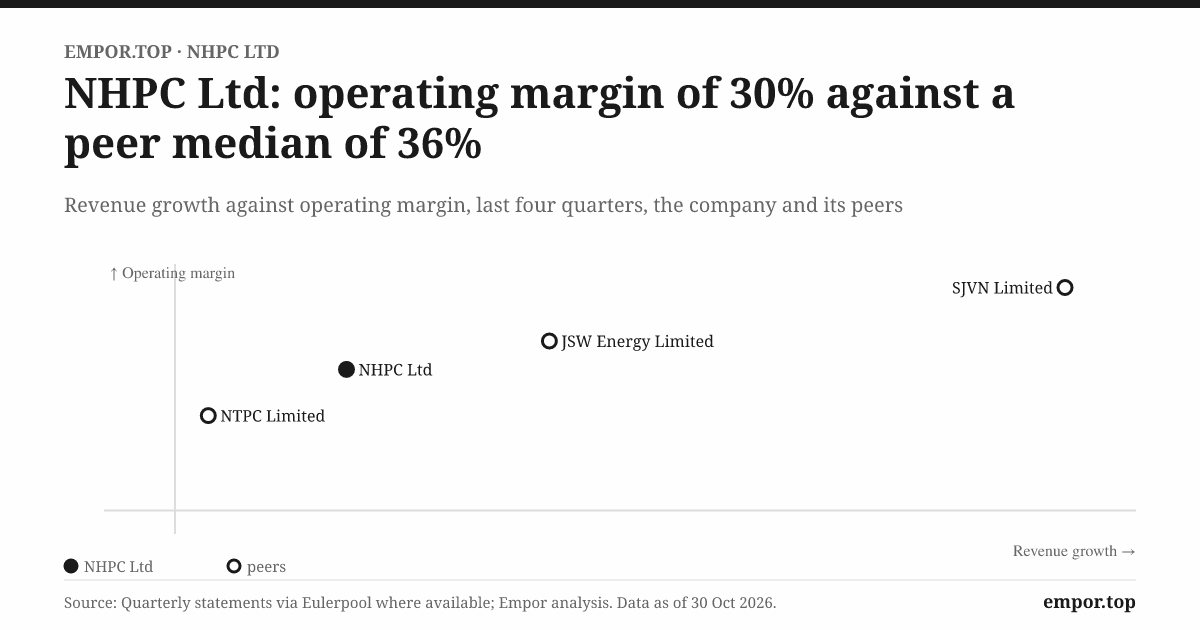
The income statement shows where the strain lands. Operating margin fell from about 44% to about 35% in FY2026.7 Revenue rose by about ₹1,235 crore, but other expenses rose by about ₹1,938 crore, driven by ₹822 crore more in general network access charges for transmission, ₹476 crore more in insurance expense and ₹225 crore more in losses on insurance claims. Depreciation rose by ₹783 crore as new stations came onto the books, and finance costs rose by ₹234 crore as ₹877 crore of interest on Parbati-II, Subansiri and the Karnisar solar plant moved from the construction account into the profit and loss, partly offset by lower interest on arbitration cases.5 In plain terms, a commissioned project starts costing money on the day it starts earning it, and in the early months, while tariffs are still interim, the costs arrive in full before the revenue does.
Is that bad? Not necessarily. A cost-plus regulated developer earns its return precisely by putting capital to work; the regulated equity base grows as projects are commissioned, and the return on that equity is what shareholders ultimately own. Management said on the May 2026 call that regulated equity of about ₹18,309 crore, including Parbati-II, would rise to about ₹30,672 crore by the end of FY2027 if planned hydro commissioning arrived on schedule.5 If that happens, and if the regulator approves the costs, the earnings base could step up sharply. That is the bull case in one sentence.
The bear case is in the same sentence. "If planned commissioning arrives on schedule" is a heavy clause for a company whose record includes Subansiri and Parbati-II. And until the projects are commissioned, the interest on the debt that financed them is capitalised into the project cost, which is exactly why the tariff, when it finally comes, has to be so much higher. The returns show the strain: return on equity fell from about 10.6% in FY2023 to 6.7% in FY2026, and return on capital employed from 9% to 3.9%.7 The capital is being deployed. It is not yet earning.
Two clarifications matter for how investors should read this transformation. The first is about acquisitions, or rather their absence. NHPC's growth is almost entirely project development: building its own stations, sometimes through subsidiaries and joint ventures such as Chenab Valley Power Projects in Jammu and Kashmir or NHDC in Madhya Pradesh. The FY2025 and FY2026 annual reports describe no material acquisition programme that would require a valuation-versus-peers test.715 It is in the process of merging Jal Power Corporation, owner of the 120-megawatt Rangit-IV project in Sikkim, into NHPC, but that is a small consolidation of a project it already controls.5 The capital allocation question here is not "did they overpay for a deal?" It is "will each dam earn its cost of capital?"
The second clarification is about the June 2026 sell-down. The President's sale transferred existing shares to other owners, so it did not dilute existing shareholders or add cash to NHPC.12 NHPC's paid-up share capital stayed at about ₹10,045 crore.76 The government raised money for the national exchequer; the company's construction programme remained funded by the same mix of internal cash and debt as before.
The sell-down widened public ownership and made the stock somewhat more liquid, while leaving the arithmetic of the dams unchanged. Beneath the government, the register was shifting quietly: over FY2026, foreign portfolio investors raised their stake from about 8.8% to about 10.3% and insurers from about 6.0% to 6.5%, while domestic mutual funds trimmed theirs from about 4.5% to 3.9%. Roughly 3.37 million shareholders were on the books in March 2026.11
The verdict on this chapter is straightforward. NHPC has shifted from harvesting a mature fleet toward funding a construction cycle, and has kept paying generous dividends while doing so. Over the long run, those dividends exceeded the free cash the business produced, which means part of today's debt is, in effect, yesterday's dividend. Whether this shift creates value depends entirely on what is being built. So it is time to look at the pipeline itself.
VI. The New Build: Subansiri, Dibang and the Solar Detour
On March 9, 2024, at a public event in Itanagar, the Prime Minister laid the foundation stone of the Dibang Multipurpose Project.22 Foundation-stone ceremonies are a staple of Indian infrastructure politics, but this one carried unusual weight. Dibang, in Lower Dibang Valley district of Arunachal Pradesh, is designed as a 2,880-megawatt station with twelve 240-megawatt units, generating about 11,223 million units in a dependable year, behind a 278-metre concrete gravity structure.23 When built, it will be among the largest hydro projects India has ever attempted. It will also, by design, be a flood-control structure for the Brahmaputra plains below, which is why it is called multipurpose.
Dibang's history is itself a lesson in patience. The project had been talked about for decades before the Ministry of Power conveyed investment approval for it on February 27, 2023, at an estimated cost of about ₹31,876 crore at May 2021 price levels, with a nine-year construction period.23 By March 2025, civil works had begun, the government told Parliament.[^24]
By May 2026, management said all major contracts had been awarded, including a ₹14,446 crore dam package in April 2026; about ₹4,504 crore had been spent; and the scheduled completion was February 2032.5 That estimated cost includes a ₹6,716 crore government grant for flood moderation and enabling infrastructure, an important detail: the state is paying directly for the part of the dam that serves the public rather than the power buyer.5
Dibang is only the largest piece of a much bigger puzzle. The company's broader construction total includes joint ventures and subsidiaries.6 The Ministry of Power's FY2026 annual report counts NHPC's hydro construction portfolio at 8,264 megawatts.24 The difference between those figures is not an error. It reflects what is being counted: solar projects, joint-venture capacity and subsidiary projects. That distinction matters for investors, because a megawatt in a partly owned joint venture is not the same as a megawatt NHPC owns outright.
The pipeline divides naturally into three bands. The nearest band, due over the next year or so, includes Subansiri's remaining 750 megawatts; the 1,000-megawatt Pakal Dul and 624-megawatt Kiru projects in Jammu and Kashmir, both built through Chenab Valley Power Projects and both described as about 80% complete in May 2026 with commissioning expected in the fourth quarter of FY2027; and the 120-megawatt Rangit-IV in Sikkim, 96% complete and expected by November 2026.5 Management told analysts it expected to commission 2,994 megawatts of hydro capacity in FY2027.5
The middle band runs to the end of the decade: the 850-megawatt Ratle project, 29% complete with an expected date of November 2028; Kwar, 540 megawatts, by March 2028; the 500-megawatt Teesta-VI, 72% complete, by September 2029; and two new Kashmir projects, Uri-I Stage-II and Dulhasti Stage-II, whose civil contracts were awarded in March 2026 for completion in November 2029.5 The far band includes Dibang in 2032, the 1,720-megawatt Kamala project approved by the Cabinet in April 2026 at about ₹26,070 crore, and giant prospects such as Sawalkot, Subansiri Upper and Etalin still working through clearances.5 Beyond those sit nine more projects, 10,207 megawatts, awaiting approval.6
Lay that list beside the company's history and the tension is obvious. Some 9,204 megawatts under construction is meaningful: it is almost as large as everything NHPC has built in half a century. If even most of it arrives close to schedule, NHPC's regulated equity, generation and earnings could step up for a decade. But Subansiri and Parbati-II show how far projects can slip on time and cost. Announced capacity is not revenue. It is not even cash. It is a claim on future capital that will only become a claim on future income when the turbines turn and the regulator signs off.
The most useful near-term test is already running. Management's FY2027 promise of 2,994 megawatts of hydro commissioning depends on Subansiri finishing, Rangit-IV arriving in November, and both Pakal Dul and Kiru coming in before March 2027.5 Seven months into the fiscal year, one more Subansiri unit had arrived.1 Nothing about that is yet a miss. But it is the right yardstick: an investor should count commissioned megawatts against that promise, quarter by quarter, rather than counting the size of the pipeline.
Then there is solar, the detour. NHPC has been building solar capacity for several years, and by October 2026 it had six solar projects totalling about 512 megawatts plus a 50-megawatt wind farm.6 The flagship is the 300-megawatt Karnisar plant in Bikaner, Rajasthan, built under a central government scheme for state enterprises; further plants in Andhra Pradesh, Gujarat's Khavda renewable park, Odisha and a floating solar project in Kerala were scheduled for 2026 and early 2027.5 Management told analysts it expected about 1,190 megawatts of solar to be commissioned in FY2027.5
NHPC also acts as a renewable-energy implementing agency, running auctions for capacity that others build, and said it had awarded about 23 gigawatts in that role, of which only about 7 gigawatts had signed power-sale agreements.5 Solar is real, it is growing, and it diversifies the company's exposure to hydrology. But measured against its hydro fleet and a hydro-dominated construction book, solar does not yet change NHPC's economic centre of gravity. It is an adjunct, not a new company.
Pumped storage deserves an even more careful framing. A pumped-storage plant is essentially a giant water battery: it pumps water uphill when electricity is cheap, typically during sunny afternoons, and releases it through turbines when demand peaks in the evening. As India adds solar capacity at enormous scale, that kind of storage could become very valuable.
NHPC says it is exploring pumped storage projects in seven states, with about 18 gigawatts at the stage of pre-feasibility or detailed project reports, and hoped to begin construction of the 640-megawatt Indira Sagar–Omkareshwar project in FY2027.5 But when an analyst asked when the pumped-storage plants would start earning, management's answer was disarmingly honest: it had not started construction on any of them, and it was too early to talk about realisation or tariffs.5 That is optionality, tied to a real grid need, but optionality nonetheless. A detailed project report is not a power station.
The discipline to apply across this entire pipeline is the one Subansiri taught. Technical expertise, clearances and foundation-stone ceremonies do not establish commercialisation. Physical progress does, followed by commissioning dates met, final tariffs approved and cash returned. NHPC has proven it can do the first three eventually. Whether it can do them on schedule, at scale and with returns that exceed its cost of capital is what the next five years will reveal. And all of that depends on a further question: in a power market being transformed by cheap solar, why should anyone keep paying for expensive dams?
VII. The Company's Edge Meets Cheap Power
Imagine a planner at a state distribution utility, sitting with two offers on the desk. The first is from a solar developer. In SECI's interstate solar auctions, bids at around ₹2.55 to ₹2.61 per unit were already being struck in 2019.25 The second is a share of a new Himalayan hydro station, whose regulated tariff will have to recover a ₹30,000-crore construction bill over its life. On the simple metric of cost per unit, the choice looks obvious. Why would anyone buy the dam?
The answer depends on what time of day the planner needs the power. Solar generates when the sun shines and stops at dusk, which is precisely when Indian electricity demand peaks as households switch on lights, fans and air conditioners. Making solar deliver after sunset requires storage, and storage costs money. In October 2025, a SECI auction for 2,000 megawatts of solar, each megawatt paired with at least half a megawatt of battery storage able to run for four hours, cleared at about ₹2.86 per unit.26
That is still cheaper than NHPC's ₹3.98 fleet average.13 But it is a different product from a reservoir hydro station that can ramp up within minutes, hold water for hours or days, absorb monsoon floods and provide the grid with spinning inertia that inverter-based generators do not naturally offer. Solar is a strong substitute for some of what hydro does. It is not a like-for-like replacement for all of it.
This is the right frame for asking what NHPC's competitive edge actually is, and whether it is a moat.
Start with scale. NHPC leads the country in installed hydropower capacity.13 Its nearest pure hydro peers, SJVN and THDC, operate much smaller fleets. NTPC, the giant of Indian power, is far larger in total but overwhelmingly thermal, with hydro arriving mainly through its THDC and NEEPCO subsidiaries. So NHPC's leadership in large hydro is real. But capacity alone does not establish superior returns. Peers differ in hydro mix, project ownership, tariff regimes and the size of their construction books, and NHPC's own return on capital has been falling as its construction exposure rises.7
Now walk through the five forces as they bear on this specific business. The bargaining power of buyers is high. NHPC's customers are state utilities and distribution companies, mostly government-owned, sometimes financially weak, and capable of paying slowly, as its overdue dues from J&K Power Corporation show.7 They also sit on the other side of every regulatory hearing. Rivalry over pricing is limited, because the regulator, not competition, sets the tariff for each station; NHPC cannot raise prices, and nor can a competitor undercut it on an existing station.
The threat of new entrants into large Himalayan hydro is low, because it requires enormous capital, clearances that can take a decade, and a tolerance for twenty-year construction periods that private developers rarely have. Supplier power is moderate, concentrated in civil contractors and equipment makers, and shows up in price-variation clauses and contract disputes; NHPC's standalone contingent claims of about ₹8,252 crore at March 2026 included about ₹4,855 crore related to capital works.7
And the threat of substitutes, as the planner's desk shows, is the most important force of all, because solar plus storage is already close to hydro on price. Looming over all five is the regulator itself: CARE lists an unfavourable change in the hydro tariff regime among the developments that could trigger a downgrade, a reminder that the generosity of cost-plus regulation is a policy choice, not a law of nature.13
Hamilton Helmer's framework of seven powers sharpens the picture further. Of the seven sources of durable advantage, NHPC can plausibly claim two. The first is a cornered resource: once NHPC holds a site and an operating dam on a particular river, nobody else can build that dam. The site is unique and the asset lasts for decades. The second is something like a process power: half a century of institutional knowledge in Himalayan tunnelling, dam engineering and stakeholder management that is hard to replicate quickly.
It does not have network effects or brand power in any meaningful commercial sense, because power buyers do not care whose electrons they receive. It has switching costs only in the contractual lock-in once the station is built. Scale economies are modest; a dam's cost depends on its site, not on how many other dams its owner runs. And counter-positioning does not apply.
The deeper problem for the moat thesis is that the cornered resource does not guarantee a return. NHPC's sites are unique, but each new one must be won through clearance processes, local consent and a construction period during which none of those advantages earns anything. Process power is real, but Subansiri and Parbati-II are the strongest evidence that it has not yet translated into on-time, on-budget delivery. And the regulatory structure that protects the existing stations also caps their upside: the return on equity is set by the regulator, not by the scarcity of the asset.
So what is the system actually paying for? Increasingly, it may be paying for exactly what hydro does that solar cannot: balancing, flexibility and storage. India's government has backed that view with policy support, including hydro purchase obligations and budgetary grants for flood moderation and enabling infrastructure that CARE cites among NHPC's advantages.13 As solar and wind grow, the value of a dispatchable, storable resource should rise.
But that value has to be translated into tariffs and utilisation, project by project. A hydro station's cost-plus tariff does not, by itself, pay a premium for flexibility; it pays a regulated return on whatever the dam cost. If construction delays push that cost high enough, even a valuable resource becomes an expensive one for the buyer, and the buyer's patience with paying for it is not unlimited.
The moat conclusion, then, must stay narrow. NHPC's capability and its installed sites are genuine advantages; the evidence supports a leading position in large hydro, not a protected market share or proven pricing power. A durable economic moat, in the sense of returns sustainably above the cost of capital, remains unproven. It will be proven, if at all, by sustained availability, timely execution and adequate returns on new capital. And responsibility for delivering those three things now rests with a new chairman.
VIII. Bhupender Gupta Inherits the Pipeline
On September 4, 2025, Bhupender Gupta walked into NHPC's corporate office in Faridabad and took charge as Chairman and Managing Director.27 It was the end of an unsettled year at the top of the company. NHPC had gone through several chairman and acting-chairman transitions in 2025, and its finance director role had also changed hands.7 Gupta arrived from outside the company, though hardly from outside the industry.
His career is a map of India's public-sector hydro world. An electrical engineer with an MBA in operations management, he began at ACC in 1991 before joining SJVN in 1995, where he spent about twelve years, much of it on the 1,500-megawatt Nathpa Jhakri project in Himachal Pradesh.2728 He spent three years on deputation in Bhutan on the 1,020-megawatt Tala project, then about six years at REC financing hydro and thermal projects, before returning to Bhutan in December 2020 as Director (Technical) of the Punatsangchhu Hydroelectric Project Authority, a project notorious for its own geological troubles.27
He joined THDC India as Director (Technical) in June 2023, where his tenure covered the Khurja thermal plant and the Tehri pumped-storage units, and in May 2025 he was given additional charge as Chairman of SJVN.27 When the Public Enterprises Selection Board met in June 2025, it interviewed nine candidates for NHPC's top job, including NHPC's own Director (Technical), Suprakash Adhikari, and recommended Gupta.29 He still held the additional SJVN charge when he took over at NHPC, meaning that for a period one person was running two of the country's hydro state enterprises at once.28
What kind of leader does that résumé suggest? An engineer who has seen projects go wrong from several angles: as a builder at Nathpa Jhakri, as a financier at REC and as a technical director at a Bhutanese project that ran into severe ground conditions. NHPC describes him as having helped restart a stalled tunnel-boring machine on THDC's Vishnugad Pipalkoti project.27 For a company whose central problem is execution, that is a relevant biography. It is not yet a track record at NHPC.
The incentives deserve a clear-eyed look. Gupta was appointed by the government, under public-sector rules. His pay follows government scales: NHPC's FY2026 annual report lists ₹36.18 lakh for his partial year, after a predecessor, Raj Kumar Chaudhary, received about ₹1.05 crore.7 Those figures are modest by private-sector standards, and the filings show no equity-linked incentive plan for management. That has two consequences. On the positive side, there is little incentive for financial engineering or short-term share-price management. On the negative side, management's rewards are only loosely tied to whether minority shareholders earn an adequate return on the capital being deployed. The controlling shareholder, the government, has goals that include energy security, regional development and flood control, alongside dividends.
The governance picture reinforces the point. During part of FY2026, NHPC's board lacked the prescribed number of independent directors, including a woman independent director, because, as the company explains, appointments rest with the government.7 At the 50th annual general meeting in 2026, every resolution passed, but shareholders were not entirely silent. About 1.67% of votes opposed adoption of the accounts, while roughly 8.7% opposed the special resolution appointing Bernadette Lyngdoh as an independent director.30 That is limited dissent, but it is materially higher than on the accounts, and it is a signal that some institutional holders care about how the board is assembled.
Assessing capital allocation through behaviour rather than intent produces a clear picture. NHPC continues to pay generous dividends while investing heavily and borrowing more, even as return on capital employed has fallen to 3.9%.7 An activist investor would press on precisely this combination. The likeliest answer is that the government wants the dividend, and the government controls the board.
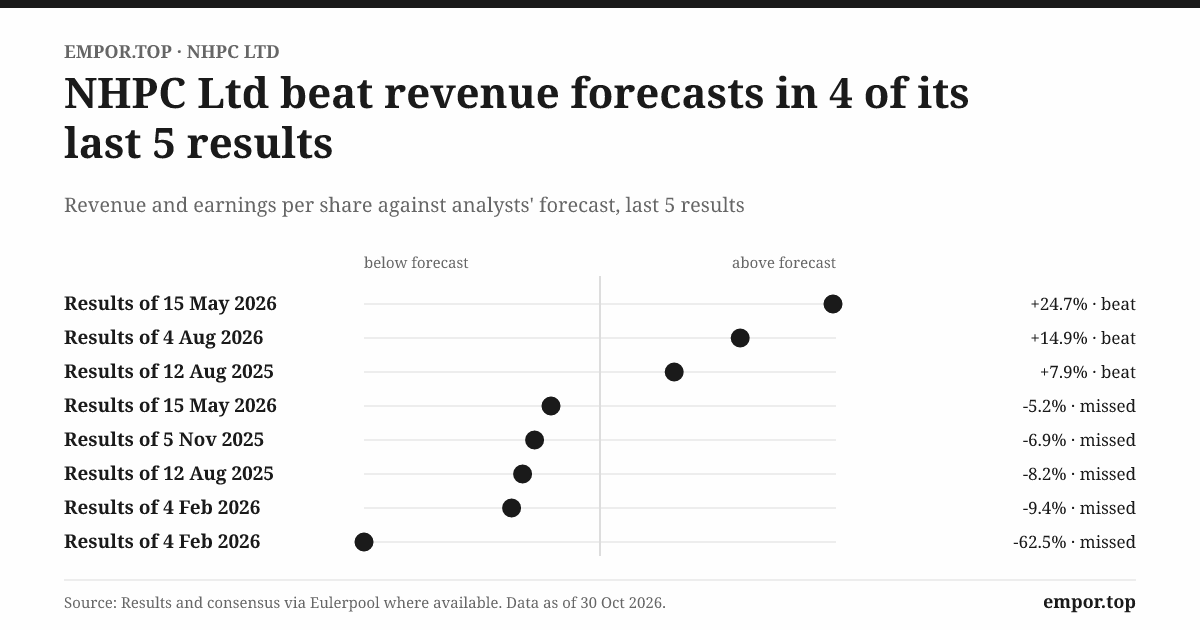
The May 2026 earnings call is the best window into how this management team talks. Gupta did not speak; the call was led by Director (Projects) Sanjay Kumar Singh, Director (Technical) Suprakash Adhikari and Director (Finance) Mahesh Kumar Sharma.5 The prepared remarks were orderly and confident: generation up 16%, revenue up 12%, reported profit up 25%, a long list of project milestones.5 The analyst questions told a more nuanced story. They kept returning to three themes: under-recovery at the new projects, the gap between actual generation and design energy, and project timelines. The answers were generally specific, with figures on booked revenue, filed tariffs and expected generation, and occasionally strikingly frank, as in the admission that cost overruns are inherent in hydro. Where management was most confident, on Pakal Dul, Kiru and Kwar ("nothing extraordinary you will find there"), it was making promises that the next two years will test.5
Some of those promises came with explicit dates. In May 2026, the finance director said he expected the regulator's final order on Parbati-II by June 30, and expected Subansiri's final order within about six months of an interim order that had not yet been issued.5 Regulatory timetables are not entirely in management's hands. But they are exactly the kind of commitment a shareholder can write down and check.
One more thing a careful listener should take from that call: the quality of the reported earnings. The headline 25% rise in FY2026 profit, to ₹3,766 crore, included a one-off deferred-tax adjustment of about ₹900 crore, arising from NHPC's move to the lower 25% corporate tax regime.5 Strip that out, as management itself suggested, and adjusted profit was about ₹2,870 crore, roughly 5% below the prior year's ₹3,007 crore. Further down the income statement, other income matters too.
At the standalone level, other income was about ₹1,322 crore against profit before tax of ₹3,352 crore, roughly 39%, including about ₹473 crore of dividends from subsidiaries, mainly NHDC, and about ₹442 crore of insurance claims, partly tied to flood losses.7 Insurance recoveries do not recur on purpose, and subsidiary dividends are, in effect, the group moving cash around.
So the credibility test for Gupta's team is measurable and close at hand. Can the remaining Subansiri units arrive by March 2027, as promised? Will the regulator issue final tariff orders for Parbati-II and Subansiri that recover the filed costs? Will plant availability climb back toward the 80% normative level now that Teesta-V is running again? And will debt growth slow as projects start earning? Each of those questions has a date attached. Which brings the story to the question every investor ultimately has to answer.
IX. The Investment Case: A Growing Fleet or a Growing Burden?
At 17.5 times trailing earnings, investors are paying close to NHPC's own five-year median multiple for a company whose construction spending now exceeds its operating revenue. That is the puzzle at the centre of the investment case. The market is not pricing NHPC as a distressed developer, nor as a fast-growing one. It is pricing it as roughly normal. Is that the right answer?
Start with the long-run record, because it is less flattering than the recent headlines. Revenue grew about 4.1% a year over the five years to FY2026; net profit, on a consistent basis, fell about 3.2% a year over the same period, and about 10.7% a year over the last three.7
Over a full decade, net profit barely grew at all: about 0.7% a year.7 Return on equity fell to 6.7% in FY2026, return on capital employed to 3.9%, debt-to-equity rose to 1.26, and free cash flow was negative.7 That is not the profile of a growth company. It is the profile of a company in the expensive middle of a transition whose payoff has not yet arrived.
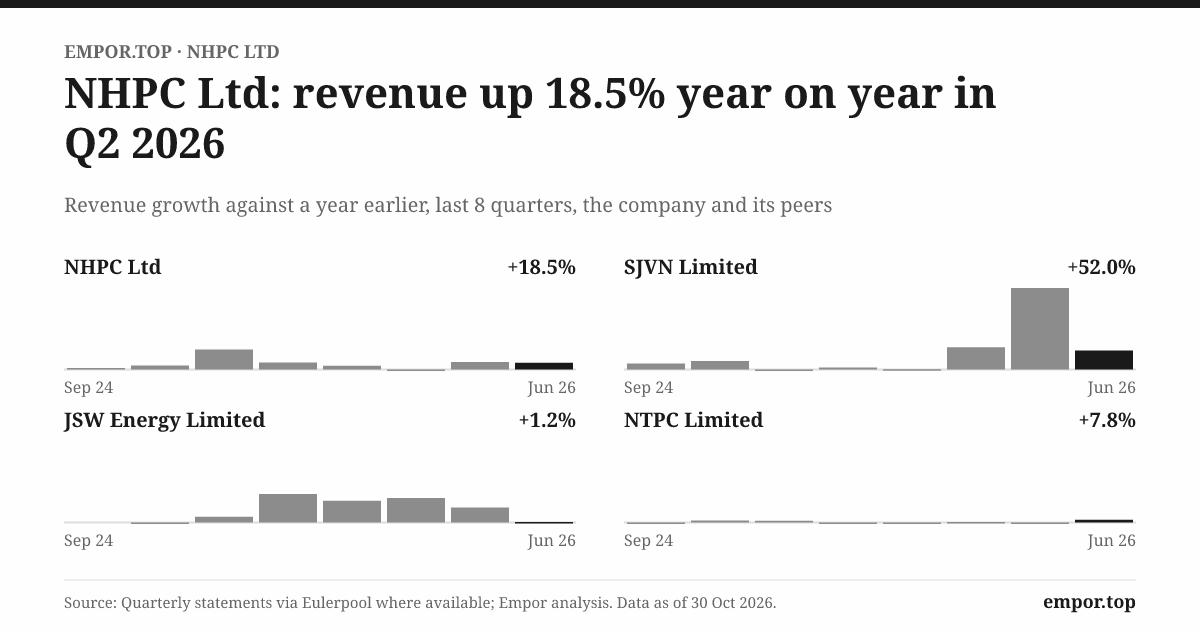
The bull case begins exactly there: the payoff is arriving. Generation rose 16% in FY2026 as Parbati-II and the first Subansiri units came online.5 In the first quarter of FY2027, standalone revenue from operations rose about 19% from a year earlier, to about ₹3,537 crore, and the consolidated profit was about ₹1,096 crore, up modestly from ₹1,065 crore.31 Teesta-V is generating again.14 If the near-term hydro pipeline arrives roughly as planned, regulated equity could rise by around two-thirds within a year, with 40-year agreements and regulated returns attached to every new megawatt.513 Government backing and an AAA credit rating keep the cost of financing low, and CARE judges liquidity as strong, with room to raise more debt.13 And the long-term demand story favours hydro: as solar and wind expand, the system value of dispatchable power and pumped storage should rise, potentially making NHPC's sites more valuable, not less.
The bear case is the same set of facts read in a different order. Subansiri and Parbati-II show that delays and cost escalation can impair project economics so badly that even a regulated return on the inflated cost may not satisfy a buyer, or the regulator. Even on full filed tariffs, Parbati-II would have earned only about ₹150 crore in its first year on a ₹13,000-crore asset.5 Plant availability fell in FY2026, and the fleet's exposure to floods, silt and cloudbursts is structural, not cyclical.5 New projects require years of debt before they generate a rupee, and CARE expects debt to stay above eight times EBITDA through a ₹53,000-crore spending plan.13 Return on capital employed at 3.9% is low by any standard relative to the capital being deployed.
Cash quality sits in the middle. Over twelve years, operating cash flow comfortably exceeded reported profit, which is what a genuinely earning asset base should produce.7 But recent free cash flow is deeply negative, and the long-run dividend total exceeded cumulative free cash flow more than three times over.7 Part of the debt now funding the dams is effectively the cash previously paid out. Customer risk has improved: overdue receivables fell from more than half of the total in 2021 to under a tenth in 2026.13 But slow-paying counterparties remain, unbilled balances are large, and the auditor has already questioned how receivables are classified.716
Pull the threads of the competitive analysis together and the shape of the advantage is clear. NHPC holds a cornered resource in its operating sites and real process know-how in Himalayan construction. Buyer power is high, prices are set by the regulator, entry into large hydro is hard, and substitution from solar plus storage is the force most likely to squeeze the value of new dams over time. That combination supports stable returns on existing stations, and an unproven return on new ones.
Valuation in that context is telling. NHPC's 17.5 times earnings compares with about 10.6 times for NTPC on the same date.32 The companies are not directly comparable: NTPC is far larger, predominantly thermal and carries a different capital structure. But the comparison makes clear that the market is not applying a discount for NHPC's execution burden. If anything, investors are paying a premium for hydro's strategic position and the step-up in earnings that commissioning promises. The earnings yield, about 5.7%, is modest for a business whose return on capital is currently lower still. The price appears to assume that the pipeline will convert into regulated earnings broadly as management describes.
What should an investor track to find out whether that assumption is right? Three numbers matter more than any others. The first is commissioned capacity against schedule: management promised about 2,994 megawatts of hydro in FY2027, and by late October one more Subansiri unit had arrived.51 The second is the plant availability factor, which fell to 74.75% in FY2026 and should recover toward the 80% normative level if Teesta-V and the repaired stations run normally.5 The third is the cash return on completed projects after final tariff orders, best seen in whether the ₹450 crore of unrecognised revenue at Parbati-II and Subansiri is approved, and whether operating cash flow begins to catch up with capital spending.5 Everything else in the investment case flows from those three. And the lessons behind them reach beyond one company.
X. Lessons from the River
Go back to the gorge at Subansiri in December 2011, when the cranes stopped and the half-built dam stood silent above the Assam plains. For eight years, nothing moved except the interest meter. Every lesson NHPC offers grows out of moments like that one, when an engineering project turned into a test of consent, execution and financing all at once.
The first lesson is this: a long contract can stabilise a power station; it cannot make the river flow on schedule. NHPC's 40-year agreements and cost-plus tariffs are genuinely valuable. But when the South Lhonak lake burst and Teesta-V went dark for nearly three years, the contract did not generate a single unit. When the Parbati-II cloudburst halved its first year's output, the tariff formula could not refill the river. The lesson for investors in any regulated asset is that the contract protects price; it does not protect volume, and in hydro, volume depends on weather, geology and repair crews as much as on demand.
The second lesson: a project's first cost is a hypothesis. Subansiri's ₹6,285 crore sanction and Parbati-II's ₹3,920 crore sanction were not lies. They were reasonable estimates made at a moment in time, before protests, tribunals, geology and two decades of inflation tested them. Both projects eventually cost several times more. For founders and investors, the wider point is that in long-duration infrastructure, the first number is the beginning of a negotiation with reality, not an answer. Project economics must be re-underwritten every time the calendar slips, because the cost of delay is not linear: it compounds.
The third lesson: cash paid out is capital not reinvested. NHPC's dividends have exceeded the free cash its business produced over the past twelve years. That might have been harmless if the fleet had stayed mature. It is not harmless when the company is borrowing to build the biggest construction programme in its history. A dividend is always a choice about where the next rupee of capital comes from, and at NHPC that choice has been made, repeatedly, in favour of the controlling shareholder's budget over the balance sheet.
The fourth lesson: state backing opens doors; it does not close the execution gap. Government ownership and support helped NHPC secure sites, clearances and an AAA rating. It kept Subansiri alive through eight years of standstill when a private developer might have been forced to sell.
But the same backing did not deliver the dam on time, did not prevent a fivefold cost increase, and does not guarantee the regulator will approve every rupee. Sovereign support is a credit enhancement, not an operating capability. For investors in any state-controlled infrastructure company, the useful question is not "will the government stand behind it?" but "will each project earn a return that a minority shareholder would accept?"
There is a final distinction worth carrying out of the gorge. Building a national asset and earning an adequate return on it are two different achievements. NHPC has achieved the first, repeatedly and against considerable odds. The rivers of the Himalayas do turn its turbines, and India's grid is cleaner and more stable for it. The second achievement is still being written, and the next few years will decide whether the ink is black or red.
XI. Epilogue
Tonight, NHPC stands at the midpoint of its most ambitious decade. Its newest stations are running, the next projects are advancing, and the company is spending heavily and borrowing more.
The next moments that will decide the story are already on the calendar. The remaining three units at Subansiri are promised by March 2027.5 A finish on that schedule would be a meaningful break from the project's long record of moved dates. A further slip would tell investors that even the last mile of NHPC's flagship project resists the timetable.
The second is the regulator. Final tariff orders for Parbati-II, and interim and then final orders for Subansiri Lower, will determine how much of the roughly ₹450 crore of unrecognised revenue is real and how much of the inflated capital cost is allowed into the tariff.5 A full approval would validate the bull case's central mechanism: that cost-plus regulation protects shareholders from the cost of delay. A material disallowance would show the limits of that protection.
The third is the operating fleet. Plant availability fell in FY2026.5 With Teesta-V back, availability should recover; if it does not, investors will learn that the fleet's maintenance burden is heavier than management's 80%-excluding-Teesta framing suggested. Alongside it, watch overdue receivables, particularly the Kashmiri utility's growing balance, and whether operating cash flow begins to close the gap with project spending and borrowing.
The fourth is the pipeline itself. The company says it intends to push several large projects into construction in the current fiscal year.5 Each will deserve attention only as physical progress and revised cost data arrive, not as headlines.
What would change the thesis? Consistent project delivery close to promised dates, final tariffs approving most of the filed capital costs, availability back toward 80% and debt growth slowing as new stations start earning would together strengthen the growth case considerably. Further slippage at Subansiri or the Chenab projects, disallowed costs, weak availability and rising debt without corresponding earnings would weaken it, and would suggest that the market's ordinary multiple is pricing a smoother future than the company's history supports.
The tension that remains is the one that has followed NHPC since 1975. The company exists because some infrastructure is too long, too risky and too political for anyone but the state to build. The same characteristics make it hard for that infrastructure to reward a shareholder who does not share the state's patience.
XII. Outro
Return, one last time, to the gorge on the Subansiri. The river that once forced eight years of silence on the project now pours through five turbines, while three more units wait in the powerhouse for their turn. Somewhere downstream, the same water that will keep a city's lights on after sunset is also the water a farming family in Assam once feared would come down all at once.
That double image is NHPC. It is both the promise and the price of building power infrastructure at Himalayan scale: the patience to finish what others would abandon, and the bill that patience runs up along the way. NHPC can make the river work for India. The next test is making the capital work for NHPC.
References
-
NHPC Commissions 250 MW Unit 5 at Subansiri Lower Hydroelectric Project, Boosting Capacity to 1,250 MW — Indian Masterminds, 2026-10-22 ↩↩↩↩
-
NHPC declares commercial operation of hydropower unit — Energy Global, 2026-01-05 ↩↩↩↩
-
Lower Subansiri hydroelectric power project, Rajya Sabha Unstarred Question No. 1026 — Ministry of Environment, Forest and Climate Change, 2025-02-13 ↩↩↩↩↩↩
-
NHPC project cost revisions, including Subansiri Lower and Parbati-II — Ministry of Power ↩
-
Q4 FY2026 Earnings Conference Call transcript — NHPC Limited, 2026-05-18 ↩↩↩↩↩↩↩↩↩↩↩↩↩↩↩↩↩↩↩↩↩↩↩↩↩↩↩↩↩↩↩↩↩↩↩↩↩↩↩↩↩↩↩↩↩↩↩↩↩↩↩↩↩↩↩↩
-
NHPC project portfolio and installed capacity — NHPC Limited, 2026-10-30 ↩↩↩↩↩↩↩↩↩↩↩
-
NHPC Limited Annual Report FY2026, including audited financial statements — NHPC Limited, 2026-08-05 ↩↩↩↩↩↩↩↩↩↩↩↩↩↩↩↩↩↩↩↩↩↩↩↩↩↩↩↩↩↩↩
-
NHPC 41st Annual Report, FY2016–17 — NHPC Limited, 2017-08-23 ↩
-
NHPC Limited — Final Offer Documents filed with ROC — SEBI, 2009-08-26 ↩
-
Rating Rationale and Rating Action, NHPC Limited — CARE Ratings, 2026-05-21 ↩↩↩↩↩↩↩↩↩↩↩↩↩↩↩↩↩↩↩
-
Teesta-V fully back online: NHPC restarts third and final unit, nearly 3 years after Sikkim flood — PSU Watch, 2026-07-16 ↩↩↩
-
Auditor and CAG Supplementary Audit Report FY2025 — NHPC Limited, 2025 ↩↩
-
Subansiri Lower Hydroelectric Project — Drishti IAS, 2023-11-08 ↩↩↩↩↩↩
-
NHPC commissions Unit 3 of 2,000 MW Subansiri Lower HEP — Power Line, 2026-02-03 ↩
-
Power generation begins from all four units of NHPC's Parbati Hydroelectric Project, Stage-II — NHPC Limited, 2025-04-17 ↩↩
-
Completed after 25 years, Parbati power project to generate Rs 270 crore for state — The Tribune, 2025-03-29 ↩↩
-
Rs 244 crore cost overrun for NHPC in 800 MW Himachal Pradesh unit: CAG — The Economic Times, 2012-08-31 ↩
-
Foundation stone for Dibang Multipurpose Hydropower Project — Press Information Bureau, 2024-03-09 ↩
-
Annual Report 2025–26 — Ministry of Power, Government of India ↩
-
SECI's 1.2GW ISTS solar auction draws lowest bid of 2.55 rupees — PV Tech, 2019-02-25 ↩
-
SECI Concludes 2,000 MW Solar and 1,000 MW/4,000 MWh Energy Storage Auction at ₹2.86 per kWh — SolarQuarter, 2025-10-16 ↩
-
Shri Bhupender Gupta, Chairman & Managing Director — NHPC Limited ↩↩↩↩↩
-
Shri Bhupender Gupta takes charge as NHPC Chairman and MD — Water Power & Dam Construction, 2025-09-16 ↩↩
-
PESB recommends THDC India director Bhupender Gupta for NHPC top job — The Week (PTI), 2025-06-11 ↩
-
NHPC declares financial results for Quarter I of FY2026–27 — NHPC Limited, 2026-08-05 ↩
 LinkedIn
 WhatsApp
 Reddit
 Hacker News
 Email
 Kindle
 RSS Feed
 Spotify
 Apple Podcasts
 Amazon Music
 Audible
 YouTube