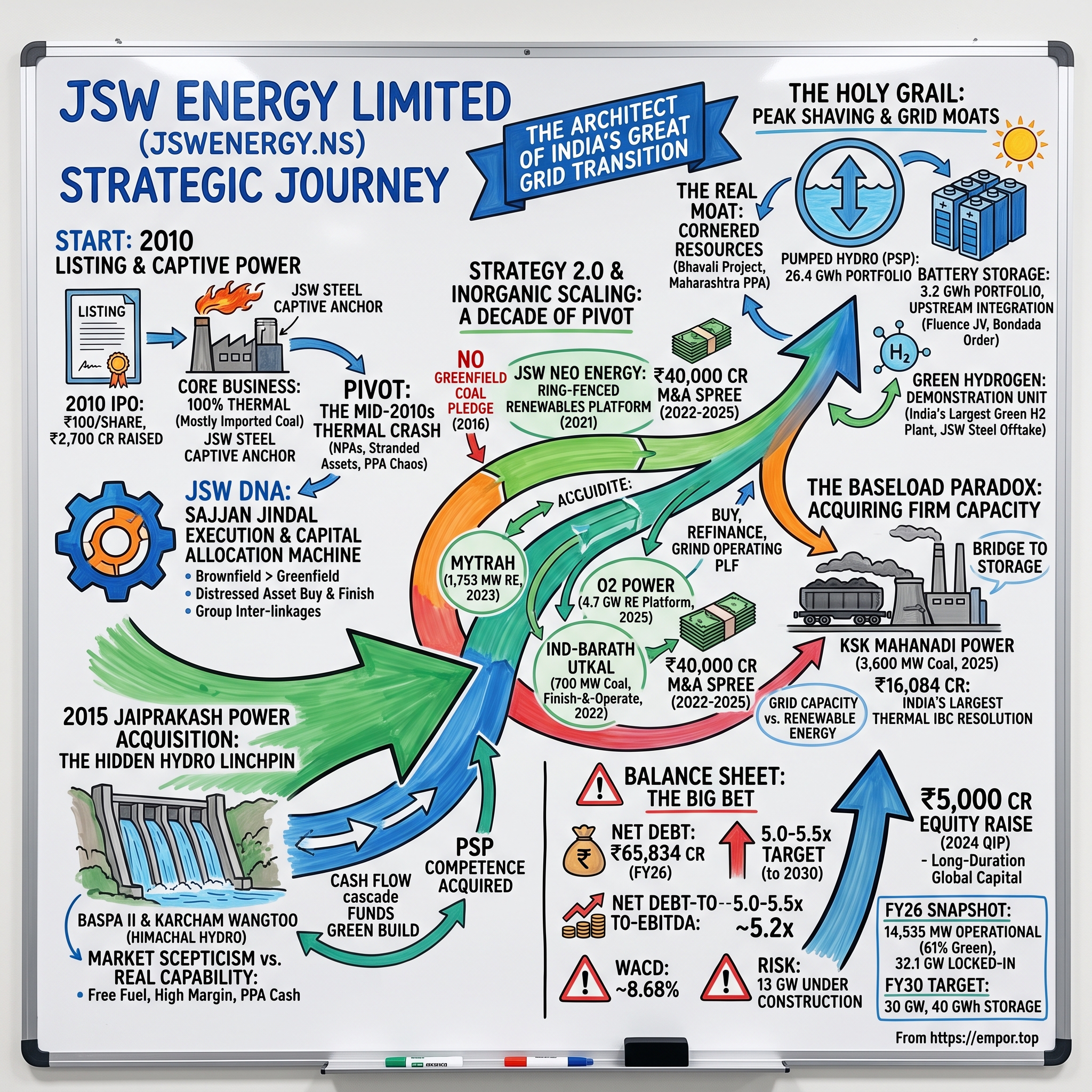
JSW Energy: The Architect of India's Great Grid Transition
I. Introduction & Episode Roadmap
On January 4, 2010, a mid-sized Indian power company listed its shares on the Bombay and National stock exchanges at ₹100 apiece, having raised roughly ₹2,700 crore from investors who were, frankly, not especially excited.12 The pitch was straightforward and slightly boring: JSW Energy burned coal, mostly imported, at plants in Karnataka and Maharashtra, and sold a large slice of the output to its sister company, JSW Steel. It was a captive utility with ambitions. In the India of 2010 — an India that was adding coal capacity faster than almost any country on earth — that was a perfectly respectable thing to be.
Sixteen and a half years later, the company looks almost nothing like that. As of July 8, 2026, JSW Energy operated 14,535 MW of generation capacity, of which 8,877 MW — about 61% — was renewable: wind, solar, hybrid, and hydro.3 Its locked-in generation portfolio, counting everything operational, under construction, and in advanced development, stood at 32.1 GW. Alongside that, it had contracted 29.6 GWh of energy storage — 26.4 GWh of pumped hydro and 3.2 GWh of batteries.3 In November 2025 it commissioned what it described as India's largest green hydrogen plant, sitting on the fence line of a steel mill.4
That is a genuinely unusual corporate transformation. Plenty of legacy utilities announce green pivots. Very few actually move the capacity mix from majority-thermal to majority-renewable inside a decade while simultaneously buying a 3,600 MW coal plant out of bankruptcy court. JSW Energy did both, more or less at the same time, and that apparent contradiction is the most interesting thing about the story.
The transition thesis worth interrogating is this: can you pivot a heavy industrial carbon business into a diversified clean energy platform and keep the returns intact? Management's answer, repeated across investor presentations since 2021, is yes — that legacy thermal and hydro cash flows fund the green build, and that the combination of firm baseload and dispatchable storage is worth more than either piece alone. That is a coherent story. It is not yet a proven one. In FY26, the year ended March 31, 2026, JSW Energy's net debt reached ₹65,834 crore against EBITDA of ₹11,041 crore — a net debt-to-EBITDA ratio of roughly 5.2 times, and a net-debt-to-equity ratio of 2.1 times.56 That is a balance sheet in the middle of a very large bet.
Here is where this story goes.
We start with the JSW Group's industrial DNA and Sajjan Jindal's capital allocation instincts, because you cannot understand JSW Energy without understanding that it is, culturally, a steel company that happens to sell electrons. Then the foundation years: captive thermal power as a moat for steelmaking, and the extraordinary sector-wide collapse of Indian thermal in the mid-2010s that JSW walked through mostly unscathed.
Then the pivot that made everything else possible — the 2015 purchase of two Himalayan hydro plants from a collapsing infrastructure empire, a deal the market hated and which turned out to be the linchpin. From there, the green architecture: the "no new greenfield coal" decision, the creation of JSW Neo Energy as a ring-fenced clean vehicle, and the utility-scale bidding machine.
Then the acquisition spree — Mytrah, O2 Power, Ind-Barath, and the blockbuster KSK Mahanadi resolution — which is where the company's identity as an operator gave way to an identity as a serial consolidator. Then storage, the piece management believes is the real moat, and green hydrogen, which is currently more optionality than business. Then the balance sheet: the landmark 2024 equity raise that funded all of it, and what leverage looks like now. Then the frameworks — Helmer's 7 Powers, Porter's Five Forces — applied without the usual flattery. And finally the investment spine: why this wins from here, and what would break it.
The through-line is a question every industrial investor eventually faces. When the technology under your business changes, do you defend the old asset base or cannibalise it? JSW Energy chose a third answer: milk the old, buy the distressed, and use both to fund the new. Whether that is genius or over-reach is exactly what the next several hours are for.
 Subscribe on LinkedIn
II. JSW Group DNA & The Sajjan Jindal Capital Allocation Machine
There is a particular species of Indian industrialist that Western investors consistently misread. They look at a sprawling conglomerate — steel, cement, paints, ports, energy, a football club, a Formula-E team — and see undisciplined empire-building. Sometimes they are right. But the JSW Group under Sajjan Jindal is a more specific animal: it is an execution machine built around a single repeatable skill, which is putting very large capital projects into the ground faster and cheaper than the people it competes with.
Jindal is a second-generation entrepreneur. His father, O.P. Jindal, built a pipe-and-steel business from a bucket-manufacturing shop in Haryana; on his death in 2005 the empire was divided among four sons, and Sajjan took the South-West cluster — hence Jindal South West, JSW. What he did with it is the relevant part. Over two decades JSW Steel became one of India's largest steelmakers, and around it Jindal assembled cement, paints, infrastructure, ports, and energy. In April 2026 he was named The Economic Times Business Leader of the Year for 2025, which is the sort of recognition that arrives after, not before, a track record.7
The JSW method has a recognisable signature, and it matters enormously for how you underwrite JSW Energy. First: build brownfield wherever possible. Adding capacity at an existing site — shared land, shared evacuation infrastructure, shared workforce, existing environmental clearances — is dramatically cheaper per megawatt than starting from scratch. Second: obsess over capex per unit of output rather than headline project size. Third: buy distressed assets and finish them. India's insolvency regime, created by the Insolvency and Bankruptcy Code of 2016, produced a decade-long supply of half-built industrial assets sold at a fraction of what they cost to construct. JSW became one of the most active buyers in that market, across both steel and power.
Fourth, and least discussed: JSW manages the interface between group companies aggressively. JSW Energy sells power to JSW Steel. JSW Energy now sells green hydrogen to JSW Steel. JSW Infrastructure handles the ports. This is a real commercial advantage — a guaranteed, creditworthy anchor customer is worth a great deal in a sector where the standard customer is a bankrupt state distribution utility. It is also, unavoidably, a governance question. Related-party transactions between listed group entities require investors to take on faith that transfer pricing is fair. JSW discloses these arrangements in its filings, and no regulator has taken issue with them, but a sceptical investor is entitled to ask whether the captive offtake is priced to benefit the energy shareholder or the steel shareholder. The answer is not knowable from outside.
Promoter alignment is high by any measure. Promoter and promoter-group holding in JSW Energy stood at roughly 69% as of April 2026, with foreign institutions around 11% and domestic institutions around 16%.8 High promoter ownership cuts both ways for minority investors. It means the controlling family's wealth rises and falls with the share price — genuine skin in the game. It also means minorities have essentially no ability to force a change in strategy if they disagree with it. When management commits ₹16,000 crore to a new coal plant, or takes leverage to 5.2 times EBITDA, there is no activist path to challenge that decision. You are along for the ride.
Day-to-day execution sits with Sharad Mahendra, who became Joint Managing Director and CEO in February 2024. His profile is instructive: a mechanical engineer from NIT Allahabad, roughly 33 years of operating experience across steel, power, chemicals and automobiles, and 15 of those years inside the JSW Group.9 Immediately before taking the energy job he ran JSW Steel Coated Products, where his mandate included organic capacity expansion and the integration of two acquired assets. In other words, JSW did not hire a power-sector strategist to run its energy pivot. It promoted an industrial operator with an acquisition-integration track record — which tells you precisely what the board thought the job actually was.
The finance function turned over more recently. Chandrasekaran Prabhakaran joined as CFO ahead of the Q3 FY26 earnings call in January 2026, brought in with more than 25 years of corporate finance and governance experience from large listed conglomerates.[^10] A CFO change during the most leveraged stretch in a company's history is worth noting — not as a red flag, but as a variable. The person now defending the balance sheet to lenders and rating agencies is new to the seat.
What all of this adds up to for an investor is a specific bet. You are not betting on JSW Energy's technology, or its brand, or a network effect. You are betting that a family-controlled industrial group can keep executing large, complex, capital-hungry projects on time and near budget, in a country where that is rare — and that it will not, in the process, over-extend. The evidence for the first half of that bet is strong. The second half is being tested right now.
To see why the group is temperamentally comfortable with heavy capex and long horizons, you have to go back to why JSW Energy existed in the first place. It was never designed to be a merchant power company. It was designed to keep a steel mill running.
III. The Foundation: Thermal Baseload & JSW Steel Captive Offtake (1994 - 2014)
Picture Vijayanagar, Karnataka, in the late 1990s. Dry, hot, iron-ore country in the state's north — the site of what would become one of the largest single-location steel plants in the world. And the problem with building a giant steel plant in northern Karnataka in the 1990s was not iron ore, or labour, or capital. It was electricity. Indian state grids at the time were unreliable in ways that are difficult to convey to anyone who has not run a continuous industrial process. A blast furnace does not tolerate a brownout. A rolling mill that loses power mid-pass produces scrap.
So JSW did what Indian industrialists have always done when public infrastructure fails: it built its own. JSW Energy was incorporated in 1994 for exactly this purpose, and began commercial operations in 2000 with its first thermal plant.10 The logic was defensive, not entrepreneurial. Power was an input cost and a reliability risk, and the cheapest way to control both was to own the generation.
This is the origin of what remains, three decades later, the most under-appreciated structural feature of JSW Energy's business: the group captive arrangement. Roughly a fifth of the company's operational capacity has historically been dedicated to JSW Steel under long-term captive structures. Strip away the jargon and the economics are simple, and unusually good.
Consider what a normal Indian independent power producer faces. It builds a plant, signs a power purchase agreement with a state distribution company — a DISCOM — and then waits to be paid. Indian DISCOMs have been chronically loss-making for decades, hobbled by subsidised agricultural tariffs, theft, and political reluctance to raise prices. Receivables stretch for months. Some producers have waited years. On top of that, power sent across the state transmission grid loses several percent to transmission and distribution losses, and pays wheeling charges for the privilege.
A captive plant next to the factory it powers avoids all of this. There is no long-distance transmission, so no meaningful line loss and no wheeling charge. There is no DISCOM, so no collection risk — the counterparty is another arm of a solvent industrial group with steel cash flows. And the tariff is set on a cost-plus basis with contracted returns, so the margin is stable regardless of what the merchant market is doing. It is, functionally, an infrastructure annuity embedded inside a cyclical utility.
That annuity funded the ambition. Through the 2000s JSW Energy expanded well beyond captive supply, building merchant and utility-scale thermal capacity at Ratnagiri on the Maharashtra coast and at Barmer in the Rajasthan desert — the former designed around imported coal shipped to the west coast, the latter around lignite mined locally. By the time it listed in 2010, it was a genuine independent power producer with a captive core.
And then Indian thermal power fell apart.
The mid-2010s were a bloodbath that is now half-forgotten but which shaped every strategic decision JSW Energy has made since. Three things went wrong at once. First, in September 2014 the Supreme Court cancelled 214 coal block allocations made since 1993, ruling the allocation process illegal — instantly vaporising the fuel security assumptions underpinning dozens of projects. Second, imported coal prices spiked while Indonesia changed its export pricing regulations, destroying the economics of coastal plants built specifically to burn imported coal. Third, the DISCOMs, already weak, effectively stopped signing new long-term PPAs, leaving newly built plants stranded without customers.
The result was one of the largest concentrations of industrial distress in modern Indian history. Tens of gigawatts of thermal capacity — much of it new, much of it never commissioned — became non-performing assets on bank balance sheets. Companies that had been feted as the future of Indian infrastructure went into insolvency.
JSW Energy survived, and the reasons are worth being precise about rather than romantic. Part of it was genuine conservatism: the company had not levered itself to the degree several peers had, and it had not bet the enterprise on coal blocks it did not yet own. Part of it was the captive anchor, which kept a meaningful share of revenue insulated from DISCOM chaos. Part of it was scale discipline — JSW built fewer, larger, better-sited plants rather than scattering mid-sized projects across states. And part of it, honestly, was that the group's steel business gave it staying power that standalone power developers lacked.
But it would flatter the story to pretend JSW Energy sailed through untouched. Its own imported-coal exposure at Ratnagiri hurt. Merchant realisations were weak for years. Return on equity through the mid-2010s was unremarkable. What JSW Energy really achieved in that period was not outperformance — it was solvency at a moment when solvency was itself a strategic asset. Because the companies that stayed solvent got to buy the ones that did not.
That is the essential lesson of the foundation era, and it explains everything that followed. JSW Energy learned, very early and very concretely, that in capital-intensive infrastructure the returns do not go to the best builder. They go to the best-capitalised buyer standing at the bottom of the cycle. Within a year of the sector's nadir, JSW would put that lesson to work in the most dramatic way available — by buying two of the finest generating assets in India from a seller who had no choice but to sell.
IV. The Hydrological Trojan Horse: The 2015 Jaiprakash Power Acquisition
To understand the deal, you first have to understand the seller's desperation.
The Jaypee Group — Jaiprakash Associates and its listed power arm, Jaiprakash Power Ventures — had been one of the emblematic Indian infrastructure conglomerates of the boom years. Cement, expressways, real estate, sports facilities, and hydroelectric power, funded with a debt load that made sense only if growth never stopped. Growth stopped. By 2014-15 the group was in a forced deleveraging, selling its best assets not because it wanted to but because its creditors required it.
Among those best assets were two hydroelectric plants in the Sutlej valley of Himachal Pradesh, in the high Himalaya near the Tibetan border: Baspa II, rated at 300 MW, and Karcham Wangtoo, rated at 1,091 MW. Both were run-of-the-river schemes — meaning they divert river flow through tunnels and turbines rather than impounding a giant reservoir behind a dam. Karcham Wangtoo in particular was an engineering achievement of the first order: a project built through Himalayan rock in a seismically active, landslide-prone, logistically brutal region.
In September 2015, JSW Energy agreed to acquire 100% of Himachal Baspa Power Company, the entity holding both plants, for an asset value of ₹9,275 crore, with an additional ₹300 crore payable contingent on certain further consents relating to Karcham Wangtoo.1112 It was, at the time, the largest transaction in JSW Energy's history and made it India's largest private hydropower generator.
The market's reaction was not applause. It was scepticism bordering on alarm.
The bear case was easy to articulate. JSW was paying roughly ₹6.7 crore per megawatt for assets in a sector — Indian hydro — with a well-earned reputation for cost overruns, geological surprises, litigation, and regulatory disputes over free power obligations to host states. It was doing so by taking on substantial debt at a moment when the entire Indian power sector was in distress and investors wanted balance sheets shrinking, not growing. Karcham Wangtoo, in particular, carried unresolved regulatory issues. And Himalayan hydro carries a tail risk that spreadsheets handle poorly: glacial lake outburst floods, silt loading that erodes turbines, and monsoon variability that determines output.
So did JSW overpay? The honest answer requires holding two ideas at once.
On price: ₹6.7 crore per MW for operational hydro was not a distressed steal. It was a full, negotiated price for high-quality assets. What JSW bought at that price, though, was not just megawatts — it was the elimination of time and construction risk. A greenfield Himalayan hydro project of that scale typically takes seven to ten years from clearance to commissioning, with a real probability of never finishing at all. JSW acquired two finished, grid-connected plants with long-term power purchase agreements already signed. In development terms, it bought a decade.
On economics: run-of-the-river hydro has an income statement that looks unlike almost anything else in power generation. The fuel is water, and water is free. Once the capital is sunk, the marginal cost of a unit of electricity is essentially the cost of maintenance and staff. That produces operating margins in a range thermal generation can never reach, and — critically — margins that do not compress when coal prices spike. A hydro plant is a natural hedge against exactly the fuel-cost shock that was destroying JSW's thermal peers.
And on strategy — this is the part that only became visible with hindsight — those two plants sat in a river valley with the topography that pumped storage requires, in a company that would spend the next decade learning how to build and operate large hydraulic infrastructure in difficult terrain. The Baspa deal did not just buy cash flow. It bought an institutional capability in water-based generation that JSW would later apply to the pumped-storage portfolio that now anchors its entire storage strategy. You cannot credibly bid for 26.4 GWh of pumped hydro if you have never run a hydro plant.
The financial outcome vindicated the buyer. High-margin, fuel-cost-immune, PPA-contracted cash flow arrived just as thermal cash flows were under pressure, and it kept arriving. Over the following decade, that cash flow was a meaningful part of what funded the renewable build without requiring the company to return to equity markets — which it did not do, at all, for fourteen years after listing.
There is a broader analytical point here that generalises beyond JSW. In capital-intensive infrastructure, the market consistently over-penalises the acquirer who levers up at the bottom of a cycle and under-penalises the one who preserves optionality by doing nothing. The Baspa deal was, at the moment of announcement, the riskier choice. It was also the one that created the balance sheet capacity for everything after.
Which raises the obvious next question. If the company had just acquired the best thermal-alternative cash flow in India, why did it stop building the thing it actually knew how to build?
V. Strategy 2.0 & The Green Pivot: Unleashing JSW Neo Energy (2015 - 2021)
Sometime around 2016, the arithmetic that had governed Indian power generation for fifty years quietly inverted, and most of the industry took several more years to notice.
The mechanism was solar auctions. India's Solar Energy Corporation and various state agencies had begun running reverse auctions for utility-scale solar capacity — developers bid the tariff at which they would supply power for 25 years, and the lowest bid won. Between 2010 and 2017 the winning tariffs in those auctions collapsed by roughly 80%, driven by crashing Chinese module prices, falling cost of capital, and increasingly aggressive bidding. Wind followed a similar path once India shifted from a feed-in-tariff regime to competitive auctions in 2017.
The consequence was stark. By the late 2010s, a new solar or wind project in India could deliver electricity at a tariff below the fuel-and-operating cost of many existing coal plants, let alone the all-in cost of a new one. Coal did not lose on ideology. It lost on price.
For an incumbent thermal generator, this is a genuinely difficult moment, and the range of possible responses is instructive. You can deny it — argue that intermittency makes the comparison meaningless and keep building coal. Several Indian and global utilities did exactly that, and some of them were partly right about intermittency and completely wrong about the direction of capital. You can hedge — build a little renewable capacity for the annual report while your real capex stays thermal. Or you can make a hard commitment.
JSW Energy made the hard commitment. Management drew a line: no new greenfield coal plants. All incremental growth would be green. That decision, articulated through what the company labelled Strategy 2.0, was consequential precisely because it was constraining. A company that says "we will grow renewables" has committed to nothing. A company that says "we will not build new coal" has closed off the option it knows best.
It is worth being precise about what that commitment did and did not cover, because it becomes important later. The pledge was about greenfield coal — new plants built from scratch. It did not preclude buying existing thermal assets, and it did not, in the end, prove permanent: in 2025 JSW broke ground on a new 1,600 MW ultra-supercritical coal plant at Salboni in West Bengal, of which much more shortly.13 Investors who read the 2016-vintage commitment as a permanent exit from coal read it wrong. What it actually meant was: we will not build new coal speculatively, without a contracted buyer, into a market that does not want it.
The institutional expression of the pivot came in 2021, when JSW Energy consolidated its green assets under a wholly-owned subsidiary, JSW Neo Energy. This was not a cosmetic reorganisation, and the reasons it mattered are worth spelling out for readers who do not spend their days inside project finance.
First, ring-fencing. Renewable projects are financed at the project level, against contracted cash flows, in special purpose vehicles. Housing them under a dedicated holding company keeps that debt structurally separate from the parent's obligations and makes lender security cleaner.
Second, capital access. A large and growing pool of global capital — pension funds, sovereign wealth funds, dedicated infrastructure and climate funds — is mandated to invest in clean energy and mandated not to invest in coal. A diversified utility with a 60% thermal fleet is uninvestable for those pools. A ring-fenced renewable platform inside that utility is not. Creating Neo Energy created an entity those investors could theoretically buy into.
Third, and most speculatively, optionality on structure. A cleanly separated green platform is the necessary precondition for any future demerger, stake sale, or separate listing. JSW has not committed to any of these. But the architecture makes them possible, and Indian conglomerates have a long history of eventually monetising separately-listed subsidiaries. Investors should treat this as unpriced optionality rather than a plan.
Beneath the structure, the operating machine got to work. JSW Neo Energy became a regular participant in central and state renewable auctions, competing against a field that included Adani Green, ReNew, Tata Power Renewables, Avaada, and the state-owned giant NTPC. Winning those auctions is almost entirely a function of two things: cost of capital and cost of equipment. Tariff bids in a 25-year contracted asset are dominated by the discount rate. A developer borrowing at 8.5% can bid a materially lower tariff than one borrowing at 10.5% and still earn the same equity return. JSW's group pedigree, investment-grade domestic ratings — the parent carries an ICRA AA rating — and relationships with Indian lenders gave it a genuine funding edge over smaller independent developers.14
But here is the uncomfortable truth about auction-won renewables that any honest analysis has to confront: it is a commodity business with a regulated-utility return profile and none of the moat. Everyone bids into the same auctions with the same modules from the same Chinese and Indian suppliers. The winner is whoever accepts the lowest return. Scale helps at the margin, but it does not create pricing power. A pure-play renewable IPP in India is, structurally, a spread business between cost of capital and contracted tariff.
Which is precisely why JSW did not stop there. If organic bidding is a low-return grind, the alternative is to buy capacity that someone else already built — ideally from a seller who needs to sell.
VI. The Inorganic Scaling Engine: Mytrah, O2 Power, & Ind-Barath (2022 - 2025)
Between December 2022 and April 2025, JSW Energy spent roughly ₹40,000 crore acquiring other people's power assets. That is not a growth strategy bolted onto an operating company. That is a company whose primary competence had become capital deployment.
The pattern is consistent enough to describe as a playbook. Find portfolios where the seller is constrained — by fund life, by leverage, by insolvency. Underwrite the assets on operating metrics rather than promoter narrative. Pay a price that clears the seller's floor but sits below replacement cost or below what strategic buyers with higher costs of capital could justify. Then refinance the acquired debt at JSW's cost of borrowing and grind up the operating performance. The value creation is not in the purchase price. It is in the refinancing spread and the operational delta.
Mytrah Energy: the template
The first large test came in March 2023, when JSW Neo Energy completed the acquisition of a 1,753 MW renewable portfolio from Mytrah Energy (India) — ten wind SPVs totalling 1,331 MW and seven solar SPVs totalling 422 MW, spread across southern, western and central India.1516 The announced enterprise value was ₹10,530 crore; the figure settled at approximately ₹10,150 crore after adjustments for net current assets under the share purchase agreements.16 It was the largest acquisition in JSW Energy's history to that point, and it lifted operational capacity by more than a third in a single stroke, from 4,811 MW to 6,564 MW.16
Why was Mytrah selling? The honest answer is that it was a leveraged independent developer that had built a large portfolio using expensive capital and was struggling under the weight of it. That is the profile of the ideal seller in this playbook — good assets, wrong balance sheet.
The synergy thesis had two legs, and they are worth separating because only one of them is genuinely difficult. The easy leg was financial: JSW could refinance Mytrah's high-cost project debt at its own borrowing rate. For a portfolio of contracted renewable assets, where revenue is fixed by PPA and interest is the largest cost line after depreciation, a couple of hundred basis points of refinancing benefit flows almost entirely to equity. This is real value creation, but it is not a competency — it is a balance sheet arbitrage that any lower-cost-of-capital buyer could execute.
The harder leg was operational: raising plant load factors on acquired wind assets. Wind PLF depends on turbine availability, blade condition, gearbox maintenance, and grid curtailment management. A neglected wind farm loses several percentage points of output to downtime that better O&M recovers. That improvement is real, durable, and does require capability. JSW has consistently claimed operational uplift across acquired portfolios; investors should track it through the disclosed PLF data rather than take it on faith, because it is the part of the thesis that distinguishes an operator from a financier.
Ind-Barath Utkal: finishing what others could not
Running in parallel was a smaller but more revealing transaction. In December 2022, JSW Energy completed the acquisition of Ind-Barath Energy (Utkal) — a 700 MW coal plant (two units of 350 MW) at Jharsuguda in Odisha — for ₹1,047.6 crore under the insolvency process, taking 95% of the equity with secured financial creditors retaining 5%.17 The resolution plan had been approved by the committee of creditors back in October 2019 and cleared by the Hyderabad bench of the NCLT in July 2022 — a three-year gap that tells you something important about the pace of Indian insolvency resolution.
The asset was a mess. Unit I had been commissioned in 2016 but sat idle under financial stress. Unit II had never been completed. JSW paid roughly ₹1.5 crore per MW against a new-build cost of something like ₹8-9 crore per MW — but of course you cannot compare those numbers directly, because JSW then had to spend real money finishing Unit II and restarting Unit I. It did. Unit II was synchronised to the grid in January 2025 and received its commercial operation date certificate in March 2025, bringing the station to full 700 MW output.17
Ind-Barath is the small deal that proves the capability. Buying a stalled construction project and finishing it requires engineering depth that pure financial acquirers do not have. It is precisely the skill the JSW Group built across steel. And it is the credential JSW carried into a transaction an order of magnitude larger.
O2 Power: buying scale from a fund
The largest renewable acquisition came in April 2025. JSW Neo Energy completed the purchase of O2 Power — a 4.7 GW renewable platform — for an enterprise value of approximately ₹12,468 crore, roughly US$1.44 billion.1819
O2 Power's provenance matters. It was established in 2020 as a platform backed by EQT, the Swedish private equity house, and Temasek, Singapore's sovereign investor. This was not a distressed seller. It was a fund-backed platform reaching the point in its life where sponsors seek an exit, and JSW was buying at what the sellers presumably judged a fair price.
The economics disclosed at the time were specific and therefore testable. Of the 4.7 GW platform, installed capacity at closing was 1,343 MW.19 Roughly 2,259 MW was expected to be operational by mid-2025, generating steady-state EBITDA of about ₹1,500 crore. Reaching the full 4,696 MW would require approximately ₹13,500 crore of additional capital expenditure, with full capacity targeted by June 2027 and steady-state annualised EBITDA of about ₹3,750 crore at that point.19
Read those numbers carefully, because they reframe the deal. JSW did not pay ₹12,468 crore for 4.7 GW. It paid ₹12,468 crore for 1.3 GW operational plus the right and obligation to spend another ₹13,500 crore building the remaining 3.4 GW. The all-in commitment was closer to ₹26,000 crore. On management's own projected steady-state EBITDA of ₹3,750 crore, that implies roughly seven times EBITDA on a fully-built basis — a reasonable but not cheap multiple for contracted renewables, and one that depends entirely on the remaining capacity being built on time, on budget, and with PPAs in place.
That is the crux of the sceptical case on O2. Buying a pipeline is buying execution risk, and Indian renewable pipelines have a long history of slipping on land acquisition, transmission connectivity, and — increasingly — the gap between winning a letter of award and actually signing a PPA with a willing DISCOM. Management acknowledged this pressure directly on the Q3 FY26 call, where the difficulty of converting letters of award into signed PPAs, with roughly 4.5 GW awaiting contracts, was a recurring theme in analyst questions.20 That is a candid disclosure and appropriately worrying. Capacity without a contract is capital tied up earning nothing.
What the three deals collectively demonstrate is a company that has industrialised acquisition. The upside is obvious: JSW added more capacity through M&A in three years than most developers build in a decade, at prices below what greenfield would have cost. The downside is equally real: serial acquirers accumulate integration debt, and leverage compounds faster than EBITDA when a large share of the acquired asset base is still under construction. That is exactly what the FY26 balance sheet shows.
And none of it explains the strangest capital allocation decision of the entire sequence — which was to spend more on a single coal plant than on any renewable transaction in the company's history.
VII. The Baseload Paradox: Why KSK Mahanadi and Thermal Stressed Assets Matter (2025)
In March 2025, a company that had spent nine years telling investors it was becoming a clean energy champion paid ₹16,084.08 crore for a coal-fired power station.2122
The asset was KSK Mahanadi Power Company: 3,600 MW of domestic-coal-fired capacity in Chhattisgarh, in the heart of India's coal belt. JSW acquired 74% of the equity through the insolvency resolution process, with secured financial creditors collectively holding the remaining 26% under the terms of the resolution plan.21 It was the largest acquisition of a thermal power asset ever completed under India's IBC framework.22
The market reaction was, predictably, split. ESG-oriented investors saw a company reneging on its transition narrative. Value-oriented investors saw a large, cheap, contracted cash generator. Both readings contain something true.
Start with the case for the defence, which is stronger than the headline suggests.
Indian electricity demand is growing at a rate that renders European or American decarbonisation debates largely inapplicable. Peak demand has been climbing at high single digits annually as air conditioning penetration, industrialisation, electric mobility and — increasingly — data centre load compound. India is not replacing generation. It is adding it, at scale, for decades.
And here the physics becomes unavoidable. Solar generates when the sun shines, which in India means a pronounced midday peak and nothing at all in the evening. Wind is seasonal and, as JSW itself experienced in FY26, weather-dependent in ways that make quarterly earnings lumpy. Grid demand, meanwhile, peaks in the early evening — precisely when solar output goes to zero. Something has to be dispatchable: capable of being turned up on command. Today, in India, that something is overwhelmingly coal, with hydro and a rapidly growing but still small storage fleet filling the rest.
A useful way to think about it: renewables produce energy, but grids need capacity — the guaranteed ability to serve load at the worst moment of the worst day. Those are different products, and until storage is deployed at enormous scale, thermal plants are the ones selling the second product.
Which means that a 3,600 MW coal station with domestic coal linkage and contracted offtake is not a stranded asset in the India of the 2020s and 2030s. It is a cash machine attached to a structural shortage.
Now the numbers, without the promotional gloss. At ₹16,084 crore for 3,600 MW, JSW paid roughly ₹4.5 crore per MW. New ultra-supercritical coal capacity in India costs something in the region of ₹8.5-10 crore per MW — JSW's own Salboni project, at ₹16,000 crore for 1,600 MW, implies ₹10 crore per MW.13 So the KSK price represented a meaningful discount to replacement cost, roughly half. But it was not the fire-sale ₹1.5 crore per MW of Ind-Barath. It was a full, competitively-bid price for a large asset in a market where thermal had come back into fashion. Anyone describing KSK as a steal is not looking at the arithmetic.
The company followed up in August 2025 by acquiring a majority stake in KSK Water Infrastructures, the entity supplying water to the plant — an unglamorous but essential piece of vertical integration, since a thermal station without secured water is not a thermal station.
The strategic logic that ties the coal purchase to the green build is what management calls, in effect, a cash-flow cascade: thermal and hydro assets with contracted offtake and predictable output generate free cash flow, which funds equity contributions into renewable and storage projects that are far more capital-hungry up front. The "dirty" business finances the "clean" one.
This is intellectually coherent and it is also exactly the argument every diversified fossil incumbent makes. The question an investor should ask is whether the cascade is real or rhetorical — whether thermal cash actually funds green capex, or whether the company simply borrows for everything and the thermal narrative provides cover. The FY26 numbers give a partial answer, and it is not entirely comfortable: net debt of ₹65,834 crore against EBITDA of ₹11,041 crore says that whatever cash the thermal fleet is generating, it has not been sufficient to fund the growth without very substantial borrowing.56
There is a further risk that deserves naming rather than burying. Thermal assets carry long-dated regulatory and environmental exposure that does not show up in a discounted cash flow. Indian emission norms for sulphur dioxide and particulate matter have been repeatedly tightened and repeatedly deferred; whenever they finally bite, retrofit capex on a 3,600 MW station is substantial. Carbon pricing, currently absent in India, is not permanently impossible. And a portfolio that is 39% thermal by capacity will limit the pool of global capital willing to fund the group, which is not trivial for a company that needs continuous access to debt markets.
The honest summary is that KSK was a defensible financial decision with an unresolved narrative cost. JSW bought firm capacity at a discount to replacement in a market short of firm capacity. It also demonstrated that its green commitment is a commercial position rather than a principle — which is arguably more investable, and definitely less quotable.
The counter-argument management makes is that thermal is a bridge, not a destination, and that the destination is storage. That claim deserves its own examination, because if it is true, it is the only part of this business with a genuine moat.
VIII. The Holy Grail of the Grid: Pumped Hydro (PSP), Battery Storage, & Green Hydrogen
Here is the problem that will define Indian electricity for the next twenty years, stated as simply as possible.
Imagine a grid where solar has grown so large that at one in the afternoon on a mild March day, generation exceeds demand. The grid operator has no choice but to curtail — to instruct solar plants to stop producing, unpaid. Then at eight in the evening, when everyone comes home and turns on the air conditioning, the sun has set and the same grid is desperately short. The energy exists. It simply exists at the wrong time.
Storage solves this by moving energy across hours. And the entity that owns the storage occupies an extraordinarily valuable position: it buys power when it is nearly free and sells it when it is scarce. Storage does not compete with renewables. It monetises their weakness.
JSW Energy has bet very heavily on this. Its locked-in storage portfolio stood at 29.6 GWh as of mid-2026 — 26.4 GWh of pumped hydro and 3.2 GWh of batteries — against a stated target of 40 GWh by 2030.323
Pumped hydro: the water battery
Pumped storage is a nineteenth-century idea executed at twenty-first-century scale. You build two reservoirs at different elevations. When power is cheap, you run pumps to move water uphill. When power is expensive, you release it back down through turbines. Round-trip efficiency is typically around 75-80% — you lose a fifth of the energy — but the storage medium is water, it lasts for eighty years, and there is no degradation curve of the kind that afflicts lithium-ion.
The critical point for investors is not the technology. It is the geography. A pumped storage site requires a specific and rare combination: sufficient elevation difference over a short horizontal distance, suitable geology for reservoir construction, water availability, proximity to transmission, and the absence of protected forest or dense settlement. Sites meeting all those criteria are finite, identifiable, and — once granted to a developer under state concession — unavailable to anyone else.
That is a cornered resource in the strictest sense. It is not a brand, or a network, or a cost advantage that a better competitor could erode. It is a physical location that either you have or you do not.
JSW moved early to lock these up across Maharashtra, Karnataka, Telangana and elsewhere, and has been converting concessions into contracts. The most significant is the Bhavali project in Maharashtra's Nashik and Thane districts, where JSW Energy PSP Two signed an energy storage facility agreement with the Maharashtra State Electricity Distribution Company for 1,500 MW with 12,000 MWh of storage — an eight-hour discharge duration, targeted for completion within 48 months.2425 Further storage agreements cover offtakers including the Uttar Pradesh distribution utility and Karnataka's procurement agency.23
Eight-hour duration matters. Most battery projects contracted in India today are two- to four-hour systems, adequate for evening peak shaving. An eight-hour asset can genuinely shift bulk energy across the day, which is a different and more valuable service.
The bear case on pumped storage is equally concrete, and it is about time and cost. These are civil engineering megaprojects — tunnels, dams, powerhouses, often in remote terrain — with construction periods of four to six years and a global track record of overruns. Land acquisition in India is politically fraught. Environmental clearances are slow. And the competitive threat is that battery costs, which have fallen relentlessly, could make four-hour lithium systems economically superior before an eight-hour pumped hydro asset is even commissioned. JSW is making a multi-billion-dollar bet on a technology with a five-year construction lead time against a competing technology whose cost falls roughly 10-15% a year. That is not a trivially safe bet.
Batteries: the fast-moving flank
JSW has hedged accordingly. Its battery portfolio stands at 3.2 GWh of contracted capacity, including a 1.0 GWh project for the Solar Energy Corporation of India in Rajasthan.23 More interestingly, the company has moved upstream: JSW Energy operates a battery assembly facility in Pune with 5.0 GWh of annual capacity, and formed a joint venture with Fluence — the Siemens-AES storage venture — to deploy systems across Karnataka and Maharashtra.23 In July 2026, a JSW Energy arm secured a battery storage order worth approximately ₹4.4 billion from Bondada Engineering, indicating the assembly business is selling to third parties, not just internally.26
Vertical integration into battery assembly is a characteristic JSW move — the same instinct that led the group into steel processing and wind blade manufacturing under a technology licence from SANY.10 Whether it creates durable value is unclear. Battery pack assembly is a competitive, thin-margin activity where the value sits in cells, and JSW does not make cells. The strategic case is supply security and cost visibility for its own projects rather than a standalone profit pool.
Green hydrogen: real plant, immaterial economics
In November 2025, JSW Energy commissioned what it described as India's largest green hydrogen plant, adjacent to JSW Steel's Vijayanagar works in Karnataka.427 It produces 3,800 tonnes per annum of green hydrogen and 30,000 tonnes per annum of green oxygen, supplied to the steel plant's direct-reduced-iron unit under a seven-year offtake agreement. The project sits within a 6,800 TPA allocation under India's SIGHT programme run by the Solar Energy Corporation of India, and falls under the Production Linked Incentive scheme.27
Take the enthusiasm down several notches, then look at what is actually interesting.
At 3,800 tonnes a year, this facility is financially immaterial to a company generating ₹11,041 crore of EBITDA. Its significance is as a demonstration unit and a policy position. What makes it strategically non-trivial is the structure: a memorandum of understanding with JSW Steel to progressively supply 85,000-90,000 TPA of green hydrogen and 720,000 TPA of green oxygen by 2030.27
That structure solves the single hardest problem in green hydrogen, which is not production but demand. Green hydrogen worldwide is stuck because it costs multiples of grey hydrogen and there is no natural buyer willing to pay the premium. JSW has a captive buyer with a strategic reason to pay it: if European carbon border adjustment mechanisms make high-carbon steel imports expensive, low-carbon steel becomes a commercial necessity for an exporter, and green hydrogen for DRI becomes an input cost rather than a green gesture.
So the honest assessment is: not a business today, possibly a business by 2030, entirely dependent on steel-sector carbon economics that are themselves uncertain. Investors should value it at approximately zero and treat any contribution as upside — while noting that it is also another claim on group capital.
Storage is where the analytical weight belongs. If the pumped hydro portfolio gets built on time and on budget, JSW will own a set of physically scarce assets selling a service the grid will increasingly need and cannot easily substitute. If it does not, the company will have tied up enormous capital in half-finished civil works while cheaper batteries take the market. Everything hinges on execution — which brings us to the balance sheet that has to fund it.
IX. Balance Sheet Rigor, Capital Allocation, & The Landmark 2024 QIP
For fourteen years after listing, JSW Energy did not ask public equity investors for a single rupee.
That is an unusual record for an Indian infrastructure company, and it is the necessary context for what happened in the first week of April 2024. The board approved a qualified institutional placement of up to ₹5,000 crore on April 2, and by April 5 it was done — the first equity raise since the 2010 listing, subscribed more than 3.2 times.2829
The investor list read like a roll call of long-duration global capital: GQG Partners, BlackRock, Nomura, Wellington, UBS, and the Abu Dhabi Investment Authority, alongside Indian mutual funds and insurers.2829 The company described it as the largest primary equity raise in the Indian power sector in a decade and among the three largest in the sector's history.29 Stated use of proceeds was general: to strengthen the capital structure, enhance financial flexibility, and accelerate growth plans.29
The timing, in hindsight, was the whole point. Within twelve months of that raise, JSW Energy signed the O2 Power transaction and completed the KSK Mahanadi resolution — commitments together exceeding ₹28,000 crore before the additional construction capital O2 requires. Raising ₹5,000 crore of equity ahead of that was not opportunism about a high share price. It was pre-funding.
This is worth pausing on because it reveals something about how the company thinks. A management team that intends to make two very large acquisitions has two choices: raise equity first, from a position of strength, at a good price, or raise it afterwards, under pressure, from a weaker one. JSW chose the first. That is a point in favour of the finance function's judgment, and the 3.2x subscription confirms the market agreed at the time.
Now the uncomfortable part.
The equity did not prevent leverage from rising sharply — it merely capped how far it rose. By March 31, 2026, net debt stood at ₹65,834 crore. Against FY26 EBITDA of ₹11,041 crore, that is a net-debt-to-EBITDA ratio of about 5.2 times, with net debt to equity at 2.1 times.56 On the Q4 FY26 call in May 2026, management framed this as a function of the investment phase and indicated a target of roughly 5.0-5.5 times net debt to EBITDA through to 2030.30
That framing deserves scrutiny on two levels.
First, the mechanical point in management's favour: a substantial portion of that debt funds capital work in progress — assets under construction that are consuming interest but producing no EBITDA yet. On a like-for-like basis, excluding CWIP-related debt, the ratio is lower.6 For a company with 13 GW under construction against 14.5 GW operational, this is not a rhetorical dodge; it is how project finance works. As projects commission, EBITDA arrives and the ratio falls mechanically.
Second, the point against: 5.2 times is high in absolute terms, and management's own guidance is that it stays in the 5.0-5.5 range for the next four years rather than falling. That is a company that intends to remain highly levered through a period of rising global interest costs, while committing to further greenfield capex including ₹16,000 crore at Salboni. Weighted average cost of debt was 8.68% as of Q3 FY26, having improved 11 basis points sequentially — a good number for Indian infrastructure, but on ₹65,834 crore of net debt, every 50 basis points of adverse movement is roughly ₹330 crore of annual pre-tax cash.20
An activist or short-oriented investor would press on several related points. The interest burden is already visible in earnings quality: FY26 EBITDA rose about 81% year-on-year to ₹11,041 crore while profit after tax rose 39% to ₹2,762 crore — the gap between those growth rates is depreciation and interest on the newly acquired asset base.65 Q3 FY26 showed the same pattern more starkly, with EBITDA up 98% and PAT up 150% off a low base, but commentary at the time flagged rising interest costs eroding the operating improvement.20 A company whose EBITDA growth substantially outpaces its earnings growth is a company converting operating gains into financing costs.
The second activist line would be on portfolio complexity. JSW Energy now spans thermal generation, hydro, wind, solar, hybrid, pumped storage, battery storage, battery assembly, wind blade manufacturing under a SANY licence, boiler manufacturing acquired from GE and undergoing demerger, and green hydrogen.10 Each has an internal logic. Collectively they constitute a lot of surface area for a management team simultaneously integrating two multi-gigawatt acquisitions. "Diworsification" is a fair charge to level at the manufacturing adjacencies in particular, where JSW has no evident structural advantage.
The third would be on disclosure of related-party economics with JSW Steel — captive power, green hydrogen, green oxygen — where the pricing is not transparent to outside investors.
Set against that, the management credibility record is genuinely decent on the metric that matters most in infrastructure: does the company commission what it says it will commission, when it said it would? On that score, the recent evidence supports them. Management reaffirmed 3 GW of capacity additions for FY27 on the May 2026 call, and by early July had commissioned 1,081 MW since April — roughly a third of the annual target in the first quarter, and about 87% of the greenfield renewable capacity added in the whole of FY26.330 That is running ahead, not behind. It is the single most reassuring operational data point in the story.
Where management has been less impressive is in explaining shortfalls. On the Q3 FY26 call, weak results were attributed to an unusually long and intense monsoon, soft merchant tariffs, and reserve shutdowns — a 30% drop in standalone revenues.20 Those explanations are factually true. They are also entirely external. An investor is entitled to a sharper account of what is controllable, and to note that a company with 95% of capacity under long-term PPAs should, in principle, be less exposed to weather and merchant prices than the commentary implied.
The financing question and the operating question converge on one issue: is the competitive position strong enough to earn adequate returns on all this capital? That requires stepping back from the numbers and thinking structurally.
X. Strategic Playbook & Frameworks: 7 Powers & Porter's 5 Forces
Frameworks are usually deployed to flatter a company. Used honestly, they should mostly deflate it. Applied to JSW Energy, the exercise produces a clear result: this business has one genuine structural advantage, two real but replicable ones, and a great deal of ordinary utility economics.
Hamilton Helmer's 7 Powers
Cornered Resource — the one real moat. Pumped storage sites are physically finite. The combination of elevation, geology, water and grid access that a viable PSP requires exists in a limited number of locations, and state concessions convert geography into exclusivity. JSW's 26.4 GWh of locked-in pumped hydro represents ownership of assets that cannot be replicated by a better-funded or better-run competitor, because the sites are simply gone. The legacy Himalayan hydro plants are the same category: nobody is building another Karcham Wangtoo. This is the strongest claim in the portfolio, and it is the reason to be interested in JSW Energy rather than any other Indian renewable developer. The caveat is that a cornered resource only creates value if you can develop it profitably — an unbuilt concession is an option, not a moat.
Scale Economies — real but shared. JSW's procurement scale for turbines, modules and balance-of-plant lowers unit costs, and its cost of capital — reflected in an ICRA AA rating at the parent and a weighted cost of debt in the high-eight-percent range — is materially better than smaller independent developers achieve.1420 But NTPC, Adani Green, and Tata Power all have comparable or better funding access. This is table stakes among the top tier, not differentiation.
Process Power — plausible, partially evidenced. The claim is that JSW executes large projects faster and cheaper than peers. The Ind-Barath completion is genuine evidence: finishing an abandoned power station is hard. So is the FY27 commissioning run-rate. But process power is the power most often asserted and least often verifiable, and it degrades under the strain of simultaneous integrations. Treat it as probable rather than proven.
Switching Costs — moderate, and not really a moat. Twenty-five-year PPAs lock in revenue, which is valuable. But they are contracts, not switching costs — the customer is not staying because leaving is painful, it is staying because it signed a document. When the PPA expires, the asset re-enters a competitive market. Real switching costs would require the customer to face genuine friction in changing supplier, and electrons offer none.
Counter-Positioning — weak. Counter-positioning requires that incumbents cannot copy you without damaging their existing business. Nothing prevents NTPC or Tata Power from building pumped storage; NTPC in fact has a large renewable and storage programme. JSW moved earlier on PSP than most, which is a head start. A head start is not counter-positioning.
Network Economies — absent. Electricity has no network effect at the generator level. Additional customers do not make the product more valuable to existing ones.
Branding — minimal in the product, real in the capital markets. No industrial buyer pays more for JSW electrons. But the JSW name demonstrably affects the terms on which lenders and equity investors provide capital, evidenced by the QIP's 3.2x subscription and the quality of the participating institutions.29 In a business where cost of capital is the primary competitive variable, that is not nothing — it is arguably where the brand converts into economics.
Net assessment: one durable power, contingent on execution. Everything else is competitive parity with a well-run peer group.
Porter's Five Forces
Rivalry — high and intensifying. The Indian renewable auction market is contested by NTPC with sovereign-adjacent funding costs, Adani Green with enormous scale and vertical integration into module manufacturing, Tata Power with brand and distribution, and a fleet of private-equity-backed platforms including ReNew and Avaada. Auction tariffs have been driven to levels where equity returns are thin. Rivalry in the storage segment is less intense today — which is precisely why JSW is emphasising it.
Buyer power — high, and structurally so. The dominant buyers are state distribution companies with chronic financial weakness and considerable leverage over developers. The gap between winning a letter of award and signing an actual PPA — roughly 4.5 GW pending as of the Q3 FY26 call — is buyer power expressing itself directly.20 JSW mitigates through SECI-intermediated contracts, commercial and industrial customers, and the JSW Steel captive relationship, but a majority of its offtake ultimately depends on entities whose credit quality is politically determined.
Supplier power — moderate and shifting. Solar module and wind turbine supply is globally competitive and prices have trended down for a decade. Scale buyers extract terms. But two dependencies deserve flagging: lithium-ion cells, where China dominates production and geopolitics could disrupt supply, and Indian domestic content requirements, which restrict sourcing to approved lists and can raise costs.
Threat of substitutes — low at the product level, real at the technology level. Nobody substitutes away from electricity. But within generation, technologies substitute for each other constantly, and JSW's exposure is specifically that cheap four-hour batteries could substitute for expensive eight-hour pumped hydro before the pumped hydro is built.
Threat of new entrants — low. Capital intensity, land acquisition, transmission connectivity, and multi-year regulatory clearance processes constitute genuine barriers. New entrants at scale are rare; new capital entering through existing platforms is not.
The framework verdict is more sober than the narrative. JSW Energy is a well-run participant in a structurally difficult industry, holding one scarce and potentially very valuable asset class. The investment case rests almost entirely on whether that scarce asset class gets built and monetised — not on any general claim of superiority.
XI. The Investment Spine: Bull vs. Bear & Risk Radar
Strip away the narrative and the investment question reduces to a single sentence: is JSW Energy earning an adequate return on the enormous quantity of capital it is deploying, and will it still be able to do so when the capital is deployed?
The bull case, stated at its strongest
The core of it is the storage position. If pumped hydro is what the Indian grid needs at scale by the early 2030s — and the physics of high renewable penetration says it is — then JSW owns an early and physically irreplaceable claim on that market. Contracts like the 1,500 MW / 12,000 MWh Maharashtra agreement convert geography into long-dated, inflation-protected cash flow at prices set before the market fully repriced storage scarcity.24
Underneath that sits an unusually resilient cash-generating base. Hydro assets with no fuel cost. Thermal assets with domestic coal linkage and long-term PPAs. A captive relationship with a creditworthy industrial anchor. Roughly 95% of capacity tied to long-term contracts, which means revenue is largely insulated from merchant price collapse.20 Even in a soft year — and FY26 was soft, with average exchange prices around ₹3.86 per unit reflecting muted demand — JSW's merchant realisations ran more than 20% above exchange averages, achieved through back-to-back short-term contracting rather than spot exposure.30 That is competent commercial management.
The growth arithmetic is straightforward. Operational capacity of 14.5 GW against 32.1 GW locked in means the company has already contracted or committed to more than double its current size.3 If those assets commission and generate anything close to the EBITDA management projects, leverage falls mechanically and earnings compound. The FY27 commissioning run-rate — a third of the annual target achieved in the first quarter — suggests the execution engine is working.3
The bear case, stated at its strongest
Leverage is the fault line. Net debt of ₹65,834 crore at 5.2 times EBITDA, with guidance to stay in the 5.0-5.5 range through 2030, describes a company with limited margin for error over a multi-year horizon.5630 Infrastructure businesses do not fail because a project is late. They fail because a project is late and rates rose and a counterparty stopped paying, simultaneously. At 5.2 times, a single large project slipping two years while borrowing costs rise 150 basis points would be genuinely painful.
Execution risk is not theoretical. The company is simultaneously integrating a 4.7 GW renewable platform, operating a newly acquired 3,600 MW coal station, building a 1,600 MW greenfield plant at Salboni with a 42-48 month timeline, and constructing multi-gigawatt-hour pumped storage projects.13 Any one of these is a full management agenda.
The PPA conversion gap is the sharpest near-term concern. Roughly 4.5 GW of awarded capacity awaiting signed contracts represents capital committed against revenue not yet secured.20 This reflects an industry-wide problem — DISCOMs slow to contract because they are financially stretched and because renewable-only power does not solve their evening peak — but it lands on JSW's balance sheet regardless.
Returns compression is the structural concern. Auction-won solar and wind in India generate modest, regulated-utility-like equity returns. A company whose growth comes predominantly from that channel is compounding capital at a rate that may not justify the risk. The bull case therefore requires storage economics to be genuinely superior — and storage tariffs are being set now, in a market where competition is increasing.
And the dependency question: how much of the stability in this business is genuinely JSW Energy's, and how much is JSW Steel's? Captive offtake, green hydrogen demand, and group financial backing all trace to a cyclical steel business. If steel enters a severe downcycle, the anchor loosens at precisely the moment the energy business most needs it.
Risk radar, restricted to what is material
Interest rate and refinancing risk is the dominant one, for the reasons above. Regulatory and environmental risk on the thermal fleet — emission norm enforcement, potential future carbon pricing, water availability in Chhattisgarh — is real and long-dated. Weather and hydrology risk is structural, not incidental: FY26 demonstrated that an extended monsoon suppresses demand and merchant prices while affecting generation patterns.20 Supply chain and geopolitical risk concentrates in lithium-ion cells sourced predominantly from China. Technology risk is the possibility that battery cost declines outrun pumped hydro's construction timeline. Governance risk is the standard promoter-controlled-conglomerate set: related-party pricing, capital allocation without minority recourse, and complexity that obscures segment-level returns.
Notably absent from that list: demand risk. Indian electricity consumption growth is one of the more reliable macro trends available. JSW Energy's risks are almost entirely about cost of capital, execution, and contract quality — not about whether anyone will want the power.
The three KPIs that actually matter
Most utility metrics are noise. Three are not.
One: capacity commissioned against stated target. This is the master variable. Management has committed to 3 GW of additions in FY27 and 30 GW of total capacity by 2030 against 14.5 GW today. Every quarter, the company discloses megawatts commissioned. If that number tracks guidance, leverage falls as EBITDA arrives, and management credibility compounds. If it slips, the entire financial structure strains — because the debt is already on the balance sheet whether or not the asset is producing.
Two: net debt to EBITDA. Management has guided to 5.0-5.5 times through 2030. This is the constraint on everything. Watch not just the headline ratio but the direction as construction projects commission — the ratio should fall mechanically as CWIP converts to operating assets. If it does not fall as projects come online, something is wrong with either the capex or the projected economics.
Three: PPA-tied share of capacity, and the pending letter-of-award backlog. Roughly 95% of current capacity is contracted. The question is whether that holds as the pipeline commissions. The 4.5 GW awaiting PPA conversion is the leading indicator of whether growth is producing contracted cash flow or stranded capital.
Everything else — quarterly PAT, dividend, merchant tariff prints — is downstream of these three.
XII. Epilogue & Outro
The temptation with a story like this is to reach for the tidy moral: legacy industrial company reinvents itself for the clean energy age, funded by the cash flows of the very business it is transcending. It is a satisfying arc, and it is roughly what JSW Energy's investor presentations describe.
The more interesting reading is less tidy and more useful.
What JSW Energy actually demonstrates is that in capital-intensive infrastructure, strategy is mostly about when you deploy capital, not what you deploy it into. The company's defining decisions were all timing decisions made against prevailing sentiment. Buying Himalayan hydro in 2015, when the market wanted power companies to shrink. Refusing new greenfield coal from 2016, when coal still looked like the obvious growth path. Buying a bankrupt half-built coal plant in 2022, when coal was uninvestable. Raising ₹5,000 crore of equity in April 2024, before anyone knew what it was for. Buying a 3,600 MW coal station in 2025, when the consensus narrative said the opposite. And locking up pumped storage sites years before storage tariffs became a topic of conversation.
None of those were technology bets. They were bets on the cycle, executed by a group whose real competence is putting steel and concrete in the ground and finishing what it starts. That is a much less glamorous edge than the green-transition framing suggests, and a considerably more durable one — provided the balance sheet holds.
Which brings us to the honest state of play as of mid-2026. JSW Energy has assembled an impressive collection of assets: 14.5 GW operating, 32.1 GW locked in, 29.6 GWh of storage under contract, a genuine cornered resource in pumped hydro, and an anchor customer with strategic reasons to keep buying. It has also assembled ₹65,834 crore of net debt to get there, and it intends to stay levered for another four years while building more. The thesis is not that JSW Energy has already won. The thesis is that it has bought the right assets at defensible prices and now has to execute its way out of the leverage it took on to do so. Both halves of that sentence are true simultaneously.
And the surprise takeaway, the one that only becomes visible looking backwards: the most important thing JSW Energy ever did was not the green pivot, or the storage land-grab, or any of the headline acquisitions. It was buying two hydroelectric plants in a Himalayan river valley in September 2015 from a seller who had run out of options. That purchase did three things at once. It supplied a decade of fuel-cost-immune cash flow at exactly the moment thermal economics were collapsing. It gave the company institutional expertise in large-scale hydraulic engineering, without which the pumped storage strategy would be an unsupportable claim. And it established the operating pattern — buy quality from constrained sellers, finance it cheaply, run it better — that the company has repeated at ever-larger scale ever since.
The deal that critics said would sink the balance sheet is the one that built the company. Whether the current, far larger bet earns the same verdict is a question that will be settled somewhere around 2030, in megawatts commissioned and debt repaid.
References
-
JSW Energy listing tomorrow; issue price at Rs 100 — Business Standard, 2010-01-03 ↩
-
JSW Energy Commissions 1,081 MW Renewable Capacity Since April 2026; Operational Capacity Reaches 14,535 MW — Innovacia Insights, 2026-07-08 ↩↩↩↩↩↩
-
JSW Energy Commissions its first Green Hydrogen Plant — JSW Group, 2025-11-11 ↩↩
-
JSW Energy Q4 & FY26 Results: Net Profit at ₹2,762 Crore, Declares ₹2 Dividend — PSU Connect, 2026-05-11 ↩↩↩↩↩
-
JSW Energy FY26: Record EBITDA Surges 81% YoY, Targets 30 GW Capacity by FY30 — ScanX, 2026-05 ↩↩↩↩↩↩
-
JSW Energy Board of Directors and Leadership Team — JSW Energy ↩
-
JSW Energy acquires Himachal Baspa Power for Rs 9,275 crore — Business Standard, 2015-09-08 ↩
-
JSW Buys 300-MW Baspa II, 1,091-MW Karcham Wangtoo Hydroelectric Plants in India — Renewable Energy World, 2015 ↩
-
JSW Energy Breaks Ground on 1600 MW Ultra Supercritical Thermal Power Plant In Salboni, West Bengal — JSW Group ↩↩↩
-
JSW Energy Completes the Acquisition of RE Portfolio of Mytrah Energy — JSW Energy, 2023-03-29 ↩
-
JSW Energy completes acquisition of Mytrah's 1.75 GW renewable assets — pv magazine India, 2023-03-31 ↩↩↩
-
JSW Energy completes acquisition of Ind-Barath Energy for Rs 1,047 cr — Business Standard, 2022-12-28 ↩↩
-
JSW Energy Completes the Acquisition of 4.7 GW RE Platform from O2 Power — JSW Group, 2025-04-09 ↩
-
JSW Energy completes acquisition of O2 Power — pv magazine India, 2025-04-09 ↩↩↩
-
JSW Energy Ltd Q3 FY26 Earnings Call Highlights — GuruFocus via Yahoo Finance, 2026-01 ↩↩↩↩↩↩↩↩↩
-
Completion of acquisition of KSK Mahanadi Power Company Limited — JSW Energy stock exchange release ↩↩
-
JSW Energy Acquires 3,600 MW KSK Mahanadi Power Company for INR 16,084 Cr — Energetica India, 2025-03 ↩↩
-
Energy Storage Solutions: Pumped Hydro & BESS — JSW Energy ↩↩↩↩
-
JSW Energy Inks 1.5 GW/12 GWh Energy Storage Agreement with MSEDCL — Mercom India ↩↩
-
India: JSW Energy signs PPA with Maharashtra State Electricity Distribution Company for 12GWh of pumped hydro plant — Energy-Storage.News ↩
-
JSW Energy arm bags Rs 4.4 billion BESS order from Bondada Engineering — Renewable Watch, 2026-07-13 ↩
-
JSW Energy Commissions India's Largest Green Hydrogen Plant to Power Low-Carbon Steel Production — SolarQuarter, 2025-11-11 ↩↩↩
-
JSW Energy Shares Gain 4% After Rs 4,000 Crore QIP; SBI Mutual Fund, GQG And BlackRock Participate — DSIJ Insights, 2024-04 ↩↩
-
JSW Energy completes Rs 5,000 crore QIP, its 1st ever equity raise since 2010 — Business Today, 2024-04-06 ↩↩↩↩↩
-
JSW Energy Ltd Q4 FY26 Earnings Call Highlights: Record Growth and Strategic Expansion — GuruFocus, 2026-05-11 ↩↩↩↩
 LinkedIn
 WhatsApp
 Reddit
 Hacker News
 Email
Email Kindle
 RSS Feed
 Spotify
 Apple Podcasts
 Amazon Music
 Audible
 YouTube