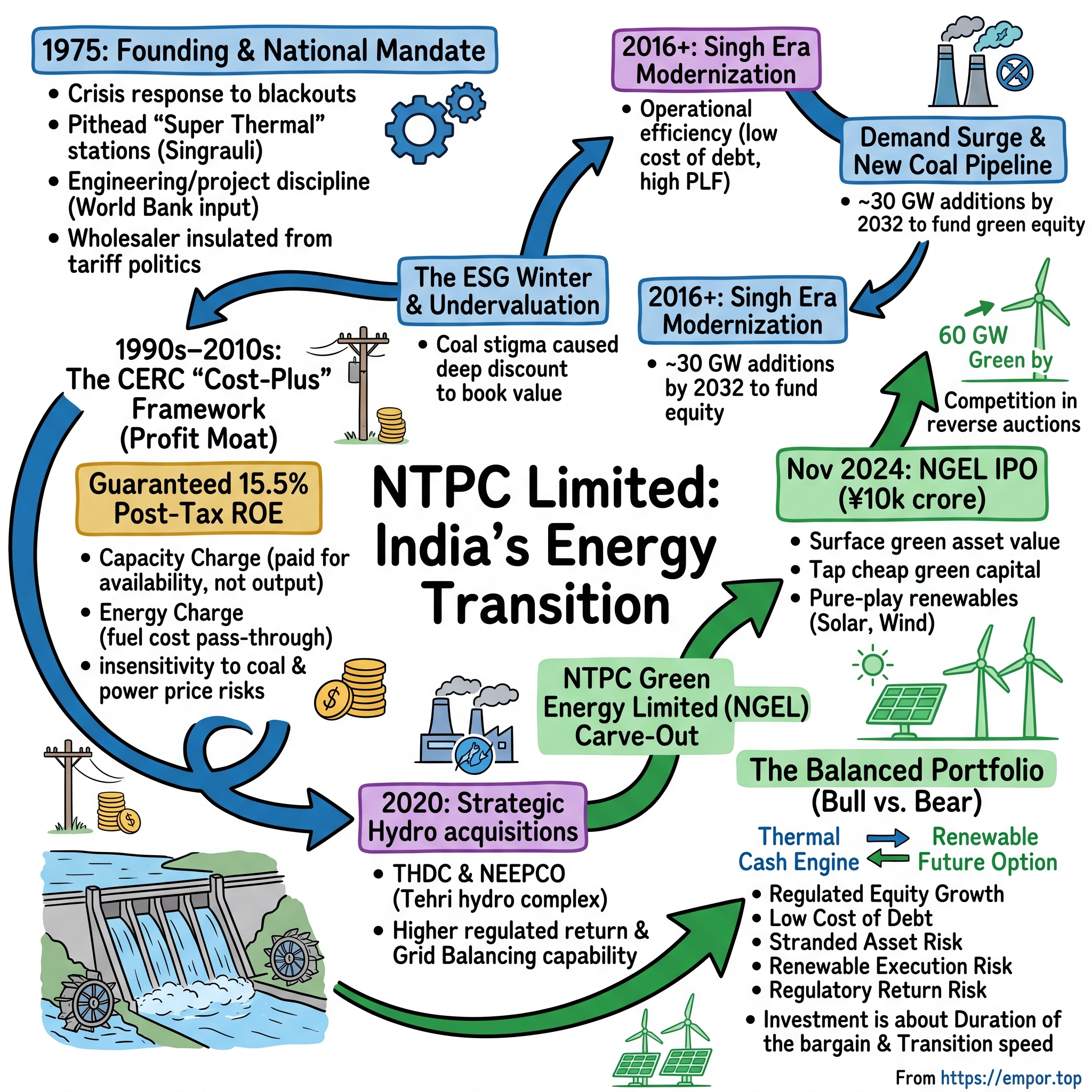
NTPC Limited: The Balance Sheet of India's Energy Transition
I. Introduction & Episode Roadmap
Here is a number that ought to be impossible. On any given evening in the summer of 2026, when air conditioners across northern India spin up in unison and the national grid strains toward its record peak of well over 250 gigawatts of demand, roughly one out of every four units of electricity flowing into Indian homes and factories is generated by a single company — one that owns only about seventeen percent of the country's installed generating capacity.2 That is not a rounding artifact. It is the signature of the most efficiently dispatched fleet of power plants on the subcontinent, and it belongs to a state-controlled behemoth that most global investors, for the better part of a decade, would not touch.
The company is NTPC Limited, and it is a walking contradiction. It is India's largest owner of coal-fired power stations — the very asset class that European pension funds and ESG screens spent the late 2010s exiling from their portfolios. It is also, as of late 2024, the parent of NTPC Green Energy Limited, a pure-play renewables developer that it carved out and floated in one of the largest Indian IPOs of that year, a listing that briefly attached a valuation of roughly a hundred thousand crore rupees — on the order of twelve billion dollars — to a business that barely existed as a separate entity five years earlier.[^13] Same parent, two opposite narratives, sold to two opposite kinds of investor.
The paradox runs deeper than optics. NTPC is simultaneously the primary builder of India's new coal capacity — with a thermal pipeline it has been steadily enlarging even as the rest of the developed world declares coal dead — and the standard-bearer for the government's clean-energy ambitions, targeting sixty gigawatts of renewables by 2032.14 How does a single balance sheet hold both of those bets at once without tearing in half? The answer, as we will see, is not ideology. It is arithmetic — a regulatory formula so unusual that it turns the question "will this plant make money?" into "will the regulator let it earn its return?", and the answer, for fifty years, has almost always been yes.
This is the spine of the story we are going to trace. NTPC does not, for the overwhelming majority of its fleet, take the price of electricity as a market risk. It operates under a cost-plus tariff set by the Central Electricity Regulatory Commission, under which it recovers its fixed costs plus a guaranteed post-tax return on equity of 15.5% so long as its plants stay available — whether or not they actually run.[^3] Understand that mechanism and you understand almost everything else: why NTPC could load its balance sheet with debt at rates a private developer can only dream of, why it survived the ESG winter with its cash flows intact, why it could absorb a pair of government-directed hydro acquisitions that looked like a bailout, and why the market's decade-long discount to book value was either a gift or a warning, depending on which risk you believed.
We will move through ten acts. We begin in 1975, in the aftermath of chronic blackouts and a national Emergency, when a young engineering corps set out to build "super thermal" power stations at the mouths of India's coal mines. We will dissect the CERC cost-plus framework in forensic detail, because it is the entire ballgame. We will meet Gurdeep Singh, the chairman who steered the company through the ESG storm and whose own term is now ending in an unresolved succession. We will interrogate the 2020 acquisitions of THDC and NEEPCO — masterstroke or forced marriage? We will size the green spin-off against the thermal cash engine and ask whether the renewable tail can really wag this very large coal-fueled dog. We will war-game the competition, run the Porter and Helmer frameworks, and lay out the bull and bear cases with the skepticism a fifty-year-old state monopoly deserves. And we will end with the transferable lessons.
Before we begin, one myth deserves puncturing up front, because it colors how most people misread this company. The popular framing casts NTPC as a "coal stock" — a bet on a dying fuel, to be valued at the depressed multiple that label implies. That framing gets the risk almost exactly backwards. NTPC is not, in any meaningful economic sense, exposed to the price of coal, nor to the price of electricity; it has contracted both of those risks away. What it is exposed to is a regulatory return and a political timetable. The right question is therefore never "what will happen to coal?" but "how long will the regulated bargain hold, and how fast will the transition force its hand?" An investor who buys or sells NTPC on a view about coal prices is answering a question the business does not actually ask.
A final orienting note, because it matters for everything that follows. NTPC's own published figures put its share of national generation at roughly 24%, not the 25% sometimes quoted, from about 17% of capacity — the gap between those two numbers is the story of this company's operating advantage.2 Keep it in mind. Now, back to the beginning.
 Subscribe on LinkedIn
II. Founding & The National Mandate (1975–1990)
Picture India in the early 1970s: a nation two decades into independence, straining to industrialize, and repeatedly plunged into darkness. State electricity boards — the government-owned utilities that generated, transmitted, and sold power within each state — were chronically starved of capital, riddled with political interference over tariffs, and bleeding electricity through transmission-and-distribution losses that in some states ran above a quarter of everything they produced. Factories ran on diesel generators. Farmers waited for power that arrived, if at all, at three in the morning. The shortages were not a nuisance; they were a brake on the entire development project.
Into that vacuum, on November 7, 1975, the central government incorporated the National Thermal Power Corporation.1 The timing is worth dwelling on. This was the height of Indira Gandhi's Emergency, a period of suspended civil liberties but also of centralized, unapologetic state action. The diagnosis behind NTPC was blunt: if the states could not build reliable large-scale generation, the Union government would do it directly, at scale, and sell the power back to the state boards in bulk. It was central planning as crisis response — and, unusually for the era, it worked.
The founding chairman was D.V. Kapur, a technocrat who assembled what would become one of the most respected engineering cadres in Indian public life.1 The design philosophy was elegant in its simplicity: rather than scatter modest plants around the country and pay to haul coal to each one, build enormous "super thermal" power stations at the pithead — physically adjacent to the coal mines themselves — and let the electricity, not the coal, travel the long distances over transmission lines. The first of these rose at Singrauli in Uttar Pradesh, followed by Korba, Ramagundam, and Farakka. Each was a self-contained industrial township, and each embodied a bet that scale plus proximity to fuel would deliver the cheapest reliable power in the country.
The culture that built these plants was, by many accounts, closer to a disciplined engineering regiment than a typical government department. NTPC recruited aggressively from India's premier engineering institutes and instilled a project-management rigor that state boards conspicuously lacked. Early capital and technical standards came in part from the World Bank, whose involvement imposed an external discipline on capital efficiency and construction quality that shaped the organization's DNA.1 The company learned, early, how to bring vast thermal projects in on schedule — a competence that sounds mundane until you compare it against the decade-slippage that plagued so much Indian infrastructure.
Consider what "building at scale" actually meant in that era, because it explains a corporate temperament that persists to this day. A super thermal power station was not simply a bigger version of a state board's plant; it was a small city. Singrauli required NTPC to construct roads, railway sidings to bring in construction material, townships to house thousands of workers and their families, schools, hospitals, and water systems — all before the first boiler could fire. The organization that emerged from that experience thought in terms of self-sufficiency and vertical control by instinct, because it had been forced to supply everything itself. That instinct — do it in-house, control the inputs, standardize the design and replicate it — is the same instinct you can trace decades later in the decision to dig captive coal mines rather than depend on suppliers, and to run its own project-engineering and consultancy arms. NTPC did not become an integrated builder-operator as a strategy consultant's recommendation; it became one because the conditions of its birth left it no other way to build.
There was also a financial discipline baked in from the start that is easy to overlook. Because NTPC sold power in bulk to state boards rather than to retail consumers, it never carried the toxic burden that crippled the state utilities — the political impossibility of charging farmers and households a cost-recovering tariff. NTPC was a wholesaler, insulated by design from the populist tariff politics that bankrupted its customers. It billed the state boards; the state boards absorbed the political pain of collecting from voters. That structural separation between who generates power and who sells it to the public — with NTPC firmly and profitably on the generation side — is one of the least appreciated reasons the company stayed solvent and creditworthy while the utilities buying its power lurched from one bailout to the next.
Why does any of this half-century-old history matter to an investor in 2026? Because the assets built in that era are still earning today, and their age is a feature, not a bug. A coal plant commissioned in the 1980s has, by now, been fully depreciated on the books — the capital cost long since recovered from ratepayers. What remains is a functioning generator whose only real running cost is fuel, sitting near the mine that supplies it. In the language of the national grid's "merit order" — the system that dispatches the cheapest available plants first — these old pithead stations sit right at the front of the queue, their variable cost among the lowest in the country. The founding thesis, in other words, is not a museum piece. It is the reason NTPC still generates a quarter of India's power from a minority of its capacity. To understand why that translates into such durable profit, though, we have to leave the engineering behind and open the rulebook that governs the money.
III. The CERC "Cost-Plus" Framework: The Holy Grail of NTPC's Moat
Every great business has a secret, and NTPC's is not hidden in a laboratory or a brand. It is written down, in public, in a dense regulatory document that almost no one outside the power sector ever reads: the Central Electricity Regulatory Commission's Terms and Conditions of Tariff Regulations. The current edition governs the five-year "control period" running from April 1, 2024 to March 31, 2029, and it is, in effect, the constitution of NTPC's profit.[^3] Master its logic and the company stops looking like a risky coal play and starts looking like something closer to a regulated bond with an equity upside.
Start with what NTPC does not do. It does not, for the vast bulk of its capacity, sell electricity into a spot market and pray the price covers its costs. That merchant model — betting on where power prices land — is what most people imagine when they hear "power company," and it is precisely the risk NTPC has engineered away. Instead, its plants operate under long-term power purchase agreements with state distribution utilities, at tariffs the regulator calculates from the plant's own costs.
The tariff comes in two parts, and the distinction between them is the whole game. The first part is the capacity charge — sometimes called the fixed charge. It is designed to recover, in full, every fixed cost of running the plant: the interest on its debt, the depreciation of its assets, its operations-and-maintenance expenses, and — here is the crown jewel — a guaranteed post-tax return on equity of 15.5%, grossed up for corporate tax so that the pre-tax figure lands closer to 19–20%.[^3] The critical feature is the condition attached: NTPC earns this capacity charge in full so long as the plant is available to run at a normative Plant Availability Factor of 85%. Read that again. The plant does not have to generate a single unit of electricity. It merely has to be ready. If a state utility, flush with cheap solar power at noon, declines to draw from an NTPC coal plant, NTPC still collects its fixed charge and its 15.5% return, because it kept the plant standing by. The company is paid for readiness, not output — an insurance premium against the grid going dark.
The second part is the energy charge, and it is where the coal-price risk goes to die. The energy charge is a straight pass-through of actual fuel cost — the coal, the freight to move it, the gas where relevant — to the buyer. If global coal prices triple, as they did during the 2022 energy shock, NTPC's margin does not compress by a rupee, because the higher fuel cost flows directly onto the state utility's bill. The company is a toll collector on the fuel, not a speculator in it. This is the single most misunderstood feature of NTPC by investors who lump it in with merchant generators: a coal-price spike, which would gut a merchant player, is essentially a non-event for NTPC's earnings.
Now put the two together and you see the machine. NTPC's profit is, to a first approximation, a fixed percentage of one number: its regulated equity base. That base is the equity portion of the capital invested in its approved, in-service assets. As of December 31, 2025 — the close of its fiscal third quarter — the consolidated regulated equity stood at ₹118,970 crore, and it ticked up to roughly ₹120,300 crore by the March 2026 year-end.34 Here is the compounding logic that makes it a growth machine rather than a static utility. Indian tariff regulation assumes a standard capital structure of 70% debt and 30% equity for approved projects. So every ₹100 of capital expenditure that NTPC commissions adds roughly ₹30 to that regulated equity base — and that ₹30 immediately begins earning its regulated 15.5%. Spend, commission, earn 15.5%, repeat. The more the company builds, the larger the equity base on which it earns its guaranteed return. Growth is not a hope; it is a mechanical consequence of capital deployment, provided the regulator keeps approving it.
It helps to make this concrete with a simplified illustration. Imagine NTPC builds a new plant for ₹10,000 crore. Under the assumed 70:30 structure, ₹7,000 crore is debt and ₹3,000 crore is equity. That ₹3,000 crore of equity is added to the regulated base, and at a 15.5% post-tax return it is entitled to earn roughly ₹465 crore a year — grossed up for tax, closer to ₹580 crore of pre-tax return — every year, provided the plant stays available 85% of the time. On top of that, the tariff recovers the interest on the ₹7,000 crore of debt, the depreciation of the asset, and the fixed O&M cost, all separately. The fuel to run it is billed on to the buyer at cost. So the only real ways NTPC can fail to earn its return on that plant are if the plant is chronically unavailable (an operational failure entirely within the company's control) or if the regulator changes the 15.5% number (a policy risk entirely outside it). Notice what is absent from that list: demand risk, price risk, and fuel-cost risk — the three variables that determine profit or ruin for almost every other kind of energy company on earth. That absence is the whole moat, expressed in a single worked example.
This is also why NTPC's growth is so much more predictable than that of a typical utility, and why analysts can model its earnings years out with a confidence that would be reckless applied to a merchant generator. You are not forecasting electricity prices or coal costs; you are essentially forecasting how much capital the company will commission and fold into its regulated base, and multiplying by a known return. It turns equity research on NTPC into something closer to a capex-tracking exercise than a market-prediction exercise.
There is one more pillar, and it addresses the question any skeptic asks first: if your customers are financially weak state utilities notorious for not paying their bills, how is any of this "guaranteed"? For decades, that was NTPC's genuine Achilles' heel — state distribution companies, or DISCOMs, ran up enormous arrears. The structural fix came in 2002, when the Government of India put in place a tripartite arrangement binding the central government, the Reserve Bank of India, and the state governments.5 The mechanism is quietly ruthless: if a state DISCOM defaults on its dues to NTPC, the RBI can be directed to deduct the outstanding amount straight from that state's share of central tax devolution — money the state is otherwise counting on. The state's own budget becomes the collateral. This was reinforced in 2022 by the Late Payment Surcharge Rules, which imposed a hard framework for clearing overdue amounts in installments and cutting off supply to chronic defaulters.[^6] The effect is that NTPC's receivables are, in practice, backstopped by the sovereign's tax machinery. That is why it can carry a very large debt load at a credit spread that would be unthinkable for a private company with the same customers.
So what does the evidence actually tell us here — beyond the elegance of the design? It tells us that NTPC's earnings are unusually insensitive to the two variables that wreck most power companies: the price of electricity and the price of fuel. That is a real, structural, documented moat, not management rhetoric. But it comes with the mirror-image risk that we will return to in the bear case: the entire edifice rests on the regulator's continued goodwill. The 15.5% is set by CERC and reviewed every control period. It is not a law of nature; it is a policy choice, and policy choices can be revised. Hold that thought. For now, the machine is running — and in the mid-2010s, a new kind of pressure arrived that had nothing to do with tariffs and everything to do with the color of NTPC's fuel.
IV. The Transition Inflection: Enter Gurdeep Singh (2016–Present)
For most of its life NTPC's problem was building fast enough. In the mid-2010s it acquired a stranger kind of problem: being unfashionable. As the global ESG movement gathered force, institutional capital began drawing a hard line around coal. Pension funds in Europe and North America announced blanket divestment from thermal generators. Index providers built fossil-fuel-screened benchmarks. And a company like NTPC — which by any honest accounting was among the largest coal-burning enterprises on earth — found itself on the wrong side of a capital-markets religion, regardless of how efficiently it ran or how creditworthy its cash flows were. The stock reflected the stigma. NTPC spent long stretches trading below its book value, at price-to-book ratios that dipped under 0.8x, an extraordinary discount for a company throwing off the kind of regulated cash it did. The market was, in effect, valuing its assets at less than what it had spent building them.
It is worth being precise about why a valuation discount is not merely a cosmetic annoyance for a company like this, because it goes to the heart of the strategic problem Singh inherited. A depressed equity valuation raises the cost of equity capital — and for a business whose entire growth model is "issue or retain equity, deploy it, and earn 15.5% on it," a rising cost of that equity is corrosive. If global capital is unwilling to fund coal-linked equity at a reasonable price, then the marginal cost of the very fuel that powers NTPC's compounding machine — new equity — goes up, even as the return on it stays regulated and fixed. The ESG discount was not an insult to be shrugged off; it was a direct threat to the arithmetic of expansion. That is the lens through which every subsequent move — the NGEL carve-out most of all — should be read: not as virtue signaling, but as an attempt to repair the company's access to cheap capital.
Into this moment stepped Gurdeep Singh, appointed Chairman and Managing Director in February 2016.[^8] Singh was not a bureaucrat parachuted in from the civil service; he was a career power man, with operating experience across both the public and private sides of the Indian electricity business, including a stint running Gujarat's state generation utility. That dual exposure — to the accountability pressures of the private sector and the scale of the public sector — shaped a leadership style that leaned unusually heavily, for a state enterprise, on execution metrics and guidance discipline rather than on political theater. His mandate was to modernize an aging giant and, above all, to answer the ESG question without torching the cash engine that funded everything.
What distinguishes a credible manager from a promotional one is the gap between what they promise and what they deliver, tracked over years — and on that test Singh's tenure reads better than most Indian public-sector chiefs. He set capacity-addition and mining targets and, broadly, hit or exceeded them; he was consistent across earnings calls in framing new coal as a cash-flow decision rather than a climate reversal, which is at least an internally coherent story even for those who dislike its conclusion; and he did not, in the manner of many state-enterprise heads, blame the government or the weather for misses. That consistency is itself an analytical fact worth weighting. It is also worth weighting the counterpoint: a chairman who runs a company whose profits are guaranteed by formula has a far easier job of "meeting guidance" than one exposed to real market risk. Hitting targets when the regulator underwrites your return on equity is a lower bar than hitting them in a merchant business.
Singh's term, extended more than once, was set to run until July 31, 2026 — which places this very article at the hinge of an unresolved succession, with the selection committee having interviewed candidates in early July 2026 but no successor yet publicly named.16 That vacuum at the top is itself a live governance question for investors, and we will not pretend otherwise: the identity and mandate of the next CMD will shape how aggressively NTPC pushes the coal build versus the green pivot, and it is, ultimately, a government appointment made on the government's timetable and priorities, not the market's.
Singh's approach is best judged not by his speeches but by his capital-allocation behavior, and here the record is genuinely instructive. Rather than chase headline-grabbing green pledges he could not deliver, he leaned into the boring stuff that actually moves a regulated utility's economics: driving down the cost of borrowing, tightening execution, and cleaning up the existing fleet. On the FY26 earnings call, management put the weighted average interest rate on the company's borrowings at 5.98%, down from 6.61% the prior year — a remarkable figure for a coal-heavy balance sheet, and one that flows directly from the sovereign-adjacent credit standing we have already described.4 Under the cost-plus formula, a lower interest cost does not automatically fatten NTPC's own margin (interest is a pass-through within the capacity charge), but it lowers the tariff NTPC charges, which keeps its plants competitive in the merit order and keeps state buyers willing to sign up for the next round of capacity. It is a virtuous circle, and Singh's team worked it deliberately. In parallel, the company pushed the long-delayed installation of Flue Gas Desulfurization units — the "scrubbers" that strip sulphur dioxide from smokestack emissions — to bring its older plants toward tightening environmental norms.
Then the paradox at the heart of this whole story detonated. Even as the ESG pressure peaked, India's power demand did not politely flatten to accommodate the clean-energy narrative — it surged. Brutal heatwaves in 2023 through 2026, relentless industrialization, and rising household consumption drove peak demand past 250 gigawatts and kept setting records.6 And the awkward physics reasserted itself: solar produces nothing after sunset, wind is intermittent, and grid-scale battery storage — while falling in cost — was nowhere near cheap or abundant enough to carry the nation's night-time base load. Somebody had to keep the lights on at 9 p.m. in a heatwave, and that somebody, by default, was thermal.
So the government, and NTPC with it, executed a course correction that would have been heresy to state five years earlier: it went back to building coal. India's power ministry laid out plans to add on the order of 80 gigawatts of new coal capacity by the early 2030s, and NTPC positioned itself as the primary builder, steadily enlarging a thermal pipeline that — counting plants under active construction plus committed and tendered projects — runs to roughly 16 gigawatts, with the company raising its coal ambition toward 30 GW of additions by 2031–32.6 Analysts pushed back; the reputational optics of a "green transition" leader pouring concrete for new coal were uncomfortable. Singh's answer, repeated across investor calls, was disarmingly financial: the highly profitable, regulated cash flows from these new thermal plants are precisely what will fund the equity checks for the renewable build-out. The dirty core would pay for the clean future. It is a coherent argument — and, as we will keep testing, one whose credibility rests entirely on execution rather than intention. Nowhere was that tension tested more sharply than in a pair of deals struck in the first weeks of 2020.
V. M&A & Conglomerate Restructuring: The Hydro Roll-Up
In March 2020, as the world was shutting down for a pandemic, NTPC quietly closed a transaction that critics would spend years calling a bailout dressed up as strategy. In a single stroke, it acquired the Government of India's 74.496% stake in THDC India Limited — the developer behind the giant Tehri hydro complex in the Himalayas — for ₹7,500 crore, and simultaneously bought 100% of the North Eastern Electric Power Corporation, or NEEPCO, for ₹4,000 crore. The combined cheque was ₹11,500 crore.[^10]7 With it, NTPC's installed capacity crossed 62,000 megawatts and the company became, overnight, a serious owner of hydroelectric power.
Let us start with the skeptical reading, because it was widespread and not unreasonable. The Government of India in early 2020 was straining against a yawning fiscal deficit and had aggressive disinvestment targets to hit — targets it routinely met by shuffling assets between the public-sector companies it controlled. THDC and NEEPCO were both government-owned. NTPC was government-controlled. So this was, in plain terms, one arm of the state selling assets to another arm of the state to book proceeds for the budget. That is the textbook definition of a related-party transaction, and the price was set by the seller, who also happened to be NTPC's own controlling shareholder. The assets themselves invited skepticism too: hydro projects are notorious for decade-long gestation, geological and hydrological surprises, cost overruns, and rehabilitation disputes over the villages their reservoirs drown. NEEPCO, operating in the difficult terrain of India's northeast, carried meaningful leverage. A minority shareholder in NTPC had every right to ask whether the company's balance sheet was being used as the government's piggy bank.
Now the other reading — the one that looks stronger with six years of hindsight. Recall that under the CERC framework, the return NTPC earns is set by asset class, and hydro is treated more generously than thermal precisely because it is harder to build and more valuable to the grid. Storage-type and pumped-storage hydro projects earn a higher base return on equity — on the order of 16.5% versus 15.5% for thermal — under the tariff regulations.[^3] So the acquisitions did not merely bolt on capacity; they bolted on capacity that expands the regulated equity base at a higher guaranteed return. For a company whose entire profit engine is "grow the regulated equity base," buying a portfolio of high-return hydro assets — with operational plants and an advanced-stage pipeline behind them — is strategically coherent, even if the manner of the purchase deserved the scrutiny it got.
But the deeper logic only becomes visible when you connect it to the renewable story. Here is the technical problem that the outline flags and that the grid engineers lose sleep over. As India floods its grid with solar power, it creates a control nightmare. Solar output collapses the moment a cloud passes and vanishes entirely at dusk — and it does so for the entire region at once. A grid must match supply to demand instant by instant, or its frequency drifts and equipment trips offline. The technical term is grid balancing, and the ideal balancing tool is a generator that can go from zero to full output in seconds and back again. Coal plants are sluggish; they take hours to ramp. Batteries are fast but expensive and short-duration. Hydro — and especially pumped-storage hydro, which pumps water uphill when power is cheap and releases it through turbines when power is scarce — is the gold standard: it can swing its output in seconds and it can store energy for hours. In a grid drowning in intermittent solar, the ability to firm and balance that power is not a nice-to-have; it becomes one of the most valuable services on the system.
So what read in 2020 as a forced PSU asset-shuffle looks, by 2026, a great deal more like vertical integration into the exact capability that a solar-heavy grid most desperately needs. That reframing is genuine — but investors should hold both truths at once. The strategic logic is real and the transaction was a related-party deal priced by the controlling shareholder. Both things are true, and a neutral analyst files this under "outcome vindicated the asset, process still deserved the questions." The clean-energy build-out that makes those hydro assets so valuable, meanwhile, had by 2024 grown large enough to warrant a corporate structure all its own.
VI. The Crown Jewel Spin-off: The NGEL IPO & Renewable Expansion
The problem with being a coal company that also builds renewables is that the market refuses to pay you for the renewables. Investors looked at NTPC and saw a thermal utility; the solar and wind assets buried inside it were valued, if at all, at the same depressed multiple as the coal plants they sat beside. So NTPC did what conglomerates trapped in a valuation discount have done for generations: it carved the good story out of the compromised one, put it in its own box, and let the market price it separately.
The box was NTPC Green Energy Limited — NGEL — into which the parent pooled its renewable portfolio. In November 2024, NGEL went public in one of the marquee Indian IPOs of the year. The offering was a fresh issue of shares aimed at raising roughly ₹10,000 crore, priced in a band of ₹102 to ₹108 per share, and it valued the company at approximately a hundred thousand crore rupees — around twelve billion dollars.[^12]8 The shares listed on November 27, 2024 at a modest premium to the issue price.[^13] Crucially, the offering was structured as a fresh issue — new capital raised for NGEL to spend on building projects — rather than a sale of the parent's shares, so NTPC emerged still owning the overwhelming majority of the entity, on the order of 89%.8
The elegance of the maneuver is worth spelling out, because it is pure financial engineering in the good sense. By listing NGEL separately, NTPC accomplished three things at once. It gave the renewables business its own currency — publicly traded equity it could issue to fund the enormous capital needs of a solar-and-wind build-out. It surfaced a market value for green assets that had been invisible inside the parent, meaning NTPC's ~89% stake became a large, liquid, quotable line item on its own balance sheet. And it gave ESG-constrained global investors a way to own the clean-energy growth story without touching a lump of coal. On paper, the sum-of-the-parts had been unlocked.
There is a subtler advantage still, and it connects directly to the capital-cost problem of the previous act. Renewable projects are financed differently from thermal ones. A solar farm sells its power under a long-term contract at a fixed tariff, and its economics are attractive to a class of patient, low-cost capital — infrastructure funds, green bonds, development finance institutions — that will not or cannot touch a parent whose balance sheet is dominated by coal. By ring-fencing the renewables in a separately listed, coal-free entity, NTPC created a vehicle that could tap that pool of green-labeled capital at a lower cost than the parent ever could. In effect, the carve-out was an arbitrage on the cost of capital itself: put the clean assets where the cheap green money wants to go, and keep the regulated coal cash flows where they can be levered against the sovereign's credit. Two businesses, two distinct investor bases, two different costs of money — deliberately separated so each could be funded on its best possible terms.
And yet — this is where a neutral platform has to part company with the IPO cheerleaders — the market's subsequent verdict has been distinctly cooler than the launch narrative promised. By mid-July 2026, NGEL's shares were trading around ₹93, below their ₹108 issue price, leaving IPO subscribers underwater roughly eighteen months after listing, with sell-side consensus hovering around a neutral "hold."13 The re-rating thesis — that a pure-play green utility would command a premium multiple that would then flatter the parent — has, so far, not been vindicated by the share price. That does not make the carve-out a mistake; the strategic and financing logic stands independent of one year's price action, and renewable developers globally de-rated as interest rates stayed high and tariff-based bidding compressed returns. But it is a useful corrective to the "valuation unlocking" story: the market gave NGEL its own price, and that price has been a disappointment, not a coronation.
Now the materiality test — the discipline of asking how big each of these growth engines actually is relative to the whole, because narratives and cash flows are not the same thing.
The core thermal fleet remains overwhelmingly the profit engine. It generates the great majority of NTPC's EBITDA and cash flow, anchored by that ~₹120,000 crore regulated equity base. Everything else in this section is, in cash terms, still a rounding error against it — for now.
NGEL, the renewables business, had by fiscal 2026 grown its group commercial capacity into the range of ten to eleven gigawatts, adding several gigawatts in the year and guiding to roughly eight gigawatts of annual additions thereafter on the road to its 60 GW-by-2032 target.15 The operational figure is materially below the "12 GW" sometimes cited and worth stating precisely: this is a business whose pipeline is vast and whose current earnings contribution is still modest — well under a fifth of group profit. It is an option on the future, not yet a driver of the present.
Captive coal mining, housed in NTPC's mining arm, is the quiet, underappreciated piece. The company dug and dispatched about 45.7 million tonnes of coal from its own mines in FY25 — up more than a quarter year-on-year — and targeted roughly 50 million tonnes in FY26.910 Why does an owner of coal plants want its own coal mines when a state monopoly, Coal India, exists to supply it? Because captive coal insulates NTPC's plants from the supply disruptions that have periodically forced Indian generators to idle, and because self-mined coal lowers the fuel cost that flows through as the energy charge — a rare instance where NTPC's efforts directly benefit the buyer's bill and, indirectly, its own competitiveness in the merit order. It is worth appreciating how counter-cyclical this is: during the coal shortages that hit Indian power stations in the 2021–2022 crunch, when plants across the country ran down to critically low fuel stocks and some tripped offline, having a captive supply was the difference between generating and going dark. Vertical integration into fuel is not a margin play; it is a reliability insurance policy that also happens to reduce cost — the same self-sufficiency instinct that built the townships at Singrauli, now applied to the coal seam itself.
Nuclear, finally, is the most speculative and longest-dated of the bets. Through a joint venture with the Nuclear Power Corporation of India, NTPC is developing large reactors — including a four-unit, 2,800-megawatt project at Mahi Banswara in Rajasthan, where site work advanced through 2025 and 2026 and tenders for the reactor's core were floated in mid-2026.11 Nuclear is a genuine zero-carbon baseload source that sidesteps the solar-storage bottleneck entirely, which makes it strategically interesting — but it is a decade from meaningfully moving NTPC's numbers, and Indian nuclear projects carry their own history of delay. File it under long-dated optionality, not investment thesis. With the portfolio mapped, the natural next question is who NTPC is actually competing against — and the answer reveals just how unusual its position is.
VII. Competitive Landscape & Structural Dynamics
To understand why NTPC's competitive position is so unusual, imagine three rivals lining up on the same field — and then notice that NTPC is the only one wearing the referee's protective vest. The Indian power-generation market has real competition, but it is competition of a peculiar, asymmetric kind, because the state monopoly plays by rules its private challengers cannot access.
Adani Power is the most aggressive of the private set — the largest private thermal generator in the country, with a fleet of roughly 18 gigawatts and expansion plans pushing toward 30, built on modern ultra-supercritical coal technology that squeezes more electricity from each tonne of fuel.17 Adani wins on private-sector speed: it builds fast and moves decisively. But a meaningful slice of its output is sold on merchant or shorter-term contract terms, exposing it to the very power-price risk NTPC has regulated away, and it borrows at a private-sector cost of capital well above NTPC's sub-6% — a structural handicap in a business where the cost of money is the cost of the product. Tata Power has reinvented itself around the consumer end of the electricity chain — distribution franchises, rooftop solar, EV charging — a genuinely attractive integrated model, but one with a smaller and far less regulatory-protected generation base than NTPC's. JSW Energy has pivoted hard and credibly toward hydro, wind, and storage, growing quickly, but from a fraction of NTPC's scale and, decisively, without the sovereign-backed payment security that lets NTPC treat its receivables as quasi-government paper.
The pattern across all three private challengers is instructive, and it points to the single fact that most defines NTPC's competitive reality. Each rival is stronger than NTPC on some dimension — Adani on raw construction speed, Tata on consumer-facing distribution and brand, JSW on nimbleness in the clean-energy transition. None of them can match NTPC on the one dimension that dominates the economics of a capital-intensive, long-duration business: the cost of capital. A private developer financing a coal or solar plant at, say, 8–9% and a state monopoly financing the identical plant at under 6% are not really in the same business, because the interest bill compounds over a 25-year asset life into a gap that no amount of operational cleverness can close. The private players compete on speed and agility precisely because they cannot compete on the cost of money. This is why the Indian power market, for all its apparent rivalry, is less a level playing field than a set of parallel games — the private developers fighting each other for merchant and competitively-bid capacity, and NTPC occupying a regulated redoubt they cannot enter.
Run the structural analysis through Porter's Five Forces and the picture sharpens into something close to a fortress — with one crack.
Threat of new entrants — low. Power generation at scale is one of the most capital-intensive undertakings in the economy, and the barriers stack: environmental clearances that take years, land acquisition that can take longer, and the need for transmission connectivity that only the grid operator can grant. You cannot bootstrap a national baseload generator.
Bargaining power of buyers — medium-low. The state DISCOMs are NTPC's customers, and they are financially weak, which in a normal market would give them leverage to squeeze suppliers or simply not pay. But two things neutralize them. They have no alternative source of reliable baseload at NTPC's price, and the tripartite payment mechanism means their non-payment can be answered by the RBI reaching directly into their tax devolution. The buyer is weak and declawed.
Bargaining power of suppliers — low. NTPC's dominant supplier is Coal India, a state monopoly — which sounds like a supplier with pricing power. But NTPC is Coal India's single largest customer, and it has been steadily building its own captive mines precisely to blunt that dependence. The supplier relationship is balanced, not one-sided.
Threat of substitutes — low, and this is the subtle one. For baseload — the steady, around-the-clock floor of electricity demand — there is genuinely no substitute yet at scale. Solar substitutes for daytime energy but not for a still, hot night. Until storage is abundant and cheap, thermal and hydro baseload have no true replacement, which is exactly why the coal phase-out keeps slipping.
Competitive rivalry — low, but rising in one arena. India is structurally short of power. In a supply-deficit market, plants are dispatched by merit order — cheapest first — and NTPC's fully-depreciated, low-variable-cost pithead plants sit at the front of that queue. When demand exceeds supply, everyone's plants get called; there is no price war to fight because there is no surplus to fight over. But note the crucial exception, because it is where NTPC is most genuinely contested: the renewable segment does not run on the cost-plus regulated model at all. New solar and wind capacity in India is largely allocated through competitive reverse auctions, in which developers bid down the tariff they will accept and the lowest bid wins. That is a real, brutal price war — and it is precisely the arena NGEL has entered, against private developers who have spent a decade honing their bidding discipline and financing structures. So the rivalry NTPC has been insulated from in thermal is exactly the rivalry it has volunteered for in green. The company that never had to fight on price is now bidding in the one corner of Indian power where price is the only thing that matters.
The one crack in this fortress is not in any of the five forces as traditionally drawn — it is regulatory and structural, and it is the same crack we keep circling back to: the entire favorable structure is a policy construct. The referee's vest NTPC wears was issued by the state, and the state can revise the rules. That is the pivot into the frameworks that let us weigh these advantages against one another, and against what could take them away.
VIII. Hamilton Helmer's 7 Powers Analysis
Porter tells us about the industry; Hamilton Helmer's 7 Powers framework tells us about the company — which specific, durable advantages let NTPC earn returns its rivals cannot compete away. Running NTPC through all seven is clarifying, because it separates the powers that are genuinely formidable from the ones the company simply does not have. A neutral scorecard, not a highlight reel.
Scale Economies — the strongest power NTPC holds. The decisive number is the 5.98% weighted cost of debt.4 In a power plant, capital costs — the interest and depreciation on the machine — typically dominate the lifetime economics; fuel is a pass-through and labor is thin. So a financing advantage of 150 to 200 basis points over a private developer is not a marginal edge; it compounds across every gigawatt and every year of a 25-year asset life into an economic moat that scale and sovereign standing together create and that no private rival can simply match. This is the real thing.
Cornered Resource — high. NTPC's cornered resource is its relationship with the Government of India itself, and everything that flows from it: priority coal linkages, land allotments, transmission corridors, and — the crown jewel — the tripartite payment protection. No private player can replicate access to the sovereign's tax-devolution mechanism as collateral. It is, almost by definition, uncornerable by anyone else.
Switching Costs — high, with a caveat. NTPC's capacity is locked into long-term, typically 25-year power purchase agreements. A state utility cannot casually switch to another supplier mid-contract without legal and operational penalty, which gives NTPC's revenue base a stickiness merchant generators lack. The caveat: this is a switching cost enforced by contract and regulation, not by irreplaceable product love — it holds as long as the contracts and the regulatory framework hold.
Counter-Positioning — low, and honestly acknowledged. This is the power NTPC lacks, and its absence is the entire reason NGEL exists. As the incumbent coal giant, NTPC cannot counter-position against a nimble pure-play green developer — it cannot shed its legacy the way a startup arrives without one. Its response was not to counter-position but to replicate the form of the challenger: carve out NGEL and give it a green developer's capital-raising profile. That is an admission that on this dimension, NTPC is the disrupted, not the disruptor.
Network Effects — none. Electricity generation exhibits no network effects. A megawatt-hour is a megawatt-hour; NTPC's plants do not become more valuable because other people use NTPC's plants. Zero, and no amount of framing changes it.
Process Power — medium, and real. Five decades of running large thermal fleets shows up in the operating statistics. NTPC's coal plants ran at a plant load factor of about 72% in FY26 against a rest-of-India average of roughly 63% — meaning its plants were actually generating far more of the time than the national fleet.4 That gap reflects accumulated operational know-how in maintenance, fuel handling, and plant management that competitors cannot buy off a shelf. It is worth noting the FY26 figures came down from an even stronger FY25 (about 77% versus 67%), as more renewables in the mix reduced how often coal plants were dispatched — a reminder that even process power is being reshaped by the transition.
Brand — low. Electricity is the ultimate commodity. No household chooses NTPC's electrons over another generator's; the product is undifferentiated at the point of consumption. NTPC has institutional reputation with lenders and the government, but consumer brand power is essentially nil.
Tally it up and the honest scorecard reads: two dominant powers (scale economies and cornered resource), two solid ones (switching costs and process power), and three absent or weak (counter-positioning, network effects, brand). That is a strong but specific profile — a company whose moat is almost entirely a function of its cost of capital and its relationship with the state, and almost not at all a function of anything it could carry into an unregulated or genuinely competitive market. Which is exactly the fault line along which the bull and bear cases divide.
IX. The Investment Spine: Bull vs. Bear Case
Every investment case worth the name can be stated as a single question, and for NTPC the question is this: is a regulated compounding machine with a guaranteed return the safest utility on the subcontinent, or is it a giant pile of coal assets whose guarantee is only as good as the next regulatory review and the next decade of climate politics? Let us make the spine explicit and then stress-test it.
The bull case — the re-rating compounding machine. The bull starts with the arithmetic we have already built. NTPC's profit is a function of its regulated equity base, and that base is set to grow mechanically as its enormous under-construction pipeline — thermal and hydro alike — is commissioned and folded into the tariff calculation. The regulated equity base has climbed past ₹120,000 crore and is on a trajectory toward ₹150,000 crore and beyond as capacity comes online, and each increment earns its guaranteed 15.5% (more for hydro).34 This is about as visible and low-variance an earnings-growth path as exists in Indian equities. Layer on the ~89% stake in listed NGEL as a separate, liquid store of value that could re-rate if the renewable build delivers; the sub-6% cost of debt that keeps the whole model competitive; and the captive coal that insulates fuel costs. The bull's summary: you are buying a bond-like stream of guaranteed-return cash flows, growing at a double-digit clip, with a free option on a 60 GW green business attached — and for years the market handed you all of it below book value. The evidence for this case is strong precisely because it rests on a documented formula rather than on management's forecasting skill.
The bear case — the stranded asset and the execution gap. The bear does not dispute the arithmetic; the bear disputes its durability, and attacks on three fronts.
Stranded-asset risk. NTPC's greatest strength — its vast, cheap, fully-depreciated thermal fleet — is also its greatest long-term liability in a decarbonizing world. If carbon pricing arrives in earnest, if international climate finance penalizes coal exposure, or if battery storage costs fall fast enough to make solar-plus-storage genuinely cheaper than coal baseload, then plants NTPC is building today could face premature retirement or write-down long before their regulated lives end. The company is adding coal capacity on a bet that the energy transition will be slow; if it is fast, that concrete becomes a stranded liability. The bull calls new coal a cash cow; the bear calls it building the past. The pivotal variable, and the one every serious investor in NTPC should be modeling, is the cost curve of grid-scale battery storage. The entire justification for new coal rests on a single technical claim: that nothing can yet firm the grid through a windless night at an acceptable cost. That claim has been true for years — but it is a claim about today's battery prices, and battery prices have a habit of falling faster than incumbents expect. The day four-hour and eight-hour storage becomes cheap enough to shift midday solar into the evening peak economically, the marginal case for a new coal plant collapses, and NTPC's newest, least-depreciated, most expensive-to-retire assets become the most exposed. There is a partial hedge worth noting on the bull's side of this exact ledger: NTPC's push into pumped-storage hydro through the THDC assets is, in effect, a bet on storage — just a mechanical rather than an electrochemical one. If storage is the future, the company owns some of it already.
Renewable execution risk. The 60 GW-by-2032 target is enormous, and the path to it runs through the two hardest bottlenecks in Indian renewables: acquiring vast tracts of land and securing transmission connectivity through the Green Energy Corridor before the projects can even sell power. NGEL is also bidding for projects against ferocious private developers — Adani, ReNew, Avaada — in auctions that have already compressed solar tariffs to razor-thin levels. The below-water NGEL share price since its IPO is the market's early, skeptical vote on exactly this risk: growth, yes, but at what return?
Regulatory risk — the crack in the fortress. This is the bear's sharpest point, and it is the mirror image of the entire bull case. Every rupee of NTPC's guaranteed profit exists because CERC sets the return on equity at 15.5%. CERC reviews its tariff regulations every five years — the current framework runs only to 2029.[^3] Any future government under fiscal pressure, or any regulator persuaded that a state monopoly should earn less at ratepayers' expense, could trim that return. A cut from 15.5% to, say, 14% would flow straight to NTPC's bottom line with nowhere to hide. The moat was granted by the state and can be narrowed by the state.
To this, an activist-minded skeptic would add a governance overlay that a neutral platform is obliged to raise. NTPC is a company where the controlling shareholder is the government, whose interests — fiscal targets, energy security, employment, disinvestment — do not always align with those of minority investors. The THDC and NEEPCO acquisitions were the clearest illustration: strategically defensible in hindsight, but priced and directed by the controlling owner in a related-party transaction. The new-coal build sits in similar tension: is it optimal capital allocation, or national policy executed through a listed company's balance sheet? And the unresolved CMD succession at the exact moment this article is written is a reminder that leadership of India's largest power company is, ultimately, a government appointment.16 None of these are disqualifying. All of them are reasons the market has historically demanded a discount — and reasonable people can disagree on whether that discount is too large or not large enough.
The honest synthesis is that the bull and bear are not really arguing about NTPC's present; they largely agree on it. They are arguing about the duration of the regulatory bargain and the speed of the energy transition. That framing is what an investor should actually track — which brings us to the handful of metrics that will tell you, in real time, which way the argument is resolving.
The KPIs that actually matter
Ignore the quarterly noise and watch three things. First, the regulated equity base — its growth rate is, almost literally, NTPC's guaranteed earnings-growth rate, and any stall signals a commissioning slowdown.3 Second, the weighted average cost of debt — as long as it stays near or below 6%, the entire competitive edge is intact; a sustained rise would erode the moat from the inside.4 Third, NGEL's annual capacity additions against its ~8 GW/year run-rate — this is the single cleanest read on whether the green pivot is real execution or just a target on a slide.15 Those three numbers, tracked over time, will tell you more than any earnings headline.
X. Playbook: Business & Investing Lessons
Strip away the gigawatts and the tariff formulas, and NTPC leaves behind three lessons that travel far beyond the Indian power sector.
Leverage the legacy core to fund the future — do not martyr it. The reflexive instinct of the ESG era was that a company with a dirty core should shrink, apologize, and starve that core of capital. NTPC did the opposite, and the logic is quietly powerful: the steady, high-margin, regulated cash flows of the legacy coal fleet are the funding source for the equity checks that the renewable build demands. Killing the cash cow to prove your virtue would have left nothing to pay for the transition. The transferable insight is that an incumbent's unfashionable asset is often the very thing that finances its reinvention — provided management is honest that the core is a bridge, not a destination. The open question NTPC has not yet answered is whether it will actually cross that bridge or simply keep rebuilding it with new coal.
Structural moats outlast narratives. For years the market discounted NTPC below book value because the narrative said coal was uninvestable. The structure — the cost-plus framework, the sovereign-backed payment security, the rock-bottom cost of debt — never changed. Investors who could hold the structure in their heads while the narrative screamed were buying guaranteed-return cash flows at a discount to the cost of the assets producing them. The lesson is not "coal was misunderstood"; it is that a durable regulatory or contractual structure is a fact you can underwrite, while a narrative is a mood you cannot. The discipline is to keep asking which one is actually driving the price — and to remember that structures, unlike moods, can also be legislated away, which is why the bear's regulatory point deserves equal weight.
Spin-offs are valuation tools — but the market, not the sponsor, sets the clearing price. When a conglomerate's market refuses to value a hidden segment, carving it out and listing it independently is a legitimate and often powerful way to force a price discovery the parent could never achieve internally. NTPC's NGEL listing did exactly that. But the coda matters, and it is the neutral platform's final word: unlocking value and creating value are not the same act. NGEL surfaced a price, and that price has since fallen below where it listed. The spin-off gave the green business its own currency and its own scoreboard — and the scoreboard, so far, is asking harder questions than the IPO prospectus did. That is not a failure of the strategy. It is the market doing its job, which is exactly what a company invites when it lets the market set the price. For an investor in the parent, the enduring value was never really the re-rating; it was the ₹120,000-crore regulated compounding machine that was there all along, doing what it was built in 1975 to do — keeping the lights on, and getting paid a guaranteed return to do it.
References
-
NTPC Group crosses 90 GW installed capacity — NTPC Limited, 2026-05-18 ↩↩
-
NTPC Q3 FY26 Investor Presentation, January 2026 — NTPC Limited ↩↩↩
-
NTPC Q4 FY26 Analyst Conference Call Transcript, May 23, 2026 — NTPC Limited ↩↩↩↩↩↩
-
Tripartite Agreements and DISCOM payment security mechanism — Press Information Bureau, Government of India ↩
-
India to add 80 GW coal power capacity by 2032, minister says — Reuters, 2023-12-11 ↩↩
-
NTPC buys 74.496% equity stake in THDC India and 100% stake in NEEPCO — NTPC Limited ↩
-
NTPC captive coal mining hits record production — Press Information Bureau, Government of India, 2025-04-01 ↩
-
NPCIL-NTPC JV invites bids to build core of Mahi Banswara nuclear project — Business Standard, 2026-07-16 ↩
-
NTPC Q4 profit jumps 34% to ₹10,615 crore; FY26 net profit rises 15% to ₹27,546 crore — Free Press Journal, 2026-05 ↩
-
NTPC Green Energy Ltd share price and financials — Screener.in ↩
-
NTPC revises 2032 capacity addition target to 149 GW, earmarks ₹7 lakh crore investment — PSU Watch ↩
-
NTPC targets renewable energy capacity additions — Mercom India, 2026 ↩↩
-
NTPC CMD succession: Search-cum-Selection Committee interviews candidates — IndianPSU, 2026-07 ↩↩
-
NTPC vs Adani Power vs Tata Power: capacity, revenue, market cap — PSU Connect ↩
 LinkedIn
 WhatsApp
 Reddit
 Hacker News
 Email
Email Kindle
 RSS Feed
 Spotify
 Apple Podcasts
 Amazon Music
 Audible
 YouTube