 Chat with
this content: Summary, Analysis, News...
Chat with
this content: Summary, Analysis, News...
 Subscribe on LinkedIn


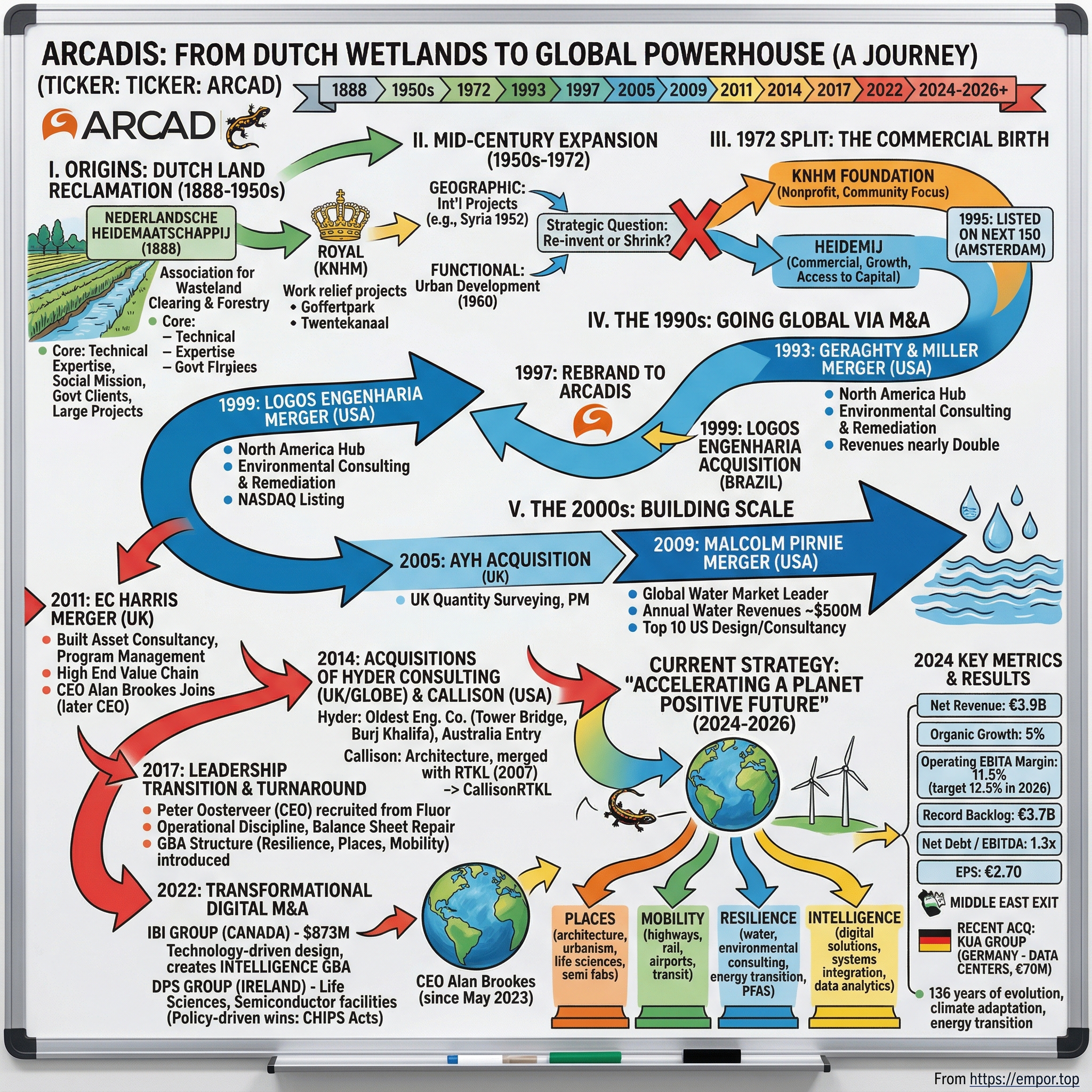
Arcadis: From Dutch Wetlands to Global Design & Engineering Powerhouse
I. Introduction: The Question Worth Asking
Picture the Netherlands in 2024. A nation that, by all geological logic, should be underwater—26% of its landmass sits below sea level. Yet here it stands, not merely surviving but thriving, home to one of the world's most sophisticated infrastructure networks. This is the crucible that forged Arcadis, a company whose 136-year journey from transforming Dutch marshlands into farmland to commanding €5 billion in global revenues represents one of the most remarkable corporate metamorphoses in the professional services industry.
Arcadis is the world's leading company delivering data-driven sustainable design, engineering, and consultancy solutions for natural and built assets. It reported strong full year results with record net revenues of €3.9 billion, organic growth of 5%, and a strong Operating EBITA margin improvement to 11.5%. The firm now employs more than 35,000 architects, data analysts, designers, engineers, project planners, water management and sustainability experts.
But raw numbers alone miss the real story. The question that makes Arcadis worth understanding is this: How did a 19th-century Dutch land reclamation association—an organization founded by aristocrats concerned about rural poverty—transform into a publicly-traded global consultancy that helps design data centers, semiconductor fabs, and climate resilience programs across 30 countries?
The answer reveals universal truths about M&A-driven growth, the transition from local expertise to global scale, and the critical inflection points that separate companies that become industry leaders from those that fade into obscurity. Arcadis has navigated nearly every challenge the professional services industry can throw at an organization: geographic expansion, capability diversification, digital disruption, leadership transitions, and cyclical market downturns. That it has emerged stronger from each offers a masterclass in adaptive strategy.
From its early origins in the Netherlands, Arcadis has grown into a global industry leader through innovation, the expansion of services and a series of strategic acquisitions. 2020 saw the creation of a new global business area structure: Resilience, Places and Mobility. In 2022, Arcadis announced the acquisitions of IBI Group, DPS Group and Giftge Consulting. These strategic moves mark the establishment of a prominent digital position, with the addition of a fourth global business area—Intelligence.
This episode will trace that journey, from the heathlands of eastern Netherlands in 1888 to the Zuidas business district of Amsterdam today, where Arcadis's headquarters sits amid the gleaming towers of Europe's financial elite. Along the way, we'll meet the leaders who shaped its trajectory, analyze the acquisitions that built its moat, and assess whether this company has what it takes to thrive in an era where digital transformation and climate change are reshaping the entire design and engineering industry.
II. Origins: The Dutch Land Reclamation Story (1888–1950s)
The story begins not with engineers or architects, but with Dutch aristocrats gathered in Arnhem in 1888, worried about a rural crisis that threatened the social fabric of their nation.
The Nederlandsche Heidemaatschappij was founded in 1888 as an association that aimed to stimulate the development of Dutch agricultural land by encouraging forestry and the clearing of wasteland. The name itself tells the story—"Heidemaatschappij" translates roughly to "heathland society," referring to the vast tracts of undeveloped marshland and heather-covered wastelands that dominated the country's eastern provinces.
To understand why a group of notables would form such an organization requires understanding the Netherlands of the 1880s. Arcadis traces its origins to 1888, when it was established in the Netherlands as the Nederlandsche Heidemaatschappij, a nonprofit association dedicated to land reclamation and the improvement of agricultural productivity by transforming unproductive wastelands into fertile areas. The organization focused primarily on domestic projects, addressing the challenges of the Dutch landscape through initiatives in wasteland redevelopment, hydraulic engineering for water management and irrigation, and the development of rural infrastructure such as drainage systems and farm layouts to support sustainable agriculture.
Dutch farmers in the second half of the 19th century faced an existential threat. Cheaper grain imports from the Americas and Russia had cut wheat prices in half. Unable to compete, farmers abandoned their fields for urban centers, leaving agricultural communities hollowed out. The country's political and social elite grew concerned—not just about economic disruption, but about social stability in the rural heartlands.
The Markenwet of 1886 provided the catalyst. This legislation liberalized public lands for private ownership, creating an opportunity for organized development of the country's unproductive territories. The founding visionaries of the Nederlandsche Heidemaatschappij saw a mission: transform unusable wetlands into prosperous farmland, restoring economic viability to rural communities while expanding the nation's agricultural capacity.
What made this organization distinctive from the start was its hybrid nature—part social mission, part technical enterprise. The founders weren't just do-gooders; they were practical-minded industrialists who understood that land reclamation required engineering expertise. Over the following decades, these efforts expanded to encompass broader rural development, including forestry and community planning, establishing a foundation in environmental and engineering services tailored to the Netherlands' unique hydrological needs.
The work proved consequential. Particularly during the crisis years of the 1930s, tens of thousands of workers toiled by hand under the supervision of the 'Heidemij', for example on the construction of Goffertpark in Nijmegen or the Twentekanaal. The organization became the nation's primary private employment contractor for land development projects, providing work relief during economic downturns while simultaneously expanding the country's productive capacity.
The royal recognition that followed reflected this impact. The organization eventually earned the "Koninklijke" (Royal) predicate, becoming the Koninklijke Nederlandsche Heidemaatschappij (KNHM)—an acknowledgment of its contributions to the nation's development and a mark of prestige in Dutch society.
The DNA That Persists: What's remarkable about Arcadis's founding is how clearly it established traits that persist today. From its inception, the organization combined: - Technical expertise in water management and land engineering—competencies that remain central to Arcadis's identity - A social mission beyond pure profit-seeking—now expressed through sustainability initiatives - Government and institutional relationships as primary clients—still a significant portion of the revenue base - Large-scale project management—the capability to coordinate complex, multi-year development programs
These weren't accidental characteristics that emerged over time; they were encoded in the organization's founding DNA. The modern Arcadis, with its focus on climate adaptation, water optimization, and sustainable development, is recognizably descended from those 1888 founders who believed that thoughtful engineering could improve quality of life.
III. Mid-Century Expansion: From Rural to Urban & International (1950s–1972)
By the mid-20th century, the Netherlands' most pressing land reclamation challenges had been addressed. The organization faced a classic strategic question: continue doing what you've always done, watching your market gradually shrink, or reinvent yourself for new opportunities?
The Heidemij chose reinvention—twice over. First geographically, then functionally.
By the mid-20th century, the company began to diversify and internationalize modestly, exporting its expertise in water management to emerging economies. The logic was compelling: if Dutch engineers had mastered water management in one of the world's most challenging environments, that expertise would prove valuable anywhere water posed problems—which was essentially everywhere.
The international expansion began in 1952 with a cooperation project in Syria—an early recognition that the decolonizing world would need technical expertise to develop infrastructure. This wasn't random exploration; it was strategic positioning in markets where Dutch engineering credentials carried weight.
In keeping with the association's "good works" principles, Heidemij found its new market overseas primarily in developing countries, especially the Netherlands' former and soon-to-be former colonies. To limit financial risk—a prudent approach for an organization still structured as a nonprofit association—the company established separately operating firms for its Third World operations.
The second reinvention was functional. In 1960, Arcadis branched out into urban development—a recognition that the future of engineering consultancy lay in cities, not heathlands. The Netherlands itself was urbanizing rapidly, and the same hydraulic and civil engineering skills that transformed marshes into farms could transform open land into livable cities.
This expansion wasn't merely opportunistic; it was strategic repositioning that would define Arcadis's future trajectory. Urban development required coordinating multiple disciplines—not just water management and civil engineering, but also transportation planning, environmental assessment, and eventually architecture and cost consulting. Each new capability created opportunities to add more.
The Nonprofit Question: Throughout this period, Heidemij remained a nonprofit association—an organizational structure that created both advantages and constraints. The advantages included credibility with government clients, alignment of mission with public interest, and freedom from quarterly earnings pressure. The constraints included limited access to capital for major acquisitions and inability to offer equity incentives to key talent.
By the late 1960s, these constraints were becoming binding. The engineering consultancy industry was globalizing, and competitors structured as commercial enterprises could grow faster, pay higher salaries, and make strategic acquisitions. Heidemij's leadership faced a difficult choice: remain true to the founding nonprofit mission, or commercialize to compete in an increasingly global industry.
IV. The 1972 Split: Birth of the Commercial Entity
The decision, when it came, was elegant in its execution. Rather than abandoning the nonprofit mission entirely, the organization split itself in two.
Over the following decades, the firm became involved in various development projects, initially with a rural focus. As a consequence of a restructuring in 1972 that divided the company, it became Heidemij.
The 1972 restructuring separated the nonprofit KNHM foundation, which continued the community development mission, from the commercial consulting and engineering activities, which were spun off into a new company called Heidemij. This wasn't a simple divestiture—it was a philosophical unbundling that acknowledged different activities required different organizational forms.
The nonprofit KNHM foundation could continue pursuing social good without the commercial pressures that might compromise mission integrity. The commercial Heidemij could pursue growth, make acquisitions, and compete aggressively in the global market for engineering consultancy services.
This structural clarity proved strategically important. Heidemij could now: - Access capital markets for growth financing - Offer competitive compensation including equity-based incentives - Make acquisitions without nonprofit governance constraints - Pursue purely commercial opportunities without mission conflicts
Under the Heidemij name, the firm began pursuing projects beyond its traditional rural scope, including urban development and industrial environmental consulting. The foundation was being laid for international expansion.
In 1995, Heidemij became a listed company on the Next 150 index in Amsterdam. But the real transformation came earlier, in 1993, when Heidemij executed a merger that would fundamentally alter its trajectory.
V. The 1990s: Going Global Through M&A
The 1990s represent Arcadis's true transformation from Dutch engineering firm to global consultancy. The decade began with a strategic imperative: expand internationally or be marginalized in an industry consolidating rapidly.
The nineties mark the start of Arcadis' European expansion strategy. In 1993, the merger with Geraghty & Miller brings US expansion and grants an initial listing on the NASDAQ index.
Geraghty & Miller wasn't a random acquisition target—it was a strategic masterstroke. Launched in 1957 with peer expert James Geraghty, the firm was acquired in 1993 by Dutch global consultant Heidemij and became that company's Colorado-based North America hub—rebranded as Arcadis.
The firm, headquartered in Plainview, New York, was a leading groundwater and environmental consulting practice with deep expertise in contaminated site remediation—a growth market as environmental regulations tightened in the United States. Heidemij began seeking entry into the vast North American market, notably via a partnership with—and in 1993 the acquisition of—publicly held Geraghty & Miller Inc. of Plainview, New York. That acquisition helped raise Heidemij's 1993 revenues to NLG 816 million, almost double the revenues of the year before. The Geraghty & Miller acquisition, for some $130 million, also brought Heidemij onto its first stock exchange, with a listing on the NASDAQ.
The strategic rationale was multidimensional: - Geographic diversification into the world's largest economy - Capability expansion into environmental services, which complemented existing water expertise - Capital market access through NASDAQ listing - Client base diversification with strong industrial relationships
In 1993, the company made a transformative move by merging with Geraghty & Miller, a U.S.-based environmental consulting firm. This merger gave the firm a foothold in North America and led to an international stock listing. By 1997, Heidemij had rebranded to Arcadis, adopting the name of a mythological idyllic region ("Arcadia") to reflect its broadened vision of harmonizing human development with the natural environment. During the 1990s, Arcadis also entered South America by acquiring a Brazilian engineering firm, signaling its ambitions to become a global player.
The name change was more than cosmetic. "Heidemij" was virtually unpronounceable outside the Netherlands, creating branding challenges as the company expanded internationally. "Arcadis"—evoking the mythological Arcadia, said to be the most beautiful place on Earth—communicated aspirations while being pronounceable in any language.
During October 1997, the company opted to rebrand itself, changing its name to Arcadis. Two years later, it established a presence in the Brazilian market via the firm's acquisition of Logos Engenharia.
The fire salamander logo adopted alongside the new name represented ecological balance—an apt symbol for a company increasingly focused on environmental engineering. Subsidiaries were similarly rebranded, creating unified global positioning.
Since 1990, the company has largely expanded itself via a series of acquisitions and mergers, which have allowed it to both expand its presence in existing markets as well as to enter new ones.
The 1990s established the M&A playbook that would define Arcadis's growth strategy for the next three decades: identify firms with complementary capabilities in strategic markets, acquire them, integrate them into global operating structures, and leverage combined capabilities to serve multinational clients.
VI. The 2000s: Building Scale Through Acquisition
The 2000s saw Arcadis transform from a Dutch company with international operations into a truly global enterprise. CEO Harrie Noy, who led the company through this period, executed an aggressive growth strategy that doubled down on the M&A playbook.
In June 2005, Axtell Yates Hallett was acquired and became a subsidiary of Arcadis NV, being rebranded as Arcadis UK. AYH was a British quantity surveying firm, founded by Stanley Axtell and his colleagues in the City of London in 1946. Since 1946, Axtell Yates Hallett firm grew steadily and broadened both its service base to include firstly project management and subsequently building surveying and facilities consultancy.
The UK entry was strategically significant. Britain's infrastructure market was among Europe's largest, and London was a global hub for project management and cost consulting. Establishing a UK presence positioned Arcadis to compete for major construction projects across Europe and beyond.
But the decade's most transformative acquisition came in 2009, when Arcadis merged with Malcolm Pirnie.
ARCADIS, the international consultancy, design, engineering and management services company, finalized the previously announced merger with Malcolm Pirnie, the White Plains, New York-based company active in water and environmental consulting and engineering. All internal shareholders, representing 100% of the share capital of Malcolm Pirnie, voted in favor of the merger, showing that this major step is fully supported by management and senior staff of the company. Malcolm Pirnie, now a wholly-owned subsidiary of ARCADIS U.S., has more than 1,700 employees with 2008 gross revenues of $392 million.
Malcolm Pirnie, having roots going back to 1895, provides infrastructure consulting and engineering services in water and wastewater treatment, environmental services, and through its Red Oak division management consulting services. The combination of both companies is expected to generate significant business and operational synergies. Malcolm Pirnie brings an established world-class water brand, with specializations in water quality, treatment, strategic planning and project delivery. Combined with ARCADIS' international position in water management and coastal engineering, the merger creates a major position in the global water market with annual revenues approaching $500 million, representing about 17% of combined revenues.
The strategic logic was impeccable. Water was emerging as one of the 21st century's defining challenges—climate change, population growth, and urbanization were all intensifying pressure on water resources. CEO Harrie Noy said: "This is a major step for ARCADIS which very well fits our strategic goals. Together with Malcolm Pirnie we are in the top 10 of consulting engineers in the international water market. Clean water availability and water quality are increasingly important issues. In order to capitalize on the expected strong growth in this market, water will become a separate business line within ARCADIS. In addition the merger brings us into the top 10 in the U.S. design, consultancy and engineering market, with a more balanced services portfolio."
Malcolm Pirnie was a century-old firm with deep relationships with U.S. government clients and strong technical expertise in water treatment—capabilities that complemented Arcadis's existing water management strengths. The merger created a global water practice with the scale and expertise to compete for the largest projects worldwide.
VII. Key Inflection Point #1: EC Harris & UK Expansion (2011)
If the Malcolm Pirnie acquisition established Arcadis as a water leader, the EC Harris merger transformed it into a full-service built environment consultancy.
In 2003, EC Harris became a limited liability partnership (LLP). EC Harris merged with Arcadis NV on 2 November 2011, after a vote of EC Harris' 183 partners on 31 October 2011. This grew the work force EC Harris had access to over 21,000 professionals as a subsidiary of Arcadis.
EC Harris was no ordinary acquisition target. EC Harris Built Asset Consultancy is a construction consultancy and project management firm whose headquarters are in the United Kingdom. It is a key part of Arcadis NV, following the companies' merger in October 2011. Founded in 1911 by Edward Charles Harris, EC Harris began as a multi industry consultancy business. By the 1950s, the business was largely property based, focusing on civil engineering and infrastructure development. It was in 1986 that the company started Europe's first facilities management consultancy services.
The strategic rationale extended beyond geographic expansion. Through the merger, Amsterdam-based Arcadis will grow to almost 19,000 employees and €2.3 billion in revenues. Combined, the two companies will obtain a top five global position in strategic advisory and project delivery services for built assets.
Commenting on the merger, Arcadis CEO Harrie Noy said: "This merger is a major step forward in realizing our strategic ambitions. With EC Harris we get a leading position in project management and related services while their built asset consultancy approach perfectly fits our goal of expanding our services at the high end of the value chain." He continued: "With the expansion of our footprint in the Middle East and Asia we can capitalize on the growth opportunities in these markets."
EC Harris brought capabilities Arcadis had lacked: quantity surveying, program management, and cost consulting. These "high end of the value chain" services commanded better margins than pure engineering and positioned Arcadis as a strategic advisor to clients, not just a technical service provider.
A major milestone was the 2011 merger with EC Harris, a prominent British program management and built-asset consultancy. This substantially grew Arcadis's presence in the UK and provided expertise in managing large construction programs.
The integration introduced Alan Brookes to Arcadis—a surveyor who would eventually become CEO. He started his career as a surveyor, where he grew to lead a chartered surveying practice and then chair Povall, Flood and Wilson, which was eventually acquired by EC Harris in 2000. Alan helped transform the business into a global force, moving to lead the Asian business in 2011 when he became an EC Harris Board member. When EC Harris was acquired by Arcadis, Alan continued to lead Asia supporting the acquisition of Langdon and Seah.
In October 2011, Arcadis acquired EC Harris, an international built asset consultancy firm headquartered in the United Kingdom. In 2012, Arcadis purchased Langdon & Seah, an Asia-based cost and project management consultancy.
The Langdon & Seah acquisition in 2012 extended the EC Harris model to Asia, creating a global cost and project management capability that could serve multinational clients on every continent.
VIII. Key Inflection Point #2: Hyder & Callison Acquisitions (2014)
2014 was Arcadis's most acquisitive year, with two major deals that added design and architecture capabilities to the consultancy portfolio.
In October 2014, the company acquired Hyder Consulting for £296 million. Hyder Consulting, now an integrated component of Arcadis can trace its roots back to as early as 1739. In 2014, Arcadis purchased Callison, an international architecture firm based in Seattle, Washington.
Hyder Consulting represented a different kind of acquisition—a competitor with a distinguished heritage and complementary geographic presence. Arcadis finally offered a much-improved £288 million. Hyder is one of the world's longest established engineering consultancies, with a heritage that spans over two centuries. Headquartered in the UK, Hyder operates in Asia, Australia, the Middle East, Germany and the United Kingdom.
Through Hyder, ARCADIS now becomes the oldest consulting engineering company on record, with activities dating back two hundred and thirty years. A number of iconic projects become part of our combined history, including the Tower Bridge in London, the Sydney Harbor Bridge in Australia and the Burj Khalifa in Dubai.
The Hyder deal notably gave Arcadis direct access to Australia for the first time. Geographically, ARCADIS' positions in North America, the UK, Continental Europe, and Emerging Markets have been strengthened by the acquisitions. The deals also for the first time provide direct access to the Australian market, where ARCADIS can use the existing Hyder footprint to provide a broad range of solutions to its multinational clients.
Callison represented a different strategic logic—expanding into architecture and design. In 2014, Arcadis purchased Callison, an international architecture firm based in Seattle, Washington. In October 2015, a new subsidiary, CallisonRTKL, was formed through the merger of two existing Arcadis subsidiaries, Callison and RTKL.
By combining Callison with RTKL (which Arcadis had acquired in 2007), Arcadis created CallisonRTKL—one of the world's largest architecture firms. This wasn't about competing with boutique design studios; it was about offering clients integrated services from concept through completion.
Hyder Consulting, a 4,600 people design and engineering consultancy with activities in the UK, the Middle East, Germany, Asia and Australia, is a leader in infrastructure, water and buildings. These acquisitions add more than €500 million in gross revenues thereby increasing ARCADIS' gross revenues to €3 billion and creating the leading global natural and built asset design & consultancy firm with more than 28,000 talented professionals across the globe.
By end of 2014, Arcadis had assembled a remarkable capability portfolio: environmental consulting, water engineering, cost consulting, program management, civil engineering, architecture, and design. The question was whether it could integrate these disparate pieces into a coherent global offering.
IX. Key Inflection Point #3: Leadership Transition & Turnaround (2017)
The integration challenges became apparent in 2016, when CEO Neil McArthur departed due to what the company described as "a difference of opinion" with the board. After an interim period under CFO Renier Vree, Arcadis recruited Peter Oosterveer—an outsider with precisely the operational experience the company needed.
Peter Oosterveer, stepping down as Fluor Corp. chief operating officer, will return to his native Holland in April to take over as new chief executive of global engineering giant Arcadis, according to the companies' announcements on March 8 and 9. Oosterveer, who will retire from the contractor on March 31, will fill a permanent slot left vacant since last October when Neil McArthur left Arcadis because of unspecified differences with its supervisory board.
Oosterveer's background was perfect for the task at hand. Having grown the Global Chemicals business, Mr. Oosterveer became President of the Energy and Chemicals group for Fluor globally, and a member of the Corporate Leadership Team of Fluor. In 2014, he was appointed as Chief Operating Officer with Profit & Loss responsibility for the Commercial Operations of Fluor worldwide, responsible for approximately $20 billion of annual revenues.
At Fluor—one of the world's largest engineering and construction companies—Oosterveer had managed operations far larger than Arcadis while navigating the cyclical volatility of the energy sector. He understood large-scale project delivery, client relationship management, and operational discipline.
"Arcadis is a great company entering a critical phase in its development, and I'm excited about the prospect of leading it through that phase", said Mr. Oosterveer. "I look forward to working with the rest of the Executive Board and all the talented people in Arcadis to deliver profitable and sustainable growth. My passion as a leader is ensuring the highest quality delivery, and unrelenting client focus, and I know this matches Arcadis' values."
Peter Oosterveer was appointed Chief Executive Officer and Chairman of the Executive Board of Arcadis NV in 2017. He successfully led the company in achieving its 2018 – 2020 strategic goals, strengthening its balance sheet, significantly reducing the voluntary turnover and closing out several legacy issues. Additionally, he led the company to become a frontrunner in using data and digital platforms, and an industry leader in delivering sustainable solutions to client challenges.
Oosterveer's turnaround playbook focused on fundamentals: - Balance sheet repair to provide flexibility for strategic investments - Operational discipline to improve project margins - Cultural transformation to reduce voluntary turnover - Legacy issue resolution to eliminate drags on performance - Digital positioning to prepare for industry transformation
At the end of 2020, Peter unveiled Arcadis' corporate strategy for 2021 – 2023: Maximizing Impact. In it, Arcadis has committed to addressing global megatrends like climate change, urbanization, and evolving societal expectations, by making sustainability the common thread, by preserving and expanding its digital leadership, and by focusing on the global delivery of scalable solutions.
The "Maximizing Impact" strategy introduced the Global Business Area (GBA) structure that persists today—organizing Arcadis around capability areas (Resilience, Places, Mobility) rather than geographies, enabling global delivery and consistent client experience.
X. Key Inflection Point #4: Digital Transformation & 2022 Acquisitions
The 2022 acquisitions marked the most transformative year since the 1990s—not because of deal size, but because of what they signaled about Arcadis's strategic direction.
Amsterdam, 27 September 2022 - Arcadis, the leading global design & consultancy organization for natural and built assets is pleased to confirm it has completed its previously announced acquisition of Toronto based, IBI Group Inc. creating a global leader for planning, designing and building the resilient cities of tomorrow. IBI is a technology-driven design firm with global architecture, engineering, planning, and technology expertise spanning more than 60 offices and 3,500+ professionals around the world.
IBI Group wasn't acquired for its traditional design capabilities—Arcadis already had those. It was acquired for its Intelligence practice. This is truly a transformational step in the development of new digital solutions, which will result in the creation of a fourth Arcadis global business area that we have decided to call Intelligence. Combining IBI's group existing Intelligence platform with Arcadis Gen and with other digital capabilities.
IBI Group announced on July 18, 2022, that it has entered into an agreement with the Dutch design, engineering and management consulting company Arcadis to "acquire all issued and outstanding shares" for $19.50 per share, a thirty percent premium on the day's closing price. The approximately $873 million acquisition was finalised in September 2022 after a shareholder vote.
The IBI acquisition signaled Arcadis's bet that the future of design and engineering consultancy is digital. Traditional services—design drawings, engineering calculations, project management—were becoming commoditized. The firms that would capture value in the future would be those that could leverage data, software, and AI to deliver superior outcomes.
The acquisition of IBI Group is fully in-line with Arcadis' strategy and will accelerate the delivery of the 2021-2023 'Maximizing Impact' targets. Digital leadership is a key tenet of the strategy, and the acquisition of IBI Group's leading technology platform is a significant step in realizing this ambition. IBI Group also adds significant scale to Arcadis across its GBAs in North America and in particular in the attractive Canadian market.
Two months later, Arcadis announced another major acquisition: DPS Group.
Amsterdam, 5 October 2022 – Arcadis, the leading global design & consultancy organization for natural and built assets is pleased to announce it has entered into an agreement to acquire DPS Group, a leading consultancy, engineering and construction management company for Life Sciences and Semiconductor facilities. DPS has a strong presence in North America and Europe, and long-standing client relationships with the world's largest pharmaceutical and semiconductor manufacturing companies. With this acquisition, Arcadis will achieve a leading global position in the two high growth manufacturing markets.
DPS's high growth and resilient Life Sciences and Semiconductor manufacturing expertise will become part of Arcadis' Places Global Business Area. Arcadis adds an extra 2,850 talented employees to its growing business, increasing headcount by over 20% to 36,000 since the beginning of 2022.
The DPS acquisition was strategic positioning for policy-driven investment cycles. These sectors are expected to achieve double digit growth in years to come after public policy driven investments - such as the European and the US Chips Acts - and private investments.
The CHIPS Act in the United States and similar legislation in Europe were committing hundreds of billions of dollars to semiconductor manufacturing reshoring. Pharmaceutical companies, chastened by COVID-era supply chain disruptions, were investing heavily in domestic manufacturing capacity. DPS had the specialized expertise—clean room design, GMP compliance, process engineering—to serve these clients.
The Irish headquartered business has a strong presence in North America and Europe, and long-standing client relationships with the world's largest pharmaceutical and semiconductor manufacturing companies. Arcadis and DPS already collaborate closely together, including supporting Bristol Myers Squibb develop a new cell therapy facility at the Leiden Bio Science Park in the Netherlands. With this acquisition, Arcadis will increase its talent base by 2,850 people, achieve a leading position in the high growth, hi-tech industrial manufacturing facilities markets.
Together, IBI and DPS represented over €1 billion in acquisition investment—a significant bet on digital services and advanced manufacturing as Arcadis's growth engines.
XI. The Current Strategy: "Accelerating a Planet Positive Future" (2024–2026)
In May 2023, the CEO torch passed again. Alan Brookes has been appointed as the new chief executive officer (CEO) and chair of the executive board of Arcadis for a period of four years which starts with immediate effect. Alan's nomination was announced by the supervisory board on 27 October 2022, following the decision by outgoing CEO, Peter Oosterveer, to retire after six years. According to Arcadis, since he joined the company in 2011 through the acquisition of EC Harris, Brookes has established himself as an innovative leader and has been instrumental in the strategic and operational successes of the company.
Brookes was an insider's insider—someone who had grown up within Arcadis (via EC Harris) and understood both its capabilities and its limitations. Alan was born in Chester in the United Kingdom. He has lived and worked abroad in Asia, but home now is in Warrington, just over half an hour away from where he grew up. He's married to Tracy and has four children – who are now (young) adults – and is a 'retired' amateur singer and lover of all kinds of music. Alan was appointed Chief Executive Officer in May 2023, and leads Arcadis with a clear vision: to create a blueprint for a sustainable future. Under Alan's leadership, Arcadis has positioned itself at the forefront of global efforts to address climate change, accelerate clean energy transition and build resilient, livable cities.
He has significant international leadership experience, a strong commercial and operational background, and extensive understanding of the Arcadis business. As chief operating officer since 2020, Brooks has led Arcadis' transformation to a global operating model including the creation of four global business areas (Resilience, Mobility, Places and Intelligence).
The strategy Brookes unveiled—"Accelerating a Planet Positive Future"—represented both continuity and evolution. Amsterdam 16 November, 2023 – Today Arcadis (EURONEXT: ARCAD), the leading global Design & Consultancy organization for natural and built assets, announced its 2024–2026 strategy: Accelerating a Planet Positive Future. Alan Brookes, CEO Arcadis, said: "Over the last three years, Arcadis has undergone a remarkable transformation, successfully delivering our strategic objectives. We are now excited to present our 2024-2026 strategy: Accelerating a Planet Positive Future."
Building on its 2021-2023 "Maximizing Impact" strategy, Arcadis' 2024–2026 strategy is focused on Accelerating a Planet Positive Future by addressing clients' needs as they pursue their objectives including decarbonization, electrification and the transition towards renewable energy sources, the onshoring of advanced industrial facilities, the need to replace and upgrade existing infrastructure whilst moving to smarter, more efficient and cleaner modes of transportation. Arcadis targets mid-high single digit organic annualized net revenue growth for 2024–2026 and aims to further improve operating EBITA margin to at least 12.5% in 2026. Arcadis will also maintain a balanced capital allocation framework, including a commitment to a dividend pay-out ratio of 30% to 40% of Net Income from Operations and to retain its Investment Grade credit rating.
2024 Results: The early evidence suggests the strategy is working. Arcadis reported record net revenues of €3.9 billion, organic growth of 5%, strong Operating EBITA margin improvement to 11.5% (2023: 10.4%), Net debt / Operating EBITDA of 1.3x, reflecting strong balance sheet. Record earnings per share (EPS) of €2.70, proposed dividend increased by 18% to €1.00 per share (2023: €0.85).
Record backlog of €3.7B provides significant visibility on future performance. In a fast-changing environment, Arcadis has been able to secure a record order intake providing long term visibility and anchoring positions with key clients. The company continues to see sustained commercial momentum on long term projects despite increased volatility from geopolitical uncertainty.
The record backlog is particularly significant—€3.7 billion represents substantial forward visibility in an industry where project timing can be volatile.
Despite all the hype about Neom and other major infrastructure projects in the Middle East, Brookes said Arcadis is in the process of leaving the region. "We had about 2,000 people, we're down to about 200 at the minute and we will be finished by the end of this year." Brookes stated: "We made a decision three or four years ago that we will finish all projects and be out of the Middle East in total by the end of this year. The main reason to make that decision was cash. You just don't get paid, basically, is the honest answer."
The Middle East exit reflects Brookes's pragmatic approach—willingness to walk away from revenue that doesn't convert to cash or align with values.
Recent Acquisitions: Arcadis continues its M&A strategy. On 12 February 2025, Arcadis entered into a definitive agreement to purchase KUA Group (KUA) for €70 million on a cash and debt free basis, representing ~8x KUA's 2024 EBITDA. KUA is one of Germany's leaders in complex data center design and excels in architecture, design and engineering, and planning and permitting services. These capabilities complement Arcadis' strengths in site selection due diligence, program and cost management, and sustainability advisory. KUA has successfully delivered significant growth, nearly doubling its revenue over the last 3 years. Germany, the second largest data center market in Europe, is seeing accelerated growth of AI investments. Data centers are a key growth area for Arcadis' Places and Resilience GBAs.
XII. Business Model Deep Dive: The Four Global Business Areas
Arcadis today operates through four Global Business Areas (GBAs), each addressing distinct client needs while sharing common delivery capabilities.
1. Places – Creating and managing sustainable places where people live, work and thrive. This GBA encompasses architecture, urban design, building engineering, and asset management. It includes CallisonRTKL's architecture practice and the DPS Group's life sciences and semiconductor facility expertise.
2. Mobility – Developing sustainable and innovative solutions to transform the way we move around and between our cities. This covers transportation planning, rail and transit engineering, airport design, and intelligent transportation systems. The significant order intake for Mobility resulted from large multi-year wins in North America, the Netherlands and Australia. We were able to secure these wins on the back of strong client relationships, our integrated cross-GBA offering, and relevant global expertise from comparable programs such as HS2 and Lower Thames Crossing in the UK, the LA Regional Connector in the US, and the Rozelle Interchange tunnel in Australia.
3. Resilience – Protecting our environment and water resources and powering our world for future generations. This GBA houses Arcadis's heritage water and environmental practices—the direct descendant of Malcolm Pirnie's water expertise and Geraghty & Miller's environmental consulting. Resilience performance continued to be strong in the fourth quarter of 2024 with ongoing selectivity towards Key Clients in high growth markets, capitalizing on Arcadis' market positions. Despite elections and geopolitical events, key markets US and Europe remained healthy with good wins in Energy Transition and PFAS supporting strong order intake.
4. Intelligence – The newest GBA, established in late 2022 following the IBI acquisition, advances Arcadis's digital value propositions. This includes systems integration, digital client solutions, data analytics, and software development.
The company operates through Places, Mobility, Resilience, and Intelligence segments. The company offers architectural and urbanism services; and asset management services, such as asset management strategy and planning, asset management decision making and operational optimization, life cycle planning and asset management systems, asset information/condition assessment, risk and review, organization and people. Further, it provides mobility solutions for connected highways, intelligent rail and transit, integrated airports, and new mobility.
The GBA structure matters because it enables global delivery with local relevance. A client building a semiconductor fab in Arizona can access DPS's life sciences expertise (Places), water treatment capabilities (Resilience), and digital twin technology (Intelligence)—all coordinated through a single relationship.
XIII. Iconic Projects & Dutch Water Heritage
Arcadis's project portfolio illustrates its transformation from Dutch land reclamation to global consultancy.
The A2 Maastricht Tunnel: Perhaps no project better demonstrates how Arcadis's heritage capabilities translate to modern infrastructure challenges. Client Consortium Avenue2 (Ballast Nedam, Strukton) and Projectbureau A2 (Rijkswaterstaat, Provincie Limburg, Gemeente Maastricht en Meerssen) Partners: Ballast Nedam, Strukton, Arcadis, Humble Architecten, dGmR.
The plan: the urban part-route of the A2 motorway, an important north-south artery in the Netherlands, will run underground through Maastricht between the Geusselt and Europaplein hubs over a length of some 2.3 km. The "Groene Loper" (Green Carpet) project represents one of the biggest construction schemes ever undertaken by the city. At present a double-deck tunnel with two bores is being produced – the first of its kind in Europe.
The A2 tunnel was opened on 16 December 2016, the exact date specified in the contract. Challenging in the project was the ground condition with fractured Limestone, layers of Flint and high groundwater table.
Sizewell C Nuclear Power Station: The Sizewell C nuclear power station achieved financial close with the technical assistance of Arcadis (EURONEXT: ARCAD), a global leader in sustainable design, engineering, and consultancy solutions. Alan Brookes, CEO, Arcadis, said: "Arcadis is proud to partner with the Sizewell C team as they work to deliver the UK's next nuclear energy facility, and we are excited that they achieved financial close today. This game-changing investment in Britain's energy future will drive economic growth and improve the quality of life for residents across the country."
Major Mobility Programs: Arcadis has established positions on some of the world's largest infrastructure programs—HS2 in the UK, the LA Regional Connector, and the Rozelle Interchange tunnel in Australia. These reference projects enable success in subsequent competitions.
XIV. Competitive Landscape & Porter's Five Forces Analysis
Arcadis's top competitors include WSP, Atkins and Jacobs. WSP is the most similar to Arcadis. Arcadis's top 3 competitors are WSP, Atkins, Jacobs. WSP is the most similar to Arcadis. Atkins and Jacobs are also similar to Arcadis.
The design and engineering consultancy industry is dominated by a handful of global players:
| Company | 2024 Revenue | Employees | Headquarters |
|---|---|---|---|
| AECOM | $16.1 billion | ~50,000 | Los Angeles, USA |
| WSP Global | ~$14 billion | ~67,000 | Montreal, Canada |
| Jacobs | ~$14 billion (team of approximately 45,000) | ~45,000 | Dallas, USA |
| Arcadis | €5.0 billion in gross revenues for 2024 | 35,000+ | Amsterdam, Netherlands |
Porter's Five Forces Analysis:
1. Threat of New Entrants: LOW High barriers protect incumbents. Building reputation in professional services takes decades. Client relationships are sticky—infrastructure projects span years, and switching consultants mid-project is disruptive. Key personnel require years of training and certification. However, specialized boutiques can carve niches in emerging areas (AI, sustainability advisory).
2. Bargaining Power of Buyers: MODERATE Large infrastructure programs increasingly consolidate under frameworks with preferred suppliers, giving major clients pricing leverage. However, specialized expertise commands premium pricing, and switching costs during active projects remain high.
3. Bargaining Power of Suppliers: LOW-MODERATE The primary "input" is professional talent. Labor markets for engineers and architects are competitive globally, and firms increasingly leverage Global Excellence Centers in lower-cost locations. However, specialized expertise in hot sectors (semiconductors, energy transition) commands premium compensation.
4. Threat of Substitutes: LOW but INCREASING Traditional design and engineering services have few substitutes. However, AI and automation increasingly commoditize basic calculations and drawing production. The consultants that thrive will be those adding strategic value beyond technical execution.
5. Competitive Rivalry: HIGH The global consultancy market is consolidated at the top but fragmented below. Major players compete intensely for large program opportunities, where winner-take-all dynamics often apply. Differentiation comes through specialized expertise, reference projects, and client relationships.
Hamilton Helmer's 7 Powers Assessment:
- Scale Economies: Moderate. Global delivery capabilities, shared back-office functions, and Global Excellence Centers provide cost advantages at scale.
- Network Effects: Limited. Project delivery doesn't benefit from network effects in the classic sense.
- Counter-Positioning: Present. Arcadis's bet on digital (Intelligence GBA) and sustainability represents counter-positioning vs. traditional engineering firms.
- Switching Costs: Moderate to High. Embedded in client organizations during long-term programs; institutional knowledge difficult to replace.
- Branding: Moderate. Important for winning public sector competitions; less decisive for private sector relationships.
- Cornered Resource: Present. Specialized expertise in water, climate adaptation, semiconductor facilities represents scarce capability.
- Process Power: Emerging. Proprietary tools and methodologies (Arcadis Gen, IBI Intelligence platform) may create differentiated delivery.
XV. Bull Case vs. Bear Case
Bull Case
1. Structural Tailwinds: Multiple mega-trends support Arcadis's positioning: - Climate adaptation: Rising sea levels, extreme weather events, and water stress drive demand for resilience engineering - Energy transition: Decarbonization requires massive infrastructure investment in renewable generation, grid upgrades, and EV charging - Industrial reshoring: CHIPS Act and post-COVID supply chain concerns drive manufacturing facility investment in developed markets - Urban infrastructure renewal: Aging infrastructure in developed markets requires replacement and upgrading
2. Integrated Offering: Few competitors can match Arcadis's breadth—from architecture through engineering to program management, with digital capabilities overlaid. This enables larger account relationships and cross-selling.
3. Geographic Diversification: In the first half of 2025, Arcadis demonstrated good performance, with continued strong demand in North America and Europe offsetting more challenging conditions in UK and Australia. No single geography dominates, providing natural hedging against regional cycles.
4. Margin Expansion Trajectory: Arcadis targets mid-high single digit organic annualized net revenue growth for 2024–2026 and aims to further improve operating EBITA margin to at least 12.5% in 2026. The path from 10% to 12.5%+ operating margin represents meaningful profit expansion on a €4 billion revenue base.
5. Balance Sheet Strength: Net debt / Operating EBITDA of 1.3x, reflecting strong balance sheet. Low leverage provides flexibility for opportunistic M&A or weathering downturns.
Bear Case
1. Cyclicality: Infrastructure spending correlates with government budgets and economic cycles. This was largely offset by a softer UK market, where revenues declined by 8% year-on-year due to the delayed outcome of the government's Spending Review. In addition, a pause in Australia's infrastructure market and a shift in US Environment business towards a higher quality portfolio also weighed on overall growth.
2. Integration Risk: The 2022 acquisitions (IBI and DPS) added complexity. The improved operating EBITA margin of 11.4% was driven by continued operating leverage, an improved project portfolio and the materialization of cost synergies following the successful integration of IBI and DPS. Integration synergies appear on track, but multi-year integration programs can encounter unexpected challenges.
3. Talent Pressure: Professional services firms live and die by talent. Hot sectors (AI, sustainability, semiconductors) face acute talent competition. Arcadis must continuously attract and retain top professionals against well-funded competitors and in-house client teams.
4. Technology Disruption: AI threatens to commoditize basic design and engineering tasks. Firms that don't adapt may see their value proposition erode. Arcadis is investing in the Intelligence GBA, but technology bets can prove premature or misallocated.
5. Valuation: Market Cap (intraday) 3.807B, PE Ratio (TTM) 15.95. At ~16x trailing earnings, Arcadis trades at a reasonable but not cheap multiple. Meaningful upside requires both earnings growth and multiple expansion.
XVI. Key Metrics for Long-Term Investors
For investors tracking Arcadis's progress, three metrics matter most:
1. Organic Net Revenue Growth: This measures the underlying health of client demand, excluding M&A effects. The 2024-2026 target is mid-to-high single digit growth. Net revenues of €3.9B result in 5% organic growth. Consistent mid-single-digit organic growth indicates the business model is working; acceleration toward high-single-digits suggests share gains.
2. Operating EBITA Margin: This measures operational efficiency and pricing power. A record fourth quarter Operating EBITA margin of 12.6% led to 11.5% for the full year (2023: 10.4%). The trajectory from 10% to 12.5%+ matters more than any single quarter. Margin pressure could signal pricing competition, integration challenges, or cost inflation.
3. Backlog: This provides forward visibility. Record backlog of €3.7 billion, organic growth of 16%, from large multi-year project wins driving visibility. Growing backlog suggests strong demand and successful business development. Shrinking backlog—particularly in specific GBAs—could foreshadow revenue challenges.
XVII. Conclusion: What Arcadis Tells Us About Business Evolution
The Arcadis story is, at its core, about strategic adaptation. A 136-year journey from draining Dutch marshes to designing semiconductor fabs required countless reinventions—from nonprofit to commercial entity, from national to global, from engineering firm to integrated consultancy.
Several themes emerge for students of business strategy:
1. Heritage as Competitive Advantage: Arcadis's water management expertise—rooted in 1888—remains a core differentiator today. Deep technical capability accumulated over generations creates barriers competitors cannot easily replicate.
2. M&A as Strategic Transformation: From Geraghty & Miller through EC Harris to IBI and DPS, Arcadis used acquisitions not merely for scale but for capability transformation. Each major deal repositioned the company for new market opportunities.
3. Structure Following Strategy: The 1972 split into nonprofit and commercial entities, the GBA reorganization under Oosterveer, and the addition of Intelligence as a fourth GBA—each structural change enabled strategic execution.
4. Leadership Transitions as Renewal: The transition from Noy to McArthur to Oosterveer to Brookes brought fresh perspectives at critical moments. Each leader brought capabilities suited to their era's challenges.
5. Local Expertise, Global Delivery: Arcadis's model—deep local market knowledge combined with global capability transfer—addresses the fundamental tension in professional services between relationships (local) and expertise (global).
"We have dedicated the past year to building a solid foundation for a stronger, more efficient, and profitable business. Led by our new strategy, Accelerating a Planet Positive Future, we're focusing on our key clients and making sustainable project choices, investing in digital products and solutions, and unlocking the power of more than 35,000 Arcadians around the world."
As climate change, urbanization, and digital transformation reshape the built environment, Arcadis occupies a privileged position—136 years of engineering heritage combined with capabilities in sustainability, digital, and advanced manufacturing. Whether that position translates to sustained value creation depends on execution against stated strategy, successful integration of recent acquisitions, and navigation of an industry undergoing rapid transformation.
The Dutch visionaries who gathered in Arnhem in 1888 could never have imagined their land reclamation association becoming a €5 billion global consultancy. Yet the mission they articulated—improving quality of life through thoughtful engineering—remains recognizable in Arcadis's work today. In that continuity lies both the company's greatest strength and its enduring identity.
Arcadis NV trades on Euronext Amsterdam under the symbol ARCAD.AS. The company maintains a secondary OTC listing in the United States under ARCAY.


 RSS Feed
 Spotify
 Apple Podcasts
 Amazon Music
 Audible
 YouTube