Cyient: Engineering India's Global Technology Powerhouse
I. Introduction & Episode Roadmap
On April 23, 2026, in a conference room in Hyderabad's Madhapur district, Krishna Bodanapu had to explain to investors why his company had written off ₹71 crore on an acquisition it never completed.
The deal carried the codename Project Astro. It had passed through financial, legal, commercial, and operational diligence. Bankers and lawyers had been paid. Yet at what Bodanapu called "the point of commitment," the board halted the transaction — rattled by the speed of artificial intelligence developments across the sector and a sudden surge in geopolitical instability. "We have, therefore, made a conscious decision not to walk away, but to pause this transaction," he told the call.2 Five weeks later, Cyient announced a separate $218 million acquisition of an AI-native data engineering firm.23
That sequence — halting a deal, writing off the pursuit costs, and rapidly pivoting to another target — offers a revealing starting point for Cyient in 2026. The company has spent 35 years reinventing itself, but it is now attempting its most demanding pivot yet, attempting to catch up from behind.
What Cyient actually does. Cyient (CYIENT on NSE and BSE) is a pure-play engineering research and development (ER&D) provider. The distinction from India's traditional IT-services giants is substantial. While TCS, Infosys, and Wipro largely manage enterprise back-office functions — such as databases, payroll, and claims processing — ER&D firms focus on core products. They handle structural designs for jet engine components, software certification for aircraft systems, fiber network layouts for municipalities, and control logic for power plants. In enterprise IT, a software bug creates a bad report. In ER&D, a software bug can trigger a physical failure. Consequently, corporate buyers qualify vendors over years and rarely switch providers based on price alone.
The numbers, plainly stated. For the fiscal year ended March 31, 2026, Cyient's consolidated revenue stood at ₹7,268 crore, or roughly $821 million — down 1.3% in rupees and 4.3% in constant currency compared to FY25's ₹7,360 crore.12 The core services segment, reported as Digital, Engineering & Technology (DET), generated $657.6 million. That represents a flat constant-currency performance of −0.7%, alongside a normalized operating margin of 12.2%.2 Its listed electronics manufacturing subsidiary, Cyient DLM, contributed ₹1,262 crore, down sharply from ₹1,520 crore.1 Meanwhile, a newly carved-out semiconductor unit recorded $25.7 million in revenue while operating at a loss.2 Group operating margin contracted 254 basis points to 9.5%.2
These results reflect a business navigating its third consecutive year of stalled growth rather than steady compounding.
The central question. Cyient's management frames its target positioning as "Intelligent Engineering" — combining physical-domain expertise with AI platforms, data architecture, and custom silicon. The company serves over 300 customers, including a reported 30% of the world's top 100 global innovators.3 The critical evaluation is whether this positioning represents a defensible competitive advantage or a strategic narrative layered over a business whose expansion has stalled since FY24 — and whether management, having missed its targets widely enough to withdraw formal guidance, can deliver on its latest strategic roadmap.
Four thematic threads define this analysis: the transition from cost arbitrage to high-stakes engineering ownership; an acquisition track record that is long, capital-intensive, and mixed in outcome; the financial engineering behind separating asset-light services from asset-heavy manufacturing; and the operating pressures of guidance cuts, client concentration, and weakening European industrial demand.
The story begins with a founder leaving a secure corporate position.
 Subscribe on LinkedIn
II. The Founding & The GIS Wedge (1991–1999)
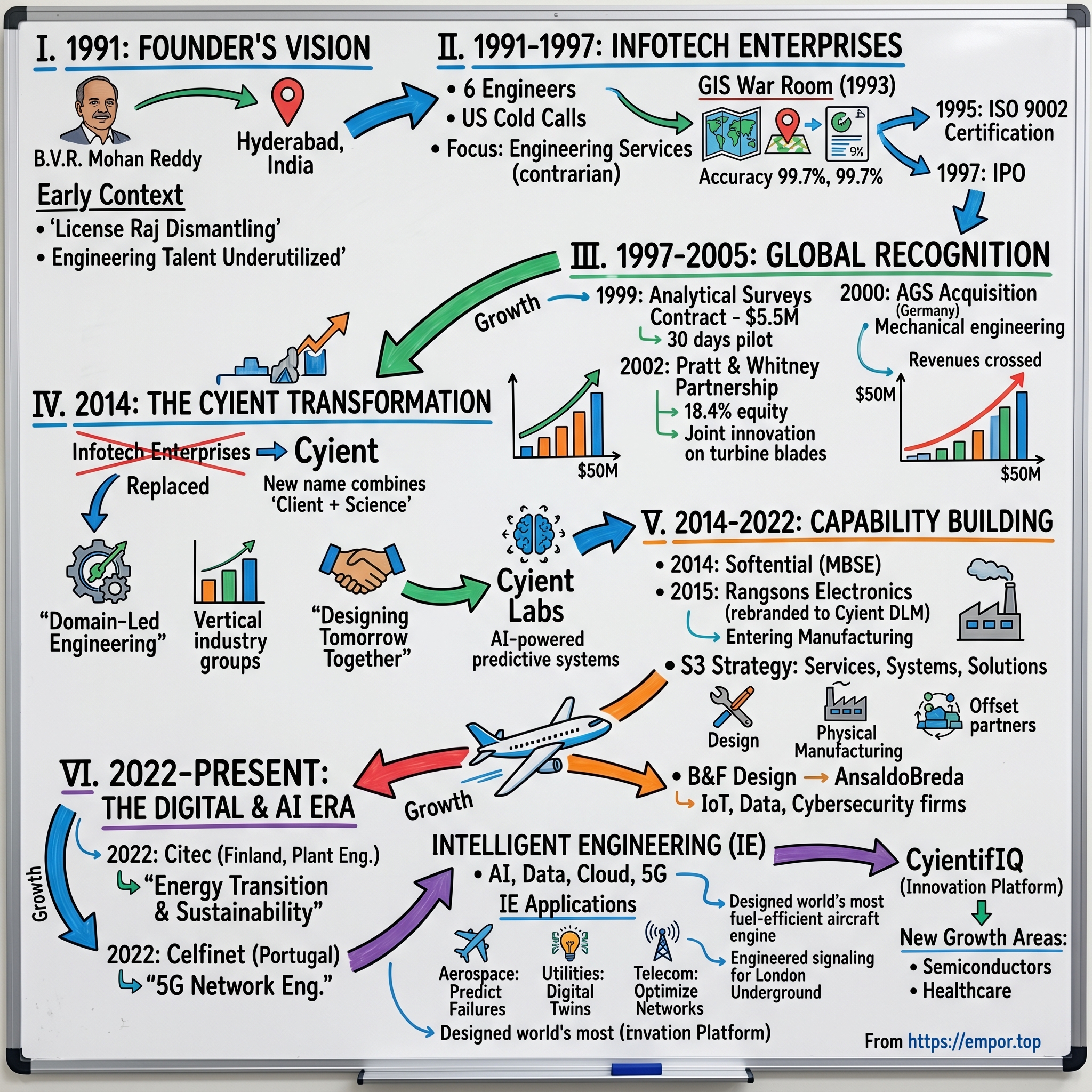
The office was the dining area of a house in Hyderabad, staffed by just two associates. The founding capital came from cashing out a 3% stake in a previous venture — about ₹20 lakh.6 It was August 1991, the same season the Indian government was dismantling the licence raj under balance-of-payments duress, and B.V.R. Mohan Reddy was betting that the wall between Indian engineers and global industrial customers was about to come down.
Reddy was not a software developer, which turned out to be the whole point. He held postgraduate engineering degrees from IIT Kanpur and the University of Michigan.5 His career had been an unusual tour of Indian industry's early development: management trainee at Shriram Refrigeration running diesel engine assembly, then Motor Industries Company (later Robert Bosch), then HCL to learn selling, and finally chief executive of OMC Computers — a joint venture that by the late 1980s held roughly half the domestic CAD/CAM/CAE market.6
So when Reddy started Infotech Enterprises, he did not look at application software, where most Indian tech pioneers were heading. He looked at engineering drawings.
Why maps were the wedge. Consider the problem a mid-sized American electric utility faced in 1993. It owned tens of thousands of poles, transformers, switches, and buried cables. The authoritative record of that physical network lived on paper — Mylar sheets stored in flat files, annotated by hand across four decades, in the custody of a retiring drafting department. Regulators and emerging outage-management software both required that infrastructure recorded in a spatial database. Converting it meant painstaking, judgment-heavy, tedious work: tracing features, reconciling contradictory revisions, attaching attributes, and checking accuracy. It was not groundbreaking work, but it required real skill, and it could not be botched.
That combination — high volume, exacting quality standards, unglamorous execution, and complete portability across an ocean — created the arbitrage opportunity. Infotech's early customers included General Motors and Gabriel Shock Absorbers, and the business scaled on process discipline rather than proprietary technology.6 By March 1995, the company employed over 100 people across two shifts.6 In March 1997, it went public in an IPO valued at roughly ₹11 crore that was oversubscribed 1.56 times — a modest raise even for that era, but one that made the company audited, public, and eligible to negotiate with Fortune 500 procurement departments as a listed entity rather than a private workshop.6
Krishna Bodanapu, describing the company's trajectory to investors three decades later, framed it plainly: "We started off as a digitization company, basically creating digital drawings from paper drawings."7
What the wedge actually bought. The strategic value of map conversion was never the margin. It was the master service agreement. Once a utility or telecom operator had handed Infotech its geospatial records — among the most sensitive operational assets outside the physical network itself — the firm gained an entry point no cold-calling competitor could match. The customer had already cleared procurement, security reviews, and quality audits with the vendor. Selling a second, more complex service became far easier than securing the initial contract.
This pattern recurs throughout Cyient's history: its advantage has consistently come from being already embedded within client workflows rather than offering unmatched technical superiority. That position provides a real advantage, but a fragile one, because it depends on the incumbent workflow persisting. Paper-to-digital conversion was, by design, a self-limiting market. Every map digitized was a map that never needed digitizing again.
By the late 1990s, having built a profitable business around a task with a natural expiration date, Reddy needed his next growth driver. He found it in one of the least forgiving industries in global business.
III. Strategic OEM Partnerships & The Aerospace Breakthrough (2000–2013)
There is a moment in the life of every outsourcing company when it discovers that the ladder it is climbing has a rung it cannot reach through hard work alone. For Infotech, that rung was aerospace.
Nobody hands a jet engine sub-assembly to a Hyderabad firm simply for quoting a low rate. Aerospace design work sits behind strict export-control regimes, airworthiness authorities, AS9100 quality systems, and an OEM supplier-qualification process that can consume years before a single billable hour is logged. The barrier is not technical intelligence; it is institutional trust, and institutional trust cannot be bought through cost arbitrage alone.
The German bridgehead. The first move was geographic and technical rather than aerospace-specific. In 2000, Infotech acquired Advanced Graphics Software GmbH, a German 3D CAD/CAM engineering firm. The logic was straightforward: European industrial OEMs were hesitant to send mechanical design work directly to India, but they would contract with a German engineering house — which could then execute part of the project offshore. Buying a European front end to connect to an Indian delivery engine became a template Cyient returned to repeatedly over the next two decades.
Pratt & Whitney changes the company. Around the turn of the millennium, Pratt & Whitney — then the aero-engine division of United Technologies — took a strategic equity stake in Infotech alongside a commercial relationship.6 Three years later, in 2003, the two formed Infotech Aerospace Services Inc. in Isabela, Puerto Rico, split 51:49 in Pratt & Whitney's favour, focused on aerospace and defence design and development.8
The equity provided the signal; the joint venture served as the mechanism. Puerto Rico gave the arrangement a US-domiciled, export-control-compliant entity through which sensitive engine work could flow, backed by Indian delivery capacity. For Infotech, the value was less about the joint venture's own standalone economics than what it certified: that a tier-one aero-engine OEM had audited the company's processes, embedded its engineers in active programmes, and put its own balance sheet behind the relationship. Every subsequent conversation with aerospace customers started from a position of established credibility.
The disconfirming evidence, placed where it belongs. The standard narrative of this growth phase treats OEM equity alignment as proof of an unbreakable moat. The company's own record does not support that reading.
In September 2017, Cyient sold its entire 49% stake in the Puerto Rico joint venture back to Pratt & Whitney. Bodanapu framed the move as a shift toward corporate focus — a step toward the company's "Design-Build-Maintain" strategy and an exit from non-core investments, following a similar divestment of the group's IT services business in 2015.8 The transaction was described as EPS-neutral.8 Fourteen years of a marquee aerospace joint venture ended in a disposal that management explicitly told investors would not move earnings.
Nor did the equity tie endure. Pratt & Whitney does not appear anywhere in Cyient's promoter or promoter-group register today, which as of June 30, 2026, consisted of fourteen Indian holders controlling 23.28% of the company.30
What should an investor conclude? Not that the aerospace relationships were worthless — they demonstrably were not, and aerospace remains Cyient's strongest vertical three decades on. The narrower, better-supported conclusion is this: OEM integration produces durable access and high switching costs within an active programme, but it offers no protection against falling industry volumes. When Boeing and Airbus stop launching clean-sheet aircraft, there is simply less design work to win, regardless of how deep the relationship runs. Sukamal Banerjee conceded exactly this on the January 2026 earnings call, noting that "with no major designs which are going on at this point in time, a large part of it is driven by MRO and aftermarket services."22
That is a real business — arguably a more stable, annuity-like business than clean-sheet design. But it is a fundamentally different business from the one the moat narrative implies, and investors must be clear about which model they are underwriting.
By 2013, the company possessed a credible aerospace franchise, a German front end, a shrinking legacy mapping business, and a corporate name that still led procurement officers to assume it handled basic helpdesk support. That last issue was about to receive expensive attention.
IV. The Cyient Rebranding & The EMS Pivot (2014–2019)
The word "Infotech" was killing them.
By the early 2010s, "Infotech Enterprises" had become a liability in exactly the rooms that mattered. When a chief engineering officer at a European industrial group heard the name, they assumed application maintenance and staff augmentation — the low-trust, low-margin end of Indian tech services. Cyient was selling flight-critical engineering, but buyers were filing it under body-shopping.
So on May 7, 2014, Infotech Enterprises became Cyient Limited. Working with global brand agency Wolff Olins, the company engineered the constructed name to carry three signals at once: client, science, and the "ient" suffix of the old name to preserve continuity. The brand name was tested across seventeen languages before adoption.9
Rebrands are cheap to mock and hard to value. This one is best judged by what accompanied it rather than the logo: a deliberate repositioning from an "engineering services vendor" to a "design-build-maintain partner." Within months, Cyient spent real capital to make that claim literally true.
Buying a factory. On January 2, 2015, Cyient signed an agreement to acquire a 74% stake in Rangsons Electronics, a Mysore-based electronics system design and manufacturing company with two decades of history supplying defence, aerospace, medical, automotive, telecom, and industrial customers. It was an all-cash transaction, with the consideration left undisclosed in the announcement.10 Bodanapu positioned the acquisition as the missing piece in a "services, systems, solutions" strategy, while Rangsons chief executive Pavan Ranga framed the combined entity as "an end-to-end integrated engineering, design and manufacturing provider."10
Why does a company with 15%-plus operating margins buy a contract manufacturer? The answer lies in customer behavior. When an aerospace or defence buyer needs a line-replaceable unit — such as a ruggedised control box with a printed circuit assembly, wiring harness, and housing — it can manage two separate vendors (one to design it, one to build it) or just one. Managing a single vendor is worth paying a premium for, and it creates a relationship that is nearly impossible to displace once the design intent and manufacturing process reside under one roof.
The strategic logic was sound, but the financial fallout was immediate: electronics manufacturing is a fundamentally different business, running operating margins in the high single digits compared to the low-to-mid teens of engineering services, while consuming working capital that services firms do not. Every rupee of manufacturing revenue diluted group margins and return on capital. Institutional investors who bought into an asset-light engineering story suddenly owned a factory — and expressed their frustration.
The capital-allocation test, tested honestly. The 2014–2019 period marked the real acceleration of Cyient's acquisition engine, and it revealed the first signs of integration indigestion. The clearest verified marks against its track record are the two exits already noted — the IT services business divested in 2015 and the Pratt & Whitney joint venture unwound in 2017 at an explicitly EPS-neutral price.8 Management framed both moves as strategic focus. Read plainly, however, both were admissions that assets acquired or built in earlier strategy cycles no longer earned their keep.
Neither exit was catastrophic, but together they establish a clear pattern for evaluating Cyient's dealmaking: management buys capability enthusiastically, integrates it unevenly, and demonstrates a willingness — to its credit — to sell or shut down what fails to perform. The pattern is not reckless empire-building; it is serial repositioning. Yet it carries a real cost in write-offs and executive distraction that recurs across decades rather than resolving.
The succession. During this period, B.V.R. Mohan Reddy handed operational control to his son, Krishna Bodanapu, who became managing director and chief executive. Reddy stepped back into the founder-chairman role, making the transition around age 60 explicitly to grant Bodanapu decision-making authority rather than shadow him, according to a 2022 profile.6 Reddy received the Padma Shri in 2017, chaired NASSCOM in 2015–16, and remains founder chairman and board member, serving as mentor and strategic adviser on governance, values, and direction.5
Second-generation transitions in Indian promoter families fail often enough that a clean handoff is notable. This one was clean. Whether it proved effective is a separate question — one for which the subsequent decade provides the evidence.
V. The Mega M&A Sprint & European Expansion (2020–2022)
In the spring of 2020, roughly two-thirds of the world's commercial aircraft fleet stopped flying. For a company with its deepest relationships in commercial aerospace, this was not a soft patch. Engineering budgets at airframers and engine manufacturers are discretionary in a way that maintenance spending is not, and they were among the first items cut.
Cyient responded by deciding that client and sector concentration was its primary vulnerability — and attempted to fix it by rapidly buying its way into other industries.
Citec: the big swing. On April 25, 2022, Cyient announced the acquisition of Citec, a Finnish plant and product engineering company headquartered in Vaasa, with operations across Finland, Sweden, Norway, France, Germany, and India. The enterprise value was €94 million on a debt-free, cash-free basis for 100% of the equity.[^11] Citec had generated €80 million of revenue in 2021, up from €73 million the prior year, and brought over 1,200 engineering professionals.[^11]11 Cyient described it as the largest outbound acquisition by an Indian engineering services company and its own largest deal to date.[^11]
The purchase price — roughly 1.2 times trailing revenue — appeared disciplined against European engineering valuations at the time. However, revenue multiples can obscure structurally lower margins, which was precisely Citec's financial profile. Plant engineering involves project-based work with substantial fixed overheads and European cost structures. Combining it with a group running low-to-mid-teens operating margins guaranteed margin dilution unless the acquired business improved its profitability materially.
The strategic rationale was clear: Citec gave Cyient immediate exposure to the energy transition, process industries, and Nordic industrial capital expenditure just as spending on decarbonization was expected to accelerate.
Celfinet and Grit. Six weeks later, on June 6, 2022, Cyient acquired Lisbon-based Celfinet for €41 million, acquiring wireless network planning and optimization capabilities aimed at 5G — and eventually 6G — deployments across Europe, North America and Australia.12 In between, on April 28, 2022, it acquired Singapore-based Grit Consulting, a performance-improvement firm serving mining, energy, and asset-intensive sectors; the price was not disclosed in the announcement.13
Taken together, these three deals represented a single strategic pivot: converting a revenue base heavily reliant on commercial aerospace into a diversified industrial franchise using cash and debt over ten weeks.
What actually happened next. In retrospect, the timing proved challenging. Within months of closing the Citec deal, European energy markets faced severe dislocation, industrial capital spending across Germany and the Nordics slowed, and the plant engineering pipeline took longer to materialize than projected. In telecommunications, operators across Europe curtailed 5G rollout spending, converting Celfinet's growth premise into an operational drag.
Evidence of these headwinds appears in Cyient's segment disclosures four years later. The Strategic Units division — housing mining and minerals, energy, and healthcare — declined 12.2% in FY26 in reported dollar terms and 8.8% in constant currency, after falling 12.4% sequentially in the March 2026 quarter alone.3 Sukamal Banerjee noted on the April 2026 earnings call that "the headline numbers look sharp" and acknowledged that turning the cluster around "will be a few quarters."2 Meanwhile, Networks & Infrastructure, which houses the Celfinet capability, declined 1.6% in FY26.3
Further evidence appears in the financial disclosures. In the quarter ended December 2025, Cyient recognized a one-time impairment of ₹2,429 million against its investment in Cyient Singapore Private Limited in its standalone accounts, citing the integration of operations into other subsidiaries and "updated forecasts and long-term outlook."1 While this write-down had no consolidated P&L impact — operating as an intra-group accounting adjustment rather than a direct loss for shareholders — it represented an auditor-validated reassessment that the long-term earnings potential of part of the international footprint built during this period was lower than originally assumed.
The calibrated conclusion. The 2022 M&A sprint did not establish Cyient as a market leader in sustainability or 5G plant engineering; instead, it acquired scale in sectors that subsequently slowed, leaving these units among the group's weakest performers for three consecutive years. What the sprint did deliver was narrower but real: it reduced concentration risk in commercial aerospace, added roughly 1,800 European engineers alongside onshore client relationships that Cyient could not have built organically, and expanded the company's global delivery footprint.
The evaluation criteria going forward remain specific: does the Strategic Units cluster return to growth, and does DET's operating margin recover toward the mid-teens? Until both occur, the evidence indicates Cyient paid fair multiples for international assets whose full earning power has yet to be demonstrated.
VI. Unlocking Cyient DLM: The Spin-Off & Partial Monetization (2023–2024)
There is a specific kind of pain in owning two good businesses that no single investor wants together.
By 2023, Cyient's problem was structural. Engineering services investors valued asset-light, high-return, low-working-capital models and marked down anything that consumed a factory's worth of capital. Electronics manufacturing investors — in the middle of an Indian EMS re-rating driven by defence indigenisation and production-linked incentives — wanted pure exposure to that theme and had no interest in valuing a services parent. The combined entity was being priced by whichever set of investors was more sceptical.
The solution was to let the market price the two halves separately.
The listing. Cyient DLM's IPO opened on June 27, 2023, and closed on June 30 as an entirely fresh issue of ₹592 crore. Priced between ₹250 and ₹265 per share, the proceeds were earmarked for capital expenditure, debt repayment, and acquisitions.14 It listed on July 10 at ₹403 on the NSE — a 52% premium over the upper issue price of ₹265 — after being subscribed 71.35 times overall, with the institutional portion covered nearly 96 times.15
On listing day, this proved a straightforward validation of the separation logic: the same manufacturing assets that had dragged down parent valuations commanded a steep premium when investors could buy them standalone. It was a lesson in market structure rather than operational improvement. Nothing about the factories themselves had changed on July 10, 2023.
The monetisation. Thirteen months later, Cyient took the second step. On August 21, 2024, the parent company sold roughly 1.15 crore shares — representing a 14.5% stake in Cyient DLM — through a block deal at a floor price of ₹748.65 per share. That transaction raised about ₹861 crore at a 5% discount to the prior close, reducing Cyient's holding from 66.66% to 52.16% while retaining majority control.16
The stated uses were those of a balance sheet under pressure: funding acquisitions, paying down debt, and supporting the semiconductor business.16 The balance sheet relief was immediate. On the April 2025 earnings call at the end of FY25, the chief financial officer described DET as "a long-term debt-free business" holding a record cash balance of $157 million.20 By the close of FY26, consolidated long-term borrowings stood at just ₹77.8 crore against a net worth of ₹6,163 crore, backed by an AA credit rating.28
The honest framing. It is tempting to frame this as elegant capital allocation, and in execution it was largely successful. Yet the sequencing tells a simpler story: Cyient spent heavily on European acquisitions in 2022; those acquisitions underperformed; and the company then sold down a stake in its best-performing asset — at a discount to the prevailing market price — partly to repair a balance sheet strained by those very deals. That was not a failure, but neither was it organic growth funded by operating cash flow.
That structural tension remains. Manufacturing consumes working capital, whereas services generate it. Cyient DLM's FY26 revenue fell from ₹1,520 crore to ₹1,262 crore — a drop Bodanapu attributed on the January 2026 earnings call to "customer specific pushouts, year-end holidays, and of course, the tariff uncertainty."122 The counter-evidence is that profitability held: DLM maintained double-digit operating margins through the slowdown, closing FY26 with a 10.3% EBITDA margin, a full-year book-to-bill ratio of 1.5 times, and what management called the largest order book in the unit's history.2 The subsidiary also expanded its US presence, acquiring Torrington, Connecticut-based Altek Electronics on October 4, 2024 — a purchase that added ITAR certification, roughly 80,000 square feet of manufacturing capacity, and direct entry into the US defence market.17
DLM is neither a distraction nor free optionality. It is a controlled, separately priced, cyclical manufacturing business inside a services group, whose primary contribution to the parent so far has been a well-timed ₹861 crore cash infusion. Whether it evolves beyond a liquidity valve depends on whether its record order book converts into revenue without eroding margins — the exact challenge facing the rest of the company.
VII. Modern Era & The FY25 Execution Crisis (2024–Present)
The shape of the group today. Effective April 1, 2025, Cyient reorganised its financial reporting into four segments, breaking out semiconductors as a standalone unit for the first time.1 Digital, Engineering & Technology (DET) remains the core engine, encompassing Transportation & Mobility (aerospace, rail, automotive), Networks & Infrastructure (connectivity and utilities), and Strategic Units (mining, energy, healthcare, and life sciences).1 Cyient DLM operates as the listed manufacturing arm, Cyient Semiconductors designs and supplies chips, and a residual "Others" segment holds an aerospace tooling division.1
The concentration of profit is stark. In FY26, DET generated ₹5,819 crore of the group's ₹7,268 crore in revenue, but delivered ₹691 crore in segment profit against a group-wide operating total of just ₹658 crore — meaning everything outside the core services business collectively ran at a net loss.1 Performance within DET varied sharply: Transportation & Mobility generated $269.3 million, up 8.0%; Networks & Infrastructure slipped 1.6% to $209.1 million; and Strategic Units contracted 12.2% to $177.4 million.3
How the crisis unfolded. To understand the current position, look back to July 25, 2024. Entering FY25, management had guided to high-single-digit constant-currency growth for DET. Just one quarter in, that forecast collapsed. Revenue fell 5% sequentially, prompting then-chief executive Karthikeyan Natarajan to inform analysts that high-single-digit growth was unreachable and to cut guidance to flat.18
The subsequent analyst call was exceptionally candid. Kotak analyst Kawaljeet Saluja pressed management on how the magnitude of the miss could be so large, noting that four or five delayed projects alone could not account for such a sharp first-quarter decline, and asked whether the failure stemmed from sales execution or the forecasting process itself. Natarajan conceded both issues, acknowledging the miss and noting that sales leaders had been overly aggressive in their forecasts.18
Even the revised flat target proved unachievable. DET closed FY25 at $687.7 million, a 3% decline in constant currency.20
The leadership response. Natarajan resigned in January 2025. On February 19, 2025, Cyient appointed Sukamal Banerjee as executive director and chief executive of DET. A thirty-year ER&D veteran who previously headed engineering services at HCL Technologies and served as CEO of Xoriant, Banerjee brought strong operational credentials.19 Bodanapu transitioned to executive vice chairman and managing director, retaining oversight of group capital allocation, subsidiary governance, and M&A.
Six weeks into the role, on the April 2025 earnings call, Banerjee withdrew financial guidance entirely, telling investors the company needed to focus on building predictability and stability across its portfolio.20 Having visited four continents, met over a thousand employees, and spoken with nearly a hundred clients, his summary was measured but direct: while client relationships and engineering talent were strong, operational execution required significant improvement.20
Withdrawing guidance after two consecutive years of missed targets was a practical reset, but also an explicit admission of limited visibility. It removed the primary benchmark investors used to evaluate management, shifting the full burden of proof to reported results.
The FY26 scorecard. Judged by operational delivery, FY26 delivered only a partial recovery. Sequential revenue growth improved through the first three quarters — moving from a 1.5% constant-currency decline in Q1 to 0.5% growth in Q2 and 1.9% in Q3 — before reversing to a 2.4% drop in the March quarter.21222 Banerjee attributed the fourth-quarter reversal to three client project delays and postponed Middle East energy contracts due to geopolitical friction, maintaining that these delays were non-structural.2 Profitability showed discipline: DET's operating margin expanded sequentially for three quarters to reach 12.4% in Q4, while gross margins expanded 114 basis points in the final quarter.2 Full-year free cash flow remained solid at ₹731 crore.26
Yet full-year results confirmed underlying stagnation. DET revenue declined in constant currency, group operating margin contracted 254 basis points, and reported net profit attributable to shareholders fell to ₹428 crore from ₹635 crore a year earlier.1 Even on management's normalized basis, group profit of ₹534 crore declined 14.3%.2
The semiconductor bet. Cyient's most prominent growth initiative is also its least proven. Cyient Semiconductors generated $25.7 million in FY26 revenue while posting an operating loss of ₹108 crore, compared to a ₹47 crore profit in the restated prior year.12 On December 17, 2025, the unit agreed to acquire a majority stake in Kinetic Technologies — a power management and analog chip developer with over 250 products and 100 patents — for ₹8,002 million (approximately $84.83 million), completing the transaction on April 8, 2026.1 In May 2026, the subsidiary raised external capital: $10 million in equity from funds managed by EAAA India Alternatives alongside $20 million in structured debt, establishing a post-money equity valuation of approximately $500 million.24
Bodanapu was clear about why Cyient brought in external equity rather than funding the business internally. He noted that public markets assigned near-zero or negative valuation to the standalone semiconductor division because its operating losses weighed on group earnings under standard EBIT multiples.2 Management expects Kinetic to help drive segment revenue to $100 million in FY27, targeting operational breakeven by late FY27 or early FY28.2
The strategic rationale is specific: rather than competing with mega-cap designers on leading-edge logic, Cyient is targeting mature-node power semiconductors where design costs run $5 million to $10 million per chip and every AI accelerator requires companion power management silicon.22 The unit has also been selected for a modernization package at Semiconductor Complex Limited under the Indian government's MeitY initiative.22
However, measured evaluation requires caution. Selection for a government program does not constitute commercial revenue, and a $500 million private valuation established by a minor equity cheque is a negotiated metric rather than a market price. Furthermore, the segment's full-year revenue dropped in rupee terms despite mid-year sequential gains, following a 35% revenue collapse in Q1 FY26 when management shed low-margin accounts.21 The semiconductor unit represents a real strategic asset with valuable IP, but it currently remains the primary drag on group earnings while the core business is flat.
And then, Tao. On May 30, 2026, Cyient agreed to acquire 100% of Tao Digital Solutions, a Santa Clara-headquartered data, product, and AI engineering firm with roughly 3,500 employees across North America, Europe, and Asia. Tao's revenue grew rapidly from $19.7 million in CY23 to $50.3 million in CY24 and $79.1 million in CY25. Cyient agreed to an enterprise value of $218 million, representing 9.5 times estimated CY27 EBITDA.23
On a June 1 analyst call, CFO Shrinivas Kulkarni outlined the deal structure: Cyient will pay roughly 60% — approximately $130 million — upfront at closing (representing 7.9 times CY25 EBITDA), with two performance-based earnout tranches over two years. The cash transaction is funded primarily through debt, which management expects to service using Tao's cash flows, bringing EPS accretion after integration.7 The Competition Commission of India approved the deal on August 25, 2026, with completion expected in Q2 FY27.
The strategic rationale underpins Cyient's effort to expand its addressable market. Banerjee argued the acquisition expands the company's scope from a $100 billion traditional ER&D market to a $2 trillion product lifecycle engineering landscape, while raising higher-margin technology services toward the high teens as a proportion of DET revenue.7
The deal also carries a notable historical echo. Kulkarni explained that roughly 40% of Tao's offshore staff — representing about 20% of its overall revenue — performs data digitization.7 Thirty-five years after B.V.R. Mohan Reddy started the firm by manually digitizing paper utility maps, Cyient's largest transaction includes a digitization engine. The operational difference lies in the output: rather than populating spatial databases, Tao's teams prepare training data for industrial AI models.
Whether that technical shift justifies a $218 million debt-funded purchase remains the central question — particularly as it re-leverages a balance sheet that had only recently eliminated long-term debt following the previous acquisition cycle.
VIII. Industry Structure, Segment Economics & Competitive Benchmarking
To understand why engineering research and development (ER&D) providers are valued differently from IT services companies, consider how much leverage a procurement officer holds when dissatisfied.
In enterprise IT, the buyer holds significant leverage. Application maintenance can be re-tendered, and infrastructure management can be transitioned within a quarter. The work is heavily documented, the toolsets are standard, and commoditisation keeps generic IT services trading at modest earnings multiples.
In ER&D, switching costs depend entirely on the nature of the work. Displacing a vendor whose engineers possess airworthiness certification knowledge on a specific aero-engine program, have spent eight years inside a client's proprietary CAD environment, and hold sign-offs embedded in regulatory filings is a multi-quarter undertaking with genuine schedule risk on multi-billion-dollar programs. That represents the high-moat end of the market. The lower end — routine drafting, testing, and basic mechanical design — resembles IT services and commands pricing to match.
Cyient operates across both tiers, and its financial performance reflects that split.
The peer comparison is unflattering, and specific. In FY26, L&T Technology Services grew revenue 8.3% in dollar terms to $1.233 billion and 14% in rupees, delivering a 14.5% operating margin while securing over $850 million in large-deal total contract value.31 Tata Elxsi finished FY26 with ₹3,757 crore in revenue and a 23.4% profit-before-tax margin, closing its fourth quarter with an EBITDA margin of 24.6%.32 By contrast, Cyient's core DET services segment contracted 0.7% in constant currency, posting a normalized operating margin of 12.2%.2
This growth and margin gap is neither a rounding error nor a single-year anomaly. Cyient has lagged both pure-play Indian ER&D peers on growth for three consecutive years while operating at lower margins. Any argument that Cyient possesses a structurally superior market position must reconcile that claim with its financial results.
Structural differences explain part of the divergence. Tata Elxsi benefits from a higher-margin mix focused on design and media with minimal onshore delivery. LTTS maintains a broader industrial client base with less exposure to slowing European plant engineering. Cyient, meanwhile, carries an unusually heavy onshore footprint. Chief financial officer Prabhakar Atla noted in January 2026 that offshoring remains below 50%, framing this as a deliberate strategy that acts as "a significant buffer for us against the current trends we see of localization," while acknowledging it remains an unexploited margin lever.22 Maintaining local delivery provides a defensible hedge against protectionist trade trends, but it imposes a clear cost on operating efficiency.
Concentration and the talent equation. Client concentration increased even as overall revenue fell. Cyient's top five clients generated 33.6% of DET revenue in the March 2026 quarter, while the top ten contributed 46.0% — up from 30.2% and 43.5% a year earlier.3 Atla explained the dynamic on the January 2026 call, noting "a significant positive movement in contribution from our top 3, top 5, and top 10 clients, which grew by about 5% quarter-on-quarter."22
Expanding work within core accounts demonstrates effective client mining, but rising concentration increases revenue volatility. When ten clients account for nearly half of revenue, a small number of procurement decisions can dictate annual performance.
On the talent supply side, headcount closed FY26 at 14,236, while trailing twelve-month voluntary attrition eased to 14.5% from 16.5% the prior year.3 Moderating attrition in a flat-revenue environment reflects a blend of improved internal retention and broader tech sector hiring lulls. However, structural talent competition remains intense. Global aerospace, industrial, and semiconductor corporations continue expanding captive engineering centers in Bengaluru and Hyderabad, competing directly for specialized engineering talent with higher compensation and direct brand affiliation. In response, Chief Executive Sukamal Banerjee established a dedicated unit designed to sell services directly to these captive centers rather than competing exclusively against them.20
Where Cyient wins, and where it does not. Cyient retains competitive strength in commercial aerospace lifecycle engineering, integrated design-and-build bids supported by Cyient DLM, and an established European onshore presence. Empirical evidence confirms these capabilities: during the March 2026 quarter, Cyient was selected as one of three strategic suppliers for a global rail OEM during vendor consolidation and displaced incumbent providers at a mid-sized airframe manufacturer.2 Furthermore, Banerjee noted that "some of our existing customers have also backed us on price increases this year" — a rare indication of pricing power during an industry-wide spending slowdown.2 Realized price increases in a soft demand environment provide tangible proof of domain defensibility.
Conversely, Cyient loses ground when contract scope demands massive scale. Competing against global IT and engineering giants like HCLTech, Capgemini, and Alten, Cyient lacks the balance sheet depth to absorb bundled multi-year contracts spanning enterprise IT alongside engineering. Against Tata Elxsi, Cyient historically lacked software-centric capabilities — a gap the Tao Digital acquisition is explicitly structured to address.
IX. Management Credibility, Capital Allocation & Governance
Two decisions made just weeks apart in the spring of 2026 capture how Cyient's leadership approaches capital allocation — and on the surface, they appear to point in opposite directions.
On April 23, 2026, the board authorized a buyback of 6.4 million shares — representing 5.76% of paid-up equity — at ₹1,125 per share, allocating up to ₹720 crore through a tender offer.1 Executive Vice Chairman Krishna Bodanapu pointed directly to valuation as the rationale: "The Board of Directors trust the fundamentals of our business and believe that its intrinsic value is not reflected in the current market price."26 Promoters, board members, and key executives opted out of participating, ensuring that the payout accrued entirely to public shareholders.2 The board recommended no final dividend for FY26, treating the ₹16 interim dividend paid in the second quarter as final, while reiterating its commitment to return 40% to 50% of earnings through a mix of dividends and buybacks.12 Shareholders overwhelmingly approved the buyback on June 10 with 99.99% of valid votes in favor, and the transaction was completed before the end of the June quarter.274
Just five weeks after announcing that capital return, Cyient committed to the $218 million debt-funded acquisition of Tao Digital Solutions.
Whether returning cash while taking on acquisition debt creates a contradiction was raised directly by an analyst on the April 2026 earnings call. Bodanapu defended the structure by clarifying that the share buyback was executed at the parent level while a separate capital raise was directed at the semiconductor subsidiary, maintaining that the group remained "well capitalized to deliver on our execution and strategic road map."2 Repurchasing stock at what management deems a discount while taking on leverage to buy high-growth digital capabilities can be a rational allocation of capital. However, executing both simultaneously during a period of flat organic revenue growth undeniably heightens financial risk — a shift an activist investor would scrutinize closely.
The record on promises. Evaluating Cyient's leadership requires comparing management's stated commitments against reported outcomes.
The guidance sequence for FY25 — which began with a forecast of high single-digit revenue growth, was revised down to flat, and ultimately ended in a 3% decline — represents the most visible forecasting failure, resulting in the exit of the DET chief executive.1820 Subsequent execution showed signs of stabilization. Chief Executive Sukamal Banerjee informed investors in October 2025 that the business required a stabilization phase and projected a stronger second half of FY26; DET operating margins subsequently expanded sequentially across three quarters, while second-half order intake rose 5.5% year-over-year, capped by a 23% order surge in the March quarter.212 Former CFO Prabhakar Atla emphasized on the January 2026 call that this margin recovery was "all fundamental and structural to our business," driven by internal efficiency gains rather than currency tailwinds.22
Quarterly predictability, however, remains volatile. Banerjee entered the final quarter of FY26 citing positive momentum, only for DET revenue to drop 2.4% sequentially due to project deferrals across three major clients.2 When asked during the January call how management planned to improve forecasting reliability, Banerjee asserted that Cyient was "on par with anybody else" regarding accuracy.22 The subsequent fourth-quarter miss highlighted the inherent lumpiness of project-based revenues in energy and connectivity. Consequently, management's targets for FY27 — achieving mid-to-high single-digit organic growth and reaching a 15% DET operating margin by the fourth quarter2 — should be viewed as benchmarks requiring quarterly verification rather than baseline guarantees.
Governance signals. Independent oversight and voting patterns provide additional context on corporate governance.
Statutory auditor S.R. Batliboi & Associates LLP issued an unmodified audit opinion on Cyient's consolidated and standalone FY26 financial statements.1 While shareholder approval for management resolutions remains high, voting results show subtle friction. Krishna Bodanapu's re-appointment as executive vice chairman and managing director passed with 98.17% of votes in favor and 1.83% opposed out of 8.03 crore votes cast.27 The dissenting votes represented approximately 14.7 lakh shares — a modest figure, but a notable signal given the shareholder register structure, where domestic mutual funds hold 31.79% and foreign portfolio investors hold 14.5%, compared to the promoter group's 23.28% stake.30 Institutional shareholders, rather than the founding family, hold voting control over major governance decisions.
Several non-operational accounting adjustments impacted FY26 figures. Net exceptional items for the year totaled ₹928 million, comprising ₹712 million in write-offs from the abandoned Project Astro transaction alongside a ₹423 million one-time provision for employee benefits under India's new Labour Codes, which went into effect on November 21, 2025, and mandated recognition under Ind AS 19.1 Cyient also recorded a ₹278 million ($3 million) impairment against its aerospace tooling division under Ind AS 36, as well as a ₹207 million reduction in the fair value of an investment in an IP-based communications firm, citing extended development and execution timelines.1 Partially offsetting these charges, the company received a ₹207 million insurance recovery during the quarter ended September 2025 connected to the court-approved settlement of a civil class-action antitrust case completed in June 2025.1
Finally, a regulatory filing from early 2026 illustrates the importance of detailed disclosure checks: on April 30, 2026, Cyient filed a correction regarding its buyback announcement, rectifying an erroneous statement that its securities were registered under Section 12 of the US Securities Exchange Act. The core procedural requirement — seeking SEC exemptive relief due to conflicts between Indian and US tender-offer rules — remained unchanged.29 While a minor administrative oversight, prompt corrections highlight the value of examining regulatory filings beyond executive summaries.
X. Strategic Powers & Competitive Advantage Analysis
Strip away the narrative and ask Hamilton Helmer's central question directly: what would a well-funded, competent competitor have to do to take Cyient's business, and what would it cost them?
Process Power — real, and the strongest of the set. Three decades of accumulated domain knowledge, certification procedures under FAA and EASA airworthiness regimes, AS9100 quality systems, and the institutional memory of how a specific customer's engineering organization actually functions cannot simply be hired into existence. A new entrant can recruit a thousand engineers; it cannot recruit the eight-year audit trail that permits sign-off on a flight-critical deliverable. The supporting evidence is behavioral rather than rhetorical: customers accepted price increases during a weak year, and Cyient was retained through vendor consolidation exercises at both a rail OEM and an aerospace airframer, displacing incumbents in the latter case.2 Consolidation processes are where weaker vendors are eliminated; surviving them reflects genuine operational embedding.
Switching Costs — high within programs, weak across cycles. This distinction is enforced by the company's own historical record. Inside an active engineering program, switching costs are severe. Between program cycles, when a customer decides how much clean-sheet design work to commission overall, those switching costs offer no protection. Cyient does not control client program volumes, and the current aerospace cycle — heavy on aftermarket maintenance, repair, and overhaul (MRO) while light on new aircraft design — reflects a demand mix set entirely by its customers.22
Scale Economies — modest. A global delivery footprint across Hyderabad, Bengaluru, Mysuru, Connecticut, Germany, Finland, and Portugal enables round-the-clock engineering and local presence in protected markets. Yet at $658 million of DET revenue, Cyient operates at roughly half the scale of L&T Technology Services and a fraction of global engineering consultancies, while an offshore delivery mix below 50% limits its ability to capture classic labor-arbitrage economies.2231
Counter-Positioning — the DLM combination is genuine but narrow. Bidding on integrated design-and-build contracts is something a pure engineering consultancy cannot match without subcontracting manufacturing. Evidence that this integration converts includes Cyient DLM's record order book and 1.5 times book-to-bill ratio.2 Evidence that the combination is not transformative is that Cyient DLM's revenue declined 17% in FY26.1 The offering represents a genuine technical capability searching for consistent end-market demand.
Cornered Resource, Network Effects, Branding — essentially absent. Specialized engineering talent is contestable, with corporate captive centers bidding for talent directly. Network effects do not exist in project engineering. And whatever weight the Cyient brand carries in Hyderabad, it commands little pricing premium in a Toulouse procurement office.
Porter's Five Forces, applied to disclosed performance. Buyer power is high and rising — Cyient's top ten clients account for nearly half of DET revenue, while consolidated aerospace original equipment manufacturers and European telecom operators run structured vendor rationalization programs as standard policy. Winning two recent consolidations demonstrates resilience, but the prevalence of these exercises underlines client leverage. Threat of new entrants is low in certified aerospace and defense work, but considerably higher in the digital, data, and platform services Cyient is attempting to expand into — as demonstrated by Tao Digital's rapid scaling of over 100% annually from a 2022 baseline.7 Supplier power — namely engineering talent — is high and structural. Threat of substitutes is the live strategic debate, centered on artificial intelligence. Rivalry remains intense against peers like LTTS, Tata Elxsi, AXISCADES, HCLTech, Capgemini's Altran unit, and Alten.
On AI, test management's framing against the business mix. Asked in April 2026 which parts of the business faced the greatest risk from AI, Banerjee offered a three-part assessment: substantial opportunity in product lifecycle and data engineering; genuine uncertainty in raw data conversion, where automation eliminates traditional tasks while creating new demand for structured training data; and acknowledged compression in software development, where he noted that 20% to 30% productivity gains are already established fact. He contended that the net effect for Cyient remains slightly positive because software represents a small proportion of the core portfolio.2
That argument is logical, but it reveals a strategic paradox. If AI compresses software effort by 20% to 30% and Cyient's software exposure is small, the firm is insulated today primarily because it is under-indexed to the highest-growth segment of tech services — the exact gap the Tao Digital acquisition is intended to close. Insulation through absence is not a competitive moat. Management is simultaneously maintaining that its heavy mechanical-engineering mix protects the business from AI disruption and that it must urgently diversify beyond mechanical engineering.22 Both statements may be accurate, but together they highlight a fundamental strategic tension.
XI. Historical Falsification Pass (Mandatory Thesis Stress Test)
Thesis Claim 1: Aerospace domain dominance creates an unshakeable moat with sticky recurring revenues.
The disconfirming evidence has already been established: the Pratt & Whitney equity partnership did not endure, the 14-year Puerto Rico joint venture ended in an earnings-neutral divestment in 2017, and the 2020 aviation groundings proved that client spending volumes, not relationships, dictate revenue.8
The current cycle provides a more subtle test. Aerospace remains Cyient's strongest vertical, with Transportation & Mobility growing 13.2% in constant currency during FY26 and delivering five consecutive quarters of growth through Q1 FY27.24 However, management attributes this expansion largely to maintenance, repair, and aftermarket support during a period with few clean-sheet aircraft designs.22 While aftermarket services offer steady, annuity-like revenue, they involve lower engineering complexity—leaving them more exposed to efficiency gains from AI-assisted automation.
Verdict: the claim survives in narrowed form. Domain expertise provides durable client access, proven pricing leverage, and survival during vendor consolidations. It provides no protection against broader volume declines, and current growth relies on aftermarket services rather than the high-margin clean-sheet design work implied by the moat thesis. Falsifying evidence to watch: the top five and top ten client concentration ratios, and whether Transportation & Mobility growth persists once the current commercial-aviation volume surge normalises.
Thesis Claim 2: Inorganic M&A is a disciplined growth driver that expands high-margin capabilities.
This claim fares worst when evaluated against historical capital allocation.
The 2022 European acquisitions brought roughly €135 million in revenue across verticals that subsequently became the group's weakest performers, with Strategic Units contracting 12.2% in FY26 and Networks & Infrastructure slipping 1.6%.3 Financial disclosures reflect these headwinds: Cyient recorded a ₹2,429 million impairment against an international holding structure in its standalone accounts following a weakened long-term outlook.1 It booked a separate ₹278 million write-down against its aerospace tooling unit,1 took a ₹207 million fair-value markdown on a communications investment,1 and expensed ₹712 million — over $8 million — on deal diligence for an acquisition the board aborted at the final stage.12
Conversely, management has demonstrated flexibility by divesting its IT services unit, exiting the Puerto Rico joint venture, and monetizing a stake in Cyient DLM when market conditions were favorable—showing a willingness to prune non-performing assets.
Verdict: the claim is rejected as stated. Cyient's acquisition history shows reasonable prices paid for assets whose earnings potential takes years to materialize, accompanied by recurring write-downs, impairments, and abandoned transactions. A defensible restatement is that Cyient buys capabilities it cannot build internally, requires significantly longer than modeled to realize returns, and eventually exits or writes down underperforming assets. The $218 million debt-funded acquisition of Tao Digital, a firm with a four-year operating history, represents the ultimate test of whether management has broken this cycle.723 Falsifying evidence to watch: whether the technology mix within DET actually reaches the high teens as management projects, and whether the group's operating margin recovers rather than absorbing another integration.
Thesis Claim 3: Cyient DLM represents pure optionality and value creation for parent shareholders.
Selling a 14.5% stake at a 5% discount to market — primarily to pay down debt incurred from European acquisitions — challenges the pure optionality narrative.16 Furthermore, Cyient DLM's 17% revenue drop in FY26 underscores that manufacturing remains cyclical and volatile compared to core services.1
The counter-evidence lies in operational resilience: operating margins held at 10.3% EBITDA through the downturn, while a 1.5 times book-to-bill ratio expanded the subsidiary's order book to a record high entering FY27.2
Verdict: the claim is narrowed, not rejected. Cyient DLM is a separately listed, controlled subsidiary that has primarily served the parent company as a liquidity mechanism rather than a source of operational synergies or steady earnings. Executive Vice Chairman Krishna Bodanapu explicitly cited DLM as the model for the standalone semiconductor business, noting that "this is at least a DLM-like investment, if not even better"2 — confirming that management is applying the separation strategy a second time. Falsifying evidence to watch: whether DLM's record order book converts to revenue growth at sustained double-digit EBITDA margins, and whether parent ownership stays near 52% or drifts lower to fund other things.
Thesis Claim 4: Management guidance is conservative, reliable, and execution-focused.
This claim was disproved during FY25. Lowering initial high-single-digit growth targets to flat before ending the year down 3%, admitting to over-aggressive sales forecasts, replacing the chief executive, and withdrawing formal guidance entirely represents an unequivocal forecasting failure.1820
Under Sukamal Banerjee, operational discipline has improved. Management delivered on focused near-term promises: stabilizing the core portfolio, expanding operating margins sequentially, and accelerating second-half order intake.212 However, targets under Banerjee have been more conservative, and the fourth-quarter FY26 revenue decline proved that underlying volatility remains an operational challenge.
Verdict: the old claim is rejected; a new, unproven one is on the table. Targets for FY27 — achieving mid-to-high single-digit organic growth and reaching a 15% DET operating margin by the fourth quarter — represent the first full-year benchmark of the Banerjee era.2 Performance in the first quarter of FY27 lagged that trajectory, with DET revenue slipping 0.9% year-on-year in constant currency to $162.5 million, even as operating margins rose to 13.2% and order intake grew 5.3%.4 Falsifying evidence to watch: DET constant-currency growth turning positive and staying positive, quarter after quarter.
XII. Transcripts & Conference Call Evidence: What the Earnings Calls Reveal
Read six consecutive Cyient earnings calls in sequence and a pattern emerges that no single quarter reveals: the vocabulary of accountability changes faster than the financial results do.
The confrontation phase. The July 2024 call remains the most revealing transcript in the series, defined primarily by the questions analysts insisted on asking. Morgan Stanley's Sulabh Govila opened by asking what had gone wrong in the forecasting process, given that the revenue decline was broad-based rather than isolated to specific clients.18 Kotak's Kawaljeet Saluja rejected management's explanation of four or five delayed projects, noting it was arithmetically insufficient to account for the magnitude of the miss.18 Neither analyst received a detailed mechanical explanation, getting instead an acknowledgment of forecasting errors and a promise that management would apply stricter "discounting factors" to sales projections.18 When leadership responds to an earnings miss by explaining internal forecasting mechanics rather than customer behavior, it signals a systemic operational issue.
The reset phase. By April 2025, the tone of the earnings call had shifted entirely. Executive Vice Chairman Krishna Bodanapu opened by preempting the headline numbers — noting that performance in March had been "softer than what we anticipated" — before the chief financial officer could present the formal slides.20 Chief Executive Sukamal Banerjee, just six weeks into the role, offered no full-year guidance at all. Instead, he presented an operational baseline and announced key administrative changes: recruiting a chief technology officer from Honeywell, dividing the sustainability vertical into separate utilities, energy, and mining units, forming a dedicated team for Indian captive engineering centers, and rehiring a former Cyient executive in Germany to lead the energy business, including the Citec team.20 Rehiring a former executive to manage an acquired business three years after the deal closed served as a quiet acknowledgment of past integration challenges.
The rebuild phase. By October 2025 and January 2026, management's tone grew more confident as operational metrics began to stabilize. Banerjee laid out the trajectory explicitly during the October call, tracing performance from a 1.9% sequential contraction in Q4 FY25 to a 1.5% drop in Q1 FY26, before returning to 0.5% growth in Q2.21 By January, he reported eight new client logos, a large-deal pipeline he described as the largest in company history, 15.5% year-over-year revenue expansion across key accounts, and a second consecutive quarter of net headcount growth.22
However, the January Q&A session also marked a clear pull-back in selective metrics. Asked to quantify the impact of client furloughs, then-CFO Prabhakar Atla stated the company was "not quantifying it anymore."22 Asked for specific order intake figures, Banerjee noted that "we stopped sharing order intake numbers, as you are aware," characterizing quarterly intake only as "robust."22 When pressed on pipeline growth rates, management offered only a general reference to "double digits."22 Reducing disclosure during an operational recovery is a defensible choice when past metrics were volatile, but it removes the primary data points independent analysts rely on to verify a turnaround, requiring investors to evaluate the pipeline largely on faith.
Antique's Vikas Ahuja pressed on this lack of visibility during the January call, asking what had fundamentally changed given that revenue had previously been dragged down by portfolio churn and cautious client spending. Banerjee acknowledged real client risks — including a leadership change at a top account that temporarily paused several initiatives — while Bodanapu argued that the current pipeline reflected higher quality and improved execution readiness, stating: "We will not have the execution hiccups that we have had in the past."22
Three months later, three major clients deferred project schedules, and fourth-quarter DET revenue contracted 2.4% sequentially.2
The candour phase. The April 2026 call proved to be the most candid of the series, as management addressed unexpected operational developments directly. Bodanapu opened by explaining the decision to halt Project Astro before analysts raised the topic, describing a board that reached "the point of commitment" before choosing to walk away.2 JP Morgan's Bhavik Mehta asked which industry vertical the target operated in, but Bodanapu declined to disclose details, citing non-disclosure agreements.2 Ambit's Moez Chandani asked whether the quarter's deferred programs represented permanent cancellations or temporary delays, prompting a detailed explanation of client capacity constraints: the connectivity work was actively executing but could not be accelerated because client operations could absorb engineering design output only at the rate of physical field deployment.2
That explanation provided greater clarity than the responses offered in July 2024, framing the slowdown around verified external client bottlenecks rather than internal forecasting failures — a distinction that offers reassurance regarding management execution while underscoring structural constraints on near-term growth.
XIII. Current Risk Radar
1. Aerospace programme composition, not just aerospace demand. The primary risk in aerospace is not a broad industry shutdown like 2020. Instead, it lies in the composition of current demand: Cyient's strongest vertical is currently expanding on aftermarket volume during a period when, in management's own words, there are no major new aircraft designs underway.22 While aftermarket work tracks high fleet utilization, it commands lower hourly billing rates than clean-sheet engineering and carries greater exposure to AI-assisted documentation and support automation. A downturn in global air traffic or an OEM decision to expand in-house engineering at Indian captive centres would immediately pressure the group's most reliable growth engine.
2. Project-based volatility in energy, compounded by geopolitical friction. Energy contracts are awarded and executed as discrete projects rather than steady run-rate engagements, leaving revenues vulnerable to abrupt schedule changes. Chief Executive Sukamal Banerjee disclosed in April 2026 that deals in West Asia were deferred due to regional geopolitical tensions, despite Cyient spending nearly a year investing in local capability to build that pipeline, with the revenue drag expected to persist into the first quarter of FY27.2 In project-based businesses, this timing mismatch directly hits margins because delivery costs are committed before project revenue materializes.2
3. European industrial softness and the Citec portfolio. The plant engineering capabilities acquired through the 2022 Citec purchase remain embedded within the group's weakest-performing strategic cluster, where management expects a turnaround to take several quarters.2 If industrial capital expenditure across Germany and the Nordics remains subdued, the operational risk expands beyond suppressed top-line growth to potential goodwill impairment testing on assets that have lagged acquisition targets for four consecutive years.
4. Artificial intelligence as a dual threat to delivery and commercial models. The substitution risk from automation is already quantifiable, with established productivity gains of 20% to 30% in software development and similar efficiency pressures taking shape across drafting, testing, and technical documentation.2 While demand is growing for industrial clients seeking to organize operational and supply chain data for AI models, Cyient is acquiring external capabilities like Tao Digital rather than developing them organically to capture this shift. The broader risk is structural: under traditional time-and-materials contracts, a 25% efficiency gain transfers savings to the client. Retaining those margin gains requires transitioning to outcome-based pricing—a shift management is actively negotiating but has not yet proven at scale.7
5. Re-leveraging the balance sheet during a growth pause. Cyient entered FY27 with a strong balance sheet, carrying minimal long-term debt and an AA credit rating.28 However, the company subsequently committed to a largely debt-financed $218 million acquisition of Tao Digital, executed a ₹720 crore share buyback, and continued capital deployment toward a $100 million total commitment for its semiconductor unit, of which approximately $30 million had been invested by mid-2026.225 While each transaction serves a specific strategic rationale, their combined execution rapidly consumes the financial cushion created by the Cyient DLM equity sale before core organic growth has comfortably re-accelerated.
6. Persistent competition from corporate captive centres. Although trailing twelve-month attrition moderated to 14.5%, structural competition for specialized aerospace, embedded systems, and semiconductor talent remains intense.3 Global capability centres operated by major industrial OEMs continue to bid aggressively for skilled engineers in Hyderabad and Bengaluru. Cyient's strategic initiative to sell services directly to these captive centres represents a practical counter-strategy, though its financial contribution remains unquantified in public disclosures.
XIV. Analysis & Bear vs. Bull Case
The Bull Case
The pivot is finally funded and staffed, not just announced. For three years Cyient talked about moving from engineering services into lifecycle, data and AI-led work while technology remained a high-single-digit share of revenue.7 Tao Digital changes the arithmetic in one step, and the leadership bench has been rebuilt around it — a chief business officer for strategic initiatives hired to scale the platform, a chief AI architect, a chief growth officer recruited in February 2026 with a large-deal mandate, a new chief financial officer, and the outgoing CFO moved into a chief operating officer role charged with transforming the service lines.2 That is a wholesale management change in eighteen months, and it is being executed against an explicit plan rather than in reaction to a crisis.
The demand signals lead the revenue. Second-half FY26 order intake exceeded the prior year by 5.5%, with the March quarter up 23%; large deals appeared in five to six of seven market segments; and Q1 FY27 delivered the highest order book and pipeline in twelve quarters with intake up 5.3%.24 If the historical relationship holds — Banerjee said order book converts roughly 75% within nine months2 — revenue should follow.
Pricing power is demonstrated, not asserted. Winning price increases from existing customers during a flat year, and displacing incumbents in vendor consolidation exercises, are behavioural proofs of switching costs that no framework can supply.2
The balance sheet was genuinely repaired. Free cash flow of ₹731 crore in FY26 against ₹77.8 crore of long-term debt and ₹6,163 crore of net worth is a strong position from which to take integration risk.2628 Cash conversion has been consistently above 100% of profit.22
Two under-priced options. Bodanapu's claim that the market assigns marginal or negative value to Cyient Semiconductors is arithmetically plausible for a loss-making segment, and the Edelweiss round establishes an external reference point.224 The 52% stake in a listed DLM with a record order book is a second.
The Bear Case
Three years of underperformance against the closest peers is the fact that matters most. Growth and margin are the two numbers that would demonstrate structural advantage, and Cyient trails LTTS and Tata Elxsi on both.3132 Every bull argument above is a reason to expect that to change; none of them is evidence that it has.
The acquisition record does not support the acquisition strategy. Impairments, markdowns, an abandoned process that cost ₹71 crore, and four years of underperformance in the verticals bought in 2022 form a pattern.12 Tao is being acquired at 9.5 times forward EBITDA on projections for a company founded in 2022 that has grown over 100% annually from a small base, with roughly a fifth of its revenue in data digitisation.723 The earnout structure and management lock-in mitigate the risk; they do not remove it.
Disclosure has narrowed exactly where verification matters. Order intake, furlough impact and pipeline growth are no longer quantified.22 Investors are asked to accept qualitative descriptions of the leading indicators for a turnaround whose lagging indicators have not yet turned.
The semiconductor investment is a real cash cost against an unpriced return. It consumed the group's operating margin by a material part of the 254 basis point decline, has yet to break even, and its revenue declined year-on-year in rupee terms in FY26 despite sequential improvement.12 Government programme selection and technology partnerships are milestones; they are not revenue, and this company's own history of converting technical positions into profit — from the aerospace JV to the marked-down communications investment — argues for patience rather than credit.
Client concentration is rising into a weak year. The top ten approaching half of DET revenue in a business where two of three clusters are shrinking concentrates risk precisely when diversification would be most valuable.3
Structural conclusion. Cyient today is a company with a defensible position in a slow-growing part of its market, an unproven position in the fast-growing part, a competent new management team eighteen months into a turnaround that has produced margin stability but not growth, and a balance sheet that has just been re-committed to a large integration. The bull case requires the pivot to work. The bear case requires only that it take longer than management expects — which, on this company's twenty-year record, is the base rate.
XV. Playbook: Business & Investing Lessons
1. The wedge works, but wedges expire. Map digitisation was never going to be a high-margin business. It served as a mechanism to become embedded inside a customer's most sensitive operational assets before competitors could enter, generating decades of follow-on engineering work. For investors, the lesson is to focus on access mechanisms rather than immediate margins: a low-margin entry point that secures proprietary operational access can create far more long-term value than a high-margin service with no downstream expansion path. The harder discipline is managing expiration — Cyient has had to uncover a new commercial wedge roughly once a decade as earlier entry points matured. Companies following this strategy should be judged by how effectively they identify the next entry wedge rather than the margins of their legacy work.
2. Revenue multiples flatter margin-dilutive deals. Acquiring Citec at roughly 1.2 times revenue appeared modest against European engineering valuations, but proved expensive relative to Cyient's internal economics because the acquired revenue could not support the parent group's margin profile.[^11] The takeaway for investors: when an IT or engineering services acquirer justifies a transaction using enterprise-value-to-sales multiples, the acquired company's operating margin demands immediate scrutiny. Purchasing a lower-margin business at a depressed sales multiple does not constitute value creation; it represents margin dilution presented as a discount.
3. Separating incompatible economics can unlock value without operational changes. Cyient DLM's 52% listing-day premium reflected a market re-rating rather than an operational transformation — pricing the same manufacturing facilities and order book through dedicated investors who sought pure EMS exposure.15 Carving out distinct business lines remains one of the few repeatable value-unlocking mechanisms in public markets. However, Cyient's experience highlights an ongoing constraint: because the parent company retains majority control, the conglomerate discount is narrowed rather than eliminated, and the subsidiary continues to rely on parent capital allocation.
4. Founder transitions are governance events, not simple succession steps. The transfer of leadership from B.V.R. Mohan Reddy to Krishna Bodanapu was executed smoothly, with the promoter group maintaining a 23.28% stake.30 More instructive was the subsequent operational transition: when the professional chief executive running the core services business missed financial targets, the board replaced him within months and recruited an external leader with a clear turnaround mandate, while the founder's son retained oversight of capital allocation rather than stepping into day-to-day operations.19 Separating strategic capital allocation from operational P&L management provides a practical framework for second-generation governance, though its ultimate success depends on sustained operational recovery.
5. Track what management chooses to stop disclosing. The most revealing metric in Cyient's recent disclosures was not a reported financial figure, but the decision to reduce transparency. The withdrawal of formal revenue guidance in April 2025, followed by the decision to stop quantifying order intake and client furlough impacts, marked a clear shift in communications.2022 While reducing disclosure may reflect operational prudence during a turnaround, it can also shield management from accountability. In either case, diminished visibility transfers the burden of proof to reported quarterly results, and investors should adjust their valuation multiples to reflect that reporting shift.
XVI. Epilogue, Forward KPIs & What to Watch
In the closing minutes of the January 2026 earnings call, Executive Vice Chairman Krishna Bodanapu made a claim he had avoided for two years: "I can confidently say we are back in the phase of stable growth after the challenges of the last 2 years."22 Three months later, core services revenue in the March quarter contracted 2.4% sequentially, a ₹71 crore write-off from an abandoned transaction hit the P&L, and the board announced a ₹720 crore share buyback on the explicit premise that public markets were mispricing the business.2
That whipsaw captures where Cyient stands in September 2026. The company brings to this moment a rebuilt executive team, a balance sheet that was recently repaired and swiftly re-leveraged, a defensible position in aerospace lifecycle engineering, an unproven stance in AI-driven data engineering acquired through external M&A, and a semiconductor unit that represents both its most ambitious growth option and its heaviest earnings drag. With the Tao Digital acquisition securing Indian antitrust clearance in late August 2026 and expected to close in the current quarter, the multi-year integration that will define Cyient's next phase is only just beginning.
The three metrics that matter, and nothing else does until they move:
1. DET constant-currency revenue growth, year-on-year. This single metric distills the investment thesis. Internal operational improvements — from margin discipline to deal pipeline expansion — remain enabling steps until top-line expansion resumes and persists. Following three consecutive years of flat or declining revenue, core services revenue contracted 0.9% year-on-year in constant currency in the first quarter of FY27.4 Management has reaffirmed full-year targets of mid-to-high single-digit organic growth.2 The trajectory between current contraction and management's target remains the primary indicator of operational recovery.
2. DET operating margin, tracked against the 15% exit commitment. Management has repeatedly committed to achieving a 15% operating margin for DET by the end of the fourth quarter of FY27, up from 12.2% in FY26 and 13.2% in the first quarter of FY27.24 Reaching that target would signal that cost discipline, off-shoring levers, and selective price increases are yielding structural margin expansion. Missing it, after repeated public affirmations, would mark another significant guidance failure for leadership.
3. The technology share of DET revenue. Management projects that consolidating Tao Digital will elevate higher-margin technology services from a high-single-digit percentage of core DET revenue into the high teens.7 Financial consolidation delivers an immediate mechanical boost; the critical long-term test is execution after closing — specifically whether the acquired business can sustain its historical growth rates within Cyient while pulling core engineering accounts into larger, outcome-priced engagements. That outcome will determine whether the $218 million transaction creates enduring enterprise value or adds to the group's history of underperforming acquisitions.
Cyient's 35-year history reflects a consistent pattern: identifying strategic operational wedges with domain foresight, followed by slower-than-projected integration and execution. The company pioneered utility map digitization in India, established aerospace design capabilities ahead of domestic peers, and acquired electronics manufacturing capabilities before defence indigenization accelerated domestic demand. Yet across successive strategy cycles, management has also repeatedly written down, divested, or restructured acquired assets that failed to meet long-term expectations.
The strategic question facing Cyient is whether an established 35-year-old engineering services firm can transform itself into an AI-enabled provider through debt-funded acquisitions while its organic core business remains flat. Management has committed the balance sheet to that premise. The evidence that validates or refutes the strategy will arrive quarterly across those three core metrics.
References
-
Statement of Audited Consolidated and Standalone Financial Results for the Quarter and Year Ended March 31, 2026 — Cyient Limited (BSE/NSE filing), 2026-04-23 ↩↩↩↩↩↩↩↩↩↩↩↩↩↩↩↩↩↩↩↩↩↩↩↩↩
-
Transcript of Q4 FY26 Results Conference Call — Cyient Limited, 2026-04-23 ↩↩↩↩↩↩↩↩↩↩↩↩↩↩↩↩↩↩↩↩↩↩↩↩↩↩↩↩↩↩↩↩↩↩↩↩↩↩↩↩↩↩↩↩↩↩↩↩↩↩↩
-
Investor Presentation for the quarter and year ended 31 March 2026 — Cyient Limited, 2026-04-23 ↩↩↩↩↩↩↩↩↩
-
Cyient Delivers Resilient Q1 Performance, Led by Continued Growth in Transportation and Mobility — Cyient, 2026-07-23 ↩↩↩↩↩↩
-
BVR Mohan Reddy: A living example for success by design — Deccan Chronicle, 2022-12-21 ↩↩↩↩↩↩↩
-
Transcript of Conference Call on the acquisition of TAO Digital — Cyient Limited, 2026-06-01 ↩↩↩↩↩↩↩↩↩↩
-
Cyient signs an Agreement to sell its 49% stake in Infotech Aerospace Services, Inc. to Pratt & Whitney — Cyient, 2017-09-14 ↩↩↩↩↩
-
It's Official: Cyient Limited Is The New Name For Infotech Enterprises — PR Newswire, 2014-05-07 ↩
-
Cyient to acquire majority stake in Rangsons Electronics — Cyient, 2015-01-02 ↩↩
-
Cyient to Acquire Citec; Positions itself to be a Leader in Plant and Product Engineering — Cyient, 2022-04-25 ↩
-
Cyient to Acquire Portugal-Based Celfinet to Strengthen its Wireless Communications Offerings — Cyient, 2022-06-06 ↩
-
Cyient to Acquire Singapore-based Grit Consulting, to Strengthen its Global Technology Consulting Practice — Cyient, 2022-04-28 ↩
-
Cyient DLM IPO — Details, dates, price band and issue size — Upstox, 2023 ↩
-
Cyient DLM shares make a strong D-Street debut; stock lists at 52% premium at Rs 403 — Business Today, 2023-07-10 ↩↩
-
Block Deal: Cyient offloads 14.5% stake in Cyient DLM — Business Today, 2024-08-21 ↩↩↩
-
Cyient DLM acquires Altek Electronics — Cyient DLM, 2024-10-04 ↩
-
Transcript of the Q1 FY25 Earnings Conference Call — Cyient Limited, 2024-07-25 ↩↩↩↩↩↩↩
-
Sukamal Banerjee Appointed Executive Director and Chief Executive Officer of Cyient — Cyient, 2025-02-19 ↩↩
-
Transcript of the Q4 FY25 Earnings Conference Call — Cyient Limited, 2025-04-24 ↩↩↩↩↩↩↩↩↩↩
-
Cyient Limited Q2 FY26 Earnings Conference Call transcript — Cyient Limited, 2025-10-16 ↩↩↩↩↩
-
Transcript of the earnings conference call Q3 FY26 — Cyient Limited, 2026-01-22 ↩↩↩↩↩↩↩↩↩↩↩↩↩↩↩↩↩↩↩↩↩↩↩
-
Intimation of the acquisition — Tao Digital Solutions Inc. (Regulation 30 disclosure) — Cyient Limited, 2026-05-30 ↩↩↩↩
-
Cyient Semiconductors Announces Strategic Financing with Edelweiss at ~USD 500 Mn Equity Valuation — PR Newswire, 2026-05-25 ↩↩
-
Transcript of Conference Call on Cyient Semiconductors fundraise — Cyient Limited, 2026-05-25 ↩
-
Cyient Board Approves ₹720 Crore Share Buy-Back — Cyient, 2026-04-23 ↩↩↩
-
Results of Postal Ballot by remote e-voting process and Scrutinizer's Report — Cyient Limited, 2026-06-10 ↩↩
-
Initial Disclosure to be made by an entity identified as a Large Corporate — Cyient Limited, 2026-04-30 ↩↩↩
-
Clarification regarding the outcome filed on 23 April 2026 — Proposal for buyback of equity shares — Cyient Limited, 2026-04-30 ↩
-
Shareholding Pattern as on 30 June 2026 — Cyient Limited, 2026-07 ↩↩↩
-
L&T Technology Services reports 14% (INR) growth in Revenue from Continued Operations for FY26 — LTTS, 2026-04 ↩↩↩
-
Tata Elxsi Operating Revenue at Rs. 993.8 Cr, registers healthy growth of 4.2% QoQ — Tata Elxsi, 2026-04 ↩↩
 LinkedIn
 WhatsApp
 Reddit
 Hacker News
 Email
Email Kindle
 RSS Feed
 Spotify
 Apple Podcasts
 Amazon Music
 Audible
 YouTube