 Chat with
this content: Summary, Analysis, News...
Chat with
this content: Summary, Analysis, News...
 Subscribe on LinkedIn


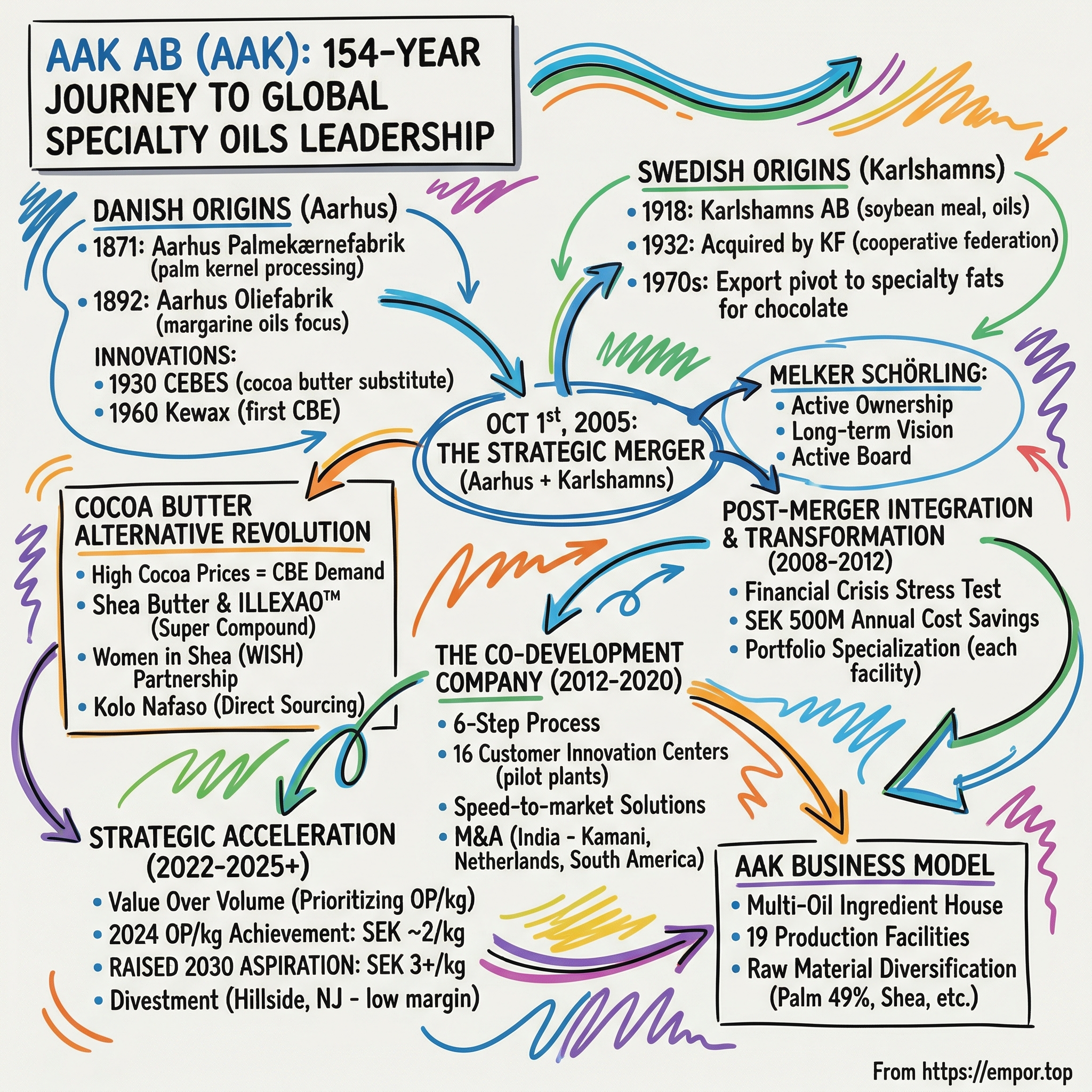
AAK: The Hidden Giant Behind Your Favorite Chocolate
A 154-Year Journey from Palm Kernel Processing to Global Specialty Oils Leadership
I. Introduction: The Invisible Ingredient Empire
Picture yourself unwrapping a premium chocolate bar. As the first square melts perfectly on your tongue—that silky cascade of flavor and smooth finish—you're experiencing the handiwork of a company you've almost certainly never heard of. That moment when the chocolate "snaps" cleanly, then dissolves at precisely body temperature? There's a Swedish-Danish specialty oils company working behind the scenes to make that possible.
AAK AB, formerly AarhusKarlshamn, is a global Sweden-based company and producer of vegetable oils and fats. In 2021, AAK was named world's second top specialty oil company by the Chinese food media FoodTalk—a remarkable position for a company that most consumers could not name if their lives depended on it.
Here's the hook that makes this story fascinating: How did a Scandinavian palm kernel processor from 1871 become the critical ingredient supplier that makes your chocolate melt perfectly, your plant-based burger taste juicy, and your baby formula safe for infants?
The company recorded net sales of 45.05 billion SEK in 2024—roughly $4.3 billion—yet operates in near-total anonymity relative to its massive footprint in the global food system. AAK specializes in plant-based oils and fats that make everyday products better tasting, healthier, and more sustainable. They enhance products' sensory experiences – by giving the silkier mouthfeel in premium chocolate, the juicier texture in a plant-based burger, and the puffier appearance in a lower-fat pastry.
This is the story of B2B ingredient innovation at its finest—a masterclass in how to build moats in what should, by all accounts, be a commoditized industry. It's a story about the power of "co-development" as a business model, the strategic genius of Scandinavian active ownership, and the rare industrial company that found a way to thrive at the intersection of consumer health trends, sustainability demands, and food science complexity.
The company's structure spans three business segments: Food Ingredients, Chocolate & Confectionery Fats, and Technical Products & Feed. AAK provides solutions for chocolate & confectionery, dairy & ice cream, bakery, plant-based foods, special nutrition, personal care, foodservice & retail, technical products, candles, and animal nutrition. This breadth is both AAK's competitive advantage and its operational complexity—the company must be a specialist in dozens of applications simultaneously.
II. The Danish & Swedish Origins: Two Parallel Journeys (1871-2000)
The Danish Story: Aarhus
AAK's successful story of expertise in plant-based oils and fats started more than 150 years ago. In 1871, Aarhus Palmekærnefabrik was established to process palm kernels. Farmers used the remaining cakes as animal feed, while the extracted palm oil became important to a wide range of industries.
This founding moment captures something essential about the oils and fats industry: it emerged from agricultural waste streams. What began as a byproduct—the oil squeezed from palm kernels after the cake was extracted for animal feed—would eventually become the main event. It's a pattern that repeated throughout AAK's history, as the company consistently found ways to add value to agricultural commodities that others considered secondary.
Aarhus Palmekærnefabrik was restructured and named Aarhus Oliefabrik in 1892. The focus became production of vegetable oils, primarily for margarine. The margarine industry was exploding across Europe at this time, driven by Napoleon III's commission of a butter substitute for the French navy and working classes. Aarhus Oliefabrik positioned itself to be a key supplier to this growing market.
Key innovations included a 1909 method for refining coconut oil, enabling all-vegetable margarine, the 1930 launch of CEBES as a cocoa butter substitute, and the 1960 introduction of Kewax, the first commercial cocoa butter equivalent. These weren't incremental improvements—they were foundational innovations that would define the specialty fats industry for decades.
The 1930 launch of CEBES deserves particular attention. This was the world's first commercial cocoa butter substitute, a product designed to give confectioners the functional properties of cocoa butter—the snap, the melt, the mouthfeel—without the volatile pricing and supply constraints of the cocoa market. Nearly a century later, this exact capability would become AAK's most valuable growth driver.
Already in the early 1900s, Aarhus Oliefabrik expanded globally through the acquisition of companies abroad. The success was huge – in 1940, Aarhus Oliefabrik accounted for 10 percent of Denmark's exports. Ten percent of an entire nation's exports from a single oil company—that's a staggering concentration that speaks to both Aarhus's dominance and the centrality of specialty fats to the European food system.
Another reason behind the success was the focus on specialty fats for chocolates. Aarhus Oliefabrik became a pioneer in the fractionation of palm kernels. This innovative work also formed the basis for the fractionation of shea kernels, the process when shea butter is extracted.
Fractionation—the process of separating oils into their component parts based on different melting points—became Aarhus's core competency. It's the technical foundation that allows a specialty fats company to create custom products with precise melting profiles, crystallization behavior, and texture characteristics. Master fractionation, and you can engineer fats that perform exactly as your customers need them to.
The Swedish Story: Karlshamns
In Karlshamn, Sweden, the company Karlshamns AB was established in 1918. Karlshamns AB produced soybean meal for animal feed, while the soy oil was used in other areas, in other products.
The parallels to Aarhus are striking: another Scandinavian company, another agricultural processing operation, another business built on extracting value from what others considered byproducts. Where Aarhus focused on palm and coconut, Karlshamns specialized in soybeans—but the underlying business logic was identical.
Kooperativa Förbundet (KF) in Sweden acquired Karlshamns AB in 1932. The purpose was that KF wanted to use fats with competitive prices in their margarine production. Over the years, KF invested heavily in Karlshamns AB.
KF—the Swedish cooperative movement's federation—was one of the most influential economic organizations in Scandinavian history. Their ownership gave Karlshamns both capital for expansion and guaranteed demand from KF's massive retail network. It was a classic vertical integration play: control your inputs to protect your margins.
In the 1970s, Karlshamns AB made an important strategic venture as it began to export specialty fats to chocolate manufacturers. An organization for product development and international sales was created. This pivot from commodity oils to specialty chocolate fats would prove prescient—it moved Karlshamns up the value chain into exactly the territory where margins were more defensible.
The Pre-Merger Consolidation
In the 1960s, growth and modern production capabilities helped Aarhus Oliefabrik to become a market leader within specialty fats. Børge Beck-Nielsen acquired the majority of the shares in Aarhus Oliefabrik in 1978.
The Beck-Nielsen family would remain significant shareholders through the eventual merger with Karlshamns and beyond—a continuity of ownership that's characteristic of Scandinavian industrial companies. International growth accelerated in the late 20th century, with acquisitions and new plants; for instance, Anglia Oils opened in the United Kingdom in 1982, and a U.S. subsidiary was established in Port Newark, New Jersey, in 1990.
All operations were gathered under the collective name Aarhus United in 2003. This rebranding signaled that the company was preparing for something bigger—a consolidation of its identity ahead of a transformational merger.
By 2005, both companies had evolved from commodity processors into specialty ingredients suppliers, each with complementary geographic footprints and technical capabilities. The stage was set for a combination that would create a true global leader.
III. The Melker Schörling Factor & The 2005 Merger
Enter Melker Schörling
To understand AAK's modern history, you must understand Melker Schörling—a figure who shaped Swedish industrial capitalism as profoundly as anyone in the late 20th century.
Melker Schörling, born on May 15, 1947, in Sweden, emerged from humble beginnings to become one of the nation's most influential and discreet business magnates. His journey from a farmer's son to a billionaire investor is a testament to his strategic acumen. After graduating from the Gothenburg School of Business, Economics and Law in 1970, Schörling embarked on a career that saw him hold executive positions at prominent Swedish industrial companies, including Atlas Copco and Ericsson.
Schörling's career trajectory reads like a tutorial in Swedish industrial leadership. Born in Götlunda, Västmanland County, as the son of a farmer, Schörling graduated from the Gothenburg School of Business, Economics and Law in 1970 with a degree in economics. Schörling built his early career at major Swedish industrial firms, including stints at Atlas Copco and Ericsson, before ascending to executive roles such as CEO of Fläkt Group in 1978, Crawford Door in 1984, and Skanska in 1993. His breakthrough came in 1987 when he became CEO and President of Securitas, simultaneously acquiring a significant ownership stake that fueled the company's international growth.
In 1987, Melker Schörling became the CEO of Securitas. He made his first major investment in the company the same year. A little more than 10 years later, he ended his operative career to start his company MSAB, Melker Schörling AB.
The Securitas transformation is legendary in Swedish business circles. Schörling took a regional security company and turned it into a global powerhouse through disciplined operations and aggressive international expansion. Schörling's tenure as CEO lasted until 1992, when he transitioned to Chairman of the Board, during which Securitas achieved foundational growth that boosted its European market share to approximately 6 percent by the late 1990s and positioned it as a leader in the sector.
In 1999, he founded Melker Schörling AB (MSAB), an investment company that held significant stakes in several publicly traded firms, including Assa Abloy, Hexagon AB, Loomis, and Hexpol. MSAB became the vehicle through which Schörling would practice his particular style of active ownership: taking significant stakes in industrial companies, providing strategic guidance through board representation, and supporting management over long time horizons.
In 2001, Melker Schörling acquired the shares held by KF, thereby becoming Karlshamns AB's largest shareholder. This acquisition brought Karlshamns into the Schörling orbit—and set the stage for the transformational merger that would create AAK.
Schörling's investment philosophy was built on a few core principles: Schörling's investment philosophy was characterized by a focus on long-term value creation and a preference for investing in companies with strong leadership and growth potential. His holding company operated with remarkable efficiency: Organizationally, MSAB functions as a lean holding company with a small core team, emphasizing flexibility and rapid decision-making supported by an extensive network of advisors.
"Extraordinary people need extraordinary conditions"—that was Schörling's summarizing philosophy. It captures something essential about the Swedish model of active ownership: the belief that capital's role is to create the conditions for operational excellence, not to micromanage operations.
The Strategic Merger
On October 1st, 2005, Aarhus United from Denmark and Karlshamns AB from Sweden merged to form AarhusKarlshamn—today known globally as AAK. As we approach our 20th anniversary, we reflect on a strategic union that combined over a century of expertise in plant-based oils and fats.
The merger was more than a consolidation—it was a vision for synergy. Aarhus United, founded in 1871, had built a reputation for technical excellence and global reach. Karlshamns AB, established in 1918, was known for its innovation and sustainability. Together, they formed a company that could serve diverse markets with complementary strengths in production, R&D, and customer solutions.
The strategic rationale was articulated clearly at the time. "We underlined the rationality of a merger in four points in presentations in Copenhagen and Stockholm on August 15, 2005. The combined company would allow us to accelerate growth, strengthen competitiveness, optimise investments and improve cash flow," said Jerker Hartwall, CEO of AAK.
This wasn't a merger of desperation—it was a strategic combination designed to create a company with sufficient scale to compete globally while maintaining the specialty focus that generated attractive margins. Karlshamns was merged with the Danish company Aarhus United and the new group AarhusKarlshamn (AAK) was listed on the stock exchange.
The combination brought together complementary assets: Aarhus's strength in chocolate and confectionery fats with Karlshamns's expertise in food ingredients and technical applications. Geographically, Aarhus provided stronger European and international distribution while Karlshamns contributed deep Scandinavian market penetration.
On December 10, 2023, Schörling passed away peacefully at his home in Nyköping, surrounded by his family. His legacy at AAK lived on through the governance structures and strategic philosophy he helped establish. Sofia Schörling Högberg and Märta Schörling Andreen, both educated at the Stockholm School of Economics, have continued their father's legacy with distinction. As majority owners of MSAB, they oversee the family's investments in key companies like Hexagon, AAK, Assa Abloy, Hexpol, and Securitas.
The Schörling approach to AAK exemplified the broader pattern: patient capital, active board engagement, support for management, and a relentless focus on long-term value creation over short-term financial engineering.
IV. Key Inflection Point #1: Post-Merger Integration & The 2008-2012 Transformation
The 2005 merger created the structure for AAK's success, but the 2008-2012 period forged its operational excellence. The global financial crisis served as a brutal stress test—and AAK emerged stronger.
The Financial Crisis Challenge
Chocolate & Confectionery Fats was still negatively affected by lower chocolate consumption as a result of the recession. The results for the third quarter showed a seasonal improvement in chocolate sales, compared to the second quarter.
The recession hit AAK's chocolate segment particularly hard. When consumers tighten their belts, discretionary treats are among the first expenses cut. For a company with significant exposure to confectionery, this was a direct hit to revenues.
But Food Ingredients continued to improve in operating profit – in this quarter by 19 percent. The diversification that the merger created proved its value: while chocolate suffered, food ingredients held steady. This portfolio effect would become a recurring theme in AAK's ability to weather industry cycles.
Aggressive Cost Restructuring
The real story of the post-merger period was the disciplined extraction of synergies. So far, the merger has enabled annual savings in costs of SEK 200 million. Further savings of SEK 100 million will come in late 2010, and another SEK 200 million – as announced during the second quarter of 2009 – will come in the second half of 2011.
The math was impressive: SEK 500 million in annual cost savings once fully realized—a half-billion kronor reduction in the combined cost base. This wasn't one-time restructuring; these were permanent efficiency gains from rationalizing overlapping operations, consolidating production, and eliminating redundancies.
Management described the approach: "We have been able to specialise the production between our production units, especially Aarhus and Karlshamn, which has involved the optimisation of our production resources without major investments." The key insight here is that synergies came primarily from operational specialization rather than workforce reductions—each facility focused on what it did best.
"Through an aggressive strategy to cut costs we have turned cash flow and achieved a much stronger balance sheet, and we thus open up for acquisitions in the future." This last phrase signaled AAK's strategic intent: use the merger to build a platform for further consolidation.
Moving Up the Value Chain
Cost cutting alone doesn't build a great company. What distinguished AAK's post-merger strategy was the simultaneous push into higher-margin specialty products.
"In just a few years, AAK has forcefully concentrated its resources on developing products further up the value chain for the confectionery and cosmetic industries as well as the bakery industry with high quality and high value content. Further, the company has had great success with vegetable oils for baby food."
The baby food segment deserves particular attention. Infant formula requires extraordinarily precise fat compositions to mimic human breast milk. The technical barriers to entry are enormous—not just in product development, but in regulatory compliance and quality assurance. Once you're qualified as a baby food supplier, customers are extremely sticky. This was exactly the kind of specialty business AAK wanted to grow.
"AAK's filling fat for confectionery has been nominated for the industry's highest honour, the Food Ingredients Excellence Award. Our strategy to develop products further up the value chain is now being rewarded," said Jerker Hartwall.
After four years of operation, the company is noting a growth in EBIT by approx. 90 percent. That's the compounding effect of simultaneous margin expansion and cost reduction—a nearly doubling of operating profit in four years despite facing a global recession.
V. Key Inflection Point #2: The Co-Development Model & Specialty Focus (2012-2020)
Building the "Co-Development Company" Identity
If the post-merger period was about operational efficiency, the 2012-2020 era was about strategic positioning. AAK embraced a distinctive identity: The Co-Development Company.
Our Co-Development approach means that we bring our capabilities in plant-based oils and fats into a collaboration with you. Together we create lasting value for your business as we are Making Better Happen™.
This wasn't just marketing language—it described a fundamental shift in how AAK engaged with customers. Traditional ingredient suppliers sell products from a catalog. AAK's co-development model positioned the company as a solutions partner, working alongside customers to solve specific technical challenges.
Our purpose, Making Better Happen™, is about enabling our customers to be even more successful and in a better way. We choose to do this by collaborating closely as one team, as reflected in AAK's commitment to be The Co-Development Company. At the very heart of our Co-Development approach is our passion for continuous improvement. Incremental innovation is what we do, providing significant and lasting value for our customers. It is how we are Making Better Happen.
The co-development process followed a structured methodology. AAK's Co-Development process is made up of six steps. We start by understanding your needs and business opportunities, and we collaborate all the way throughout the launch of your product. Our capabilities in vegetable oils and fats will create long-lasting value for you.
The Customer Innovation Centers became the physical embodiment of this strategy. Speed-to-market is of course a key success factor. Our 16 Customer Innovation Centers located around the world represent our innovation network, bringing our competencies closer to your door.
Each one is a pilot facility where concepts are developed, tested, and refined in conditions that mirror your own manufacturing process, greatly accelerating development times. AAK's application capabilities and experience from working across many industries are the origin of our unique insight into how oils and fats function.
Consider what this means competitively. A customer developing a new chocolate product can come to AAK's Innovation Center, work with AAK's food scientists to formulate a custom fat blend, test it on pilot equipment that replicates their production line, and validate performance before committing to full-scale manufacturing. The customer gets de-risked innovation; AAK gets deeper customer relationships and higher-margin custom products.
Our 4,000 employees drive close collaboration with customers through 25 regional sales offices, 16 dedicated Customer Innovation Centers, and 19 strategically located production facilities.
Global Expansion Through Acquisitions
The stronger balance sheet from post-merger synergies enabled AAK to pursue acquisitions that expanded both geographic reach and technical capabilities.
Expansion into high-growth Asian markets accelerated in September 2015 with the acquisition of a 51 percent stake in Kamani Oil Industries Pvt Ltd., a prominent Indian producer of speciality and semi-speciality vegetable oils and fats, enabling enhanced local production and tailored solutions for regional customers.
The Kamani deal exemplified AAK's emerging market strategy: partner with established local players who understand regional customer preferences and distribution networks, then integrate AAK's global expertise in specialty formulation. Late in 2020, AAK acquired 100 percent of the shares in Kamani Oil following a successful five-year joint venture with the founding family. The joint venture structure allowed both parties to evaluate the partnership before full commitment.
In February 2019, AAK acquired MaasRefinery BV in the Netherlands, a facility specializing in toll refining of vegetable oils for food applications, which bolstered European processing capacity.
The 2021 acquisition of BIC Ingredients expanded AAK's lecithin portfolio—lecithin being a critical emulsifier derived from vegetable sources that enables fats to mix smoothly with other ingredients. This technical capability complemented AAK's core oils and fats business.
Geographically, business boomed, with AAK acquiring companies and building greenfield factories in South America, North America, and Asia in a conscious effort to maximize its global reach.
VI. Key Inflection Point #3: 2022-2025 Strategic Acceleration
The Optimization Programs
AAK has demonstrated a track record of profitability improvement in volatile market conditions, with average profit growth of 9% from 2015-2021, followed by 21% in 2022, 43% in 2023, and 19% in 2024. With 21 percent operating profit growth and an improved operating profit per kilo, we delivered on our target of having an average EBIT growth of ∼10 percent.
AAK's strategy builds on initiatives launched in 2022, including production process optimization, portfolio and price management, procurement excellence, and cash-to-grow programs. In 2024, the company added commercial and innovation excellence along with the cost performance initiative.
The focus on operating profit per kilogram became AAK's key internal metric. 2023 was a very strong year for the company, with an operating profit per kilo at SEK 1.94 and despite a slight decline in volumes, we surpassed our target of having an average operating profit growth of around 10% per year.
This is a crucial strategic choice: prioritizing value over volume. Many commodity-adjacent businesses chase volume growth, which often destroys margins. AAK explicitly chose the opposite—accepting flat or even declining volumes if necessary to protect profitability.
Emerging Market Expansion
AAK has acquired 100 percent of the shares in Arani Agro Oil Industries Ltd. The acquisition aligns with AAK's strategy to expand geographically and increase its market share in India's high-value specialty oils and fats market.
The Arani acquisition in November 2022 strengthened AAK's India position significantly. Arani operates out of Kakinada Port on the southeast coast of India. Over the coming years, AAK will invest an estimated total of SEK 200-300 million, including the acquisition consideration, to increase capacity and improve efficiency in the production facility.
"India continues to grow in importance for the global food supply chain, and the food and health industry is uniquely positioned to enjoy both domestic and export growth. This investment confirms AAK's commitment to making a positive impact and contributing to our customers' growth and expansion in India and beyond", says Sten Estrup, President of AAK Asia. "We have seen strong growth from our operations in India, and the acquisition of Arani is a strategic next step to further accelerate growth in a key market," says Dheeraj Talreja, President AAK India.
Portfolio Optimization
In October 2024, AAK demonstrated the discipline to divest as well as acquire. AAK has entered into an agreement to divest its Foodservice facility in Hillside, NJ, USA. This move aligns with our portfolio-based strategy to further optimize our Foodservice operations. While the standalone Hillside site will be sold, we are also planning to invest in enhancing our European Foodservice structure, with a focus on strengthening our already strong presence in the UK and Nordic regions.
Hillside represents approximately 5 percent of AAK's total volumes and contributes around 1 percent to its operating profit. As a result, the divestment is expected to positively impact the group's operating profit per kilo by approximately 4 percent, all else being equal.
The Hillside divestment crystallized AAK's value-over-volume strategy: exit low-margin operations even if it means lower absolute volumes. AAK completes Hillside, NJ divestment, generating approximately SEK 600 million in Q4 cash flow.
The total capital investment for the European Foodservice expansion is approximately SEK 400 million, spread over 2025-2026. These investments will further strengthen our competitiveness in the UK and northern Europe. The proceeds from Hillside funded expansion in regions where AAK sees "critical mass and growth potential."
Raised Ambitions
Following strong performance in recent years, we have raised our 2030 profitability aspiration from SEK 2 per kilogram to SEK 3+ per kilogram. Additionally, we aim to grow our volumes faster than the underlying market while strengthening our recognition for delivering a positive impact.
This ambition provides a clear direction for continued operating profit growth on average of 10 percent per year.
The upgrade from SEK 2 to SEK 3+ per kilogram represents a 50% increase in profitability aspiration—signaling management confidence in the specialty strategy. Looking at the full year 2024, we made strong progress and exceeded our financial target of growing operating profit by around 10 percent on average over time. Furthermore, we achieved our long-term aspiration of doubling operating profit per kilo ahead of schedule—a milestone originally set for 2030.
VII. The Cocoa Butter Alternative Revolution
The Shea Butter & CBE Innovation
AAK has been sourcing shea kernels from West Africa for more than 60 years. We source from traditional shea traders as well as women's groups, to help improve their lives and livelihoods and to ensure good business practices throughout the supply chain.
Shea is gaining strong interest as an alternative to palm products. Though it is known primarily for its use in cosmetics, shea has become popular in the food industry. This 60-year sourcing relationship gives AAK a supply chain advantage that newer entrants cannot easily replicate.
Because cocoa costs have skyrocketed, the company is turning to shea to deliver on what he called cocoa butter equivalents. "Shea is a lesser, lower cost replacement for cocoa butter, and the ingredient is becoming more and more interesting to players in the space."
Ingredients business AAK has developed a key range of fats to create a super compound aimed at replacing up to 100% of the free cocoa butter within chocolate recipes for confectionery. Notably, the new range, known as Illexao is claimed to reduce manufacturers' formulation costs by up to 40% with no decline in quality or product stability.
As the company revealed, the main fat phase of the super compound comprises vegetable fats with a similar composition to cocoa butter. This means it is fully compatible with cocoa butter, which will allow chocolate manufacturers to use it in their products to reduce costs while continuing to add cocoa mass to their formulations.
But if you add ILLEXAO™ you can adjust taste, texture, softness, and hardness with a consistent result. Or you can reduce costs. Your chocolate will still be chocolate. Our ILLEXAO™ range consists of solutions that can be mixed with cocoa butter, but that give you possibilities that cocoa butter alone cannot provide.
The Cocoa Price Tailwind
With cocoa butter prices increasing more than 90% over the past five years, switching to cocoa butter equivalents (CBEs) presents an opportunity for cost savings while meeting customer expectations on delicious chocolates.
The cocoa crisis of 2024 made AAK's CBE capabilities suddenly critical to the entire chocolate industry. Cocoa prices fluctuated in June 2024. On the London futures index, cocoa prices reached a high of $11,530 per tonne on 13 June; the previous year, prices had averaged $3,182. Although effects were similarly observed on the New York market, which reached US$10,782 per tonne, effects were less prominent due to greater European consumption of West African cocoa.
Price spikes and volatility have created one of the most dramatic upheavals in decades for the cocoa industry. Global cocoa prices have skyrocketed past $12,000 per metric ton — a sixfold increase since 2022 — driven by crop disease, extreme weather and global supply chain strain.
The 2024-25 season is expected to see a supply shortfall of 374,000 tons, marking the fourth consecutive year of global deficits, according to the International Cocoa Organization. As a result, bakers are seeking reformulation strategies to reduce cocoa dependency without sacrificing consumer expectations for taste, quality or clean label.
AAK has a cocoa butter substitute for use in coatings and molded products. It uses lauric acid — a medium-chain saturated fatty acid found in coconut and palm kernel oils and some vegetable fats — and it requires no tempering and is low viscosity. "Coating and molded products have outstanding snap, texture and flavor release, which are very similar to those of chocolate," said Ryan Branch, senior marketing manager at AAK.
Substituting part of the cocoa butter with shea butter, more specifically, using CBE (Cocoa Butter Equivalent), a shea-based fat blend compatible with cocoa butter, which is currently trading at around €5,500 per metric ton. Major consumer brands such as Guylian, Hershey, and Cadbury (in select products) have already adopted shea butter, demonstrating its commercial and functional viability.
Social Impact in Sourcing
AAK has joined forces with global confectionery, food, and pet care company Mars, several leading NGOs, and an impact investment fund to create a public-private partnership. This will improve the livelihoods of women working in Ghana's shea supply chain. Running until 2030, the Women in Shea (WISH) initiative aims to reach 13,000 women shea collectors from more than 150 communities in northern Ghana.
Shea is an important source of income for an estimated four million women in western Africa, where they collect and sell shea kernels. AAK sources shea through our direct women's group supply chain Kolo Nafaso, which now engages almost 300,000 women. In addition to the traditional shea supply chain, AAK sources shea from our direct women's group supply chain Kolo Nafaso. Since 2009, the program focuses on poverty alleviation and women empowerment through direct trade, interest-free micro credits, and training of shea-collecting women in West Africa.
The Kolo Nafaso program creates competitive advantage through supply chain security. Women are completely free to decide who they want to sell their kernels to, but Kolo Nafaso offers a long-term partnership with a buying guarantee. By offering fair terms and pre-financing, AAK builds loyalty that ensures reliable supply during periods of tight global markets.
VIII. Business Model Deep Dive
The "Multi-Oil Ingredient House" Model
AAK describes itself as a "multi-oil ingredient house"—a positioning that captures both its breadth of raw material sourcing and its depth of application expertise.
The Food Ingredients segment delivers customized plant-based oils and fats to industries such as bakery, dairy, plant-based foods, special nutrition, and foodservice, enhancing attributes like taste, nutritional profile, and processing efficiency. Through a co-development model, the company collaborates with customers to formulate solutions that address specific functional needs, leveraging multi-oil sourcing and advanced processing at 19 global facilities.
Raw material diversification is a core strength. The company's raw material strategy involves a diversified mix of plant-based oils and fats, with palm oil representing the largest component at 49% of the total mix. This diversification helps AAK manage supply chain risks and respond to changing market conditions.
Innovation Centers & Customer Intimacy
AAK offers Academies: sessions where they gather customers within a certain industry at one of their innovation centers across the globe. The Belgian innovation center - located in Merksem - is equipped with a unique pilot plant and bakery unit, where innovative products are developed and presented to customers and prospects.
AAK has opened a new customer innovation center in Richmond, California, adjacent San Francisco, to support bakery, dairy, plant-based foods and beauty/personal care innovation. The Richmond site was acquired in 2016 when AAK purchased California Oils Corporation from Mitsubishi Corporation of Japan.
"AAK has over 15 Customer Innovation Centers worldwide and has opened multiple locations across the U.S. over the last several years," said Octavio Diaz de Leon, president of AAK USA and AAK North Latin America. "Our Richmond Customer Innovation Center investment offers an additional 2,000 square feet of co-development space and delivers on our commitment to providing our customer-partners coast-to-coast service and support. We accelerate innovation using AAK's Co-Development approach, and our expansive team of fats and oils, bakery, dairy, plant-based foods and personal care experts, all coming together to create real-world formulation solutions."
AAK also opened a Biotechnology Innovation Centre in Lund, enhancing its capabilities in enzyme and fermentation research, which supports industries like food, feed, and cosmetics.
Value Over Volume Strategy
We will continue to: Increase efficiency across AAK to drive profitability. Shift towards higher-margin products by focusing on speciality solutions.
The optimization program involves tactical decisions on product sales, focusing on value over volume. The strong earnings were driven by optimization programs and a positive mix effect. Lower sales of non-specialty, lower value-added products like rapeseed solutions were offset by higher sales of more profitable products, supported by our optimization efforts.
This mix shift is visible in the financial results. The full-year 2024 results also highlighted a 19% growth in absolute EBIT, with a 2% increase in volumes. Growing profits nearly ten times faster than volumes demonstrates the value-over-volume strategy in action.
IX. Financial Performance & Capital Allocation
Current Financials
AAK AB reported its Q4 2024 earnings, revealing a robust 11% growth in operating profit compared to the same quarter last year. Despite these strong financial results, the company's stock fell by 6.72% in pre-market trading.
Volumes decreased by 1 percent to 541,000 MT (548,000). Operating profit increased by 11 percent, reaching SEK 1,268 million (1,141), including a negative currency translation effect of SEK 37 million. At fixed foreign exchange rates, operating profit increased by 14 percent. Profit for the period totaled SEK 928 million (870). Earnings per share equaled SEK 3.57 (3.34).
Together with capital employed at SEK21.8 billion, the latter somewhat flat over the last few quarters, resulted in a return on capital employed of 22.4, which is up 0.3% from Q3 in 2024. Driven by the strong operational earnings as well as a positive cash flow and the divestment of Hillside, net debt to EBITDA remains at a level that provides us with financial flexibility. At 0.29 in Q4, slightly down from 0.39 in Q3 and significantly down from the peak of about two in Q2 twenty twenty two.
With a strong balance sheet, the board is, as Johan mentioned before, proposing a dividend of SEK 5 per share for the financial year of 2024. Subject to approval at the AGM, it represents a 35% increase from the previous years compared to the 20% increase in EPS for the same period and an 82% increase compared to the dividend paid for the 2022 financial year.
Recent Quarterly Performance
AAK AB, a global leader in plant-based oils and fats, reported strong financial results for the second quarter of 2025, with operating profit increasing 16% at fixed exchange rates despite a 2% decline in volumes. The company's Q2 presentation, delivered on July 17, 2025, highlighted AAK's continued focus on specialty solutions and optimization initiatives while reaffirming its long-term strategic goals.
The company achieved an operating profit of SEK 1,162 million, representing a 16% year-over-year increase at fixed exchange rates when excluding one-time restructuring costs and the Hillside divestment. The most impressive performance came from the Technical Products & Feed segment, which posted remarkable growth with volumes up 18%, net sales increasing 19%, and operating profit surging 178% year-over-year.
Dividend Policy and Capital Returns
The company maintains a dividend policy of 30-50% of net profit and has potential for distribution of excess cash.
AAK noted it could leverage up to a net debt/EBITDA ratio of less than 3x to support transformational acquisitions and investments. With current leverage at 0.29x, AAK has substantial financial flexibility for M&A or capital returns.
X. Leadership: Johan Westman's Transformation
Johan has close to 20 years of industrial experience in management consulting and from the automotive supplier industry. He was President and CEO of FinnvedenBulten AB (publ.) between 2009 and 2014 and President of the Finnveden Metal Structures AB division 2008–2014.
Johan Westman, born in 1973, holds a Master's degree in Industrial Engineering from Chalmers University of Technology in Gothenburg, Sweden. "With the recruitment of Johan Westman we will have a CEO with broad industrial and international experience", says Mikael Ekdahl, Chairman of the Board of Directors. "He has over the last ten years successfully developed companies to drive shareholder value through profitability improvements, organic growth as well as global expansion. I am confident that Johan will continue to develop AAK in the best possible way."
Westman's background in automotive supply—one of the world's most demanding industries for operational excellence—proved directly relevant to AAK's transformation. Prior to these positions he spent eight years in management consulting with Arthur D. Little. He did a degree in Finance from University of Gothenburg and a MS in Industrial Engineering & Management from Chalmers University of Technology in 1998.
Johan Westman, born in 1973 and hailing from Sweden, is a dynamic business leader who has been at the helm of AAK, producer of plant-based oils, as President and CEO since 2018. During this period, AAK has undergone a transformative journey.
Under Westman's leadership, AAK has articulated a clear strategic vision. He pointed out that the food industry must have a holistic approach and called for global collaboration to secure food supply, as the demand for food is expected to increase by 70% by 2050. Furthermore, he emphasized the importance of making decisions based on facts, not opinions, to better use existing solutions that we miss out on today due to misconceptions.
President & CEO, AAK. Other significant positions: Chairman of the Board of Absolent Group AB (publ.) and Board member of Thule Group AB (publ.) Experience: Senior Vice President Europe and Managing Director of the BlankLight division at Shiloh Industries, Inc., President and CEO of FinnvedenBulten AB (publ.), President of Finnveden Metal Structures AB, and management consulting with Arthur D. Little.
XI. Competitive Landscape & Industry Positioning
Market Structure
The competitive landscape of the specialty fats and oils market is significantly consolidated, with the top five players—Wilmar International, Cargill, Incorporated, Bunge Limited, AAK AB, and Mewah International Inc—collectively holding over 58.8% of the market share. This concentration intensifies the rivalry among these major companies, each striving to expand their global footprint and diversify their product portfolios.
Our principal competitors in the Refined and Specialty Oils segment include, but are not limited to: ADM, AAK AB, Cargill, Fuji Oil Co. Ltd., and Wilmar, as well as local competitors in each market. This assessment from Bunge's 10-K filing confirms AAK's position among the industry's leading players.
Cargill Incorporated was the largest competitor with a 5.45% share of the market, followed by Bunge Global SA with 4.72%, Wilmar International Limited with 4.58%, Fuji Oil Co. Ltd. with 2.18%, AAK AB with 1.78%.
Differentiation Strategy
These industry leaders are investing heavily in research and development to offer sustainable, health-focused products in response to consumer demands and regulatory pressures. There is a substantial push toward developing palm oil alternatives due to environmental and ethical concerns associated with palm oil production.
AAK's differentiation lies in its specialty focus and co-development model. While competitors like Cargill and Bunge operate primarily as commodity processors with specialty divisions, AAK has positioned itself as a specialty-first company. This focus enables deeper customer relationships and higher margins, though at the cost of scale in commodity processing.
Porter's Five Forces Analysis
Threat of New Entrants: MODERATE Capital requirements for specialty fats production are substantial, and technical expertise in fractionation and formulation takes decades to develop. However, regional players can enter specific markets with targeted offerings. AAK's global scale and customer relationships create meaningful barriers.
Bargaining Power of Suppliers: MODERATE Raw material costs (palm, shea, coconut, rapeseed) are largely commodity-priced, limiting supplier power. However, AAK's shea sourcing demonstrates how differentiated raw material access can create competitive advantage.
Bargaining Power of Buyers: MODERATE-HIGH Large food manufacturers like Mars, Nestlé, and Mondelēz have significant purchasing power. However, switching costs for specialty formulations are high—customers invest substantial time in co-development and qualification.
Threat of Substitutes: LOW-MODERATE For many applications, plant-based fats are difficult to substitute. However, the cocoa butter alternatives market demonstrates that substitution within the fats category is possible, which both threatens some products and creates opportunity for others.
Competitive Rivalry: HIGH Competition among the top five players is intense, with all pursuing similar strategies of innovation, sustainability, and emerging market expansion.
Hamilton Helmer's 7 Powers Analysis
Scale Economies: PRESENT AAK's global production network enables cost advantages through centralized procurement, shared R&D, and production specialization across facilities.
Network Effects: LIMITED Limited direct network effects, though the Customer Innovation Center network creates ecosystem benefits as more customers engage in co-development.
Counter-Positioning: PRESENT AAK's specialty-first positioning creates counter-positioning against commodity-focused competitors. Cargill or Bunge cannot easily replicate AAK's business model without cannibalizing their core commodity businesses.
Switching Costs: PRESENT Custom formulations, qualification processes, and co-development relationships create meaningful switching costs. Customers cannot easily migrate years of collaborative development to competitors.
Branding: LIMITED As a B2B ingredient supplier, AAK's brand value is limited to industrial buyers. Consumer brand equity does not apply.
Cornered Resource: PRESENT AAK's 60-year shea sourcing relationships and Kolo Nafaso program represent a cornered resource—supply chain relationships that took decades to build and cannot be easily replicated.
Process Power: PRESENT Fractionation expertise, formulation knowledge, and co-development methodology represent process capabilities that enable AAK to solve customer problems competitors cannot.
XII. Investment Considerations
Bull Case
-
Cocoa Crisis Tailwind: The multi-year cocoa supply crisis creates structural demand for CBE products where AAK holds leadership position. With cocoa prices remaining elevated, reformulation interest accelerates.
-
Specialty Mix Shift: Continued improvement in operating profit per kilogram as AAK exits low-margin products and expands specialty solutions.
-
Emerging Market Growth: India, Southeast Asia, and Latin America represent decades of growth runway as food consumption premiumizes.
-
Sustainability Positioning: ESG-conscious customers increasingly value AAK's sustainable sourcing programs (Kolo Nafaso, certified palm).
-
M&A Optionality: Strong balance sheet (0.29x net debt/EBITDA) enables transformational acquisitions.
Bear Case
-
Volume Pressure: Prioritizing value over volume risks market share loss if competitors offer lower prices for "good enough" quality.
-
Commodity Volatility: Despite specialty focus, raw material costs still impact margins during supply disruptions.
-
Customer Concentration: Large food manufacturers have negotiating leverage and could backward-integrate or shift suppliers.
-
Cocoa Price Normalization: If cocoa prices moderate significantly, the tailwind for CBE products could reverse.
-
Palm Oil Controversy: Despite sustainability programs, continued ESG concerns about palm oil could pressure customer relationships.
XIII. Key Performance Indicators to Watch
For investors following AAK, the following KPIs merit particular attention:
1. Operating Profit Per Kilogram (SEK/kg) This is AAK's primary internal metric and the clearest indicator of mix improvement. The 2024 achievement of ~SEK 2/kg (ahead of the original 2030 target) and the upgraded aspiration of SEK 3+/kg by 2030 provides a clear benchmark. This metric captures both pricing power and product mix evolution better than absolute volumes or revenues.
2. Chocolate & Confectionery Fats Segment Operating Profit Given the cocoa crisis tailwind, this segment's performance indicates whether AAK is capturing reformulation demand. Watch for volume growth (indicating customer adoption of CBE solutions) alongside margin expansion.
3. Return on Capital Employed (ROCE) At 22.4% in Q4 2024, ROCE demonstrates capital efficiency. As AAK invests in emerging markets and capacity expansion, maintaining ROCE above 20% would indicate disciplined capital allocation.
XIV. Conclusion: The Invisible Giant's Visible Opportunity
AAK's 154-year journey from Danish palm kernel processing to global specialty oils leadership illustrates a powerful business model: find the high-value intersection between commodity inputs and differentiated outputs, then build capabilities that make your solutions difficult to replicate.
The company's co-development approach creates customer intimacy that pure ingredient suppliers cannot match. Its shea sourcing relationships—built over six decades with hundreds of thousands of West African women—represent supply chain assets that would take competitors decades to replicate. Its fractionation expertise enables precise engineering of fat profiles that solve customer problems competitors cannot address.
The cocoa crisis has handed AAK a multi-year tailwind at exactly the moment the company achieved operational excellence. With operating profit per kilogram having doubled ahead of schedule and management raising aspirations 50%, the strategic execution has been impressive.
Johan Westman, CEO and President of AAK, reflects: "As we celebrate this milestone, we honor the bold decision that brought Aarhus and Karlshamn together. From local roots to global impact, AAK has evolved into a purpose-driven company that continues to innovate, inspire, and make a better world happen."
The next chapter for AAK will test whether the company can sustain specialty margin expansion while capturing emerging market growth—and whether the cocoa butter alternatives revolution represents a permanent market shift or a cyclical opportunity.
For investors seeking exposure to the global food ingredients supply chain with differentiated positioning, AAK represents a rare combination: leadership in specialty applications, sustainability credentials that matter to food customers, and financial discipline that has consistently delivered results. The question is whether the market has adequately recognized these qualities, or whether AAK remains what it has always been—a hidden giant waiting to be discovered.


 RSS Feed
 Spotify
 Apple Podcasts
 Amazon Music
 Audible
 YouTube