Old Mutual Limited: The Company That Unbundled Its Future
The insurer that gave away its bank
On 15 October 2018, shareholders in Old Mutual woke up owning something new. For every hundred Old Mutual shares in their accounts, they now held a little over three shares of Nedbank, one of South Africa's four big banks.1 Nobody had bought those shares, and nobody had sold them in the usual sense. The insurer that had controlled Nedbank since 1986, when the bank still went by the name Nedcor, simply handed most of it over.2
The distribution was worth about R43 billion on the day.1 Old Mutual kept a 19.9% stake, down from about 52%, and that figure was not an accident: it was negotiated with Nedbank and discussed with the South African Reserve Bank so that the country's financial system would stay steady while one of its pillars changed owners.3
That morning was the last act of a plan called Managed Separation, which the old London-listed parent had announced two and a half years earlier.4 In June 2018 the group's British wealth business had been demerged as Quilter, and a new South African holding company, Old Mutual Limited, had listed in Johannesburg.5
With the Nedbank shares gone out the door, the separation was complete.1 A group that had once been an insurer, a bank, a British wealth platform and an American asset manager stacked inside one share was now, mostly, an African insurer and investment house.
Here is the puzzle that makes Old Mutual worth an episode. A 180-year-old insurer spent three decades owning a bank, gave that bank away, and then, within a few years, began building a new bank from scratch inside what remained. The new one cost more than R3 billion to set up before it opened to the public.6
It lost about R1.25 billion at the operating level in 2025, after losing about R1.1 billion the year before.7 Management now says the banking cluster should reach somewhere between break-even and R200 million of operating contribution in 2028.8 Is that a contradiction? Or did the company give away a bank that was never truly integrated with its customers, in order to build one that is?
There are three stakes in this story, and they follow Old Mutual from Cape Town in 1845 through a results presentation in September 2026. The first is whether Old Mutual can turn its enormous reach across insurance, savings and investments into growth that repeats year after year, rather than growth that arrives when markets are kind.
The second is whether OM Bank can earn a return on the capital it consumes, in a South African retail-banking market where Capitec, the incumbents and digital challengers already fight for every salary deposit. The third is whether the company can keep paying shareholders generously while funding all of that ambition, because dividends, buybacks, a new bank and acquisitions all draw on the same pool of cash that subsidiaries send up to the parent.
Before going any further, one boundary needs drawing in thick ink. Old Mutual Limited has been listed only since June 2018.5 Any long-run figure that reaches back before then describes a different company: one that still consolidated Quilter, Nedbank and an American asset manager. That is why ten-year growth rates for this business look strange. Measured in rand from 2015 to 2025, revenue appears to have shrunk by about 6% a year and net profit by about 5% a year.9
Those numbers are real arithmetic on reported statements, but they mostly measure the shrinking of the perimeter, not the performance of the businesses that remain. Comparing them with today's group is a little like comparing a household's spending before and after the grown children moved out. The fall says more about who left than about how the remaining family runs its budget.
So the honest starting line for judging this company is 2018, and the honest measures are the ones the current group reports about itself: results from operations, value of new business, net client cash flow, solvency, and cash remitted from subsidiaries. Those are the gauges this story will keep returning to.
And the story is not standing still. In March 2026, Old Mutual Wealth took control of 10X Investments, a low-cost index-tracking manager, for about R2.1 billion.9 In June 2025, a new chief executive, Jurie Strydom, took over with a reset strategy.6
The group wants to become something it has talked about for years without fully achieving: an integrated financial-services company in which an insurance customer becomes a banking customer, a banking customer becomes a savings customer, and the whole relationship is worth more than its parts. The bank it gave away in 2018 was never quite that. Whether the bank it is building now can be is the question underneath everything that follows. To see why the company thinks it can, the story goes back to the promise on which it was founded.
 Subscribe on LinkedIn
The 1845 promise, rebuilt for a listed company
In 1845, in Cape Town, a group of colonists led by the Scottish-born newspaperman and reformer John Fairbairn founded the Mutual Life Assurance Society of the Cape of Good Hope.10 The idea was simple and old: many people each pay a little into a common pool, and the pool pays out to the families of those who die. In a mutual, there were no outside shareholders skimming a profit. The policyholders were the owners. The society's capital was, in effect, the trust of its own customers.
That structure shaped Old Mutual for more than 150 years. It grew into the largest life insurer in South Africa, spread into neighbouring countries, and accumulated an enormous investment portfolio on behalf of policyholders. But a mutual has a limitation. It cannot easily raise equity to buy businesses abroad, and its owners cannot easily sell their stake.
Between May and July 1999, Old Mutual demutualised. Policyholders received shares, and Old Mutual plc listed in London, Johannesburg, Zimbabwe, Malawi and Namibia at 120 pence a share, valuing the company at about £3.9 billion.10 The head office moved to London. The South African mutual had become an international financial group with a British address and global ambitions.
The next two decades of global expansion were, in a sense, what the Managed Separation unwound. What came back home was Old Mutual Limited, the company listed in Johannesburg in 2018: a South African holding company for a group of financial businesses spread across the continent.5
In 2025 it reported 15.1 million customers, up from 13.6 million a year earlier, and 31,865 employees.11 About 39,600 tied and independent intermediaries sold its products, up from about 35,900.11 At the end of 2025 it managed roughly R1.64 trillion of funds for clients, policyholders and itself.7
What does the company actually do? Think of it as five businesses under one roof. The largest is life and savings: funeral cover sold to working families, life and disability policies for the middle class, retirement annuities, and retirement funds and group schemes run for employers. The second is asset management, the business of investing other people's money for a fee.
The third is short-term insurance, which in South Africa means cover for cars, homes and businesses; Old Mutual sells it under the Old Mutual Insure name. The fourth is banking and lending, which today means Old Mutual Finance's personal loans and the new OM Bank. The fifth is a collection of operations outside South Africa, grouped as Old Mutual Africa Regions, with businesses in Southern, East and West Africa.
Each of these makes money differently, which is why the group's consolidated revenue line is close to useless as a guide. A life policy earns premiums and policy fees up front and over time, and the insurer pays out claims and benefits. A savings product earns fees that rise and fall with the value of the assets. An asset manager earns a slice of the money it manages, plus occasional performance fees. A bank earns the spread between what it pays depositors and what it charges borrowers, plus transaction fees. A short-term insurer earns premiums and hopes claims come in lower.
In 2025, the Life and Savings business recognised about R44 billion of insurance revenue, while the group booked about R139 billion of investment returns and other income, and about R8.7 billion of fees and commissions.9 Read that again: the biggest "revenue" line is investment returns, and most of those returns belong to policyholders. When the stock market rises, Old Mutual's revenue swells; when it falls, revenue can collapse. That is how the group's half-year revenue in dollar terms could swing from a little over $1 billion in one period to more than $11 billion in another without anyone selling more policies.9
This is also why the group's balance sheet needs a warning label. At the end of 2025, Old Mutual held about R1.2 trillion of investments and securities and about R60.8 billion of cash and cash equivalents.9 Those sound like the war chest of a continental conglomerate. They are not.
Most of those assets back promises made to policyholders and clients: the retirement savings of a teacher in Durban, the funeral cover of a miner in Rustenburg, the pension fund of a municipal worker. The investor's question is not how much money sits inside the group. It is how much capital the parent can draw out after the subsidiaries have satisfied their regulators and their policyholders. That distinction will matter a great deal when we reach the dividend.
The company does keep investing in the machinery behind that reach, though it does not report a research-and-development line. In 2025 it added about R1.2 billion of capitalised software development and about R1.0 billion of property and equipment, while its spending on employee learning fell to about R203 million from about R242 million.911 The workforce barely grew. That mix reads like a group spending on technology and distribution while holding headcount and training budgets tight, which is consistent with a cost-discipline story rather than a harvest.
Nor does the company publish one tidy number for how much of its income repeats. There is no group-wide recurring-revenue share and no single contract duration, because a ten-year retirement annuity, a monthly funeral policy, a one-year car insurance contract and an unsecured personal loan simply do not share economics.9 The proxies that do exist, persistency, net client cash flow, and the value of new business, are scattered across segments.
So what is Old Mutual's advantage? Its scale is undeniable. Fifteen million customers, spread across South Africa and the group's other African markets, is a vast footprint. A brand that has been on South African streets for 180 years carries trust, and trust matters in a business that asks customers to hand over money today for a promise decades away. But scale is a fact, not a moat.
The company's filings show that it is large. They do not, by themselves, show that size makes customers stay longer, pay more, or cost less to serve than they would elsewhere. That is the test. If breadth improves retention, flows, pricing or cost, it is an advantage. If it merely puts several cyclical, regulated businesses under one listed name, it is a portfolio.
The strategy under the current management is a bet on integration: that broader product relationships make customers stickier and cheaper to maintain.
It is a reasonable bet, and it is an old one. Old Mutual tried it before with Nedbank. To understand why the company is trying again, and why the long-run numbers cannot tell whether it is working, the reader needs to go back to the decision that took the old group apart.
The break-up changed the numbers—and the job
In November 2015, Old Mutual plc hired Bruce Hemphill, a seasoned South African financial-services executive, as group chief executive.4 The job he walked into was awkward. Since the 1999 listing, the London-based group had become a collection of businesses that did not obviously belong together. It owned a controlling stake in Nedbank.
It owned Old Mutual Emerging Markets, the original South African insurer and its African cousins. It owned Old Mutual Wealth, the British investment platform built largely out of the former Skandia UK business. And it owned an American asset-management business. Each had its own regulators, its own capital requirements, and its own investor base. The London head office sat on top, costing money and adding, in the market's eyes, very little.
Hemphill's answer, announced on 11 March 2016, was to stop pretending these were one company.4 The group would separate into four stand-alone businesses and, in the phrase that became the strategy's name, manage the separation over the following years. The logic was blunt. Investors who wanted a British wealth manager did not want to own a South African bank to get it.
Investors who wanted African financial services did not want London head-office costs and an American fund business. A conglomerate discount, the gap between the group's share price and the value of its parts, was the problem to be solved. Hemphill's plan even dissolved his own job: once the separation was done, there would be no London parent to run.
Over the next two years, the American asset manager was sold down, the British business prepared for its own listing, and the South African business was set up as a new holding company. In June 2018, Quilter was demerged and listed in London, and Old Mutual Limited listed in Johannesburg on 26 June.5 The Nedbank distribution in October finished the job.1
Did it work? For shareholders of the old plc, the answer depends on whom you ask and what you measure. They walked away with separate listed shares in Quilter, Nedbank and Old Mutual Limited, each priced on its own merits. The more interesting question for this story is narrower: did the separation create a better owner of the African businesses that remained?
The figures that look most authoritative are the ones least able to answer that: the headline series crosses the break-up.
Even the five-year line, which starts after the separation, comes with a health warning: revenue grew by about 4% a year from 2020 to 2025 in rand, but that "revenue" is dominated by investment returns, and the series jumps from one year to the next with the stock market.9 In 2022, a poor year for markets, reported revenue nearly vanished.9 No sensible reader thinks Old Mutual sold almost no insurance that year.
So what does the current group's own scorecard say? In 2025, results from operations, the company's main measure of the profit generated by its businesses before market noise and one-offs, rose 13%, and adjusted headline earnings rose 24%.7 Those are good numbers. They are also numbers from one year in which markets were strong and some currency effects flattered translation.
The following half-year muddied the picture: in the six months to June 2026, results from operations rose 7% in total and 11% per share, while adjusted headline earnings fell 30% in total and 27% per share.12 Per-share growth outran total growth because buybacks had shrunk the share count, which is exactly what buybacks are supposed to do.
The separation also changed what the company's reported revenue means. Shareholders received the businesses that were easiest to value separately. Old Mutual retained the one whose reported numbers are most affected by investment returns, insurance accounting and currency translation, including exposure to some of the most volatile currencies on the continent. That is not a criticism of the decision; it is a description of the legacy.
There is one more inheritance worth naming, because it is a caution about acquisitions that will matter when we reach 10X. In 2015, the predecessor group paid about R2.9 billion for 60.7% of UAP Holdings, an East African insurer based in Kenya, as part of a push to build a pan-African footprint.13
The integration ran slowly, conditions in Kenya and Zimbabwe weakened, and in 2016 the group recognised about R2.19 billion of goodwill impairments, including writedowns tied to East Africa.14 Within roughly a year of the purchase, much of the premium paid for the business had been written away.
It would be unfair to lay that deal at the feet of today's management. It was made under a different chief executive, a different board, and a different corporate structure, by a London parent that no longer exists. But it is the most relevant evidence in the group's own record about what happens when an acquisition thesis meets African operating reality. Cross-border insurance deals depend on integration speed, on local management, on regulators and on currencies that can move sharply in a single year. Those risks did not disappear with the London head office.
The fair conclusion is that the separation delivered exactly what it promised, a narrower company, but that narrowness is not the same thing as compounding. The current group's record as a listed entity is only eight years long, and two of those years were distorted by a pandemic. The sharper test of today's leadership is whether it can grow the businesses it kept without repeating the expensive habits of slow integration and optimistic acquisition assumptions. To answer that, we need to look inside the group and find out where the profit actually comes from.
The life business carries the earnings
Picture the investor-relations deck for Old Mutual's 2025 annual results, released in March 2026. The consolidated income statement is a wall of numbers dominated by investment returns, insurance-contract accounting and policyholder liabilities. If you read it top down, you learn very little. If you turn instead to the segment pages, the business snaps into focus, because the company reports each cluster's results from operations: the profit each business generated from its core activity.
In 2025, Life and Savings produced about R7.27 billion of results from operations. Old Mutual Insure produced about R2.06 billion. Old Mutual Investments produced about R1.54 billion, and Old Mutual Africa Regions about R1.68 billion. The bank lost about R1.25 billion.7 Put those together and the shape is unmistakable. Life and Savings supplied roughly three-quarters of the group's operating result after the bank's losses and central costs are netted off. Everything else, the short-term insurer, the asset manager, the African operations, together roughly matched what the bank burned plus a bit more.
This is the engine, so it deserves a proper explanation. A life and savings business is a machine for turning promises into money over long periods. A customer pays premiums or deposits. The insurer pays commission to the adviser or intermediary who sold the policy, pays administration costs, and invests the money. Over time, it pays claims when policyholders die or become disabled, pays benefits when savers retire, and keeps what is left as profit.
The art lies in pricing: charging enough to cover claims, costs and a return on the capital regulators require, but not so much that customers go elsewhere. The science lies in two numbers that do not appear on the income statement. The first is persistency, how many customers keep paying their premiums rather than lapsing. A funeral policy that lapses after six months, before the insurer has recovered the commission it paid up front, is a loss. The second is the value of new business, an estimate of the future profit locked in by the policies written this year.
Both of those numbers improved in the first half of 2026. Annual premium equivalent sales, a standard measure that blends single and recurring premiums into one comparable number, rose 21% in the life business.12 Group value of new business rose 32% to about R569 million, and the new-business margin, the profit embedded in each rand of new premiums, improved to about 1.4% from 1.2%.8
On the interim call in September 2026, Strydom described that margin as still short of the 2% to 3% range the company regards as acceptable.8 He had made the same point a year earlier, when the margin had fallen to 1.3% and he said it should return to that range.15 The direction is right; the destination has not yet been reached.
The mass market is where that gap matters most. Old Mutual's Mass and Foundation cluster, which sells funeral cover, savings and credit life to lower-income households, is the part of the business most associated with the brand, and on the interim call the company reported a new-business margin there of about 2.5% for the half, excluding credit life.8
That is healthier than the group figure, but it is earned in the most crowded corner of the market, where funeral cover is sold by banks, retailers and burial societies as well as insurers, and where a customer who misses two premiums can lapse in a matter of months. The mass market is both Old Mutual's heartland and its most contested ground.
Here is the counterweight, and it is important. Net client cash flow, the money coming in minus the money going out across the group's savings and investment businesses, was still negative in the first half of 2026, at about minus R3.1 billion. That was a big improvement on minus R10.1 billion a year earlier, but it was still an outflow.16
Gross sales measure how many new customers walked through the door. Net flows measure whether, after the leavers walked out the back, the room got fuller. For a savings franchise, net flows are the closer test of customer loyalty, and on that test Old Mutual is improving but has not yet turned the corner.
How does the franchise compare with its rivals? Here the evidence is sobering. In 2024, Old Mutual Life Assurance Company, the main life subsidiary, wrote about 5.4% of South African life premiums, according to KPMG's annual industry survey. Sanlam Life wrote about 13.1%. In non-life insurance, Old Mutual Insure had about 8.7% of insurance revenue, against Santam's 23.0%.17
These are subsidiary-level measures, and premium share is not the same as profit share; a life company that sells many low-premium funeral policies can be more profitable than its share of premiums suggests. But the numbers puncture one comfortable assumption: Old Mutual is not the dominant life insurer in South Africa. It is one of several large ones, in a market where life insurers collectively manage more than R5 trillion of assets.18
The competitive set is crowded and well-capitalised. In life and savings, Sanlam, Discovery, Momentum Metropolitan and Liberty all chase the same middle-class customers, the same employer retirement funds and the same independent financial advisers. In non-life, Santam leads, while Hollard and OUTsurance compete on price and direct distribution. In the mass market, where Old Mutual is historically strongest, funeral insurers, retailers and banks sell cover that is simple, cheap and easy to compare.
So how does Old Mutual win? The plausible answers are its large existing customer base, its army of tied advisers and independent intermediaries, its brand, its product breadth and its long-established operations. Each of those is real.
What the filings offer less of is direct proof that these advantages produce superior economics: no published series shows Old Mutual's persistency beating peers, its price realisation exceeding the market's, or its cost per policy falling below rivals'. The improvement in new-business value is encouraging. A margin of 1.4%, against a target range of 2% to 3%, is also a reminder that, for now, the company is selling more at thinner profit than it wants.
That leaves a small number of measures that will settle the question over the next few years: persistency, net client cash flow, the value of new business and its margin, and results from operations per share. If they move together in the right direction, the life engine is compounding. If sales rise while flows stay negative and margins stay thin, the company is buying growth rather than earning it. And whether it is earning it depends on a question bigger than Old Mutual: how much power customers and intermediaries have to walk away.
A broad franchise in a market that can still say no
Fifteen million customers is a number that fills a slide. It is roughly the population of a mid-sized European country, all of them holding at least one Old Mutual product.11 Now set that number beside the shape of the South African insurance market. Sanlam writes more than twice Old Mutual's share of life premiums.
Santam writes almost three times Old Mutual Insure's share of non-life business.17 Discovery has built one of the most admired insurance brands in the world on behavioural rewards. Banks sell funeral cover at the till. What, in practice, does scale buy in a market like this?
The cleanest way to answer is to run the industry through Michael Porter's five forces once, carefully, and then ask which of Hamilton Helmer's seven powers survive the test.
Start with rivalry, which is fierce. South African financial services are concentrated at the top but competitive in the middle. Sanlam is larger in life premiums, Santam leads non-life, and Discovery, Momentum Metropolitan, Liberty and the big banks all compete for the same customer relationships, the same retirement-fund mandates and the same advisers' attention.17 Digital-first insurers and investment platforms nibble at the edges, and their customer-acquisition costs are falling. Rivalry is not a force that protects Old Mutual's returns. It is one that compresses them.
Buyer power splits in two. On the retail side, it looks weak: fifteen million customers, none of them individually important, many buying small policies that they will not shop around every year. The group does not publish a concentration figure because there is no single dominant customer to name.9 But retail buyers do not always buy directly. Intermediaries, independent advisers and brokers stand between the insurer and the customer, and they can redirect flows from one product provider to another.
On the institutional side, employers choosing a retirement-fund administrator and pension funds choosing an asset manager are sophisticated, price-sensitive and capable of moving large sums in a single decision. Old Mutual does not disclose how concentrated its institutional mandates or distribution partners are, which leaves this part of the buyer-power question genuinely open.9
Switching costs are where an insurer's moat should live, and here the evidence is suggestive but incomplete. Long-term policies, retirement annuities and advice relationships are not easily moved. A customer who cancels a life policy at age fifty may not get new cover at a similar price, and moving a retirement annuity can involve penalties and paperwork.
But plausible switching costs are not proven switching costs. The company does not publish a group-wide retention series that would show these barriers protecting either price or flows. The persistent net outflows in savings, recently narrowed but still negative, suggest that some customers are finding the door.16
The threat of new entrants is genuinely constrained. Starting a life insurer or a bank in South Africa requires substantial capital, a licence from the Prudential Authority, and a reputation that takes decades to build. That is precisely why Old Mutual itself spent years and billions of rand to obtain its own banking licence. But digital distribution lowers some barriers.
A fintech can sell a funeral policy underwritten by someone else, or offer a savings product built on index funds, without carrying the full balance sheet of an insurer. Technology alone does not create good underwriting or good advice economics, but it does make it easier for a newcomer to take the customer relationship while leaving the capital-heavy part to an incumbent.
Substitutes are everywhere. Bank savings accounts compete with endowments. Independent asset managers and low-cost index products compete with Old Mutual's actively managed funds. Self-directed investing apps compete with advice. Funeral cover sold by retailers or burial societies competes with funeral policies sold by advisers. The irony, which the company has now embraced, is that one of the most important substitutes, low-cost passive investing, is exactly what Old Mutual bought into with 10X.
Suppliers are the weakest force, with one exception. The scarce input is not money or technology; it is skilled people: actuaries, advisers, portfolio managers and, increasingly, software engineers. Intermediaries also behave partly like suppliers, because they supply the customers. Their growing number in Old Mutual's network, up about 10% in a year to almost 40,000, is a sign that the company is investing in distribution.11 It is also a sign that distribution has to be paid for.
Now turn to Helmer's seven powers, the conditions under which a business can earn returns above its cost of capital for a long time. Scale economies are a candidate: a large insurer can spread its systems, compliance and brand costs over more policies. But the cost advantage is not visible in any published unit-cost comparison with peers. Brand is another candidate: 180 years of history and wide recognition matter when the product is a promise.
But brand power means customers pay more for the same product, and there is no published evidence that Old Mutual commands a price premium. Switching costs are a candidate, as discussed, but unproven. Counter-positioning, network effects, cornered resources and process power are hard to find in the evidence. The honest Helmer verdict is that Old Mutual holds candidates, not demonstrated powers.
That verdict is not a dismissal. It narrows the claim to a smaller, testable version. Old Mutual's moat, if it exists, is in distribution and relationships: the ability to reach a lower- and middle-income South African household through an adviser network, a branch footprint and a brand that household has known for generations, and then to keep that household for decades.
The proof would be rising persistency, sustained positive net flows and profitable cross-selling, measured as more products per customer at stable or rising margins. The customer count by itself proves none of that. The improvement in net flows from minus R10 billion to minus R3 billion is a step in the right direction; a sustained move into positive territory would be the first real evidence that breadth produces loyalty.
Management's 2025 strategy is, in effect, an answer to this analysis. Strydom's agenda put competitiveness in the core South African businesses first, followed by deeper leadership in Southern Africa, the "right to win" in banking, and selective pivots in other growth markets.15 Each of those is aimed at the weakness the five forces expose. Competitiveness means cost and price. Southern African leadership means focusing where the group already has scale. Banking means owning the daily relationship rather than an occasional premium. The plan is coherent. The bank is where it becomes expensive.
The bank that must earn its place
In August 2025, Old Mutual opened its new bank to the public. It was called OM Bank, not Old Mutual Bank, because regulation prevented the new entity from simply borrowing the parent's name.19 It had been tested first on a few hundred staff before opening more widely, and it arrived as an app rather than a marble banking hall, aimed squarely at the mass market where Capitec and the big incumbents already compete hard for every salary deposit.19 By then, Old Mutual had spent more than R3 billion to build it.6
Seven years earlier, the same company had handed most of Nedbank to its shareholders. It is fair to ask why the insurer that walked away from a bank came back to build another. The answer is that Nedbank was never the kind of bank this strategy needs. Nedbank was a separately listed, separately managed bank, run largely for corporate and middle-market clients, whose customers were not Old Mutual's customers. Old Mutual owned it as a financial investment, not as a distribution channel.
OM Bank is designed as the opposite: a bank built for Old Mutual's own mass-market and middle-income customers, sitting inside the group, intended to be the app those customers open every day. The company's own justification is that a banking relationship produces many more interactions with a customer than an insurance policy does, and every interaction is a chance to sell savings, insurance and credit.19
The ingredients are real. Old Mutual already has a large insurance and savings customer base, a branch and adviser network, and an existing lending business in Old Mutual Finance, whose personal-loan book stood at about R16.4 billion by mid-2026.8 In theory, a customer who already trusts Old Mutual with their funeral cover and receives a salary into an OM Bank account is cheaper to acquire, easier to underwrite for a loan, and more likely to stay.
The economics, however, are currently going the wrong way. In 2024, the bank's results from operations were a loss of about R1.11 billion; in 2025, the loss widened to about R1.25 billion.7 In the first half of 2026, the banking and lending business earned about R1.33 billion of net interest income, up 4% year on year, while non-interest revenue, the fees and commissions, fell 5%.12
The gross loan book was about R19.3 billion, almost flat over the year.12 And the credit-loss ratio, the share of the loan book written off or provided for as expected losses each year, rose from 4.9% to 6.6%.12
That last number deserves a pause. A net interest margin of 12% sounds spectacular to anyone used to the 3% margins of a corporate bank. But a bank that lends unsecured money to lower-income borrowers charges high rates precisely because many borrowers will not repay. Take a simple R100 loan. The bank earns about R12 a year in net interest.
If it then loses about R6.60 to bad debts, rather than about R4.90 a year earlier, almost a third more of its margin is being swallowed by credit losses before it has paid for branches, staff, technology and marketing. A margin is a promise, and the credit-loss ratio is the bill. On the interim call, Strydom acknowledged "some additional credit provisioning within Old Mutual Finance," and said that loans and advances had been flat for the half.8
Management's target is precise and, to its credit, has been made more demanding rather than vaguer. On the September 2026 call, Strydom said the banking cluster was targeting between break-even and R200 million a year of results from operations in 2028.8 He also described the trajectory: about 750,000 OM Bank customers at the end of June, a million within weeks, and a target of 2.5 to 2.8 million.8
Deposits had grown to about R1.4 billion by June and R1.6 billion by the end of August, against a 2028 target of R8 billion to R10 billion in retail deposits.8 The Old Mutual Finance loan book was meant to grow to between R23 billion and R26 billion, with bank lending to begin in the second half of 2026 and diversify into secured loans, home loans and credit cards.8
Put those targets together and you can see what has to happen. Customers need to grow roughly three-fold. Deposits need to grow about five- to six-fold in little more than two years. The loan book needs to grow by about half, at the same time as credit losses come down. And operating costs need to stay contained while all of that growth happens. None of that is impossible. All of it has to go right at once.
The narrative has shifted along the way, and that is worth noting. When Strydom first discussed the bank as chief executive, in September 2025, the company guided to losses of R1.1 billion to R1.3 billion for the following year and planned to inject about R1.6 billion of capital into the bank to cover its 2026 needs.15
By the 2026 interim, discretionary capital at the parent included about R2 billion earmarked for OM Bank's capitalisation across 2026 and 2027.8 The bank's early losses have broadly matched guidance, which is a point in management's favour. But the funding requirement has grown, and the credit performance has deteriorated.
The strongest warning sign sits not in the consolidated accounts but in the parent's own books. In its stand-alone 2025 financial statements, Old Mutual Limited impaired its investments in subsidiaries by about R11.8 billion, with the writedown concentrated on exposure to its holding companies and to OM Bank.9 That is not a consolidated operating loss; it does not reduce group earnings in the same way.
But it shows that the carrying value of the group's subsidiary bets can reset sharply, and the auditors treated the impairment assessment as a key audit matter.9 When a parent marks down what it believes its investments are worth by that much in a single year, investors are entitled to ask what assumptions changed.
There is also a timeless lesson about banking milestones. A licence, an app launch, and a million registrations are technical and marketing achievements. They are not proof of profitable customer economics. Many fintechs around the world have reached millions of sign-ups with dormant accounts and thin balances.
What would settle the question? Audited deposits, credit losses and customer economics, reported separately for the banking cluster, through the stated 2028 break-even period. Until then, OM Bank is best understood as a funded option: a costly, plausible bet that the group can own its customers' daily financial lives. It is not yet a proven growth engine. And while that option is being funded, the company has gone shopping again.
R2.1 billion for 10X—and a return to buying
In October 2025, Old Mutual announced that it would buy control of 10X Investments.20 The deal closed in March 2026, after South Africa's Competition Tribunal approved it, and Old Mutual Wealth became the operating owner of a business whose name had come to stand for one simple idea: that most South African savers pay too much for investment management.219
10X was founded on that premise. It built retirement annuities, preservation funds and other savings products on index-tracking funds, which follow the market rather than trying to beat it, and charged fees well below those of traditional active managers. Its marketing was aggressive, sometimes openly critical of the industry's high-fee incumbents, a description that fit Old Mutual quite well. Now one of those incumbents owns it.
The price was about R2.1 billion for 87.97% of the company.9 The remaining 12.03% stayed with 10X's management shareholders, and Old Mutual agreed to buy it in three equal tranches through 2031 at prices set by a formula based on revenue.9 That structure is sensible: it keeps the founders and managers who built the business invested in its next few years, and it ties the final price to the revenue the business actually produces.
There is an intra-group twist. Before the deal, part of 10X had been owned through Old Mutual Private Equity, the group's own private-markets business.9 So this was not purely an outside acquisition; it was also a decision to move a business from a financial investment held by one part of the group to an operating asset owned by another. That makes strategic sense. A private-equity arm wants to sell eventually; a wealth business wants to keep and integrate.
Why does 10X fit? Because passive investing is one of the clearest long-term threats to Old Mutual's economics, and the classic defence against a disruptive substitute is to own it. Old Mutual already distributes savings, advice and investment products through a vast adviser network. Adding a low-cost index range gives that network a product for cost-sensitive customers who might otherwise leave.
It also gives the group a direct-to-consumer brand with a reputation among exactly the kind of digitally confident, fee-conscious savers who may never sit down with a tied adviser. On the interim call, Strydom said 10X "is going to become an important part of our proposition."8
What the company has not yet shown is how much 10X will contribute. The available disclosures give no target revenue, profit or assets-under-management multiple for the transaction, so there is no honest way to call the price cheap or expensive by comparison with other deals. And the interim results offered little detail on 10X's separate contribution; the only boundary adjustment flagged in the cost analysis was 10X's effect on controllable expenses.8 Without disclosed earnings, flows or fee margins for 10X inside Old Mutual Wealth, investors cannot yet calculate the return on the R2.1 billion.
That is where the predecessor group's UAP experience belongs. The East African deal in 2015 was larger, cross-border and made by a different regime, and its quick writedown came from a mix of slow integration and a turn in local conditions. 10X is smaller, domestic, and in a business Old Mutual understands.
The comparison does not prove that history will repeat. It does temper any claim that the group has an established record of disciplined acquisitions. The honest version is narrower: management has bought a strategically relevant business at a disclosed price, with sensible earn-out mechanics, and has not yet shown what it earns.
Success here has a clear definition: net flows into 10X products, assets gathered from Old Mutual's existing customers, a fee margin that holds up as the products are sold through new channels, retention of the 10X team through the tranche purchases, and, eventually, an incremental return on the R2.1 billion that clears the group's cost of equity.
And all of this has to be weighed against the other uses of the same capital. For 2025, Old Mutual declared total dividends of 93 cents a share.7 It also announced a R3 billion share buyback, of which about R0.7 billion had been completed by December 2025.7 By the 2026 interim, the R3 billion programme was complete and a further R1 billion buyback had been announced.8
So in roughly eighteen months, the group committed about R4 billion to buybacks, R2.1 billion to 10X, about R2 billion to OM Bank's next capitalisation, and a dividend paying out close to half of its earnings. That is a lot of commitments for one balance sheet. Who decides which comes first? A new chief executive, with a scorecard that shareholders had begun to question.
A new CEO inherits a demanding scorecard
On 1 June 2025, Jurie Strydom walked into the chief executive's office at Old Mutual's head office as an insider of an unusual kind. He had been an independent non-executive director of the company, so he knew its board papers. But his career had been built largely at competitors.6 An actuary by training, he graduated from the University of Cape Town and later earned an MBA at the Massachusetts Institute of Technology.6
He had run Sanlam's life and savings business, the insurer that out-writes Old Mutual in life premiums. He had also been chief executive of Regent Insurance and Alexander Forbes Life, and an executive director of the industrial group Imperial Holdings.6 More recently he had become a fintech investor and majority owner of FSPHub, an intermediary platform, from whose board he said he would step down.6
Chairman Trevor Manuel, the former South African finance minister, said the board had wanted an experienced financial-services chief executive with strategic grip and an exceptional operational record.6 Strydom succeeded Iain Williamson, who had spent 32 years in the group, the last five as chief executive.6
To understand why the board valued steadiness, recall how the current group's first chief executive left. Peter Moyo, appointed to lead Old Mutual Limited at the time of the listing, was suspended in May 2019 and dismissed in June, after the board cited a conflict of interest involving NMT Capital, an investment firm he had co-founded and in which Old Mutual held preference shares.22
A High Court ordered his temporary reinstatement on 30 July 2019; a full bench overturned that order on 14 January 2020.23 Moyo later pursued a damages claim of about R250 million, which the courts ultimately threw out.24 The board won in court, but the saga meant the newly separated company spent its first years with leadership turmoil rather than strategic momentum. That is the governance memory Strydom inherited.
His first act was a reset. Within his first hundred days, he restructured the operating model from 1 August 2025 into clusters with a leaner corporate centre, and appointed Prabashini Moodley to run Life and Savings.15 He named return on group equity value, the growth in the estimated value of the group's businesses as a share of their starting value, as the "North Star," and said the aim was to get it above the cost of equity.15
He also used a phrase that sounded like a promise to shareholders: the company was "clear on earning the right to deploy capital."15 The strategy he set out came in two stages. First, unlock value and improve competitiveness in the existing South African businesses. Then generate growth, including banking and selected markets.
How has the scorecard looked since? In 2025, results from operations rose 13% and adjusted headline earnings rose 24%.7 In the first half of 2026, results from operations per share rose 11%, inside the company's medium-term target range of 10% to 14%, while adjusted headline earnings per share fell 27%.8
Chief financial officer Casper Troskie explained the fall plainly: shareholder investment returns had been below normal levels, largely because of bond positions taken to lengthen duration and reduce volatility in the solvency ratio.8 That is a reasonable explanation, and it was given with figures. It also shows how a single financial decision, in this case about how to invest shareholder funds, can swing the earnings measure that many investors follow most closely.
Incentives are where governance becomes concrete. The 2025 remuneration report recorded about 776,000 Old Mutual shares held by Strydom and about 1.1 million held by Troskie, excluding unvested scheme shares.25 Neither holding is enormous relative to their pay; Troskie's single-figure remuneration for 2025 was about R21.7 million, and Strydom's partial-year figure about R14.6 million.25
Williamson's 2025 single figure was about R64.7 million, which included about R34.7 million of deferred awards and about R13.1 million of other payments, among them a restraint-of-trade payment.25 That number is not a clean comparison with recurring pay, but it is the kind of figure that catches shareholders' attention.
They noticed. At the 2026 annual general meeting, the remuneration policy received 68.39% support and the implementation report 70.72%, both below the 75% threshold that then required the board to engage dissenting shareholders.26 The board committed to that engagement. A third of votes against pay is not a revolt, but in a company with no controlling shareholder and a dispersed register led by the Public Investment Corporation, which held about 15% at the end of 2025, it is a meaningful signal of discontent.11
Succession continues. On 8 September 2026, the company named Ranen Thakurdin, the group's chief risk officer, as chief financial officer designate, subject to regulatory approval; he is due to take over on 1 April 2027, and Troskie is due to retire at the end of that month.27 Changing the chief financial officer while the bank is still loss-making and the capital framework is being redrawn is not unusual, but it is another moving part.
What would a sceptical investor push on? The obvious stress test is the competing claims on capital. Management has committed to buybacks, a dividend, a bank build and acquisitions. On the interim call, it said normalised return on net asset value was below its 15% to 17% target, so distributions to shareholders would be prioritised and capital deployment limited to strategy-linked, time-sensitive uses.8
That is the right kind of statement: it names a trade-off. The test is whether the company visibly makes one, pausing a buyback if subsidiary remittances fall further, or slowing bank investment if credit losses do not turn. The key measure of credibility is sustained return on group equity value and results from operations per share, backed by real capital generation, not one strong half-year on an adjusted measure.
The return is attractive; the cash label is not
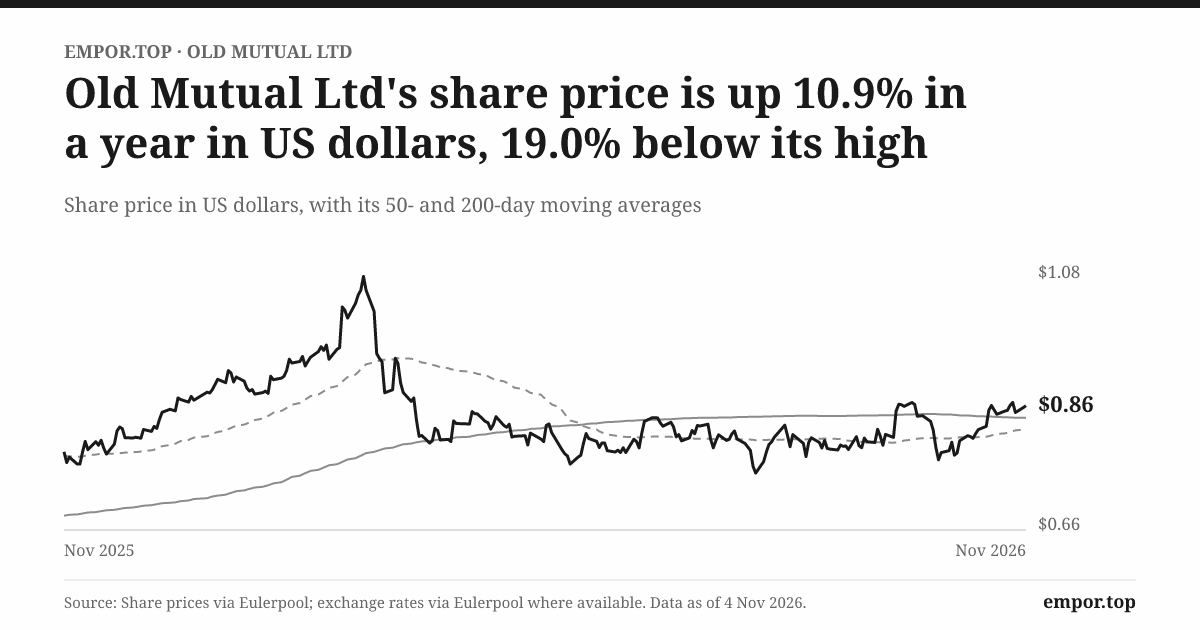
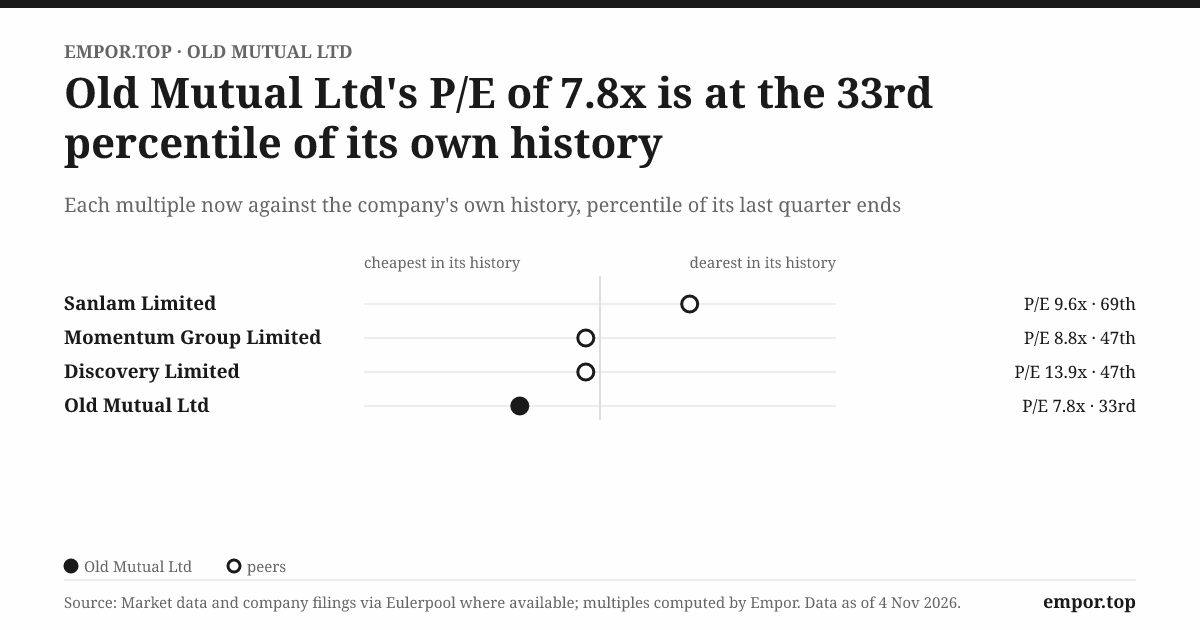
In early November 2026, Old Mutual's shares traded at about R14.26, valuing the company at roughly R64 billion.28 The market was paying about 7.8 times trailing earnings, a little below the stock's own five-year median of about 8.2 times. The shares changed hands at roughly book value and offered a dividend yield of about 6.7%.287 Turn the price-to-earnings ratio upside down and you get an earnings yield of about 12.8%: for every R100 invested at today's price, the company earned about R12.80 last year.
Those are the figures of a stock the market treats with suspicion. Sanlam, the closest listed peer, traded at about 9.6 times trailing earnings on 3 November 2026.29 The comparison is a clue, not a verdict, because the two companies differ in mix, geography and in how their earnings are defined. But a persistent discount says the market either doubts the durability of Old Mutual's earnings or doubts the cash behind them.
The cash question begins with a number that looks alarming. Conventional valuation screens show Old Mutual with a free-cash-flow yield of about minus 14.6%. For an industrial company, that would mean it is burning cash at a rate that would eventually require new funding. For an insurer and bank, it means almost nothing on its own. In 2025, the consolidated cash-flow statement showed an operating cash outflow of about R2.5 billion, against an inflow of about R24.1 billion the year before, even though IFRS profit attributable to shareholders was about R8.4 billion.9
That swing does not mean the business suddenly stopped earning. Operating cash flow for an insurer includes the purchase and sale of investments backing policyholder liabilities, the movement of client money and, for a bank, changes in loans and deposits. A year in which the group invested more of its policyholders' premiums can look like a cash drain; a year in which it sold investments can look like a gusher.
The more useful view is the parent's. Old Mutual Limited, the holding company, received about R8.5 billion of dividends from its subsidiaries in 2025, and its own operating cash inflow was about R7.6 billion.9 That is the cash that pays shareholders, funds buybacks and capitalises the bank. Those are internal transfers, not external revenue, but they are what matters for distributions.
Then add solvency. Insurers must hold capital well above their regulatory minimum, and their subsidiaries can pay dividends upstream only from capital above the buffers set by their boards and the Prudential Authority. At the 2026 interim, the group's shareholder solvency ratio was 172%, meaning it held about 1.7 times the required capital.12
Discretionary capital at the parent, the money available for decisions rather than already committed, fell from about R6.1 billion at the end of 2025 to about R3.1 billion after buybacks, and that remaining R3.1 billion already included about R2 billion earmarked for OM Bank and R1 billion for the next buyback.8 The group also narrowed its target solvency ranges, which could in time free up capital, and took on about R1.8 billion of new debt in the half, lifting gearing to about 16.9%.8
Corporate debt is modest by comparison with the size of the group, and it needs to be kept apart from the far larger obligations to policyholders and depositors. Consolidated borrowings, made up of term loans, revolving facilities and subordinated debt, were about R10.0 billion at the end of 2025, down from about R12.9 billion a year earlier, with about R2.9 billion falling due within twelve months.9
No covenant breach or refinancing strain was disclosed. The first-half issuance in 2026 shows the group is willing to use its debt capacity, which is reasonable for a rated insurer, but it also means some of the buyback and bank funding is, at the margin, being financed rather than earned.
Who sits on the other side of these decisions? Old Mutual has no controlling shareholder. Its largest holder at the end of 2025 was the Public Investment Corporation, which manages South African government employees' pensions; Vanguard, Wellington Management, Sanlam Investment Management and Singapore's GIC each held between roughly 2.5% and 4.3%.11
About 61% of the register was based in South Africa.11 The PIC had held about 17.3% a year earlier, and the company's reports do not explain the reduction.30 A register like this gives management freedom from a single dominant owner, but it also means the biggest voice in the room belongs to a state pension manager whose patience is not unlimited.
The dividend sits inside that framework. The 2025 payout ratio was about 45%, a level that looks comfortable against earnings.9 Management guides that cash remitted from subsidiaries should equal 70% to 80% of adjusted headline earnings before optimisations and special dividends.15 It has also squeezed extra cash out of the system where regulators allowed: in August 2025 the Prudential Authority approved a R1 billion special dividend from the main South African life company to the parent, and the 2025 interim dividend rose 9% to 37 cents.15
Special dividends are useful, but by definition they do not repeat, which is why the first-half 2026 remittance figure attracted so much attention. The bull case is that a group earning a return on equity of about 14%, priced at book value, paying out half its earnings and buying back stock, does not need heroic growth to reward patient owners. The bear case is that market, currency and credit effects keep earnings volatile, while new investments absorb capital that would otherwise flow to shareholders.
So does the discount compensate? It might, if operating earnings keep growing and remittances recover. It will not, if OM Bank keeps consuming more capital than planned and the life business keeps selling at thin margins. That makes the next question unavoidable: how much of the earnings risk is outside management's control?
What can move the numbers without asking permission
Inside Old Mutual's 2025 financial statements sits a note about Malawi that reads less like accounting and more like a dispatch from a currency front line. The group explained that the official exchange rate of the Malawian kwacha had diverged from the rate at which money actually changed hands, and that the kwacha was considered overvalued.
Foreign-currency transactions were often executed through forward contracts priced at the official rate plus an option premium.9 In plain language: the government's price for its currency was not the price the market would pay, and getting money out of the country cost extra.
That note matters because Old Mutual's business in Malawi is not trivial, and because it illustrates a mechanism that runs through the whole group. Some of the numbers that move Old Mutual's earnings are not decided by anyone at Old Mutual.
The first such force is markets. Investment returns flow through to both investment income and policyholder liabilities. When equity and bond markets rise, the value of assets backing policies rises, fee income on assets under management rises, and returns on shareholder funds rise. None of that represents more customers or better products. The first-half 2026 fall in adjusted headline earnings was mostly a story about shareholder investment returns, not about the insurance business.8 Market movements can lift earnings without creating repeatable operating growth, and they can depress earnings without anything going wrong.
The second is currency. Old Mutual reports in rand but earns in kwacha, Zimbabwe dollars, Kenyan shillings, Namibian dollars and more. In 2025, currency translation took about R1.3 billion out of other comprehensive income.9 The company said a 30% to 50% devaluation of the Malawian kwacha would materially reduce reported growth and return measures.7
On the interim call, Troskie said the Malawi operations continued to face high inflation and foreign-currency shortages, although underlying performance there had remained strong.8 A business can perform well in local currency and still disappoint shareholders who measure in rand, and worse, the cash it generates may be hard to move.
That leads to the third force: remittances. In the first half of 2026, cash remitted from subsidiaries to the parent fell to about R2.3 billion from about R4.8 billion a year earlier.12 Troskie attributed the fall mainly to the main South African life company, which reported a lower capital ratio at the end of 2025 and therefore paid a smaller dividend.8
The prior year had also benefited from one-off optimisations. This is the number that tests whether dividends and buybacks are funded by repeatable upstream cash. Halving it in a single half-year, even for explainable reasons, is a reminder that the parent's cash depends on regulatory capital calculations in each subsidiary.
The fourth force is regulation. In Zimbabwe, a policyholder compensation scheme, tied to the losses savers suffered in the country's past currency upheavals, remained subject to regulatory approval, and its financial effect on Old Mutual could not yet be reliably estimated.9 It is a real overhang but a bounded one, and it should be tracked as a regulatory decision rather than inflated into a crisis.
Against all of this sits a credit view that supports resilience. S&P Global Ratings, in its November 2024 rationale, emphasised the capital strength and business resilience of South African insurers, while naming weak domestic growth and concentration in South Africa as constraints.31 In November 2025, after a related action on the sovereign, S&P upgraded Old Mutual's national-scale rating.32 That later action was driven by the country, not by a fresh judgment on the company, which is itself the point. Old Mutual's credit standing rises and falls with South Africa's.
Ordinary-course litigation appears in the accounts too, and it is just that: ordinary. The group said it could not reliably estimate the outcome of various claims but did not expect a material adverse effect.9 The joint auditors issued an unmodified opinion for 2025, highlighting as key audit matters the valuation of insurance contracts, the valuation of hard-to-price investments, and the impairment assessment of subsidiary investments.9
None of that is a red flag. It is a map of where the judgments lie. Insurance-liability assumptions, illiquid investment valuations, and the worth of the bank and other subsidiaries are the places where a change in assumptions can move the numbers most.
The verdict is that diversification across countries does not remove correlated macro and remittance risk. A dozen markets can all suffer from the same dollar shortage, the same commodity downturn, or the same rand weakness. The question for Old Mutual is not whether it can avoid these forces. It is whether its operating growth is large enough to show through them.
The lessons in owning a financial conglomerate
Go back to October 2018, to the morning shareholders found Nedbank shares in their accounts. That moment was an act of focus. It simplified the map. Eight years later, Old Mutual still trades at about book value and below its peers' multiples.
The first lesson belongs to that morning: a break-up can simplify the map without improving the return. For founders and investors anywhere, the separation of a conglomerate is the start of a test, not its conclusion. Clarity is a gift to shareholders only if the remaining business uses it to earn more.
Now picture fifteen million customers beside the still-negative net flows of the first half of 2026. The second lesson is written in that gap: a customer count is not a moat until customers stay and assets grow. Reach is a promise of potential economics. Persistency, net flows and products per customer are the economics themselves. Any company that reports its customer total more prominently than its retention rate is telling you what it wishes were true.
Next, OM Bank's gap between interest earned and credit losses. The third lesson is for every insurer, retailer or telecom operator that dreams of a bank: a bank inside an insurer still has to price credit. Distribution can lower the cost of acquiring a customer. It cannot make a borrower repay. The cross-sell thesis lives or dies not on the number of app downloads but on the gap between what the loan earns and what the loan loses.
Then the cheques: UAP's writedown, 10X's undisclosed earnings, and the impairment of subsidiary investments in the parent's own books.
The fourth lesson: capital discipline is measured after the cheque clears. A board's acquisition record is not its press releases but its impairment notes. For investors, the best predictor of whether the next deal will earn its keep is how candidly the company accounts for the last ones.
And finally, the gap between the group's investments and securities and the parent's discretionary capital. The fifth lesson is perhaps the most Old Mutual of all: cash in the group is not necessarily cash for shareholders. Policyholder money, solvency buffers and subsidiary remittances stand between the headline liquidity of a financial conglomerate and the capital its owners can actually use. In a company like this, the most important number is not how much money it holds. It is how much it can move.
The next results will decide what the strategy is worth
When Old Mutual reports its full-year 2026 results in March 2027, the presentation will have to connect three stories that are currently told separately: the bank's growth plan, the 10X integration, and the capital-return programme. Each draws on the same capital. Each will be judged by the same return framework. And three measures will do most of the judging.
The first is results from operations per share, which rose 11% in the first half of 2026, inside management's 10% to 14% medium-term range.8 The test for 2026 as a whole is whether that growth holds without relying on favourable market and currency movements. If it does, the core group is compounding. If it falls back, the half-year will look like a peak.
The second is the life business's value of new business and net client cash flow, which improved in the first half but remained negative.816 The case improves materially if the margin moves toward the 2% to 3% range management itself has set and net flows cross into positive territory. Rising gross sales alone, with thin margins and continued outflows, would suggest the company is paying for growth.
The third is OM Bank's credit-loss ratio and its operating contribution. The ratio rose in the first half, while the cluster has a 2028 target of between break-even and R200 million of results from operations.128 A falling credit-loss ratio while the loan book grows would be the strongest evidence that the cross-sell model works. A rising one would mean the bank is buying customers with credit risk.
Other signals include 10X's assets, flows and fee economics after consolidation, and whether Old Mutual begins to disclose them separately enough to measure the return on the R2.1 billion. Subsidiary remittances need to prove sufficient to support dividends, buybacks and the bank's capital calls. The governance calendar includes the CFO handover in April 2027, which requires regulatory approval, and the next remuneration vote, where stronger support would suggest the board's engagement with shareholders has worked.2726
The case weakens if acquisitions and buybacks run ahead of recurring capital generation, if currency and credit losses repeatedly erase operating progress, or if the bank's targets slide without explanation. It strengthens if the three core measures move together for several periods. What remains genuinely open is the question underneath them all: whether the integrated group can make its breadth earn more than the sum of its parts.
Epilogue
Imagine the next annual results presentation, in a Johannesburg auditorium, with Strydom at the lectern and a new chief financial officer at his side. The analysts in the room will want three answers, and each one maps to a question this story has carried since 2018.
What did the group earn from insurance? That answer tests repeatability.
What did it spend to build the bank, and what did the bank lose? That answer tests economics. At the interim, management expected OM Bank to pass a million customers within weeks and said its own lending was due to begin in the second half of 2026.
What came back from the subsidiaries? That answer tests capital.
Beyond that presentation lie the other moments that will decide the story: 10X's first full year inside Old Mutual Wealth, the bank's 2027 numbers on the road to its 2028 target, and the next remuneration vote. None of them, on its own, will settle whether Old Mutual is becoming a focused compounder or remaining a collection of promising businesses that still need to prove their returns. Together, over two or three years, they will.
The uncertainty that remains is precise. The company does not publish a group-wide retention series, and its earnings path, adjusted for markets and currencies, is short and noisy. A low price multiple and one strong sales period cannot answer whether the whole franchise is compounding. Operational growth has to become durable earnings, and durable earnings have to become cash that reaches the parent and then the shareholder.
Outro
In 1845, a few colonists in Cape Town pooled their savings so that their families would not be ruined by an early death. In 2018, the company they started handed most of a bank it had controlled for three decades to its own shareholders, and drew a new, smaller boundary around itself. And by 2028, it has promised, a bank it built from nothing inside that boundary will at last stop losing money.
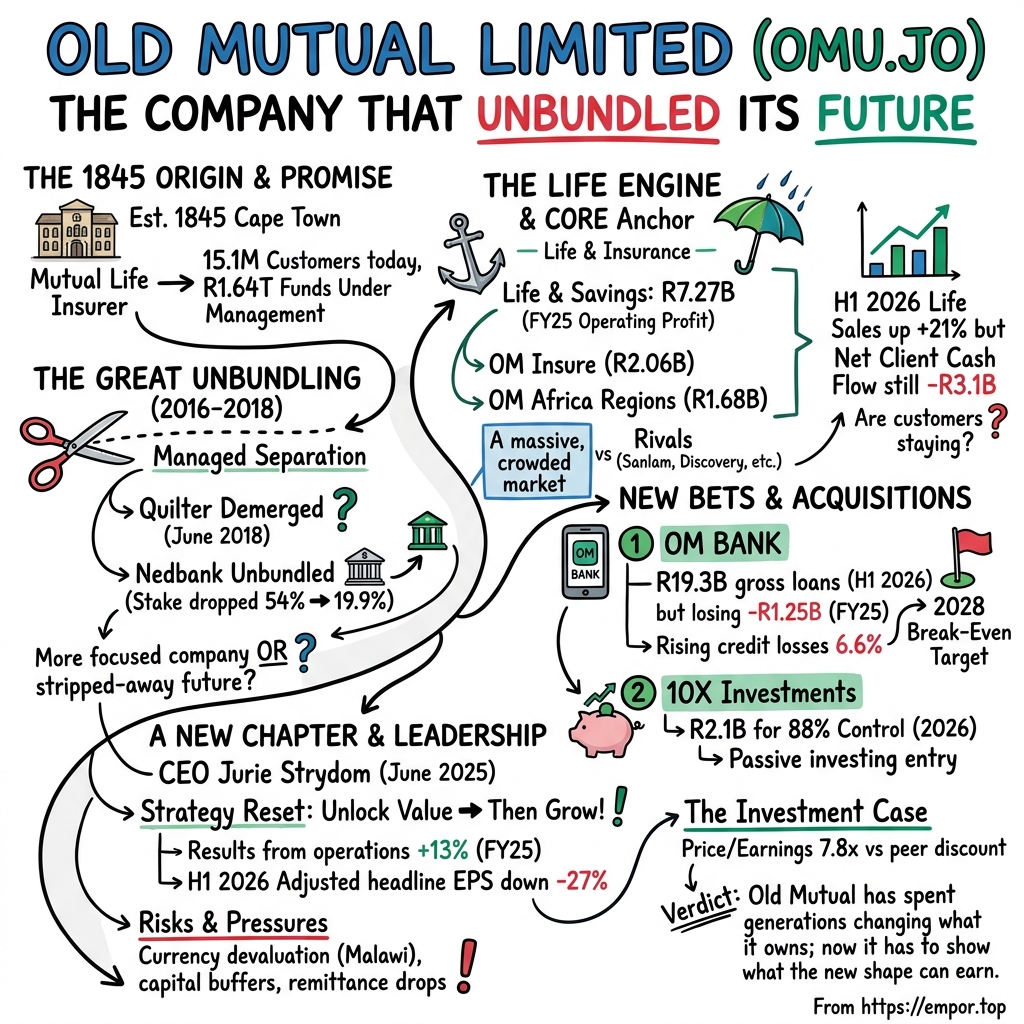
That is Old Mutual's particular ambition: not to grow by standing still, but to keep redrawing the line around what it owns, betting each time that the new shape will earn more than the old. Old Mutual has spent generations changing what it owns; now it has to show what the new shape can earn.
References
-
Completion of the unbundling of Nedbank Group Limited and the managed separation of Old Mutual plc — Old Mutual, 2018-10-15 ↩↩↩↩
-
Old Mutual to Split into 4 Units as CEO Works to Reverse Flagging Returns — Insurance Journal, 2016-03-11 ↩↩↩
-
Old Mutual appoints new CEO — BusinessTech, 2025-05-09 ↩↩↩↩↩↩↩↩↩
-
Old Mutual Limited annual results and dividend declaration for the year ended 31 December 2025 — Old Mutual/JSE SENS, 2026-03-17 ↩↩↩↩↩↩↩↩↩↩
-
Old Mutual H1 2026 earnings call transcript — StockAnalysis, 2026-09-08 ↩↩↩↩↩↩↩↩↩↩↩↩↩↩↩↩↩↩↩↩↩↩↩↩↩
-
Annual Financial Statements for the year ended 31 December 2025 — Old Mutual/JSE, 2026-03-17 ↩↩↩↩↩↩↩↩↩↩↩↩↩↩↩↩↩↩↩↩↩↩↩↩↩↩
-
Group interim results for the six months ended 30 June 2026 — Old Mutual/JSE, 2026-09-08 ↩↩↩↩↩↩↩↩
-
Old Mutual writes off Sh9bn in its Kenyan subsidiaries — Business Daily Africa, 2017 ↩
-
Old Mutual H1 2025 earnings call transcript — StockAnalysis, 2025-09-10 ↩↩↩↩↩↩↩↩
-
The South African Insurance Industry Survey 2025 — KPMG, 2025 ↩↩↩
-
Assets managed by SA life insurers exceed R5 trillion for the first time — ASISA, 2026 ↩
-
New bank taking on Capitec officially launches in South Africa — BusinessTech, 2025 ↩↩↩
-
Old Mutual acquires a majority stake in 10X Investments — Business Day, 2025-10-28 ↩
-
Old Mutual Wealth (Pty) Ltd and 10X Investments (Pty) Ltd case file — Competition Tribunal of South Africa, 2026 ↩
-
Peter Moyo vs Old Mutual vs Trevor Manuel: a firing timeline — Sowetan, 2019-07-31 ↩
-
Peter Moyo loses final legal battle against Old Mutual — Moonstone ↩
-
Results of Shareholders Voting at the Annual General Meeting — Old Mutual/JSE SENS, 2026-06-05 ↩↩
-
Appointment of CFO Designate — Old Mutual/JSE announcement, 2026-09-08 ↩↩
-
Sanlam Statistics & Valuation Metrics — Stock Analysis, accessed 2026-11-04 ↩
-
Old Mutual Limited Annual Report 2024 — FinancialFilings, 2025 ↩
-
Various South Africa-Based Insurer Outlooks Revised To Positive Following Similar Rating Action On The Sovereign — S&P Global Ratings, 2024-11-20 ↩
-
Old Mutual rating announcement — Old Mutual/JSE SENS, 2025-11-19 ↩
 LinkedIn
 WhatsApp
 Reddit
 Hacker News
 Email
 Kindle
 RSS Feed
 Spotify
 Apple Podcasts
 Amazon Music
 Audible
 YouTube