Momentum Metropolitan Holdings: The Merger, the Reset and the R7 Billion Question
I. The Year the Earnings Fell in Half
Picture the claims floor of a South African life insurer in the winter of 2020. In a normal year, a death claim is a sad but statistically expected event. Actuaries have priced it, reserves have been set aside for it, and the premiums of thousands of healthy policyholders quietly pay for the few who die. In 2020 the statistics stopped behaving. COVID-19 swept through a country whose insurers had built their books on decades of mortality tables, and the claims arrived faster than any of those tables had imagined. At the same moment, households that had lost income began asking for premium holidays, and some simply stopped paying. Then the equity and bond markets, which an insurer leans on to grow the assets that back its promises, lurched downward.
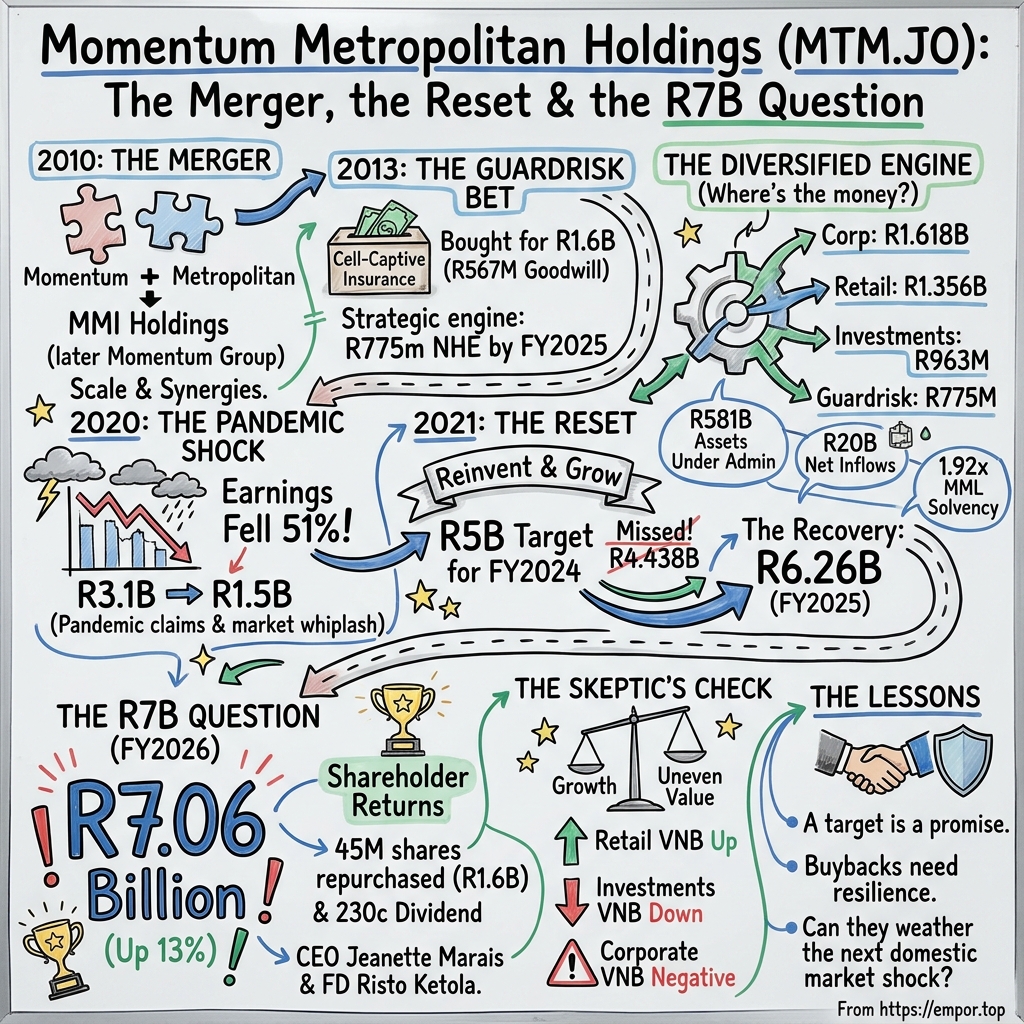
Momentum Metropolitan, one of the country's biggest financial-services groups, took all three blows in the same twelve months. For the year to June 2020, its normalised headline earnings, the adjusted profit measure management uses to judge itself, fell from about R3.1 billion to about R1.5 billion.1 Roughly half the group's earning power disappeared in a single year. Reported profit attributable to shareholders fell even further, to a sliver of its former level, and the dividend payout that year looked absurd against what was left.1
That collapse is the right place to start this story, because it is the cleanest stress test the modern group has faced. A financial-services group like this one sells promises that may last forty years: a funeral policy, a retirement annuity, a disability cover, a guaranteed pension. Its own earnings, though, are reported every six months and move with claims experience, market prices, interest rates and the actuarial assumptions used to value all those future obligations. The gap between the length of the promise and the shortness of the reporting cycle is the central tension in any life insurer. 2020 showed how violently it can snap.
Six years later the picture looked entirely different. For the year to June 2026, the group reported normalised headline earnings of R7.06 billion, 13% higher than the year before.2 That figure is more than four and a half times the pandemic trough. It also crossed a R7 billion target that management had set for the 2027 financial year, a year ahead of schedule.3 Shareholders who had watched the earnings fall in half got a record instead.
The temptation is to tell this as a straight comeback. It is more interesting than that. A recovery from a trough flatters everyone, because almost anything looks like growth from a low enough base. So the question this story carries is not whether Momentum's earnings recovered. They clearly did. It is how much of that recovery is repeatable: whether the group built a more resilient business, or whether its results still depend mostly on markets and assumptions it cannot control.
Four smaller questions sit inside that big one. Did the 2010 merger that created the group produce durable advantages, or merely a bigger and more complicated company? Are today's new sales turning into profitable future earnings, or just enlarging the book? Has management earned credibility by delivering through the cycle, including after missing an earlier target? And are the buybacks and dividends the group now pays a fair and prudent use of capital in a business whose first duty is to keep its promises to policyholders?
Before going further, the names need straightening out, because this company has worn several. The listed parent on the Johannesburg Stock Exchange is now Momentum Group Limited, trading under the code MTM. It was previously Momentum Metropolitan Holdings, and before that MMI Holdings.3 Momentum Metropolitan Life Limited, often shortened to MML, is a different entity: it is the group's main regulated life insurer, a subsidiary owned by the listed parent, and the company that rating agency Moody's actually rates.4 Throughout this story, "the group" means the listed parent and everything it consolidates; "MML" means the life-insurance subsidiary. The distinction matters most when the subject turns to solvency and credit ratings, where it is easy to borrow the subsidiary's numbers for the parent.
The listener should hold one figure in mind until the end. R7 billion was the earnings line management promised for 2027 and reached in 2026. To get there, the group had to absorb a missed earlier target, restructure loss-making businesses, sell assets abroad, repurchase tens of millions of its own shares and convince sceptical investors that operating performance, not markets, was doing the work. What exactly did it have to do to reach that number, and how much of it will still be there after the next bad year? To answer that, the story has to go back to the moment two very different insurers decided to become one.
 Subscribe on LinkedIn
II. Two Insurers Become One Listed Group
In December 2010, two of South Africa's best-known insurance brands joined forces. On one side stood Metropolitan, an insurer with deep roots in the mass market, selling funeral cover and life policies through a large field force to working-class and emerging middle-class households. On the other side stood Momentum, then part of the FirstRand banking stable, which had made its name among wealthier clients, independent financial advisers, employee-benefit schemes and investment platforms.5 The combined company was called MMI Holdings. In accounting terms it was a reverse acquisition: the legal parent was the old Metropolitan listed vehicle, but the transaction was treated as if Momentum had acquired Metropolitan, a structure the group still records in its annual statements today.3
The logic was easy to state. Metropolitan reached customers Momentum never saw; Momentum had products, investment capabilities and adviser relationships Metropolitan lacked. Put them together and, in theory, the group could sell more products through more channels, cut duplicated head-office costs, and use one large balance sheet to support everything from life insurance to asset management to health-scheme administration. It was the kind of merger that consultants draw as two overlapping circles with a large and promising intersection.
The first test of a merger is whether the promised savings show up. On that narrow measure, this one passed. By the 2014 results, management reported that cumulative merger-related expense savings had reached R522 million, slightly above the R500 million target it had set.6 That is real evidence of integration: duplicated functions were removed, and the company did what it said it would do on cost. But cost savings are the easiest synergy to deliver and the easiest to copy. Any two companies that merge can close an office. They do not, on their own, create a reason customers will choose you over Sanlam or Old Mutual for the next twenty years.
The listed-company boundary also took shape in these years. The parent became a holding company owning a portfolio of operating businesses: life insurance, investments, employee benefits, health administration, short-term insurance and a growing collection of operations elsewhere in Africa and abroad. The regulated life insurer, Momentum Metropolitan Life, sits underneath as the engine room for long-term policies.4 Investors buy shares in the parent; policyholders rely on the regulated subsidiaries; regulators and rating agencies watch the subsidiaries' capital. That layered structure is normal for an insurance group, but it means the listed company's value always depends on the health of several separately regulated businesses that cannot freely move capital between them.
Scale, it turned out, was not the same as returns. Through the middle of the decade, net profit attributable to shareholders drifted downward. By the 2018 financial year, the group's reported net profit was well below where it had stood in 2015, and return on equity had slipped to roughly 6%, a poor result for a business whose shareholders could have earned more than that in government bonds.7 Something in the sprawling portfolio was leaking value.
The 2017 and 2018 reports showed where. The group recorded impairments in its international businesses, writing down goodwill on operations that had been bought or built abroad and were losing money.7 It also wrote off software that was no longer used, or that would cost more to maintain than it was worth.7 Those are revealing admissions. A goodwill impairment is a company's formal confession that it paid more for a business than the business is now worth. A software write-off is a confession that money spent on technology bought a system the company no longer wanted. Neither proves the merger was a mistake. Both show that combining two complex businesses also combined their ambitions, and that some of those ambitions, especially outside South Africa and in technology, destroyed value.
So the merger's record splits in two. The integration savings were delivered and the group gained real breadth: distribution from the mass market to the affluent, products from funeral cover to retirement annuities, and a place among the country's largest financial groups. The growth bought with that platform, however, was uneven. International expansion and some large technology projects consumed capital and ended in write-downs.
That leaves a sharper question than "was the merger good?" If expanding abroad and building systems could destroy value, what kind of growth was actually worth buying? One deal, struck three years after the merger, offers the group's best answer. It involved an unusual kind of insurer that most South African households have never heard of, even though many of them are covered by it.
III. Guardrisk: The R1.6 Billion Bet on a Different Kind of Insurance
On 4 November 2013, Alexander Forbes, the South African employee-benefits and financial-services group, announced that it had agreed to sell Guardrisk to MMI Holdings for R1.6 billion in cash.8 MMI said it expected the deal to be earnings-enhancing and to generate revenue synergies.8 Business Day framed the purchase as a diversification move: a way for a life insurer still digesting a merger to buy a different kind of insurance business, with different customers and a different source of profit.9
To understand what MMI bought, imagine a retailer that wants to sell its own branded cellphone insurance at the till, or a car dealer that wants to offer warranty cover with every vehicle. Neither wants to become a licensed insurer. That would mean raising regulatory capital, hiring actuaries, building claims systems and reporting to the Prudential Authority. A cell-captive insurer solves the problem. Guardrisk holds the insurance licence and the regulated structure; inside it, the retailer or dealer rents a "cell," a ring-fenced compartment with its own capital, premiums and claims. The client keeps the customer relationship and most of the underwriting result; Guardrisk earns fees and commissions for supplying the licence, the governance and the risk expertise. It is a bit like a serviced office building for insurance: the tenants run their own businesses, but the landlord owns the building, the security desk and the fire certificate.
The strategic logic for MMI was attractive. Guardrisk reached customers through partners, so it did not need the expensive field force or branch network that made mass-market life insurance costly. Its clients were businesses, which fitted naturally beside the group's corporate-benefits operation. And because the cell owners bore much of the underwriting risk, Guardrisk's earnings depended more on the volume of business flowing through its structure than on getting every claims estimate right.
When the 2014 accounts closed, the acquisition carried R567 million of goodwill, the premium MMI paid above the fair value of Guardrisk's identifiable net assets.6 In other words, about a third of the purchase price was a bet on future earning power that did not yet appear on any balance sheet.
That bet paid. By the 2025 financial year, Guardrisk contributed R775 million of normalised headline earnings to the group.10 Set against a R1.6 billion purchase price, a single year's contribution now equals roughly half of what was paid more than a decade earlier. Guardrisk also became more than a profit line: in the group's segment presentation it stands as one of the named businesses, beside Momentum Retail, Momentum Corporate and Momentum Investments.10
Proportion matters, though. Guardrisk's R775 million was a meaningful contribution, but it was smaller than Momentum Corporate's roughly R1.6 billion and Momentum Retail's roughly R1.4 billion in the same year.10 It diversified the group's earnings rather than defining them.
And there is a limit to what the record proves. It is tempting to call the deal cheap in hindsight. But the price looked full at the time, the goodwill was substantial, and there is no clean published multiple for comparable South African cell-captive transactions against which to measure it. The honest verdict is that Guardrisk became a material and growing earnings contributor, which makes it a successful acquisition by outcome. Whether MMI paid a bargain price or a fair price for a business it then managed well cannot be settled from the public terms. Guardrisk also brought complexity of its own: in the 2026 financial year, model and data errors at Guardrisk Life led to restatements that the group described as immaterial, with no impact on group earnings or equity, but which the joint auditors treated as a key audit matter because of the estimation uncertainty and model complexity involved.3 A specialist insurer is valuable partly because its risks are hard to measure, and the auditors were reminding shareholders that this cuts both ways.
The contrast with the group's earlier expansion abroad is instructive. Guardrisk was a business with an established model, purchased whole, that fitted beside an existing corporate relationship base. It earned its way into the earnings engine, unlike the group's earlier impaired foreign ventures.7 Even the group's more recent African footprint has been trimmed, with disposals in Ghana completed in the 2026 financial year.3
The capital-allocation story did not end with Guardrisk. In September 2023 the group announced it was acquiring RMI Investment Managers, adding a stable of boutique asset managers to its investment business, with consideration split between an upfront payment and deferred amounts.11 The Competition Tribunal approved the merger in January 2024.12 The announcement did not set out a simple purchase multiple, so it is too early and too opaque to judge the price. And from 2025 onward, the group directed large sums into repurchasing its own shares, a decision examined later in this story.
Each of those uses of capital raises the same question Guardrisk answered well: does the money earn more than the group could earn by simply buying back its own shares or keeping the capital as a buffer? To answer it, one first has to see where the group's money is actually made.
IV. The Group That Sells Protection, Investment and Administration
Follow three transactions on an ordinary Monday morning. A municipal worker in Gqeberha pays the monthly premium on a Metropolitan funeral policy. A mining company in Johannesburg signs a new mandate for its employees' retirement fund to be administered on Momentum's FundsAtWork umbrella platform. A retired teacher in Cape Town moves her savings into a living annuity on Momentum's investment platform. The money flows into three different regulated businesses, is governed by three different contracts and earns three different kinds of profit. Yet all three show up, eventually, on one listed balance sheet.
That is the first thing to understand about where Momentum Group makes its money: it is not one business but several, joined by a brand family and a balance sheet. In the 2026 financial year the group reported about R61 billion of insurance revenue and about R11 billion of fee income.3 The fee income itself had several distinct streams. Contract administration brought in about R4.9 billion, health administration about R3.1 billion, trust and fiduciary services about R1.6 billion and cell-captive commissions a comparatively modest R167 million.3 Behind each line is a different engine.
The insurance engines earn money the old-fashioned way. A policy is priced with assumptions about how many people will die, become disabled or stop paying; reserves are set aside; and profit emerges over the life of the policy if experience turns out at least as good as assumed. That makes insurance profit sensitive to four things: claims, persistency (whether customers keep paying), the investment return on reserves, and the assumptions actuaries use to value the future. The fee engines are different. An asset manager or administrator earns a percentage of the assets it looks after or a charge per member it serves. Those earnings rise with inflows and rising markets and fall when clients leave or markets drop, but they do not carry the risk of a mortality shock.
Size those engines against each other and a clear hierarchy appears. In the 2025 financial year, Momentum Corporate and Momentum Retail remained the group's largest contributors, followed by Momentum Investments and Guardrisk.10 Metropolitan Life, Momentum Insure, the health business and the operations in Africa added further diversification, though none carried the weight of the largest three.10 By June 2026 the group administered about R581 billion of assets, and clients had added a net R20 billion over the year.2
Now place that portfolio in its market. In South African life insurance, the group is a significant player but not the giant. Measured by life premiums in 2024, Sanlam wrote roughly 10% of the market, while Momentum Metropolitan Life wrote roughly 3%, according to Moody's.4 That comparison needs a careful caveat: it describes the life subsidiary's share of premiums, not the listed group's share across administration, asset management, health and cell-captive insurance. But it does correct an easy assumption. Momentum is not the default supplier of life insurance to South Africa. It competes against Sanlam and Old Mutual, both larger; against Discovery, which has built a distinctive model linking insurance pricing to its Vitality wellness programme; against Liberty and Hollard; and, in each adjacent market, against specialist administrators and asset managers who do one thing and do it cheaply.
Where, then, could a durable advantage actually exist? Not in the products themselves. A funeral policy or a living annuity can be copied by any licensed competitor, and South African customers can, and do, hold policies with several providers at once. The plausible advantages are narrower and more specific. The first is distribution: a large tied adviser force and long relationships with independent financial advisers, who decide where a great deal of affluent money goes. The second is administration: running employee-benefit and medical-scheme platforms involves systems, compliance and member records that are painful for a client to move. The third is regulated infrastructure: licences, capital and actuarial capacity that newcomers cannot replicate quickly. The fourth is Guardrisk's specialist cell-captive model, where expertise and an established partner network give the business a lead in a niche most competitors ignore. Moody's itself points to the group's top-tier positions in corporate benefits and the retail affluent market as a rating strength.4
Each of those claims needs to be tested against the evidence that could break it. The usual way to break a distribution or administration moat is through customer behaviour: if clients multi-source, switch easily or extract price cuts, the moat is shallower than it looks. Here the group's disclosure is thin in exactly the places that matter. Momentum Group does not publish a consolidated client-retention rate, a recurring-revenue share across the whole group, an average contract length, or concentration among its largest corporate and scheme clients.3 It names no customer accounting for more than a tenth of revenue, and it gives no top-five or top-ten client share.3 That leaves the scale of exposure to big corporate and medical-scheme mandates unresolved. The moat is plausible in specific niches and unproven across the group as a whole.
One piece of balance-sheet evidence helps show how the cell-captive business actually works. At June 2026, the group's financial-asset receivables totalled about R6.1 billion before impairment, and about R2.5 billion of that was money owed by cell-captive intermediaries.3 Monthly premiums are normally settled within 30 days, and annual premiums within 30 days or quarterly.3 The impairment allowance on the whole book was small, at about R155 million, and the group says most of its riskiest balances are already provided for.3 A crude measure of how many days of revenue sit in receivables fell sharply, to about 57 days in 2026 from more than twice that two years earlier, but that ratio is distorted by how insurance revenue is defined, and the group does not publish an ageing table that would show who pays late.3 The fair reading is that the receivables look like a normal timing float in a partner-collected premium model rather than a credit problem.
There is a wider caution here about reading this company's financial statements. In 2026 the income statement carried about R93 billion of realised and unrealised fair-value gains on investments, offset by about R55 billion of fair-value adjustments on investment-contract liabilities and about R37 billion of insurance-finance expenses.3 Those enormous lines largely belong to policyholders: when the market rises, the assets backing a unit-linked policy go up, and so does what the group owes the policyholder. They wash through the accounts in a way that makes reported revenue and margins jump around from year to year without saying much about how the underlying business is doing. That is why serious analysis of Momentum relies on normalised headline earnings, segment results, the value of new business and solvency, rather than on revenue growth or operating margin.
Assets under administration and gross sales, in other words, are only half the scorecard. They matter only if the new business the group writes earns attractive margins and turns into profits in future years. That test runs through the strategy management announced after the pandemic, and through a target it did not hit.
V. The R5 Billion Promise—and the Reset
In September 2020, as the group reported that its earnings had halved, it also announced a new chairperson and revised its targets.13 The message to shareholders was blunt in substance: the plans set before the pandemic would not be met. The group's leadership at the time, with Hillie Meyer as chief executive and Jeanette Marais as his deputy, then had to tell investors what a realistic recovery would look like.15
The answer came in 2021 under a strategy called "Reinvent and Grow." Its headline commitment was a normalised headline earnings target of R5 billion for the 2024 financial year.14 It was a bold number. It implied more than tripling earnings from the pandemic trough in four years, and it required the group to repair loss-making businesses, cut costs, improve the profitability of new business and do it all while COVID claims were still flowing through the books. Management's own 2021 report acknowledged the scale of what had gone wrong and the need for a reset, rather than presenting the target as a simple bounce-back.14
It is worth pausing on 2020 as a test, not an excuse. Every South African life insurer faced the same pandemic, the same lockdowns and the same markets. The pandemic explains why earnings fell; it does not explain why they fell by as much as they did, or why targets set before COVID had already been in doubt. By acknowledging the earlier misses, management at least avoided pretending the virus was the whole story.
Then came the scorecard. In the 2024 financial year, the group reported normalised headline earnings of about R4.4 billion.10 That was a large improvement on the trough and a respectable figure in its own right. It was also about 11% short of the R5 billion target. The recovery story, in other words, should not begin with the record that followed. It should begin with a miss.
What came next was stronger. In the 2025 financial year, normalised headline earnings rose 41% to about R6.3 billion, comfortably above the level once promised for 2024, just a year late.10 In 2024 the group had also launched its next strategy, called "Impact," with a new target: R7 billion of normalised headline earnings by the 2027 financial year.15 It crossed that target a year early.215
A note on the measure itself. Normalised headline earnings is management's chosen yardstick. It strips out items such as goodwill impairments and certain accounting effects, including adjustments for the group's own shares held on behalf of policyholders, to give a figure management believes better reflects ongoing performance. That is reasonable for an insurer, but it is still an adjusted number. Reported earnings attributable to shareholders tell a similar story in direction: they rose from about R6.0 billion in 2025 to about R6.6 billion in 2026.3 The two measures moving together is a reassuring sign that the adjusted figure is not doing all the work.
Was the recovery more than a rebound? Here the evidence is mixed, and the mix matters. On the operating side, there were genuine improvements. In the 2026 financial year, the group's sales rose 18% to about R93.8 billion and assets under administration grew 16%.2 Management reported about R810 million of annualised cost savings, and direct expenses grew only 3%, below inflation.2 The company said it had concluded turnarounds at Momentum Insure and Metropolitan, two businesses that had dragged on returns.15 Management told investors that operating performance contributed more to growth in 2026, and markets a smaller part, than in the prior year.2
That is management's claim, and it deserves to be tested rather than repeated. The strongest contrary evidence sits in the same results. Investment markets still contributed about R1.5 billion to the group's embedded-value earnings in 2026, a reminder that rising asset prices remained a meaningful tailwind.2 Assumption changes and yield movements also moved the numbers, and the Guardrisk Life restatement showed that even a specialist business's valuation models can contain errors.3 None of that cancels the operating improvement. But it means the 2026 figure is not a clean measure of underlying earning power.
The fairest verdict sits between the two narratives. The recovery is not merely a low-base rebound: earnings kept growing well after the pandemic effects had washed out, cost savings were real, and loss-making units were fixed. Yet the group has not yet shown, through a period of weak markets, that the operating gains alone can sustain growth. The 2024 miss is a reminder that targets in this business are hostage to experience, and the next two years of results will show whether the operating share of growth keeps rising.
How did the group take out cost without starving the business? The headcount offers a clue. Total staff edged up from about 13,800 at June 2025 to about 14,000 a year later, but the mix shifted: indoor staff rose to about 10,400 while the field force declined to about 3,600.3 That is a group investing in administration, technology and service capacity while trimming the expensive face-to-face sales channel that serves the mass market. Capital commitments told a similar story, at about R422 million, mostly for software, building refurbishments and new-business opportunities, all to be funded internally.3 Given the software write-offs of 2017 and 2018, technology spending is exactly where a sceptical shareholder should look hardest. Digital advice and automated administration could lower the cost of serving clients for every insurer in the market, which would make it table stakes rather than an advantage, and could expose any group that spends heavily on systems that do not earn their keep.
A sceptical activist would also ask about portfolio complexity. The group still runs a life insurer for the mass market, an affluent retail franchise, a corporate-benefits business, an investment platform, asset managers, a short-term insurer, a health administrator, a cell-captive insurer, operations elsewhere in Africa and an Indian health-insurance joint venture with Aditya Birla, which management describes as progressing toward sustainable profitability.15 Each unit has its own regulator, its own capital and its own management layer. The Ghana disposals show the group is willing to prune, and the turnarounds at Momentum Insure and Metropolitan show it can repair.315 But a holding company with this many moving parts has to keep proving that the whole is worth more than the parts, and the market's discount suggests it is not yet fully persuaded.
There is a revealing way to judge management through all this. Set the 2021 strategy-day remarks beside the 2024, 2025 and 2026 results presentations and the questions write themselves: how did management explain the 2024 shortfall; did it change what it said drives earnings; and how carefully does it separate operating experience from market and assumption effects? On the evidence of the results themselves, the explanations have moved in a consistent direction, toward cost discipline, fixing underperforming units and profitable new business. Whether that narrative holds through a bad market year is still untested.
That brings the story to the single most important leading indicator in a life insurer. Sales and assets are growing. Are the new policies and mandates creating profitable value, or just enlarging the book?
VI. More Sales, Uneven Future Value
Consider two salespeople inside the same group in the 2026 financial year. One sells a guaranteed annuity to a retiree: a contract that pays a fixed income for life, with the insurer bearing the risk that the retiree lives longer than expected or that interest rates move against it. The other sells a living annuity: the retiree's money stays invested in funds they choose, and the retiree draws an income from it and carries the investment and longevity risk. Both count as sales. Both add to assets under administration. Their economics for the insurer could hardly be more different.
That contrast sits at the heart of the 2026 results. In Momentum Investments, guaranteed-annuity volumes fell 26%, and the product mix shifted toward lower-margin living annuities.2 The value of new business in that segment fell from about R509 million to about R357 million, and its new-business margin slipped to about 0.6%.2 In other words, the investment business sold plenty, but each rand it sold was worth markedly less to shareholders than a year earlier.
Value of new business is the concept that makes this visible, so it is worth explaining. When an insurer writes a long-term policy, it does not book the profit immediately. Instead, actuaries estimate the present value of all the profits the policy is expected to produce over its life, after the cost of holding capital against it. That estimate is the value of new business, usually shortened to VNB. Divide it by the present value of the premiums the policy will bring in and you get the new-business margin. Volume tells you how much the group sold; VNB tells you how much future profit it actually created by selling it. It is the closest thing a life insurer has to a gross margin on new orders.
Measured that way, the group's segments told very different stories in 2026. Momentum Retail's VNB more than doubled, rising from about R45 million to about R98 million.2 That is a real improvement and deserves its due, because retail life and savings products sold through advisers are where Momentum's brand and distribution matter most. But a doubling from a low base is a single year's evidence. The test is whether the gain persists, and whether it holds across the retail product mix rather than coming from one favourable line.
Momentum Corporate offers the warning. It is the group's largest earnings contributor, with large wins on its FundsAtWork umbrella-fund platform and in group risk cover. Yet its VNB remained slightly negative in 2026, at about minus R7 million, despite higher volumes.2 A negative VNB means that, on the group's own actuarial assumptions, the new corporate business written that year was expected to destroy a little value rather than create it. Winning a large mandate is a sales success; it is not automatically an economic one. Large corporate clients have bargaining power, tender processes are competitive, and the cost of onboarding thousands of members can take years to recover. It would be a mistake to call the corporate franchise a moat on the strength of mandate wins alone when the economics of new corporate business are this thin.
Metropolitan Life, the mass-market business, sat in between. Its VNB margin was about 1.1%, which management acknowledged remained below its medium-term expectation.2 The turnaround at Metropolitan has improved its earnings, but new business there is still not as profitable as the group wants it to be.
Put together, the verdict is that growth is real but uneven. There is genuine opportunity in parts of retail, in corporate benefits and in investment flows; net inflows show that clients are still choosing the group's platforms. But a low or negative new-business margin is evidence that volume alone does not prove a stronger franchise. Some of the 2026 growth was the group selling more of the things that earn the least.
There is a strategic case to be made for the group's breadth. A business that touches a retiree through an annuity, an employer through a benefits fund, a household through a funeral policy and a medical scheme through administration has many chances to sell more products to the same people. In 2026 the group also won the administration contract for Bonitas, one of South Africa's larger open medical schemes, which had previously been administered by AfroCentric, a Sanlam business.15 That is a concrete proof point that administration capability can win large clients from rivals. But the group does not publish consolidated retention trends or client concentration, so the claim that its breadth translates into stickier, more profitable relationships remains a management argument rather than a demonstrated fact.
The next test is specific. In the 2027 results, investors will want to see segment VNB and margins, persistency (whether policies stay on the books), product mix in annuities, and how the large FundsAtWork and annuity deals actually perform once their costs and claims start to run. If Momentum Investments rebuilds its margin and Momentum Corporate's VNB turns positive, the case that the group is building future earnings strengthens considerably. If volumes keep rising while margins slide, the earnings growth of 2025 and 2026 will start to look like it was borrowed from the future.
Those choices about which business to write, and at what price, belong to the people at the top. The current management team has produced a strong earnings recovery. Its record also contains a missed target and visible corrections, and its pay has risen sharply. That combination is the next part of the story.
VII. Jeanette Marais's Scorecard: Delivery, Buybacks and Trust
In September 2026, Jeanette Marais and finance director Risto Ketola stood in front of investors to present a set of results that crossed the R7 billion target a year early. The board's chair, Tyrone Soondarjee, said the board was "delighted with the exceptional performance delivered under the leadership of the group CEO and Exco."15 Marais, for her part, was already looking further ahead, saying the group had "simultaneously started formulating the strategy beyond F2027."15 It was, by any measure, the strongest results day the group had enjoyed since the merger.
Marais's path to that stage is longer than her tenure as chief executive suggests. She first joined Momentum in 1990 and left nine years later to join PSG, where she helped set up its unit-trust business.15 She then worked at Stanlib, Old Mutual and Allan Gray, building a career in investments and distribution rather than in actuarial pricing, before returning to the group in 2018 as deputy chief executive to Hillie Meyer.15 She became group chief executive in 2023 when Meyer retired, making her the first and only woman to lead one of South Africa's large listed life insurance and asset-management groups.15 That background matters for how the group now talks about itself: distribution, advice and client flows feature prominently, and the strategy places weight on winning money and mandates, not just on pricing risk. Ketola, the long-serving group finance director, provides continuity on the numbers side, having held the role through the trough, the miss and the recovery; the 2026 annual report recorded no change in either the chief executive or the finance director.3
After revising pre-pandemic targets and setting a R5 billion goal for 2024, management missed that goal by about 11%, then reached its next target a year early.13141015 Its record offers a reasonable basis for credibility, though not an unconditional one.
Pay is where shareholders have pushed back. In the 2026 financial year, Marais's reported remuneration was R45.1 million, Ketola's R36.7 million and Momentum Corporate chief executive Dumo Mbethe's R27.8 million.3 Combined pay for the three executive directors rose to about R110 million from about R84 million the year before, an increase of roughly 31%.3 Almost all of that increase came from incentives: long-term incentive payments rose to about R72 million from about R52 million, and short-term incentives to about R17 million from about R13 million.3 Over the same year, normalised headline earnings rose 13% and reported attributable earnings about 11%.3
That gap between pay growth and earnings growth needs explaining, not merely reporting. Long-term incentive awards pay out based on performance over several years, so the 2026 vesting reflects the whole recovery from the pandemic trough, including the big 2025 jump and the share-price gain that came with it. The share price had roughly doubled over three years by September 2026.15 On that logic, the pay increase reflects multi-year value creation rather than one year's 13%. A sceptic would counter that incentive schemes measured from a pandemic trough are easy to beat, and that the remuneration report should be read for exactly how awards connect to earnings, value of new business, risk and shareholder returns. Both points are fair.
Shareholders had already signalled their unease. At the November 2025 annual general meeting, about 12.5% of votes cast opposed the remuneration policy and about 12% opposed its implementation report.16 Neither vote came close to failing, but in South Africa, opposition above a quarter of votes forces a company to engage with dissenting shareholders, and a vote in the low teens is a yellow card rather than a red one. Separately, about 20% opposed the re-election of non-executive director Stephen Jurisich.16 The 2026 annual general meeting is scheduled for 26 November 2026, so the response to the larger pay increase will be visible within weeks.3
Another governance change is quieter but worth noting. In the 2026 annual report, the group raised its retirement age from 60 to 63 without explaining why, which gives Marais, then 58, and her executive team more time at the helm.15 Several South African banks have made similar moves, so it is not unusual.15 But it does mean the team that will be judged on the next strategy is, very likely, the team that wrote it.
Ownership adds context without implying control. At June 2026, the Government Employees Pension Fund, managed by the state-owned Public Investment Corporation, held about 15.7% of the shares, up from about 14.4% two years earlier, while Kagiso Tiso Holdings, the group's black economic empowerment partner, held about 6.5%, down from about 8.1%.317 Neither is a controlling shareholder, and collective investment schemes held the largest block, at about 62%.3 Kagiso Tiso is classified as a related party, but the group does not quantify its transactions with the empowerment partner as a share of revenue or costs.3 That is a disclosure gap rather than evidence of a problem, but it leaves outsiders unable to assess the commercial terms of the relationship.
Then there are the buybacks. In the 2026 financial year, the group repurchased and cancelled about 45 million shares for about R1.6 billion, at an average price of about R35.71.3 The year before, it had bought back about 44 million shares for about R1.4 billion.3 The R1 billion programme announced in 2025 was completed by April 2026.2 Taken together, close to 90 million shares disappeared from the register in two years, which means each remaining share now owns a larger slice of the group's earnings. Against those purchases stand the earlier deployments of capital: Guardrisk, which earned its place, the international ventures, which were impaired, and the RMI Investment Managers transaction, whose consideration was split between upfront and deferred payments and whose price cannot be reduced to a simple multiple from the public terms.11
On paper, buying back shares at around nine times earnings looks like a better use of capital than buying a new business at a higher multiple. Whether it was depends on two things the buyback itself cannot guarantee: that earnings per share keep growing, and that the capital returned was genuinely surplus rather than a buffer the group will wish it had kept. The skeptical investor's question, in a business that sells long promises, is simple. When does returning capital beat keeping it for solvency, for product investment or for the next downturn? Answering that requires a look at the balance sheet behind the promises.
VIII. The Balance Sheet Behind the Promise
Open the group's 2026 balance sheet and the numbers are dizzying. Cash and cash equivalents of almost R40 billion.3 Financial assets of about R411 billion, including hundreds of billions in unit-linked investments, debt securities and equity securities.3 To an untrained eye, it looks like a company drowning in money. It is nothing of the kind.
Most of those assets do not belong to shareholders in any practical sense. They back policyholder contracts: the unit-linked investments that mirror what policyholders have chosen, the bonds held against guaranteed annuities, the cash held to pay claims. When a policyholder's fund rises, the asset and the liability rise together. Reading the group's cash pile as surplus corporate cash would be like reading a bank's deposits as the bank's own savings. The money is there to keep promises.
The same caution applies to debt. The group's borrowings at June 2026 included about R5.6 billion of subordinated debt, about R1.4 billion of term loans and smaller other borrowings.3 In May 2026 MML issued R1.5 billion of new subordinated bonds, and in August 2025 the group redeemed a R270 million MML bond.32 Subordinated debt in an insurer counts partly as regulatory capital, because it ranks behind policyholders if things go wrong. A headline debt-to-equity ratio of about 0.3 therefore says little on its own; the meaningful measure of an insurer's safety is how much capital it holds against the risks it carries.
That measure is the solvency capital requirement ratio, known as the SCR cover. Under South Africa's prudential regime, each insurer must hold enough eligible capital to survive a severe one-in-two-hundred-year stress. A ratio of 1.0 times means it holds exactly the required amount; anything above that is a buffer. At June 2026, MML's SCR cover was 1.92 times, down slightly from 1.96 times a year earlier.2 MML, in other words, held almost twice the capital the regulator requires it to hold.
Moody's adds an outside view, with an important boundary. In June 2026, Moody's affirmed MML's insurance financial-strength rating at Ba1 on its global scale and Aaa.za on the national scale, and changed the outlook to positive.4 These ratings apply to the subsidiary, not the listed parent. The global-scale rating sits just below investment grade, a reflection of how tightly any South African financial institution is tied to its home economy; the national-scale rating places MML among the strongest credits in the country. Moody's credited the group's top-tier market positions, loss-absorbing product features and solid capitalisation.4 It also named the constraints: concentration in South African investments and earnings, high exposure to equities and the need to sustain operating improvement.4 And it spelled out what would trigger a downgrade, including MML's regulatory capital falling below about 1.7 times and group solvency below about 1.3 times.4
Those thresholds make the solvency question measurable. At 1.92 times, MML's cover sits a little more than 0.2 above the level Moody's flagged. That is a real buffer, but not an enormous one, and it moved slightly in the wrong direction in a year when the group returned R1.6 billion through buybacks. It is a guardrail worth watching.
Why does South African concentration matter so much? Because a domestic shock tends to hit everything at once. A sharp fall in local equities and bonds would reduce the value of shareholder assets and the fees earned on assets under administration. It would likely raise lapses as households cut back, worsen claims if it came with a wider economic crisis, and reduce the capital surplus that supports dividends and buybacks. 2020 showed exactly that correlation. The diversified group still had all its eggs in one country's economy.
Currency risk is more contained than it first appears. At June 2026, the group held about R164 billion of assets in foreign currencies, against only about R10 billion of liabilities in the currencies where the group itself bears the risk.3 Much of the foreign exposure sits in policyholder portfolios where benefits track the underlying assets, so if the rand strengthens, both sides of the balance sheet fall together. The group says it matches assets to guaranteed-benefit obligations in the same currency where possible and hedges currency risk on embedded guarantees depending on available instruments.3 Translation of foreign operations still cost the group about R225 million in 2026, mainly because the rand strengthened against sterling and the euro, partly offset by the recycling of losses on the Ghana disposals.3 It is manageable, but not zero.
Cash conversion is the trap here. In some years the group's operating cash flow has been negative, in others strongly positive, with no clean relationship to reported profit.3 That is not a sign of trouble. It reflects the movement of premiums, claims, investment-contract balances and fair-value changes through the cash-flow statement. Applying an industrial company's "free cash flow" lens to this group would be misleading. The better indicators of cash available to shareholders are the dividend, the buyback and the solvency cover after both.
Two smaller items belong on the watch list because they bear on how the group runs its operations rather than on its capital. In 2026 the group set aside a new R90 million provision for an operational incident involving unauthorised transactions that affected clients, with settlement expected in the 2027 financial year and recoveries being pursued from insurers and others.3 It also disclosed a commercial dispute with Eris Property Group as a contingent liability, without quantifying it, because management did not consider an outflow probable and could not reliably estimate the amount or timing.3 Neither threatens the balance sheet. The first, though, is a reminder that a group holding hundreds of billions of rand of client money is also a target, and that operational and cyber controls are part of the promise as much as actuarial reserves are. The joint auditors issued an unmodified opinion on the 2026 statements, with the valuation of insurance contracts and of hard-to-price level 3 assets as the key audit matters.3
On the dividend, the 2026 payout rose to 230 cents a share, equal to a little under 40% of net profit.23 At the share price in early November 2026, that equated to a dividend yield of about 6%.3
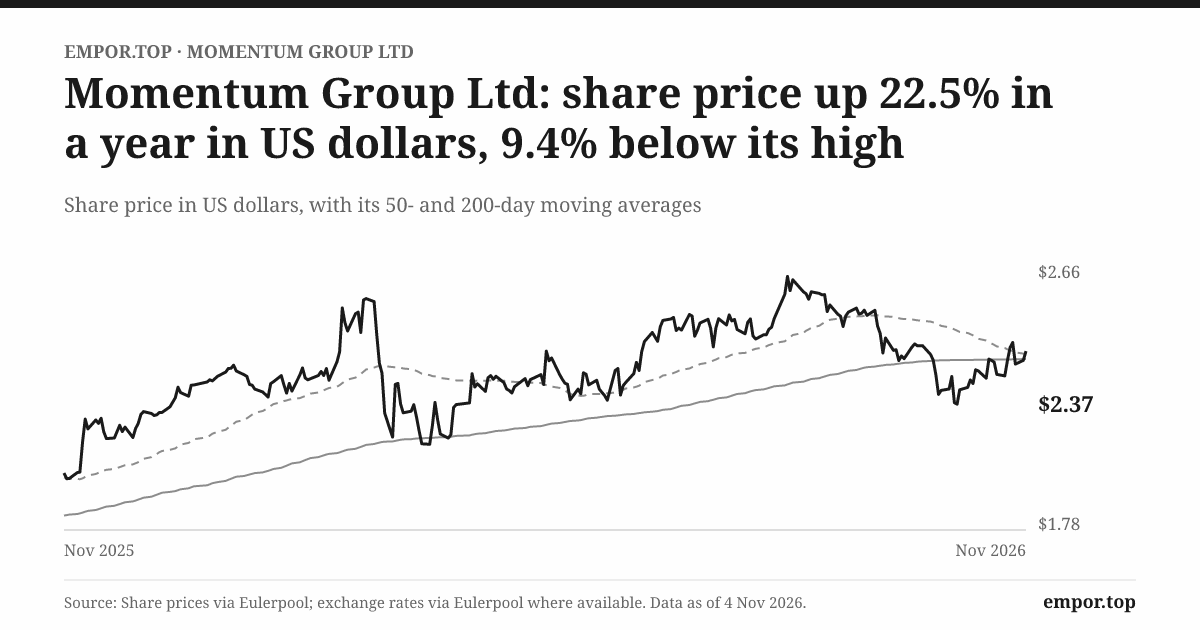
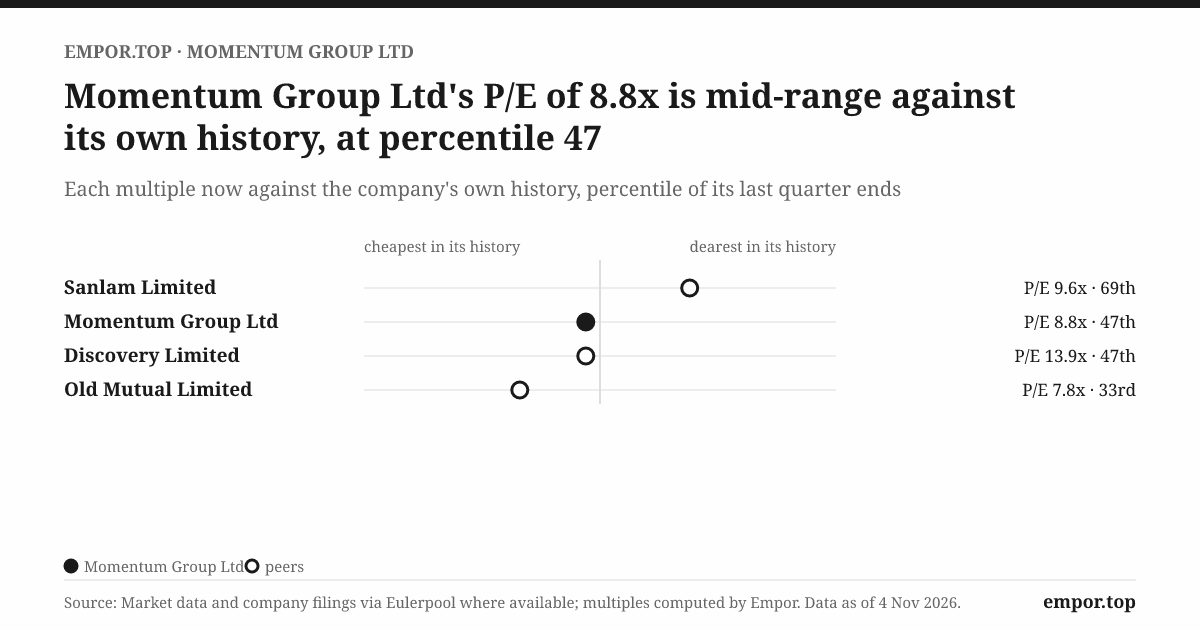
Only with that balance-sheet context does the valuation make sense. At early November 2026, the group's shares traded at about 8.8 times trailing earnings, below their own five-year median of about 12.3 times, and at about 1.5 times book value.3 Peers traded at a range of multiples: about 9.6 times for Sanlam, about 14.3 times for Discovery and about 24.4 times for OUTsurance, the short-term insurer.181920 On that comparison, the market prices Momentum at a discount to its own recent history and broadly in line with Sanlam, its closest large peer, while paying much more for Discovery's growth and OUTsurance's short-term insurance economics. What does that price assume? Most likely, that the 2026 earnings are near a cyclical peak, that market tailwinds will fade and that new-business margins will not improve much. It is context, not proof that the shares are mispriced. Insurance earnings definitions differ, and volatility makes simple multiple comparisons treacherous.
The resilience question can only be settled by the next stress. If MML's solvency cover holds well above Moody's thresholds through a sharp market fall while dividends and buybacks continue at a sensible pace, the group will have proven its balance sheet. If capital returns must be suspended to protect the buffer, as they effectively were in the pandemic years, the market's discount will have been justified. That uncertainty frames the investor's case in its sharpest form.
IX. The Investor's Case: A Broad Platform at a Discount—or a Hard Business to Read?
Lay out the evidence on a single table and the tension is obvious. On one side sit R7.06 billion of normalised headline earnings, a target hit a year early, net inflows of R20 billion and a share price below its own five-year valuation history. On the other side sit a 2024 target that was missed, new-business margins that range from strong to negative, and a capital buffer that moved slightly closer to the rating agency's red line. Both are true at once. The investment case depends on which set of facts will matter more over the next decade.
The bull case is straightforward. The group earns money from several different engines, so a weak year in one does not sink the whole. Its businesses operate under strict regulation, which raises the cost of entry for newcomers. It has specialist distribution among advisers and employers, a successful cell-captive platform in Guardrisk, and a management team that, the company says, turned around loss-making units and cut costs. Earnings have risen sharply, buybacks have shrunk the share count while the multiple sat below history, and the dividend yield is generous. If operating improvements continue and new-business margins recover, today's price may come to look undemanding.
The bear case is just as plain. The 2021 strategy missed its target. 2020 showed how violently earnings can fall when claims, lapses and markets turn together. New-business value varies widely by segment, and some of the largest volume businesses earn thin or negative margins on new sales. The group's earnings and investments are concentrated in South Africa, whose markets and economy dominate the outcome. And the evidence for durable client retention and pricing power, the hallmarks of a true moat, is limited because the company does not publish it.
Where the moat holds and where it thins
Michael Porter's five forces offer a useful way to test the structure of the industry. Rivalry among existing competitors is intense: Sanlam and Old Mutual are larger, Discovery has a differentiated model, Liberty and Hollard compete aggressively, and specialist administrators and asset managers fight on price. The threat of new entrants is moderate. Licences, capital requirements and regulatory complexity deter start-ups from writing long-term life business, but digital insurers, bank-owned insurers and low-cost platforms can enter specific products. Buyer power varies sharply by segment. Individual policyholders have little power on their own, but large employers, retirement funds and medical schemes run competitive tenders and can move mandates, which is exactly the force reflected in Momentum Corporate's negative new-business value. The power of suppliers, here mostly the advisers and brokers who control distribution, is significant, because independent advisers can choose among providers and must be paid commissions. And the threat of substitutes is real: passive investment platforms, bank savings products and direct-to-consumer insurance can replace parts of what the group sells.
Hamilton Helmer's 7 Powers framework narrows the question further: what, if anything, gives the group persistent differential returns? Scale economies exist in administration, where fixed systems and compliance costs are spread over millions of members, but Momentum is not the largest player, so its scale advantage over Sanlam and Old Mutual is limited. Switching costs are meaningful in employee-benefit and medical-scheme administration, where moving a fund means migrating members, records and contracts; the Bonitas win shows they can be overcome by a competitor, which cuts both ways.15 Cornered resource is arguably present in Guardrisk's licence, expertise and partner network in a niche where few rivals compete. Brand matters in retail life and investments, but South African customers recognise several strong insurance brands, so brand is a qualifier rather than a decisive edge. Network economies, counter-positioning and process power are hard to identify on the evidence available. The net reading is that the group has some genuine powers in specific niches, notably Guardrisk and benefit administration, but not a group-wide moat that would guarantee superior returns.
That conclusion should shape how the historical claims are judged. The claim that the group allocates capital well is narrowed by its own record: Guardrisk became a material contributor, but international expansion and software investments produced impairments, and the buybacks are too recent to judge.67 The claim that earnings growth reflects operating improvement rather than markets is supported by cost savings, turnarounds and continued growth after the rebound, but not proven, because market and assumption effects still contribute a substantial share.2 The claim that the group has a franchise that wins new business profitably is contradicted in parts of the corporate and investment businesses and supported in retail.2 None of these claims is rejected outright. Each is smaller and more conditional than a promotional version would suggest.
Three measures will do most of the work in settling the thesis. The first is normalised headline earnings excluding investment-market and assumption effects, the closest proxy for underlying operating profit; the latest result showed further growth, with management saying the operating share had risen.2 The second is segment value of new business and margin, which shows whether today's sales will become tomorrow's earnings; the 2026 results were mixed across segments.2 The third is MML's solvency cover, read alongside buyback and dividend decisions, which remains a key test.2
The balanced conclusion is that the platform has a credible answer to the question of why it should win: diversified earnings, regulated businesses, specialist niches and a team that has delivered after missing. But the evidence for pricing power and durable retention, the things that would make the discount look unjustified, is incomplete. The next operating results should decide how much confidence that answer deserves.
Stripped of the numbers, the story of this group teaches lessons that apply to any business whose product is a promise stretching decades into the future.
X. Lessons From a Business Built on Promises
Two scenes sit at opposite ends of this story's record. In November 2013, a newly merged insurer bought Guardrisk.86 And in 2024, the same group missed its public earnings target.1014 One was a bet that compounded. The other was a promise that fell short. Between them sit the lessons that belong to Momentum and no other company.
The first lesson comes from Guardrisk. What made the deal a success was not the announcement but the decade that followed: the business earned its place in the earnings engine while international ventures from the same era were written down. For investors, the implication is to judge acquisitions by what they contribute five and ten years later, not by the synergies promised in the press release, and to remember that the same management team that bought Guardrisk also signed off the ventures that ended in impairment notes.
The second lesson comes from the miss. What happened next is what matters. The group kept its explanations consistent, set a new target and reached it early. A target is a promise; the next year's explanation is part of the score. Investors who discounted the R5 billion target until it was met were right to; investors who wrote off management after the miss would have missed the recovery. The rational stance is to reward demonstrated operating contribution and to discount targets until they are delivered, which applies equally to whatever strategy management sets beyond 2027.
The third lesson comes from the annuity desk. The 2026 results showed why sales alone mislead: value of new business weakened in investments and was slightly negative in corporate. In insurance, the sale is the beginning of the economics, not the proof of them. A business that sells forty-year promises can always buy growth by underpricing risk or accepting thin margins; the bill arrives years later. That is why value of new business, not sales volume, is the number that should lead every discussion of this company's growth.
The fourth lesson comes from the balance sheet. The group returned billions to shareholders through buybacks while its main insurer's solvency cover edged down, though it remained above the regulatory minimum and Moody's downgrade threshold. Buybacks create value only when the promise book can still survive a bad year. In a bank or an insurer, capital returned is capital that cannot absorb the next shock, so every rand repurchased must be judged against the scenario in which the 2020 collapse repeats.
The fifth lesson is about scale itself. The 2010 merger delivered savings and scale, yet the group's returns remained mediocre until it fixed or sold underperforming units and concentrated on profitable new business. Scale, sales and a low multiple are not substitutes for underwriting discipline or profitable new business. In a business built on promises, being big makes you more visible, not more right.
Those lessons point toward a set of tests that are coming soon, in the group's next two sets of results.
XI. Epilogue: The Next Two Results
Tonight, in early November 2026, Momentum Group stands at a high-water mark. It has crossed the R7 billion earnings target a year early, completed its buyback programme, concluded turnarounds in two troubled businesses and won a major medical-scheme administration contract from a rival.215 Its share price had roughly doubled over three years before the results.15 Its chief executive has more time at the helm after the retirement age was raised, and she has said the group has already started formulating the strategy beyond 2027.15 Now the story enters the part where the record is written in real time.
The first moment arrives on 26 November 2026, at the annual general meeting.3 Shareholders will vote on a remuneration report in which executive-director pay rose by roughly a third in a year when earnings rose 13%. If dissent rises well above the roughly 12% recorded in 2025, the board will face harder questions about how incentives connect to value creation. If it falls, management will have won the argument that the pay reflects multi-year delivery. Either outcome will tell outsiders something about the relationship between the board and the institutions that own most of the shares.
The second moment is the 2027 interim results, likely in early 2027, followed by the full-year results around September 2027. Three things will matter most. The first is whether operating experience continues to contribute more to earnings than markets and assumption changes; a good result driven by equity markets would revive doubts that a good result driven by cost savings and claims experience would quiet. The second is whether Momentum Investments rebuilds its new-business margin, whether Momentum Corporate turns its value of new business positive and whether Metropolitan Life lifts its margin toward management's medium-term expectation. The third is MML's solvency cover, read alongside the decision on the next buyback and the dividend.
Each outcome has a clear meaning. If earnings grow again from a higher base, with new-business value rising across segments and solvency stable, the case that the group has become a durable operating franchise rather than a cyclical beneficiary of markets will strengthen materially. If earnings stall while sales keep rising, it will suggest the group has been buying growth at thin margins. And if a market shock arrives and solvency falls toward Moody's thresholds, the buyback decisions of 2025 and 2026 will be judged in a far harsher light.
There is also the strategy itself. Management will set a new target beyond 2027. History suggests investors should hear it with the R5 billion miss and the R7 billion beat both in mind, and should ask, before the next number is announced, how much of it relies on markets.
The four opening questions now have measurable tests. Whether the merger created durable advantages will be answered by retention and new-business value in the segments that depend on scale and distribution. Whether sales are becoming profitable future earnings will be answered by VNB margins. Whether management keeps delivering will be answered by the next target and the next AGM. Whether capital returns are fair and prudent will be answered by solvency through the next downturn. None of those answers is available tonight. That is exactly why the story remains open.
XII. Outro: The Promise That Has to Be Kept
Go back to the winter of 2020, when earnings fell by half. Six years later, the same group reported record earnings of R7.06 billion and beat its target a year early. Its share price had been rewarded for the recovery.
The numbers recovered. That is what everyone will remember. But Momentum Group is a business that sells promises measured in decades while its own earnings move through cycles measured in months. Its real test was never whether it could report a record year in a rising market. It is whether every funeral policy, annuity and pension it has written can still be honoured, profitably, after the next bad one. That is the promise that has to be kept, and it will be kept, or not, long after this year's record has been forgotten.
References
-
Momentum Metropolitan Integrated Report, FY2020 — Momentum Metropolitan, 2020 ↩↩
-
Operating Update and Summarised Annual Financial Statements, FY2026 — Momentum Group, 2026-09-17 ↩↩↩↩↩↩↩↩↩↩↩↩↩↩↩↩↩↩↩↩↩↩
-
Momentum Group Annual Financial Statements, FY2026 — Momentum Group, 2026-09-17 ↩↩↩↩↩↩↩↩↩↩↩↩↩↩↩↩↩↩↩↩↩↩↩↩↩↩↩↩↩↩↩↩↩↩↩↩↩↩↩↩↩↩↩↩↩
-
Credit Opinion: Momentum Metropolitan Life Limited — Moody's Ratings, 2026-06-05 ↩↩↩↩↩↩↩↩
-
Eleven years later, how far has the Momentum-Metropolitan merger come? — News24, 2021-05-05 ↩
-
MMI Holdings acquires Guardrisk, FY2014 results — Sharenet SENS, 2014-09-10 ↩↩↩↩
-
Integrated Report, FY2018 — Momentum Metropolitan, 2018 ↩↩↩↩↩
-
Alexander Forbes and MMI Holdings Announce Guardrisk Transaction — Sharenet SENS, 2013-11-04 ↩↩↩
-
MMI buys Guardrisk to diversify business — Business Day, 2013-11-04 ↩
-
Financial Results Announcement, FY2025 — Momentum Group, 2025-09-17 ↩↩↩↩↩↩↩↩↩
-
Momentum Metropolitan acquires RMI Investment Managers — Momentum Group, 2023-09-12 ↩↩
-
Momentum Metropolitan and Investments Managers Group merger decision — Competition Tribunal of South Africa, 2024-01-23 ↩
-
Momentum revises targets as earnings halve, names new chairperson — News24, 2020-09-09 ↩↩
-
Momentum Metropolitan Integrated Report, FY2021 — Momentum Metropolitan, 2021 ↩↩↩↩
-
Momentum boss gets more time at helm as group hikes retirement age — TimesLIVE, 2026-09-26 ↩↩↩↩↩↩↩↩↩↩↩↩↩↩↩↩↩↩↩↩
-
Results of the Annual General Meeting — Momentum Group, 2025-11-21 ↩↩
-
Momentum Group Limited Remuneration Report 2024 — Momentum Group, 2024 ↩
-
OUTsurance Group Quote and Valuation — Stock Analysis, 2026-11-04 ↩
 LinkedIn
 WhatsApp
 Reddit
 Hacker News
 Email
 Kindle
 RSS Feed
 Spotify
 Apple Podcasts
 Amazon Music
 Audible
 YouTube