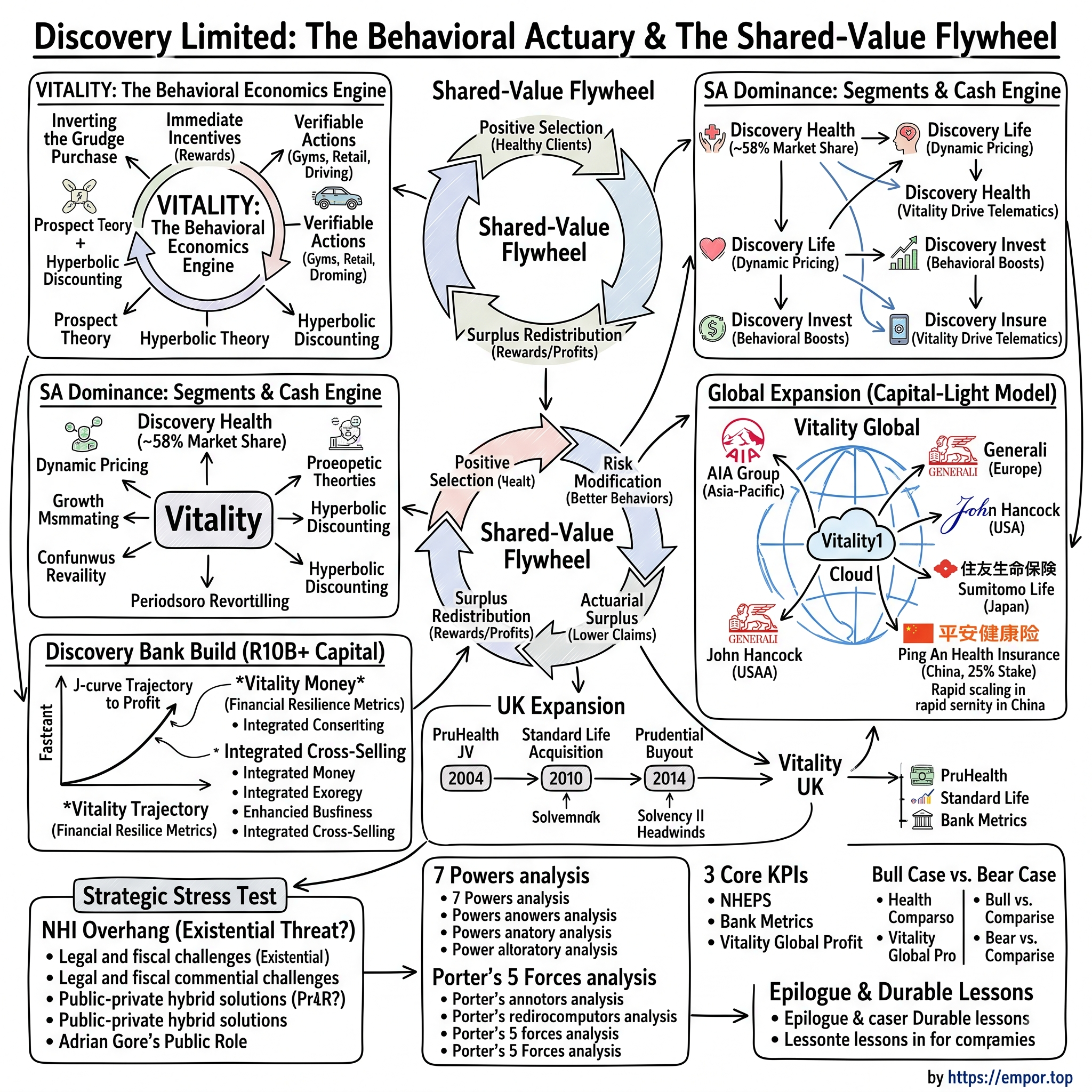
Discovery Limited: The Behavioral Actuary & The Shared-Value Flywheel
I. Introduction & The Discovery Paradox
In March 1992, a 28-year-old actuary walked out of Liberty Life's Johannesburg offices carrying almost nothing: no book of business, no distribution network, no brand, and no clients. What Adrian Gore did have was a R10 million cheque from the partners at Rand Merchant Bank and a borrowed desk in their building.1 The concept he pitched was not a conventional product. It was a structural objection to how the insurance industry had operated for three centuries.
The critique was straightforward. In a traditional insurance contract, the insurer and the policyholder are adversaries by design: the customer wants to claim, while the insurer profits by containing payouts.
Worse, risk is assessed once at policy inception and locked into an actuarial price for decades. Yet the individual attached to that policy makes thousands of daily lifestyle decisions that alter their mortality and morbidity risk. Because the initial price is fixed, the insurer has little economic incentive to intervene, while the customer has no financial motive to change.
Both parties simply wait. It is, in the most literal sense, a business model premised on inactivity.
Thirty-four years later, that critique has evolved into a diversified financial services group whose scale spans three distinct populations: approximately 6.5 million covered lives in South Africa, 11.2 million across the broader Vitality network, and another 34.1 million lives through a minority-owned Chinese health insurance venture.2 For the six months ended 31 December 2025, the group reported normalised profit from operations of R8,891 million, up 24%, alongside normalised headline earnings of R5,745 million.2 Trading near R259 per share in mid-August 2026, the company carried a market capitalisation of roughly R173 billion.3
The core thesis is worth stating directly and evaluating throughout this analysis. Discovery is not merely an insurance conglomerate that bundles a wellness programme. It operates an actuarial model designed to monetise three distinct levers: selection (healthier individuals self-select into the platform), behaviour change (active members file fewer claims), and retention (engaged policyholders lapse less frequently, keeping lower-risk lives in the pool). Management frames this as an equation—dynamic pricing, plus behaviour change, plus optimised retention, minus incentive costs, multiplied by scale—and terms the resulting surplus "alpha."4 According to company disclosures, engaged Gold and Diamond members at Discovery Insure experience road fatality rates 74% lower than unengaged peers, while engaged policyholders at Discovery Life record mortality rates roughly 35% better than actuarial baselines.4
Those figures represent substantial claims that warrant scrutiny. In practice, separating adverse selection from true behavioural causation is notoriously difficult: a consumer who purchases a gym-linked policy and tracks workouts was likely healthier than average from the outset.
Discovery's near-term underwriting economics do not strictly require resolving this distinction—a healthier risk pool lowers claims regardless of the root cause. However, the long-term durability of its competitive advantage depends on which mechanism drives the results. Favourable selection can be matched or eroded by competitors; a proprietary, 30-year behavioural dataset is far more difficult to replicate.
The strategic stakes are highlighted by three immediate tensions. In its home market, Discovery Health administers the country's dominant open medical scheme while the National Health Insurance Act—signed into law in May 2024—continues to create structural regulatory uncertainty. Financially, Discovery Bank has transitioned from a decade-long capital build into profitability, with management setting specific targets for its scaling phase. Internationally, the asset-light licensing business that was intended to provide capital-efficient global expansion missed its intermediate targets in the latest reporting period.
Underpinning these dynamics is management's view that four structural shifts favor its model: that risk is dynamic and behavioural rather than static; that standard clinical pathways designed for average patients underperform in up to 40% of cases due to biological variation; that artificial intelligence is compressing administrative cost structures faster than legacy insurers can adjust; and that roughly 97% of health data remains unmonetised even as about 35% of adults in developed markets wear connected devices.4 While each trend aligns with Discovery's operating model, they represent strategic hypotheses to be evaluated against operational delivery rather than foregone conclusions.
To reflect this structure, Discovery reorganised its operations into two primary reporting divisions: Discovery South Africa, comprising the five domestic product lines, and Vitality, housing the international partnerships and platforms.4 Both operate on the same behavioural analytics engine and are evaluated against distinct, published annual earnings growth corridors through FY29: 12.5% to 17.5% for the South African business, and 20% to 30% for Vitality.4 That framework offers the clearest structure for assessing the group's performance.
The company's trajectory, however, began with an initial challenge to how private healthcare cover should be structured and priced.
 Subscribe on LinkedIn
II. Actuarial Rebellion: Adrian Gore, Laurie Dippenaar, & The Birth of Discovery (1992–1998)
South African private healthcare in the early 1990s suffered from a structural design flaw.
Traditional medical schemes funded routine out-of-hospital expenses—general practitioner visits, prescription drugs, and physiotherapy—from a collective risk pool. Because individual policyholders bore no marginal cost for each consultation and fee-for-service practitioners had no financial incentive to curtail visits, claim volumes climbed steadily.
As claims escalated, schemes raised member contributions to cover deficits. Healthier members exited the pool rather than subsidise escalating costs, leaving behind a sicker, more expensive demographic. Actuaries refer to this dynamic as an adverse selection death spiral; policyholders experienced it simply as double-digit medical inflation.
Adrian Gore, who graduated from the University of the Witwatersrand in 1986 and qualified as a Fellow of both the Actuarial Society of South Africa and the Faculty of Actuaries in Edinburgh, observed this cycle firsthand while working in pricing at Liberty Life.5 Alongside co-founder Barry Swartzberg—a fellow actuary who would spend the next three decades expanding the group's global footprint and who serves as an executive director and CEO of Vitality Group—Gore proposed restructuring the underlying product architecture rather than merely repricing existing benefits.6
The concept was pitched to Rand Merchant Bank co-founder Laurie Dippenaar and his leadership team. RMB operated with an entrepreneurial mandate, backing founder-led ventures and accepting minority equity stakes in unconventional models. The R10 million commitment in 1992 was modest for the banking group, but it provided the capital necessary to operationalise the concept.1
The macroeconomic backdrop was fraught. In 1992, South Africa was undergoing a volatile political transition characterised by constitutional negotiations, the lifting of international sanctions, capital outflows, and regulatory uncertainty across healthcare. Launching a private health venture under those conditions carried significant operational risk, yet Gore focused on the structural durability of the underlying consumer problem rather than cyclical timing—a strategic perspective that would characterise the group's subsequent capital deployment decisions.
The core structural innovation was the Medical Savings Account (MSA). The model bifurcated the product into two distinct financial mechanisms.
Catastrophic events, such as major hospitalisations, remained within a collective risk-pooling fund. Meanwhile, routine day-to-day healthcare expenses were shifted into an individual, member-owned savings account where unspent balances accrued directly to the policyholder.
By assigning the marginal cost of routine consultations to the consumer, the MSA altered consumer behaviour without requiring administrative claim denials or fee compression on healthcare providers. This shift in decision-making responsibility became the operational blueprint that Discovery subsequently applied to life assurance, short-term motor insurance, and retail banking.
The structure also created an underwriting advantage crucial for a new entrant without an existing risk pool. By isolating catastrophic cover from discretionary spending, Discovery could quote lower headline premiums. This pricing model disproportionately attracted younger, healthier consumers who expected minimal day-to-day healthcare utilisation. In effect, the savings account operated as a self-selection filter, insulating the fledgling scheme from high-risk, high-cost claimants in the broader market.
Discovery Health launched in 1993, expanding rapidly enough that Ernst & Young named Gore South Africa's Best Entrepreneur in 1998.5 The group introduced the Vitality behavioural programme in 1997 and completed its initial public offering on the Johannesburg Stock Exchange in 1999.1 Discovery Life launched in 2000 to apply behavioural underwriting to long-term risk, followed in 2004 by the Discovery Card joint venture with FirstRand subsidiary First National Bank (FNB)—a partnership that established Discovery's credit card footprint but later created strategic friction.1
The corporate architecture evolved alongside product development. Incubation within the RMB Holdings orbit provided foundational capital and institutional credibility, but tied the business to a major banking conglomerate. The eventual unbundling of that shareholding enabled Discovery to operate as an independent entity. This autonomy proved essential for its subsequent strategy, allowing the group to launch an independent digital retail bank in competition with FNB, allocate capital to the United Kingdom, and acquire an equity stake in a Chinese health insurer—initiatives that would have conflicted with an anchor banking shareholder.
This formative period established an operating pattern that persisted across subsequent business lines: identify misaligned incentives in a financial product, redesign the pricing mechanism around consumer behaviour, and absorb multi-year capital investment cycles while the risk pool matures. While this methodology drove product differentiation, it also required shareholders to finance extended J-curves with long payback horizons.
The foundational savings mechanism, however, was only the first component. The next step was transforming an administrative savings account into an active behavioural platform.
III. The Invention of Vitality: Engineering the Shared-Value Machine (1997–2005)
The behavioural insight underpinning Vitality draws on research documented by Amos Tversky and Daniel Kahneman: humans discount future outcomes steeply and inconsistently. A preventive screening at age 50 materially improves long-term health outcomes at age 70, but the immediate friction and discomfort are certain, while the clinical benefit is distant and probabilistic. Consequently, many individuals forgo preventive care not after a deliberate cost-benefit analysis, but because human cognitive discounting inherently undervalues long-term payoffs.
Traditional insurance responds by pricing that inaction into underwriting tables: policyholders with higher lifestyle risks simply pay higher premiums. Vitality's approach was to counter the discount rate directly. If consumers fail to act for a benefit decades away, the programme provides an immediate, tangible reward within days: a cinema ticket, a smoothie, a discounted flight, or grocery cashback. By making incentives frequent, immediate, and modest in unit cost, the model encourages ongoing engagement, with long-term clinical improvements accumulating as an operational byproduct.
From an underwriting perspective, the primary value lies in what those incentives generate for the insurer. Group disclosures disaggregate that value into four components: dynamic pricing (adjusting premiums per unit of risk based on ongoing behaviour rather than a static baseline at inception), behaviour change (lower claims resulting from healthier lifestyle habits), optimised retention (a structural shift in the policyholder mix, as healthier lives lapse at lower rates), and the offsetting cost of shared-value incentives, with the net surplus scaled by policy volume.4
The operational impact of this mechanism is best understood through a comparative scenario. Consider two insurers starting with identical policy books. The first insurer prices risk once at policy inception and remains passive. The second continuously tracks member behaviour, charges incrementally less to individuals whose habits improve, funds rewards for active participants, and benefits from the fact that engaged, healthier members are the ones who consistently retain their policies.
Two decades later, the passive insurer's book reflects the original cohort, merely aged. The dynamic insurer's book retains a disproportionate concentration of the healthier segment of that population. The resulting difference in claims experience is substantial, driven less by any single individual's incremental exercise than by structural portfolio sorting over time.
To operationalise this sorting, Vitality introduced a tiered status hierarchy—spanning Blue, Bronze, Silver, Gold, and Diamond in South Africa, and Bronze through Platinum in the UK. Members advance through verified health actions, such as gym attendance, clinical screenings, step counts, and sleep tracking. Tier status dictates the magnitude of consumer rewards and, across several product lines, dynamic premium discounts. Unusually for the sector, Discovery publishes operating metrics segmented by these status tiers, allowing analysts to observe engagement and lapse differentials across the book.
Verification is the critical mechanism separating the platform from standard loyalty schemes. To make behavioural data actuarially actionable, activities must be objectively recorded rather than self-reported. Gym turnstiles log attendance, pathology laboratories report biometric results, smartwatches transmit heart rates, and vehicle telematics record driving telemetry. By eliminating self-reporting bias, this data can be integrated directly into dynamic pricing algorithms. In support of the mechanism, Discovery cites an independent study by the RAND Corporation, which documented a 34% to 40% activity increase among members who combined an Apple Watch with Vitality incentives.4
Commercially, Discovery avoids paying retail prices for these rewards. Gym chains offer deep wholesale discounts in exchange for consistent foot traffic and insurer-subsidised memberships. Airlines offer distressed inventory to fill marginal seats, and grocery retailers provide cashback to capture proprietary basket data and drive category spend. Because ecosystem partners capture commercial value from member volume, they effectively co-fund the behavioural incentives, protecting Discovery's underwriting margins from bearing the full economic cost of the rewards.
Management's disclosures on its UK life portfolio illustrate the scale of the claimed underwriting advantages. Discovery states that its shared-value design generates 24% to 53% more premium per unit of risk, that policies linked to its Optimiser feature record 18% lower claim rates, and that after 20 years the book demonstrates 47% lower lapse rates and 75% more healthy lives remaining compared to standard mortality tables, with average policyholders capturing rewards equal to 30% to 59% of premiums over their first three years.4 In total, the group attributes an approximate 110% uplift in the present value of new business to the shared-value model relative to traditional term life products.4
These claims require three analytical caveats. First, the portfolio metrics represent internal cohort analyses evaluated across defined, multi-year windows that are not independently audited. Second, behavioural modification and retention sorting remain heavily intertwined: if healthier individuals selectively remain while higher-risk lives lapse, aggregate loss ratios improve even in the absence of broad lifestyle changes across the base. Third, providing early-year incentives worth up to 59% of premium represents a substantial upfront capital commitment, viable only if the group's assumption of high price elasticity—which Discovery estimates at greater than 5x—consistently delivers sufficient new business volume.4 Any softening in consumer price elasticity would convert that incentive expenditure into an unrecovered margin drag.
The most substantive institutional validation comes from global reinsurance arrangements. Discovery has established partnerships with international reinsurers—including SCOR, Hannover Re, Swiss Re, and Pacific Life Re—that embed Vitality rating factors into their treaty pricing, offering upfront selection discounts and automatically expanding discounts as the physical activity profile of the underlying policyholder pool improves.4 Because reinsurers commit institutional balance-sheet capital against those behavioural metrics, these agreements provide external underwriting backing for the risk differential, even if underlying behavioural causation remains difficult to isolate from selection effects.
On the consumer side, the ecosystem encompasses device manufacturers such as Apple, Garmin, Fitbit, Oura, Polar, Samsung, Suunto, and Huawei; physical activity partners including Virgin Active, PureGym, and parkrun; and lifestyle and travel partners including Expedia, IHG, and Emirates.4 These commercial alliances provide partners with member traffic and behavioural data, while giving Discovery verified risk signals and co-funded incentives.
By the late 1990s and early 2000s, this behavioural infrastructure provided a scalable operating architecture: a shared analytics and incentive chassis capable of integrating across medical schemes, life assurance, motor insurance, and banking. That shared engine transformed what began as a niche healthcare administrator into an integrated financial services group.
IV. South African Dominance: Segments, Scale, and Cash Generation
From an operational perspective, Discovery's Sandton headquarters reflects a platform model rather than a traditional insurer, anchoring five domestic product lines to a unified behavioural engine. In the six months ended 31 December 2025, Discovery South Africa generated R6,775 million in normalised operating profit, an increase of 19% that ran ahead of management's target annual growth corridor of 12.5% to 17.5% through FY29.4
Discovery Health serves as the group's domestic annuity engine, though its business model is frequently misunderstood. Discovery Health does not underwrite risk. Instead, it administers medical schemes—principally the Discovery Health Medical Scheme (DHMS), a separate, non-profit entity owned by its members and governed by an independent board of trustees, alongside several restricted corporate schemes. Discovery Health earns administration and managed-care fees without carrying medical claims risk on its balance sheet. Total lives under administration reached 3.86 million, with non-scheme products—including gap cover, Flexicare, and commercial health insurance—growing 20% to exceed 305,000 lives.4 Segment normalised operating profit rose 5% to R2,128 million, a figure that included a R125 million concession.4
The operational performance of DHMS demonstrates both the scale of the franchise and its structural growth limits. As of 31 December 2025, DHMS covered 2,725,122 beneficiaries, representing a 57.7% share of the open medical scheme market—down fractionally from the prior year, reflecting a mature market where scale is primarily defended rather than expanded.7 For the period, the scheme reported insurance revenue of R86,653 million, paid R75 billion in risk claims, and generated an insurance service surplus of R565 million compared to a R350 million deficit in the prior year.7 Its solvency ratio stood at 32.58%, comfortably above the 25% statutory minimum, backed by projected reserves of approximately R33.1 billion.74
Pricing dynamics illustrate the competitive gap between DHMS and the broader industry. DHMS increased weighted contributions by 5.4% for 2026, compared to an average of roughly 10.1% across the next seven largest open schemes, while deferring the implementation of that increase to 1 April 2026—a decision the scheme calculated saved members R1.5 billion collectively.47 Discovery stated that this pricing structure delivered a 17.7% lower cost per unit of benefit relative to competitors.4 The scheme's annual lapse rate held at 5.5%, with 96% of members making no change to their coverage plans.4
This pricing power reflects both an underwriting advantage and a structural earnings constraint. DHMS prices below competitors because its risk pool is younger and healthier, while its administration costs benefit from unmatched scale. However, because DHMS is a non-profit, member-owned entity, efficiency gains are returned to policyholders through lower contribution increases rather than converted into underwriting profits for Discovery Limited shareholders. As an administrator, Discovery Health's earnings depend directly on membership volume rather than underwriting margins.
Consequently, product design focused on attracting new lives remains essential to driving fee growth. The scheme's Active Smart plan quadrupled its membership between January and December 2025; enrolled members were on average 6.4 years younger than the wider DHMS population and recorded a 60% lower chronic disease incidence.4 This dynamic highlights active demographic sorting, reinforcing the risk pool with lower-cost members.
However, operational execution requires ongoing administrative oversight. In its annual disclosures, the scheme reported that a claims processing error affected certain policyholders on its Priority, Comprehensive, and Executive plans in late 2025; Discovery Health absorbed the financial cost of the overpaid claims, and an internal root-cause investigation was initiated.7 The scheme also acknowledged service disruptions during 2025 for members managing severe health conditions.7 Deloitte issued an unqualified audit opinion on the scheme's financial statements on 30 April 2026.7 While these issues were contained, the administrator's absorption of processing expenses underscores that fee-based contracts remain exposed to operational risk even in the absence of underwriting exposure.
To deepen member engagement, Discovery introduced Personal Health Pathways, an initiative that provides personalised clinical recommendations funded through a dedicated benefit allocation. By late February 2026, the programme had registered 575,000 activated lives, 887,000 completed clinical actions, and 5.2 million completed exercise milestones, with 67% of all actions completed by policyholders living with chronic conditions.4 Preventative screening completion rates ranged between 1.39 and 2.10 times those of non-participating members across various assessments, with influenza vaccinations and diabetic foot screenings recording the highest uptake and prostate screenings the lowest.4 The scheme reported funding more than R269 million in outpatient claims through the benefit in 2025.7 While verifying whether these interventions permanently reduce downstream hospitalisation costs will require longitudinal claims data, the initial metrics demonstrate substantial early engagement.
Discovery Life increased normalised operating profit by 15% to R3,093 million, with the individual life segment expanding 6%.4 Within its embedded value reporting, the value of new business (VNB) margin on individual life improved from 3.8% to 5.5% over the six-month period, lifting the internal rate of return on new business to the risk-free rate plus 8%—meeting the group's explicit investment hurdle.4 Total positive operating variances reached R1,080 million.4 In the underwritten retail risk market, Discovery maintained an estimated market share roughly 2.4 times the average of the next five largest life insurers.4
However, the life division also reveals consumer vulnerability to economic pressure. Policy alterations—where customers reduce benefits or restructure coverage rather than lapsing entirely—generated a persistent negative experience variance, prompting management to phase in operational interventions that it noted would require time to neutralise the drag.4 Conversely, mortality claims for highly engaged Gold and Diamond policyholders tracked roughly 35% better than actuarial baselines, while Bronze and Silver members recorded a 20% improvement, keeping overall long-term claims at 93% of expectations.4 These divergent results highlight that while behavioural risk selection consistently lowers mortality claims, economic headwinds continue to pressure premium retention through policy downgrades.
Evaluating Discovery Life's performance also requires understanding the impact of IFRS 17 accounting standards. Under IFRS 17, expected future profits from long-term policies are deferred into a Contractual Service Margin (CSM) and recognized gradually over the coverage period. Discovery defines its store of value as the CSM plus the risk adjustment, net of the insurance finance reserve. This balance expanded from R23,251 million in June 2025 to R34,084 million by December 2025, an increase of roughly 47%.4 However, analysis of the movement shows that R7,395 million of the total R11,529 million increase was recognized through other comprehensive income, driven by market interest rate movements revaluing long-duration liabilities, compared to R1,046 million generated directly from new business underwriting.4
A parallel dynamic appeared in embedded value reporting. Discovery Life's embedded value increased from R52,164 million to R58,968 million, representing an annualized return on embedded value of 31.3%; excluding economic assumption adjustments, the underlying operational return was 14.1%.4 This 17.2-percentage-point differential underscores that a substantial portion of the division's reported headline value expansion in late 2025 reflected prevailing macroeconomic interest rate cycles rather than purely operational underwriting gains.
Discovery Invest represents the group's asset management and investment platform, operating in an environment characterized by ongoing industry fee pressure. Segment normalised profit grew 1% to R984 million—or 21% when adjusting for prior one-off items—while assets under administration expanded 20% to R200 billion.4 The divergence between 20% asset growth and 1% headline operating profit growth reflects ongoing fee compression across retail investment platforms.
Discovery Insure, established in 2011 to apply telematics and dynamic behavioural pricing to short-term personal lines, delivered strong underwriting expansion. Normalised operating profit increased 34% to R546 million on insurance revenue of R3,207 million, lifting the operating margin to 15.2% against a long-term target of approximately 10%.4 The loss ratio across the full portfolio has declined 29% since the first half of 2022, while the new business loss ratio fell 28%.4 Risk characteristics improve as policy duration increases, with the portfolio shifting toward Gold and Diamond tiers over time; telematics data indicates that accident frequency for a Diamond policyholder in their fifth policy year is 71% lower than that of a newly enrolled Blue member.4 However, gross new business contracted 2%, indicating that management prioritized underwriting margin discipline over volume expansion during a hardening commercial cycle.4
Across all five domestic divisions, Discovery South Africa converted 71% of its in-force cash generation into R4.6 billion in operating cash flow, exceeding the group's targeted conversion range of 60% to 70%.4 This domestic cash flow provides the internal funding engine supporting Discovery's primary strategic capital allocations: the expansion of its international Vitality network and the development of Discovery Bank.
V. Going Global Without Underwriting Risk: Vitality Global & The Ping An Bet
Financial services history contains numerous examples of emerging-market insurers attempting global expansion through direct cross-border acquisitions. The typical pitfalls are well-documented: paying a control premium for an unfamiliar book of business, operating under an unmastered regulatory regime, underwriting in foreign currencies, and leaving capital trapped offshore for years.
Discovery’s approach was to export its algorithmic architecture rather than its balance sheet. Under this model, the group licenses the Vitality platform—including its behavioural mechanics, incentive design, actuarial tables, and partner network—to established tier-one insurers in territories where Discovery chooses not to compete directly. The partner insurer assumes underwriting risk, while Discovery collects a fee. In theory, this grafts high-margin software economics onto a proprietary insurance intellectual property asset.
In practice, for the six months ended 31 December 2025, this licensing arm was the division that fell short of financial targets.
Vitality Network—the pure licensing business—reported a 46% decline in normalised operating profit to US$10.2 million on revenue down 12% to US$48 million, missing internal targets of roughly 15% revenue growth and an operating margin near 50%; actual operating margin landed at 21%.4 Adjusting for what management categorized as macroeconomic impacts, the company presented profit as up 7% and revenue up 2%—a materially different picture that reflects management’s own adjustments.4 Underlying operational activity proved more resilient: integrated annualised premium income written by partner insurers grew 13% to US$1,026 million, while partner membership expanded 11% to 6.9 million lives.4
Two factors accounted for the divergence between operational volume and reported revenue. The first was a structural contract renegotiation with Sumitomo Life in Japan. Discovery rebased commercial terms so that Vitality Group earns a fixed proportion of gross written premium, aiming for a more predictable revenue baseline as both partners committed to expanding the Japanese member base to five million lives by 2030.4 However, this restructuring generated a long-dated, yen-denominated receivable carried at US$62 million as of December 2025—a carrying value that declined 9% over the half-year as the yen weakened against the US dollar and Japanese risk-free benchmark yields rose 63 basis points, evaluated at a discount rate of the risk-free rate plus 10%.4 Consequently, a long-term commercial repositioning translated into an immediate accounting headwind, highlighting a persistent currency and interest rate exposure: fixed future revenue streams remain vulnerable to fluctuations in the yen and Japanese sovereign yields.
The second driver was more consequential. The Generali partnership ended. Discovery characterized the termination as an amicable exit that opened up the broader European market, stating that it is actively developing a new carrier network across the continent supported by the rollout of Vitality AI.4 That framing warrants critical assessment. Generali and Vitality Group had publicly extended their partnership through 2028 in 2021, operating Generali Vitality across Germany, France, Austria, and Spain.8 Terminating a flagship regional partnership several years ahead of schedule and reframing the departure as an expansion opportunity represents a narrative pivot that warrants caution until replacement carriers are formally contracted. Continental Europe currently represents an open territory rather than a committed revenue pipeline.
Myth versus reality. The conventional narrative surrounding Vitality Global frames it as a high-margin, capital-light software annuity.
Disclosures reveal a more nuanced reality. Segment revenue is denominated in foreign currencies, discounted across long durations, and concentrated among a small group of large institutional counterparties whose corporate priorities may diverge over time. When a single major partner exits, the segment's revenue foundation shifts.
This structure introduces partner concentration risk beneath a software-as-a-service label. While unit economics remain attractive when contracts persist, the software analogy overstates customer stickiness. Enterprise software is deeply integrated into operational workflows, making replacement costly and disruptive; an outsourced wellness layer attached to an insurance policy is a commercial arrangement subject to termination at renewal.
The surviving partnerships, however, demonstrated continued expansion. Integrated annualised premium income rose 23% at John Hancock in the United States and 10% at AIA across the Asia-Pacific region, while integrated insurance premium at Sumitomo Life in Japan grew 14%.4 Discovery is co-investing with AIA to accelerate the deployment of shared-value products and Vitality AI across key Asian markets, while positioning North America—the world's largest life insurance market—as its primary expansion frontier alongside John Hancock and other non-competing carriers.4
The China position is structurally distinct because Discovery holds an equity stake rather than operating a pure licensing agreement. The group acquired a 20% interest in Ping An Health Insurance—a subsidiary of Ping An Insurance Group—in 2010, subsequently agreeing in 2013 to increase its holding to 24.99%, a transaction completed in 2014.9 Financial returns have compounded significantly. In the half-year to December 2025, Ping An Health Insurance grew pre-tax operating profit 59% to RMB1.4 billion, yielding a RMB361 million contribution to Discovery; the group's after-tax operating result from the venture increased 38% to RMB235 million.4 Licensed earned premium grew 15% to RMB9.5 billion, and covered lives expanded 17% to 34.1 million.4 Ping An Health's net profit margin reached 12% to 13%, outperforming the low-single-digit margins reported by domestic peers such as PICC, CPIC, and Fosun.4
The operational risk in China relates primarily to distribution rather than geopolitical factors. Ping An Health is actively transitioning away from exclusive reliance on Ping An Life's tied agency force toward proprietary digital channels: direct online new business grew 159% year-on-year, while the SuiShenYi digital health platform—designated as the venture's long-term growth engine—expanded 60%.4 Rebuilding a distribution infrastructure during rapid growth presents operational hurdles, and a meaningful portion of the period's profit growth stemmed from investment returns and capital gains rather than pure underwriting margin expansion.4 While underlying volume growth remains robust, the headline profit figure reflects favorable investment conditions.
The final component is Vitality Health International, where Discovery directly manages health underwriting and clinical services outside South Africa. In the United States, its acquisition of WellSpark brought an existing contract with EmblemHealth, transitioned more than one million members onto the Vitality AI platform, and supported the addition of 2.5 million members from January 2026 across regional health plans including Medical Mutual of Ohio, MVP Health Care, and BlueCross BlueShield affiliates.4 Management is targeting US operational break-even in FY27 and reported that execution remains on track.4 Amplify Health, the digital health joint venture established with AIA in Asia, is deploying an integrated technology package with multi-year value-sharing arrangements across four markets, securing three regional industry awards for health technology services during the period.4 Neither business has yet achieved profitability, representing long-term strategic optionality rather than established earnings engines.
The strategic evolution of the US operation also alters Discovery’s risk profile. Rather than licensing a wellness layer to life insurers, the business is selling engagement and clinical management tools directly to health plans—institutions whose operating economics are governed by medical loss ratios and who evaluate vendor contracts based on demonstrable short-term reductions in healthcare claims over annual or biennial renewal cycles. This represents a more demanding, evidence-intensive sales cycle than life insurance partnerships. Furthermore, it takes place in a US healthcare environment that experienced its weakest relative quarterly equity performance against the S&P 500 in recent history during the second quarter of 2025, alongside regulatory shifts in public health and vaccination policy.4 While institutional cost pressure can accelerate health plans' adoption of clinical engagement platforms, it also risks compressing vendor pricing, potentially delaying the targeted FY27 break-even date.
Across the broader segment, Vitality Health International (excluding Ping An) reduced its operating loss to R16 million—an 89% improvement that reflects progression toward operational scale.4 Crucially for capital allocation, these losses remain modest and declining, contrasting with the substantial multi-year cash absorption experienced during the development phase of Discovery Bank.
For all the strategic elegance of the asset-light licensing model, the United Kingdom represents the international market where Discovery deployed direct balance-sheet capital—and where financial performance has faced its sharpest volatility.
VI. The UK Expansion: M&A, Consolidation, and Solvency II Headwinds
The United Kingdom in 2004 presented an unpromising market for private health cover. The National Health Service was free at the point of delivery and politically entrenched, while private medical insurance functioned primarily as an employment benefit purchased by human resources departments on price and renewed by brokers through inertia. The market was not visibly demanding a South African wellness programme.
Discovery entered through a joint venture with Prudential plc under the PruHealth brand, followed by PruProtect in life and protection.1 The entry strategy was deliberately incremental: establishing a minority-risk position alongside an established domestic brand rather than attempting a large-scale acquisition. Scale followed in 2010, when the venture acquired Standard Life's healthcare division for £138 million, lifting Discovery's economic interest to 75% and securing in a single transaction the corporate broker distribution network that the business had struggled to build organically.1011
Full consolidation occurred on 10 November 2014, when Discovery agreed to acquire Prudential's remaining 25% stake in Prudential Health Holdings for £155 million in cash, securing complete ownership of the underlying UK insurance entities and consolidating both operations under the Vitality brand.11 The transaction announcement set out a five-year target of reaching £1 billion in earned premiums and £200 million in new business.11
From a capital allocation perspective, the UK expansion demonstrated disciplined sequencing. Rather than bidding for a major listed insurer, Discovery initiated a minority stake, tested the operational model over six years, added distribution scale through a corporate carve-out, and acquired full equity control only after establishing operational familiarity. Across the two main transactions, the group deployed £293 million in capital to establish a substantial challenger across both private medical insurance and protection.
Operational delivery, however, faced severe friction during the intermediate years. Vitality UK's normalised operating profit stagnated and subsequently contracted between the first half of 2022 and the first half of 2024. The business was pressured simultaneously by rising clinical claims—as growing NHS treatment backlogs accelerated demand for private healthcare faster than premiums could be repriced—and by the capital intensity of the European Solvency II regulatory regime, which requires materially more solvency capital per unit of long-term risk than South Africa's domestic framework.4
Financial results rebounded sharply in the six months to 31 December 2025. Vitality UK delivered normalised operating profit of £66.0 million, an increase of 65%, on premium income up 14% to £698.5 million, while new business expanded 20% to £126.0 million and covered lives increased 7% to 2.02 million.4
Within the division, VitalityHealth grew normalised operating profit 97% to £50.9 million on insurance revenue of £450.8 million.4 Disclosures indicate that this expansion was driven primarily by corrective tariff adjustments: premiums were rebased upward to catch up with post-2023 claims inflation, bringing premium revenue back into alignment with underlying claim costs.4 Consequently, this rebound reflects cyclical repricing rather than structural margin expansion; management guided that the full-year FY26 operating margin will settle "above 7.5%", reflecting the fact that claims utilization is seasonally lower in the first half of the financial year.4
The empirical evidence from the UK health portfolio provides some of the group's most rigorous data on behavioural risk segmentation. After controlling for confounding variables—including age, geographic location, product mix, policy duration, underwriting category, and distribution channel using generalised linear models—claims relativity declines steadily across engagement tiers: indexed at 1.00 for Bronze, 0.84 for Silver, 0.81 for Gold, and 0.72 for Platinum.4 Policy lapse rates follow an identical downward slope.4 This represents an approximate 28% claims differential between the most and least engaged cohorts after adjusting for standard demographic variables.
VitalityLife represents the more strategically significant business line, despite generating a more modest 7% increase in normalised operating profit to £15.1 million.4 New business expanded 35% to £64.2 million, premium income rose 14% to £247.7 million, and covered lives grew 12% to 958,000, lifting new business market share from 7.4% in the first half of 2022 to 14.8% in the first half of 2026.4 The number of independent financial advisers writing Vitality policies increased by up to 50% over a 24-month period.4 Reflecting this distribution momentum, the net value of new business rebounded from negative £0.2 million in the first half of 2024 to positive £34.6 million in late 2025.4 In a mature protection market, doubling market share over four years offers tangible evidence that the behavioural model can gain traction in developed competitive environments.
The commercial mechanism driving those market share gains stems from product design rather than headline discounting. Under the Optimiser structure, policyholders receive an upfront premium discount in exchange for agreeing to track their physical activity, with future premium trajectories adjusting to verified engagement. Discovery reported that policies written with the Optimiser feature include 44% more supplementary cover selections and a 10% larger average benefit size.4 For independent financial advisers—who operate in an intermediated market with high provider inertia—the ability to structure more comprehensive coverage at a competitive entry price has served as the primary catalyst for expanding the active adviser network.
Balance-sheet metrics indicate that this value is accumulating steadily: VitalityLife's contractual service margin and risk adjustment, net of the insurance finance reserve, expanded 9% from £552.2 million to £600.8 million, with £37.3 million generated directly from new business underwriting.4 While this expansion appears modest alongside the headline reserve increases in South Africa, its composition is fundamentally different: the UK growth was driven by operational new business rather than by macroeconomic interest rate revaluations, reflecting an underlying improvement in operational quality.
Discovery has designated Vitality UK not merely as an operating subsidiary but as its "centre of excellence for global expansion."4 Following the termination of the Generali partnership in continental Europe, this role assumes operational significance: the UK platform serves as the operating template through which Discovery intends to demonstrate the viability of its redesigned European carrier distribution network.
The operating environment, however, presents persistent macroeconomic and structural pressures. Long-term UK government bond yields hovered near multi-decade highs amid fiscal scrutiny; employer National Insurance contributions rose from 13.8% to 15%, increasing overhead for small and medium-sized enterprises that purchase group corporate schemes; and the NHS faced a projected £2 billion deficit alongside a patient treatment backlog of approximately 7.29 million.4 For private health insurers, that backlog functions as a dual-edged driver: it accelerates private policy sales while simultaneously elevating claims frequency and treatment costs.
If the UK demonstrated that the behavioural insurance framework could compete within a mature overseas market, Discovery Bank represented a distinct strategic bet: applying the Vitality behavioural engine not to physical health or driving habits, but to retail personal finance.
VII. The Ultimate Ambit: Building Discovery Bank from Scratch
For fourteen years, Discovery maintained a highly lucrative position in South African retail banking without carrying balance-sheet risk. The Discovery Card, launched in partnership with FNB in 2004, generated interchange revenue and a high-margin profit share on a credit portfolio held entirely on FirstRand's balance sheet.1 Discovery assumed minimal credit risk while FirstRand bore the capital charges, creating an asset-light fee annuity.
In 2018, Discovery dismantled that arrangement. The group agreed to pay FirstRand R1.8 billion to exit the joint venture and acquire full control of the card business, in which it had held a 74.99% economic interest.12 Combined with required regulatory capital reserves and technology development, Discovery committed roughly R10.5 billion to build an independent banking institution.13 Securing a banking licence from the South African Reserve Bank, it entered a mature, heavily contested retail market dominated by the traditional "Big Four"—Standard Bank, Absa, Nedbank, and FNB—alongside an expanding Capitec in the mass market and a nascent cohort of zero-fee digital entrants.
The strategic rationale extended beyond standalone banking economics: the transactional account functions as the central operating system of retail personal finance. The primary account provider monitors salary deposits, discretionary spending patterns, debt obligations, and daily digital interactions. While Discovery maintained multiple insurance and investment relationships with its clients, it lacked a frequent daily consumer touchpoint. The bank was an investment to secure that primary interface.
Product design adapted the core Vitality architecture to retail finance. Vitality Money assesses financial behaviour across five pillars: managing spending relative to income, saving, servicing debt obligations, maintaining adequate insurance, and preparing for retirement. The system dynamically adjusts interest rates on deposits and borrowings, alongside lifestyle rewards, based on a member's engagement tier.4 The underlying actuarial hypothesis mirrors the health model: consumers who demonstrate disciplined financial habits present a lower credit default risk, allowing the bank to price risk dynamically over time rather than relying on static credit scoring at origination. From an infrastructure perspective, Discovery avoided legacy core banking architectures in favour of a modern, cloud-based platform built for real-time integration across the wider group.
The resulting development J-curve proved protracted and capital-intensive. Profit before new business acquisition costs stood at negative R408.0 million in the first half of FY22, negative R266.7 million in FY23, and negative R154.0 million in FY24, before reaching positive R69.2 million in the first half of FY25.4 For the six months ended 31 December 2025, that metric reached R318.9 million, translating into a reported normalised operating profit of R75 million—marking the bank's first positive bottom-line contribution to group earnings.4
The underlying unit economics explain this operational turnaround. Over a five-year scaling horizon, client numbers expanded from 0.39 million to 1.40 million. Non-interest revenue per client per month increased from R89 to R122, while net interest income per client held broadly steady near R77. Credit impairments per client remained stable within a range of R14 to R19, sitting at R16 for the period.
Crucially, operating expenses per client per month dropped from R336 to R144.4
This metric illustrates the structural nature of the bank's operational transition. The initial loss profile reflected a fixed-cost absorption challenge rather than a structural revenue or credit defect: the technology and administrative infrastructure was built to support a significantly larger scale, making profitability contingent on reaching critical client volume. Discovery's long-term scaling targets project that reaching 2.0 to 2.5 million clients will generate annual operating profit of approximately R3 billion alongside a cost-to-income ratio of 40% to 50%.4 Management has set an interim milestone of R400 million in annual operating profit growth—compared to R220 million delivered in the first half of FY26—and reported that the FY29 target remains on track.4
Balance-sheet expansion reflects this progression. Total clients grew 28% to 1.4 million and active accounts rose 29% to 3.4 million; customer deposits expanded 21% to R25.7 billion; gross retail advances grew 42% to R11.1 billion, with home loans representing a growing share; and total revenue increased 34% to R1.5 billion.4 Because retail deposits exceed advances by more than two to one, the bank remains in a structurally over-funded position, providing balance-sheet capacity to expand its loan book—a more capital-efficient driver of earnings growth toward the R3 billion target than accumulating low-yielding excess liquidity.
This expansion presents three material underwriting and capital considerations. First, a 42% expansion in advances alongside flat unit impairments is characteristic of a rapidly expanding loan portfolio before newly written credit vintages mature; the bank's credit loss profile has yet to be tested across a severe domestic macroeconomic downturn. Second, the bank's regulatory capital adequacy ratio stood at 1.1 times the required minimum as of December 2025, representing the thinnest solvency buffer across the group.4 Accelerating lending growth consumes regulatory capital, meaning continued expansion in advances will require careful capital management or additional equity allocation. Third, customer acquisition remains concentrated in affluent and mass-affluent demographics. While this profile supports credit quality, it limits the immediate addressable market, and higher Vitality Money tiers inevitably correlate with baseline household wealth rather than pure behavioural discipline.
Conversely, the strategic case for cross-selling has begun to generate empirical support. Discovery reported that leads originating directly within the banking application generated conversion uplifts against baseline expectations of 77% for Discovery Health, 127% for Discovery Life, and 98% for Discovery Insure—metrics calculated under an assumption that 30% of those leads would have converted organically through existing channels.4 Ecosystem engagement was substantial: members booked 576,000 flights, earned 5.56 billion Discovery Miles, and logged 7.8 million grocery transactions qualifying for HealthyFood rewards over the six-month period.4
The banking application has evolved into the group's primary operational data ingestion pipeline, processing approximately 9.5 million daily data events.4 This interaction frequency carries distinct informational value: while healthcare administrators observe members primarily during medical claims and life insurers at policy inception or settlement, a transactional bank observes real-time liquidity events, discretionary retail spending, and debt utilisation. Because personal financial distress serves as a recognized leading indicator for policy lapses and adverse health outcomes, banking data provides real-time behavioural signals across the wider insurance book.
Operational refinements have also produced defensive benefits. Discovery reported that the incidence of electronic funds transfer (EFT) fraud among its banking clients declined to approximately 20% of its October 2025 baseline by February 2026, following the rollout of enhanced in-app authentication protocols and payment controls.4 In a domestic retail banking market where digital fraud concerns represent a primary catalyst for consumer switching, robust fraud mitigation functions as a tangible retention mechanism rather than merely a regulatory compliance expense.
Customer acquisition metrics highlight the evolving commercial mix. Monthly client acquisition costs declined approximately 10% between the first half of FY24 and the first half of FY26, while average daily account openings roughly doubled compared to the bank's initial launch phase.4 Concurrently, the composition of new business shifted: customers entirely new to Discovery—holding no prior Health, Invest, Insure, Vitality, Gap Cover, or Life policies—accounted for roughly 70% of new banking intake, up from under 60% two years earlier.4 This shift presents a dual implication: while it confirms the bank's ability to attract customers independently of the established insurance base and broadens the addressable pipeline toward the 2.0 to 2.5 million client target, it also indicates that the majority of incoming depositors have not yet adopted additional group products, leaving the broader cross-sell thesis dependent on future execution.
This dynamic sets up the broader challenge: while internal cross-sell and behavioural incentives remain within management's operational control, the group's domestic foundation faces a structural test written directly into national legislation.
VIII. Strategic Stress Test: The NHI Overhang, Capital Discipline, & Governance
On 15 May 2024, President Cyril Ramaphosa signed the National Health Insurance Act into law. The Act envisions a single-payer state fund purchasing healthcare for the entire population, and—in its most contested provision, Section 33—restricts private medical schemes to offering only complementary cover for services the state fund does not reimburse once the system is fully operational. For a company whose primary domestic profit driver administers the country's largest medical scheme, this represents a fundamental structural challenge.
What has followed is a case study in the gap between legislative enactment and operational execution.
Since the signing, no sections of the Act have been brought into operation, and only limited draft regulations have been published for comment.7 In May 2025, the Gauteng High Court ruled that the President's decision to assent to the Bill was legally reviewable and ordered him to produce the record of that decision, following litigation brought by the Board of Healthcare Funders.14 In February 2026, the President undertook not to proclaim any provisions of the Act and the Minister of Health committed to halting implementation, pending the Constitutional Court's rulings on legal challenges concerning public participation.7 A High Court order of 24 February 2026 formalised that pause: proclamation and implementation of all sections remain suspended until the Constitutional Court rules.4 The Constitutional Court heard oral arguments from 5 to 7 May 2026 on whether Parliament's public participation process prior to presidential assent was constitutionally adequate.4
Separately, the Constitutional Court confirmed a High Court declaration invalidating sections 36 to 40 of the National Health Act—the "certificate of need" framework that would have required director-general approval to establish a health facility or practice—finding that it unjustifiably limited the constitutional right to freely choose a profession.15 While that ruling concerned a distinct statute, it underscored the judiciary's willingness to strike down health-sector provisions that exceed constitutional bounds.
Practical fiscal realities provide additional constraints. The 2026/27 national budget increased medical scheme tax credits only by inflation, at 3.3%, without introducing structural changes—and Discovery's assessment indicates that any future adjustments would most likely affect taxpayers earning above R1 million annually.4 Because tax credits represent the primary mechanism through which the state could redirect private funding toward the NHI, leaving them structurally intact reflects underlying fiscal constraints.
The realistic threat assessment, therefore, centers on execution timing and institutional capacity.
The Act remains on the statute book, but it is judicially frozen, unfunded, and administratively unbuilt. Given South Africa's fiscal position, securing the required annual funding—with external estimates exceeding R200 billion—remains improbable within near-term budget cycles.
The most probable trajectory involves protracted litigation followed by legislative amendments or phased partial implementation, beginning with uncontroversial administrative elements. However, Section 33 remains unamended.
For investors, the NHI represents an unresolved tail risk with an open-ended timeline—neither an imminent operational disruption nor an abandoned policy. The practical consequence is that Discovery's domestic healthcare earnings trade with a persistent political discount that operational outperformance cannot fully eliminate.
Discovery's strategic response argues that the NHI "is not workable without private sector collaboration." Adrian Gore has spent years advocating a hybrid model in which private administration and managed-care infrastructure serve as the delivery chassis for universal coverage rather than being displaced by it.4 While commercially aligned with Discovery's operational interests, this framing represents corporate advocacy designed to preserve the group's administrative role.
Adjacent regulatory developments present more immediate operational friction. DHMS has submitted annual applications to the Council for Medical Schemes for exemptions to offer Low-Cost Benefit Options—entry-level primary-care packages targeting uninsured workers—and every application has been declined, with the scheme lodging an appeal in 2026 against the latest refusal.7 The scheme is also participating in discussions regarding the Competition Commission's draft block exemption regulations for tariff negotiations, as well as navigating the outcome of the Section 59 investigation into allegations of unfair treatment and racial discrimination by medical schemes and administrators.7 DHMS has publicly noted concerns that misinterpretations of the panel's report—which stated it could not substantiate findings of unfair discrimination by any individual scheme—could complicate efforts to recover improperly claimed funds.7 These routine administrative determinations shape the day-to-day economics of South African private healthcare far more directly than the suspended NHI statute.
On capital allocation and governance, financial metrics have demonstrated measurable operational improvement. The group's financial leverage ratio declined from roughly 22% in the first half of FY23 to 15.1%, operating comfortably within management's 10% to 20% target corridor.4 Cash conversion reached 71%, exceeding the 60% to 70% target range.4 Expenditure on new strategic initiatives—including Discovery Green, Vitality AI, and Vitality Health International—ran at 3% of earnings against a budget of approximately 5%.4 Regulated operating entities maintained solvency cover between 1.7 and 2.1 times statutory requirements, with Discovery Bank remaining the single exception.4 The group raised its interim dividend by 28% to 111 cents per share, while dividend cover of 5.7 times remained above management's long-term ceiling of 5.0 times.4
That distribution policy highlights an important capital allocation choice. Discovery previously retained a significant share of earnings to fund capital-intensive development phases, particularly the multi-year buildout of Discovery Bank. With the bank reaching profitability, leverage declining, cash conversion exceeding targets, and new venture spend moderating, the group continues to maintain dividend cover above its stated threshold. Management stated that the interim distribution represents 30% to 40% of the anticipated full-year dividend, in line with historical seasonal weighting.4 However, capital allocation discipline will face evaluation at the FY26 full-year results, specifically whether distributions normalize toward policy targets or whether capital is redirected into funding subsequent development J-curves across Vitality AI, European carrier distribution, and US health plan expansion.
Regarding disclosure transparency, management tracks performance against an explicit five-year financial scorecard—targeting normalised operating profit growth of 15% to 20%, cash conversion of 60% to 70%, new initiative expenditure around 5%, financial leverage between 10% and 20%, dividend cover up to 5.0 times, and normalised return on equity of 15% to 20%—and reports actual results against each benchmark.4 Segment-level KPIs are published using the same format, which clearly revealed the Vitality Network shortfall: the business reported an operating margin of 21% against an internal target of roughly 50%, alongside a 12% revenue contraction against a 15% growth objective.4 Alongside these disclosures, the group's practice of presenting "adjusted for macroeconomic impacts" figures alongside IFRS reported earnings means that statutory figures require careful comparison against management adjustments.
On the operational risk radar, two structural exposures warrant detailed examination.
The first involves cybersecurity and data privacy. Discovery's competitive model depends on maintaining a consolidated longitudinal repository of health, behavioural, telematics, and banking data—spanning roughly 2,800 analytical dimensions across more than 60 million life-years on a unified platform.4 Because health and biometric data are subject to stringent oversight under South Africa's Protection of Personal Information Act, the UK GDPR, and Chinese data privacy regulations, a significant data breach would present substantial regulatory and franchise risks, directly threatening the member trust required to collect continuous biometric and lifestyle telemetry.
The second consideration centers on artificial intelligence adoption. Discovery's disclosures indicate that roughly 90% of global insurers are actively deploying or evaluating AI, with early industry adopters recording 50% to 75% faster claims processing, approximately 20% operational cost reductions, and the potential to automate or augment up to 40% of traditional broker workflows.4 While Discovery's deep proprietary dataset provides substantial training inputs for proprietary models, widespread AI deployment across the insurance sector could simultaneously lower technological barriers for competitors, potentially compressing the analytical advantage historically derived from proprietary actuarial algorithms.
Executive leadership remains closely tied to the group's founders. Adrian Gore has served as Group Chief Executive for thirty-four years. Deon Viljoen, Group CFO since May 2017, and Barry Swartzberg, co-founder and CEO of Vitality Group, serve alongside him as executive directors.6 Discovery Bank has been led by Hylton Kallner since January 2021, overseeing its transition into operating profitability. Founder succession remains an important long-term governance consideration, as the group has not publicly detailed a formal transition plan for the founder-led executive structure.
The strategic balance sheet. An objective portfolio assessment highlights clear structural trade-offs. The group operates a complex corporate structure spanning five South African product divisions, two regulated UK insurers, an associate equity holding in China, emerging US health services contracts, an Asian technology joint venture, and an independent retail bank. These operations are unified by the Vitality analytics platform and shared branding, but operate with distinct balance sheets, separate regulatory capital requirements, and localized distribution networks. Furthermore, funding international expansion and early-stage ventures has historically relied on domestic South African cash flows, which remain exposed to domestic political and regulatory developments.
Conversely, Discovery met its published financial corridors across key operational metrics in the latest reporting period, lowered group debt leverage, and guided Discovery Bank through its development phase into reported operating profitability broadly on schedule. Delivering on core banking targets strengthens management's operational credibility, while future capital returns and international execution will determine the long-term returns generated from that platform.
With the mechanics understood, it is worth stepping back and asking what kind of moat this actually is.
IX. The Strategy Playbook: 7 Powers & Porter's 5 Forces
Hamilton Helmer's 7 Powers Analysis
1. Network Effects — real but localized. The Vitality rewards ecosystem operates as a two-sided network: higher member engagement makes Discovery an attractive commercial partner for retail, travel, and fitness brands such as Virgin Active, Woolworths, Emirates, and Expedia, allowing the insurer to negotiate deeper wholesale discounts that in turn attract health-conscious consumers.4 However, this dynamic remains fundamentally local rather than global. A gym partnership in Johannesburg provides no utility to a policyholder in Manchester. Discovery must rebuild commercial partner networks market by market, illustrating why the European exit presents distribution friction and why scaling US health-plan partnerships requires extended lead times. The network effect is genuine, but it does not automatically compound across borders.
2. Switching Costs — high and empirically demonstrated. A customer holding Discovery Health, Life, Invest, Insure, and Discovery Bank accounts accumulates status tier points, Discovery Miles, and dynamic interest-rate benefits that reset upon departure. The strength of this moat appears directly in retention data rather than marketing assertions: DHMS annual lapses stood at 5.5%, with 96% of members maintaining their coverage plans; UK lapse rates declined by roughly 47% from Bronze to Platinum tiers; and Discovery Insure lapse rates improved across both status tiers and policy duration.4 Measured by actual policyholder behaviour, switching costs represent the group's most consistently validated advantage.
3. Counter-Positioning — historically significant, currently eroding. For two decades, domestic incumbents such as Old Mutual, Sanlam, Momentum Metropolitan, and Liberty were constrained from adopting dynamic behavioural pricing because doing so risked cannibalising static in-force policy books and legacy broker distribution. That structural barrier has diminished. Major insurers have since introduced wellness programmes, and Discovery's own disclosures acknowledge that approximately 90% of global insurers are actively deploying or evaluating AI.4 Consequently, the defensive moat has shifted from whether competitors can replicate the model to whether they can match the depth, verification, and speed of Discovery's behavioural data engine. That transition reflects an operational process advantage rather than classic counter-positioning.
4. Scale Economies — substantial, yet bounded by corporate structure. Administering 3.86 million lives, with DHMS holding a 57.7% share of the open medical scheme market, provides fixed-cost dilution and bargaining leverage with major private hospital groups, including Netcare, Mediclinic, and Life Healthcare.47 However, the economic capture of this scale is structurally constrained: Discovery Health operates as an administrator for a member-owned, non-profit medical scheme, meaning underwriting and scale efficiencies are returned to members through lower contribution increases rather than converted into shareholder equity returns. Furthermore, with market share holding near 57.7%, the domestic health business operates as a mature franchise defending market share rather than expanding rapidly into new volume.
5. Process Power — durable and analytically deep, though opaque. Discovery has consolidated more than 60 million life-years of behavioural, clinical, device, and claims data across roughly 2,800 dimensions spanning thirty years onto a single unified platform, augmented by Google Cloud infrastructure and Gemini models under the Vitality AI initiative launched in London in November 2025.416 Competitors cannot readily procure this dataset in the open market; it must be accumulated through decades of adjudicating claims alongside verified activity tracking. The willingness of global reinsurers to embed Vitality rating factors into treaty pricing provides external institutional validation of this data advantage.4 The analytical caveat is that proprietary process power remains difficult to verify independently from outside the group, depending entirely on whether proprietary algorithms continue to outperform emerging commercial AI models.
6. Branding — distinct and aspirational within a grudge category. Discovery transformed insurance and retail banking—traditionally viewed as grudge purchases—into an active status hierarchy. Independent industry awards have recognised Discovery Bank as South Africa's top bank brand and leading retail and private banking service.4 While financial services branding typically focuses on institutional stability and trust, Discovery established an aspirational lifestyle brand that encourages voluntary consumer engagement.
7. Cornered Resource — overstated. Adrian Gore's executive leadership and the concentration of actuarial talent at the group's Sandton headquarters represent material operational assets, but a cornered resource strictly requires exclusive, non-transferable access to a key factor of production. Actuaries are professionally mobile, and founder conviction cannot be institutionalized indefinitely. This dynamic represents human capital with associated key-person succession risks rather than an insurmountable barrier to entry.
Porter's Five Forces
Threat of new entrants: low. Prudential capital standards—under the Solvency Assessment and Management regime in South Africa and Solvency II in the UK—combined with the actuarial infrastructure and IT systems required to administer dynamic pricing, create multi-billion-rand entry hurdles. Discovery's own independent banking build absorbed roughly R10.5 billion and required six years to reach operating profitability, providing a tangible benchmark for the capital intensity of market entry.13
Bargaining power of suppliers: moderate to high. South Africa's private hospital groups and medical specialist associations maintain pricing leverage within a concentrated healthcare provider market, constrained primarily by DHMS's patient volume. This dynamic explains the importance of the Competition Commission's draft block exemption regulations for collective tariff negotiations, alongside DHMS's argument that sustainable reform requires holistic healthcare inflation management for member benefit rather than exclusive focus on statutory tariff caps.7
Bargaining power of buyers: low for individual consumers, moderate for corporate clients. Individual retail policyholders face accumulated switching frictions and reward penalties. Conversely, corporate scheme sponsors and UK employee benefit consultants negotiate aggressively on administrative fees and premium rates, with recent increases in UK employer National Insurance contributions providing additional incentive for corporate cost discipline.4
Threat of substitutes: high over the long term, constrained near term. The National Health Insurance Act represents a statutory substitute for private medical cover, though near-term implementation remains constrained by judicial review, administrative complexity, and fiscal deficits. In retail banking, digital challengers including Capitec, TymeBank, and Bank Zero compete aggressively on transaction pricing, though Discovery's focus on affluent and mass-affluent demographics provides partial insulation from pure mass-market price competition.
Competitive rivalry: intense. Sanlam, Old Mutual, and Momentum Metropolitan operate as well-capitalised composite financial institutions across domestic life assurance, short-term insurance, and wealth management. Competitive pressure is particularly pronounced in Discovery Invest, where 1% headline operating profit growth alongside 20% growth in assets under administration reflects persistent industry-wide fee compression.4
How Discovery actually compares
Assessing Discovery's competitive positioning requires evaluating its operating model against competitors across specific market segments.
In South African healthcare, Discovery Health's primary competition is the collective cost structure of rival medical schemes rather than competing third-party administrators. Competing open schemes struggle to undercut DHMS on pricing without attracting a healthier risk demographic, which in turn requires an active behavioural engagement platform. This self-reinforcing dynamic explains why the pricing differential between DHMS and the next seven largest open medical schemes has persisted over time.4 In this segment, regulatory intervention under the NHI represents a more fundamental structural consideration than conventional commercial rivalry.
In South African life and short-term insurance, the competitive landscape is more direct. Sanlam and Old Mutual maintain extensive distribution reach across mass-market demographics that Discovery does not target. Discovery's underwriting advantage is concentrated in the underwritten retail risk market, where it writes roughly 2.4 times the average volume of the next five largest life insurers.4 This reflects leadership within a specific premium segment rather than broad dominance across the entire insurance industry.
In retail banking, Discovery Bank functions as a specialised, high-engagement institution in a market where Capitec commands mass-market scale advantages and the traditional big four banks retain dominant corporate and retail banking relationships. Discovery Bank's 1.4 million clients compare against competitor customer bases numbered in the tens of millions.4 The bank's business case therefore depends on revenue generation and operating efficiency per client rather than total account volume.
In the global Vitality business, competitive dynamics are uniquely structured because Discovery's partner insurers also represent prospective competitors. Institutions such as AIA, John Hancock, and Sumitomo Life possess the balance-sheet capital and customer scale to develop in-house behavioural programmes if they determine that internal development costs compare favorably to ongoing licensing fees. The termination of the Generali partnership illustrates the operational risk when a major carrier alters its strategic direction. Operating partnerships where counterparties are potential competitors creates an ongoing structural tension, making the licensing model dependent on Discovery maintaining a sufficiently wide algorithmic and analytical advantage to ensure that licensing remains more cost-effective than internal development.
The strategic profile that emerges is a business anchored by proprietary process and data power, reinforced by measurable consumer switching costs, supported by strong brand recognition and administrative scale, and balanced by partner dependencies and regulatory constraints.
X. Valuation, Bull vs. Bear Case, & The 3 Core KPIs
How the market is framing it
Two disclosed figures set the frame without requiring a complex financial model. Group embedded value—the actuarial present value of the in-force book plus adjusted net worth—closed the December 2025 half-year at R135,844 million, up from R126,554 million at the start, representing an annualised return on embedded value of 17.3%.4 Against that, the equity was capitalised at roughly R173 billion in mid-August 2026.3
The gap between those two numbers encapsulates the core valuation debate surrounding Discovery.
Embedded value, by construction, captures the covered life and health insurance balance sheets. It excludes Discovery Health's administration business, which carries no medical claims risk on its balance sheet and generates a cash-fee annuity. It excludes Discovery Bank, whose commercial value depends on future operational scale rather than its current asset base. And it excludes the software and intellectual property assets of the global Vitality licensing network.
Consequently, the premium to embedded value reflects the market's valuation of those non-covered businesses alongside expectations for future new business value. An investor who expects the bank to achieve its R3 billion operating profit ambition and anticipates a re-acceleration in international licensing will view that premium as modest. Conversely, an investor concerned that the National Health Insurance framework will eventually impair domestic scheme administration while banking growth plateaus will view the valuation as demanding. Neither stance can be settled by static arithmetic alone.
Historical financial trajectory provides essential context. For the full year ended 30 June 2025, Discovery reported normalised operating profit of R15,210 million, up 29%; normalised headline earnings of R9,781 million, up 30%; normalised headline earnings per share of 1,470 cents, up 29%; a normalised return on equity of 15.4% compared to 13.5% in the prior year; cash conversion of 77%; and a final dividend of 201 cents per share.17 Discovery South Africa contributed R12,005 million, an increase of 22%, while VitalityHealth's operating profit expanded 174% to £50.6 million off a depressed base and VitalityLife rose 70% to £27.1 million.17 Two observations follow. First, the growth rates reported in the December 2025 half-year represent a continuation of this underlying trajectory rather than a sudden step-change. Second, several of the most striking percentage gains—particularly in the UK health operations—reflect cyclical recoveries from prior operational troughs rather than structural margin expansion from a historical baseline, a distinction that requires careful evaluation when projecting forward earnings.
The three KPIs that matter
1. Discovery Bank client count and the path to R3 billion. The bank's operational leverage depends on expanding client volume to absorb its fixed technology infrastructure. Management has outlined the operational progression required: scaling to between 2.0 and 2.5 million clients to generate approximately R3 billion in annual operating profit alongside a cost-to-income ratio of 40% to 50%, targeting delivery by FY29 with an interim milestone of R400 million in annual profit growth.4 Tracking client intake and bottom-line profit against this trajectory provides the most direct test of the banking thesis. If client acquisition decelerates below the high-twenties percentage range while credit impairments drift upward, the scaling logic faces fundamental strain.
2. DHMS beneficiaries and the contribution differential to the next seven open schemes. This pair of metrics tracks whether the domestic selection engine continues to function. Covered lives indicate whether the risk pool is expanding, while the contribution gap—currently 17.7% lower on a cost-per-benefit-unit basis, supported by a 2026 contribution increase of 5.4% compared to an average of roughly 10.1% across competitor schemes—evaluates whether superior demographic health translates into a tangible pricing advantage.4 If this pricing differential narrows while market share contracts, the core domestic moat is eroding regardless of group headline earnings.
3. Vitality Network revenue growth and operating margin. This licensing segment tests the viability of the asset-light international expansion thesis. Management's targets call for annual revenue growth near 15% and an operating margin around 50%; the segment delivered a 12% revenue contraction and an operating margin of 21% in the latest half-year.4 Consecutive reporting periods narrowing that operational gap would validate third-party demand for the platform, whereas a persistent shortfall—particularly without contracting replacement carrier networks in continental Europe—would suggest that the intellectual property carries less commercial pricing power than the software narrative implies.
The bear case
NHI structural impairment. If the Constitutional Court upholds the National Health Insurance Act and the state eventually proclaims Section 33, the addressable market for open medical schemes would contract to complementary cover only. Discovery Health's fee-earning administration pool would shrink against that diminished base. While implementation faces multi-year fiscal and operational constraints, the statutory risk remains unresolved while judicial rulings remain reserved.
The permanent J-curve. Discovery has operated in an extended capital investment cycle since 2018. While Discovery Bank has crossed into operating profitability, several growth initiatives—including Vitality AI, the continental European carrier rebuild, Vitality Health International, and Amplify Health—remain pre-profit. A skeptical assessment suggests that Discovery risks remaining in continuous development mode, funding successive long-dated capital cycles that keep dividend cover elevated and defer meaningful surplus cash returns to shareholders.
Partner concentration in the global business. The early exit of Generali demonstrated that commercial partnerships framed as long-term arrangements can terminate ahead of schedule, materially impacting segment revenue.84 Concurrently, the Sumitomo Life contract rebasing swapped variable revenue for a fixed yen-denominated stream that remains vulnerable to movements in Japanese benchmark interest rates and currency valuations.4 These dynamics highlight that the licensing model carries partner concentration risks that differ markedly from standard enterprise software subscriptions.
Credit seasoning at the bank. Gross retail advances expanded 42% over the half-year.4 While credit impairments per client remained stable, newly originated loans typically experience minimal defaults during initial periods, with default rates manifesting as loan vintages season. A regulatory capital adequacy ratio of 1.1 times provides a limited capital buffer if macroeconomic pressures elevate credit losses across the maturing book.4
Macroeconomic and currency exposure. Discovery generates approximately three-quarters of its operating profit in South African rand, while several capital investment initiatives require expenditure in US dollars, British pounds, and Japanese yen. While domestic operational indicators improved—with loadshedding declining from 290 days in 2023/24 to 7 days in 2025, rail freight volumes shifting from a 34% contraction to 15% growth, South Africa exiting the FATF grey list, consumer inflation moderating to 3.2%, and S&P upgrading the foreign currency rating to BB with a positive outlook on the local currency rating—these developments remain tied to broader economic cycles.4 Any domestic macroeconomic reversal would compress the cash-generating foundation that finances the group's offshore expansion.
The bull case
The bank inflects into an operating earnings engine. Operating expenses per client per month declined from R336 to R144 while revenue per client expanded, establishing demonstrable operational leverage as incremental accounts contribute directly to margin expansion.4 If customer volume doubles toward the target of 2.0 to 2.5 million clients, generating R3 billion in annual operating profit on a cumulative capital deployment of R10.5 billion represents a structurally attractive return on invested equity.
Vitality AI deepens proprietary process power. If the Google Cloud and Gemini collaboration operationalises the group's thirty-year repository of 60 million life-years of behavioural and clinical data into effective, real-time member interventions, it widens the analytical gap against generic wellness competitors.416 Early clinical engagement data from Personal Health Pathways provides preliminary directional support for this capability.4
The UK establishes a self-sustaining second home market. VitalityLife expanding its protection market share from 7.4% to 14.8% over four years, accompanied by net new business value rebounding from negative levels to positive £34.6 million, demonstrates that the behavioural underwriting model can achieve organic scale in a mature, highly competitive international market.4
The NHI transitions toward a public-private hybrid. If constitutional scrutiny or fiscal realities prevent the full implementation of a single-payer monopoly, Discovery's national administration scale and managed-care networks position the group to serve as administrative infrastructure for universal coverage. However, because this represents management's preferred operational outcome, it should be treated as an upside scenario rather than an underwriting baseline.
Weighing it
The evidence supporting Discovery's competitive strengths is unusually concrete for a diversified financial services group: verified lapse differentials, GLM-adjusted claims relativities, reinsurer-backed treaty rating factors, transparent unit-economics disclosures for the retail bank, and demonstrated market share gains in the United Kingdom. This provides a more rigorous quantitative foundation than traditional insurance disclosures typically offer.
Conversely, the principal risks are equally concrete and largely independent of management's operational execution: reserved constitutional court judgments on healthcare legislation, premature terminations of international distribution partnerships, currency and interest rate sensitivities on foreign receivables, an unseasoned retail credit portfolio, and an executive leadership structure without a publicly articulated founder succession plan. Discovery presents a profile in which operational delivery is meeting or exceeding published targets while structural exposures remain unresolved.
For investors evaluating the business, the group's disclosure framework provides an objective mechanism to evaluate performance over time. Discovery publishes explicit five-year financial corridors alongside actual segment-level delivery, supported by an archive of historical announcements and financial reports.18 Tracking subsequent financial releases against these published operational milestones—noting whether shortfalls are systematically addressed through underlying operational execution or obscured by management adjustments—remains the most effective method for assessing the durability of the group's shared-value model.
XI. Epilogue & Strategic Lessons
Three strategic lessons extend beyond this company.
Inverting the grudge purchase. Most financial products are sold to consumers who resent buying them, by institutions whose profitability increases when policyholder claims fall. Discovery's contribution was recognizing that this adversarial framing is an architectural choice rather than an inevitable market reality: by financially incentivizing behaviors that lower claims, an insurer can split the resulting economic surplus with the customer. The broader strategic insight is not merely that wellness incentives encourage activity, but that in any industry characterized by misaligned incentives, significant economic value often sits within the misalignment itself.
The trade-offs of balance-sheet export. Discovery's decision to license its intellectual property rather than acquire foreign underwriters insulated the group from trapped offshore equity and costly post-merger integrations. In the United Kingdom—the single international market where it deployed direct balance-sheet capital—the business required over a decade and multiple earnings cycles to establish sustainable profitability. Yet the asset-light licensing route introduces distinct friction: partner concentration, currency volatility, and an absence of direct customer ownership. The lesson is not that licensing inherently outperforms direct underwriting, but that each strategy relocates risk rather than eliminating it, with the transferred exposure often emerging in less visible forms.
The cost of long-horizon capital cycles. Developing Discovery Bank absorbed roughly R10.5 billion and six years before generating positive operating earnings.13 Few executive management teams with conventional short-term incentive structures could sustain a development horizon of that duration. Founder conviction made that commitment possible; that same conviction requires careful scrutiny regarding whether subsequent long-dated initiatives will deliver comparable returns. Extended investment horizons function as a durable competitive advantage only as long as capital discipline governs capital allocation.
A fourth consideration concerns the nature of actuarial validation. Discovery has published extensive quantitative evidence supporting its shared-value model: statistically adjusted claims relativities, lapse differentials across engagement tiers, favorable mortality variance against actuarial baselines, and global reinsurers pricing behavioural factors into commercial treaties. Yet the core analytical question—the precise division between genuine behavioral modification and upfront risk selection—remains unresolved after three decades, because the two dynamics are inextricably linked within an operating risk pool. That ambiguity is not an informational deficit; it reflects the reality that in business models centered on human behavior, key drivers resist simple isolation, and capital allocation should reflect demonstrated operating delivery rather than theoretical attribution.
This distinction remains critical for the group's long-term trajectory. If the advantage stems primarily from favorable risk selection, it will face compression as competing insurers introduce rival engagement layers to target the same demographic. If it is driven predominantly by sustained behavioral change, it compounds over time, because a multi-decade longitudinal dataset cannot be easily replicated by competitors.
From an initial R10 million commitment and a borrowed desk at Rand Merchant Bank to a financial services group spanning millions of lives across four continents, Discovery represents a company built on a behavioural concept rather than an inherited distribution network. Its future performance will depend less on the concept itself—which has demonstrated operational viability—and more on two factors that algorithmic design cannot resolve: whether judicial rulings preserve the domestic healthcare foundation, and whether an organization shaped by thirty-four years of continuous venture building can successfully transition to harvesting returns for shareholders.
References
-
Discovery delivers strong interim performance as the Shared-value model accelerates growth and AI unlocks a new phase of hyper personalised engagement — Discovery Limited, 2026-03-03 ↩↩
-
Discovery Limited (DSY:SJ) Profile and Market Data — Bloomberg Markets ↩↩
-
Unaudited Interim Results for the six months ended 31 December 2025 — Results Presentation, Discovery Limited, 2026-03-03 ↩↩↩↩↩↩↩↩↩↩↩↩↩↩↩↩↩↩↩↩↩↩↩↩↩↩↩↩↩↩↩↩↩↩↩↩↩↩↩↩↩↩↩↩↩↩↩↩↩↩↩↩↩↩↩↩↩↩↩↩↩↩↩↩↩↩↩↩↩↩↩↩↩↩↩↩↩↩↩↩↩↩↩↩↩↩↩↩↩↩↩↩↩↩↩↩↩↩↩↩↩↩↩↩↩↩↩↩↩↩↩↩↩↩↩↩↩↩↩↩↩↩↩
-
Adrian Gore Biography, Founder & Group Chief Executive — Discovery Limited ↩↩
-
Highlights of Discovery Health Medical Scheme's Results 2025 — Discovery Health Medical Scheme, 2026-04-30 ↩↩↩↩↩↩↩↩↩↩↩↩↩↩↩
-
Generali and Vitality Group renew partnership until 2028 — Generali Group, 2021 ↩↩
-
South African insurer to raise stake in Ping An unit — Embassy of the People's Republic of China in the Republic of South Africa ↩
-
Standard Life sells healthcare division to Discovery's PruHealth for £138m — Financial Times, 2010-05-31 ↩
-
Voluntary announcement regarding agreement to acquire remaining 25% stake in Prudential Health Holdings Limited — Discovery Limited SENS, 2014-11-10 ↩↩↩
-
Discovery to pay FirstRand R1.8bn to exit credit card JV — Moneyweb ↩
-
Six years and R10.5 billion later — A big win for Discovery Bank — MyBroadband ↩↩↩
-
Board of Healthcare Funders of Southern Africa NPC v President of the Republic of South Africa and Another [2025] ZAGPPHC 429 — SAFLII, 2025-05-06 ↩
-
It's back to the drawing board after ConCourt's NHI judgment — Daily Maverick, 2026-05-24 ↩
-
Global Vitality businesses gain momentum as AI platform moves into deployment — Moonstone Information Refinery, 2026 ↩↩
-
Discovery Group delivers strong annual performance as it enters a distinct new growth phase with two well defined operational composites — Discovery Limited, 2025-09-11 ↩↩
 LinkedIn
 WhatsApp
 Reddit
 Hacker News
 Email
Email Kindle
 RSS Feed
 Spotify
 Apple Podcasts
 Amazon Music
 Audible
 YouTube